OATAO is an open access repository that collects the work of Toulouse
researchers and makes it freely available over the web where possible
This is an author’s version published in: http://oatao.univ-toulouse.fr/25438
Official URL:
https://doi.org/10.1007/s11746-015-2725-1
Any correspondence concerning this service should be sent
to the repository administrator:
[email protected]
To cite this version:
Nyame Mendendy Boussambe, Gildas
and Valentin, Romain
and
Mouloungui, Zéphirin
Structural Analysis of Partial and Total Esters of
Glycerol Undecenoate and Diglycerol Undecenoate. (2015) Journal of the
American Oil Chemists' Society, 92 (11-12). 1567-1577. ISSN 0003-021X
DOi 10.1007/sl 1746-015-2725-l
Structural Analysis of Partial and Total Esters of Glycerol
Undecenoate and Diglycerol Undecenoate
Gildas Nyame Mendendy Boussambe1,2 · Romain Valent.in1,2 · Zéphirin Mouloungui1,2
Abstract The direct esterification reaction between glyc erol and undecylenic acid or between diglycerol and unde cylenic acid generates ail the possible types of glycerol or diglycerol esters. Purification by silica gel chromatography resulted in the isolation of each of these types of ester in a pure form. The molecular structures of the compounds iso lated were characterized and identified by mass spectrom etry, 1H NMR, 13C NMR and DEPT-135. We then stud ied the composition of esters of undecylenic acid formed with glycerol or diglycerol as a function of their reaction conditions, which constitute a highly complex system. We purified undecylenic acid esters from each polyol family to allow the structural identification of each ester of glyc erol and each ester of diglycerol with undecylenic acid. We found that the polarity of these non-ionic amphiphilic esters directly affected their affinity for organic and inorganic sol vents and that these esters behaved very differently from anionic amphiphilic molecules, such as undecylenic acid. Keywords Glycerol undecenoate esters • Diglycerol undecenoate esters • Structural analysis • Direct esterification • NMR spectroscopy • Mass spectroscopy
Electronic supplementary material The online version of this article ( doi: 10.1007/sl 1746-015-2725-1) contains supplementary material, which is available to aulhorized users.
igj Romain Valentin
romain. [email protected]
Université de Toulouse, INPT- E NSIACET, LCA (Laboratoire de Chimie Agro-Industrielle), 4 Allée Emile Monso, 31030 Toulouse, France
2 INRA, UMR lOI0 CAI, 31030Toulouse, France
Introduction
Esters of glycerol and diglycerol are amphiphilic molecules widely used in industry. Glycerol monoesters (GMs) are used as emulsifiers in the food, pharmaceutical and cos metic industries [1-3]. Glycerol diesters (GDs) play an important role in the lipid domain, because oils containing 80 % GDs are now available on the American and Japanese markets [4]. Diglycerol ester use is rapidly increasing: they are present in mixtures of polyglycerol esters, and they have been shown to reduce tension at the water-air inter face [5, 6]. They are used as foarning agents [7, 8] and as coalescence agents [9].
Such esters may be produced by the esterification of fatty acids with either glycerol or diglycerol. Glycerol esters can also be produced by the glycerolysis or partial hydrolysis of plant oils. There are also other more selec tive pathways, such as the condensation of glycidol with an existing fatty acid [10], but they are not exploited in industry.
In this study, we used undecylenic acid as an acyl donor for the synthesis of partial esters of glycerol and diglycerol. Undecylenic acid is obtained from castor oil by pyrolysis of either the crude oil or the ricinoleic acid methyl esters [11]. This acid is potentially useful, because it has two functional groups: a carboxyl group that can be esterified, and a terminal reactive alkene group.
Partial esters of undecylenic acid, such as glycerol mon oundecenoate and glycerol diundecenoate, have been stud ied. Pace et al. [12] and Cauvel et al. [13] studied partial esters of glycerol and described the synthesis and struc tural characterization of the a-monoglyceride, without tak ing into account the presence of the � regioisomer. Berger and Schneider [14] proposed a method for enriching the
preparation in the a-monoglyceride; however, this study did not consider other glycerides. Chidambaram et al. [15] produced a stoichiometric mixture of the a and � regioiso mers of glycerol monoundecenoate from acetal.
Kumar et al. [6], in their studies of diglycerol esters, described the synthesis of diglycerol monoundecenoate by esterification, followed by silica column chromatogra phy purification. The structural analysis did not differenti ate between the regioisomers. Brito et al. [16] synthesized diglycerol tetraundecenoate, with the aim of studying its lubrication properties. The structure of this molecule was confirmed by I H and 13C NMR and by mass spectrometry.
Work characterizing and deterrnining the properties of these glycerol and diglycerol esters should always include steps for the separation or purification of the various con stituents of the reaction mixtures. Molecular distillation methods have been developed [17-19], and they yield purer ester fractions. However, they generally require the use of high temperatures (240-300 °C) for the distillation of esters with high boiling points, such as the glycerol diesters synthesized from sunflower oil, which has a high oleic acid content (87.6 % oleic acid) [19]. In such situations, there is a high risk of modifying the composition of partial esters through acyl transfer.
Temperature appears to be an important parameter and, at relatively low temperatures (23 °C), close to room temperature, acyl group migration is extremely limited [20-22]. Rapid purification methods at room temperature should make it possible to obtain samples of glycerides without the purification method causing isomerization. One possible approach involves the use of recrystallization methods for purification. However, these methods are diffi cult to implement when the glycerides present have sirnilar crystallization temperatures, as is the case for partial esters of glycerol and partial esters of diglycerol [23, 24]. Separa tion by silica gel chromatography is widely used in organic chemistry and is the method that best preserves the struc ture of glycerol esters [6, 25].
Here, we report a study of the composition of esters of undecylenic acid formed with glycerol or diglycerol, based on their reaction conditions, which constitute a highly com plex system. We purified undecylenic acid esters from each polyol family to allow the structural identification of each ester of glycerol and each ester of diglycerol with unde cylenic acid.
Materials and Methods Materials
Glycerol (98 %) was obtained from Sigma-Aldrich, lin ear diglycerol (84 % a,a' -diglycerol, 14 % a,�-diglycerol,
<l % �.W-diglycerol and <0.2 % cyclic isomers) was obtained from Solvay Chemicals, and undecylenic acid (99 %) was obtained from Acros Organic. Dodecylbenzene sulfonic acid (DBSA; :::95 %) was obtained from Sigma Aldrich. HPLC-quality solvents (cyclohexane, ethyl ace tate, chlorofom and methanol) were obtained from Aldrich. Synthesis of Esters of Glycerol and of Diglycerol with Undecylenic Acid
The synthesis of these compounds was adapted from the procedure developed by Eychenne and Mouloungui [26]. The reactions were carried out in a 250-mL batch reactor loaded with 80 g of reaction medium and equipped with a Dean-Stark receiver and a refrigerant, with mechanical stirring at 500 rpm. The reactor was loaded with unde cylenic acid and glycerol (molar ratio of 2: l) or with unde cylenic acid and diglycerol (molar ratio of 3: 1). DBSA was used as the catalyst (molar ratio of 0.125 with respect to undecylenic acid). The reaction was carried out for 3 h, at a temperature of 120 °C. The reaction medium was cooled and washed with saturated NaCl solution (4 x 100 mL), until a neutral pH was reached, to eliminate the DBSA and any residual glycerol or diglycerol. The molar compo sition of the glycerol esters reaction medium was 26.6 % glycerol monoundecenoate (GMU), 25.3 % glycerol diun decenoate (GDU), 4.2 % glycerol triundecenoate (GTU) and 43.9 % of residual undecylenic acid (UA). The molar composition of the diglycerol esters reaction medium was 15.2 % diglycerol monoundecenoate (DGMU), 27.6 %
diglycerol diundecenoate (DGDU), 30.9 % diglycerol tri undecenoate (DGTU), 5.2 % diglycerol tetraundecenoate (DGTeU) and 21.l % of residual UA. Gas chromatogra phy analyses are detailed in the supporting information. Esters of a,�-diglycerol, �.W-diglycerol and cyclic glycerol were not identified by gas chromatography or by thin-layer chromatography.
Thin-layer chromatography (TLC) analyses
The analyses were carried out on plates (5 x 5 cm) coated with silica gel 60 F254. The glycerol esters were separated by elution with a 60:40 (v/v) mixture of cyclohexane and ethyl acetate. The diglycerol esters were separated by elu tion with a 3:97 (v/v) mixture of methanol and chloro form. Esters of glycerol or diglycerol do not absorb in the visible spectrum and have very low levels of absorption for UV light (Fig. l , supporting information). We were therefore unable to use UV lamps designed for TLC sig nal detection at 254 or 365 nm. GMU and DGMU absorb at wavelengths of 223 and 220 nm, respectively. We there fore used potassium permanganate detection methods on the TLC plates.
Column Gel Chromatography
We used 19.6-cm-long, 8.5-cm-wide cylindrical Pyrex glass chromatography columns, which we filled with 500 g of silica (60 µm, 60-100 mesh) in the eluent, which was cyclohexane for glycerol esters and chloroform for diglyc erol esters. We placed 130 g of Fontainebleau sand on the top of each silica gel column.
Purification of Glycerol Esters
From a 30-g sample, we isolated GTU (Rr
=
0.86) and then UA (Rr=
0.66), with 1.5 L of cyclohexane. GDU (Rr=
0.52) was purified with 3 Lof a 15:85 (v/v) mixture of ethyl acetate and cyclohexane. Finally, GMU (Rr=
0.14) was recovered by elution in 2 Lof a 40:60 (v/v) mixture of ethyl acetate and cyclohexane.Purification of Diglycerol Esters
Thirty grams of reaction mixture was used. DGTeU (Rr
=
0.89), DGTU (Rr=
0.52) and UA (Rr=
0.47) were purified by elution with 3 L of chloroform. DGDU ( Rr=
0.10) and DGMU (Rr=
0) were recoved by elution with a 2:98 (v/v) mixture of methanol and chloroform. Mass SpectrometryWe used a Waters GCT Premier high-resolution mass spec trometer. The samples were dissolved in chloroform. DCI CH4 ionization techniques were used, with direct introduc tion and GC/MS coupling, to the determination of exact masses.
NMR
NMR spectra were recorded on a Fourier 300 (300 MHz) spectrometer (Bruker, Karlsruhe, Germany). The acquisi tion temperature was set to 300 K. The samples were dis solved in deuterated chloroform (CDC13). Chemical shifts were determined with tetramethylsilane at O ppm (TMS) as the reference. Standard sequences were used for the 1H, 13C and DEPT-135 NMR spectra.
Results and Discussion
Ail the components separated by TLC were identified. The retardation factors of glycerol esters and diglycerol esters vary linearly with LogP (Table 1, and Supporting informa tion Figs. 2 and 3). Molecules having more free OH groups are most strongly retarded by the silica stationary phase by binding to the silanols of the silica. The OH groups act as
both electron donors and hydrogen bond acceptors. Unde cylenic acid has a relatively low LogP value, similar to that of GMU and DGMU. It has a high retardation factor. It is retarded by the silica gel slightly Jess strongly than GDU or DGTU, whereas it would be expected to be retained much more strongly because it contains both an OH group capa ble of donating and accepting electrons for hydrogen bond ing and a carbonyl group capable of acting as an electron acceptor for hydrogen bonding. Undecylenic acid would be expected to form dimers in organic solvents [27-29]. Such associations between molecules would decrease the capac ity of undecylenic acid to interact with the silica stationary phase, which would therefore "see" only the lipophilic part of the undecylenic acid, accounting for the high Rr value.
Esters of Glycerol and Undecylenic Acid
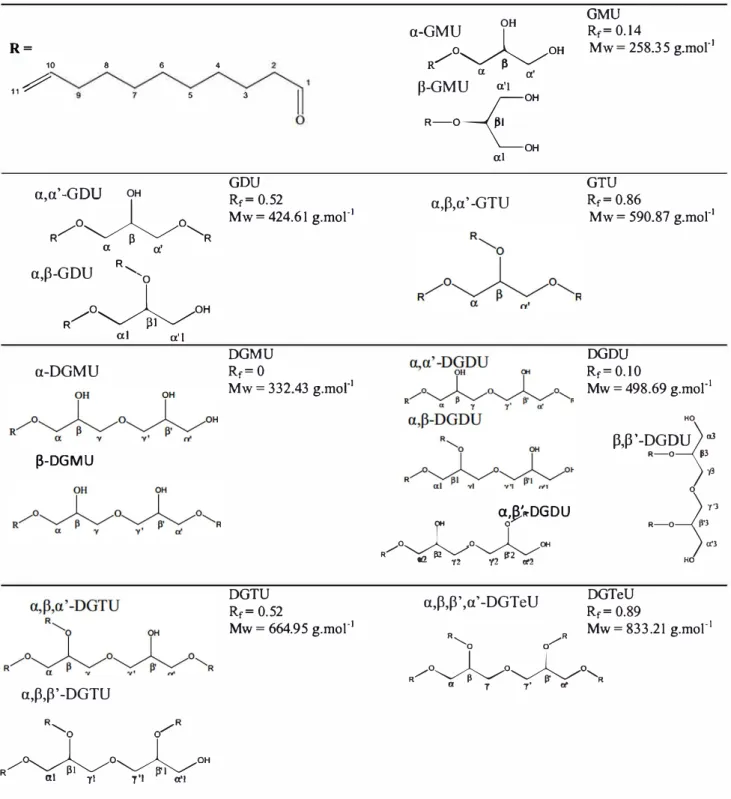
The direct esterification reaction between glycerol and undecylenic acid catalyzed by DBSA can generate three different esters: glycerol mono-, di- and triundecenoate (Table 1). Glycerol has three OH groups, which accept acyl groups during esterification reactions with undecylenic acid. For each group of partial esters of glycerol, two regioisomers are possible: glycerol a-monoundecenoate (a-GMU) and glycerol �-monoundecenoate (�-GMU) for monoglycerides, glycerol a,�-diundecenoate (a,�
GDU) and glycerol a,a'-diundecenoate (a,a'-GDU) for the diglycerides. The expected overall ester was glycerol a,�,a'-triundecenoate (a,�,a' -GTU).
Determination of the Chemical Structures of Esters of Glycerol and Undecylenic Acid, in Ascending Order of Polarity
Glycerol Triundecenoate (GTU) The mass spectrum for the compound corresponding to this retardation factor is presented in Fig. la. The peak at m/z 590.45 corresponds to the parent ion of a,�,a'-GTU with the formula [C36H6206]+. The m/z 407.32 peak corresponds to [C25H4304]+, charac teristic of the Joss of an undecylenic acid fragment with the formula [C11H1902]+. The m/z 241.18 peak [C14H2503]+ corresponds to the Joss of two undecylenic acid fragments with the formula [C11H1902]+. The m/z 166.14 peak corre sponds to a fragment with the formula [C11H190]+.
1H NMR analysis of this sample (Fig. lb, Table 2) revealed chemical shifts between 4.08 and 4.19 ppm and between 4.24 and 4.34 ppm, corresponding to the four hydrogens in the a and a' positions of glycerol. The heav ily deshielded multiplet between 5.21 and 5.31 ppm cor responds to the H� hydrogen. The chemical shifts between 0.95 and 1.46 ppm correspond to the hydrogens car ried by carbons 4-8 of undecylenic acid. Between 1.53 and 1.70 ppm the chemical shifts correspond to the H3
Table l Molecular structures of the esters of glycerol and diglycerol with undecylenic acid R= 10 8 6 11� 5 a,a'-GDU OH R/0�0"-.._R a.R a: a,[>-GDU "-0 /0 1 OH R� a.l a'I a-DGMU �-DGMU a,[>,[>'-DGTU R '-.__ /R /0
î
Oî
OH R�� al yl y'l a'l 4 3GDU
Rr= 0.52 Mw = 424.61 g.mor1 DGMU Rr=0 Mw = 332.43 g.mor1 DGTU Rr= 0.52 Mw = 664.95 g.mor1 OH a-GMU 1 /O�OH R a. � a.' f>-GMU a.'l ___/4.0H R-0� OH a.l a,[>,a' -GTU a,J}.'�DGDU 0j
OI
œ R/�� a2 'Y2 "(2 IX'2 a,[>,[>' ,a'-DGTeU GMU Rr= 0.14 Mw = 258.35 g.mor1GTU
Rr= 0.86 Mw = 590.87 g.mor1DODU
Rr= 0.10 Mw = 498.69 g.mor1 HO f>,W-DGD �a3 R-0 J!3 13 JO Y'l DGTeU Rr= 0.89 R-0 Wl CX'3 H Mw = 833.21 g.mor1 ,/o � o� ,, a 'Y -y' ocGMU glycerol monoundecenoate, GDU glycerol diundecenoate, GTU glycerol triundecenoate, DGMU diglycerol monoundecenoate, DGDU
diglycerol diundecenoate, DGTU diglycerol triundecenoate, DGTeU diglycerol tetraundecenoate, R1 TLC retardation factor, Mw molecular weight
hydrogen, between 1.97 and 2.09 ppm to H9 and between 2.24 and 2.37 ppm to the H2 hydrogen. Those between 4.88 and 5.04 ppm and between 5.72 and 5.89 ppm cor respond to the hydrogens carried by the ethylenic carbon residues at the end of the undecylenic acid chain, H11 and
H10, respectively. These characteristics of undecylenic acid were common for al! glycerol esters and will not be discussed in the further sections. These findings are char acteristic of triglycerides [30, 31], such as a,�,a'-GTU in particular.
Fig. l a Mass spectrum of GTU, b 1H NMR spectrum of GTU, and c ne NMR and ne DEPT-135 spectra of GTU
a
CI-CH4"
b
6.0 5.5 C 170.. ,1·"''
mlz = 407.32 m/z=24118 < ---. 'i'I 0 1 0 �OJ--___�O� ! Ti
�0-1---1 --- ---�,-J _____________________ , 0 1 1 5.0 4.5 4.0 1S0 130 110 l+H m/z = 591.45 3.5 ppm ppm 3.0 2.5 2.0 1.5 1 1 ff 1.0The 13C NMR spectrum of GTU (Fig. le, Table 3) con tains the chemical shift at 62.25 ppm that is characteristic of the a and a' carbons of glycerol. The shift at 69.04 ppm is characteristic of the � carbon. This was confirmed by the DEPT-135 analysis, in which the a and a' carbons give a
positive signal, whereas the � carbon gives a negative sig nal. The chemical shifts characteristic of the carbons of the undecylenic acid, e.g. at 114.13 and at 139.19 ppm which are characteristic of the ethylenic carbon residues C11 and C10, are common for ail glycerol esters. They are
Table 2 1H NMR chemical shifts of glycerol and diglycerol esters of undecylenic acid Molecules GTU GDU GMU DGTeU DGTU DGDU DGMU
Common shifts of unde cylenic chain Chemical shifts (ppm) 4.0&--4.19 4.24--4.34 5.21-5.31 4.00--4.35 5.04--5.12 3.69-3.75 4.07-4.27 3.54-3.75 3.87-3.98 3.80--3.85 3.45-3.80 4.00--4.40 5.10--5.25 3.21-4.46 5.12-5.25 3.43--3.86 3.95-4.25 5.14-5.28 5.35-5.45 4.12-4.24 4.06-4.12 3.97-4.06 3.73--3.89 3.45-3.72 2.24-2.37 1.53--1.70 0.95-1.46 1.97-2.09 5.72-5.89 4.88--5.04 Hydrogens ex a' � ex,�, a' �l a'l ex a' � exl, ex' y, y' a.,rl
�.
�/ex, Y, y',
W,
ex'�
�.
�/ a.,rl �l �2, �2' ex �w
a' y, y' 2 3 4-8 9 10 11GMU glycerol monoundecenoate, GDU glycerol diundecenoate, GTU glycerol triundecenoate, DGMU diglycerol monoundecenoate, DGDU diglycerol diundecenoate, DGTU diglycerol triundecenoate, DGteU diglycerol tetratundecenoate
reported in the Table 3 and will not be discussed further. This analysis is consistent with a triglyceride [32], such as a,�,a'-GTU.
Glycerol Diundecenoates (GDU) The mass spectrum of
this component (Table 4) contained a peak at m/z 424.32,
with the formula C25H4405, corresponding to the exact molecular mass of a,a'-GDU or a,�-GDU. The fragment at
m/z 407 .32 resulted from the loss of a water molecule from
GDU. The fragment at m/z 24l.l8 corresponds to the loss
of an undecylenic fragment with the formula [CllH19üi]+
and reveals the presence of an ionized fragment of glycerol monoundecenoate with the crude formula [C14H2503]+. The
Table 3 13C NMR chemical shifts of glycerol and diglycerol esters of undecylenic acid Molecules GTU GDU GMU DGTeU DGTU DGDU DGMU
Common shifts of undecylenic chain Chemical shifts (ppm) 62.25 69.04 65.02 68.37 61.70 62.16 72.26 70.48 65.52 63.70 62.98 69.70 69.90 69.98 72.55 69.93 68.88 62.42 65.24 68.77 69.06 72.25 72.25 70.66 68.77 64.71 64.82 63.63 72.80 173.13--174.68 24.84-34.27 139.13--139-50 114.13--114.50 Carbons a,a' � a,a' � exl ex'l �l ex' � ex a,a' y,y'
�.
�/ y y' � �/ ex ex' a,a'�.
�/ Y, y' ex � �/ y y' ex' �l l 2-9 10 11GMU glycerol monoundecenoate, GDU glycerol diundecenoate, GTU glycerol triundecenoate, DGMU diglycerol monoundecenoate, DGDU diglycerol diundecenoate, DGTU diglycerol triundecenoate, DGteU diglycerol tetratundecenoate
crude formula of GDU is clearly identified, but nevertheless does not differentiate between the a,a' -GDU and a,�-GDU 1somers.
1 H NMR is a technique that is very suitable for the iden tification and quantification of regioisomers of diacylg lycerol [19]. On the spectrum shown at the top of Table 4, the multiplet between 4.0 and 4.35 ppm corresponds to the five Ha, Ha' and
811
hydrogens of the glycerol of a,a' -GDU (Table 2). The chemical shifts between 5 .04 and 5.12 ppm correspond to the811,
hydrogen of the a,�-GDU isomer.Table 4 Mass spectra and 1H, 13C and DEPT-135 NMR spectra of the esters of glycerol undecenoate and diglycerol undecenoate
GDU
GMU
DGTeU
DGTU
DGDU
DGMU
Mass spectra 1H NMR spectra ne NMR and ne DEPT-135 spectra
��
t �-----
,
1_l;
60 SS so ., •o U�
-
,o JS JO IS 10.1
1' .. J
1,
1
1
l.1
�l.
- - - -.Z.- - - .;:. - .. .. .. .. . ,. ..GMU glycerol monoundecenoate, GDU glycerol diundecenoate, DGMU diglycerol monoundecenoate, DGDU diglycerol diundecenoate, DGTU
The doublet between 3.69 and 3.75 ppm corresponds to the two Ha'I hydrogens characteristic of the presence of the a,�-GDU regioisomer. These findings are consistent with those of Hatzakis et al. [33]. It was thus possible to show
that there was 82 % a,a'-GDU and 18 % a,�-GDU in the GDU sample of Rr 0.52.
On the 13C NMR spectrum (Tables 3, 4), the chemical
shifts corresponding to the undecylenic chains of GDU were found. On DEPT-135 analysis, the chemical shifts of
Ca and Ca' at 65 .02 ppm, Cal at 61. 70 and Ca 1, at 62.16 ppm
gave positive signais. This confirms the presence of the two regioisomers, a,a'-GDU and a,�-GDU, consistent with the attributions of chemical shifts published for other diacylg
lycerols [33].
Glycerol Monoundecenoates (GMU) The mass spec trometry analysis for this sample (Table 4) showed that the peak at m/z 259.19 corresponded to the molecular mass of the ionized molecule [C14H2704]+, and the crude formula
C14H2604 of a-GMU and �-GMU. The peak at m/z 241.18 ([C14H2503]+) corresponds to the Joss of a molecule of
water from GMU. The peak at m/z 185.15 corresponds to a molecule with the crude formula of [C11H2i02]+. The Joss of a molecule of water from this molecule gives rise to the peak at 167.14, with a crude formula of [C11H190]+. The
peak at m/z 149.13 corresponds to the Joss of a molecule of water from [C11H190]+, yielding [C11H17]+.
1H NMR analysis (Tables 2, 4) showed that the chemi
cal shifts between 3.87 and 3.98 ppm corresponded to
the hydrogens in positions Ha, Ha'l and H1 of glycerol.
Ha hydrogens display a chemical shift between 4.07 and 4.27 ppm. These hydrogens are more deshielded than the
H� hydrogen (3.87-3.98 ppm). The two Ha' hydrogens of
a-GMU yield a multiplet between 3.54 and 3.75 ppm. Fol lowing esterification of the hydroxyl site in the a position of glycerol, the two Ha hydrogens become more deshielded than the Ha' hydrogens and they have a higher chemical shift (4.07 and 4.27 ppm). This difference in chemical shift between Ha and Ha' is due to the ester group, which is elec tron withdrawing. These results thus confirm the presence of the a-GMU regioisomer.
We can also see the doublet between 3.80 and 3.85 ppm corresponding to the four Ha, and Ha'I hydrogens of �-GMU. This finding is consistent with those of Compton
et al. [20, 34] for other monoglycerides, making it possible
to quantify the relative proportions of the two regioisomers, a-GMU and �-GMU. We found that �-GMU accounted for 7.64 %, and that a-GMU accounted for 92.34 % of the sample with Rr 0.14.
On the 13C NMR spectrum (Table 4), the chemical shifts
at 70.62, 65.52 and 63.70 ppm correspond to Ca, C� and
Ca, respectively (Table 3). Analysis by DEPT-135 confirms
the identification of Ca at 63.48 ppm, Ca' at 65.52 and C�
at 70.48 ppm. The chemical shifts characteristic of unde cylenic chain were found. This spectrum confirms the structure of a-GMU. It was not possible to detect the shifts characteristic of �-GMU because of the limited sensitivity of the apparatus used.
Esters of Diglycerol and Undecylenic Acid The esterifica
tion reaction between undecylenic acid and linear diglycerol can generate four types of diglycerol: mono-, di-, tri- and tetraesters of diglycerol (Table 1). Several isomers of these types of linear diglycerol ester are likely to be present: (1) a-DGMU and �-DGMU for diglycerol monoesters; (2) four isomers of diglycerol diundecenoate: a,a'-DGDU, a,� DGDU, �.W-DGDU and a,W-DGDU; (3) two types of diglyc erol triundecenoates: a,�,a'-DGTU and a,�,W-DGTU and (4) a,�,a' ,W-DGTeU. It is important to detect the presence of each regioisomer and to determine their relative proportions in the reaction mixture reliably, particularly as not ail the molecular structures of these molecules have been published. We used silica gel chromatography for purification, with TLC as an elu tion control. Spectroscopie methods were used to deterrnine the structures associated with the retardation factors and the proportions of the various regioisomers identified.
Qualitative analysis of the reaction mixture by TLC revealed the presence of various molecules with differ ent Rr values, from the least to the most polar: Rr = 0.89, 0.61, 0.47, 0.10, O. The component with an Rr of 0.47 is undecylenic acid. It was identified by comparison with a standard.
Determination of Chemical Structures on the Basis of lncreasing Polarity of Esters of Diglycerol and Undecylenic Acid
Diglycerol Tetraundecenoate (DGTeU) The mass spec
trum for the molecule with an Rr of 0.89 is presented in Table 4. The fragment with m/z 831.63 has a molecular mass corresponding to that of ionized diglycerol tetraun decenoate. The fragment at m/z 649.49 corresponds to the Joss of an undecylenic fragment. The m/z 407.32 fragment corresponds to the Joss of half the diglycerol tetraunde cenoate molecule. The fragment at m/z 241.18 corresponds to an ionized fragment of glycerol monoundecenoate. The presence of these various fragments identifies the molecule obtained as diglycerol tetraundecenoate.
On the 1H NMR spectrum (Tables 2, 4), the structure
of DGTeU is identified by the presence of hydrogens Ry and Hy, specific to the carbons carrying the ether group of diglycerol, for which a multiplet is observed between 3.45 and 3.80 ppm. The Ha and Ha, hydrogens are identified by the presence of a multiplet between 4.00 and 4.40 ppm. The chemical shifts between 5.10 and 5.25 ppm correspond to the H� and Hll' hydrogens.
On the 13C NMR spectrum (Tables 3, 4), the DEPT-135 experiment distinguishes between CH and CH2. The chem ical shift at 62.98 ppm is characteristic of Ca and Ca'. The
shift at 69.70 ppm is characteristic of Cy and Cy, and that
at 69.90 ppm is characteristic of C� and Cil'. This profile
corresponds exactly to the three types of carbon present in diglycerol tetraundecenoate. We thus find ail the character istic carbons of the undecylenic chain. No discussion of the attribution of the diglycerol carbons in diglycerol tetraun decenoate has ever been published. Only the carbonyl group carbons of the ester, at 173.16 ppm, and those of the terminal double bond have been identified [16].
Diglycerol Triundecenoate (DGTU) Diglycerol triunde
cenoate has a molecular mass of 664.952 g/mol. The Joss of a water molecule thus yields a fragment at m/z 648.494 (Table 4). The fragment at m/z 481.350 results from the Joss of an undecylenic chain. This fragment was also observed on the mass spectrum of DGDU. The peak at m/z 407 .34 corresponds to the Joss of a glycerol monoester fragment. The fragments at m/z 315.217 and 241.180 correspond to the Joss of two undecylenic chains from diglycerol triunde cenoate and the Joss of a glycerol monoester fragment and an undecylenic chain, respectively. The presence of these fragments indicates that the molecule isolated is diglycerol triundecenoate.
On the 1H NMR spectrum (Table 4), the multiplet between 3.21 and 4.46 ppm corresponds to the nine hydro gens of diglycerol: the Ha, Hy, Ry, Hll' and Ha' hydrogens
(Table 2). The � hydrogen characteristic of DGTU is deshielded and visible between 5.12 and 5.25 ppm. It yields a multiplet. We observed none of the hydrogens character istic of the <l,�.W-diglycerol triundecenoate isomer.
On the ne NMR spectrum for this sample (Table 4) the carbons carrying the ether group, Cy and Cy, are visible at 69.98 and 72.55 ppm. The strong deshielding of the c.11 carbon results from its close proximity to the CH carbon carrying the OH group. The Cy close to the CH of the ester ified C� is more shielded. The chernical shifts (Table 4) of the C� and Cil' carbons can be seen at 69.93 and 68.88 ppm, respectively. The esterified Ca and Ca' carbons display shifts at 62.42 and 65.24 ppm. We can also see the carbons of undecylenic chain. This spectrum is characteristic of Cl,� ,Cl' -DGTU. No chernical shift indicative of the presence
of the Cl,�,W-DGTU was detected.
Diglycerol Diundecylenate (DGDU) The characteriza
tion of this sample by mass spectrometry (Table 4) revealed the presence of a fragment at m/z 481.1 corresponding to the Joss of a molecule of water from DGDU. The fragment at m/z 315.22 corresponds to the loss of an undecylenic fragment from the symmetric diester. The fragment at m/z 241.18 corresponds to the loss of a part of DGDU
consist-ing of the glycerol and the undecylenic chain. On the basis of these fragments, this molecule was identified as DGDU.
The 1H NMR analysis (Tables 2, 4) shows the two mul tiplets between 3.43 and 3.86 ppm and between 3.95 and 4.25 ppm corresponding to the two types of hydrogens on the diglycerol head. The least deshielded hydrogens, between 3.43 and 3.86 ppm, correspond to the H� and Hll'
hydrogens, and the most deshielded hydrogens, between 3.95 and 4.25 ppm, correspond to the four Ha and Ha'
hydrogens.
The peaks between 5.14 and 5.28 ppm and between 5.35 and 5.45 ppm are two multiplets that correspond to hydro gen H�1 of <l,�-DGDU, and hydrogens H�2 and �,2 of �.W
DGDU, respectively.
The regioisomer composition of the isolated mixture of diglycerol diesters can be calculated on the basis of the integration of the characteristic peaks for each diglycerol ester: 73.8 % <l,<l'-DGDU, 22.8 % <l,�-DGDU and 3.4 %
�.W-DGDU. The<l,W-DGDU form was not detected. On the ne NMR spectrum shown in Table 4, there are six peaks corresponding to the six carbons of diglycerol (Table 3). These peaks are grouped in twos, at 68.77 ppm for the Ca and Ca' carbons, and 69.06 ppm (C16 and C13),
corresponding to the two CH carbons carrying the second ary hydroxyl groups of diglycerol. The peak at 72.25 ppm corresponds to the Cy and
c.
11 carbons; this peak shows that the esterification of diglycerol with undecylenic acid occurs via the primary hydroxyl groups in positions Cl and <l1• This analysis confirms that the molecule isolated is thesymmetric molecule <l,<l'-DGDU. The DEPT-135 analysis confirmed the presence of the <l,�-DGDU and �.W-DGDU regioisomers, because the Ca, Ca', Cy and Cy' yielded a pos itive signal, corresponding to CH2 groups. The C� and Cil' carbons gave a negative signal, corresponding to CH. We did not detect the carbons corresponding to the <l,W-DGDU form.
Diglycerol Monoundecylenate (DGMU) Table 4 shows the mass spectrum for this sample. The fragment at m/z 315.21 corresponds to the loss of a water molecule from DGMU, during its ionization. The peak at m/z 241.18 cor responds to the Joss of a glycerol fragment from <l-DGMU and �-DGMU. The peak at m/z 149.08 results from the Joss of the diglycerol fragment, and the peak at m/z 131.07 cor responds to the Joss of a water molecule from this fragment, during its ionization.
On the 1H NMR spectrum of Table 4, the multiplet between 3.45 and 4.25 ppm corresponds to the hydrogens characteristic of the linear diglycerol head of <l-DGMU (Table 2). The peak between 4.12 and 4.24 ppm corre sponds to the Ha hydrogens. The peaks between 4.06 and 4.12 ppm, and between 3.97 and 4.06 ppm correspond to the H� and Hll' hydrogens. The chernical shift between 3.73
and 3.89 ppm is attributed to the Ha' hydrogens, and the multiplet between 3.45 and 3.72 ppm corresponds to the four Hy and Hy1 hydrogens. The complexity of the multiplet
between 3.4 and 4.3 ppm suggests that the �-DGMU regio isomer may be present, although its characteristic shifts are not visible. Additional analyses are required to confirm or exclude this hypothesis.
On the 13C NMR spectrum (Table 4), the presence of
the cr-DGMU form was confirmed by the chemical shift at 72.25 ppm, corresponding to the Ca carbon bearing the
esterified hydroxyl group of the diglycerol (Table 3). The
chemical shift at 70.66 ppm corresponds to the C� carbon,
and that at 68.77 ppm corresponds to Cil'. The Cy and Cy
carbons give rise to shifts at 64.71 and 64.82 ppm. Finally, the Ca' carbon bearing the primary hydroxyl group yields
a shift at 63.63 ppm. The Ca1, Cr Cy1, Cil' and Ca carbons
gave positive signais on DEPT-135 analysis; they corre spond to the CH2 groups of cr-MUG. The chemical shift at 72.82 ppm corresponds to CH2-0H, confirming the pres ence of �-DGMU, as suggested by the 1H NMR spectrurn. Conclusion
The direct, non-selective esterification reaction between glycerol and undecylenic acid or between diglycerol and undecylenic acid generates ail the possible positional iso mers of glycerol or diglycerol esters. Isolation of the iso mers in high purity was achieved by silica gel chromatog raphy. The molecular structures of the isolated compounds were characterized and identified by mass spectrometry, 1H NMR, 13C NMR and DEPT-135. The polarity of these non ionic amphiphilic esters directly affected their affinity for organic and inorganic solvents and were found to behave very differently from carboxylic acid amphiphilic mol ecules, such as undecylenic acid.
Acknowledgments The authors would like to thank the French govemment and the Midi-Pyrenees Region for their financial support through the Fond Unique Interministériel (FUI) and OSEO.
Compliance with Ethical Standards
Conflict of interest The authors declare no conflict of interest.
References
1. Van Haften JL (1976) Fat-based food emulsifiers. J Am Oil Chem Soc 53:831A-835A
2. Henry C (1995) Monoacylglycerides: the universal emulsifiers.
Cereal Foods World 40:734-738
3. Young FVK, Poot C, Biemoth E, Krog N, Davidson NGJ, Gun stone FD (1994) In: Gunstone FD, Harwood JL, Padley FB (eds) Lipid handbook. Chapman & Hall, London
4. Wang Y, Zhao M, Song K, Wang L, Han X, Tang S, Wang Y (2010) Separation of diacylglycerols from enzymatically hydro Iyzed soybean oil by molecular distillation. Sep Purif Technol 75:114-120
5. Holstborg J, Pedersen BV, Krog N, Olesen SK (1999) Physical properties of diglycerol esters in relation to rheology and stabil ity of protein-stabilised emulsions. Colloids Surf B 12:383-390
6. Kumar TN, Sastry Y SR, Lakshminarayana G (1989) Preparation and surfactant properties of diglycerol esters of fatty acids. J Am Oil Chem Soc 66:153-157
7. Shrestha LK, Shrestha RG, Solans C, Aramaki K (2007) Effect of water on foaming properties of diglycerol fatty acid ester-oil systems. Langmuir 23:69l!Wi926
8. Kunieda H, Shrestha LK, Acharya OP, Kato H, Takase Y, Gutié rrez JM (2007) Super-stable nonaqueous foams in diglycerol fatty acid esters-non polar oil systems. J Disper Sei Technol 28:133-142
9. Matsumiya K, Nakanishi K, Matsumura Y (2014) Destabiliza tion of protein-based emulsions by diglycerol esters of fatty acids-The importance of chain Jength similarity between dis persed oil molecules and fatty acid residues of the emulsifier. Food Hydrocoll 25:773-780
10. Mouloungui Z, Rakotondrazafy V, Valentin R, Zebib B (2009) Synthesis of glycerol 1-monooleate by condensation of oleic acid with glycidol catalyzed by anion-exchange resin in aqueous organic polymorphie system. lnd Eog Chem Res 48:6949--6956 11. Van der Steen M, Stevens CV (2009) Undecylenic acid: a valu
able and physiologically active renewable building block from castor oil. Chem Sus Chem 2:692-713
12. Pace S, Gonzalez P, Devoisselle J-M, Milhiet P-E, Brunel D, Cunin F (2010) Grafting of monoglyceride molecules for the design of hydrophilic and stable porous silicon surfaces. New J Chem 34:29-33
13. Cauvel A, Renard G, Brunel D (1997) Monoglyceride synthesis by heterogeneous catalysis using MCM-41 type silicas function alized with amino groups. J Org Chem 62:749-751
14. Berger M, Schneider M (1992) Enzymatic esterification of glyc erol II. Lipase-catalyzed synthesis of regioisomerically pure
1(3)-rac-monoacylglycerols. J Am Oil Chem Soc 69:961-965 15. Chidambaram N, Bhat S, Chandrasekaran S (1992) A highly
selective methodology for the direct conversion of acetals to esters. J Org Chem 57:5013-5015
16. Brito DHA, Cavalcante IM, Rocha NRC, Maier ME, Lima APD, Schanz MTGF, Ricardo NMPS (2014) Synthesis and characteri zation of diglycerol tetraundecylenate as potential biolubricant. In: Abstract of the IX Congresso Brasileiro de Amilise Térmica E Calorimetria, Serra Negra, SP, Brasil, 2-12 November 2014 17. Fregolente LV, Fregolente PBL, Chicuta AM, Batistella CB,
Maciel Filho R, Wolf-Maciel MR (2007) Effect of operating conditions on the concentration of monoglycerides using molec ular distillation. Chem Eog Res Des 85: 1524-1528
18. Szelag H, Zwierzykowski W (1983) The application of molecu Jar distillation to obtain high concentration of monoglycerides. Eur J Lipid Sei Technol 85:443-446
19. Compton DL, Laszlo JA, Eller FJ, Taylor SL (2008) Purifica tion of 1,2-diacylglycerols from vegetable oils: comparison of molecular distillation and liquid C02 extraction. Ind Crop Prod 28:113-121
20. Compton D, Vermillion K, Laszlo J (2007) Acyl migration kinet ics of 2-monoacylglycerols from soybean oil via l H NMR. J Am Oil Chem Soc 84:343-348
21. Boswinkel G, Derksen J, Van't Riet K, Cuperus F (1996) Kinet ics of acyl migration in monoglycerides and dependence on acyl chainlength. J Am Oil Chem Soc 73:707-711
22. Fureby AM, Virto C, Adlercreutz P, Mattiasson B (1996) Acy! group migrations in 2-monoolein. Biocatal Biotransform 14:89-111
23. Goldsmith HA (1943) Polyhydric alcohol esters of fatty acids. Their preparation, properties, and uses. Chem Rev 33:257-349 24. Shrestha LK, Shrestha RG, lwanaga T, Aramaki K (2007) Aque
ous phase behavior of diglycerol fatty acid esters. J Disper Sei Technol 28:883-891
25. Quinlin P, Weiser H (1958) Separation and determination of mono-, di-, and triglycerides in monoglyceride concentrates. J Am Oil Chem Soc 35:325-327
26. Eychenne V, Mouloungui Z (1999) High concentration of 1-(3-) monoglycerides by direct partial esterification of fatty acids with glycerol. Lipid 101:424-427
27. Bellamy LI, Lake RF, Pace RJ (1963) Hydrogen bonding in carboxylic acids-11. Monocarboxylic acids. Spectrochim Acta 19:443�9
28. Excoffon P, Marechal Y (1972) lnfrared spectra of H-bonded systems: saturated carboxylic acid dimers. Spectrochim Acta Part A 28:269-283
29. Lacaze-Dufaure C, Mouloungui Z (2000) Catalysed or uncata lysed esterification reaction of oleic acid with 2-ethyl hexanol. Appl Catal A Gen 204:223-227
30. Sacchi R, Addeo F, Paolillo L (1997) 1H and 13C NMR of virgin olive oil. An overview. Magn Reson Chem 35:Sl33--Sl45
31. Knothe G, Kenar JA (2004) Determination of the fatty acid profile by IH-NMR spectroscopy. Eur J Lipid Sei Technol 106:8&-96
32. Vlahov G, Angelo CS (1996) The structure of triglycerides of monovarietal olive oils: a 13C-NMR comparative study. Lipid 98:203-205
33. Hatzakis E, Agiomyrgianaki A, Kostidis S, Dais P (2011) High resolution NMR spectroscopy: an alternative fast tool for qualita tive and quantitative analysis of diacylglycerol (DAG) oil. J Am Oil Chem Soc 88:1695-1708
34. Compton D, Laszlo J, Appell M, Vermillion K, Evans K (2014) Synthesis, purification, and acyl migration kinetics of 2-monori cinoleoylglycerol. J Am Oil Chem Soc 91:271-279