To link to this article:
DOI:10.1016/j.chemosphere.2011.12.020
http://dx.doi.org/10.1016/j.chemosphere.2011.12.020
This is an author-deposited version published in:
http://oatao.univ-toulouse.fr/
Eprints ID: 5589
To cite this version: Gandois, Laure and Probst, Anne Localisation and
mobility of trace metal in silver fir needles L. Gandois. (2012) Chemosphere,
vol. 87 (n°2). pp. 204-210. ISSN ISSN: 0045-6535
Open Archive Toulouse Archive Ouverte (OATAO)
OATAO is an open access repository that collects the work of Toulouse researchers and
makes it freely available over the web where possible.
Any correspondence concerning this service should be sent to the repository
administrator:
[email protected]
Localisation and mobility of trace metal in silver fir needles
L. Gandois
⇑, A. Probst
Université de Toulouse, UPS, INP, EcoLab (Laboratoire Ecologie fonctionnelle et Environnement), ENSAT, Avenue de l’Agrobiopôle, F-31326 Castanet-Tolosan, France CNRS, EcoLab, F-31326 Castanet-Tolosan, France
a r t i c l e
i n f o
Keywords: Trace metal Needles Needle wax Atmospheric deposition Abies albaa b s t r a c t
Trace metals (TM: Co, Ni, Cu, Zn, Cd, and Pb) as well as Al, Mn, and Fe content was measured in needles of a remote silver fir stand in the south of France. TM localisation and behaviour in needles was evaluated by measuring total and internal content of needles of different ages. Measured concentrations fell within background values. Al, Fe, Co, and Pb were trapped in wax following atmospheric particulate deposition. Contrasting accumulation and migration behaviours of the different elements studied were observed. The wax contained less than 10% Mn, Al, Ni, Co, and Zn and 15–45% Fe, Cu, and Cd in the young needles. Lead was mostly located in the wax (50–80%), and this proportion decreased with needle age. Only the internal content of Pb and Fe increased significantly with needle age. Finally, due to atmospheric deposition accu-mulation, higher input fluxes of Fe, Cu, Cd, and Pb can be expected in forest soil.
1. Introduction
Trace metals (TMs: Cd, Co, Cu, Ni, Pb, Zn) are ubiquitous constit-uents of the Earth’s crust. Their natural cycle has been deeply mod-ified by human activity (Rauch and Pacyna, 2009). They are dispersed in the atmosphere following both natural (Nriagu, 1989) and anthropogenic (Pacyna and Pacyna, 2001) processes, and can be transported over long distances. They can reach remote places and impact ‘pristine’ ecosystems (Steinnes and Friedland, 2005). Trace metals are emitted in various forms and undergo transformation during transport. They are subsequently deposited on terrestrial ecosystems by wet and dry deposition (Migon et al., 1997). Among terrestrial ecosystems, forest ecosystems are sensi-tive to atmospheric inputs, since forest canopy constitutes an important interaction surface with atmospheric pollutants (Lovett and Lindberg, 1984). TMs deposited on terrestrial ecosystems can impact living organisms (Bur et al., 2010). Indeed, some TMs have no known biological role (Cd, Pb) and others (Co, Cu, Ni, Zn) are micronutrients which are essential for life but can become toxic at high concentrations (Clemens, 2006). Even when emitted simul-taneously, the fate of two different TMs in a forest ecosystem can differ greatly (Gandois et al., 2010a). When deposited on forest canopy, and depending on their potential biological role as well as their chemical properties, TMs can undergo direct assimilation by vegetation or accumulation on it (Lovett and Lindberg, 1984;
Hou et al., 2005; Balestrini et al., 2007). Forest canopy (and the water layer on the needle/leaf surface) is an active surface, exuding chelating organic molecules that can form complexes with some TMs (Qualls et al., 2000; Hou et al., 2005; Michalzik and Stadler, 2005). Moreover, TMs undergo all the processes that govern the elemental cycle in forest ecosystems, including translocation with-in the tree compartments and senescence before fall (Morrison and Hogan, 1986; Hovmand et al., 2008; Aznar et al., 2009). Since TMs might be toxic elements, vegetation uses defence processes at cell level and macro-scale level, such as exclusion or accumulation in non-essential or senescing plant parts (Mingorance et al., 2007; Aznar et al., 2009; Probst et al., 2009). These processes are key point in understanding the fate and cycling of TMs in forest ecosys-tems. Indeed, this will partly govern TM fluxes on forest soils under the canopy (Hou et al., 2005; Gandois et al., 2010a). Coniferous needles are covered by a layer of wax which is particularly efficient at trapping atmospheric dust (Müller and Riederer, 2005). Conifer needles have been used by a few studies in the vicinity of pollution sources to track TM emission (Ceburnis and Steinnes, 2000; Aboal et al., 2004; Trimbacher and Weiss, 2004), and localisation of TMs in the wax has been developed for tracking particulate deposition of TMs (Lin et al., 1995; Rautio and Huttunen, 2003). Needles of different ages have also been used to assess TM mobility within the trees and potential detoxification processes in the context of high pollution (Rautio and Huttunen, 2003; Aznar et al., 2009). Trace metal localisation in needles or mobility within needles of different ages has rarely been assessed in a low contamination con-text; however, the ability to track the background levels and the processes involved in the behaviour of TMs in slightly impacted environments is still important and challenging.
⇑Corresponding author. Tel.: +65 6516 5671/+33 5 34 32 39 42; fax: +65 6778 5654/+33 5 34 32 39 55.
E-mail addresses: [email protected] (L. Gandois), anne.probst@ ensat.fr(A. Probst).
In this study, we propose to evaluate the level of TMs in fir nee-dles in a little impacted mountainous forest and to investigate the TM location within the needles and TM mobility according to needle ages. The objectives of the present study are thus to provide new insights to understand:
– how TM atmospheric inputs interact with forest canopy, – what the differences between essential and non-essential
ele-ments are,
– what the different mobilities of elements in the needles are, – what the consequences in terms of incident fluxes for the forest
soils are.
2. Materials and methods 2.1. Studied site
The study site is located in the south of France, in the Pyrénées Mountains (42.5°N, 2.0°E, altitude 950 m). This site (SP11) belongs to the French RENECOFOR network (Réseau National de suivi à long terme des Ecosystèmes Forestiers – National Network for the Long Term Monitoring of Forest Ecosystems;Ulrich (1995)), managed by the ONF (Office National des Forêts – French Forest Board). This network is a part of the European network of ICP Forests (Interna-tional Co-Operative programme on Assessment and Monitoring of Air Pollution Effects on Forests) (Level II).
The silver fir (Abies Alba Miller) stand is mature (100 years old). The soil is a stagnic luvisol (IUSS) originating from shale. The humus is of mesomull type. The soil pH is rather high, from 6.6 in the sur-face layer to 8.3 in the deeper layer (Table 1). The soil exchange capacity is high (above 20 cmol+kg 1) and saturated with Ca.
The mean (1993–2007 period) average precipitation amount is 1226 mm.
The trace metal content in soil has been determined (Table 1). An increase in Pb concentration in the surface layer can be ob-served. An anthropogenic atmospheric contribution has been iden-tified for Pb using an enrichment factor calculation (EF > 2) (Gandois et al., 2010b).
2.2. Sampling procedure, sample treatment, and analyses 2.2.1. Sampling of needles
A thinning managed by the ONF occurred in October 2008 on the studied site. Seventeen trees were selected in order to accu-rately represent the class diameter variation of the stand. For each tree, a branch of the fourth verticil was sampled. The branches were sealed in paper bags and brought to the laboratory. For six trees, needles were sorted according to their ages: the current year’s needles (2008, referred to hereafter as A1), the previous year’s needles (A2), and needles that had grown two years before (A3).
2.2.2. Needle treatment
Needles were dried (60 °C) and 5 g of sample was ground in an agate mortar to avoid any contamination. This sample was used for total analysis.
2.2.2.1. Cuticle removal. Quickly after sampling, fresh needles were used for wax removal. Five hundred milligrammes of needles were shaken in a mixture (20 mL) of Suprapur toluene/tetrahydrofuran (1/1) for 100 s (Schleppi et al., 2000; Garrec et al., 2001). The dura-tion of washing was determined during preliminary experiments on fresh needles. The time was set so that chlorophyll was not extracted from mesophyll tissues. It was also checked by micro-scopic observations that the needle surface was not damaged by the extraction. The needles were then dried (60 °C) and ground in an agate mortar.
2.2.2.2. Mineralisation. The elemental analysis was performed on unwashed needles (referred to hereafter as total content) and on needles after wax removal (referred to hereafter as internal content).
Samples were digested with a mixture of H2O2/HNO3in a
micro-oven at 220 °C and 20 bar. A blank and a certified material were included in every mineralisation batch. Blanks showed no contam-ination during the digestion process: measured concentrations were always below the quantification limits of the ICP-MS (Induc-tively coupled plasma mass spectrometry). The repeatability of the method was checked by mineralisation and analysis of tripli-cates. The coefficients of variation were less than 5%. The precision of the methods was estimated by the analysis of trace elements for a certified material (NIST1575a, pine needles) standard. Twelve repetitions of the standard showed a slight underestimation of TM concentration by the method (18% for Ni, 7% for Cu, 13% for Zn, 21% for Cd, and 2% for Pb). These values are typical of deviation from certified values of 5–30% as reported during analysis of certi-fied vegetation materials (Feng et al., 1999).
2.2.3. Chemical analysis
Solution samples were acidified (2%) with ultrapure HNO3prior
to ICP-MS analysis and kept in a frozen chamber. Trace elements were measured in the solutions of digested samples using ICP-MS (7500ce, Agilent Technologies). This instrument was equipped with a collision cell and a He flux to eliminate interferences. During the analytical procedure indium and rhenium were used as inter-nal standards. The internatiointer-nal geostandard SLRS-4 (Riverine Water Reference Material for Trace Metals certified by the National Research Council of Canada) was analysed as a reference material for each run and the accuracy (recovery > 90%) was checked (Yeghicheyan et al., 2001). The ICP-MS was calibrated every 15 samples. Quantification limits were determined by the analysis of at least 12 ultrapure water samples and were on average 0.5
l
g L 1for Fe and Al, less than 0.05l
g L 1for Mn, Ni, Cu, and Zn, and less than 0.005l
g L 1for Cd, Zn, and Pb.Table 1
Main soil properties (pH, OC, and CEC) as well as total trace metal (TM) concentration for the four described soil layers of the SP11 stand.
Layer Prof max pH OC CEC Al Mn Fe Co Cd Cu Ni Pb Zn
g kg1 cmol+ kg1 mg kg 1 Aci 8 6.6 49.2 25 5.0 356.5 27.65 10.6 0.273 9.35 29.40 25.15 81.2 Sci-g 45 7.9 14.1 23 6.5 368 35.65 12.75 0.274 9.71 38.40 22.75 91.8 Cci-g 95 8.3 9.5 20 6.8 252.5 34.25 11.08 0.323 11.06 37.95 18.50 94.7 Rca 115 8.3 6.8 15 5.8 320 30.75 9.4 0.222 9.56 33.45 15.95 75.4 pH H2O Organic Carbon
3. Results
3.1. TM total concentrations
The median TM concentration measured in the needles as well as the standard deviations and ranges are reported inTable 2. The mea-sured concentrations in needles were compared to published data in order to evaluate the level of concentration and potential contami-nation. To our knowledge, only a few studies have reported TM con-centration in fir (balsam) and they do not allow direct comparison with total TM content since concentrations have been assessed using NAA (neutron activation analysis) (Lin et al., 1995) or micro-PIXE (proton induced X-ray emission) (Lin and Schuepp, 1996). Published studies report results about other species of fir (Abies balsamea (L) inLin et al. (1995)), spruce (Picea abies inCeburnis and Steinnes (2000), Trimbacher and Weiss (2004), Lindroos et al. (2007), and Picea mariana Mill. B.S.P. inAznar et al. (2009)), and pine (Pinus sylvestris L. inKurczyska et al. (1997), Rautio and Huttunen (2003), Aboal et al. (2004)). Moreover, many studies focused on the impact of punctual pollution sources on TM needle content. Only a few studies reported background concentrations (Lin et al., 1995; Ceburnis and Steinnes, 2000; Trimbacher and Weiss, 2004; Aboal et al., 2004; Lindroos et al., 2007). The list of studied elements often differed in the various studies. Measured concentrations of Mn, Cu, Cd, Ni, Zn, and Pb were in the range of background values reported previously for spruce and pine (Ceburnis and Steinnes, 2000; Trimb-acher and Weiss, 2004; Aboal et al., 2004). However, Al and to a les-ser extent Fe and Co showed slightly higher concentrations than previously reported values for fir (Lin et al., 1995).
3.2. TM concentrations in needle compartments 3.2.1. Variation in needle composition with needle age
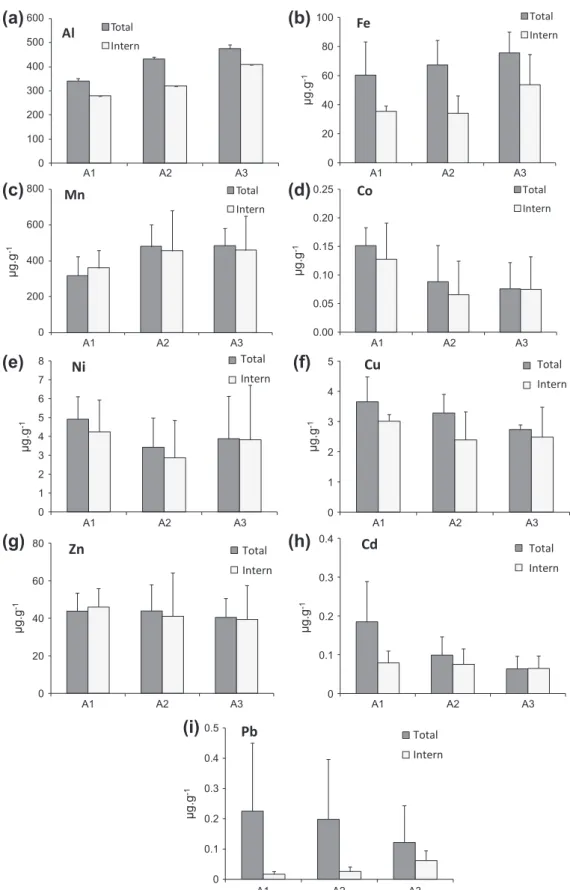
The mean TM concentrations and the standard deviations mea-sured in the total and internal fractions of needles of different ages are presented inFig. 1. The differences between TM concentrations measured in the needles of different ages for both total and inter-nal groups were evaluated with the Kruskal–Wallis test (
a
= 0.05). Only a few significant differences appeared in the total TM concen-trations between the needles of different ages. The only exception is Cu, for which significantly higher concentrations were measured in the young needles (A1) compared to the older ones (A3). For the internal fraction, only Pb and Fe concentrations were significantly higher in the old needles (A3) compared to the young ones (A1). 3.2.2. TM localisation in needlesIn order to determine TM localisation in needles, TM concentra-tions were measured in total needles and in needles after wax re-moval, since it was not possible to measure the TM concentrations in the wax with a satisfactory precision. Then, TM localisation was assessed by comparing total and internal concentrations. Since the
wax mass is low compared to the internal and total masses, the proportion of an element in the wax can be estimated by calculat-ing (Ctot–Cint)/Ctotfor a single needle. The results for the needles of
three different ages are presented inFig. 2. The studied elements showed contrasting behaviour. Aluminium, Co, Ni, Zn Mn, Co, Ni, and Mn were mainly (>90%) located in the internal part of the needles of all three year groups (less than 10% was found in the wax). For A1 and A2 needles, 20 to 45% of Fe, Cd, and Cu was lo-cated in the wax; in the older (A3) needles this proportion de-creased to below 15% for Fe and below 5% for Cd and Cu. Lead was always mainly (>50%, and up to 80% for A1 needles) located in the wax. The proportion of Pb contained in the wax decreased with needle age (Figs. 1 and 2).
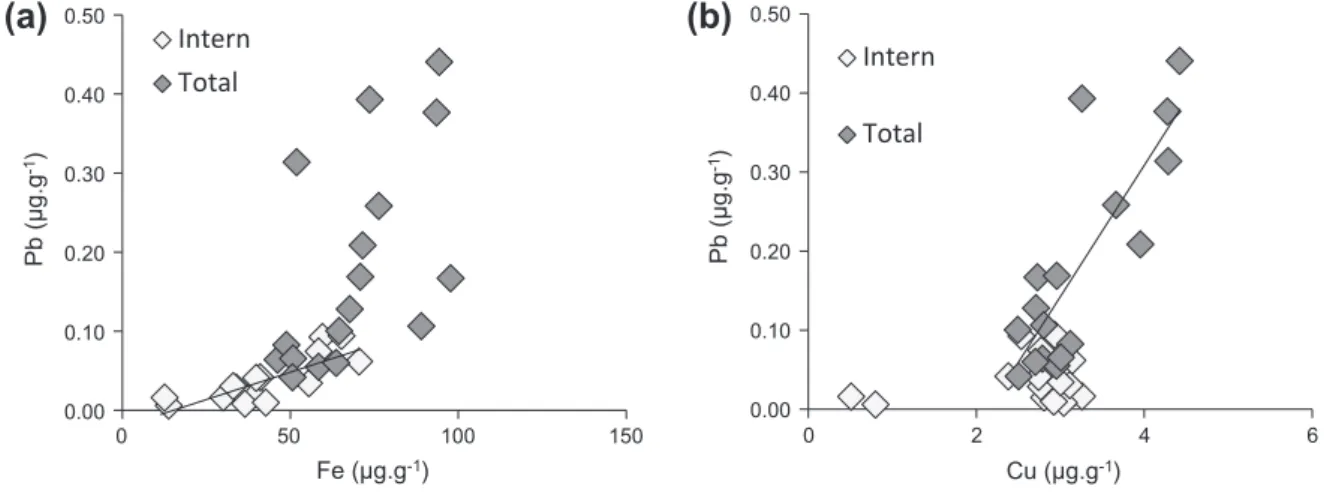
A correlation analysis (Spearman test) was performed on the two sets of samples, total and internal TM concentration data. Indeed only a few significant correlations were observed for TM concentrations in the two fractions (Fig. 3). Considering the total concentrations, Pb concentrations were positively significantly correlated to Cu concentrations (r = 0.75, p < 0.001). In the internal fraction of needles, Pb concentrations were no longer correlated to Cu, but were correlated to Fe concentrations (r = 0.79, p < 0.001).
4. Discussion
4.1. Origin of trace metals in the needles
TMs measured in aerial parts of trees (leaves, needles) have two potential origins: transfer from soil and atmospheric deposition (Kabata-Pendias, 2004; Klaminder et al., 2005). Plant-to-soil concentration ratio can be used as a rough indicator of the magni-tude of element transfer from soil to plant (Kabata-Pendias and Pendias, 2001; Ehlken and Kirchner, 2002). In our case study, the ratio of TM concentration in needles to TM concentration in soil (as calculated using data fromTables 1 and 2) indicated contrasting values for the different elements studied: Fe (0.0029) < Al (0.0077) < Co (0.0087) < Pb (0.0093) Ni (0.15) < Cd (0.30) = Cu (0.31) < Zn (0.47) < Mn (1.1). Especially, the values of Co and Pb were two orders of magnitude lower than those of the other elements. The soil-to-plant transfer ratio depends on the TMs’ elemental concen-tration in soil but mainly on their availability in soil, pH, and compe-tition with other cations (Kabata-Pendias and Pendias, 2001; Ehlken and Kirchner, 2002; Probst et al., 2009; Gandois et al., 2010b,c). In the studied site, TM transfer to plants and trees was expected to be low, because soil pH is high and thus favours TM complexation in soil solution with DOC and Fe hydroxides (Gandois et al., 2010b). Manganese, Ni, Cd, Zn, and Cu had the highest soil/needle transfer ratios. These elements are labile in forest ecosystems (Mor-rison and Hogan, 1986; Clemens, 2006) and even if they are non-essential, like Cd, they can be easily transferred from the soil to the aerial parts of the trees (Reimann et al., 2007). For these ele-ments, the concentration measured in the needles resulted from both atmospheric deposition and transfer from soil. The relative pro-portions of the two origins remained difficult to assess, but the soil origin was certainly dominant relative to direct assimilation from atmospheric deposition. Al, Fe, Co, and Pb showed much lower trans-fer ratio values. Only a partial transtrans-fer of these elements can be expected from soil to trees and especially to the aerial parts of the trees, since Pb accumulates in roots (Brunner et al., 2008; Probst et al., 2009) and in the stem (Gandois et al., 2010c). In the needles, Al, Fe, Co, and Pb will consequently have a mainly atmospheric origin. An isotope-based study on Pb movement in trees showed that in the aerial parts of trees, Pb content was mostly of atmospheric ori-gin. A predominantly atmospheric origin of Pb in needles has previ-ously been proven (Hovmand et al., 2008).
Table 2
Median, standard deviation, and range of the TM concentrations measured in the white fir needles (n = 17) of the SP11 stand.
lg g 1 Median Std dev. Range
Al 382 147 123–678 Mn 373 140 133–615 Fe 77 22 57–135 Co 0.09 0.048 0.011–0.18 Ni 4.66 1.63 1.96–6.98 Cu 2.88 0.36 2.52–3.97 Zn 40.5 14.1 10.5–62.1 Cd 0.09 0.04 0.02–0.17 Pb 0.20 0.13 0.07–0.53
4.2. Translocation of TM between the needles
Nutrient movements are expected in trees from old needles to young ones during senescence (Ranger et al., 1997). Therefore, it is claimed that concentration might decrease in old needles for TMs
which have a physiological role (Aznar et al., 2009). In TM polluted environments, trees can accumulate TMs in non-sensitive or senesc-ing parts (Aznar et al., 2009) as a detoxification process. Neverthe-less, in highly polluted contexts, increases in TM (Fe, Pb, Zn) concentration in older needles were also observed because of
0 0.1 0.2 0.3 0.4 A1 A2 A3 µg.g -1 0 20 40 60 80 A1 A2 A3 µg.g -1 µg.g -1 0 1 2 3 4 5 A1 A2 A3 µg.g -1
(h)
(g)
(f)
(e)
0 1 2 3 4 5 6 7 8 A1 A2 A3 0 0.1 0.2 0.3 0.4 0.5 A1 A2 A3 µg.g -1(i)
0 200 400 600 800 A1 A2 A3 µg.g -1 0 100 200 300 400 500 600 A1 A2 A3 0 20 40 60 80 100 A1 A2 A3 µg.g -1(a)
(d)
(c)
(b)
0.00 0.05 0.10 0.15 0.20 0.25 A1 A2 A3 µg.g -1Fig. 1. Trace metal concentrations (lg g 1) in total and internal parts of needles for the current year (A1), one-year-old needles (A2), and two-year-old needles (A3) for (a) Al,
passive foliar accumulation of atmospheric deposition over years (Rautio and Huttunen, 2003; Aznar et al., 2009). Various observa-tions are reported on the evolution of TM concentration with nee-dles’ ages in highly impacted environments. An increase in concentration in older needles was observed for Zn, Fe (Kuang et al., 2007), and Pb (Rautio and Huttunen, 2003; Kuang et al., 2007; Aznar et al., 2009), whereas no significant differences between the different years appeared for Cd (Kuang et al., 2007). Concerning Cu and Ni, a significant increase in concentration in older needles was observed byRautio and Huttunen (2003), but no difference in Cu was observed byKuang et al. (2007), whileAznar et al. (2009) even noticed a significant decrease in Cu. In our study, a slight de-crease in concentration from young needles (A1) to older ones (A3) was observed for Cu, Cd, Co, and Ni. Except for Cd, these ele-ments are micronutrients, known for their biological role (Kabata-Pendias and (Kabata-Pendias, 2001). Cadmium has no known biological role but it can be taken up via Ca and Zn (Probst et al., 2009; Gandois et al., 2010a) routes by living organisms (deBaar and LaRoche, 2003). No potential detoxification process was observed for known toxic ele-ments (Cd, Pb), since total concentrations of these eleele-ments were higher in young (A1) needles compared to old (A3) needles. 4.3. Trace metal mobility within needles and consequences for input fluxes on forest soils
TMs can be deposited on forest ecosystems by both wet and dry deposition (Migon et al., 1997). In coniferous forests, needle wax is an efficient material to trap dust (Trimbacher and Weiss, 2004;
Müller and Riederer, 2005; Aznar et al., 2009), especially of submi-cron size (Lin and Schuepp, 1996). Once deposited on a needle, the fate of TMs depends on their potential bioavailability and chemical properties (Lin et al., 1995). Macronutrients do not accumulate on the needle surface (Rautio and Huttunen, 2003). Our results showed that less than 10% of Al, Mn, Co, Ni, and Zn was present in the epicular wax. The internal concentration measured for these elements can partly result from transfer from soil. Although these elements are labile and even deposited in particulate form with the other elements, they might have migrated through the epicular wax to the internal part of the needles. In the internal part, Cu and Zn, and Zn and Mn concentrations were correlated. Similar micronutrient associations in needles had already been observed in silver fir needles (Gandois et al., 2010a).
In contrast, Fe, Cd, and Cu (in A1 and A2 needles) and especially Pb were located to an important extent in the needles’ wax. This clearly indicated that particulate atmospheric inputs of these ele-ments accumulated in the wax layer. The internal content of these elements increased (Fe, Pb) with needle age, signifying that these elements could have migrated through the wax to the internal part since transfer from soil is unlikely. In A3 needles, a low content of TM was measured in the wax, with only 5% of Cd remaining in the wax. The TM content in the wax decreased with needle age, due to the transfer of labile elements like Cd to the internal parts of the needles and, more likely, to the leaching of TMs contained in the wax in the case of the other elements (Fe, Cu, Pb). Indeed, dry deposition leads to a reaction on contact with the needle, due to the water layer formed and to the reactive organic molecules that can be exuded by the needles (Hou et al., 2005; Gandois et al., 2010a). Then, increased fluxes of some TMs (Pb, Cu, and Fe) can be observed (Gandois et al., 2010a) under the canopy in throughfall. The investigation of TM localisation in needles provides new in-sights into TM mobility within fir forest ecosystems. Labile ele-ments that do not accumulate in the wax and are assimilated by the needles like Ni, Cu, and Zn will return to the soil with litterfall (Bergkvist et al., 1989) since a low translocation from senescing needles is observed. Some other elements like Fe, Pb, and Cd are directly assimilated by needles only to a small extent, and, in con-trast, accumulate on surface wax. The decrease in concentration with needle age is more important for the elements which are abundant in the wax (Pb, Cu, and Cd for A1). Consequently, the ele-ments trapped in the wax could be more easily washed off than those that were assimilated (Ni, Co, Zn). The accumulation of TMs on needle wax and the subsequent lack of uptake by the nee-dles can induce higher input fluxes to forest soils (Gandois et al., 2010a). These additional fluxes must be taken into account in for-est stands (Gandois et al., 2010c).
0 0.2 0.4 0.6 0.8 1 A1 A2 A3
Proprotion of TM in the wax
Fig. 2. Proportion of the TM contained in the needle wax for each of the three year groups. n = 6 For each year.
0.00 0.10 0.20 0.30 0.40 0.50 0 2 4 6 Pb (µg.g -1) Pb (µg.g -1) Cu (µg.g-1) 0.00 0.10 0.20 0.30 0.40 0.50 0 50 100 150 Fe (µg.g-1)
(a)
(b)
5. Conclusions
This study provides new results on TM origin, localisation, and translocation within silver fir needles in an environment with a low level of contamination. TMs were not translocated between nee-dles of different ages. No movement of TMs was observed during senescence. The localisation of TMs within needle compartments (internal content vs total content) showed contrasting results depending on the elements. Micronutrients like Al, Mn, Ni, Co, and Zn were found only in small amounts in the wax. When deposited by atmospheric deposition on forest canopy, these elements were assimilated by needles and did not accumulate on the wax. The atmospheric origin and the association with dry deposition in wax were evidenced for Fe, Cd, Cu, and Pb. Between 15% and 45% of copper, Cd, and Fe was located in the wax. This proportion decreased with needle age. A slight increase in Fe concentration in the internal part with needle age was observed. Cd and Cu concentration, in contrast, decreased with needle age, as did the proportion of these elements in the wax. The same observations were made to a greater extent for Pb (50–80% was located in the wax). For these elements, atmospheric deposition accumulation on the needle wax was observed for the young needles. Later, the partial assimilation by needles and leaching from the needles by precipitation decreased these elements’ concentrations in old needles and their content in the wax. Their accumulation on needle wax may induce higher input fluxes of these elements (Fe, Cu, Cd, Pb) on the forest floor.
Acknowledgments
This project benefited from a financial support by ADEME (French Agency for Environment) and received a logistic support from the RENECOFOR – ONF (French Forest board). The authors warmly thank the ONF staff (Jean Luc Fiol, Alain Jacquemard) as well as Gaël Durbe (EcoLab, Université de Toulouse, UPS–CNRS– INP) for their great help during the field work, Frédéric Candaudap (GET, Université de Toulouse, UPS–CNRS–IRD) for ICPMS analysis assistance and Christophe Hissler (CGL, Luxembourg) for his help during the mineralisation of the needles samples. Laure Gandois benefited from an ADEME fellowship.
References
Aboal, J.R., Fernandez, J.A., Carballeira, A., 2004. Oak leaves and pine needles as biomonitors of airborne trace elements pollution. Environmental and Experimental Botany 51 (3), 215–225.
Aznar, J.-C., Richer-Laflèche, M., Bégin, C., Bégin, Y., 2009. Lead Exclusion and Copper Translocation in Black Spruce Needles. Water, Air, and Soil Pollution 203 (1), 139–145.
Balestrini, R., Arisci, S., Brizzio, M.C., Rosello, M., Rogora, M., Tagliaferri, A., 2007. Dry deposition of particles and canopy exchange: comparison of wet, bulk and throughfall deposition at five forest sites in Italy. Atmospheric Environment 41 (4), 745–756.
Bergkvist, B., Folkeson, L., Berggren, D., 1989. Fluxes of Cu, Zn, Pb, Cd, Cr and Ni in temperate forest ecosystems. A literature review. Water, Air, and Soil Pollution 47, 217–286.
Brunner, I., Luster, J., Günthardt-Goerg, M.S., Frey, B., 2008. Heavy metal accumulation and phytostabilisation potential of tree fine roots in a contaminated soil. Environmental Pollution 152 (3), 559–568.
Bur, T., Probst, A., Bianco, A., Gandois, L., Crouau, Y., 2010. Determining cadmium critical concentrations in natural soils by assessing Collembola mortality, reproduction and growth. Ecotoxicology and Environmental Safety 73 (3), 415– 422.
Ceburnis, D., Steinnes, E., 2000. Conifer needles as biomonitors of atmospheric heavy metal deposition: comparison with mosses and precipitation, role of the canopy. Atmospheric Environment 34 (25), 4265–4271.
Clemens, S., 2006. Toxic metal accumulation, responses to exposure and mechanisms of tolerance in plants. Biochimie 88 (11), 1707–1719.
deBaar, H.J.W., LaRoche, J., 2003. Trace metals in the oceans: evolution, biology and global change. Marine Science Frontiers for Europe, 79–105.
Ehlken, S., Kirchner, G., 2002. Environmental processes affecting plant root uptake of radioactive trace elements and variability of transfer factor data: a review. Journal of Environmental Radioactivity 58 (2–3), 97–112.
Feng, X.B., Wu, S.L., Wharmby, A., Wittmeier, A., 1999. Microwave digestion of plant and grain standard reference materials in nitric and hydrofluoric acids for multi-elemental determination by inductively coupled plasma mass spectrometry. Journal of Analytical Atomic Spectrometry 14 (6), 939–946. Gandois, L., Tipping, E., Dumat, C., Probst, A., 2010a. Canopy Influence on trace metal
atmospheric inputs on forest ecosystems: speciation in throughfall. Atmospheric Environment 44 (6), 824–833.
Gandois, L., Probst, A., Dumat, C., 2010b. Modeling trace metal extractability and solubility using soil properties in French forest soils. European Journal of Soil Science 61, 271–286.
Gandois, L., Nicolas, M., VanderHeijden, G., Probst, A., 2010c. The importance of biomass net uptake for a trace metal budget in a forest stand in north-eastern France. Science of The Total Environment 408 (23), 5870–5877.
Hou, H., Takamatsu, T., Koshikawa, M.K., Hosomi, M., 2005. Trace metals in bulk precipitation and throughfall in a suburban area of Japan. Atmospheric Environment 39 (20), 3583–3595.
Hovmand, M.F., Kemp, K., Kystol, J., Johnsen, I., Riis-Nielsen, T., Pacyna, M., 2008. Atmospheric heavy metal deposition accumulated in rural forest soils of southern Scandinavia. Environmental Pollution 155 (3), 537–541.
Garrec, J.P., Rose, C., Radnay, F. 2001. Evolution dans le temps (1997–2000) et dans l’espace de l’impact de la pollution atmosphérique sur la forêt communale de Valmy aux environs du site industriel des Islettes (55). Rapport INRA-LPA-ONF. Kabata-Pendias, A., 2004. Soil-plant transfer of trace elements–an environmental
issue. Geoderma 122 (2–4), 143–149.
Kabata-Pendias, A., Pendias, H., 2001. Trace Elements in Soils and Plants. CRC Press. Klaminder, J., Bindler, R., Emteryd, O., Renberg, I., 2005. Uptake and recycling of lead by boreal forest plants: quantitative estimates from a site in northern Sweden. Geochimica et Cosmochimica Acta 69 (10), 2485–2496.
Kuang, Y.W., Wen, D.Z., Zhou, G.Y., Liu, S.Z., 2007. Distribution of elements in needles of Pinus massoniana (Lamb.) was uneven and affected by needle age. Environmental Pollution 145 (1), 146–153.
Kurczyska, E.U., Dmuchowski, W., Wloch, W., Bytnerowicz, A., 1997. The influence of air pollutants on needles and stems of scots pine (Pinus Sylvestris L.) trees. Environmental Pollution 98 (3), 325–334.
Lin, Z.Q., Schuepp, P.H.R., Schemenauer, S., Kennedy, G.G., 1995. Trace metal contamination in and on Balsam fir (abies Balsamea (L) Mill.) Foliage in southern Quebec, Canada. Water, Air, and Soil Pollution 81 (1–2), 175–191. Lin, Z.Q., Schuepp, P.H., 1996. Concentration and distribution of metal elements at
the surface of balsam fir foliage by micro-proton induced X-ray emission. Environmental Science and Technology 30 (1), 246–251.
Lindroos, A.J., Derome, J., Raitio, H., Rautio, P., 2007. Heavy metal concentrations in soil solution, soil and needles in a Norway spruce stand on an acid sulphate forest soil. Water, Air, and Soil Pollution 180 (1–4), 155–170.
Lovett, G.M., Lindberg, S.E., 1984. Dry deposition and canopy exchange in a mixed oak forest as determined by analysis of throughfall. Journal of Applied Ecology 21, 1013–1027.
Michalzik, B., Stadler, B., 2005. Importance of canopy herbivores to dissolved and particulate organic matter fluxes to the forest floor. Geoderma 127 (3–4), 227– 236.
Migon, C., Journel, B., Nicolas, E., 1997. Measurement of trace metal wet, dry and total atmospheric fluxes over the Ligurian Sea. Atmospheric Environment 31 (6), 889–896.
Mingorance, M.D., Valdés, B., Oliva, S.R., 2007. Strategies of heavy metal uptake by plants growing under industrial emissions. Environment International 33 (4), 514–520.
Morrison, I.K., Hogan, G.D., 1986. Trace element distribution with in the tree phytomass and forest floor of a tolerant hardwood stand, algoma, Ontario. Water, Air, and Soil Pollution 31, 493–500.
Müller, C., Riederer, M., 2005. Plant surface properties in chemical ecology. Journal of Chemical Ecology 31 (11), 2621–2651.
Nriagu, J.O., 1989. A global assessment of natural sources of atmospheric trace metals. Nature 338, 47–49.
Pacyna, J.M., Pacyna, E., 2001. An assessment of global and regional emissions of trace metals to the atmosphere from anthropogenic sources worldwide. Environmental Review.
Probst, A., Liu, H., Fanjul, M., Liao, B., Hollande, E., 2009. Response of Vicia faba L. to metal toxicity on mine tailing substrate: geochemical and morphological changes in leaf and root. Environmental and Experimental Botany 66 (2), 297–308. Qualls, R.G., Haines, B.L., Swank, W.T., Tyler, S.W., 2000. Soluble organic and
inorganic nutrient fluxes in clearcut and mature deciduous forests. Soil Science Society of America Journal 64 (3), 1068–1077.
Ranger, J., Marques, R., Colin-Belgrand, M., 1997. Nutrient dynamics during the development of a Douglas-fir (Pseudotsuga menziesii Mirb.) stand. Acta Oecologica 18 (2), 73–90.
Rauch, J.N., Pacyna, M., 2009. Earth’s global Ag, Al, Cr, Cu, Fe, Ni, Pb, and Zn cycles. Global Geochemical Cycles 23 (GB2001), 1–16.
Rautio, P., Huttunen, S., 2003. Total vs. internal element concentrations in Scots pine needles along a sulphur and metal pollution gradient. Environmental Pollution 122 (2), 273–289.
Reimann, C., Arnoldussen, A., Finne, T.E., Koller, F., Nordgulen, O., Englmaier, P., 2007. Element contents in mountain birch leaves, bark and wood under different anthropogenic and geogenic conditions. Applied Geochemistry 22 (7), 1549–1566.
Schleppi, P., Tobler, L., Bucher, J.B., Wyttenbach, A., 2000. Multivariate interpretation of the foliar chemical composition of Norway spruce (Picea abies). Plant and Soil 219 (1–2), 251–262.
Steinnes, E., Friedland, A.J., 2005. Metal contamination of natural surface soils from long-range atmospheric transport: existing and missing knowledge. Environmental Reviews 14 (3), 169–186.
Trimbacher, C., Weiss, P., 2004. Norway Spruce: a novel method using surface characteristics and heavy metal concentrations of needles for a large-scale monitoring survey in Austria. Water, Air, and Soil Pollution 152 (1), 363–386.
Ulrich, E., 1995. Le réseau RENECOFOR: objectifs et réalisation. La revue Forestière Française XLVII (2), 107–124.
Yeghicheyan, D., Carignan, J., Valladon, M., Bouhnik Coz, M., Le Cornec, F., Castrec-Rouelle, M., Robert, M. 2001. A compilation of silicon and thirty one trace elements measured in the natural river water reference material SLRS-4 (NRC– CNRC). Geostandards Newsletter 25(2–3), 465–474.