O
pen
A
rchive
T
OULOUSE
A
rchive
O
uverte (
OATAO
)
OATAO is an open access repository that collects the work of Toulouse researchers and
makes it freely available over the web where possible.
This is an author-deposited version published in :
http://oatao.univ-toulouse.fr/
Eprints ID : 12168
To link to this article : DOI :
10.1002/bbb.1480
URL : http://dx.doi.org/10.1002/bbb.1480
To cite this version :
Bergez Lacoste, Manon and Thiebaud-Roux, Sophie and De Caro,
Pascale and Fabre, Jean-François and Gerbaud, Vincent and
Mouloungui, Zephirin From chemical platform molecules to new
biosolvents: Design engineering as a substitution methodology.
(2014) Biofuels, bioproducts, biorefining, vol. 8 (n° 3). pp. 438-pp.
451. ISSN 1932-1031
Any correspondance concerning this service should be sent to the repository
administrator:
[email protected]
From chemical platform molecules to
new biosolvents: Design engineering
as a substitution methodology
Manon Bergez-Lacoste, Sophie Thiebaud-Roux, Pascale De Caro, and Jean-François Fabre,
Université de Toulouse and INRA, LCA (Laboratoire de Chimie Agro-Industrielle) Toulouse, France
Vincent Gerbaud, Université de Toulouse and CNRS LGC (Laboratoire de Génie Chimique),
Toulouse, France
Zéphirin Mouloungui, Université de Toulouse and INRA, Toulouse, France
Abstract: The substitution of conventional solvents, in line with regulation changes, requires the use of
appropriate methodologies able to generate candidate molecules. Starting from the widely used trial
and error approach, we developed two improved, time- and cost-saving methodologies, involving the
prediction of molecule properties and reverse design. Reverse design is an innovative methodology to
design biosolvents through a virtual laboratory: stages of generation of molecular structures and
prop-erties prediction are integrated into a computer-aided molecular design tool providing solutions that
meet targeted specifi cations. These two substitution methodologies were applied in a case study
aim-ing at replacaim-ing acetone and methyl ethyl ketone for the solubilization of epoxy resin prepolymers. The
generation of performing biosolvents was carried out from furfural as a bio-based platform molecule,
thanks to the prediction of different relevant properties (physico-chemical, safety, and environmental
characteristics). The reverse design succeeded in ranking these solvent candidates according to their
capacity to match the required specifi cations.
Keywords: biosolvents; substitution methodologies; reverse design; furfural
Introduction
S
olvents play a major role in the chemical industry. Th ey are essential for many applications, includ-ing cleaninclud-ing, pesticide delivery, coatinclud-ings, and syn-thetic chemistry.1 Th e market for conventional solvents totals 18 million tonnes per year worldwide, and 4 mil-lion tonnes per year in Europe. Th e most commonly used solvents to date have been of petrochemical origin. Th eseconventional solvents include aliphatics, aromatics, halo-genated hydrocarbons, terpenes, alcohols, esters, ketones, and glycol ethers. Th ey account for about 20% of the vola-tile organic compound (VOC) emissions and are, there-fore, a major environmental concern, due to their contri-bution to the accumulation of tropospheric ozone through photochemical reactions in the atmosphere. Th ey therefore play an indirect role in the greenhouse eff ect. Moreover, conventional solvents are oft en highly fl ammable and
high vapor pressures, for the solubilization of epoxy resin prepolymers: DGEBA (bisphenol A diglycidyl ether) and TGPA (triglycidyl p-aminophenol ether). Th ese polymers are widely used in industry as starting monomers for the production of epoxy resins and polycarbonates, polymers widespread in several industrial sectors, including the petrochemical industry, packaging, restoration, adhesives, panels, and composites.
Substitution of conventional
solvents
Criteria for the selection of new
alternatives
Th e goal of substitution approaches is to move progres-sively to the use of safer products and processes, in accord-ance with legislation, public concern, and customer needs. However, clear criteria must be defi ned for the identifi ca-tion of a safer alternative with a similar technical charac-teristics profi le and production price. Th us, for the design of eco-friendly solvents, the following criteria must be considered:1
– Technical specifi cations: linked to the desired per-formance for the targeted application and the required safety properties.
– Environmental and health properties: to meet par-ticular requirements in terms of regulations, standards, and ecolabel specifi cations.
– Ecocompatibility of the process for biosolvent produc-tion: it must respect most of the 12 principles of green chemistry proposed by Anastas and Warner.6
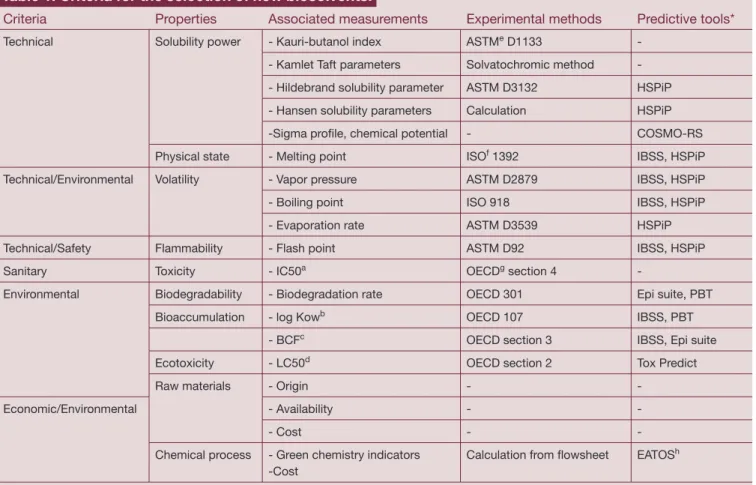
– Th e cost of the biosolvent, depending on the raw mate-rials and the processes used for their transformation. Th ese criteria can be checked by evaluating several prop-erties, by experimental or predictive methods (Table 1).
In this context, the selection of biosolvents is based on the determination of several parameters described below.
Solubility power may be assessed by various
experimen-tal and theoretical methods:
– Th e Kauri-butanol index, which indicates the
maxi-mum amount of solvent that can be added to a solution of Kauri gum in n-butanol without causing cloudiness. Th is measurement is described by ASTM D1133 and provides a scaleless index.
– Th e Kamlet Taft solvatochromic scale is a widely used
multiparameter scale for investigating and predicting solvent behavior.7-9 Th e Kamlet-Taft solvent parameters toxic, and their manufacture is also dependent on fossil
resources. Th is context has tended to modify the array of solvents used in industry, and regulations have evolved with advances in our understanding of the potential eff ects of solvents on the environment and human health. Solvent use is governed by several European directives: directive 1999/13/CE limits VOC emissions from indus-trial equipment; directive 2004/42/CE concerns the VOC content of solvents used to dilute architectural paints and varnishes and car refi nishing paints; and directives 64/548/CEE and 1999/45/CE govern the use of dangerous chemicals. In addition, petrochemical solvents have been subject to REACH regulations since 2007. Th is regulatory context resulted, for example, in the banning of dichlo-romethane in paint strippers in 2012 (REACH 276/2010 regulation). Th us, many studies are currently focusing on the replacement of hazardous solvents with more envi-ronment-friendly alternatives, according to the ecodesign approach.2 In recent years, solvent-free processes, ionic liquids, eutectic solvents, fl uorous solvents, supercritical fl uids, and water as a reaction medium have emerged as interesting alternatives.3,4 For other applications, how-ever, such as industrial cleaning, these alternatives are not applicable and the replacement of conventional solvents remains diffi cult. Biomass-derived chemicals off er promis-ing opportunities in the search for eco-friendly, ‘sustaina-ble’, or ‘green’ solvents.5 Th e market for bio-based solvents in Europe is currently 60 000 tonnes, but is expected to expand over the next few years, in a context of changes to the regulations in force. Biosolvents are not universal sol-vents like most of the chlorinated or hydrocarbon solsol-vents for which substitutions are required. Th ey are therefore oft en suitable only for specifi c applications. For instance, fatty-acid methyl esters have proved eff ective solvents for cleaning purposes. Dimethyl carbonate is used as a toluene substitute in the pharmaceutical industry. Methyl THF is an interesting solvent for organic synthesis. Th is lower level of versatility means that a larger number of biosol-vents are required to cover the principal applications.
New tools and methodologies are being developed in the face of the need for alternative solvents. Selecting new solvents is a laborious, time-consuming task, as the new solvents must have technical performances at least as good as those of the conventional solvents they replace, together with better health, safety, and environmental profi les. Th ree diff erent types of methodology can be applied in the substitution approach. We will introduce these methodol-ogies here, comparing their effi ciency through an example of substitution. In the case study presented, the aim is to replace acetone or methyl ethyl ketone, both of which have
Table 1. Criteria for the selection of new biosolvents.
Criteria Properties Associated measurements Experimental methods Predictive tools* Technical Solubility power - Kauri-butanol index ASTMe D1133
-- Kamlet Taft parameters Solvatochromic method -- Hildebrand solubility parameter ASTM D3132 HSPiP - Hansen solubility parameters Calculation HSPiP -Sigma profi le, chemical potential - COSMO-RS Physical state - Melting point ISOf 1392 IBSS, HSPiP Technical/Environmental Volatility - Vapor pressure ASTM D2879 IBSS, HSPiP
- Boiling point ISO 918 IBSS, HSPiP
- Evaporation rate ASTM D3539 HSPiP
Technical/Safety Flammability - Flash point ASTM D92 IBSS, HSPiP
Sanitary Toxicity - IC50a OECDg section 4
-Environmental Biodegradability - Biodegradation rate OECD 301 Epi suite, PBT
Bioaccumulation - log Kowb OECD 107 IBSS, PBT
- BCFc OECD section 3 IBSS, Epi suite
Ecotoxicity - LC50d OECD section 2 Tox Predict
Raw materials - Origin -
-Economic/Environmental - Availability -
-- Cost -
-Chemical process - Green chemistry indicators -Cost
Calculation from fl owsheet EATOSh
*Tools described in the predictive methodology section
aIC50: half inhibitory concentration; blog kow: octanol-water partition coeffi cient, cBCF: BioConcentration Factor; dLC50: median lethal concentration.
eASTM (American Society for Testing and Materials); fISO (International Organization for Standardization); gOECD (Organisation for
Economic Co-operation and Development), guidelines for the testing of chemicals; hEATOS: Environmental Assessment Tool for Organic
Synthesis.
are hydrogen bond donation ability α, hydrogen bond acceptor ability β, dipolarity-polarizability π*, and a correction term, δ. Th ese parameters were recently measured by Jessop et al for solvents of interest in green chemistry.10
– Th e Hildebrand solubility parameter δ indicates the
relative solvency behavior of a specifi c solvent.11 It is derived from the cohesive energy density of the solvent, which is linked to the heat of vaporization.
– Hansen solubility parameters are derived from Hansen theory, which describes the cohesion of a substance as the result of the combination of three intermolecular interactions. Th ese interactions correspond to three parameters dividing the Hildebrand parameter into three parts: δD refl ects the non-polar interactions derived from London dispersion forces, δP represents the polar interactions linked to Keesom forces and
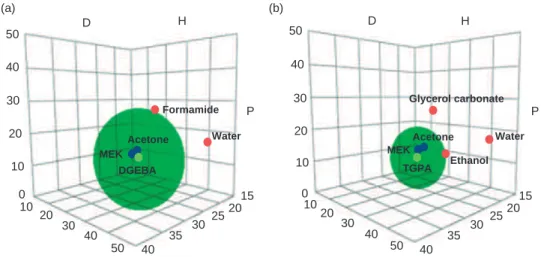
δH refl ects the ability to form hydrogen bonds. Th ese parameters are used as coordinates, to place solvents or solutes in a three-dimensional space. Th e affi nity of a solvent and solute increases with the closeness of their Hansen parameters. Hansen solubility parameters can be determined experimentally by solubility tests in a set of solvents with known Hansen parameters. Th e solubil-ity sphere includes the maximum number of miscible solvents and no non miscible solvents. Th is sphere is characterized by a radius. Th e RED number, refl ecting the relative energy diff erence, is defi ned as the ratio D/R, where D is the distance between a solute and a solvent (or two solvents), and R is the radius. Th is number is, thus, a powerful indicator of predicted solubility (or miscibility). If RED < 1, the studied solvent is within the solubility sphere and should dissolve the target. If RED > 1, its position outside the sphere indicates that it is not
environmental impact of a chemical substance: these indi-cators are assessed through their action on sample popula-tions of living organisms (measurements of median lethal concentration and of the concentrations of substances accumulating in specifi c organisms).
Economic aspects can be evaluated in terms of the cost
of the raw materials and processes involved in the pro-duction chain. Raw materials should be renewable, easily available, aff ordable and should not also be used in the food industry (to avoid competition between the two sec-tors, pushing up food prices).
Th e processes should be evaluated by green metrics, which can be calculated from the mass balance by EATOS soft ware.14
All of these critical factors are taken into account in sol-vent substitution. In all the various alternative approaches described since the 1990s by Fishkov et al.,15,16 the British Health and Safety Executive,17 or Collaton and Green,18 similar criteria were taken into account in the analysis of needs: technical effi ciency, health aspects, safety, protec-tion of the environment, process ecoeffi ciency, economic aspects, and human and organizational factors.
Solvent substitution methodologies
Computing resources, such as the CAGE (coating alterna-tives guide) or SAGE (solvent alternative guide) soft ware developed by the Research Triangle Institute, can be used to fi nd substitutes for cleaning and paint solvents.19,20 However, these tools are not suitable for the identifi cation of appropriate alternatives for all applications.
Various diff erent methodologies have been developed for the substitution of conventional solvents.
predicted to be a good candidate. Th is notion is illus-trated in Fig. 1. Th e solubility spheres of epoxy resin pre-polymers (studied in the next section) are represented. Th eir conventional solvents, methyl ethyl ketone (MEK) and acetone, have been also located with non-solvents in the Hansen space.
– COSMO-RS (Conductor-like Screening Model for Real Solvents) is a new approach for the classifi cation of organic solvents.12 It is based purely on solvent struc-ture and the solvents are located in a pseudo 3D-space on the basis of principal component analysis and clus-tering procedures. Th is representation of solvents as a function of their electron density, sigma profi les and chemical potential may facilitate the identifi cation of potential alternatives to an undesirable solvent.13 VOC emissions are strictly limited by regulations and the VOC emissions of industrial equipment must thus be carefully controlled. Vapor pressure and boiling point are good indicators of solvent volatility. A high evaporation rate is useful for limiting drying time (for applications such as coatings, nail polish, and paints), but a compro-mise must be found to decrease VOC emissions.
Flash point is related to fl ammability and must be high enough for safety purposes during the production, condi-tioning, and transportation steps.
Th e impact on the environment is correlated with solvent biodegradability, the ability of the compound to be broken down by natural micro-organisms into water, carbon dioxide, and biomass. Products with a biode-gradability rate of more than 60% in 28 days are gener-ally described as easily biodegradable. Bioaccumulation and ecotoxicity can also be used as indicators of the
Figure 1. Hansen solubility spheres for (a) DGEBA and (b) TGPA: epoxy resin prepoly-mers, conventional solvents and non solvents.
Water Acetone MEK DGEBA Formamide Acetone MEK Water Glycerol carbonate Ethanol TGPA 50 (a) (b) 40 30 20 10 0 50 40 30 20 10 0 10 20 30 40 50 10 20 30 40 50 40 35 30 2520 15 40 35 30 2520 15 P P H H D D
organic synthesis program able to suggest virtual com-pounds from one bio-based platform molecule. 23
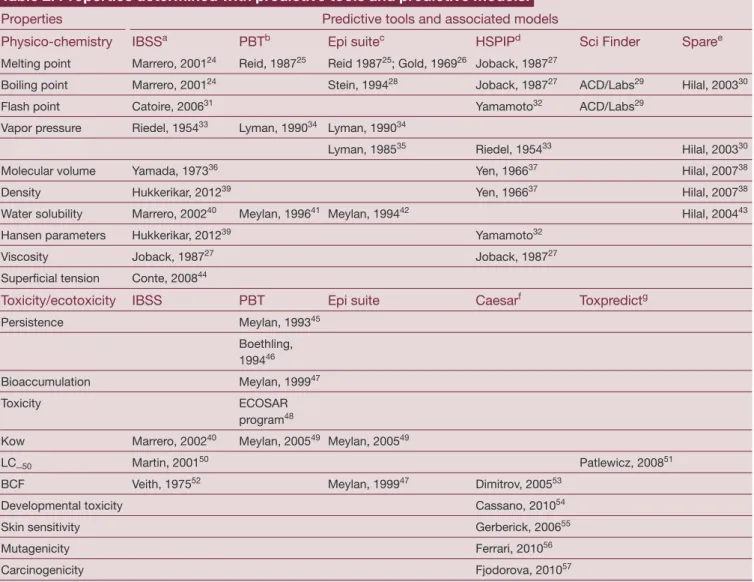
Before testing these molecules in the laboratory, they are subjected to a screening process: their properties are predicted with the various tools listed in Table 2 and compared with the specifi cations. Th is makes it possible to eliminate any molecules with predicted properties not meeting the defi ned specifi cations. Th e selected molecules are synthesized and tested. Th is methodology is clearly more productive, because only potentially interesting molecules (predicted properties consistent with the speci-fi cations) are synthesized, saving time, energy and raw materials.
Th e models implemented in the IBSS tool were selected based on their fi ability regarding the comparison between predicted properties and experimental properties for a series of known compounds.
All these computational systems were developed to over-come the lack of experimental data for many chemicals. Indeed, physico-chemical properties have been experi-mentally determined for less than 1% of the approximately 100 000 chemicals registered in the REACH program.58 Th ey are based on property modeling and must be handled with care, as their domain of applicability determines the molecules to which they can be applied.
IBSS is a CAPD (computer-aided product design) tool developed by the Laboratoire de Génie Chimique (Toulouse, France) for the InBioSynSolv project, a research program supported by the French National Research Agency.59 Th e CAPD approach is an extension to mul-ticomponent mixtures of the CAMD (computer-aided molecular design) approach, which principle is described in the next section. Within this tool, a library of prop-erty prediction methods is available including physico-chemical properties, as well as toxicity and ecotoxicity models. Once target property values are defi ned, they can be aggregated into a performance function enabling to check the match of a molecule or mixture with property specifi cations.
Some of the other tools are dedicated to the prediction of chemical and physical properties, whereas others spe-cifi cally predict the toxicity and ecotoxicity properties. HSPiP was developed by Professor Abbot and its main application is the prediction of Hansen solubility param-eters, although it can also be used to predict various other properties.60 Sci Finder is a well known database of chemi-cal abstracts with integrated ACD/Labs soft ware for the prediction of some properties. SPARC (Sparc Performs Automated Reasoning in Chemistry) was developed by EPA (Environment Protection Agency) researchers and is
Trial and error methodology
‘Trial and error’ is an experimental problem-solving method that can be seen as a basic approach built on practical experiments. For a conventional solvent to be replaced, one or several hypothetical candidates are iden-tifi ed and tested (trials). If these molecules do not match requirements (errors), they are eliminated and others are proposed and tested, with a view to identifying a suitable substitution solvent. Bégin and Gérin have described this methodology for solvent substitution in greater detail, focusing on the following major steps: 21
– Identifi cation of the solvent to be replaced for reasons of toxicity, a poor environmental footprint, high costs, etc.
– Proposition of alternative solvents by a chemist able to select bio-based building blocks and to propose derived compounds. Th e choice of the proposed alter-native solvents is generally guided by existing solvent classifi cations, which are based on dipolar moment, dielectric constant and protic character, but also on the Hansen solubility parameters or Kamlet Taft param-eters or the COSMO-RS approach.13
– Tests of candidates for the target application, such as solubilization of the active principle or industrial cleaning.
– Finally, candidate selection tends to be based on a compromise between several criteria.
Th is methodology has been depicted and used in several case studies aiming to replace trichloroethylene or xylene, for instance.21 Ethyl lactate was identifi ed by the same authors as a good biosolvent for paint stripper, degreasing agents and precision cleaning.22
Th is method is time-consuming; every solution has to be tested. Moreover, the selected solvent may not necessarily be the best alternative.
Predictive methodology
Th is methodology was developed as an improvement of the trial and error method, based on prediction of the properties of the molecules proposed by the chemist. As for the trial and error method, the substitution problem and the associated specifi cations are fi rst identifi ed and alternative solvents are then proposed by the chemist. In this case, the chemist, in charge of the generation of molecules derived from bio-based building blocks, selects the transformation routes respecting green chemistry principles. He may be then helped by a computer-assisted
SMILES notation or molecule-drawing soft ware is required as an input for these tools, with the predicted properties as the output.
In the absence of experimental information for a candi-date molecule, prediction tools are useful for the primary selection of molecules.
Reverse design
Th is methodology, which combines the chemist’s knowl-edge and CAMD, is suitable for use in the substitution of conventional solvents and has already proven success-ful for the identifi cation of alternative products in vari-ous fi elds, such as processes, solvent design, refrigerant fl uids, and polymer design.64–68 Indeed, computer-aided available online.61 It uses computational algorithms based
on fundamental chemical structure theory to estimate a large array of physical/chemical properties.
PBT (Persistance, Bioaccumulation Toxicity), Caesar (Computer-Assisted Evaluation of industrial chemi-cal Substances According to Regulations), Epi suite (Estimation Program Interface), and Toxpredict were developed more specifi cally for predicting the impact of products on human health and the environment.62,63 Th e PBT and Epi suite were designed under contract for the Offi ce of Chemical Safety and Pollution Prevention of the US Environmental Protection Agency. Caesar and Toxpredict were developed with funding from the European Community. Th ese predictive tools are available either online or as free downloads.
Table 2. Properties determined with predictive tools and predictive models.
Properties Predictive tools and associated models
Physico-chemistry IBSSa PBTb Epi suitec HSPIPd Sci Finder Sparee
Melting point Marrero, 200124 Reid, 198725 Reid 198725; Gold, 196926 Joback, 198727
Boiling point Marrero, 200124 Stein, 199428 Joback, 198727 ACD/Labs29 Hilal, 200330
Flash point Catoire, 200631 Yamamoto32 ACD/Labs29
Vapor pressure Riedel, 195433 Lyman, 199034 Lyman, 199034
Lyman, 198535 Riedel, 195433 Hilal, 200330
Molecular volume Yamada, 197336 Yen, 196637 Hilal, 200738
Density Hukkerikar, 201239 Yen, 196637 Hilal, 200738
Water solubility Marrero, 200240 Meylan, 199641 Meylan, 199442 Hilal, 200443
Hansen parameters Hukkerikar, 201239 Yamamoto32
Viscosity Joback, 198727 Joback, 198727
Superfi cial tension Conte, 200844
Toxicity/ecotoxicity IBSS PBT Epi suite Caesarf Toxpredictg
Persistence Meylan, 199345 Boethling, 199446 Bioaccumulation Meylan, 199947 Toxicity ECOSAR program48
Kow Marrero, 200240 Meylan, 200549 Meylan, 200549
LC_50 Martin, 200150 Patlewicz, 200851
BCF Veith, 197552 Meylan, 199947 Dimitrov, 200553
Developmental toxicity Cassano, 201054
Skin sensitivity Gerberick, 200655
Mutagenicity Ferrari, 201056
Carcinogenicity Fjodorova, 201057
aIBSS: InBioSynSolv; bPBT: Persistence, Bioaccumulation, Toxicity; cEpi suite: Estimation program interface; dHSPiP: Hansen Solubility
Parameters in Practive; eSparc: Sparc Performs Automated Reasoning in Chemistry; fCaesar: Computer- Assisted Evaluation of industrial
less strict target property value specifi cations can be set for such properties. Once candidate molecules have been selected, syntheses and tests are performed.
Th is methodology is highly innovative and the most exhaustive, because specifi cations and renewable materi-als are used for the generation of alternative solvents. Although it does not take into account the ecocompat-ibility of the synthesis process (greenness of the reaction) according to the 24 principles of green chemistry and green engineering, the multicriterion search of the CAPD makes it possible to achieve ‘the greenest solvent’ in terms of health, safety, and environmental considerations for its use while at the same time, considering technical.70 Th e ecocompatibility of the process can be evaluated further, by calculating green metrics.71,72
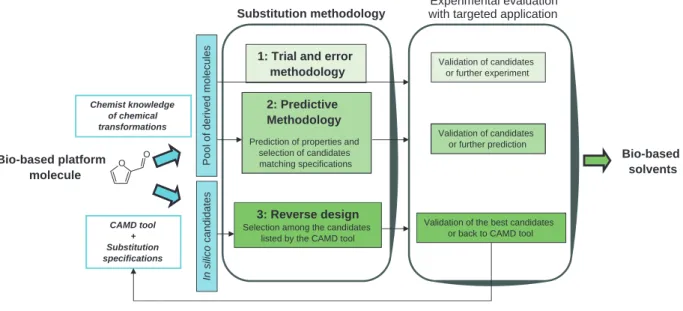
Th e three methodologies are depicted in Fig. 2.
Th e results provided by the second and third methodolo-gies will be compared through a case study.
Case study: substitution of common
epoxy prepolymer solvents
Th e substitution methodologies described above are illus-trated here for the replacement of conventional solvents for the solubilization of epoxy resins.
Targeted application: cleaning of resins
by solubilization
Th e aim is to design an effi cient biosolvent for the solubi-lization of two epoxy resin prepolymers presented in Fig. 3: bisphenol A diglycidyl ether (DGEBA) and triglycidyl p-aminophenol ether (TGPA).
Th ese prepolymers are widely used in industry as basic monomers for the production of two major polymers: epoxy resins and polycarbonates. Th e cleaning of manu-facturing and conditioning materials requires conven-tional volatile solvents, such as acetone and methyl ethyl ketone (MEK). Alternative solvents are now required, to limit the emission of VOCs.73
Th e specifi cations for this context are listed in Table 3, for defi nition of the required technical and environmental properties of the substitution solvent.
Th e Hansen parameters of the prepolymers were deter-mined experimentally in a previous study,74 from the solu-bility spheres of radii, R = 23.7 MPa1/2 for DGEBA and R = 12.3 MPa1/2 for TGPA (Fig. 1).
Both the predictive and reverse design methods were used, with a selected bio-based building block, furfural, as the starting material.
molecular design has emerged as a powerful tool, given the progress made with group contribution methods in the estimation of values for particular properties. Th e CAMD method consists in fi nding molecules satisfying a set of requirements defi ned a priori. Alternative structures are generated by an optimization technique; their properties are predicted and compared to the requirements trans-formed into property value specifi cations; and molecules are ranked according to their match with the specifi ca-tions. Th e chemist can then select candidate molecules, based on the feasibility of their synthesis. Th e IBSS tool developed for the InBioSynSolv project is an innova-tive CAMD tool dedicated to the design of bio-based solvents.59,69 Indeed, in addition to the abovementioned characteristics of CAMD implemented with a genetic algorithm, a specifi c functionality has been added for molecular architecture: the ability to impose one or more bio-based building blocks as fragment in the molecule structure, to ensure the development of bio-based solvent.
Th e specifi cations are provided as target property values to build a performance objective function in the CAMD tool. Th us, the targeted properties are defi ned as constraints of the optimization problem to be met by the generated structures. Th e other input of IBSS soft ware is a platform molecule. A bio-based building-block (like furfural) is thus given as the starting point for molecular architecture. Common functional groups (simple ones like -CH3, >C=O, -OH or complex ones like -COOH) are also listed in the CAMD tool as elementary blocks. By connecting these building blocks together, IBSS gener-ates molecules containing the bio-based core, predicts their properties and compares them to the specifi ca-tions. A large set of property models can be used in the specifi cations, including technical performance (melting point, boiling point), Hansen solubility parameters, safety properties (fl ash point), and environmental impact (vapor pressure, bioaccumulation factor, and LC50 acute toxicity). Aft er a given number of algorithm generations, a popula-tion of 100 molecules is obtained. Th ese molecules are ranked according to their performances describing how well they match the specifi cations. Diff erent weighting fac-tors can be applied to the properties in the performance function, to weight the selection criteria as a function of the targeted application. Th e choice of weighting factors is usually done based on the user perception of each property importance for his problem to be solved. As the CAPD approach relies upon property prediction methods, a lower weight may be attributed for properties with methods hav-ing poor known prediction accuracy, so as to enable the search to fi nd good compromise solutions. Alternatively,
Fig ure 2. Substitution methodologies: Trial and error, predictive method, and reverse design.
Bio-based platform molecule
O O
1: Trial and error methodology 2: Predictive Methodology Prediction of properties and
selection of candidates matching specifications
3: Reverse design Selection among the candidates
listed by the CAMD tool
Chemist knowledge of chemical transformations CAMD tool + Substitution specifications Experimental evaluation with targeted application
Bio-based solvents
Pool of derived molecules
In silico candidates Substitution methodology Validation of candidates or further experiment Validation of candidates or further prediction
Validation of the best candidates or back to CAMD tool
Fig ure 3. Epoxy resin prepolymers.
O O O O N O O O O DGEBA TGPA
Table 3. Specifications for the dissolution of DGEBA and TGPA and properties of conventional solvents to be substituted.
Properties Specifi cations Acetone MEK
Technical performance
Melting point < 0ºC –95ºC –86ºC
Boiling point 100ºC <...< 250ºC 56ºC 80ºC
Solubility
Hansen parameters (MPa1/2) DGEBA: δD = 17.2, δP = 6.9, δH = 8.2, R = 23.7 TGPA:
δD = 17.4, δP = 6.1, δH = 6.4, R = 12.3 δD = 15.5, δP = 10.4, δH = 7.0 δD = 16.0, δP = 9.0, δH = 5.1 Safety Flash point > 61ºC –18ºC –9ºC Environment
Vapor pressure < 10 Pa, 20ºC 22 800 Pa, 20ºC 10500 Pa, 20ºC
Bioaccumulation
BCF BCF < 500 0.69
log kow < 3 0.24 0.29
R: radius of the Hansen sphere
Furfural as a platform molecule
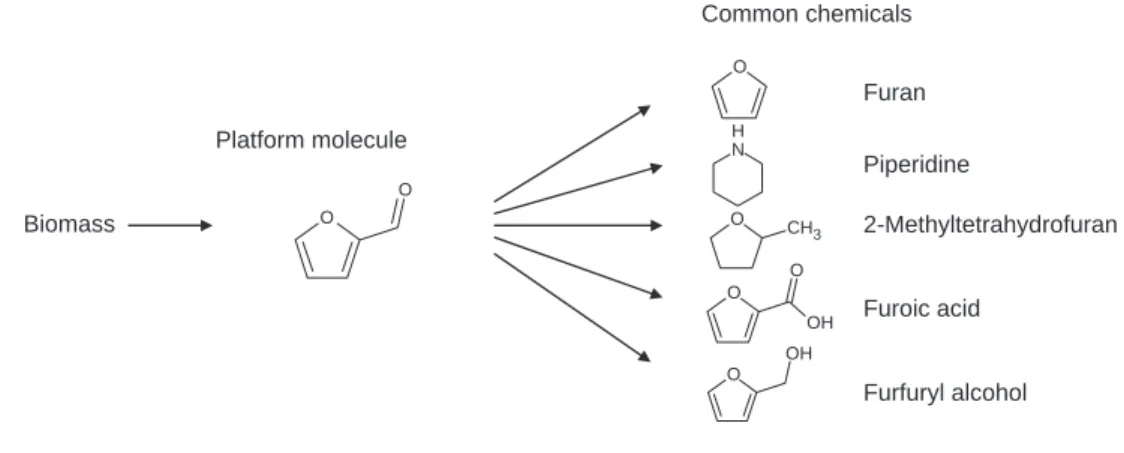
Furfural is a widely used platform molecule with sev-eral advantages for the preparation of new eco-friendly solvents.75 It is readily available, exclusively from plant feedstock, as no synthetic route exists. Furfural is thus prepared by dehydration of the xylose present in the hemi-cellulose of plant waste.76
Th e annual production of furfural worldwide is 250 000 tonnes, 60% of which is converted into furfuryl alcohol. Th e rest is used as a selective solvent for the refi nement
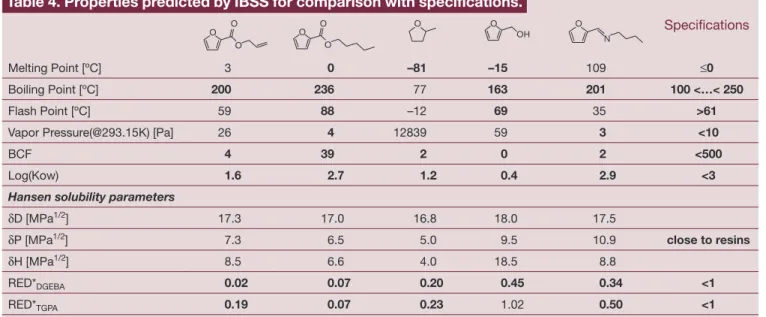
IBSS (Table 4) were correlated and validated with the results obtained with other tools (e.g. Sparc, HSPiP), for the selection of promising candidates.
Th e most promising molecule (A) is selected by compar-ing the predicted properties with the specifi cations. Th e actual properties of the candidate molecule can be cheked aft er synthesis.
Results for the reverse design
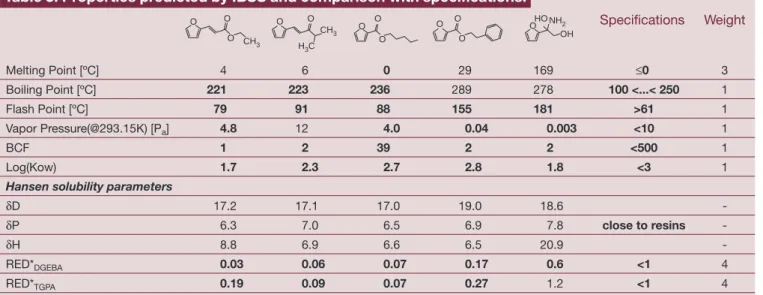
Th e innovative IBSS tool was also used to fi nd alternative solvents for the solubilization of epoxy resins. Th e speci-fi cations despeci-fi ned in Table 3 were taken as the functional objectives and furfural was used as the platform molecule. IBSS can build furfural-derived molecules and predict their properties, for comparison with the specifi cations. A selection of molecules ranked by IBSS is depicted in Fig. 6, and their predicted properties are gathered in Table 5 as well as the weights attributed to the considered prop-erties in the performance function. Th e molecule (A) selected by the predictive methodology is among the molecules selected by CAMD, but this tool also proposes new structures. Th e chemist must consider the feasibility of lubricating oils, or as a synthesis intermediate for the
production of furan and tetrahydrofuran (Fig. 4).75 Th is upgrading scheme is consistent with the condition that bio-based chemistry should not compete with the food industry. Diff erent types of agricultural waste are used, depending on the country: corn cobs in China, sugarcane bagasse in India, the black liquor from wood pulping in Austria, and apricot and olive seeds in Spain.
Alternative structures derived from furfural were screened by the predictive methodology. For the reverse design, furfural was used as the initial building block for CAMD.
Results for the predictive methodology
Several chemical transformations consistent with the principles of green chemistry (e.g. atom economy, small number of steps, limited waste and energy) were consid-ered and applied to the platform molecule. Th is led to the identifi cation of several candidate compounds, presented in Fig. 5.
Th e predictive tools were applied only to molecules that could be synthesized easily. Th e properties predicted by
Fig ure 4. Furfural as a platform molecule.
Biomass O O Platform molecule O O OH O CH3 N H O Piperidine 2-Methyltetrahydrofuran Furoic acid Furan O OH Furfuryl alcohol Common chemicals
Fig ure 5. Selection of a candidate molecule after property prediction.
O OH O O O O O O O O O Prediction of properties Comparison with specifications
Selection of one interesting candidate
O O O O N (A)
Figu re 6. Selection from the results generated by the reverse design. O O Specifications
+
IBSS O O H3C CH3 O O O O O O O O O CH3Selection of one promising candidate
O O H3C CH3 Specifications matching Chemist knowledge O NH2 HO OH (B)
Table 4. Properties predicted by IBSS for comparison with specifications.
O O O O O O O O OH O N Specifi cations Melting Point [ºC] 3 0 –81 –15 109 ≤0 Boiling Point [ºC] 200 236 77 163 201 100 <…< 250 Flash Point [ºC] 59 88 –12 69 35 >61
Vapor Pressure(@293.15K) [Pa] 26 4 12839 59 3 <10
BCF 4 39 2 0 2 <500
Log(Kow) 1.6 2.7 1.2 0.4 2.9 <3
Hansen solubility parameters
δD [MPa1/2] 17.3 17.0 16.8 18.0 17.5
δP [MPa1/2] 7.3 6.5 5.0 9.5 10.9 close to resins
δH [MPa1/2] 8.5 6.6 4.0 18.5 8.8
RED*DGEBA 0.02 0.07 0.20 0.45 0.34 <1
RED*TGPA 0.19 0.07 0.23 1.02 0.50 <1
*RED = distance between epoxy prepolymer resin and solvent/radius of the resin solubility sphere. Bold values are in agreement with the specifi cations.
and relative costs of the various syntheses when choosing a candidate from the results obtained with IBSS.
Th is innovative reverse design methodology has proved effi cient for the generation of alternative solvents in accordance with defi ned specifi cations. IBSS seems to be a valuable tool for the rapid design of bio-based molecular architectures (a few minutes of calculation).
The performances of the two alternative solvents selected (A and B) by the predictive methodology and reverse design were experimentally validated for the
solubilization of DGEBA and TGPA. A solubility of 100 g/L was achieved, confirming the satisfactory per-formances of these two solvents for resin dissolution in industrial cleaning, for example. The corresponding boiling points are 205 °C for (A) and 225 °C for (B). And the Hansen solubility parameters were determined for (B): δD = 17.1, δP = 8.6, δH = 9.7 with REDDGEBA = 0.09, REDTGPA = 0.33. The experimental values were then compared with the predicted properties, and were found in agreement.
Table 5. Properties predicted by IBSS and comparison with specifications. O O O CH 3 O O CH3 H3C O O O O O O OHO OH
NH2 Specifi cations Weight
Melting Point [ºC] 4 6 0 29 169 ≤0 3 Boiling Point [ºC] 221 223 236 289 278 100 <...< 250 1 Flash Point [ºC] 79 91 88 155 181 >61 1 Vapor Pressure(@293.15K) [Pa] 4.8 12 4.0 0.04 0.003 <10 1 BCF 1 2 39 2 2 <500 1 Log(Kow) 1.7 2.3 2.7 2.8 1.8 <3 1
Hansen solubility parameters
δD 17.2 17.1 17.0 19.0 18.6
-δP 6.3 7.0 6.5 6.9 7.8 close to resins
-δH 8.8 6.9 6.6 6.5 20.9
-RED*DGEBA 0.03 0.06 0.07 0.17 0.6 <1 4
RED*TGPA 0.19 0.09 0.07 0.27 1.2 <1 4
*RED = distance between epoxy prepolymer resin and solvent/radius of the resin solubility sphere. Bold values are in agreement with the specifi cations.
Conclusion
Research into green solvents is oft en a complex issue for the chemical industry. Th is study highlights the impor-tance of using a rational methodology to achieve high-performance substitutions.
Both predictive methodology and reverse design proved eff ective for the development of new functional solvents meeting specifi cations. We checked the performances of the furfural derivatives selected with these methodolo-gies for solubilization of the targeted solutes, DGEBA and TGPA.
Several tools for the prediction of solvent properties have been described. In combination with the predictive meth-odology, they facilitate the transition from conventional solvents to eco-friendly solvents. Th is approach saves time and reduces costs, by ensuring that only the best candi-dates are synthesized. Th e predictive methodology is easy to apply when alternative structures have already been identifi ed by the chemist.
However, when starting from a bio-based building block, the reverse design is the most complete and rapid method-ology, as all steps are managed by the CAMD tool, includ-ing the generation of derivative molecules. Th e reverse design approach goes further than other methodologies: it has the advantage of integrating constraints relating to both properties and molecular structures.
Moreover, the CAMD tool IBSS is being extended for prediction of the properties of mixtures, opening up new possibilities for increasing the substitution potential of biosolvents.77
Finally, the substitution process deserves to be comple-mented by a ‘green chemistry’ approach to the chemical conversion step. Green metrics, such as atom economy and environmental factors, can then be taken into account in the selection of ecofriendly processes for the preparation of biosolvents.
Acknowledgement
Th e InBioSynSolv project is supported by the French ANR CP2D program (Grant No. ANR-CP2D2009-08).
References
1. De Caro P and Thiebaud-Roux S, Biosolvants. Techniques de
l’Ingénieur IN 102:1–9 (2008).
2. Jessop PG, Searching for green solvents. Green Chem
13:1391–1398 (2011).
3. Sheldon RA, Green solvents for sustainable organic synthesis: State of the art. Green Chem 7:267–278 (2005).
4. DeSimone JM, Practical approaches to green solvents.
Science 297:799–803 (2002).
5. Bandres M, de Caro P, Thiebaud-Roux S and Borredon ME, Green syntheses of biobased solvents. C R Chimie
14:636–646 (2011).
6. Anastas PT and Warner JC, Green Chemistry: Theory and
Practice. Oxford University Press, New York, USA (2000).
7. Kamlet MJ and Taft RW, The solvatochromic comparison method. I. The β-scale of solvent hydrogen-bond acceptor (HBA) basicities. J Am Chem Soc 98:377–383 (1976). 8. Kamlet MJ, Abboud JL and Taft RW, The solvatochromic
comparison method. 6. The π* scale of solvent polarities. J Am
Chem Soc 99:6027–6038 (1977).
9. Kamlet MJ, Abboud JLM, Abraham MH and Taft RW, Linear solvation energy relationships. 23. A comprehensive collec-tion of the solvatochromic parameters, π*, α, and β, and some
methods for simplifying the generalized solvatochromic equa-tion. J Org Chem 48:2877–2887 (1983).
10. Jessop PG, Jessop DA, Fu D and Phan L, Solvatochromic parameters for solvents of interest in green chemistry. Green
Chem 14:1245–1259 (2012).
11. Hildebrand JH and Scott RL, The solubility of Non-Electrolytes, 3rd ed., Reinhold Publishing Co., New York (1950).
12. Durand M, Molinier V, Kunz W and Aubry J-M, Classifi cation of organic solvents revisited by using the COSMO-RS approach.
Chemistry 17:5155–5164 (2011).
13. Moity L, Durand M, Benazzouz A, Pierlot C, Molinier V and Aubry J-M, Panorama of sustainable solvents using the COSMO-RS approach. Green Chem 14:1132–1145 (2012). 14. Eissen M and Metzger JO, Environmental performance
met-rics for daily use in synthetic chemistry. Chemistry 8:3580– 3585 (2002).
15. Filskov P, Goldschmidt G, Hansen MK, Höglund JL, Johansen T, Pedersen CL and Wibroe L, Substitutes for Hazardous
Chemicals in the Workplace. CRC Press Inc., Lewis
Publishers, Boca Raton, FL (1996):
16. Goldschmidt G, An analytical approach for reducing work-place hazards through substitution. Am Ind Hyg Assoc J
54:36–43 (1993).
17. HSE, 7 Steps to Succesful Substitution of Hazardous
Substances. United Kingdom Health and Safety Executive,
HSE Books, Sudbury, Suffolk, UK (1994).
18. Callahan MS and Green B, Hazardous Solvent Source
Reduction. McGraw-Hill, NY (1995).
19. Cornstubble DR, CAGE 1.0 - Coating Alternatives Guide -
User’s Guide. Research Triangle Institute and united States
Environmental Protection Agency, National Risk Management Research Laboratory, Air Pollution Prevention and Control Division, Research Triangle Park, NC (1996).
20. Monroe KR and Hill EA, Solvent Alternatives Guides (SAGE), Computer assisted guidance for solvent replacement. CFC
and Halon Alternatives Conference - Stratospheric Ozone Protection for the 90s, Washington, October 20–22 (1993).
21. Bégin D and Gérin M, Substitution des Solvants. Etude de cas
d’implantation. Institut de Recherche Robert-Sauvé en Santé
et Sécurité du Travail, Montréal (2001).
22. Bégin D and Gérin M, La substitution des solvants par le
lactate d’éthyle, in Bilans de connaissances, Université de Montréal (IRSST), Montréal (2005).
23. Moity L, Molinier V, Benazzouz A, Barone R, Marion P and Aubry J-M, In silico design of bio-based commodity chemi-cals: Application to itaconic acid based solvents. Green Chem
16:146–160 (2014).
24. Marrero J and Gani R, Group-contribution based estima-tion of pure component properties. Fluid Phase Equilibr
183/184:183–208 (2001).
25. Reid RC, Prausnitz JM and Poling BE, The Properties of
Gases and Liquids, Chapter 2. McGraw-Hill Inc., NY (1987).
26. Gold PI and Ogle GJ, Estimating thermophysical properties of liquids. Part 4 - Boiling, freezing and triple-point temperatures.
Chem Eng 76:119–122 (1969).
27. Joback KG and Reid RC, Estimation of pure-component properties from group-contributions. Chem Eng Commun
57:233–243 (1987).
28. Stein SE and Brown RL, Estimation of normal boiling points from group contributions. J Chem Inf Comp Sci 34:581–587 (1994).
29. Advanced Chemistry Development (ACD/Labs), Software
V11.02 (© 1994–2013 ACD/Labs). [Online]. ACD/Labs
Percepta Predictors. Available at: http://www.acdlabs.com/ products/percepta/predictors.php [September 26, 2013]. 30. Hilal SH, Karickhoff SW and Carreira LA, Prediction of the
vapor pressure boiling point, heat of vaporization and diffusion coeffi cient of organic compounds. QSAR CombSci 22:565– 574 (2003).
31. Catoire L, Paulmier S and Naudet V, Estimation of closed cup fl ash points of combustible solvent blends. J Phys Chem
35:9–14 (2006).
32. Yamamoto H. [Online]. About the Pirika.com. Available at: http://pirika.com/ [September 26, 2013].
33. Riedel L, Eine neue universelle admpfdruckformel untersuc-hungen über eine Erweiterung des Theorems der übereinstim-menden Zustände. Teil I. Chem-Ing-Tech 26:83–89 (1954). 34. Lyman WJ, Reehl WF and Rosenblatt DH, Handbook of
Chemical Property Estimation Methods. American Chemical
Society, Washington DC (1990),
35. Lyman WJ, Environmental Exposure From Chemicals, Volume
I, ed by NeelyWB and Blau GE. CRC Press, Boca Raton, FL
(1985).
36. Yamada T and Gunn RD, Saturated liquid molar volumes. Rackett equation. J Chem Eng Data 18:234–236 (1973). 37. Yen LC and Woods SS, A generalized equation for computer
calculation of liquid densities. AIChE J 12:95–99 (1966). 38. Hilal SH, Saravanaraj AN, Whiteside T and Carreira LA, Calculating physical properties of organic compounds for environmental modeling from molecular structure. J
Comput-Aid Mol Des 21:693–708 (2007).
39. Hukkerikar AS, Sarup B, Ten Kate A, Abildskov J, Sin GR and Gani R, Group-contribution+ (GC+) based estimation of prop-erties of pure components: Improved property estimation and uncertainty analysis. Fluid Phase Equilibr 321:25–43 (2012). 40. Marrero J and Gani R, Group-contribution-based estimation
of octanol/water partition coeffi cient and aqueous solubility.
Ind Eng Chem Res 41:6623–6633 (2002).
41. Meylan WM, Howard PH and Boethling RS, Improved method for estimating water solubility from octanol/water partition coeffi cient. Environ Toxicol Chem 15:100–106 (1996). 42. Meylan WM and Howard PH, Validation of Water Solubility
Estimation Methods Using Log Kow for Application in PCGEMS & EPI. Offi ce of Pollution Prevention and Toxics,
U.S. Environmental Protection Agency, Environmental Science Center, Washington DC (1994).
43. Hilal SH, Karickhoff SW and Carreira LA, Prediction of the solubility, activity coeffi cient and liquid/liquid partition coef-fi cient of organic compounds. QSAR Comb Sci 23:709–720 (2004).
44. Conte E, Martinho A, Matos HA and Gani R, Combined group-contribution and atom connectivity index-based methods for estimation of surface tension and viscosity. Ind Eng Chem Res
47:7940–7954 (2008).
45. Meylan WM and Howard PH, Computer estimation of the atmospheric gas-phase reaction rate of organic compounds with hydroxyl radicals and ozone. Chemosphere 26:2293– 2299 (1993).
46. Boethling RS, Howard PH, Meylan W, Stiteler W, Beauman J and Tirado N, Group contribution method for predicting prob-ability and rate of aerobic biodegradation. Environ Sci Technol
47. Meylan WM, Howard PH, Boethling RS, Aronson D, Printup H and Gouchie S, Improved method for estimating bioconcen-tration/bioaccumulation factor from octanol/water partition coeffi cient. Environ Toxicol Chem 18:664–672 (1999). 48. United States Environmental Protection Agency (EPA).
[Online]. Ecological Structure Activity Relationships
(ECOSAR). Available at: http://www.epa.gov/oppt/newchems/ tools/21ecosar.htm [September 27, 2013].
49. Meylan WM and Howard PH, Estimating octanol-air parti-tion coeffi cients with octanol-water partiparti-tion coeffi cients and Henry’s law constants. Chemosphere 61:640–644 ( 2005). 50. Martin TM and Young DM, Prediction of the acute toxicity (96-h LC50) of organic compounds to the fathead minnow (Pimephales promelas) using a group contribution method.
Chem Res Toxicol 14:1378–1385 (2001).
51. Patlewicz G, Jeliazkova N, Safford RJ, Worth AP and Aleksiev B, An evaluation of the implementation of the Cramer clas-sifi cation scheme in the Toxtree software. SAR QSAR Environ
Res 19:495–524 (2008).
52. Veith GD and Konasewich DE, Structure-activity correlations
in studies of toxicity and bioconcentration with aquatic organ-isms. Great Lakes research advisory Board, Windsor, Ontario
(1975)
53. Dimitrov S, Dimitrova N, Parkerton T, Comber M, Bonnell M and Mekenyan O, Base-line model for identifying the bioac-cumulation potential of chemicals. SAR QSAR Environ Res
16:531–554 (2005).
54. Cassano A, Manganaro A, Martin T, Young D, Piclin N, Pintore M et al., CAESAR models for developmental toxicity. Chem
Cent J 4:S4 (2010).
55. Gerberick GF, Ryan CA and Kern PS, Compilation of historical local lymph node data for evaluation of skin sensitization alter-native methods. Dermatitis 16:157–202 (2005).
56. Ferrari T and Gini G, An open source multistep model to pre-dict mutagenicity from statistical analysis and relevant struc-tural alerts. Chem Cent J 4:S2 (2010).
57. Fjodorova N, Vracko M, Novic M, Roncaglioni A and Benfenati E, New public QSAR model for carcinogenicity. Chem Cent J
4:S3 (2010).
58. United States Environmental Protection Agency (EPA). [Online]. SPARC Performs Automated Reasoning in
Chemistry. Available at: http://www.epa.gov/athens/research/ sparc.html [September 26, 2013].
59. Heintz J, Belaud J-P and Gerbaud V, Chemical enterprise model and decision-making framework for sustainable chemi-cal product design. Computers in Industry 65:505–520 (2014). 60. Abbott S, Hansen CM and Yamamoto H. [Online]. The Offi cial
Hansen Solubility Parameter Site. Available at: http://www. hansen-solubility.com [September 26, 2013].
61. SPARC. [Online]. SPARC Performs Automated Reasoning in Chemistry. Available at: https://archemcalc.com/sparc/ [September 26, 2013].
62. PBT profi ler, a component of OPPT’s P2 Framework, assess-ing chemical in the absence of data. [Online]. Persistent, Bioaccumulative, and Toxic Profi les Estimated for Organic Chemicals. Available at: http://www.pbtprofi ler.net/default.asp [September 26, 2013].
63. Computer Assisted Evaluation of Industrial Chemical Substances According to Regulations (CAESAR). [Online]. Available at: http://www.caesar-project.eu/ [September 26, 2013].
64. Song J and Song HH, Computer-aided molecular design of environmentally friendly solvents for separation processes.
Chem Eng Technol 31:177–187 (2008).
65. Sherman J, Chin B, Huibers PDT, Garcia-Valls R and Hatton TA, Solvent replacement for green processing. Environ Health
Persp 106:253–271 (1998).
66. Sinha M, Achenie LEK and Ostrovsky GM, Environmentally begnin solvent design by global optimization. Comput Chem
Eng 23:1381–1394 (1999).
67. Constantinou L, Bagherpour K, Gani R, Klein JA and Wu DT, Computer aided product design: Problem formulations, meth-odology and applications. Comput Chem Eng 20:685–702 (1996).
68. Maranas CD, Optimization accounting for property prediction uncertainty in polymer design. Comput Chem Eng 21:S1019– S1024 (1997).
69. Heintz J, Systemic approach and decision process for
sustain-ability in chemical engineering: Application to computer aided product design, PhD thesis. Laboratoire de Génie Chimique,
Toulouse. (2012)
70. Capello C, Fischer U and Hungerbuhler K, What is a green solvent? A comprehensive framework for the environmental assessment of solvents. Green Chem 9:927–934 (2007). 71. Andraos J, Unifi cation of reaction metrics for green chemistry
II: Evaluation of named organic reactions and application to reaction discovery. Org Process Res Dev 9:404–431 (2005). 72. Constable DJC, Curzons AD and Cunningham VL, Metrics to
‘green’ chemistry-which are the best? Green Chem 4:521–527 (2002).
73. Medina-Gonzalez Y, Thiebaud-Roux S, De-Caro P, Hernandez-Ochoa L and Mouloungui Z, The role of co-addi-tive on epoxy resin pre-polymers solubilization in supercritical CO2. J Supercrit Fluid 38:13–17 (2006).
74. Medina Gonzalez Y, de Caro P, Thiebaud-Roux S and Lacaze-Dufaure C, Fatty acid methyl esters as biosolvents of epoxy resins: A physicochemical study. J Solution Chem 36:437–446 (2007).
75. Hoydonckx HE, Van Rhijn WM, Van Rhijn W, De Vos DE and Jacobs PA, Furfural and Derivatives, in Ullmann’s
Encyclopedia of Industrial Chemistry. Wiley-VCH Verlag GmbH
& Co. KGaA, Weinheim (2007).
76. Mamman AS, Lee JM, Kim YC, Hwang IT, Park NJ, Hwang YK et al., Furfural: Hemicellulose/xylosederived biochemical.
Biofuel Bioprod Bioref 2:438–454 (2008).
77. Heintz J, Touche I., Teles dos Santos M and Gerbaud V, An integrated framework for product formulation by computer aided mixture design. Comput-Aided Chem Eng 30:702–706 (2012).
Manon Bergez-Lacoste
Manon Bergez-Lacoste is a PhD student in Bio-based Chemistry in Laboratoire de Chimie
Agro- industrielle, at the University of Toulouse, France. Her research interests include the in silico and in
vivo design of chemicals, particularly
biosolvents, in the framework of an eco-design of bio-based products.
Jean-François Fabre
Dr Jean-François Fabre is a Physico-Chemistry Engineer at Laboratoire de Chimie Agro-Industrielle, Toulouse. His research interests include extraction and valorization of agricultural derived products with particular emphasis on colloids chemistry and molecular modeling.
Sophie Thiebaud-Roux
Dr Sophie Thiebaud-Roux is Associate Professor and head of the Depart-ment of Chemistry at INP-ENSIACET in Toulouse (France). She holds a PhD degree in organic chemistry applied to agro-molecules. During the last ten years, her research work focuses on the development of bio-solvents under reaction conditions close to the principles of Green chemistry.
Vincent Gerbaud
Dr Vincent Gerbaud is a research di-rector at the French National Scientific Research Center CNRS at Laboratoire de Génie Chimique in Toulouse. His research field concerns modeling and simulation in process system engi-neering, with a strong interest in small scale modeling: molecular simulation, thermodynamics, computer aided molecular and mixture design. At the process scale, He also focuses with the design and synthesis of distillation processes, like ex-tractive and azeotropic distillation.
Pascale de Caro
Dr Pascale de Caro is an associ-ate Professor at INPT-ENSIACET in Toulouse. She is graduated from the Chemical Engineer School of Toulouse. Her research work in Laboratoire de Chimie Agro-Industrielle is focused on the development of bio-based func-tional products from vegetable raw materials, according to a green chemistry approach.
Zéphirin Mouloungui
Dr Zephirin Mouloungui is a research director at INRA (Institut National pour la Recherche Agronomique), at the head of the research team for the chemical reactivity of agromolecules and oleochemicals, in Laboratoire de Chimie Agro-Industrielle. His expertise deals with the development of the re-newable resources in the fields of chemistry, bioproducts and neo-materials, according to innovating integrated schemes of production.