Any correspondence concerning this service should be sent to the repository administrator:
This is an author-deposited version published in: http://oatao.univ-toulouse.fr/ Eprints ID: 11181
To cite this version:
Orgogozo, Laurent and Labat, David and Renon, Nicolas and Tomer, Sat K. and
Soulaine, Cyprien and Henon, Florent and Ababou, Rachid and Quintard,
Michel A massively parallel OpenFOAM solver for Richards Equation: towards
mechanistic modelling of transfers at the watershed scale. (2013) In:
INTERPORE 2013, 21 May 2013 - 24 May 2013 (Prague, Czech Republic)
O
pen
A
rchive
T
oulouse
A
rchive
O
uverte (
OATAO
)
OATAO is an open access repository that collects the work of Toulouse researchers and makes it freely available over the web where possible.
______________________________________________________________________________________________________ This abstract was prepared for the InterPore2013 conference held in Prague on May 21 – 24, 2013.
A
massively parallel OpenFOAM solver for Richards Equation:
towards mechanistic flow-transport modelling at watershed scale
L. Orgogozoa, D. Labata, N. Renonb, S.K. Tomerc, C. Soulained, F. Hénond, R. Ababoud, M. Quintardd,e aGET (Géosciences Environnement Toulouse), Observatoire Midi-Pyrénées, Université Paul Sabatier, University of Toulouse, 14 avenue
Edouard Belin, 31400 Toulouse, France
bCALMIP/DTSI, Université Paul Sabatier, University of Toulouse, 118 route de Narbonne, 31400 Toulouse, France cCESBIO (Centre d’Etude Spatiale de la BIOsphère), Observatoire Midi-Pyrénées, Université Paul Sabatier, University of Toulouse, 18
avenue Edouard Belin, BPI 2801, 31401 Toulouse cedex 9, France
dIMFT - Institut de Mécanique des Fluides de Toulouse (University of Toulouse), 1 Allée Camille Soula, F-31400 Toulouse, France eCNRS, IMFT, F-31400 Toulouse, France
Key words: variably saturated / unsaturated porous media; Richards equation; massively parallel computing;
watershed scale modelling; OpenFOAM
1 Introduction
Many applications both in engineering and in basic research involve water transfer in variably saturated or unsaturated porous media, such as soils for example. From the point of view of water engineering, the direct infiltration of rainwater into soils is the main cause of recharge of aquifers. The transport of contaminant solutes through soils is one of the main sources of subsurface pollution, e.g. through infiltration of nitrates and pesticides. An accurate modelling of water transfers in soils is thus an important stake for this kind of applications. From the stand point of basic research in geosciences, these phenomena are also of great interest, since for example the water content in a soil profile is one of the driving parameters of weathering processes, which are key processes of the carbon cycle (e.g. [1]).
In order to predict the impact of global warming on weathering processes, mechanistic modelling of the water fluxes in soils is needed (e.g. [2]), since modelling in evolving climatic conditions (e.g. dry or wet warming) are needed. Large scale modelling is also needed, both from the spatial point of view (watershed scale must be considered in order to assess mass balances) and from the temporal point of view (modelling on the time scale of the observed global warming, i.e. century scale).
Numerical tools which allow accurate modelling of water transfers in soils are already available (e.g. [3], [4], [5], [6]), but they do not allow to use massively parallel computations with hundreds or thousands of processors. However the use of such massively parallel computing techniques is required to handle modelling of water transfer processes on watersheds of the scale of several square kilometres on century time scale. More generally, the need for high performance computing in geosciences modelling has been pointed out in the literature (e.g. [7]).
In this work, we present a framework for modelling which allows for the efficient solution of the non-linear Richards PDE (Partial Differential Equation) on 3D cases using massively parallel computation techniques. The numerical tool used is the open source CFD tool box OpenFOAM (e.g. [8]), where CFD stands for Computational Fluid Dynamics. Here, we present the model itself through a validation case and an example application on field data, and we then present the parallel performance of the solver in order to show the capability of the modelling tool to handle mechanistic modelling of water transfer at the spatial scale of square kilometres and the time scale of decades or centuries.
2 The RichardsFOAM modelling tool: validation, and example application
If one assumes a negligible viscosity of the air phase, and that air in the porous medium is fully and permanently connected to the atmosphere, two-phase (water-air) flow in porous media may be described with a reduced single equation model. This leads to the well know Richards equation, shown below:
(h)/
t =
C h
h
h
.
h
z
t
(1)In this equation, h is the pressure head expressed as the equivalent water column height [L], z is the vertical coordinate [L] (oriented upwards), K(h) is the hydraulic conductivity of the unsaturated porous medium [L.T-1] and C(h) is the capillary moisture capacity of the unsaturated porous medium [L-1]. The capacity is
______________________________________________________________________________________________________ This abstract was prepared for the InterPore2013 conference held in Prague on May 21 – 24, 2013.
defined as C(h)=/h where is volumetric water content. Note: a more “mass conservative” formulation of (1) consists in replacing C(h)h/t by (h)/t (equivalent mathematically, but not numerically).
The non-linearities due to pressure-dependent K(h) and C(h) are classically handled with a Picard iteration method (e.g. [3], [5]) implemented into a home-made OpenFOAM solver, the so-called RichardsFOAM solver. In order to validate this solver, we will present in the first part a code-to-code benchmark comparing the results of RichardsFOAM with the well known software HYDRUS on a simple test case. Then, an application of RichardsFOAM on field data acquired in south west India, in a monsoon area, is proposed as an illustrative example. The main originality of RichardsFOAM is that it accommodates massivelly parallel computing: parallel performance will be investigated in the second part of this work.
3 Massively parallel computing performance of RichardsFOAM
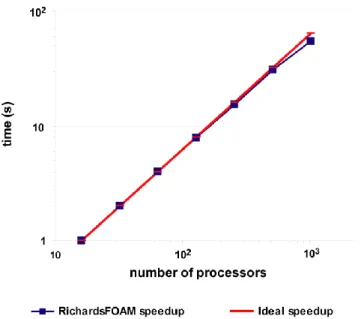
In this part we present the capability of RichardsFOAM to run long time simulations at the watershed scale with a reasonable computational time <Or CPU times? Or clock time??>. After a careful study of convergence, we build up strong scaling curves and weak scaling curves (the computations were conducted on the CALMIP cluster, http://www.calmip.cict.fr/spip/) for a simple 3D case involving infiltration on a 10 m thick loam soil with a slope and with a river at the bottom of the slope. The strong scaling curves were obtained for the case of a 3 km2 surface. One of these curves is presented in figure 1.
Figure 1: Comparison of the results of Hydrus-1D and RichardsFOAM on an infiltration test case. One can see that RichardsFOAM exhibits good parallel computing performances (in this case, about 85% of parallel efficiency with 1024 processors). The scaling curves will be used to discuss the current limits of space-time scales which one can deal with our RichardsFOAM approach, and the associated perspectives in the field of basic research in geosciences.
References
[1] Walker J.C.G., Hays P.B., Kasting J.F., A negative feedback mechanism for the long term stabilization of Earth’s surface temperature, J. Geophys. Res., 86, 9776-9782 (1981).
[2] Goddéris Y., Brantley S.L., François L.M., Schott J., Pollard D., Déqué M., Rates of atmospheric CO2 through the weathering of loess during the next 100 yr of climate change, Biogeosciences Discuss., 9, 10847-10881 (2012).
[3] Ababou R., Sagar S., Wittmeyer G., Testing Procedure for Spatially Distributed Flow Models, Advances in Water Resources 15, 181-198 (1992).
[4] Simunek J., van Genuchten M.Th., Sejna M., Development and applications of the HYDRUS and STANMOD software packages, and related codes, Vadose Zone Journal, Special Issue “Vadose Zone Modeling”, 7(2), 587-600 (2008).
[5] Weill S., Mouche E., Patin J., A generalized Richards equation for surface/subsurface flow modelling, J. of Hydrology, 366, 9-20 (2009). [6] Kuznetsov M., Yakirevich, Pachepsky Y.A., Sorek S., Weisbrod N., Quasi 3D modeling of water flow in vadose zone groundwater, Journal of Hydrology, 450-451, 140-149 (2012).
[7] Coumou D., Matthäi S., Geiger S., Driesner T., A parallel FE-FV scheme to solve fluid flow in complex geologic media, Computers and Geosciences, 34, 1697-1707 (2008).
[8] Weller H.G., Tabor G., Jasak J., Fureby C., A tensorial approach to computational continuum mechanics using object-oriented techniques, Computer in Physics, 12(6), 620-631 (1998).