Université de Montréal
Neural Approaches to Dialog Modeling.
par
Chinnadhurai Sankar
Département d’Informatique et de Recherche Opérationnelle Faculté des arts et des sciences
Thèse présentée à la Faculté des études supérieures et postdoctorales en vue de l’obtention du grade de
Philosophiæ Doctor (Ph.D.) en Informatique
août 2020
Sommaire
Cette thèse par article se compose de quatre articles qui contribuent au domaine de l’apprentissage profond, en particulier dans la compréhension et l’apprentissage des ap-proches neuronales des systèmes de dialogue.
Le premier article fait un pas vers la compréhension si les architectures de dialogue neuronal couramment utilisées capturent efficacement les informations présentes dans l’historique des conversations. Grâce à une série d’expériences de perturbation sur des ensembles de données de dialogue populaires, nous constatons que les architectures de dialogue neuronal couramment utilisées comme les modèles seq2seq récurrents et basés sur des transformateurs sont rarement sensibles à la plupart des perturbations du contexte d’entrée telles que les énoncés manquants ou réorganisés, les mots mélangés, etc.
Le deuxième article propose d’améliorer la qualité de génération de réponse dans les systèmes de dialogue de domaine ouvert en modélisant conjointement les énoncés avec les attributs de dialogue de chaque énoncé. Les attributs de dialogue d’un énoncé se réfèrent à des caractéristiques ou des aspects discrets associés à un énoncé comme les actes de dialogue, le sentiment, l’émotion, l’identité du locuteur, la personnalité du locuteur, etc.
Le troisième article présente un moyen simple et économique de collecter des ensembles de données à grande échelle pour modéliser des systèmes de dialogue orientés tâche. Cette approche évite l’exigence d’un schéma d’annotation d’arguments complexes. La version initiale de l’ensemble de données comprend 13 215 dialogues basés sur des tâches comprenant six domaines et environ 8 000 entités nommées uniques, presque 8 fois plus que l’ensemble de données MultiWOZ populaire.
Le dernier article présente une méthode sans intégration pour calculer les représentations de mots à la volée. Cette approche réduit considérablement l’empreinte mémoire, ce qui facilite le déploiement sur les périphériques (contraintes de mémoire) sur l’appareil. En
plus d’être indépendante de la taille du vocabulaire, nous trouvons que cette approche est intrinsèquement résistante aux fautes d’orthographe courantes.
Mots-clés: systèmes de dialogue axés sur les tâches, actes de dialogue, hachage sensible à la localité, auto-attention, inférence en langage naturel, analyse des sentiments, graphique de calcul dynamique, réseaux récurrents, réseaux récursifs, réseaux de neurones, apprentis-sage profond, naturel traitement du langage, apprentisapprentis-sage par renforcement, apprentisapprentis-sage automatique.
Summary
This thesis by article consists of four articles which contribute to the field of deep learning, specifically in understanding and learning neural approaches to dialog systems.
The first article takes a step towards understanding if commonly used neural dialog architectures effectively capture the information present in the conversation history. Through a series of perturbation experiments on popular dialog datasets, we find that commonly used neural dialog architectures like recurrent and transformer-based seq2seq models are rarely sensitive to most input context perturbations such as missing or reordering utterances, shuffling words, etc.
The second article introduces a simple and cost-effective way to collect large scale datasets for modeling task-oriented dialog systems. This approach avoids the requirement of a com-plex argument annotation schema. The initial release of the dataset includes 13,215 task-based dialogs comprising six domains and around 8k unique named entities, almost 8 times more than the popular MultiWOZ dataset.
The third article proposes to improve response generation quality in open domain dialog systems by jointly modeling the utterances with the dialog attributes of each utterance. Dialog attributes of an utterance refer to discrete features or aspects associated with an utterance like dialog-acts, sentiment, emotion, speaker identity, speaker personality, etc.
The final article introduces an embedding-free method to compute word representations on-the-fly. This approach significantly reduces the memory footprint which facilitates de-ployment in on-device (memory constraints) devices. Apart from being independent of the vocabulary size, we find this approach to be inherently resilient to common misspellings.
Keywords: task-oriented dialog systems, dialog-acts, multiwoz, locality sensitive hash-ing, wizard-of-oz, self-attention, natural language inference, sentiment analysis, dynamic
computational graph, recurrent networks, recursive networks, neural networks, deep learn-ing, natural language processlearn-ing, reinforcement learnlearn-ing, machine learning.
Contents
Sommaire . . . iii
Summary . . . v
List of tables . . . xiii
List of figures . . . xv
Acknowledgement . . . xvii
Chapter 1. Introduction. . . 1
Chapter 2. Background : Dialog . . . 3
2.1. Types of Dialog systems . . . 4
2.1.1. Task Oriented Dialog Systems. . . 4
2.1.2. Open-Ended Dialog Systems . . . 6
Chapter 3. Basic Neural Network Architectures . . . 9
3.1. Feed Forward Networks . . . 9
3.2. Recurrent Neural Architectures . . . 10
3.2.1. Long-Short Term Memory units . . . 10
3.2.2. Gated Recurrent Unit. . . 11
3.3. Deep Learning For NLP. . . 13
3.3.1. Language modeling . . . 13
3.3.2. Sequence to Sequence Models . . . 13
3.3.3. Attention Mechanism . . . 14
3.3.4. Transformers. . . 15
Chapter 4. Neural Approaches for End-to-End Dialog modeling . . . 19
4.1. Sequence to Sequence approaches . . . 19
4.2. The Hierarchical Recurrent Encoder-Decoder. . . 20
Chapter 5. Background : Efficient Locality Sensitive Hashing (LSH)-based Text Representation . . . 25
5.1. Introduction . . . 25
5.2. Motivation . . . 27
Chapter 6. Prologue to First Article . . . 29
6.1. Article Details . . . 29
6.2. Context. . . 29
6.3. Contributions . . . 30
6.4. Recent Developments . . . 30
Chapter 7. Do Neural Dialog Systems Use the Conversation History Effectively? An Empirical Study. . . 31
7.1. Abstract . . . 31 7.2. Introduction . . . 31 7.3. Related Work . . . 33 7.4. Experimental Setup . . . 34 7.4.1. Datasets . . . 35 7.4.2. Types of Perturbations. . . 35 7.4.3. Models . . . 36
7.5. Results & Discussion. . . 37
7.6. Conclusion. . . 39
Chapter 8. Prologue to Second Article . . . 41
8.1. Article Details . . . 41
8.2. Context. . . 41
8.3. Contributions . . . 42
8.4. Recent Developments . . . 42
Chapter 9. Taskmaster-1: Toward a Realistic and Diverse Dialog Dataset . 43 9.1. Abstract . . . 43
9.2. Introduction . . . 44
9.3. Related work . . . 45
9.3.1. Human-machine vs. human-human dialog . . . 45
9.3.2. The Wizard of Oz (WOz) Approach and MultiWOZ . . . 46
9.4. The Taskmaster Corpus. . . 47
9.4.1. Overview . . . 47
9.4.2. Two-person, spoken dataset . . . 50
9.4.2.1. WOz platform and data pipeline . . . 50
9.4.2.2. Agents, workers and training . . . 51
9.4.3. Self-dialogs (one-person written dataset) . . . 54
9.4.3.1. Task scenarios and instructions . . . 54
9.4.3.2. Pros and cons of self-dialogs . . . 54
9.4.4. Annotation . . . 55
9.5. Dataset Analysis . . . 56
9.5.1. Self-dialogs vs MultiWOZ . . . 56
9.5.2. Self-dialogs vs Two-person . . . 57
9.5.3. Baseline Experiments: Response Generation. . . 57
9.5.4. Baseline Experiments: Argument Prediction. . . 59
9.6. Conclusion. . . 59
Chapter 10. Prologue to third Article . . . 61
10.1. Article Details . . . 61
10.2. Context . . . 61
10.3. Contributions . . . 62
10.4. Recent Developments . . . 62
Chapter 11. Deep Reinforcement Learning For Modeling Chit-Chat Dialog With Discrete Attributes . . . 63
11.1. Abstract . . . 63
11.2. Introduction . . . 63
11.2.1. Contributions . . . 65
11.3. Attribute Conditional HRED . . . 66
11.3.1. Dialog Attribute Prediction . . . 67
11.3.2. Conditional Response Generation . . . 68
11.3.3. RL for Dialog Attribute Prediction. . . 69
11.4. Training Setup. . . 71
11.5. Experimental Results . . . 72
11.5.1. Dialog Attribute Prediction . . . 73
11.5.2. Utterance Evaluation . . . 74
11.5.3. RL For Dialog Attribute Prediction . . . 76
11.6. Related Work. . . 78
11.7. Conclusion. . . 80
Chapter 12. Prologue to Fourth Article . . . 81
12.1. Article Details . . . 81
12.2. Context . . . 81
12.3. Contributions . . . 82
12.4. Recent Developments . . . 82
Chapter 13. Transferable Neural Projection Representations . . . 83
13.1. Abstract . . . 83
13.2. Introduction . . . 83
13.3. Neural Projection Model . . . 85
13.3.1. Vanilla Skip-Gram Model . . . 85
13.3.2. Neural Projection Skip-Gram (NP-SG). . . 85
13.3.3. Training NP-SG Model . . . 86 13.3.4. Discriminative NP-SG Models . . . 87 13.3.5. Improved NP-SG Training . . . 87 13.4. Training Setup. . . 88 13.4.1. Dataset . . . 88 13.4.2. Implementation Details . . . 88 13.5. Experiments . . . 89
13.5.1. Qualitative Evaluation and Results . . . 89
13.5.2. Quantitative Evaluation and Results . . . 90
13.5.2.1. Similarity Task . . . 90 13.5.2.2. Language Modeling . . . 91 13.5.2.3. Text Classification . . . 92 13.6. Conclusion. . . 92 Chapter 14. Conclusion . . . 93 Bibliography . . . 97 xi
List of tables
7.1 An example of an LSTM seq2seq model with attention’s insensitivity to shuffling of words in the dialog history on the DailyDialog dataset. . . 32 7.2 Model performance across multiple datasets and sensitivity to different
perturbations. Columns 1 & 2 report the test set perplexity (without perturbations) of different models. Columns 3-7 report the increase in perplexity ( P P L[ ] ) when models are subjected to different perturbations. The mean
(µ) and standard deviation [ ] across 5 runs are reported. The model that exhibits the highest sensitivity (higher the better) to a particular perturbation on a dataset is in bold. seq2seq_lstm_att are the most sensitive models 24/40 times, while transformers are the least with 6/40 times. . . 36 7.3 Model performance across multiple datasets and sensitivity to different
perturbations. Columns 1 & 2 report the test set perplexity (without perturbations) of different models. Columns 3-7 report the increase in perplexity when models are subjected to different perturbations. The mean (µ) and standard deviation [ ] across 5 runs are reported. The Only Last column presents models with only the last utterance from the dialog history. The model that exhibits the highest sensitivity (higher the better) to a particular perturbation on a dataset is in bold. seq2seq_lstm_att are the most sensitive models 24/40 times, while transformers are the least with 6/40 times. . . 38 9.1 Statistics comparison: Self-dialogs vs MultiWOZ corpus both containing
approximately 10k dialogues each. . . 46 9.2 Statistics comparison: Self-dialogs vs two person corpus both containing 5k dialogs.
Perplexity and BLEU are reported for Transformer baseline. Joint-Perplexity and
Joint-BLEU are perplexity/BLEU scores from the joint training of self-dialogs
and two-person but evaluated with their respective test sets. . . 56
9.3 Evaluation of various seq2seq architectures [156] on our self-dialog corpus using both automatic evaluation metrics and human judgments. Human evaluation ratings in the 1-5 LIKERT scale (higher the better), and human ranking are averaged over 500 x 3 ratings (3 crowdsourced workers per rating). . . 58
9.4 Inter-Annotator Reliability scores of seq2seq model responses computed for 500 self-dialogs from the test set, each annotated by 3 crowdsourced workers. . . 59
9.5 API Argument prediction accuracy for Self-dialogs. API arguments are annotated as spans in the utterances. . . 59
11.1 Dialog-acts prediction accuracy in Reddit validation set. . . 73
11.2 Dialog-acts prediction accuracy for classifiers trained on validation set of different datasets.. . . 74
11.3 Perplexity and Embedding Metrics for the Reddit validation set. . . 74
11.4 Validation Perplexity for the Open-Subtitles dataset. . . 75
11.5 Human Evaluation results: Seq2Seq+Attr vs Seq2Seq . . . 76
11.6 Sample conversations . . . 77
11.7 Diversity scores on the Open-Subtitles validation set after RL fine-tuning . . . 77
11.8 Human Evaluation results:RL vs Seq2Seq+Attr . . . 78
11.9 Percentage of generic responses after RL fine-tuning. . . 78
11.10 Sample conversations . . . 79
13.1 Similarity Tasks: # of params, 100k vocabulary size for skipgram baseline, 100 embedding size. . . 89
13.2 Sampled nearest neighbors for NP-SG. . . 90
List of figures
2.1 . . . 4
3.1 Deep fully-connected feed forward network . . . 9
3.2 Recurrent Neural Network (RNN). . . 10
3.3 Sequence to Sequence Encoder-Decoder Architecture . . . 14
4.1 The computational graph of the HRED architecture [141] for a sample dialog composed of three turns. The token encoder provides a representation for each utterance and the context encoder provides the condensed representation for the previous utterances. The decoder predicts tokens conditioned additionally on this context embedding. . . 21
5.1 Memory for V look-up vectors for each token vs storing K(<< V ) vectors and linearly combining them for token representation. We consider K = 1120 following [124] in this paper. . . 26
5.2 Binary Locality-Sensitive Hashing (LSH) projection representation for text. . . 27
7.1 The increase in perplexity for different models when only presented with the k most recent utterances from the dialog history for Dailydialog (left) and bAbI dialog (right) datasets. Recurrent models with attention fare better than transformers, since they use more of the conversation history. . . 34
9.1 Sample Taskmaster-1 two-person dialog . . . 48
9.2 Sample instructions for agents playing “assistant" role . . . 49
9.3 Sample instructions for crowdsourced workers playing “user" role . . . 50
9.4 Sample instructions for written “self-dialogs" . . . 52
9.5 Sample one-person, written dialog. . . 53 9.6 Indicating transaction status with “accept" or “reject" . . . 55 11.1 Dialog attribute classification: We predict the dialog attribute of the next
utterance based on the previous context and attributes corresponding to the previous utterances. Please note that we depict only a single attribute for convenience . . . 67 11.2 Attribute Conditional HRED : Token generation is additionally conditioned on
the predicted dialog attributes. The dialog attribute’s embedding is concatenated with the context vector. . . 68 13.1 Neural Projection Skip-gram (NP-SG) model . . . 86
Acknowledgement
There are a lot of people who helped me in various aspects of the research I conducted, as well as being supportive during the past five years.
First, I would like to thank my advisor Yoshua Bengio for his great advice and support. His optimism, enthusiasm and research freedom helped me explore ambitious research plans during my PhD. I would like to thank the committee members for suggesting thoughtful experiments to analyze and improve the methods presented in the thesis. I would like to thank members of MILA: Sarath Chandar, Julian Serban, Sandeep Subramanian, Srinivas Venkattaramanujam, Zhouhan Lin, Alex Lamb, Taesup Kim, Sai Rajeswar, Saizheng Zhang, Prasanna Parthasarathi, Guillaume Alain, Hugo Larochelle, Aaron Courville from whom I have learned lot about research on a diverse set of topics. Special thanks to all the staff members at Mila who made my Ph.D. life much easier: Julie Mongeau, and Linda Peinthiere, Frédéric Bastien, Myriam Cote, Jocelyne Etienne and others.
I spent a considerable amount of time during my PhD at Google Brain/AI where I had great mentors, Sujith Ravi and Zornitsa Kozareva during internships. I thank the Google Brain/AI team for providing an excellent atmosphere to learn about many topics in neural networks and different tasks. Discussing research with fellow internship friends: Arvind Neelakantan, Semih Yavuz, Bill Byrne, Da Cheng Juan, Gaurav Menghani and others was was hugely beneficial. I would like to thank Layla El Asri for hosting me at Microsoft Research and support me with my dataset collection project.
I would like to thank my brother, Jeevan who introduced me to Deep Learning and encouraged me to pursue a PhD on the topic. My parents, Sankar, and Mala have made many sacrifices to make sure that I get the best education and they derive immense joy from my academic progress. Finally, I would like to thank my wife, Prathusha who has been incredibly supportive of me and has always believed in me.
Chapter 1
Introduction
Advances in deep learning-based speech recognition systems [10], with improved Automatic Speech Recognition (ASR) modules [135], resulted in a flurry of voice operated personal-assistant bots like Apple’s Siri, Amazon’s Alexa, Google Home and Microsoft’s Cortana, to name a few. Such systems have enjoyed reasonable success in replacing the traditional touch interface, used by most applications, with voice/speech signals. Over the past few years, "Chatbots" have been successfully commercialized in several areas, with the most success in e-commerce, agenda/scheduling, and event/travel reservations. This also lead to the development of similar applications aimed at people with disabilities like autism, visually impairment, etc. Unlike traditional rule-based learning systems which are often restricted to specific domains and require handcrafted rules, deep learning approaches are data driven, scalable and don’t usually require domain experts to make commercialization viable.
Deep Learning [44] has been extremely effective in machine learning sub-fields like speech recognition & synthesis [10], and natural language processing (NLP) tasks like language mod-eling [100], machine translation [8, 184] and abstractive summarization [134], etc. Natu-rally, there have been several research efforts [127, 168, 83, 80, 141, 142] in deep learning research community in training end-to-end neural architectures for modeling conversations. However, the success in applying end-to-end deep learning based approaches in the real world dialog tasks has been slightly underwhelming. While these models have demonstrated the ability to generate fluent responses, they still lack the ability to “understand” and produce incoherent responses. They often produce boring and repetitive responses like “Thank you.” [79, 136] or meander away from the topic of conversation. Fortunately, the research com-munity has been very active in deeply understanding the root cause of such issues [81, 147],
organizing challenges [135, 38], releasing effective large scale datasets [84, 93, 20] and research frameworks like ParlAI [106], ConvLab [76], Plato [111], etc.
In this thesis, we present four articles exploring neural approaches to modeling dialog systems. Chapter 2 provides the basics of dialog and introduces the types of dialog systems. Chapters 3 - 5 introduces the basic neural architectures used in the current dialog systems research.
Chapter 2
Background : Dialog
This chapter covers the basics needed to understand the motivation and solutions proposed in this thesis. Dialog systems are conversational systems which respond to queries or messages posed by humans, in a meaningful natural language form. Entities take turns to answer to messages based on the previous context.
A dialog typically consists of multiple turns. Each dialog turn may contain multiple utterances spoken by the same user. Dialogs can be either dyadic - for example, conversations between a customer service representative and a customer - or may involve more than two people, like Reddit forums. Dialogs can involve users interacting through written language, spoken language, or in a multi-modal setting (e.g. using both speech and visual modalities). There is usually a very weak correlation between the word usage statistics of spoken and text-based conversations. Spoken language tends to be less formal, containing lower information content and many more pronouns than written language [21].
Dialog systems have been an active research topic from the early 60s [162, 25, 174, 7, 97, 146, 67, 17, 87, 167, 126, 149, 15, 68]. Predominately, the hand engineered rule-based approaches were the ones that were popular and practical, among the ideas put forward. Advances in machine learning systems and computing power, thanks to Moore’s law, paved the way for successful statistical machine learning approaches, embedded with hand engineered rules, to gather necessary attention [155, 60, 16, 180]. Recent progress in the last years in both Automatic Speech Recognition (ASR) and Question Answering (QA) systems opens the way to a new generation of dialog systems allowing a human user to, through a phone or in front of a screen, ask a computer for information on any subject.
2.1. Types of Dialog systems
Dialog systems can be commonly grouped into two categories based on most uses-cases. • Task oriented - conversational agents are expected to accomplish well defined tasks with quantifiable goals like movie or restaurant reservation, meeting scheduling, book-ing cabs, etc.
• Open-Ended - conversational agents capable of conversing with humans on popular topics, such as entertainment, fashion, politics, sports, technology, etc.
We introduce the nature of each dialog task along with commonly used approaches to solving each task in this section.
2.1.1. Task Oriented Dialog Systems
Traditionally, for goal oriented systems, the dialog task is framed as a sequential slot filling process [186, 171] where the dialog system interacts with users to extract the data needed to fill the slots and the task is completed when all the slots are filled. Typical domains of this task are telephone shopping, online banking, online trading, etc [97, 146, 7]. The user has his/her purpose and knows almost all information in order to achieve the task. As an example, for a restaurant reservation system, such slots can be the location, price range or type of cuisine served at the restaurant.
A typical task-oriented dialog system architecture as shown in Figure 2.1 contains four major components - a natural language interpreter/understanding (NLU) unit, a state tracker, a dialog manager, and a Natural Language Generation (NLG) unit. Spoken di-alog systems additionally contain an Automatic speech recognition (ASR) module.
Fig. 2.1
The NLU unit. : parses the user utterance for extracting features like user intent, entities, etc., which are vital for dialog state tracking.
The state/user intent tracker. : computes a probability distribution over the dialog states, taking into account previous user utterances and states [179]. For instance, consider a restaurant reservation system where the dialog states in this case might be slot values like time, city and number of people. Each slot might be filled with one of the many valid discrete values. The task of the dialog state tracker is to output a distribution over all possible slot-value pairs.
The Dialog manager. : collects scores from ASR module, if available and gathers the dialog state features computed from the other submodules (practical implementations typically incorporate helper modules like Question-Answering (QA) modules, Memory/Knowledge base (KB) modules, etc.) in the system and chooses an action with the intention of increasing user satisfaction, both in the short term as well as in the long term. Actions here usually refer to dialog acts pertaining to the conversational domain (e.g., movie booking). Dialog acts can be used to suggest, inform, request certain information, etc. and they are unique to each dialog domain. Therefore, the set of dialog acts in the hotel domain may be different from the train domain although there could be some overlap among domains. For example, in the MultiWOZ [20], the hotel and train domain share the following dialog acts - offer booking, inform booked, decline booking. Apart from dialog acts, the NLG response selection problem can also be formulated as a planning problem and solved using reinforcement learning (RL) to optimize a dialog policy through interaction with users [77, 181, 61, 186].
The NLG unit. : converts the selected dialog manager actions to natural language re-sponses. In case of a spoken system, the generated responses are passed to the Text To Speech module (TTS). There are, indeed, no standard rules as to what responsibilities should be assigned to each module. In recent years there has been a trend towards developing fully data driven systems by unifying these modules using a deep neural network that maps the user input to the agent output directly [175, 20, 150].
Although there are recent end-to-end trainable models using RNNs for slot filling [102], it is inherently hard to scale to new domains, i.e, it is will be a tedious task to manually list down
all the slots that users might refer to in a conversation. Nevertheless, sequence to sequence based models have inspired recent task oriented system designs [128, 176] where the models are end-to-end trainable but still modularly connected. [19], taking inspiration from the latest developments in memory networks [177] for question answering, propose a completely end-to-end trainable model from scratch, without any prior slot structure assumption. While it is easier to evaluate task oriented systems, it is difficult to gather large data-sets to train models as they are usually too domain specific. So, this makes it especially harder to train deep learning based architectures as they are known to be data hungry.
Evaluation. : Task oriented systems are usually evaluated on two types of metrics - task completion metrics like accuracy, precision, recall, F1 etc., and generated response quality metrics like F1 and BLEU scores. Although there are several recent research efforts [63, 88], human evaluation is still among best possible ways to judge the quality of the generated responses.
2.1.2. Open-Ended Dialog Systems
Open-Ended dialog systems belong to a class of unstructured dialogs where the agents are expected to converse with humans on pretty much any popular topic, such as entertainment, fashion, politics, sports, technology, etc. Open-Ended dialog systems are evaluated only on user satisfaction scores. Unlike task oriented systems, there are no task completion metrics like accuracy, precision, etc. Open-Ended conversations are more complex to model as they inherently exhibit high entropy i.e., there are numerous plausible responses or directions in which discussions can progress at each time step. Evaluation criteria for testing such systems are hard for the same reason, and we usually resort to human evaluation (mechanical turkers), like Amazon Mechanical Turk (AMT) [35], to rate the responses of Open-Ended dialog systems.
Early works in non-goal oriented systems like the popular ELIZA program [174] involved template (regular expression) matching and just simple text parsing rules. It soon gained popularity mostly by persistently rephrasing statements or asking questions. ELIZA’s rep-utation led to similar works like [32], where the authors used simple text parsing rules, similar to ELIZA, to mimic behaviors of paranoid patients. However, such systems were merely viewed as an amusement and not commercialized for any real world applications.
Later, works like [55] employed data driven methods to statistically model dialog as a sto-chastic sequence of tokens using Markov chains. During inference, their model would first generate topic or intent-based tokens, which was then fed to another Markov chain to fill in the words surrounding the topic tokens.
Lack of low latency, reliable evaluation metrics, lack of large scale datasets and other related issues contributed to the slow pace of the Open-Ended dialog research until recently when promising works like [150, 141, 168, 83, 80] took inspiration from the success of deep neural network based sequence to sequence modeling for Neural Machine Translation (NMT) [29] and proposed end-to-end training of dialog systems by posing the response generation as a machine translation problem. We explain the end-to-end neural approaches to dialog modeling further in Chatper 4.
Chapter 3
Basic Neural Network Architectures
In this chapter we are going to introduce some important building bricks of modern neural architectures specifically in the context of natural language processing. These components forms the basis of the models we are going to introduce in the following articles.
3.1. Feed Forward Networks
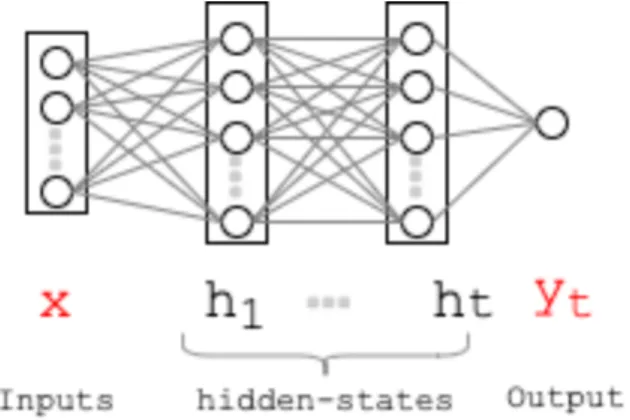
The architecture of a shallow feed-forward neural network is typically defined as follows: ht = f (W xt+ b)
ˆ
yt = sof tmax(V ht+ c)
(3.1.1) where f is some non-linearity function like sigmoid or tanh, and ht is the hidden state of
the network. Softmax gives a valid probability distribution over possible values yt can take.
Figure 3.1 depicts a deep fully-connected feed forward network.
Fig. 3.2. Recurrent Neural Network (RNN)
3.2. Recurrent Neural Architectures
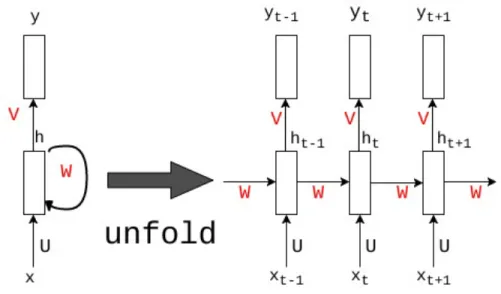
Recurrent neural networks(RNNs) [130] are a family of neural networks for processing sequential data, Figure 3.2. The typical architecture of a vanilla RNN is defined as follows:
ht = f (W xt+ U ht 1+ b) (3.2.1)
ˆ
yt= sof tmax(V ht+ c) (3.2.2)
where the matrix U corresponds to hidden-to-hidden connections. RNNs can be used as a probabilistic model [103] over a sequence of tokens, as in eq 3.3.1. The hidden state acts as a sufficient statistic, which summarizes the past sequence and parametrizes the output distribution of the model: P✓(wt|w1:t 1) = P✓(wt|ht 1).
3.2.1. Long-Short Term Memory units
Vanilla RNNs suffer from exploding and vanishing gradients [14] for tasks involving longer sequences like language modeling. RNNs become very ineffective when the gap between the relevant information and the point where it is needed become very large. That is due to the fact that the information is passed at each step and the longer the chain is, the more probable the information is lost along the chain. While techniques like gradient clipping [14] can limit exploding gradients, vanishing gradients are harder to prevent and so limit the network’s ability to learn long term dependencies [52]. A key development in addressing the
vanishing gradient issue in RNNs was the introduction of gated memory in the Long Short Term Memory (LSTM) network [53]. LSTM can be viewed as an extension to vanilla RNN by adding a series of gates and an internal cell state. The update equations at time step t for the LSTM are as follows
it = (Uixt+ Wist 1+ bi) ft = (Ufxt+ Wfst 1+ bf) ot = (Uoxt+ Wost 1+ bo) gt = tanh(Ugxt+ Wgst 1+ bg) ct = ct 1 f + g i ht = tanh(ct) ot (3.2.3)
Here stands for element-wise multiplication, and (·) is the sigmoid activation function. W· and b· are the corresponding weights and biases. The it, ft, ot are the input gate, forget
gate, and output gates, respectively. ct is the internal cell state, and ht is the output hidden
state.
The three gates control the flow of information in the network. All of it, ft, otare outputs
of sigmoid functions, thus their values are in between 0 and 1. Input gate (it), forget gate
(ft), and output gate (ot) control the inputs to the cell state (g), the cell state inherited from
the last time step (ct 1), and the cell state at the current time step (ct), respectively. These
gating mechanisms are explicitly designed to enable the LSTM to retain contents in the cell states for longer time steps.
3.2.2. Gated Recurrent Unit
The Gated Recurrent Unit (GRU) [29, 31] is a simplified version of the LSTM (with fewer gates) which works equally well. It can be viewed as a simplified version of LSTM without the cell state and output gate.
At time step t, GRU first computes two sets of gates, i.e., the update gate zt and the
reset gate rt:
zt = (Wxzxt+ Whzht 1+ bz)
rt = (Wxrxt+ Whrht 1+ br)
(3.2.4)
where xt is the input at time step t, W⇤ and b⇤ are the corresponding weights and biases.
ht 1 is its hidden state at t 1, which we will elaborate later. Then a candidate activation
e
ht is computed with the reset gate rt and hidden state ht 1:
e
ht = tanh(W xt+ U (rt ht 1)) (3.2.5)
The reset gate, rtis used to control the amount of past information to erase, just like the
forget gate in the LSTM. The final hidden state of GRU is then specified by
ht= (1 zt) ht 1+ zt het (3.2.6)
where the hidden state ht is a linear combination of previous activation ht 1 and the
candidate activation eht, where the interpolation is determined by the update gate zt. The
update gate helps the model to determine how much of the past information (from previous time steps) needs to be passed along to the future.
Note that there is another variant for the Equation 3.2.5, which was proposed in [31], where the order of multiplication between U and rt is slightly different [28]:
e
ht = tanh(W xt+ rt (U ht 1)) (3.2.7)
The GRU effectively removes one fourth of the parameters in the LSTM, thus allows more hidden states with a same budget of model size. This advantage allows the GRU to be able to yield better results on tasks with large datasets such a machine translation and dialog modeling. Although gates introduced in LSTMs and GRUs help model the long-term depen-dencies better, it often gets tricky to train the gates when they are saturated especially when they are expected to be saturated by design [23]. Also, it gets hard to parallelize the model for processing sentences due to their sequential computations requirements. Now, Trans-formers [166] - a self-attention-based non-recursive architecture, has become widely popular and has achieved state-of-the-art performance on several NLP tasks [36, 91]. It allows for parallelizable implementations as the self-attention-based architecture is non-recursive by design. We introduce the Transformer model in Section 3.3.4.
3.3. Deep Learning For NLP
3.3.1. Language modeling
We use language models to compute the probability distribution over the sequence of words w1, ..., wT. One way to factorize the probability P (w1, ..., wT), is to represent it as the
product of conditional probabilities of each word given all the previous ones, as in eq 3.3.1. P (w1:T) =
T
Y
t=1
P (wt|w1:t 1) (3.3.1)
where w1:t 1 is the sequence w1, ..., wt 1 and w01 is defined as null. N-gram models adopt
a count-based approach towards statistical language modeling. N-gram models compute probability of a sequence of words by maintaining a look up table of conditional probabilities for each word given the previous (N 1) words. As for neural network based approaches, we can either use feed-forward neural networks or Recurrent Neural Networks (RNNs) to parameterize the probability of the next token given the previous tokens, for each time step, 1 t T . We train such models with the standard maximum likelihood objective, by decreasing the cross-entropy loss [45]. Once trained, we can use this model for conditional language generation by sampling a word given the sequence of previously sampled words. [12] use feed-forward neural networks for language modeling, where they approximate the next word prediction (in eq 3.3.1) by conditioning with the previous N words instead of the entire history : P (wt|w1:t 1) ⇡ P✓(wt|wt 1 N :t 1), where ✓ refers to the parameters of
the feed forward network. With the assumption that the outputs lie within in closed set V(vocabulary of the tokens), RNNs can also be considered as a simple generative model of discrete sequences. For probabilistic language models word perplexity is a well-established performance metric [13, 103]. Word perplexity of a language model over a sequence W = w1, ..., wt is defined as
P P (W ) = 2 N1log2P (w1,...,wt 1) (3.3.2)
3.3.2. Sequence to Sequence Models
We can extend the idea of predicting the next token given the previous tokens to predict-ing the output sequence given the input sequence directly. For instance, we can frame the problem of machine translation (translating text from one language to another) as a sequence
Fig. 3.3. Sequence to Sequence Encoder-Decoder Architecture
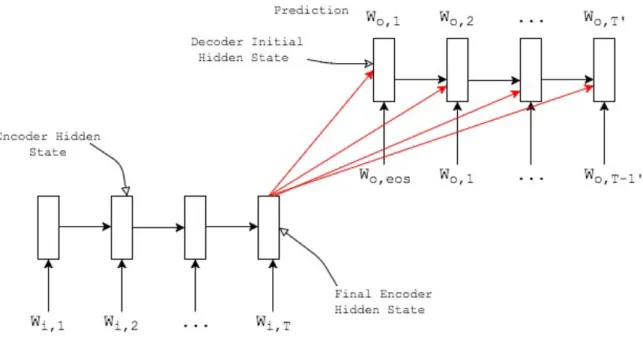
to sequence problem where the input sequence is a sentence belonging to the source language sentence and output sequence is the target language sentence. Sequence to Sequence models (Figure 3.3) mainly involve a Recurrent Neural Network (RNNs) based encoder to summa-rize the input sequence wi
1:N and a RNN based decoder which predicts the output sequence
wo
1:t 1 token by token conditioned on the encoder hidden state.
P✓(wot|w1:t 1o , w1:Ni ) / softmax (Wto f (hdecodert 1, hencoderN)) (3.3.3)
where Wo
t is the output token embedding of wot, hdecodert 1, hencoderN are the hidden states of
the decoder and encoder respectively. f is a non-linear transformation - usually a Multi-Layer Perceptron (MLP) network.
3.3.3. Attention Mechanism
In the Sequence to Sequence model described above, the basic premise of the Encoder RNN is to parse every item in an input series, one after the other, and keep updating it’s hidden state vector every step of the way as shown in Figure 3.3. This hidden vector at the end of every step is understood to represent the context of all prior inputs. In other words, the last hidden state represents the context of the entire sequence and is fed to the decoder at every time step to generate the output sequence. Attention mechanism introduced in
[8] enables the decoder to attend to all the tokens in the input sequence directly instead of just conditioning on the last hidden state context vector. The attention mechanism can be described by the following equations
ci = PMj=1↵ijhj
↵ij = PMexp(eij) k=1exp(eik)
eij = f (si 1, hj)
(3.3.4)
where M is the input sequence length, ci is the attention based context vector which is
fed to decoder instead of hM, f is a type of non-linear transformation (eg. a feedforward
neural network) termed as the alignment model. The attention context vector, ci is a linear
combination of the input hidden states from all the time steps. As seen from the Equation 3.3.4, there is a shorter and direct path for the backpropagation training signals to propagate from the decoder equally to all the input time steps. ↵ij are called as the attention weights
corresponding to the attention placed by the decoder at the ith time step over the jth input
token.
There have been different variants of attention mechanisms since they were first pro-posed, among which self-attention becomes the most influential variant, which was proposed under the name of self-attention [86]. Later on the Transformer model [166] significantly developed the self-attention mechanism, which resulted in a series of the state-of-the-art performances. Transformers [166] based architectures like BERT [36], XL-net [185], GPT-2 [118], MT-DNN [89], RoBERTA [9GPT-2] reached state-of-the-art performance on tasks like machine translation [6], language modeling [118], text classification benchmarks like GLUE [170].
3.3.4. Transformers
The Transformer still follows the encoder-decoder framework as depicted in Section 3.3.2. The difference lies in the form of the encoder and decoder, and the attention mech-anism between them. Following the notations from [166], the encoder maps an input se-quence of symbol representations (x1, . . . , xn) to a sequence of continuous representations
z = (z1, . . . , zn). Given z, the decoder then generates an output sequence (y1, . . . , ym)
of symbols one element at a time. Transformers consists of multiple layers (typically 6) of
encoder and decoder layers stacked upon each other. All encoder and decoder layers have similar structure.
Each encoder consists of two layers: self-attention and a feed forward layer.
Self-attention layer. : The encoder’s inputs first flow through the self-attention layer. The self-attention operation can be described as mapping a query and a set of key-value pairs to an output, where the query, keys, values, and output are all vectors. In the first layer, the input tokens are converted to query, keys and values by a simple linear transformation and packed into matrices, Q, K, V 2 RN·d, where N in the input sequence length and d is the
embedding dimension. We compute the matrix of outputs as: A = softmax(QK
T
p
d )V (3.3.5)
The scaling factor, d is to avoid the softmax from saturating due to high values resulting the dot products. Please note that the dimension of the self-attention output matrix, A is RN·d as well.
Feed forward layer. : The output of the self-attention layer is fed into a full connected layer with ReLU activation [109]. The output of this feed-forward layer is fed into the subsequent encoder layers after which they are fed into the decoder.
Position encodings. : Since the transformer doesn’t have a recurrent mechanism, the token embeddings are added with positional encodings to inform the network about the token’s position in the sequence. [166] use the following functions to create a constant positional encoding matrix with position-specific values.
P Epos,2i = sin(10000pos2i/d)
P Epos,2i+1 = cos(10000pos2i/d)
(3.3.6) where pos is the position in the sequence and i is the dimension in the embedding vector, d is the embedding dimension. The positional encoding matrix is simply added to the token embedding matrix before feeding to the encoder layer. The authors chose a sinusoid function as it would allow the model to easily learn to attend by relative positions, since for any fixed offset k, P Epos+k can be represented as a linear function of P Epos. Such embeddings are
typically referred to as absolute position embeddings, to usually depend on the absolute location of the token within the sequence. This differs from how recurrent neural networks operate as they model position in relative terms through their recurrence over the positions in the input sequence. [143] introduce relative position embeddings to allow attention to be informed by how far two tokens are apart in a sequence. This involves learning a separate relative position embedding, P Ei 2 Rdfor 0 i N 1. which is added to the self-attention
weights.
Cross-attention. : Similar to the encoder layers, the partially decoded outputs are fed into the decoder layers. In the final decoder layer, the attention is performed between the encoder and decoder layers where the query, Q is from the final decoder layer and key K & value V are the outputs from the last encoder layer. The output of this attention is fed to softmax layer to decode the next token. It is important to note that the Transformer is still an auto-regressive model which generates sequences token by token.
Chapter 4
Neural Approaches for End-to-End Dialog modeling
4.1. Sequence to Sequence approaches
Following the success of neural machine translation systems [8], there were multiple works [150, 141, 142] with the sequence to sequence paradigm adapted to the generative dialog framework. Early work on probabilistic end-to-end generative dialog systems done by [127, 168, 83, 80] pose the utterance generation problem as a machine translation problem. All the utterances within a conversation concatenated back-to-back (with appropriate sequence delimiters) in order to form a flattened dialog history serves as the input sequence and next utterance serves as the output sequence.
For instance, [168] feed the flattened dialog history into a single layer LSTM based encoder and generate the next utterance via another single layer LSTM based decoder con-ditioned on the dialog history as in Figure 3.3. Let U1:m be the sequence of m utterances in
a conversation where each utterance, Ui = wi1, wi2...win in turn can be seen as a sequence of
n tokens. Now, the input and outputs to the sequence to sequence model are of the form Inputs = U1 < eou > U2 < eou > · · · < eou > Um 1
Outputs = Um
(4.1.1) During training, the true output sequence is given to the model, so learning can be done by backpropagation [130]. The model is trained to maximize the cross entropy of the ground truth utterance given its dialog context. During inference, given that the true output sequence is not observed, we simply feed the predicted output token as input to predict the next output token. This approach is referred to as the "greedy inference" approach. A less greedy approach would be to use beam search [156], by feeding several probable candidates
at the previous step to the next step. In the next section, we introduce a encoder-decoder architecture [141] (used in Article 3) which takes into the view that a dialog is a sequence of utterances which, in turn, are sequences of tokens.
4.2. The Hierarchical Recurrent Encoder-Decoder
For modeling dialog systems, we can concatenate all the utterances of a conversation into a single sequence and train the LSTMs (or GRU) as a conditional language model as in [167]. However, we lose the utterance level structure present in the dialog data while flattening out the utterances. Also, this throttles the gradient flow for efficient training, as sequence lengths get unnecessarily longer. It would be difficult to model the dependencies of later utterances of a dialog on the initial utterances due to lack of alternate shorter paths for information flow across utterances. The Hierarchical Recurrent Encoder-Decoder (HRED) [141] tries to address both these issues by adding another utterance level RNN encoder over the token level encoder, thus reducing the number of computational steps between two utterances facilitating gradient flow. The model architecture presented in [150] is as shown in Figure 4.1. The model primarily consists of three modules - token level encoder, utterance level encoder and output token decoder.
The mth tokenized utterance, U
m = wm1, wm2...wmn is fed through the token level RNN
to obtain a utterance representation as in equation 4.2.1.
hmn = GRUenc(hmn 1, wmn), n = 1, 2...Nm (4.2.1)
where GRUenc is the token-level encoder GRU function, hmn is GRU’s hidden state
representation and hm0 = 0, the null vector. So, the token encoder should give us a sequence
of fixed size distributed order sensitive representations, h1, h2...hM where M is the number
of utterances in the conversation.
Now, we pass the sequence of utterance representations h1, h2...hM through another GRU
to compute a representation of the M utterances so far as in equation 4.2.2.
si = GRUuttr(si 1, hi), i = 1, 2...M (4.2.2)
Fig. 4.1. The computational graph of the HRED architecture [141] for a sample dialog composed of three turns. The token encoder provides a representation for each utterance and the context encoder provides the condensed representation for the previous utterances. The decoder predicts tokens conditioned additionally on this context embedding.
where GRUuttr is the utterance-level encoder GRU function, si is the GRU’s hidden
state representation and s0 = 0, the null vector. The recurrent hidden state si summarizes
the utterances that have been processed up to position i in addition to preserving the order information of both utterances and tokens spoken so far.
The RNN output token decoder is responsible for the prediction of the next utterance given the previous utterances. The probability of the next utterance prediction is given by
P (Um/U1:m 1) = Nm Y n=1 P (wn|w1:n 1, U1:m 1) (4.2.3) 21
where Um is the mth utterance, U1:m 1 are the past utterances. The contribution of the
previous utterances to the recurrent equation of the output token decoder is as in equation 4.2.4
hdecm,n = GRUdec( hdecm,n 1, wm,n, sm), n = 1,· · · , Nm (4.2.4)
where hdecn is the n
thGRU
dec’s recurrent hidden state and sn is the recurrent hidden state
of the utterance encoder from 4.2.2. It is a common practice to either set hdecm,0 to the null
vector or initialize it sm.
The model is trained by maximizing the log-likelihood of each conversation as in 4.2.5
LL = M X m=1 logP (Um|U1:m 1) = M X m=1 Nm X n=1 logP (wm,n|wm,1:n 1, U1:m 1) (4.2.5)
While the adaptation of sequence to sequence based hierarchical generative model is a good first direction, such dialog systems have difficulties with training as there is a wide range of plausible responses, unlike the translation setting. Dialog datasets, especially open domain corpus like the Twitter dataset [127], are jammed with short generic responses like "yes", "thank you", "got it.thanks!" etc. Also, there are contrasting responses to the same types of utterances across different conversations.
During training, when the decoder sees the same output utterance for different utter-ance encoder hidden states, it manages to ignore the encoder hidden state over time regarding it as just noise and instead concentrates on being a better language model. Thus, the decoder doesn’t generalize to new encoder states during inference and ends up predicting one of the many generic responses it has seen during training. Also, we cannot afford to remove the abundant generic responses from the dataset, like some sampling-based solutions, for class imbalance problems in classification.
Several approaches have been proposed in the literature to address the generic response generation issue. [80] propose to modify the loss function to increase the diversity in the generated responses. Multi-resolution RNN [138] addresses the above issue by additionally conditioning with entity information in the previous utterances. Alternatively, [148] uses
external knowledge from a retrieval model to condition the response generation. Latent vari-able models inspired by Conditional Variational Autoencoders (CVAEs) [147] are explored in [144, 189]. In Article 3, we propose to address this problem by jointly modeling the utterances with the dialog attributes of each utterance. Dialog attributes of an utterance refer to discrete features or aspects associated with an utterance like dialog-acts, sentiment, emotion, speaker identity, speaker personality, etc.
Chapter 5
Background : Efficient Locality Sensitive Hashing
(LSH)-based Text Representation
This chapter covers the basics of Locality Sensitive Hashing (LSH) [24] based projection operations for efficient text representations discussed in Article 4.
5.1. Introduction
In the last decade, research in deep neural networks has lead to tremendous advances and state of-the-art performance on wide range of Natural Language Processing (NLP) ap-plications [8, 139]. The availability of high performance computing has enabled research in deep learning to focus largely on the development of deeper and more complex network architectures for improved accuracy. However, the increased complexity of the deep neural networks has become one of the biggest obstacles to deploy deep neural networks on-device such as mobile phones, smart watches and Internet of Things (IoT) devices [56]. On-device deployment of neural network models specifically require a tiny memory footprint and low inference latency.
Recently, [123, 124, 72, 62], introduced a class of on-device deep learning models learned via embedding-free lightweight binary LSH-based projections learned on-the-fly. The projection approach surmounts the need to store any embedding matrices, since the projections are dynamically computed. The computation of the representation is linear in the number of inputs in the sentence surmounting the need to maintain and lookup global vocabulary. Additionally, this further enables user privacy by performing in-ference directly on device without sending user data (e.g., personal information) to the server.
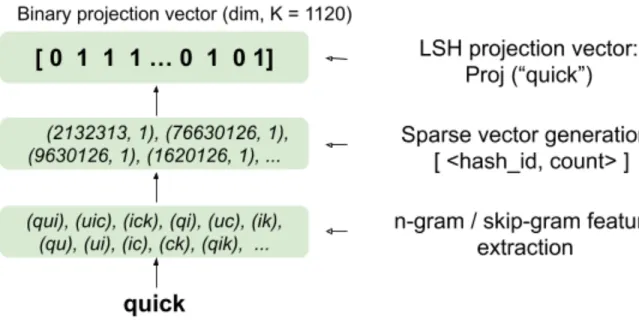
They propose a modified LSH-based projection operation, P that dynamically gener-ates a fixed binary projection representation P(x) 2 [0, 1]K for any text, x by extracting
morphological input features like char (or token) n-gram & skip-gram features, parts of speech tags, etc. The first step of the projection operation involves a string-based hashing method to extract a fixed vector,
~x2 Rd
from the morphological input features. Similar to the LSH via random projection methods, the projection vectors, Pkin the projection matrix P (contains K randomly generated vectors
2 Rd) transform the input ~x
i to a binary hash representation denoted by Pk(~xi) 2 [0, 1] as
in
Pk(~xi) := sgn[h~xi, Pki]
where h, i denotes inner product and sgn denotes the sign of the inner product. This results in a K-bit vector representation P(x) 2 [0, 1]K one bit corresponding to each projection row.
Fig. 5.1. Memory for V look-up vectors for each token vs storing K(<< V ) vectors and linearly combining them for token representation. We consider K = 1120 following [124] in this paper.
Fig. 5.2. Binary Locality-Sensitive Hashing (LSH) projection representation for text.
5.2. Motivation
The dependency on vocabulary size V , is one of the primary reasons for the huge memory footprint of embedding matrices. It is common to represent a token x by one-hot representa-tion Y(x) 2 [0, 1]V and a distributed representation of the token is obtained by multiplying
the one-hot representation with the embedding matrix, WV 2 Rd⇥V as in
UV(x) = WV ⇤ Y(x) 2 Rd
where ⇤ refers to matrix-vector product.
One way to remove the dependency on the vocabulary size is to learn a smaller matrix WK 2 Rd⇥K (K << V ), as shown in Figure 5.1. For instance, 300-dimensional Glove
embeddings, WV [113] with 400k vocabulary size occupies > 1 GB while the WK occupies
only ⇡ 1.2 MB for K = 1000 yielding a 1000⇥ reduction in size. Instead of learning a unique vector for each token in the vocabulary, we can think of the columns of this WK matrix as a
set of basis vectors and each token can be represented as a linear combination of basis vectors in WK. We select the basis vectors from WK for each token with a fixed K-bit binary vector
instead of a V -bit one-hot vector.
The LSH Projection function, P (Figure 5.2)[122] used in [124, 72, 62] does exactly this as it dynamically generates a fixed binary projection representation P(x) 2 [0, 1]K for any
token x by extracting morphological input features like char (or token) n-gram & skip-gram
features, parts of speech tags etc. from x and a modified Locality-Sensitive Hashing (LSH) based transformation, L as in
x! [fF 1,· · · , fn]! P(x) 2 [0, 1]L K
where F extracts n-grams (or skip-grams), [f1,· · · , fn]from the input text. Here, [f1,· · · , fn]
could refer to either character level or token level n-grams(or skip-grams) features. Given the LSH projection representation P(x), the distributed representation of the token x is represented as in
UW(x) = WK ⇤ P(x) 2 Rd
It is worth noting that the projection operation P can also be used to map an entire sentence directly to the [0, 1]K space.
Chapter 6
Prologue to First Article
6.1. Article Details
Do Neural Dialog Systems Use the Conversation History Effectively? An Empirical Study. Chinnadhurai Sankar, Sandeep Subramanian, Christopher Pal, Sarath Chandar, Yoshua Bengio, 57th Annual Meeting of the Association for Computational Lin-guistics, 2019
Personal Contribution. There has been a surge of end-to-end neural dialog approaches [141, 138, 165] advocating different kinds of architectures, loss functions and training pro-cedures addressing the utterance repetition problem. However, there is very little under-standing of how or if these dialog models are leveraging dialog history effectively. With this motivation, I proposed the idea to analyze existing dialog models over multiple goal-oriented and chit-chat datasets within the ParlAI framework [106]. I set up the initial coding framework on top of ParlAI code-base. Sandeep Subramanian helped with extending the ex-perimental coverage to other models and datasets. Additionally, he contributed to the initial draft of the paper while others helped improve the presentation.
6.2. Context
A common criticism of recent neural dialog systems is that they seldom understand or use the available dialog history effectively due to which they tend to generate repetitive utterances or meander away from the context of the conversation [79, 136]. [66] proposed a perturbation-based study on how language models attend to words near and far away in
the context. In this paper, we proposed to understand how neural dialog models use context via perturbation-based experiments along the lines of previous research efforts [66, 11].
6.3. Contributions
We separately train various types of neural dialog models on multi-turn datasets and study how the learned probability distribution over generated utterances behaves as we artificially perturb the conversation history. We measure behavior by looking at how much the per-token perplexity of the generated utterance increases under these perturbations. We experiment with 10 different types of perturbations on 4 multi-turn dialog datasets and find that commonly used neural dialog architectures like recurrent and transformer-based seq2seq models are rarely sensitive to most perturbations such as missing or reordering utterances, shuffling words, etc.
6.4. Recent Developments
This article was nominated for the best paper award at ACL 2019, Florence. There are multiple research efforts extending our perturbation-based experimental setting to other dialog domains such as Conversational Question Answering [26], Conversational Machine Comprehension [115], etc. [145] propose a similar experimental setting to study the robust-ness of representations learnt by BERT [36] for multiple-choice reading comprehension tasks. Research efforts like [132] propose reinforcement learning a method to effectively attend to longer dialog context.
Chapter 7
Do Neural Dialog Systems Use the Conversation History
Effectively? An Empirical Study
7.1. Abstract
Neural generative models have been become increasingly popular when building conver-sational agents. They offer flexibility, can be easily adapted to new domains, and require minimal domain engineering. A common criticism of these systems is that they seldom un-derstand or use the available dialog history effectively. In this paper, we take an empirical approach to understanding how these models use the available dialog history by studying the sensitivity of the models to artificially introduced unnatural changes or perturbations to their context at test time. We experiment with 10 different types of perturbations on 4 multi-turn dialog datasets and find that commonly used neural dialog architectures like recurrent and transformer-based seq2seq models are rarely sensitive to most perturbations such as missing or reordering utterances, shuffling words, etc. Also, by open-sourcing our code, we believe that it will serve as a useful diagnostic tool for evaluating dialog systems in the future.
7.2. Introduction
With recent advancements in generative models of text [184, 166, 116], neural ap-proaches to building chit-chat and goal-oriented conversational agents [150, 167, 141, 19, 137] have gained popularity with the hope that advancements in tasks like machine transla-tion [8], abstractive summarizatransla-tion [134] should translate to dialog systems as well. While these models have demonstrated the ability to generate fluent responses, they still lack the
No Perturbations Token shuffling
1 Good afternoon ! Can I help you ? I afternoon help you Good ? ! Can 2 Could you show me where the Chinesc-style
clothing is located ? I want to buy a silk coat
the located Chinesc-style where is show a . buy you ? I clothing want coat silk me Could to
3 This way , please . Here they are . They’re all handmade .
are handmade . way please This all Here they . , They’re .
4 Model Response: How much is it ? Model Response: How much is it ?
Tab. 7.1. An example of an LSTM seq2seq model with attention’s insensitivity to shuffling of words in the dialog history on the DailyDialog dataset.
ability to “understand” and process the dialog history to produce coherent and interesting responses. They often produce boring and repetitive responses like “Thank you.” [79, 136] or meander away from the topic of conversation. This has been often attributed to the manner and extent to which these models use the dialog history when generating responses. However, there has been little empirical investigation to validate these speculations.
In this work, we take a step in that direction and confirm some of these speculations, showing that models do not make use of a lot of the information available to it, by subjecting the dialog history to a variety of synthetic perturbations. We then empirically observe how recurrent [157] and transformer-based [166] sequence-to-sequence (seq2seq) models respond to these changes. The central premise of this work is that models make minimal use of certain types of information if they are insensitive to perturbations that destroy them. Worryingly, we find that 1) both recurrent and transformer-based seq2seq models are insensitive to most kinds of perturbations considered in this work 2) both are particularly insensitive even to extreme perturbations such as randomly shuffling or reversing words within every utterance in the conversation history (see Table 7.1) and 3) recurrent models are more sensitive to the ordering of utterances within the dialog history, suggesting that they could be modeling conversation dynamics better than transformers.
7.3. Related Work
Since this work aims at investigating and gaining an understanding of the kinds of infor-mation a generative neural response model learns to use, the most relevant pieces of work are where similar analyses have been carried out to understand the behavior of neural models in other settings. An investigation into how LSTM based unconditional language models use available context was carried out by [66]. They empirically demonstrate that models are sensitive to perturbations only in the nearby context and typically use only about 150 words of context. On the other hand, in conditional language modeling tasks like machine translation, models are adversely affected by both synthetic and natural noise introduced anywhere in the input [11]. Understanding what information is learned or contained in the representations of neural networks has also been studied by “probing” them with linear or deep models [2, 154, 33].
Several works have recently pointed out the presence of annotation artifacts in common text and multi-modal benchmarks. For example, [48] demonstrate that hypothesis-only base-lines for natural language inference obtain results significantly better than random guessing. [64] report that reading comprehension systems can often ignore the entire question or use only the last sentence of a document to answer questions. [4] show that an agent that does not navigate or even see the world around it can answer questions about it as well as one that does. These pieces of work suggest that while neural methods have the potential to learn the task specified, its design could lead them to do so in a manner that doesn’t use all of the available information within the task.
Recent work has also investigated the inductive biases that different sequence models learn. For example, [161] find that recurrent models are better at modeling hierarchical structure while [158] find that feedforward architectures like the transformer and convolu-tional models are not better than RNNs at modeling long-distance agreement. Transformers however excel at word-sense disambiguation. We analyze whether the choice of architecture and the use of an attention mechanism affect the way in which dialog systems use information available to them.
Fig. 7.1. The increase in perplexity for different models when only presented with the k most recent utterances from the dialog history for Dailydialog (left) and bAbI dialog (right) datasets. Recurrent models with attention fare better than transformers, since they use more of the conversation history.
7.4. Experimental Setup
Following the recent line of work on generative dialog systems, we treat the problem of generating an appropriate response given a conversation history as a conditional lan-guage modeling problem. Specifically we want to learn a conditional probability distribution P✓(y|x) where y is a reasonable response given the conversation history x. The
conversa-tion history is typically represented as a sequence of utterances x1, x2, . . . xn, where each
utterance xi itself is comprised of a sequence of words xi1, xi2. . . xik. The response y is a
single utterance also comprised of a sequence of words y1, y2. . . ym. The overall conditional
probability is factorized autoregressively as P✓(y|x) =
n
Y
i=1
P✓(yi|y<i, x1. . . xn)
P✓, in this work, is parameterized by a recurrent or transformer-based seq2seq model. The
crux of this work is to study how the learned probability distribution behaves as we artificially perturb the conversation history x1, . . . xn. We measure behavior by looking at how much the
per-token perplexity (defined in Section 3.3.1) increases under these changes. For example, one could think of shuffling the order in which x1. . . xnis presented to the model and observe
how much the perplexity of y under the model increases. If the increase is only minimal, we can conclude that the ordering of x1. . . xn isn’t informative to the model. For a complete
list of perturbations considered in this work, please refer to Section 7.4.2. All models are trained without any perturbations and sensitivity is studied only at test time.
7.4.1. Datasets
We experiment with four multi-turn dialog datasets.
bAbI dialog. is a synthetic goal-oriented multi-turn dataset [19] consisting of 5 different tasks for restaurant booking with increasing levels of complexity. We consider Task 5 in our experiments since it is the hardest and is a union of all four tasks. It contains 1k dialogs with an average of 13 user utterances per dialog.
Persona Chat. is an open domain dataset [188] with multi-turn chit-chat conversations between turkers who are each assigned a “persona” at random. It comprises of 10.9k dialogs with an average of 14.8 turns per dialog.
Dailydialog. is an open domain dataset [84] which consists of dialogs that resemble day-to-day conversations across multiple topics. It comprises of 13k dialogs with an average of 7.9 turns per dialog.
MutualFriends. is a multi-turn goal-oriented dataset [49] where two agents must discover which friend of theirs is mutual based on the friends’ attributes. It contains 11k dialogs with an average of 11.41 utterances per dialog.
7.4.2. Types of Perturbations
We experimented with several types of perturbation operations at the utterance and word (token) levels. All perturbations are applied in isolation.
Utterance-level perturbations. We consider the following operations 1) Shuf that shuffles the sequence of utterances in the dialog history, 2) Rev that reverses the order of utterances in the history (but maintains word order within each utterance) 3) Drop that completely drops certain utterances and 4) Truncate that truncates the dialog history to contain only the k most recent utterances where k n, where n is the length of dialog history.
Word-level perturbations. We consider similar operations but at the word level within every utterance 1) word-shuffle that randomly shuffles the words within an utterance 2) reverse that reverses the ordering of words, 3) word-drop that drops 30% of the words uniformly 4) noun-drop that drops all nouns, 5) verb-drop that drops all verbs.
Models Test PPL Word Drop Verb Drop Noun Drop Word Shuf Word Rev Word level perturbations ( P P L[ ])
DailyDialog seq2seq_lstm 32.90[1.40] 1.58[0.15] 0.87[0.08] 1.06[0.28] 3.37[0.33] 3.10[0.45] seq2seq_lstm_att 29.65[1.10] 2.03[0.25] 1.37[0.29] 2.22[0.22] 2.82[0.31] 3.29[0.25] transformer 28.73[1.30] 1.20[0.69] 0.63[0.17] 2.60[0.98] 0.15[0.08] 0.26[0.18] Persona Chat seq2seq_lstm 43.24[0.99] 1.81[0.25] 0.68[0.19] 0.75[0.15] 1.29[0.17] 1.95[0.20] seq2seq_lstm_att 42.90[1.76] 2.47[0.67] 1.11[0.27] 1.20[0.23] 2.03[0.46] 2.39[0.31] transformer 40.78[0.31] 0.54[0.08] 0.40[0.00] 0.32[0.18] 0.01[0.01] 0.00[0.06] MutualFriends seq2seq_lstm 14.17[0.29] 0.28[0.11] 0.00[0.03] 0.61[0.39] 0.31[0.25] 0.56[0.39] seq2seq_lstm_att 10.60[0.21] 1.56[0.20] 0.15[0.07] 3.28[0.38] 2.35[0.22] 4.59[0.46] transformer 10.63[0.03] 0.75[0.05] 0.16[0.02] 1.50[0.12] 0.07[0.01] 0.13[0.04]
bAbi dialog: Task5
seq2seq_lstm 1.28[0.02] 0.38[0.11] 0.01[0.00] 0.10[0.06] 0.09[0.02] 0.42[0.38]
seq2seq_lstm_att 1.06[0.02] 0.64[0.07] 0.03[0.03] 0.22[0.04] 0.25[0.01] 1.10[0.80]
transformer 1.07[0.00] 0.36[0.02] 0.25[0.06] 0.37[0.06] 0.00[0.00] 0.00[0.00]
Tab. 7.2. Model performance across multiple datasets and sensitivity to different pertur-bations. Columns 1 & 2 report the test set perplexity (without perturbations) of different models. Columns 3-7 report the increase in perplexity ( P P L[ ] ) when models are
sub-jected to different perturbations. The mean (µ) and standard deviation [ ] across 5 runs are reported. The model that exhibits the highest sensitivity (higher the better) to a particular perturbation on a dataset is in bold. seq2seq_lstm_att are the most sensitive models 24/40 times, while transformers are the least with 6/40 times.
7.4.3. Models
We experimented with two different classes of models - recurrent and transformer-based sequence-to-sequence generative models. All data loading, model implementations and eval-uations were done using the ParlAI framework. We used the default hyper-parameters for all the models as specified in ParlAI.
![Fig. 4.1. The computational graph of the HRED architecture [141] for a sample dialog composed of three turns](https://thumb-eu.123doks.com/thumbv2/123doknet/11572833.297647/39.918.148.776.122.486/computational-graph-hred-architecture-sample-dialog-composed-turns.webp)