
HAL Id: hal-01427642
https://hal.archives-ouvertes.fr/hal-01427642
Submitted on 3 Mar 2021
HAL is a multi-disciplinary open access
archive for the deposit and dissemination of
sci-entific research documents, whether they are
pub-lished or not. The documents may come from
teaching and research institutions in France or
abroad, or from public or private research centers.
L’archive ouverte pluridisciplinaire HAL, est
destinée au dépôt et à la diffusion de documents
scientifiques de niveau recherche, publiés ou non,
émanant des établissements d’enseignement et de
recherche français ou étrangers, des laboratoires
publics ou privés.
Fast polynomial arithmetic for Somewhat Homomorphic
Encryption operations in hardware with Karatsuba
algorithm
Vincent Migliore, Maria Mendez Real, Vianney Lapotre, Arnaud Tisserand,
Caroline Fontaine, Guy Gogniat
To cite this version:
Vincent Migliore, Maria Mendez Real, Vianney Lapotre, Arnaud Tisserand, Caroline Fontaine, et
al.. Fast polynomial arithmetic for Somewhat Homomorphic Encryption operations in hardware with
Karatsuba algorithm. International Conference on Field-Programmable Technology (FPT), Dec 2016,
Xi’an, China. �10.1109/FPT.2016.7929535�. �hal-01427642�
Fast polynomial arithmetic for Somewhat
Homomorphic Encryption operations in hardware
with Karatsuba algorithm
Abstract—Most practical Somewhat Homomorphic Encryp-tion (SHE) schemes require the implementaEncryp-tion of fast polynomial
arithmetic in the ring Zq[X]/f (X) , for a given modulus q and an
irreducible polynomial f (X) . That is why hardware accelerators usually target the FFT/NTT algorithm, which has the smallest complexity asymptotically. Unlike standard approaches, this pa-per proposes a Karatsuba-based accelerator. Karatsuba imple-mentation requires 3 steps: Pre-recursions producing several sub-polynomials, a term by term multiplication of sub-sub-polynomials, and post-computations to reconstruct the output polynomial. Compared to FFT/NTT, Karatsuba can address various size of polynomials, and is sufficiently flexible to be adapted to specific operations required by SHE schemes. In this paper, we propose a hardware/software co-design where several Karatsuba recursions are made in software, and the remaining ones plus the sub-polynomial multiplication are made in hardware. We provide 3 different hardware approaches: An area efficient approach with 3 Karatsuba recursions in hardware, an intermediate design with 4 recursions, and a performance-oriented one with 5 recursions. The study evaluates proposed hardware accelerators for 3 FPGA platforms, the SoCkit and the DE5-net platforms from Terasic, and the Catapult platform from Microsoft. The area efficient approach can evaluate a degree-2559 polynomial multiplication in 2.44 ms and a relinearization/key switching evaluation in 2.29 ms, with an important save of hardware resources compared to FFT/NTT implementations. Compared to [1], our lightweight approach saves 57% of ALM resources, 46% of registers, 99.95% of embedded memory and 30% of DSPs. For the performance-oriented design, the accelerator can evaluate a degree-2559 polynomial multiplication in 1.24 ms and a relinearization/key switching evaluation in 1.1 ms.
I. INTRODUCTION
Lattice-based cryptography is on the spot since it has been demonstrated by C. Gentry in 2009 that it can be used to con-struct a Fully Homomorphic Encryption (FHE) scheme. With the help of FHE, one can compute any small algorithms in the cipher domain. To reduce the size of operands, one can bound the number of achievable multiplications on one ciphertext, constructing a Somewhat Homomorphic Encryption (SHE) scheme. Most practical encryption schemes are based on related problem, like the approximate-Great Common Divisor
(a-GCD) problem [2][3], NTRU problem [4][5] and
Ring-Learning With Error (R-LWE) problem [6][7][8][9][10][11].
Due to the relative flexibility of NTRU and R-LWE, recent
software and hardware implementations target these schemes. Based on a ring of polynomials, both software and hardware approaches implement fast polynomial arithmetic using the
FFT/NTT algorithm [12]. Two operations are usually
per-formed by hardware accelerators: the polynomial
multiplica-tion and the relinearizamultiplica-tion/key switching. However, because
SHE security knowledge is still under investigation, many
hardware accelerators have quite unsecured parameters, in
particular the oldest ones [13][14]. In [1], a classical but optimized FFT implementation is presented for two parameter
sets. for parameter set n = 4096 and log2q = 124 bits, the
proposed accelerator performs a polynomial multiplication
in 1.96 ms and a key switching in 4.79 ms. For parameters
n = 16384 and log2q= 512 bits, the polynomial multiplication
is performed in 27.88 ms and the key switching in 20.8 ms. Authors of [1] implemented 512 × 512 bits multipliers with a small modular reduction by selecting a Solinas prime
mod-ulus [15]. Due to the size of polynomials and coefficients, a
cache is implemented to connect the external memory used to store intermediate coefficients. They also report a bottleneck due to large integer multiplication. That is why in [16] a pre-computation is performed on polynomials to reduce the size of coefficients. They split a ciphertext into a few polynomials
by using the Chinese Reminder Theorem (CRT) on each
coefficient. The overall architecture is based on an array of crypto-units, which gives some flexibility to process several residue polynomials in parallel. For parameters n = 32768 and log2q = 1228 bits, their accelerator performs an homomorphic multiplication in 121 ms including 25 ms spent for CRT. Unlike standard approaches, we investigate the use of
Karat-suba algorithm instead of FFT/NTT. Karatsuba has already
demonstrated its effectiveness for polynomial multiplication
in GF2[17], in particular for elliptic curve cryptography, but
has not been much investigated for the general case. Compared to FFT, Karatsuba can address various sizes of polynomials, and above all, can be cleverly adapted to relinearization/key
switching as it will be presented in the following. In this
paper, we demonstrate that for various sizes and parameters, Karatsuba algorithm can be a good alternative to FFT. The main contributions of this work are as follows:
• A presentation of a hardware/software co-design
polyno-mial arithmetic accelerator for SHE schemes based on Karatsuba algorithm.
• A complete study of 3 variants of the hardware
accel-erator, implementing 3, 4 and 5 Karatsuba recursions in hardware.
• A thorough study of the hardware implementation,
pro-viding hardware implementation results for different FP-GAs.
Vincent Migliore1, Maria Mendez Real1, Vianney Lapotre, Arnaud Tisserand1 2, Caroline Fontaine3, Guy Gogniat1 1Univ.Bretagne-Sud, UMR CNRS 6285, Lab-STICC, F-56100 Lorient, France
2CNRS, UMR CNRS 6285, Lab-STICC, F-56100 Lorient, France 3CNRS, UMR CNRS 6285, Lab-STICC, Brest, France
This paper is organized as follows. Section II recaps some key information on SHE crypto-systems based on the arithmetic
on a ring of polynomials. Section III details the proposed
architecture, the evolution of the architecture to address more Karatsuba operations in hardware, as well as the evaluation of hardware resources for different FPGAs. Section IV draws some conclusions.
II. THEORETICAL BACKGROUND
A. Notation
In the following, a polynomial is represented with an uppercase and its coefficients with a lowercase. For
polynomial A, ai represents its ith coefficient. A vector of
polynomials is noted in bold. For vector A, A[i] is the ith
polynomial of the vector. For coefficient ai of polynomial A,
ai,(j..k) corresponds to the binary truncation of ai between
bits j and k. This notation is extended to polynomial A
where A(j..k) is the sub-polynomial where the truncation is
applied to each coefficient. All operations are performed on
the ring of polynomials Zq[X]/f (X) , where q is an integer
and f (X) a degree- n irreducible polynomial. q and n are chosen for security requirements, and also depend on the number of homomorphic operations required.
B. Karatsuba algorithm
Karatsuba algorithm is an improvement of the standard
polynomial multiplication algorithm which reduces the num-ber of sub-products.
Input polynomials P and Q of degree n − 1 are split into
two parts of equivalent size, that is to say n2 coefficients.
Let PH and PL be two polynomials composed respectively
by the coefficients of highest degree of P and lowest degree
of P . By the same way, one constructs QH and QL. Input
polynomials are now expressed as P = P L + PHxn/2 and
Q = QL + QHxn/2.
When multiplying P × Q using the standard approach, the
resulting decomposition is given by: A × B = (PL + PHxn/2)(QL + QHxn/2)
= PLQL + (PLQH + PHQL)xn/2 + PHQHxn
Karatsuba optimization is based on noticing that the
mid-dle factor (PLQH + PHQL) can be cleverly computed by
(PL + PH)(QL + QH) − PLQL − PHQH. As one can quote,
PLQL and PHQH are already computed and so do not require
additional multiplications.
At the end, Karatsuba requires 3 sub-polynomial multiplica-tions instead of 4, at a cost of two pre-computamultiplica-tions, namely
(PH + PL) and (QH + QL), and two post-computations for
the reconstruction of the middle factor. However, these
pre-and post-computations are made of additions pre-and subtractions only. To further reduce the number of sub-products, Karatsuba algorithm can be recursively applied on sub-polynomials.
TABLE I: Parameters for FV extracted from [18] satisfying a security level λ of 80 bits, with ω set to 27 bits.
L log2q n 1 48 904 2 73 1428 3 98 1951 4 125 2515 5 152 3077 6 179 3636 7 207 4215 8 235 4792 9 264 5388 10 293 5982
Because each recursion of Karatsuba halves the size of sub-polynomials, Karatsuba can achieve polynomial multiplication
of degree 2r(p + 1) − 1, where r is the number of Karastuba
recursions and p the degree of the smallest sub-polynomial. C. Relinearization/Key switching evaluation
The relinearization/key switching operation is a central
bottleneck of SHE schemes. During the homomorphic mul-tiplication, a polynomial multiplication is performed between ciphertexts. This leads to a malformed ciphertext which cannot be further used for homomorphic evaluation. The transforma-tion to a well-formed ciphertext is called relinearizatransforma-tion or key switching, depending on the scheme. In both cases, the core arithmetic is the same. One has to select a parameter ω, which is an adjustment variable in practice. The ciphertext is split
into l = dlog2q/ log2ω parts, and each sub-polynomial ise
multiplied/accumulated with an associated key γ[i]. The split
operation is usually called WordDecompw,q(A) :
• WordDecompw,q(A) : A R∈ lw,q q for i in 0 to lw,q− 1 l0= i × log2ω l1= (i + 1) × log2ω − 1 A[i] = A(l0..l1) end for returnA
The formal writing of relinearization/key switching operation can be expressed as:
C = WordDecompw,q(C) e C = l X i=1 C[i]γ[i] (1)
Where C is the input ciphertext, γ the vector of
D. Choosing parameters
In SHE, the size of operands is led by the number of op-erations performed on a given ciphertext. Each ciphertext has an initial noise which is growing between each homomorphic
operation until making the decryption procedure faulty. To
balance that issue, one has to increase the size of the modulus q, inferring an increase of the polynomial degree to maintain the required security level. Because the noise growth after an
addition is much less important than after a multiplication, it
is standard to determine parameters considering the number of required multiplications only. It is called multiplicative depth and is usually noted L . Table I gives some SHE parameters for FV scheme.
As it can be noticed, the degree n of polynomial can be
quite distant from a power of two. The FFT/NTT algorithm
is much impacted by this issue, requiring to be below and
as closed as possible to a power of two to be efficiently
implemented. Two FFT/NTT are usually implemented, the
Positive Wrapped Convolution (PWC) which is associated to
the polynomial xn−1, and the Negative Wrapped Convolution
(NWC), which is associated to xn+1. During the computation
of the FFT/NTT-based multiplication, the resulting polynomial
is reduced by xn − 1 for the PWC, and xn + 1 for the
NWC. That is why in practice, one must double the size of
the FFT/NTT for a basic multiplication. However, because
xn+1 is an irreducible polynomial, the NWC does not require
to double the size of the FFT/NTT because homomorphic
operations are in the ring Zq[X]/f (X) .
Even if the NWC is implemented most of the time for perfor-mance reason, in practice it brings important issues. Because
xn + 1 is irreducible modulo 2, one cannot pack several
messages into one ciphertext, disabling Single Instruction
Multiple Data (SIMD) operations as explained in [19]. That
implies large expansion of data compared to the plaintext. Because Karatsuba implements a standard multiplication, our approach does not have such a limitation.
To demonstrate the interest of Karatsuba approach, this paper
focusses on multiplicative depth of 4, requiring polynomial
arithmetic of degree-2515. For such parameters, a FFT/NTT of size 8192 is required in the standard approach, or 4096 for the NWC one. To be as close as possible to the required n, we set the smallest Karatsuba sub-polynomial to degree-4, associated with 9 Karatsuba recursions. That allows polynomial
multipli-cations of degree at most 2ip − 1 = (4 + 1)· 29− 1 = 2559.
III. KARATSUBA IMPLEMENTATION
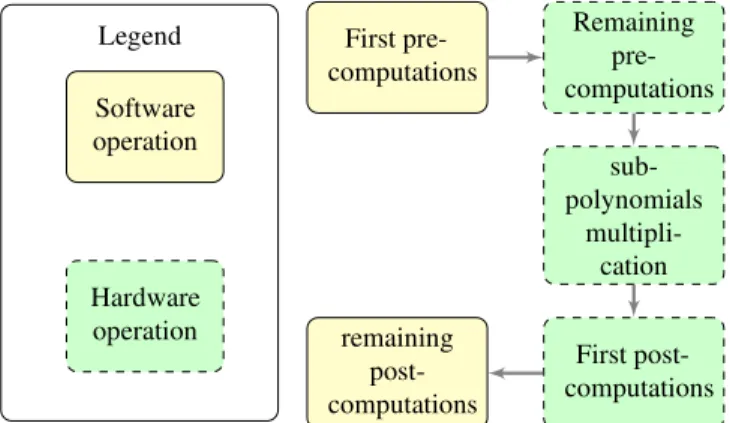
The complete implementation relies on a hardware/software co-design approach. Figure 1 provides a high level flowchart for the proposed accelerator. On the software side, first
pre-computations are performed in order to generate
sub-polynomials. Then, sub-polynomials are sent continuously
to the hardware accelerator which performs the remaining
Karatsuba pre-computations. At that point, degree-4 sub-polynomials are generated in hardware. Then, sub-sub-polynomials are multiplied using the standard multiplication algorithm. Fol-lowing the polynomial multiplication, first post-computations
First pre-computations Remaining pre-computations sub-polynomials multipli-cation First post-computations remaining post-computations Legend Software operation Hardware operation
Fig. 1: Flowchart of the proposed software/hardware co-design approach.
are performed before sending back polynomials to the soft-ware. Finally, the software computes the remaining post-computations.
In order to be able to send continuously polynomials to the hardware, proposed Karatsuba hardware implementation is a fully pipelined one. When input polynomial coefficients are sent in the ascending order, the accelerator produces output
coefficients continuously after a few clock cycles, depending
on the number of pipeline stages. Because the number of
coefficients of output polynomials is greater than input ones,
output polynomials are dispatched into two channels. The
accelerator can run into two modes: A standard mode for
the polynomial multiplication, and a relinearization/key switch mode for relinearization/key switching. For this second con-figuration, the relinearization key is required and must be sent
at the same time than the polynomial to be relinearized/key
switched.
To use embedded resources at their maximum frequency,
we set the datapath to 27 bits. It is the consequence that
embedded DSPs are efficiently implemented to run 27 ×27
bits integer products fastly. Because the size of coefficients
is greater than 27 bits, namely 125 bits, each coefficient
is split into 5 elements of 27 bits each. That implies that
all elementary operations, including adders, subtractors and multipliers, are serialized. Another consequence is that our accelerator performs polynomial operations on coefficients of 27×5 = 135 bits instead of 125 bits required by the security parameters provided in Table I.
In the following, we propose 3 Karatsuba hardware imple-mentations: a Karatsuba with 3 recursions in hardware called Karatsuba-3, which allows the multiplication of two degree-39 polynomials; an implementation with 4 recursions called Karatsuba-4, performing a degree-79 polynomial
multiplica-tion; and a version with 5 recursions in hardware called
Karatsuba-5 for degree-159 polynomial multiplication. A. Karatsuba-3
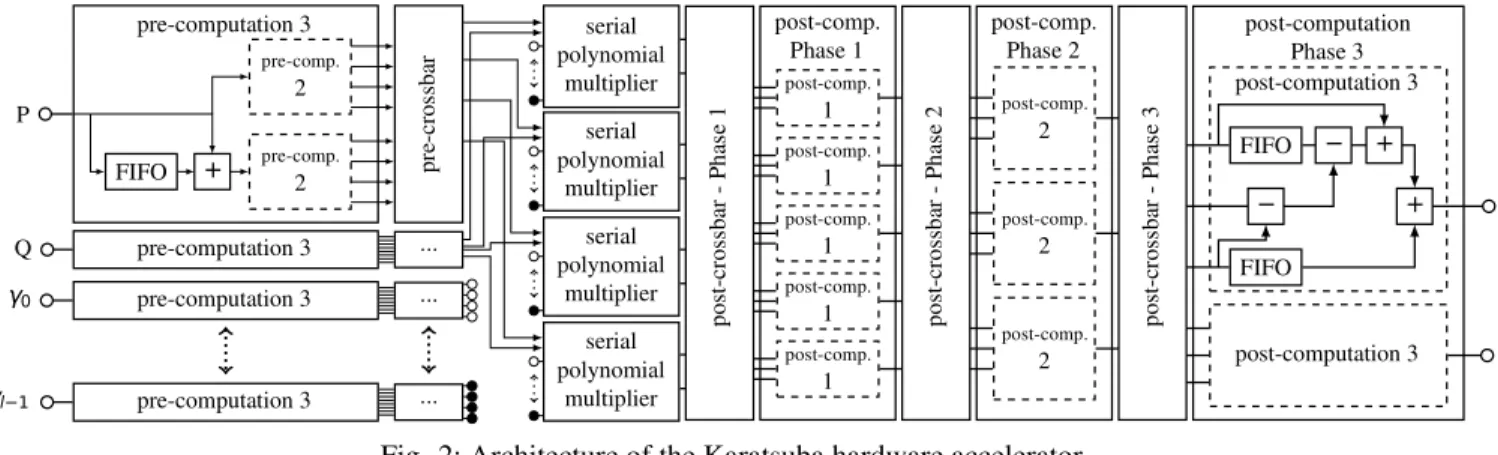
Figure 2 provides the high-level view of the architecture
of Karatsuba-3, where input sub-polynomials are named P
P Q γ0 γl−1 FIFO + pre-computation 3 pre-comp. 2 pre-comp. 2 pr e-cr os sb ar serial polynomial multiplier serial polynomial multiplier serial polynomial multiplier serial polynomial multiplier pre-computation 3 ... pre-computation 3 ... pre-computation 3 ... p os t-cr os sb ar P h as e 1 post-comp. Phase 1 p o st -c ro ss b ar P h as e 2 post-comp. Phase 2 p os t-cr os sb ar P h as e 3 post-computation Phase 3 post-comp. 1 post-comp. 1 post-comp. 1 post-comp. 1 post-comp. 1 post-comp. 2 post-comp. 2 post-comp. 2 post-computation 3 post-computation 3 FIFO FIFO − − + +
Fig. 2: Architecture of the Karatsuba hardware accelerator.
0 1 2 3 4 5 6 7 8 9 10 11 12 13 14 15 16 17 18 19 20 21 22 23 24 25 26 27 28 29 30 31 32 33 34 35 36 37 38 39 TIME P0 0 P10 P30 P40 P0 6 P70 P0 9 P100 P120 P130 P0 15 P160 P0 2 P50 P0 8 P0 11 P140 P0 17 P1 0 P11 P1 2 P0 18 P190 P0 20 P0 21 P0 24 P0 22 P0 23 P0 25 P0 26 out[0] out[1] out[2] out[3] P : Re-scheduled polynomial
Fig. 3: Schedule example after a pre-computation with 3 recursions of Karatsuba.
accelerator generates 4 lines of sub-polynomials, which are
multiplied in parallel. Post-crossbars and post-computations perform the reconstruction of the output polynomial.
1) Pre-computation and pre-crossbar: The pre-computation step is the first block of Karatsuba-3 and performs 3 pre-recursions of Karatsuba on the input
polynomial. Our implementation is based on a recursive
architecture as it can be seen in Figure 2. During a
pre-computation, one has to split into two parts input polynomial P , namely PL and PH. Because coefficients are sent in an ascending order, a FIFO is implemented in order to store first
arrived coefficients, namely coefficients of PL, before adding
them term by term to last ones, namely coefficients of PH.
This creates two channels of polynomials: the first is just
the input and produces PL and PH; and the second one is
just after the polynomial sum and produces sub-polynomial
PL + PH half of the time.
To perform an additional Karatsuba recursion, the same
operation must be applied to PL, PH and PL + PH. That
is why the architecture is duplicated on each channel, with
a minor modification on the FIFOs in order to manipulate
polynomials of halve size, namely PL, PH and PL + PH.
Because each PL + PH channel produces sub-polynomials
half of the time, after 3 pre-computations, several output channels haven’t numerous valid sub-polynomials. That is
why a pre-crossbar is implemented in order to re-schedule
more efficiently sub-polynomials. Figure 3 proposes a scheduling for Karatsuba-3.
2) Serial polynomial Multiplier and serial integer multi-plier: The serial polynomial Multiplier can run in two modes: a standard polynomial multiplier which requires polynomials P and Q; and a relinearization/key switching mode which requires a polynomial P and relinearization/key switching key γ. 4 serial polynomial multipliers are implemented because 4 channels of sub-polynomials are produced after the pre-crossbar of each input polynomial. As it can be seen in Figure 2, the first output of each pre-crossbar is connected to the first polynomial multiplier, the second output to the second
multiplier, and so on. For readability reasons, connections
for relinearization/key switching key are not represented, but mentioned with black and white circles.
Implemented degree-4 polynomial multipliers are based on
the standard polynomial multiplication algorithm. In order
to be able to send polynomials without interruption, a
full-parallel design is implemented and requires 5 serial
inte-ger multipliers in parallel. By the same way, serial integer
multipliers are based on the standard algorithm. Because
polynomial coefficients are split in 5 segments of 27 bits
each, the serial integer multiplier requires 5 DSPs. Thus, the serial polynomial multiplier requires 25 DSPs, and 100 for the overall accelerator.
P Q γ0 γl−1 pre-computation 4 Karatsuba-3 without pre-computation Karatsuba-3 without pre-computation p o st -c ro ss b ar P h as e 4 post-comp. Phase 4 post-comp. 4 post-comp. 4
(a) Karatsuba-4 hardware accelerator.
P Q γ0 γl−1 pre-computation 5 Karatsuba-4 without pre-computation Karatsuba-3 without pre-computation Karatsuba-3 without pre-computation Karatsuba-4 without pre-computation Karatsuba-3 without pre-computation Karatsuba-3 without pre-computation p o st -c ro ss b ar P h as e 5 post-comp. Phase 5 post-comp. 5 post-comp. 5
(b) Karatsuba-5 hardware accelerator.
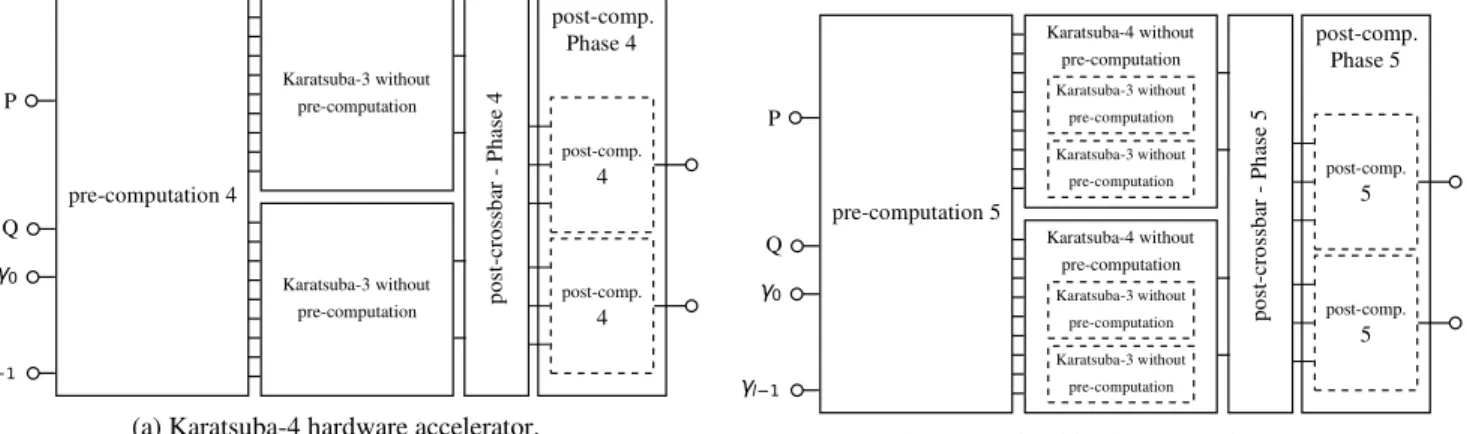
Fig. 4: Proposed architectures to perform 4 and 5 Karatsuba recursions in hardware.
3) Post-crossbar and post-computation: A reverse schedul-ing is required to realign sub-polynomials before post-computations. However, if the post-crossbar is implemented
following the same approach than the pre-crossbar, this one
would be quite complex because all sub-polynomials would be aligned with the most delayed one. That is why in Figure 2, a successive implementation of partial crossbars and post-computations is implemented. Because the pre-crossbar only moved 1/3 of all sub-polynomials, 2/3 of sub-polynomials can be post-computed before any re-alignment, reducing the com-plexity of successive post-crossbars and also storage require-ments. Unlike the pre-computation, because post-computations
and post-crossbars are successively implemented, each
post-computation unit is an elementary one, and so is not imple-mented using a recursive approach.
B. Implementing additional recursions in hardware
The initial design implements 3 Karatsuba recursions in
hardware and 6 recursions in software. In order to re-duce software computation times, we propose an adaptation
of Karatsuba-3 to execute further recursions in hardware.
The study provides a method, especially for pre- and
post-crossbars, and hardware results for 4 and 5 recursions. 1) Impacts on the sub-systems: Implementing additional
recursions in hardware does not impact each sub-system
equally. Due to the scalability of pre- and post-computation units, these components are not much impacted, but require additional logic and temporary storage. Degree-4 polynomial multipliers internal structure remains unchanged, because fur-ther Karatsuba recursions only means additional lanes of sub-polynomials at the output of pre-crossbars, and thus just
more degree-4 polynomial multipliers in parallel. For
pre-and post-crossbars, additional recursions means a more com-plex schedule of sub-polynomials, and thus possible comcom-plex crossbars. When 8 channels of sub-polynomials were produced
3 4 5 6 7 8 9 10 11 12 13 14 15 16 17 18 19 20 21 22 23 24 25 26 27 28 29 30 31 32 33 34 TIME out[0] out[1] out[2] out[3] out[4] out[5] out[6] out[7] P0 0 P01 P30 P04 P0 6 P0 7 P0 9 P100 P120 P013 P0 15 P0 16 P0 18 P190 P210 P022 P0 24 P0 25 P0 2 P0 5 P0 8 P0 11 P0 14 P0 17 P0 20 P023 P0 26
after 2 recursions after 2 recursions
after 2 recursions
Spacial polynomial organization after 3 recursions
Fig. 5: Spacial organization of sub-polynomials after 3 Karat-suba pre-recursions, and the link with the spacial organization of sub-polynomials in the previous recursion.
for Karatsuba-3, 16 are produced for Karatsuba-4 and 32 for Karatsuba-5.
2) Adaptation of pre- and post-crossbars: For 4 and 5 recursions in hardware, the pcrossbar has to manage
re-spectively 16 and 32 channels of sub-polynomials, which
possibly requires a complex architecture when one wants
to reduce as much as possible the number of channels in
order to limit hardware resources consumption. Instead of
designing complex crossbars, with a risk of reducing the
design maximum frequency, we propose a method which
does not require additional developments. Figure 5 presents the spacial organization of sub-polynomials after 3 Karatsuba
pre-recursions, and the link with the spacial organization of
sub-polynomials in the previous recursion. Because the
pre-computation architecture is recursive, the spacial organization of sub-polynomials is recursive too. To determine the spacial organization of sub-polynomials for the next recursion, one
just has to duplicate the previous one two times: one time on the same channels, and the other time to fresh channels. Because the pre-crossbar role is to spatially organize in a better manner sub-polynomials, the previous remark on spacial orga-nization of sub-polynomials between two successive Karatsuba recursions can be used to create a new somewhat efficient sub-polynomial schedule. To generate the Karatsuba pre-crossbar, one can reuse the Karatsuba-3 pre-schedule twice. One time on the first 8 channels of the pre-computation unit of Karatsuba-4, and the other one on the remaining channels. As one can see in Figure 5, the south-west area is free of sub-polynomials, which means that the second pre-crossbar will not run half of the time. That is why compared to the Karatsuba-3 schedule, DSPs
usage only decreases by 25%. For 3 Karatsuba recursions,
the DSPs usage is of 84.38%, it decreases to 63.29% for 4
recursions, and reaches 47.46% for 5 recursions.
To counterbalance, the post-crossbar for the 4th iteration is
very simple, because the spacial organization for the step has not been modified.
3) High-level architectures: Figures 4a and 4b provide the architecture of Karatsuba-4 and Karatsuba-5 designs.
The Karatsuba-4 approach is presented in the following, but
Karatsuba-5 design follows the same approach.
All pre-computations are generated in a unique entity, by using the proposed pre-computation unit presented in Section III-A1. Then, the Karatsuba-3 pre-crossbar must be applied twice:
one time on the first 8 outputs of the pre-computation unit,
and a second time on the 8 remaining outputs. Remaining
computations on each branch until the 4th post-computation
remain the same than Karatsuba-3. Finally, the 4th
post-computation is performed after a quite simple post-crossbar.
As it can be noticed, the strategy provided to adapt
pre-and post-crossbars leads to duplicate the logic 2 times
for Karatsuba-4 compared to Karatsuba-3, and 4 times for
Karatsuba-5. This remark leads to two main issues. First, be-cause FPGAs have limited embedded multipliers, the number
of DSPs required will drive the choice of the target FPGA.
For 3 Karatsuba recursions, 100 DSPs are required, which
is not a particular issue because even smaller FPGAs like a
Cyclone V have such a number of multipliers. This is not
all the time true for the next implementations, namely for 4
and 5 Karatsuba recursions, because respectively 200 and 400
DSPs are required. In particular, if one wants to target an
embedded system with an energy efficient design, Cyclone V SoC family owns at most 112 DSPs, which limits the design to 3 recursions. Second, doubling the number of logic between
each recursion will quickly lead to large design for small
FPGAs. It will also limit the number of parallel Karatsuba implementable in parallel.
C. Hardware implementations results
Table II provides hardware implementation results. In order
to thoroughly explore the proposed approach, we address
3 different platforms. For embedded systems, we present
results for a SoCkit platform from Terasic, embedding a
small Cyclone V (5CSXFC6D6F31C6N) FPGA with 41,910
ALMs and 112 DSPs. The second platform is a DE5-net
450 from Terasic, especially designed for speeding up
software applications with the help of a PCIe. This platform
embeds a powerful Stratix V (5SGXEA7N2F45C2) FPGA
with 234,720 ALMs and 256 DSPs. The last one is the
Catapult platform from Microsoft, used in [1] to accelerate Homomorphic Encryption. With its 172,600 ALMs and above
all its 1,590 DSPs, this platform can address all Karatsuba
implementations. Due to the relatively low design frequency
for the Cyclone V FPGA with the balanced mode of
Quartus, we present implementation results when aggressive
performance optimization mode is enabled in Quartus II. For
Karatsuba-5 design, only the Catapult platform can embed
this one due to the number of DSPs required, thus hardware
results are only given for this platform. Our implementation is a fully pipelined implementation of Karatsuba, thus we do not provide number of clock cycles required for the accelerator, because it is not relevant. The overall computation time
will be determined in Section III-D, when the complete
design, including the software part running on the CPU
will be presented. Hardware resources of the FFT/NTT
implementation in [1] is also provided, able to perform a
FFT/NTT of size 4096 with coefficients of size 125 bits. 1) Karatsuba with 3 recursions: As one can see, important efforts are required to reach acceptable performance for the Cyclone V approach. The balanced design runs at 148.7 MHz with 64% of logic consumption. If one wants to increase the maximum frequency, one can reach up to 184.4 MHz with minimum efforts, namely selecting the aggressive performance mode in Quartus II, but at a cost of 80% of the available logic. As one can see, the Quartus algorithm tries to limit the number
of embedded memory to increase performances, at a cost of
extra registers.
For Stratix V FPGAs, the design only requires 12.7% of
logic resources for the DE5-net 450 platform, and 17.2% for the Catapult platform. Because the PCIe limits the
max-imum design frequency to 250 MHz, the frequency margin
permits to implement other accelerator in parallel, or even other Karatsuba. For the DE5-net 450 platform, due to the limitation in terms of DSP, only 1 additional Karatsuba can be implemented. For the Catapult approach, a maximum of 5 Karatsuba can be implemented in parallel. However, in Altera FPGAs, the PCIe is implemented on the FPGA-side as a 256 bits bus, full duplex, implementing 5 Karatsuba-3 in parallel
requires a bus of 27×2×5 = 270bits large. Thus, in practice,
only 4 Karatsuba-3 can be implemented.
Compared to the FFT approach, our accelerator saves 57%
of ALM resources, 46% of registers, 99.95% of embedded memory and about 30% of DSPs.
2) Karatsuba with 4 recursions: If one has a larger FPGA, the Karatsuba implementation with 4 recursions can be a good balance to accelerate SHE polynomial arithmetic.
Karatsuba-4 requires 26.5% of the overall logic in the DE5-net 450
platform, and 36% for the Catapult one. Due to the limitation of DSPs on the DE5-net 450, no additional Karatsuba-4 design
TABLE II: Hardware implementations results compared to FFT implementation in [1].
Algorithm recursions platform mode ALM Registers Embedded
memory DSP fmax
Karatsuba 3 SoCkit Balanced 27,034 (64.5%) 70,273 12,855 100 (89%) 148.7 MHz
Performance 33,915 (80.9%) 93,310 4,297 100 (89%) 184,4 MHz Karatsuba 3 DE5-net Balanced 29,718 (12.7%) 76,706 4,131 100 (39%) 355.75 MHz Catapult Balanced 29,715 (17.2%) 76,730 4,131 100 (6.3%) 334.0 MHz 4 DE5-net Balanced 62,215 (26.5%) 155,427 12,638 200 (78.1%) 330.58 MHz Catapult Balanced 62,202 (36%) 155,299 12,638 200 (12.6%) 355.75 MHz 5 Catapult Balanced 124,978 (72.4%) 309,416 101,380 400 (25.6%) 321.34 MHz FFT [1] Catapult Performance 69,058 (40%) 144,747 8,031,568 144 (9.1%) 100 MHz
TABLE III: Implementations results compared to FFT implementation from [1], where (A) refers to the polynomial
multiplication and (B) the relinearization/key switching.
Our design FFT [1]
Setup ( n, log2q) (2560, 125) (4096, 125)
Hardware Karatsuba recursions 3 4 5
(A) Software pre-computation 531 µs 385 µs 270 µs Hardware accelerator 583.2 µs 388.8 µs 259.2 µs Software post-computation 1.35 ms 931 µs 710 µs Total 2.46 ms 1.704 ms 1.24 ms 1.96 ms (B) Software pre-computation 343 µs 212 µs 135 µs Hardware accelerator 583.2 µs 388.8 µs 259.2 µs Software post-computation 1.35 ms 931 µs 710 µs Total 2.28 ms 1.53 ms 1.104 ms 4.79 ms (A) + (B) Total 4.74 ms 3.23 ms 2.34 ms 6.75 ms
Area × latency (ALM · s)
(A) 73 105 154.9 136
(B) 68 95 137 331
(A) + (B) 141 201 292 466
can be implemented, and only 1 additional design for the
Catapult one. Regarding the resources consumption, if we do not take into account embedded memory consumption, this design is the closest one in terms of resources consumption compared to the FFT implementation in [1].
3) Karatsuba with 5 recursions: For the Karatsuba with
5 recursions, one begins to reach the limit of the approach.
First, only the Catapult platform can embed this accelerator
due to the number of DSP required. Second, the number of
logic resources does not allow the implementation of multiple units in parallel, because it requires 72.4% of the total amount of ALMs. However, this implementation reduces as much as possible the total computation time because the pre- and
post-computations required in software are limited. As one
can see, the number of embedded memory used grows up. A possible explanation is that each additional
post-crossbar/post-computation requires to store even larger polynomials. For
the 5th recursion, a degree-159 polynomial must be stored,
implying 21,600 bits. It is also possible that the tool tries to limit the use of registers, so ALMs, because the design begins to reach the device limits.
D. Evaluation of the complete computation time
In order to completely evaluate degree-2559 polyno-mial multiplication and relinearization/key switch operation,
the software computation of the remaining pre- and
post-computations is required. Table III recaps software compu-tation time for the 3 different hardware implemencompu-tations, and
the total computation time taking into account the hardware
latency. It also provides the area-latency product for each
design, taking into account the complete computation time (polynomial multiplication + Relin/key switch).
The software is executed on an Intel core i7-4910MQ with 4 cores running at 2.9 GHz. Hardware computation time is given by taking an operating frequency of 250 MHz, limitation due to the PCIe.
As one can see, our accelerator is very competitive
com-pared to FFT/NTT implementation in terms of latency. Even
with the Karatsuba-3 design, our accelerator outperforms
FFT/NTT for the relinearization/Key switching step, with
approximately 47% of computation time saved. This is a
consequence that FFT/NTT has much less flexibility than Karatsuba approach. For a pure polynomial multiplication, the FFT/NTT still remains competitive for Karatsuba-3, due to the lower complexity asymptotically. However, this is not the
case when additional recursions are made in hardware, because the post-computation in software drops down. Thus, Karatsuba approach is a good alternative to FFT/NTT in any scenario. The area - latency product provides a good indicator to com-pare designs, because it indicates the efficient use of FPGA
resources. As one can see, the fully optimized Karatsuba-3
design has the lowest area - latency product compared to other Karatsuba implementations. It is a consequence of the not op-timized schedule implemented for 4 and Karatsuba-5. For the polynomial multiplication only, the area - latency product shows that the FFT implementation is still competitive, despite the fact that the polynomial multiplication achieved is larger, namely for degree-4095 polynomials instead of 2559. However, Karatsuba is much better for the relinearization/key switching, because the FFT fails in terms of flexibility.
IV. CONCLUSION
In this paper, we demonstrate that for some cases, Karatsuba
algorithm can be a good alternative to FFT/NTT. The study
provides 3 architectures for speeding up degree-2559
poly-nomials multiplication and the relinearization/key switching with coefficients up to 135 bits, with a software/hardware co-design approach. Proposed architectures perform respectively
3, 4 and 5 Karatsuba pre- and post-recursions, plus the
sub-polynomials multiplication.
For the first design with 3 recursions, the accelerator can per-form a polynomial multiplication in 2.46 ms and a relineariza-tion/key switching in 2.28 ms, which is already competitive compared to FFT/NTT implementation in [1] due to the poor flexibility to perform efficiently the relinearization/key switch-ing. Remaining Karatsuba implementations keep reducing the computational time, at a cost of doubling hardware resources between each additional recursion. For 5 recursions in hard-ware, the polynomial multiplication is performed in 1.24 ms and the relinearization/key switching in 2.34 ms, which halves
computation times compared to the first Karatsuba design.
Thus, the paper provides some key information in order to
select an approach depending on the application constraint, namely hardware resources available.
Future work will consist on developing a complete demonstra-tor using the provided Karatsuba implementation.
ACKNOWLEDGMENT
This study has been partially funded by the french Direction G´en´erale de l’Armement (DGA).
REFERENCES
[1] T. P¨oppelmann, M. Naehrig, A. Putnam, and A. Macias, “Accelerating homomorphic evaluation on reconfigurable hardware,” in Proc. of
Cryp-tographic Hardware and Embedded Systems – CHES 2015. Springer, pp. 143–163.
[2] M. van Dijk, C. Gentry, S. Halevi, and V. Vaikuntanathan, “Fully homomorphic encryption over the integers,” in Proc. of Advances in Cryptology – EUROCRYPT 2010. Springer, pp. 24–43.
[3] J.-S. Coron, T. Lepoint, and M. Tibouchi, “Scale-invariant fully homo-morphic encryption over the integers,” in Proc. of Public-Key
Cryptog-raphy – PKC 2014. Springer, pp. 311–328.
[4] J. W. Bos, K. Lauter, J. Loftus, and M. Naehrig, “Improved security for a ring-based fully homomorphic encryption scheme,” in Proc. of Cryptography and Coding: 14th IMA International Conference – IMACC 2013. Springer, pp. 45–64.
[5] Y. Dor¨oz and B. Sunar, “Flattening ntru for evaluation key free ho-momorphic encryption,” Cryptology ePrint Archive, Report 2016/315, 2016.
[6] Z. Brakerski, C. Gentry, and V. Vaikuntanathan, “(leveled) fully ho-momorphic encryption without bootstrapping,” in Proc. of the 3rd
Innovations in Theoretical Computer Science Conference – ITCS 2012,
pp. 309–325.
[7] Z. Brakerski, “Fully homomorphic encryption without modulus switch-ing from classical gapsvp,” in Proc. of Advances in Cryptology –
CRYPTO 2012.
[8] J. Fan and F. Vercauteren, “Somewhat Practical Fully Homomorphic Encryption,” Cryptology ePrint Archive, Report 2012/144, 2012. [9] C. Gentry, A. Sahai, and B. Waters, “Homomorphic encryption
from learning with errors: Conceptually-simpler, asymptotically-faster, attribute-based,” in Proc. of Advances in Cryptology – CRYPTO 2013, pp. 75–92.
[10] Z. Brakerski and V. Vaikuntanathan, “Lattice-based fhe as secure as pke,” in Proc. of the 5th Conference on Innovations in Theoretical Computer
Science – ITCS 2014. ACM, pp. 1–12.
[11] A. Khedr, G. Gulak, and V. Vaikuntanathan, “Shield: Scalable homo-morphic implementation of encrypted data-classifiers,” Accepted to IEEE
Transactions on Computers, 2015.
[12] J. Pollard, “The Fast Fourier Transform in a Finite Field,” in
Mathemat-ics of Computation, 1971, vol. 25, no. 90, pp. 365–374.
[13] A. Aysu, C. Patterson, and P. Schaumont, “Low-cost and area-efficient FPGA implementations of lattice-based cryptography,” in Proc. of IEEE
International Symposium on Hardware-Oriented Security and Trust (HOST), 2013, pp. 81–86.
[14] N. G¨ottert, T. Feller, M. Schneider, J. Buchmann, and S. Huss, “On the Design of Hardware Building Blocks for Modern Lattice-Based En-cryption Schemes,” in Proc. of Cryptographic Hardware and Embedded
Systems — CHES 2012, ser. LNCS, no. 7428, pp. 512–529.
[15] J. A. Solinas, “Generalized mersenne prime,” in Encyclopedia of
Cryp-tography and Security. Springer, 2011, pp. 509–510.
[16] S. Sinha Roy, K. J¨arvinen, F. Vercauteren, V. Dimitrov, and I. Ver-bauwhede, “Modular hardware architecture for somewhat homomorphic function evaluation,” in Proc. of Cryptographic Hardware and
Embed-ded Systems – CHES 2015. Springer, pp. 164–184.
[17] D. Pamuła, E. Hrynkiewicz, and A. Tisserand, “Analysis of gf 2233 multipliers regarding elliptic curve cryptosystem applications.” vol. 45, no. 7, pp. 271 – 276, 2012.
[18] T. Lepoint and M. Naehrig, “A Comparison of the Homomorphic Encryption Schemes FV and YASHE,” in Proc. of AFRICACRYPT 2014, ser. LNCS, vol. 8469, pp. 318–335.
[19] N. P. Smart and F. Vercauteren, “Fully homomorphic simd operations,”
![TABLE I: Parameters for FV extracted from [18] satisfying a security level λ of 80 bits, with ω set to 27 bits.](https://thumb-eu.123doks.com/thumbv2/123doknet/11638976.306930/3.918.468.848.115.318/table-parameters-extracted-satisfying-security-level-bits-bits.webp)
![TABLE II: Hardware implementations results compared to FFT implementation in [1].](https://thumb-eu.123doks.com/thumbv2/123doknet/11638976.306930/8.918.68.849.96.283/table-ii-hardware-implementations-results-compared-fft-implementation.webp)
