P a g e 1
N
O
.
44
D
EFINING SCENARIOS OF FUTURE POVERTY
:
A PROSPECTIVE
ASSESSMENT AND RELEVANT PREVENTIVE POLICIES
October 2016
Rafael De Arce,
University Autonoma de Madrid, [email protected]Eva Medina,
University Autonoma de Madrid, [email protected]Gloria Pérez-Salazar,
School of Government and Public Transformation Monterrey, [email protected]Delia Visan,
University Paris Dauphine, [email protected]“Neither tomorrow - nor yesterday - is written. […] The future is a stimulating prospect of adventure and flight - tomorrow is not written. The future therefore has to be shaped since it is not merely a matter of fatality or destiny; it is in the hands of each human being. Our lives, at the personal and social level, are open-ended projects capable of reaching unsuspected heights of beauty and creativity”1.
In order to plan strategic policy-oriented measures to reduce poverty, a long-term view should be prioritized. This essentially means the recognition of the many factors that can lead to “surprising futures”, and the different ways they can combine at a fundamental level to define potential future scenarios. This brief adopts a forward-looking analysis of potential new scenarios of poverty, related to emerging social issues. Specifically, the main objective is to answer this question: what are the major trends which may have an effect on poverty reduction to 2030?
Major societal challenges such as global warming, chronic diseases, population growth, international migrations, and technological change, are becoming more and more complex. However, not all societal challenges have the same impact on poverty, nor the same probability of occurrence. In addition, the inter-relationship among these topics increases the difficulty of understanding what might happen in the future.
1 Federico Mayor Zaragoza, Toledo, May 1999. Machado (Iberian God): “ ¡Qué importa un día! Está el ayer alerto / al
mañana, mañana al infinito, / hombres de España, ni el pasado ha muerto, / no está el mañanani el ayer Escrito”.
P a g e 2
The idea of ‘strategic scenarios’ could help policy-makers to anticipate threats, by measuring likelihood and eventual impacts, and to “rehearse the future”. What are the implications for policy depends on the regions of the world where these issues are identified. Therefore, policy makers should address issues taking appropriate measures according to each geographical area.
In order to address this challenge, more than 200 experts among NOPOOR researchers, stakeholders, external experts, and NGOs have been consulted. Here, we present a summary of the research results, defining three potential futures, and some main levers, which will activate or deactivate them.
Main poverty challenges: governance, education, water and sanitation, natural disasters, and
military conflicts
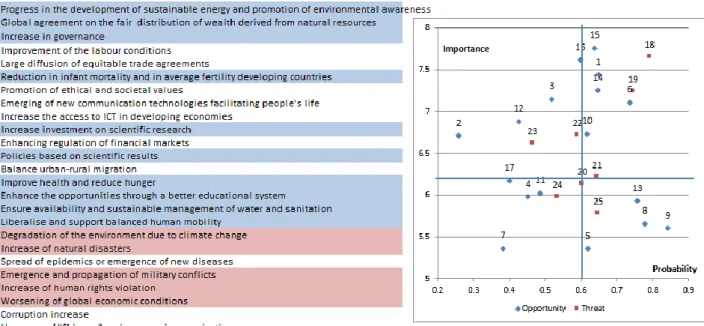
A key feature of the future scenarios design is the importance of recognising that many factors could emerge, creating “surprising futures”. The different ways in which these factors combine could be crucial and hence need to be defined. In the first step of the investigation a list of events grouped into 25 factors affecting poverty by 2030 (based on the results coming from a survey answered by experts in different fields of poverty knowledge).
Figure 1. Factors affecting poverty by 2030
Given the difficulty of defining alternative developments for 25 factors and the connection (correlation) among them, a multistep synthetic exercise was conducted. First, Nopoor experts carried out a new survey in which participants were asked to define the importance and likelihood of occurrence of the 25 factors previously identified. The results allowed the identification of 15 priority issues [highlighted in blue or red above], which were scored highly in terms of their impact on poverty.
After defining the main factors, it was clear that a regional perspective was fundamental to identifying the different impacts of these factors. At this point, the research focuses on what are considered the most vulnerable regions of the world: North and sub-Saharan Africa, East Asia and the Pacific, South Asia, and Latin America. Aspects such as development level differences, physical exposure to the different factors and ways of addressing these factors in the recent past are key considerations in the production of the different scenarios of poverty by 2030 and, more importantly, in the design of strategies to prevent certain threats and drive forward other poverty alleviation opportunities.
P a g e 3
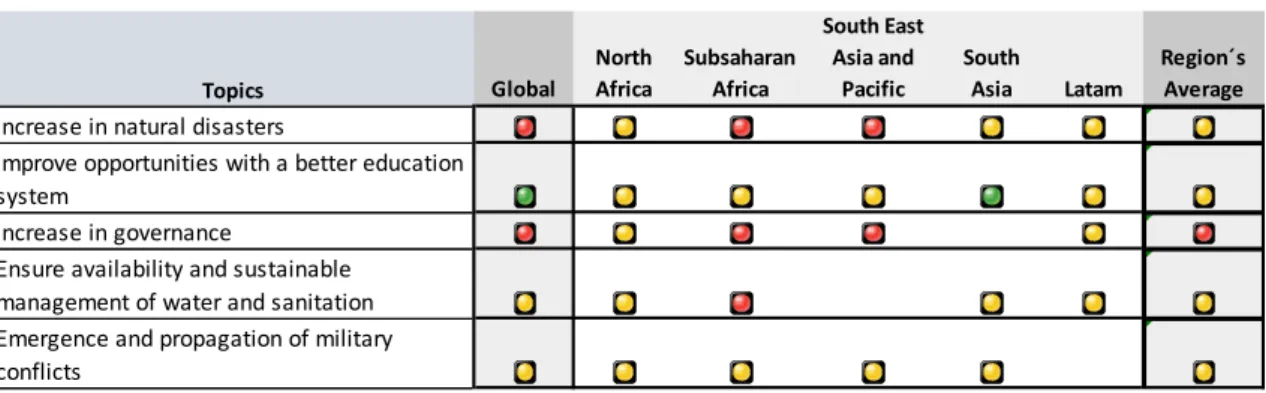
The 15 priority factors were then divided between ‘trend’ factors and ‘pivotal’ factors. The trend variables include those 10 factors that the experts identified as having a high probability of occurrence, with a large consensus regarding their future occurrence (both globally and regionally considered). On the other hand, the pivotal variables include those that the experts deemed uncertain, with a low probability of occurrence, and also include those that met with no consensus, suggesting uncertain developments at regional level. The five factors identified as pivotal are presented in Figure 2.
In sum, results of consultation workshops highlight five main areas with most acute challenges for poverty reduction: governance, education, water and sanitation, natural disasters, and military conflicts. The results are very similar to and make the link with many of the UN’s Sustainable Development Goals (SDG). Mainly: “end poverty in all its forms everywhere” (SDG 1); “ensure inclusive and equitable quality education and promote life-long learning-opportunities“ (SDG 4); “ensure availability and sustainable management of water and sanitation for all” (SDG 6); “protect, restore and promote sustainable use of terrestrial ecosystems, sustainably manage forests, combat desertification and halt and reverse land degradation and halt biodiversity loss” (SDG 15); and “promote peaceful and inclusive societies” (SDG16).
Figure 2. The pivotal topics
Note: The green code refers to factors that will most probably occur with a high degree of certainty, given their continuous improvement based on current developments, generating a predicted optimistic poverty reduction trend. The yellow code represents highly relevant factors whose probability of occurrence is unlikely or unknown: "uncertain or unlikely to occur", consequently, their impact on poverty could be either positive or negative. The red code denotes risks in the form of negative and adverse factors with an elevated likelihood of occurrence and positive factors with a low probability of materializing.
Scenarios of future of poverty
Taking into account the five factors, three scenarios of the future of poverty emerged as the status-quo scenario (“waiting, crying and hoping”); the most optimistic scenario (“Here comes the Sun”); and the most pessimistic scenario (“Help!”).
Figure 3. Main poverty challenges in the scenarios of future of poverty
Topics Global North Africa Subsaharan Africa South East Asia and Pacific South Asia Latam Region´s Average
Increase in natural disasters
Improve opportunities with a better education system
Increase in governance
Ensure availability and sustainable management of water and sanitation Emergence and propagation of military conflicts
P a g e 4 From 0 to 3: 0 is worst performance in reducing problems related with the topic and 3 is the best potential evolution
“CRYING, WAITING AND HOPING”:
A status quo projection in which the situation doesnot change that much from the current state of affairs.
• Primary education is finally universal worldwide, although major challenges remain (access, quality and affordability of higher education).
• Illegitimate, corrupt governments with opaque policies remain in place, making the management of water resources and sanitation unsustainable as there is no budget allocated for it.
• On the damage caused by extreme natural events: work to alleviate the effects of global warming has reduced the impact on human lives, but these events still wreak devastating damage on physical assets.
• Armed conflicts still have a moderate effect and are long-lasting, destroying years of development in many cases.
“HELP!”:
A dramatic scenario, where the population has to overcome much adversity.• Natural disasters are still a growing problem claiming slightly fewer human casualties, but wreaking devastating damage on infrastructures and the physical environment and hence placing an even greater burden on already-degraded land.
• Access to clean water and sanitation remains poor as some countries continue to struggle to provide these basic amenities to their population. These countries are also the hardest hit by extreme natural events.
• The situation is exacerbated by illegitimate, corrupt governments wreaking total havoc. Armed conflicts show no sign of abating, and their negative impacts are neither fully averted nor properly sanctioned.
• The glimmer of hope is dashed by growing generations with little access to basic, quality education facing huge higher education challenges.
“HERE COMES THE SUN”:
The glimmer of hope comes in the form of better-educated citizenswho are able to overcome adversity in a more confident manner.
• Natural disasters are still a growing problem with less of an impact on human lives, but devastating effects on the physical environment.
• Although progress has been made with access to clean water and sanitation, some countries still lag far behind.
P a g e 5
• Despite decisive progress with establishing legitimate governments worldwide, governments in some areas continue to be plagued by corruption. A number of these regimes are in turn associated with certain ongoing and new armed conflicts.
• However, growing generations of well-informed, innovative, skilled young adults have the tools they need to address these hardships and difficulties, and are able to move to revolution and guide humankind towards a brighter future.
It is beyond the scope of this document to draw up an exhaustive roadmap for all of the poverty dimensions in all of the above-mentioned world regions. Our intention is to present a practical and synthesised list of aspects to be taken into account when designing specific policies. In this sense, some crucial policy recommendations are showed by geographic region. They are mainly directed to the stakeholders at national level (governments of developing countries) and at international level (the United Nations, the World Bank, the European Commission).
The following table presents, for each one of the five pivotal factors, the strategies identified for implementation in each of the regions considered in the above analysis. As can be seen, most of the factors are endogenous in that they are characteristic of the country and it is hence the country that should address the issue, taking appropriate measures or action. Other factors are exogenous in that they are not inherent to the country, but are rather environmental. In these cases, the countries cannot take concrete measures or specific policy actions. In the latter case, for example, good governance could foster regional agreements to learn from best practices and close the gaps between developed and developing countries.
INCREASE REGIONAL GOVERNANCE:
Increase in global and country-specific good governance, rule of law and corruption control working towards obtaining fundamental freedoms, transparency, participation, equity, pluralism, etc.
East Asia and
Pacific While the focus of integration with Southeast Asia rests on economics, it is important to move towards more comprehensive political and security‐related integration. Clear commitment and leadership from governments, the business sector and civil society is critical. The community will be tasked with leading closer regional anti-corruption cooperation, collaboratively defining specific annual indicators and assessing their implementation, such as achieving effective anti-corruption policies, legislation and strategies.
Latin America
If this new generation is to be heard, significant progress absolutely must be made with the democratic system to introduce real democracy that will increase confidence in its institutions. The real hope in this is placed in educational improvements by society and in political change promoted by social movements, both long-term issues.
Lastly, bear in mind the deeply rooted inequalities in Latin American society, which policymakers need to consider when developing and implementing public policies whose effectiveness will be closely associated with targeting the most vulnerable and marginalised groups.
ENSURE AVAILABILITY AND SUSTAINABLE MANAGEMENT OF WATER AND SANITATION
Efficient, sustainable and environmentally friendly management of water resources for the establishment of and access to clean drinking water, sanitation and hygiene.
Sub-Saharan Africa
Official development assistance should target in particular drought action in sub-Saharan Africa, including the promotion of stricter water controls in countries facing sudden rainfall variations and facilitating producer access to short-cycle seeds more resistant to water stress. Policies promoting more stable remittance flows and a more efficient use of resources would step up the reduction of poverty and inequality in developing countries.
North Africa
Generating the conditions required for widespread decent living conditions in the region (in terms of personal and community security, equal access to health and education, social protection, infrastructure facilities, sanitation, electricity, etc.) is seen as the pillar that will stabilise the area’s sustainable growth and have beneficial effects on social integration and more balanced human mobility.
P a g e 6
EMERGENCE AND PROPAGATION OF ARMED CONFLICTS
Ongoing armed conflicts and emergence/propagation of new armed conflicts affecting the population’s security and hindering any possible development.
North
Africa Armed conflicts, terrorism and the threat of religious radicalisation are top of the list of problems to be urgently addressed for decisive progress in order to build a solid base for the peaceful future of these societies. More broadly, building social and geographic inclusion capacities could help solve human conflicts (undesired mobility and violent events), inequality in resources and wealth distribution, access to welfare state benefits, etc.
Latin
America Violence is one of the most serious problems in Latin America, affecting the region’s health, welfare, economic development and security. Assisting action against violence and armed conflicts, characterised by a military intervention that seeks to counter the high level of corruption within the police, calls for work on the roots of the problem: first, in terms of the consolidation of more democratic institutions and the development of public security policies; and, secondly, by reducing inequalities between areas and social classes.
IMPROVE OPPORTUNITIES WITH A BETTER EDUCATION SYSTEM
Provision of high-quality education enhancing people’s knowledge and foundation, ability to think critically and make informed decisions, solve problems, etc. in an increasingly competitive global economy.
East Asia
and Pacific Work on the priority areas that will improve opportunities by means of a better education system over the next 15 years: access, equity, quality, relevance, lifelong learning, governance and financing. This will call for collaboration to be fostered among UNESCO, respective education ministries, NGOs, CSOs and other education partners in order to increase and sustain enrolment. South
Asia
In addition to targeting growing income disparities as a source of political and social instability, education and civic engagement could play a critical role in shifting governance structures in the future.
North Africa
Actions such as improvements to education, professional capacity building, public and private stimuli for innovative start-ups, and modernization of the economic structures are urgently needed in order to secure the status of more developed countries.
Sub-Saharan
Africa People need skills and training. The poverty gap can be narrowed by improving the quality of the production of education services. This calls for teacher training and incentives to be put into place by local governments. Another measure to be taken into account is improving the quality of the education system’s management. Training facilities and vocational training should focus in particular on young people entering the labor markets.
Latin America
Although significant progress has been made with access to education, it is still not universal. In this area, the region needs to focus its efforts on ramping up access to secondary education as the minimum level of education required for the population to earn the necessary income to escape poverty. Broader coverage needs to be accompanied by a quality supply of education, for which investment in education is a key element. This calls for an increase in investment levels, still far below those found in other more developed areas, and a move to prevent their concentration in areas of higher incomes. If the education system is to be reformed in this direction, and hence increase labour market access opportunities for young Latin Americans, corruption and elite systems need to be eliminated.
INCREASE IN NATURAL DISASTERS DUE TO CLIMATE CHANGE
Prevalence of adverse natural events (often extreme and sudden) such as earthquakes, tsunamis, volcanic eruptions, windstorms, floods, droughts, heatwaves, etc. damaging vulnerable areas.
East Asia and
Pacific Death and damage due to natural disasters expose the cumulative implications of human decisions. Prevention is possible and often less costly than disaster relief and response. Disaster risk could be reduced by strengthening resilience: the ability of societies to resist, cope with and recover from shocks. Change the emphasis from reducing or compensating for disaster losses and damage to transforming the underlying drivers that generate risk in the first place.
P a g e 7
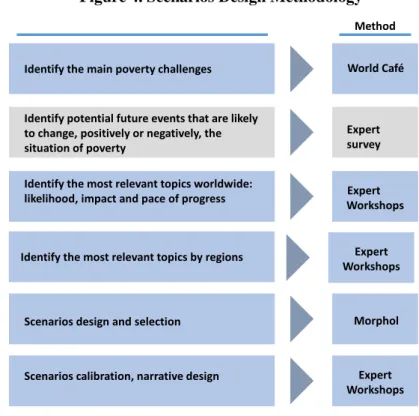
A sound research design was implemented to capture the qualitative and quantitative dimensions of investigation. A wide range of methods were combined, as showed in the graph below.
Figure 4. Scenarios Design Methodology
More than 200 experts among Nopoor project researchers, policy makers and think-thank representatives participated in this process. The list of experts includes economists, specialists in development studies, sociologists, experts in international relationships, demographers, experts in labor market and immigration, anthropologists, specialists in energy and environment, and policy consultants
.
Identify the main poverty challenges
Identify potential future events that are likely to change, positively or negatively, the situation of poverty
Identify the most relevant topics worldwide: likelihood, impact and pace of progress
World Café Expert survey Expert Workshops Method
Identify the most relevant topics by regions Expert
Workshops
Scenarios design and selection Morphol
Scenarios calibration, narrative design Expert
Workshops
P a g e 8
PROJECT NAME NOPOOR – Enhancing Knowledge for Renewed Policies against Poverty
COORDINATOR Institut de Recherche pour le Développement, Paris, France
CONSORTIUM CDD The Ghana Center for Democratic Development – Accra, Ghana
CDE Centre for Development Economics – Delhi, India
CNRS (India Unit) Centre de Sciences Humaines – New Delhi, India
CRES Consortium pour la Recherche Èconomique et Sociale – Dakar, Senegal GIGA German Institute of Global and Area Studies – Hamburg, Germany GRADE Grupo de Análisis para el Desarrollo – Lima, Peru
IfW Kiel Institute for the World Economy – Kiel, Germany IRD Institut de Recherche pour le Développement – Paris, France
ITESM Instituto Tecnológico y de Estudios Superiores de Monterrey – Monterrey, Mexico LISER Luxemburg Institute of Socio-Economic Research – Esch-sur-Alzette, Luxemburg OIKODROM - The Vienna Institute for Urban Sustainability – Vienna, Austria
UA-CEE Université d’Antananarivo – Antananarivo, Madagascar UAM Universidad Autónoma de Madrid – Madrid, Spain UCHILE Universidad de Chile – Santiago de Chile, Chile
UCT–SALDRU University of Cape Town – Cape Town, South Africa UFRJ Universidade Federal do Rio de Janeiro – Rio de Janeiro, Brazil UNAMUR Université de Namur – Namur, Belgium
UOXF-CSAE University of Oxford, Centre for the Study of African Economies – Oxford, United Kingdom
VASS Vietnamese Academy of Social Sciences – Hanoi, Vietnam
FUNDING SCHEME FP7 Framework Programme for Research of the European Union –SSH.2011.4.1-1:
Tackling poverty in a development context, Collaborative project/Specific International Cooperation Action. Grant Agreement No. 290752
DURATION April 2012 – September 2017 (66 months)
BUDGET EU contribution: 8 000 000 €
WEBSITE http://www.nopoor.eu/
FOR MORE
INFORMATION Xavier Oudin, Scientific coordinator, IRD-DIAL, Paris, France, Delia Visan, Manager, IRD-DIAL, Paris, France [email protected] [email protected] Tel: +33 1 53 24 14 66 Contact email address: [email protected]
EDITORIAL TEAM Anne-Sophie Robilliard (IRD)
Xavier Oudin (IRD)
The views expressed in this paper are those of the authors and do not necessarily represent the views of the European Commission.