Impact of Serious Games on Science Learning Achievement Compared with More Conventional Instruction: An Overview and a Meta-Analysis
Martin Riopel1, Lucian Nenciovici, Patrice Potvin, Pierre Chastenay, Patrick Charland, Jérémie Blanchette Sarrasin, Steve Masson
Département de didactique, Université du Québec à Montréal, Montréal, QC, Canada
Abstract
Serious games have become increasingly available to educators. Empirical studies and meta-analyses have examined their impact on learning achievement. However, natural sciences could have a special relation to serious games by their systematic use of quantitative and predictive models that can generate microworlds and simulations. Since no known meta-analysis on serious games observed a significant impact in the specific context of science learning, the present meta-analysis synthesized results from 79 empirical studies that compared the impact on science learning achievement of instruction using serious games versus instruction using more conventional methods. Consistent with theory and past meta-analyses not specifically related to science learning, post-instruction learning achievement was weakly to moderately higher for declarative knowledge, knowledge retention and procedural knowledge for students taught with serious games. Furthermore, findings of the present work suggest that five moderator variables produced significant effects on the relationship between playing serious games and learning outcomes, and three showed consistent variations in mean effect size that could lead to significance, with more studies and larger samples. These findings are discussed in connection with previous meta-analyses’ findings, potential pedagogical implications and possible future research.
Keywords
Science education; Learning achievement; Serious game; Conventional instruction; Meta-analysis; Overview
1
Introduction
Serious Games for Science Learning
It has been widely argued that more active instructional methods must be implemented in science classrooms (Aziz, Z., Nor, S. H. M. & Rahmat, R., 2011; Millar, 2011; Avvisati, 2011; Wieman, 2012). To define these more active instructional methods, one can refer to the general proposition of Bonwell (1991, p. iii) for students to be engaged in usual tasks such as listening, reading, writing, discussing or solving problems but also, and most importantly, to be engaged in higher-order thinking tasks such as analysis, synthesis, or evaluation and for which an inquiry-based approach to science produces good examples. The National Research Council (2011, p. 22) has also pointed out that:
A growing body of research indicates that engaging students in science processes (inquiry) can motivate and support science learning. However, because inquiry approaches can be difficult for students, teachers, and schools, they are rarely implemented.
In this particular context, computer simulation and serious games can play a special role because the quantitative and predictive models of science can be used to generate interactive microworlds and simulations that can be freely experienced. "Computer simulations and games have great potential to catalyze and support inquiry-based approaches to science instruction, overcoming curricular and logistical barriers.” (National Research Council, 2011, p. 22).
Serious games are generally defined as digital software the primary purpose of which is
learning rather than entertainment (Klopfer, Osterweil & Salen, 2009). They could be a beneficial alternative to other instructional methods (Griffiths, 2002; Munienge & Muhandji, 2012; Scanlon, 2002) and could transform education (Shaffer, Squire, Halverson & Gee, 2004) because: 1) simulation and video games let players participate in
worlds otherwise inaccessible to them and thus develop new situated understanding; 2) video games make it possible for players to participate in very large scale communities of practice and to learn by doing the ways of thinking that organize those practices. With regard to the role of serious games in education, some scholars (e.g. Prensky, 2001)have even argued that developing digital-based educational games is a “moral imperative,” as learners of the new generation do not respond as effectively to more conventional instruction. In a widely publicized report following its 2006 Summit on educational games, the Federation of American Scientists (FAS) echoed these opinions by writing that “Given the digital natives’ affinity for digital technologies, digital games for learning could be potentially powerful tools for teaching” (p. 17). Of course, one must recognize the complexity of the “digital natives” notion and raise questions about the empirical evidence supporting it (Helsper & Eynon, 2010), consider the social inequalities related to Internet and digital technology access (Camerini, Schulz & Jeannet, 2018), recognize the complexity of changing policies and practices (Coburn, 2004), and the profound challenges related to implementing constructivist instruction (Windschitl , 2002), but there still appears to be enough potential to justify at least some private and government-sector investment in educational game research.
Despite the potential and the popularity of serious games, there is currently no consensus with regard to their impact on science learning. At times, empirical evidence supports higher science learning achieved by students subjected to serious games in comparison with more conventional instructional methods (e.g. Cameron, 2003; Huppert, Lomask & Lazarowitz, 2002; Kolloffel & de Jong, 2013; Myneni, Narayanan, Rebello, Rouinfar & Pumtambekar, 2013; Pyatt & Sims, 2007, 2012; Zacharia, Olympiou & Papaevripidou, 2008). In this context, more conventional instruction can be considered the opposite of a more active approach (previously defined) and refers mostly to lectures, discussions,
textbook readings, exercises and problem solving (McLaren & Kenny, 2015; Waldrop, 2015) or, more generally, of less involvement and fewer higher-order thinking tasks. Of course, one has to acknowledge that the opposition between active and more conventional approaches can be misleading because quality of both active games and conventional instruction have changed over the years. At other times, no difference in science learning achievement is found between serious games in comparison with more conventional instructional methods (Corter, Esche, Chassapis, Ma & Nickerson, 2011; Lang, 2012; Zacharia & Olympiou, 2011; Renken & Nunez, 2013; Wiesner & Lan, 2004). The National Research Council (2011, p. 54) concluded that “Evidence for the effectiveness of games for supporting science learning is emerging, but is currently inconclusive.” They observed that, even if the research on simulations is stronger than the research on games, both have not yet been studied enough to reach a definitive conclusion (Clark et
al., 2009). This can be explained partially by the rapid changes in technology and the
related difficulty in focusing the research. Another problem is the poor or missing description of the variables describing the context or the students that could also influence learning. Some methodological issues were also identified, such as small sample size, ecological biases related to nested groups, wide range of theoretical perspectives, and variability of instruments to measure learning outcomes. Globally, dissentious views are present among both practitioners and researchers (Brinson, 2015; National Science Teachers Association, 2013; O’Neil, Wainess & Baker, 2005; Vogel et
al., 2006). Young et al. (2012, p. 70) similarly noted that:
Despite a decade of research emphasis on STEM education, there has been little peer-reviewed literature published in game-based learning for science, and that which already exists, like that for mathematics, is not consistent in terms of activities being monitored, learning outcomes assessed, or types of science-based gaming being used as the treatment variable.
More recently, Giessen (2015, p. 2242), after conducting an overview of the field of digital game-based learning, concluded that despite the fact that “it seems language learning is a sphere where computer-based games are quite convincing, […] we are still far away from a general result on whether computer-based gaming or Serious Games, for that matter, are successful or not.” Wouters et al. (2013, p. 258) similarly observed that serious games significantly improve learning in all domains except in science.
To fill in the gaps and strengthen the overall quality of the research, the National Research Council (2011) proposed a list of possible actions for researchers such as: explicitly specifying the desired science learning outcomes and studying the role of a simulation or game in advancing these; studying the effects of a simulation and game both in formal and informal contexts; using the simulations and games to assess and support individualized learning. Other actions were also proposed for developers and institutions. All these proposed actions were meant to coordinate and provide guidance to players in the field. Another possible approach to address this currently inconclusive state of the art concerning the impact of serious games on science learning achievement is to conduct a quantitative review of previously published empirical studies, called a
meta-analysis. This approach provides several benefits, such as the ability to improve the
power by combining small or inconclusive studies to answer important questions on a topic, the capacity to identify sources of diversity across various types of studies, and the ability to reveal how heterogeneity among populations, settings and methodologies affects the educational interventions (Fagard, Staessen & Thijs, 1996; Ioannidis & Lau, 1999). Another advantage of a meta-analytical approach is to allow for a comparison of studies that differ in experimental rigor and other methodological factors (Lipsey, 2003). In brief, meta-analyses can increase the precision with which the treatment effect of an intervention, such as serious games, can be estimated (Bartolucci & Hillegass, 2010).
Because it can be argued that natural sciences could have a special relation to serious games and because of the current inconclusiveness of scientific literature with regard to the impact of serious games on science learning achievement, a meta-analysis was conducted in the present work to answer two research questions:
(1) What is the impact of serious games on science learning achievement when compared with more conventional instructional methods?
(2) Which moderator variables influence the relationship between playing serious games and science learning achievement? A moderator variable (i.e. hereinafter referred to as
moderator) is a continuous (e.g. age, school marks) or discrete (e.g. gender, ethnicity)
variable that affects the strength or direction of the relationship between an independent or predictor variable and a dependent or criterion variable (Baron & Kenny, 19862,3).
Answering these questions should provide the best up-to-date high-level description that characterizes the significant impact of serious games on science learning. It is important to note that, because of its general stance related to the available data in the previous studies, the present work could not satisfactorily address some questions that might prove useful to educators or designers and be related to the effectiveness of games at the instructional level, such as: “Why is a given game better than another one?”, “What is the best way to use a given game in school?”, or more generally, “What are the best underlying educational purposes, pedagogical models, or other forms of typologies for games?” It is also important to note that, even if the diversity and limited quality of learning outcomes in science must be acknowledged, the observed significant differences,
2
http://psych.wisc.edu/henriques/mediator.html. 3
Conceptual, strategic, and statistical considerations. Journal of Personality and Social Psychology, 51, 1173-1182.
if any, can still be interpreted at a high level with appropriate caution. The focus of the present work therefore is to determine cautiously if the previously studied games, in the specific context of natural sciences and for a short list of moderator variables, had significant impact on measured learning. It is meant to give the best possible answer with available data from literature and serve as one possibly useful starting point for future studies.
Previous Meta-Analyses on Serious Games
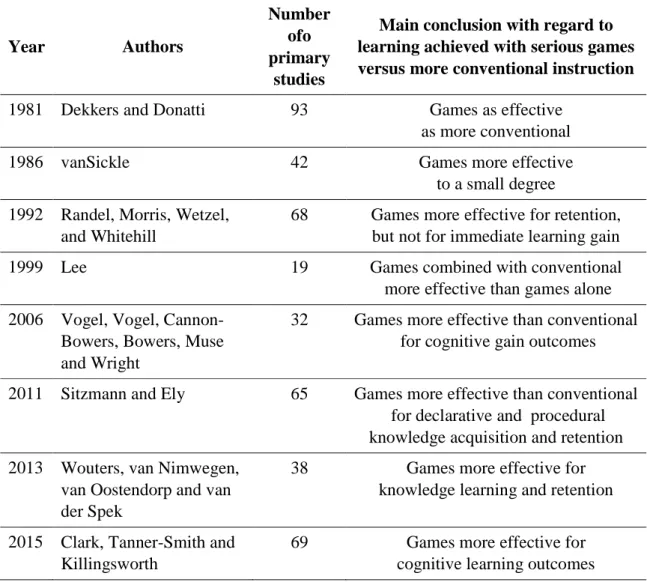
Because the present meta-analysis aims to fill the lack of knowledge regarding the impact of serious games on science learning achievement, it is important to look first at relevant past meta-analyses that examined the impact of serious games on learning achievement in general, with an emphasis on how these past meta-analyses can inform us with respect to the definition of serious games and the present research questions. As this overview will point out, the main limitation of these past meta-analyses is that the question of the impact of serious games or simulations in the specific context of science learning achievement was addressed only weakly. Another scope of this overview is to establish the hypotheses of the present work with regard to the research questions. Table 1, at the end of this text, summarizes all the relevant meta-analyses found in the literature. Although this list goes back to 1981 for completeness, only results for the studies produced after the year 2000 are discussed briefly below.
The meta-analysis conducted by Vogel et al. (2006) analyzed results from 32 studies from 1986 to 2003. Vogel et al.’s meta-analysis focused on pretest/post-test comparisons of learning achievement outcomes for simulations, games or or an activity combining features of both, versus more conventional instruction. Simulation was defined as an “activity which must interact with the user by offering the options to choose or define
parameters of the simulation then observe the newly created sequence rather than simply
selecting a pre-recorded simulation” (p. 231). A computer game was defined as being “defined as such by the author, or inferred by the reader because the activity has goals, is
interactive, and is rewarding (gives feedback)” (p. 231). Comparison conditions ranged
from no training to more conventional instructional methods, such as lectures, tutorials and discussions. Learners in the studies included ranged from preschoolers to adults. The main learning outcome considered was cognitive gain, which was not explicitly defined, but which seems to consist of both knowledge (e.g. course material) and skill (e.g. flight navigation) acquisition. Moderator variables were analyzed and consisted of (1) gender, (2) level of learner control during navigation (i.e. game controlled by student vs. teacher/computer), (3) type of activity (i.e. simulation, game, combination), (4) age (i.e. from preschool to adult), (5) image realism (i.e. unrealistic/low-quality images, cartoon-like, photo-realistic) and (6) user grouping (i.e. individual vs. group). Vogel et al.’s meta-analysis did not focus on a particular subject area, and included studies from various knowledge domains such as psychology, flight navigation, computer science, mathematics, general cognitive skills, science, etc. Overall, Vogel et al. found that significantly higher cognitive learning gains were observed in subjects using simulations, games or a combination versus traditional instructional methods (z = 6.05, p < .0001, N = 8549). More specifically, the highest effect size was found for simulations (z = 9.147, p <
.0001, N4 = 2179), with a lower effect size found for games (z = 3.706, p = .0001, N =
2165) and combination (z = 3.209, p = .0007, N = 4205), although Vogel et al. noted a low reliability for these results. With respect to other moderators, Vogel et al.’s findings suggested a lack of significant differences across genders (z = .9910, p = .1594, N = 394).
4
In Vogel et al.’s meta-analysis, N represents the cumulative number of participants from primary studies on which overall effect sizes were computed.
For age, the combination of preschool, elementary, middle, and high school children showed significant results (z = 4.111, p < .0001, N = 6138) favoring simulations and games, while slightly more beneficial, albeit not significantly different, results were obtained for the combination of college students and adult populations (z = 7.434, p < .0001, N = 2336). Likewise, image realism did not have a significant moderator effect, with both the unrealistic simulations and games (z = 5.447, p < .0001, N = 11481148) and the photo-realistic ones (z = 4.105, p < .0001, N = 842) being more beneficial than more conventional instruction. However, significant differences were found with regard to learner control and user grouping. Compared with more conventional instruction, significantly higher cognitive learning gains were observed for studies in which learners controlled their navigation through the system (z = 7.038, p < .0001, N = 3656), and lower, albeit not significantly different, cognitive learning gains for studies where learners were automatically navigated through the system (z = -2.099, p = .018, N = 94). Cognitive learning gains were also significantly higher for studies involving learners individually navigating through the simulation or game (z = 7.352, p < .0001, N = 3413) versus studies in which group navigation was performed (z = 2.222, p = .0131, N = 931), with both forms of navigation being more beneficial than more conventional instruction. However, Vogel et al.’s meta-analysis has limitations. Despite providing an explicit definition of the concepts of simulation and game, Vogel et al. included several studies in which the experimental condition did not seem to consist of either a simulation or a game. In such studies (i.e. Andrews, Schwarz & Helme, 1992; Blank, Roy, Sahasrabudhe, Pottenger & Kessler, 2003; Brewster, 1996; Costabile, De Angeli, Roselli, Lanzilotti & Plantamura, 2003; Kekkonen-Moneta & Moneta, 2002), the experimental group was subjected to multimedia or hypermedia instruction consisting, for instance, of hypertext, images, videos, sounds, quizzes, or PowerPoint presentations, but not a
simulation or a game. In addition, Vogel et al.’s meta-analysis computed general effect sizes for several knowledge domains considered as a whole, thus precluding a conclusion related specifically to science learning achievement.
In a 2011 meta-analysis, Sitzmann and Ely analyzed results from 65 studies from 1976 to 2009. This meta-analysis focused on pretest/post-test comparisons of computer-based
simulation games versus more conventional instruction in the context of professional
adult training. Studies included were in various knowledge domains, such as psychology, business, computer science, mathematics, science, etc. Sitzmann and Ely defined computer-based simulation games as a form of “instruction delivered via personal computer that immerses trainees in a decision-making exercise in an artificial environment in order to learn the consequences of their decisions” (p. 492). Control conditions in the empirical studies analyzed by Sitzmann and Ely ranged from no training to trainees who received various forms of more conventional instruction as a substitute for the computer-based simulation game. Three types of cognitive outcomes were considered: (1) declarative knowledge, referring to trainees’ memory of the facts and principles taught in training, (2) procedural knowledge, referring to information about how to perform a task or action, and (3) retention, referring to the delayed assessment of trainees’ declarative knowledge weeks or months after leaving the training environment. Moderators were analyzed and consisted of five theoretical moderators, which were respectively (1) entertainment value of the simulation game (i.e. high vs. low, with the high value being described as the simulation game containing at least one characteristic commonly seen in board games or video games, such as rolling a virtual dice, moving pegs around a board, striving to make the list of top scorers, playing the role of a character in a fantasy world, or shooting foreign objects), (2) activity level of users during navigation (i.e. passive vs. active), (3) level of access to the simulation game (i.e.
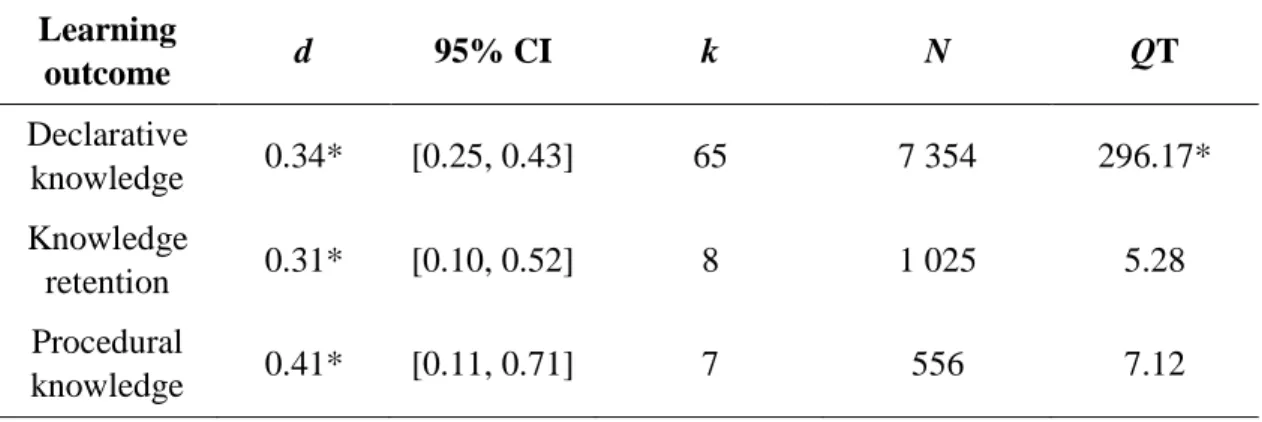
unlimited vs. limited), (4) simulation game as sole instructional method vs. accompanied by other forms of instruction, and (5) activity level of the comparison group (i.e. passive instruction [i.e. lecture, reading] vs. active instruction [i.e. hands-on practice, discussion]). Four methodological moderators were also considered, namely (1) random assignment to conditions (vs. no random assignment), (2) rigor of study design (i.e. pretest/post-test comparison vs. post-test only), (3) publication status (i.e. published vs. unpublished in scientific journal), and (4) year of publication/presentation. For declarative knowledge (d = 0.28, 95% CI [0.20 – 0.38], N5 = 2 758), procedural knowledge (d = 0.37, 95% CI[0.23 – 0.50], N = 936), and retention (d = 0.22, 95% CI [0.07 – 0.37], N = 824), Sitzmann and Ely found significantly higher positive effects for trainees receiving instruction via a simulation game in comparison with trainees receiving instruction via more conventional instruction. With respect to theoretical moderators, all proved significant, with the exception of entertainment value. For entertainment value, it was found that the benefits of high entertainment value (d = 0.26, 95% CI[0.11 – 0.41],
N = 809) were not significantly higher, and were even possibly lower than those of low
entertainment value (d = 0.38, 95% CI[0.31 – 0.45], N = 32163216). However, adults trained with a simulation game learned more, in comparison with a control group, when (1) they were active (d = 0.49, 95% CI[0.41 – 0.56], N = 32603260) rather than passive (d = -0.11, 95% CI[-0.29 – 0.07], N = 521) during navigation, (2) they had unlimited (d = 0.68, 95% CI[0.54 – 0.82], N = 925) rather than limited (d = 0.31, 95% CI[0.23 – 0.38],
N = 2738) access to the simulation game, and (c) the simulation game was used as a
supplement to other instructional methods (d = 0.51, 95% CI[0.43 – 0.58], N = 3109) rather than the standalone instruction (d = -0.12, 95% CI [-0.26 – 0.01], N = 946).
5
In Sitzmann & Ely’s meta-analysis, N represents the cumulative number of participants from primary studies on which overall effect sizes were computed.
Conversely, the control group learned significantly more than the simulation game group when the control group received instruction that actively (d = -0.19, 95% CI [-0.33 – -0.05], N = 832) rather than passively (d = 0.38, 95% CI[0.24 – 0.51], N = 970) engaged them in the learning experience. With respect to methodological moderators, random assignment, rigor of the study design and year of publication did not moderate learning from simulation games, relative to the comparison group. Random assignment to a group (d = 0.35, 95% CI[0.26 – 0.45], N =19971997) yielded a slightly lower, but not significantly different overall effect size than the lack of random assignment (d = 0.43, 95% CI[0.34 – 0.53], N = 19311931). The more rigorous pretest/post-test study design (d = 0.36, 95% CI[0.26 – 0.46], N = 18321832) yielded an identical overall effect size with the less rigorous post-test only study design (d = 0.36, 95% CI [0.27 – 0.45], N = 21932193). For year of publication, the inverse of the sampling error variance weight correlation between the year of publication or presentation and the effect size was not statistically significant (r = .16), thus suggesting that the effect of simulation games on learning, relative to the comparison group, has not changed over time. However,
publication status produced a significant moderator effect, with effect sizes being significantly larger for published (d = 0.52, 95% CI[0.44 – 0.59], N = 30323032) than for unpublished (d = -0.10, 95% CI[-0.23 – 0.03], N = 993) studies, suggesting a probable publication bias effect. As in previous reviews, Sitzmann and Ely’s meta-analysis has some limitations. Sitzmann and Ely calculated general effect sizes for several knowledge domains (e.g. psychology, business, computer science, mathematics, science) considered as a whole, and did not draw specific conclusions in connection with science learning achievement. Furthermore, Sitzmann and Ely’s meta-analysis focused exclusively on adult workforce trainees, thus precluding generalization to younger learners specifically.
A meta-analysis conducted by Wouters, van Nimwegen, van Oostendorp and van der Spek followed in 2013, and analyzed 38 studies from 1990 to 2012. Wouters et al. included pretest/post-test as well as post-test-only comparisons of serious games versus more conventional instructional methods. Studies included covered several knowledge domains (e.g. language, mathematics, preparatory education, science) with 22 studies being in the domain of science (i.e. biology and engineering). Serious games were defined as “being interactive, based on a set of agreed rules and constraints, directed toward a clear goal often set by a challenge, and constantly providing feedback, either as a score or as changes in the game world, to enable players to monitor their progress toward the goal” (p. 250). Control conditions in the studies analyzed by Wouters et al. comprised a wide range of more conventional instructional methods, such as lectures, reading, drill and practice, or hypertext learning environments. Learners in the studies included ranged from elementary school children to adults. Three types of learning achievement outcomes were considered: (1) knowledge learning, as observed by immediate post-test; (2) cognitive skills learning, pertaining to more complex cognitive processes, such as when learners apply their knowledge to solve problems; and (3)
retention, as observed by delayed post-test. Theoretical moderators consisted of (1)
arrangement of the comparison group (i.e. active vs. passive instruction), (2) serious game being inclusive (i.e. combined with another instructional method) vs. exclusive (i.e. the only instructional method), (3) number of training sessions (single vs. multiple), (4) group size (i.e. single player vs. group play), (5) instructional domain, (6) age, (7) level of realism (schematic, cartoon-like, photorealistic), (8) presence of a narrative during gameplay (vs. absence). Methodological moderators consisted of (1) publication source (i.e. peer-reviewed journal, proceedings, dissertation), (2) presence of randomization (vs. absence), and (3) experimental design (post-test only vs. pretest/post-test design).
Wouters et al. found that serious games were significantly more effective than more conventional instruction concerning knowledge learning (d = 0.27, 95% CI[0.01 – 0.54],
N6 = 948), cognitive skills learning (d = 0.29, 95% CI[0.15 – 0.43], N = 45994599), and retention (d = 0.36, 95% CI [0.07 – 0.68], N = 499). With respect to theoretical moderators, no significant effect was found for arrangement of the comparison group and age. Serious games did not yield more learning, in comparison with more conventional instruction, when the control group engaged in passive instruction rather than active instruction (zactive-passive = 1.38, p > .05). Likewise, comparisons of age groups did not
yield any significant difference (ps > .1). However, significant effects were found for all other theoretical moderators. Serious games were significantly more effective (zinclusive vs. exclusive = 1.66, p < .048), compared with more conventional instruction, when they were
supplemented with other instructional methods (d = 0.41, 95% CI[0.23 – 0.59], k7 = 29)
rather than presented alone (d = 0.20, 95% CI [0.03 – 0.37], k = 48). Games were significantly more effective (z1 session vs. multiple sessions = 3.94, p < .003) when played over
multiple training sessions (d = 0.54, 95% CI[0.35 – 0.72], k = 30) rather than a single training session (d = 0.10, 95% CI[-0.07 – 0.26], k = 47). Games were significantly more effective (zindividual vs. group = 2.34, p < .01) when learners played in a group (d = 0.66, 95%
CI[0.32 – 1.00], k = 13) rather than individually (d = 0.22, 95% CI[0.09 – 0.36], k = 63). With regard to visual realism, schematic games (d = 0.46, 95% CI[0.27 – 0.65], k = 14) were significantly more effective (zschematic vs. cartoon-like = 1.89, p = .03) than cartoon-like
games (d = 0.20, 95% CI[-0.01 – 0.40], k = 20) and significantly more effective (zschematic vs. realistic = 2.25, p = .01) than photorealistic games (d = 0.14, 95% CI [-0.08 – 0.35], k =
6
In Wouters et al.’s meta-analysis, N represents the cumulative number of participants from primary studies on which overall effect sizes were computed.
7
In Wouters et al.’s meta-analysis, k represents the cumulative number of effect sizes from primary studies on which overall effect sizes were computed.
32). Findings also suggested that the absence of a narrative (d = 0.46, 95% CI [0.18 – 0.73], k = 15), compared with the presence of a narrative (d = 0.25, 95% CI[0.11 – 0.39],
k = 62), seemed to yield higher learning gains, although this result did not quite reach
statistical significance (znarrative vs. no narrative = 1.34, p = .09). For instructional domains,
significant difference was observed for all domains except the ones related to natural sciences: biology (d = 0.11, 95% CI [0.11 – 0.33], k = 28) and engineering (d = -0.36, 95% CI [-0.80 – 0.09], k = 6) for which no significant effect was observed. With respect to methodological moderators, unpublished studies (d = -0.20, 95% CI[-0.83 – 0.43], k = 3) seemed to yield a lower effect size in favor of games than published studies (d = 0.36, 95% CI [0.24 – 0.48], k = 67), but this result did not reach significance (ps > .05). Random assignment (d = 0.08, 95% CI [-0.13 – 0.29], k = 35) significantly attenuated (zrandom vs. non-random = 2.75, p = .003) the positive learning effect of serious games
compared with lack of randomization (d = 0.44, 95% CI [0.29 – 0.60], k = 42). The experimental design had no effect on the magnitude of the effect size (zpost-test only vs. pre-post-test = 0.55, p > .1), with post-pre-post-test only (d = 0.25, 95% CI [0.07 – 0.44], k = 27) and pre/post-test (d = 0.32, 95% CI[0.16 – 0.48], k = 50) studies yielding similar effect sizes. Wouters et al.’s main limitation with regard to science learning achievement is the rather small sample of 22 studies in the domain of natural sciences that were included in the analysis and the absence of significant effect in this domain.
The last relevant meta-analysis for this study was conducted by Clark, Tanner-Smith and Killingsworth (2015), and they analyzed 69 studies from 2000 to 2012. Clark et al. focused on pretest/post-test comparisons of digital games versus more conventional instructional methods. Studies included covered several knowledge domains (e.g. language, mathematics, social sciences, natural sciences) with 13 studies in the domain of natural sciences. Participants in primary studies ranged from ages 6 to 25. Digital games
were defined either as a (1) “digital experience in which the participants (a) strive to achieve a set of fictive goals within the constraints of a set of rules that are enforced by the software, (b) receive feedback toward the completion of these goals (e.g. score, progress, advancement, win condition, narrative resolution), and (c) are intended to find some recreational value” (p. 9), or as a (2) “digital environment explicitly referred to by the authors of the study as a game in the title or abstract” (p. 9). Control conditions in the studies analyzed by Clark et al. included more conventional instructional methods such as lectures, reading, drill and practice, or hypertext learning environments. The learning achievement outcome consisted of a unified cognitive learning outcome comprising cognitive processes and strategies, knowledge and creativity. Most notable theoretical moderators consisted of (1) play duration (single vs. multiple sessions), (2) additional instruction (game with vs. without additional non-game instruction), (3) player grouping (e.g. single player vs. collaborative team), (4) game type (i.e. rudimentary game [adding points/badges] vs. more school-like game consisting of more than adding points/badges), (5) visual realism (schematic, cartoon, realistic) and (6) story relevance (none, irrelevant, relevant). Most notable methodological moderators consisted of (1) research design (quasi-experimental vs. experimental), (2) assessment type (pre-existing normed instruments vs. author-developed instruments) and (3) quality of game condition reporting, in terms of word count and number of screenshots. Analysis for the overall cognitive learning outcome showed that students in digital game conditions demonstrated a significantly better outcome relative to students in the non-game comparison conditions (g = 0.35, 95% CI [0.20, 0.51], N8 = 173). For play duration, effect sizes were significantly smaller (b = −0.37, p = .03, 95% CI [−0.70, −0.04]) when games were
8
In Clark et al.’s meta-analysis, N represents the cumulative number of effect sizes from primary studies which lead to computation of overall effect sizes.
played in one session (g = 0.08, 95% CI [-0.24, 0.39], N = 43) versus multiple sessions (g = 0.44, 95% CI [0.2, 0.59], N = 166). For additional instruction, the analysis found no evidence (b = 0.04, 95% CI [−0.23, 0.31]) that effect sizes were different depending on whether game conditions included additional non-game instruction (g = 0.36, 95% CI [0.19, 0.52], N = 72) or not (g = 0.32, 95% CI [0.11, 0.52], N = 137). For player grouping, average effects were significantly larger (b = 0.29, p = .03, 95% CI [0.02, 0.56]) for games with single players (g = 0.45, 95% CI [0.29, 0.61], N = 150) relative to those using collaborative teams (g = -0.22, 95% CI [0.32, 0.76], N = 12). For game type, no significant difference (b = 0.28, p = .07, 95% CI [−0.02, 0.57]) was found in the mean effect size across the two categories of rudimentary (g = 0.53, 95% CI [0.27, 0.79], N = 64) and school-like games (g = 0.25, 95% CI [0.08, 0.42], N = 145). For visual realism, effects were significantly larger (b = 0.45, p = .03, 95% CI [0.05, 0.84]) for schematic (g = 0.48, 95% CI [0.13, 0.82], N = 52) than for realistic games (g = -0.01, 95% CI [-0.34, 0.32], N = 36). For story relevance, effects were significantly larger (b = 0.46, p = .01, 95% CI [0.12, 0.81]) for game conditions using irrelevant story lines (g = 0.63, 95% CI [0.33, 0.94], N = 75) compared with those using relevant story lines (g = 0.17, 95% CI [-0.03, 0.37], N = 88). Research design was not significantly associated (b = -0.26, p = .051, 95% CI [-0.51, 0.001]) with effect size magnitude across studies, but was close to significance, with quasi-experimental studies yielding a notably larger average effect size (g = 0.43, 95% CI [0.22, 0.63], N = 96) than experimental studies (g = 0.17, 95% CI [0.004, 0.33], N = 113). For assessment type, results indicated no significant differences (ps > .05) in effect size magnitude across assessment types, although the mean effect sizes were slightly lower for author-developed instruments (g = 0.33, 95% CI [0.11, 0.56], N = 97) compared with pre-existing normed instruments (g = 0.40, 95% CI [0.22, 0.58], N = 89). Finally, for condition reporting, there were no significant differences in
mean effect sizes filtering studies based on word counts of the game descriptions. Number of screenshots, however, was significantly correlated with effect sizes for the game versus non-game conditions in the media comparison analyses (b = 0.05, p = .02, 95% CI [0.01, 0.09]), suggesting that studies which included more screenshots of the game condition obtained larger effect sizes. Clark et al.’s main limitations with regard to the present work’s objectives are the relatively small sample size (N = 13) of studies in the domain of science and the lack of differentiation of the learning outcome, which considered as a single whole knowledge, cognitive processes/strategies and creativity.
Thus, as can be noted from these previous reviews, the main limitation with regard to the present work’s objectives is the lack of sufficient examination of the effect of serious games in the domain of natural sciences. Even if several of these meta-analyses (e.g. Clark et al., 2015; Sitzmann & Ely, 2011; Vogel et al., 2006) included some science-focused games, they did not differentiate the science learning outcome. Besides, for the only meta-analysis (e.g., Wouters et al., 2013) that specifically addressed this question, the science domain included a limited number of primary studies (N = 22) and was the only domain for wich no significant effect on learning was observed.
Research Hypotheses of the Present Meta-Analysis
Definition of Serious Games
Because the present meta-analysis aims to examine the impact of serious games on science learning achievement, it is important to specify what will be meant by a serious
game. As could be noted in the preceding overview, there is some heterogeneity in the
scientific literature with regard to the defining features of a serious game (Garris, Ahlers & Driskell, 2002; Hays, 2005; Manninen, 2002; O'Neil et al., 2005; Sitzmann & Ely,
2011; Vogel et al., 2006). Some scholars (e.g. Gredler, 1996, 2004; Prensky, 2001) have proposed that there are in fact two types of digital games, namely serious games and
simulations. A serious game is generally defined as a digital software the primary
purpose of which is learning, rather than entertainment (Bellotti, Kapralos, Lee, Moreno-Ger & Berta1, 2013; Giessen, 2015; Girard et al., 2013; Klopfer, Osterweil & Salen, 2009; Quinn, 2015; Wouters, van der Spek & Oostendorp, 2009). In addition, there is general agreement that a serious game has the following features: a goal to be reached (e.g. move to a higher difficulty level), rules and constraints (e.g. what a player can and cannot do, time limits), competition (e.g. against other players or against computer), a dose of fantasy (e.g. a specific context separate from real life in terms of time and space), and fun for users (Bright & Harvey, 1984; Dorn, 1989; Leemkuil, de Jong & Ootes, 2000; Lindley, 2003, 2004; Tobias & Fletcher, 2007; Vogel et al., 2006; Wouters et al., 2009). A simulation shares several of these same features, but, according to several scholars (Bell & Smetana, 2008; Gredler, 1996, 2004; Hays, 2005; Tobias & Fletcher, 2007), it differs from a serious game mainly because of its greater realism and more serious goals. For example, Gredler (1996, p. 522) noted that while a serious game’s rules and constraints may be imaginative and exceed the limits of the real world, “a simulation is a realistic approximation of reality and its basis is a dynamic set of relationships among several variables that reflect authentic causal processes.” The National Research Council (2011, p. 9) identifies four features in which computer games differ from simulations: 1) they are played for enjoyment in informal contexts, 2) they incorporate goals and rules, 3) they provide feedback on the player’s progress; 4) they let the player influence the future state of the game. It has also been acknowledged (National Research Concil, 2010, p. 1) that “the technical and cultural boundaries between modeling, simulation, and games are increasingly blurring.”
Despite possible conceptual distinctions between serious games and simulations, this distinction will not be made in the present work for three reasons. First, several authors have pointed out that these two concepts are frequently used interchangeably by researchers conducting studies in the field (Greenblat & Duke, 1981; Hays, 2005; Rieber, Smith & Noah, 1998; Thomas, Cahill & Santilli, 1997). Second, recent works (e.g. Sitzmann & Ely, 2011; Tennyson and Jorczak, 2008) proposed that there are no longer clear boundaries between these two concepts, because the scientific literature is rich with examples of digital software called simulations, which do not reproduce real-world contexts and examples of software called serious games, which have very serious goals. Third, the more recent meta-analyses discussed in the preceding overview (i.e. Clark et
al., 2015; Sitzmann & Ely, 2011; Wouters et al., 2013) did not distinguish between
serious games and simulations. Thus, to help comparisons between these past reviews and the present work, a unifying concept of serious games with the four preceding features but not excluding simulations will be considered here.
Learning Outcomes
Although serious games could possibly advance many science learning goals (identified by National Research Council, 2011, p. 25) such as motivation, conceptual understanding, science process skills, scientific discourse and identity, research actually provides some evidence only for the first two (motivation and conceptual understanding) and the present work focuses on the second because it is a more essential goal for the educational system. The present meta-analysis aims to examine the overall effect of serious games and simulations versus more conventional instructional methods on science learning achievement outcomes. Of course, future work could focus on motivation as, for comparable learning outcomes, more engaged students is preferable.
Several taxonomies of learning outcomes have been proposed in the scientific literature (Kraiger, Ford & Salas, 1993; O’Neill, 2009; Wouters, van der Spek & van Oostendorp, 2009). To help build on previous reviews’ findings, and because of available data, three cognitive learning outcomes will be considered here and will be the same as those frequently examined by previous reviews, namely: (1) learning of declarative knowledge, as observed by immediate post-test on facts, concepts, principles, theories or models (Chi & Ohlsson, 2005), (2) retention of declarative knowledge, as observed by delayed post-tests, and (3) learning of procedural knowledge, as observed by post-test on how to perform a task (Chi & Ohlsson, 2005). However, as future studies are conducted and provide more data, it will be interesting to focus on more ambitious goals for the rich learning contexts related to serious games, as proposed by Barab & Luehmann (2003) or Shaffer, Squire, Halverson & Gee (2004), to provide resources and tools supporting the complex learning-by-doing process of individuals participating in large communities. For learning of declarative knowledge, because (i) of the previously discussed theorized advantages of serious games (i.e. more active) compared with more conventional instruction and (ii) the fact that previous meta-analyses (e.g. Sitzmann & Ely, 2011; Wouters et al., 2013) mostly concluded that serious games were more beneficial than more conventional instruction, the first hypothesis reads as follows.
H1: Instruction using serious games yields higher learning gains in terms of
immediate declarative knowledge than instruction using more conventional methods under conditions of similar time investment or engagement.
Similarly, for declarative knowledge retention, because of the theorized advantages of serious games and because previous meta-analyses (e.g. Sitzmann & Ely, 2011; Wouters
et al., 2013) mostly concluded that serious games were more beneficial than more
H2: Instruction using serious games yields higher learning gains in terms of
declarative knowledge retention than instruction using more conventional methods under conditions of similar time investment or engagement.
For the learning of procedural knowledge, only one previous relevant meta-analysis (Sitzmann & Ely, 2011) examined this outcome and found a beneficial effect of simulation gaming compared with more conventional instruction. At a theoretical level, this finding seems to support the postulate of some scholars, which posited that serious gaming “fosters procedural thinking” (Johnson, Smith, Willis, Levine & Haywood, 2011, p. 7; McClarty et al., 2012, p. 16). Therefore, the third hypothesis reads as follows.
H3: Instruction using serious games yields higher learning gains in terms of
procedural knowledge than instruction using more conventional methods under conditions of similar time investment or engagement.
With regard to the special relation between serious games and natural sciences, it could seem reasonable to propose that the first three hypotheses should be verified with stronger effect sizes when compared with other knowledge domains.
Moderators
As can be noted from the preceding overview, several moderators have been empirically found to affect the relationship between playing serious games and learning outcomes. The following list describes the expected significant moderators that will be tested in the present meta-analysis, and the hypothesis regarding each moderator’s effect based on the overview and theoretical postulates from the scientific literature. A dichotomist categorization (i.e. theoretical and methodological moderators), as used by some previously discussed reviews (e.g. Clark et al., 2015; Sitzmann & Ely, 2011), will be
used to classify moderators. The first four theoretical moderators categorize context (subject area, grade level, duration of intervention, activity level of the comparison group), three more theoretical moderators describe some qualities of the games (ludic content, level of realism, level of user control) and the last four moderators characterize methodology (randomization, experimental design, year of publication, publishing status).
Subject area. Examining the moderator effect of subject area consists of verifying if the
impact of serious games, compared to conventional instruction, differs depending on subject area or, in the present case, on scientific discipline (i.e. physics, chemistry, biology, etc.). As pointed out in the present overview, one major limitation of previous reviews (e.g. Clark et al., 2015; Dekkers & Donatti, 1981; Lee, 1999; Sitzmann & Ely, 2011; Vogel et al., 2006) with regard to the present work’s aims is the fact that overall effect sizes were computed by considering primary studies in various knowledge domains (e.g. science, mathematics, social sciences, computer science, etc.) as a single whole, thus precluding a precise conclusion with regard to the domain of science. Some recent meta-syntheses (Brinson et al., 2015; Ma & Nickerson, 2006; Rutten, van Joolingen & van der Veen, 2012; Young et al., 2012), which examined the impact of serious games on science learning achievement, suggest, however, that serious games could yield different learning outcomes depending on scientific discipline. For example, Rutten et al.’s review (2012) suggests that studies on serious games in biology and physics generally yield positive learning outcomes, but that studies in chemistry yield more negative outcomes, such as “no difference in long-term performance” and “not much contribution to conceptual understanding” (p. 142). Young et al.’s review (2012) suggests that serious games in physics seem to yield less positive outcomes compared with biology, and that one reason explaining this could be that they “may introduce misconceptions that could interfere
with the learning of concepts like force, momentum, and inertia” (p. 73). Thus, because of these previous findings, the fourth hypothesis reads as follows.
H4: The beneficial effect of instruction using serious games on learning
achievement outcomes, in comparison with more conventional instruction, is larger for some scientific disciplines than for others.
With regard to the special relationship between serious games and natural sciences, it could seem logical to propose that the observed differences with other knowledge domains should be larger than the differences between natural sciences.
Grade Level. Examining the moderator effect of grade level consists of verifying whether
serious games are more beneficial, in comparison with more conventional instruction, depending on learners’ educational level (i.e. elementary, secondary, college, etc.). Previous meta-syntheses (Brinson et al., 2015; Hew & Cheung, 2010; Oloruntegbe & Alam, 2010) note that a majority of primary studies which examined the impact of serious games on science learning achievement were carried out in higher education settings, such as polytechnics and universities. Brinson (2015, p. 230) suggests it is therefore important to gain a better understanding of serious games’ “effectiveness relative to student grade level and cognitive/psychological development because of the proliferation of serious games and the increase in number of online elementary and secondary schools.” As pointed out in the present overview, the moderator effect of grade level was examined by some previous meta-analyses. Vogel et al. (2006) found that younger learners (i.e. combination of preschool, elementary, middle, and high school children) seemed to benefit less (z = 4.111, p < .0001, N = 6138) from serious games, compared with older learners consisting of a combination of college students and adult populations (z = 7.434, p < .0001, N = 2336), although this comparison failed to quite reach statistical significance. Wouters et al. (2013) found similar results, with adults (d =
0.50, 95% CI [-0.10, 1.10]) seemingly benefiting more than children (d = 0.30, 95% CI [0.08, 0.52]) from playing serious games, but not to the point of statistical significance.
Thus, because of previous meta-analytical findings, the fifth hypothesis reads as follows.
H5: The beneficial effect of instruction using serious games on learning
achievement outcomes, in comparison with more conventional instruction, is greater for older learners compared with younger learners.
Duration of Intervention. Examining the moderator effect of duration of intervention
consists of verifying whether the effect of serious games on learning achievement, in comparison with more conventional instruction, varies depending on the length of game play. In a 1977 meta-synthesis on serious games, Pierfy already cautioned that short duration studies, in which one group continues with the same instructional method they have been using previously while another group is subjected to a new technological method, being the serious game, are almost always influenced by a Hawthorne or novelty effect biasing the results. Novelty effect has been described as the greater learning
transitorily achieved by participants in the experimental group because of their increased
interest and motivation toward the new technological media, and as the attenuation of this beneficial effect as the duration of exposure to the technological media lengthens (Clark, 1983; Colorado, 1988; Lookatch, 1995; Poppenk, Moscovitch & Köhler, 2010; Timmerman & Kruepke, 2006). The presence of novelty effect in computer-assisted instruction (CAI) in general was confirmed by several meta-analyses (Bayraktar, 2001; Kulik, Bangert & Williams, 1983; Kulik & Kulik, 1986, 1991; Kulik, Kulik & Shwalb, 1986; Liao, 1998, 2007; Roh & Park, 2010; Schenker, 2007). These meta-analyses found that, when compared with more conventional instruction, longer duration of exposure to CAI (e.g. more than four weeks) was associated with smaller learning effect sizes than a median duration of exposure to CAI (e.g. between one and four weeks) which itself was associated with smaller learning effect sizes than a shorter duration of exposure to CAI
(e.g. less than one week). For the specific type of CAI that are serious games, the present overview suggests more contradictory findings. Dekkers and Donatti (1981) found a negative correlation between duration of game play, and both learning (r = -.282; p < .05) and retention achieved (r = -.431; p < .05), a result suggesting the presence of a novelty effect and going along well with meta-analyses on CAI in general. On the contrary, Sitzmann and Ely (2011) found that learners benefited more from game play when they had unlimited (d = 0.68, 95% CI[0.54 – 0.82], N = 925) rather than limited (d = 0.31, 95% CI[0.23 – 0.38], N = 2738) access to the serious game. In the same vein as Sitzmann and Ely, Wouters et al. (2013) found that serious games were significantly more effective (z1 = 3.94, p < .003) when played over multiple training sessions (d = 0.54, 95% CI[0.35
– 0.72], k = 30) rather than a single training session (d = 0.10, 95% CI[-0.07 – 0.26], k = 47), while Clark et al. (2015) found that effect sizes were significantly smaller (b = −0.37, p = .03, 95% CI [−0.70, −0.04]) when serious games were played in one game session (g = 0.08, 95% CI [-0.24, 0.39], N = 43) versus multiple sessions (g = 0.44, 95% CI [0.2, 0.59], N = 166). However, one limitation of the three last-mentioned meta-analyses on serious games is the fact that only two levels of game play duration were considered (e.g. one session vs. multiple sessions), thus precluding a finer analysis with regard to the effect of game play duration. In accordance with the previously discussed meta-analyses on CAI in general, it is thus possible that learning promoted by serious games needs more than one play session to reach its maximum effect, and that this effect wanes thereafter as game play duration lengthens. Therefore, the sixth hypothesis reads as follows.
H6: The beneficial effect of instruction using serious games on learning
achievement outcomes, in comparison with more conventional instruction, decreases with length of game play duration.
Activity Level of the Comparison Group. Examining the moderator effect of the activity
level of the comparison group consists of verifying whether the group playing a serious game shows more learning outcomes when the comparison group receives passive rather than active conventional instruction. There is general agreement in the scientific literature that learning is enhanced when learners actively engage with the course material (Newell, Rosenbloom & Laird, 1989; Sitzmann, Kraiger, Stewart & Wisher, 2006; Webster & Hackley, 1997). Active learning has been found to be effective across several subject matter areas (Freeman et al., 2014) and should benefit learning regardless of whether learners are playing a serious game or learning from more conventional instruction. It has been posited (Bell & Kozlowski, 2008; Keith & Frese, 2005, 2008) that active learning is beneficial by helping learners develop a more refined mental model of course material (i.e. declarative knowledge) and the expertise required to apply their knowledge to different circumstances (i.e. procedural knowledge). According to previously discussed meta-analyses (e.g. Sitzmann & Ely, 2011; Wouters et al., 2013), learners in comparison groups are considered active when they are using a computerized tutorial, participating in a discussion, completing assignments or exercises, doing hands-on laboratory work, or a combination of these instructional methods. They are considered passive when they are listening to a lecture or PowerPoint presentation, reading textbook or other forms of expository texts, watching a video, or a combination of these instructional methods. The previously discussed Sitzmann & Ely meta-analysis (2011) found that adult trainees learning with serious games learned more than comparisons trainees learning with more conventional instructional methods, when the more conventional instruction was passive rather than active. Although this finding was not replicated by Wouters et al.’s (2013) meta-analysis, based on theoretical postulates and Sitzmann and Ely’s (2011) finding, the seventh hypothesis reads as follows.
H7: The beneficial effect of instruction using serious games on learning
achievement outcomes, in comparison with more conventional instruction, is larger when the comparison group receives passive rather than active instruction.
Ludic Content. Examining the moderator effect of ludic content consists of verifying
whether the effect of serious games on learning achievement, in comparison with more conventional instruction, varies depending on how ludic a game is. The ludic content can be described as the “entertainment value” of the game (Sitzmann & Ely, 2011), the “enjoyment felt while playing” (Hays, 2005) or very simply, as Prensky (2001) wrote, how “fun” the game is. Baranowski, Buday, Thompson & Baranowski (2008) noted that “fun” is not a concept that is well understood and that typical measures of enjoyment (or fun) have used synonyms of fun (e.g. enjoy, like, interested, pleasurable, energizing). Several scholars (e.g. Goh, Ang & Tan, 2008; Johnson, 1991; Prensky, 2001) posited that more ludic serious games promote greater learning achievement. In a 2009 meta-synthesis examining the effects of serious games on health and physical education, Papastergiou (2009, p. 608) notably concluded that “enjoyment […] seems to account for the effectiveness of the games.” In the present overview, it was pointed out that only Sitzmann and Ely’s meta-analysis (2011) examined the effect of this moderator on the learning achieved playing serious games, and found learning attained with high entertainment value games (d = 0.26, 95% CI [0.11 – 0.41], N = 809) was not significantly higher than learning achieved with low entertainment value games (d = 0.38, 95% CI [0.31 – 0.45], N = 32163216). Thus, because of theoretical postulates and because of Papastergiou’s meta-synthetic findings, the eighth hypothesis reads as follows.
H8: The beneficial effect of instruction using serious games on learning
achievement outcomes is greater for games with higher ludic content than for games with lower ludic content.
One has to recognize here that the effects of ludic content could also have a complex relation to engagement and duration of gameplay. This testing would be beyond the scope of the present work.
Level of Realism. Examining the moderator effect of level of realism consists of
verifying whether the effect of serious games on learning achievement, in comparison with more conventional instruction, differs depending on how realistic the game interface looks. Game realism can be defined as how accurately the game “replicates the real world environment” (Wilson et al., 2009, p. 232), or as the physical and psychological similarity between a game and the environment it represents (Crawford, 1984). Several scholars posited that a higher level of game realism enhances learning (e.g. Bell & Smetana, 2008; Dickey, 2007; Goh et al., 2008; McClarty et al., 2012; Prensky, 2001; Warren, Dondlinger & Barab, 2008). For example, according to Bell and Smetana (2008, p. 3), realism can “bring the subject matter to life” and favor the development of mental constructs about objects, phenomena and processes. Similarly, in a 2011 meta-synthesis on serious games, Mikropoulos and Natsis (p. 769) noted that “real world, authentic tasks […] enable context and content dependent knowledge construction.” In the present overview, it was pointed out that three previous meta-analyses (Clark et al., 2015; Vogel
et al., 2006; Wouters et al., 2013) examined the moderator effect of realism with rather
concurring results. Contrary to previous postulates, Wouters et al. (zschematic vs. realistic =
2.25, p = .01) and Clark et al. (b = 0.45, p = .03) found that less realistic (schematic) games were significantly more beneficial than more realistic (photorealistic), while Vogel
et al. found a slightly higher beneficial effect for schematic games (z = 5.447) than for
photorealistic games (z = 4.105), although this comparison did not reach statistical significance. One possible interpretation for these findings is that visual complexity may “distract students from the intended learning content or provide alternative goals within
the game that do not support improvement on the assessed outcome measures” (Clark et
al., 2015, p. 34). Thus, because of the general agreement among these three previous
meta-analyses, the ninth hypothesis reads as follows.
H9: The beneficial effect of instruction using serious games on learning
achievement outcomes, in comparison with more conventional instruction, is greater for less realistic games than for more realistic games.
Level of User Control. Examining the moderator effect of level of user control consists of
verifying whether the effect of serious games on learning achievement, in comparison with more conventional instruction, differs depending on whether a learner can decide what happens during his navigation through the game or not. This moderator can be described subjectively as the sense of being in control which is experienced by the user while using a medium (Csikszentmihalyi, 1990; Gredler, 1996) or objectively as the “users’ ability to influence elements of their learning environment, such as […] how they navigate through content, and their pace through the game” (Wilson et al., 2009, p. 234). It was posited that learner control over navigation through tasks and activities is a “surprisingly important feature of effective learning games” (Mayo, 2009, p. 80). Similarly, Gifford (1991) emphasized the importance of control in a good serious game. In the present overview, it was pointed out that only one previous meta-analysis examined this moderator. Vogel et al. (2006) found that significantly higher learning gains were observed for studies in which learners had control over content, sequence or pace of navigation (z = 7.038, p < .0001, N = 3656), and lower, albeit not significantly different, learning gains for studies in which learners did not have control over any of these elements (z = -2.099, p = .018, N = 94). Another meta-analysis (Sitzmann et al., 2006), not discussed in the overview, examined the effect of this moderator in studies comparing the impact of Web-based instruction (WBI) in relation to more conventional classroom instruction and found concurring results. The cumulative findings showed that
the extent to which Web-based trainees learned more than classroom trainees was greater when they were afforded a high (d = 0.30) rather than a low level of control (d = 0.07) during WBI. Thus, the tenth hypothesis reads as follows.
H10: The beneficial effect of instruction using serious games on learning
achievement outcomes, in comparison with more conventional instruction, is greater when learners control their navigation through the game than when they do not.
Randomization. Examining the moderator effect of randomization consists of verifying
whether the effect of serious games on learning achievement, in comparison with more conventional instruction, differs depending on whether a pure experimental (participants randomly assigned to group or randomized control trial) or quasi-experimental (participants not randomly assigned to group) study design is used. Randomized controlled trials are the most rigorous way of determining whether a cause-effect relation exists between treatment and outcome (Girard et al., 2013; Sibbald & Roland, 1998), but only a minority of studies which examined the impact of serious games used this design (Connolly, Boyle, MacArthur, Hainey & Boyle, 2012; Oloruntegbe & Alam, 2010). Because an experimental design is more rigorous, it is often posited that effect sizes related to the effect of serious games on learning achievement should be lesser in such design (Bisoglio, Michaels, Mervis & Ashinoff, 2014). In the present overview, it was pointed out that three meta-analyses examined the moderator effect of randomization and all concur that randomization is associated with lower overall effect sizes. Sitzmann and Ely (2011) found that random assignment to a group (d = 0.35) yielded a slightly lower, but not significantly different, overall effect size than the lack of random assignment (d = 0.43). Wouters et al. (2013) found that random assignment to a group (d = 0.08) significantly attenuated (zrandom vs. non-random = 2.75, p = .003) the positive learning effect of
that randomization was not significantly associated (b = -0.26, p = .051) with effect size magnitude across studies, but that it was close to significance, with quasi-experimental studies yielding a notably larger average effect size (g = 0.43) than experimental studies (g = 0.17). Thus, the eleventh hypothesis reads as follows.
H11: The beneficial effect of instruction using serious games on learning
achievement outcomes, in comparison with more conventional instruction, is greater for studies using a quasi-experimental design than for studies using an experimental design.
Experimental Design. Examining the moderator effect of experimental design consists of
verifying whether the effect of serious games on learning achievement, in comparison with more conventional instruction, differs depending on whether a study used a pretest/post-test design or a post-test only design. Some scholars (e.g. Pierfy, 1977; Salthouse & Tucker-Drob, 2008) posited that pretest/post-test design poses a risk of a test-retest effect, especially so when the same test is used at both times, thus enhancing the observed effect size due to game playing. Other scholars (e.g. Hays, 2005; Liao, 1998) posited that, on the contrary, repeated measure design is methodologically more rigorous and takes into account learners’ various entry levels of knowledge before playing the game. In the present overview, it was pointed out that two meta-analyses examined this moderator and concurred that there is no significant effect with regard to this moderator. Sitzmann and Ely (2011) found that the pretest/post-test study design (d = 0.36) yielded an identical overall effect size with the post-test only study design (d = 0.36). Wouters et al. (2013) found that the experimental design had no effect on the magnitude of the effect size (zpost-test only vs. pre-post-test = 0.55, p > .1), with post-test only
(d = 0.25) and pretest/post-test (d = 0.32, 95% CI[0.16 – 0.48], k = 50) designs yielding rather similar effect sizes. Thus, the twelfth and last hypothesis reads as follows.