A Note on the Concept of Knowledge
Management for Decision Aid Activity
S. Damart* - A. Pachulski**
LAMSADE
Université Paris Dauphine
Place du Mal de Lattre de Tassigny 75775 Paris
Cedex
*{damart,** pachulski}@lamsade.dauphine.fr
ABSTRACT : Progresses in information collection, storage and spreading have lead to an increasing efficiency of decision and decision aiding processes in organisations. They have provided both new technological solutions for information treatment and new knowledge management tools. This may have many implications and we may think of a new perception of what knowledge management is. Through a study of the connection between knowledge management and decision aid activity, this paper intends to put forward theoretical foundations of these changes: it puts into light that complexity in a decision stems from the fact that a problem is subjective, since it depends on the knowledge of the person who feels the problem. Therefore, knowledge management for decision aid must deal with this “being” dimension of knowledge, that is to say the knowledge which underlies each individual interpretative framework. It also has to deal with the “doing” dimension of knowledge – that is to say with skills and know-how - in allowing the company’s actors to use the knowledge conveyed within company on the one hand and to create new knowledge on the other hand. Taking these two dimensions of knowledge into account aims at increasing the effectiveness of the different phases of the decision process.
1. Introduction
According to Manuel Castells, the actual technological revolution, due to the emergence of the internet technology, is characterized by the application of information to the knowledge creation processes and to the processing/circulation of information for practical uses (Castells, 2001). In that frame, information is not relevant in itself. It becomes relevant when it can help people – and especially company’s actors – being more efficient in their activities. Therefore, the internet technology must be studied from on the one hand a technical perspective and on the other hand a cognitive perspective.
This latter perspective implies a questioning on how decision makers use information to take good decisions. More precisely, it implies a focused and theoretical questioning on how decision aid activities and knowledge management activities are connected.
This paper aims at studying the role of knowledge with respect to the decision process, as described by Simon (Simon, 1977), and thus, the stake of knowledge for decision aid activity. This paper does not intend to bring practical solutions to specific problems. It rather intends to formalise a new way to take decision aid activity into account, focusing on the influence of knowledge upon the decision process. According to (Watzlawick et al., 1975), new solutions can stem from a situation when we look at things from a new angle : this paper draws a renewal perspective upon decision aid activity.
The first part stresses out the dual complexity for decision aid activities, and more especially, the interpersonal oriented complexity. The second part puts forward the influence of knowledge upon the decision process. And the third part deals with the stakes related to knowledge management with respect to decision aid activity.
2. Dual complexity for decision aid activities
In this section, we define what we expect to be decision aid in our work and put into light that a work on decision should lead to two kinds of complexity. Then, we focus on this dual complexity. And finally, we point out the connection between decision aid and the knowledge carried by actors involved in a decision process.
2.1 How to define decision aid
What is decision aid except a cognitive resource decision makers can use for the resolution of a complex problem ? Every decision is necessarily surrounded by uncertainty : that is partly why a decision is complex. According to (Zoller and Béguin, 1989), decision aid activities are mainly based upon uncertainty ; they write : “Aiding decision, consists in bringing the information which make possible a more
certain evaluation of feasible alternatives and a more correct anticipation of consequences resulting from alternatives such as the process takes place around the table rather than in the field” (p. 15 in french). Indeed, volatile environment and hardness to correctly forecast the evolution of a system explain a decision process should be expected as a very complex question.
Research and works in operation research since the second world war effectively show how it is hard to model systems of real world situations. This may explain a relative disaffection with systemic analysis theories in management sciences. We should find different reasons to understand operation research crisis during the seventies and the eighties. In many situations, trying to find an optima end in vain. The idea of first operation researchers that, in the reality, there is always an optima or a best solution (F.W. Taylor would have said a one best way) in every problem, is not an obvious assumption. Rather than searching an optima which does not exist every time, decision aid researchers have fixed a much less ambitious program.
B. Roy in (Roy, 1996) defines decision aid as “the activity of the person who, through the use of explicit but not necessarily completely formalised models, helps to obtain elements of responses to the questions posed by a stakeholder of a decision process. These elements work towards clarifying the decision and usually towards recommending, or simply favouring, a behaviour that will increase consistency between the evolution of the process and this stakeholder’s objectives and value system” (p. 10). This definition is in keeping with the rejection of optima (cf. (Roy, 2000)).
Nethertheless, the rejection of optima does not mean the rejection of scientific character or the rejection of rationality. Indeed, decision aiding is based upon models and representations of reality which are cleverly taken out from reality. These models aim at being a tool to understand an object which – as we said it previously - was complex to understand. Operations planning to put a ship in commission, determination of the optimal position of an incineration plant or travel salesman problems, etc., are problems which object is clearly and obviously complex.
The definition of B. Roy suggests we should take an other kind of complexity into account. It is not sufficient to try to forecast the evolution of a complex system or a process. Who wants to aid decision should try to make people as coherent as possible with their values systems. In other words, understand a complex object is relevant according to a certain value system which gives to our subject a totally different dimension.
First, in decision aid, rationality means value rationality as much as objective rationality in order to borrow weberian words. Second, nobody can claim a single and universal value system. The definition of decision suggest a strong criticism of the traditional classical mono rationality. It also suggests that the complexity in a decision process is an object oriented complexity as much as an interpersonal
oriented complexity (terms inspired by what A. David wrote in (David, 1996) about managerial innovations).
2.2 Interpersonal oriented complexity in decision aid
Decision aid indirectly refers to criticism of traditional rationality as it were
considered with L. Walras, V. Pareto or A. Marshall in the 19th century. We namely
read elements of this criticism in (Sfez, 1992) or (Landry, 1998). These are linked with certainty in decision process, mono rational decision, linearity of decision process, etc. M. Landry in (Landry, 1998) particularly insists on the quatuor Problem / Decision maker / Decision / Action. This point catches our attention.
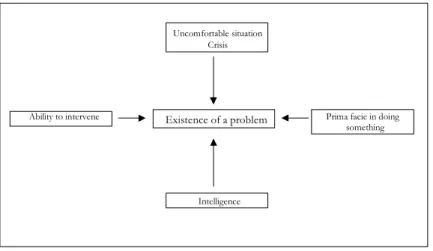
To one decision maker corresponds several problems ; and one problem is not perceived the same between the different decision makers (cf. fig. 1: a problem begins where people feel a crisis or an uncomfortable situation (cf. (Landry, 1995)). So a problem is necessarily subjective because it depends on the person who feels the problem.
Because a problem should be seen as an artefact built differently by every actor of a decision process, decision analysts should :
- Abandon ideas of normativism in decision aid ;
- See limits of tools he can use to provide aid in decision process ; - Look for complementarity of tools he uses ;
- Judge the relevance of an intervention after having a precise analysis of the socio-political context ;
- Consider decision aid activities as a meaning construction activity. In providing aid in decision process, analysts provide tools to give a certain meaning to events.
Furthermore, meaning construction by decision aiding is a central point for M. Landry. A lonely event does not mean anything. In particular, an event does not make a problem. A situation is obviously considered as a problem because people judge the situation as a problem. An examination of events, in organisation especially but also in current life, make sense for these events. This is an activity which is usually made by actors in organisations. Of course decision aiding activities appreciably contributes to it.
Figure 1. What a problem is (Landry, 1995)
It appears from this point of view that a problem must necessarily be considered as a construction an not a pre-existing primary data. Problems fundamentally depends on individual mental representations, interpretation of events and finally sense individual choose to give to these events. Representations and the interpretation scheme are partially built by education, individual experiences, norms, values and culture of the group people belongs to (family, clan, social class, nation, country, etc.). Although we will come after on this point, this is not the main subject of this paper to know much more about the way the interpretation scheme is built. We are just making the assumption that there exists many different way of considering a problem and representing it mentally. If there exist some, there is no reason to consider that the perception of a problem will be the same for every actor. It seems easy to identify the different stakeholder in a decision process. In fact, the analyst should see that the phase of identification of the different stakeholders in a decision aiding process is fulfilled with a certain representation of a problem. In particular, it prejudges the different levels of affection the different actors feels about a situation.
Furthermore, it is hazardous to trust in the interpretation actors explicitly claim. Statements could be interpreted as strategic signals by others. This leads to a large field of questions around strategic behaviour of people. In organisations, (March and al., 1972) have shown that decisions are often something different than a rational display. It is an opportunity to show some power relationships or authority relationships. It is also an opportunity to reaffirm past commitments or a way to rationalise a posteriori a behaviour.
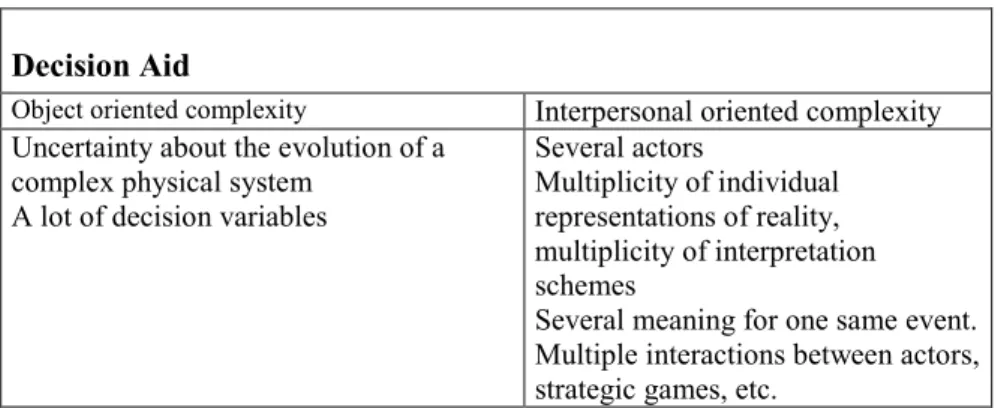
In this context, decision aid consists in providing help in an interpersonal oriented complexity next to an object oriented complexity. We define the interpersonal oriented complexity as a complexity coming from multiplicity of
Existence of a problem
Uncomfortable situation Crisis
Ability to intervene Prima facie in doing
something
interpretation schemes, absence of a mono rationality, interactions between actors (cf. Table 1).
Decision Aid
Object oriented complexity Interpersonal oriented complexity
Uncertainty about the evolution of a complex physical system
A lot of decision variables
Several actors
Multiplicity of individual representations of reality, multiplicity of interpretation schemes
Several meaning for one same event. Multiple interactions between actors, strategic games, etc.
Table 1. Complexity in decision aid
2.3. Duality of complexity in decision aid : towards the concept of knowledge
As said before, decision aid is an interesting activity which takes into account two types of complexity : an object oriented complexity and an interpersonal oriented complexity. By the way, (Banville and al., 1998) show that every decision aid framework should take into account the socio-political context. Without this concern, any decision aid model is not relevant. Many experiences or works in decision aid keep this concern in background.
Artificial intelligence brought many contributions to the subject with a considerable amount of literature on Group Decision Support Systems (GDSS). Generally, researchers on GDSS try to implement computer solutions to the problem of finding a collective compromise. They provide tools and methodology which produce compromises or process to make the different interpretation schemes coherent. This comes from theories of social choice (cf. (Marchant, 2000) for a brief summary on GDSS and (Hwang and Lin, 1986) for a complete summary on social choice theories).
In multicriteria decision aid, we find works on collective construction of models procedures. Particularly, (Banville and al., 1998), (Rousseau and Martel, 1996) have built a participative multicriteria decision aid framework in which a first phase is entirely dedicated to identification of stakeholders. By the way, the construction of a common and accepted set of criteria should be a first step towards the production of a common and accepted representation of a problem; the different criteria representing different points of view (cf. (Bouyssou, 1989)).
(Belton and Pictet, 1997) have identified three ways to take individual information into account in multicriteria decision aid models: sharing, aggregating
and comparing. These are three ways to lead a decision process to a common and coherent representation of a problem.
We see that interpersonal oriented complexity is not absent from decision aid works. The reason of such an appropriation is mainly that the structure of a decision aid process seems exactly like the traditional structure of a decision process as built by (Newell and Simon, 1972) (cf. Fig 2)
Figure 2. Decision process structure (Newell and Simon, 1972)
During the intelligence phase, decision aid provides help to design formulation of the problem through the expression of multiple interpretations. The interpersonal oriented complexity is acute and construction of an accepted method and set of rules is often very hard. At this stage, the analyst is maybe more a mediator than a mathematician.
Conception stage is closer to know how and skills. Experts are more present and we find at this stage the work around the evaluation of the different potential actions (Roy, 1985) on the different criteria. That is why we can say that the object oriented complexity is here more acute. Works of (Maystre and Bollinger, 1998) on the construction of alternatives and criteria are interesting. They show the role of experts during this phase of conception ; experts are in some cases the only actors able to make the process continuing by providing information on what alternative is technically relevant or not even before the evaluation.
In the next section we study in further details the influence of knowledge upon the decision process.
3. Influence of knowledge upon the decision process
Efficiency of the company’s decision process, as described by Simon (Simon, 1977), depends on the knowledge carried by the actors involved in this process. The representation of a given problem - built by the actors during the “intelligence”
Intelligence Conception
phase – actually depends on the mental models, pictures and representations, social standards, values, tacit rules, myths, beliefs, mistakes, dreams, hopes, etc. (Popper, 1985), (Nonaka and Takeuchi, 1995), (Baumard, 1996), which are different forms of knowledge.
On the other hand, the potential actions – conceived during the “conception” phase – depends as we have seen it previously on skills and know-how carried by the involved actors.
In this section, we put forward that knowledge comprises two distinct and complementary dimensions. Then, we put into light the influence of these two dimensions of knowledge upon the decision process phases.
3.1. The two dimensions of knowledge
Because of our constructivist approach of knowledge, our research work lies on the following postulates (Pachulski et al., 2000) :
- knowledge is not an object but does exist in the interaction between a person
and data, and is stored through an interpretative framework in individual memory ;
- information is a knowledge vehicle since it conveys the knowledge of its
transmitter and has to be articulated trough the receiver’s interpretative framework to turn into knowledge;
- knowledge is linked up to action ;
This knowledge approach brings out two distinct and complementary dimensions : the “being” dimension, allowing the individual to build his “vision of the world” (Watzlawick, 1988), and the “doing” dimension, allowing the individual to act into the world, as he perceives it (Newell and Simon, 1972).
3.1.1. The “being” dimension
The “being” dimension of knowledge is composed of all the forms of knowledge which determine how people build their “vision of the world” (Watzlawick, 1988). It comprises mental models, pictures and representations, social standards, values, tacit rules, myths, beliefs, mistakes, dreams, hopes, etc. (Popper, 1985), (Nonaka and Takeuchi, 1995), (Baumard, 1996). All these forms of knowledge can be private or collective, according to the fact that they are shared (as institutionalised rules) or not. However, this dimension of knowledge is tacit (Polanyi, 1966).
Philippe Baumard distinguishes two kinds of mental models : “Building mental models is a learning process. A first level of models comes from education and culture. A second level of models belongs to the specific culture of a given company. These models stem from the knowledge creation of a given company and from the actors interactions” (Baumard, 1996). Considering that our research work focuses on the company’s decision processes, we will only take into account the
mental models build within company and not the personal beliefs, hopes, etc., carried by actors.
3.1.2. The “doing” dimension
The “doing” dimension of knowledge comprises every skills and know-how (Drucker, 1993), (Hatchuel and Weil, 1992) which allow an entity (individual or collective) to apply methods – or to act – in order to solve problems. According to (Newell and Simon, 1972), solving a problems means applying methods to carry out the necessary transformations to pass from one state to another. Therefore, the “doing” dimension of knowledge allows an entity to act or to intervene upon a problematic situation in order to modify it : in that frame, knowledge is a resource. This resource can be individual or collective, according to the fact it is shared by the company’s actors or not.
3.2. Influence of knowledge upon the decision process
The two dimensions of knowledge that we have pointed out influence the decision process in different ways. On the one hand, knowledge shapes the human being and on the other hand, knowledge helps the human being to act.
We study the influence of these two dimensions in the following sections. 3.2.1. Influence of the “being” dimension of knowledge
The individual problem representations built by actors during the “intelligence” phase of the decision process depends on the “being” dimension of knowledge carried by these actors. The artefact built by each actor actually depends on the expression of his interpretative framework, which is supported by all the mental models, pictures and representations, social standards, values, tacit rules, myths, beliefs, mistakes, dreams, hopes, etc., carried by this actor.
Thus, the artefact built by each actor is a projection upon reality of his interpretative framework - and of the knowledge which supports it (Watzlawick, 1988) - and this artefact is different from one actor to another one. Therefore, how actors can solve a problem together if the problem perception is different from one actor to another one ?
In decision aid, the influence of the “being” dimension of knowledge has been indirectly pointed out trough the notion of “interpersonal oriented complexity” (David, 1996) since this notion deals with the numerous ways to perceive a single problem. But it has been made no connection between this kind of complexity and the knowledge carried by actors, although the way actors interpret a given situation is strongly connected to the knowledge they carry on. Connecting these notions of “interpersonal oriented complexity” and “knowledge” stresses out how knowledge management and decision aid are linked up together.
3.2.2. Influence of the “doing” dimension of knowledge upon the decision process The potential actions conceived during the “conception” phase depends on the skills and know-how carried by the actors involved in the decision process, as the assessment of the consequences of these actions upon the environment. It is a matter of the “doing” dimension of knowledge since, in this frame, the knowledge is used as a resource aimed at helping actors to pass from one problematic state to a more satisfying state (Newell and Simon, 1972).
Many disciplines, as management, intelligence artificial or information systems, have brought solutions aimed at increasing the actors’ capacity to solve problems in providing them the needed knowledge, conveyed within the company they belong to. The Encyclopaedia of Diderot and d’Alembert, the scientific management of Taylor (Taylor, 1947), expert-systems and knowledge-based systems (Barr and
Feigenbaum, 1981) and the IT1 (Grundstein et al., 2001) have all contributed
towards a more efficient use of knowledge within company, in order to help actors becoming more efficient in their everyday tasks.
In that frame, knowledge management deals with the management of activities and processes, allowing to insure the mastery of knowledge in organisations, in order to help the company’s actors solving the problems they are confronted with or to help them taking better decisions. Actually, a decision is always taken in order to solve a problem (Lévine and Pomerol, 1989).
In the next section, we study how knowledge management can respond two the stakes related to the influence of the “being” and “doing” dimensions of knowledge upon decision processes.
4. Knowledge management for decision aid
Given the influence of the two dimensions of knowledge that we have put into light, finality of managing knowledge is to help the company’s actors taking better decisions. This postulate lies on the idea that the company’s performance depends on the efficiency of its decision processes.
In the following sections, we study the stakes related to knowledge management with respect to the efficiency of the company’s decision processes.
4.1. Capitalising on the company’s knowledge
The problem, related to knowledge, stemming from the company’s decision processes -particularly from the “conception” and “choice” phases - is that the knowledge carried by actors is sometimes insufficient to solve the problem they are
- The third facet of the problem concerns problems bound to the added-value of knowledge and know-how : it is necessary to enhance their value, to put them in the service of the development and of the expansion of the company, that is make them accessible according to certain rules of confidentiality and safety, to disseminate them, to share them, to use them more effectively, to combine them and to create new knowledge.
- The fourth facet of the problem concerns problems bound to the actualisation of knowledge and know-how : it is necessary to appraise them, to update them, to standardise them and to enrich them according to the returns of experiments, the creation of new knowledge and the contribution of external knowledge.
- The fifth facet of the problem concerns the interactions between various problems mentioned first. It is there that the management of activities and processes, allowing to insure the mastery of knowledge in organisations, takes place. It is often called “Knowledge Management” in numerous publications. In fact, the expression “Knowldege Management” covers all the managerial actions aiming to answer the problem of capitalisation of knowledge in general : it is necessary to align the knowledge management on the strategic orientations of the organisation; to make people sensitive ; to form, to encourage, to motivate and to rally people’s interest ; to organise and to pilot activities and specific processes leading towards more mastery of knowledge ; to arouse the implementation of favorable conditions to the cooperative work and to encourage the sharing of knowledge ; to elaborate indicators allowing to insure the follow-up and the coordination of launched actions, to measure results and to determine relevance and impacts of these actions.
Company has to set up specific processes allowing actors to coordinate themselves “ to do what each actor considered separately, or even the juxtaposition
of individual actors, could not achieve” (Lorino, 2000). Company has to allow its
actors to use the knowledge which has been capitalised in order to enrich their potential actions and to improve their assessment of the consequences of these actions. But company has also to provide the necessary means to create new knowledge and then elaborate new solutions.
Therefore, capacity of actors involved in the company’s decision processes depends on the company’s capacity to capitalise on knowledge – studied from its “doing” dimension - and to provide it to actors through specific processes.
The following section focuses on the role of knowledge management with respect to decision aid when it deals with the “being” dimension of knowledge.
4.2. The commensurability of interpretative frameworks
The problem, related to knowledge, stemming from the company’s collective decision processes - particularly from the “intelligence” phase - is that the knowledge carried by actors determines their perception of problems, seen as
artefacts. Therefore, how actors can solve a problem together if the problem perception is different from one actor to another one ?
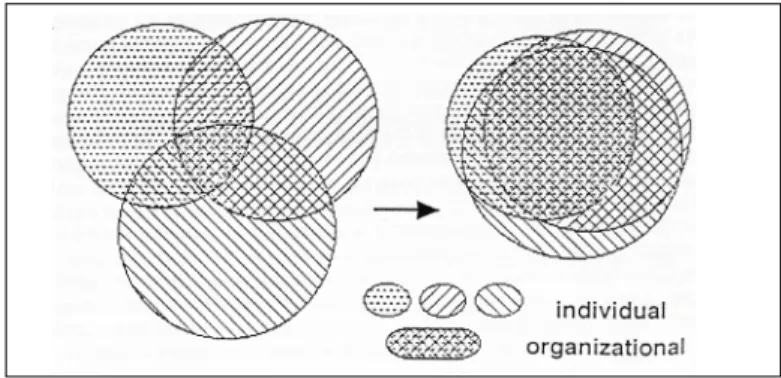
When we focus on the “being” dimension of knowledge, the stake of knowledge management is to help actors, involved in a given decision process, to build a minimum common representation of what the problem is. To do so, it is necessary to insure a certain level of consistence between individual interpretative frameworks. That is what Shigehisa Tsuchiya calls “commensurability” of interpretative frameworks (Tsuchiya, 1993), as illustrated with figure 4 :
Figure 4. Commensurability of interpretative frameworks
This figure stresses out the difference between several interpretative frameworks which can, by a combination of circumstances, have a certain level of consistence and the level of consistence based on which the actors’ interpretations will be similar enough to share a minimum common representation of the problem and to lead to a collective decision. The consistence between the different interpretative frameworks greatly depends on the knowledge underlying these interpretative frameworks : that is why it is necessary to favour communication between actors, that is to say having dialogue, exchanging ideas, confronting mental models and internal representations about the company, modifying these representations, etc.
Therefore, capacity of actors involved in the company’s collective decision processes depends on their ability to communicate upon their knowledge – studied in its “being” dimension” – in order to insure a certain level of consistence between their interpretative frameworks and then a build a minimum common representation of the problem they are faced with.
5. Conclusion
Collection, storage and treatment of relevant information is an essential part of organisations activities. Inside organisations, it is relatively obvious that new
technologies of information and communication lead to a better understanding of what we have called an object oriented complexity. But information could be useless if the diversity of interpretation schemes has not been taken into account within decision processes. In other words, decision processes and aiding decision processes must be based upon knowledge management processes as much as information treatment processes.
This paper puts into light that the complexity in a decision process is an object oriented complexity as much as an interpersonal oriented complexity. The interpersonal oriented complexity deals with the fact that to one decision maker corresponds several problems and that one problem is not perceived the same between the different decision makers. So a problem is necessarily subjective because it depends on the person who feels the problem. The different ways to interpret or perceive a single situation depends on the “being” dimension of knowledge carried on by the involved actors, that is to say the mental models, pictures and representations, social standards, values, tacit rules, myths, beliefs, mistakes, dreams, hopes, etc., carried by these actors.
Therefore, knowledge management for decision aid must take into account this dimension of knowledge in order to favour the construction of a minimum common representation of what the problem is and finally to increase the effectiveness of the “intelligence” phase of the decision process.
But knowledge management for decision aid must also - in order to increase the effectiveness of the “conception” and “choice” phases of the decision process – deal with the “doing” dimension of knowledge, that is to say skills and know-how. In that frame, it is necessary to allow any entity to use the knowledge conveyed within company on the one hand and to create new knowledge on the other hand. Thus, company has to set up managerial actions aimed at responding to the capitalising on company’s knowledge set of problems.
6. Bibliography
BANVILLE C., LANDRY M., MARTEL J.-M., BOULAIRE C., “A stakeholder approach to MCDA”, Systems Research, vol. 15, 1998, p. 15-32.
BARR A., FEIGENBAUM E. A. , “The Handbook of artificial intelligence”, Pitman, 1981. BELTON V., PICTET J., “A framework for group decision using a MCDA model : sharing,
aggregating or comparing individual information”, Revue des Systèmes de Décision, vol. 6 n°3, 1997, p. 283-303.
BOUYSSOU D., “Problèmes de construction de critères”, Cahier du LAMSADE n°91, 1989, Université Paris-Dauphine.
CASTELLS M., “La société en réseaux”, Fayard, 2001.
GRUNDSTEIN M., ROSENTHAL-SABROUX C., PACHULSKI A., “Reinforcing Decision Aid by Capitalizing on Company’s Knowledge : Future Prospects”, Revue EJOR, 2001. HWANG C-L., LIN M-J., “Group Decision Making under multiple Criteria”,
Springer-Verlag, 1986.
LANDRY M., “La décision comme support à la construction du sens dans l'organisation”,
Systèmes d'Information et Management n°1, vol..3, 1998.
LANDRY M., “A note on the concept of problem”, Organization Studies, 1995.
LEVINE P., POMEROL J.C., “Systèmes interactifs d’aide à la décision et systèmes experts”, Hermès, 1989.
LORINO P., “Piloter ou catalyser le changement organisationnel : une approche sémiotique et pragmatique”, Actes du colloque “Conception et dynamique des organisations : Sait-on
piloter le changement? ” , Ecole des Mines, 2-3 novembre 2000.
MARCH J.C., COHEN M.D., OLSEN J.P., “A garbage can model of organizational choice”,
Administrative Science Quaterly, vol. 17 n°1, 1972.
MARCHANT T., “Les systèmes d’aide à la décision en groupe : une brève revue”, INFOR, vol.38, n°1, 2000, p. 1-13.
MAYSTRE L.-Y., BOLLINGER D., “Aide à la Négociation Multicritère”, Presses Polytechniques et Universitaires Romandes, 1998.
NEWELL A., SIMON H. A., “Human problem solving”, Prentice Hall, 1972.
NONAKA I., TAKEUCHI H., “The Knowledge Creating Company”, Oxford University Press, 1995.
PACHULSKI A., GRUNDSTEIN M., ROSENTHAL-SABROUX C., “GAMETH : A Methodology Aimed To Locate The Company’s Crucial Knowledge”, ECKM00, Bled, Slovénie, 26-27 octobre 2000.
POPPER K., “Des sources de la connaissance et de l’ignorance”, Rivages Poche, 1985. ROUSSEAU A., MARTEL J.-M., “La décision participative : une démarche pour gérer
efficacement les problèmes environnementaux”, Research paper 96-24, 1996, Université Laval.
ROY B., “Méthodologie d’Aide Multicritère à la Décision”, Economica, 1985.
ROY B., “Multicriteria Methodology for Decision Aiding”, Kluwer Academic Publishers, 1996.
ROY B., “Réflexions sur le thème de la quête de l’optimum, in Décisions, Prospective”,
Auto-Organisation – Mélanges en l’honneur de Jacques Lesournes, Textes réunis par J.
Thépot, M. Sodet, F. Roubelat, A.E. Saab, 2000, p. 61-83, Paris Dunod.
SFEZ L., “Critique de la Décision”, Coll. Références, Presses de la Fondation Nationale des Sciences Politiques, 1992.
TAYLOR F.W., “The Principles of Scientific management”, Harper, 1929, (c1911).
TSUCHIYA S., “Improving Knowledge Creation Ability Through Organizational Learning”,
ZACKLAD M., GRUNDSTEIN M., “Ingénierie et capitalisation des connaissances”, Traité
IC2, Série Informatique et SI, Ouvrage collectif dirigé par Manuel Zacklad et Michel
Grundstein, Hermès Sciences, 2001.
ZOLLER H.G., BEGUIN H., “Aide à la décision : l'évaluation des projets d'aménagement”, coll. Bibliothèque de science régionale, Economica, Paris, 1992.