! " ! " !#!$ % &' ( ) # $ ' *+$, &' ( - ./01 $ & ( $ ' . 0/,$ &*2 3 ( % 3 % " 1"'!#!!$/4 $/ 5 & ( 1 % ./01 $ & ( & & '( ) 1 6 * ' &+ '&+ ). / 0 3 1 5 ' & ', +-, )1 ), '#/"% 3 )#%' .*/7,
'. /"
0
"
89/ 3 :9881
,1
.(
&
&
2
2&,
,3
Sergey S. KRISHTOPENKO
Spin splitting and collective effects in InAs/AlSb
quantum well heterostructures
Toulouse, 2011
IPM RAS
Acknowledgements
It would not have been possible to write this Ph.D. thesis without the help and support of the kind people around me, to only some of whom it is possible to give particular mention here. Above all, I would like to thank my parents and twin Dmitry for their personal support and great patience at all times. This thesis would not have been possible without the help, support and patience of my supervisors, Prof. Vladimir I. Gavrilenko and Prof. Michel Goiran, not to mention their advice and knowledge in physics of semiconductors. The good advice and support of Prof. Vladimir Ya. Aleshkin has been invaluable on both an academic and a personal level, for which I am extremely grateful. I would like to acknowledge the fi-nancial, academic and technical support of the Institute for Physics of Microstructures RAS and its staff in Department for physics of semiconductors.
I thank the French Embassy in Moscow provided me with the necessary financial sup-port for this research in Laboratoire National des Champs Magnétiques Intenses (LNCMI) and especially the scientific attaché, Dr. Michel Tararine, for his kind and valuable advices at every stages of my scholarship. I also thank Geert Rikken, the director of LNCMI, for his per-sonal support during my stays in Toulouse.
I am most grateful to the non-profit Dynasty Foundation, Russian Academy of Sci-ences and Russian Foundation for Basic Research for the financial support in Russia. I would like to thank Prof. A. S. Mel’nikov and Prof. V. V. Kurin for their academic courses that caused my interest in physics of condensed matter. I would like to thank Maksim S. Zho-ludev, Dr. Denis. Y. Vodolazov, Dr. Taras A. Dauzhenka and Prof. Leonid E. Golub for their valuable comments of this research.
I also acknowledge my collaborators Dr. Anton V. Ikonnikov (IPM RAS, Nizhny Novgorod), Dr. Oleksiy Drachenko (HZDR, Dresden) and Dr. Kirill V. Maremyanin (IPM RAS, Nizhny Novgorod) who carried out the experiments on persistent photoconductiv-ity and cyclotron resonance in InAs/AlSb QW heterostructures.
Content
INTRODUCTION
1
CHAPTER 1 Spin-related phenomena in two-dimensional electron gas
(literature review).
9
1.1 Spin splittings in two-dimensional electron gas.
9
1.2 Persistent photoconductivity in InAs/AlSb single quantum well
het-erostructures.
19
1.3 Exchange enhancement of quasiparticle g-factor in 2D electron gas.
23
1.4 Collective excitations in the quantum Hall effect regime. Excitonicrepresentation.
32
CHAPTER 2 Spin splitting in AlSb/InAs/AlSb quantum well in zero
mag-netic field.
43
2.1 Hartree approximation in narrow-gap QW heterostructures.
43
2.2 Persistent photoconductivity in InAs/AlSb heterostructures with double
quantum wells.
52
2.3 The “built-in” electric field effects and exchange interaction in
InAs/AlSb heterostructures with single quantum wells.
61
CHAPTER 3 Exchange interaction effects in magnetotransport
experi-ments in InAs/AlSb QW heterostructures with 2D electron
gas.
73
3.1 Hartree-Fock approximation in the presence of magnetic field in
nar-row-gap QW heterostructures.
73
3.2 Quasiparticle spectrum in InAs/AlSb heterostructures with single
quantum wells.
82
3.3 Exchange enhancement of quasiparticle g-factor in InAs/AlSb
heterostructures with single quantum wells.
87
CHAPTER 4 Spin resonance in 2D electron gas in InAs/AlSb
heterostruc-tures.
99
4.1 Magnetic excitons in 2D electron gas in quantum well with
non-parabolic electric subbands. Excitonic representation.
99
4.2 Spin exciton energy in the short- and long-wavelength limits in InAs/AlSb quantum well heterostructures. Larmor theorem violation.
106
iv
CHAPTER 5 Cyclotron resonance in InAs/AlSb quantum well
het-erostructures.
117
5.1 Cyclotron resonance study in InAs/AlSb heterostructures with single
occupied electric subbands.
117
5.2 Cyclotron resonance study in InAs/AlSb heterostructures with two
oc-cupied electric subbands.
136
5.3 Effect of exchange interaction on cyclotron resonance in InAs/AlSb
quantum well heterostructures. Kohn theorem violation.
144
CONCLUSIONS
157
BIBLIOGRAPHY
159
AUTHOR’S PUBLICATIONS
170
Introduction
In recent years there has been considerable interest in spin-related phenomena in two-dimensional (2D) systems which were explored in numerous works, both theoretical and ex-perimental. This interest is solicited first of all by a possibility to develop a new kind of de-vices manipulating electron and atom spins, i.e. spintronic dede-vices. Controlling the electron spin states, in perspective, will allow creating ultra small logic elements and memory arrays with huge operating rate as well as with small energy consumption and large information ca-pacity. During the last decade much attention has been devoted to the 2D heterostructures based on narrow gap semiconductors that are characterized by high electron mobility and large spin splitting in the energy spectrum in the absence of magnetic field. Such heterostructures are of particular interest for high speed transistors, short wavelength quantum cascade lasers, resonant tunneling diodes, detectors of far-infrared and terahertz ranges as well for the spintronic devices. To explain the wide range of spin-related phenomena that take place in 2D systems one needs to be conscious of band spectra of charge carriers, density of states at Fermi level as well as of the role of electron-electron interaction in these phenomena.
All spin-related phenomena in semiconductor heterostructures with 2D electron gas can be conventionally divided into two broad classes. The first class, the “single electron” effects, is related to the spin-orbit interaction in the system. Most of the spin-related phenomena of this class results from the spin splitting in the electron energy spectrum in the absence of the magnetic field. This splitting in the energy spectrum in a quantum well (QW) nearby the conduction band edge (top of the valence band) in semiconductor heterostructures is either linear or proportional to the third power of the wavevector (depending to the partici-pation of |S>- and |P>-states of the bulk materials in the lowest electric subband in the QW). Spin splitting of electron states in a QW in some cases manifest itself as beating of Shub-nikov-de Haas (SdH) oscillations and as cyclotron resonance (CR) line splitting. Spin splitting may also results in peculiarities in Raman spectra.
The second class of spin-related phenomena in semiconductor heterostructures is gen-erated by many-body effects resulting from Coulomb interaction of charge carriers. Most of the experimental techniques to probe band structure of 2D systems are based on magneto-transport and magnetooptical measurements, the Coulomb interaction effects are different in these two cases. In magnetooptics the resonant absorption of the electromagnetic wave by 2D electron gas results in the generation of quasielectron-quasihole pairs (quasielectrons over the Fermi level and quasiholes below the Fermi level); as a result the system transits from the ground to an excited state. Concerning the collective excitations in 2D electron gas there are
2
on the resonant absorption energy in the long wavelength limit. According to Kohn theorem [1] electron-electron interaction does not affect the CR frequency in 2D system with full translation symmetry. In accordance with Larmor theorem in rotationally invariant spin space, in 2D system the electron-electron interaction does not affect the energy absorption in the spin resonance in the long wavelength limit. Note that in narrow gap QW heterostructures and in other systems with strong nonparabolicity in electric subbands where the effects of spin-orbit coupling are significant both theorems are violated [2-7].
In magnetotransport experiments the measured quantity is the static conductivity that is determined by the ground state of 2D electron gas, i.e. by quasiparticle spectrum in the magnetic field renormalized by Coulomb interaction. Magnetotransport study in 2D electron gas allows one to extract the value of the spin splitting at the Fermi level in quasiparticle spectrum. For example, analysis of Zeeman splitting of SdH oscillations allows determining the quasiparticle factor values that can differ significantly from both the free electron g-factor and that of electrons in bulk material. This enhancement, observed experimentally, of the “magnetotransport” g-factor as compared with the values obtained from magnetooptical studies (electron spin resonance) is related to the exchange interaction [8]. Ando and Uemura were the first to suggest that the g-factor should be an oscillating function of the Landau lev-els filling factor [9].
In most of narrow gap QW heterostructures where large values of quasiparticle g-factor have been observed [10-17] the electric subbands are characterized by a pronounced nonparabolicity. That is why in order to quantitatively describe the effects of electron-electron interaction on the quasiparticle spectrum in QW one has to take into account energy-momentum features of the electric subbands. Typical representatives of 2D systems based on narrow gap semiconductors are InAs/AlSb QW heterostructures. InAs/AlSb heterostructures are characterized by small values of electron effective mass in InAs QW [18-21], large values of effective g-factor [14, 16] and high electron mobility up to 3⋅104 cm2/V⋅s at T = 300 K and 9⋅105 cm2/V⋅s at T = 4.2 K [22, 23]. In these heterostructures the QW in the conduction band is very deep (more than 2 eV for -valley electrons). It is well known that even in nominally undoped InAs/AlSb heterostructures there is a 2D electron gas, the electron concentration be-ing about 1012 cm-2 [22-25]. As electron “suppliers” to InAs QW deep donors associated with defects in AlSb as well as surface donors in GaSb cap layer (grown over AlSb barrier layer to prevent from its oxidation at air [22-26]) have been considered [23-25]. The “built-in” electric field generated by spatially separated 2D electrons gas and the donors in GaSb cap layer and in the AlSb barriers distorts the QW profile that in turn, due to the spin-orbit interaction, leads to the splitting of the energy spectrum of the 2D electron gas in AlSb/InAs/AlSb QW even in
the absence of the magnetic field [27]. In InAs/AlSb heterostructures the effects related with spin splitting of the electron energy spectrum have been observed experimentally [28, 33].
A remarkable peculiarity of InAs/AlSb heterostructures is the bipolar persistent photo-conductivity (PPC) observed at low temperatures [29-32]. Under illumination of the het-erostructures by infrared (IR) radiation positive PPC takes place while under the action of visible light negative PPC is observed. Using PPC effect it is possible to reversibly change the 2D electron concentration in AlSb/InAs/AlSb QW by several times, that in turn leads to a change of the built-in electric field and the spin subbands population. The latter allows not only tuning the effects of spin-orbit coupling but also controlling the effects of collective elec-tron interaction, in particular, the exchange enhancement of the g-factor [16, 34] thus opening new possibilities for spin engineering.
The thesis consists of the Introduction, five chapters and Conclusions that are organ-ized as follows. In the Introduction we formulate the main aims and show the scientific
nov-elty of the research. Chapter 1 provides a literature review of the studies on the persistent
photoconductivity and various spin-dependent phenomena in heterostructures with 2D elec-tron gas. In the first section we survey publications on the effect of spin-orbit interaction on the splitting of 2D electron energy-momentum law in zero magnetic field and discuss the pa-pers devoting to the investigation of beatings of Shubnikov-de Haas oscillations in InAs/AlSb QW heterostructures. The second section provides a review of persistent photoconductivity investigations in InAs/AlSb QW heterostructures with GaSb cap layer. The third section is devoted to the exchange enhancement of g-factor in 2D electron gas and provides a review of magnetotransport studies of quasiparticle g-factor in AlSb/InAs/AlSb QW. In the fourth sec-tion various collective excitasec-tions in the quantum Hall effect regime are considered. We also perform a review of theoretical studies of the effects of electron-electron interaction on spin and cyclotron resonances in heterostructures with 2D electron gas (a violation of Kohn and Larmor theorems).
Chapter 2 is devoted to the study of Rashba spin splitting and asymmetry of the
“built-in” electric field in InAs/AlSb QW heterostructures in zero magnetic field. In the first section we consider the self-consistent Hartree approximation used for energy spectrum calcu-lating in narrow-gap heterostructures. The second section provides the results of persistent photoconductivity study in InAs/AlSb double QW heterostructures. Pronounced asymmetry of the “built-in” electric field in the InAs/AlSb heterostructures in the case of positive PPC is demonstrated. The third section of the chapter presents the calculations of 2D electron energy spectrum and the Rashba splitting constant in AlSb/InAs/AlSb QWs in the presence of asymmetric “built-in” electric field. Experimental value of the Rashba splitting constant,
ob-4
tained from Fourier analysis of Shubnikov-de Haas oscillations at 0.2 K in InAs/AlSb QW heterostructures, is compared with theoretical calculations.
Chapter 3 is devoted to the study of exchange interaction effects in magnetotransport
experiments in InAs/AlSb QW heterostructures. In the first section we consider the Hartree-Fock approximation taking into account the screening effect in 2D electron gas in AlSb/InAs/AlSb QW. The second section presents the studies of the exchange interaction ef-fect on the density of states at the Fermi level and the energy spectrum of quasiparticles de-pending on the Landau levels width in InAs/AlSb QW heterostructures. The third section pro-vides the calculations of exchange enhancement of quasiparticle g-factor in AlSb/InAs/AlSb QW. The calculation results are compared with experimental g-factor values obtained from various magnetotransport experiments in InAs/AlSb heterostructures.
Chapter 4 provides the results of a theoretical study of the effects of Rashba spin
splitting and exchange interaction on spin resonance in InAs/AlSb heterostructures with 2D electron gas. In the first section we obtain an effective Schrödinger equation for magnetic ex-citon in narrow-gap heterostructures with 2D electron gas. The second section presents the calculations of the spin exciton energy in the short- and long-wavelength limit in AlSb/InAs/AlSb QWs. We demonstrate Larmor theorem violation in InAs/AlSb heterostruc-tures with symmetric and asymmetric “built-in” electric field. The third section presents the calculations of “magnetooptical” g-factor measured in electron spin resonance for different values of the Landau levels width and 2D electron concentration in InAs/AlSb QW het-erostructures.
Chapter 5 is devoted to the cyclotron resonance study in InAs/AlSb QW
heterostruc-tures. The first and second sections of the chapter provide the experimental and theoretical results of studies of cyclotron transitions in InAs/AlSb heterostructures with single and two occupied electric subbands. Experimental values of the CR transition energies are compared with theoretical calculations within the Hartree approximation. The third section is devoted to theoretical investigations of the influence of electron-electron interaction on CR energies in InAs/AlSb QW heterostructures. It is shown that taking into account the Coulomb interaction in 2D electron gas leads to Kohn theorem violation in AlSb/InAs/AlSb QWs.
The main results obtained in the thesis are summarized in the Conclusions. The thesis is aiming at:
1) Investigation of the persistent photoconductivity and the asymmetry of “built-in” elec-tric field in InAs/AlSb double QW heterostructures.
2) Study of the “built-in” electric field and electron-electron interaction effects on elec-tron energy-momentum law and spin splitting in electric subbands in AlSb/InAs/AlSb single quantum well in the absence of magnetic field.
3) Exploring the quasiparticle energy spectrum and the density-of-states at Fermi level in InAs/AlSb heterostructures. Calculation of quasiparticle g-factor at various 2D elec-tron concentration, magnetic field and Landau level width values.
4) Investigation of the electron-electron interaction effect on the spin exciton energy (violation of Larmor theorem) in InAs/AlSb heterostructures in the long-wavelength limit. Calculations of “magnetooptical” g-factor of 2D electrons for various magnetic field and Landau level width values.
5) Cyclotron resonance study in InAs/AlSb QW heterostructures with single and two oc-cupied electric subbands. Revealing the effects of electron-electron interaction in cy-clotron resonance spectra.
The scientific novelty of the results obtained:
1) Strong asymmetry of InAs/AlSb heterostructures due to the “built-in” electric field was demonstrated directly. The self-consisted calculations of the energy profile of the double QW performed allowed one to determine the ionized donor concentrations from both sides of QWs and to specify the earlier proposed mechanism of the bipolar persistent photoconductivity in these heterostructures.
2) 2D electron energy spectra in InAs/AlSb heterostructures with asymmetric QW profile were calculated both in Hartree and Hartree-Fock approximations. The exchange in-teraction was shown to decrease the electric energy in subbands and, at the same time, to increase the electric subband separation as well as the spin splitting in the spectrum. The nonlinear dependence of the Rashba splitting constant at the Fermi wave vector on 2D electron concentration was demonstrated.
3) In the thesis the calculations of the exchange enhancement of the quasiparticle g-factor at zero temperature in InAs/AlSb QW heterostructures with single occupied electric subband have been performed. It has been demonstrated that the exchange g-factor enhancement not only exhibits maxima at odd values of Landau level filling factors but, due to the conduction band nonparabolicity, persists at even filling factor values as well. The magnitude of the exchange enhancement, the amplitude and shape of the
6
4) Theoretical study of the electron-electron interaction effect on quasiparticle energy spectrum in InAs/AlSb QW heterostructures versus Landau level width has been per-formed. It has been shown that taking into account the exchange interaction results in the distortion of monotonic dependence of Landau level energy on the magnetic field as well as in the peak features appearance in quasiparticle spectrum at integer values of Landau level filling factors associated with a screening effect in 2D electron gas. It has been demonstrated that the exchange interaction in the case of the overlapping of spin-split Landau levels leads to the density-of-states splitting into two peaks corresponding to the different levels contribution and renormalizes the filling factors of the Landau levels at the Fermi energy. It has been shown that the magnetic field, in which the maximum value of the quasiparticle g-factor is achieved, depends on the Landau levels overlapping and corresponds to the odd filling factors only in the absence or in the case of small density-of-states overlapping at spin-split Landau levels.
5) It has been demonstrated that nonparabolicity of the energy-momentum law in InAs/AlSb QW heterostructures leads to Larmor theorem violation. The exchange in-teraction effect on the spin exciton energy in the long-wavelength limit has been dem-onstrated. The calculation results have shown that the “magnetooptic” g-factor value in InAs/AlSb heterostructures, measured by electron spin resonance technique, oscil-lates with the magnetic field and coincides with the quasiparticle g-factor at even Lan-dau level filling factors. Both the amplitude and the form of “magnetooptical” g-factor oscillations are controlled by screened electron-electron interaction and the Landau level overlapping.
6) An “enhanced” splitting of the cyclotron resonance line in InAs/AlSb heterostructures with 2D electron gas has been discovered that results from the hybridization of cyclo-tron transitions in nonparabolic electric subband due to eleccyclo-tron-eleccyclo-tron interaction (violation of Kohn theorem). In the samples with higher mobility an increase of the “enhanced” splitting with the magnetic field has been observed. At the filling factors < 1 in static and pulsed magnetic fields an increase of cyclotron resonance transition energy at the decrease of 2D electron concentration, the shift exceeding that owing to the Landau level broadening, has been discovered.
Scientific and applied significance of the thesis:
The scientific significance of the results, obtained in the thesis, consists in the discov-ering and prediction of new physical effects. The asymmetry of the built-in electric field in
InAs/AlSb QW heterostructures was probed both experimentally and theoretically and its ef-fect on the electron energy spectrum splitting in electric subbands was demonstrated. The theoretical investigation into electron-electron interaction effect on quasiparticle Landau lev-els and density-of-states at the Fermi level was undertaken for the first time. Theory of the exchange enhancement of the g-factor at zero temperature in narrow gap semiconductor het-erostructures with single occupied electric subband was developed in the work. Calculation results on the “magnetooptical” g-factor, measured in electron spin resonance experiments, in InAs/AlSb heterostructures are the first demonstration of Larmor theorem violation in narrow gap QW heterostructures. Cyclotron resonance study in the samples with high mobility 2D electron gas in quantizing magnetic fields provides evidences of Kohn theorem violation in InAs/AlSb heterostructures. A principle possibility to control by optical means the “built-in” electric field and, correspondingly, the spin splitting in the energy spectrum in the absence of the magnetic field was demonstrated.
The results obtained in the dissertation work can be utilized at the designing new elec-tronic and optoelecelec-tronic units as well the spinelec-tronic devices based on InAs/AlSb heterostruc-tures.
Author’s contribution to the results obtained:
All theoretical studies and calculations in the Thesis have been performed by the au-thor without any assistance. The auau-thor has also carried out the magnetotransport experiments at T = 200 mK in Toulouse (Section 2.3) and has taken part in experimental studies on
cyclo-tron resonance in weak magnetic fields in Nizhny Novgorod (Section 5.1). Others
experi-ments on persistent photoconductivity (Section 2.2) and cyclotron resonance (Section 5.1 and 5.2) in quantizing magnetic fields have been performed by the collaborators presented on
Chapter 1. Spin-related phenomena in two-dimensional electron
gas (literature review).
1.1. Spin splittings in two-dimensional electron gas.
Most “single-electron” spin-related phenomena in 2D semiconductor systems result from the spin splitting of the energy spectrum of charge carriers in the absence of magnetic field. In semiconductor quantum well (QW) heterostructures this splitting of electronic states near conduction band edge in 2D semiconductor structures is a linear function of the quasimomentum .The exceptions are the QWs with InAs/GaSb heterointerfaces and quantum wells based on HgTe, in which the contribution of |P>-states of bulk materials in the formation of the lower electric subband can greatly exceed the contribution of |S>- states that leads to the formation of the “hole-kind” subband.
Two carrier spin states with the same wavevector k in the plane of structure will have
different energy in zero magnetic field if the system lacks inversion center. There are two well known reasons for the lack of the spatial inversion center in 2D systems. The first one is the lack of inversion symmetry in bulk materials which a heterostructure is grown from. This bulk inversion asymmetry (BIA) takes place in A3B5 and A2B6 semiconductor compounds as well as in tellurium, however it is absent at the diamond-like semiconductors (Si and Ge). Two-dimensional systems, grown from materials with BIA, also do not have the inversion center and, consequently, there is no spin degeneracy in the energy spectrum of charge carri-ers.
The second reason of the lack of spatial inversion center in heterostructures is the structure inversion asymmetry (SIA). It means there is a macroscopic asymmetry in 2D sys-tem: directions along and against the growth axis are not equivalent. For example, the quan-tum well (QW) is sandwiched between the lower and the top barriers grown from different materials, or there is an electric field, oriented across the plane of heterostructure, or the sys-tem is asymmetrically doped. SIA can take place in heterostructures, grown from any semi-conductor materials.
Effective Hamiltonian for electrons near conduction band edge in heterostructures without a spatial inversion center is as follows:
( ) ( )
z U z H( )
k THˆ = ˆ + + ˆSO , (1.1)
where Tˆ
( )
z is the kinetic energy operator (quadratic form in k), depending on the coordinate10
with the system invariance with respect to time reversal, HˆSO
( )
k should contain only odd terms in k, that leads to the form HˆSO( )
k ∝σ
ˆlkm, σˆlkikjkm etc., whereσ
ˆ are the Pauli lmatrices (l = x, y, z).
In contrast to the A3B5, A2B6 bulk semiconductors, where there are no terms of
σ
ˆlkm-type in Hamiltonian, HˆSO is linear in k in two-dimensional electron systems:
( )
l m m l lm SO k k Hˆβ
σ
ˆ , = . (1.2)Here
β
ˆ is pseudotensor of second rank. The media which have nonzero components of such pseudotensor are called gyrotropic. In the absence of magnetic field in such media there is a spin splitting of the energy-momentum law, linear versus the quasimomentum:(
)
= + = ∆ z y x l lx k ly k spin k , , 2 sin cos 2β
ϕ
β
ϕ
. (1.3)Here
ϕ
k is the angle between k and the x axis. The systems, where only SIA is present, havea C∞v symmetry. It means that the pseudotensor
β
ˆ has only one linear-independent component:α
β
β
xy =− yx ≡ ;β
ii =0 (1.4)Therefore, the Hamiltonian of the spin-orbit interaction, induced by SIA, has the following form:
( )
(
x y y x)
( )
zSIA k k k k
Hˆ =α σˆ −σˆ =ασˆ× . (1.5)
This form of the Hamiltonian was first proposed by Rashba [35] for bulk semiconductors with wurtzite structure having a screw axis (z direction). Later, in [36-39], it was noted that SIA in 2D systems leads to the spin-orbit interaction of the same form.
BIA reflects the lack of inversion center in the crystal structure of bulk semiconductors from which two-dimensional system is grown. Therefore, the Hamiltonians of the spin-orbit interaction, induced by BIA, differ for the QWs grown along different crystallographic directions.
To obtain the BIA terms, we note that in the 3 5 bulk semiconductors possessing the
d symmetry, the operator of the spin-orbit interaction has the form:
( )
[
ˆ(
2 2)
ˆ(
2 2)
ˆ(
2 2)
]
ˆSO K xKx Ky Kz yKy Kz Kx zKz Kx Ky
H =γ σ − +σ − +σ − . (1.6)
Here K = (k,kz) is the 3D electron quasimomentum vector, γ is a constant, and || [100], || [010], z || [001] are the cubic axis of the crystal. Such Hamiltonian was first obtained by Dresselhaus in [40].
In two-dimensional systems due to the size quantization the component of quasimomentum along the growth axis is replaced by the operator. For example, for quantum wells grown along the cubic axis z || [001]
z i
kˆz =− . Since the spin-orbit interaction is usually weak, one can obtain the Hamiltonian for 2D electron averaging expression (1.6) over the adiabatic rapid motion along the growth axis. Carrying out this averaging and taking into account that 0 ˆ =z k , ˆ2 ≠0 z k ,
where the brackets mean the quantum-mechanical averaging over the structure part of the electron wavefunction, depends on z, one can arrive to the 2D form of the Dresselhaus term:
( )
(
x x y y)
BIA k k k
Hˆ =βσˆ −σˆ (1.7)
Here β is a single linear-independent component of pseudotensor βˆ in 2D systems with BIA, which have the symmetry of D2d:
β β
βxx =− yy ≡ ; βij ~δij. (1.8)
Within the adiabatic approach mentioned above the expression for β is as follows: 2 ˆ z k γ β =− . (1.9)
The Hamiltonian in the form of (1.7) and expression (1.9) were first obtained by D’yakonov and V. Yu. Kachorovskii in [41].
If the quantum well growth direction is not along the cubic axis, the operator of the spin-orbit interaction will have another form. For example, in symmetric (113) heterostructures, there is only one (1-10) reflecting plane. The point symmetry group of such systems is Cs and spin-orbit interaction takes the following form:
( )
z x BIA k k Hˆ =β
σ
ˆ , (1.10) where z || [113], x || [1-10] and 0.5 ˆ2 z k γβ =− . Note that the part of spin orbit interaction, induced by BIA, in the asymmetric (110) quantum wells takes the same form (1.10) if the z axis is oriented along the growth direction [110]. If the QW is asymmetric then
SIA BIA SO H H
Hˆ = ˆ + ˆ , where the second term has the same form in all cases. In (001) quantum
wells
( )
(
y x) (
x x y)
ySO k k k k k
Hˆ = α +β σˆ − α +β σˆ . (1.11)
In the simultaneous presence of the two asymmetry types (BIA and SIA) the structure has the point group C2v. Therefore, we also present the Hamiltonian in the main axes of the C2v group:
( )
(
)
(
)
12
where x' || [1-10] and y' ||[110]. It is convenient and methodologically helpful for many problems to represent the spin-orbit Hamiltonian in the following form:
( )
k( )
kHˆSO = σˆ⋅Ω , (1.13)
where the vector of Ω
( )
k = βˆ⋅k with components lm m lk
⋅ =
Ω β is introduced. The
Hamilto-nian (1.13) has the Zeeman form and Ω
( )
k denotes the frequency of spin precession ineffective magnetic field acting on the spin of electrons with quasimomentum k. The spin
split-ting (1.3) is expressed via Ω
( )
k as( )
k k spin = Ω∆ 2 . (1.14)
Precession of electron spins with frequency Ω is caused by the absence of spatial inversion center in the system. The orientation of Ω at given quasimomentum k depends on the reason
of the lack of spatial inversion center in the systems. If SIA dominates, the spin-orbit interaction will be described by the Rashba Hamiltonian (1.5) and the corresponding frequency precession has the form:
(
y x)
R = k −k
Ω α , . (1.15)
If (001) QW heterostructure is symmetric then BIA will dominate and as follows from the 2D form of the Dresselhaus term (1.7),
(
x y)
D = k −k
Ω β , . (1.16)
In axes ' || [1-10], ' || [110] precession frequencies are as follows:
(
y', x')
R = k −k
Ω α ; ΩD = β
(
ky',kx')
. (1.17)Figure 1.1 illustrates the distribution of effective magnetic fields in the k-space. As it clear to
see the directions of Ω and R Ω are different at different quasimomentum orientations but D
their absolute values have isotropic distributions in k-space. As a result the spin-splittings,
induced by SIA and BIA, have the forms:
k SIA =2α
∆ ; ∆BIA =2
β
k. (1.18)However, if both asymmetry types are presented in the structure (α·β 0) then BIA
SIA spin ≠∆ +∆
∆ . Fig. 1.1 demonstrates that for the [110] direction the precession
frequencies are codirectional and for k || [1-10] the frequencies are contradirectional. Since
the spin splitting is determined by the vector sum Ω and R Ω , for some directions it is less D than ∆SIA+∆BIA and for some k orientations ∆ exceeds the sum spin ∆ and SIA ∆BIA. The
k spin =2k
α
2 +β
2 +2αβ
sin2ϕ
∆ . (1.19)
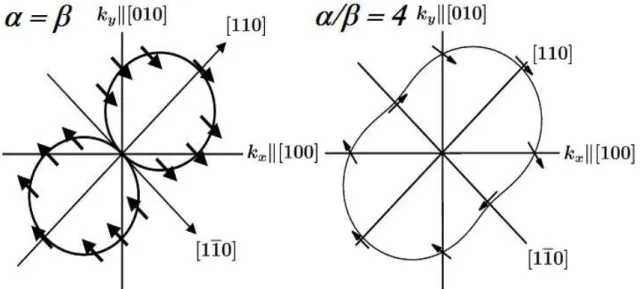
The angular dependence of Ω at non-zero and is presented in figure 1.2. The
( )
kinterference of SIA and BIA is especially pronounced at equal values of and . In this case, as it is seen from (1.12), the Hamiltonian of the spin-orbit interaction has the form:
( )
2 ˆ ' ˆ y x SO k k H = ασ ′ . (1.20)The spin precession frequency Ω is oriented parallel to the ' axis for the electrons with any quasimomentum directions:
( )
' ' 2 y x k = α k Ω , Ω ky'( )
=0. (1.21)The angular distribution of Ω in this “degenerate” case is presented in Fig. 1.2.
( )
kFig. 1.1 The angular distribution of ΩR
( )
k (left panel) and ΩD( )
k (right panel) in the14
In addition to SIA and BIA, there is another reason for the lack of spatial inversion center that lifts the spin degeneracy in 2D semiconductor systems. It is the interface inversion asymmetry (Interface Inversion Asymmetry, IIA), associated with the anisotropy of chemical bonds at the QW interfaces. The lack of inversion center induced by IIA is associated with low symmetry (C2v) of single interface. IIA contributes to an additional term, linear in k, to the spin splitting of energy spectrum. In (001) quantum wells it has the same form as HˆBIA
[43]:
( )
IIA(
x x y y)
IIA k k k
Hˆ =β σˆ −σˆ (1.22)
The constant IIA is determined by the probability to find out an electron close to the interface, so IIA-splitting plays significant role in narrow quantum wells. As it is shown in [44], IIA can be compared with γ kˆz2 value in some heterostructures.
Thermodynamic and kinetic coefficients such as heat capacity, magnetic susceptibility (de Haas-van Alphen effect), longitudinal conductivity (Shubnikov-de Haas effect), etc. oscil-late in systems with 2D degenerate electron gas at low temperatures. As it is known, the period of these oscillations is related to the radius of the Fermi circle. Such behavior of these coefficients is due to the appearance of the Landau levels which successively intersect the Fermi level as the magnetic field increases.
Fig. 1.2. The angular distribution of Ω in the
( )
k k-space at different values of ratio to :Quantum phenomena are highly sensitive to the fine structure of the carrier energy spectrum, so that even a small spin splitting may qualitatively modify the oscillation pattern. In 2D electron gas with spin splitting in the energy spectrum, where two Fermi circles are filled, the oscillations can be observed with two close periods. The addition of such oscillations results in the appearance of modulated oscillations (beatings) whose period as well as zeros of the amplitude depends on the BIA and SIA contribution to the spin splitting in energy spectrum. As it is demonstrated in [45] the different intensity of BIA and SIA contributions leads to the beatings of the Shubnikov-de Haas (SdH) oscillations. However, if the intensities of both contributions are equal, the oscillations occur only at a single frequency and the beatings disappear (Fig. 1.3), although the Hamiltonian contains terms linear in k.
Typically, in semiconductor quantum wells the SIA contribution to the spin-spin splitting exceeds the BIA contribution by several times [28], so that the latter is often neglected. From the Fourier analysis of beatings of SdH oscillations the Fermi vectors in each of the spin subband and, hence, the Rashba spin splitting constant can be determined.
Fig. 1.3. Magnetic-field dependence of the resistivity xx in the regime of Shubnikov–de Haas oscillations in the presence of (a) only one type of linear terms, EF / = 50 and kF/ = 3, and (b) both contributions with equal intensi-ties, EF / = 50. Here EF is the Fermi energy, is the cyclotron frequency,
16
The beatings of SdH oscillations in weak magnetic fields in InAs/AlSb QW heterostructures were observed in several papers [46-48]. In [46] the magnetotransport in AlSb/InAs/AlSb with 12.5 nm wide QW, sandwiched between Al0.80Ga0.20Sb layer on the left and AlSb barriers on right side, was studied. From Fourier analysis of SdH oscillations in magnetic fields less than 2 T (Fig. 1.4) two electron concentrations in different spin subbands, split due to “built-in” electric field of donors and 2D electrons, were determined. The value of Rashba spin splitting constant, determined by comparing the measurement results and simulation of SdH oscillations, was equal to 7.82·10-9 eV cm. Theoretical value, obtained from the self-consistent solution of Poisson and Schrödinger equations, was 5.37·10-9 eV cm. Note that the depth of AlSb/InAs/AlSb QW mistakenly assumed to be 1.3 eV, while for the electrons at Γ-valley of conduction band quantum well depth is more than 2 eV.
Fig. 1.4. (a) Shubnikov-de Haas oscillations in AlSb/InAs/AlSb QW in weak magnetic fields at 1.8 K [46]. Black, red and blue curves correspond to the experimental results and simulation with and without Rashba spin splitting. The arrow indicates the node position of the beatings. (b) The results of Fourier analysis of SdH oscillations in the range of 0.15 - 4.0 T-1.
In paper [47] to enhance the structure asymmetry instead of AlSb barrier close to the surface the AlGaSb barrier was used (Fig. 1.5). The values of Rashba splitting constant, determined from the comparison with simulations of SdH oscillations, were found to be 2.8·10-8 eV·cm and 1.1·10-8 eV·cm for the samples A and B with the 2D electron concentration of 8.4·1012 cm-2 and 9.0·1012 cm-2 respectively. The reasons for such strong differences in the values of the spin splitting in nominally identical samples A and B in [47] remained unclear.
In paper [48], in a 15 nm wide AlSb/InAs/AlSb QWs with a single occupied electric subband at temperature T = 1.3 K beatings of SdH oscillations were observed. The 2D electron concentration in the QW was changed by varying the voltage at the gate. As deter-mined from the difference between the electron concentrations in two spin subbands at zero gate voltage (ns = 1.2×1012 cm-2), the spin splitting at the Fermi wave vector (kF) was 3.2 meV (the samples A and B) that corresponded to the Rashba spin splitting constant 5.83×10⁻⁹ eV.cm. The Rashba spin splitting constant , determined for the samples A and B at different gate voltages, was found to be practically independent on 2D electron concentration. For another sample C with lesser value of 2D electron concentration, studied in [48], the au-thors report the splitting (kF) one-half than for above-mentioned samples A and B.
Fig. 1.5. (a) Scheme of band diagram of AlGaSb/InAs/AlSb QWs (samples A and B) [47]. (b) Shubnikov-de Haas oscillations in weak magnetic fields at 2 K. Upper and lower curves correspond to the experimental results and simulation taking into account the Rashba spin splitting.
18
In the papers [46-48], where the beating of Shubnikov-de Haas oscillations, related to the spin splitting in energy spectrum, were observed the nonparabolicity of electric subbands in InAs QW was completely ignored in the determination of Rashba splitting constant . Note that value of the spin-orbit splitting in 2D electron spectrum is determined not only by the “built-in” electric field and structure parameters but also by boundary conditions for the envelope wave functions. The self-consistent calculations of the spin splitting in InAs/AlSb QW heterostructures at zero magnetic field taking into account effects of nonparabolicity and deformation caused by lattice mismatch in InAs and AlSb at different 2D electron concentration values (see Chapter 2), have not been presented in literature till now.
In Chapter 2 of the thesis results of theoretical and experimental studies of Rashba
spin splitting in InAs/AlSb QW heterostructures are presented. Using the 8-band k·p
Hamiltonian the Rashba spin splitting constant at the Fermi level and at the bottom of electric subbands is calculated. By Fourier analysis of Shubnikov-de Haas oscillations at 0.2 K in weak magnetic fields the values of 2D electron concentration in spin subbands and experimental value of Rashba constant at the Fermi level are determined.
Fig. 1.6. (a) Scheme of band diagram of AlSb/InAs/AlSb QW heterostructures under positive voltage, applied to the gate [48]. (b) SdH oscillations at 1.3 K and gate voltage of 1 V. The inset shows the beatings of oscillations SdH in different scale.
1.2. Persistent photoconductivity in InAs/AlSb single quantum well
het-erostructures.
Persistent photoconductivity (PPC) is the phenomenon of long-term modification of the material conductivity after the action of light. If the sample conductivity increases after the illumination, this is a positive PPC, while in the case of conductivity decrease after light action, PPC is called the negative one. Usually PPC takes place at the charge carrier concen-tration increase/decrease after sample illumination by light with definite wavelength due to the charge space transfer. Therefore, in 2D systems with a pronounced PPC there is a princi-ple possibility to control optically the “built-in” electric field and, correspondingly, the spin splitting in the energy spectrum in the absence of the magnetic field that is significant for de-signing different spintronics devices.
Persistent photoconductivity was observed in various semiconductor systems: Si 1-xGex/Si QW heterostructures [49], crystals ZnCdSe [50], GaN films [51] etc. One of the most studied 2D electron system exhibiting PPC is GaAs/AlGaAs heterojunction. PPC in this sys-tem was discovered in work [52] where an increase of the 2D electron concentration from 1.1⋅1012 cm−2 up to 1.6⋅1012 cm−2 was observed at liquid helium temperature after the struc-ture illumination. Negative PPC has been observed in GaAs/AlGaAs QWs [53]. The effect is related to the generation of electron hole pairs under illumination with photons having ener-gies exceeding the band gap of AlGaAs. Photoexcited electrons are captured by ionized shal-low donors in AlGaAs, while holes move in the “built-in” electric field to the QW where they recombine with 2D electrons. It results in a decrease of 2D electron concentration.
As it has been mentioned in the Introduction, a remarkable feature of InAs/AlSb QW heterostructures is the bipolar PPC, i.e. it can be positive [25, 29, 30, 54] or negative [22, 29-31], both effects being of considerable strength. In these heterostructures 2D electron concen-tration can be reversibly tuned by more that 10 times depending on the wavelength of the ra-diation illuminating the sample [55]. PPC in InAs/AlSb heterostructures was explored for the first time in reference [22] where heterostructures with InAs QW 12 nm wide with 2D elec-tron concentration of 1.25⋅1012 cm-2 and mobility about 25000 cm2/V⋅s (at room temperature). It was discovered that, in contrast to the widely investigated GaAs/AlGaAs heterostructures, the illumination by green light emitting diode (LED) at low temperatures result not in an in-crease but in the diminishing of the 2D electron concentration (from 8⋅1011 cm-2 down to 2.5⋅1011 cm-2). The concentration change persisted up to T = 100 K and at higher temperatures the effect disappeared.
20
Further studies of persistent photoconductivity in InAs/AlSb heterostructures demon-strated that positive PPC was observed when the heterostructures was illuminated by infrared (IR) light. The latter was related to the photoionization of some deep donors in AlSb barriers (Fig. 1.7). The photoexcited electrons are considered to be captured by InAs QW thus increas-ing 2D electron concentrations that persists practically up to the sample thermal heatincreas-ing. The negative PPC is related with band gap excitation of electron-hole pairs firstly in GaSb cap layer and then (at shorter wavelengths) in AlSb barriers. Photoexcited electrons are captured by ionized deep donors while holes drift in the AlSb barriers in the “built-in” electric fields to the interface AlSb/InAs where they recombine with electrons in InAs QW, thus decreasing 2D electron concentration.
Spectroscopic studies of PPC in InAs/AlSb heterostructures at T = 4.2 K were carried out in references [29, 30, 56]. Under irradiation with photon energies 0.6 to 1.2 eV positive PPC was observed related to the photoionization of deep donors. At shorter wavelengths posi-tive PPC was observed related to the generation of electron-hole pairs with subsequent sepa-ration of electrons and holes by the “built-in” electric field, capture of electrons by ionized donors and holes recombination with 2D electrons in InAs QW. At photon energies over 3.2 eV an abrupt decrease of the negative PPC was discovered [30, 56] and attributed to the photoionization of deep donors in AlSb due to optical transitions into the next (over the con-duction band) energy band. Since in this case the process of electron generation prevail over recombination ones (due to electron-hole pair generation) this results in the fast setting of a higher “equilibrium” concentration that in turn leads to a resistance decrease.
Fig. 1.7. Scheme of band diagram of InAs/AlSb heterostructure. Dashed line indicates -valley edge in AlSb. Arrows indicate energies in eV.
Hall effect measurements demonstrated the correlation between spectral dependences of sample resistance and 2D electron gas concentration. In the spectral range of positive PPC an increase of electron concentration (compared to the dark value) is observed, while in the range of negative PPC the electron concentration decreases. In Fig. 1.8 spectral dependences of both the InAs/AlSb sample A680 resistance and 2D electron concentration are given [56]. Solid lines were obtained when the illumination was permanently switched on and the wave-length was swept continuously (from large photon energies to smaller ones). The dots corre-spond to persistent (after illumination switching off) values of resistance. Horizontal dotted lines correspond to the dark (after cooling and before first illumination) values of 2D electron concentration and sample resistance. As one can see from Fig. 1.8 2D electron concentration decreases in the spectral range of negative PPC approximately 1.5 times compared with the dark value.
It was also demonstrated in reference [56] that negative PPC in InAs/AlSb heterostruc-tures is mainly owing to surface donors in GaSb cap layer. In Fig. 1.9 PPC spectra of nomi-nally undoped samples B1532, B1534 and B1535 are given [56]. In these samples InAs cap layer was grown over the GaSb one. In the long wavelength part of the spectrum there is posi-tive PPC just as in Fig.1.8. However in contrast to the sample A680, that exhibit also a strong negative PPC in the short wavelength part of the spectrum, in the samples B1532, B1534 and B1535 the negative PPC is very weak. The latter indicates the significant role of surface do-nors in GaSb cap layer as “suppliers” of 2D electrons to InAs QW. It has been shown [57]
Fig 1.8. 2D electron concentration and PPC (resistance) versus photon energies in nominally undoped InAs/AlSb sample A680 [56].
22
face) AlSb barrier that also indicates a significant role of surface donors in GaSb cap layer. Besides, it was demonstrated in [58] that such donors participate significantly in the 2D elec-tron concentration in the case of GaSb cap layer only (in contrast to InAs cap layer).
In Chapter 2 of the thesis an asymmetry of the “built-in” electric field in InAs/AlSb
heterostructures with GaSb cap layer will be directly demonstrated by PPC measurements in the samples with double QWs in the spectral range of positive PPC (at photon energies less that 1.7 eV).
Fig. 1.9. PPC spectra of nominally undoped InAs/AlSb heterostructures (sam-ples B1532, B1534 and B1535) with InAs cap layer [56]. Dark resistances of the samples are shown by horizontal lines.
1.3. Exchange enhancement of quasiparticle g-factor in 2D electron gas.
The electron motion in plane of 2D system is quantized under external magnetic field applied perpendicular to the interfaces. Discrete character of the density of states in a magnetic field leads to a partial suppression of the screening of the electron-electron interaction and the formation of specific many-body Coulomb states such as Laughlin’s in-compressible liquids, a composite fermion system, a Hall ferromagnet, a Wigner crystal and a number of exotic phases in systems with a spatial charge separation [59], that do not have analogues in three-dimensional systems. As it is noted in the Introduction, it is convenient to subdivide the "many-body” spin-related phenomena in semiconductor heterostructures, caused by the Coulomb interaction between 2D charge carriers, into “magnetotransport” and “magnetooptical” phenomena.
The most part of the collective “magnetotransport” spin-related phenomena in 2D semiconductor systems are defined by the ground state of the 2D electron gas that is the qua-siparticle spectrum in magnetic field renormalized by Coulomb interaction. Many aspects of the structure of the ground state in 2D electron system in integer [60] and fractional [61] quantum Hall effect (QHE) regimes still remain unclear, even three decades after the discov-ery of these remarkable phenomena. For example, considerable efforts are currently focused on studying an unusual fractional QHE state at a filling factor of 5/2 [62], for which the the-ory predicts the possible existence of elementary excitations with non-Abelian statistics [63, 64].
In magnetotransport studies of 2D electron gas in QHE regime under high magnetic fields it is possible to determine the value of the effective g-factor that characterizes the Zeeman splitting at the Fermi level in the quasiparticle spectrum. The obtained data may differ appreciably from the g-factor values for both free and bulk material electrons. This effect was first discovered in 1968 by Fang and Stiles [65], who studied the magnetotransport of 2D electron gas in silicon MOS structures in tilted magnetic fields.
The “coincidence method”, proposed in [65], is based on the assumption that in tilted magnetic fields the orbital Landau quantization, characterized by the effective mass m*, is de-termined by the perpendicular component of the magnetic field and the Zeeman splitting, characterized by the effective g-factor g*, is determined by the total magnetic field. By vary-ing the tilt angle, one can control the ratio of Zeeman energy to the energy of Landau quanti-zation in the quasiparticle spectrum. When this ratio equals an integer value at some critical angle, two different Landau Levels coincide in energy and, if this happens at the Fermi level, then two peaks of SdH oscillations corresponding to the Landau levels contribution also
coin-24
SdH oscillations in tilted magnetic field one can extract the value of the m*g* product for the quasiparticles from experimental data. Using the quasiparticle mass m*, extracted from the temperature dependence of the amplitude of SdH oscillations, Fang and Stiles obtained the g-factor values in the range of 2.47 ÷ 3.25 exceeding the values in bulk samples g ≈ 2. In refer-ence [8] the observed enhancement of the “magnetotransport” g-factor was for the first time associated with electron exchange interaction. Ando and Uemura were the first to suggest that the g-factor should be an oscillating function of the Landau levels filling factor [9].
Oscillatory behavior of the quasiparticle g-factor was associated by Ando and Uemura to the Fermi level oscillations in a magnetic field. If an odd number of Landau levels are occupied in a given magnetic field and their densities of states do not overlap, the Fermi level lies between (N, ) and (N, ) Landau levels and the difference in the electrons with opposite spin is maximized. In accordance with the Pauli principle (antisymmetry of the many-particle wavefunction with respect to the permutation of two particles) the electrons with one spin orientation do not contribute to the exchange correction of the energy of the Landau level with opposite spin. Since the exchange corrections to the Landau level energies in the Fermi system are negative, then the difference in the numbers of electrons with opposite spins leads to an increase in the splitting of the (N, ) and (N, ) Landau levels, which achieves a maximum at odd filling factors, resulting in a maximum of the quasiparticle g-factor. If the Fermi level lies between the (N, ) and (N+1, ) states, which corresponds to an even filling factor, the numbers of electrons with opposite spins are the same, and g-factor takes a minimum value. Thus, the quasiparticle g-factor should oscillate under magnetic field (Figure 1.10).
In most magnetotransport experiments presented in the literature, in which the exchange enhancement of the g-factor in various 2D electron systems was studied, as well as in papers [65-69] the "coincidence method" was used. Thus, it is necessary to make a few comments about its applicability. We note that the exchange corrections to the Landau level energies in the tilted magnetic field are defined by the single-particle wave functions, which, generally speaking, depend on both parallel and perpendicular components of the applied magnetic field. Since the mass and the quasiparticle g-factor renormalization is determined by exchange corrections, the m* and g* values at different tilt angles will be different. Therefore, applicability and accuracy of the results obtained by the “coincidence method” should be discussed in each case. In spite of this fact, this method of magnetotransport study is widely used to determine the quasiparticle g-factor and often gives physically reasonable results in 2D system based on CdTe, GaAs, AlAs [70-74] with parabolic subbands.
Fig. 1.10. The oscillations of quasiparticle g-factor at the Fermi level depending on 2D electron concentration at several magnetic field values [9].
26
Besides the coincidence method there are several well-known methods to study the exchange enhancement of the g-factor in perpendicular magnetic fields. By analyzing the Zeeman splitting of the SdH oscillations in perpendicular magnetic field at different temperatures and hydrostatic pressure [75] one can extract the value of the Zeeman splitting at the Fermi level in the quasiparticle spectrum at odd values of Landau levels filling factors. The values of the Zeeman splitting in quasiparticle spectrum, obtained in [75] were in good agreement with the predictions of Ando and Uemura theory (Figure 1.11).
Magnetotransport study of heterostructures with 2D electron gas by resonant-tunneling spectroscopy in a perpendicular magnetic field allows one to determine the Zeeman splitting at the Fermi level and the quasiparticle g-factor directly [76, 77]. In strong magnetic fields the densities of states of adjacent Landau levels in a quantum well, sandwiched between two barriers, do not overlap. If in given magnetic field a Landau level crosses the Fermi level, which corresponds to the maximum value of the density of states at the Fermi energy, the tunneling current through the heterostructure also reaches its maximum value. With increasing magnetic field the Fermi level lies between Landau levels as a result the density of states at the Fermi energy and tunneling current through the heterostructure vanish. By ana-lyzing the peak positions of the tunneling current in perpendicular magnetic field one can determine the spin splitting of the Landau levels at the Fermi energy (Figure 1.12).
Fig. 1.11. Zeeman splitting at the Fermi level at odd filling factor values in 8.2 nm wide AlGaAs/GaAs/AlGaAs QW [75].
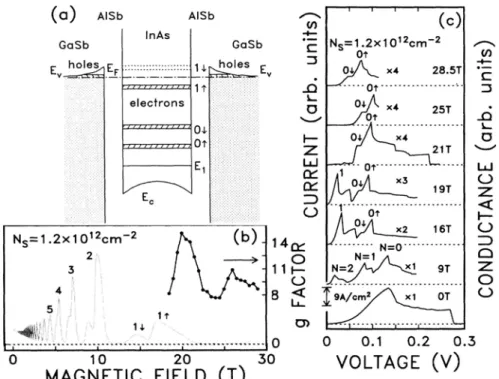
Mendez et al. [77] investigated the exchange enhancement of the g-factor in 2D elec-tron gas in GaSb/AlSb/InAs/AlSb/GaSb heterostructure by resonant-tunneling spectroscopy in magnetic fields up to 30 T at T = 1.4 K. The thickness of the AlSb and InAs layers in the heterostructure was 4 and 15 nm respectively. The concentration of 2D electron gas was de-termined from the conductance oscillations in low magnetic fields. The sample with the 2D electron concentration nS = 1.2·1012 cm-2 exhibited two peaks in the oscillations of the elec-tron g-factor. One peak with the g-factor maximum of 15 was observed in the magnetic field corresponding to the Landau levels filling factor of 3; the authors regarded it as a manifesta-tion of the exchange interacmanifesta-tion. The other peak with the maximal g-factor value of 11 was observed in the magnetic field corresponding to the filling factor of 2. However, the origin of this peak for even values of the filling factor remained unclear [77].
Fig. 1.12. (a) The band scheme of GaSb/AlSb/InAs/AlSb/GaSb heterostructures in perpendicular magnetic field. Dotted line corresponds to the Fermi level position. The small Landau-level quantization of the heavy holes in GaSb layers has been ignored [77]. (b) Conductance oscillations (left) and the values of the quasiparticle g-factor (right) determined by analyzing of current-voltage characteristics in magnetic fields. (c) Low temperature (T = 1.4 K) tunneling current-voltage characteristics at different values of the magnetic field.
28
Another way to study the exchange enhancement of the g-factor in 2D electron gas is based on time-domain capacitance spectroscopy [78, 79]. Landau levels capacitance spectroscopy in 2D system allows one to measure not only the spin splitting in the quasiparticle spectrum at the Fermi energy but also the density of states, the lifetimes of quasiparticles in the QHE regime and the spin splitting of Landau levels not located at the Fermi surface [79]. The results of experimental study of the exchange enhancement of the Zeeman splitting at the Fermi energy in AlGaAs/GaAs/AlGaAs QW, performed in [79], are presented in Figure 1.13. The observed decrease of the Zeeman splitting with increasing filling factor at fixed magnetic field is in good agreement with predictions of Ando and Uemura theory [9].
Generally, estimations of the g-factor enhancement in various 2D systems, made to in-terpret the results of magnetotransport experiments, are based on reference [9]. In addition to Ando and Uemura, exchange enhancement of the g-factor was studied in references [80-82]. W. Xu et al. [80] added to their model the electron interaction with acoustic and piezoelectric phonons which allows them to provide calculations of the quasiparticle g-factor and density of states at non-zero temperature. The authors in [81] calculated the ground state energy and the g factor in 2D electron gas in strong magnetic fields using a variational Monte Carlo method and many-body trial wave functions composed of the Jastrow correlation factor and the Laughlin type functions [83]. C. H. Yang and W. Xu [82] examined how the exchange interaction affects the spin splitting in a 2D electron gas with the Rashba spin-orbit coupling induced by SIA in the presence of quantizing magnetic fields. The single-particle states in
Fig. 1.13. The exchange enhancement of Zeeman splitting at the Fermi energy in the 17.5 nm wide AlGaAs/GaAs/AlGaAs QW at odd filling factor values and different values of the magnetic field [79].
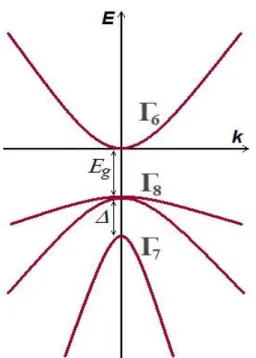
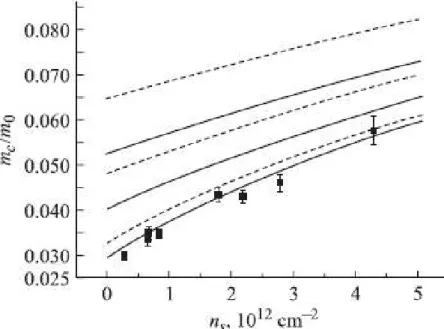
heterostructures with parabolic energy-momentum law in electric subbands are well described by the 2×2 Hamiltonian which contains only the effective mass and g-factor as phenomenol-ogical parameters. Such Hamiltonian was used as a single-particle operator of the kinetic en-ergy in [8, 9, 80-82]. In QW heterostructures based on narrow-gap semiconductors with 2D electron gas, such as AlSb/InAs/AlSb quantum well, the energy-momentum law in the electric subbands is characterized by pronounced nonparabolicity (Figure 1.14). Single-particle states in narrow-gap heterostructures are usually well described by the 8-band k·p Hamiltonian [16, 21, 27, 32, 34], which takes into consideration the k·p interaction between the conduction band, the light and heavy-hole bands and the split-off band exactly. The interaction with remote bands is considered under the perturbation theory. It allows one to directly take into account the influence of nonparabolicity, lattice-mismatch deformation and spin-orbit cou-pling on the electron energy spectrum. We note that quasiparticle g-factor calculations, based on 8-band k·p Hamiltonian, in narrow gap quantum wells have not been performed till now.
In addition to paper [77], exchange enhancement of the g-factor in narrow-gap InAs/AlSb QW heterostructures was also studied in [14-16]. To determine the g-factor values in AlSb/InAs/AlSb QW S. Brosig et al. [14] used the “coincidence method”. As noted above, the energy spectrum of single-particle states in narrow-gap QW heterostructures are well described by the 8-band k·p Hamiltonian, as a result the electron motions in plane and per-pendicular to the QW interfaces are mixed by 8-component wavefunctions. It means that in
Fig. 1.14. Cyclotron mass dependence on the 2D electron concentration: the theo-retical calculation for the first three electric subbands in the AlSb/InAs/AlSb quantum wells with widths of 20.5 nm (solid lines) and 150 nm (dashed lines). Experimental data are represented by closed squares [21].
30
quasiparticle spectrum will be determined by both components of the magnetic field and cannot be described by two phenomenological parameters m* and g*. Thus, the main assumption underlying the “coincidence method” in narrow-gap semiconductors is violated. Therefore, the experimental results of the g-factor exchange enhancement study, obtained in [14], will not be considered in the thesis.
In paper [15] the SdH oscillations in perpendicular magnetic fields were studied and the quasiparticle g-factor was estimated from the relation:
g*=2(B1m0/B2m*), (1.23)
where B1 is the magnetic field at which the first SdH oscillation occurs, B2 is the field when the first spin splitting shows up and m* is the effective electron mass at the Fermi energy. The results of experimental study of the g-factor exchange enhancement in the samples with different 2D electron concentrations at different magnetic field values are presented in Figure 1.15. The authors in [15] admit that the proposed method is not very accurate because the fields B1 and B2 cannot be measured with precision. Note that expression (1.23) ignores the band nonparabolicity effects and the dependence of the Landau levels broadening on the magnetic field and on the Landau level index.
In paper [15] to determine the g-factor the measurements of temperature dependences of the longitudinal resistance at the minima corresponding to odd filling factor values, where the exchange enhancement of the g-factor should be the maximum, were also used. It was as-sumed that Rxx ~ exp(- /kBT) , where = |g*| BB is the spin splitting energy of the Landau
Fig. 1.15. Quasiparticle g-factor values measured in AlSb/InAs/AlSb QW samples with different 2D electron concentration at different magnetic field values [15].
levels, B is the Bohr magneton, T is the temperature, and kB is the Boltzmann constant. But the g-factor values |g*|, obtained within the second method, were significantly smaller than
the values obtained by using the first method. That was associated with significant densities of states overlapping at the spin-split Landau levels.
To determine the g-factor values by analyzing the peak positions of the split SdH os-cillations in perpendicular magnetic fields in paper [26] a simple expression for the Landau level energy, taking no into account the strong nonparabolicity of the electric subbands in InAs/AlSb, was used. It led to unphysical giant oscillations of the g-factor as a function of magnetic field (Figure 1.16). V. Ya. Aleshkin et al. [16] used the results of numerical Landau levels calculations, obtained within the Hartree approximation based on 8-band k·p
Hamiltonian. It allowed them to avoid the non-physical giant oscillations in the quasiparticle g-factor [16] and to obtain the g-factor values in the neighborhood of odd filling factors which were in qualitative agreement with experimental data from paper [15].
“Magnetotransport” g-factor values, obtained in papers [15, 16 and 67], will be used to compare with the results of quasiparticle g-factor calculations in InAs/AlSb QW heterostructures with single occupied electric subband, performed in Chapter 3 of the thesis. Until now, similar calculations, based on the 8-band k·p Hamiltonian, in narrow-gap QW heterostructures have not been performed.
Fig. 1.16. Quasiparticle g-factor oscillations versus magnetic field for three different samples. The horizontal line corresponds to the g-factor position at the conduction band bottom in bulk InAs [26].
![Fig. 1.4. (a) Shubnikov-de Haas oscillations in AlSb/InAs/AlSb QW in weak magnetic fields at 1.8 K [46]](https://thumb-eu.123doks.com/thumbv2/123doknet/2119980.8243/23.892.135.761.68.342/shubnikov-haas-oscillations-alsb-inas-alsb-magnetic-fields.webp)
![Fig. 1.6. (a) Scheme of band diagram of AlSb/InAs/AlSb QW heterostructures under positive voltage, applied to the gate [48]](https://thumb-eu.123doks.com/thumbv2/123doknet/2119980.8243/25.892.161.734.69.319/scheme-diagram-alsb-inas-heterostructures-positive-voltage-applied.webp)
![Fig. 1.9. PPC spectra of nominally undoped InAs/AlSb heterostructures (sam- (sam-ples B1532, B1534 and B1535) with InAs cap layer [56]](https://thumb-eu.123doks.com/thumbv2/123doknet/2119980.8243/29.892.225.676.196.525/spectra-nominally-undoped-inas-alsb-heterostructures-inas-layer.webp)
![Fig. 1.10. The oscillations of quasiparticle g-factor at the Fermi level depending on 2D electron concentration at several magnetic field values [9]](https://thumb-eu.123doks.com/thumbv2/123doknet/2119980.8243/32.892.191.726.62.442/oscillations-quasiparticle-factor-fermi-depending-electron-concentration-magnetic.webp)
![Fig. 1.11. Zeeman splitting at the Fermi level at odd filling factor values in 8.2 nm wide AlGaAs/GaAs/AlGaAs QW [75]](https://thumb-eu.123doks.com/thumbv2/123doknet/2119980.8243/33.892.212.679.72.426/zeeman-splitting-fermi-filling-factor-values-algaas-algaas.webp)
![Fig. 1.15. Quasiparticle g-factor values measured in AlSb/InAs/AlSb QW samples with different 2D electron concentration at different magnetic field values [15]](https://thumb-eu.123doks.com/thumbv2/123doknet/2119980.8243/37.892.219.681.253.631/quasiparticle-measured-samples-different-electron-concentration-different-magnetic.webp)