Science Arts & Métiers (SAM)
is an open access repository that collects the work of Arts et Métiers Institute of Technology researchers and makes it freely available over the web where possible.
This is an author-deposited version published in: https://sam.ensam.eu Handle ID: .http://hdl.handle.net/10985/10149
To cite this version :
George CHATZIGEORGIOU, Mokarram HOSSAIN, Fodil MERAGHNI, Paul STEINMANN -Micromechanics modeling of magneto-sensitive polymeric materials during curing - 2015
Any correspondence concerning this service should be sent to the repository Administrator : [email protected]
Science Arts & Métiers (SAM)
is an open access repository that collects the work of Arts et Métiers ParisTech researchers and makes it freely available over the web where possible.
This is an author-deposited version published in: http://sam.ensam.eu Handle ID: .http://hdl.handle.net/null
To cite this version :
George CHATZIGEORGIOU, Mokarram HOSSAIN, Fodil MERAGHNI, Paul STEINMANN -Micromechanics modeling of magneto-sensitive polymeric materials during curing - 2015
Any correspondence concerning this service should be sent to the repository Administrator : [email protected]
MICROMECHANICS MODELING OF MAGNETO-SENSITIVE
POLYMERIC MATERIALS DURING CURING
George Chatzigeorgiou1, Mokarram Hossain2, Fodil Meraghni1 and Paul Steinmann2
1
LEM3-UMR 7239 CNRS, Arts et Métiers ParisTech Metz-Lorraine 4 Rue Augustin Fresnel 57078 Metz, France
Email: [email protected], [email protected]
2
Chair of Applied Mechanics, University of Erlangen-Nuremberg Egerlandstr. 5, 91058 Erlangen, Germany
Email: [email protected], [email protected]
Keywords: Magneto-sensitive polymers, curing, shrinkage, magneto-mechanics, Mori-Tanaka
ABSTRACTThis work proposes a coupled magneto-mechanical multi-scale model for simulating the curing process of magneto-sensitive polymers. In this type of composites, ferromagnetic particles are mixed with a liquid polymeric matrix in the uncured stage. The polymer curing process is a complex mechanism that transforms a fluid to a solid with time. In order to identify the overall response of the magneto-mechanically coupled polymeric composite, an extended Mori-Tanaka semi-analytical homogenization procedure is utilized that tranfers information from the micro to the macroscale. The stiffness gaining phenomenon as in the case of a curing process is realized by time-dependent material parameters appearing within the polymer piezomagnetic material tensors. Moreover, the volume reduction during curing is taken into account through a magnetic induction dependent shrinkage model. Several numerical examples illustrate the model capability to capture major observable phenomena in the curing process of polymeric composites under infinitesimal deformations and magnetic field.
1 INTRODUCTION
The last decades magneto-sensitive polymers have become very popular, due to their ability to change mechanical properties under an external magnetic excitation. They are relatively new in the category of the so-called smart materials. Due to the magnetically controllable stiffness and damping behaviour, they are attractive candidates for various technical applications, like suspension bushing, brakes, clutches, smart springs in dynamic vibration absorber to civil engineering devices (as building vibration isolators).
During the curing process of polymers, a viscoelastic fluid transforms into a viscoelastic solid due to a series of chemical reactions, which result in polymer chains cross-linking to each other and formation of chemical bonds that allow the chains to come closer. The packing of chains due to cross-linking yields a decrease in specific volume which is denoted as the volume or curing shrinkage. An illustrative review on the constitutive modelling of the curing process of polymers can be found in Hossain et al. [1, 2].
Several experimental works demonstrate isotropic and anisotropic response of magneto-sensitive polymeric composites during the curing process with or without the application of a magnetic induction. However, there is a lack of constitutive modelling that can capture the curing process in the presence of a magneto-mechanically coupled load.
The simulation of microheterogeneous,
particle-filled, magneto-sensitive composites during the curing process can be studied using
various homogenization techniques.
Several multi-scale approaches have been developed for magneto-sensitive polymers with coupled loads without considering the curing process [3, 4].A
m
ulti-scale approach is proposed in [5], in which parameters are considered to be evolving with time during the curing process, but only a mechanical load is considered to be applied.Here a Mori-Tanaka micromechanical approach for small magneto-mechanically coupled deformations is proposed, where the polymer mechanical properties appearing in its constitutive law are considered time-dependent. It is well known that the curing phenomenon is a highly temperature-sensitive and exothermic reaction process, but in the current cure-dependent magneto-mechanical coupled model isothermal processes are assumed.
2 POLYMERS MAGNETOELASTIC RESPONSE CONSIDERING CURING
In polymer curing processes, the chemical reactions yield a cross-linked structure from an initial solution of monomers. This phase transition is analogous to the addition of progressively more springs to the already-formed network. According to the literature [6], the formation of a new cross-link is unstrained and stress-free. This means that a curing material does not change its state of stress as resulted from previous deformations - even though the material properties continue to evolve. Thus, a magneto-elastic coupled energy potential, as a function of the strain, the magnetic induction and the time, for the case of isothermal curing processes can be proposed in the form of a convolution integral,
(1)
where , and are the time derivatives of the fourth order mechanical stiffness tensor, the second order magnetic permeability tensor and the third order magnetomechanical tensor respectively. Using the standard Coleman-Noll procedure and rearranging the terms, the rate of stress and the magnetic induction can be written in terms of the rate of strain and the magnetic field as
(2)
where
(3)
For general nonlinear magnetoelastic continua the magnetomechanical moduli are functions not only of the time, but also of the strain and the magnetic field.
The above equations describe sufficiently the polymer behaviour during the curing process, without though considering the effects of curing-induced shrinkage. If this phenomenon is also taken into account, an additive decomposition of the total strain into a mechanical and a shrinkage part,
(4) with
(5) In the last expression, denote the total volume shrinkage and a curvature parameter respectively. Under the influence of a magneto-mechanical load, it is assumed that there is a coupled relation between the total amount of curing shrinkage and the applied magnetic induction,
(6)
with H denoting the Heaviside function.
3 MULTI-SCALE APPROCH FOR MAGNETOELASTIC COMPOSITES UNDER CURING
In this work, an extended version of the Mori-Tanaka method, appropriate for magnetoelastic continua is utilized. The main concepts of the theory for the magnetoelastic case have been developed in [7]. The main steps of this methodology are presented in this section, as well as the effects of time dependency and shrinkage-induced (when taken into account) in the macroscopic response of the composite.
Using indicial notation along with Einstein summation convention, equation (2) can be represented in a more general way as
(7)
Following classical micromechanics arguments [8], both the average magnetomechanical fields on each phase (polymer, particles) and the macroscopic fields on the total composite are considered to be connected with analogous expressions to equation (7). Following the computational steps of [7], the macroscopic constitutive response of a composite with N+1 phases (0 the matrix phase and N types of inclusions) is described by the relations
(8)
where represents the extended Eshelby tensor for magnetomechanical continua (see [7] for details). This tensor in the general case can be computed numerically with an approach similar to the one described in [8].
When shrinkage effects due to the curing process are taken into account, the first expression of equation 8 is modified to
(9) Based on the approach of [9] for mechanical inelastic strain mechanisms, the macroscopic shrinkage strains can be shown to be expressed by the formulas
(10)
and is the generalized, shrinkage tensor (equal to the shrinkage strain for indices 1, 2, 3 and zero value when an index is equal to 4). For metallic inclusions this tensor is always zero, while for the polymer the shrinkage strain tensor is given by equation (4).
Due to the nonlinear nature of the equations (especially in the case of shrinkage-induced strains), the numerical calculations are obtained with an implicit computational scheme based on an Euler-backward type integrator.
4 NUMERICAL EXAMPLES
The capabilities of the designed framework are illustrated through numerical examples on a magnetoelastic particulate composite. In the examined composite, cobalt iron oxide (CoFe2O4)
particles are embedded in an epoxy matrix. The particles are assumed to have spherical shape and they are randomly distributed inside the matrix.
while the epoxy material is considered isotropic [11] with magnetic permeability equal to that of the free space, shear modulus 1.28q(t) GPa and Lame constant 2.97q(t) GPA, where q is a time dependent function of the form
q(t)=0.0001+[1-0.0001][1-exp(-0.0925t)].
5.1 Macroscopic coupled moduli
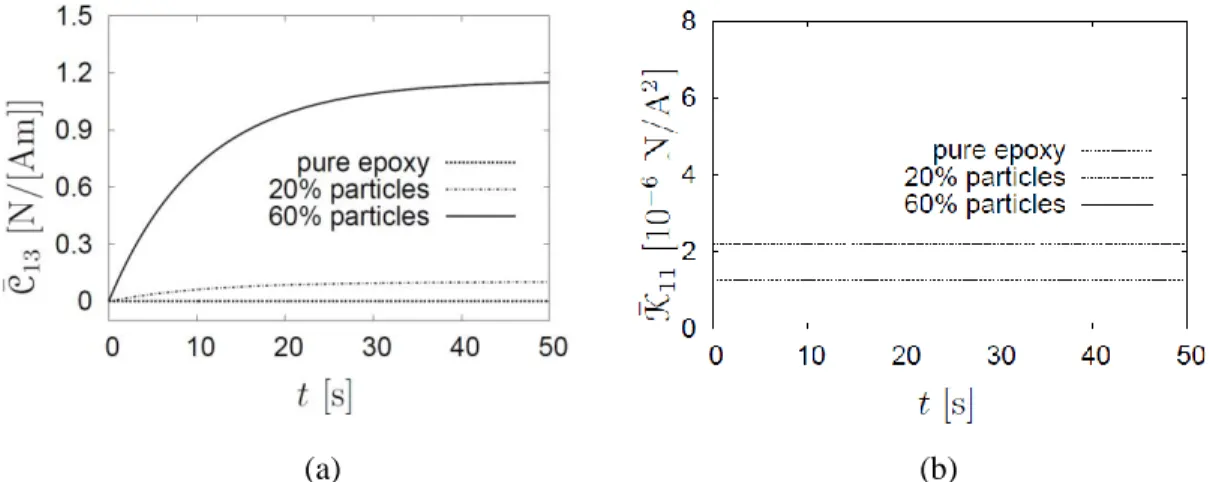
Figure 1a shows the evolution of the coupled term 1-3 of the composite with time. As it is observed,
while the epoxy itself is not a piezomagnetic material, the composite behaves as such. For 20% and 60% particles volume fraction, the evolution with time of this parameter is exponential. On the other hand, the composite magnetic permeability coefficient in the 1 direction (Figure 1b) becomes higher as
the particles volume fraction increases, but does not evolve with time. Thus, the composite eventually combines the behaviour of the particles (piezomagnetic response) and the epoxy matrix (time evolution of material parameters during curing), an observation that one needs to account for when designing phenomenological models for magneto-sensitive polymers.
(a) (b)
Figure 1: a) Coupled term 1-3 and b) magnetic permeability in the 1 direction of the pure epoxy and the composite material with two different particles volume fractions.
5.2 Composite response under combined mechanical and magnetic loading
(a) (b)
Figure 2: Macroscopic loading conditions for the composite: a) strain and b) magnetic field path. In this example, a combined macroscopic strain-magnetic field loading condition is applied in the composite. The macroscopic strain is considered in the third direction and follows three steps with time: a linear increase for 5 s, a constant value for 40 s and again a linear increase for 5 s, until it reaches the value 0.01 (Figure 2a). The magnetic field is also in the third direction and follows three
steps: two linear increases with time for 5 s, separated by a period of 40 s in which it remains constant. The maximum magnetic field reaches the value of 100000 A/m (Figure 2b).
The other two directions
are traction free.
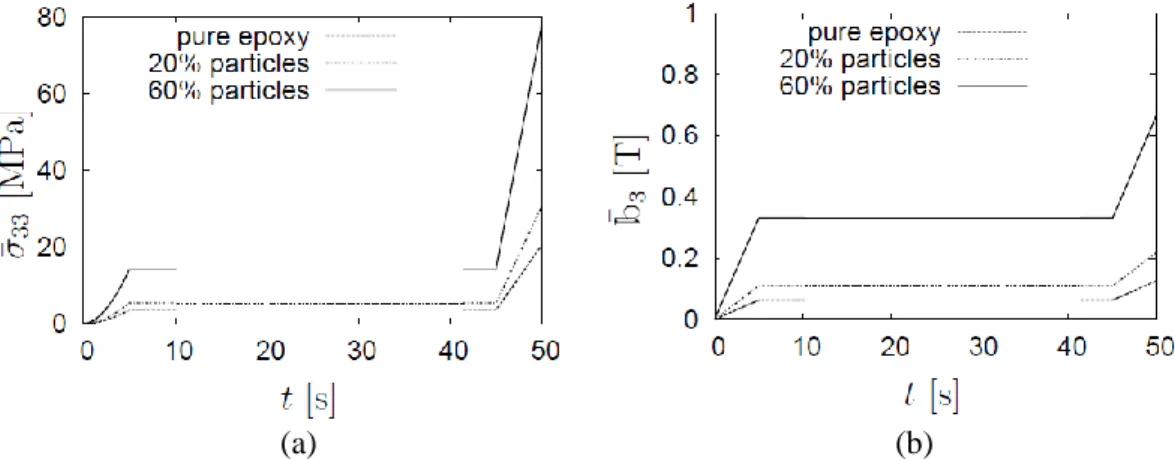
The evolution of the macroscopic stress is depicted in Figure 3a and follows astepwise relation with time. For 60% particles volume fraction, a sharp increase in stress between 0-5 s and 45-50 s is observed. Moreover the final value of stress is almost four times larger than that of the pure epoxy. Similar results are obtained also for the macroscopic magnetic induction (Figure 3b).
(a) (b)
Figure 3: Evolution of a) stress and b) magnetic induction with time for the pure epoxy and for the composite with two particles volume fractions.
5.3 Shrinkage effect in the composite response
In this example, the epoxy is assumed to undergo curing-induced shrinkage strains of the form
The macroscopic strain is set to zero in the third direction, while the magnetic field in the same direction increases linearly with time and obtains the value of 100000 A/m in 50 s. Figure 4 shows the evolution of the macroscopic stress and magnetic induction in the third direction with time. As it is observed, the stress has increases in a nonlinear fashion with time reaches almost 6 MPa at the end of the curing process.On the other hand, the magnetic induction follows a linear increase with time.
(a) (b)
Figure 4: Evolution with time of a) macroscopic stress and b) macroscopic magnetic induction for linearly increasing magnetic field and zero strain. Shrinkage effects are taken into account.
6 CONCLUSIONS AND FUTURE WORK
In this paper, a multi-scale approach, based on the Mori-Tanaka scheme, has been proposed for the simulation of polymeric materials during curing processes in the case of a coupled
magneto-mechanical load with or without curing-induced shrinkage phenomenon. The novel framework has been validated through several numerical examples. These examples indicate that the final composite combines the properties of the matrix and the particles, creating a new class of materials. In a forthcoming contribution, the effect of temperature is going to be included.
ACKNOWLEDGEMENTS
This work is funded by an ERC advanced grant within the project MOCOPOLY.
REFERENCES
[1] M. Hossain, G. Possart and P. Steinmann, A small-strain model to simulate the curing of thermosets, Computational Mechanics, 43, 2009, 769-779.
[2] M. Hossain, G. Possart and P. Steinmann, A finite strain framework for the simulation of polymer curing. Part I: Elasticity, Computational Mechanics, 44, 2009, 621-630.
[3] J. Schröder and M. A. Keip, Two-scale homogenization of electromechanically coupled boundary value problems, Computational Mechanics, 50, 2012, 229-244.
[4] A. Javili, G. Chatzigeorgiou and P. Steinmann, Computational homogenization in magneto-mechanics, International Journal of Solids and Structures, 50, 2014, 4197-4216.
[5] S. Klinge, A. Bartels and P. Steinmann, The multi-scale approach to the curing of polymer incorporating viscous and shrinkage effects, International Journal of Solids and Structures, 49, 2012, 3883-3990.
[6] M. Kiasat, Curing shrinkage and residual stresses in viscoelastic thermosetting resins and
composites, PhD Thesis, TU Delft, The Netherlands, 2000.
[7] M. L. Dunn and M. Taya, Micromechanics predictions of the effective electroelastic moduli of piezoelectric composites, International Journal of Solids and Structures, 30, 1993, 161-175. [8] A. C. Gavazzi and D. C. Lagoudas, On the Numerical Evaluation of Eshelby’s Tensor and its
Application to Elastoplastic Fibrous Composites, Computational Mechanics, 7, 1990, 13-19. [9] B. T. Lester, Y. Chemisky and D. C. Lagoudas, Transformation characteristics of shape
memory alloy composites, Smart Materials and Structures, 20, 2011, 094002.
[10] J. H. Huang and W.-S. Kuo, The analysis of piezoelectric/piezomagnetic composite materials containing ellipsoidal inclusions, Journal of Applied Physics, 81, 1997, 1378-1386.
[11] N. Pakam and A. Arockiarajan, Study on effective properties of 1-3-2 type magneto-electro-elastic composites, Sensors and Actuators A: Physical, A209, 2014, 87-99.