HAL Id: hal-00998541
https://hal.archives-ouvertes.fr/hal-00998541
Submitted on 2 Jun 2014
HAL is a multi-disciplinary open access archive for the deposit and dissemination of sci-entific research documents, whether they are pub-lished or not. The documents may come from teaching and research institutions in France or abroad, or from public or private research centers.
L’archive ouverte pluridisciplinaire HAL, est destinée au dépôt et à la diffusion de documents scientifiques de niveau recherche, publiés ou non, émanant des établissements d’enseignement et de recherche français ou étrangers, des laboratoires publics ou privés.
Synthesis, thermogravimetric and high temperature
X-ray diffraction analyses of zinc-substituted nickel
manganites
C. Chanel, Sophie Fritsch, Christophe Drouet, Abel Rousset, Maria L.
Martinez Sarrion, L. Mestres, Mario Morales
To cite this version:
C. Chanel, Sophie Fritsch, Christophe Drouet, Abel Rousset, Maria L. Martinez Sarrion, et al.. Syn-thesis, thermogravimetric and high temperature X-ray diffraction analyses of zinc-substituted nickel manganites. Materials Research Bulletin, Elsevier, 2000, vol. 35, pp. 431-439. �10.1016/S0025-5408(00)00221-X�. �hal-00998541�
Any correspondence concerning this service should be sent to the repository administrator:
Identification number: DOI: 10.1016/S0025-5408(00)00221-X
Official URL:
http://dx.doi.org/10.1016/S0025-5408(00)00221-X
This is an author-deposited version published in: http://oatao.univ-toulouse.fr/
Eprints ID: 11631
To cite this version:
Chanel, C. and Fritsch, Sophie and Drouet, Christophe and Rousset, Abel and
Martínez Sarrión, Maria L. and Mestres, L. and Morales, Mario Synthesis,
thermogravimetric and high temperature X-ray diffraction analyses of
zinc-substituted nickel manganites. (2000) Materials Research Bulletin, vol. 35 (n°
3). pp. 431-439. ISSN 0025-5408
O
pen
A
rchive
T
oulouse
A
rchive
O
uverte (
OATAO
)
OATAO is an open access repository that collects the work of Toulouse researchers and makes it freely available over the web where possible.
Synthesis, thermogravimetric and high temperature X-ray
diffraction analyses of zinc-substituted nickel manganites
C. Chanel
a, S. Fritsch
a,*, C. Drouet
a, A. Rousset
a, M.L. Martı´nez Sarrio´n
b,
L. Mestres
b, M. Morales
ba
Laboratoire de Chimie des Mate´riaux Inorganiques, ESA 5070, Universite´ Paul Sabatier, 118, Route de Narbonne, 31062 Toulouse Cedex, France
b
Departament de Quı´mica Inorga`nica, Universitat de Barcelona, Diagonal 647, 08028 Barcelona, Spain
Abstract
Stoichiometric spinel phases Mn2.352xNi0.65ZnxO4 were prepared by thermal decomposition of
mixed oxalate precursor powders Mn0.782aNi0.22ZnaC2O4znH2O (with 0 # a # 0.53) at 900°C.
Cation-deficient phases Mn2.352xNi0.65Znxh3d/4O41d were identified in the temperature range
350 –500°C. The nonstoichiometric coefficient d was found to strongly depend on the zinc content and the decomposition temperature. We showed that the introduction of zinc into the spinel phase enlarges the stability domain of the structure and inhibits oxidation at least up to 900°C. A cubic single-phase was observed for x # 1.00. The lattice parameter variation of the oxides in the composition range 0 # x # 0.60 can be explained using Poix’s method, in terms of the distribution of Zn21 cations on the tetrahedral sites. However, for higher zinc content (x . 0.6) a detailed analysis of data showed that a small fraction of Zn21 is located on octahedral sites.
Keywords: A. Oxides; B. Chemical synthesis; C. X-ray diffraction; C. Thermogravimetric analysis (TGA)
* Corresponding author. Fax: 133-5-61-61-63.
1. Introduction
The Mn/Ni/O system with spinel structure has been widely studied [1– 8], especially in view of its commercial application as negative temperature thermistor ceramics. These spinel phases are usually obtained at temperatures above 850 –900°C by thermal decomposition in air of mixed oxalate salt precursors. Recent studies [9 –12] have shown that these spinel phases can be obtained at low temperatures (300 – 400°C); however, they present cation deficiencies due to oxygen excess. Moreover, these phases decompose with increasing temperatures, giving rise to thermodynamically stable phases NiMnO3and a-Mn2O3in the
temperature range 500 – 800°C. At 900°C, a stoichiometric spinel phase is obtained. On the other hand, it has been shown [13,14] that zinc substitution in hausmannite leads to a stabilization of the spinel phase, i.e., to an inhibition of oxidation phenomena.
The aim of this work was to synthesize and characterize a mixed zinc-nickel-manganese oxalate series Mn0.782aNi0.22ZnaC2O4znH2O (0 # a # 0.53).
2. Experimental
2.1. Elaboration of the oxalate precursors
Samples of the series Mn0.782aNi0.22ZnaC2O4znH2O (0 # a # 0.53) were prepared by
coprecipitation of transition metal nitrates Mn(NO3)2z6H2O, Ni(NO3)2z6H2O, and
Zn(NO3)2z6H2O with ammonium oxalate (NH4)2C2O4zH2O in an aqueous solution at 25°C.
The precipitates were stirred for 30 min, then filtered, washed several times with deionized water, and dried in air at 60°C. The precipitation reaction is described in Eq. (1):
~0.78 2 a! Mn~NO3!2z6H2O 1 0.22Ni~NO3!2z6H2O 1 a-Zn~NO3!2z6H2O 1 ~NH4!2C2O4zH2O 2 Mn0.782aNi0.22ZnaC2O4z nH2O 1 2NO3 2 1 2NH41 1 ~7 2 n! H2O (1) 2.2. Characterization techniques
The powder morphology was observed with a JEOL JSM-6400 scanning electron micro-scope. The thermal decomposition of the mixed oxalate precursors was examined by thermogravimetric analysis (Setaram TGDTA92B operating in air) and high temperature X-ray diffraction analysis (Bragg-Brentano u/2u Siemens D500 powder diffractometer, using Cu Ka radiation (l15 1.54060 Å, l25 1.54443 Å, l2/l15 0.50) and operating at 40 kV
and 30 mA). Data were collected in the step-scan mode using 0.02° 2u step-size and 1s/step counting time over the 2u range 20 – 80°. The chemical composition of the oxides was determined by plasma emission spectrometry.
Temperature programmed reduction analyses (TPR) were performed both by thermo-gravimetry and gas chromatography. Experiments were realized in a vertical plug flow differential reactor. The mass variation was determined with a Cahn D200 microbalance
(accuracy 1026g). The temperature of the sample could be linearly increased by a furnace monitored by a Shimaden SR25 temperature programmer. The sample was first degassed (1 Pa) at room temperature for 1 h, then the system was filled with Ar. A flow of 15 cm3min21 was allowed to pass through the reactor. During the experiment, the temperature was linearly increased to 950°C (with a heating rate b 5 5°Cmin21). Every 120 s, the gas flowing out of the reactor was sampled and analyzed by gas chromatography (Shimadzu GC-8A chromato-graph fitted with a molecular sieve 133 column and a thermal conductivity detector). These analyses measured the oxygen concentration in the flowing gas, and the integration of these data over time gave the total amount of oxygen released during the experiment.
3. Results and discussion
3.1. Characterization of the zinc-nickel-manganese oxalates
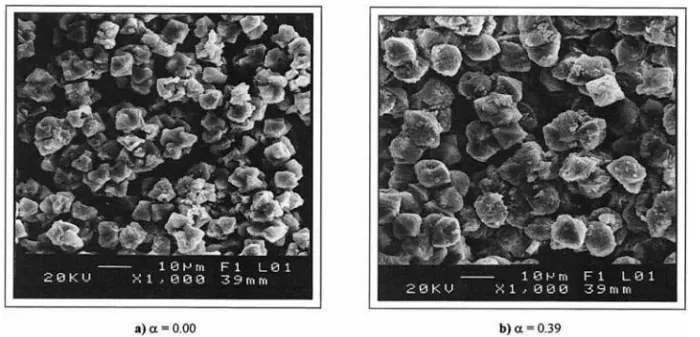
The powder morphology was shown to depend on the zinc content. For low zinc content, the powder has an octahedral-like shape. It becomes more spherical as the zinc content increases (Fig. 1). The average size of the oxalate powders varies between 10 and 15 mm. It is well established [15] that nickel manganese oxalate Mn12aNiaC2O4z2H2O
synthe-sized by “chimie douce” is a mixed oxalate that crystallizes in the stable a form, for nickel content a # 0.25. X-ray diffraction experiments completed with TG analyses show that the substitution of Mn by Zn in this system leads to mixed oxalates. High temperature X-ray diffraction was performed to follow the oxalate structural change (Table 1).
In the nickel manganese oxalate TG curve (Fig. 2), a continuous weight loss between 350 and 500°C (Step I) was observed. This mass loss was also observed for oxides containing zinc, although it decreased with increasing zinc content. In this temperature range, it was difficult to
Fig. 1. SEM micrographs of zinc nickel manganese oxalate Mn0.782aNi0.22ZnaC2O4z nH2O: (a) a 5 0.00, (b) a 5 0.39.
Table 1
Structural evolution of mixed Mn0.782aNi0.22ZnaC2O4z2H2O oxalates as a function of temperature for different zinc contents a
T (°C) a
0.00 0.10 0.21 0.34 0.39 0.45
300, 1 h AP AP AP CspPCP AP AP
400, 1 h AP AP CspPCP CspPCP AP AP
500, 1 h NiMnO31 a-Mn2O3 CspPCP CspPCP Csp CspPCP CspPCP1 ZnOPCP
600, 1 h NiMnO31 a-Mn2O3 NiMnO31 a-Mn2O31 CspPCP Csp Csp Csp CspPCP1 ZnOPCP
700, 1 h NiMnO31 a-Mn2O3 a-Mn2O31 NiMnO31 CspPCP Csp Csp Csp Csp 1 ZnO
800, 1 h Csp 1 NiMnO31 a-Mn2O3 Csp 1 a-Mn2O31 NiMnO3 a
Csp Csp Csp Csp 1 ZnO
900, 4 h Csp Csp Csp Csp Csp 1 Znoa
Csp 1 ZnO Csp: Cubic spinel; AP: Amorphous phases; PCP: Poorly crystallized phases.
a
identify the structure using in situ XRD analysis because the phase was almost amorphous. However, previous studies [9 –12,16] have shown that a nonstoichiometric spinel phase Mn2.35Ni0.65h3d/4O41d(with oxygen excess) is obtained. We find that in a similar temperature
range, the spinel phase is more crystallized (and therefore identified) and appears at lower temperature as the zinc content increases. The nonstoichiometry coefficient d was determined by TPR experiments for the low temperature (400°C) Mn2.352xNi0.65Znxh3d/4O41d phases as a
function of zinc content (Table 2). d decreased significantly with increasing zinc content. On the other hand, for a fixed zinc content (x 5 0.00 and x 5 0.31) (Table 3), the nonstoichiometric coefficient d decreased with increasing decomposition temperature.
From these results, one can assume that the weight loss observed on the TG curve between 350 and 500°C corresponds to the oxygen excess of the nonstoichiometric phases. In fact, when the zinc content increases, the mass loss observed is less important, which is in agreement with the variations of d. At 520°C (Step II), the sudden mass loss observed for nickel manganese oxalate (Fig. 2, curve a) is due to the reduction of the octahedral Mn41cations to Mn31or Mn21. According to Tang et al. [10], the reduction could be related to the migration of Ni21and Mn21from the octahedral to the tetrahedral sites. In the temperature range 550 –900°C, the mass changes observed (Steps III and IV) are due to the oxidation of the tetrahedral Mn21 cations to Mn31, which leads to the Fig. 2. TG curves of Mn2.352xNi0.65ZnxO4, with (a) x 5 0.00, (b) x 5 0.11, (c) x 5 0.31, and (d) x 5 0.62, in the temperature range 300 –1000°C.
Table 2
Nonstoichiometric coefficient d at 400°C as a function of zinc content x
x 0.00 0.31 0.70 1.02
transformation of the spinel phase into the bixbyite a-Mn2O3(JCPDS file 24-0508) and
the ilmenite NiMnO3(JCPDS file 12-0269) [6,16 –18]. The mass loss (Step IV) is due to
the reaction of these two phases to form the cubic spinel phase again. After 4 h at 900°C, only the spinel phase Mn2.35Ni0.65O4is observed, as expected. The mass change related
to this reduction decreases rapidly as the zinc content increases, and disappears for a . 0.10. For this composition, the diffraction peaks relative to the NiMnO3 and a-Mn2O3
phases are no longer observed. In fact, the temperature range of stability increases significantly with increasing zinc content. However, if the zinc content is too high (a . 0.34), the ZnO phase is observed (JCPDS file 36-1451) in addition to the cubic spinel phase (Table 1). As expected, the precipitation of ZnO occurs at lower temperatures as the ratio of zinc increases. So the substitution of manganese by zinc in solid solution series Mn2.352xNi0.65ZnxO4 results in a gradual and substantial change in the thermal
behavior of the oxides in the temperature range 300 –900°C. We can say that the introduction of zinc into the spinel phase enlarges the stability domain of the structure and inhibits oxidation at least up to 900°C. Our results are in agreement with those obtained by Dubrawski [14]. He showed the increase of stability of hausmannite Mn3O4
when introducing zinc in the structure. Fruhwirth et al. [19] mentioned the role of zinc cations in the increasing stability of the structure in Mn/Ni/Zn/O systems.
3.2. Characterization of the zinc-nickel-manganese oxides
For this part of the work, the temperature of the treatment was fixed at 900°C for 4 h in air. At this temperature, a single phase is obtained for the composition range from Mn2.33Ni0.67O4to Mn1.33Ni0.65Zn1.02O4(Fig. 3). The heating and cooling rates were fixed at
150°C/h. One single spinel phase is observed up to x # 1.1. For higher zinc content, the ZnO phase appears. The experimental lattice parameter aexpdecreases linearly as the zinc content
increases, in agreement with Vegard’s law. It is well established that Zn21cations are located on the tetrahedral sites in zinc manganites [20,21]. The strong tetrahedral preference of Zn21 cation was evidenced by electrostatic energy measurements by O’Neill and Navrotsky [22]. In fact, the ionic radius of Zn21is smaller than that of Mn21(rZn215 0.580 Å and rMn215
0.655 Å) in the tetrahedral sites [22]. The decrease of the lattice parameters is similar to that observed by Feltz and Seidel [23] in the Mn22xNi1.00ZnxO4 system. When the ZnO phase
appears, the lattice parameter of the spinel phase is constant.
The spinel structure is based on the cubic close-packing of oxygen ions in which the cations are located on both tetrahedral and octahedral sites. The general formula for the cationic distribution is
Table 3
Nonstoichiometric coefficient d as a function of decomposition temperature
x 5 0.00 x 5 0.31
d350°C 0.66 0.30
d400°C 0.51 0.30
A122l21 B2l31@B222l31 A 2l 21#O
4
22 (2)
where l is the degree of inversion, 0 # l # 0.5. The brackets indicate the octahedral sites. Poix [24] has pointed out the invariable character of the “anion– cation” distance for a particular site in the spinel structure. Thus two parameters are defined, dCA 5 A–O and
dCB 5 B–O, where dCA and dCB are the mean values of the “anion– cation” distance in
tetrahedral and octahedral sites, respectively. The lattice parameter a is related to dCAand
dCB according to the following relation:
a 5 2.0995dCA1
Î
~5.8182dCB2 2 1.4107dCA2 ! (3)The theoretical lattice parameters can be calculated for various cationic distributions and compared with the experimental parameters. Therefore, the cationic distribution of a solid solution can be approached. We want to point out that this method is qualitative, and we will consider only the single phases for determining a cationic distribution. The characteristic bond lengths Mn–O, Ni–O, Zn–O on the different sites are found in ref. 24. The zinc nickel manganites were prepared by substituting manganese cations by zinc in nickel manganites of formula Mn2.35Ni0.65O4. Under the same preparation conditions, Legros et al. [25] proposed
a cationic distribution for nickel manganites Mn32xNixO4 (0.5 # x # 1):
Mn12y21Niy21@Nix2y21Mn
222~ x2y! 31 Mn x2y 41 #O 4 22 (4)
where y 5 xP/100 and P 5 percentage of Ni21on tetrahedral sites; P 5 f(x) 5 282.1x21
192.4x 2 81.5.
In fact, despite their strong preference for octahedral sites, a small fraction of Ni21cations is located on the tetrahedral sites. In order to keep the electroneutrality, the number of Mn41 cations on octahedral sites is equal to that of Ni21cations on the same sites. Gillot et al. [26] have quantified the degree of inversion, using neutron diffraction experiments, for a given Fig. 3. Variation of the experimental lattice parameter of the spinel phase in Mn2.352xNi0.65ZnxO4oxide as a function of zinc content (x).
nickel manganite. For the composition Ni1.00Mn2.00O4, only 0.12 Ni 21
(per unit formula) is located on the tetrahedral sites. For Mn2.35Ni0.65O4, all the Ni
21
are located on the octahedral sites. The variation of the lattice parameter of Mn2.352xNi0.65ZnxO4as a function of the zinc
content x (0 # x # 0.35), calculated for the cationic distribution I, where Zn21cations are located in tetrahedral sites, is compared with the experimental data in Fig. 4. In all cases, all the Ni21 cations (0.66 per unit formula) are located on the octahedral sites. The limiting cationic distribution (distribution I) proposed is
Mn12x 21 Znx 21@Ni 0.65 21 Mn0.7 31 Mn0.65 41#O 4 22 ~ x # 0.6! (5)
This observation confirms that the Zn21cations are located on the tetrahedral sites. Thus, in these compounds Mn2.352xNi0.65ZnxO4, the tetrahedral sites are occupied by the zinc ions
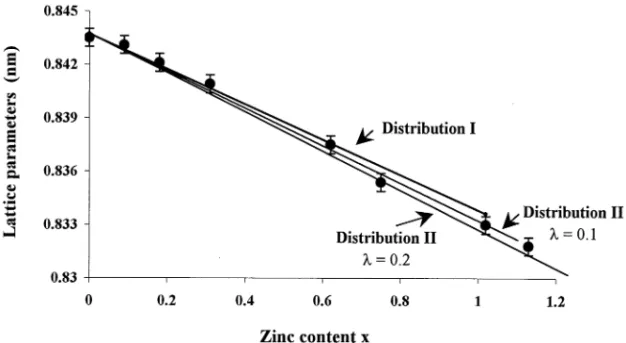
and the octahedral sites are shared by the nickel and manganese ions. However, for higher zinc content (x . 0.6), a small shift is observed between the experimental and the calculated lattice parameter (Fig. 4). In this case, if we consider that a small amount of Zn21can occupy the octahedral sites, according to distribution II
Mn12~12l! x21 Zn~12l! x21 @Ni0.6521Zn l 21Mn 0.722l 31 Mn 0.651l 41 #O 4 22 ~ x . 0.6! (6)
a much better agreement is obtained. The calculated lattice parameters for, respectively, 10% and 20% of Zn21located on octahedral sites are plotted in Fig. 4. Although the Zn21cations preferentially occupy the tetrahedral sites, when the zinc content increases, a small fraction of Zn21cations could move to the octahedral sites. Two cationic distributions are suggested for different zinc content:
For x # 0.6: Mn12x 21 Zn x 21@Ni 0.65 21Mn 0.7 31Mn 0.65 41#O 4 22 (7)
Fig. 4. Variation of the lattice parameter calculated (using Poix’s method) for cationic distributions I, II, and experimental, as a function of zinc content. Distribution I: Mn12x
21 Znx 21 [Ni0.65 21 Mn0.7 31 Mn0.65 41 ]O4 22 (x # 0.6); Distribution II: Mn12(12l)x 21 Zn(12l)x 21 [Ni0.65 21 Znl 21 Mn0.722l 31 Mn0.651l 41 ]O4 22 (x . 0.6).
For x . 0.6: Mn12~12l! x 21 Zn ~12l! x 21 @Ni 0.65 21Zn l 21Mn 0.722l 31 Mn 0.651l 41 #O 4 22 (8)
The results are in agreement with the studies of zinc manganites Mn22xZnx11O4conducted
by Rosenberg et al. [27]. They supposed that a fraction of the Zn21cations was located on the octahedral sites.
Acknowledgments
The authors are grateful to Mrs. R. Legros for her valuable advice and continuous interest in this work. They also thank Mr. P. Alphonse for his assistance in the measurement and interpretation of the TPR analyses, Mr. J. Sarrias for helpful discussion, and Mr. X. Alcobe and Mr. J. Bassas (Servicio de difraccion de rayos X de la Universidad de Barcelona) for their help to obtain high-temperature X-ray diffraction results.
References
[1] E.D. Macklen, Thermistors, Electrochemical Publications Limited, 1979.
[2] E. Jabry, G. Boissier, A. Rousset, R. Carnet, A. Lagrange, J Phys Colloq 46 C1 (1986) 843.
[3] J.P. Caffin, A. Rousset, R. Carnet, A. Lagrange, in: P. Vincenzini (Ed.), High-Tech Ceramics, Elsevier, Amsterdam, 1987, p. 1743.
[4] R. Legros, R. Metz, J.P. Caffin, A. Lagrange, A. Rousset, Mater Res Soc Symp Proc 121 (1988) 251. [5] R. Metz, J.P. Caffin, R. Legros, A. Rousset, J Mater Sci 24 (1989) 83.
[6] M.L. Martı´nez Sarrio´n, M. Morales Sa´nchez, J Mater Chem 3 (3) (1993) 273. [7] A. Feltz, J. To¨pfer, F. Schirrmeister, J Eur Ceram Soc 9 (1992) 187.
[8] M.L. Martı´nez Sarrio´n, M. Morales Sa´nchez, J Am Ceram Soc 78 (4) (1995) 915. [9] J. To¨pfer, J. Jung, Thermochim Acta 202 (1992) 281.
[10] X.-X. Tang, A. Manthiram, J.B. Goodenough, J Less-Common Met 156 (1989) 357.
[11] C. Laberty, P. Alphonse, J.J. Demai, C. Sarda, A. Rousset, Mater Res Bull 32 (2) (1997) 249. [12] J.L. Martin de Vidales, R.M. Rojas, E. Vila, O. Garcia Martinez, Mater Res Bull 29 (11) (1994) 1163. [13] F.C.M. Driessens, G.D. Rieck, J Inorg Nucl Chem 28 (1966) 1593.
[14] J.V. Dubrawski, React Solids 2 (1987) 315.
[15] R. Metz, Thesis, Universite´ Paul Sabatier, Toulouse (1991). [16] D.G. Wickham, J Inorg Nucl Chem 26 (1964) 1359. [17] E.H. Jabry, Thesis, Universite´ Paul Sabatier Toulouse, 1985. [18] S. Fritsch, Thesis, Universite´ Paul Sabatier, Toulouse, 1995.
[19] O. Fruhwirth, A. Macher, K. Reichmann, H.G. Schuster, in: P. Duran, J.F. Fernandez (Eds.), Third Euro-Ceramics, Vol. 2. Properties of Ceramics, Faenza Editrice Iberica, Madrid (1993), p. 395.
[20] A. Miller, J Appl Phys (Suppl) 30 (1959) 245.
[21] J.B. Goodenough, A. Loeb, Phys Rev 98 (2) (1955) 391. [22] H.St. C. O’Neill, A. Navrotsky, Am Mineral 68 (1983) 181. [23] A. Feltz, A. Seidel, Z Anorg Allg Chem 608 (1992) 166. [24] P. Poix, Bull Soc Chim 5 (1965) 1085.
[25] R. Legros, R. Metz, A. Rousset, J Mater Sci 25 (1990) 4410.
[26] B. Gillot, J.L. Baudour, F. Bouree, R. Metz, R. Legros, A. Rousset, Solid State Ionics 58 (1992) 155. [27] M. Rosenberg, P. Nicolau, R. Manaila, P. Pausescu, J Phys Chem Solids 24 (1963) 1419.