HAL Id: dumas-01280936
https://dumas.ccsd.cnrs.fr/dumas-01280936
Submitted on 1 Mar 2016HAL is a multi-disciplinary open access archive for the deposit and dissemination of sci-entific research documents, whether they are pub-lished or not. The documents may come from teaching and research institutions in France or abroad, or from public or private research centers.
L’archive ouverte pluridisciplinaire HAL, est destinée au dépôt et à la diffusion de documents scientifiques de niveau recherche, publiés ou non, émanant des établissements d’enseignement et de recherche français ou étrangers, des laboratoires publics ou privés.
Factors affecting female criminality in Kenya: a case
study of Lang’ata maximum women prison
Margaret Oketch Agola
To cite this version:
Margaret Oketch Agola. Factors affecting female criminality in Kenya: a case study of Lang’ata maximum women prison. Sociology. 1999. �dumas-01280936�
FACTORS AFFECTING FEMALE _CRIMINALITY IN
KENYA A CASE STUDY OF LANG'ATA MAXIMUM
WOMEN PRISON
'11-117.SIS \S. ,7,717,7,7 ACCFPTED , ... •• ... Pk4. Pr. i1::::CED IN 'BY: MARGARET AGOLA °KETCH
IFRA
IINKUNINNI -1
IFRA002661ate
/ odoi
THIS THESIS IS SUBMITTED IN PARTIAL FULFILMENT
FOR THE AWARD OF THE DEGREE OF MASTER OF
ARTS IN SOCIOLOGY IN THE UNIVERSITY OF
NAIROBI.
AGOLA, M. 0.
(C/50/7555186)
DECLARATION
This thesis is my original work and has not been presented for a degree in any other University.
(AGOLA, MARGARET OKETCH)
DATE:
19-4\ 1199
This thesis has been submitted for examination with my knowledge as the University Supervisor
(PROF. ENOS H. N. NJERU)
No eye has seen, No ear has heard, No mind has conceived, What God has prepared
For those who love Him 1 Corinthians 1:9
DEDICATION
This thesis is dedicated to the memory of my late brother, Sammy, who did not live long to enough to see the "fruits" of the "tree" he had helped in weeding and watering, and to my late mother, Phelgonah, who did not live to see me make it.
TABLE OF CONTENTS PAGE Table of Contents
List of Tables
Acknowledgements iv
Abstract vi
1.0 CHAPTER ONE: INTRODUCTION
1.1 Background to the Study 1
1.2 The Statement of the Problem 3
1.3 Objectives of the Study 5
1.4 The Study's Hypotheses-- 6
1.5 The Scope of the Study 6
1.6 Justification of the Study 7
2.0 CHAPTER TWO: LITERATURE REVIEW AND THEORETICAL PERSPECTIVES
2.1 Introduction 8
2.2 Definitions of Crime 10
2.3 Theoretical Perspectives 10
2.3.1 Female Criminality and Anomie Theory 13
2.3.2 The Nature and Extent of Female Criminality 15
2.4 Various Explanations For Female Criminality 20
3.0. CHAPTER THREE: SITE SELECTION AND METHODOLOGY 3.1 3.2 3.3 Site S -....lection Methodology
Limitations of the study
3 3 33 38 4.0 CHAPTER FOUR: CRIMINAL BEHAVIOUR,
DEMOGRAPHIC CHARACTERISTICS AND ASSORTED ATTITUDES.
4.1 Introduction 39
4.2 Background Information on Respondents 40
4.3 Factors Associated with Female Criminality 57
4.4 A Discussion of the Findings in Relation to Lander's Anomic Factors. 69
4.5 Other Revealing Factors 73
4.6 The Vicious Cycle of Crime and Poverty 81
5.0 CHAPTER FIVE : CONCLUSIONS AND RECOMMENDATIONS
5.1 Conclusions 83
5.2 Recommendations 85
Bibliography 87
Annex I: Questionnaire 'A' Primary Respondents 91
Annex 11 : Questionnaire '13' Key Informants 102
Annex III: Summary of Responses from Key Informants 103
Annex IV : Problems Encountered in The Field 104
LIST OF TABLES
TABLE NO TITLE PAGE
Female Prisoners Admitted during the Decade 1975 — 1985 3 Pre-custodial Occupation and Type of Crime Committed 41
Level of Education and Type of Crime Committed 46
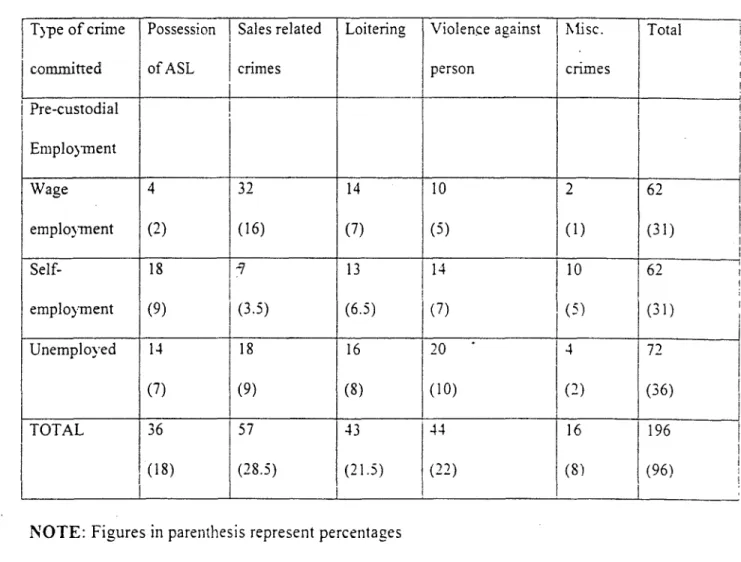
Pre-custodial Employment and Type of Crime Committed 49
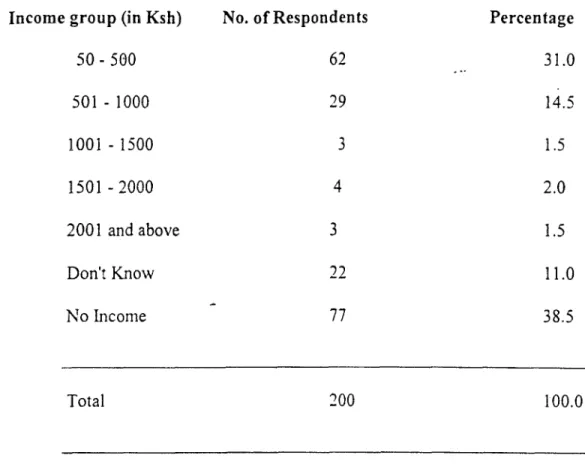
The Inmates' Pre-custody Monthly Incomes 52
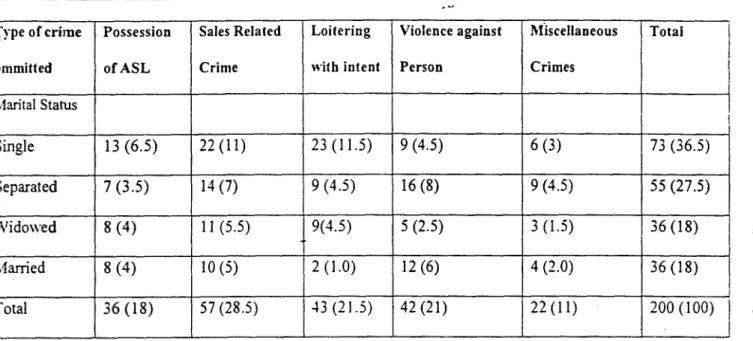
Marital Statuses versus Type of Crime Committed 55
Reasons for Various Crimes and Marital Statuses 57
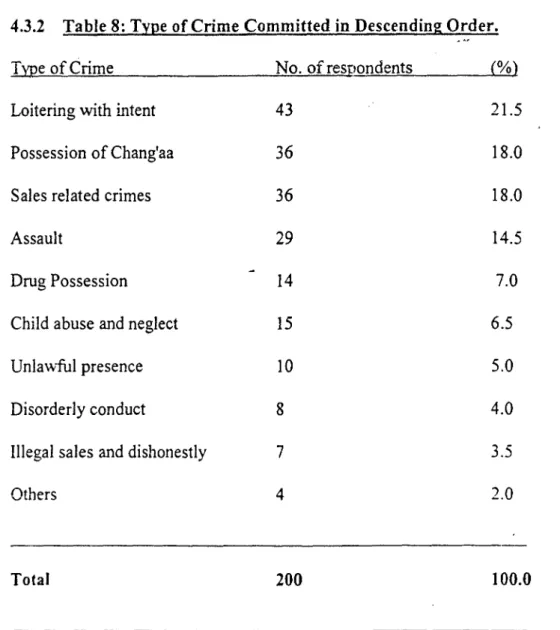
Types of Crime Committed in Descending Order 60
Reasons for Crimes Committed -
A Comparison of First Offenders and Recidivists 62
Type of Crime Committed versus Views on Causes of 65 Female Criminality
ACKNOWLEDGEMENTS
This is to express my deep felt appreciation to a number of people who assisted in various ways during the trying years of this thesis. The University of Nairobi for awarding me the scholarship to pursue the Degree course, the Board of Post-graduate Studies for being very considerate to me all along the way, the Department of Sociology for the assistance received, the Ministry of Home Affairs for allowing me to carry out the research at Langtata Maximum Women prison, Dr. Muli - Musiime and Mr. Omondi (Prison Headquarters) for their material assistance, and constant encouragement, staff of Lang'ata Prison for their co-operation (especially to Hellen Okaalo), the women who provided the information for this study and the key informants from various professions.
I would like to appreciate my former supervisors, Professor Muga, the late Dr. George Bagamuhunda, the late Dr. Walter Abilla and Dr. Phillista Onyango, for assisting in concretising my ideas, Dr. Odegi - Awuondo for his invaluable comments, Professor Omondi and Dr. Okoth Okombo for their contributions, my last supervisor Prof. Njeru for his cooperation, readiness and openness in discussing the weak points without sugar coating them.
Many thanks to my sisters Esther and Susan who lovingly and selflessly assisted me in many ways, to my friends Mabel, Florence, Lomah, Sarah and Gladys for their encouragement and optimistic outlook. I am also grateful to Mama Kimathi for her steadfast prayers and encouragement, which boosted me up a great deal.
My appreciation also extends to my parents who sacrificed to educate me.
I would like to extend my special appreciation to Mr and Dr (Mrs) Otieno for their prayers and their unbeatable hospitality to me and Mrs. Judith Mboli for her secretarial services. Many are the others who assisted in various ways and as such they cannot all be mentioned here but I want them to know that I appreciate them too.
Last but not least I give all the glory, honour, and praise to God for enabling me and renewing my strength time and again.
ABSTRACT.
This research was carried out at Lang'ata Women's Prison in Nairobi, Kenya. The major objective of the study was to determine the factors affecting female criminality in Kenya and the nature and extent of female criminality with reference to Langiata Maximum Women's Prison.
The study had nine hypotheses. The major hypothesis was that the women involved in low occupations and therefore materially deprived prior to custody are more likely to be charged with criminality than those with better opportunities. A sample of 200 women was selected for the study using simple random sampling method.
The data was collected through direct personal interviews using questionnaires containing both structured and non-structured questions. In addition, views on some of the issues were sought from professionals from the fields of Social Work, Psychology. Law, and Psychiatry. The data was analysed using descriptive statistics namely percentages and cross tabulations.
The major findings of the study were that most of the offenders were young, (between the ages of 16 - 35) single mothers, semi-literate, illiterate and with dependants, poor dwellers from the slum areas of Nairobi. These factors appeared to have high recurrence frequency in the study.
The offenders had committed mainly petty crimes in form of loitering with intent to engage in prostitution, possession of African Spirituous Liquor, hawking without licences, petty thefts of property and possession of bhang. It was further found that through these activities, the offenders earned their livelihood prior to arrest, as most of them were not gainfully employed. They earned very low incomes from these activities. Some of them were recidivists as they had been imprisoned before over similar crimes. The women cited financial constraint as the main causes of criminality.
Based on the above fmdings the investigator makes a number of recommendations, to be realised through:
- Economic empowerment of women through creation of more job opportunities. - Facilitation of access to credit facilities by women;
- Planned parenthood;
- Non-custodial sentences for petty crimes by the women and introduction of training
programs by the Prisons Department to enable the ex-prisoners to get employment or start some business of their own after discharge.
CHAPTER ONE : INTRODUCTION Background to the Study.
Human societies have societal norms that spell out appropriate and inappropriate behaviour. In modem societies norms have been codified and made into laws such that laws themselves have become norms. Wherever laws have been created there will always be individuals or groups that break them by getting involved in proscribed behaviour. This gives rise to the concept of crime, a phenomenon as old as the human society itself.
Crime is traced back to antiquity when Cain murdered his brother Abel, after which God punished him by making him a tramp. When the crime rate on earth increased God decided to destroy the whole earth, only leaving Noah and his righteous descendants (The Holy Bible;
1976).
Empirical observations have shown that crime occurs in social systems o f all sizes, from dyads and small groups to social collectivities. According to Mushanga, the poor, the rich, the educated, the illiterate, men and women are all involved without any exception (Mushanga;
1976: 4-5). According to Durkheim, there is no society so perfect that crime is unknown (Durkheim,1950:68-9).
If anything, sociologists from the functional school of thought believe that crime performs certain functions in society, e.g. production of detectives, judges, executioners and juries. Even torture has provided opportunity for the invention of torture machines by geniuses (Mushanga;
1976; 27). Nevertheless, crime causes disruption of order and decline of public security. It poses a danger to offenders and victims alike (Clifford; 1974:xi), and must be controlled. This is why various mechanisms such as corporal punishment, imprisonment, and death sentence were
introduced to deal with lawbreakers.
Although men tend to be identified more with criminal activities, women also commit crimes although as statistics all over the world indicate, the rate of female criminality is much lower than that of male criminality (Lopez Rey; 1970:199). This is so in the whole World without any exception of age or community (Adwani; 1978:38). It has however been generally observed that the rate of female criminality in Kenya has been going up in the past few years. This is indicated by statistical information analysis from prisons Annual Reports (1975-1985). Thus more and more women in Kenya are today facing trial and conviction, and getting committed to penal institutions because of criminality.
Clinard, (who conducted most of his research in developing countries) and Abbot once pointed out that the distinction between crimes of men and women had more significance when nearly all crimes committed by women were prostitution and drunkardness but that women are now engaging in as many varieties of crimes as men (Clinard and Abbot; 1973:192). They further observed that there has been a considerable increase in the proportion of every crime and women now participate sufficiently in the general society and that since the women are now in more positions of opportunity to commit crimes, a much larger amount of crime can be expected (Clinard and Abbot; 1973:195). With this kind of background in mind, the investigator sets out to explore female criminality in Kenya, with the major objective focussing on the factors affecting female criminality.
Statement of the Problem
The study is an attempt to investigate the factors that affect female criminality in Kenya. Crimes committed by women may be dominated by acts such as prostitution and other petty crimes. Men on the other hand may commit more of crimes of violence. Nevertheless, women also commit crimes that men commit and vice versa. Female Criminality in this study refers to the state of criminality of the women.
The rate of female criminality has gone up all over the world. In the United States of America, arrests of women over the period from 1960 - 1972 rose thrice as fast as those of men, with similar trends being recorded in Germany, Canada, Japan, Norway and New Zealand (Radzinowicz and King; 1977; 15-16). Likewise available statistics in Kenya reveal that female criminality rose fairly steadily during the 1975 - 1985 decade, with just a few variations as indicated in table I below:
TABLE 1: FEMALE PRISONERS ADMITTED IN KENYA PRISONS MIRING
THE DECADE 1975-1985.
YEAR ADMISSION INCREASE DECREASE °GAGE INCREASE %AGE DECREASE
1975 6927 - - - - 1976 9316 2389 - 25.6 - 1977 8242 - 1074 - 13.0 1978 6728 - 1541 - 21.5 1979 8004 1276 - 15.9 - 1980 11677 3673 - 31.4 - 1981 12869 1192 - 9.2 - 1982 13206 337 - 2.6 - 1983 12334 - 872 - 7.0 1984 13818 1484 - 10.03 - 1885 12970 - 848 - 6.5
Table 1 above indicates thit six years out of ten show an increase in female criminality whereas only four out of ten show a decrease. The highest annual decrease (by 18.5%) was recorded in 1978 whereas the highest increase was by (45.9%) in 1980. This may indicate a general inclination towards an upward trend.
Female criminality in Kenya has reached alarming proportions and more women are being committed to prisons. This is a problem situation because of the various effects:
First, when women are placed in custody children are abandoned and there may be nobody to take proper care oTthem. This is more so with female headed households.
Second, the children may become malnourished because of lack of proper food and perhaps even unavailability of food. This is more so because the children may be taken to stay with a family that may already be experiencing economic constraints.
Third, imprisonment of women may result in a higher rate of child mortality because of lowered immunity to common childhood diseases. Some may drift to the streets in urban settings thus making worse the street children phenomenon and juvenile delinquency.
Fourth, many women are breadwinners in their families and in many cases they may be the only breadwinners. When they are imprisoned this particular role is automatically interfered with. Those who have been under their direct care such as children, husbands, brothers, sisters and aged parents are left behind suffering for lack of food, adequate
clothing, school fees and so on. Where they were supplementing the husband's income, this ceases to be with their imprisonment.
Fifth, many women are directly involved in farming in Kenya and imprisonment denies them an opportunity to contribute to the food supply in the country.
Sixth, it is commonly believed that a family with a good mother can do well even without a father but rarely do families with a father and no mother do well. This is because it is mainly mothers who guide and counsel children thus moulding their characters.
Some marriages may be broken as a result of wives' imprisonment and some husbands may many other wives. This may badly disrupt even the lives of the imprisoned women's children
Objectives of the Study
The major objective of the study was to investigate the factors that influence female criminality in Kenya.
The other objective was to identify the nature and extent of crimes committed by women criminals in Kenya.
Study's Hypotheses
The investigator made certain theoretical assumptions at the outset as follows;
L. The women involved in low status occupations prior to custody are more likely to be charged with criminality than those with better opportunities. Therefore the relationship between female criminality and economic conditions is direct.
!. The younger the woman, the more likely that she will get involved in criminality. I. The lower the level of education, the higher the tendency for women to commit crimes.
L The higher the incidence of unemployment, the more the likelihood that a woman will commit a crime.
As women earn higher inconies, the probability of their committing crimes is reduced. There is a strong relationship between marital status of women and types of crime they
commit.
Large family sizes tend to be closely associated with female criminality. Poor residences seem to have a strong link with female criminality. Peer association has an influence on female criminality.
Scope of the Study
Although female offenders in Kenya are disposed of in different ways, this study will focus on those sentenced to imprisonment because the latter is among the major disposal methods used in Kenya. The study confines itself to a representative sample drawn from the population of Langata Maximum Prison, the biggest maximum prison for female offenders in Kenya. The study is on adult female offenders, from sixteen years of age and above. Due to the limitations posed by financial and time resources, it would have been impossible to interview the whole Langata prison population, and hence a representative sample '2OO women was used.
1,6 Justification of the Study.
Due to the fact that imprisonment of women causes a disruption to lives of many, the problem of female criminality should be investigated as this may provide clues to the solutions.
Very few studies have been carried out on the subject of female criminality world-wide. This renders the available literature insufficient and the subject relatively unexplored.
The relatively low incidence of female criminality in itself presents a considerable theoretical challenge.
This is a pioneer study because no study of this magnitude has been carried out in Kenya. Okaalo's 1986 study on 'Female Criminality' was limited in sample size and depth of analysis and therefore inadequate arid not of much significance. A handful of others have focused on "Effectiveness of Rehabilitation" (Mbugua; 1987) and "Attitude of Women Criminals Towards Custodial Treatment" (Katana; 1984). This study will fill existing research gap thus extending knowledge. The findings will contribute to the laying of a foundation for future researchers of Criminology in Kenya.
It is expensive to maintain penal institutions. The Development Plan for the period 1979 - 1983 indicates that the Kenya government set aside K Pounds 6.9 million for probation and rehabilitation services alone. Identifying factors influencing female criminality would lead to some clues to solutions and consequently lead Co a reduction of crimes committed by women. Resources could then be channelled elsewhere towards other departments.
CHAPTER TWO : LITERATURE REVIEW AND THEORETICAL PERSPECTIVES
Introduction
This chapter will review available literature as per objectives of the present study. In common usage, the word 'crime' includes acts that are proscribed by _the law, acts that deviate from innumerable forms of human behaviour that appear to some persons and by some standards to represent improper behaviour (Block and Geis; 1970:17). To clarify the concept of crime, it becomes necessary to disentangle it from some related concepts such as 'offence', 'sin' 'deviance', and 'delinquency'. According to Mushanga, some offences are regarded as more serious than others. He gives the examples of driving a motor vehicle without a valid driving licence as a traffic offence, but rape and bigamy as crimes (Mushanga; 1976: 4-6). From this one may perceive an offence as a " less serious crime " and a crime as a " serious offence." Hence, whereas the term 'crime' is specific, the term offence' is more general. To distinguish crime from sin, religious laws must be brought into the picture since this is probably the only issue of significance. Whereas crime is to societal (man-made) laws, sin is to religious (Godly) laws. Being disobedient to one's parents is a sin but not necessarily a crime, whereas trespassing may be a crime, but is not necessarily a sin. Alighting from a bus without paying fare is a sin since it is tantamount to cheating, but it is not a crime. However, some religious norms have acquired legal statuses so that acts like homicide and stealing are sins as well as crimes.
'Deviance' is a much wider range of behaviour that simply implies being 'different'. One may be different by behaving well when expected to behave badly and vice versa. It also depends on
the point of view from which behaviour is looked at. A member of a gang of robbers is thus not
a deviant in the eyes of the other members although he is a deviant in the eyes of the general
from the group, he becomes a deviant in the eyes of the other members but a conformist in the eyes of the general public. A wide range of behaviour included in the deviant bracket are crime, delinquency, malingering, dishonesty, mental illness, and suicide (Thio; 1978:9). Deviance is thus a wide range of behaviour of which crime is just an aspect. Hence crime constitutes a specialised and distinctive category of deviation (Block & Geis; 1970:19). Consequently, whereas to commit any crime is to deviate, not all deviations are criminal acts.
Crime is not a homogeneous act but rather a complex of many kinds of human behaviour hence we have different types of crimes (Wolfgang; 1967:27). It is also a concept that is subject to a variety of definitions by different states so that an act considered to be criminal in one state is not necessarily so in another.
This gives rise to the concept of "crime relativity." That may be either temporal (i.e. according to time) or cultural, that is, according to people and place (Clifford; 1974:2). Thus, what was legal two years ago may be illegalised now and vice versa. Laws may be made, unmade, or amended, all the time changing the acts constituting criminal offences.
From functional perspective, Durkheim views crime as functional in that it brings about flexibility to adapt to a changing world. He believes that a society with a very powerful control where the law is never broken would be a society so uniform and rigid that it lacks flexibility (Mushanga; 1976: 28-29). Crime therefore, reinforces the major collective values of a society because where crime weakens them, punishment for the same re-asserts and strengthens them.
Definition olf Crime.
Several attempts have been made to define the concept of crime. Wolfgang gives it the following definition:
"Crime is any act or omission, prohibited by the public law, for the protection of the public, and made punishable by the state in a judicial proceeding" (Wolfgang; 1967:14). According to Reid:
"Crime is any act or omission of act that violates criminal statutory or case law and for which the state has provided penalty" (Reid; 1979:6).
Glueck and Glueck on the other hand define crime as follows:
"Any act or failure to act that is prohibited by law for the protection or supposed welfare of the public, and punishable by a politically organised society in a judicial proceeding initiated by the state" (Glueck and Glueck; 1950:33).
The salient feature in the above definitions is the fact of undesirability of acts that are resultant to penal sanctions. Secondly, crime does not have to be an act but it can also be an omission. In this study, however, the terms crime and offence will be used interchangeably.
Theoretical Perspectives
) Individualistic Theories
These are theories that have attempted to explain crime from the individual's point of view.
They have used different approaches ranging from psychiatric, psychoanalytic, psychological,
medical and anthropological approaches. None of these approaches is however of much use to
(2) Group Oriented Theories.
These are theories that have explained crime causation mainly from the social interaction perspective, considering the effects of culture as well. They are "differential association", "economic determinism", multiple factor approach and "anomie" theories, the last being of main interest to the current study.
1.) Anomie Theory
The term "anomie" was first coined by Durkheim who used it to explain pathological forms of division of labour. Anomie according to Durkheim, comes about when traditional rules lose their authority over behaviour resulting in a state of norinlessness or anomie (Merton; 1968: 34- 41). Merton's theory of anomie was therefore derived from Durkheims concept of anomie. Durkheim confined his application of anomie chiefly to suicide, but Merton sought to explain not only suicide but also crime, delinquency, and mental disorder. The theory derives from a functional perspective. The general principal in Merton's application is as follows:
"Social structures exert pressure upon certain persons in the society to engage in non- conforming rather than conforming conduct - (Cloward and Ohlin; 1961; 78-81).
With reference to the American Society, Merton stated that it commends all men to strive for success goals by means of certain normatively approved forms of activity. At the same time, opportunities to reach these goals through socially approved means are differentially distributed so that success is only available through legitimate occupational channels for a minority of the population.
Phillipson (1971) also supports the position that the bottom echelons of social class hierarchy are unlikely to succeed and among these groups anomie is likely to be experienced most vividly. For this reason pressure to deviate is at it's strongest among the most economically and socially disadvantaged groups. Merton adds that a situation like this makes the people affected adopt one or more of the 5 modes of adaptation to the situations which, are conformity, ritualism, retreatism, rebellion, and innovation. Only the last form of adaptation is of significance in this study. 'Innovation' refers to a state whereby persons continue to pursue approved goals but whose means are illegitimate.
The crucial relationship postulated in Merton's theory is between blocked opportunities and deviant behaviour where, the former is indexed by unemployment rate and lack of education. These generally result in lack of skills, poverty, and slum dwelling, as opposed to success in business and prestigious posts (Clifford; 1974: 45).
As to what it is that makes individuals choose any one of the five forms of adaptation, the investigator does not deem it relevant to the present study since this would call for another full study. In any case no single theory can adequately explain crime causation and no theory is therefore free from criticism. It should be pointed out here that the theory of anomie will not be applied wholesale to the area of female criminality but with caution.
Furthermore, Merton argues that indicators must be developed if the concept of anomie is to be utilised in empirical research. He talks about Leo Sreole's attempt to develop a 'scale of anomie' which incorporates terms referring both to an individual's perception of his social environment and his place within that environment. Merton points out that Sreole's scale of
anomie was defective and goes on to discuss Bernard Lander's indicators of anomie (Merton; 1968; 41-48). The latter developed two clusters of variables, one of which he termed anomie factor because it has values of high delinquency rate.
The factors are as follows: High delinquency rate areas
High percentage of non-white residents in the area Small percentage of dwellings occupied by owner Family disintegration (divorced and separated) Occupational status
Marital status
3.1 Female Criminality and Anomie Theory.
It is apparent from the proposition of the theory that many cultural and structural systems all over encourage people to strive towards certain goals or material achievements which can only be obtained legitimately through education and employment, which presumably lead to better life.
Women all over the world were for a long time discriminated upon in so many ways such as education, employment, remuneration and ownership of property. Lopez-Rey summarises the
situation as follows:
"In many countries political and legal rights of women are constitutionally proclaimed, but not always recognised, the right to equal employment is seldom accompanied by equal remuneration" (Lopez-Rey; 1970:200).
He further contends that this situation is more significant due to factors such as the growing number of unmarried women with children, the greater frequency of divorce and separation, as well as shorter life span for men as compared to women (Ibid; 1970). This represents a marginalised group with no easy way of achieving their goals. They are consequently more exposed to the use of illegitimate means and more so due to recently added family responsibility.
Lopez-Rey (1970:200) continues to observe that acts such as abortion, infanticide, child abandoning and cruelty to children prevail among women of the less privileged classes because the male may turn his back thereafter. Abortion is on the other hand easier for those with financial means, and this leaves the disadvantaged with the responsibility of bearing unwanted children, who easily become victims of infanticide, child abandonment and cruelty (Ibid: 1970:201).
Concerning ownership or inheritance of property, women had no right in many parts of the world. This is one of the many reasons that gave rise to the Women's Liberation Movement and a search for equality due to the discriminatory laws that restricted the women's access to legitimate means of reaching their goals.
Education for women has also been an area of discrimination particularly for women in Kenya. This is because for a long time parents preferred to educate their sons rather than daughters, as a result of discriminatory traditions and traditional role expectations. The argument being that the latter would end up getting married and leave the home (Pala et al; 1975:155). Where finances are limited Kenyan parents have opted to educate sons. Early pregnancies have also led to high a
rates of school dropouts among girl students. This leads to higher rates of unemployment or at best, employment in menial occupations for girls and women.
The "changing roles" concept has also ushered in female- headed households where women are the sole breadwinners. In most cases women no longer remain athome to take care of the duties there. They have to go out to earn an income and more so where they are family heads either because they are single or because their husband are working elsewhere (Goode; 1987: 132-
133).
It would seem as if all along, perhaps from early childhood, women are alienated from the means to achieve their life goals and thus more exposed to law breaking because the traditional rules lose their authority over the women's behaviour.
3.2 The Nature and Extent of Female Criminality, 3.2.1 The Initial Studies.
Empirical data on female criminality shows that very little research has been carried out in this area. Smart points out that voluminous and rich work in the field has been confined almost exclusively to the study of male criminals because of the belief in the relative insignificance of female criminality (Smart; 1977: 1-3). This is mainly because the preponderance of criminal activity has been attributed to men and theoretical explanations have been focused therefore on male criminality.
The differential crime rate between male and female where the former have a much higher ratio than the latter has been attributed by different criminologists to such factors as closer supervision of women and girls, the more active economic role for the men and that some
crimes committed by women such as theft by female servants, theft by prostitutes are under reported (Yablonslcy; 1962:4). Yablonslcy reiterates that women are less criminal because they are sheltered from the hardship of life namely heavy physical labour and violence, rendering them less likely to commit crimes of violence namely, assault, rbbbery, and others.
It is not however the purpose of this study to focus on the male - female differential crime rates. Nevertheless, this has to be mentioned since a few studies on women offenders, (according to Wooton ), have generally looked upon the difference between masculine and feminine criminality merely as a reason for eliminating female subjects from their researches on the ground that they provide insufficient material (Wootton;1967:318). That is an area that needs to be explored can no longer be ignored.
Early studies carried out by scholars like Lombroso and Ferrero, Thomas, Pollak, Courie, and Slater, tended to dwell so much on biological and physiological views. It should be noted that, the role played by social and environmental factors has been ignored by these scholars. It should hereby be pointed out that women are not entirely biological and physiological beings.
Classifying them exclusively as such is not realistic since they are also social beings. Social and environmental factors should not therefore be ignored and relegated to nothingness. The point is that Lombroso and some of his successors over concentrated on biological and physiological factors ignoring the social criteria. To look at factors such as urbanisation and the development of capitalism as merely triggers of criminal activity is to take a narrow perspective, to say the least.
Lombroso saw a close connection between physical deficiencies and crime. In his few "born criminals," he reported to have found lack of maternal instincts, less sensitivity to pain, less
compassion, jealousy, and vengeance. He said though, that these qualities are normally tempered by more typical female attributes such as piety, maternity, and feminine weakness.
The investigator would like to point out that improbability of the "born criminal," as criminality is more of a learnt behaviour, at worst a response to life pressures. The flat noses and the protruding forehead that Lombroso talked about may not be traits that would stamp one as a born criminal, but rather, the victim's reactions to the people around them would determine whether they become criminals or not. The view of offenders as sub-normal gives a distorted picture of the phenomenon (Smart; 1977: 17-18). Female offenders might have been rare in comparison to male offenders but this does not make them an abnormal species. That female offenders are biologically subnormal, lack maternal instinct, are not fully female, and are monsters (according to early criminologists like Lombroso, Cowie and Slater) need to be proved (Smart; 1977: 33-35) beyond any reasonable doubt. These scholars arrived at their assessment after studying middle class women in Europe in the 19th century. Thus they have overlooked historical and anthropological evidence of the activities and social position of other women in other periods and societies (Smart; 1977: 31-39). This type of study can be fallacious and inadequate since it is actually limited to women in a particular society at a particular period (Smart; 1977: XIV).
If anything, women may be more vulnerable to these forces due to phenomena such as single parenthood (widowhood, divorce, never married) coupled with a higher incidence of unemployment and low remuneration. The biological and psychological determinism were largely rejected in later studies and as Smart appropriately observes, this is an important development in our understanding of female criminality (Ibid; 1977). And so this takes us back
to the social and environmental factors.
Empirical observations have proved that crime in different parts of the world and in different types of societies mirror the most basic values of a people and the means that the society has devised for the fulfilment and realisation of these values. Consequently the fotal female crime picture of a given country may be wholly dominated by one particular crime which may be of very little importance elsewhere, partly because of the criminal law, climatic, social, and economic conditions. Mannheim cites an example of drunkenness in Sweden and libel in Germany (Mannheim; 1965; 335). A society can therefore be understood and judged only against the background of its peculiar culture, i.e. its norms and values since some crimes are directly and simply a reflection of these forces. It is with this background in mind that studies by different scholars on female criminality will be reviewed.
2.2 The Subsequent Studies
Mannheim, after analysing the history of criminality in Europe, observed thus;
"From the point of view of history the crimes in which women were mostly involved used to be adultery, incest, witchcraft, poisoning, infanticide, drunkenness, prostitution, cruelty to children, shoplifting, and motoring offences in that order" (Mannheim; 1965:696).
Walker reiterates that women generally commit crimes that are petty and non-violent in nature and that when opportunities avail themselves, women outnumber men among shoplifters, this being so because they enter shops more often than men (Walker; 1973: 295-6).
Adwani argues that prostitution and shopliftiru are the forms of crimes traditionally attributed to women (Adwani;1978: 39). Available literature from the West reveals that the type of crimes frequently committed by women and girls is sexual in nature and that the convicts had been leading immoral lives prior to conviction.
In a study of 590 cases of women prostitutes from New York city Smart shows that 32% were committed for misdemeanour and felonies while the remainder (68%) were committed for crimes connected with sexual immorality (Smart; 1977: 8-11).
It appears from above observations that these scholars have for a long time believed that the deviance attributed to women are mainly shoplifting and sexual deviance. It is interesting to note the manner in which shoplifting and prostitution are explained away. The former is believed to be caused by the need for psychic relief whereas the latter is explained away by an intense need for love and tenderness (Smart; 1977:39).
On the other hand Smith's typical woman offender in Scotland, England, and Wales appears to be young and dishonest or middle aged and disorderly (Ibid; 1977: 32) whereas this may not be necessarily so in Kenya. The investigator hereby refutes this observation
In connection with dominance of particular crimes and looking at the empirical data in Kenya scene, Muga, in his study in 1975 reveals that women offenders in Kenya commit crimes as listed below;
Possession of African Spirituous Liquor; trading without licence ( hawking ); over- charging; possession of cannabis sativa; possession of poisonous drugs; forgery;
burglary and theft; handling s`olen property and disorderly conduct (Muga; 1975:68-70)
What comes out of a comparative examination of the above list of crimes with Western and Eastern literature is that the first four crimes are not common in the Western and Eastern countries. This is one of the reasons 'why cultural practices can not be igriored in studying female criminality
Noting that Kenya women commit some crimes that are peculiar to them and perhaps women from some other parts of the African continent, Nelson observes that rural urban migration has had a criminogenic effect on women. As he put it:
"Nairobi is growing at a yearly increase of 7.8% and this has resulted in an increasing number of unmarried, landless women whose only solution often is to go to town. They enter into the struggle for a limited number of jobs and most likely become domestic servants, petty traders, casual labourers, prostitutes or delinquents" (Nelson; 1975:4) He continues to say that entering new social and economic settings in the urban social field implied that these women have to be employed, yet they are not qualified and can therefore only get menial unskilled labour (Nelson; 1975:5). These crimes may or may not be known to the women in Western and Eastern world.
2.4 Various Explanations for Female Criminality 1.4.1 Increased Learning Opportunities
A group of scholars have pointed out the impact of increased learning opportunities for women
and the fact that traditional sex roles have undergone considerable transformation. The following is their view:
"The more recent increases in female crime have been due to increased learning opportunities together with changes in traditional sex roles which previously emphasised production of goods and services, bearing and rearing of children, female submissiveness and stay - at - home attitude" (Clinard and Meier, 1985:86).
For this reason, women are exposed to opportunities to commit crime just like men. Clinard et al applied differential association theory in explaining women's exposure to deviant norms due to more participation in the general society. Cooper reinforces this position thus;
Women in men's position have not shown themselves to be strong enough to resist the temptations of bribery, fraud, and embezzlement (Cooper ; 1974: 160).
2,4.2 Women's Liberation Movement
Female criminality cannot be discussed without considering the concept of Women's Liberation Movement, a group that was agitating the liberation of women from all forms of oppression, exploitation, ignorance, and poverty. Ideally the achievements of the movement would result in a society where women and men can leave in peace with each other interacting with human dimity and mutual respect and where decent standard of living is assured for all. West believes that as women become emancipated (liberated) they get convicted of more crimes (West; 1967:197). This is mainly because they became more aware of equal rights with men, the exposure and excesses of which may result in criminal offences. The investigator would like to point out here that there is an indication that most people have misunderstood the meaning of emancipation and have equated it with women senselessly imitating men, even in deviant behaviour (as was vogue in the West and to some small extent, in Kenya during the 70s and 80s. Smart blames criminologists who have studied female criminality for falling into this trap too (Smart; 1977: 73-74). She views emancipation as an extension of human rights and full social
and economic opportunities, which she sees as an advancement of social justice. She warns :‘s that emancipation is not merely based on a desire to emulate men in dressing and behaviour but explains that it actually refers to the ability to resist stereotyped sex roles and to reject limiting misconceptions about the inherent capabilities of the sexes.
The argument that women's emancipation has altered the formerly low rates' of female crime may be valid in as far as it opens up opportunities once denied women. Adler, for instance, observes that by challenging the traditional restrictions and social roles, women are likely to be subjected to pressures that can increase crime. She maintains that as women move into white-collar positions, most of them will perform their tasks honestly and responsibly but that it is unrealistic to assume that w-omen will be any more honest than men. Leonard supports Adler's contention that increasing freedom might lead to greater female crime and she says Adler's statement deserves consideration, although she at the same time accuses Adler of blurring the connection between female crime and liberation movement (Leonard; 1982: 176) and failing to clearly distinguish between criminality and liberation of women.
The investigator observes that it is quite possible for women to be liberated from oppressive situation without being criminal, and also to be criminal without having been liberated from any oppressive situation. Female criminality in Kenya may have nothing to do with liberation movement per se. Perhaps the movement sensitised women to their rights as human beings and their social and economic positions vis-a-vis those of men, and this in turn increased female crime rate but mainly due to increased opportunities. Sooner or later women were definitely going to wake up to their oppressive circumstances and do something about it. Emancipation and women's movement are just but labels. With or without these, increase in rates of female crime was inevitable as a consequence of social change and development.
Economic Constraints
Concerning economic problems and its influence on female criminality, Wootton's (Wootton; 1971: 100) analysis of studies carried out by American researchers leads to a number of observations. Among these, she cites a study carried out by Fernald on a sample of 420 women classified into four categories as follows:
Very poor - dependent all or most of the time - 5.7%. Poor - Managing with difficulty, with occasional aid 35.7% Fair - normally self supporting but without surplus - 45% Good- with money saved or its equivalent - 13.1%
On this basis, Fernald concluded that even though the convicts' records showed a low wage, the wages were not lower that the bulk of unskilled workers in the same occupation. This does not support economic constraint as a factor in criminality.
On the basis of general studies on crime however, some scholars believe that economic ends are the primary means to the ultimate happiness, viewing crime as an alternative means to such ends where 'one cannot make it legitimately' (Cressey and Ward; 1971: 317). The theory has had as many supporters as critics.
The proponents of Marxists, school of thought hold the following belief:
"Society is profoundly affected by its economic institutions since economic activity is central. The key to the problems of a society, like crime, might lie in its economic arrangement" (Vold; 1959: 121).
From the above discussion it could be concluded that there is a strong tendency for crime and delinquency to be associated with poverty. Wootton (1969) also notes that women offenders tend to be unfortunate in their social and economic backgrounds. Studies have shown that in Kenya and other developing countries, prostitution, for example, is a means of earning an income, an outcome of a dire economic need as well as a choice between survival and starvation for most women. Smart, on the same subject observed that:
"Prostitution is today not a reality for women in the West. It is still a fact of life for others living in Third World countries and the tendency to reject the argument that prostitution is a consequence of extreme poverty may therefore only be relevant in advanced industrial societies where absolute poverty is uncommon although not unknown" (Smart; 1977:9).
Muga's 1977 study also confirms the above statement. He concludes that unemployment and its attendant poverty gives rise to prostitution, the culprits being young school drop-outs who also happen to be unmarried mothers and cannot therefore take care of their children
(Muga; 1977:69).
'14.4 Changing Roles.
Adwani's study conducted in India also looks at crimes committed by women in relation to the role structure and gives it a purely economic explanation. He states the following;
"The commitment of such crimes by females in which economic harm was done to the victim indicates the change in role structure. That is, some times the women have to indulge in anti-social activities to help their husbands in economic pursuits or when they face economic stresses. It may then be said that women's crimes were incidental to the
role they play as wives, mothers and rearers of children" (Adwani; 1978:39).
Smart observes that most occupations give some opportunities for dishonesty and that it is likely that as women become a larger part of the work force, more of them will be involved in more crimes related to their respective occupations (Smart; 1977:5). She reiterates that changes in women's social and economic roles are leading to higher rates of criminality. Making this conclusion she observes that women are currently engaging more frequently in more varied forms of crime such as burglary, robbery, theft, handling of stolen goods, drunkenness and fraud (Ibid; 1977; 13).
Dinennan states that virtually all one-parent families are headed by women and these families are triply handicapped by child-care costs, lack of marketable skills and job discrimination and as such they are highly vulnerable to poverty (Dinerman; 1977:472).
Okaalo's 1986 Lang'ata prison study, for instance, reveals that 85.25% out of her sample were single women, out of which 77.05% were mothers (Okaalo;1986). She further found that 40.98% had no sources of income prior to imprisonment. A total of 63.33% cited need of money as the reason for their crimes.
.5 Unemployment and Under-employment.
Mbithi, in his documented 1979 address to Prison Officers, attempted to explain criminality (both men and women) in Kenya. He stated it was caused by unemployment and underemployment and various social tensions such as poor conditions of life in rural areas that cause an influx into urban areas where people imagine life is easier. It has been observed that young people, men and women, educated and uneducated, move to towns in large numbers with
the intention of finding employment. The situation being what it is, most o r them find no employment since they are likely to be lowly educated and may not be able to effectively compete with the rest who mostly are comparatively better educated. They end up unemployed and this creates a lot of pressure for the individuals concerned.
Mbithi goes on to state that by the year 1982 Nairobi's unemployment rate had risen to 35% and that the situation was likely to be worse by 1992, with only one out of every 10 school-leavers expected to get a job. The situation is getting progressively worse since more than a decade has passed and women are more of victims because they are generally less educated as compared to men their male counterparts. Many women without reliable income sources who depend on chang'aa brewing or hawking for survival end up in prison but after release they go back to the same crimes. This is because the behaviour has been punished but the root cause (poverty) has remained un-tackled. Mbithi elaborated on this idea by saying that when a man is arrested then one is dealing with only symptoms of social pressure, for which punishment may not be the answer.
We have learnt from available literature that the Kenyan woman prisoner is a" young rural-urban migrant, with little or no education, no full-time employment, may or may not be a single parent, has dependants". From this we can infer that women prisoners in Kenya are from disadvantaged backgrounds which factors highly predispose them to illegal activities which are sure to land them in courts of law. They are fined and since they may not have the money, they get imprisoned.
who get caught in the criminal-justice process indicatcs that this increase is due more to socio-economic vulnerability of women than to crime per se ( Muli-Musiime; 1986:3 ). This vulnerability is due to the fact that women are poor, in most cases uneducated, lack skills, and may be parents, single or otherwise.
Lack of Skills.
The few women in formal employment may lack skills thus ending up in occupations that demand little skill but which are low paying. Women have responsibilities yet more often than not they lack proper sources of income. In a study of women prisoners in Langata Women's Prison, Mbugua found that:-
"23% were single mothers who had between 3-5 children. Another 23% were divorced and illiterate and had 6 - 10 children. 9% were widowed and re-married, 20% stated that their husbands were very poor and in no position to help them financially"
(Mbugua, 1987:53).
Many who work in factories are insecure due to the temporary nature of their work. These women, though employed, may not therefore be much better than their unemployed counterparts. They may end up looking for such other ways and means of supplementing their incomes as illegal trade. When they are single parents the situation becomes even worse because of the intensity of needs. This is compounded by the needs of their children who must feed, go to school, and have medical attention in sickness.
The preceding discussion about factors leading to female criminality suggests that many of the factors are social and economic in nature. The recurring factors are unemployment, poverty, single parent-hood, and the changing roles of women.
Moreover, even with thol. (men and women) in wage employment, returns from their work may provide no more than a poverty standard of living, implying that they are as much a part of the problem as are the unemployed.
.
„.5 Hypotheses
There exists a strong relationship between female criminality and material deprivation and thus the relationship between crime and economic conditions is direct (positive). This is so in the sense that criminality is an extension of normal economic activity (a criminal fringe) and increases and decreases in the same manner and at the same time as normal economic endeavor.
:51 Variable Specification and Variable Indicators
The variables are divided into two categories made up of independent and dependent variables. Since it is assumed theoretically and practically that independent variables influence dependent (effect) variables, the former must therefore precede the latter in occurrence.
Independent Variables.
The independent variables in this study are as follows:
Hypothesis Independent Variables Indicator for Variable
I.The women involved in low Occupation Executive (secretaries, Nurses) status occupations prior to
,
Petty trade (hawkers, chang'aa
custody are more likely to be brewers, bhang sellers)
charged with criminality at some point in their lives
Service (house maids, bar maids, waiters, etc)
2.The younger the woman, the Age Years since birth as follows
more likely that she will get 16 —25 years
involved in criminal behaviour 26 — 35 years
36 — 45 years
The lower the level of Level of education . No. of years in school as follows
education, the higher the 1- 4 years
tendency for women to commit 5 — 8 years
crimes 9-12 years
13 and above
The higher the incidence of Employment Wage (formal) employment
unemployment, the more the Self employment
likelihood that a woman will commit a crime
Hypothesis Independent Variable Indicator for Variable 5. As women earn higher
income, the probability of their committing crimes is reduced
There is a strong relationship between marital status of women and types of crime they commit.
Large family sizes tend to be closely associated with female criminality
Income levels as follows: None
Very low-ranging from Kshs. 50.00 — 1500.00pm
Low ranging from Kshs. 1501.00-3000.00pm Middle-ranging from Kshs. 3001-4500.00pm High-ranging from Kshs. 4501.00 and above Categorised as follows;
single (separated and divorced) Widowed
Married Separated
Measured by number of children as follows:
Small (between 1-3 children) Large (between 4-6 children) Very large (7 and above)
Income Level
Marital status
Family Size
NOTE: The indicator reading "executive" for hypothesis 4 is for the purpose of
simplification of grouping in this study and includes those who were in white collar jobs prior
to imprisonment such as nurses, teachers, secretaries. The word executive in this context does not therefore bear its normal dictionary meaning.
_
Hypothesis Independent variables Indicator for variable
Poor residence seems to have Residence type Mgasure by monthly rent levels as a strong link with female
, follows:
criminality. - Low level Rent — Mathare
Kawangware, Kariobangi etc. - Middle level — Ngara, Buruburu
etc. _
- High level rent — Westlands, Parklands, Lang'ata
Peer pressure has an influence Peer Pressure Measured by company one kept both
on female criminality, before and in prison and whether the
friends were ever imprisoned and the type of crime for which they were placed in custody
NOTE: The variable "family size" for hypothesis 7 will encompass members of the extended family in the discussion chapter.
Dependent Variable
All the 9 hypotheses have a causal relationship with the same dependent variable, the" female criminality" which is indicated by the following specific crime clusters.
1.)
Possession of "chang'aa"
Drug trafficking, hawking without license, selling goods at a price exceeding the recommended price, selling after closing hours.
Loitering with intent to commit prostitution
Affray, assault, manslaughter, murder, abortion, child abuse and neglect.
Robbery with violence, burglary, theft by servant, forgery and being present in the country illegally. The crime types have been classified into 5 major classes for ease of analysis. Possession of African Spirituous Liquor (A.S.L) or "Changlaa"
Sales related crimes.
Loitering with intent to commit prostitution. Violence against the person.
Miscellaneous Crimes.
NOTE: The first and the third categories consist of a single type of crime. This was done deliberately since these crimes are commonly committed by women in Kenya and thus combining them with any other type would cause the whole study to lose focus.
CHAPTER THREE: SITE SELECTION AND METHODOLOGY
Site Selection
Langsata Women's prison was chosen as the most suitable due to the fact that it is the only maximum prison for female offenders in the country, thus the only one that detains both short-term and long-term prisoners from all over Kenya. This factor makes it possible to generalise from the findings of the research since Lang'ata seems to be quite representative.
The secondary factor was related to the available resources. The attributes of representativeness, convenience and familiarity made Lang'ata prison the only possible choice if the objectives of the study were to be achieved and valid generalisation made from the findings.
The institution is located about 13 km outside the Nairobi City Centre with a full capacity of 800 inmates including remandees. At the time of the study it was being managed by a Chief-Officer assisted by an Chief-Officer-in-charge and a number of Prison Wardresses.
2 Methodology 2.1 Sampling Frame
Lang'ata Women's Prison has a Register of all the inmates, including personal details such as marital status, crime committed, residence, and others. The Register is very big, with very many names entered over a long period of time. This necessitated taking the names of only those who were currently serving their sentences. This new list constituted the universe from which the sample was later drawn, i.e. individuals or adult inmates aged 16 and above. Thus the individual offender is the unit of inquiry in this study.
..2 Sampling Procedure
Initially the investigator had planned to leave out the inmates with only 3 months or less of jail term. This was to ensure that all in the sample would be interviewed before release but
would have excluded many brewers and all loiterers from the sample, since the former mostly go in for 3 months or less while the latter go in for 1 to 6 weeks. That kind of sample would have been biased and unrepresentative, giving the impression that there are no loiterers and very few brewers while these were actually the most dominant category.
Specifically, simple random sampling method was employed. The investigator transferred all the names of current prisoners from the Register on to a sheet of paper, without changing the order in which they appeared. Using the lottery method, the names were transferred on small pieces of paper which were then well folded, placed in a container then mixed thoroughly.
From the 548 pieces of paper representing the universe, the required sample of 200 pieces was randomly selected. without replacement. Those were listed together with the crimes committed and prison terms for it was of crucial importance that the short-term prisoners and the long termers (who were about to be released) be interviewed first i.e. before they were released.
3 Sample Size
At the time of the present study the universe of Lang'ata prison, was ,548 inmates. The universe was relatively homogeneous in terms of the type of offences represented. The investigator decided to draw a sample of 200 inmates, representing 36% of the universe. This was considered to be the optimum sample size, which, according to Ghosh;'(1985:206).fulfils the requirements of efficiency, representation, reliability and feasibility.
4 Data Collection Instruments
) The Questionnaire
The questions had been formulated as per the objectives of the study. They were designed within the framework of the problem statement and linked up with the chosen theory and the study's variables. There were two sets of questions, one for the Langfata inmates (see Annex I) and the second for the key informants (see Annex II). Key informants from various professions were given questionnaires, which they filled out on their own and were later collected from them. Questions for both categories were short, precise, and simply worded for better understanding.
The main questionnaire included both structured and non-structured questions. The former were used due to their ease in filling out responses and because they keep the respondents within the subject matter due to their restricted nature.
However, non-structured questions were also included because they are less superficial and also offer a better flexibility in tapping the attitudes of the inmates. These also allowed the investigator an opportunity to probe and in this way greater depth of responses was obtained.
The questionnaire was pre-tested before finalization.
Prisons are restricted places and the investigator had to obtain an authorisation letter from the then Commissioner of Prisons to the Officer-in-Charge of Lang'ata Women's Prison. Only then was the investigator able to test the questionnaire on a few inmates to discover the draw-backs in the questionnaire in terms of ambiguity and redundance, judging from respondents' reactions. At the prison, the investigator was introduced to the 'Welfare Officer who was to give all the required assistance during the period of study. The Welfare Officer introduced the investigator to the uniformed members of staff and the inmates as well as the purpose of the visit.
Sources of Primary Data
Personal Interviews with Inmates
The
questionnaires were administered to the inmates through a direct personal interview since a good number of the respondents could neither read nor write. Even those who could read and wTite most would have been unable to clearly record the responses themselves because of semi-literacy. The interviews were conducted in Kiswahili for effective communication. The first four to be interviewed for the day would be detained while others went to work to avoid discussion of the interview with those yet to be interviewed.In the afternoons the next two would be detained for the interview. They would wait outside the office in which the exercise was taking place and come in one at a time. It took an average of 40 minutes to interview one respondent and only a few problems were encountered (See Annex IV).
.1 Views From Key Informants
The investigator decided to gather information from professionals (both men and women) from the fields of Psychology, Psychiatry, Law, Police Force, and Social work. This was done through questionnaires, which they filled out. It was for the purpose of obtaining their views concerning certain pertinent issues in female criminality. Whatever information they provided was used to supplement the information gathered from the offenders. All the questions were non-structured but based on the major variables of the study (see Annex II).
) Direct Observations
The investigator also used this method to gather some information. These were so in connection with inmates' general appearance, their conduct during the interview and interpersonal relationship amongst inmates and members of staff. In this way the investigator did not have to keep on asking questions about everything.
Sources of Secondary data
The secondary sources of data were the library and prison records.
Library
The books on Criminology were obtained from the University of Nairobi Library and a few from individuals.
Prison Records
These were obtained from the Prison Headquarters, Nairobi. They were in the following forms: Official reports and statistics; Committal Warr- ants; Consolidated Annual Returns;
Annual Reports on the Administration of Prisons and Press cuttings (on articles related to crime and imprisonment)
Limitations of the Study
The investigator would like to point out that prisons are probably not a representative sample of criminals. At best they can only be representative of prison populations, which is obviously a selected group from among those involved in crime and also selected for imprisonment because they are 'failed offenders' (Phillipson; 1971:27).
The readers should therefore know that the sample drawn from Lang'ata Prison for this study can not possibly be completely representative. However, the findings are expected to be a reflection of the female criminality picture in Kenya as a whole. This is because, as stated earlier, Lang'ata is the biggest female prison in Kenya drawing inmates from all over the country.
4.0 CHAPTER FOUR: CRIMINAL 3EHAVIOUR, DEMOGRAPHIC CHARACTERISTICS AND ASSORTED ATTITUDES.
4.1 Introduction
In this chapter, data on female offenders is presented, analysed, and finally interpreted using descriptive statistics mainly through tables, percentages, and measures of central tendency. An attempt is also made to apply the theory that is most suitable in explaining female criminality in Kenya.
Wootton has heavily criticised contemporary social research in being over-enthusiastic in using complicated statistical techniques in data analysis even when it is not required. She makes the following observation:
"One of the many weaknesses of contemporary social research is that we have allowed ourselves to disregard the obvious. Quantification is now the rule in nearly all social investigations. Yet inaccurate observations remain inaccurate no matter how sophisticated the statistical processing to which they are subjected. We should be well advised to resist the temptation to elaborate manipulation and to content ourselves with such humble methods as purely descriptive treatment" (Wootton; 1967:312-313).
Dubin (1969:85) observes that Descriptive research is the stuff out of which we finally derive information useful for theory building and as such we cannot do without it.
4.2. Background Information on Respondents
4.2.1 inmates' Pre-Custodial Occupations
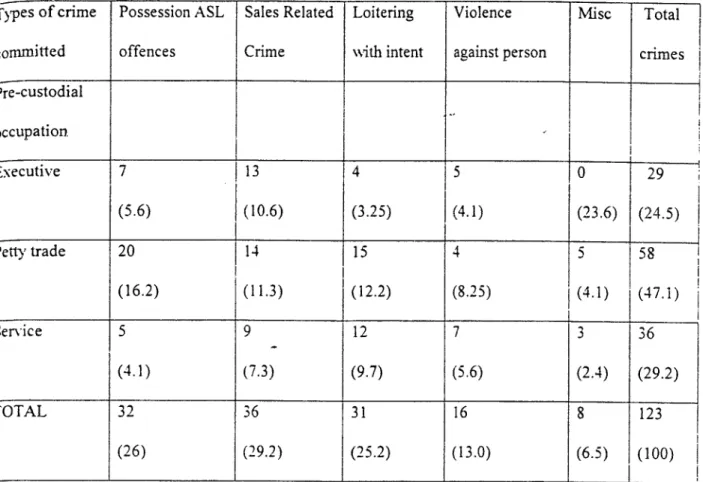
The "executives" only constituted 24% of those who had incomes. These were mainly clerks, copy typists, nurses, and teachers. Another 47% had engaged in petty trade, which included small businesses dealing mainly in fruit and vegetables. Majority from this category had been hawkers while others rented stalls in various market places; sold from small kiosks in residential areas; roasted maize by the road sides; sold cooked food tchang`aa and some were bhang dealers.
A further 29% had been serving either as domestic workers or as service girls and waitresses in bars and eating places. The few who had intimated that prostitution was their full-time occupation were also placed in this category. Only 5% had engaged in subsistence farming. on tiny pieces of land and sold surplus for money, which they spent on purchasing other goods and services. Another 3% had been engaged in such other varied occupations as hair saloons and selling of white stones, the latter applying exclusively to the Abagusii inmates.
Table 2: Pre-custodial Occupation and Type of Crime Committed Types of crime committed Possession ASL offences Sales Related Crime Loitering with intent Violence against person Misc Total crimes —ire-custodial occupation Executive 7 13 4 5 0 29 (5.6) (10.6) (3.25) (4.1) (23.6) (24.5) ' Petty trade 20 14 15 4 5 58 (16.2) (11.3) (12.2) (8.25) (4.1) (47.1) Service 5 9 12 7 3 36 (4.1) (7.3) (9.7) (5.6) (2.4) (29.2) TOTAL 37 36 31 16 8 123 (26) (29.2) (25.2) (13.0) (6.5) (100)
Note: Figures in parenthesis represent percentages. A SL- African Spirituous Liquor or chang'aa
Sales Related Crimes - In this study refers to crimes like hawking without licence. selling after closing hours, over charging, handling stolen property and drug trafficking.
Violence against the person - In this study refers to crimes like manslaughter, murder, concealing birth, affray, child stealing, child abuse and neglect and assault.
Miscellaneous - In this study refers to crimes committed in minor frequency such as disorderly conducts, forgery, burglary, robbery with violence, abortion, child defilement, theft by servant, damage to property and illegal presence in the country.