HAL Id: hal-01411357
https://hal.archives-ouvertes.fr/hal-01411357
Submitted on 7 Dec 2016
HAL is a multi-disciplinary open access
archive for the deposit and dissemination of
sci-entific research documents, whether they are
pub-lished or not. The documents may come from
teaching and research institutions in France or
abroad, or from public or private research centers.
L’archive ouverte pluridisciplinaire HAL, est
destinée au dépôt et à la diffusion de documents
scientifiques de niveau recherche, publiés ou non,
émanant des établissements d’enseignement et de
recherche français ou étrangers, des laboratoires
publics ou privés.
Benchmarking of triple stores scalability for MPSoC
trace analysis
Leon Fopa, Fabrice Jouanot, Alexandre Termier, Maurice Tchuente, Oleg
Iegorov
To cite this version:
Leon Fopa, Fabrice Jouanot, Alexandre Termier, Maurice Tchuente, Oleg Iegorov. Benchmarking of
triple stores scalability for MPSoC trace analysis. 2ndt International workshop on Benchmarking RDF
Systems (BeRSys 2014), Sep 2014, Hangzhou, China. �hal-01411357�
Benchmarking of triple stores scalability for MPSoC trace
analysis
Leon Constantin Fopa
University of Grenoble, LIG 681 rue de la passerelle St Martin d’Heres, France[email protected]
Fabrice Jouanot
University of Grenoble, LIG681 rue de la passerelle St Martin d’Heres, France
[email protected]
Alexandre Termier
University of Grenoble, LIG681 rue de la passerelle St Martin d’Heres, France
[email protected]
Maurice Tchuente
University of Yaounde 1 LIRIMA and IRD-UMI 209
UMMISCO
BP 337 Yaounde, Cameroon
[email protected]
Oleg Iegorov
STMicroelectronics 850 Rue Jean MonnetCrolles, France
[email protected]
ABSTRACT
A Multi Processor System-on-Chip (MPSoC) is a complex embedded system used in consumer electronic devices, such as smartphones, tablets and set-top boxes. In order to cope with the complexity of MPSoC architectures, software devel-opers rely on post-mortem trace analysis for application de-bugging or optimization. The traces are explored to localize expected and unexpected programs behaviors. However, the low semantic value of low-level trace events make the trace exploration difficult. We propose to perform trace explo-ration through an ontology which adds semantics to events and provides a declarative language for querying data. Be-cause traces can be huge, such an ontology contains a large number of instances stored as RDF triples. Because an-alysts need fast results on classical computer, an efficient system for query answering is preferred. Therefore, satu-rating, loading and querying those triples pose a scalabil-ity challenge to state-of-the-art knowledge base repositories (KBR). In this paper, we have conducted a benchmark of 7 KBRs: Jena, Sesame-native, Sesame-memory, tdb, sdb, rdf-3x and vertical-mdb, to test their scalability in a non-distributed environment close to analyst environment. We used these KBRs to analyze real traces through VIDECOM, an ontology we designed for trace analysis of applications on MPSoC. Results show that vertical-mdb has a loading rate 3 times faster than the others. It is the only KBR able to saturate the biggest trace of our dataset without exceed-ing system memory and to run complex queries on it in an acceptable time. Other approaches failed, due to memory limitation or inefficient join implementation.
1.
INTRODUCTION
Multi Processors Systems-on-Chip (MPSoC) are small chips containing multiple components like processors, memory units, buses, Graphical Processor Unit (GPU), input/output ports. They are widely used in our everyday life through mobile phones, washing machines, automotive control, flight con-trol and set-top boxes. Developing embedded software on MPSoC is difficult because of the inherent parallelism of these chips. Indeed, industrial studies on quality control of embedded softwares indicate high defect densities of 13 major bugs per 1000 lines of code [13]. In multimedia appli-cations, such inefficient code can cause, for example, frozen images or desynchronized images and sound.
The main task in embedded software debugging or opti-mization is to track bugs or inefficient code manifestations in order to correct them. Inefficient codes and bugs related to parallelism manifest themselves mostly at runtime. Devel-opers, therefore, rely on post-mortem trace analysis methods to debug embedded software [3]. The basic idea is to run the program against specific tests and to explore its execu-tion trace, in order to compare the observed program be-havior with expected bebe-havior. The semantics of the trace events, such as relations and constraints between them, are known by the developers, but are not explicit in the trace. Therefore, characterizing program behaviors in a trace is a challenge.
Interpreting events as program behavior is quite similar to data interpretation in the semantic web. The key idea of the semantic web is to propose logical assertions that relate a resource to some concepts in predefined ontologies [2]. Thus, by using a domain ontology for trace analysis, trace explo-ration can be done through declarative queries whose results will be closer to developer expectations. Because a trace can consist of several million of events for only few minutes of execution, such an ontology will contain a large number of instances stored as RDF triples, which will definitely pose scalability challenges to knowledge base repositories (KBR). In this paper, we present VIDECOM, an ontology that we have designed for trace analysis of applications on MPSoC. We present a benchmark of 7 KBRs to test their scalabil-ity when they are used to saturate, load and query RDF
triples obtained from real trace events mapped to classes and properties of VIDECOM. Because the analyst environ-ment is mainly non-distributed, and because we focus on query answering efficiency on a saturated knowledge base, such KBRs have been chosen mainly for their support of query engine and storing system on a non-distributed envi-ronment, but not for their inference capabilities.
The rest of the paper is organized as follows. The VIDE-COM ontology is presented in Section 2. In Section 3 we present data storage mechanisms in KBR and the perfor-mance criteria for our comparative study. In Section 4 we present results of our experiments. We present some related work in Section 5. In Section 6 we conclude the paper and propose some future work.
2.
THE VIDECOM ONTOLOGY
One important contribution of this paper is the VIDE-COM ontology. VIDEVIDE-COM is based on a deductive triple store composed of two parts. The first part is a domain ontology built on RDFS triple patterns extended with rules expressing domain knowledge. The second part is a popu-lated ontology consisting of triples coming from trace events and the saturation mechanism.
Domain ontology. In this section, we briefly present some classes and properties of VIDECOM. We also present how developers can enrich VIDECOM using their knowledge about expected and unexpected behaviors.
Trace captures events that occurred during execution, such as interrupts, task running and context switches. Each event carries basic information like the start time, the duration, the task or the interrupt executed, the processor, the func-tion called and arguments used. Table 1 shows an example of 8 trace events. The first event starts at timestamp 3771 and ends at timestamp 3781. It corresponds to a sys read operation executed by the task ts record on cpu 0 with ar-gument 0x46d.
id Start End Operation Task CPU Arg 0 3771 3781 sys read ts record 0 0x46d 1 3792 3873 sys write ts record 0 0x11b 2 3879 switch to sshd 1
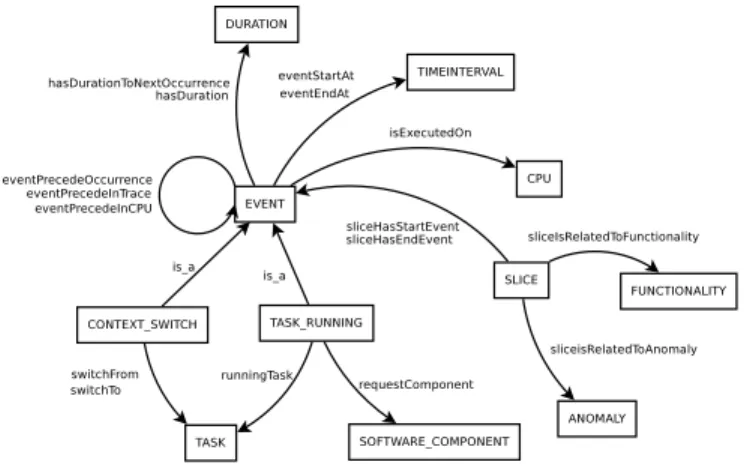
3 3884 3885 Interrupt mdtp 1 1 4 4260 switch to kworker 1 0 5 4502 4602 sys poll ts record 0 0xc1c 6 4605 4647 sys read ts record 0 0x11d 7 4792 4873 sys write ts record 0 0xe1e Table 1: Illustration of 8 events from a real trace. VIDECOM is based on a lightweight ontology of 608 classes and 238 properties. Figure 1 shows some of these classes and properties. The main class Event represents differ-ent types of evdiffer-ents, such as TASK RUNNING and CON-TEXT SWITCH. Properties eventStartAt and eventEndAt identify the start and the end timestamps of the event. The property isExecutedOn indicates the processor on which the event occurred, and the property runningTask indicates the task executed. The property requestComponent represents the software component (interrupt, system call or function call) requested by the event. The order between events is provided by eventPrecedeInTrace and eventPrecedeInCPU that indicate the order in trace and on each CPU. More-over, eventPrecedeOccurrence indicates the order between
Figure 1: Some classes and properties of VIDECOM
occurrences of the same event. The property hasDuration indicates the duration of the event, and hasDurationToNex-tOccurrencerepresents the duration between consecutive oc-currences of an event.
Some classes represent program behaviors concepts. The class FUNCTIONALITY represents expected behaviors and ANOMALY represents unexpected ones. To locate those behaviors, VIDECOM uses the class SLICE that represents a portion of a trace. A SLICE is bounded by two events using sliceHasStartEvent and sliceHasEndEvent properties. A SLICE can be related to a FUNCTIONALITY (respec-tively an ANOMALY ) with the property sliceIsRelatedTo-Functionality (respectively sliceIsRelatedToAnomaly).
In VIDECOM, RDF triple patterns can be enriched with Datalog rules of the form φ ⇒ ψ, where φ = φ1∧ ... ∧ φn is
a conjunction of atoms (triple patterns) called premise, and ψ= {ψ1, ..., ψm} is a conjunction of atoms called conclusion.
An atom is a triple with variables at subject, property or object positions. The variable identifiers start with ?. An atom holds if there are triples that matched the triple form of the atom. Therefore, the inference rule works as follows. If the conjunction of atoms of the premise holds, then the set of triples from the conclusion is added to the triple store. For example, let’s consider the following inference rule
h?e,runningTask,?ti ⇒ h?e,rdf:type,TASK RUNNINGi, if there is a triple in the triple store with runningTask in the property position and whatever in the subject (?e) and the object (?t) positions, then a triple is built and added to the triple store based on the atom of the conclusion with the corresponding value of variable ?e.
We consider safe rules, that means that all variables in the conclusion are also in the premise, even the so-called blank node that is interpreted here as a constant for the safety property. RDFS semantics are captured by inference rules listed in the W3C recommendation1
. Rules expressing domain knowledge corresponding to program behaviors are also captured using the same type of rules.
Populated ontology. Instances of VIDECOM classes and properties are built from events and stored as RDF triples hsubject, property, objecti in a triple store. Table 2 shows 10 RDF triples that represent the basic information contained in event1 from table 1.
1
http://www.w3.org/TR/2014/REC-rdf11-mt-20140225/#rdfs-entailment
id h subject, property, object i 1 h event1, eventStartAt, ”3792” i 2 h event1, eventEndAt, ”3873” i 3 h event1, isExecutedOn, cpu0 i 4 h event1, runningTask, ts record i 5 h event1, requestComponent, sys write i 6 h event1, eventPrecedeInTrace, event2 i 7 h event1, eventPrecedeInCPU, event4 i 8 h event1, eventPrecedeOccurrence, event7 i 9 h event1, hasDuration, ”81” i
10 h event1, hasDurationToNextOccurrence, ”1000” i Table 2: Set of RDF triples representing the basic information contained in event1 from table 1.
The saturation ensures the completeness as well as the soundness of the query answering. It is done through an inference engine called reasoner. The reasoner implements a forward-chaining algorithm that applies all users and rdfs inference rules to populate the triple store with new facts. The saturated triple store is loaded in a KBR for querying purpose. In the next section we will briefly describe state-of-the-art KBRs.
3.
KBR DESCRIPTION
In this section, we will briefly present several state-of-the-art KBRs. We classify the KBRs by the data storage mechanism they use to store the RDF triples.
3.1
Data storage mechanism
Various data storage layouts are presented in [6]. They distinguished native and non-native storage.
3.1.1
Native storage
This solution provides a way to store RDF triples in a model similar to the graph model. These solutions can be classified as persistent disk-based and main memory-based.
The persistent disk-based storage of RDF triples uses pro-prietary file format in many cases. Among the existing so-lutions we can mention tdb, Sesame-native and rdf-3x. tdb2
uses a file system and stores triples in B+ Tree data struc-tures. Sesame-native uses dedicated on-disk data structures for storage [14]. rdf-3x stores all the triples in a compressed clustered B+ Tree and uses an exhaustive index for all per-mutations of subject-property-object triples [12].
The main memory-based storage of RDF triples allocates a certain amount of the available main memory to store the whole RDF graph structure. Jena [10] and Sesame-memory [5] fall into this category.
3.1.2
Non native storage
The non-native storage solution makes use of Relational Database Management Systems (RDBMS) to store RDF triples. Storage of RDF triples in RDBMS exists in three models: triple table, property table and vertical partitioning. In the triple table approach RDF triples are stored under the form hsubject, property, objecti in one large table with a three-columns schema corresponding to subject, property and object. Usual RDBMS indexes are built on each column to optimize access. sdb3
is an example of this solution.
2
http://jena.apache.org/documentation/tdb/architecture.html
3
http://jena.apache.org/documentation/sdb/
The property table technique improves triples organization by allowing multiple triple patterns referencing the same subject to be retrieved with less join. In this model, triples are physically stored in a representation close to traditional relational schema in order to speed up the queries over the triple stores. In this approach each named table includes a subject and several fixed properties. The main idea is to discover clusters of subjects that appear frequently with the same set of properties. 4store uses this approach [9].
Abadi et al suggested the vertical partitioning as an alter-native to the property table. They illustrated the approach in swStore [1]. In this approach the triple table is divided into n two-columns tables, one table for each property in the data. In each of these tables, the first column contains the subject and the second column contains the object value related to this subject. Tables are stored by using a column-oriented RDBMS as a collection of columns rather than a collection of rows.
3.2
Inference support
Not all KBRs provide an RDFS reasoner. In those that we cited above only Jena and Sesame provide reasoners. The Jena reasoner implements a configurable subset of RDFS inference rules using the RETE algorithm [7] for forward chaining. We retained Jena reasoner because it is the only one that allows the implementation of user defined inference rules.
3.3
Performance criteria
We consider the following performances criteria to test scalability of KBR: the saturation time which is the time spent to saturate the triple store, the loading time which is the time spent to load the saturated triple store into the repository, and the query response time which is the time spent to answer a query.
We consider various characteristics of queries. We first consider the selectivity, because a high selective query must efficiently return a small portion of the entire triple store as answer. Next we consider the k-complexity defined as the number of atoms with k variables in the query. A 1-complexity atom has one variable and a 2-complexity atom has variables in two positions. We do not consider the case where a variable appears at the property position because it concerns very infrequent category of queries. Moreover a conjunction between two atoms with at least a variable in common in different places will indicate a join. We next consider whether or not the query uses sorting operators on the result. Indeed, due to the temporal nature of events, results may need to be sorted to facilitate their exploitation.
4.
RESULTS AND DISCUSSIONS
In this section, we present a use case on STMicroelec-tronics MPSoC. This use case corresponds to an analysis of a real video recorder program called ts record. We present experimental settings and results of our comparative study.
4.1
Experimental settings
We performed our experiments on 6 traces corresponding to different execution times of ts record. Table 3 presents de-tails on traces, such as, the execution duration, the number of runtime events recorded and the disk size of the trace. Section A of the Appendix provides more details on the ts record use case, and Table 6 of the Appendix provides
Traces Execution duration # of events # of triples T0 2 m 38 sec 500 000 7 653 945 T1 3 m 25 sec 1 000 000 15 307 847 T2 7 m 43 sec 1 500 000 22 881 749 T3 9 m 23 sec 1 800 000 27 441 696 T4 10 m 25 sec 2 000 000 30 492 400 T5 25 m 47 sec 5 000 000 76 258 631 Table 3: List of traces and their corresponding exe-cution time, number of runtime events and number of triples before saturation.
details on two users inference rules related to the ts record use case that we used to enrich VIDECOM.
During the saturation, we ignored rdfs rules rdfs1, rdfs4a, rdfs4b, rdfs12 and rdfs13, because they produced useless triples for trace analysis, such as rdfs:Resource and rdfs:Literal.
We consider 8 test queries from real analyst needs related to ts record use case. Table 4 shows their characteristics. The query Q0 is a conjunction of two atoms of 1-complexity and 2-complexity. More details on those queries are provided in the Appendix (Table 7).
Q0 Q1 Q2 Q3 Q4 Q5 Q6 Q7 Selectivity H L L H H H H L 1-complexity 1 0 0 2 1 0 1 1 2-complexity 1 1 1 1 2 3 7 7 join 0 0 0 0 1 0 2 2 Filter 0 0 0 1 0 1 1 1 Order by x
Table 4: List of characteristics of our 8 test queries. We performed our experiments on a machine with a 2.27 GHz Intel Xeon CPU and 64 GB of RAM. We chose the following non-commercial KBR for our comparative study: jena and tdb, sesame-memory and sesame-native sdb, and vertical-mdb. More details on their configuration are pro-vided in the Appendix (Section B).
The reader can find the VIDECOM ontology, non-saturated and saturated public datasets4
, user inference rules, 8 tests queries and experimental results, on the website hosted at http://videcom.imag.fr.
4.2
Experimental results
4.2.1
The saturation time
Table 5 shows the saturation time for each trace, the num-ber of triples after saturation and the disk size of the ontol-ogy stored in a N-Triple5
format. The main memory was insufficient for Jena reasoner to saturate T5. We used a naive SQL-based implementation of forward-chaining algo-rithm in vertical-mdb. We saturated T5 in 2 days 11 h 35 m 8 sec, but many optimizations are possible in our imple-mentation to have better performances.
We observed that, one trace event produces 25 RDF triples, and that saturated triple store disk size is 68 times larger
4
Because of the privacy of STMicrolectronics data, we pro-vided datasets obtained from execution traces of video de-coding on GStreamer (http://gstreamer.freedesktop.org/) an open source framework for multimedia applications
5
http://www.w3.org/2001/sw/RDFCore/ntriples/
Traces Saturation time # of triples Size (MB) T0 08 m 01 sec 13 051 370 2 185 T1 18 m 28 sec 25 981 602 4 347 T2 22 m 43 sec 38 790 013 6 508 T3 1 h 12 m 18 sec 46 494 600 7 818 T4 1 h 41 m 01 sec 51 607 411 8 670 T5 x 95 309 610 16 404 Table 5: Saturation time, number of triples and disk size of each trace after saturation.
than corresponding trace size. This result illustrates the difference of magnitude between the number of trace events and RDF triples, and the limitation of resource for satura-tion at this scale.
4.2.2
The loading time
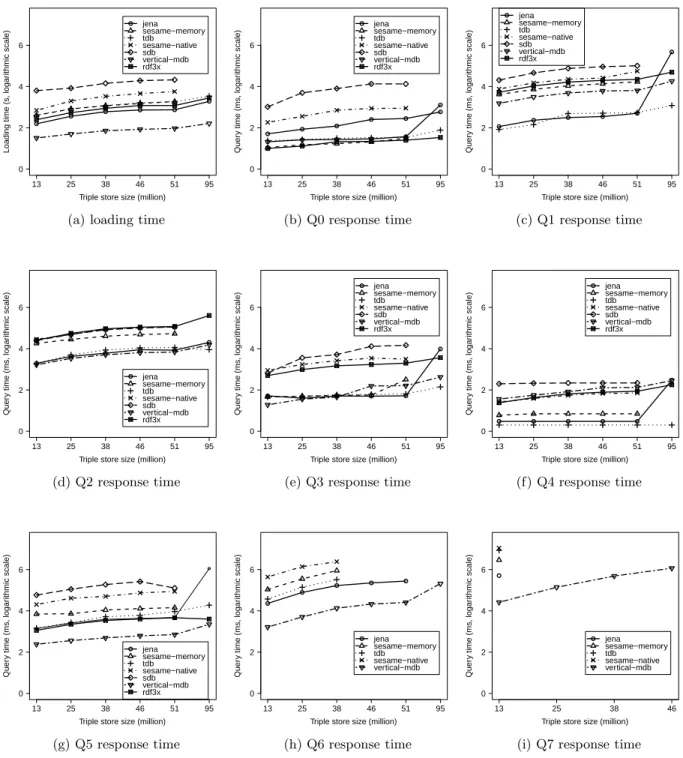
Figure 2(a) shows the loading time for each repository and saturated triple store size. Indexes construction is in-cluded in the loading time. Because vertical-mdb uses batch import operations provided by MonetDB to copy data from file to tables and constructs index after data are loaded, it is the most efficient comparing to others condifered KBRs. It is 2 orders of magnitude faster than sdb, which builds in-dexes before loading data and, thus, frequently updates its indexes. Figure 2(a) also shows that sesame-memory and sesame-native cannot load 95 million triples. As it took sdb more than 2 hours to load 51 million triples (see Figure 2(a)), We were not able to load 95 million triples with sdb. In conclusion, results show that vertical-mdb can load 95 million triples in 2 minutes. We also observed that loading all the 95 million triples of T5 with Jena filled all the main memory and an additional 6 GB space from the swap. An-other fact is that being non-persistent, main-memory based repositories load data for each working session.
4.2.3
Query response time
We executed our queries on each KBR and for each trace from T0 to T5. We ran each query 10 times and we collected the mean time as query response time.
Selectivity:Figure 2(b) shows response time for Q0. All KBR answered within 10 seconds. Thanks to their B+Tree based indexes rdf-3x and tdb are faster than the others. Jena scales poorly on 95 million triples because of swap-in and swap-out needed to get free space in main memory. In the case of Q1 depicted in Figure 2(c), all KBR performance dropped by one order of magnitude but rdf-3x dropped by 2 orders of magnitude. However, tdb remains the fastest, which indicates that its indexes are well adapted for both high and low selectivity queries.
Sorting: Figure 2(d) shows the performance of Q2. We observed that performance of vertical-mdb did not change, unlike the others which lost at least one order of magnitude in response time. The reason can be the efficient implemen-tation of sorting in MonetDB. We observed that the perfor-mance of rdf-3x dropped by 2 orders of magnitude, which indicates that the implementation of its sorting operators is not efficient. Figures 2(e) and 2(f) show the performance of Q3 and Q4. Using inferred classes, Q4 returns the same result as Q3. We observed that using inferred classes leads to fast query response time. The reason can be that inferred classes have higher selectivity.
13 25 38 46 51 95 0
2 4 6
Triple store size (million)
Loading time (s , logar ithmic scale) jena sesame−memory tdb sesame−native sdb vertical−mdb rdf3x
(a) loading time
13 25 38 46 51 95 0
2 4 6
Triple store size (million)
Quer y time (ms , logar ithmic scale) jena sesame−memory tdb sesame−native sdb vertical−mdb rdf3x (b) Q0 response time 13 25 38 46 51 95 0 2 4 6
Triple store size (million)
Quer y time (ms , logar ithmic scale) jena sesame−memory tdb sesame−native sdb vertical−mdb rdf3x (c) Q1 response time 13 25 38 46 51 95 0 2 4 6
Triple store size (million)
Quer y time (ms , logar ithmic scale) jena sesame−memory tdb sesame−native sdb vertical−mdb rdf3x (d) Q2 response time 13 25 38 46 51 95 0 2 4 6
Triple store size (million)
Quer y time (ms , logar ithmic scale) jena sesame−memory tdb sesame−native sdb vertical−mdb rdf3x
(e) Q3 response time
13 25 38 46 51 95 0
2 4 6
Triple store size (million)
Quer y time (ms , logar ithmic scale) jena sesame−memory tdb sesame−native sdb vertical−mdb rdf3x (f) Q4 response time 13 25 38 46 51 95 0 2 4 6
Triple store size (million)
Quer y time (ms , logar ithmic scale) jena sesame−memory tdb sesame−native sdb vertical−mdb rdf3x (g) Q5 response time 13 25 38 46 51 95 0 2 4 6
Triple store size (million)
Quer y time (ms , logar ithmic scale) jena sesame−memory tdb sesame−native vertical−mdb (h) Q6 response time 13 25 38 46 0 2 4 6
Triple store size (million)
Quer y time (ms , logar ithmic scale) jena sesame−memory tdb sesame−native vertical−mdb
(i) Q7 response time
Interval of trace: Figure 2(g) shows the result when querying the same interval of time in all traces. We ob-served that vertical-mdb has better performance. The rea-son is that vertical-mdb identifies numerical object values; therefore, indexes built on columns containing numbers are more efficient than indexes built on strings like others do.
k-complexity: Figure 2(h) shows results for Q5. rdf-3x did not provide results due to an internal error in the query parser. Conjunctions are implemented in RDBMS as joins. In the case of sdb it consists of self-joins on the unique table Triple Table, and in the case of vertical-mdb it consists of joins between multiple tables. sdb failed to pro-duce results; we suppose the reason being the inefficiency of self-join on large triple tables. vertical-mdb has acceptable response time (2 minutes for 95 million triples) unlike tdb which needed 5 minutes for 38 million triples. Figure 2(i) shows the performance of Q7. vertical-mdb has better re-sponse time (2 minutes for 46 million triples). Other KBRs performed poorly over 13 million triples. Jena took 8 min-utes, sesame-memory took 48 minmin-utes, tdb took 2 hours and sesame-native took 3 hours.
Discussion: Results show that the saturation with Jena is efficient but depends on the available memory. We also found that tdb indexes are efficient at large scale, and that vertical-mdbjoin implementation is efficient. Due to its fast loading speed vertical-mdb loads 95 million triples in 2 min-utes and supports RDFS rule reasoning without memory limitation. The inefficiency in the saturation mechanism for vertical-mdbis mainly due to unoptimized code and far bet-ter performance should be expected. vertical-mdb is the only one that exhibited low running times accross all queries. It is also the only system that could handle Q7, a complex but realistic query. Considering the type of queries the analysts are interested in, the constraints of their practice, a vertical database system is the best solution in this context. Because an efficient inference engine is not required in the solution we chose based on a saturated triple dataset, some KBRs have been discarded. Nonetheless, KBRs such as, OWLIM and Virtuoso should be considered for future works considering distribution of the dataset and parallel processing.
5.
RELATED WORK
Several RDF benchmarks were previously developed. We can cite, the Lehigh University Benchmark (LUBM) [8], the Berlin SPARQL Benchmark (BSBM)[4], and DBpedia [11]. Those benchmark handle large synthetic or real datasets (300 million of triples for DBpedia). They are mainly fo-cused on the loading time and the query response time on various KBRs, such as, Jena, TDB, SDB, Sesame, virtuoso and OWLIM. Unlike those benchmarks, our benchmark is also focused on the saturation time of triples, because our datasets are deductive triple stores and need inference rule to be provide sound and complete query answers.
6.
CONCLUSION AND FUTURE WORK
In this paper we presented a benchmark of triple stores scalability for MPSoC trace analysis. We presented VIDE-COM, an ontology for trace analysis of application on MP-SoC and we made a comparative study to test the scalability of 7 state-of-the-art KBRs. These experiments have shown that even with relatively simple traces and a large server, ex-isting KBR have difficulties to scale up. Among the testedKBR, vertical-mdb is the only one that exhibited low run-ning times across all queries. Given that execution traces are likely to grow much larger than the traces of these exper-iments, we can conclude that solutions based on a vertical approach will be required to handle them, and will have to be improved.
For our future work we are interested in giving answers to query over large traces in a fixed time. We plan to develop efficient approaches to speedup saturation, and we are in-terested in different strategies for query parallelization. Fol-lowing this track we plan to consider OWLIM and Virtuoso KBRs for comparison with the vertical database approach.
7.
ACKNOWLEDGEMENT
This work was supported by French FUI project SoC-Trace.
8.
REFERENCES
[1] D. J. Abadi, A. Marcus, S. R. Madden, and K. Hollenbach. SW-Store: A Vertically Partitioned DBMS For Semantic Web Data Management. The VLDB Journal, 18(2):385–406, 2009.
[2] S. Abiteboul, I. Manolescu, P. Rigaux, M.-C. Rousset, P. Senellart, et al. Web Data Management. Cambridge University Press, 2012.
[3] T. Ball. The Concept Of Dynamic Analysis. pages 216–234, 1999.
[4] C. Bizer and A. Schultz. Benchmarking the performance of storage systems that expose sparql endpoints. World Wide Web Internet And Web Information Systems, 2008.
[5] J. Broekstra, A. Kampman, and F. van Harmelen. Sesame: An architecture for storing and querying rdf data and schema information. Spinning the Semantic Web: Bringing the World Wide Web to Its Full Potential, pages 197–203, 2003.
[6] C. David, C. Olivier, and B. Guillaume. A Survey Of RDF Storage Approaches. ARIMA Journal, 15:11–35, 2012.
[7] C. L. Forgy. Rete: A Fast Algorithm For The Many Pattern/many Object Pattern Match Problem. Artificial intelligence, 19(1):17–37, 1982.
[8] Y. Guo, Z. Pan, and J. Heflin. LUBM: A Benchmark For OWL Knowledge Base Systems. Web Semantics: Science, Services and Agents on the World Wide Web, 3(2):158–182, 2005.
[9] S. Harris, N. Lamb, and N. Shadbolt. 4store: The Design And Implementation Of A Clustered RDF Store. pages 94–109, 2009.
[10] B. McBride. Jena: Implementing The RDF Model and Syntax Specification. 2001.
[11] M. Morsey, J. Lehmann, S. Auer, and A.-C. N. Ngomo. Dbpedia sparql benchmark–performance assessment with real queries on real data. In The Semantic Web–ISWC 2011, pages 454–469. 2011. [12] T. Neumann and G. Weikum. The RDF-3X Engine
For Scalable Management of RDF Data. The VLDB Journal, 19(1):91–113, 2010.
[13] A. Roychoudhury. Embedded Systems And Software Validation. Morgan Kaufmann, 2009.
APPENDIX
A.
THE TS RECORD USE CASE
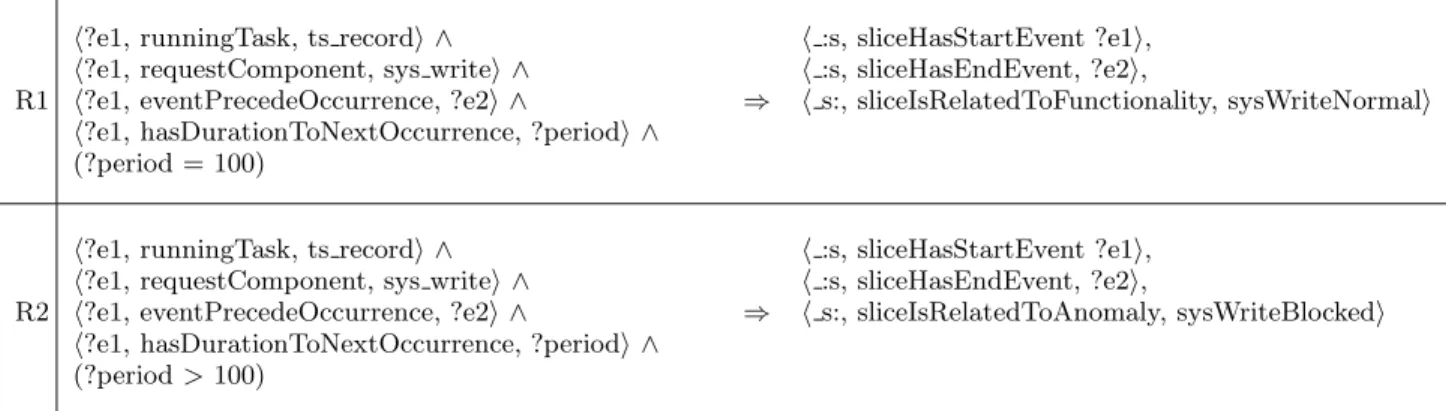
The program ts record contains three tasks which can be scheduled on different CPUs of the MPSoC. The first task t1 collects streaming data and stores them in small IP buffers. Every 100 milliseconds, the second task t2 copies data from IP buffers to main memory. Finally, every 5 seconds, the last task t3 copies them to a USB disk. The period between each task is important to avoid errors which can cause data loss. Based on this domain description, Table 6 presents 2 user inference rules that correspond to the behavior of task t2. For simplicity we present only two rules, but more rules can be added to VIDECOM. The number of user inference rules influence the saturation time. The rule R1 instantiates the FUNCTIONALITY subclass sysWriteNormal when two occurrences of events corresponding to t2 are separated by a period equal to 100 milliseconds. The second rule R2 instantiates the ANOMALY subclass sysWriteBlocked if the period is greater than 100 milliseconds.
B.
KNOWLEDGE BASE SYSTEMS FOR
EX-PERIMENTS
We chose the following non-commercial KBRs for our com-parative study. jena and tdb (version 2.11.2) with their de-fault configuration. We set the java heap size to 60 GB. We also chose sesame-memory and sesame-native (version 2.7.7), we configured sesame-native to support all the com-bination of subject-property-object indexes known as spoc, posc, and opsc. We set the java heap size to 60 GB. We chose sdb (version 1.3.4) backed on postgresql (version 9.3), and we configured sdb with the default ”layout2” indexing storage. We set the java heap size to 60 GB.
Unfortunately 4Store has not been maintained for 5 years and we were not able to install it in our setup configuration. The column-store-based approach swStore implementa-tion was not available. We implemented the approach as described in [1], but used MonetDB6
(version 11.17.9) as a backend instead of C-Store because C-Store is no longer maintained. We called our implementation vertical-mdb.
6
R1
h?e1, runningTask, ts recordi ∧ h?e1, requestComponent, sys writei ∧ h?e1, eventPrecedeOccurrence, ?e2i ∧
h?e1, hasDurationToNextOccurrence, ?periodi ∧ (?period = 100) ⇒ h :s, sliceHasStartEvent ?e1i, h :s, sliceHasEndEvent, ?e2i, h s:, sliceIsRelatedToFunctionality, sysWriteNormali R2
h?e1, runningTask, ts recordi ∧ h?e1, requestComponent, sys writei ∧ h?e1, eventPrecedeOccurrence, ?e2i ∧
h?e1, hasDurationToNextOccurrence, ?periodi ∧ (?period > 100)
⇒
h :s, sliceHasStartEvent ?e1i, h :s, sliceHasEndEvent, ?e2i,
h s:, sliceIsRelatedToAnomaly, sysWriteBlockedi
Table 6: Two user inference rules to capture behavior of task t2 in ts record.
Queries SPARQL
Q0 finds all events which requested the program flush SELECT ?event ?debut
WHERE {
?event requestComponent flush 8 00 . ?event eventStartAt ?debut .
}
Q1 finds all events which corresponded to a context switch in the program SELECT ?event ?debut
WHERE { ?event eventStartAt ?debut . }
Q2 finds all events which corresponded to a context switch in the program order by their start timestamp SELECT ?event ?debut
WHERE { ?event eventStartAt ?debut . } ORDER BY ?event
Q3 finds all sys write called by ts record program which occurs more than 100 ms after the previous occurrence SELECT ?event ?duration
WHERE {
?event requestComponent sys write . ?event runningTask ts record .
?event hasDurationToNextOccurrence ?duration . FILTER (?duration > 100000)
}
Q4 finds all events related to the concept sysWriteBlocked SELECT ?event ?duration
WHERE {
?slice sliceIsRelatedToAnomaly sysWriteBlocked . ?slice sliceHasStartEvent ?event .
?event hasDurationToNextOccurrence ?duration . }
Q5 finds all the tasks executed within timestamps 537756 and timestamp 19482669 SELECT ?task
WHERE {
?event eventStartAt ?debut . ?event eventEndAt ?end . ?event runningTask ?task .
FILTER (?debut >= 537756 AND ?end < 19482669) }
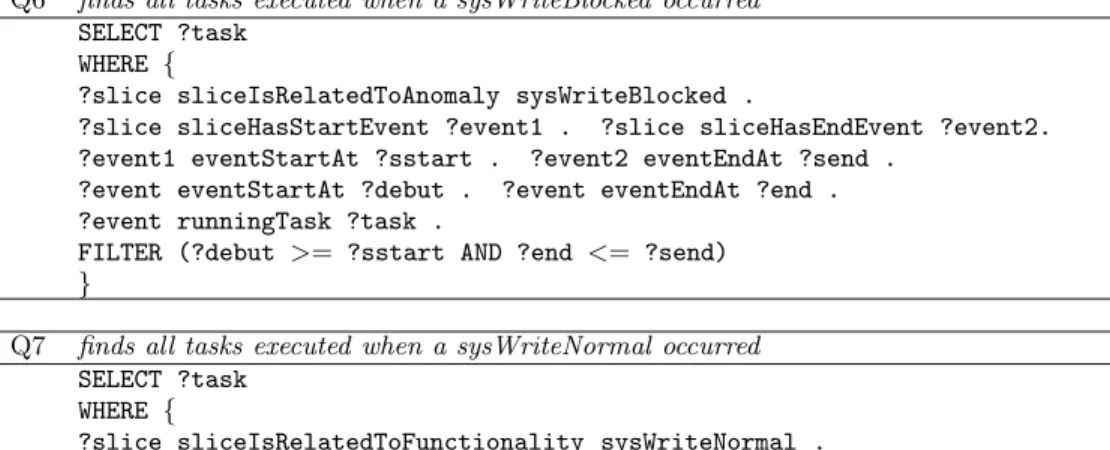
Q6 finds all tasks executed when a sysWriteBlocked occurred SELECT ?task
WHERE {
?slice sliceIsRelatedToAnomaly sysWriteBlocked .
?slice sliceHasStartEvent ?event1 . ?slice sliceHasEndEvent ?event2. ?event1 eventStartAt ?sstart . ?event2 eventEndAt ?send .
?event eventStartAt ?debut . ?event eventEndAt ?end . ?event runningTask ?task .
FILTER (?debut >= ?sstart AND ?end <= ?send) }
Q7 finds all tasks executed when a sysWriteNormal occurred SELECT ?task
WHERE {
?slice sliceIsRelatedToFunctionality sysWriteNormal .
?slice sliceHasStartEvent ?event1 . ?slice sliceHasEndEvent ?event2. ?event1 eventStartAt ?sstart . ?event2 eventEndAt ?send .
?event eventStartAt ?debut . ?event eventEndAt ?end . ?event runningTask ?task .
FILTER (?debut >= ?sstart AND ?end <= ?send) }