HAL Id: hal-01947047
https://hal.archives-ouvertes.fr/hal-01947047
Submitted on 6 Dec 2018
HAL is a multi-disciplinary open access
archive for the deposit and dissemination of
sci-entific research documents, whether they are
pub-lished or not. The documents may come from
teaching and research institutions in France or
abroad, or from public or private research centers.
L’archive ouverte pluridisciplinaire HAL, est
destinée au dépôt et à la diffusion de documents
scientifiques de niveau recherche, publiés ou non,
émanant des établissements d’enseignement et de
recherche français ou étrangers, des laboratoires
publics ou privés.
Importance of direction of vibration on the onset of
Soret-driven convection under gravity or weightlessness
Yazdan Pedram Razi, Kittinan Maliwan, Marie-Catherine Charrier-Mojtabi,
Abdelkader Mojtabi
To cite this version:
Yazdan Pedram Razi, Kittinan Maliwan, Marie-Catherine Charrier-Mojtabi, Abdelkader Mojtabi.
Importance of direction of vibration on the onset of Soret-driven convection under gravity or
weight-lessness. European Physical Journal E: Soft matter and biological physics, EDP Sciences: EPJ, 2004,
15 (3), pp.335-341. �10.1140/epje/i2004-10072-6�. �hal-01947047�
OATAO is an open access repository that collects the work of Toulouse
researchers and makes it freely available over the web where possible
This is an author’s version published in:
http://oatao.univ-toulouse.fr/20677
To cite this version:
Razi, Yazdan Pedram and Maliwan, Kittinan and
Charrier-Mojtabi, Marie-Catherine and Charrier-Mojtabi, Abdelkader Importance
of direction of vibration on the onset of Soret-driven
convection under gravity or weightlessness. (2004) European
Physical Journal E, 15 (3). 335-341. ISSN 1292-8941
Official URL:
https://doi.org/10.1140/epje/i2004-10072-6
Open Archive Toulouse Archive Ouverte
Any correspondence concerning this service should be sent
Importance of direction of vibration on the onset of Soret-driven
convection under gravity or weightlessness
Y.P. Razi1, K. Maliwan1, M.C. Charrier Mojtabi2,a, and A. Mojtabi1
1 IMFT, UMR CNRS/INP/UPS N5502, UFR MIG, Universit´e Paul Sabatier, 118 route de Narbonne, 31062 Toulouse Cedex,
France
2 Laboratoire d’Energetique (LESETH), EA 810, UFR PCA, Universit´e Paul Sabatier, 118 route de Narbonne, 31062 Toulouse
Cedex, France
Abstract. This paper considers the influence of the direction of vibration on the stability threshold of
two-dimensional Soret-driven convection. The configuration is an infinite layer filled with a binary mixture, which can be heated from below or from above. The limiting case of high-frequency and small-amplitude vibration is considered for which the time-averaged formulation has been adopted. The linear stability analysis of the quasi-mechanical equilibrium shows that the problem depends on five non-dimensional
parameters. These include the thermal Rayleigh number (RaT), the vibrational parameter (R), the Prandtl
number (Pr), the Lewis number (Le), the separation ratio (S) and the orientation of vibration with respect
to the horizontal heated plate (α). For different sets of parameters, the bifurcation diagrams are plotted Rac
= f(S) and kc= g(S), which are the critical thermal Rayleigh and the critical wave numbers, respectively.
Our results indicate that, relative to the classical case of static gravity, vibration may affect all regions in
Rac-S stability diagram. In the case of mono-cellular convection, by using a regular perturbation method, a
closed-form relation for the critical Rayleigh number is found. Several physical situations in the presence or
in the absence of gravity (micro-gravity) are discussed.
1 Introduction
One of the most recent subjects in space science is the re-search on the behaviour of materials in the micro-gravity environment. Zero-gravity hydrodynamics has emerged as a new field of fundamental studies and has continued to develop intensively. The production of new materials forms the basis of most technological improvements. Con-sequently, possibilities of experiments in weightlessness may help to improve the production of traditional mate-rials and may create opportunities for production of new materials.
It was thought that thermosolutal convection, which can produce undesirable effects in solidification of binary alloys and solutions, would be totally eliminated in a space laboratory. However, early studies under micro-gravity conditions cast doubt on this idea [1].
It has been shown that a spacecraft in orbit is sub-ject to many disturbing influences of human as well as equipment origin. These influences result in the appear-ance of residual accelerations, which are commonly called
a e-mail: [email protected]
“g-jitter”. As a first step, g-jitter may be modelled as mono-frequency oscillations [2].
In broad terms, the subject of thermo-vibration con-vection concerns the appearance of a mean flow in a confined cavity filled with a fluid having temperature non-homogeneities [3]. This kind of convection induced by time-dependent body forces is distinguished from the gravity-induced convection in that it may exist under micro-gravity conditions.
The influence of time-dependent gravitational acceler-ation on the onset of Rayleigh-B´enard convection has been the subject of numerous theoretical, numerical and exper-imental studies. For a review of Russian research on this domain see, for example, the comprehensive book of Ger-shuni and Lyubimov [4] and for some early development of this subject the reviews of Davis [5], Ostrach [6] and Nel-son [7] are highly recommended. The study of convection in a binary mixture with Soret effect provides us with more interesting instability mechanisms and pattern formation phenomena, which are absent in a single-component fluid. Under the Soret effect a concentration gradient is estab-lished as a result of a temperature gradient [8].
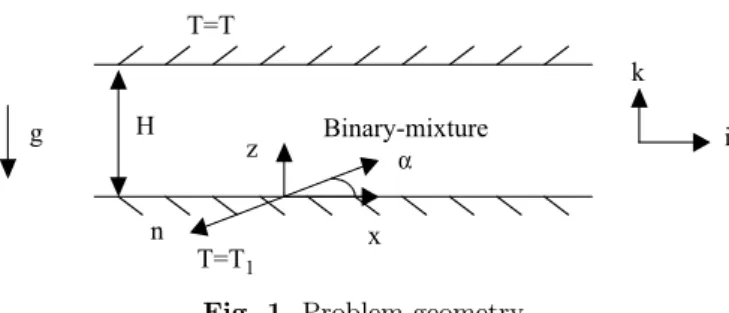
α n H g z T=T Binary-mixture T=T1 x k i
Fig. 1. Problem geometry.
Terrones and Chen [9] consider the two-component Rayleigh-B´enard problem under the effect of vertical vibration. They consider different boundary conditions (stress-free and rigid), and the cross-diffusion effects are included in their studies. Gershuni et al. [10, 11] con-sider the same problem under the effect of high frequency and small amplitude of vibration. They find that, for a small wave number, the stability is stationary and they obtain an analytical relation for the stability threshold. Myznikova and Smorodin [12] and Smorodin et al. [13] investigate the same problem under finite frequency.
It should be indicated that Saunders et al. [14] studied the same problem without Soret effect; they further con-sidered the stress-free case. A list of useful papers on the applied aspect of solidifications under the effect of vibra-tion may be found in [14]. Also, Jue and Ramaswarmy [15] study numerically the thermo-solutal convection in a con-fined cavity in the Rayleigh-B´enard geometry.
It has been suggested elsewhere [7] that not only the amplitude of g-jitter but also its orientation contributes significantly to the acceleration environment in a space laboratory. In the present paper we study the influence of directions of vibration on the stability threshold of a hori-zontal binary mixture layer with the Soret effect. Different situations based on vibrational and gravitational mecha-nisms are considered. The results are presented in stability diagrams for stationary or oscillatory bifurcations.
2 Governing equations
The geometry of the problem consists of an infinite hor-izontal layer containing a binary mixture, Figure 1. The horizontal boundaries are assumed rigid, impermeable and are kept at different constant temperatures. The Soret ef-fect, which describes the coupling between a temperature gradient and a resulting mass flux in a multi-component system, is taken into account. The layer is subjected to a harmonic mono-frequency vibration, which is character-ized by amplitude b, frequency ω, and its direction n. The governing equations are written in the coordinate system linked to the oscillating layer which allows us to replace the gravitational acceleration g by g + bω2sin ωt n. In the case of high-frequency and small-amplitude vibration, the asymptotic behaviour of the system may be approx-imated with the superposition of fields having slow evo-lution with time and fields having rapid evoevo-lution with respect to time [16]. It is important to note that the aver-age of fields with rapid evolution with respect to time over
the vibration period (2π/ω) is zero. The fields with rapid time evolution (v0, T0, c0) may be expressed as a function of slow fields by using some hypotheses [4].
The time-averaged system of equations in dimension-less form in the framework of the Boussinesq approxima-tion can be written as
∇· V∗= 0 , ∂V∗ ∂t∗ + (V ∗· ∇)V∗ = −∇P∗ + Pr ∇2V∗+ Ra Pr (T∗+ C∗)k + RavPr(W · ∇) [(T∗+ C∗)n − W] , ∂T∗ ∂t∗ + V ∗· ∇T∗= ∇2T∗, ∂C∗ ∂t∗ + V ∗· ∇C∗= 1 Le(∇ 2C∗−S∇2T∗) , ∇· W∗= 0 , ∇× W∗= ∇(T∗+ C∗) × n , (1) where V∗, T∗and C∗are velocity, temperature and mass fraction fields and W∗ represents the solenoidal vector.
The corresponding boundary conditions are z∗= 0, 1 : V∗= 0, W∗ z = 0, ∂C∗ ∂z∗ −S ∂T∗ ∂z∗ = 0 , T∗(x, z∗ = 0) = 1, T∗(x∗, z∗= 1) = 0. (2) The non-dimensional parameters are defined as RaT=gβT∆T H 3 νa , Rav= (bωβT∆T H)2 2νa = Ra 2 TR2, S = −DTβc βT , Pr = ν a, Le = a D .
RaT is the thermal Rayleigh number, Rav is the vibra-tional Rayleigh number, S the separation factor, Pr the Prandtl number and Le is the Lewis number. In these non-dimensional parameters, βT, ν, a, βc, DTand D represent the coefficient of thermal expansion, kinematic viscosity, the thermal diffusivity, the composition expansion coeffi-cient, the thermo-diffusion coefficient and finally the mass diffusivity, respectively.
3 Linear stability analysis
The orientation of vibration relative to the temperature gradient plays an important role in the existence of me-chanical equilibrium. If the axis of vibration is not par-allel to the temperature gradient, a mechanical quasi-equilibrium solution exists for an infinite horizontal layer. This solution is characterized by
T0= 1 − z∗,
C0= −S z∗+ const ,
W0x∗ = − (1 + S) (z∗−1/2) cos α ,
W0z∗ = 0 ,
For the linear stability analysis, the temperature, concen-tration and solenoidal fields are perturbed around this quasi-equilibrium state. Two-dimensional disturbances are considered which are developed in normal modes:
(ψ, T0, C0, F ) = (φ(z) , θ(z) , ξ(z) , f (z)) exp(−λt + ikx).
In the above equation, φ, θ, ξ and f represent the ampli-tude of the velocity stream function, the temperature, the concentration and the solenoidal stream function distur-bances, respectively; −λDφ = Pr D2φ − ikRa Pr (θ + ξ) −ikRavPr(1+S) · (θ+ξ) cos α−df dz ¸ cos α +k2Rav Pr(1 + S)f sin α , −λθ + ikφ = Dθ , −λξ + ikSφ = 1 LeD(ξ − Sθ) , Df =µ dθ dz + dξ dz 
cos α − ik(θ + ξ) sin α . (4)
The corresponding boundary conditions are
z = 0, 1 : φ = φ0= 0, θ = 0, dξ dz −S
dθ
dz = 0 . (5) A Galerkin method is used to solve (4-5). The trial func-tions are chosen as follows:
φ = N X i=1 φi(z − z2)2zi−1, θ = N X i=1 θi(z − z2)zi−1, ξ = ξ0+ N X i=1 ξizi µ z i + 1− z2 i + 2 ¶ , q = N X i=1 qizi−1(z − z2) . (6)
It should be noted that in order to facilitate the numerical study, the transformation q = ξ − Sθ is made. The solu-tion of system (4) with boundary condisolu-tions (5) leads to a spectral problem in which λ is related to the important parameters of the problem:
λ = λ(RaT, Rav, P r, Le, S, k, α) .
Generally, λ is a complex number (λ = λr+ iλi). For a stationary bifurcation, the stability domain is determined by setting λ = 0. In the case of an oscillatory bifurcation, the stability domain is determined by considering λr= 0 (λi represents the frequency of oscillatory bifurcation).
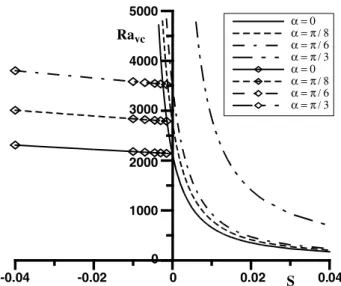
-0.04 -0.02 0 0.02 0.04 0 1000 2000 3000 4000 5000 α = 0 α = π / 8 α = π / 6 α = π / 3 α = 0 α = π / 8 α = π / 6 α = π / 3 S Ravc
Fig. 2. Stability diagram for the onset of thermo-solutal
con-vection under micro-gravity conditions for different directions of vibration for Le = 100, Pr = 6.7. -0.04 -0.02 0 0.02 0.04 0 1 2 3 4 α = 0 α = π / 8 α = π / 6 α = π / 3 α = 0 α = π / 8 α = π / 6 α = π / 3 S kc
Fig. 3.Effect of the direction of vibration on the critical wave number in micro-gravity, Le = 100, Pr = 6.7.
4 Thermo-solutal convection under
micro-gravity conditions (Ra
T= 0)
In this case the convective-induced mechanism is due to mechanical vibration. The results of stability analysis un-der high-frequency and small-amplitude vibration are pre-sented in Figure 2 (the truncation order for calculation is four and the validation is made with the result of Ger-shuni [4] for the onset of convection under microgravity, for example for α = 0 the precision is 2.56 10−5). It may be concluded from this figure that a positive separation factor (S > 0) has a destabilizing effect on the quasi-equilibrium solution. Further, it is obvious that the direction of vibra-tion has an important effect on the stability of the prob-lem. Increasing the direction of vibration (α) has a stabi-lizing effect on the onset of convection under micro-gravity conditions. Figure 3 shows that if S is increased, the criti-cal wave number decreases. For this region, increasing the direction of vibration reduces the wave number. It can be concluded from the results of stability analysis that the
Table 1. Influence of the direction of vibration on the critical parameters of oscillatory bifurcation for S = −0.001, Le = 100 and Pr = 6.7. α RaTco kco ω0 0 2142.94 3.21 0.59 π/8 2788.08 3.11 0.57 π/6 3521.53 2.98 0.56 π/4 8284.81 2.33 0.49
long-wave mode is the preferred convective pattern. For this reason, a regular perturbation analysis with the wave number as a small parameter is performed (the details are given in App. A). The result of this analysis can be presented in the following form:
Ravc= 720
LeS (1 + S) cos2α (k → 0) . (7) For the direction of vibration perpendicular to the temper-ature gradient, we obtain the result given by Gershuni [10]. In order to know from which value of S the long-wave mode (k → 0) may be achieved, we followed the procedure proposed by Nield [17] and Knobloch [18], which leads us to the following relation:
Sk→0= 1 Leµ 831 1900+ 189 190tan 2α ¶ −1 . (8)
The theoretical results are in good agreement with the numerical results given in Figure 3. For negative separa-tion ratios, the onset of convecsepara-tion can be in the form of stationary or oscillatory bifurcation. Figure 2 shows that the oscillatory bifurcation takes form before the station-ary bifurcation. In the interval of S ∈ (0, −0.04), which is chosen for the reason of a realizable experiment, the RaTcoincreases slightly with increasing absolute value of S. From a pattern formation point of view, it is evident that in the interval studied the critical wave number is almost insensitive to the separation factor, cf. Figure 3. It should be added that increasing the direction of vibration has a stabilizing effect. At the same time the oscillatory frequency decreases with increasing the direction of vibra-tion. Some of the results are summarized in Table 1.
5 Thermo-solutal convection under the
simultaneous action of vibration and
gravitation
When the direction of vibration is not vertical (α 6= π/2), convective motion in all regions of the stability diagram is possible. Two different cases are considered, namely the stationary bifurcation and the oscillatory bifurcation.
5.1 Stationary bifurcation
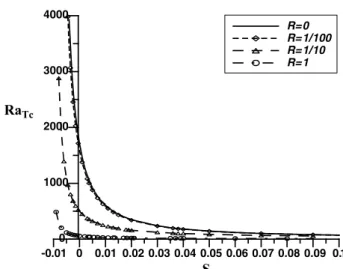
The results of linear stability analysis for a layer heated from below are presented in the stability diagram RaTc-S,
-0.01 0 0.01 0.02 0.03 0.04 0.05 0.06 0.07 0.08 0.09 0.1 0 1000 2000 3000 4000 R=0 R=1/100 R=1/10 R=1 S RaTc
Fig. 4. Stability diagram for the onset of thermo-solutal
con-vection for different vibrational parameters for Le = 100 and α = π/6. -0.0 0 0.01 0.02 0.03 0.04 0.05 0.06 0.07 0.08 0.09 0.1 0 1 2 3 4 5 R=0 R=1/100 R=1/10 R=1
S
k
csFig. 5.Influence of vibrational parameter on the critical wave
number for Le = 100 and α = π/6.
see Figure 4. The influence of the vibration parameter R on the threshold of stability is shown for Le = 100 and α = π/6. It is clear that increasing R has a destabiliz-ing effect on the quasi-equilibrium solution. For the same range of parameters, Figure 5 illustrates the influence of R on the critical wave number in the kc-S diagram. One can conclude that increasing the vibrational parameter re-duces the critical wave number. As the long-wave mode is the dominant convection mode in this situation, by fol-lowing the method described in Section 4, we obtain the following relation for the onset of convection for k → 0 (for details refer to App. A):
RaTc+ (1 + S)Ravcos2α = 720
SLe, (Rav = R 2Ra2
T). (9) The influence of the angle of vibration with heated bound-ary for a fixed value of the vibration parameter R is shown
-0.01 0 0.01 0.02 0.03 0.04 0 400 800 1200 1600 2000 R= 0 α=π/ 3 α=π/ 6 α=π/ 8 S RaTcs
Fig. 6. Influence of the directions of vibration on the
quasi-equilibrium solution in the presence of the gravity field for the layer heated from below for Le = 100, Pr = 6.7 and R = 1.
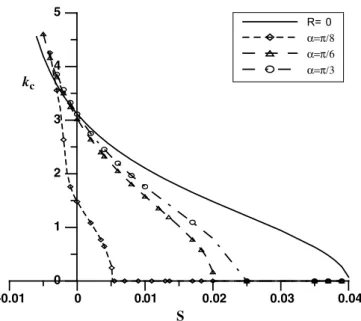
-0.01 0 0.01 0.02 0.03 0.04 0 1 2 3 4 5 R= 0 α=π/8 α=π/6 α=π/3 S kc
Fig. 7.Influence of the directions of vibration in the presence
of the gravity field on the critical wave number for the layer heated from below for Le = 100, Pr = 6.7 and R = 1.
in Figure 6. The results indicate that increasing the direc-tion of vibradirec-tion can stabilize the quasi-equilibrium solu-tion. The formation of the long-wave mode may be delayed by increasing the direction of vibration, see Figure 7.
5.2 The oscillatory bifurcation
The results of the linear stability analysis are presented in Table 2, which shows that for negative values of S, there exists an oscillatory bifurcation. It may be observed that the critical values of the Rayleigh number for the oscillatory bifurcation (RaTco) are less than the critical
Table 2. Influence of S on the onset of stationary and
os-cillatory bifurcations for α = π/6, Le = 100, Pr = 6.7 and R = 1/100. S kcst RaTst kco RaTco ω0 −0.0005 3.1845 1714.6193 3.100 1600.6593 0.3750 −0.001 3.2687 1860.14065 3.1014 1603.0991 0.5569 −0.0015 3.3589 2028.4102 3.1024 1604.6990 0.6973 −0.002 3.4558 2224.7157 3.103 1605.9551 0.8155 −0.0025 3.5607 2456.0176 3.1035 1607.0415 0.9195 −0.003 3.6749 2731.6365 3.1038 1608.0329 1.0133
Table 3. Influence of S on the onset of stationary and
os-cillatory bifurcations for α = π/8, Le = 100, Pr = 6.7 and R = 1/100. S kcst RaTst kco RaTco ω0 −0.0005 3.194 1681.9239 3.1095 1571.9292 0.3763 −0.001 3.2793 1822.0779 3.1109 1577.2811 0.5587 −0.0015 3.3701 1983.7151 3.1119 1575.8300 0.6995 −0.002 3.4678 2171.7224 3.1126 1577.0504 0.8180 −0.0025 3.5736 2392.5063 3.1130 1578.1088 0.9222 −0.003 3.688 2654.5781 3.1134 1579.0765 1.0162
values of Rayleigh number for the stationary bifurcations (RaTcst). The results are calculated for α = π/6, Le = 100, P r = 6.7 and R = 1/100. Reducing the direction of vibration destabilizes the quasi-equilibrium solution and slightly increases the oscillatory frequency, cf. Table 3.
6 Conclusions
In this paper, the influence of the direction of vibration on the onset of thermo-solutal convection is considered. The geometry of the problem is an infinite layer with rigid and impermeable boundaries; the layer can be heated from below or above. The Soret effect is included in govern-ing equations. Linear stability analysis is performed which shows that the thermal stability of the problem depends on the following parameters: RaT, Rav, Le, Pr , α and S. In the case of micro-gravity conditions for different sets of parameters, the bifurcation diagrams are plotted as Ravc = F (S) and kc = G(S), which are the criti-cal vibrational Rayleigh and the criticriti-cal wave numbers respectively. It is proved analytically that in the region S ∈ [−1, 0], there is no possibility of long-wave mode. It is shown that in this region, there is a possibility of multi-cellular oscillatory convection, which is formed before the stationary convection. The negative Soret coefficient has a stabilizing effect. The effect of the direction of vibration in this region is studied and its effect on the frequency of oscillatory bifurcation is discussed. For the region with S > 0, the onset of convection is in the form of station-ary multi-cellular or mono-cellular convection. Increasing the direction of vibration has a stabilizing effect on the quasi-equilibrium solution. In the case of vibrational ef-fect in the presence of gravity field, our results show that
for the direction of vibration, which is not, parallel to the temperature gradient, increasing the vibrational parame-ter R has a destabilizing effect on the quasi-equilibrium solution. In addition, it is shown that the long-wave mode is the dominant convection pattern. We find an analytical relation, which is in good agreement with the numerical re-sults. As the vibration is of high frequency, the oscillatory frequency may be easily distinguished. We have equally investigated the effect of the direction of vibration on the oscillatory onset of convection. Our results show that in-creasing the direction of vibration has a stabilizing effect on the quasi-equilibrium solution and the oscillatory fre-quency is diminished.
Appendix A. Onset of convection at
vanishing value of the wave number
In this section, the stability analysis of the problem in the case of long-wave mode is analyzed. As was explained ear-lier, the Soret effect influences drastically the critical value of the thermal Rayleigh number. Indeed, it is possible to be much more precise and to find analytically the critical Rayleigh number as a function of (Le, Rav, S, α). In or-der to obtain the criterion for the onset of convection in long-wave mode, the regular perturbation method is used. The eigenvalue equation (4) is expanded in powers of k. For this reason, the variables are developed as follows:
φ(z) = ∞ X n=0 knφn(z) , θ(z) = ∞ X n=0 knθn(z), ξ(z) = ∞ X n=0 knξn, f (z) = ∞ X n=0 knfn(z) , λ(z) = ∞ X n=0 knλn(z) .
For (k0), we obtain the following system:
(k0) : −λ0d 2φ0 dz2 = Pr d4φ0 dz4 , −λ0θ0 = d 2θ0 dz2 , −λ0ξ0 = 1 Le µ d2ξ0 dz2 −S d2θ0 dz2 ¶ , d2f0 dz2 = µ dθ0 dz + dξ0 dz ¶ cos α , z = 0, 1 : φ0 = dφ0 dz = θ0 = f0, dξ0 dz −S dθ0 dz = 0, which results in λ0= 0, φ0= 0, θ0= 0, f0= 0 and ξ0 = const.
For (k1), the system reads
(k1) : d4φ1
dz4 = iξ0£RaT+ Rav(1 + S) cos 2α¤ , d2θ1 dz2 = 0 , 1 Le µ d2ξ1 dz2 −S d2θ1 dz2 ¶ = −λ1ξ0, d2f1 dz2 = µ dθ1 dz + dξ1 dz 
cos α − iξ0sin α ,
for which we may find
λ1= 0, θ1= 0, ξ1= const, f1= iξ0z(1 − z) sin α/2 and φ1= iξ0z2(z − 1)2[Ra + (1 + ε)Ravcos2α]/24.
For (k2), the following system of equation can be ob-tained: (k2) : d4φ2
dz4 = iξ1£RaT+ Rav(1 + S) cos 2α¤ , d2θ2 dz2 = iφ1, 1 Le µ d2ξ2 dz2 −S d2θ2 dz2 ¶ = µ 1 Le−λ2 ¶ ξ0+ iSφ1, d2f2 dz2 = µ dθ2 dz + dξ2 dz 
cos α − iξ1sin α .
By invoking the solvability condition (Le1 − λ2)ξ0 + i S
1 R 0
φ1dz = 0 and using the φ1expression, we find
λ2= 1 Le−
S
720 £RaT+ (1 + S)Ravcos 2α¤
. We note that λ2∈ <, which means that the instability is of stationary type; for marginal stability λ2 is set to zero and we obtain
RaTc+ (1 + S)Ravcos2α = 720 SLe.
For the particular case of the mono-cellular convection in microgravity (RaT= 0) we obtain
Ravc= 720
LeS (1 + S) cos2α .
References
1. Y. Kamotani, A. Prasad, S. Ostrach, AIAA. J. 19, 511 (1981).
2. J.I.D. Alexander, Microgravity Sci. Technol. 7, 134 (1994). 3. G.Z. Gershuni, E.M. Zhukhovitskii, Sov. Phys. Dokl. 24,
894 (1979).
4. G.Z. Gershuni, D.U Lyubimov, Thermal Vibrational
Con-vection (Wiley, 1998).
6. S. Ostrach, Annu. Rev. Fluid Mech. 14, 313 (1982). 7. E.S. Nelson, NASA TM 103775 (1991).
8. S.R. DeGroot, P. Mazur, Non-Equilibrium
Thermodynam-ics (North Holland, Amesterdam, 1962).
9. G. Terrones, C.F. Chen, J. Fluid Mech. 255, 301 (1993). 10. G.Z. Gershuni, A.K. Kolesnikov, J.C. Legros, B.I.
Myznikova, J. Fluid Mech. 330, 251 (1997).
11. G.Z. Gershuni, A.K. Kolesnikov, J.C. Legros, B.I. Myznikova, Int. J. Heat Mass Transfer 42, 547 (1999). 12. B.I. Myznikova, B.L. Smorodin, Fluid Dyn. 36, 1 (2001). 13. B.L. Smorodin, B.I. Myznikova, I. Keller, in Thermal
Nonequilibrium Phenomena in Fluid Mixtures, Lect. Notes
Phys., Vol. 584, edited by W. K¨ohler, S.W. Wiegand
(Springer, 2002) p. 372.
14. B.V. Saunders, B.T. Murray, G.B. McFadden, S.R. Coriell, A.A. Wheeler, Phys. Fluids A 4, 1176 (1992).
15. T.C. Jue, B. Ramaswarmy, Heat Mass Transfer 38, 665 (2002).
16. I.B. Simonenko, S.M. Zenkovskaya, Izv. Akad. Nauk SSSR, Mekh. Zhidk. Gaza 5, 51 (1966).
17. D.A. Nield, J. Fluid Mech. 29, 545 (1967).