Physicochemical, nutritive and safety evaluation of
local cereal flours sold in areas of the District of
Abidjan-Côte d’Ivoire
Yevi D. N’GUESSAN*, Micaёl E. BEDIKOU, Lessoy T. ZOUE, Bernadette G. GOUALIE and Sébastien L. NIAMKE
Laboratoire de Biotechnologies, UFR Biosciences, Université Félix Houphouët-Boigny, 22 BP 582, Abidjan 22, Côte d’Ivoire.
*Corresponding Author: E-mail: [email protected] , Phone: + (225) 05 06 10 04
Original submitted in on 11th September 2014. Published online at www.m.elewa.org on 30th November 2014.
http://dx.doi.org/10.4314/jab.v83i1.8 SUMMARY
Objective: The aim of this work was to contribute to the food safety of Ivorian consumers by investigating the nutritive value and the microbial quality of local cereal flours offered for retail sale on different markets located on selected areas of the District of Abidjan.
Methodology and results: Local cereal flours samples were collected and their physicochemical and microbiological characteristics determined. Mean value intervals were as follow: moisture (22.53 – 35.36 %), pH (4.46 – 7.95), ash (0.38 – 1.93 %), proteins (3.93 – 7.46 %), lipids (1.20 – 3.84 %), carbohydrates (72.13 – 89.19 %). The cereal flours analyzed in this study contained remarkably high amounts of potassium (162.92 – 1363.93 mg/100 g) with highest value (718.08 - 1363.93 mg/100 g) for potash-treated samples. The calculated [Phytates]/ [Fe] and [Phytates]/[Zn] ratios in all the maize flours ranged in the values of 10.27 – 46.28. The total microbial species isolated ranged from 3.65 to 8.33 Log cfu/g with Enterococcus (1.27 – 1.86 Log cfu/g) and thermotolerant coliforms (1.06 – 1.60 Log cfu/g). These retailed market flours contained also relatively high amount of yeast and moulds ranged from 2.05 to 3.33 Log cfu/g. Local cereal flours sold in retail markets of Abidjan have a quite heterogeneous physicochemical, nutritive and microbiological quality, which do not display a sanitary guarantee for consumers.
Conclusion and application of results: Given the results obtained, awareness campaign on good hygiene practices and good manufacturing processing should be considered. Such initiatives need to be carried amongst local cereal producers to help minimize food safety risk and limit nutritive depletion in flour meals due to practices inherited from traditional processing methods.
Keywords: cereal flours, proximate composition, nutritive value, microbial quality.
Journal of Applied Biosciences 83:7579– 7594
N’guessan et al. J. Appl. Biosci. 2014 Physicochemical, nutritive and safety evaluation of local cereal flours sold in areas of the District of Abidjan-Côte d’Ivoire
They are good source of energy providing about 350 kcal per 100 grams of whole grains (Chopra et al., 2002) and contribute to about half of the food protein available in the world, mainly in developing countries (Butt et al., 1997; Schönfeldt & Gibson, 2012). ). In coastal countries of West Africa such as Côte d’Ivoire, they contribute to 45 percent of dietary proteins (FAO, 2003). However cereals have low quality proteins because of limiting amino acids as lysine and tryptophan (MacCrae et al., 1993; Cissé et al., 2013). Such essential amino acids deficiency remains an important dietary problem, particularly among the children and the elderly (Krivanek et al., 2007). So, it is advised to compensate limiting amino acids by combining cereals with protein-rich legumes such as cowpea, when meat products are not included in the diet (Afoakwa et al., 2004; Oyarekua, 2011; Oyarukua, 2012;). In this context, biofortification which is the development of food crops rich in bio-available nutrients is a promising strategy to address essential amino acids deficiency in maize by conventional breeding (Johns & Eyzaguirre, 2007). Cereals fulfil an important role in the diet as a source of starch and dietary fibre that make up to 70 to 77 % of the whole grain (McKevith, 2004) while proteins account for only 6 to 15 % (Goldberg, 2003). As whole grain, cereals can potentially contribute to B vitamins (Kulp & Ponte, 2000) and minerals (Kowieska et al., 2011) intake. As concerns lipids, they are the minor components consisting mainly of unsaturated fatty acids (Souhthgate, 1993). Anti-nutrients in cereals such as phytates and tannins affect the efficient utilization of nutrients (Lorenz, 1998). Phytates are considered as anti-nutritional factors mainly due to their ability to build mineral complexes with multivalent cations such as calcium (Ca2+), zinc (Zn2+) and iron (Fe2+) thus inhibiting their absorption (Hurrell, 2004). This results for example in incidence of iron deficiency anaemia (Lestienne et al., 2003). Phytic acid is mainly located in the aleurone layer (rice, millet, sorghum, wheat) and the germ of maize (Cheryan, 1980). Tannins on the other hand adversely affect digestibility of proteins by lowering bioavailability of amino acids. Several traditional food processing and preparation
methods can significantly improve the bioavailability of nutrients (Hortz & Gibson, 2007). Indeed, processes like thermal and mechanical treatments (Anon, 1979), soaking (Lestienne et al., 2003), fermentation (Adegunwa, 2012; Metzler-Zebeli et al., 2014), germination malting (Egli et al., 2002; Ocheme & Chinma, 2008) and alkali treatment (Drinah et al., 1990; Ochanda et al., 2010) has been reported to improve the chemical bioavailability of proteins and minerals. The microflora of cereals and cereal products is variable (Christensen, 1982). Thus, there is potential for contamination and deterioration with moulds, yeasts, bacterial pathogens, coliforms, and Enterococci (Bullerman & Bianchini, 2009). Pests and rodents also are major sources of problems (Jood & Kapoor, 1994). So, several measures are recommended such as the use of typical insecticides, good storage, moisture content of grain, temperature and duration of storage are important to keep the stability of the grain (Chelowski, 1991; Macrae et al., 1993; Richard-Molard, 2003). Grain products can be categorized into two different types, whole grains and refined grains. Whole grains contain the entire grain kernel; in refined cereals however, the pericarp, germ and aleurone layer that are rich in micronutrients are mainly removed thus resulting in loss of important nutrients (MacEvilly, 2003). Diet rich in highly refined cereal meals are more energy dense and less nutrient rich than whole cereals (Wang et al., 2007). Such meals could be responsible for deficiency diseases such as “beriberi” caused by lack of thiamine (B1 vitamin) less than 0.3 mg per kcal (Ensminger & Ensminger, 1993). Polished white rice, white flour, degerminated cornmeal can be named among the implicated meals. In Côte d’Ivoire, local cereals are mainly grown in savannah zones (Northern areas) and traditionally consumed, after processing into flour, as staple foods by the native population (Kouakou et al., 2010). Local cereal production concerns mainly rice (Oryza sativa), maize (Zea mays), sorghum (Sorghum bicolor), millet (Pennisetum typhoides) and fonio (Digitaria exilis). Traditionally cereal flour production was arduous because it was made by hand pounding using
wooden pestle and mortar, or by grinding with stones. Presently, milling by mechanical means commonly using abrasive decorticators and disk mills has become popular for it provides a service to low-income customers (FAO, 1985). In the districts of Abidjan, only millet and maize flours are commercially produced (N’guessan et al., 2014). Four types of maize flours were thus identified: pure white and yellow maize in one hand and potash-treated white and yellow maize. The most commonly sold are pure white and potash-treated yellow maize. Unlike millet, grains that undergoes only milling process, maize grains are decorticated then soaked overnight prior to milling. The majority of cereals processors are women, which have no educational background. With no formal training, their professional experience results from years of traditional family education. Thus, cereal flours are
produced and handled under poor hygiene conditions. An African regional standards project has been defined for local cereal flours by the Codex Alimentarius (FAO/WHO, 1985) where conditions of hygiene and packing have been fixed. Moisture content, particle size determination and ash content are crucial factors for quality attributes of cereal flours. These standards aim at helping both processor and user to better characterize and position their products. So far, there is no formal report on the influence of the artisanal processing on the nutritional quality and safety of the local cereal flours. This study aims at evaluating the physicochemical, microbiological and nutritive qualities of the commercial local cereals flours sold on the markets of some areas of the District of Abidjan.
MATERIALS AND METHODS
Market samples collection: Cereal flours samples were obtained from producers on regular markets of nine (9) areas of the District of Abidjan including Abobo, Adjamé, Attécoubé, Cocody, Marcory, Koumassi, Port-Bouet, Treichville and Yopougon. Two grand producers (sellers) were identified per district making a total of 18 sellers. Twice a week, two sellers were randomly selected (4 sellers a week) for samples collection for microbiological analysis. Each time, the rest of the samples were fragmented into smaller part and kept under sterile polyethylene bags at 4 °C. Each type of cereal flour was thus sampled 18 times; a representative sample (900 g) of each type of cereal flour was obtained by mixing equal amount (50 g) of all the different samples. These representative samples were split into aliquots (30 g) for physicochemical and biochemical analysis.
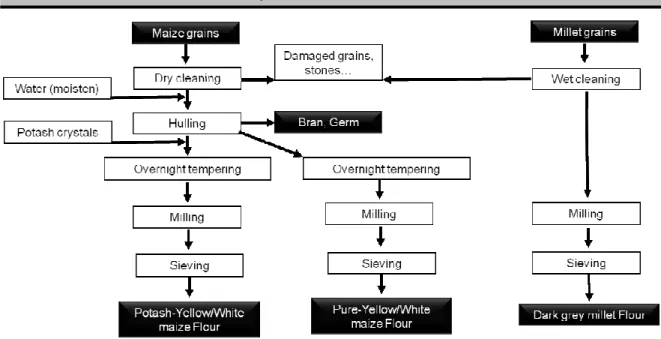
Standard samples processing: Standards were made out of raw grains (100 g) of millet, yellow and white corn processed in laboratory conditions by applying the commercial transformation steps. Processing used is described by the figure 1. Maize grains were hulled, washed and soaked in two volumes of distilled water
of millet flour, milling and sieving were used after wet cleaning of millet grains.
Physicochemical and nutritive characterization Proximate analysis: Proximate analysis was performed using the AOAC (1990) standard methods. The moisture content was determined by the difference of weight before and after drying the sample (10 g) in an oven (Memmert, Germany) at 105 °C until constant weight. Ash fraction was determined by the incineration of dried sample (5 g) in a muffle furnace (Pyrolabo, France) at 550 °C for 12 h. The percentage residue weight was expressed as ash content. PH was determined as follow: 10 g of flour sample was homogenized with 100 mL of distilled water and then filtered. The pH value was recorded after the electrode of pH-meter (Hanna, Spain) was immersed into the filtered solution. For crude fibres, 2 g of sample were weighed into separate 500 mL round bottom flasks and 100 mL of 0.25 M sulphuric acid solution was added. The mixture obtained was boiled under reflux for 30 min. Thereafter, 100 mL of 0.3 M sodium hydroxide solution was added and the mixture were boiled again under reflux for 30 min and filtered through a Whatman
N’guessan et al. J. Appl. Biosci. 2014 Physicochemical, nutritive and safety evaluation of local cereal flours sold in areas of the District of Abidjan-Côte d’Ivoire
Figure 1: Diagram of market and standard (maize and millet) flours processing Proteins were determined through the Kjeldhal method
and the lipid content was determined by Soxhlet extraction using hexane as solvent. Carbohydrates and calorific value were calculated using the following formulas (FAO, 2002):
Carbohydrates: 100 – (% moisture + % proteins + % lipids + % ash + % fibres).
Calorific value: (% proteins × 4) + (% carbohydrates × 4) + (% lipids × 9).
The results of ash, fibres, proteins, lipids and carbohydrates contents were expressed on dry matter basis. Polyphenols were extracted and determined using Folin–Ciocalteu’s reagent (Singleton et al., 1999). A quantity (1 g) of dried powdered sample was soaked in 10 mL of methanol 70 % (w/v) and centrifuged at 1000 rpm for 10 min. An aliquot (1 mL) of supernatant was oxidized with 1 mL of Folin–Ciocalteu’s reagent and neutralized by 1 mL of 20% (w/v) sodium carbonate. The reaction mixture was incubated for 30 min at ambient temperature and absorbance was measured at 745 nm by using a spectrophotometer (PG Instruments, England). The polyphenols content was obtained using a calibration curve of gallic acid (1 mg/mL) as standard. Phytates contents were determined using the Wade’s reagent spectrophotometric method (Latta & Eskin, 1980). A quantity (1 g) of dried powdered sample was mixed with 20 mL of hydrochloric acid (0.65 N) and stirred for 12 h. The mixture was centrifuged at 12000 rpm for 40 min. An aliquot (0.5 mL) of supernatant was added with 3
mL of Wade’s reagent. The reaction mixture was incubated for 15 min and absorbance was measured at 490 nm by using a spectrophotometer (PG Instruments, England). Phytates content was estimated using a calibration curve of sodium phytate (10 mg/mL) as standard.
Mineral analysis: The mineral content was estimated by dry ashing of dried powdered sample (5 g) in a muffle furnace (Pyrolabo, France). The ash obtained was dissolved in 5 mL of HCl/HNO3 and analyzed using
emission spectrometer coupled with electronic microscopy (MEB/EDS).
In vitro starch digestibility: Digestive fluid of the giant snails Achatina achatina was extracted according to the method given by Colas (1977) and used as enzymatic source. The reactions were carried out at 37 °C with 20 µL of enzyme solution, 100 µL of gelatinized flour (1%; w/v) in 80 µL of sodium acetate buffer (100 mM, pH 5.0) for 24 hours. A blank, made out of 100 µL of substrate and 100 µL of buffer, was simultaneously run. At various intervals, 100 µL of samples were withdrawn to quantify the total reducing sugars (Bernfeld, 1955). A standard curve was prepared using glucose (1 mg/mL). Amylolytic enzymes activities were expressed as the amount of catalysts, which release 1 µmol of reducing sugar from starch per minute under the experimental conditions.
Microbial analysis: The culture dependent approach was performed as follow: 225 mL of peptone water (Oxoid, Basingstoke, United Kingdom) was added to 25
g of flour in a sterile Stomacher bag that was vigorously shaken for 5 min in a Stomacher 400 (Seward, Worthington, United Kingdom) to obtain a uniform homogenate. Samples (1 mL) of the homogenate were serially diluted 10-fold in peptone water, from which aliquots (0.1 mL) were spread-plated onto different selective agar media and incubated at different temperatures for 1 to 4 days for isolation and enumeration (by recording the number of CFU) of specific groups of microorganisms: plate count agar (PCA; Oxoid) for the total aerobic bacterial count (30 °C), yeast glucose chloramphenicol (YGC; Oxoid) agar for yeast and moulds (30 °C); Rapid E. coli(BioRad) agar for E. coli (44 °C); Baird Parker (BioRad) agar for S. aureus (37 °C); Violet Red Bile Lactose (VRBL, AES Laboratoire) agar for coliforms (30 °C for total coliforms
and 44 °C for thermotolerant coliforms); Hektoen (BioRad) for Salmonella, Trypton Sulfite Neomycin (TSN, BioRad) agar for anaerobes (46 °C) and Bile Esculin Azide (BEA, Oxoid) agar for Enterococci (37 °C). Colonies obtained from selective agar mediums were purified through sub-culturing on nutrient agar. Confirmation was done by using morphological and biochemical characteristics with reference to the Bergey’s Manual of Determinative Bacteriology (Bergey & Holt, 1994).
3.5 Statistical analysis: All the analyses were performed in triplicate and data were analyzed using EXCELL and STATISTICA 7.1 (StatSoft). Differences between means were evaluated by Fisher’s Least Difference test. Statistical significant difference was stated at p < 0.05.
RESULTS AND DISCUSSION
Proximate composition: The proximate composition of the selected local cereal flours is depicted in Table 1. The values of the physicochemical parameters varied with the types of flours and showed significant difference (p < 0.05). The moisture content of the flours ranged from 29 to 35% thus they are hardly kept beyond 24 hours. These flours are meant to be consumed within 12 hour to ensure freshness. The moisture values obtained are in accordance with those obtained from traditional wet processing flours, which have 22 to 46 % moisture content (FAO, 1994). These values are well above the Codex standard specifications that limit flour moisture to a maximum range of 13% and 15% for millet (Codex-Stan 170, 1989) and maize (Codex-Stan 154, 1985) flours, respectively. Moisture is a specific criterion of food quality that has a direct influence on the stability during storage. Organism naturally occurring in the flour would
readily thrive at high moisture all of which cause deterioration during storage (Ntuli et al., 2013). Ash content gives information on the efficiency of the hulling process. Hulling is not favourable to millets due to their small grains sizes thus the common practice is to produce whole meal flours in order to maximize yield. The ash content, of the maize flours, with the exception of the potash treated ones, was lower than the level expected for decorticated cornmeal meaning 0.7 % (FAO, 1985). Ash content of the samples ranged from 0.38 to 1.93 %. The highest values (1.46 and 1.93 %) were found in potash-treated yellow maize. The ash content in millet flour (0.89 - 1.26 %) almost met the standard specification (FAO, 1985; Codex- Stan 170, 1989) whereas the ash content (0.38 – 0.66 %) in pure yellow and white cornmeal was below the standard level (0.7 %) expected for decorticated grains (FAO, 1985).
N’guessan et al. J. Appl. Biosci. 2014 Physicochemical, nutritive and safety evaluation of local cereal flours sold in areas of the District of Abidjan-Côte d’Ivoire
Table 1: Proximate composition of market and standard flours from maize and millet
Flours
Yellow maize Yellow maize + potash White maize White maize + potash Millet
Market Standard Market Standard Market Standard Market Standard Market Standard
Moisture (%) 35.36a±0.1 22.93b±0.1 33.33a±1.72 23.43b±0.15 33.86a±0.15 22.92b±0.60 34.89a±0.11 22.53b±0.50 34.30a±0.17 23.63b±0.50 Ash (%) 0.53d±0.01 0.38e±0.01 1.93a±0.11 1.38b±0.01 0.66d±0.11 0.58d±0.01 1.46b±0.30 1.38b±0.01 1.26b±0.11 0.89c±0.10 pH 4.46e±0.01 4.49e±0.01 7.50b±0.01 7.91a±0.01 4.53e±0.02 4.50e±0.01 7.86a±0.05 7.95a±0.11 4.98d±0.02 5.56c±0.01 Fibres (%) 0.20c±0.05 0.70b±0.10 0.15d±0.01 0.85b±0.05 0.25c±0.01 0.73b±0.03 0.15d±0.01 0.78b±0.13 0.27c±0.02 2.70a±0.03 Lipids (%) 1.44d±0.03 1.84c±0.04 1.20e±0.01 1.26e±0.07 1.79c±0.00 1.91c±0.03 1.19e±0.00 1.51d±0.02 2.12b±0.05 3.84a±0.16 Proteins (%) 4.99d±0.15 5.26c±0.14 3.94e±0.17 4.24d±0.62 5.56c±0.43 6.06b±0.06 3.93e±0.10 3.87e±0.43 6.44b±0.41 7.46a±0.26 Carbohyd.(%) 76.03b±0.2 72.13c±0.2 73.64c±0.23 73.56b±1.89 74.16b±0.19 85.64a±0.66 74.06b±0.45 71.87c±0.55 89.19a±0.47 77.89b±0.49 Polyphenols (mg/100g) 69.10d±1.1 86.30c±0.0 62.49e±3.57 23.79h±0.00 63.14e±4.01 70.39d±0.00 55.70f±0.28 44.36g±0.05 95.81b±5.67 195.43a±0.0 Phytates (mg/100g) 17.90c±0.2 23.20a±0.2 14.87d±0.5 21.90b±0.5 11.51f±0.5 17.97c±0.2 20.57b±0.1 29.62a±0.5 13.68e±0.64 20.54b±0.27 Energy (kcal/100g) 337d±1.00 326.1e±1.1 321.43e±1.1 322.61e±8.9 335.07d±0.1 384.07a±2.9 322.76e±0.0 316.60f±3.9 365.67c±3.6 375.99b±4.5
These results clearly indicate depletion of minerals, which can be attributable to the unnecessary prolonged tempering of hulled grain during processing (Ndjouenkeu et al., 1989). This observation can also be applied to the protein content (3.93 - 5.56 %) of market cornmeal instead of the 7 % expected in decorticated maize flour (FAO, 1985). Long-time tempering of decorticated grain is impoverishing because of draining of nutriments such minerals, vitamins and proteins (Favier, 1989). This traditional practice tends to be counterproductive and problematic when addressing issues like protein deficiency by introduction of quality protein maize (QPM) in the diet (Krivanek et al., 2007). The main traditional meal made of yellow and white maize flours is a thick porridge called tô (Nguessan et al., 2014); therefore the consumption of tô can be implicated in malnutrition because of its extremely low protein content. Whole millet flour displayed higher protein content (6.44 – 7.46%) as well as higher fat content (2.12 – 3.84%). It should be recalled that fat content along with moisture is a decisive factor in appreciating the shelf life of flours (Sauer, 1992); thus, high fat content could lead to rancidity during storage (Kaced et al., 1984). The fat content was significantly (p < 0.05) lower in the potash-treated maize flour presumably due to defatting caused by alkalinity (Matz, 1991). In addition, there was significant difference (p < 0.05) in pH values of the samples. The pH of the potash-treated maize flour increased from 4.46 to 7.95 due to the potash added. Plant phenolics include condensed tannins, which reduce proteins bioavailability (Naczk & Shahidi, 2004). Recent studies (Lestienne et al., 2003) have revealed that soaking of whole seeds for 24 h led to a significant reduction of phytates content of maize (21%) and millet (28%).
Phytates are the principal storage form of phosphorus and are particularly abundant in cereals (Champ, 2002). These anti-nutrients chelate divalent cations such as calcium, magnesium, zinc and iron, thereby reducing their bioavailability (Sandberg, 2002). Therefore, whole seed soaking or limiting soaking times (N’djouenkeu et al., 1989) of hulled grains prior to milling could be considered as detoxification method in commercial flour processing (Ekop & Eddy, 2005). In the same context, the tempering process used for maize flours manufacturing also reduce the levels of anti-nutritional factors such as polyphenols and phytates (Afify et al., 2012).
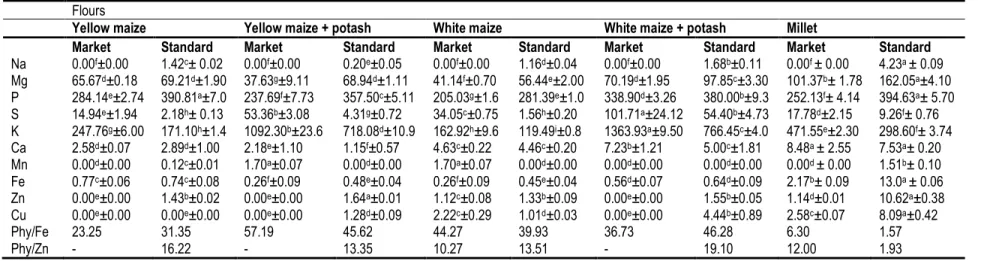
Mineral composition: Mean values for mineral content of the selected cereal flours are presented in Table 2. The samples analyzed in this study contained remarkably high amounts (p < 0.05) of potassium (162.92 – 1363.93 mg/100 g) with the highest value (718.08 - 1363.93 mg/100 g) observed for potash-treated samples. Although the increased potassium intake might have salutary effects on blood pressure (He et al. 2010), some concern may be raised for consumers with diabetes, heart or kidney failure. Indeed, the relatively higher level of potassium in potash-treated flours could lead to hyperkalaemia that cause excess potassium in the bloodstream (Soetan et al., 2010). A campaign to raise awareness of local flour processors on the possibility of standardizing the level of potash in yellow maize to ensure consumers safety might be needed. It was also observed that potash-treated flours showed higher content (4.31 – 101.71 mg/100g) of sulfur than the (1.56 – 34.05 mg/100g) non potash-treated ones. This molecule could be considered as impurity of potash crystals.
N’guessan et al. J. Appl. Biosci. 2014 Physicochemical, nutritive and safety evaluation of local cereal flours sold in areas of the District of Abidjan-Côte d’Ivoire
Table 2: Mineral composition (mg/100g) of market and standard flours from maize and millet
Flours
Yellow maize Yellow maize + potash White maize White maize + potash Millet
Market Standard Market Standard Market Standard Market Standard Market Standard
Na 0.00f±0.00 1.42c± 0.02 0.00f±0.00 0.20e±0.05 0.00f±0.00 1.16d±0.04 0.00f±0.00 1.68b±0.11 0.00f ± 0.00 4.23a ± 0.09 Mg 65.67d±0.18 69.21d±1.90 37.63g±9.11 68.94d±1.11 41.14f±0.70 56.44e±2.00 70.19d±1.95 97.85c±3.30 101.37b± 1.78 162.05a±4.10 P 284.14e±2.74 390.81a±7.0 237.69f±7.73 357.50c±5.11 205.03g±1.6 281.39e±1.0 338.90d±3.26 380.00b±9.3 252.13f± 4.14 394.63a± 5.70 S 14.94e±1.94 2.18h± 0.13 53.36b±3.08 4.31g±0.72 34.05c±0.75 1.56h±0.20 101.71a±24.12 54.40b±4.73 17.78d±2.15 9.26f± 0.76 K 247.76g±6.00 171.10h±1.4 1092.30b±23.6 718.08d±10.9 162.92h±9.6 119.49i±0.8 1363.93a±9.50 766.45c±4.0 471.55e±2.30 298.60f± 3.74 Ca 2.58d±0.07 2.89d±1.00 2.18e±1.10 1.15f±0.57 4.63c±0.22 4.46c±0.20 7.23b±1.21 5.00c±1.81 8.48a ± 2.55 7.53a± 0.20 Mn 0.00d±0.00 0.12c±0.01 1.70a±0.07 0.00d±0.00 1.70a±0.07 0.00d±0.00 0.00d±0.00 0.00d±0.00 0.00d ± 0.00 1.51b± 0.10 Fe 0.77c±0.06 0.74c±0.08 0.26f±0.09 0.48e±0.04 0.26f±0.09 0.45e±0.04 0.56d±0.07 0.64d±0.09 2.17b± 0.09 13.0a ± 0.06 Zn 0.00e±0.00 1.43b±0.02 0.00e±0.00 1.64a±0.01 1.12c±0.08 1.33b±0.09 0.00e±0.00 1.55b±0.05 1.14d±0.01 10.62a±0.38 Cu 0.00e±0.00 0.00e±0.00 0.00e±0.00 1.28d±0.09 2.22c±0.29 1.01d±0.03 0.00e±0.00 4.44b±0.89 2.58c±0.07 8.09a±0.42 Phy/Fe 23.25 31.35 57.19 45.62 44.27 39.93 36.73 46.28 6.30 1.57 Phy/Zn - 16.22 - 13.35 10.27 13.51 - 19.10 12.00 1.93
Therefore, the consumption in high amount of potash-treated flours may have adverse effect on human health. The iron and zinc contents (13.08 ± 0.66 and 10.62 ± 0.68 mg/100g) detected in standard millet flour were noticeable, higher than values (8 and 6 mg/day, respectively) recommended for human dietary allowance (FAO/WHO, 1988). To predict the bioavailability of iron and zinc, anti-nutrients to nutrients ratios were calculated. The calculated [phytates]/ [Fe] and [phytates]/ [Zn] ratios in all studied flours were above the critical level of 10 known to impair iron and zinc bioavailability (Davies & Olpin, 1979; Saha et al., 1994). This implies that the phytates content of these processed flours may hinder iron and zinc bioavailability. Therefore, treatment such as soaking the flours prior to cooking without discarding the steeping water will be necessary to significantly improve the bioavailability of iron and zinc in infant meals (Lestienne et al., 2003).
Flour (starch) digestibility: The result of in vitro starch digestibility (IVSD) of the local cereal flours is presented in Figure 2 and the calculated hydrolysis rate shown in Table 3. The maize flours all type combined were more susceptible to in vitro enzymatic digestibility than millet flours (p < 0.05). Possible reasons could be given such as differences in grain characteristics due to botanical origin and treatments prior to milling. Refining processes such as decortications leads to an important loss in nutrients and anti-nutrients (Bach Knudsen et al., 1988). Since millet was milled in their whole form, it meant that they were rich in lipids, phenolic compounds and insoluble dietary fibres (Table 1). This may cause restriction in accessibility of starch by amylolytic enzymes (Holm et al., 1983; Waniska et al., 1990; Cui & Oates, 1999). Recent studies have shown that removing proteins and lipids significantly increased enzymatic starch hydrolysis rate and therefore glycaemic index of millet starches (Annor et al., 2013). Other works reported a possible interaction between starch and polyphenol molecules or between amylase and polyphenols in cereal foods thereby reducing the starch digestibility (Thondre & Henry, 2011). It was thus asserted that polyphenol content could have potential effect on glycaemic response to cereal meals. IVSD for
most of market flours were significantly different to their standard counterparts (p < 0.05). The commercial processing of the local flours needs generally 2 or 3 passes though the mill in order to minimize losses. This practice results in an important heat built up in the flours, which is known to affect starch granules. During milling and grinding of cereals a mechanical gelatinization of starch occurs, resulting in what is termed "damaged starch" (Hasjim et al., 2009) which are more susceptible to amylases. The main difference reported between yellow and white maize was the presence of carotenoids, fat soluble pigments (Morin-Savy, 2005) responsible for the yellow color of the grain (FAO, 1997). Therefore, the slow hydrolysis of pure yellow maize starch compared to pure white maize starch observed in this study might be ascribed to the presence of these pigments (Adejumo et al., 2013). The study also showed that potash causes significant increase in the in vitro starch digestibility of white maize flours (p < 0.05). Indeed, alkalinity is reported to loosen the hulls of maize grains, to modify endosperm cell walls and protein matrix thus exposing starch granules to enzyme action (Altieri et al, 2005). Therefore, the structural changes induced by the chemical treatment may partly explain increasing of digestibility (Ørskov & Greenhalgh, 1977). The presence of carotenoids in yellow corn may lead to formation of lipid complex with starch and hence limit in vitro digestibility of the potash treated yellow cornmeal (Cui & Oates, 1999; Holm et al., 1983). In addition, it is reported that no salivary or gastric enzymes are known to hydrolyze carotenoids (Fardet et al., 2013); however, disruption of the cell walls containing the carotenoids during digestion would allow their recovery (Weisse, 2002). Therefore, the popular belief that tô, thick porridge, made with potash treated yellow maize is easily digestible may not be fully asserted but it provides undoubtedly the dough with lightness and suppleness. However, studies have shown that maize thick porridges, all types taken together, can be useful in the prevention or treatment of diabetes because of reduced in vitro starch digestibility and predicted glycaemic index ranging from 39 to 50 glucose reference (Van der Merve et al., 2001; SABC, 2005).
N’guessan et al. J. Appl. Biosci. 2014 Physicochemical, nutritive and safety evaluation of local cereal flours sold in areas of the District of Abidjan-Côte d’Ivoire
Figure 2: In vitro digestibility of gelatinized market and standard flours by the digestive fluid of Achatina achatina
Legend: m-market sample; st-standard sample; WM-white maize; YM-yellow maize
Table 3: Hydrolysis rates of maize and millet flours (µmoles/min)
Cereal flours Standard (10-5µmole/min) Market (10-5µmole/min)
Yellow maize 556d ±24 485c ± 9
Yellow maize with potash 551d ± 59 536d ± 35
White maize 573e ± 23 586f ± 5
White maize with potash 715g ± 15 774h ± 6
Millet 245a ± 12 441b ± 3
Mean with different letters are statistically different (p < 0.05) according to Fisher’s test. Microbial quality: The microbial load found in the
flours samples is shown in Table 4. The presence of high level (6.76 – 8.33 Log cfu/g) of total mesophilic aerobic bacteria count in market cereal flours give them an unsatisfactory microbiological quality according to the health standardized criteria of 5 Log cfu/g (Guiraud, 1998). These bacteria groups include mesophilic, pathogens and non-pathogens microorganisms. The market samples were also contaminated with Enterococcus and thermotolerant coliforms (1.27 – 1.86 Log cfu/g and 1.06 – 1.60 Log cfu/g, respectively). These bacteria are widely distributed in the environment (soil, surface waters, plants and vegetables), principally inhabiting the human and warm-blooded animal gastro-intestinal tract (Mundt, 1986). Furthermore, it has been shown that enterococci and coliforms are considered as hygiene indicators in the manufacturing process of foods (Birollo et al., 2001). Therefore, to avoid food borne illnesses due to enterococci and coliforms, cereal market flours must be prepared with good manufacturing practices and good conditions of storage. The high microbial count detected for yeast and moulds might be due to
improper postharvest and storage handling of the cereal grains. The residue built up in milling machines as well as the wet process used can be relevant as additional sources of microbial contamination of commercial samples (Berghofer et al., 2003; Shoba et al., 2011). Yeast and moulds growth on processed foods may lead to the formation of mycotoxins, which are secondary fungal toxic metabolites to humans and animals, causing disorders like cancer, immune suppression or endocrine disruption (Filtenborg et al., 1996). Therefore, storage conditions as relative humidity of atmosphere must be a critical control points during processing of cereal flours. It is also important to note that all the analyzed samples were free of toxin producing moulds and pathogenic bacteria such as Salmonella, Staphylococcus, Clostridium and Escherichia coli that are usually involved in food poisoning (Bourgeois et al., 1996). Processing techniques such as heat treatment significantly reduce microbial contamination. Therefore, precaution needs to be taken in order to avoid cross contamination of the prepared meals.
Table 4: Microbial characteristics (log10 cfu/g) of market and standard flours from maize and millet Criteria
log10
(cfu/g)
Flours
Yellow maize Yellow maize + potash White maize White maize + potash Millet
Market Standard Market Standard Market Standard Market Standard Market Standard
Total microflora 5 7.75b±0.12 3.65g±0.32 7.03c±0.02 5.13e±0.17 6.99c±0.01 4.19f±0.19 8.33a±0.17 5.09e±0.41 6.76c±0.03 4.07d±0.36 Enterococci 1 1.55b±0.82 0.00d±0.00 1.86a±0.65 0.00d±0.00 1.27c±1.18 0.00d±0.00 1.39b±0.27 0.00d±0.00 1.41b±0.89 0.00d±0.00 Total coliforms 3 1.40c±0.17 00.0e±0.00 1.48c±0.12 0.00e±0.00 1.64b±0.07 0.00e±0.00 1.90a±0.34 0.00e±0.00 1.48c±0.20 0.33d±0.00 Thermo. coliforms 1 1.10c±0.05 0.00d±0.00 1.06c±0.00 0.00d±0.00 1.48b±0.10 0.00d±0.00 1.60a±0.50 0.00d±0.00 1.40b±0.32 0.00d±0.00 E. coli 0 0.00a±0.00 0.00a±0.00 0.00a±0.00 0.00a±0.00 0.00a±0.00 0.00a±0.00 0.00a±0.00 0.00a±0.00 0.00a±0.00 0.00a±0.00 Anaerobes 2 0.00a±0.00 0.00a±0.00 0.00a±0.00 0.00a±0.00 0.00a±0.00 0.00a±0.00 0.00a±0.00 0.00a±0.00 0.00a±0.00 0.00a±0.00 S. aureus 1 0.00a±0.00 0.00a±0.00 0.00a±0.00 0.00a±0.00 0.00a±0.00 0.00a±0.00 0.00a±0.00 0.00a±0.00 0.00a±0.00 0.00a±0.00
Salmonella Abs Abs Abs Abs Abs Abs Abs Abs Abs Abs Abs
Yeast and
moulds
3 2.67b±0.72 1.85d±1.11 3.33a±0.24 1.30e±0.03 2.05c±0.014 1.20e±0.05 2.93b±0.77 1.02f±0.67 2.13c±0.17 1.20e±0.04
N’guessan et al. J. Appl. Biosci. 2014 Physicochemical, nutritive and safety evaluation of local cereal flours sold in areas of the District of Abidjan-Côte d’Ivoire
CONCLUSION
Local cereals namely maize and millet flours are in great demand among the Ivorian consumers and show a great introduction on the markets of the District of Abidjan. Up to this point, local cereal flours are mainly manufactured in artisanal way following empirical traditional procedures. The unsuited storage facilities of grains, as well as the wet transformation process (including the unnecessary prolonged tempering) and the poor hygienic handling of the flours affect the final product. The current study thus reveals that the local flours have a quite heterogeneous physicochemical, nutritive and non-satisfactory microbiological quality.
Maize and millets have high carbohydrate energy content that make them useful components of dietary foods hence, deserve particular attention. Management quality of these cereal flours is necessary to develop competitive products to conquer a wider urban market. More stringent measure with regard to microbial contamination need to be implemented for consumers’ safety. Manufacturing which implies standardizing tempering times and potash addition, drying facilities and conditioning practices of cereal products with novel technology that would offer full sanitary guarantees to the consumers have to be imperatively considered. REFERENCES
Abecassis J et Bergez J : 2009. Les filières céréalière, organisation et nouveaux défis. Editions Quæ, 184p.
Adegunwa MO, Alamu EO, Bakare H.A and Godwin PO: 2011. Effect of fermentation length and varieties on the qualities of corn starch (Ogi) production American Journal of Food and Nutrition. pp 1:166-170.
Adejumo AL, Aderibigbe FA and Owolab RU, 2013. Comparative studies of starch susceptibilities to α-amylase degradation of different cereal and root crops of Nigeria. African Journal of Biotechnology. pp 4663-4669.
Afoakwa EO, Sefa-Dedeh S, Sakyi-Dawson E: 2004. Effects of cowpea, dehydration method and storage time on some quality characteristics of maize-based traditional weaning foods. African Journal of Food, Agriculture, Nutrition and Development 4: 1-17.
Afify AEM, Hossam MR, El-Beltagi S, Samiha M, Abd El-Salam M, and Omran AA: 2012. Effect of Soaking, Cooking, Germination and Fermentation Processing on Proximate Analysis and Mineral Content of Three White Sorghum Varieties (Sorghum bicolor L. Moench.). Notulae Botanicae Horti Agrobotanici 40:92-98.
Altieri PA, Bindzus W, Green V.R. and Lee CC: 2005. Alkaline wet milling of corn grain. EP1505077A1. Official Journal of the European Patent No 12/82, 9p.
Anon: 1979. Phytate and zinc bioavailability. Nutrition Reviews 37:365–6.
Annor GA, Marcone M, Bertoft E, Seetharaman A: 2013. In Vitro Starch Digestibility and Expected Glycemic Index of Kodo millet
(Paspalum scrobiculatum) as Affected by Starch–Protein–Lipid Interactions. Cereal Chemistry 90: 211-217.
AOAC: 1990. Official methods of analysis. Association of Official Analytical Chemists Ed., Washington DC. 684 p.
Bach Knudsen KE, Munck L, and Eggum BO: 1988. Effect of cooking, pH and polyphenol level on carbohydrate composition and nutritional quality of a sorghum (Sorghum bicolor (L.) Moench) food, ugali. British Journal of Nutrition 59:31-47.
Bernfeld P: 1955. Amylases, α and β. Meth Enzymology 1:149-158.
Berghofer IK, Hocking AD, Miskelly D and Jansson E: 2003. Microbiology of wheat and flour milling in Australia. International Journal of Food Microbiology 85:137-49.
Bergey DH and Holt JG: 1994. Bergey’s manual of determinative bacteriology. 9th ed. Williams
and Wilkins, USA. 787 p.
Birollo GA, Reinheimer JA and Vinderola CG: 2001. Enterococci vs. nonlactic acid microflora as hygiene indicators for sweetened yoghurt. Food Microbiology 18:597-604.
Blomhoff R: 1991. “Vitamin A in health and disease”, Ed. Blomhoff, Marcel Dekker Inc, NY, 10016. pp 189-238.
Bourgeois CM, Mescle JF and Zucca J: 1996. Food microbiology. 2nd ed. Technique and Documentation, Paris. 672 p.
Bullerman LB and Bianchini A: 2009. Production of Microbiologically Safe Foods - Cereals and Cereal Products. In: N. Heredia, I. Wesley, and S. Garcia (Eds.). Production of
Microbiologically Safe Foods. John Wiley and Sons, NY. 596p.
Butt MS, Anjum FM, Shaheen M, Rehman AU and Asif M: 1997. Protein composition and physical dough development of spring wheat. Journal of .Agricultural Research 35: 341-402.
Cauvain P, Young LS and Salmon S: 2004. Using cereal science and technology for the benefit of consumers: proceedings of the 12th International ICC Cereal and Bread Congress 23-26 May, 2004, Harrogate, UK. 502 P. Codex-Stan 170: 1989. Codex Standard 170-1989. Norme codex pour la farine de mil chandelle. 3p. Codex-Stan 154: 1985. Codex Standard 170-1989.
Norme codex pour la farine de maïs complète. 3p.
Chelkowski J: 1991. Fungal pathogens influencing cereal seed quality at harvest. In: Chelkowski J. (Ed.). Cereal Grain. Mycotoxins, fungi and quality in drying and storage. Amsterdam: Elsevier. pp. 67-80.
Cheryan M: 1980. Phytic acid interactions in food systems. Critical Review in Food Science and nutrition 13:297-335.
Champ MM: 2002. Non-nutrient bioactive substances of pulses. British Journal of Nutrition 88: 307-319. Chopra VL and Parkash S: 2002. Evaluation and adaption of cereal crops. Science Publishers Inc,Nh. USA. 295 p.
Christensen CM: 1982. Storage of cereal grains and their products. Published by American Association of Cereal Chemists, Inc, St. Paul, MN, US. 544 p.
Cisse M, Megnanou R, Kra KAS, Soro R Y and Niamke S: 2013. Physicochemical, biochemical and nutritive properties of QPM and regular maize flours grown in Côte d’Ivoire. International Journal of Research in BioSciences 2: 26-32. Colas B : 1977. Purification et caractérisation des
propriétés cinétiques et moléculaire de β glycosidases du suc digestif d’Archachatina ventricosa. Thèse de doctorat d'état ès Sciences, Université de Provence, France. 155 p.
Cui R and Oates CG: 1999. The effect of amylose–lipid
Drinah BC, Banda N and Pran V: 1990. Nutritional Improvement of Tannin-Containing Sorghums (Sorghum bicolor) by Sodium Bicarbonate. Cereal Chemistry 67:533-537.
Egli I, Davidsson L, Juillerat MA, Barclay D and Hurrell R: 2002. The influence of soaking and germination on the phytase activity and phytic acid content of grains and seeds potentially useful for complementary feeding. Journal of Food Science 67:3484–3488.
Ekop AS and Eddy NO: 2005. Comparative Studies of the level of toxicants in the seed of Indian almond (Terminalia catappa) and African walnut (Coula edulis). Chemistry Class Journal 2: 74-76.
Elkhalifa AEO, Schiffler B and Bernhard R.: 2004. Effect of fermentation on the starch digestibility, resistant starch and some physicochemical properties of sorghum Flour. Nahrung Food 48:91 – 94.
Ensminger ME and Ensminger AH: 1993. Contribution of cereals to dietary fibre and antioxidant intakes: Towards more reliable methodology. Foods & Nutrition Encyclopedia, Two Volume Set CRC Press. 241 p.
FAO: 2003. Food security and nutrition trends in West Africa challenges and the way forwards 2nd International Workshop on Food-based Approaches for a Healthy Nutrition I Burkina Faso.
FAO: 2002. Food energy-methods of analysis and conversion factors. FAO Ed, Rome. 97 p. FAO: 1997.White Maize: a Traditional Food Grain in
Developing Countries. Rome. 22 p
FAO: 1995. Sorghum and millets in human nutrition. Food and Nutrition Series, No.27. Rome. 189p.
FAO: 1985. Précis technique sur les farines composées. Commission Economique pour l'Afrique des Nations Unies. Application des techniques existantes Commission Economique pour l'Afrique Addis-Abeba 1985. Rome; Italy.
FAO/WHO: 1988. Requirement of vitamin A, iron, folate and vitamin B12. Report of a joint expert
N’guessan et al. J. Appl. Biosci. 2014 Physicochemical, nutritive and safety evaluation of local cereal flours sold in areas of the District of Abidjan-Côte d’Ivoire
Fardet A, Souchon I et Dupont D : 2013. Structure des aliments et effets nutritionnels .Edition Quae Amazon, France. 470 p.
Favier JC : 1989. Valeur nutritive et comportement des céréales au cours de leurs transformations. Céréales en régions chaudes AUPELF-UKEF, Eùs John Libbey Eurotext, Paris Q 1989. pp. 285-296.
Filtenborg O, Frisvad JC and Thrane U: 1996. Moulds in food spoilage. International Journal of Food Microbiology 33: 85-102.
Goldberg G: 2003. Plants diet and health. The report of the British nutrition foundation. Task force, Blackwell, Oxford. 372p.
Guiraud JP: 1998. Food microbiology. 2nd ed. Dunod, Paris. 652 p.
Hasjim J, Srichuwong S, Scott MP and Jay-Lin J: 2009. Kernel composition, starch structure, and enzyme digestibility of opaque-2 maize and quality protein maize. Journal of Agricultural and.Food Chemistry 57: 2049–2055.
He FJ, Marciniak M, Carney C, Markandu N D, Anand V, Fraser WD, Dalton R.N, Kaski JC and MacGregor GA :2010. Cardiovascular risk factors, and bone turnover in mild hypertensives.effects of potassium chloride and potassium bicarbonate on endothelial function. Hypertension 55: 681-688.
Holm I, Björck S, Ostrowska AC, Eliasson NG, Asp K L and Lundquist I: 1983. Digestibility of Amylose-Lipid Complexes in-vitro and in-vivo. Starch 35: 294–297.
Hotz C and Gibson RS: 2007. Traditional Food-Processing and Preparation Practices to Enhance the Bioavailability of Micronutrients in Plant-Based Diets. 2007 American Society for Nutrition. Journal of. Nutrition 137: 1097–1100. Hurrell RF: 2004. Phytic acid degradation as a means of improving iron absorption. International Journal for Vitamin and Nutrition Research 74:445–52.
Johns T and Eyzaguirre PB: 2007. Biofortification, biodiversity and diet: A search for complementary applications against poverty and malnutrition. Food Policy, 32:1-24. Jood S and Kapoor AC: 1994. Vitamin contents of
cereal grains as affected by storage and insect infestation. Plant Foods for Human Nutrition 46: 237–43.
Kaced I, Hoseney RC and Varriano-Marston E: 1984. Factors affecting rancidity in ground pearl
millet Pennisetum americanum L Leeke. Cereal Chemistry 61; 187-192.
Kiria CG, Vermeulen H and De Groote H: 2010. Sensory Evaluation and Consumers’ Willingness to pay for quality protein maize (QPM) using experimental auctions in rural Tanzania. Paper prepared for presentation at the 3rd International Conference of the African
Association of Agricultural Economists, Cape Town South Africa.
Kator H and Rhodes MW: 1991. Indicator and alternate indicators of growing water quality. In D. R. Ward and C.R. Hackney (Ed.), Microbiology of marine food products, Van Nostrand Reinhold Co., New York. 450 PP.
Kouakou CK, Akanvou L, Konan YA. Mahyao A : 2010. Stratégies paysannes de maintien et de gestion de la biodiversité du maïs (Zea mays L.) dans le département de Katiola, Côte d’Ivoire. Journal of Applied Biosciences 33: 2100 – 2109.
Kowieska A, Lubowicki R, Jaskowska I: 2011. Chemical composition and nutritional characteristics of several cereals. Acta Scientirum Polonorum Zootechnica 10: 37– 50.
Krivanek AF, De Groote H, Gunaratna NS., Diallo AO and Friesen D: 2007. Breeding and Disseminating Quality Protein Maize (QPM) for Africa. African Journal of Biotechnology 6:312-324.
Kulp K and Ponte JG: 2000): Handbook of Cereal Science and Technology. 2nd Edition. Revised and expanded. Marcel Dekker, Inc., New York. 790 p.
Latta M and Eskin M: 1980. A simple method for phytate determination. Journal of Agricultural and Food Chemistry 28: 1313-1315.
Lestienne I, Icard-Vernière C, Picq C and Trèche S: 2003. Effets du trempage des graines et de farines de céréales et de légumineuses sur leur teneur en phytates et leurs rapports molaires Phy/Fe et Phy/Zn. 2ème Atelier
international : Voies alimentaires d’amélioration des situations nutritionelles. Ouagadougou. pp 479-486.
Lorenz K.:1998. Tannin and phytate content in proso millet, Panicum millaceum. Cereal Chemistry 60: 424-426.
Macrae R, Robinson RK and Sadler MJ: 1993. Encyclopaedia of Food Science, Food
Technology and Nutrition. Academic Press, London.
MacEvilly C: 2003. Cereals contribution to the diet. In: Encyclopedia of Food Sciences and Nutrition L Trugo, P Finglass & B Caballero (Eds). Academic Press, San Diego. pp. 1008–1014. Matz AS: 1991. The chemistry and technology of
cereals as food and feed. New York: Van Nostrand Reinhold; McAllen, TX, USA : Pan-Tech International distributor; Publisher: Springer; 2nd edition. 751p.
Mazoyer M. et Roudart L : 1997. Histoire des agricultures du monde. Du néolithique à la crise contemporaine, Paris, Éditions du Seuil. 546 p.
McKevith B., 2004. Nutritional aspects of cereals. British Nutrition Foundation, Nutrition Bulletin 29: 111–142.
Metzler-Zebeli BU, Deckardt K, Schollenberger M, Rodehutscord M and Zebeli Q: 2014. Myo-Inositol Hexakisphosphate Hydrolysis in Barley PLOS ONE. 9: 101-166
Morin-Savy S: 2005. Biosynthèse de caroténoïdes aromatiques hydroxylés par des bactéries non photosynthétiques : des carotènes aux xanthophylles. Thèse Présentée devant L’Université de Bretagne Occidentale Pour obtenir le grade de docteur de L’Université de Bretagne Occidentale Mention Microbiologie. 173p.
Mundt OJ: 1986. Enterococci. In: Sneath PHA, Mair NS, Holt JG (Eds). Bergey’s manual of systematic bacteriology. Williams and Wilkins, Baltimore, pp.1063-1065.
Naczk M and Shahidi F: 2004. Extraction and analysis of phenolics in food. Journal of Chromatography. 1054: 95-111.
Nguessan YD, Bedikou EM, Megnanou R and Niamey SL: 2014. Importance of local cereal flours in the diet habits of consumers in the District of Abidjan, Côte d’Ivoire. Food and Environmental Safety 13: 134-146.
Ndjouenkeu R, Mbofung CMFand Etoa FX: 1989. Étude comparative de quelques techniques de transformation du maïs en farine dans
Properties of Millet Flour for Porridge Production. Journal of Food Technology 6: 185-188.
Ochanda SO, Onyango CA, Mwasaru MA, Ochieng JK, and Mathooko FM: 2010. Effects of alkali treatment on tannins and phytates in red sorghum, white sorghum and pearl millet. Journal of Applied Biosciences 36: 2409 – 2418.
Ørskov ER and Greenhalgh JFD: 1977. Alkali treatment
as a method of processing whole grain for cattle. The Journal of Agricultural Science 89:253-255.
Ottaway P: 1993. The Technology of Vitamins in Food. Kluwer Academic/Plenum Publishers, Dordrecht. 270p.
Oyarukua MA.: 2012. Effect of germination boiling and co-fermentation on the viscosity of maize/cowpea mixture as complementary infant food. American Journal of Food Technology 7: 1-12.
Oyarekua MA: 2011. Evaluation of the nutritional and microbiological status of co-fermented cereals/cowpea ‘OGI’ Agriculture and Biology Journal of North America 2 p61.
Pitt JI, Hocking AD: 2009. Primary keys and miscellaneous fungi. In: Pitt JI, Hocking AD (Eds). Fungi and food spoilage. New York pp. 122-124.
Richard-Molard D: 2003. Cereals/bulk storage of grains. In: Encyclopedia of Food Sciences and Nutrition. L Trugo, P Finglass & B Caballero (Eds) Academic Press, San Diego. pp. 1014. Saha PR, Weaver CM and Mason AC: 1994. Mineral
bioavailability in rats from intrinsically labeled whole wheat flour of various phytate levels. Journal of Agricultural and Food Chemistry 42: 531-545
Sandberg AS: 2002. Bioavailability of minerals in legumes. British Journal of Nutrition 88: 281-285
SACB: 2005. South African Chamber of Baking. Bread
and glycaemic index.
www.sacb.co.za/webroot/main/bread_gi.htm Sauer D B 1992. Storage of cereal grains and their
N’guessan et al. J. Appl. Biosci. 2014 Physicochemical, nutritive and safety evaluation of local cereal flours sold in areas of the District of Abidjan-Côte d’Ivoire
Indian Journal of Fundamental Applied Life Sciences 1:129-140.
Schönfeldt HC and Gibson Hall N: 2012. Dietary protein quality and malnutrition in Africa. British Journal of Nutrition 108:69-76.
Singleton VL, Orthofer R and Lamuela-Raventos RM: 1999. Analysis of total phenols and other oxydant substrates and antioxydants by means of Folin-ciocalteu reagent. Methods Enzymology 299: 152-178.
Soetan KO, Olaiya CO and Oyewole OE: 2010. The importance of mineral elements for humans, domestic animals and plants: A review. African Journal of Food Science 4: 200-222.
Souhthgate DAT: 1993. Cereals and cereal products. In human nutrition and dietetics, 9th edn JS
Garrow and WPT James (Eds). Churchill livingstone, Edinburgh. pp. 273-288.
Sujka M and Jamroz J: 2009. a-Amylolysis of native potato and corn starches – SEM, AFM, nitrogen and iodine sorption investigations LWT - Food Science and Technology 42 1219–1224.
Teh SS, Bekhit AE and Birch AC: 2014. Effect of the defatting process, acid and alkali extraction on the physicochemical and functional properties of hemp, flax and carola seed cake protein isolates. Food Measure 8:92-104.
Thondre PSLR and Henry CJK: 2011. Influence of polyphenols on in vitro starch digestibility of oat porridges. Proceedings of the Nutrition Society 70: E138.
Tyssandier V, Reboul E, Dumas JF, Bougteloup-Demange C, Armand M, Margand J, Sallas M.
and Borel P: 2003. Poccessing of vegetable-borne caroténoïds in the human stomach and duodonum. American Journal of Physiology-Gastrointestinal and Liver Physilogy 284:G913-G923.
UNIDO: 2004. Small-scale Cereal Milling and Bakery Products. Vienna, 111p.
Vasal, SK: 2000. The quality protein maize story. Food and Nutrition Bulletin, 21:445- 450.
Van der Merwe B, Erasmus C and Taylor JRN: 2001. African maize porridge: a food with slow in vitro starch digestibility Food Chemistry 72:347–353.
Wang L, Gaziano JM, Liu S, Manson JE, Buring JE, and Sesso DH: 2007. Whole- and refined-grain intakes and the risk of hypertension in women. The American Journal of Clinical Nutrition 86:472–9.
Wani AA, Singh P, Shah MA, Schweiggert-Weisz U, Gul K and Wani A.: 2012. Rice starch diversity: effects on structural, morphological, thermal and physicochemical properties-A review. Comprehensive Reviews in Food Science and Food Safety 11: 417-436. Waniska K and Thurn K: 1990. Sorghum Nutritional
Quality, in Proceedings of the International Conference on Purdue University, West Lafayette, Ejeta, G. (Ed.). pp. 177–190. Weisse S : 2002. Complexes cyclodextrines / ester de
vitamine A : stabilisation, solubilisation et promotion de l’absorption cutanée. Thèse doctorat de L’Université de Paris Xème ,224p