UNIVERSITÉ DE MONTRÉAL
DEVELOPMENT OF A TIME DELAY FORMULATION FOR FLUIDELASTIC INSTABILITY MODEL
HAO LI
DÉPARTEMENT DE GÉNIE MÉCANIQUE ÉCOLE POLYTECHNIQUE DE MONTRÉAL
MÉMOIRE PRÉSENTÉ EN VUE DE L’OBTENTION DU DIPLÔME DE MAÎTRISE ÈS SCIENCES APPLIQUÉES
(GÉNIE MÉCANIQUE) AOÛT 2016
ÉCOLE POLYTECHNIQUE DE MONTRÉAL
Ce mémoire intitulé :
DEVELOPMENT OF A TIME DELAY FORMULATION FOR FLUIDELASTIC INSTABILITY MODEL
présenté par : LI Hao
en vue de l’obtention du diplôme de : Maîtrise ès sciences appliquées a été dûment accepté par le jury d’examen constitué de :
M. VO Huu Duc, Ph. D, président
M. MUREITHI Njuki William, Ph. D, membre et directeur de recherche M. PETTIGREW Michel, M. Sc, membre
DEDICATION
To my parents Jiabing Li and Lanfeng Zhang who love me, believe in me, inspire me
ACKNOWLEDGEMENTS
First of all, I would like to express my sincere appreciation to my supervisor, Prof. Mureithi Njuki, for offering me the opportunity to pursue my master degree in such a challenge research field, and for his constant encouragement and guidance. He has walked me through all the stages of this thesis. Without his consistent and illuminating instruction, this thesis would not have reached its present form.
Special thanks to Stephen Olala who shared his experience without reservation and illuminated the darkness of the current study with his intelligence. As well as to Farzad Ashrafi who helped me solve the problems about CFD.
Thanks to the BWC/AECL/NSERC Industrial Chair of Fluid-Structure Interaction for providing me the experimental apparatus. I would like to acknowledge each member of the Chair who supported me through their advices and encouragements, especially François de Kerret, as well as Ines Benito, Bastien Cucuel and Abdallah Hadji.
I am also indebted to Prof.Yang jianming from Southeast University for his approval of my request of studying aboard and for his continuous support and encouragement.
Many friends have helped me stay optimistic through these difficult years. Their support helped me overcome setbacks. I greatly value their friendship and I deeply appreciate their belief in me.
Finally, I must express my very profound gratitude to my family for providing me with unfailing support and continuous encouragement throughout the years of study and through the process of researching and writing this thesis.
RÉSUMÉ
Les faisceaux de tubes dans les composants industriels, tels que les échangeurs de chaleur et les générateurs de vapeur sont susceptibles d'être endommagés en raison de l'instabilité fluides-élastiques. Cette étude porte sur la modélisation de l'instabilité fluides-élastiques dans des faisceaux de tubes soumis à un écoulement transverse. Il y a consensus sur le fait d'introduire un déphasage dans les modèles d’instabilité fluides-élastiques. Bien que ce déphasage soit l'un des paramètres clés dans les modèles d'instabilité fluides-élastiques, le phénomène physique qui en est responsable est encore mal compris, et il est expliqué de manière variée.
Dans cette étude, une nouvelle formulation du déphasage pour des modèles quasi-stationnaire est dérivée dans le domaine fréquentiel sous la forme d'une fonction équivalente de Theodorsen. Les forces fluides instationnaires et quasi-statiques ont été mesurées pour développer l’expression du déphasage. L'effet du nombre de Reynolds sur les coefficients de force statique a également été étudié. Nous avons observé que la fonction de déphasage dépend également du nombre de Reynolds, ce qui implique que l'instabilité fluides-élastiques dépend aussi du nombre de Reynolds. Des comparaisons avec les fonctions de déphasage proposées dans les modèles quasi-stationnaire et quasi-instationnaires ont été faites. Un dépassement initial de la force de portance a été observé avec le modèle actuel.
En utilisant la nouvelle expression du déphasage, l'effet du nombre de Reynolds sur l'instabilité fluides-élastiques était bien pris en considération. Une étude de stabilité a été réalisée afin de prédire la vitesse critique pour une variété de paramètres d’amortissement massique. La vitesse critique prédite pour l'instabilité fluides-élastiques a été comparée à d'autres modèles théoriques ainsi qu’à des données expérimentales de la littérature. Les résultats montrent une amélioration significative par rapport au modèle statique de déphasage constant et au modèle quasi-instationnaire. Cela confirme également la validité du modèle d'instabilité fluides-élastiques proposé et permet d’accorder de la fiabilité à la méthode.
ABSTRACT
Tube arrays in industrial components such as heat exchangers and steam generators are susceptible to damage due to fluidelastic instability (FEI). This study focuses on the modelling of fluidelastic instability in tube arrays subjected to cross-flow. There is agreement on the idea of introducing a time delay in FEI models. Although it is one of the key parameters for FEI models, the phenomenon behind this time delay is still subject to many possible explanations, and the underlying physics is still not well understood.
In the present work a new time delay formulation for the class of the quasi-steady FEI models is derived in the frequency domain in the form of an Equivalent Theodorsen Function.
Unsteady and quasi-static fluid forces were measured to develop the time delay formulation. The effect of Reynolds number on the static force coefficients was also investigated. The time delay function was found to be also dependent on the Reynolds number which implies that the fluidelastic instability is also Reynolds number dependent. Comparison to other time delay functions proposed in the quasi-steady and quasi-unsteady models is made. An initial overshoot in the lift force was observed for the present model.
Using the new time delay formulation, the effect of Reynolds number on FEI is conveniently taken into consideration. A stability analysis was carried out to predict the critical velocity for a range of mass-damping parameters. The predicted critical velocity for FEI was compared with other theoretical models and also to experiment data from the literature. The results show a significant improvement over the constant time delay quasi-steady model and the quasi-unsteady model. The results also confirm the validity of the proposed FEI model and give some confidence in the reliability of the method.
TABLE OF CONTENTS
DEDICATION ... III ACKNOWLEDGEMENTS ... IV RÉSUMÉ ... V ABSTRACT ... VI TABLE OF CONTENTS ...VII LIST OF TABLES ... X LIST OF FIGURES ... XI LIST OF SYMBOLS AND ABBREVIATIONS... XIV
CHAPTER 1 INTRODUCTION ... 1
1.1 Research background ... 1
1.2 General objectives and specific objectives ... 3
1.3 Methodologies ... 4
1.4 Presentation of the thesis ... 5
CHAPTER 2 LITERATURE REVIEW ... 6
2.1 The nature of fluidelastic instability in tube arrays ... 6
2.2 Theoretical models for fluidelastic instability ... 8
2.2.1 Jet-Switching model ... 8 2.2.2 Quasi-Static model ... 9 2.2.3 Unsteady model ... 10 2.2.4 Semi-analytical model ... 12 2.2.5 Quasi-Steady model ... 14 2.2.6 Quasi-Unsteady model ... 16
2.3 Extension of unsteady aerodynamics theory ... 19
2.4 Summary ... 22
CHAPTER 3 ARTICLE 1: DEVELOPMENT OF A TIME DELAY FORMULATION FOR FLUIDELASTIC INSTABILITY MODEL ... 25
3.1 Introduction ... 26
3.2 Theoretical Model ... 31
3.3 Experimental Test ... 34
3.3.1 Test loop and test section ... 34
3.3.2 Test Procedure ... 36
3.4 Results and Discussions ... 37
3.4.1 Force coefficients ... 37
3.4.2 Equivalent Theodorsen function ... 40
3.4.3 Time delay model comparison ... 44
3.4.4 Stability analysis ... 49
3.5 Conclusions ... 51
CHAPTER 4 INVESTIGATION OF REYNOLDS NUMBER EFFECT ON FORCE COEFFICIENTS BASED ON CFD ... 53
4.1 Turbulence model ... 53
4.2 Computational Domain and Mesh ... 54
4.3 Simulation results ... 57
CHAPTER 5 GENERAL DISCUSSION ... 66
5.1 Flow periodicity in tube arrays ... 67
5.2 General relation of time delay function with aeroelastic system ... 69
5.3 Limitation of the stability analysis ... 72
6.1 Conclusions ... 74
6.2 Limitations and challenges ... 75
6.3 Recommendations ... 75
LIST OF TABLES
Table 3-1 : Comparison with different memory functions for rotated triangular tube array with P/D=1.5. Q-S=Quasi-Steady model; Q-Unst=Quasi-Unsteady model; ETF=Equivalent
Theodorsen function ... 48
Table 4-1 : Mesh information of the computation domain ... 56
Table 4-2 : Boundary condition ... 57
LIST OF FIGURES
Figure 1-1 : Vibration amplitude of a flexible tube versus pitch flow rate (Pettigrew & Taylor, 1991)
... 2
Figure 2-1 : A tube array subjected to cross-flow ... 6
Figure 2-2 : Jet-Switching model ... 8
Figure 2-3 : Unsteady model ... 11
Figure 2-4 : Semi-analytical model (Lever & Weaver, 1982) ... 13
Figure 2-5 : Quasi-Steady model ... 14
Figure 2-6 : A comparison between the theoretical stability threshold and the experimental data for a single flexible cylinder in an array of rigid cylinders (Price & Paidoussis, 1984). Experimental data: , Connors (1980); , Gorman (1976); , Hartlen (1974); , Heilker and Vincent (1981);
, Pettigrew et al. (1978); , Soper (1980); , Weaver and Grover (1978); , Weaver and El-Kashlan (1981). ... 15Figure 2-7 : Comparison of different time delay models. (a) quasi-static model; (b) quasi-steady model; (c) quasi-unsteady model. ... 17
Figure 2-8 : Wagner’s function for an incompressible fluid. ... 20
Figure 2-9 : Real and imaginary components of Theodorsen function. ... 21
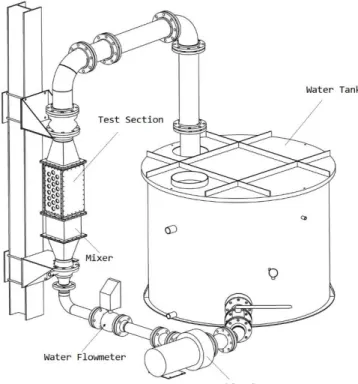
Figure 3-1 : Test Loop. ... 34
Figure 3-2 : Test Section and Displacement Mechanism: (a) Test section of a Rotated Triangular Tube Array, (b) Central Tube Mounted on the Linear Motor. ... 35
Figure 3-3 : Tube array configuration ... 35
Figure 3-4 : Magnitude of unsteady fluid force coefficient versus Up/ fD. ... 38
Figure 3-5 : Phase of unsteady fluid force coefficient versus Up / fD . ... 38
Figure 3-6 : Drag coefficient variation with tube displacement. ... 39 Figure 3-7 : Lift coefficient variation with tube displacement for a range of Reynolds numbers. 41
Figure 3-8 : Drag coefficient versus Reynolds number. ... 42
Figure 3-9 : Lift coefficient versus Reynolds number. ... 42
Figure 3-10 : Amplitude of the time delay function against k and Re. ... 43
Figure 3-11 : Phase of the time delay function against k and Re. ... 43
Figure 3-12 : Phase of the time delay function against k. ... 45
Figure 3-13 : The effect of Reynolds number on the memory function. ... 47
Figure 3-14 : Comparison with different memory functions for rotated triangular tube array with P/D=1.5. ... 48
Figure 3-15 : Stability threshold for rotated triangular tube arrays. , experiment data from (D. t. Weaver & Fitzpatrick, 1988); , experiment data from (Sawadogo & Mureithi, 2014b);
, experiment data from (Violette et al., 2006); , Quasi-unsteady model; , Current model ... 50Figure 3-16 : Local stability threshold. , experiment data from (D. t. Weaver & Fitzpatrick, 1988); ,experiment data from (Sawadogo & Mureithi, 2014b);
, experiment data from (Violette et al., 2006); , Quasi-unsteady model; , Current model. ... 51Figure 4-1 : Computation domain ... 55
Figure 4-2 : Top view of the mesh ... 55
Figure 4-3 : Local mesh around the central tube ... 56
Figure 4-4 : Time averaged streamline ... 58
Figure 4-5 : Local streamline around the central tube ... 59
Figure 4-6 : The contour of averaged pressure ... 59
Figure 4-7 : Drag and lift force ... 60
Figure 4-8 : Mean drag and lift forces ... 61
Figure 4-9 : Time averaged streamline ... 61
Figure 4-10 : Local streamline around the central tube ... 62
Figure 4-12 : Drag and lift force ... 63 Figure 4-13 : Mean drag and lift forces ... 64 Figure 5-1 : Typical fluctuating velocity spectra of an in-line tube bundle. (a) air tests; (b) water
tests. (Samir Ziada, 2006) ... 68 Figure 5-2 : Typical Strouhal number chart for vorticity shedding in parallel triangle arrays. ... 68 Figure 5-3 : PSD of the static fluid forces acting on the central tube in the rotated triangular tube
array versus velocity. ... 69 Figure 5-4 : Typical indicial function of a bluff body ... 71 Figure 5-5 : Stability threshold for rotated triangular tube arrays. , experiment data from (D. t.
Weaver & Fitzpatrick, 1988); , experiment data from (Sawadogo & Mureithi, 2014b);
, experiment data from (Violette et al., 2006); , Quasi-unsteady model; , Current model ... 73LIST OF SYMBOLS AND ABBREVIATIONS
Ms , Cs , KsThe mass, damping and stiffness matrices of the structure, respectively , , f f f M C K
The added mass, damping and stiffness matrices of the fluid, respectively
, ,
x x x Tube acceleration, velocity, displacement vector, respectively
f
F General form of the fluid force
Fluid density
, p
U U Flow free stream velocity, flow pitch velocity, respectively
D Tube diameter
Complex eigenvalue
The parameter of the constant time delay quasi-steady model
Dimensionless time
( )
Memory function
,
i i
Memory function parameters
( )
H
Heaviside step function, ,
D CL L y
C C
Steady drag and lift coefficients, derivative of the lift coefficient with respect to the dimensionless displacement in the lift direction,
respectively
k Reduced frequency
C k Equivalent Theodorsen Function
( ), ( )
F k G k The real part and imaginary part of C k( ), respectively
( ), ( )
A k
k The magnitude and phase of C k( ),
f f
C The magnitude and phase of the unsteady fluid force coefficient ,
da s
C C Damping and stiffness coefficient, respectively
Fy
CHAPTER 1
INTRODUCTION
1.1 Research background
Nuclear power as a sustainable energy source plays an important role in society. In 2013, there were 437 nuclear power reactors operated in 31 countries and provided 10% of the world’s electricity (IAEA, 2013). In nuclear power plants, steam generators, whose function is to facilitate the heat exchange between two fluid media, have significant effects on the generating efficiency. At first, thermal-hydraulic and heat transfer issues were the primary considerations to enhance the efficiency. Lighter and more slender structures were thus applied. Despite great progress in the improvement of energy output, the specific problem, namely, flow induced vibration (FIV), occurred and became a great concern in the nuclear industry for several decades. It is well known that heat transfer benefits from cross-flow, but higher vibration levels and the possibility of flow-induced instabilities arise. Many incidents of failure in commercial steam generators due to the undesirable vibrations with large amplitudes have been reported (Pettigrew & Taylor, 1991). Almost all heat exchangers, not only limited to steam generators, suffered from this problem during their operation.
Flow-induced vibration (FIV), as the name suggests, is the interaction between fluids and structures that causes excessive vibration. The phenomenon has been studied since 1970s and due to great research effort dedicated to this issue, its mechanism is now better understood. It is generally agreed that four different vibration excitation mechanisms are important in heat exchanger tube arrays. These mechanisms include periodic vortex shedding, random excitation caused by flow turbulence, fluidelastic instability and acoustic resonance (Pettigrew & Taylor, 2003a). The first two kinds of excitation mechanisms are already well known. Periodic vortex shedding takes place when the fluid flow passes over a cylinder at certain velocity. Once the shedding frequency coincides with the natural frequency of the cylinder, excessive vibration will occur and thereby destroy the structure. However, it seems unlikely to happen inside the tube bundles due to the complex structure and high Reynolds number. Pettigrew et al. (2004) carried out detailed flow measurements in a rotated triangular tube array subjected to two-phase cross-flow and identified that even at high void fraction up to 90% no evidence of periodic vortex shedding can be found. The turbulent nature of flow introduces the random pressure fluctuations acting on the surface of
the cylinder which may cause the vibration. Khalvatti (2007) pointed out that turbulence-induced vibrations have little effect on short term damage of the structure but play an important role in the long term wear due to the friction between the tubes and supports. Acoustic resonance occurs in gas flow when the acoustic mode in the tube array matches the vortex shedding frequency. It may amplify the vibration response and create considerable noise leading to fatigue damage.
Fluidelastic instability (FEI) is different in nature from the other types of excitation mechanisms because the fluidelastic forces are motion dependent. The instability depends not only on the flow velocity, but on the tube frequency, the tube bundle configuration and the support effectiveness. This kind of instability has the greatest potential for short term damage to heat exchangers and thus must be avoided in all cases. Figure 1-1 illustrates the amplitude response of a flexible tube in a tube array subjected to cross flow.
Figure 1-1 : Vibration amplitude of a flexible tube versus pitch flow rate (Pettigrew & Taylor, 1991)
Several theoretical or semi-empirical models have been developed to predict the critical velocity for fluidelastic instability. These include the static (Blevins, 1974; Connors, 1970), quasi-steady (Price & Paidoussis, 1984), quasi-unquasi-steady models (Granger & Paidoussis, 1996; Meskell,
2009), the analytical channel flow model (Lever & Weaver, 1982) and the unsteady model (Chen, 1987; Tanaka & Takahara, 1981).
The differences among these models lie in the definitions of the dynamic fluidelastic forces. For example, the quasi-steady model was developed based on the position dependent steady fluid forces measured on the tubes. In the analytical channel flow model, the fluid forces are estimated directly using the unsteady Bernoulli equation. The unsteady model was developed by measuring directly the unsteady forces acting on the vibrating tubes. Those models will be reviewed in details in the following chapter.
One of the most important parameters among these models is the time delay, or phase lag, between the tube motion and the fluid forces generated thereby. The quasi-steady model introduced a constant time delay due to retardation of the flow approaching the cylinder (the flow velocity slows down as it nears the cylinder). The quasi-unsteady model proposed a memory effect not the constant time delay and attributed this effect to the reorganization of the viscous wake flow. While in the semi analytical model, this time delay is associated with a mass flow redistribution due to fluid inertia.
The idea of introducing a time delay is not only limit to fluidelastic instability in tube arrays, but also considered in the analysis of flutter of airfoils in unsteady aerodynamics theory. The Wagner’s indicial function (Wagner, 1925) and the Theodorsen function (Theodorsen, 1934), which have been widely used for many years, described the time delay between the fluid forces acting on the airfoil and the step transient in the angle of attack in the time domain and the frequency domain, respectively. By reformulating and adapting the expressions of the time delay functions, The Wagner’s indicial function and Theodorsen function can also be extended to bluff bodies such as bridge decks (R. H. Scanlan, 1996), square-section cylinders (Luo & Bearman, 1990). Significant successes have been achieved in this extension of unsteady aerodynamics theory. It is, therefore, reasonable to expect that the unsteady aerodynamics theory should be applicable to cylinders in tube arrays to investigate the time delay.
1.2 General objectives and specific objectives
The need to introduce a time delay effect in the fluidelastic instability models is well agreed upon, although the phenomenon behind this time delay is still subject to many possible explanations and
the physics are not well understood. Therefore, the general objective of the research is to investigate the time delay effect for the fluidelastic instability models in order to shed light on the physics of fluidelastic instability. More specifically:
1. The time delay, which specifies the characteristics between the perturbations in the flow and their effects on the tubes, greatly affects the theoretical models. The underlying physics is not fully understood. It is therefore proposed in this work to extend the unsteady aerodynamics theory to the fluidelastic instability model in tube arrays in order to shed more light on the physics of fluidelastic instability.
2. To apply the concept of an Equivalent Theodorsen Function to obtain the time delay formulation for tube arrays in a frequency domain representation.
3. To measure the unsteady fluid forces and quasi-static forces in a rotated triangular tube array subjected to water flow for determining the Equivalent Theodorsen Function.
4. To conduct the stability analysis of predicting the critical velocity for fluidelastic instability and to evaluate the performance of the newly proposed model
1.3 Methodologies
It is well known that FEI may occur even for a single flexible cylinder in a rigid tube array subjected to cross flow. Lever and Weaver (1986) pointed out that the single flexible tube in the rotated triangular tube array has essentially the same critical velocity as the corresponding fully flexible tube array and the dynamic instability occurs in the transverse direction. For simplicity, consideration is given here to the particular case of a single flexible tube in an otherwise rigid tube array which is free to move in the transverse direction. We note, however, that the time delay function to be developed remains valid for fully flexible arrays with appropriate considerations. The determination of the time delay formulation will be done by measuring the unsteady and quasi-static fluid force coefficients in a rotated triangular tube array subject to water flow with a pitch ratio of 1.5. The unsteady fluid forces can be measured by integration of the pressure field on the surface of the tubes, or be measured indirectly by using the force sensor instrumented on the tube. In the latter case, the inertia of the tube and the fluid added mass are, however, incorporated in the measured forces. The added mass is measured in still water and a relatively high frequencies. A
transfer function between the fluid force and the displacement of the vibrating tube can be applied to obtain the fluid force coefficients from the measured forces.
To validate the theoretical model, stability analysis will be conducted and compared with experiments. Considering the limitation of time, the experimental stability test will not be conducted in the present work. Instead, the experimental results from the literature (Sawadogo & Mureithi, 2014b; Violette et al., 2006; D. t. Weaver & Fitzpatrick, 1988) will be used for comparison.
1.4 Presentation of the thesis
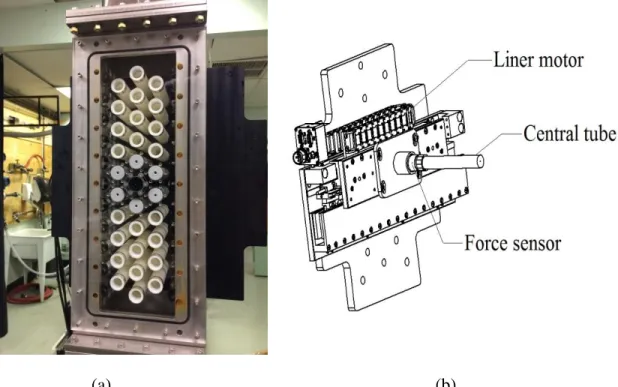
The main work done to develop a time delay formulation for FEI model is presented in Chapter 3 as a journal article. Firstly, a time delay formulation using the concept of the Equivalent Theodorsen Function was developed in the frequency domain. A test section was designed to measure the unsteady and static fluid forces. The test section includes a rotated triangular tube array with a pitch ratio of 1.5, a linear motor which is mounted on the central tube, instrumented with a force sensor ATI Nano25 and a displacement system allowing the tube to be displaced in the transverse direction. The Equivalent Theodorsen Function which is developed in a frequency domain representation was extracted from the experimental data. It was compared with the other time delay functions. Using the Equivalent Theodorsen Function, a stability analysis was conducted to predict the critical velocity for fluidelastic instability. The theoretical results were compared with experimental data and other FEI models to assess the validity of the proposed model.
The Reynolds number effect on the force coefficients on the central tube in a rotated triangular tube array is investigated based on CFD in Chapter 4. Some results presented in Chapter 3 are discussed in Chapter 5. Some supplementary discussions are also presented in Chapter 5, including the flow periodicities in tube arrays, the general relation of time delay function for aeroelastic systems and the limitation of the stability analysis. Conclusions and recommendations for future work are presented in Chapter 6.
CHAPTER 2
LITERATURE REVIEW
2.1 The nature of fluidelastic instability in tube arrays
Fluidelastic instability is a self-excitation mechanism due to the motion-dependent forces. In tube arrays, when a tube is subjected to cross flow, the tube moves from its initial (equilibrium) position. The displacement causes a further change in the fluid force acting on the tube. The damping force absorbs the energy to back its equilibrium position to compete with the fluid force. From the viewpoint of energy, if the energy consumed by damping force exceeds the energy input by the fluid force, the vibrations die out. Conversely, if enough energy is provided to sustain the vibration, the amplitude will grow rapidly. This occurs when the flow velocity exceeds a critical threshold level which is called the critical velocity. Once instability occurs the tube will be damaged by fretting wear at the supports, by clashing with neighbouring tubes or by fatigue.
(i,j) (i+2,j) (i-2,j) (i+1,j+1) (i-1,j+1) (i+1,j-1) (i-1,j-1) x y Flow Direction
To describe the fluidelastic instability in a tube array subjected to cross-flow as shown in Figure 2-1 in detail, the general equation of motion for the system can be written as (Chen, 1987)
M
X
C
X
K
X Fe (2.1) or
s f s f s f e M M X C C X K K X F (2.2)where
M , C , K are the mass, damping and stiffness matrixes, respectively. The subscripts s and f represent structure and fluid, respectively.
X represents the tube acceleration vector,
X the tubes velocity vector and
X the tubes displacement vector. F is the external forcing e term. It should be noted that
M , C , K are functions of
X , X ,
X in general.From the viewpoint of dynamics, the system is considered to be stable if both modal damping and stiffness terms are positive. The modal stiffness terms switch from positive to negative indicates the occurrence of static instability, also known as divergence. Dynamic instability occurs when physically there is a net energy increase per oscillation causing a dramatic growth in response amplitude as shown in Figure 1-1. It may be caused by two distinct mechanisms: damping (or velocity) controlled and stiffness (or displacement) controlled instability (Chen, 1987).
Damping controlled instability take place when the net damping switches from positive to negative. It only needs one degree-of-freedom (Lift direction). The fluid force producing instability is in phase with the tube velocity. Stiffness controlled instability is caused by the antisymmetric stiffness term. It is also called coupled mode flutter (in aeroelasticity) since at least two modes are required such that the relative motion between tubes can produce the force to overcome the structural damping. In this kind of instability the fluid forces are in phase with the tube displacements. Some theoretical or semi-empirical FEI models have been developed to predict the critical velocity such as the quasi-static (Blevins, 1974; Connors, 1970), the quasi-steady (Price & Paidoussis, 1984), the quasi-unsteady model (Granger & Paidoussis, 1996; Meskell, 2009), the semi-analytical channel flow model (Lever & Weaver, 1982) and the unsteady model (Chen, 1987; Tanaka & Takahara, 1981). The differences among these models lie in the definitions of the dynamic fluidelastic forces. For example, the quasi-steady model was developed based on the steady fluid forces measured on the tube placed at various positions. In the channel flow model, the fluid forces
are estimated directly using the unsteady Bernoulli equation. The unsteady model was developed by measuring directly the unsteady forces acting on the vibrating tubes. One of the most important parameters among these models is the time delay, or phase lag, between the tube motion and the fluid forces generated thereby. In general, for a cylinder subjected to a cross-flow, the flow-induced forces acting on it will be time dependent as a consequence of motion or turbulence in the approaching flow. When a sudden change happens in the position of the cylinder relative to the cross-flow, a transient is initiated in the associated force acting on the cylinder. This is typically not instantaneous but takes some time to develop. This time taken to develop the steady fluid force is the time delay. The main goal of the present work is to develop a new time delay formulation for FEI models and to shed light on the physics of FEI. First, a brief review of some fundamental FEI models is presented as follows
2.2 Theoretical models for fluidelastic instability
2.2.1 Jet-Switching model
U Up Small wake Large wake Imaginary boundary Imaginary boundary Upstream Cylinder Downstream CylinderThe Jet-Switch model, proposed by Roberts, is the first semi-analytical model to study fluidelastic instability in tube arrays subjected to cross flow. Roberts found that the fluid jets developed behind a single row of cylinders subjected to cross flow. The instability was limited to the in-flow direction building on his preliminary experiments. A hypothetical channel flow was proposed as shown in Figure 2-2. The flow through two rows of cylinders is represented by two wake regions (one large and one small) developed behind the two adjacent downstream half cylinders, a jet flow between them and imaginary boundaries. The jet switched as the cylinder was moving upstream and downstream, inducing a variation in the pressure distribution and thus a variation of drag force, resulting in fluidelastic instability. Assuming that the flow separation occurs at the minimum cross section between the cylinders, that the flow upstream of separation points and in the jet region is inviscid, and the pressure in the wake regions to be constant, the pressure distribution can be obtained analytically and then the drag force can be achieved by integration. He obtained equation (2.3) for the critical velocity by neglecting both the effects of unsteady and fluid damping.
0.5 2 c n U m K D D (2.3)
where ε is the ratio of fluidelastic frequency to structural frequency, which is approximately 1.
c
U is the critical flow velocity, f is the tube natural frequency, m/D2 is the non-dimensional mass parameter, is the logarithmic decrement and K is the constant. It is the initial form of the well-known Connors equation.
Although the jet-switch model showed a poor agreement with experiments because of the fact that most experiments indicated that instability predominantly occur normal to flow, the analysis shed some light on the mechanism of fluidelastic instability, including the consideration of the time delay effect and the initial form of Connors equation.
2.2.2 Quasi-Static model
The quasi-static model can be understood through the idea that the motion of the tube is sufficiently slow such that the fluid-dynamic forces acting on the cylinder oscillating in flow are equal to, at any instant of time, the forces on the stationary cylinders in the identical position. The quasi-static model was first developed by Connors for the instability of a single row of cylinders subjected to cross flow. The author observed that the main oscillating patterns of the cylinders when instability
occurs are elliptical orbits either streamwise or in the cross-stream direction. Given the fact that jet switching cannot occur for low U fD , he concluded that jet switching is not the mechanism leading to instability. Connors measured the fluid force coefficients instead of determining them analytically. By neglecting the fluid damping terms and performing an energy balances in the in-flow and cross-in-flow directions, Connors obtained the most famous expression for fluidelastic instability as follows: 0.5 2 c U m K fD D (2.4)
where K is the Connors constant for which Connors obtained as 9.9 for the tube row.
Connors model achieved reasonable success in the engineering field due to its simplicity and satisfactory accuracy. It was used to design tube bundles of various geometrical arrangements by choosing the appropriate value of K . Blevins (1974) also formalized this expression mathematically and extended the quasi-static model to analyze tube arrays. He suggested that the constant K needs to be changed depending on the tube array. H. Connors (1978) also demonstrated that the constant is a function of the tube pattern and spacing. He obtained the correlation
0.37 1.76
K T D for 1.41T D2.12 based on experimental results, where T is the separation between cylinders in a row. Pettigrew (1978) extended the quasi-static model to the two-phase flow and suggested a conservative value of K 3.0based on a number of experimental observations.
However, the quasi-static theory does not always hold well when compared with experimental results. The quasi static theory is limited, as Tanaka and Takahara (1981) pointed out, since the quasi-static fluid force is always in phase with the displacement (only dependent on displacement) and the effect of the unsteady fluid force component is ignored.
2.2.3 Unsteady model
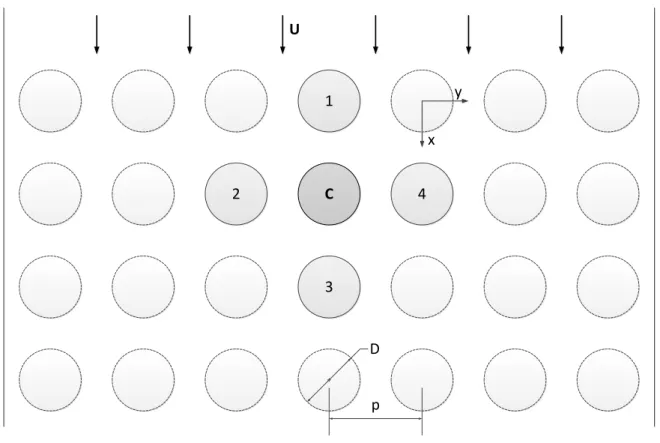
Tanaka and Takahara (1980, 1981) presented an unsteady model which takes into consideration all components of the fluid dynamic forces. The square tube array with 4 rows and 7 columns and the pitch ratio of 1.33 was considered as shown in Figure 2-3. The fluid force acting on the cylinder C
was assumed to be induced by the cylinder itself and the four neighbouring cylinders numbered as 1-4. The unsteady drag and lift forces acting on the cylinder were then expressed as
2 2 2 4 2 2 4 1 1 3 3 2 2 2 4 2 2 4 1 1 3 3 1 ( ) 2 1 ( ) 2 x xcx c x x x y x x x x y ycy c y y y y y y y y F U C x C x x C y y C x C x F U C y C y y C y y C y C y (2.5)where Cxcx,Cycy, etc. are the fluid dynamic force coefficients, in which the first subscript gives the force direction, the second gives the position of the vibrating cylinder and the last subscript is the vibrating direction of the cylinder, respectively. The unsteady fluid forces acting on the cylinder were therefore measured by vibrating these five cylinders separately to obtain the corresponding force coefficients. 2 C 3 1 4 U D p y x
Figure 2-3 : Unsteady model
The critical velocity in air and water flow was then investigated using their measured unsteady force coefficients. The results showed that calculated critical velocities in water flow are a little less than the experiment data, while it is in quite good agreement with experiment data for air flow.
Tanaka and Takahara studied the effect of fluid density on critical velocity and gave the expressions for critical velocity as follows:
0.5 0.5 2 1/3 1/5 2
for low density fluid
for high density fluid
c c U m K fd d U m K fd d (2.6)
They also investigated the effect of detuning of the natural frequency on the critical velocity by varying the frequency of test tubes slightly. The critical velocity increases with detuning indicating that detuning of the natural frequency has a stabilizing effect.
Chen (1987) developed an analytical expression for the fluid forces based on the unsteady flow theory. His work proved that the other theories, such as quasi-static, quasi-steady, quasi-unsteady models, are special forms of the unsteady flow theory depending on the assumptions. The coefficients in the analytical expression were calculated by Chen and Jendrzejczyk (1983) based on Tanaka and Takahara’s data (1980, 1981; 1982). The authors proposed that the dynamic instability can be classified into two mechanisms: fluid-damping-controlled and fluid stiffness-controlled instabilities.
Although the unsteady model gives excellent agreement with experimental results, a great experimental effort is required to obtain the unsteady fluid force coefficients. As a practical tool of tube array design, the unsteady model is not considered to be the idea option.
2.2.4 Semi-analytical model
Based on experiments showing that a single flexible cylinder in a rigid array could have essentially the same critical velocity as the fully flexible tube array, Lever and Weaver (1982) developed the first semi-analytical model based on a single flexible tube in a unit cell of rigid tubes subjected to cross-flow as shown in Figure 2-4. The flow pattern is divided into two regions, streamtube or channel regions and front stagnation and wake regions. The key assumption of the model is that the excitation mechanism derives from motion dependent fluid forces in the streamtube regions. The flow near the front stagnation point and in the wake behind the cylinder was not considered as they argued that the flow in these regions has little effect on the stability in the transverse direction. The time delay was proposed as follows
0
/ l U
(2.7)
where l is the length of the streamtube and U the upstream velocity. The authors assumed that 0 the time delay originates from the mass flow redistribution lagging behind the tube variation due to the finite fluid inertia. The pressure distribution around the cylinder was solved analytically by applying the unsteady Bernoulli equation and as a result the fluid forces could be calculated.
Figure 2-4 : Semi-analytical model (Lever & Weaver, 1982)
Lever and Weaver (1986) modified the analytical model to describe the static and dynamic instability in the transverse and streamwise directions. The authors suggested that there is no flow redistribution in streamwise direction and thereby no dynamic instability in streamwise direction is predicted by the model. However, static instability was found to exist in both transverse and streamwise directions.
Yetisir and Weaver (1993) refined the theoretical model by introducing some assumptions, such as the disturbance decay function which accounts for flow perturbation due to the tube motion, phase function as well as flow attachment and separation points. The authors also extended the model to multiple flexible tubes in the array. The results indicated that the damping mechanism is predominant at low mass damping parameter, and the stiffness mechanism is predominant at high mass damping parameters with regard to fluidelastic instability. This finding is in considerable agreement with the quasi-steady model (Price & Paidoussis, 1984).
2.2.5 Quasi-Steady model
Price and Paidoussis (1984) developed the quasi-steady model for the fluidelastic instability of a double row of flexible tubes subjected to cross-flow as shown in Figure 2-5. The author assumed that the fluid forces acting on a tube are affected only by two adjacent tubes and the tube itself. The tube movement changes the resultant flow velocity of the fluid, the drag and lift forces are then parallel and normal to the resultant velocity, respectively. The coefficients of fluid forces were developed in a Taylor expansion using the coordinates of the surrounding cylinders.
k-1 K+1 k y x Ux y r U L 1 k L T 1 k L T 1 k TL 1 k TL Drag Lift U (a) (b) (c) 1st row 2nd row 2T Drag Lift
Figure 2-5 : Quasi-Steady model
The fluid dynamics of a typical downstream cylinder k (see Figure 2-5 (a)) are considered. U is the free-stream flow velocity. The inclination angle of the relative flow velocity is donated by as shown in Figure 2-5(b). The forces on cylinder k depend on the motion of cylinder k 1 and
1
k as well as on its own motion. It is, therefore, necessary to determine the apparent displacement of cylinder k 1 and k 1 as seen from cylinder k (see Figure 2-5 (c)).
Figure 2-6 : A comparison between the theoretical stability threshold and the experimental data for a single flexible cylinder in an array of rigid cylinders (Price & Paidoussis, 1984). Experimental data: , Connors (1980); , Gorman (1976); , Hartlen (1974); , Heilker and Vincent (1981);
, Pettigrew et al. (1978); , Soper (1980); , Weaver and Grover (1978); ,Weaver and El-Kashlan (1981).
A time delay of the fluid forces relative to the movement of the tubes was proposed. This effect was incorporated in the model, resulting in frequency-dependent terms contained in the stiffness and damping matrices. It is worth noting that the time delay arises from two aspects: (i) the time taken for the flow leaving an upstream cylinder to arrive at a downstream cylinder; (ii) the retardation of the flow approaching the cylinders. Using potential flow theory, the time delay due to flow retardation is expressed as follows:
p
D τ μ
U
(2.8)
where U is the fluid velocity, D the tube diameter, and P μ the time delay coefficient which is taken to be of order 1 as suggested by Simpson and Flower (1977). As the time delay coefficient is always taken as a constant, the quasi-steady model is also called the constant time delay model.
The comparison between the theoretical prediction of this model and the experimental stability boundaries for a single flexible cylinder in an array of rigid cylinders is shown in Figure 2-6. Although the quantitative agreement is not satisfactory, the slopes of the theoretical curve and experimental data are similar.
The authors pointed out that the fluidelastic instability is governed by the (i) negative fluid damping mechanism for mδ / ρd2 300 and (ii) stiffness controlled mechanism for mδ / ρd2 300 . Moreover, the authors suggested that the mass term and damping term in the Connors-type expression should not be lumped together for stiffness-controlled instability.
Price and Paidoussis (1986) extended this model to analyze the fluidelastic instability for a single flexible cylinder in an otherwise rigid array. The time delay parameter is taken to be unity, which appears to give the best agreement between theory and experiments. An improved prediction is obtained in an in-line square array with P/D=1.5. The authors also confirmed Lever and Weaver’s observation (Lever & Weaver, 1982) that for mδ / ρd2 300 , the single flexible cylinder in the midst of an array of rigid cylinders has approximately the same stability boundary as fully flexible array.
2.2.6 Quasi-Unsteady model
Granger and Paidoussis (1996) proposed an improvement to the quasi-steady model, namely the quasi-unsteady model, where the most important unsteady effects are considered. The continuity and Navier-Stokes equations were applied to develop the fluid forces induced by an impulsive motion of a body subject to cross-flow. A memory effect, rather than a constant time delay, was established. The authors postulated that the memory effect is due to the diffusion-convection process of the vorticity induced by the motion of the cylinder. The physics of time delay may be described as follows: a perturbation of the tube velocity disturbs the flow field in the neighborhood of the tube. The perturbation in the fluid force acting on the tube is therefore induced and decays continuously with time as the vorticity is transported downstream. The new steady state is obtained after the vorticity has been conveyed far away from the tube by the mean flow.
The modified fluid force is expressed as follows:
f f f
f M x C x K h x
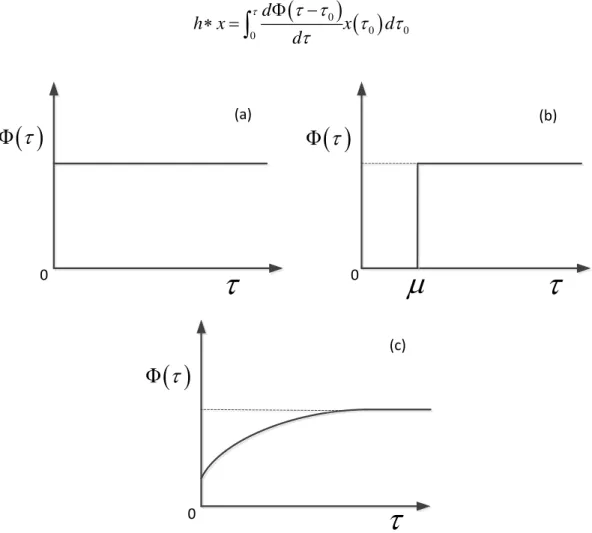
where Mf , Cf , Kf are the added mass, damping and stiffness matrices of the fluid. The convolution function which is in terms of the dimensionless timeτ(τ = Ut D⁄ ) in Eqn. (2.9) is defined as follows:
0
0 0 0 d h x x d d
(2.10)
Φ
Φ
Φ
0 0 0 (a) (b) (c)Figure 2-7 : Comparison of different time delay models. (a) quasi-static model; (b) quasi-steady model; (c) quasi-unsteady model.
In Eqn. (2.10), ( ) is the time delay function, or memory function, which is of key interest to the quasi-unsteady model. The memory function, which accounts for the time delay, tends to one as
. This can be approximated by a linear combination of decaying exponentials and a Heaviside step function H
as follows
1 Φ 1 i N i i e H
(2.11)It is noteworthy that this memory function forms a general framework for the foregoing models. The quasi-static model can be retrieved by setting i , and the quasi-steady model by i 0 setting i i 0, H
H
. The values for i and i in this model were obtained with experimental data.The different transient behaviors of the lift coefficient for the quasi-steady and quasi-unsteady models are shown in Figure 2-7.
To support the assumption of the physics of the time delay proposed by Granger and Paidoussis (1996), Meskell (2009) proposed a simple wake model to clarify that the underlying process of vorticity transport accounts for the time delay. The memory function is obtained by numerical integration of the governing equations without calibrating the model with experimental data. Although the memory effect may appear novel in a quasi-unsteady analysis, the use of memory effect is far from new, and as early as 1950, this effect was deemed to be important in the unsteady airfoil theory. It is worth noting that if the transient function of the quasi-unsteady model is taken as the Wagner’s function (Wagner, 1925), the lift force acting on the cylinder is the same as the lift force acting on the airfoil due to the growth of circulation. since we believe that the unsteady airfoil theory has a degree of generality and is also applicable to the cylinder, the extension of the theory will be briefly introduced later.
2.2.7 Computational Fluid Dynamics model
To study fluid-structure interaction problems, Computational Fluid Dynamics (CFD) has a great advantage over the other methods at solving the governing equations. The developments in CFD and the availability of more powerful computers have paved the way for the modeling and predicting fluidelastic instability. Due to the high turbulence and viscous effects of the fluid flow inside the tube arrays, the full Navier-Stokes equations with moving boundaries are required to simulate the tube motions. Kassera and Strohmeier (1997) used the k turbulence model to predict the flow-induced vibrations of six different tube bundles. Although they could not predict the correct critical velocity for fluidelastic instability, the simulations of vibration amplitudes agreed well with experiment data for low Reynolds numbers. Schröder and Gelbe (1999) carried out two- and three-dimensional CFD simulations to predict fluidelastic instability in tube bundles. The k and k turbulence models were compared and the simulations indicated that the
k model provides the best results. However, the predicted critical velocities were too low compared with experimental results. Khalifa et al. (2013) developed a simplified two-dimensional CFD model for a parallel triangular tube array with a pitch ratio of 1.54. The Reynolds Averaged Navier-Stokes equations (RANS) and the Shear Stress Transport (SST) turbulence model were used. The moving boundaries were employed to obtain the flow velocities and time dependent pressure distributions. The surface pressure distributions given by the CFD results were in good qualitative agreement with the experiments of Mahon and Meskell (2012). The phase lag function obtained from the CFD results was then applied in the Lever and Weaver’s semi-analytical model for FEI. A significant improvement of the predictions was provided by the model, especially for low reduced velocity which eliminated the infinite stability regions.
Although computational fluid dynamics (CFD) has improved significantly in recent years, no computational model, at least at present, can solve the fully coupled governing equations with the tube motion equations for practical Reynolds numbers and provide reliable predictions for fluidelastic instability.
2.3 Extension of unsteady aerodynamics theory
It is worth noting that the memory function Φ
in Eqn.(2.11) is identical to the approximate expression of the Wagner function of unsteady aerodynamics theory. Luo and Bearman (1990) applied the unsteady aerodynamics theory to estimate the fluctuating lift force induced by the transverse oscillation of a square-section cylinder. This model improved agreement between theory and the experiments which shows that the unsteady aerodynamics theory should have a certain degree of generality and may also be applicable to cylinders in tube array.In unsteady aerodynamics theory, descriptions in both time- and frequency- domains of the aerodynamic forces acting on the thin airfoils have been applied in the aeroelastic analysis models of airfoils with reasonable success. Among the wide range of unsteady aerodynamics models, the classical models of Wagner (1925) and Theodorsen (1934) remain widely used for over three-quarters of a century. These two models will be reviewed briefly as follows and the interested reader is referred to Fung (2002) for more detailed information.
Wagner proposed the so-called indicial function which gives the relationship between the indicial lift force and the transient step change in angle of attack of an airfoil in an inviscid flow. If the
airfoil experiences an abrupt step-function change from steady state to an incremental angle of attack 0 in an incompressible fluid, the lift force undergoes a transient change expressed as follows:
2 0
( ) 2 b ( )
L U (2.12)
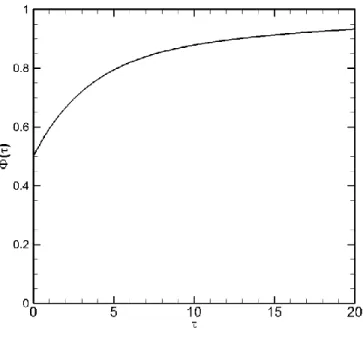
where Ut b/ is a non-dimensional time, b the half chord of the airfoil. The function ( ) , called Wagner’s function or the indicial function, is illustrated in Figure 2-8.
Figure 2-8 : Wagner’s function for an incompressible fluid.
Theodorsen obtained a transfer function in terms of the lift force and the motion of the airfoil under harmonic oscillations. Assuming a thin airfoil undergoing harmonic vertical (h) and torsional (t) motion in a potential flow:
0 0 , 0 0
i t ik i t ik
t
hhe h e e (2.13)
where kb U/ is the reduced frequency
The theoretical lift force can be expressed as follows:
2
( ) b ( t h ab t) 2 b U ( ) t h b(0.5 t) t
where ab is the distance from the airfoil midchord to the oscillatory rotation point and the function ( )
C k is the renowned Theodorsen function
( ) ( ) ( )
C k F k iG k (2.15)
originally expressed in terms of Bessel or Hankel functions. The function F and Gare plotted in Figure 2-9. It should be noted that although the lift force is expressed in the time domain, the Theodorsen function is defined in the frequency domain which is the built-in characteristic of the classical flutter theory.
Figure 2-9 : Real and imaginary components of Theodorsen function.
For a harmonic motion consisting only of the vertical velocity h the lift force according to Eqn. (2.14) is 2 ( ) 2 bU tC( ) L k (2.16) where / t h U
Garrick (1938) and Jones (1938) observed that Theodorsen and Wagner functions are equivalent representations of the effect of the wake (the lift force due to circulation) in the frequency domain
and time domain, respectively. It is worth noting that the time-domain indicial function developed by Wagner, and the frequency domain formulation proposed by Theodorsen are obtained with the hypothesis of inviscid and fully attached flow.
These descriptions both in time-domain and frequency-domain, were not only employed to the motion-induced forces on the streamlined airfoil, but reorganized and adjusted to the nonstreamlined bodies, such as the bridge decks (R. H. Scanlan, 1996) and rectangular cylinders (Hatanaka & Tanaka, 2008). In these cases, the vortex shedding, flow separation, reattachment and other possible unsteady effects may occur in the flow which is not compatible with the hypothesis mentioned before. The analytical closed-form formulations for the motion-induced forces are hence not available. Nevertheless, several approaches have been developed to overcome such a drawback.
In the cases of domain approaches, it is common practice to obtain the frequency-dependent functions (namely, the flutter derivatives or aeroelastic derivatives which are similar to the Theodorsen function) by experimental means (Miranda,S, 2013). In the context of bridge decks, the aerodynamic loads acting on bridge sections were expressed in a linearized format. The flutter derivatives were evaluated by forcing a harmonic motion on the section and extracting the derivatives via the method of least squares (Simiu & Scanlan, 1996).
As regards the time-domain approaches, great challenges exist in the experimental evaluation of the indicial function (similar to the Wagner function) due to the difficulties arising in the direct measurements of the response to step motions. The computational fluid dynamics (CFD) approaches have therefore been developed to obtain the indicial function, such as in the work of Farsani et al. (2014), Hatanaka and Tanaka (2008) and Braun and Awruch (2003). R. Scanlan (2000) first presented the interrelationships between the indicial functions and the flutter derivatives. An indicial function for the bluff section was achieved based upon the measured flutter derivatives.
2.4 Summary
In the previous sections, the different vibration mechanisms including periodic vortex shedding or more generally, flow periodicities, random excitation caused by turbulent flow, fluidelastic instability and acoustic resonance have been described. It is generally agreed that fluidelastic
instability is the most severe case which has the great potential for short term damage to heat exchangers.
Several theoretical models for fluidelastic instability were also presented. The jet-switching model confined the instability in the in-flow direction which is not in accord with most experiments which indicate that instability predominantly occurs in the direction transverse to the flow. Connor’s model is the most popular model in industry because of its simplicity and satisfied accuracy. However, the phase between the fluid force and the displacement and the effect of unsteady fluid force are ignored. Besides, the Connors model can only predict the critical velocity. Therefore, interest in the study of the vibration response of the structure before and after the instability cannot be answered. The unsteady model gives the best agreement with experimental results. Nevertheless, it requires a great effort in the unsteady fluid force measurements which indicates that it is not the priority as a practical model for the tube array design. In the semi-analytical model, the fluid forces are obtained using unsteady Bernoulli equation. The model can only predict the instability in cross-flow direction and fails to predict the stiffness-controlled instability. Recently, Hassan and Weaver (2016) attempted to extend this model to predict streamwise instability. The quasi-steady and quasi-unsteady models, on the other hand, have the advantage of requiring less experiment effort and overcome the theoretical problems mentioned above. The main difference between the quasi-steady and quasi-unsteady models is the definition of the induced time delay. As previously noted, from the very beginning of the jet switch model, quasi-static model to the sophisticated quasi-steady, quasi-unsteady and semi-analytical model and then to the more general unsteady model, one of the most important parameters among these models is the time delay, or phase lag, between the tube motion and the fluid forces generated thereby. In the semi-analytical model, the time delay originates from the mass flow redistribution lagging behind the tube motion due to the finite fluid inertia. A constant time delay was introduced in the quasi-steady model. The origin of time delay arises from two aspects: (i) the time taken for the flow leaving an upstream cylinder and arriving at a downstream cylinder; (ii) the retardation of the flow approaching the cylinders. Later, it became clear that the constant quasi-steady model is unphysical and the model fails to predict instability if the lift derivative is positive. Instead of a constant time delay, a memory effect was proposed in the quasi-unsteady model assuming the effect is due to the diffusion-convection process of the vorticity induced by the motion of the cylinder.
Similar to the case of tube arrays, a time delay between the lift force and the motion of an airfoil also occurs in the unsteady aerodynamics theory. A great effort of research has been dedicated to this phenomenon. The Wagner’s indicial function (Wagner, 1925) and the Theodorsen function (Theodorsen, 1934), which have been widely used for over three-quarters of a century, described the time delay in the time domain and the frequency domain, respectively. Several researchers extended these models to bluff bodies such as bridge decks (R. H. Scanlan, 1996), square-section cylinders (Luo & Bearman, 1990) by reformulating and adapting the time delay function. Significant successes have been achieved in this extension of unsteady aerodynamics theory. It is, therefore, reasonable to expect that the unsteady aerodynamics theory should be applicable to cylinders in tube arrays to study the time delay.
CHAPTER 3
ARTICLE 1: DEVELOPMENT OF A TIME DELAY
FORMULATION FOR FLUIDELASTIC INSTABILITY MODEL
Li H. and Mureithi N. W (2016) submitted to Journal of Fluids and Structures (10th June 2016).
Abstract
Tube arrays in industrial components such as heat exchangers and steam generators are susceptible to damage due to fluidelastic instability (FEI). In the present work a new time delay formulation for the quasi-steady FEI model is derived in the frequency domain in the form of an Equivalent Theodorsen Function. Unsteady and quasi-static fluid forces were measured to determine the time delay formulation. The effect of Reynolds number on the static force coefficients was also investigated. The time delay function was found to be also dependent on the Reynolds number. Comparison to other time delay functions proposed in the steady and quasi-unsteady models is made. Using the new function, a stability analysis was carried out to predict the critical velocity for a range of mass-damping parameters and compared with other theoretical models. The results show a significant improvement over the constant time delay quasi-steady model and the quasi-unsteady model.
Key words: fluidelastic instability, Time delay, Theodorsen function, Lift coefficient, Reynolds number.
Nomenclature
Ms , Cs , Ks The mass, damping and stiffness matrices of the structure, respectively, ,
f f f
M C K
The added mass, damping and stiffness matrices of the fluid, respectively
, ,
x x x Tube acceleration, velocity, displacement vector, respectively
f
F General form of the fluid force
Fluid density
, p
U U Flow free stream velocity, flow pitch velocity, respectively
D Tube diameter
Complex eigenvalue
Dimensionless time
( )
Memory function
,
i i
Memory function parameters
( )
H
Heaviside step function, ,
D CL L y
C C
Steady drag and lift coefficients, derivative of the lift coefficient with respect to the dimensionless displacement in the lift direction,
respectively
k Reduced frequency
C k Equivalent Theodorsen Function
( ), ( )
F k G k The real part and imaginary part of C k( ), respectively
( ), ( )
A k
k The magnitude and phase of C k( ),
f f
C The magnitude and phase of the unsteady fluid force coefficient ,
da s
C C Damping and stiffness coefficient, respectively
Fy
H Transfer function between the unsteady fluid force and tube motion
3.1 Introduction
Tube arrays in industrial components such as heat exchangers and steam generators are susceptible to damage due to flow-induced vibration (FIV). As the name suggests, FIV is the interaction between fluids and structures that can potentially cause excessive tube vibration. The phenomenon has been studied at least since the 1970s. Significant research effort has been dedicated to FIV so that the main mechanisms are now reasonably well understood. It is generally agreed that four different vibration excitation mechanisms are normally important in heat exchanger tube arrays. These mechanisms include periodic vortex shedding or more generally, flow periodicities, random excitation caused by turbulent flow, fluidelastic instability and acoustic resonance. Fluidelastic instability (FEI), among these mechanisms, is considered to have the greatest potential for short term damage to heat exchangers.
Fluidelastic instability is a self-excitation mechanism due to the motion-dependent fluid forces. The amplitude of vibration grows once the flow velocity exceeds a critical threshold. It is well known that even a single flexible tube in an otherwise rigid tube array subjected to cross-flow may
experience large amplitude vibration due to FEI. Because of its extremely destructive nature, a considerable research effort has been undertaken over the past fifty years in an attempt to reveal the underlying mechanisms leading to fluidelastic instability. Some excellent reviews on the subject are provided by Paidoussis (1983), Price (1995),D. t. Weaver and Fitzpatrick (1988), Pettigrew and Taylor (1991, 2003a, 2003b) and Chen (1984).
Fluidelastic instability may be caused by two distinct mechanisms: the damping controlled and the stiffness controlled instability mechanisms. Damping controlled instability is governed by the velocity dependent fluid forces and takes place when the total damping switches from positive to negative. The mechanism only needs one degree-of-freedom. Stiffness controlled instability is caused by the antisymmetric stiffness term. It is also called coupled mode flutter (in aeroelasticity) since at least two modes are required such that the relative motion between tubes can produce the force needed to overcome the structural damping.
The general governing equation of motion for the tube array subjected to single-phase cross-flow can be written as
Ms x Cs x Ks x Ff
x x, , , , , ,x U D
(3.1) where
Ms , Cs , K are the mass, damping and stiffness matrices of the structure, respectively. sf
F is the general form of the fluid force,
x the tube acceleration vector,
x the tubes velocity vector and
x the tubes displacement vector.Some theoretical or semi-empirical models have been developed to predict the critical velocity for fluidelastic instability. These include the quasi-static (Blevins, 1974; Connors, 1970), quasi-steady (Price & Paidoussis, 1984), quasi-unsteady models (Granger & Paidoussis, 1996; Meskell, 2009), the analytical channel flow model (Lever & Weaver, 1982) and the unsteady model (Chen, 1987; Tanaka & Takahara, 1981). The differences between these models lie in the definitions of the dynamic fluidelastic forces which are the terms in the right hand side of the governing equation as shown in Eqn. (3.1). For example, the quasi-steady model was developed based on the position dependent steady fluid forces measured on the tubes. In the analytical channel flow model, the fluid forces are estimated directly using the unsteady Bernoulli equation. The unsteady model was developed by measuring directly the unsteady forces acting on the vibrating tubes. One of the most