AGNOSTIC CONTENT ONTOLOGY DESIGN PATTERNS
FOR A MULTI-DOMAIN ONTOLOGY
by
Daniel FITZPATRICK
MANUSCRIPT-BASED THESIS PRESENTED TO ÉCOLE DE
TECHNOLOGIE SUPÉRIEURE IN PARTIAL FULFILLMENT OF THE
REQUIREMENTS FOR THE DEGREE OF DOCTOR OF PHILOSOPHY
Ph.D.
MONTRÉAL, DECEMBER 20, 2018
ÉCOLE DE TECHNOLOGIE SUPÉRIEURE UNIVERSITÉ DU QUÉBEC
This Creative Commons licence allows readers to download this work and share it with others as long as the author is credited. The content of this work can’t be modified in any way or used commercially.
BOARD OF EXAMINERS
THIS THESIS HAS BEEN EVALUATED BY THE FOLLOWING BOARD OF EXAMINERS
Mr. François Coallier, Thesis Supervisor
Department of Software Engineering & Information Technology at École de technologie supérieure
Mrs. Sylvie Ratté, Thesis Co-supervisor
Department of Software Engineering & Information Technology at École de technologie supérieure
Mr. Robert Hausler, President of the Board of Examiners
Department of construction engineering at École de technologie supérieure
Mr. Witold Suryn, Member of the jury
Department of Software Engineering & Information Technology at École de technologie supérieure
Mr. Sergio Terzi, External Evaluator Politecnico di Milano , Milano, Italy
THIS THESIS WAS PRESENTED AND DEFENDED
IN THE PRESENCE OF A BOARD OF EXAMINERS AND PUBLIC ON DECEMBER 3, 2018
FOREWORD
“Get a good idea and stay with it. Dog it, and work at it until it's done right.”
Walt Disney
During September 2001, I started a consulting engagement as a lead data architect and data management advisor at an energy company called Mirant based near Atlanta, Georgia. This engagement lasted about 18 months and instilled in me the passion for designing data integration platforms using high abstract concepts, pioneered notably by David Hay (Hay, 1996). I initially led the data architecture and database design efforts to implement an enterprise data warehouse. The data integration platform, or as we called it the “Core”, required a highly abstract design to ensure data structure reusability. We measured the core’s reusability with a homemade formula that calculated a percentage of all attributes that were reused at a given phase of the project, something I never saw being done before this project and have not seen since. The numbers, measured from one phase of the project to the next, impressed us and made my colleagues and I staunch believers in what we call today agnostic data model patterns. This sense of great accomplishment was not only for the data architecture team, it was also for project management, software development, database administration, infrastructure and operations. The executive team provided extraordinary leadership. It was like living empowerment with steroids. Everything simply went extremely well. Reminiscent of another amazing story of excellence called Amazon. Virtually little or no counterproductive politics, our teams were like perfectly aligned planets. From the CEO to the executives, managers and workers, permanent and contract, only one attitude prevailed: excellence. Such a “no fear” empowering environment fostered the risky but successful development of a data integration platform using agnostic data model patterns. The quality and performance of Mirant’s enterprise data warehouse represented only a very small portion of Mirant’s successful IT ecosystem. Once my contract was completed, I remember promising myself to write about this unique once-in-a-career experience.
VI
Advancing science typically involves small strides and moving at a geological pace. In respect to agnostic data model patterns, and even less with agnostic (formal) ontology design patterns, very little has been accomplished in any form of scientific research. The next pages will progressively outline an emerging embryo of a solution track to the semantic heterogeneity problem. This painstaking process is designed to offer an alternative to the current theories. Some of the current proposed theories seem to perpetuate semantic heterogeneity albeit with bigger silos, e.g. ontology domains used in run time for inferential applications. Hopefully, this project will jump-start a new promising solution path for all private industry and government sectors to interoperate with ease, thus resolving the semantic heterogeneity problem once and for all. Ironically, older reference architectures, “successful” enterprise data warehouses such as Mirant’s, apparently a rare commodity, may inspire more effective cognitive solutions for the future.
We are still possibly light years away from describing the concept of success with data integration. In this dissertation, I cannot, for the time being, scientifically demonstrate, define, explain, prescribe or even less predict a successful design and implementation of a data integration platform such as Mirant’s, cognitive or not. But having experienced Mirant, I can really tell you how one feels like!
This research is dedicated to the outstanding folks, IT and business staff at Mirant, and my former colleagues at Praeos Technologies, all a rare breed of dedicated and talented leaders and professionals. This is for you guys! This project is also meant to underscore the contribution of all data modelers and data architects who endeavor to keep semantic sanity in application ecosystems. And their key role to ensure, as much as possible, a smooth transition toward cognitive systems.
ACKNOWLEDGMENT
I wish to express my deepest sense of gratitude to my “coachs”, my research supervisor professors François Coallier and Sylvie Ratté, my research co-supervisor. François and Sylvie, you have guided me through rough waters. A difficult candidate and a very difficult project, but we stayed the course. I will be forever grateful to you for accompanying me into this journey.
To my wife Suzanne, daughter Karen and son Charles, a loving thank you for your enduring patience and for all the sacrifices. I would think that it was François that stimulated me at the beginning and throughout the project; Sylvie inspired me to persevere, especially in the rough tides and my wife Suzanne that motivated me to end this.
I also would like to thank Dean Pierre Bourque for his insightful recommendations and his direct style that wrangled my (former) know-it-all arrogance. Pierre foresaw challenges sometimes years ahead before I faced them. Pierre, you were right about a lot of things that really helped me, thank you.
I am profoundly grateful to the 22 co-researchers, experienced participants in the phenomenology study. You have given your precious time for the noble cause of advancing science. You have enriched so much this project. Hope you get back as much from this experience as I had.
I also want to thank Matthew West for his time and advice. Many thanks to my study buddy and great friend Richard Martin with whom I developed the qualitative research methods used in this research. I am also very grateful to Professor Balan Gurumoorthy for his tutorship during the doctoral workshop of the 2012 International Conference on Product Lifecycle Management (IFIP WG5.1), especially for his great advice on ontology engineering and on other important relevant matters. Thank you very much to Madame Lysanne Racette for her kind help and patience in the thesis submission and defense process.
VIII
Finally, thank you to Professor James Lapalme for his advices; to my laboratory colleagues for their comments during the practice sessions and especially to my friend and Phd candidate Laura Hernandez. Finally getting a positive feedback from Laura: priceless!
PATRONS DE CONCEPTION D'ONTOLOGIE DE CONTENU AGNOSTIQUE POUR UNE ONTOLOGIE MULTI-DOMAINES
Daniel FITZPATRICK
RÉSUMÉ
Le premier ennemi de la connaissance n’est pas l’ignorance, c’est l’illusion de la connaissance.
Stephen Hawking Ce projet de recherche vise à résoudre le problème d'hétérogénéité sémantique. L'hétérogénéité sémantique ressemble au cancer en ce sens qu’il consomme inutilement des ressources de son hôte, l'entreprise, et peut même affecter des vies. Un certain nombre d'auteurs signalent que l'hétérogénéité sémantique peut coûter une part importante du budget informatique d'une entreprise. En outre, l'hétérogénéité sémantique affecte la recherche pharmaceutique et médicale qui vise à préserver des vies en consommant de précieux fonds de recherche.
Le modèle d'architecture RA-EKI comprend une ontologie multidomaines, une construction agnostique interindustrielle composée d'axiomes riches, notamment pour l'intégration de données. Une ontologie multidomaines composée de patrons de modèles de données agnostiques axiomatisés conduirait un système d'application d'intégration de données cognitives utilisable dans n'importe quel secteur industriel. L'objectif de ce projet est d'obtenir des patrons de modèles de données agnostiques considérés ici comme des patrons de conception d'ontologies de contenu. La thèse de ce projet est que de tels patrons agnostiques existent et peuvent être utilisés pour résoudre le problème d'hétérogénéité sémantique. En raison du rôle de construction théorique de ce projet, une approche de recherche qualitative constitue la manière appropriée de mener ses recherches. Contrairement aux méthodes quantitatives de tests théoriques qui reposent sur des techniques de validation bien établies pour déterminer la fiabilité du résultat d'une étude donnée, les méthodes qualitatives de construction de la théorie ne possèdent pas de techniques standardisées pour vérifier la fiabilité d'une étude. Ce projet comporte deux questions de recherche. La première question porte sur l’existence de patrons de modèle de données qui peuvent s’appliquer à tout secteur d’industrie et qui peuvent permettre de résoudre le problème d’hétérogénéité sémantique. La deuxième question de recherche, de nature méthodologique, porte sur l’existence d’approche de construction de théorie à deux méthodes en vue d’inspirer la confiance dans ladite approche. La première méthode, une approche de revue de littérature systématique qualitative, induit les connaissances recherchées dans 69 publications retenues en utilisant un écran pratique. La deuxième méthode, une approche de recherche phénoménologique, élicite les concepts agnostiques à partir d'entrevues semi-structurées impliquant 22 praticiens seniors avec en moyenne 21 ans d'expérience en conceptualisation. La SLR retient un ensemble de 89 concepts agnostiques publiés entre 2009 à 2017. L'étude phénoménologique retient à son tour 83 concepts agnostiques. Au cours de la phase de
X
synthèse pour les deux études, la saturation des données a été calculée pour chacun des concepts retenus au point où les concepts ont été sélectionnés pour la deuxième fois. La saturation des données représente le point où aucun nouvel élément théorique ne s’ajoute avec le même protocole de recherche. La quantification de la saturation des données constitue un élément du critère de transférabilité de la fiabilité. On peut faire valoir que cet effort visant à établir la fiabilité, c'est-à-dire la crédibilité, la fiabilité, la confirmabilité et la transférabilité, peut être considéré comme intensif et que cette recherche est prometteuse. La saturation des données pour les deux études n'a toujours pas été atteinte.
L'évaluation réalisée dans le cadre de l'établissement de la fiabilité de l'approche de recherche qualitative à double méthode de ce projet donne des résultats très intéressants. Ces résultats comprennent deux séries de patrons de modèles de données agnostiques obtenus à partir des protocoles de recherche en utilisant des sources de données radicalement différentes, c'est-à-dire des publications par rapport à des praticiens expérimentés, mais avec des similarités frappantes. Des travaux supplémentaires sont nécessaires en utilisant exactement les mêmes protocoles pour chacune des méthodes, élargir la gamme de l'année pour le SLR et recruter de nouveaux cochercheurs pour le protocole phénoménologique. Ce travail se poursuivra jusqu'à ce que ces protocoles n'élisent pas de nouveaux matériaux théoriques. À ce stade, de nouveaux protocoles pour les deux méthodes seront conçus et exécutés dans le but de mesurer la saturation théorique. Pour les deux méthodes, cela implique de formuler de nouvelles questions de recherche qui peuvent, par exemple, porter sur des thèmes agnostiques tels que la finance, l'infrastructure, les relations, les classifications, etc. Pour ce projet d'exploration, la conception de nouveaux questionnaires des entrevues structurées, de nouvelles techniques d'élicitation des connaissances telles que des groupes de discussion et éventuellement d'autres méthodes de recherche qualitative telles que l'action de recherche pour obtenir de nouvelles connaissances et savoir-faire du développement et du fonctionnement réels d'une application cognitive ontologique. Enfin, une approche mixte qualitative quantitative préparerait la transition vers des méthodes hypothético-déductives.
Mots clés: data model patterns, content ontology design patterns, multi-domain ontology,
AGNOSTIC CONTENT ONTOLOGY DESIGN PATTERNS FOR A MULTI-DOMAIN ONTOLOGY
Daniel FITZPATRICK
ABSTRACT
It's not what you don't know that kills you; it's what you know for sure that isn't true.
Mark Twain This research project aims to solve the semantic heterogeneity problem. Semantic heterogeneity mimics cancer in that semantic heterogeneity unnecessarily consumes resources from its host, the enterprise, and may even affect lives. A number of authors report that semantic heterogeneity may cost a significant portion of an enterprise’s IT budget. Also, semantic heterogeneity hinders pharmaceutical and medical research by consuming valuable research funds.
The RA-EKI architecture model comprises a multi-domain ontology, a cross-industry agnostic construct composed of rich axioms notably for data integration. A multi-domain ontology composed of axiomatized agnostic data model patterns would drive a cognitive data integration application system usable in any industry sector. This project’s objective is to elicit agnostic data model patterns here considered as content ontology design patterns. The first research question of this project pertains to the existence of agnostic patterns and their capacity to solve the semantic heterogeneity problem. Due to the theory-building role of this project, a qualitative research approach constitutes the appropriate manner to conduct its research. Contrary to theory testing quantitative methods that rely on well-established validation techniques to determine the reliability of the outcome of a given study, theory-building qualitative methods do not possess standardized techniques to ascertain the reliability of a study. The second research question inquires on a dual method theory-building approach that may demonstrate trustworthiness. The first method, a qualitative Systematic Literature Review (SLR) approach induces the sought knowledge from 69 retained publications using a practical screen. The second method, a phenomenological research protocol elicits the agnostic concepts from semi-structured interviews involving 22 senior practitioners with 21 years in average of experience in conceptualization.
The SLR retains a set of 89 agnostic concepts from 2009 through 2017. The phenomenological study in turn retains 83 agnostic concepts. During the synthesis stage for both studies, data saturation was calculated for each of the retained concepts at the point where the concepts have been selected for a second time. The quantification of data saturation constitutes an element of the trustworthiness’s transferability criterion. It can be argued that this effort of establishing the trustworthiness, i.e. credibility, dependability, confirmability and transferability can be construed as extensive and this research track as promising. Data saturation for both studies has still not been reached. The assessment performed in the course of the establishment of trustworthiness of this project’s dual method
XII
qualitative research approach yields very interesting findings. Such findings include two sets of agnostic data model patterns obtained from research protocols using radically different data sources i.e. publications vs. experienced practitioners but with striking similarities. Further work is required using exactly the same protocols for each of the methods, expand the year range for the SLR and to recruit new co-researchers for the phenomenological protocol. This work will continue until these protocols do not elicit new theory material. At this point, new protocols for both methods will be designed and executed with the intent to measure theoretical saturation. For both methods, this entails in formulating new research questions that may, for example, focus on agnostic themes such as finance, infrastructure, relationships, classifications, etc. For this exploration project, the road ahead involves the design of new questionnaires for semi-structured interviews. This project will need to engage in new knowledge elicitation techniques such as focus groups. The project will definitely conduct other qualitative research methods such as research action for eliciting new knowledge and know-how from actual development and operation of an ontology-based cognitive application. Finally, a mixed methods qualitative-quantitative approach would prepare the transition toward theory testing method using hypothetico-deductive techniques.
Keywords: data model patterns, content ontology design patterns, multi-domain ontology,
TABLE OF CONTENTS
Page
INTRODUCTION ...1
CHAPTER 1 A DUAL METHOD QUALITATIVE RESEARCH DESIGN FOR ELICITING AGNOSTIC CONTENT ONTOLOGY DESIGN PATTERNS FOR A MULTI-DOMAIN ONTOLOGY ...27
1.1 Introduction ...28
1.2 State of the art ...33
1.3 Overview of the research process design ...36
1.4 Conclusion and future work ...38
CHAPTER 2 AGNOSTIC CONTENT ONTOLOGY DESIGN PATTERNS FOR ENTERPRISE SEMANTIC INTEROPERABILITY: A SYSTEMATIC LITERATURE REVIEW ...41 2.1 Introduction ...42 2.1.1 General Context ... 42 2.1.2 Research Context ... 43 2.2 Definition of terms ...45 2.2.1 Conceptualization ... 46 2.2.2 Representation... 46 2.2.3 Ontology ... 46 2.2.4 Pattern ... 52 2.2.5 Ontology Pattern ... 52
2.2.6 Ontology Design Pattern (ODP) ... 53
2.2.7 Content ODP ... 53 2.2.8 Enterprise ... 53 2.2.9 Domain ... 54 2.2.10 Abstract concept ... 54 2.2.11 Agnostic concept ... 54 2.2.12 Multi-domain ontology ... 54 2.3 Problem statement ...55 2.4 Research Objective ...55 2.5 Research method ...56 2.5.1 Research protocol ... 56 2.6 Research question ...61 2.7 Practical screen ...62
2.8 Logical query formulation ...64
2.9 Search results ...65
2.10 Content analysis ...66
2.11 Content Synthesis...78
XIV
2.11.2 The Product agnostic CODP ... 81
2.11.3 The Contract agnostic CODP ... 83
2.11.4 The Price agnostic CODP ... 84
2.11.5 The Event agnostic CODP ... 85
2.11.6 The Document agnostic CODP ... 86
2.11.7 The Network agnostic CODP ... 87
2.11.8 The Account agnostic CODP ... 88
2.11.9 The Concept agnostic CODP ... 90
2.11.10 The Context agnostic CODP ... 91
2.11.11 The Location agnostic CODP ... 92
2.11.12 The Role agnostic CODP ... 93
2.11.13 The Process agnostic CODP ... 95
2.12 Conclusion and future work ...96
CHAPTER 3 A USE CASE OF A MULTI-DOMAIN ONTOLOGY FOR COLLABORATIVE LOGISTICS PLANNING IN COALITION FORCE DEPLOYMENT ...99 Abstract ...99 3.1 Introduction ...100 3.2 Definition of terms ...105 3.2.1 Conceptualization ... 105 3.2.2 Representation... 105 3.2.3 Ontology ... 105 3.2.4 Ontology Pattern ... 106
3.2.5 Ontology Design Pattern (ODP) ... 106
3.2.6 Content ODP ... 106 3.2.7 Enterprise ... 107 3.2.8 Domain ... 107 3.2.9 Agnostic concept ... 107 3.2.10 Multi-domain ontology ... 107 3.3 Related work ...107
3.4 Multi-domain ontology modules...109
3.5 Business process definition for collaborative logistics planning ...111
3.6 Competency question resolution ...113
3.6.1 Create Draft Plan step ... 114
3.6.2 Determine supply opportunity ... 115
3.6.3 Transmit RFP and PO ... 116
3.6.4 Establish Logistics Network ... 117
3.6.5 Analyze Environment/Weather ... 118
3.6.6 Formulate Transportation/Supply Plan ... 119
3.6.7 Socialize and synchronize Transportation Plan ... 120
3.7 Conclusion ...120
CHAPTER 4 A USE CASE OF A MULTI-DOMAIN ONTOLOGY FOR COLLABORATIVE PRODUCT DESIGN ...123
XV 4.1 Introduction ...124 4.2 Definition of terms ...125 4.2.1 Conceptualization ... 125 4.2.2 Representation... 125 4.2.3 Ontology ... 126 4.2.4 Ontology Pattern ... 127
4.2.5 Ontology Design Pattern (ODP) ... 127
4.2.6 Content ODP ... 127 4.2.7 Enterprise ... 128 4.2.8 Domain ... 128 4.2.9 Agnostic concept ... 128 4.2.10 Multi-domain ontology ... 128 4.3 Related work ...129
4.4 Multi-domain ontology modules...137
4.5 Business process definition for collaborative product design ...139
4.6 Competency question resolution ...140
4.6.1 Gather requirements and previous design projects data, information, knowledge and know-how ... 141
4.6.2 Establish target product architecture and modules ... 142
4.6.3 Prepare a plan ... 143
4.6.4 Establish constraints... 144
4.6.5 Perform concurrent design and converge ... 145
4.6.6 Socialize and confirm solution... 146
4.7 Conclusion ...146
CHAPTER 5 ELICITING AGNOSTIC CONTENT ONTOLOGY DESIGN PATTERNS FOR ENTERPRISE SEMANTIC INTEROPERABILITY USING A PHENOMENOLOGICAL RESEARCH METHOD ...149
5.1 Introduction ...150 5.2 Related work ...152 5.3 Definition of terms ...153 5.3.1 Conceptualization ... 153 5.3.2 Data Integration ... 154 5.3.3 Representation... 154 5.3.4 Ontology ... 155 5.3.5 Pattern ... 160 5.3.6 Ontology Pattern ... 160
5.3.7 Ontology Design Pattern (ODP) ... 161
5.3.8 Content ODP ... 161 5.3.9 Enterprise ... 161 5.3.10 Domain ... 162 5.3.11 Abstract concept ... 162 5.3.12 Agnostic concept ... 162 5.3.13 Multi-domain ontology ... 162 5.4 Problem statement ...163
XVI 5.5 Research Objective ...163 5.6 Research method ...164 5.6.1 Research protocol ... 166 5.7 Research question ...177 5.8 Content analysis ...177 5.8.1 Contextual knowledge ... 178 5.8.2 Phenomenon knowledge ... 181 5.8.3 Peripheral knowledge... 185 5.9 Content synthesis ...192
5.9.1 The Party agnostic CODP ... 197
5.9.2 The Product agnostic CODP ... 198
5.9.3 The Agreement agnostic CODP ... 200
5.9.4 The Price agnostic CODP ... 201
5.9.5 The Event agnostic CODP ... 202
5.9.6 The Document agnostic CODP ... 203
5.9.7 The Network agnostic CODP ... 204
5.9.8 The Account agnostic CODP ... 205
5.9.9 The Context agnostic CODP ... 206
5.9.10 The Location agnostic CODP ... 207
5.9.11 The Role agnostic CODP ... 209
5.9.12 The Process agnostic CODP ... 210
5.10 Conclusion and future work ...212
CHAPTER 6 ESTABLISHING TRUSTWORHTINESS OF A DUAL METHOD QUALITATIVE RESEARCH FOR ELICITING AGNOSTIC CONTENT ONTOLOGY DESIGN PATTERNS IN A MULTI-DOMAIN ONTOLOGY ...215
6.1 Introduction ...216
6.2 State of the art ...219
6.3 Protocols and findings from the dual method qualitative research studies ...223
6.3.1 SLR research protocol and findings ... 224
6.3.2 Phenomenological research protocol and findings ... 228
6.3.3 Findings related to agnostic CODPs from both SLR and phenomenological studies ... 234
6.4 Assessment of the trustworthiness of the dual method approach ...238
6.4.1 Credibility ... 239 6.4.2 Dependability ... 239 6.4.3 Confirmability ... 240 6.4.4 Transferability ... 241 6.5 Discussion ...241 6.6 Conclusion ...243 CHAPTER 7 DISCUSSION ...245
XVII
RECOMMENDATIONS ...253 LIST OF BIBLIOGRAPHICAL REFERENCES ...275
LIST OF TABLES
Page
Table 1.1 Trustworthiness criteria for a dual method qualitative research ...32
Table 1.2 Related SLR publications ...35
Table 1.3 Description of the dual method qualitative research processes ...37
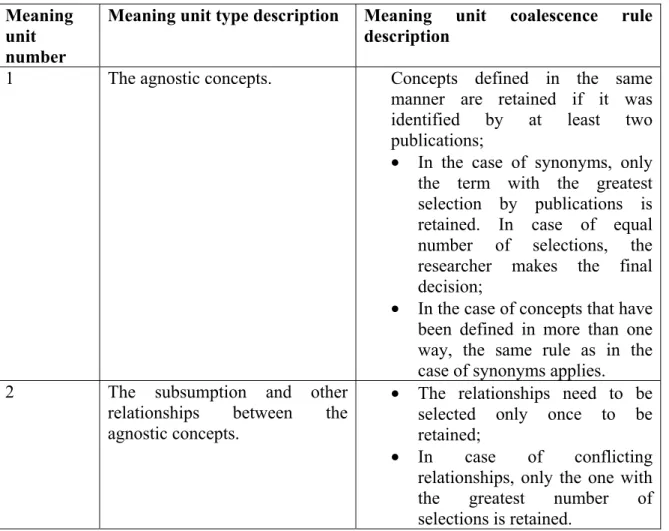
Table 2.1 Rules to synthesize data model patterns into agnostic CODPs ...60
Table 2.2 Metadata level criteria ...63
Table 2.3 Content level criteria ...63
Table 2.4 Elicited agnostic concepts from this SLR’s author previous papers ...68
Table 2.5 Elicited concepts from (West, 2011) ...70
Table 2.6 Elicited concepts from (Blaha, 2010b) ...72
Table 2.7 Summary of the analysis of the remaining retained publications ...74
Table 2.8 Top twenty agnostic concepts ...77
Table 2.9 SLR study Party CODP ...80
Table 2.10 SLR study Product CODP ...81
Table 2.11 SLR study Contract CODP ...83
Table 2.12 SLR study Price CODP ...84
Table 2.13 SLR study Event CODP ...85
Table 2.14 SLR study Document CODP ...86
Table 2.15 SLR study Network CODP ...87
Table 2.16 SLR study Account CODP ...88
Table 2.17 SLR study Concept CODP ...90
Table 2.18 SLR study Context CODP ...91
XX
Table 2.20 SLR study Role CODP ...93
Table 2.21 SLR study Process CODP ...95
Table 3.1 Description of the revised agnostic multi-domain modules ...110
Table 3.2 Business process descriptions ...112
Table 3.3 Create Draft Plan ...114
Table 3.4 Determine supply opportunity ...115
Table 3.5 Transmit RFP and PO ...116
Table 3.6 Establish Logistics Network ...117
Table 3.7 Analyze Environment/Weather ...118
Table 3.8 Formulate Transportation/Supply Plan ...119
Table 3.9 Socialize and synchronize Transportation Plan ...120
Table 4.1 Description of the product design concepts based on the SBD, CPD and modular approaches ...132
Table 4.2 Description of the CPD_Onto main concepts (Abadi et al., 2017) ...134
Table 4.3 Description of ontological meta-model ...136
Table 4.4 Descriptions of the revised agnostic multi-domain modules ...137
Table 4.5 Business process descriptions ...140
Table 4.6 Gather requirements and previous design projects data ...141
Table 4.7 Establish target product architecture and modules ...142
Table 4.8 Prepare a plan ...143
Table 4.9 Establish constraints ...144
Table 4.10 Perform concurrent design and converge ...145
Table 4.11 Socialize and confirm solution ...146
Table 5.1 Questions used for the semi-structured interview ...170
XXI
Table 5.3 Top twenty agnostic concepts ...181
Table 5.4 List of examples of relationships provided by the co-researchers ...182
Table 5.5 List of examples of domain specific concepts with subsumed relationships with agnostic concepts ...184
Table 5.6 Negative responses from co-researchers to question Q10 ...189
Table 5.7 Basic aggregating statistics about the meaning units ...194
Table 5.8 Phenomenological study Party CODP ...197
Table 5.9 Phenomenological study Product CODP ...198
Table 5.10 Phenomenological study Agreement CODP ...200
Table 5.11 Phenomenological study Price CODP ...201
Table 5.12 Phenomenological study Event CODP ...202
Table 5.13 Phenomenological study Document CODP ...203
Table 5.14 Phenomenological study Network CODP ...204
Table 5.15 Phenomenological study Account CODP ...205
Table 5.16 Phenomenological study Context CODP ...206
Table 5.17 Phenomenological study Location CODP ...207
Table 5.18 Phenomenological study Role CODP ...209
Table 5.19 Phenomenological study Process CODP ...210
Table 6.1 Trustworthiness criteria for a dual method qualitative research ...221
Table 6.2 Questions used for the semi-structured interview ...229
Table 6.3 Meaning unit coalescence rules ...232
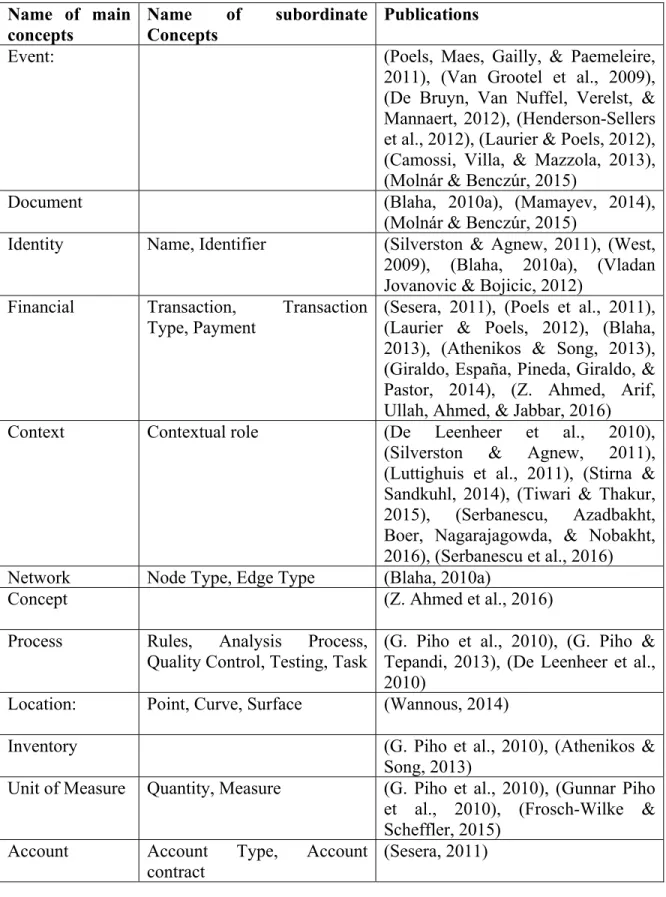
Table 6.4 Agnostic CODPs elicited in the dual method SLR and ...234
LIST OF FIGURES
Page Figure 0.1 Reference Architecture – Enterprise Knowledge Infrastructure………...2 Figure 0.2 Epistemological foundation of this project...2 Figure 0.3 Focus on the design of the multi-domain ontology...3 Figure 0.4 Language dependent and independent aspects of an ontology...7 Figure 0.5 The language dependent aspect of an ontology...8 Figure 0.6 The language independent aspect of an ontology...9 Figure 0.7 Overview of the dual method qualitative research approach...19 Figure 0.8 The problem, the affected capacity and the solution triangle...22 Figure 0.9 Recapitulative overview of the project...24 Figure 1.1 Overall business processes for the dual method qualitative research
process ...36 Figure 2.1 Summarized definition of an ontology ...49 Figure 2.2 Language independent aspect of an ontology ...50 Figure 2.3 The language dependent aspect of an ontology ...52 Figure 2.4 Number of publications per year returned and scrutinized ...65 Figure 2.5 Number of publications per year screened and retained ...66 Figure 2.6 The RA-EKI ontology architecture modules ...69 Figure 2.7 Saturation events in the SLR synthesis step ...79 Figure 3.1 Reference Architecture of an Enterprise Knowledge Infrastructure ...103 Figure 3.2 Business processes for collaborative logistics planning ...112 Figure 4.1 Summarized definition of an ontology ...127 Figure 4.2 Key product design concepts based pertaining to the SBD, CPD and
XXIV
Figure 4.3 The generic conceptual model of the Collaborative Product Design
ontology ...134 Figure 4.4 The proposed ontological meta-model by (Abadi et al., 2016) ...136 Figure 4.5 Business processes for collaborative product design ...139 Figure 5.1 Summarized definition of an ontology ...157 Figure 5.2 Language independent aspect of ontologies ...158 Figure 5.3 The language dependent aspect of ontologies ...160 Figure 5.4 Overview of the phenomenological research protocol ...168 Figure 5.5 Distribution of the co-researchers’ years of experience...178 Figure 5.6 Distribution of co-researchers per NAICS industry sectors ...180 Figure 5.7 Use of agnostic concepts to the design of a data integration function ...186 Figure 5.8 Use of domain-specific concepts to the design of a data integration
function ...187 Figure 5.9 Progression of the theoretical saturation events ...195 Figure 6.1 Number of publications per year screened and retained ...227 Figure 6.2 Saturation events in the SLR synthesis step ...237 Figure 6.3 Progression of the theoretical saturation events ...238
LIST OF ABREVIATIONS AND ACRONYMS
API Application Program Interface BOM Bill Of Material
BP Business Process
BPEL Business Process Execution Language CODP Content Ontology Design Pattern CRM Customer Relationship Management DL Descriptive Logic
ERP Enterprise Resource Planning HQDM High Quality Data Model
III-RM Information Integration Infrastructure - Reference Model MDM Master Data Management
MES Merchandizing Enterprise System NAF NATO Architecture Framework
NAICS North American Industry Classification System NAPCS North American Product Classification System NATO North Atlantic Treaty Organization
NLP Natural Language Processing ODP Ontology Design Pattern OWL Ontology Web Language PO Purchase Order
RA-EKI Reference Architecture - Enterprise Knowledge Infrastructure SCM Supply Chain Management
XXVI
SLR Systematic Literature Review SQL Structured Query Language
TOGAF The Open Group Architecture Framework TOVE Toronto Ontology Virtual Enterprise
INTRODUCTION
The role of the critical researcher is always to go beyond mere studying and theorizing, to actively affect change in the phenomena investigated.
W. Orlikowski and J. Baroudi (1991) citing (Benson, 1983)
Preamble
The raison d’être of this research project is to solve the semantic heterogeneity problem. The semantic heterogeneity problem detrimentally affects the capacity of an enterprise to maintain system interoperability, i.e. the capacity of the organization to have its systems exchange data in a seamless manner. The present delivery concludes this doctoral research project, hereafter referred to as “the project”. This delivery additionally and partially fulfills the requirements of a Ph.D. program. The project first delivered and presented in conferences the Reference Architecture – Enterprise Knowledge Infrastructure (RA-EKI). RA-EKI is described in greater detail in (Fitzpatrick, Coallier, & Ratté, 2013; Fitzpatrick, Ratté, & Coallier, 2013). It was initially presented as a reference architecture for a semantic enterprise data warehouse (Fitzpatrick, 2012; Daniel Fitzpatrick, François Coallier, & Sylvie Ratté, 2012), then reformulated in the more generic RA-EKI. An earlier research plan can be found in annex I (Fitzpatrick, 2012). RA-EKI, illustrated in figure 0.1, represents one of the first published frameworks that encompass knowledge, know-how and intelligence in addition to traditional data and information. RA-EKI covers the full range of the epistemological building blocks as represented in figure 0.2 i.e. processing from data i.e. factual symbols (unstructured, semi-structured, structured) to information i.e. data with context; to knowledge i.e. actionable information; to know-how i.e. functional knowledge; and finally to intelligence i.e. cognitive know-how. RA-EKI can also be considered as a reference model of a cognitive architecture as defined and described by Lieto and co-authors (Lieto, Lebiere, & Oltramari, 2018). The epistemological foundation of this project is further explained in (Fitzpatrick, 2012).
2
Figure 0.1 Reference Architecture – Enterprise Knowledge Infrastructure (Daniel Fitzpatrick et al., 2013)
Figure 0.2 Epistemological foundation of this project (Fitzpatrick, 2012)
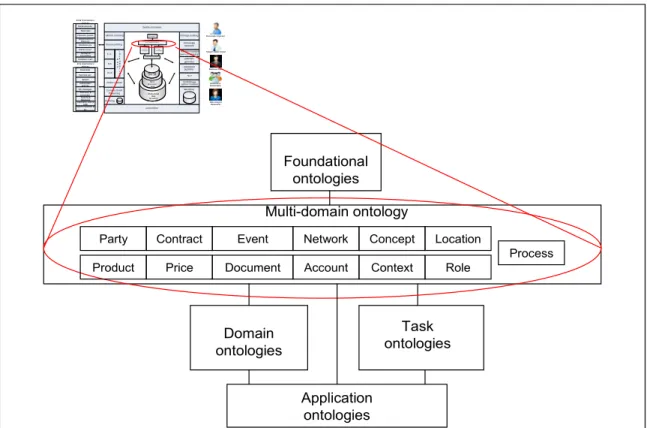
RA-EKI also contributes a new type of mid-level (formal) ontology called multi-domain ontology. The multi-domain ontology serves as part of the terminological component (“T-Box”) of a cognitive (inferential) application purposed for data integration and other functions such as Natural Language Processing (NLP). As illustrated in figure 0.3, the focus
Data Information Knowledge Know-how Intelligence Factual symbols Contextual data Actionable information Functional Knowledge Cognitive Know-how
3
of the project has changed in a zoom in fashion from RA-EKI as a whole to the design of the internals of the multi-domain ontology’s modules, RA-EKI’s cornerstone. The (formal) multi-domain ontology comprises ontology modules the equivalent of subject areas for (semi-formal) data models.
Figure 0.3 Focus on the design of the multi-domain ontology
This dissertation describes the research approach to specifically elicit agnostic data model patterns to eventually incorporate these patterns as axiomatized terminological rules in the multi-domain ontology’s modules. This project intends to pursue the research effort with the ultimate goal to definitely resolve the semantic heterogeneity problem. The remainder of the introduction section comprises the following subsections:
1. Definition of important terms.
In the case of the concept of ontology, there are several definitions. (Asunción Gómez-Pérez, Fernández-López, & Corcho, 2006) surveyed over a dozen different definitions of an ontology. This project intends to provide the most significant and
Foundational ontologies Multi-domain ontology Domain ontologies Task ontologies Application ontologies Party Product Contract Price Event Document Network Account Concept Context Process Location Role
4
consistent definitions in the context of this research, while attempting to avoid controversy;
2. Problem statement.
The problem statement motivates the execution of this project. Although the project ends with the thesis defense, other research projects will need to be started and executed to achieve the desired theoretical saturation and ultimate resolution of the problem. Furthermore, shortcomings of the greater Information Technology (IT) and software engineering domain related especially to the selection and application of scientific methodology justify a greater diligence in the choice and design of a research approach;
3. Context.
This subsection provides the holistic socioeconomic backdrop and factors related directly to the enterprises’ requirements for system interoperability notably the creation of virtual enterprises and coalitions;
4. Research Objective.
The project’s intent related to the resolution of the stated problem. The objective can vary over time as research progresses;
5. Research questions.
This subsection covers two research questions. The primary question addresses directly the project’s objective and problem. The secondary question deals with the need to properly select the right approach to effectively solve the problem without the influence of scientific domain social factors;
6. Statement of the thesis argued in this project.
The thesis statement constitutes the primary assertion that is defended in this dissertation’s argumentation;
7. The research project’s starting postulates.
The starting postulates inspire the research question formulation; 8. Fundamental research approach,
The project’s research approach is summarily described using business process modeling;
5
9. Scope of the research project.
This subsection outlines the expected findings of the project. The primary findings, the common thread of all research processes, represent the focus of the project. Secondary findings are also collected from the phenomenological research protocol mainly to provide context and preliminary data to be useful in subsequent projects; 10. Limits to the research project.
The limits of the project represent what is to be excluded from the project but are likely to be included in future phases or projects related to the current problem;
11. Recapitulative overview of the project.
This subsection provides the project’s main themes in a data flow like representation. This concept map also illustrates post-project main activities leading to the resolution of the problem;
12. Structure of the dissertation.
This subsection briefly describes the chapters.
1. Definition of important terms
The following terms constitute key notions for the project. Their definition intends to facilitate the reading of the introduction and the remaining chapters although some of the articles comprise a definition section as well.
Cognitive application
The project considers a cognitive application as a set of functions as represented in RA-EKI, figure 0.1. A cognitive application consists in a set of functions that transforms data or any of the other epistemological elements represented in figure 0.2 into a more advance stage e.g. data into information, information into knowledge, etc. These functions include NLP, data integration, knowledge extraction, ontology building and others. Also as prescribed in RA-EKI some or all of the functions may be ontology driven with the use of an inference engine (Lieto et al., 2018) (Daniel Fitzpatrick et al., 2013). Finally, an ontology driven cognitive
6
application may stochastically infer its axioms using probabilistic reasoning (Kelly, 2015). In the case of being processed by probabilistic reasoning engine, the ontology is referred to as a fuzzy ontology (Carlsson, 2018).
Specification
This project defines a specification as a detail and shareable i.e. explicit description of a thing or a collection of things using a language, such as a detail design represented in a Unified Modeling Language (UML) class diagram. A specification may be deemed expressive in its capacity to represent a conceptualization (see next definition) in a machine-readable form to be processed by an automated application, including a cognitive application that processes axiomatic terminological rules (Guarino, Oberle, & Staab, 2009). A specification is also considered as the language dependent aspect of an ontology (Nicola Guarino, 1998).
Conceptualization
This project considers a conceptualization as a set of semantic elements, e.g. concepts, relationships, properties and human readable definitions (Lacy, 2005). Guarino and co-authors consider conceptualization as what is «private to the mind of the individual» (Guarino et al., 2009). Guarino considers conceptualization as the language independent aspect of an ontology as illustrated in figure 0.4 (Nicola Guarino, 1998).
7
Figure 0.4 Language dependent and independent aspects of an ontology
Ontology
This project defines an ontology as a specification of a conceptualization. Gruber defines an ontology as an «explicit specification of a conceptualization» (Thomas R. Gruber, 1993). The project’s definition removes the unnecessary explicit qualifying term since a specification is explicit by definition. Figure 0.5 outlines the language dependent aspect of an ontology. The specification aspect of an ontology comprises four levels: informal, informal, semi-formal and semi-formal. The insemi-formal level incorporates the natural language. Concept maps compose the semi-informal level. The semi-formal level encompasses the Entity Relationship Diagram (ERD) techniques and UML. The formal ontology level contains languages that define axioms forming a partial account of reality that can be processed by a semantic reasoning system or semantic reasoner (Guarino et al., 2009) (Bae, 2014). A semantic reasoner also known as an inference engine infers new axioms by deducting them from a base ontology. An ontology engineer provides a base ontology and validates consistency and correctness of the resulting superset (Lee, Matentzoglu, Sattler, & Parsia, 2015) (Bouten et al., 2016). Four exemplary formal languages are illustrated in figure 0.5. The Foundation for Intelligent Physical Agents’ (FIPA) Agent Communication Language (ACL) supports the representation of ontological reasoned messages (Hsu & Cheng, 2015). The Semantic Web
Ontology A specification of a conceptualization Language dependent Language independent
8
rule Language (SWRL) allows specifying axioms and knowledge rules (de Farias, Roxin, & Nicolle, 2016). The Resource Description Framework Schema (RDFS) language represents knowledge in the form of triple stores (subject, verb, object predicates) that can be used for semantic queries (Su et al., 2018). The Web Ontology Language (OWL) allows the representation of knowledge in an eXtensible Markup Language (XML) document encoding format (Rattanasawad, Buranarach, Saikaew, & Supnithi, 2018).
Figure 0.5 The language dependent aspect of an ontology
Figure 0.6 illustrates a conceptualization as the language independent aspect of an ontology (Nicola Guarino, 1998). A concept definition represents a human readable narrative that in supplies meaning to the concepts (Gruber, Liu, & Ozsu, 2009) (Noy & McGuinness, 2001). Lowering an ontology’s abstraction may affect the robustness and flexibility of the conceptualization (Spyns, Meersman, & Jarrar, 2002). Semantic relationships are categorized as synonymy, antonymy, hyponymy, meronymy and holonymy relations. Synonymy
Ontology Ontology Language dependent Natural language A specification Semi-Informal Informal
Formal Semi-Formal
Concept map Has language levels Entity-relationship diagram, UML class diagram,
XSD. FIPA-ACL SWRL RDFS OWL Semantic / Rule Reasoner Processed by Is-a
9
relationships relate concepts with the same meaning. An antonymy relation associates opposing or disjoint concepts. The Hyponymy relationship subsumes a specific concept to a generic one. The meronymy and holonymy relationships support the equivalent of the UML composition relationship, the former indicates that a concept composes another one, while the latter indicates that one concept includes another one (Nicola Guarino, 1998) (Lacy, 2005).
Figure 0.6 The language independent aspect of an ontology
Ontology Design Pattern (ODP)
An ODP represents «a set of ontological elements, structures or construction principles that
solve a clearly defined particular modeling problem». ODPs for formal ontologies are
translated into axioms in a specialized language such as OWL during ontology development. Ontology architecture patterns only cover the ontology as a whole or modules as the ones
Ontology Ontology conceptualization Language independent Concept Concept Relation Relation Property Property Rigid property (essence) Rigid property (essence) Instance Instance Human readable definition Synonymy Antonymy Hyponymy Meronymy Holonymy
An instance of a concept may or may not have the same property instances (values) as an other instance of the same concept. has has has has has has has has Is-a has ide ntifies Is-a
10
within the multi-domain ontology illustrated in figure 0.3. ODPs pertain to specific concepts or relations (Blomqvist, 2009b). (Blomqvist, 2010).
Content Ontology Design Pattern (CODP)
According to (Gangemi & Presutti, 2009) (Blomqvist, 2009a), a content ODP, or a CODP, is a design pattern that addresses business concepts found in a domain ontology. This research project specifically investigates CODPs representing business concepts that are meant to be applicable to all industry sectors.
Agnostic CODP
This project defines an agnostic CODP as an abstract ODP that possesses a distinct definition among other concepts and that can apply to any industry sector. This definition is inspired by Thomas Erl’s definition of the term Agnostic in the context of Service Oriented Architecture as an application service that is business process independent and reusable across all contexts and domains in the enterprise (Erl, Merson, & Stoffers, 2017). Furthermore, an agnostic CODP is defined in such a way that it cannot be confused with other agnostic concepts.
Multi-domain ontology
A mid-level formal ontology that comprises a collection of interrelated agnostic CODPs that allow a cross-industry conceptualization (Daniel Fitzpatrick et al., 2012). Concepts related to any industry may be represented using the multi-domain ontology. The multi-domain ontology comprises modules that would possibly assist the ontology engineer in optimizing the agnostic axioms’ interactions .(Hitzler & Shimizu, 2018).
11
2. Problem Statement
Starting in the 1990s, system interoperability, the ability of application systems to exchange information and conduct coordinated processes, has become an important intra and extra organizational requirement. This organizational requirement stems from the increasing need for the organizations to cooperate within and between organizations (Lu, Panetto, Ni, & Gu, 2013) (Estublier, Cunin, Belkhatir, Amiour, & Dami, 1998).
This research project targets the semantic heterogeneity problem, dubbed the «old problem» by De Giacomo and co-authors in (De Giacomo, Lembo, Lenzerini, Poggi, & Rosati, 2018). Some work pertaining to its solution, data integration, dates back over 30 years ago (Deen, Amin, & Taylor, 1987). Semantic heterogeneity originates from having application systems designed with different vocabularies, data models or ontologies. It affects the capacity of enterprises to have their systems interoperate within and between organizations. Systems interoperability represents a crucial capability to industry and government sectors alike. Semantic heterogeneity plagues the industry sectors by costing valuable funds (Lenz, Peleg, & Reichert, 2012) (M. Dietrich, Lemcke, & Stuhec, 2013) (Lemcke, 2009) (Brodie, 2010) (Jhingran, Mattos, & Pirahesh, 2002). It also hinders medical and pharmaceutical sectors in depriving them from some research funds needed to preserve and save lives (Williams et al., 2012) (Mirhaji et al., 2009). The scientific community has yet to propose a final solution for this problem (Doan, Halevy, & Ives, 2012) (Olivé, 2017) (Olivé, 2018).
The IT scientific community has conducted research notably in the development of formal ontologies for reasoning applications to resolve the semantic heterogeneity problem. Cognitive applications would perform the data integration function with the use of formal ontologies containing knowledge assertions (Bergamaschi et al., 2018) (Haziti, Qadi, Bazzi, & Elhassouni, 2018). Ontology science and engineering lack the maturity to provide a coherent theoretical framework to allow truly cross-enterprise semantic interoperability solutions (Pinkel et al., 2015). To illustrate the lack of maturity, in (Bennett & Bayrak, 2011), the authors define a data integration system as a «general-purpose (application) used to
12
provide interoperability among autonomous heterogeneous database systems». Later in the
same article, the authors refer to data integration as a «problem». In (Lenzerini, 2002), the authors define data integration as «the problem of combining data residing at different
sources, and providing the user with a unified view of these data». Confusing the problem,
i.e. semantic heterogeneity, with the solution, i.e. data integration, sheds doubts in the theory-building research process.
Dietrich and co-authors reported, citing an Aberdeen report (Kastner & Saia, 2006), that semantic heterogeneity may cost 40% of IT budget in deploying data integration platforms (M. Dietrich et al., 2013). The cited Aberdeen report does not explain the research method used to determine the cost of a significant problem such as semantic heterogeneity. If applied hypothetically to the United States of America’s 2016 global output (Anonymous, 2016) of over $31.9 trillion and considering that IT costs in average 3.3% of corporate revenues in all industry sectors (Hall, 2016), the problem of semantic heterogeneity would cost the US economy each year in excess of $400 billion. Simply quoting an unsubstantiated number such as the cost of semantic heterogeneity in terms of the expenditures in developing data integration may not constitute effective scientific research, let alone sound theory building.
This research project intends to perform more disciplined theory building based on a dual method qualitative research approach. This project’s approach is based on a similar dual method research described in (Bano, Zowghi, & da Rimini, 2017) to alleviate the issues raised in this section. The project’s approach aims to demonstrate trustworthiness and hopefully stimulate a more definitive progress to resolve the semantic heterogeneity problem.
3. Context
The impact of economic woes, in the aftermath of the great recession of 2007 (Elsby, Hobijn, & Sahin, 2010), and the increase of compliance regulations render the enterprises more dependent on internal and external collaborations to cut costs and to achieve their strategic objectives and fulfill their mission more efficiently (Duygan-Bump, Levkov, &
Montoriol-13
Garriga, 2015) (De Toni, 2016). The significant pressure to reduce waste, in addition to costs, motivates the organizations of all industries to internally operate more efficiently with their existing customer base. Globalization, removal of trade constraints and the evolving regulatory landscape impose further pressure notably on the service industry (Bagheri & Jahromi, 2016). Direct relationship marketing monopolizes excessively financial and other resources to maintain good relations with existing customers. Again, as in the case of partnerships, the organizations' information systems must also interoperate to allow individual enterprises to strive in retaining their customers and expand their business.
Defense government agencies are affected as well by semantic heterogeneity in their attempt to implement system interoperability. Semantic heterogeneity constitutes an important challenge for large enterprises and notably for organization such as the US Department of National Defence (Morosoff, Rudnicki, Bryant, Farrell, & Smith, 2015). In manufacturing, new approaches to design products are proposed to allow product manufacturers to be more competitive: Set-Based Design (SBD) (Kerga, Schmid, Rebentisch, & Terzi, 2016), a new product development process proposed in (Belay, Welo, & Helo, 2014) and the modular approach, popular notably in aerospace manufacturing (Buergin et al., 2018). The SBD approach, for example, can contribute reducing in average by 25% the project duration and by 40% the total project costs as demonstrated in laboratory simulations (Kerga et al., 2016). These new product design approaches require that the Product Lifecycle Management (PLM) systems interoperate. Semantic heterogeneity adversely affects system interoperability thus hindering efforts to execute the new product design methodologies (Daniel Fitzpatrick et al., 2013).
4. Research Objective
This research project aims to elicit data model patterns from experienced practitioners and from rigorously selected publications. The data model patterns are to be re-engineered as agnostic axioms and to compose the multi-domain (formal) ontology. Although data model patterns are only used in semi-formal ontologies, e.g. database and software design, they can
14
contribute for building formal ontologies, such as the multi-domain ontology (Blomqvist, 2010). The use of formal ontologies within data integration cognitive platforms constitutes an efficient approach to solve semantic heterogeneity (Jirkovský, Obitko, & Mařík, 2017).
5. Research questions
In this project, the research questions allow to transition, during the project, from the research objective to the actual research protocols. This project considers a research protocol an instance of a method with a specific research question or set of questions. The first question pertains directly to the objective:
Research question #1
What are the conceptualization patterns found in semi-formal ontologies, e.g. data model patterns, software engineering patterns, etc., that can be agnostic to any domain or industry sector in the context of enterprise semantic interoperability and can be used as the basis of agnostic CODPs to resolve semantic heterogeneity in enterprise systems?
Research question #1 is to be translated into more detail forms of investigation in the design and execution of the research protocols. The second question raises the contentious issue about choosing a research approach, specifically in selecting between theory testing or theory building approaches. As indicated in (P. Leedy & Ormrod, 2012), two fundamental approaches can be used: theory building and theory testing. Theory testing or quantitative methods typically use known variables to statistically measure and validate the extent to which a theory can explain a phenomenon. Theory building or qualitative methods, on the other hand, attempt to explain a phenomenon and explore its various facets. While quantitative methods are relatively standard, qualitative research methods do not benefit from standardization and are still evolving (P. Leedy & Ormrod, 2012). The use of qualitative research methods in information systems may constitute a highly contentious matter
15
(Marshall, Cardon, Poddar, & Fontenot, 2013). The project formulates the second question as in the following:
Research question #2
What research method or methods can be used in the attempt to effectively answer the first research question while providing sufficient evidence to instill confidence in the methodology employed and in the findings?
The second question requires reviewing the literature pertaining to research methods in information systems, information technology and software engineering. The literature review performed in this project to address research question #2 included a text book well cited by researchers: (P. Leedy & Ormrod, 2012), which provides guidance on selecting between theory testing and theory building. A contribution from Orlikowsky and Baroudi raised the issue in 1991 about the detrimental effect of the exclusive use of quantitative research for information systems (Orlikowski & Baroudi, 1991). Chapter 1 provides a more complete perspective on the literature review performed for addressing research question #2 and for the design decision made and indicated in the upcoming introduction’s fundamental research approach subsection.
6. Statement of the thesis argued in this project
As indicated in the problem statement subsection, this project in effect addresses the problem pertaining to semantic heterogeneity and secondly the need to perform more disciplined theory building. This research project argues the following thesis as the position defended by the dissertation (Anonymous, 2018):
There is a set of data model patterns that are applicable to any private industry or government sector that can be used as agnostic CODPs and collectively constitute, after being translated
16
into axioms, a (formal) multi-domain ontology that can be used by a cognitive data integration application to resolve the semantic heterogeneity problem.
7. The research project’s starting postulates
The project’s starting postulates describe the researcher’s sources of inspiration for specifying the primary research question. The researcher draws from professional experience to formulate a first research question construed as potentially beneficial for an optimized research roadmap. These postulates only apply for the beginning of the project and may become irrelevant as new phases or projects pursue the exploration, theory building and theory testing efforts leading to the ultimate resolution of the problem. The starting postulates are:
• Agnostic CODPs that ensure ontology reusability are needed for a multi-domain ontology to be used in a cognitive data integration platform. This postulate conceptually originates from (Erl, 2008) and (Erl et al., 2017);
• Data model patterns can be used to kick start the development of formal ontologies (Blomqvist, 2010);
• The conceptualization aspect of an ontology is key to the richness of an ontology’s axioms (Guarino et al., 2009);
• Best practice for formulating CODPs consist in the use of ODPs that can be used across several domains (Blomqvist, 2010);
• Data model patterns, such as those proposed in (West, 2011) and (Blaha, 2010b), may contribute to a more efficient multi-domain ontology for a cognitive data integration platform.
8. Fundamental research approach
In the problem statement subsection, the semantic heterogeneity problem represents the focus of this project. While performing research to contribute in solving this problem, this project also proposes a research design to demonstrate trustworthiness. The research design needs to
17
ensure the elicitation of agnostic data model patterns or agnostic CODPs used interchangeably, fulfilling the first thesis while establishing the credibility, dependability, confirmability and transferability of the proposed dual method approach, supporting the second thesis. A purely qualitative research approach is proposed in this project to start the theory-building process.
This decision stems in part from a position taken in (Orlikowski & Baroudi, 1991) who were the first to argue that the exclusive use of positivist (hypothetico-deductive) methods may detrimentally affect the effort of effectively engaging all scientific challenges in information systems. Shirley Gregor posits in (S. Gregor, 2006) and (Shirley Gregor, 2017) that the science of design, to which the project subsumes, requires a theory-building approach. A qualitative research method is prescribed (P. Leedy & Ormrod, 2012) to build theory when needed. In (Alemu, Stevens, & Ross, 2011), the authors clearly argue that semantic interoperability research requires a qualitative research approach. This decision about the selection of the research methodology is also problematic since some IT postgraduate faculties with a positivist stance, and under pressure to produce studies, react in a hostile manner against qualitative (constructivist) studies (Marshall et al., 2013). Marshall et al. also argue the scarcity of methodological standards in qualitative research, notably to establish the trustworthiness of the research process. This controversial situation motivates a careful and diligent approach for designing the research methodology for this project.
This project’s research design is based on a concurrent dual qualitative research approach that represents one of the first actual utilizations of such research methodology. The consequences of the decision to only perform qualitative research entail that this project is attempting to establish trustworthiness and not validity (Guba & Lincoln, 2001) (Cypress, 2017). Furthermore, this qualitative research process being essentially exploratory is driven only by a research question and not by hypotheses such as in the case of hypothetico-deductive or mix methods research (Wohlin & Aurum, 2015). Future phases of this project may involve a research design using a mixed-method phenomenological approach as
18
proposed by (Flynn & Korcuska, 2018) where strengths of both qualitative and quantitative approaches may be used to solidify this emerging theory’s foundation.
This project’s research approach is inspired from another dual qualitative research method approach designed by M Bano, D Zowghi and F Da Rimini. Bano and her team’s approach uses qualitative SLR and case studies to investigate requirements engineering, specifically in the relationship of user involvement and system success in software development (Bano et al., 2017).
Figure 0.7 holistically illustrates this project’s dual method research approach. Process P1 comprises the high-level design activities to define the two theory elicitation protocols, i.e. the qualitative SLR and the phenomenological research method, two use cases and the concluding trustworthiness establishment activity. Process P1 also prescribes a strategy to establish trustworthiness for the research process. Process P2 pertains to the detail design and execution of the SLR protocol, based on (Okoli, 2015; Okoli & Schabram, 2010). P2 formulates a practical screen that retains or rejects publications in two stages. The practical screen’s first stage filters papers based on their metadata. The second stage requires reading the publications. Then, the SLR’s analysis and synthesis stages are based on this project’s phenomenological research method (C. Moustakas, 1994) and from (Thomas & Harden, 2008). Process P3 covers the detail design and the execution of the phenomenological protocol. P3 establishes a purposeful sampling approach in selecting participants. The participants, called co-researchers, provide an insight to their experience in the phenomenon defined as data integration. Also P3 elaborates the semi-structured interview questionnaire (Bevan, 2014), the analysis and synthesis activities (C. Moustakas, 1994). Finally, P3 defines the computation method for determining data saturation that is also used in P2 (Marshall et al., 2013). Processes P4 and P5 execute use cases for collaborative product design for manufacturing and collaborative logistics planning for military coalition deployments. The use cases intend to show transferability from the SLR’s findings in both contexts respectively. Finally, process P6 establishes the trustworthiness of this project’s dual
19
qualitative research method approach using the criteria proposed in (Guba & Lincoln, 2001) (Anney, 2014) (Forero et al., 2018) (Suri, 2011).
Figure 0.7 Overview of the dual method qualitative research approach
9. Scope of the research project
The focal point of the project is to collect agnostic CODPs, i.e. ontology design patterns that represents business concepts of various domains and that can apply to any industry sectors. The completion of this project consists in the development of a run-time multi-domain ontology functioning as the terminological component or T-box of a data integration cognitive platform. Concretely, the multi-domain ontology will comprise agnostic axioms, produced from the translation of the agnostic CODPs elicited in this delivery. Although less expressive than formal ontology languages such as OWL, UML can still show hyponymy, meronymy and holonymy relationships that constitutes valid ontology design pattern material
P1 Design a Dual Method Qualitative Research Approach P2 Systematic Literature Review (SLR) P3 Phenomenological Research Method
P4 Use case for Collaborative Product Design
P5 Use Case for Collaborative Logistics Planning
P6 Establishing Trustworthiness of the dual method approach
20
based on the definition of an ontology design pattern formulated in (Blomqvist, 2010). Since the project for the time being does not translate patterns into axioms, agnostic data model patterns are considered agnostic CODPs. Blomqvist also considered the benefits of accelerating the development of axioms intended for cognitive applications using data model patterns; a critical consideration for this project. The early of the project for the current delivery only elicits data model patterns. The project considers collecting from formal ontologies only at a later phase. As indicated earlier in this subsection, agnostic CODPs constitute the common thread of this project’s research processes.
10. Limits to the research project
By virtue of the research question, this project and its dual-method design concentrate exclusively on data models patterns, or semi-formal ontology patterns, elicited from selected publications through the SLR’s practical screen and by interviewing experienced practitioners using the phenomenological research method. The recommendations set forth by Blomqvist in (Blomqvist, 2009a), to elicit data model patterns to be used as CODPs, defines this project’s fundamental purpose and inspiration. This project’s limitations include the following:
• Only data model patterns are considered for this research. No formal ontologies are studied for concept elicitation;
• Only data model patterns related to a business context are handled; • Only publications written in English or French can be retained; • Only participants speaking English or French can be retained;
• The SLR only covers papers published between 2009 and 2017 inclusively;
• Only domain level concepts are considered. No foundational concepts such as “Instance” are considered;
• The conversion of agnostic CODPs to axiomatic representation in the multi-domain ontology and further design and development of the ontology are not part of this project;
21
• The logical representation in a Description Logic language is not covered in this project. Agnostic CODPs are represented in light UML;
• This project’s phenomenological research method limits the number of co-researchers to 15. Although this number may increase within the five to 25 range proposed by (P. Leedy & Ormrod, 2012), this project does not intend satisfying data or theoretical saturation. This project considers data saturation as the point where no new knowledge is created with the current research question. Further work may be required to achieve data saturation. Theoretical saturation represents here the point where no new knowledge is created after all possible research methods and protocols, qualitative, quantitative or mixed, have been used;
• The methodology to assemble and integrate the agnostic CODPs into the multi-domain ontology and consistency checks are excluded as well;
• A formal audit has not been performed although the data is available for such review on demand along with an audit protocol;
• A multi-researcher triangulation process for establishing methodological and data trustworthiness has not being performed during this project but is planned for upcoming phases.
• The project may remove certain of the aforementioned limitations in future phases.
11. Recapitulative overview of the project
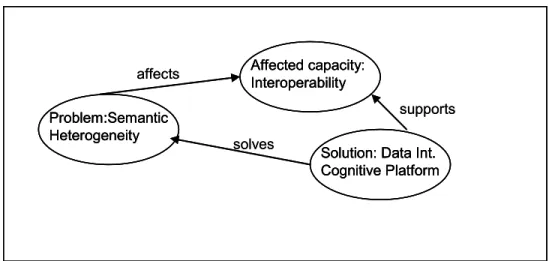
Figures 0.8 and 0.9 summarize the project in its current form using concept maps. Figure 0.8 illustrates the triangle between the semantic heterogeneity problem, the enterprise’s capacity this problem affects, i.e. system interoperability and the data integration cognitive platform, the solution to the semantic heterogeneity problem.
22
Figure 0.8 The problem, the affected capacity and the solution triangle
Figure 0.9 provides a recapitulative and holistic perspective of this project in its current state starting with the formulation of the problem. This holistic perspective finishes with the establishment of trustworthiness and the building of a proposed theory containing agnostic CODPs, the common thread to this entire research, also referred as phenomenon knowledge. Additionally, the phenomenological protocol provides on its own other elements of knowledge, or peripheral knowledge, such as quality and efficiency, elicited material that may assist the project to clearly define metrics in a future phase. The semantic heterogeneity problem requires a research objective that orients the research efforts toward what is believed to be key pieces of the solution, the agnostic CODPs. RA-EKI defines as its centerpiece the multi-domain ontology that is to be composed of agnostic axioms. The multi-domain agnostic axioms, the logical semantic rules represented in formal language and executable in cognitive applications, will originate from the agnostic CODPs elicited during this project.
Also illustrated in figure 0.9, the research objective generates two research questions as previously indicated, the primary question relative to the existence of agnostic CODPs and the secondary question regarding the research methodology that should be used during the initial stage of this project. The research methodology to be used in the initial stage of this project consists in a dual qualitative research method approach. The dual qualitative research approach comprises the SLR and phenomenological research methods, which design is described in chapter 1. Each method is instantiated into a protocol that specifically addresses
Problem:Semantic Heterogeneity
Affected capacity: Interoperability affects
Solution: Data Int. Cognitive Platform supports solves Problem:Semantic Heterogeneity Problem:Semantic Heterogeneity Affected capacity: Interoperability Affected capacity: Interoperability affects
Solution: Data Int. Cognitive Platform Solution: Data Int. Cognitive Platform
supports solves