HAL Id: hal-01301912
https://hal.archives-ouvertes.fr/hal-01301912
Submitted on 13 Apr 2016
HAL is a multi-disciplinary open access
archive for the deposit and dissemination of
sci-entific research documents, whether they are
pub-lished or not. The documents may come from
teaching and research institutions in France or
abroad, or from public or private research centers.
L’archive ouverte pluridisciplinaire HAL, est
destinée au dépôt et à la diffusion de documents
scientifiques de niveau recherche, publiés ou non,
émanant des établissements d’enseignement et de
recherche français ou étrangers, des laboratoires
publics ou privés.
Self-organization of nodes using bio-inspired techniques
for achieving small world properties
Rachit Agarwal, Abhik Banerjee, Vincent Gauthier, Monique Becker, Chai
Kiat Yeo, Bu Sung Lee
To cite this version:
Rachit Agarwal, Abhik Banerjee, Vincent Gauthier, Monique Becker, Chai Kiat Yeo, et al..
Self-organization of nodes using bio-inspired techniques for achieving small world properties. CCNet
2011 : IEEE GLOBECOM Workshop on Complex Communication Networks, Dec 2011, Houston
United States. pp.89 - 94, �10.1109/GLOCOMW.2011.6162587�. �hal-01301912�
Self-organization of nodes using bio-inspired
techniques for achieving small world properties
Rachit Agarwal
∗, Abhik Banerjee
∗†, Vincent Gauthier
∗, Monique Becker
∗, Chai Kiat Yeo
†and Bu Sung Lee
†∗Lab. CNRS SAMOVAR UMR 5157, Telecom Sud Paris, Evry, France Emails: {rachit.agarwal, vincent.gauthier, monique.becker}@telecom-sudparis.eu † CeMNet, School of Computer Engineering, Nanyang Technological University, Singapore
Emails: {abhi0018, asckyeo, ebslee}@ntu.edu.sg
Abstract—In an autonomous wireless sensor environment, self-organization of the nodes is essential in order to achieve network wide characteristics. In wireless autonomous environment, we believe connectivity in wireless network can be increased and overall average path length can be reduced using beamforming and biologically inspired algorithms. “The emergence of system-wide functionality from simple local interactions between in-dividual entities” [1] inspires us to achieve our current goal. Recent researches performed in direction of beamforming in wireless networks mostly assume knowledge of network with the heterogeneous [2] or hybrid deployment [3]. We propose that without the knowledge of the global environment or introduction of any special features, average path length can be reduced with the help of inspirations from the nature. As well as the number of network components can be reduces in a sparsely connected network. We further support our work with results and show that average path length and the number of sub-components can be reduced using very simple local rules and without the full network knowledge.
Index Terms—Autonomous communication, Scale free net-work, Beamforming, Bio-Inspired, Lateral Inhibition, Flocking, Centrality
I. INTRODUCTION
Decades of research and vast implementation of wireless networks [4] in both industrial and academic research has led wireless networks grow tremendously with the need of manageability and scalability. Studies performed on wireless networks have also brought out performance issues with the increase in the size of network. Due to manageability, scaling and need of achieving better performance of network, it is most important that nodes are autonomous. Researches have proved that this not only helps in scalability and manage-ability but also helps in achieving global consensus using local information and the information available with one-hop neighbors leading to cost efficient topology deployment and maintenance. Due to the need of autonomous behavior of the nodes these models were mostly decentralized and inspirations from nature was used.
Inspired by the experimental work of Stanley Milgram [5], over a decade ago, Watts et al [6] proposed that the average path length of a regular network could be reduced by introducing few long-range links within the network and developed the concept of small world networks. They proved that by rewiring few connections the average path length can be reduced considerably while the clustering coefficient can
mostly be preserved. Many researches were since involved in the direction of applying small world concepts to networks in order to address scaling and performance issues [7], [8], [9].
As discussed, Watts et al’s work was used to reduce the average path length of the network by introducing shortcuts. In wireless networks, however, these shortcuts can be introduced in many ways. Firstly, by using directional antenna with the power of the beam same as that of omnidirectional beam. Sec-ondly, by increasing the omnidirectional transmission range of the node thereby causing early death of the node. Thirdly, by introducing special nodes with higher omnidirectional transmission range deterministically causing the network to be heterogeneous [2]. Fourthly, by introducing few long wired links making wireless network hybrid [3]. Lastly, by using an-other antenna for beamforming in addition to omnidirectional antenna. Nevertheless, rewiring of links in wireless networks is still a relatively hard task to achieve due to the spatial nature of network and distance limited property of the link. Finding beam direction, beam length and determining the new neighborhood due to change in the beam properties are some problems associated to it. Previous research on beamforming antennas has been concentrated on uniform distribution with high-density, [2], [10], [11], [12], [13] nodes but very few of them talk about non-uniform distribution of nodes. Most of these researches consider all nodes beamforming [11], [12], [13], [14], [15], [16] and address connectivity very well but have not discussed the impact on average path length and clustering coefficient.
In this paper, however, we discard the possibility of het-erogeneous or hybrid wireless network and focus our study on how small world characteristics can be achieved in ho-mogenous wireless networks using beamforming and antenna models [17]. For our current study, we have used the abstract beamforming model, sector model1 [15]. We have however
tried to use beamforming features for the transmission antenna only though there are researches performed on the application of beamforming to reception antenna also [13], [14], [15], [16]. The above mentioned issues motivates us to investigate beamforming related issues like connectivity, average path length and clustering coefficient in non-uniformly distributed wireless networks with the help of bio inspired algorithms
and locally present information with the nodes. We propose that Lateral Inhibition [18], [19], [20] and Flocking [21] can provide us insights towards a solution to the above-mentioned problems in conjunction with centrality concept of graph theory. Further, our paper is structured in a way such that it provides brief overview of assumptions in section II considered for modeling our algorithm in section III followed by simulation setup scenario and results in section IV. We finally conclude our work in section V and provide some insights to some future research directions.
II. OURMODEL
In-order to address some previously mentioned issues we focus ourselves to homogenous and autonomous deployment wireless network nodes with limited energy. This type of deployment helps us in easily applying self-organizing fea-tures, achieving global consensus with very limited local information, leader can randomly chosen, highly fault toler-ant, easy topological maintenance, low deployment cost and extendibility to incorporate mobility of nodes. As nodes are homogenous, all nodes incorporate beamforming capabilities but the decision to use more than one antenna element is decided using simple local rules. The nodes use beamforming features only to transmit data but on the other hand use omnidirectional reception. We have used sector model to visualize our model and have assumed that transmission of data is synchronous. As we try to reach to our goal using local information, it is first very essential to know the information and the source of the information. We say local information is the information available with node and its one-hop neighbors. Determining the one hop neighborhood is thus an essential part for the correct operation of the algorithm. Many neighborhood discovery mechanisms have already been proposed and have been carefully analyzed [22].
Not focusing on to the neighborhood discovery, we limit our focus to increasing the connectivity in an unconnected network and reducing the average path length however maintaining clustering coefficient for the network using beamforming. We further divide our approach into two parts:
A) Region formation with centroid finding so that there is less message overhead and nodes can beamform to the centroid node in-order to achieve reduced average path length as discussed in section III.
B) Beamforming using simple flocking local rules in-order to determine nodes that beamform, direction and width of the beam to address connectivity, average path length and clustering coefficient as discussed in section III-B.
III. ALGORITHM A. Region formation and Centroid finding
Closeness centrality [23], [24] allows us to find the im-portant node in the network through which information can be propagated to other nodes easily and quickly i.e., can be reached by other node in the region in least number of hops. To find the closeness centrality, nodes need to know other nodes in their region as suggested by the traditional definition.
Storing information about complete component can consume lot of space as the component may have large number of nodes. To overcome this problem, logical regions are created and centroid node are found based on the local information. As suggested, creation of regions help reducing the message complexity in the network. This also helps in reducing the effect on average path length due to failure of a node, the effect of disease spread is only limited to the region thereby making the network more manageable, tolerable to the failures and efficient [25]. Some algorithms in this direction were centralized where region heads were assigned by base station based on their current energy level and position, while some of them were based on transmission power, degree and mobility of the node example, WACA [26]. On the contrary, other algorithms proposed were either distributed [27] or probability based [28].
As our model is distributed in nature where nodes have very limited information lateral inhibition serves our purpose very well. We consider nodes to broadcast a message containing three information, the head ID to which they are associated, their hop count from the head node and degree of the head node they are associated. Initially all nodes consider them-selves as heads and broadcast their own information, i.e., their ID, hop count=0, their own degree. If a node receives information from its neighbor that has higher degree, the node updates its leader information and broadcasts that information instead of its own thereby inhibiting itself from being region head. In case of node receives same node degree from their neighbors then inhibition decision is based on lower hop count. In case the hop count is also same, the node then randomly decides for the head from the set of received information. Each node, if inhibited, increments the received hop count by one in-order to know the exact distance from the head and virtually form a gradient to the region.
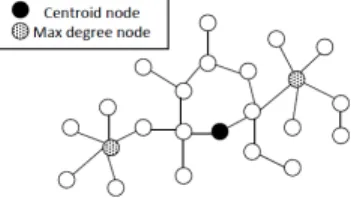
Fig. 1. The max degree nodes are not at the center of the region. The closeness centrality of this node is thus less.
The nodes during this process also keep the track of information about the distance limited heads it has received during this association phase but associate themselves to only one head as described earlier. This leads nodes to know their head as well as have information about other head within few hops. Nodes with no neighborhood are tagged as heads because at the end of this process they remain uninhibited. This helps in creating size limited regions with head distributed all across. The current technique of region formation and head selection is based on local information, but this head might not be the most important node in the region, (Cf. Fig. 1). Insights from Watteyne et al’s work [29] can be used to find
centroid node within these logical regions. All the nodes in the region assign themselves randomly selected virtual coor-dinates. Nodes using the coordinates of local neighborhood compute the average of the coordinates and broadcasts it to their neighbors. The neighbors intern use these coordinates to compute new average. This process continues until the nodes in the region have the same average coordinates. This technique reveals the location of the centroid but not the node ID. The nodes, in-order to identify the centroid node uses their initially assigned coordinates and the newly found average coordinates. Each node checks if the average coordinates is same as the node’s initial coordinates. If the average is within error margin, ε, of the average coordinates, the node declare itself as the centroid. This process might result into multiple nodes declaring themselves as centroid. To have only one region centroid, the decision of being centroid is made based on node degree and egocentric betweenness [30], [31]. Being local measures both degree and egocentric betweenness2 can be computed easily using local information. Once the centroid node is identified for the region, the centroid information is broadcasted and the nodes update the head ID and the hops from head node but not the region they are associated to. Algorithm 1 represents algorithmic description of region formation and centroid identification.
Algorithm 1 Region formation and centroid finding 1: for all node do
2: set nodeStatus = uninhibited 3: set virtualCoordinates = (x, y) 4: broadcast(headID, hopCount, degree) 5: end for
6: repeat
7: recv=receive(headID, hopCount, nodeDegree) 8: if degree<nodeDegree & hopCount<gradientSize then 9: nodeStatus=inhibited & broadcast(recv)
10: end if 11: until converges
12: for all nodes in a region in all regions do
13: newCoordinate=Centroid finding algorithm [29] 14: end for
15: for all nodes where virtualCoordinates − ε < newCoordinate < virtualCoordinates + ε do
16: compute sum(degree, egocentricBetweenness) 17: declare the node with max sum as centroid 18: end for
B. Beamforming
As discussed earlier, to achieve small world properties in wireless networks, we use beamforming. It is essential to find the beamforming nodes, direction and the width of the beam. Flocking provides us with valuable insights in determining the answers to these questions. For identifying beamforming
2egocentric betweenness approximates socio-centric betweenness in the
absence of global knowledge very well [32]
nodes, we use modified alignment rule of flocking. We say nodes align themselves towards the decision of whether to create the beam or not. The alignment rule we apply is thus to identify peripheral nodes of the regions defined in previous section. The decision of being peripheral is made based on the hop count of the neighborhood. If the nodes neighbor has a hop count less than or equal to the node’s hop count then the node declares itself as a peripheral node and makes the decision of creating a beam. A single unconnected node is considered as a peripheral node as it does not have any neighborhood.
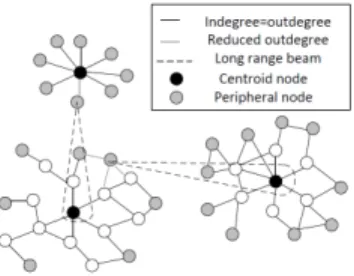
Once the decision of creating a beam has been made, another question of choosing the direction of beam arises. Taking more insights from flocking we say cohesion rule of flocking helps us in determining the best direction of the beam. As the nodes are homogenous, cohesion rule helps us increase the connectivity of the network also. We apply modified cohesion technique and say that beams are directed towards the centroid of other region in order to increase the connectivity, (Cf. Fig. 2). If no new centroid is found then the decision whether to connect to self-region centroid is made. This decision depends on hop count from the self-region centroid as creating beams towards self-region centroid is only feasible if the peripheral node is more than one hop away from the self-region centroid.
Fig. 2. Nodes beamforming towards different region’s centroid. The maximum gradient value for lateral inhibition is 3.
Considering sector model for now, each sector in the sector model is of equal width for a given length (max gain = num-ber of elements). Nodes randomly chose numnum-ber of antenna elements and use above rules to beamform. In sector model, we further assume that each element operates at same energy level and have same energy consumption rate as when the node was omnidirectional. The number of sectors formed in sector model depends on the value of elements used and thus beam width can easily be computed. However, being said that, the best direction of the beam is still not determined and how nodes know whether they have a centroid node within their one hop is still to be addressed. We address these problems later in this section. As the nodes are distributed over a region, unconnected components can be anywhere in the region. It is thus important for the beamforming node to find those regions so that large number of nodes can be connected. The alignment and cohesion rule discussed earlier does not guarantee this coverage. Flocking’s separation rule provide us valuable insight towards this problem. We say, in-order to increase connectivity, nodes create beams in different
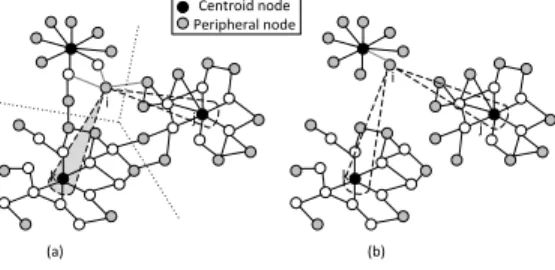
direction from their neighbors. To make this decision, if a peripheral node has decided to create a beam towards a centroid it informs its neighbors about the chosen direction before actually creating the beam, the neighbor peripheral node then tries to find a centroid node in other directions. If no centroid node is found, the decision of creating a long-range beam is dropped and peripheral node remains omnidirectional. We consider nodes determine the direction using path length and sweeping. Consider one big connected component with multiple regions as shown in fig. 3a. Let node i in one region create beam. From fig. 3a, it can be seen that this node can create beam either towards j or k or towards its own centroid. As we know that average path length is dependent on PN
i6=jd(i, j) any reduction in this summation will lead
to reduced path length. In order to have reduced path length we propose the node to determine the farthest centroid using locally available information. In fig. 3a, node i is 5 hops away from k while it is 4 hops away from j. Thus, in order to have a reduced path length node i decides to create beam towards k. In the case when the node does not have previously stored information about the centroid nodes, the node considers hop count to those centroid nodes as infinite and connects to them, (Cf. Fig. 3b). i k j Centroid node Peripheral node i k j (a) (b)
Fig. 3. a) One component with three regions when gradient=3. Here node i can create beam towards centroid j or k, but because its distance to k is more node i creates beam towards centroid k. b) Three unconnected components with gradient=3. Here node i can create beam either towards centroid j or towards k as its distance to j and k is same and is ∞.
When a node creates a beam towards a centroid to which it was not connected within h hops away the problem of asymmetric link arises. Due to this asymmetric link, nodes will not know whether they have connected to the centroid of other region or not. We solve this issue as when a centroid node receives information about the node trying to connect to it, it just for one time, to acknowledge the reception creates the beam back to the node. This can be easily done after determining angle of incidence of the beam and works well for both connected and unconnected components.
IV. SIMULATION SETUP ANDRESULTS
In our simulation, the nodes are distributed throughout the chosen network region of 10x10. Through our simulations we have tried to explore the effect on connectivity, average path length (L) and clustering coefficient (CC) based on varying node densities and varying the gradient size. Further, we
have used MATLAB to simulate our model with a confidence interval of 95%. All the results have been averaged over 50 topologies with number of nodes varying from 20 to 400.
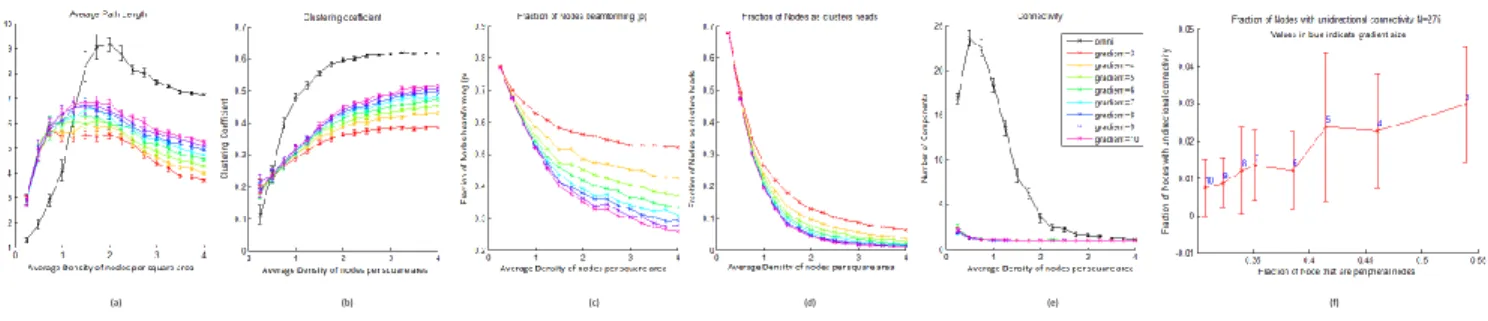
We first provide results obtained when sector model is used with gradient size varying between 3 to 10. Fig. 4a clearly shows the effect of beamforming on L. L obtained in omnidirectional case is initially less than that obtained in the directional cases because of lower density of nodes in the component. When the directional beam is induced, due to inclusion of nodes of the other component, there is an increase in L. L for the directional case is less than that of omnidirectional case when the node density in more than 1.2 due to the fact that though nodes connect to centroid node of other regions there are some nodes that also connect to centroid of the region in which they lie. The effect of gradient can be seen as the lower the gradient size more number of nodes beamform, (Cf. Fig. 4c), leading to more shortcuts and intern more reduction in L. CC however does not change much with the introduction of long-range beams, (Cf. Fig. 4b). For very low density networks CC for the directional case is higher than omnidirectional case due to the fact that nodes which were initially isolated now have neighborhood. For higher density networks the effect on CC is less for higher gradient due to less number of peripheral nodes and less number of unidirectional paths, (Cf. Fig. 4f). Number of components in the network can define connectivity. It can be seen for omnidirectional case from fig. 4e that for very low-density networks, the number of disconnected components is more. The number of disconnected components increases to a certain maximum and then decreases as the density increases because due to omnidirectional range being unity nodes are more isolated in a low density network. The connectivity is thus very low for low density networks as there are more number of disconnected components. When the number of compo-nents decreases, the connectivity increases. For the directional case however, as nodes beamform to different components with the objective of increasing connectivity, the number of disconnected components is less than that of omnidirectional case. The number of centroid nodes on the other hand clearly depends on the size of gradient, (Cf. Fig. 4d). For low-density network, the gradient size does not matter while as L increases the effect of gradient size can be clearly seen on the number of regions. As the gradient increases, more number of nodes are inhibited. For a low gradient value as the density increases the effect on number of regions is almost negligible because of increased clustering coefficient between the nodes. The effect of gradient size on the number of peripheral nodes (P) that beamform can also be seen, (Cf. Fig. 4c). For low L and low gradient size, as there are more regions and more nodes become P as they have smaller neighborhood for determination of their alignment. However, when L and gradient size is more, P is less because there are more nodes in the region and the nodes have relatively more neighbors to check before making the decision of beamforming. The number of P is also greatly tied to the number of unidirectional paths and has an adverse affect on CC. As the peripheral nodes increases unidirectional
(a) (b) (c) (d) (e) (f)
Fig. 4. Results obtained for different gradient size, 3-10, with omnidirectional average path length and clustering coefficient shown. a) average path length (L), b) clustering coefficient (CC), c) fraction of nodes beamforming (P), d) fraction of nodes as centroids, e) number of components (number of components is inversely related to connectivity), f) unidirectional links
paths between the nodes also increases leading to increasing loss in CC, (Cf. Fig. 4f).
V. CONCLUSION
In this paper, we have presented an algorithm for achieving small world characteristic using beamforming and bio inspired techniques in a wireless network. Our algorithm works us-ing locally available information and does not require the knowledge of network wide information. However, number of extensions to our algorithm can be visualized. The optimal gradient size to choose for the determination of minimal peripheral set of nodes is clearly one way of extending our work. As we are dealing node distributions comparisons for the results with different types of distributions like Thomas point process, Mat´ern hard-core process, potential field deployment algorithm etc. are a clear extension to our current study. We are currently working on our algorithm extensions to mobility with asynchronous operation.
REFERENCES
[1] F. Dressler, Self-Organization in Sensor and Actor Networks. John Wiley & Sons, Ltd, Nov. 2007.
[2] D. Guidoni, R. Mini, and A. Loureiro, “On the design of resilient heterogeneous wireless sensor networks based on small world concepts,” Computer Networks, vol. 54, pp. 1266–1281, June 2010.
[3] G. Sharma and R. Mazumdar, “A Case for Hybrid Sensor Networks,” IEEE/ACM Tran. on Networking, vol. 16, no. 5, pp. 1121–1132, 2008. [4] I. Akyildiz and I. Kasimoglu, “Wireless sensor and actor networks: research challenges,” Ad Hoc Networks, vol. 2, pp. 351–367, Oct. 2004. [5] J. Travers and S. Milgram, “An Experimental Study of the Small World
Problem,” Sociometry, vol. 32, p. 425, Dec. 1969.
[6] D. Watts and S. Strogatz, “Collective dynamics of small-world net-works.,” Nature, vol. 393, pp. 440–442, June 1998.
[7] A. Helmy, “Small worlds in wireless networks,” IEEE Communications Letters, vol. 7, no. 10, pp. 490–492, 2003.
[8] A.-L. Barab´asi and E. Bonabeau, “Scale-Free Networks,” Scientific American, vol. 288, pp. 60–69, May 2003.
[9] A.-L. Barab´asi and R. Albert, “Emergence of scaling in random net-works,” Science (New York, USA), vol. 286, pp. 509–512, Oct. 1999. [10] M. Brust and S. Rothkugel, “Small Worlds: Strong Clustering in
Wire-less Networks,” in proc. of 1st Int. Workshop on Localized Algorithms and Protocols for Wireless Sensor Networks, June 2007.
[11] C. Bettstetter, C. Hartmann, and C. Moser, “How does randomized beamforming improve the connectivity of ad hoc networks?,” IEEE Int. Conference on Communications, vol. 05, pp. 3380–3385, May 2005. [12] R. Vilzmann et al., “Hop distances and flooding in wireless multihop
networks with randomized beamforming,” in proc. of the 8th Int. Symposium on Modeling, Analysis and Simulation of Wireless and Mobile systems, pp. 20–27, ACM, 2005.
[13] R. Vilzmann, J. Widmer, I. Aad, and C. Hartmann, “Low Complexity Beamforming Techniques for Wireless Multihop Networks,” in proc. of 3rd Annual IEEE Communications Society on Sensor and Ad Hoc Communications and Networks, pp. 489–497, IEEE, 2006.
[14] M. Kiese, C. Hartmann, J. Lamberty, and R. Vilzmann, “On Connectivity Limits in Ad Hoc Networks with Beamforming Antennas,” EURASIP Journal on Wirel. Comm. and Net., vol. 2009, pp. 1–15, 2009. [15] Z. Yu, J. Teng, X. Bai, D. Xuan, and W. Jia, “Connected Coverage in
Wireless Networks with Directional Antennas,” INFOCOM, 2011. [16] P. Li, C. Zhang, and Y. Fang, “Asymptotic Connectivity in Wireless
Ad Hoc Networks Using Directional Antennas,” IEEE/ACM Tran. on Networking, vol. 17, pp. 1106–1117, Aug. 2009.
[17] C. Balanis, Antenna Theory. Wiley, 1997.
[18] P. Lawrence, “The making of a fly: The genetics of animal design,” Molecular Reproduction and Development, vol. 37, Jan. 1994. [19] R. Nagpal and D. Coore, “An Algorithm for group formationin an
aor-phus computer,” in proc. of Int. Conference of Parallel and Distributed Systems, 1998.
[20] Y. Afek et al., “A Biological Solution to a Fundamental Distributed Computing Problem,” Science, vol. 331, pp. 183–185, Jan. 2011. [21] C. Reynolds, “Flocks, herds and schools: A distributed behavioral
model,” ACM SIGGRAPH Comp. Graph., vol. 21, no. 4, pp. 25–34, 1987.
[22] S. Vasudevan, M. Adler, D. Goeckel, and D. Towsley, “Efficient Algo-rithms for Neighbor Discovery in Wireless Networks,” under submission IEEE/ACM Transactions on Networking, 2011.
[23] L. Freeman, “Centrality in social networks conceptual clarification,” Social Networks, vol. 1, no. 3, pp. 215–239, 1979.
[24] L. Freeman, “A set of measures of centrality based on betweenness,” Sociometry, vol. 40, no. 1, pp. 35–41, 1977.
[25] B. Matthias, H. C. R. Carlos, D. Turgut, and S. Rothkugel, “LSWTC: A local small-world topology control algorithm for backbone-assisted mobile ad hoc networks,” in proc. of 35th Conference on Local Computer Network, pp. 144–151, IEEE, Oct. 2010.
[26] M. Brust, A. Andronache, and S. Rothkugel, “WACA: A Hierar-chical Weighted Clustering Algorithm Optimized for Mobile Hybrid Networks,” in proc. of 3rd Int. Conference on Wireless and Mobile Communications, pp. 23–23, IEEE, Mar. 2007.
[27] W. Heinzelman, A. Chandrakasan, and H. Balakrishnan, “An application-specific protocol architecture for wireless microsensor net-works,” IEEE Transactions on Wireless Communications, vol. 1, pp. 660–670, Oct. 2002.
[28] O. Younis and S. Fahmy, “HEED: a hybrid, energy-efficient, distributed clustering approach for ad hoc sensor networks,” IEEE Transactions on Mobile Computing, vol. 3, pp. 366–379, Oct. 2004.
[29] T. Watteyne, I. Aug´e-Blum, M. Dohler, S. Ub´eda, and D. Barthel, “Cen-troid virtual coordinates A novel near-shortest path routing paradigm,” Computer Networks, vol. 53, pp. 1697–1711, July 2009.
[30] M. Everett and S. Borgatti, “Ego network betweenness,” Social Net-works, vol. 27, pp. 31–38, Jan. 2005.
[31] E. Daly and M. Haahr, “Social network analysis for routing in discon-nected delay-tolerant manets,” in proc. of 8th ACM Int. Symposium on Mobile Ad Hoc Networking and Computing, pp. 32–40, ACM, 2007. [32] P. Marsden, “Egocentric and sociocentric measures of network