To link to this article:
DOI:10.1016/j.apgeochem.2010.11.023
http://dx.doi.org/10.1016/j.apgeochem.2010.11.023
This is an author-deposited version published in:
http://oatao.univ-toulouse.fr/
Eprints ID: 5537
To cite this version: Petit, Stéphane and Lucotte, Marc and Teisserenc, Roman
Mercury sources and bioavailability in lakes located in the mining district of
Chibougamau, eastern Canada. (2011) Applied Geochemistry, vol. 26 (n°2). pp.
230-241. ISSN 0883-2927
O
pen
A
rchive
T
oulouse
A
rchive
O
uverte (
OATAO
)
OATAO is an open access repository that collects the work of Toulouse researchers and
makes it freely available over the web where possible.
Any correspondence concerning this service should be sent to the repository
administrator:
[email protected]
Mercury sources and bioavailability in lakes located in the mining district
of Chibougamau, eastern Canada
Stéphane Petit, Marc Lucotte
⇑, Roman Teisserenc
1COMERN/GEOTOP, Institut des Sciences de l’Environnement, Université du Québec à Montréal, CP 8888, suc. Centre-Ville, Montréal, Québec, Canada H3C 3P8
a b s t r a c t
The presence of Hg in the fish of the lakes from the Cu–Zn–Au mining region of Chibougamau (Canada) represents a serious source of concern for the health of local sports and subsistence fishers. This study focuses on identifying the origin of Hg present in the sediments of lakes with mine wastes stored in tail-ing facilities located on their shores. In addition to C/N ratios and determination of total Hg, Methyl Hg and other metals, a series of lignin biomarkers were used to contrast the history of the mining contam-ination with the nature and the intensity of terrigenous organic matter (TOM) inputs from the water-sheds to the sampled lakes. It appears that sediments located nearest to mine tailings are as expected most enriched in total Hg and other metals (Cu, As, Al, Fe, Pb). Nevertheless, the presence of only small amounts of refractory TOM in these contaminated sediments could explain why only a very small fraction of Hg is found as Methyl Hg. In sediments with little or no impact by mining activities, a relationship was observed between logging activities in the lake watershed and increased TOM derived from inorganic gymnosperms soils horizons and increased Hg transport to the lakes. Nevertheless, it appears that the additional TOM transported to logged lakes is refractory enough not to promote high levels of Methyl Hg. The highest fractions of Methyl Hg relative to total Hg in lake sediments of the studied area were thus observed in relatively pristine environments where least degraded TOM is brought from the watersheds.
1. Introduction
Since the beginning of the 20th Century, the economic develop-ment of the Chibougamau region has been closely linked to the successes of the mining industries hosted in this part of the Prov-ince of Québec (Canada) – mainly Au and Cu exploitation (
White-way, 1994). The mine wastes, containing significant amounts of
trace metals, are often stored in tailing facilities located on the shores of lakes used for sport or subsistence fishing (Laliberté
and Tremblay, 2002). Many environmental impact and human
health studies, notably targeted on Hg, have recently been under-taken in response to the growing concerns of the local population facing this threat to the integrity of their lakes and fish resources
(Laliberté and Tremblay, 2002; Dewailly and Nieboer, 2005). A
study on the walleye (Sander vitreus) populations found in Lake Aux-Dorés and Lake Obatogamau – nearby Chibougamau – re-cently reported elevated Hg levels in fish tissue, possibly attribut-able to the mining activities, and stressing the need to fully assess this situation (Simoneau et al., 2005).
Sediment cores are often used as proxies to study temporal trends of Hg inputs to lake environments, including all natural and anthropogenic sources (Lucotte et al., 1995, 1999; Salomons, 1995; Allan, 1997; Scherbatskoy et al., 1998; Lockhart et al.,
2000; Biester et al., 2000; Covelli et al., 2001). Numerous
method-ological approaches have been proposed to segregate the sedimen-tary Hg signal attributable to mine tailings from the natural background values. These approaches include Hg sequential extraction, X-ray spectroscopy (El Bilali et al., 2002), or chronolog-ical reconstitutions of Hg accumulation using isotopic tracers (210Pb,137Cs) (Horowitz et al., 1995; Wong et al., 1999; Lockhart
et al., 2000). Although these methodologies yield satisfactory
re-sults in areas located near to the anthropogenic point sources, they become less informative on a larger whole-ecosystem scale, be-cause they fail to distinguish between Hg leached from tailings and Hg transported from unaffected parts of the watersheds, but usually also rich in Hg (Sladek and Gustin, 2003). Most of the nat-ural Hg load to lakes usually transit through watersheds (Engstrom et al., 1994; Lucotte et al., 1995; Lockhart et al., 1998; Scherbatskoy et al., 1998; Porvari and Verta, 2003; Kainz and Lucotte, 2006). It is thus often difficult to assess the modern background levels of sed-imentary Hg accumulation in lakes as through time numerous pro-cesses affect the efficiency of the Hg transfer from watersheds to lake environments (Engstrom et al., 1994; Jackson, 1997; Grigal, 2002).
⇑Corresponding author. Tel.: +1 514 987 3000x3767; fax: +1 514 987 3635. E-mail address:[email protected](M. Lucotte).
1
Present address: Laboratoire d’Ecologie Fonctionnelle (ECOLAB), UMR 5245 CNRS-INPT-UPS, ENSAT – Avenue de l’Agrobiopole, BP 32607 Auzeville-Tolosane, 31326 Castanet Tolosan Cedex, France.
Here it is proposed to weight the relative importance of Hg in-puts from mine tailings in lakes of the Chibougamau region and as-sess its availability for methylation, using organic tracers. First, the geochemical signature of sediments will be compared to the char-acteristics of the mine tailing. Then, knowing that most of the Hg load entering lakes from unperturbed watersheds is bound to or-ganic matter (OM) of terrestrial origin (Meili, 1991; Porvari et al., 2003; Ouellet et al., 2009; Teisserenc et al., 2010), the specific pat-terns of phenolic molecules yielded by mild oxidation of the OM found in sediments will be used to estimate the amount of Hg orig-inating from the lixiviation of soils (Laskov et al., 2002; Caron et al., 2008; Ouellet et al., 2009).
2. Sampling sites and methods 2.1. Study area
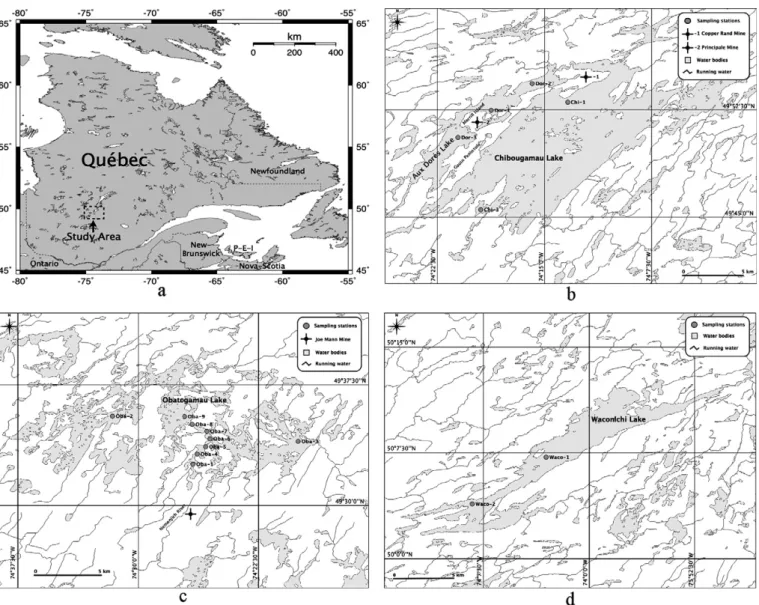
The Chibougamau region (49.92°N, 74.37°W) is located in the North-eastern part of the Canadian Shield (Fig. 1a). The bedrock of the area (ca. 2.7–2.5 Ga) is mainly composed of granite (quartz-feldspars) (Mueller and Donaldson, 1992; Chouteau et al., 1997). The overlying soils are mainly podzols, composed of quater-nary sandy-silty material (Prévost, 1996, 2004). The regional vege-tation is dominated by forests of black spruce (Picea mariana),
white spruce (Picea glauca), and birch (Betula papyrifera) (Garralla
and Gajewski, 1992).
The four lakes included in this study are large headwater lakes with areas ranging between 41.9 km2 and 205.6 km2 (Fig. 1b–d,
Table 1). The waters of Chibougamau and Aux-Dorés lakes are less
acidic and have lower dissolved organic C (DOC) than Waconichi and Obatogamau lakes (Table 1). The ratio of total lake area to total drainage basin area for Lake Aux-Dorés (0.05) is significantly lower than those of the three other lakes, which exhibit comparable val-ues – respectively, 0.29 (Lake Chibougamau), 0.16 (Lake Obatoga-mau), and 0.25 (Lake Waconichi). The relative proportion of wetland area found in the watershed of Lake Obatogamau (9.1%) is about twice the value calculated for the three other watersheds (ranging between 3.1% and 4.8%,Table 1). The relative proportion of mature forest stands in the watershed of Lake Obatogamau is 66.2% of the total watershed area, while it is about 42% for the three other watersheds (Table 1).
The watersheds of the four studied lakes have been affected by important logging operations since the early 1950s. The frequent occurrence of forest fires in the region also modulates the OM and Hg exchanges between the watersheds and the lakes (Smith et al., 2000; Witt et al., 2009). But given the geographical proximity of the four sampled lakes, the influence of forest fires on OM and Hg is considered rather similar for all lakes of this study. A
6-layered spectral analysis of LANDSAT 7-ETM + satellite imagery was performed using GIS software (Mapinfo and GRASS), coupled with ecoforestry maps and field validations. Following this analy-sis, it is possible to distinguish between barren soils, natural occur-rence or following recent clear cutting and fallow lands, recent revegetation following logging or forest fires. In the watersheds of Chibougamau and Aux-Dorés lakes, the relative proportion of barren soils is 25% of the total watershed area, mostly constituted of barren rocks. The area lying between Lake Chibougamau and Lake Aux-Dorés seems to have been impacted by logging since only a small area of mature forest can be identified. The watershed of Lake Obatogamau is characterized by the presence of only two patches of barren soils, most probably attributable to logging. Fi-nally, the watershed of Lake Waconichi is characterized by moun-tainous landscape with vegetation coverage similar to the one of Lake Chibougamau and Aux-Dorés. However, a large patch of bar-ren soils appearing on the northern part of the watershed was likely induced by recent logging.
The mining activities in the Chibougamau region began in the early 50s. The main ores extracted are pyrite, pyrrhotite, chalcopy-rite, sphalerite and galena (Whiteway, 1994). The watersheds of Chibougamau, Aux-Dorés, and Obatogamau lakes were mainly mined by the Copper Rand Co., and the Principle Mining Co., for Au and Cu. Both companies operated waste treatment plants and tailings facilities. The facilities of the Copper Rand Co., are located on the Gouin Peninsula on a stretch of land separating Lake Chibo-ugamau and Lake Aux-Dorés (Fig. 1b). The main tailings pile on this site contains 6.3 megatons of residues. The site is enclosed by dams constructed using sterile rocks. The waters draining the tailings flow into Lake Chibougamau. A second nearby tailing pile owned by the company, containing 7.7 megatons of residues, drains into Lake Aux-Dorés. The tailings facilities of the Principale Mining Co., is located on Merrill Island, Lake Aux-Dorés (Fig. 1b). Its tail-ings pile, 19.3 megatons of residues, drains into Lake Aux-Dorés.
Lake Obatogamau is impacted by the tailing pile of the Joe Mann mine, operated by the Principale Mining Co., located 6 km up-stream on the banks of the Nemenjich River (Fig. 1c). However, the residues contained in the tailings were previously subjected to a cyanidation treatment prior to storage. The extraction of Au from the ores through cyanidation was used for a period of 5 a in the mid 50s before being replaced by other extraction methods
(Laliberté and Tremblay, 2002). Finally, Lake Waconichi is not
im-pacted by any mining activities (Fig. 1d).
2.2. Sampling sites and sampling procedures
The sampling sites in the three lakes impacted by mining were selected – using bathymetric and hydrologic maps and previous information reported byLaliberté and Tremblay (2002)to reflect the potential dispersion of pollutants flushed from the mine tailings.
The two sampling stations at Lake Chibougamau CHIB 1 (22 m depth) and CHIB 3 (8 m depth) are, respectively, located in the northern part of the lake and 25 km downstream from this
loca-tion, away from the influence of the tailing (Fig. 1b). Three stations were sampled at Lake Aux-Dorés (Fig. 1b). The DOR 1 sampling sta-tion (12 m depth) is located mid-way between the tailings pile of Merrill Island and the upstream Copper Rand Co., tailings facility. The DOR 2 sampling station (32 m depth) is located 10 km up-stream to the north of the DOR 1 station. Two sediment cores were retrieved from these locations in 2004. The DOR 3 sampling station (11 m depth) is located 5 km downstream from the DOR 1 station, and about 4 km downstream from the Merrill Island tailings.
Four locations were cored in Lake Obatogamau (Fig. 1c). The OBA 1 sampling station (2 m depth) is located at the mouth of the Nemenjich River, 6 km downstream of the tailings. The OBA 2 sampling station (8 m depth) is located 20 km downstream from the OBA 1 station. The OBA 3 sampling station (12 m depth) is lo-cated 15 km downstream of the OBA 1 station, away from the influence of the waters carried by the Nemenjich River. Finally, the OBA 9 sampling station (5 m depth) is located between the OBA 1 and OBA 2 stations. Surface sediment flocculates were sam-pled between the OBA 1 and OBA 9 in summer 2004. Finally, two stations were cored in pristine Lake Waconichi at focal points
(Håkanson, 1981) located in the deep central axis of the lake –
WAC 1 (22 m depth) and WAC 2 (18 m depth) (Fig. 1d).
The sampling operations were performed during winter and/or summer field campaigns held in 2003 and 2004. Sediment cores up to 1 m long were collected using a pneumatic Mackereth corer. This type of corer minimizes sediment perturbation and compac-tion. The sediment cores were cut into 0.5–1 cm layers, put in glass containers pre-cleaned by heating at 500 °C for 3 h, and frozen un-til analyses. Surface sediment flocculates were collected by divers using 60 cc syringes.
2.3. Laboratory analyses 2.3.1. Total mercury
Prior to analysis, the sediment samples were freeze-dried, and homogenized. Then, 200–500 mg dry weight subsamples were transferred to glass tubes and digested using a mixture of 10:1 HNO3:HCl, heated for 6 h at 120 °C and diluted to volume with
NANOpureÒwater for analyses. Total Hg (THg) was then reduced
to elemental Hg vapour by a stannous chloride solution and deter-mined by cold vapour atomic fluorescence spectrophotometry (Pichet et al., 1999). A standard reference solution (MEST 3 – CNRC) was inserted in the analytical sequence at a rate of 1:10 to test the accuracy of the protocol. The recovery of the reference material was better than 95% and the reproducibility of the method was about 5% (Pichet et al., 1999).
2.3.2. Methylmercury
The determinations of methylmercury (MeHg) concentrations were performed by taking subsamples of about 0.2 g of dried sed-iments, mineralized by HCl 6N and CuSO4, then triple-extracted
with 2 mL toluene. The 6 mL extracts were evaporated under a N2flow to a final volume of 0.2–0.5 mL. An aliquot of 50
l
L wasthen injected into a gas chromatograph under an Ar gas carrier
Table 1
Morphological characteristics of the four studied lakes and their drainage basin (DB).
Sampled lakes DOCa
(mg/kg) pH water columna
Lake area (ha) DB area (ha) Ratio lake/DB Land use (%)
Mature forest Fallow land Barren land Wetland
Aux-Dorés 6.60 6.43 41.9 813 0.05 42 27 25 4
Chibougamau 6.41 6.69 205.6 696 0.29 42 29 25 4
Obatogamau 10.44 6.09 90.1 561 0.16 66 16 9 9
Waconichi 9.67 6.72 81.2 327 0.25 42 27 28 3
a
(60 L/min) to separate and detect the methyl radical concentra-tions. The total Hg concentration of the extracts was measured according to the same protocol described above (Pichet et al.,
1999; Kainz et al., 2003). The recovery of the reference material
varied between 95% and 105% while the reproducibility of the method was about 5% with a detection limit of about 0.02 ng Hg g 1(Pichet et al., 1999).
2.3.3. Other elements
The concentrations of Al, Cu, Fe and Pb were determined in trip-licate by ICPMS (Jarell-Ash ICAP-9000 spectrometer). The As con-tent was measured in duplicates by cold vapour atomic absorption spectrophotometry. The reproducibility of spectropho-tometric measurements is better than 5%.
2.3.4. Organic matter content
The total C and N contents were determined in duplicate using a Carlo Erba (NA-1500) elemental analyser. The reproducibility of the measured C vs. N ratios reported on an atomic basis ((C/N)a) ratios was ±0.1.
2.3.5. Phenolic compound signatures
The origin of the sedimentary OM was characterized using the specific patterns of phenolic compounds yielded by a mild oxida-tion of sediments using CuO. The analytical procedure used here is similar to the one first described byErtel and Hedges (1982), then modified byGoñi and Montgomery (2000). Briefly, subsam-ples of sediment containing between 2 and 5 mg organic C were placed into a Teflon reactor under a N2flow, along with a solution
of CuO:2N NaOH, and heated at 150 °C for 90 min in a microwave oven (CEM MDS 200). The phenols derived from this oxidation were extracted from the resulting solution with ethyl acetate and determined using a coupled gas chromatograph (Varian 3800) – mass spectrometer (Varian Saturn 2000).
The phenol monomers produced by the mild oxidation can be grouped into 3 main families: vanillyls (V), syringyls (S), and cin-namyls (C) (Hedges and Mann, 1979; Hedges et al., 1982; Gon~i
and Hedges, 1992). The V family are typically produced by oxidized
OM derived from all types of terrestrial plants. However, the C fam-ily is solely produced by oxidized OM derived from non-woody tis-sues (leaves, barks, needles) whereas the S family are derived solely from angiosperm plants (Hedges and Mann, 1979). A fourth family of phenols, the p-hydroxyphenols (P) is also produced by the mild oxidation of OM but these compounds can also be derived from non-ligneous sources, such as aromatic amino acids (Hedges
et al., 1982). Finally, the cupric oxidation of OM can also produce
dihydroxybenzoïc acid (3.5-Bd), which is not directly derived from ligneous macromolecules but rather from smaller organic mole-cules issuing from the degradation of ligneous compounds ( Lou-chouarn et al., 1997; Farella et al., 2001; Houel et al., 2006; Ouellet et al., 2009).
The ratios established between the different phenol families yielded by the cupric oxidation of sedimentary OM thus informs on the origin, quality and relative proportion of terrestrial OM (TOM) incorporated in sediments (Hedges et al., 1982, 1988). For example, the C/V ratio is used to segregate between woody vs. non-woody TOM in sediments (Prahl et al., 1994). Similarly, the S/V ratio indicates the relative proportion of sedimentary TOM originating from angiosperm plants. The 3.5 Bd/V ratio yields indi-cations on the relative proportion sedimentary TOM originating from the organic vs. inorganic horizons of soils (Houel et al., 2006). Finally, the P/(V + S) ratio informs on the relative extent of diagenetic decomposition of the TOM found in sediments (Dittmar
and Lara, 2001). The early diagenesis of TOM in sediments implies
the loss of methoxy radicals attached to the phenols of the S and V families, but this process does not affect the abundance of phenols
of the P family since they do not possess methoxy radicals (Ertel
and Hedges, 1982). The relative amount of TOM found in
sedi-ments is expressed by another indicator, Lambda 8 (k8), which rep-resents the sum of 8 phenols from the S, V and C families yielded by the cupric oxidation, normalized for 100 mg organic C.
3. Results
3.1. Inorganic indicators
The general aspect of the sediments retrieved was mostly quite homogenous from the top to the bottom of cores with a uniform brown colour and high water content. However, vivid yellowish sediment layers are observable in the upper part of the cores col-lected at stations DOR 1 (3rd cm) and DOR 3 (2nd cm). The bottom part (last 0–6 cm) of these two cores, similarly to the core collected at station CHIB 1, is constituted of compacted grey clayey-silty material. Similar sediment composition is observed in the layers comprised between 4 and 14 cm for the core collected at station OBA 1. However, the sediments at the bottom (last 2 cm) of this core contain significant amounts of vegetal debris. Similar debris were also observed all through the core retrieved from station CHIB 3.
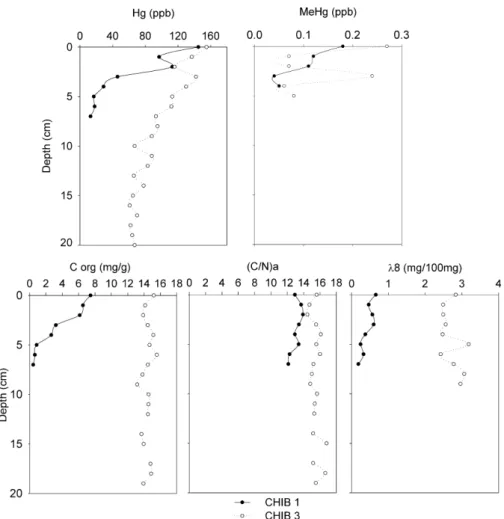
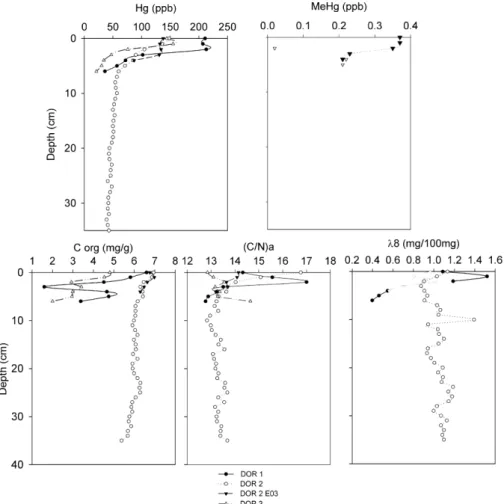
Figs. 2a–2dandTable 2show THg concentrations measured in
the sediment cores and the surface sediment flocculates. Maxi-mum THg values measured in the sediments of stations OBA 1 and OBA 9 as well as in the flocculates from stations OBA 1, OBA 4, OBA 5, OBA 7 and OBA 8 are clearly higher – up to 1450 ppb – than maximum values usually reported for lakes that are not im-pacted by local anthropogenic Hg point source, 350 ppb in Scandi-navia (Porvari and Verta, 2003), Northeastern Canada (Lucotte
et al., 1995; Lockhart et al., 1998), and the Great Lakes (Engstrom
et al., 1994). The sediment cores with lower THg levels can be
grouped into two categories. First, the THg profiles in the cores from stations CHIB 3, DOR 2, OBA 2, OBA 3, WAC 1 and WAC 2 are characterized by a steady increase of Hg levels from the bot-tom, assumed to represent natural background values (Engstrom
et al., 1994; Grigal, 2002), to the top of the cores. The
anthropo-genic sedimentary enrichment factor (ASEF) – defined here as the ratio between natural background values and maximum values found at the top of the core, presumably enriched from anthropo-genic source (Lucotte et al., 1995; Meili, 1995), ranges between 1.7 and 3.6 for this series of cores. However, the ASEF calculated for a second series of cores comprising stations CHIB 1, DOR 1 and DOR 3 is unmistakably higher, with respective values of 11.2, 21.1 and 10.3. Interestingly, these exceptionally high ASEF values seem to be induced by extremely low THg natural background values, rang-ing between 10 and 15 ppb, rather than greater anthropogenic con-tributions, THg values in the top sediment ranging layers ranging between 40 and 100 ppb.
Methyl Hg measurements were performed on the top 5 cm of the sediment cores and surface sediments flocculates (Figs. 2a–
2d, Table 2). The MeHg concentrations in sediments from Lake
Waconichi were all lower than 0.2 ppb, which represent 0.15% of the THg values. The MeHg concentrations in sediments from Aux-Dorés and Chibougamau lakes range between 0.1 and 0.3 ppb, equivalent to about 0.15% of the THg values. Finally, MeHg concentrations in sediments from Lake Obatogamau are clearly higher, ranging between 0.5 and 1.5 ppb, corresponding to 0.2– 0.3% of the THg values. The highest MeHg content was found in sediments retrieved from station OBA 9.
The concentrations of the other metal(loid)s measured in this study are highly variable, even between cores originating from the same lake (Table 3). The Al levels are comprised between 10,000 ppm (WAC 2) and 32,000 ppm (DOR 3), with surface values
of 15,000 ppm for station DOR 2. At station WAC 2, the As level in the upper part of the sediment core is 4.4 ppm, while the Cu levels are constant throughout the core at 12 ppm. The As and Cu levels in Lake Aux-Dorés are significantly higher with values of, respec-tively, 82 ppm As and 1400 ppm Cu for station DOR 1, and 13 ppm As and 360 ppm Cu for station DOR 2. The maximum Cu concentration measured is 2200 ppm Cu at station OBA 1 (cm 14 layer). The surface Fe levels in the sediment cores range between 17,000 ppm (WAC 2) and 76,000 ppm (DOR 1), with a median va-lue of 34,000 ppm at station DOR 2. The Pb vava-lues are comprised between 14 ppm (OBA 1) and 100 ppm (DOR 3). The calculated ASEF for the different metals are also highly heterogeneous. At sta-tions CHIB 1 and OBA 1, the ASEF values for As, Cu and Pb are around 10. Significant anthropogenic enrichment is also observed in the DOR 1 and 3 cores for As and Cu. Finally, at station OBA 1, the Al, Cu and Pb levels in the 14 cm layer are higher than in the surface layer.
3.2. Organic indicators
The lake environments studied here only contains negligible amounts of carbonates. The total C content measurements per-formed are thus considered to represent solely organic C (OC)
(Kainz et al., 2003). The OC contents measured in the sediment
cores (Figs. 2a–2d) are heterogeneous with values ranging between 0.44 mg C/g (CHIB 1, 6th cm) and 47.4 mg C/g (OBA 1, 22nd cm). Low OC contents (less than 2 mg C/g) are reported for the bottom part of sediment cores from stations CHIB1, DOR 1 and DOR 3, with values increasing toward the top of cores, reaching between 4.8
and 7.6 mg C/g. Similar OC contents are reported for the cores at stations DOR 2, WAC 1 and WAC 2. The sediment cores at stations OBA 1, 2, 3 and 5 have homogeneous OC contents ranging between 9 and 11 mg C/g. Meanwhile, the cores from stations OBA 1, DOR 1 and DOR 3, are marked by sharp decreases of OC contents between the top and middle of the cores. The deep layers of the cores at sta-tions OBA 1 (16–24 cm) and CHIB 3 show OC contents of about 15 mg C/g, which is higher than the OC content for bottom sedi-ments measured in the other cores 10 mg C/g.
The sediment profiles for (C/N)a ratios and k8 values are gener-ally homogeneous except for the cores from stations DOR 1, DOR 3 and OBA 1 (Figs. 2a–2d). At station OBA 1, elevated (C/N)a ratios ranging between 20 and 80) corresponding to k8 values close to 0, can be observed between 4 and 15 cm. In all other cores the (C/N)a ratios are between 12 and 15, the highest ratios reported for station CHIB 3 and in Lake Obatogamau, and the lowest ratios reported for stations CHIB 1 and WAC 1. k8 values are between 0.6 mg/100 mg and 2.0 mg/100 mg, with the exception of station CHIB 3 with values of 2.6 ± 0.2 mg/100 mg. Similar k8 values are reported for the bottom part of the core from station OBA 1 (cms 15–24) with values between 2.5 and 4.3 mg/100 mg.
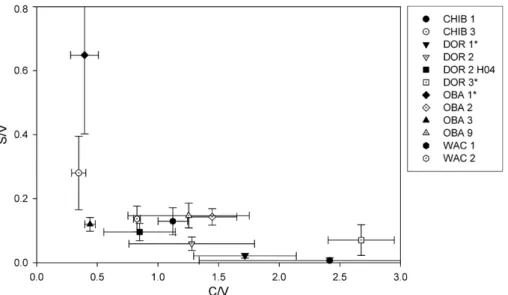
Fig. 3ashows the relationship between S/V and C/V ratios in the
sediments of all studied lakes. The S/V ratios are between 0.02 (bottom part of the cores from stations DOR 1 and CHIB 1) and 0.65 ± 0.3 (bottom part of the core from station OBA 1). All values for the S/V ratios are within a narrow range of values between 0.15 and 0.25, with the exception of the three values listed above. In contrast, the calculated C/V ratios are characterized by a great var-iability, with values ranging between 0.1 and 2.6 ± 0.2. The core
from station OBA 2 and the bottom part of cores from stations DOR 1, DOR 2, DOR 3 and CHIB 1 all have C/V ratios higher than 1.5. Ele-vated C/V ratios have in the past been considered as an indication of high inputs of OC derived from non-woody material (Hedges and
Mann, 1979; Goñi and Hedges, 1990). However, it was recently
re-ported that this indicator can also traduce high inputs of OC de-rived from gymnosperms (Suominen et al., 2003).
Fig. 3b shows the relationship between the 3.5Bd/V and P/
(V + S) ratios in the sediments taken in the four studied lakes. Most of the points on the diagram tend to align around the same axis, with the exception of ratios from cores collected at stations OBA 2 and OBA 9, which are located above this axis. The points for 3.5Bd/V vs. P/(V + S) ratios for sediments from stations CHIB 3, DOR 2 H02, and the bottom part of the cores from stations OBA 1, OBA 3 and WAC 2 are all located on the left-bottom part of the axis. The points representing the 3.5Bd/V vs. P/(V + S) ratios for stations DOR 2 and WAC 1 are located in the middle part of the axis, while the points for the sediments from station CHIB 1 and the bottom part of the cores from stations DOR 1 and DOR 3 lie in the upper-right part of the axis.
4. Discussion
4.1. Sedimentary environments directly impacted by the mine tailings The OC profiles for stations DOR 1 (0–3 cm), DOR 3 (0–2 cm), OBA 1 (0–14 cm) and OBA 1 E03 show decreasing values down from the top of the cores (Figs. 2b and 2c). This observation can be explained either by a change of sedimentary OC accumulation rates, recent increase or past decrease, or by the progressive
diagenetic degradation of the labile portion of sedimentary OM. The observed change of compaction of sediments in the top part of the cores tends to support the hypothesis of a recent increase of OC accumulation. The sedimentary inputs from the tailings at these stations can explain the increase of As, Cu and Pb contents in the top part of the cores (Table 3). These elements are present as traces in the regional bedrock (pyrite, chalcopyrite) being pro-cessed by the mine operation and stored in the tailings (Laliberté
and Tremblay, 2002). The data for As, Cu and Pb levels at stations
DOR 1, 3 and OBA 1 exceed by about 50% those reported by
Lali-berté and Tremblay (2002)for the same environments. The Hg
lev-els observed in the sediments retrieved from stations DOR 1 (0– 3 cm) and DOR 3 (0–2 cm) are around 200 ppb, these values being comparable to the one usually reported for unperturbed lake sed-iments (Lockhart et al., 1995, 1998: Lucotte et al., 1995; Meili,
1997; Porvari and Verta, 2003). However, the THg ASEF value for
these cores, about 10, far exceeds the usual THg ASEF value of 4 re-ported for other lakes located in Northeastern Canada (Lucotte
et al., 1995). The THg profile at station OBA 1 is different and can
be decomposed into two distinct parts. The THg levels from sedi-ment layers between 14 and 4 cm are all above 1400 ppb, about four times as high than those reported for unperturbed sediments. These horizons likely correspond to past massive inputs of material leached from the tailings. It is also the first time that such high THg values have been reported in this region (Laliberté and Tremblay, 2002). The THg levels in this core start to decrease upwards from the 7 cm to reach 350 ppb at the top of the core.
These results indicate that Obatogamau and Aux-Dorés lakes are greatly impacted by the presence of the Joe Mann mine tailings, but also by the other tailings facilities located on Merrill Island and
on the Gouin Peninsula. The dispersion of the pollutant load seems to be limited since the same compacted mica-feldspar top sedi-ment horizon was not observed in the other cores sampled in the two lakes.
High levels of As, Cu, Al, Fe and Pb are also symptomatic of the perturbation of the quality of sediment by the mining activities. As described above, this anthropogenic metal(loid) load can get to nearby sediments associated with fine particles. But it can also be introduced to the lake in the form of acidic lixiviates derived from the tailings drainage and then be transported over tens of kilometres from the point source (Horowitz et al., 1995; Azcue
et al., 1995; Salomons, 1995; Wong et al., 1999). According to
the THg profiles observed at stations DOR 1 and 3, the pollutant load seems to reach maximum levels in the recent sediment sur-face horizons. In the case of the OBA 1 sediment core, THg levels stabilize to lower values near the sediment surface. The top part of this core is also characterized by an increase of the (C/N)a ratios and OC contents, suggesting that the sediment load derived from the tailings has recently decreased. The damming of the tailing piles in the 1960s is probably responsible for this decrease. It is also worth noting that the extraction of ore through the cyanida-tion process was abandoned in the 1960s. Cyanidacyanida-tion is known to increase the mobility of Hg following the formation of highly soluble Hg–CN complexes (Salomons, 1995).
Although THg levels observed at station OBA 1 are elevated, MeHg levels in these sediments never exceeded 0.5 ppb or less
than 0.2% of THg values. These MeHg levels are noticeably lower than those reported elsewhere for unperturbed lakes of the Cana-dian boreal forest (Krabbenhoft et al., 1998; Kainz and Lucotte,
2006; Kainz et al., 2003). Many hypotheses can be given to explain
this observation. First, the OC content of surface sediments for these cores is relatively low, <7%, which may impair or limit the activity of SO4-reducing bacteria known to induce Hg methylation
(Lee and Iverfeldt, 1991; Kelly et al., 1995; Chen et al., 1996; Fortin et al., 2000; Ullrich et al., 2001; Kainz and Lucotte, 2002, 2006;
Kainz et al., 2003). It is also possible that the inorganic Hg found
in the sediments is immobilized in the form of HgS and thus not available for methylation (Regnell et al., 2001; El Bilali et al.,
2002; Sladek and Gustin, 2003). Finally, the observations suggest
that the sediment accumulation rate, notably at station OBA 1, is high following massive inputs of fine particles from the tailings, causing a rapid and efficient burial of the surficial sediment biofilm known to host methylation processes (Ramlal et al., 1993; Watras et al., 1995).
4.2. Sedimentary environments located away from the mine tailings The sediment cores collected at sampling stations located away from the tailings and the 2 cores sampled in Lake Waconichi do not have any compacted sediment layer. The OC and (C/N)a profiles ob-served in these cores are all flat and homogeneous (Figs. 2a–2d). However, these cores can be segregated into two classes on the
basis of their THg content in the surface horizons (Figs. 2a–2d). The first class of sediment cores comprises sampling stations where there is no noticeable THg enrichment. This class includes stations CHIB 3, DOR 2, DOR 2 E03, OBA 3, WAC 1 and WAC 2. The second class comprises cores where either: (1) the THg ASEF value signif-icantly surpasses the ASEF value of 4 generally reported for unper-turbed lake environments of the same region; or (2) the THg levels in surface sediment largely exceeds the 350 ppb value reported for unperturbed lakes. Sediments collected at stations CHIB 1, OBA 2, OBA 9, OBA 4, and flocculates at stations OBA 5, OBA 7, OBA 8 be-long to this group. These sediments seem to be affected by addi-tional Hg inputs that cannot be related to changes in the inorganic and organic indicators discussed so far. These sampling stations are all located downstream from the mine tailings. In Lake Obatogamau, the intensity of the observed sediment alteration
seems to decrease with increasing distance away from the mouth of the Nemenjich River (Fig. 2c;Table 2).
However, the overall variability of THg levels observed between the different sediment cores analysed in this study cannot be
Fig. 2d. THg, MeHg and lignin biomarker profiles at Waconichi Lake sampling stations.
Table 2
THg, MeHg, OC, (C/N)a and k8 measured in surface sediment flocculates of CHIB 3, OBA 1, OBA 2, OBA 3, OBA 4, OBA 5, OBA 6, OBA 7, OBA 8 stations.
Sampling station Hg (ppb) MeHg (ppb) OC (%) (C/N)a k8 (mg/100 mg COT) CHIB 3 147 0.27 16.15 14.97 2.14 Oba 1 371 1.17 6.13 14.86 1.32 Oba 2 302 0.93 9.86 14.08 1.07 Oba 3 228 1.23 12.44 14 1.23 Oba4 756 1.67 5.59 14.99 1.45 Oba5 902 2.43 11.33 16.17 2.20 Oba6 166 0.57 6.73 14.31 0.94 Oba7 609 1.35 10.23 13.89 1.51 Oba8 516 1.43 6.89 15.89 2.53 Table 3
Various metal(loid) concentrations in sediment cores CHIB 1, DOR 1, DOR 2, DOR 3, OBA 1, WAC 2. Sampling station Depth (cm) Al (ppm) As (ppm) Cu (ppm) Fe (ppm) Pb (ppm) CHIB 1 0 18,000 28 380 42,000 77 2 18,000 25 390 44,000 64 6 14,000 1.6 29 20,000 8 DOR 1 1 24,000 82 1400 73,000 88 3 27,000 44 2100 73,000 82 4 14,000 11 220 30,000 47 DOR 2 0 15,000 13 360 34,000 77 3 14,000 5.4 69 29,000 42 18 14,000 2.6 24 27,000 7 35 14,000 2.3 26 28,000 7 DOR 3 1 32,000 43 1100 76,000 100 3 11,000 8.4 120 22,000 33 6 18,000 13 15 53,000 36 OBA 1 0 23,000 71 440 75,000 14 11 26,000 95 1200 71,000 19 14 29,000 17 2200 8800 25 24 4100 1.6 16 6400 2 WAC 2 0 10,000 4.4 12 17,000 40 10 9900 4.2 11 16,000 25 25 10,000 1.8 11 17,000 6
explained solely by the distance from Hg point sources. Numerous studies have demonstrated that most of the THg found in lake sed-iments is transported from the watersheds bound to TOM (Meili, 1991; Mierle and Ingram, 1991; French et al., 1999; Porvari and Verta, 2003; Porvari et al., 2003; Ouellet et al., 2009; Teisserenc et al., 2010). In turn, the phenol signature of the TOM found in sed-iments gives valuable information on the source (gymnosperm vs. angiosperm plants), the origins (organic vs. inorganic soil horizons) and state of degradation of the TOM presumably carrying the THg load from watersheds to lake sediments (Ouellet et al., 2009). Overall, the low values for S/V ratios – less than 0.2 – observed here
(Fig. 3a) indicate that angiosperm-derived TOM does not represent
an important source of OC to lake sediments. Similar values for S/V ratios were reported for the St. Lawrence River estuary, the mouth of the Saguenay Fjord (Québec) (Louchouarn et al., 1997, 1999), and for hydroelectric reservoirs of Northern Québec (Houel et al., 2006). The observed relationship between the S/V and C/V ratios is similar to the one found in soils from the boreal forest, suggest-ing that the sedimentary TOM found in the lakes under study was essentially derived from the organic soil horizons of gymnosperm
forests. The only exceptions to this tendency are shown by station CHIB 3, which seems more influenced by angiosperm- and de-rived TOM, and by station OBA 1, which shows influence of peat-derived TOM at the bottom of the core. The low content of phenols from the C family observed at station CHIB 1 and at the bottom of the cores collected at stations DOR 1 and DOR 3 suggests an ad-vanced degradation of the sedimentary TOM.
Fig. 3bcan be interpreted in terms of the state of degradation of
sedimentary TOM (Houel et al., 2006). The sediments having 3.5Bd/ V vs. P/(V + S) values located close on the diagram to the values for soils from which they were derived are considered less degraded than those located away from parent-sources on the diagram.
Fig. 3bthus shows that the TOM from sediments and flocculates
collected at unperturbed sites are less degraded than those found at station CHIB 1 and at the bottom of the cores sampled at station DOR 1 and DOR 3. Also, the sediments collected at stations OBA 2 and 9, mainly derived from gymnosperms, differs from the more degraded sediments and flocculates found in the other sampling station in Lake Obatogamau, characterized by a more important influence of the inorganic horizons of the soils from the watershed.
Fig. 3a. S/V ratios vs. C/V ratios in sediments of the four studied lakes. (*) The ratios corresponding to sediment layers directly influenced by mines were not included.
Fig. 3b. 3.5Bd/V ratios vs. P/(V + S) ratios in sediments of the four studied lakes. (*
) The ratios corresponding to sediment layers directly influenced by mines were not included.
It is possible to suggest a general relationship between the rel-ative THg levels of the unperturbed sediments analysed and the k8 indicator. The lower THg levels (60 ppb) measured in the cores from Lake Waconichi correspond to k8 values of less than 1. Inver-sely, the highest THg values measured in unperturbed sediments (220 ppb), station OBA 3, correspond to k8 value of 2.5. However, it must be stressed that the magnitude of k8 values also depends on the amount of autochthonous OM found in sediments, consider-ing that this indicator is normalized accordconsider-ing to a total organic C content of 100 mg in the analysed sample, which is derived from both autochthonous and terrigenous sources.
The proportion of the THg in the form of MeHg at Lake Obato-gamau is between 0.2% and 0.3%. This percentage is elevated com-pared to those measured elsewhere in this study. This high proportion of MeHg might be explained by the low degradation exhibited by the sedimentary TOM in this lake. Kainz et al.
(2003), and later Kainz and Lucotte (2006)observed, using lipid
biomarkers, that the methylation potential associated with autoch-thonous OM greatly depends on its degree of ‘‘freshness’’. How-ever, the data set does not allow confirmation of this hypothesis.
The natural THg background level at station CHIB 1 is between 15 and 40 ppb. Similar low THg background values were measured at the bottom of the cores collected at stations DOR 1 and DOR 3, suggesting an inefficient transfer of Hg from the watersheds to the lakes (Figs. 2a and 2b), which is correlated with the apparent preferential lixiviation of inorganic soil horizon derived TOM (Fig. 3b). In these cores the MeHg content of sediments is less than 0.15% of the THg. The more degraded, thus more refractory, TOM found in these sediments might limit the efficiency of Hg methyl-ation (Ullrich et al., 2001). The sediment cores collected at stations OBA 2 and 9, as well as the flocculates sampled at stations OBA 4, 5, 7 and 8 are considered moderately impacted by anthropogenic Hg, with THg values higher than those found in unperturbed sedi-ments, even though they are located far from the tailings point sources and that the typical grey mica-feldspar surface horizon could not be observed at these stations. However, considering that the TOM signature in these sediments seems greatly influenced by the surrounding inorganic soil horizons, its is possible that the THg burden found in the sediments is derived from the recent logging activities observed in the north part of the lake watershed, or to older logging episodes that occurred at the center of the wa-tershed. Clear cutting practices are known to accelerate the THg transfer from the watershed to lakes (Scherbatskoy et al., 1998; Porvari et al., 2003; Roulet et al., 2000).
4.3. Relationships with Hg concentrations in fish living in lakes of the studied region
Laliberté and Tremblay (2002)were the first authors to report Hg
concentrations in several walleye, pike and lake trout specimens from Chibougamau, Aux-Dorés and Obatoganau lakes surpassing the 0.5 ppm threshold. However, a more recent study (Simoneau et al., 2005) on a series of 12 Québec lakes demonstrated that Hg con-centrations in walleyes collected in Chibougamau and Aux-Dorés lakes could mostly be explained by average fish growth rates typical of either lake, as this was the case for all other nine lakes not im-pacted by any mining activity. Only in Lake Obatogamau, having somewhat higher Hg concentrations in walleyes with respect to the concentrations predicted by the local fish growth rates sug-gested a slight influence of local anthropogenic activities (Simoneau
et al., 2005). This influence of the anthropogenic activities in Lake
Obatogamau was calculated to represent an increase of less than 10% in Hg fish concentrations once normalized with respect to growth rates as compared to those in walleyes of nearby pristine Lake Waconichi. It is thus worth pointing out that record high Hg concentrations reported in this study in sediments of Aux-Dorés
and Obatogamau lakes, both directly impacted by intense mining activities, do not translate into record high Hg concentrations in fish collected in these lakes (Simoneau et al., 2005; Roué-Le Gall et al., 2005). In either lake, fish Hg concentrations appear to be best pre-dicted by fish growth rates (Simoneau et al., 2005). This observation indicates that record high Hg concentrations in lake sediments are not necessarily readily available for transfer up in the aquatic food chain. The relatively small concentrations of TOM in the most con-taminated sediments and the generally refractory nature of the TOM incorporated in the sediments of the studied lakes of the Chibo-ugamau region probably sustain limited bacterial activity leading to Hg methylation in the surface sediments. Only the sediments of Lake Obatogamau enriched in more labile TOM (OBA 2 and OBA 9) could favor Hg methylation and the further transfer of the contaminant to the aquatic food chain.
5. Conclusions
The original approach used here to characterize the sediments of lakes impacted by mining operations, combining classic inor-ganic indicators and original orinor-ganic biomarkers, enabled assess-ment of the history and the extent of deterioration inflicted on the lakes of the Chibougamau mining region. It was possible to dis-tinguish three distinct types of sedimentary environments in these lakes. The first one includes sediments located close to the mine tailings, where it is possible to identify a surface sediment layer of fine particles rich in Hg and other metal(loid)s (As, Cu, Al, Fe, Pb) derived from the mining operation. In these highly polluted sedimentary environments, very low amounts of refractory organic matter limit the bacterial activity leading to Hg methylation. The second type of sedimentary environment, observed in Obatogamau and Aux-Dorés lakes, includes areas without identifiable mining derived surface layers, where the contaminant load is more diffuse, being carried over longer distance in dissolved and particulate forms. The third type of sedimentary environment is found in areas protected from the main water advection channel that carries the contaminant load from the tailings downstream. These environ-ments are comparable to those found in nearby unperturbed lakes such as Lake Wakonichi, with no noticeable impact related to the mining activities. The THg levels measured in the sediments of those relatively non-impacted locations are highly variable. This heterogeneity can be induced by the extent of soil drainage and lix-iviation that washes out TOM from watersheds towards lake envi-ronments, and by the type of vegetation coverage. The proportion of MeHg with respect to THg in the surface sediments of these low to non mine-impacted environments depends on the quantity and freshness of TOM being accumulated. Mercury bioaccumulation in fish of importance for the diet of local communities of the Chibou-gamau region thus appears to be enhanced in moderately polluted environments where inputs of fresh TOM are occurring.
Acknowledgments
This work was funded by COMERN and by the Ministère du Développement durable, de l’Environnement et Parcs du Québec. We acknowledge Denis Laliberté and Jean Carreau for field support, as well as Serge Paquet for advice on statistics and Sophie Tran and Isabelle Rheault for their help in the laboratory. We would also like to thank René Canuel, Martin Kainz and Catherine Larose for scien-tific discussions. The authors would like to acknowledge the anon-ymous reviewers for their constructive comments.
References
Allan, R., 1997. Mining and metals in the environment. J. Geochem. Explor. 58, 95– 100.
Azcue, J.M., Mudroch, A., Rosa, F., Hall, G.E.M., Jackson, T.A., Reynoldson, T., 1995. Trace-elements in water, sediments, porewater, and biota polluted by tailings from an abandoned gold mine in British-Columbia, Canada. J. Geochem. Explor. 52, 25–34.
Biester, H., Gosar, M., Covelli, S., 2000. Mercury speciation in sediments affected by dumped mining residues in the drainage area of the Idrija mercury mine, Slovenia. Environ. Sci. Technol. 34, 3330–3336.
Caron, S., Lucotte, M., Teisserenc, R., 2008. Mercury transfer from watersheds to aquatic environments following the erosion of agrarian soils: a molecular biomarker approach. Can. J. Soil Sci. 88, 801–811.
Chen, Y., Bonzongo, J.C., Miller, G.C., 1996. Levels of methylmercury and controlling factors in surface sediments of the Carson River system, Nevada. Environ. Pollut. 92, 281–287.
Chouteau, M., Zhang, P., Dion, D.J., Giroux, B., Morin, R., Krivochieva, S., 1997. Delineating mineralization and imaging the regional structure with magnetotellurics in the region of Chibougamau (Canada). Geophysics 62, 730–748.
Covelli, S., Faganeli, J., Horvat, M., Brambati, A., 2001. Mercury contamination of coastal sediments as a result of long-term cinnabar mining activity (Gulf of Triest, northern Adriatic Sea). Appl. Geochem. 16, 514–558.
Dewailly, E., Nieboer, E., 2005. Exposure and preliminary health assessments of the Oujé-Bougoumou Cree population to mine tailings and residues – report of the survey. Institut national de santé publique du Québec, Canada.
Dittmar, T., Lara, R.J., 2001. Molecular evidence for lignin degradation in sulfate-reducing mangrove sediments (Amazonia, Brazil). Geochim. Cosmochim. Acta 65, 1417–1428.
El Bilali, L., Rasmussen, P.E., Hall, G.E.M., Fortin, D., 2002. Role of sediment composition in trace metal distribution in lake sediments. Appl. Geochem. 17, 1171–1181.
Engstrom, D.R., Swain, E.B., Henning, T.A., Brigham, T.E., Brezonic, P.L., 1994. Atmospheric mercury deposition to lakes and watersheds – a quantitative reconstruction from multiple sediment cores. Environ. Chem. Lakes Reserv. 237, 33–66.
Ertel, J.R., Hedges, J.I., 1982. Characterization of lignin by gas capillary chromatography of cupric oxide oxidation products. Anal. Chem. 54, 174– 178.
Farella, N., Lucotte, M., Louchouarn, P., Roulet, M., 2001. Deforestation modifying terrestrial organic transport in the Rio Tapajós, Brazilian Amazon. Org. Geochem. 32, 1443–1458.
Fortin, D., Roy, M., Rioux, J.P., Thibault, P.J., 2000. Occurrence of sulfate-reducing bacteria under a wide range of physico-chemical conditions in Au and Cu–Zn mine tailings. FEMS Microbiol. Ecol. 33, 197–208.
French, K.J., Scruton, D.A., Anderson, M.R., Schneider, D.C., 1999. Influence of physical and chemical characteristics on mercury in aquatic sediments. Water Air Soil Pollut. 110, 347–362.
Garralla, S., Gajewski, K., 1992. Holocene vegetation history of the boreal forest near Chibougamau, Central Quebec. Can. J. Bot. 70, 1364–1368.
Gon~i, M.A., Hedges, J.I., 1990. Potential applications of cutin-derived CuO reaction-products for discriminating vascular plant sources in natural environments. Geochim. Cosmochim. Acta 54, 3073–3081.
Gon~i, M.A., Hedges, J.I., 1992. Lignin dimers: structures, distribution, and potential geochemical applications. Geochim. Cosmochim. Acta 56, 4025–4043. Gon~i, M.A., Montgomery, S., 2000. Alkaline CuO oxidation with a microwave
digestion system: lignin analyses of geochemical samples. Anal. Chem. 72, 3116–3121.
Grigal, D.F., 2002. Inputs and outputs of mercury from terrestrial watersheds: a review. Environ. Rev. 10, 1–39.
Håkanson, L., 1981. On Lake bottom dynamics – the energy-topography factor. Can. J. Earth Sci. 18, 899–909.
Hedges, J.I., Mann, D.C., 1979. The characterization of plant tissues by their lignin oxidation products. Geochim. Cosmochim. Acta 43, 1803–1807.
Hedges, J.I., Ertel, J.R., Leopold, E.B., 1982. Lignin geochemistry of a Late Quaternary sediment core from Lake Washington. Geochim. Cosmochim. Acta 46, 1869– 1877.
Hedges, J.I., Blanchette, R.A., Weliky, K., Devol, A.H., 1988. Effects of fungal degradation on the CuO oxidation products of lignin: a controlled laboratory study. Geochim. Cosmochim. Acta 52, 2717–2726.
Horowitz, A.J., Elrick, K.A., Robbins, J.A., Cook, R.B., 1995. A summary of the effects of mining and related activities on the sediment-trace element geochemistry of Lake Coeur d’Alene, Idaho, USA. J. Geochem. Explor. 52, 135–144.
Houel, S., Louchouarn, P., Lucotte, M., Canuel, R., Ghaleb, B., 2006. Translocation of organic matter following reservoir impoundment in boreal systems: implication for in situ productivity. Limnol. Oceanogr. 51, 1497–1513. Jackson, T.A., 1997. Long-range atmospheric transport of mercury to ecosystems,
and the importance of anthropogenic emissions – a critical review and evaluation of the published evidence. Environ. Rev. 5, 99–120.
Kainz, M., Lucotte, M., 2002. Can flooded organic matter from sediments predict mercury concentrations in zooplankton of a perturbed lake? Sci. Total Environ. 293, 151–161.
Kainz, M., Lucotte, M., 2006. Mercury concentrations in lake sediments – revisiting the predictive power of catchment morphometry and organic matter composition. Water Air Soil Pollut. 170, 1–17.
Kainz, M., Lucotte, M., Parrish, C.C., 2003. Relationships between organic matter composition and methyl mercury content of offshore and carbon-rich littoral sediments in an oligotrophic lake. Can. J. Fish. Aquat. Sci. 60, 888– 896.
Kelly, C.A., Rudd, J.W.M., Louis, V.L., Heyes, A., 1995. Is total mercury concentration a good predictor of methyl mercury concentration in aquatic systems? Water Air Soil Pollut. 80, 715–724.
Krabbenhoft, D.P., Gilmour, C.C., Benoit, J.M., Babiarz, C.L., Andren, A.W., Hurley, J.P., 1998. Methyl mercury dynamics in littoral sediments of a temperate seepage lake. Can. J. Fish. Aquat. Sci. 55, 835–844.
Laliberté, D., Tremblay, G., 2002. Metal, PCB, Dioxin and Furan Concentrations in Fish and Sediments from Four Lakes in Northern Québec in 2001. Ministère de l’Environnement, Direction du suivi de l’état de l’environnement, Québec. Report No. QE-129, p. 38.
Laskov, C., Amelung, W., Peiffer, S., 2002. Organic matter preservation in the sediment of an acidic mining lake. Environ. Sci. Technol. 36, 4218–4223. Lee, Y.H., Iverfeldt, A., 1991. Measurement of methylmercury and mercury in
run-off, lake and rain waters. Water Air Soil Pollut. 56, 309–321.
Lockhart, W.L., Wilkinson, P., Billeck, B.M., Hunt, R.V., Wagemann, R., Brunskill, G.J., 1995. Current and historical inputs of mercury to high-latitude lakes in Canada and to Hudson-Bay. Water Air Soil Pollut. 80, 603–610.
Lockhart, W.L., Wilkinson, P., Billeck, B.M., Danell, R.A., Hunt, R.V., Brunskill, G.J., DeLaronde, J.B., St Louis, V., 1998. Fluxes of mercury to lake sediments in central and northern Canada inferred from dated sediment cores. Biogeochem 40, 163– 173.
Lockhart, W., Macdonald, R.W., Outridge, P.M., Wilkinson, P., DeLaronde, J.B., Ruud, J.W.M., 2000. Tests of the fidelity of lake sediment core records of mercury deposition to known histories of mercury contamination. Sci. Total Environ. 260, 171–180.
Louchouarn, P., Lucotte, M., Canuel, R., Gagné, J.P., Richard, L.F., 1997. Sources and early diagenesis of lignin and bulk organic matter in the sediments of the lower St. Lawrence Estuary and the Saguenay Fjord. Mar. Chem. 58, 3–26.
Louchouarn, P., Lucotte, M., Farella, N., 1999. Historical and geographical variations of sources and transport of terrigenous organic matter within a large-scale coastal environment. Org. Geochem. 30, 675–699.
Lucotte, M., Mucci, A., HillaireMarcel, C., Pichet, P., Grondin, A., 1995. Anthropogenic mercury enrichment in remote lakes of Northern Quebec (Canada). Water Air Soil Pollut. 80, 467–476.
Lucotte, M., Montgomery, S., Caron, B., Kainz, M., 1999. Mercury in natural lakes and unperturbed terrestrial ecosystems of Northern Québec. In: Lucotte, M., Schetagne, R., Thérien, N., Langlois, C., Tremblay, A. (Eds.), Mercury in the Biogeochemical Cycle, Natural Environments and Hydroelectric Reservoirs of Northern Québec. Springer, New York, pp. 55–87.
Meili, M., 1991. The coupling of mercury and organic-matter in the biogeochemical cycle – towards a mechanistic model for the boreal forest zone. Water Air Soil Pollut. 56, 333–347.
Meili, M., 1995. Preindustrial atmospheric deposition of mercury – uncertain rates from lake sediment and peat cores. Water Air Soil Pollut. 80, 637–640. Meili, M., 1997. Mercury in lakes and rivers. In: Sigel, A., Sigel, H. (Eds.), Metal Ions
in Biological Systems, vol. 34. Marcel Dekker Inc., New York, pp. 21–51. Mierle, G., Ingram, R., 1991. The role of humic substances in the mobilization of
mercury from watersheds. Water Air Soil Pollut. 56, 349–357.
Mueller, W., Donaldson, J.A., 1992. Development of sedimentary basins in the archean Abitibi Belt, Canada – an overview. Can. J. Earth Sci. 29, 2249–2265. Ouellet, J.-F., Lucotte, M., Teisserenc, R., Paquet, S., Canuel, R., 2009. Lignin
biomarkers as tracers of mercury sources in lake water column. Biogeochemistry 94, 123–140.
Pichet, P., Morrison, K., Rheault, I., Tremblay, A., 1999. Analysis of total mercury and methylmercury in environmental samples. In: Lucotte, M., Schetagne, R., Thérien, N., Langlois, C., Tremblay, A. (Eds.), Mercury in the Biogeochemical Cycle: Natural Environments and Hydroelectric Reservoir of Northern Québec (Canada). Springer-Verlag, Berlin, pp. 41–52.
Porvari, P., Verta, M., 2003. Total and methyl mercury concentrations and fluxes from small boreal forest catchments in Finland. Environ. Pollut. 123, 181–191. Porvari, P., Verta, M., Munthe, J., Haapanen, M., 2003. Forestry practices increase mercury and methyl mercury output from boreal forest catchments. Environ. Sci. Technol. 37, 2389–2393.
Prahl, F.G., Ertel, J.R., Gon~i, M.A., Sparrow, M.A., Eversmeyer, B., 1994. Terrestrial organic-carbon contributions to sediments on the Washington Margin. Geochim. Cosmochim. Acta 58, 3035–3048.
Prévost, M., 1996. Effects of scarification on soil properties and natural seeding of a black spruce stand in the Quebec boreal forest. Can. J. Forest Res. 26, 72–86. Prévost, M., 2004. Predicting soil properties from organic matter content following
mechanical site preparation of forest soils. Soil Sci. Soc. Am. J. 68, 943–949. Ramlal, P.S., Kelly, C.A., Ruud, J.W.M., Furutani, A., 1993. Sites of methyl mercury
production in remote Canadian Shield lakes. Can. J. Fish. Aquat. Sci. 50, 972– 979.
Regnell, O., Hammar, T., Helgee, A., Troedsson, B., 2001. Effects of anoxia and sulfide on concentrations of total and methyl mercury in sediment and water in two Hg-polluted lakes. Can. J. Fish. Aquat. Sci. 58, 506–517.
Roué-Le Gall, A., Lucotte, M., Carreau, J., Canuel, R., Garcia, E., 2005. Development of an ecosystem sensitivity model regarding mercury levels in fish using a preference modeling methodology: application to the Canadian boreal system. Environ. Sci. Technol. 39, 9412–9423.
Roulet, M., Lucotte, M., Canuel, R., Farella, N., Courcelles, M., Guimara~es, J.R.D., Mergler, D., Amorim, M., 2000. Increase in mercury contamination recorded in lacustrine sediments following deforestation in the central Amazon. Chem. Geol. 165, 243–266.
Salomons, W., 1995. Environmental impact of metals derived from mining activities – processes, predictions, prevention. J. Geochem. Explor. 52, 5–23.
Scherbatskoy, T., Shanley, J.B., Keeler, G.J., 1998. Factors controlling mercury transport in an upland forested catchment. Water Air Soil Pollut. 105, 427–438. Simoneau, M., Lucotte, M., Garceau, S., Laliberté, D., 2005. Fish growth rates modulate mercury concentrations in walleye (Sander vitreus) from Eastern Canadian Lakes. Environ. Res. 98, 73–82.
Sladek, C., Gustin, M.S., 2003. Evaluation of sequential and selective extraction methods for determination of mercury speciation and mobility in mine waste. Appl. Geochem. 18, 567–576.
Smith, C.K., Coyea, M.R., Munson, A.D., 2000. Soil carbon, nitrogen, and phosphorus stocks and dynamics under disturbed black spruce forests. Ecol. Appl. 10, 775– 788.
Suominen, K., Kitunen, V., Smolander, A., 2003. Characteristics of dissolved organic matter and phenolic compounds in forest soils under silver birch (Betula pendula), Norway spruce (Picea abies) and Scots pine (Pinus sylvestris). Eur. J. Soil Sci. 54, 287–293.
Teisserenc, R., Lucotte, M., Houel, S., 2010. TOM biomarkers as tracers of Hg sources in recent lake sediments of the boreal forest. Biogeochemistry. doi:10.1007/ s10533-010-9458-x.
Ullrich, S., Tanton, T., Abdrashitova, S., 2001. Mercury in the aquatic environment: a review of factors affecting methylation. Environ. Sci. Technol. 31, 241–293. Watras, C.J., Bloom, N.S., Claas, S.A., Morrison, K.A., Gilmour, C.C., Craig, S.R., 1995.
Methylmercury production in the anoxic hypolimnion of a dimitic seepage lake. Water Air Soil Pollut. 80, 735–745.
Whiteway, P., 1994. Turnaround in chibougamau. Can. Min. J. 115, 17–19. Witt, E.L., Kolka, R.K., Nater, E.A., Wickman, T.R., 2009. Forest fire effects on mercury
deposition in the boreal forest. Environ. Sci. Technol. 43, 1776–1782. Wong, H.K.T., Gauthier, A., Nriagu, J.O., 1999. Dispersion and toxicity of metals from
abandoned gold mine tailings at Goldenville, Nova Scotia, Canada. Sci. Total Environ. 228, 35–47.