PEOPLEs’ DEMOCRATIC REPUBLIC of ALGERIA Ministry of Higher Education and Scientific Research
Ferhat Abbas University Setif-1 ´ Faculty of Sciences
Department of Computer Science
THESIS
Presented byRim Gasmi
As a requirement to aim for the degree of
Doctorate 3rd Cycle LMD in Computer Science
Title
Robust Applications for Internet of Vehicles
Defended on: November 22, 2020 Board ofExaminers:Pr. Fouzi SEMCHEDDINE Ferhat Abbas Setif 1University President Pr. Makhlouf ALIOUAT Ferhat Abbas Setif 1University Supervisor Dr. Hamida Seba Claude Bernard university lyon 1 Co-supervisor Dr. Abdelmalek BOUDRIES Mira Bejaia University Examiner
“If you don’t climb the mountain
you can’t see the view ”.
ii
Declaration of Authorship
I, Rim Gasmi, declare that this thesis, \ Robust applications in Internet of Vehicles ", and the work presented in it are my own and has been generated by me as the result of my own original research. I confirm that:
1. This work was done wholly or mainly while in candidature for a research degree at this University;
2. Where any part of this thesis has previously been submitted for a degree or any other qualification at this University or any other institution, this has been clearly stated;
3. Where I have consulted the published work of others, this is always clearly attributed; 4. Where I have quoted from the work of others, the source is always given. With the exception of such quotations, this thesis is entirely my own work;
5. I have acknowledged all main sources of help;
6. Where the thesis is based on work done by myself jointly with others, I have made clear exactly what was done by others and what I have contributed myself;
Signed: ... Date: ...
iii
Acknowledgments
In the name of ALLAH, the most gracious and merciful. I thank ALLAH for the strength and blessing he gives me. I have never expected that I would have arrived to complete this work without the aid of ALLAH.
My most sincere gratitude goes to my supervisor, Prof. Makhlouf ALIOUAT for his insightful instructions during the development of this thesis. His guidance and comments on the text were a tremendous academic support for me.
I also thank my co-supervisor Prof. Hamida SEBA, for her availability, especially during my presence at LIRIS laboratory, University Claude Bernard Lyon1 and for the guidance she gave me.
Special mention goes to Dr. Zibouda ALIOUAT, for her support and the advice she provided.
I also appreciate the availability of Prof. Saad HAROUS, during my presence at College of Information Technology of UAE university and I thank him for his wonderful advices and remarks on different aspects of my research.
Last and not least, I would like to thank my mother, my husband and all my family, friends and colleagues for their encouragement.
iv
Dedication
This dissertation is dedicated
To my dear mother, at first and foremost
To my husband
To my brother and sister
To all my family and friends
v
Table of contents
Table of contents v
List of figures viii
List of tables xi
List of algorithms xii
Abbreviations xiii
Introduction 1
Background 8
1 Internet of Vehicles: An overview 9
1.1 Introduction ………..……….. 9
1.2 IoV’s definition ………..………... 9
1.3 IoV’s communication architecture ………..…………. 10
1.4 Layered architecture of IoV………....………..……… 12
1.5 Network technologies ………....………..……… 14
1.6 Network platform ………....………..……….……… 16
1.7 IoVs’ applications ………....……….. 17
1.8 IoV’s characteristics and challenges ………..………. 21
1.9 Simulations and mobility models for IoV ………..………. 22
1.10 Conclusion ………...……… 23
2 State of the art: Routing protocols in VANETs ……….………..………..…….….. 25
2.1 Introduction ……….……….… 25
2.2 Topology-based routing protocols ……….……….. 27
2.3 Geographic-based routing protocols ……….………..………... 28
2.4 QoS-based routing protocols ………....… 31
2.5 Packet forwarding algorithms in VANETs ……….……….…... 34
2.6 Clusters based routing protocols ………...… 35
2.7 Classification and comparison of routing protocols in VANETs ….………...….. 36
2.8 Conclusion ………..…..……… 40
Contribution 41
3 A Stable Link based Zone Routing Protocol (SL-ZRP) for Internet of Vehicles environment ……….……….…..………..……..……….. 42
3.1 Introduction ……….……….……..…………..……. 42
3.2 Zone Routing Protocol (ZRP) ………..….………..….…. 44
3.3 Motivation and proposal goals ………....………..…..….………….…………. 47
3.4 Proposed Protocol ……….………....……….…..….………..….. 49
3.5 QoS based IARP ………...……….…….. 52
3.6 IERP protocol of SL-ZRP ………....……….……….……. 54
vi
3.8 Conclusion ………....………..…………..….….……….………... 62
4 Reliable connectivity-based Clustering Algorithm for IoV……….……... 64
4.1 Introduction ………..………..….…….. 64
4.2 Classification of cluster algorithms ….………..…... 65
4.2.1 Classical MANET based clustering algorithms ………...…………. 65
4.2.2 Neighborhood based clustering algorithms ………...……….………. 66
4.2.3 Geographic information-based clustering algorithms …………...……..…. 68
4.2.4 Mobility based clustering algorithms ……….……….……....… 69
4.2.5 Weight based clustering algorithms ……….……….….… 69
4.2.6 Bio-inspired clustering algorithms ..………..………..…….… 70
4.3 Motivation and Clustering approach……….…..… 72
4.4 Parameters used………..……….. 74
4.5 Network Architecture……….…...…… 77
4.6 Clustering properties………..………..…………..….. 87
4.7 Performance Evaluation ……….………....… 90
4.8 Conclusion ……….……….………….….…… 100
5 Unstable Connectivity Aware Protocol for Dependable Messages Delivery for Future Internet of Vehicles………...………..……..………….…….……….….…… 101
5.1 Introduction……….……….…….…..…….……..….………..……. 101
5.2 Proposed framework ………...………..…………..….………..….… 103
5.2.1 First Routing Level (inter-clusters) ………...……….… 105
5.2.1.1 Fuzzy Logic Approach.………..……….…..….…… 106
5.2.1.2 First Fuzzy System ……….…………..…………..….…………... 106
5.2.2 Second Fuzzy System ………..…………..…..………..…... 110
5.2.3 Routing mechanism for the first proposition………..…………...… 112
5.2.4 Routing mechanism for the second proposition……….…..…... 115
5.3 Second routing level (Intra-cluster) ……….……….………..…. 116
5.3.1 Routing mechanism of second level ……….……..………..…………. 117
5.4 Results and Discussion ……….. 121
5.5 Conclusion ……….……..………..…..………..….… 126
Conclusion and future works 128
List of publications 130
viii
List of Figures
1.1 Intra-vehicle systems in IoV ……….………..……… 10
1.2 IoV network communication ………..………… 12
1.3 Layered architecture of IoV ………..……….. 14
1.4 IoV Network technologies ………..……….…... 15
1.5 Network platform ……… 17
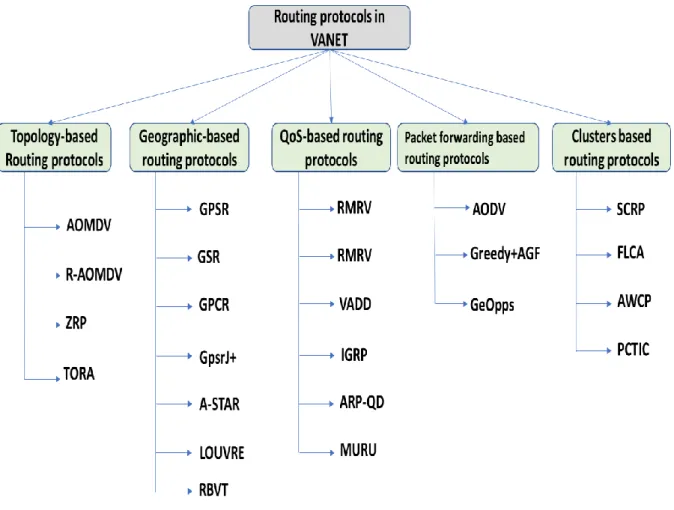
2.1 Classification of routing protocols in VANET ……….……….…..…………. 37
3.1 Intra-zone Routing Protocol (IARP) for K=3 ……….……… 45
3.2 ZRP Inter-zone Routing Protocol (IERP) for K=2 ……….………….….. 46
3.3 Intra-zone neighbors’ classification for vehicle S ……….…………. 52
3.4 SL-ZRP Intra-zone Routing Protocol ……….……….……….. 54
3.5 SL-ZRP Inter-zone Routing Protocol ………..………….. 55
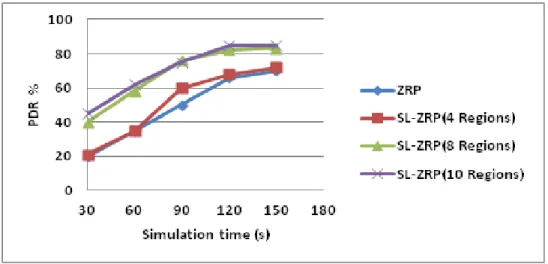
3.6 Packet delivery ratio during simulation time ………..………..……… 58
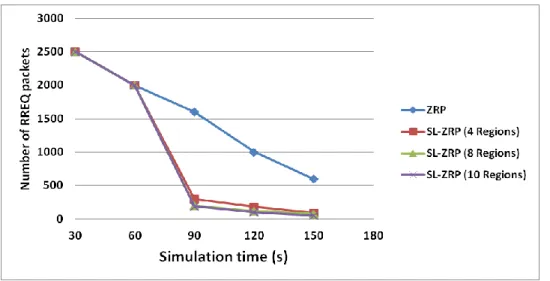
3.7 Number of RREQ sent during simulation time ………..……….……… 59
3.8 Average End to End delay during simulation time ………..……….…… 60
3.9 Packet delivery ratio versus Number of nodes ………..………..……… 61
3.10 Average End to End delay versus Number of nodes ………..……… 61
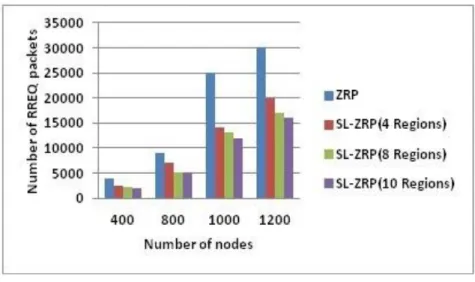
3.11 Number of RREQ sent versus Number of nodes ………..………..……… 62
4.1 Routing protocols Classification in IoV. ………..……… 71
4.2 IoV Network based Clusters structure ………..……….………… 74
4.3 Beacon exchanging process ………..………..……...……. 80
4.4 Cluster Head election process ………….………..……….…….... 81
ix
4.6 Average rate of CH change Vs Speed ……….………… 91
4.7 Average rate of CH change Vs number of nodes ……….………….…..……..…… 91
4.8 Average cluster head lifetime Vs speed ……….………..…. 92
4.9 Average cluster head lifetime Vs number of nodes ………..….….….… 93
4.10 Number of clusters Vs Speed ……….……….…... 94
4.11 Number of clusters Vs number of nodes ………..………..……….….. 95
4.12 Clustering Overhead Vs speed ………..….……….….. 95
4.13 Clustering Overhead Vs number of nodes ……….…..…….……… 96
4.14 Message Delivery Ratio Vs speed ……….….…………. 97
4.15 Message Delivery Ratio Vs number of nodes ……….…... 97
4.16 Delay Vs speed ………..……….…. 98
4.17 Delay Vs number of nodes ……….……….……. 99
5.1 Clustering based RPQLS Architecture ………... 105
5.2 Membership function for Signal strength ……….….…….. 107
5.3 Membership function for Bandwidth ……….……. 108
5.4 Membership function for link QoS of First Fuzzy System ……….….… 108
5.5 Membership Function for Speed ………..…………..…… 110
5.6 Membership Function for Delay ………..…..…… 111
5.7 Membership function for for link QoS of second Fuzzy System ……….…… 111
5.8 REQM (Request Message) Format ……….……..… 113
5.9 REPM (Reply Message) Format ………. 113
5.10 REQM Broadcasting Process ………..……….... 114
5.11 REPM Sending Process ………..….. 114
x
5.13 Parameters used to calculate LET ………..……... 117
5.14 Hello Message Format ……….…... 118
5.15 Vehicle Exchanges and Mechanism Parameters ……….…..….. 118
5.16 REQM Broadcasting Process ……….………..…. 118
5.17 Flowchart for the First Proposition ……….….. 119
5.18 Second Proposition Flowchart ………..………...… 120
5.19.a Packets Delivery Ratio vs Node Velocities ………..……….….. 123
5.19.b Packets Delivery Ratio vs Number of Nodes ………...…..… 123
5.20.a End to End Delay vs Speed of Nodes ………...……….. 124
5.20.b End to End Delay vs Number of Nodes ………..….. 125
5.21.a Number of Packets Sent vs Node Velocities ………..………….………….. 126
xi
List of Tables
2.1 Comparison of routing protocols in VANET ……… 38
3.1 Simulation parameters ………..……… 57
4.1 Routing protocols comparison ………..…. 72
4.2 Messages types ……….………. 79
4.3 Simulation parameters …...………. 90
5.1 Membership degrees Calculation Method ……….……….. 108
5.2 IF-THEN rules for the first fuzzy system ………..………..… 109
5.3 IF-THEN rules for second fuzzy system ……… 112
xii
List of Algorithms
1 SL-ZRP ……… 56
2 Node_initial_status (vi) ………..……… 80
3 Cluster Heads Election (vi)……….………. 82
4 Gateways Election Algorithm………..………. 83
5 Node Join Cluster Algorithm ……….……….…….... 85
xiii
Abbreviations
MANET Mobile Ad hoc NETwork VANET Vehicular Ad hoc NETwork ITS Intelligent Transportation System V2V Vehicle to Vehicle
V2I Vehicle to Internet
V2R Vehicle to Road infrastructures V2P Vehicle to Personnel device V2X Vehicle to everything IoT Internet of Things IoV Internet of Vehicles RSU Road Side Unit OBU On Board Unit
GPS Global Positioning System CH Cluster Head
CM Cluster Member
WAVE Wireless Access in Vehicular Environment DSRC Direct Short Range Communications QoS Quality of Service
1
Introduction
In this thesis, we are interested in proposing, designing, simulating and evaluating new protocols based on Quality of Service within the framework of the Internet of Vehicles. The research work was done in the LRSD Laboratory of Ferhat Abbas Sétif-1 University. In the introduction of this manuscript, we will introduce the concept and problematic of the research work, then we describe the goals and contributions of this thesis. Finally, we will describe the organization of this thesis.
Nowadays, the utilization of wireless communication technologies in the transportation field has augmented with the active growth of smart cars’ development. It was announced that the number of vehicles in use grew up from about tens’ million in 2006 to thousands’ million in 2015 and this number is still increasing for the time being [1]. Thus, the demand for new methods to control the transportation systems is very needed. That is why Vehicular Ad hoc NETworks (VANETs) have been created. VANETs can be considered as the application of Mobile Ad hoc NETworks (MANETs) for road traffic information sharing. They offer vehicular communications via wireless and mobile networks with or without infrastructures. VANETs apply data exchanging and processing to transport means, infrastructures and users in the aim of increasing the efficiency, resilience, safety, robustness and environmental performance of the transportation systems. As a result, VANETs provide intelligent control and services to vehicular environments. The appearance of the new concepts of Internet of Things (IoTs), big data, cloud computing have encouraged the generalization of VANETs to the Internet of Vehicles (IoV), where vehicles act as active members and smart entities with new perception and communication capabilities [2], providing an omnipresent connectivity, a wide range of applications and services relating to the road safety, the intelligent transport and the comfort of users. Moreover, a vehicle in IoV are perceived as dynamic mobile communication system, that supports the following communication modes: intra-vehicle components mode and Vehicle-to-X (V2X) mode, where X take the role of: vehicle, road,
2
infrastructure, human, cloud or Internet [3]. Compared to conventional VANETs, IoV have many specific advantages and characteristics, such as developing and extending the exploitation of the ITS in different fields of research and industry. As a main advantage, the ability to integrate multiple users, multiple vehicles and multiple networks using different communication technologies. Consequently, IoV enable reception, storage and processing of large number of data from different geographical areas through intelligent vehicles computing systems to offer several categories of services for road safety and other non-safety services to drivers and passengers. IoV support a large number of relevant applications and services, such as accident avoidance, collision warning, cooperative driving, wireless remote diagnosis, traffic flow regulation, route guidance, Internet access and infotainment applications like playing games and listening to music. Owed to this versatility of applications and services, IoV become a major research motivation of governments, car manufacturers and academic institutions, and attract more and more interests of them.
Research motivations and problem statements
Even though IoV have many advantages, they still suffer from a number of challenges such as rapid growing number of vehicles and other objects connected to the IoV system, the integration of all components and object communications in the IoV network, the big data that have to be processed and stored in IoV network [3]. Furthermore, IoV faces many implementation problems, such as the security and reliability of inter-vehicles communications and various simultaneous demands for assistance that cause a high number of collisions [4]. Otherwise, the challenges that already exist in classical VANETs also affect network system such as high mobility of vehicles, variable density, dynamic topology, network fragmentation and communication models. Considering all the above issues, the successful deployment of IoV consists of a number of important components, a key one of which is how to establish stable and efficient routing paths from sources to destinations in the complex and dense urban scenarios. The benefits of IoV will be limited without the available solution of this routing problem, the main challenges of IoV routing issue in urban scenarios are as follows:
Firstly, real-time and accurate QoS routing obtainment. Routing QoS can directly affect the
efficiency and availability of several applications, for example, emergent accident warning is required to be shared with short delay and the communication of this routing path should be favorable, while reliable and robust routing paths with high packet delivery ratio are
3
necessary to provide available E-payment service to customers. Routing QoS metrics, such as delay, packet delivery ratio, connectivity probability and network overhead play an essential role in establishing available routing paths, as they indicate the characterization of the routes quality which is highly relevant to instantaneous and precise operational traffic information (e.g., vehicle density, vehicle distribution and road segment length). Moreover, the spatial-temporal features of traffic conditions in IoV are dynamic, for example, the spatial vehicle density can change from very sparse to highly dense, and the temporal vehicle density in one area can be variant depending on the time of the day. As a result, real-time and accurate routing QoS is very difficult to be estimated in IoV scenarios.
Secondly, low QoS performance. In IoV environment, it is very hard to keep the best QoS for
packets exchanging in vehicular scenarios for the following possible reasons: (1) the overall QoS of candidate routing paths are hard to be known by a sender vehicle, so routes discovery processes in large scale networks are always based on local traffic information with random characteristics, which may result in the end-to-end routes including network partitioned/congested road segments, (2) urban environments are usually large-scale scenarios and the communication distance from a source to its destination may be very great, (3) most traditional VANET routing protocols lack of self-adaptation features and cannot cope with topology changes availably, which can disturb the process of packets forwarding, and (4) different communication pairs are usually absent of cooperation and do not make use of explored routing paths, so more routing exploration processes are implemented, which may result in redundant overhead and higher transmission delay.
Thirdly, scalability and stability. Ensuring a stable and scalable routing mechanism over IoV
is an essential and necessary phase toward the implementation of reliable vehicular communications. However, due to varying vehicle mobility and network topologies, routing paths are ruptured frequently, and it is very difficult to guarantee their stability.
Fourthly, network congestion. Large-scale vehicular structures are characterized by a high
number of vehicles in IoV especially at rush hours, their connection exchange can easily charge the wireless channel with large traffic loads and may cause significant failure of packets delivery ratio and increase transmission delay. In fact, these traffic loads comprise not only data packets but also a number of Beacon packets, which are used to update road traffic information among neighbor nodes. Clearly, higher traffic loads and limited bandwidth can easily encourage network congestion and then decrease routing performance. Thus,
4
alleviating network congestion and reducing overhead in IoV are very challenging issues that we want to address in this thesis.
Finally, heterogeneity conveyed data packets. IoV support a large variety of applications from
safety to infotainment applications. Road safety applications usually demand low transmission delay and high reliability during resource utilization, packet loss and service availability are the common performance measures for infotainment applications. Moreover, some QoS metrics may give inverse results to each other in certain communication scenarios, for example, dense vehicles are helpful to the enhancement of connectivity but may augment packet loss ratio due to channel congestion and interference. To satisfy with heterogeneous applications, the best QoS routing selection with multiple QoS thresholds should be considered.
Goals and Contributions
To support a wide range of applications, routing protocols of IoV must be able to efficiently transmit packets to their destinations. In order to deal with the challenges, we propose in this thesis suitable for large-scale urban scenarios two routing protocols in which their roles are to search the best QoS routing path which satisfies with different applications requirements based on various QoS metrics namely speed, delay, direction, link lifetime, available bandwidth, and so on. Moreover, these routing protocols are adaptive and scalable, and can effectively increase communication stability and reduce network overhead to deal with network congestion and high mobility of vehicles in IoV. Otherwise, using efficient network structuring technique for the IoV paradigm in order to manage their challenges and provide suitable conditions to run the different applications is very required. Clustering structures have significantly improved network performances compared with classic flat structure in numerous applications [106], such as data dissemination and aggregation. In this concept, we propose a new clustering technique in the context of IoV to meet the requirements of such network. In order to realize our objectives, the main research contributions are conducted as follows:
Firstly, in our papers: "Vehicular Ad Hoc NETworks versus Internet of Vehicles - A Comparative View " [15], presented in the International Conference on Networking and Advanced Systems (ICNAS 2019), we compare between the two paradigms VANETs and
5
IoV under various aspects: network architecture, network characteristics, communication technologies, network platform.
Secondly, we propose a new routing protocol suitable for the IoV environment. The goal of this proposal is to find the stable links in network in order to ensure a good communication stability in such environment. In our paper entitled "A Stable Link Based Zone Routing Protocol (SL-ZRP) for Internet of Vehicles Environment " [86], accepted for publication at Wireless Personal Communications (Springer), we modify the well-known routing protocol named Zone based Routing Protocol (ZRP) by integrating QoS to its path’s discovery process. This protocol aims to find the stable routes in network using geographic information, where each node can choose the stable route in its own zone by selecting its neighbor nodes that move to the same final region during its trajectory. Moreover, speed of vehicles and delay are also used as metrics in order to select the stable and fast routes in network.
In our paper entitled "A Weight-Based Clustering Algorithm for IoV", accepted for publication at Automatic Control & Computer Sciences (Springer), we present a new weight-based clustering algorithm for IoV, that aims to increase the stability of clusters and reduce communication overhead. The proposed algorithm uses three parameters namely: safety, mobility and density. For each group of nodes, a Cluster Head must be elected based on the three metrics previously cited. The variety of metrics used to select Cluster Heads may guarantee a high level of Quality of Service in IoV environment such as: high security, long connectivity, links stability and so on.
In our paper entitled "Reliable connectivity-based Clustering Algorithm for IoV", submitted at Future Generation Computer Systems journal (Elsevier), we introduce a new weight based clustering algorithm, where we will minimize the network overhead by using hierarchical architecture(clusters) and maximize the quality of service (short response time) by integrating selective parameters such as delay, density, speed and position to select the cluster heads in order to ensure some quality of service in IoV by guaranteeing a reliable connectivity and a low network overhead.
In our paper entitled "Unstable Connectivity Aware Protocol for Dependable Messages Delivery for Future Internet of Vehicles", submitted at International Journal of Wireless Information Networks journal (Springer), we propose to take advantage of the IoV features to choose appropriate metrics aiming to ensure route stability according to two levels. In the first one, best routes are discovered by using metrics such as signal strength, bandwidth, delay and
6
node velocity. In the second level, an approach for estimating links life time has been used. The latter is based on speed and direction parameters in order to find the most durable route. To this end, Fuzzy Logic method has been used to reach our objective.
To sum up, the main contributions of this thesis can to be summarized as follows:
• Propose new routing protocols for the IoV network, which make it possible to improve its performances while guaranteeing a high level of service required by the function performed by the latter.
• Propose a new algorithm-based clustering architecture in order to minimize network overhead and guarantee high Quality of Service.
• Evaluate the performance of the proposed algorithms, compared with known upper bounds and best-known algorithms in recent literature.
Thesis organization
In this thesis, we opted for the \articles" format. Some chapters are therefore the transcription of articles published in, or submitted to, scientific journals or conferences. So, the thesis contains five chapters divided into two main parts: background and contributions, and it is organized as follows:
In the background part:
• Chapter 1 gives a background of knowledge about the Internet of Vehicle (IoV); their architecture, characteristics, challenges, communication technologies and applications; and all that belongs to this domain.
• Chapter 2 presents the state of the art on the routing algorithms for vehicular network in the literature. At this point, we attempt to detect certain problems still open or whose proposed solutions are still to improve, in order to propose new routing protocols suitable for IoV. The contributions part of this thesis introduces the proposed clustering approaches:
• In Chapter 3, we present a new routing protocol suitable for the IoV environment, that aims to find the stable routes in network using geographic information, in such manner each node can choose the most stable route in its own zone by selecting its neighbor nodes that move to
7
the same final region during its trajectory. Moreover, speed of vehicles and delay are also used as metrics in order to select the stable and fast routes in network.
• In Chapter 4, we introduce a new weight based clustering algorithm, where we will minimize the network overhead by using hierarchical architecture(clusters) and maximize the quality of service (short response time) by integrating selective parameters such as delay, density, speed and position to select the cluster heads in order to ensure some quality of service in IoV by guaranteeing reliable connectivity and low network overhead.
• In Chapter 5, we propose a new two-level routing protocol for IoV communication. The first level aims to find the best routes using several metrics such as signal strength, bandwidth, delay and node velocity. The second level aims to find the durable routes in term of link lifetime. The approach used to estimate link lifetime is based on speed and direction parameters.
8
9
Chapter 1
Internet of Vehicles: An overview
1.1 Introduction
In the recent decade, mobile communications have known a great development by enabling us to interchange data with anything, anywhere and at any time. The utilization of such kind of developed communications systems in vehicles is anticipated to be a reality in the next years. VANETs inherit the characteristics of Mobile Adhoc NETworks (MANETs) as free connected objects capable of moving randomly and communicate wirelessly. VANETs refers to the Intelligent Transportation System (ITS), where vehicles are intelligent objects communicating (send and receive data) between each other with a smart manner [4]. This new concept of exchanging data between vehicles, sensors, and infrastructures will provide a large variety of applications for driver such as: driver safety, driver assistance and infotainment. Internet of Things (IoTs) is a network of objects containing sensors in which they capture and gather data from their surroundings and distribute data through the internet [5]. Internet of Vehicles (IoV) allow data collecting and information sharing about vehicles, roads and their surroundings. Moreover, IoV include data treatment, data computing, and secure data sharing over network platforms. Through such data, network platform can manage and supervise vehicles with an efficient manner, and offer various services such as multimedia and Internet applications [6]. IoV are considered as integrated systems that supports intelligent road traffic management, intelligent dynamic information service and intelligent vehicle control, illustrating a typical application of IoTs technologies in Intelligent Transportation Systems (ITS). In this chapter we are going to introduce the fundamental concepts of IoV. Here, we point out on definitions, architecture, applications, communication technologies, characteristics, challenges that face IoV environment in different aspects, and the simulations and mobility models used to design such network IoV.
1.2 IoV’s definition
Alam et al. [7] defined IoV as an ITS integrated IoT from the perspective of intelligent transportation. Moreover, IoV is considered as the vehicular ITS, which regards the driving vehicle as the information sensing and intelligent mobile object.
10
Hartenstein et al. [8] consider that IoV is a global network that integrates three sub-networks: intra-vehicle network, inter-vehicles network, and vehicular mobile Internet.
Jiacheng et al. [9] present the definition of IoV from the perspective of integration of on-board sensors and communication technology. They consider IoV as a set of intelligent vehicles equipped with advanced sensors, controllers, actuators, and other devices, which uses modern communications and network technology for providing the vehicles complex environmental sensing, intelligence decision-making and control functions.
It can be concluded that there are differences in the definitions of IoV when researchers provide their definition in view of their own research areas
1.3 IoV’s communication architecture
Vehicle: is an intelligent vehicle with complicated intra-vehicle systems as shown in Figure 1.1. Vehicle embeds various sensors in order to detect vehicle and driving status, and communication devices to communicate with other vehicles and/or Internet [10]. A software platform (a vehicular operating system) is necessary to process status information and controls all devices.
11
On Board Unit (OBU): It is a terminal equipment mounted on-board of a vehicle to provide a mutual wireless communication between vehicle and surrounding vehicles and infrastructures. it uses Wireless Access in Vehicular Environment (WAVE) standard which is based on the emerging IEEE 802.11p specification [11]. It operates on the 5.9 GHz Direct Short Range Communications (DSRC) band.
Road Side Unit (RSU): It is a computing device installed on the roadside that provides communication services to vehicles. Like OBU, the RSU uses WAVE standard which is based on the emerging IEEE 802.11p specification. It also operates on the 5.9 GHz DSRC standard. They are controlled and managed by the Transportation Control Center (TCC) through wired communication channels. It acts as a gateway that allows vehicles to establish connection with Internet. The RSU provides different services to vehicles such as: communication services, security services, data dissemination and aggregation services, and Internet access. In addition, the RSU has a number of functionalities such as: extending the network coverage, traffic directories, data dissemination, security management, location servers and service proxies [3].
IoV supports various types of connection which are:
• Vehicle-to-Vehicle (V2V) ad hoc communication: by this type of communication each vehicle can contact its neighbor vehicles without passing by any fixed infrastructure support (direct communication) and can be mainly used for safety, security, and dissemination applications [10].
• Vehicle-to-Roadside unit (V2R) ad hoc communication: V2R refers to the information exchanged between vehicles and roadside units such as traffic lights or warning signs on roads, where roadside units are used as data storage servers. V2R communication can reach long distance unlike V2V. In addition, roadside units may play role of intermediate hops to increase range communication to destination [8].
• Vehicle-to-Infrastructure (V2I) ad hoc communication: through this kind of communication, vehicles can connect to internet and benefit from several internet services [11].
• Vehicle to Personal devices (V2P) or Vehicle to Human (V2H) refers to the interaction between vehicles and personnel devices that appertain to persons (drivers, passengers,
12
pedestrians, cyclists) like tablets, smart phones, etc. Through this kind of connection vehicles can share with mobile devices different services (file sharing, music, video streaming) [14]. • Vehicle-to-Sensor (V2S) this type of communication is considered to enable vehicles to monitor their behavior during their movement by detecting their speed, their position, the tire pressure, the oil pressure [12], etc.
• Vehicle-to-everything (V2X) The appearance of IoT allows vehicles to be able to connect to everything that can share information about vehicle’s surrounding [15]. Figure 1.2 illustrates IoV network communication
Fig.1.2 IoV network communication
1.4 Layered architecture of IoV
IoV model architecture is based on five layers [15] that allows interconnection of all network components and data dissemination in an IoV environment as shown in Figure 1.3.
• User Interaction Layer: This layer includes the different types of machines and devices that
participate in communication process (sensors attached to vehicles, RSUs, cellular infrastructures, smart phones, etc). The goal of this layer is to collect data about vehicular
13
network environment and devices. This layer is also responsible to transform data with electromagnetic and secure manner to the coordination layer.
• Coordination Layer: The second layer of the architecture is represented by the various
universal heterogeneous networks including WAVE, Wi-Fi, 4G/LTE and satellite networks. This layer is responsible of data treatment where it processes all different data received from all heterogeneous networks and converts them into uniform structure in order to be known and treated in each candidate network.
• Processing and Analysis Layer: This layer is the core of IoV, it is responsible of storage,
processing and analysis of received information from previous layer and making decision based on these analyses. This layer is known as data management center (cloud computing) where different computing, analysis and security techniques are used.
• Application Layer: The fourth layer is consisting on intelligent applications including:
safety applications such as: congestion management, accident alert, etc, or no safety applications that include: parking and gas stations indication, file sharing, video streaming, etc. This layer is responsible of offering intelligent services to end users that are based on smart and high analysis of treated data arrived from the previous layer. It also offers to the business layer the data applications used by the end users of network.
• Business Layer: this layer is responsible to make strategies to develop new business models
based on the data applications used by the end users of network and data statistical analysis. This layer is also responsible to make decision allied to economic investment and utilization of resources.
14
Fig.1.3 Layered architecture of IoV
1.5 Network technologies
Wireless LAN (WLANs) are a useful connectivity solution for different ad-hoc networks and environments. IEEE 802.11p is designed for wireless access in the vehicular environment to support intelligent transport system applications. Wireless access in vehicular environment is presented by two standards:
• Wireless Access in Vehicular Environment (WAVE)standard: includes the features of
Dedicated Short-Range Communications (DSRC), the IEEE 802.11p for PHY and MAC layers and the IEEE 1609 family for upper layers. DSRC uses Dynamic Spectrum Access (DSA) as an additional technology. DSA allows vehicles to communicate through unused spectrum for different communication technologies such as TV spectrum [16]. DSRC/WAVE support the high mobility of vehicles, where vehicles move with speed of 10 up to 200Kmph, with a communication range of 300 m and reaching up to 1000 m and a data rate of more than 27Mbps.
• CALM (Continuous Air interface for Long and Medium range): combines a set of wireless
technologies including GSM2G/GPRS-2.5G, UMTS-3G, Infrared communication and wireless systems in the 60 GHz band, adapted to IEEE 802.11p [18].
15
In addition of network technologies cited above, IoV supports other different network technologies (Figure 1.4) such as:
• Bluetooth: is a short-range wireless technology based on the IEEE 802.15.1 standard and
operating in frequency band (2.4 GHz). It allows the communication between mobile devices at a data rate up to 3 Mbps [19], The Bluetooth devices are common in current automobiles, such as the Bluetooth headset and rearview mirror.
• ZigBee: is based on the IEEE 802.15.4 standard and operates on the ISM radio spectrum
(868 MHz, 915MHz, and 2.4 GHz). ZigBee technology enables vehicles to connect with its internal sensors devices (V2S) [20], ZigBee is low-cost and can provide an acceptable data rate (250 Kbps in 2.4 GHz frequency band).
• 4G/LTE technology: it is a cellular system that uses radio waves to transmit data over long distance. it uses the 1700 and 2100 MHz frequency bands, and supports data transfer speed up to 129 Mbps and high mobility through soft handoff and seamless switching. LTE has been proposed as a practical technology for vehicular machine-to-machine communication [13].
• WiMAX (Worldwide Interoperability for Microwave Access): refers to a wireless
communication standard defined by a family of standards IEEE 802.16 [14]. It is mainly used as a high-speed broadband internet access and transmission system. WiMAX covers a wide transmission range with robust communications and high Quality of Service (QoS), which make this technology suitable for multimedia applications.
16
1.6 Network platform
IoV system gives vehicles the ability to take different roles at the same time, where they benefit from several services through internet as consumers (clients) members, and at the same time they participate as producers (servers) to offer different services. Evidently, IoV is a mixed system with two kinds of computing models which are: client-server system and peer-2-peer system. With the client-server system, vehicles can demand services from servers such as: infrastructures, roadside units, vehicles, and so on [21]. A server can be a simple computing node or a cloud data platform. With peer-2-peer system, vehicles can help each other to execute distributed computing tasks, such as, videos streaming, files downloading, etc. With cloud data platform, IoV can execute various difficult tasks and can manage different complex applications with better manner. The primary goal of using cloud data platform in IoV is to enhance real time road data processing and to apply artificial intelligence to make intelligent decisions for smart client services. IoV cloud platform is divided into three layers [13]:
1) Basic Cloud Services: this layer includes all different cloud services given to intelligent data applications such as Data, Storage, Networking, Computing, Cooperation and Gateway. 2) Smart ITS Application Servers: IoV comprises various intelligent applications types such as: road safety applications, congestion management applications, entertainment applications and so on. Intelligent servers are composed of two processing engines: internal engine that includes: big data storage unit, big data processing unit and big data analyzing unit. The basic cloud services offered by the cloud platform are used in order to implement these tasks. The external engine includes two kinds of units: information gathering unit which is responsible of in-source data collecting and information diffusion unit which is responsible of final delivery of services to client’s applications.
3) Information Consumer and Producer: IoV network supports various intelligent devices which are the end user of the smart information offered by intelligent servers such as: vehicles, roadside units, personal devices and so on. The major responsibilities of these devices are data collecting from vehicular network environment. Developing new business models for organizations related to automobile production and repair. Internet-based services development is also one of the primer usages of data gathered by intelligent devices.
17
Fig.1.5 Network platform
1.7 IoVs’ applications
With the emergence of IoV, the previous existing applications of VANETs have been enhanced and various new applications have designed as well. This new structure founds the fundamental network needed for many significant applications that demand smooth connectivity and addressability between their elements. However, the total of these applications can be divided into two major categories; safety-oriented applications and user-oriented applications.
1) Safety-oriented applications
Safety, management client traffic safety and management related ITS applications are broadly divided into four groups including safety, navigation, diagnostic and remote telematics [22].
• Safety
The traffic safety related ITS applications are V2V communication-based applications. The execution and quality of processes could be considerably improved by integrating cloud-based smart servers [21]. The servers use big traffic data to take smart decisions in IoV. These applications improve driver’s performance and quality of driving. The applications integrate automatic operations on wheels, and thus, minimize the efforts required for qualitative driving. Some of the traffic safety applications are introduced below:
Accident Prevention- It is a V2V connection system for vehicles. It utilizes real time information exchanged between vehicles to prevent accidents. It provides different automatic processes including speed control, lane change, stoppage, steering control, etc.
18
The system would be very useful for highway and dense urban traffic environments, where automatic vehicle control has important impact on safety in case of emergency situations [23].
Emergency Call- It is an emergency call system for vehicles. It calls the emergency services such as police, fire and family or friends in case of emergency. It is both automatic and manual system. It can be considered as black-box information of the vehicle; it contains all the information related to the present and past situations of the vehicle. The information includes number of passengers, speed, direction, location, lane, cause of emergency, etc [10].
• Navigation
The navigation related ITS applications are location-based services. The execution of these applications is mainly based on the precision of location information. The information is obtained from the GPS receiver integrated in the vehicles. These applications are helpful to manage traffic, and thus, improves traffic efficiency. Some of these applications are presented below:
Real Time Traffic Information- It is a traffic information system. It offers live traffic information using video sensor of vehicles and heterogeneous communication networks. This could efficiently replace the current image analysis and radio broadcasting based non-real-time traffic information systems. The system is based on efficient online streaming of traffic information using heterogeneous vehicular networks [24].
Parking Helper- It is a parking system for vehicles. It used to help drivers to find the nearest available parking space by communicating with the parked vehicles. The system utilizes GPS receiver and cooperative positioning techniques. The system would minimize the waste of power and time in searching parking space, particularly in dense urban traffic environment [25].
Multi-modal Transportation- It is a transportation system for people. It enhances the resources including time, money, comfort, fuel, entertainment, etc., according to the choice of users. It offers route planning service including multiple means of transportation and optimizing user’s priority.
19 • Diagnostic
Vehicle diagnostic applications are considered as personal health consultant for vehicles [11]. In addition to real time monitoring total condition of vehicles, cloud-based data management of vehicle’s condition is one of the key tasks of these applications. The cloud-based diagnostic data is utilized for online prediction and maintenance advisory to vehicles. One of the diagnostic clients is described below:
Self-Repair- It is a cloud-based step-by-step repair guidance system. The system is based on a cloud-based database. It is mainly helpful to fix hardware/software problems of the vehicle. The database develops automatically with the advancements in the technology. The guidance is available for all kinds of vehicles through audio and video technologies. The system would significantly minimize the amount of money spent in repairing.
• Remote Telematics
Distantly accessing some of non-driving processes of vehicles could be made possible by utilizing very secure remote telematics applications. The applications are based on precise remote tracking, authentication and authorization methods. These applications are actually the transformation of traditional physical entity-based processes into digital entity based operation. The applications improve the ease of usage and monitoring of vehicles. Some of the examples in this category include remote locking/un-locking, car surveillance.
2) User-oriented applications
The user-oriented ITS applications for IoV can be widely divided into four categories such as insurance, car sharing, infotainment and other applications.
• Insurance
The insurance based ITS applications are based on some statistical analysis of information including usage of vehicles, driving behavior, place of usage and time duration of usage. These applications would reduce insurance cost, and thus, optimize vehicle ownership cost. One of the insurance-based applications is introduced below:
Insurance on Driving Statistics- It is an insurance system that calculates automatically the
insurance fee using the driving statistics data. The data contain daily, monthly or yearly driving duration, it includes also daily/monthly/yearly infraction of traffic rules or the
20
manner how you drive. The system is relied on the cloud-based vehicle usage statistics. The system could significantly optimize cost of insurance [13].
• Car Sharing
The goal of car sharing applications is to improve the usage of resources while utilizing cars which in turn minimizes the cost incurred in transportation. This goal can be achieved by using one vehicle in group, one of these applications is presented below.
Car Pooling- It is a car sharing application based on cloud platform. It attributes car service
seekers to car owner. The attribution is based on the optimization of similar criteria of passengers. The criteria include local address, work place, timing, gender, age, and employment position. The registration of car owners and car service seekers are verified by the service provider [8].
• Infotainment
Infotainment applications are based on reliable Internet connectivity. The application would enhance productivity and travel experience by being online while driving. One of the infotainments applications is presented below:
Connected Driving- The system would enhance productivity in driving duration while
avoiding on-road fatalities using automatic support applications for drivers in IoV. The system considered as a device synchronization system for vehicles, where it allows vehicles’ units display to connect to home computers, smartphones or other online equipment. The system uses remote login in various kinds of online devices with security credentials [6].
• Others
It exists some other applications which do not belong to the aforementioned categories. These applications are based on various business concepts and technologies. One of the applications in this category is presented below:
Cloud Service- In cloud system vehicles have two options to communicate based on cloud
communication: either they form their autonomous cloud of group of vehicles or they connect to traditional cloud. In the two cases, the resources of connected vehicles are available for utilization as cloud service as well as the vehicles can use intelligent cloud services. The cloud system can remove computational and storage limitations at vehicles. It could open new business models in connected drive [9].
21
1.8 IoV’s characteristics and challenges
IoV networks are characterized by numerous features comparing to other types of networks. As IoV is considered as the progress of the traditional VANETs, various IoV features are similar to VANETs features, like dynamic topology, different network density, high vehicles mobility, and network obstacles. Moreover, IoV networks support other characteristics such as:
• Scalability: IoV networks can integrate hundreds or even thousands of connected vehicles comparing to classical VANETs. Moreover, based on the application used, IoV can further increase the number of connected devices to millions. • Different wireless access technologies: IoV platform supports numerous kinds of
wireless access technologies such as WLANs, WiMAX, cellular wireless, and satellite communications [16].
• Extended network communication: IoV creates more types of communication comparing to conventional VANET, that is characterized by its limited communication types, IoV allows vehicle to communicate with every smart object such as smart-phone, tablet, and so on.
• Cloud Computing: Comparing to VANET, the operations in IoV are mainly based on cloud computing services.
Due to the high interaction of network components such as users, vehicles and things, IoV network is required to provide best communication capability that is manageable, controllable, operational, and credible [13]. IoV faces numerous challenges that need to be studied in order to provide more communication reliability, robustness and stability.
• Fault tolerance: Since IoV architecture is based on clouds communications some vehicles can break down; thus, this failure should not affect the rest of the network. • Latency: it is defined as the period of time taken by a packet to be transmitted in
the network., in some critical applications such as accident alert, latency must be minimized as much as possible in order to guarantee fast messages transfer. • Networks compatibility: the different kinds of access technologies supported by
IoV require researchers to take in consideration these multiple access technologies during the design of applications and protocols for IoV.
22
• Security: The information exchanged via IoV network are very important and confidential especially with access to the Internet. Therefore, the operation of securing these networks is a fundamental task and a prerequisite for the deployment of IoV [18].
• Connectivity: The high speed of the moving vehicles may drive to frequent change in the network topology. Therefore, a high rate of arrival and departure of nodes can be affected. Dealing with such a limitation drains an important communication overhead. That, nodes need frequently to choose a reliable route in order to ensure data deliverance to specific destinations. The vehicles must permanently be connected.
• Quality of services (QoS): IoV is considered as real-time distributed system that must satisfy timing, reliability and security constraints as well as application specific quality requirements to deal with scheduling of the integrated services in real time [25]. To address this diversified problem, QoS requirements have to manage the network resources to provide the QoS guarantees in IoV. The most robust IoV system provides better QoS.
1.9 Simulations and mobility models for IoV
Network simulation is the most helpful method used to evaluate the performance of networks theoretically before they are deployed physically. In fact, the network simulator has to take into account all specific characteristics of the moving vehiclesi.e., the nodes mobility model in order to mimic the real IoV environment. In IoV, vehicles movement is limited to the roads and the interaction with other vehicles (acceleration, deceleration and lane change). Thus, utilizing random models where the change in speed and position of nodes is randomly does not give a real evaluation of the protocols designed to vehicular environments. Therefore, IoV networks simulation should be carried out by simulators designed especially to VANETs. Traffic simulation models are categorized into microscopic, mesoscopic and macroscopic mobility modeling. Microscopic mobility modeling considers flow of vehicle in detail, such as acceleration / deceleration, driver’s behavior, car’s length, car’s speed. Macroscopic properties are general in nature. When large number of vehicles is in motion, global parameters can be represented as flow (mass and density). Mesoscopic modeling represents an intermediate modeling level of traffic flow. It may lead to efficient trade-off between modeling of individual vehicles and the modeling of large quantities of vehicles.
23
This model may take different forms such as the modeling headway distance as an average of large number of vehicles sometimes size or density of cluster of vehicles. This model includes dynamic behavior of vehicle and macroscopic properties such as density and velocity for large number of vehicles Among the mobility generator in VANETs, we have: VanetMobiSim, SUMO and RoadSim. The mobility models provide a precise description of vehicles mobility in the network. According to the available literature, there exist many mobility models, which are widely used for IoV networks. Compared to conventional VANET networks, IoV vehicles are much more restrictive in terms of traffic on the network and require more traffic applications and services. These scenarios cannot be therefore handled by conventional networking solutions. These mobility generators, called also vehicular traffic simulators, rely on a traffic flow theory. For instance, Simulation of Urban MObility "SUMO" [28] is an open source, microscopic, multi-modal traffic simulation. The simulation allows to address a large set of traffic management topics, where it permits to simulate how a given traffic demand which consists of single vehicles moves through a given road network. It is purely microscopic: each vehicle is modelled explicitly, where it has an own route, and moves individually through the network. MOVE [29] is built on top of an open source micro-traffic simulator SUMO. It allows users to rapidly generate realistic mobility models for VANETs simulations. The output of MOVE is a realistic mobility model and can be immediately used by popular network simulators such as NS3, NS2, OMNET, etc.
1.10 Conclusion
IoV is one of the emergent fields that attract growing interest from academia and industry areas in the last few years. This is due to the high important role that plays IoV in fundamentally increasing safety of the intelligent transportation systems (ITS). The IoV paradigm supports numerous communication types such as Vehicle-to-everything (V2X), Vehicle-to-Human (V2H), Vehicle-to-Sensors (V2S) besides the classical communication types inherited from the conventional VANETs communications (V2V, V2I and V2R). In this chapter we have presented an overview of the emergent IoV technology and a perspective for their future applications. In the introduction we introduced the development of VANET towards the new paradigm IoV. Next, related definitions of IoV, IoV’s protocol stack, IoV platform, IoV network technologies and IoV’s applications are presented. Since their special characteristics create new challenges and requirements, we
24
discuss in general the IoV’s issues. Finally, simulations and mobility models for IoV networks are presented.
25
Chapter 2
State of the art: Routing protocols in VANETs
2.1 Introduction
The appearance of the new era of Internet of Things drove to the evolution of Vehicular Ad-hoc NETworks (VANETs) toward a new paradigm named the Internet of Vehicles (IoV). The difference of the vehicle concept in VANET and IoV makes these two paradigms different in the terms of devices, communications, services and applications. In VANET, the vehicle is considered as a smart mobile object used to forward messages among vehicles and infrastructures. However, each vehicle in IoV is considered as a smart object with a powerful multi-sensor system. Moreover, a vehicle in IoV is perceived as a dynamic mobile communication system, which allows the following communication modes: intra-vehicle components mode and Vehicle-to-X mode, where X can be vehicle, road, infrastructure, human or Internet. Therefore, IoV enables the acquisition and processing of large amount of data (big data) from different geographical areas via intelligent vehicles to offer various services for drivers and passengers [30].
IoV environment is characterized by special features and characteristics, that make the design and the implementation of robust application for such networks a very challenging task [31]. The high mobility of vehicles is the first factor that distinguish IoV network from other types of ad-hoc and wireless networks. The vehicles’ speed changes according to the road conditions, it may be low or medium in urban areas and high on highways. The speed variation may affect the network stability and drives network topology to be very dynamic. The high mobility of nodes can cause frequent disconnections in the links of communications which causes a temporary stop of the service provided by the application of the network. It is therefore necessary to ensure and provide a high Quality of Service, even in the presence of breaks in communication links, to ensure the required service. The nodes density in IoV network is not stable during time and area variation. Where, the density in urban areas is higher than in rural areas, and it is different at what time of day is considered (night, morning and rush hours) [32].
Considering all the above issues, researchers have turned to the use of new techniques and mechanisms in order to guarantee some Quality of Service in its turn ensures a stable
26
network connectivity and an effective data routing and dissemination in the network. Routing algorithms play a pivotal role in today’s networks, and with the exponential increase in network density and distributed systems and applications it is obvious that the network traffic management and routing are the core issues [33]. The central job of the routing algorithm is to generate a path for the network packets. The routing protocol gives the overview of the topology of the entire network while the routing algorithm adds the power of intelligence to how one computes the path between multiple network nodes. Driving packets from source node to destination node in a network with an effective manner will ensure stable network connectivity and robust communication. A large number of routing protocols have been proposed for IoV and the main goal of these routing protocols is to provide the best path through multi-hops wireless communications. Number of properties in relation to routing algorithms need to be taken into consideration in order to reach a solution to the routing problem:
• Correctness: The property states that an algorithm should be able to accommodate itself within topological variation and network problematic conditions [34]. The algorithm should also be able to find the optimal path in any circumstances for the network. • Simplicity: The property states that an algorithm needs to be simple, efficient and easy
to implement.
• Robustness: It is crucial that the network should have the capability to work in a situation like node failure, path congestion, like failure and so forth.
• Stability: The property states that after specified runs of the time-frame window an algorithm needs to be in a stable position.
• Fairness: The property states that for the delivery of a packet, the packet delivery time schedule must be followed.
• Optimality: The property states that an optimal path should be found from a source to destination. The optimal path depends on the network parameter. It is not compulsory that an optimal must always be the shortest path, for instance a longest path can be considered an optimal path because of less buffer delay for example.
• Scalability: The property states that an algorithm needs to be capable of improving and giving its best performance as the network resources expand and traffic grows.
In this chapter, we provide most representative literature in vehicular routing area and present deeply the different protocols classified according to their core concepts, namely topology-based, geographic-based, QoS-based, packets forwarding based and clusters based.
27
Then, we classify the routing protocols and we highlight the common limitations for each type of communication.
2.2 Topology-based routing protocols
Topology-based routing protocols [36], this type of routing protocols typically take advantage of available link’s information stored in node’s routing table to send packets from source to destination. AOMDV (Ad hoc On-demand Multi-path Distance Vector) routing protocol [37] is a multi-path on-demand protocol which is an improvement of AODV routing protocol [38]. AOMDV makes use of same control messages used in AODV to maintain network connectivity. Moreover, AOMDV adds supplementary fields to minimize the overhead appearing during discovering multiple paths process, in which AOMDV saves all available paths in the routing table, then the source selects the first created route as the favorite one. Compared with single-path based routing protocols, the performance of AOMDV is better in minimizing route discovery retransmission, enhancing robustness and reducing transmission delay.
R-AOMDV [39] is an extension of AOMDV routing protocol. In R-AOMDV routing protocol, a source node sends a route request packet when it has not an available route to the destination. R-AOMDV is similar to AOMDV in term of route discovery process that is based on route request and route reply control packets. R-AOMDV is a cross-layer routing protocol, where it adds two fields to route replay message (maximum retransmission count at MAC layer and total hop count at network layer) in order to calculate the quality of the whole path. R-AOMDV protocol provides all good advantages of multi path routing protocols, such as minimizing rebroadcast route discovery and improving network robustness. Furthermore, R-AOMDV introduces good performance comparing to AOMDV in both rural and city vehicular networks [40], as well as enhances the routing processes based on the quality of routes. However, the routing protocols based on IP addresses are not suitable for VANETs because they must send the packets to nodes’ IPs even though they change their locations, and in this situation the sender node must look for a new intermediate forwarding node, which may lead to increase the packet delay and packet loss.
ZRP (Zone Routing Protocol) [41,42] is a hybrid routing protocol, its concept focuses on dividing network into several zones in terms of many factors, namely transmission power, signal strength, speed and so on. ZRP takes advantage of both reactive and proactive routing schemes for outside and inside zone, respectively. On one hand, it reduces the extent of the