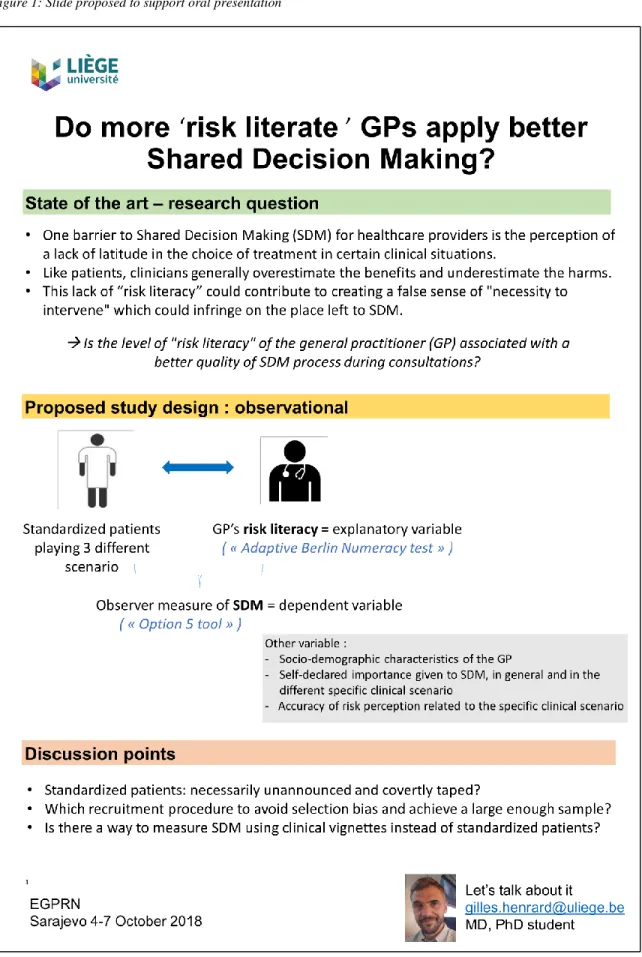
Do more ‘risk literate’ GPs apply better
Shared Decision Making?
87th EGPRN Meeting, Sarajevo, 4-7 October 2018 Dr. Gilles Henrard, Liège University, Belgium
One slide-five minute/research idea
Background
Barriers to Shared Decision Making (SDM) are well described. One of those barriers for
healthcare providers is the perception of a lack of latitude in the choice of treatment in certain clinical situations (1). We know that clinicians’ expectations of the benefits and harms of medical interventions are often inaccurate. Like patients, clinicians generally overestimate the benefits and underestimate the harms (2). This lack of “risk literacy” (3,4) among clinicians could contribute to creating a false sense of "necessity to intervene" which, besides contributing to the trend of over-medicalization, could infringe on the place left to SDM.
Research question
Is the level of "risk literacy" of the general practitioner (GP) associated with a better quality of SDM process during consultations?
Method
A
n observational study of audiotaped consultations with standardised patients comparing the level of risk literacy among GPs and the place given to SDM during consultations. Risk literacy would be measured by the ‘Berlin numeracy test’ (5) and the quality of the SDM process during consultations would be measured by the ‘Option 5 tool’ (6). To reduce case-mix variation, we would use standardized patients, focusing on 3 scenarios particularly appropriate for SDM. Basic sociodemographic characteristics, curriculum and type of practice of the GPs would also be collected to study associations with risk literacy.Results
Our hypothesis is that GPs with more accurate risk perception leave more place to SDM during consultation.
Conclusion
This study could identify another lever with which to promote SDM: the improving GPs risk literacy. Results could also identify ‘profiles’ of GPs in terms of their risk literacy.
Discussion points
Regarding the use standardized patients: necessarily unannounced and covertly taped? Which recruitment procedure to avoid selection bias and achieve a large enough
sample?
Is there a way to measure SDM using clinical vignettes instead of standardized patients? Both for logistical reasons (number of consultations needed) and to avoid first visit bias.
REFERENCES
1. Légaré F, Ratté S, Gravel K, Graham ID. Barriers and facilitators to implementing shared decision-making in clinical practice: update of a systematic review of health professionals’ perceptions. Patient Educ Couns. déc 2008;73(3):526‑35.
2. Hoffmann TC, Del Mar C. Clinicians’ Expectations of the Benefits and Harms of Treatments, Screening, and Tests: A Systematic Review. JAMA Intern Med. 1 mars 2017;177(3):407‑19. 3. Gigerenzer G, Edwards A. Simple tools for understanding risks: from innumeracy to insight. BMJ. 25 sept 2003;327(7417):741‑4.
4. Gigerenzer G. Risk savvy: how to make good decisions. New York, NY: Penguin Books; 2015. 322 p.
5. T. Cokely E, Galesic M, Schulz E, Ghazal S, Garcia-Retamero R. Measuring Risk Literacy: The Berlin Numeracy Test. Vol. 7. 2012.
6. Elwyn G, Tsulukidze M, Edwards A, Légaré F, Newcombe R. Using a « talk » model of shared decision making to propose an observation-based measure: Observer OPTION 5 Item. Patient Educ Couns. nov 2013;93(2):265‑71.