HAL Id: tel-01083982
https://pastel.archives-ouvertes.fr/tel-01083982
Submitted on 18 Nov 2014
HAL is a multi-disciplinary open access
archive for the deposit and dissemination of sci-entific research documents, whether they are pub-lished or not. The documents may come from teaching and research institutions in France or abroad, or from public or private research centers.
L’archive ouverte pluridisciplinaire HAL, est destinée au dépôt et à la diffusion de documents scientifiques de niveau recherche, publiés ou non, émanant des établissements d’enseignement et de recherche français ou étrangers, des laboratoires publics ou privés.
A Novel Radical Access to Benzazepinones,
Naphthylamides and Naphthylhydrazides
Ngoc Diem My Tran
To cite this version:
Ngoc Diem My Tran. A Novel Radical Access to Benzazepinones, Naphthylamides and Naphthylhy-drazides. Chemical Sciences. Ecole Polytechnique, 2014. English. �tel-01083982�
1
THESIS
submitted for the award of the degree of
DOCTOR OF PHILOSOPHY
In the field of
ORGANIC CHEMISTRY
by
TRAN Ngoc Diem My
A Novel Radical Access to Benzazepinones,
Naphthylamides and Naphthylhydrazides
Presented on 04 September 2014 to a committee composed of:
Dr. Martial Toffano Dr. Sandrine Piguel Pr. Laurent El Kaim Mme Iuliana Botez Pr. Philippe Belmont Pr. Samir Z. Zard Referee Referee Examiner Examiner President Director of thesis
3
ACKNOWLEDGEMENTS
This work was accomplished in DCSO laboratory at Ecole Polytechnique under the supervision of Prof. Samir Zard, first of all I would like to thank you all of the people in laboratory for their warm welcome, especially Prof. Samir Zard.
I would like to express my deepest gratitude to Prof. Samir Zard. Thank you for your kindness during the time I have been studying here. Thank you for giving me the chance to have my internship in L‟Oreal, for accepting to be my supervisor. Thank you for your encouragement and guiding me during three years of my PhD. Thank you for your understanding my personal situation and for always being there to answer all questions about chemistry. You are a great chemist, being your student is my honor, thanks to you, I have learnt many interesting things. I would like to express my sincere appreciation to the members of jury: Dr. Martial Toffano, Dr. Sandrine Piguel, Pr. Laurent El Kaïm, Pr. Philippe Belmont and Mme Iuliana Botez for excepting to participate in my PhD defense. Expecially, thank Pr. Laurent El Kaïm for accepting my invitation in last minute.
I would like also thank Ecole Polytechnique and the Graduate School of Ecole Polytechnique for financing my work. Thank Audrey Lemarechal for all of administrative work.
Thank Béatrice, I cannot express my gratitude to you by only a few words. You are the one who is always present and gives me a lot of advices for all problems I‟ve encountered in chemistry and in life. I am very lucky to work next to you; thanks to you, I‟ve learnt many tactful skills for doing experiments. Thank you for encouraging me during these three years, your kindness always stays in my heart.
Thank Fabien and Ivan for your kindness and your efforts to the NMR and solvent problem. And thank Ivan for being responsible in the exercise session.
Thank Lélia for your advices and discussion about everything in life. Thank Brigitte for your helping with administrative work and for your sharing the personal matters. I really miss your cakes.
Thank to my friends whom I‟ve spent most of the time in laboratory 2. Thank Raphael for your kindness in explaining everything very clearly to me. You are always there to discuss about chemistry and all sorts of other issues. Thank you for your Notre Dame de Paris music. It is a great pleasure to meet and be friend with you. I wish you the best with your work. Thank
4 Colombe for your instruction in everything in the laboratory. I heard numerous beautiful French songs from the radio because the music is always on when you are in the lab.
Thank Qing, even though we just met not long time ago, I have a feeling that we have been friends for years. You are a very good listener and I had great moments with you. You were there to listen to me when I faced the difficult moments. Thank you for correcting my manuscript. You accompanied me when I needed someone to share desperately, so thank you very much. I wish that you fulfill your dream soon.
Thank Zhibo for your precious advices in my master 2 and my phD. I always consider you as my older brother who can share and help me in everything.
Thank Shiguang for being there when I had problems. You always listen to my complaints and encourage me with your motivated attitudes. Thank you for being friends with me, I really appreciate all that we shared together. I wish you happiness in life.
Thank Pierre for always coming to see and talk to me. Thank you for your cheering me up during my upset moments by showing me the treasure of your work. Thank you for correcting my French pronunciation mistakes. Thank Songzhe for always inviting me to all parties. Thank you for being friendly and always giving the humorous comments. Thank Guillem for your kindness in buying everything for the nem party even though you could not participate in. Thank Azmi for discussing with me everything about our countries. I wish you guys good luck for your PhD defense.
Thank Ling for your kindness. I had a very good moment in playing badminton with you. Thank you for your spicy dishes, they are very delicious and thank you for asking me to join the airshow. I loved it very much.
Thank Wei for cooking for us during the New Year festival. You are so good at cooking! Thank you for your consideration about moving to my lab for my sake even it did not come true. But thanks a lot.
Thank Pavels for your motivation in fighting to get the wifi settings to our lab. Thank you for your helping me to solve the internet problems and, of course, for stopping my reactions.
Thank Laurent Petit for guiding me during my master 1 internship. Your straight personality is what I like the most.
Thank Laurent for taking care of exercise session. I‟ve learnt a lot from that.
5 Thank Mario and Gisela for your barbecue party. Gisela, you are one of the nicest girls I‟ve known. Thank you for your friendliness.
Thank Valentin for your guide in Paris at night. It was great.
Thank Jiri for helping me to understand that no matter how old we are, if we are eager to be friends with others, we can do it.
Thank Helene, Marie, Fabien, Lucile and Pierre for your kindness. Especially Lucile and Pierre, you spent a lot of time for solving the NMR problem for us. I wish the best for your continuation.
Thank my Vietnamese friends: Nhien, Nga, Phong, Yen, Huong, Nhung, Phuc, anh Du, chi Trang, anh Bao, Nu Ni, Hong Anh, Liem, Diem, Phuong, Nhan, anh Chung, chi Duong. You made my life more beautiful. Thank you for sharing with me the joy and the sadness in the days that I stayed here.
Finally, I would like to thank my parents, my sister and my husband for always supporting me and encouraging me every time when I have problems. If you were not there, I could not be here.
7
Contents
Abbreviations
General Introduction
11 13Chapter 1 Introduction to radical chemistry and to the radical chemistry of
xanthates
I. General introduction to radical chemistry 1. Generalities on radicals
2. Radical chain processes
i. Triorganotin hydride chemistry ii. Barton decarboxylation
iii. Group transfer reactions II. The radical chemistry of xanthates
1. Barton-McCombie deoxygenation
2. The degenerative xanthate transfer process i. Preparation of xanthates
ii. Synthetic potential of xanthates III. Conclusion 19 21 23 25 27 29 31 34 36 39 51
Chapter 2 Synthesis of benzazepinones
I. Introduction
1. Some aspects of the chemistry of hydroxamic acids 2. Brief review of the Smiles rearrangement
2. Introduction to benzazepinones
i. The importance of benzazepinones ii. Recent syntheses of benzazepinones II. Original plan and unexpected results
1. Original plan 2. Unexpected results 53 54 55 59 61 65 78
8 i. An attempt at five-membered ring construction
ii. An attempt at six-membered ring construction II. Results and discussion
1. Investigation of the mechanism
2. Preliminary results on the synthesis of benzazepinones (seven-membered ring construction)
III. Application to the synthesis of benzazepinones IV. Conclusion 78 80 81 86 88 93
Chapter 3 Synthesis of protected naphthylamine derivatives
I. Introduction
1. Applications of naphthylamines 2. Recent syntheses of naphthylamines
i. Synthesis of naphthylamines from functionalized benzene precursors ii. Functionalisation of bicyclic systems
II. Synthesis of naphthylamides using xanthate chemistry A. Synthesis of 2-naphthylamides
1. Previous work and our strategy 2. Results and discussion
B. Synthesis of 1-naphthylamides
1. Previous work and our strategy 2. Preliminary results
3. Synthesis of the xanthate precursors 4. Results and discussion
5. An attempt to extend the scope III. Conclusion 95 97 100 103 108 108 110 116 117 119 128 131 133
9
Chapter 4 Synthesis of substituted naphthylhydrazides
I. Introduction
1. Applications of aryl hydrazides 2. Recent syntheses of aryl hydrazides
II. Synthesis of substituted naphthylhydrazides using xanthate chemistry 1. Previous work and our strategy
2. Optimization
3. Application to the synthesis of naphthylhydrazides III. Conclusion 135 137 138 146 147 151 155
General Conclusion
157Experimental part
16511
Abbreviation
Ac AIBN APTS Ar Bn Boc DCE DCM DLP DMAP DMF DMSO DTBP DDQ DS EP Et EtOAc EDG EWG Hal HOMO i-Pr LDA LUMO m-CPBA Me NBS Ph PhCl PhCH3 Phth Piv Pd/C PG Pyr SET SOMO acetyl 2,2‟-azo-bis-isobutyronitrile paratoluensulfonique acid aryl benzyl tert-butoxycarbonyl 1,2-dichloroethane dichloromethane dilauryl peroxide 4-dimethylaminopyridine N,N-dimethylformamide dimethylsulfoxyde di-tert-butyl peroxide 2,3-dichloro-5,6-dicyanobenzoquinone Dean-Stark petroleum ether ethyl ethylacetateelectron donating group electron withdrawing group halogene
highest occupied molecular orbital isopropyl
lithium diisopropylamide
lowest occupied molecular orbital meta-chloroperoxybenzoic acid methyl N-bromosuccinimide phenyl chlorobenzene toluene phtalimide pivaloyl palladium on carbon protecting group pyridine mono-electronic transfert
12 SN t-Bu TEA TFA TFAA TMS Ts Xa aq. atm cat. o C e -eq. quant. sat. rt D Hz kcal h IR In min M NMR Nu Ox. Ppm Hv Red. TLC nucleophilic substitution tert-butyl triethylamine trifluoroacetic acid trifluoroacetic anhydric trimethylsilyl tosyl O-ethyl xanthate aqueous atmosphere catalytic quantity degree Celsius electron equivalent quantitative saturated room temperature heating hertz hour kilocalorie infrared initiator minute mole per liter
nuclear magnetic resonance nucleophile
oxidation
parts per million
photochemical irradiation reduction
13
General Introduction
The first radical was described experimentally by Gomberg in 19001 from the reaction of triphenylmethyl chloride with zinc. Thirty years later, a radical chain process was explained by Kharasch2 in a remarkable work showing the effect of oxygen or peroxides on the anti-Markovnikov addition of hydrogen bromide on alkenes. From that time, huge applications of radical chemistry were found in polymerization; however the use of radicals in organic synthesis was limited due to their high reactivity, which was believed to be uncontrollable and unpredictable. Ceaseless efforts have been devoted to study the nature of this chemistry over the years especially by kineticists and physical organic chemists. From a synthetic standpoint, the development of the radical chemistry of stannanes played an important role, yet there are some constraints on the usage of organotin derivatives, in an industrial setting due to the perceived toxicity and difficult purification problems. For many years, our laboratory has been developing a novel radical chemistry based on xanthates and selected functional groups. This chemistry is easy to implement and allows constructing complex structures which cannot be accessed easily by other methods. It also provides a powerful tool to introduce a broad diversity into molecular architectures.
The objective of this thesis is to show the potential of xanthates for the synthesis of nitrogen-containing cyclic structures. This manuscript consists of 4 chapters.
The first chapter introduces briefly the general use of radical chemistry in organic synthesis and then the chemistry of xanthates. This chapter provides the fundamental and indispensable knowledge for further discussion of our work.
The second chapter will focus on our first project which originally was the study of a radical-based approach to the cyclic hydroxamic acids.
1
Gomberg, M J. Am. Chem. Soc. 1900, 22, 757.
2
14 This objective was not attained but we made an unexpected observation, which after allowed us to develop an efficient route to N-unsubstituted benzazepinones. The mechanism of this process was also studied.
Synthesis of N-unsubsituted benzazepinones
The third chapter concerns the synthesis of protected naphthylamine derivatives. It starts with an introduction to some applications of naphthylamine derivatives and the synthetic routes to access this family. The preparation of regioselectively substituted naphthylamides via the α-tetralone intermediates is next presented. The preparation of the xanthate precursors required for the α-tetralone synthesis is also discussed as in some cases particular difficulties were encountered.
15 The final chapter concentrates on the preparation of naphthylhydrazides again using xanthate chemistry. The conditions for aromatizing the intermediate hydrazones derived from the
tetralones were optimized and applied successfully thus extending the general scope.
17
Chapter 1
Introduction to radical chemistry and to the radical chemistry of xanthates
I. General introduction to radical chemistry 1. Generalities on radical
2. Radical chain process
i. Triorganotin hydride chemistry ii. Barton decarboxylation
iii. Group transfer reactions II. The radical chemistry of xanthates
1. Barton-McCombie deoxygenation
2. The degenerative xanthate transfer process i. Preparation of xanthates
ii. Synthetic potential of xanthates III. Conclusion
19
I. General introduction to radical chemistry
1. Generalities on radicals
A free radical can be defined as a chemical species possessing a single unpaired electron. In contrast to anions and cations, which normally react only with molecules with the opposite charge, free radicals can couple with each other very rapidly, sometimes as fast as the difussion rate since radical-radical interactions are almost barrierless.
Figure I-1
Even though a radical is very reactive, it can be kinetically stabilized by steric hindrance thermodynamically stabilized by hyperconjugation and resonance effect. In fact, the stability of a radical is sometimes a result of all of these factors. Generally, the more a radical is substituted, the more stable it is. That is to say, a tertiary radical is more stable than a secondary radical which is more stable than a primary radical. Besides, the stability of a radical can also be enhanced by conjugation with electron-donating or electron-withdrawing atoms or groups attached to the radical center.
One illuminating example of a stable radical is TEMPO. Compared to the piperidine N-oxyl radical, the commercially available radical TEMPO is much more persistent. While both radicals enjoy the same electronic stabilization, the TEMPO radical cannot undergo disproportionation because of the absence of hydrogens on the two carbons attached to the nitrogen atom (Figure
I-2).3
Figure I-2
3
20 With respect of structure, radicals can adopt in two extreme forms: planar or a shallow pyramid. A radical that has planar structure is known as a π type radical, when the unpaired electron occupies a p orbital. A radical with a pyramidal structure is known as a type radical. In the aliphatic series, radicals are obtained when the carbon bearing the unpaired electron is substituted with electrons active elements. For example, the trifluoromethyl radical is a radical. Since the interconversion occurs fast between two pyramidal forms, the stereochemical information of the substrate is lost in the radical process (Figure I-3).
Figure I-3
In principle, a radical is neutral and in most cases reacts with uncharged molecule. However, depending on electron withdrawing or donating groups present, a radical may possess an electrophilic or a nucleophilic character respectively. Interaction with an electron-withdrawing group lowers the SOMO of the radical whereas interaction with an electron-rich substituent raises the SOMO energy level. In both cases, the whole system is stabilized as shown in Fig. I-4.
Figure I-4
In the case of radical addition to a double bond, it is important to create the largest interaction between the SOMO of the radical and the orbital of the olefin; in consequence, when SOMO is
21 lowered in energy, the SOMO-HOMO interaction become more favorable, which means that electrophilic radicals prefer to react with electron-rich olefins. On the contrary, the SOMO-LUMO interaction dominates when SOMO is higher in energy, which means that nucleophilic radicals prefer to react with electron-poor olefins (Figure I-5).
Figure I-5
After a brief general introduction of radicals, we now focus on radical chain processes.
2. Radical chain processes
A radical reaction proceeding by chain process includes 3 different steps: initiation, propagation and termination.
In the initiation step, a radical is generated by the homolysis of a weak bond in the initiator molecule through a thermal, a photochemical or redox process. The choice of initiators will be based on their half lifetime at the reaction temperature and the nature of liberated radical. The table I-1 below depicts some common chemical initiators used in radical chemistry.
22
Table I-1
The next step is the propagation; it is a succession of elementary transformations which lead to the generation of the same starting radical to begin another chain; therefore, only a small amount of an initiator is needed.
Generally, elementary reactions are addition to unsaturated bonds, elimination (fragmentation, β-elimination, α-scission), cyclisation, ring opening, rearrangement, transfer of atom or group, etc. Finally, termination is the last phase of a chain reaction. It leads to the formation of non radical species by disproportionation, combination or reduction/oxidation. In order to avoid these chain-breaking steps, the concentration of the radicals in solution must be kept low.
Some classical radical chain processes will be presented in this chapter to provide a fundamental comprehension about the radical reactions.
23
i. Triorganotin hydride chemistry
Tin chemistry has played a tremendously important role in the history of the development of radical chemistry. These triorganotin hydride reagents are used for converting the organic halides and other derivatives into the corresponding hydrocarbons. The most frequently used is tri-n-butyltin hydride Bu3SnH. Scheme I-6 represents the general mechanism of this method.
Scheme I-6
The initiation step starts with the formation of radicals Bu3Sn• due to the relative weak Sn-H
bond (bond dissociation energy of Sn-H bond in Bu3Sn-H is 74 kcal/mol, compared to the value
of C-H bond in CH2=CHCH2-H is 89 kcal/mol). The tin radicals then react with R-X such as
bromides, iodides, chlorides, sulfides, selenides or nitro compounds to liberate radicals R•. As shown in Scheme I-6, the radical R• can follow two pathways A and B. In pathway A, it can abstract hydrogen from Bu3SnH to form reduced compound RH and tin radical to propagate the
chain. This indicates that Bu3SnH is a very efficient radical reducing agent. This direct reduction
route is absolutely very convenient and powerful due to its selectivity and compatibility with various functionalities. For example, the first synthesis of (trifluoromethyl)deoxoartenisininCF-2 by the Begue group was accomplished by debromination using tributyltin hydride as a key step. The delicate O-O bond in CF-1 was unaffected under the mild reaction conditions (Scheme
I-7).4
4
Chorki, F.; Grellepois, F.; Crousse, B.; Hoang, V. D.; Hung, N. V.; Bonnet-Delpon, D.; Begue, J. P. Org. Lett.2002, 4, 757.
24
Scheme I-7
In pathway B, radical R• can undergo elementary transformations, such as an addition to an alkene, before being reduced. In this case, the reaction becomes more complex since the intermediate radicals may still be reduced by Bu3SnH, which leads to a competition. In order to
avoid the formation of side products, a good comprehension of the kinetics of each reaction is required. Because the rate constant for hydrogen abstraction from Bu3SnH is 2*106 M-1s-1 at
20oC, a staggering desired pathway B could be easily overtaken by a premature hydrogen abstraction. The concentration of Bu3SnH present in the medium must therefore be well
controlled to diminish the competitive direct reduction. This is the main reason why this method is used principally in intramolecular radical processes, indeed, the intermolecular radical additions can only be achieved when the olefin is activated and used in excess.
In any case, this method is particularly important in respect of its reactivity and flexibility in radical reduced transformations. The examples below illustrate the efficiency of this chemistry. The first example is the denitration of compound ON-1 to ON-2 in a good yield (83 %). It is worthy of note that the intermediate radical was reduced before undergoing 5-exo cyclisation on the internal double bond (Scheme I-8).5
Scheme I-8
In 1994, Journet and Malacria succeeded in performing a succession of radical reactions in the synthesis of JM-3.6 The vinyl radical generated from the corresponding bromide derivative
JM-1 underwent a 5-exo cyclisation to form radical JM-2, which subsequently underwent a 6-exo
5
Ono, N.; Kamimura, A.; Miyake, I.; Kaji, A. J. Org. Chem.1985, 50, 3692.
6
25 cyclisation and then hydrogen abstraction to furnish final product JM-3. In regards to the complexity of this transformation, the 69% yield could be considered as excellent (Scheme I-9).
Scheme I-9
However, so far problems related to the toxicity of organic derivatives and the difficult purification have limited the development of tin chemistry to mostly at laboratory level. Even though, sometimes tris(trimethylsilyl)silane7 may be as an alternative reducing agent, its price and difference in reactivity have limited its widespread applications.
ii. Barton decarboxylation
The Barton decarboxylation8 was discovered in 1980s by Sir Derek Barton. It involves in the transformation of a carboxylic acid into the corresponding thiohydroxamate ester or Barton ester then decarboxylation, which allows the chemists to access to a broad range of transformations. In its original version, as displayed in Scheme I-10, the starting carboxylic acid BD-1 was transformed into the corresponding thiohydroxamate ester BD-2.9 Generally, Barton esters are generated in situ by different methods10 since they are sensitive to light.
Scheme I-10
7Chatgilialoglu, C.; Griller, D.; Lesagel, M. J. Org. Chem1988, 53, 3641 8
(a) Barton, D. H. R.; Crich, D.; Motherwell, W. B. J. Chem. Soc., Chem. Commun.1983, 939.Tetrahedron1985, 41, 3901. (b) Barton, D. H. R. Half a Century of Free Radical Chemistry, Cambridge University Press, Cambridge,
1993, p. 91.
9Barton, D. H. R.; Bridon, D.; Zard, S. Z. Tetrahedron1987, 43, 2733.
10(a) Crich D. Aldrichimica Acta1987, 20, 35. (b) Barton, D. H. R.; Zard, S. Z. Pure Appl. Chem.1986, 58, 675. (c)
26 The flexibility in controlling the generation of radical species from these thiohydroxamate esters is one of the most interestingly attractive features for various synthetic strategies. So far, this chemistry has been widely applied in the synthesis of numerous biologically active compounds such as carbohydrates, amino acids, vitamins and terpenoids.11
The detailed mechanism of this decarboxylation is outlined below in Scheme I-11.
The initiation step involves in the homolytic rupture of weak N-O bond of the Barton ester and the driving force is the aromatisation of pyridine ring. The high energy carbonyloxy radical RCO2• thus created extrudes a CO2 molecule irreversibly and generates radical R•. If there is no
radical trap in the system, radical R• can attack the starting Barton ester to give Z and a new carbonyloxy radical RCO2• to propagate the chain (pathway 1). The example above followed
this pathway.
Scheme I-11
In the presence of radical traps, radical R• can partake in one or more elementary transformations before reacting with the Barton ester (pathway 2). For example, in the case where Bu3SnH is
11
For a review on the Barton ester chemistry, see: Saraiva, M. F.; Couri, M. R. C.; Le Hyaric, M.; de Almeida, M. V. Tetrahedron2009, 65, 3563.
27 used as a radical trap, radical R• reacts with Bu3SnH to furnish RH and radical Bu3Sn
•
which propagates the chain. Even though in this case, radical R• can proceed along two pathways 1 and
2, modifications of the temperature and the concentration of the Barton ester can favor pathway 2. Normally, using a low concentration of Barton ester and low temperature, pathway 1 can be
curtailed.
Apart from reduction with Bu3SnH, the initial carboxylic acid can also be transformed into
numerous other functional groups by using various radical traps such as Bu3SnH, HCI3, BrCCl3,
t-BuOCl, (MeS)2, (PhS)2, (PhSe)2, t-BuSH, H2O/O2/(PhSn)3Sb. Depending on the choice of
radical traps, various functional groups can be introduced into the structure such as halide, sulfide, selenide or even hydroxyl group. A simple interesting example carried out by the Zwanenburg group illustrates how versatile this chemistry is (Scheme I-12).12
Scheme I-12
iii. Group transfer reaction
Another important and tremendously useful radical process is the group transfer, which is characterized by the transfer of a group from the precursors to the products. This type of reaction was studied initially by Kharasch, namely the addition of hydrogen bromide to olefins in the presence of peroxide, known as the „peroxide effect‟ (Scheme I-13).13
In this process, radical Br•, liberated from the reaction of peroxide radical RO• and H-Br, adds to the double bond to form radical A that subsequently abstracts a hydrogen atom from H-Br to produce the anti-Markovnikov product B and radical Br•, which propagates the chain.
12Zu, J.; Klunder, A. J. H.; Zwanenburg, B. Tetrahedron1995, 51, 5099. 13
(a) Kharasch, M. S.; Jensen, E. V.; Urry, W. H. Science 1945, 102, 128. (b) Kharsch, M. S.; Skell, P. S.; Fisher, P. J. J. Am. Chem. Soc. 1948, 70, 1055. (c) Kharsch, M. S.; Freiman, M.; Urry, W. H. J. Org. Chem. 1948, 13, 570.
28
Scheme I-13
The reaction of radical Br•, with H-Br is an identity reaction. This reversible reaction is also called degenerate and is not observed at the macroscopic level.
From this basic concept, the radical mechanism by the group transfer process may be generalized and as depicted in Scheme I-14.
In the group transfer process, the fact that radical R• undergoes the degenerate reaction brings numerous advantages to the system. Since the equilibrium does consume the radicals, it increases its effective lifetime in the medium. Because of this property, radical R• can perform transformations difficult to accomplish with stannane.
29 It is important to remember that radical R• must be more stable than radical R‟• generated from in pathway 2 otherwise the reversible exchange of X step becomes inefficient. In the case of
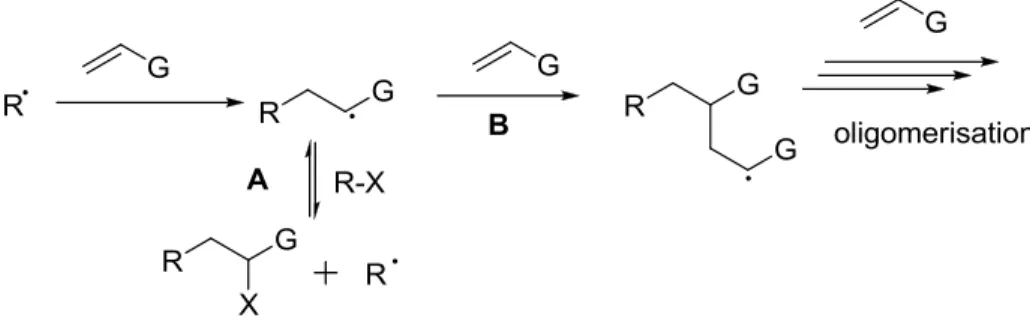
addition to alkens, a greater stability of R‟• compared to R• will cause oligomerisation of the alkene (SchemeI-15). Therefore radicals R• such as primary, vinyl and aromatic radicals are not efficient in such process.
Scheme I-15
II. The radical chemistry of xanthate
Figure II-1 The xanthate functional group
Dithiocarbonates, known as xanthates14 (Figure II-1), were initially used in the Chugaev elimination,15 which involves the elimination of COS from a secondary xanthate to produce alkenes and a thiol, and hence as a method to dehydrate a secondary alcohol (Scheme II-1). Apart from this reaction, the chemistry of xanthate was little exploited over for a relatively long period of time, until the recent discovery of its radical reactivity.
14
Zeise, W. C. J.Chem. Phys. 1822, 35, 173; 1822, 36, 1
15
30
Scheme II-1
The development of the radical chemistry of xanthates in synthesis may be traced to the early 1970s with the reporting of the Barton-McCombie deoxygenation16, which will be presented later. In fact, part of the radical chemistry of xanthate belongs to the more general field of group transfer that we introduced in the previous section.
As a consequence of the radicophilicity of the thiocarbonyl group, the first step involves the attack of a radical Ro• on the sulfur of C=S double bond. This step is fast and reversible, as
demonstrated in the study of the mechanism of the Barton-McCombie deoxygenation.17 The intermediate radical A generated from this step is the key in discussing of this chemistry (Scheme II-2).
Scheme II-2
Except from the degenerate reaction (pathway 3), this radical has the possibility to fragment in two different manners, depending on the nature of two groups R1 and R2. One pathway is the
fragmentation of the C-O bond (pathway 1), which leads to Barton-McCombie deoxygenation reaction, whereas the other pathway is the fragmentation of the C-S bond (pathway 2), which is central to our study.
16
Barton, D. H. R; McCombie, S. J. Chem.Soc. Perkin. Trans. 1 1975, 1574.
17
31
1. Barton-McCombie deoxygenation
Discovered by Barton and McCombie in 1975, this method, first used to deoxygenate secondary alcohols, involves the initial transformation of a secondary alcohol into the corresponding xanthate, followed by the treatment with Bu3SnH through a radical chain process to furnish the
deoxygenated product (Scheme II-4).18 It has been so far the most popular application of xanthates, particularly in the field of carbohydrates and aminoglycosides.
Scheme II-3
As illustrated in Scheme II-4, radical Bu3Sn• generated after the initiation step attacks the sulfur
of the C=S bond in a rapid and reversible manner, which leads to intermediate radical A. As the R1 group is a methyl group and the R2 group is a secondary alkyl group, the fragmentation of A
occurs only to the side of the C-O bond leading to more stable secondary radical. Subsequently, radical R2•reacts with Bu3SnH to generate reduced product RH and stannyl radical Bu3Sn• which
propagates the chain. The driving force of this process is the formation of a strong S-Sn bond and the conversion of a C=S bond into a stronger C=O bond.
18
32
Scheme II-4
The Barton-McCombie reaction has proved to be the most suitable deoxygenation method for alcohols in organic synthesis. Since its discovery, the original publication has been cited more than 1400 times, and its applications are found widely in total synthesis and in the systematic modification of natural products. This transformation provides a good alternative to ionic methods which are frequently less selective and efficient.
For example, in a recent total synthesis of Polygalolide A by Nishikawa‟s group in 201119, the key intermediate AM-3 was obtained by conversion of the protected alcohol functional group of
AM-1 into thiocarbonate AM-2, whichwas then transformed into AM-3 by treatment with
Bu3SnH (Scheme II-5).
Scheme II-5
19
33 Another elegant example concerns access to the very complex precusor of azadirachtine.20 After fragmentation of the C-O bond, the radical derived from VG-1 underwent a 5-exo cyclisation on an allene to furnish an allylic radical which then abstracted hydrogen from Bu3SnH to give rise
to VG-2. This example demonstrates the high functional group tolerance of this method (Scheme
II-6).
Scheme II-6
Not limited to secondary alcohols, the Barton-McCombie reaction can sometimes be applied for the primary and tertiary alcohols by modifying the conditions, even though with much less generalities than in the case of secondary alcohols.
For instance, for the primary alcohols, the rupture of C-S bond, which produces the methyl radical, will be in the competition with the desired rupture of C-O bond since both of fragmentations leads to the formation of primary radicals. To solve the problem, the thiomethyl group is replaced by an imidazole, a phenol or an aniline.21 In these cases, the undesired fragmentation becomes incompatible since a very high energy radical would be generated; therefore, the deoxygenation provides a good yield even for primary alcohol (Scheme II-7).
Scheme II-7
20
Veitch, G. E.; Beckmann, E.; Burke, B. J.; Boyer, A.; Maslen, S.; Ley, S. V. Angew. Chem. Int. Ed.2007, 46, 7629.
21
34 In the case of tertiary alcohols, the corresponding xanthates undergo the Chugaev elimination22 under the experimental conditions. For such alcohols, a better variant is to perform a reductive decarboxylation on the hemioxalate as shown in Scheme II-8.23
Scheme II-8
2. The degenerative xanthate transfer process
Originally developed from a detailed study on the mechanism of Barton-McCombie deoxygenation, yet in contrast to the cleavage of C-O bond in the deoxygention method, the radical chemistry by transfer of a xanthate is based on the cleavage of C-S bond. In this case, in order to prevent the fragmentation of the C-O bond, the R1 group is generally a primary alkyl (an
ethyl group is normally used). As the matter of fact, the chemistry of group transfer allows both intermolecular and intramolecular additions. The simplified general mechanism manifold for the addition of R-Xa to an olefin is presented in Scheme II-9.
In this process, it is important to emphasize two crucial necessary conditions for the efficiency of the whole system:
R• radical must be equally, or better, more stable than an ethyl radical so that the fragmentation occurs only to the side of C-S bond.
Radd• radical3 must be less stable than R• radical so that the problem of oligomerisation is
obviated and the chain propagates.
22Nace, H. R. Org React.1962, 12, 57. 23
(a) Barton, D.H.R.; Crich, D. J. Chem. Soc. Chem. Commun.1984, 774. (b) J. Chem. Soc. Perkin. Trans.1 1986, 1603.
35
Scheme II-9
In this respect, the key element to the success of the xanthate chemistry is due to the degenerate reaction leading to radical 2. Radical R• is stocked in the form of the more stable tertiary radical
2, in consequence, the concentration of radical R• remains very low in solution yet its lifetime is at the same time increase. The low concentration of radical R• decreases the importance of the termination steps. This makes this process unique and, in contrast to most other radical methods, the degenerative xanthate transfer process can be performed in a very concentrated solution, thus favoring even sluggish bimolecular processes. This is also an advantage for applications in industry since it is easy to scale up the reactions.
The radical addition reactions can be accomplished even with unactivated olefins. Indeed, the xanthate transfer process represents a good solution to the longstanding problem in organic synthesis of creating C-C bonds in an intermolecular fashion with non-activated alkenes.
In some special cases, the initiator peroxides can oxidize the intermediate radical Radd• to the
corresponding cation, which can then undergo typical ionic transformations.24
24
For reviews on the xanthate radical transfer reaction, see: (a) Zard, S. Z. Angew. Chem., Int. Ed. 1997, 36, 672. (b) Quiclet-Sire, B.; Zard, S. Z. Chem. Eur. J.2006, 12, 6002. (c) Quiclet-Sire, B.; Zard, S. Z. Top. Curr.Chem.2006,
36 This process offers numerous advantages:
It does notinvolve heavy metals such as tin or mercury.
There is no fast competing reduction as with the stannane chemistry.
It is easy to accessxanthates, which are generally stable.
Difficult transformations– can be accomplished, in particular intermolecular additions to unactivatedolefins and cyclisations onto aromatic rings.
It is easy to implement experimentally. Moreover, xanthates possess physical characteristics suitable for analyzing the products: they are visible under a UV lamp and exhibit characteristic NMR signals.
The processes are safe and easy to scale up.
The products of additions to alkenes are also xanthates. It is often possible to use them in a second radical transformation or convert them into other functional groups.
This chemistry has a remarkable tolerance to a variety of functional groups, which allows an easy access to an assembly of richly functionalised structures.
i. Preparation of xanthates
Numerous methods to access xanthates have been developed and depending on the nature or the substitution of the desired xanthate, a given route may be preferred. As mentioned above, the ethyl group is placed to prevent the fragmentation of the C-O bond; in fact this choice is only based on a practical facility, because potassium O-ethyl xanthate salt is commercially available and cheap. The ethyl group can obviously be replaced by another alkyl group if necessary.
Scheme II-10 portrays a summary of routes to xanthates.
264, 201. (d) Zard, S. Z. Aust. J. Chem.2006, 59, 663. (e) Quiclet-Sire, B.; Zard, S. Z. Pure Appl. Chem. 2011, 83, 519.
37
Scheme II-10
By ionic methods:
1/ The most popular method is the nucleophilic substitution of a leaving group by potassium O- ethyl xanthate salt. Most of the starting xanthates used in our group are synthesized by this method. It is efficient for the synthesis of primary or secondary xanthates, but it generally fails for tertiary xanthates.
For example, xanthate CA-2 is obtained in excellent yield from the corresponding bromide (Scheme II-11).25
Scheme II-11
2/ Certain tertiary xanthates an be prepared by Michael addition to an electrophilic alkene as shown in Scheme II-13. However, it is necessary to operate under acidic conditions to avoid the retro-Michael reaction, and this introduced a limitation.26
25
Cordero-Vargas, A.; Quiclet-Sire, B.; Zard, S. Z. Org. Lett.2003, 5, 3717.
26
38
Scheme II-12
3/ An alternative method is the nucleophilic attack of an anion on a bis-xanthate. For example, in our laboratory, the highly functionalized xanthate FG-2 is produced in high yield 76% by Fabien Gagosz (Scheme II-13). However, this approach is limited because a second addition of xanthate can take place for primary and secondary carbanions.
Scheme II-13
By radical methods:
1/ The most general method is the addition of a xanthate to an olefin by transfer of xanthate (examples will be presented in the following section). This strategy allows us to access to very complicated xanthates. By modifying the xanthate precursors and olefin traps, the number of generated xanthates is unlimited.
2/ Reacting a radical derived from an azo compound with a bis-xanthate also generates xanthates. This method is employed to form tertiary xanthates but is limited by the availablility of the azo component.27
Scheme II-14
3/ The photolysis of S-acyl xanthate can furnish tertiary xanthates through the extrusion of a CO2 or a CO molecule. It is sometimes necessary to use this process in some specific cases.
For example, S-triluoromethyl xanthates cannot be prepared by a normal nucleophic substitution,
27
39 but the procedure involving the decarbonylation of S-trifluoroacetyl xanthate proved to be a successful route. Thus, Bertrand could obtain the S-xanthate of trifluromethyl BF-2 in moderate yield (40%) as shown in Scheme II-15. 28
Scheme II-15
ii. Synthetic potential of xanthates
Xanthates have a huge potential in organic synthesis as they allow the construction of a vast array of different structures. The main types of reactions that can be accomplished by the xanthate chemistry are listed below:
a. Intermolecular additions
b. Ring-closure onto internal alkenes c. Ring-closure onto aromatic derivatives d. Fragmentation reactions
e. Transformation of xanthates
f. Application of xanthate in total synthesis
By going through these reactions, we will clarify how powerful and versatile this chemistry is. From now on, in this thesis, placing lauroyl peroxide in parentheses indicates that it is used as the initiator in substoichiometric amounts, while no parentheses means that the peroxide is used both as initiator and as a stoichiometric oxidant.
a. Intermolecular additions:
As stated above, the ability of xanthates to mediate intermolecular C-C bond formation to non-activated olefins is one of the main hallmarks of this chemistry.
28
40 The first example in Scheme II-16 is the addition of the xanthate of trifluoromethyl.29 In this case, the ethyl group is replaced by a phenylethyl group to reduce the volatility of the compound. After reaction, the trifluoromethyl motif is introduced to the structure efficiently in 84% yield. In the same way, the α-trifluoromethylamine motif30 can be introduced efficiently by using the corresponding xanthate GF-1. With these reactions, a variety of fluorinated structures important for their potential pharmaceutical applications can be obtained.
Scheme II-16
An important observation is that this chemistry is compatible with various functional groups demonstrated by the examples in Scheme II-17. The last example involving pleuromutiline and possessing unprotected alcohol groups is particularly noteworthy.
29
Bertrand, F; Pevere, V; Quiclet-Sire, B.; Zard, S. Z. Org. Lett.2001, 3, 1069.
30
41
Scheme II-17
Besides, the resulting xanthate can often react with another olefin to generate a new xanthate. A succession of addition reactions can sometimes be performed to construct, a complex and highly functionalised structures. Such an example is displayed in Scheme II-18.31
31
42
Scheme II-18
b. Ring-closure onto internal alkenes:
Xanthates can also be used to mediate efficient cyclisations if the substrate bears a suitable located internal alkene. So far, besides the easy formation of five32 or six-member-rings,33 even the difficult and problematic formation of seven34 or even eight-member-rings35 can sometimes be achieved (Scheme II-19). This method opens up an easy access to carbocycles as well as to heterocycles.
32
(a) Alamenda-Angulo, C.; Sire, B.; Zard, S. Z. Tetrahedron2006, 47, 913. (b) Denieul, M.-P.; Quiclet-Sire, B.; Zard S. Z. Tetrahedron Lett.1996, 37, 5495.
33 Boiteau, L.; Boivin, J.; Quiclet-Sire, B.; Saunier, J.B.; Zard, S. Z. Tetrahedron1998, 54, 2087 34
Heng, R; Zard, S. Z. Org. Biomol.Chem.2011, 9, 3396.
35
43
Scheme II-19
c. Ring-closure onto aromatic derivatives:
The intramolecular addition can also take place on an aromatic nucleus, but in this case, the reaction proceeds without transfer of the xanthate group. As shown in Scheme II-20, the cyclohexadienyl radical thus generated is oxidized to a carbocation by electron transfer to the peroxide, followed by aromatisation through loss of a proton. The peroxide therefore acts as both an initiator and an oxidant. The principal side reaction in this process is the premature reduction of radical 2.
44
Scheme II-20
This reaction mode allows the application of xanthate to the systhesis of a wide variety of substituted cyclic systems such as α-tetralones,36 benzazepinones,37 fluoroazaindolines,38 indulines,39 tetrahydro-pyrido-pyrimidines40… These ring-closures to aromatic and heteroaromatic derivatives allow access to highly functionalised molecular architectures as illustrated by the examples in Scheme II-21. The precursors in these examples were themselves made by an intermolecular addition of a xanthate to a simple alkene. In some cases, both steps can be performed in the same pot without isolation of the adduct.
36
Petit, L.; Zard, S. Z. Chem. Commun2010, 46, 5148.
37
Kaoudi, T.; Quiclet-Sire, B.; Seguin, S.; Zard, S. Z. Angew.Chem. Int. Ed.2000, 39, 731.
38Laot, Y.; Petit, L.; Zard, S. Z. Org. Lett.2010, 12, 3426. 39
Bereot, O.; Corsi, C.; El Qacei, M.; Zard, S. Z. Org. Biomol.Chem.2006, 4, 278.
40
45
Scheme II-21
d. Fragmentation reactions:
Following the addition or cyclisation step, a radical can sometimes undergo a fragmentation and generate a new radical, which may then propagate the chain.
46 One of the more interesting fragmentations is the case of allylic41 and vinylic sulfones;42 in the latter case, the dichloro vinyl derivative obtained can be transformed into an alkyne by the well-known Corey-Fuchs reaction (Scheme II-22).
Scheme II-22
The 2-fluoro-6-hydroxypyridinyloxy group has recently been developed in our laboratory as a means for cleaving by homolysis the C-O bond of alcohols. This fragmentation allows access to di, tri- or even tetrasubstituted olefins. The latter are generally difficult to obtain by more traditional methods such as the Wittig olefination. In this case, a stoichiometric amount of peroxide is needed because the fluoro pyridyloxyl radical, generated from the fragmentation, does not propagate the chain (Scheme II-23).43
Scheme II-23
41
Quiclet-Sire, B.; Zard, S. Z. Angew.Chem. Int. Ed.1998, 37, 2864.
42(a) Bertrand, F.; Quiclet-Sire, B.; Zard, S. Z. Angew.Chem. Int. Ed.1998, 38, 1943. (b) Li, Z.; Zard, S. Z.
Tetrahedron Lett. 2009, 50, 6973.
43
47 In the course of extending the scope of this approach, another interesting fragmentation was discovered involving the rupture of a C-C bond to generate cumyl radical, as described in
Scheme II-24. This discovery provides a synthetic route to useful ketones.44
Scheme II-24
e. Transformations of xanthate:
Since the final products of the normal addition to alkenes contain a xanthate, it is possible to transform it into numerous other functional groups by using both radical and ionic processes.
(1) Radical transformations
Using radical chemistry, the xanthate can be reduced easily by the DLP/isopropanol couple45 or by a the mixture of H3PO2/Et3N/AIBN46. The xanthate may also be converted into a bromide47
using ethyl bromo isobutyrate with di-t-butyl-peroxide or into an azide via a peroxide initiated reaction with ethylsulfonylazide;48 or, finally, into a chlorophenyl sulfide by reacting with DLP/bis(2-chlorophenyl)disulfide.49Some examples are displayed in Scheme II-25.
44Debien, L.; Zard, S. Z. J. Am. Chem. Soc. 2013, 135, 3808. 45
Quiclet-Sire, B.; Zard, S. Z. Tetrahedron Lett.1998, 39, 9435.
46
Braun, M.-G.; Heng, R.; Zard, S. Z. Org. Lett.2011, 13, 1230.
47 Barbier, F.; Pautrat, F.; Quiclet-Sire, B.; Zard, S. Z. Synlett2002, 811. 48
Olivier, C.; Renaud, P. J. Am. Chem. Soc.2000, 122, 6496.
49
48
Scheme II-25
(2) Ionic transformations
It is possible to transform a xanthate into a thiol group by cleavage with ethylenediamine in ethanol under an inert atmosphere. The resulting thiol may then be incorporated into various ionic under either basic50 or acidic51 conditions to create interesting sulfur-containing cyclic or acylic products (Scheme II-26).
50
Boutillier, P.; Quiclet-Site, B.; Zafar, S.; Zard, S. Z. Tetrahedron-Asymmetry2010, 21, 1649.
51
49
Scheme II-26
If an electrophilic alkene is present in the compound, then a Michael can occur as in the example in Scheme II-27.52
Scheme II-27
f. Application of xanthantes in total synthesis
To further illustrate the utility of xanthates in some applications in the total synthesis of natural products are briefly presented. The first example is an intermolecular radical addition-cyclisation cascade in the synthesis of the key intermediate BA-2 towards mersicarpine (Scheme II-28). The precursor BA-1 underwent a one-pot addition-cyclisation sequence, to give a crude product, which was oxidized by treatment with MnO2 as the lauroyl peroxide was not sufficient to
rearomatise completely the system. In this way, the tricyclic intermediate BA-2 was obtained in good yield (78%).53
52
Corbet, M.; Zard, S. Z. Org. Lett.2008, 10, 2861.
53
50
Scheme II-28
Another example is the systhesis of 10-norpavulenone and O-methylasparvenone where the α-tetralone framework was constructed the chemistry of xanthates.54 As shown in Scheme II-29, the formation of tetralone CA-3 started with addition of CA-1 to vinyl pivalate, followed by cyclisation of the resulting addition product CA-2. Subsequently, the formyl substituent was introduced in nearly quantitative yield by exposure of a cold (-10oC) solution of intermediate
CA-3 to TiCl4 and dichloromethyl methyl ether. From this common intermediate CA-4, two
sequences were implemented. In the first, reduction of the aldehyde in CA-4 to the alcohol followed by saponification of the pivalate furnished 10-norpavulenone. In the second, the conversion of the same aldehyde into a vinyl group, followed by hydrogenation and saponification of the pivalate led to O-methylasparvenone. The synthesis of 10-norpavulenone was accomplished in five steps in 14% unoptimized overall yield, whereas the synthesis of O-methylasparvenone required 6 steps and proceeded in 7% overall yield. This approach can be modified to provide to a flexible access to various analogs functionalised at various positions around the structure.
54
51
Scheme II-29
III. Conclusion
This chapter presented a brief introduction to radical chemistry in general and to the degenerative xanthate transfert process in particular, which is center to this work. This knowledge is fundamental and indispensable for understanding the topics of the following chapters.
In respect to the xanthate chemistry, the above examples illuminate the reactivity, stability, and diversity of xanthates in the various transformations leading to complex structures. The mild and easy-to-perform conditions underscore its compatibility with a wide range of common functional groups.
Some important applications of xanthates such as RAFT (Reversible Addition Fragmentation Transfer) and MADIX (Macromolecular Design by Interchange of Xanthate) controlled polymerization technologies are not included in this presentation.
The next chapter will focus on the application of xanthates for the synthesis of benzazepinones and discusses how this route was unexpectedly dicovered.
53
Chapter 2
Synthesis of benzazepinones
I. Introduction
1. Some aspects of the chemistry of hydroxamic acids 2. Brief review of the Smiles rearrangement
2. Introduction to benzazepinones
i. The importance of benzazepinones ii. Recent syntheses of benzazepinones II. Original plan and unexpected results
1. Original plan 2. Unexpected results
i. An attempt at five-membered ring construction ii. An attempt at six-membered ring construction II. Results and discussion
1. Investigation of the mechanism
2. Preliminary results on the synthesis of benzazepinones (seven-membered ring) III. Application to the synthesis of benzazepinones
54
I. Introduction
Our original plan was to synthesize the hydroxamic acids, but, unexpectedly, we found an interesting route to access N-Unsubstituted benzazepinones.
In the course of this work, we also found that a radical Smiles rearrangement occurred under our experimental conditions, which helped us resolve the mechanism of this unexpected transformation. Therefore, in this introduction, we shall first present some aspects of the chemistry of hydroxamic acids, then a brief review of the Smiles rearrangement and, finally, we will discuss benzazepinones and recent syntheses of members of this family. This will constitute the main part of this section.
55
1. Some aspects of the chemistry of hydroxamic acids
Hydroxamic acids are an important class of compounds which exhibit a wide spectrum of biological activities such as antibiotic, antifungal, anti-inflammatory, anticancer and enzyme inhibitory activities. The strong chelating ability of hydroxamic acids toward metal ions such as zinc and iron has made them popular targets for medicinal chemists. This class has therefore received a considerable attention from chemists in industry. Numerous members of this family have indeed been reported as potent inhibitors of histone deacetylase (HDAC) and matrix metalloproteinases. Among the many clinical agents explored in the pharmaceutical industry; suberoylanilidehydroxamic acid SAHA has emerged as a new potential drug. SAHA displays antitumor activity in several in vivo models of cancer. In 2006, the Merck Company launched the production of SAHA for the treatment of cutaneous T-cell lymphoma. It is currently in advanced clinic trials. Moreover, hydroxamic acids have been applied in therapy treatment of iron overload diseases due to their possibility to complex and transport the ferric ion. For example, desferrioxamine B (Desfaeral), produced by Novartis, is used to treat iron poisoning, which can arise by following blood transfusion to patients with genetic blood diseases (Figure
1).55
Figure 1
Not only linear hydroxamic acids are important, cyclic hydroxamic acids have also attracted more and more attention nowadays. The cyclic hydroxamic acids are present in a variety of natural products, which also display biological activities. For example, Mycobactin T and Cobactin T are siderphore growth promoters isolated from mycobacteria. Current discovery in the aspect of drug resistance in strains of tuberculosis has simulated the research in mycobatin
55
Nandurkar, S. N.; Petersen, R.; Qvortrup, K.; Komnatnyy, V. V.; Taveras, K. M.; Le Quement, S. T.; Frauenlob, R. ; Givskov, M.; Nielsen, T. E. Tetrahedron Lett.2011, 52, 7121.
56 analogs in order to investigate the iron metabolic mechanisms and mycobactin-drug conjugates for better drug delivery. Structurally related mycobactins, amamistatins A7 and B8, natural products isolated from a strain of Nocardia,exhibit an antiproliferative effect against several human tumor cell lines.56Another example includes PF-04859989 developed by Pfizer, which is used for treating schizophrenia due to its capacity as an irreversible kynurenine aminotransferase II inhibitor (Figure 2).57
Figure 2
As indicated, the incredible pharmaceutical relevance of hydroxamic acids has promoted the search to establish useful methods for their incorporation into a variety of complex structures. Since our original work focused on the synthesis of cyclic hydroxamic acids, the recent methods to access cyclic hydroxamic acids are briefly presented.
56
Fennell, K. A.; Mollmann, U.; Miller, M. J. J. Org. Chem.2008, 73, 1018.
57
Dounay, A. B.; Anderson, M.; Bechle, B. M.; Campbell, B. M.; Claffey, M. M.; Evdokimov, A.; Evrard, E.; Fonseca, K. R.; Gan, X.; Ghosh, S.; Hayward, M. M.; Horner, W.; Kim, J. _Y.; McAllister, L. A.; Pandit, J.; Paradis, V.; Parikh, V. D.; Reese, M. R.; Rong, S. B.; Salafia, M. A.; Schuyten, K.; Strick, C. A.; Tuttle, J. B.; Valentine, J.; Wang, H.; Zawadzke, L. E.; Verhoest, P. R. ACS Med. Chem. Lett. 2012, 3, 187.
57 Synthesis of Cobactin T pictured in Scheme I-1 was reported by the Yang group. In this work, the key seven-membered ring lactam intermediate YS-2 was synthesized by the ring closing metathesis of YS-1 using Grubbs II ruthenium catalyst in refluxing CH2Cl2.58
Scheme I-1
The seven-membered ring was also constructed by the cyclisation reaction of a hydroxylamine and an acid. In the course of development of therapeutically useful antihypertensive agents, the Miller group synthesized novel hydroxamic acid-derived azepinones by using nitrone precursors
WA-1 (Scheme I-2). The stable and storable nitrone WA-1 was converted to the hydroxylamine
by an exchange reaction with hydroxylamine hydrochloride. The amide coupling was accomplished by EDC/ HOAt-mediated cyclisation to give rise to hydroxamic acid WA-2.59 .
Scheme I-2
58Yang, S.-M.; Lagu, B.; Wilson, L. J. J. Org. Chem.2007, 72, 8123. 59
(a) Walz. A. J.; Miller, M. J. Org. Lett. 2002, 4, 2047. (b) Jingdan Hu and Marvin J. Miller J. Am. Chem. Soc.1997,119, 3462.
58 Cyclic hydroxamic acids can be obtained by oxidation of secondary amines. As shown in Scheme I-3, treatment of 1,2,3,4-tetrahydroquinolines with 30% aqueous hydrogen peroxide in the presence of tungstate catalyst gave the hydroxamic acids in the yield varying from 52% to 85%. This synthesis allows accessing cyclic hydroxamic acids bearing a variety of different functional groups such as bromide, chloride, cyanide, methyl and methoxy group.60
Scheme I-3
In fact, the most frequently used method to construct cyclic hydroxamic acids involves the formation of amine bond by reductive cyclisation of a suitable oxime. For example, the group of Spino reported the cyclisation after the reduction of PS-1 by NaBH3CN, as described in Scheme
I-4.61
Scheme I-4
The nitro group can also be converted into hydroxylamine group. In the case of compound CP-1 in Scheme I-5, the nitro group was reduced by zinc/AcOH/Ac2O to give directly cyclic
hydroxamic acid CP-2 (55%) and its O-acetyl derivative CP-3 (40%).62
Scheme I-5
60Marahashi, S.-I.; Ode, T.; Sugahara, T.; Masui, Y. J. Org. Chem.1990, 55, 1744. 61
Pichette, S.; Aubert-Nicol, S.; Lessard, J.; Spino, C. J. Org. Chem.2012, 77, 11216
62
59 An alternative reductive cyclisation system is SnCl2/NaOAc. This reagent allows the synthesis of
substituted cyclic hydroxamic acids bearing a wide range of substituents R2, R3, and R4 with
different electronic properties (Me, CF3, Cl, OMe, OCF3, F). The nitro group is reduced partially
to the corresponding hydroxylamine, followed by cyclisation to generate bicyclic structures
ML-1. For ease of isolation and purification, the crude amino hydroxamic acids ML-1 were protected
in situ to furnish ML-2 as the di-Boc derivatives. This method is very efficient; the yields varied from 63 to 94% (Scheme I-6).63
Scheme I-6
2. A brief review on the radical Smiles rearrangement
The origin of the Smiles rearrangement comes from an intramolecular nucleophilic aromatic substitution.64 The first radical Smiles rearrangement, also known as 1,4-arylradical rearrangement, was observed by Speckamp.65 In principle, this rearrangement starts with a free radical attack at the ipso position of sulfonates or sulfonamides, followed by the extrusion of sulfur dioxide molecular and terminated by hydrogen abstraction to generate final product with 1,4-aryl migration and the loss of SO2. This mechanism is described in detail in Scheme I-7 in
the synthesis of biaryl derivatives reported by Motherwell and coworkers. This transformation and its variants have been applied for the preparation of numerous interesting structures.
63 McAllister, L. A.; Bechle, B. M.; Dounay, A. B.; Evrard, E.; Gan, X.; Ghosh, S.; Kim, J.-Y.; Parikh, V. D.; Tuttle,
J. B.; Verhoest, P. R. J. Org. Chem.2011, 76, 3484.
64Levy, A. A.; H. C. Rains; Smiles, S.J. Chem. Soc., 1931, 3264. 65
(a) Loven, R.; Speckamp,W. N. Tetrahedron Lett., 1972, 13, 1567. (b) Köhler, J. J.; Speckamp, W. N. Tetrahedron Lett.,1977, 18, 631.
60 .
Scheme I-7
Recently, our group discovered an unusual radical Smiles rearrangement of N-(α-xantyl)acetylaminopyridines proceeding via a spiro azetidinone intermediate (Scheme I-8).66
Scheme I-8
The domino radical cyclisation/Smiles rearrangement cascade exemplified in Scheme I-9 was achieved by Sapi and co-workers to furnish 3-(2‟-aryl-N-methyl acetamido)indolin-2-ones
MP-4. Exposure of MP-1 to 2,2‟-azocyclohexanecarbonitrile (ACCN), a liposoluble radical initiator,
triggered the cyclisation followed by a Smiles rearrangement to give the desired product MP-2.67
66Bacqué,E.; El Qacemi, M.; Zard,S. Z. Org. Lett., 2005, 7, 3817.
For a review on radical aryl migration reactions, see: A. Studer and M. Bossart, Tetrahedron, 2001, 57, 9649.
67
61
Scheme I-9
3. Introduction to benzazepinones
i. The importance of benzazepinones
Benzazepinones and other molecules possessing similar structures (bicyclic lactams such as benzazepines and paullones) are an important class in medicinal chemistry and the pharmaceutical industry (Figure 1). These ubiquitous structural units are found in a large spectrum of bioactive natural products and therapeutic agents. They exhibit a large array of biological activities for the treatment of cardiovascular, neuropathic pain, cancer, Alzheimer‟s diseases, etc. Therefore, these compounds have been the targets of intensive synthetic efforts over the years.