HAL Id: hal-01845792
https://hal.archives-ouvertes.fr/hal-01845792
Submitted on 24 Feb 2021HAL is a multi-disciplinary open access
archive for the deposit and dissemination of sci-entific research documents, whether they are pub-lished or not. The documents may come from teaching and research institutions in France or abroad, or from public or private research centers.
L’archive ouverte pluridisciplinaire HAL, est destinée au dépôt et à la diffusion de documents scientifiques de niveau recherche, publiés ou non, émanant des établissements d’enseignement et de recherche français ou étrangers, des laboratoires publics ou privés.
Mechanochemical solid-phase reaction between
polyvinylidene fluoride and sodium hydroxide
Qiwu Zhang, Jinfeng Lu, Fumio Saito, Michel Baron
To cite this version:
Qiwu Zhang, Jinfeng Lu, Fumio Saito, Michel Baron. Mechanochemical solid-phase reaction between polyvinylidene fluoride and sodium hydroxide. Journal of Applied Polymer Science, Wiley, 2001, 81, p. 2249-2252. �10.1002/app.1663�. �hal-01845792�
Mechanochemical Solid-Phase Reaction between
Polyvinylidene Fluoride and Sodium Hydroxide
QIWU ZHANG,1
JINFENG LU,1
FUMIO SAITO,1
MICHEL BARON2
1
Institute of Multidisciplinary Research for Advanced Materials, Tohoku University, 2-1-1, Katahira, Aoba-ku, Sendai 980-8577, Japan
2
Ecole des Mines d Albi, 81013 Albi Cedex 09, France
ABSTRACT: Grinding a mixture of polyvinylidene fluoride (PVDF) and NaOH was conducted by a planetary ball mill at atmospheric condition to investigate mechano-chemical reaction between the two substances. The grinding stimulates the reaction to form NaF and organic composites. Yield of fluorine converted from PVDF to NaF increases with an increase in grinding time and reaches 90% at 60 min or more. As for the organic phase, oxygen-bearing compounds are formed due to substitution of fluorine by OH base. The organic compounds are classified into water-soluble and insoluble ones, depending on their structures.
Key words: PVDF; grinding; mechanochemical reaction; defluorination
INTRODUCTION
Polyvinylidene fluoride (PVDF, [CH2CF2]n) is
one of the fluorine resin group, and is distin-guished by excellent resistance to heat, aging and abrasion, chemical stability with nontoxic-ity, unique electrical properties, durability for UV, and gamma radiation. These properties al-low us to use it in a wide range such as mechan-ical, chemmechan-ical, electrmechan-ical, agricultural, and food industries.1,2 Recently, the amount of fluorine resin produced has increased; accordingly, so has the amount of the waste resin been grow-ing. When the waste halogen-bearing resins3– 6 are burned in a furnace, toxic gases such as HF as well as harmful substances like dioxins are emitted in a flue gas and ashes. Because the emission of such toxic and harmful substances should be prevented, proper techniques are
strongly required in waste deposit facilities. A method for adsorbing toxic gases in a thermal treatment of the waste has been developed; however, this is sometimes accompanied with corrosion of devices for adsorbing the gases.
Another route for processing such polymer wastes is a mechanochemical method.7–9
Al-though it is known that mechanical treatment of polymer will degrade it easily and its mo-lecular weight decreases to a relatively low level,10 –13 the basic unit (monomer part)
re-mains unchanged after the mechanical treat-ment. It is different in the mechanochemical process where an active chemical is added into polymer so that not only degradation but a real reaction takes place. In this article, we provide fundamental information on the mechanochem-ical solid phase reaction between PVDF and NaOH to form organic compounds and NaF. The organic phases after defluorination may be used as fuel, while NaF has a possibility to be a source for fluorine recycling.
EXPERIMENTAL
The PVDF sample (called sample A) used in the experiment was supplied from Dowa Mining Co. Ltd., Japan. NaOH, HCl solution, and ethyl ace-tate were obtained from Wako Pure Chemical Industries, Ltd., Japan. The PVDF and NaOH samples were mixed as a starting mixture where fluorine is equivalent to sodium in the starting mixture.
A planetary ball mill (Pulverisette-7, Fritsch, Germany) was used to grind the starting mix-tures at approximately 700 rpm under atmo-spheric condition. Four grams of the mixture were charged in a zirconia pot of 45cm3 inner volume
with seven zirconia balls of 15 mm diameter and ground for different periods of time.
Washing operation for the ground samples was conducted as follows: 1 g of sample was dispersed into 50 mL distilled water in a vial with mechan-ically agitation for 60 min. Subsequently, the sus-pension was filtered to separate solid and liquid phases. The solid particles were rinsed with 50 mL distilled water two times. The solid particles was called sample B. pH value of the filtrate was regulated to 2 by adding HCl solution, then 40 mL ethyl acetate was added to the filtrate of 250 mL to extract soluble organic phase. The organic sam-ple after the extraction is called samsam-ple C. Both samples B and C were dried at 373 K for 2 h in air. X-ray diffraction (XRD) analysis was conducted on the ground samples for identifying phases in the
ground samples. Mg-K␣ radiation was used in X-ray photoelectron spectroscopic (XPS) measure-ment to record spectra for samples A, B, and C. Infrared spectra for these three samples were re-corded by means of Fourier transform infrared (FTIR) spectroscopy using a KBr disc method. Flu-orine concentration in the filtrate was measured by an Ion-Chromatography (IC) method.
RESULTS
Figure 1 shows XRD patterns of the original PVDF and the mixtures ground for different pe-riods of time. Peaks of NaF are observed in the pattern of the sample ground for 10 min. Inten-sity of the peak increases relatively with an in-crease in grinding time. The result suggests that displacement reaction of fluoride anion for OH base proceeds during the grinding to form NaF in the product, although no clear information on dis-sociation of organic compounds is provided.
Because the reaction product, NaF, is soluble in water, conversion of fluorine from PVDF into NaF can be easily obtained by measuring its flu-orine concentration in the filtrate after washing operation. Figure 2 shows yield of fluorine con-verted from the PVDF sample as a function of grinding time. The yield increases rapidly in the early stage of grinding to about 50% at 10 min, and then rises gradually to about 90% at 60 min. However, no further significant improvement in the yield can be made.
Figure 1 XRD patterns of the PVDF and NaOH mix-ture ground for different periods of time.
Figure 2 Yield of the F extracted by washing the ground mixture.
Figure 3 shows C1s spectra of samples A, B, and C. The spectrum for sample A gives two peaks due to the existence of C—C and C—F bindings in the sample. The peak due to C—F binding at higher binding energy broadens and weakens significantly for sample B, and it almost disappears for sample C. These results indicate that C—F binding has been cut off, and the de-fluorination of PVDF has been achieved.
Figure 4 shows the O1s spectra of samples B and C. It is interesting to notice that oxygen ex-ists in both samples B and C, and the peak inten-sity in sample C is much higher than that in sample B. Because oxygen does not exist in the original PVDF, the oxygen in samples B and C should come from NaOH through the mechano-chemical reaction. The water-soluble sample C has a much higher amount of oxygen than the insoluble sample B.
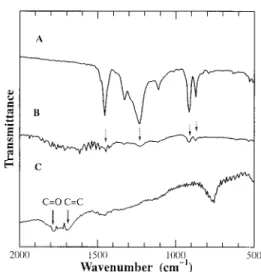
Figure 5 shows FTIR spectra of samples A, B, and C. Compared with the pattern of sample A (original PVDF sample), visible peaks in the spec-trum of sample B are the same as that of PVDF. The intensity of the peaks has reduced signifi-cantly. This indicates that a small amount of un-reacted PVDF is left in sample B. As for the pattern of sample C, three new broadened peaks are observed. Combined with the information from XPS, the new peaks could be understood as follows: the peak at about 1700 –1800 cm⫺1comes from carbonyl (C⫽O) stretch vibration, and the peak around 1600 –1700 cm⫺1may be related to the stretch vibration of the double carbon binding (C⫽C). As for the relatively large peak in the range between 700 – 800 cm⫺1, this may be due to the bending vibration of C⫽C—H binding.
DISCUSSION
The mechanochemical solid-phase reaction takes place through the substitution of F by the OH base to form a kind of alcohol, [CH2—C(OH)2], as
given by eqs. (1) and (2) expressed as a monomer unit reaction.
关CH2OCF2兴 ⫹ NaOH 3 NaF
⫹ 关CH2OCF共OH兲兴 (1)
关CH2OCF共OH兲兴 ⫹ NaOH 3 NaF
⫹ 关CH2OC共OH兲2兴 (2)
Figure 3 XPS spectra of the C1s of samples A, B, and C.
Figure 4 XPS spectra of the O1s of the samples.
It is deduced that the displacement reaction for half (one side linked to carbon) of the fluorine given by eq. (1) proceeds very easily because nearly 50% of the fluorine is converted into NaF within 10 min of grinding, as shown in Figure 2. The relatively slow increase in fluorine yield in Figure 2 suggests that it has become difficult to replace another half (opposite side linked to car-bon) fluorine given by eq. (2). High moisture ob-served in the ground sample over 30 min indi-cates that dehydration of [CH2—CF(OH)] or
[CH2—C(OH)2] takes place with a progress of substitution reaction of F by the OH base as fol-lows:
关CH2OCF共OH兲兴 3 关CHACF兴 ⫹ H2O (3)
关CH2OC共OH兲2兴 3 关CH2OCAO兴 ⫹ H2O (4)
The formation of H2O in the ground sample
causes strong agglomeration of the fine particles, which hinders the grinding efficiency so that fur-ther substitution of F by the OH base expressed as eq. (2) proceeds relatively slowly compared to eq. (1). This is the main reason why the prolonged grinding does not improve the reaction efficiently. If the water formed is taken out and the strong agglomeration is lightened, the grinding effi-ciency will be improved considerably to be able to give a nearly complete defluorination for the poly-mer. The proper method is under consideration.
The substitution of F by the OH base leads to binding of polar base to organic compound, and the dehydration leads to formation of carbon-rich organic phases. The former is a main composition of sample C, and the later is that of sample B. Sample B consists of the unreacted PVDF as well as the carbon-rich compounds. Sample C is the compounds with various types of polar base like the OH base, carbonyl base (C⫽O). Therefore, the organic phase in the ground sample is not one pure compound with only one base, but a mixture consisting of different types of chemical bases.
CONCLUSION
Mechanochemical solid-phase reaction between PVDF and NaOH proceeds rapidly in the begin-ning of the grinding stage to convert nearly half of the fluorine in PVDF into NaF through the sub-stitution of fluorine in PVDF by the OH base. The subsequent dehydration takes place to generate water molecules, which cause the strong agglom-eration of the obtained fine particles, decreasing the speed of this substitution reaction. About 90% of fluorine in the PVDF sample can be converted into NaF by this process. This indicates a high possibility of recycling fluorine from waste PVDF polymers.
The authors are grateful to Mr. Choju Nagata, General Manager, Electric Materials Company, Magnetic Ma-terials Business Unit, Dowa Mining Co. Ltd., for gen-erously supplying the PVDF sample. They wish to thank the IFPRI Inc. for providing the financial sup-port to carry out this work.
REFERENCES
1. Inderherbergh, J. Ferroelectrics 1991, 115, 295. 2. Duraud, J. P.; Le Moel, A.; Le Gressus, C. Radiat
Effect 1986, 98, 151.
3. Tukuda, T. Shigen-Shori-Gijutsu 1999, 46, 187. 4. Yoshioka, T.; Furukawa, K.; Sato, T.; Okuwaki, A.
J Appl Polym Sci 1998, 70, 129. 5. Winkler, D. E. J Polym Sci 1959, 35, 3.
6. Gupta, M. C.; Viswanath, S. C. Ind Eng Chem Res 1998, 37, 2707.
7. Loiselle, S.; Branca, M.; Mulas, G.; Cocco, G. Envi-ron Sci Technol 1997, 31, 261.
8. Rowlands, S. A.; Hall, A. K.; McCormick, P. G.; Street, R.; Hart, R. J.; Ebell, G. F.; Donecker, P. Nature 1994, 367, 223.
9. Cao, G.; Doppiu, S.; Monagheddu, M.; Orru, R.; Sannia, M.; Cocco, G. Ind Eng Chem Res 1999, 38, 3218.
10. Watson, W. F.; Pike, M. J Polym Sci 1952, 9, 229. 11. Jellinek, H. H. G. J Polym Sci 1951, 6, 745. 12. Bestul, A. B. J Appl Phys 1953, 24, 1011.
13. Yasue, T.; Aizawa, T.; Arai, Y. Nippon-Kakaku-Kaishi 1976, 3, 415.