HAL Id: hal-01978922
https://hal.archives-ouvertes.fr/hal-01978922
Submitted on 11 Jan 2019HAL is a multi-disciplinary open access archive for the deposit and dissemination of sci-entific research documents, whether they are pub-lished or not. The documents may come from teaching and research institutions in France or abroad, or from public or private research centers.
L’archive ouverte pluridisciplinaire HAL, est destinée au dépôt et à la diffusion de documents scientifiques de niveau recherche, publiés ou non, émanant des établissements d’enseignement et de recherche français ou étrangers, des laboratoires publics ou privés.
Continuum mechanical model for the Mullins effect in
swollen rubber
Andri Andriyana, Mei Sze Loo, Erwan Verron, Grégory Chagnon
To cite this version:
Andri Andriyana, Mei Sze Loo, Erwan Verron, Grégory Chagnon. Continuum mechanical model for the Mullins effect in swollen rubber. International Conference on Advanced Material and Manufac-turing Science, 2012, Beijing, China. �hal-01978922�
Continuum mechanical model for the Mullins effect in swollen rubber
Andri Andriyana
1,a, Mei Sze Loo
1,b, Erwan Verron
2,cand Grégory Chagnon
3,d 1Department of Mechanical Engineering, University of Malaya. 5800 Kuala Lumpur, Malaysia 2LUNAM Université, École Centrale de Nantes, GeM UMR CNRS 6183, 44321 Nantes, France3Université de Grenoble/CNRS, Laboratoire 3S-R, Cedex 9, 38041 Grenoble, France a[email protected], b[email protected], c[email protected],
Keywords: Rubber, Mullins effect, constitutive modeling, swelling, continuum damage mechanics.
Abstract. The present paper deals with the continuum mechanical modeling of Mullins effect
observed in swollen rubber under cyclic loading conditions. For this purpose, the concept of Continuum Damage Mechanics (CDM) applied to rubber materials is adopted and extended in order to take into account the swelling level. The damage exhibited by the material due to Mullins effect is assumed to be isotropic and is described by a scalar damage parameter which depends on the swelling level and on the maximum deformation experienced by the material during loading history. Results show that the proposed model is qualitatively in good agreement with experimental observations.
Introduction
Rubbers are widely used in engineering application such as vibration isolator, seals, gaskets, pipe, etc. During the service, they are subjecting to fluctuating mechanical loading which can lead to fatigue failure. Moreover, in engineering applications involving the contamination of aggressive liquids into the rubber components, swelling becomes a major issue since it decreases significantly the mechanical properties of rubber [1]. Thus, the understanding of the mechanical response of swollen rubber is essential for durability analysis of such components.
In the present paper, the continuum mechanical modeling of Mullins effect in swollen rubbers under cyclic loading conditions is addressed. More precisely, the concept of Continuum Damage Mechanics is adopted and extended in order to account for swelling level. For this purpose, the mechanical testing probing the Mullins effect in swollen rubber is conducted. The data is subsequently used to construct the damage function describing Mullins effect.
Continuum Mechanical Framework
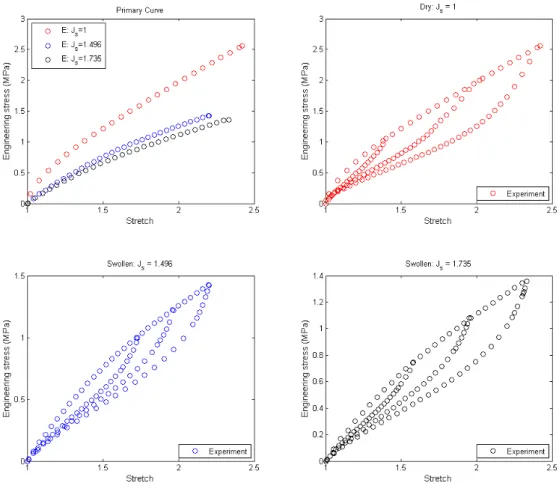
Experimental Observation. The stress-strain responses of dry and swollen rubbers under cyclic
loading at different maximum strains are presented in Fig. 1. In this figure, the secondary curves correspond to the reloading paths. The stress level during primary curve becomes lower as the swelling level increases. Moreover, as in dry rubber, it is observed that the swollen rubber also exhibits Mullins effect. However, their amount depends on the swelling level [2].
Constitutive Equation. At a continuum scale, swollen rubber is considered as homogeneous,
isotropic and hyperelastic. Moreover, it is subjected to isotropic damage due to Mullins effect [3]. Since the volume of swollen rubber does not significantly change during the deformation, the material is assumed to be incompressible. Thus, the mechanical response of the swollen rubber can be entirely characterized by the existence of a strain energy function WS which depends on the two invariants I1 and I2 of the left Cauchy-Green strain tensor B relative to the swollen-unstrained configuration, on
Fig. 1. Mullins effect observed in dry and swollen rubbers.
the scalar parameter d describing isotropic damage due to Mullins effect and on the swelling level Js = V/V0 as follow:
(
s)
S
S W I I d J
W = 1, 2, , (1)
Following the concept of Damage Mechanics by Lemaitre and Chaboche [4], WS can be considered as the product of the surface reducing parameter 1 - d and the strain energy function of the hypothetically virgin undamaged (due to Mullins effect) swollen material WOS
(
)
OS(
s)
S d W I I J
W = 1− ⋅ 1, 2, (2)
It is important to note that the damage that we address in the present work corresponds to the Mullins effect only. Considering the second law of thermodynamics, it can be shown that the Cauchy stress tensor in the incompressible swollen rubber is given by:
(
)
⎥ ⎦ ⎤ ⎢ ⎣ ⎡ ∂ ∂ − ⎟⎟ ⎠ ⎞ ⎜⎜ ⎝ ⎛ ∂ ∂ + ∂ ∂ ⋅ − + − = 2 2 2 1 1 2 2 1 B I W B I W I I W d I p OS OS OS σ (3)where the scalar p is the Lagrange multiplier due to incompressibility assumptions and is to be determined from the equilibrium equations and boundary conditions. Classically, it is mainly recognized that the Mullins effect exclusively depends on the maximum deformation endured by the material during its history [5]. Therefore, a scalar measure of the deformation state and its maximum which depends on the deformation history should be defined. Simo [6] and Miehe [7] used the virgin
strain energy density while [3] adopted the elongation of polymeric chain issued from 8-chain model as the measure of deformation state. In the present study, following [3] and [7], we adopt the discontinuous exponential-like damage function to desribe Mullins effect. Moreover, the damage function is extended in order to account for the swelling level. For this purpose, the following phenomenological damage function is proposed:
(
)
( )
( )
⎥ ⎦ ⎤ ⎢ ⎣ ⎡ ⎟⎟ ⎠ ⎞ ⎜⎜ ⎝ ⎛ − − ⋅ = = s S s S s J J d J d d η α α, 1 exp (4) where:( )
(
)
2 1 −1 + = = S s OS s S d J d d J d and ηS =ηS( )
Js =ηOS +η1(
Js −1)
(5) In the above equation, dOS, d1, ηOS and η1 are material parameters. In the case of dry rubber, i.e. when Js=1, dOS and ηOS correspond to the dimensionless maximum (possible) damage and the damage saturation parameter respectively [8]. α is the maximum value of deformation measure in the loading history. By choosing polymeric 8-chain elongation as the measure of deformation state, its maximum is defined by:( )
] ][
α( )
τ]
α τ t t , max ∞ − ∈ = and( )
( )
1 3 1 − = I t t α (6)According to Treloar [9], swelling of rubber in liquid molecules is a purely physical mixing or interdiffusion process in which the two components may be regarded as chemically neutral. Consequently, from the standpoint of mechanical response, the only effect of the swelling is to reduce the modulus in inverse proportion of the swelling ratio. However, our previous investigation revealed a deviation from the Treloar’s theory [10]. Thus, we propose the following generalized Treloar’s theory which relates the hyperelastic strain energy functions of dry WOD and swollen one WOS:
(
I1,I2,J) ( )
J W(
I1,I2)
WOS s = s −n ⋅ OD (7)
where n is a constant.
Results and Discussion
Special Case of Uniaxial Extension. Without losing generality, we focus our attention on the case of uniaxial extension. Considering the general form of the stress-strain curve, it appears that the Ogden strain energy density function fits well [11]:
(
) ( )
∑
(
)
= − ⋅ + + = 3 1 3 2 1 3 2 1, , , p p p n s s OS p p p J J W λα λα λα α μ λ λ λ (8)where λ1, λ2, λ3 are the three principal stretches while μp and αp are material parameters. By considering the boundary conditions to determine the Lagrange multiplier p, the analytical expression for the first Piola-Kirchhoff stress (engineering stress) is:
(
) ( )
∑
= − − − − ⎟ ⎟ ⎠ ⎞ ⎜ ⎜ ⎝ ⎛ − ⋅ ⋅ − = 3 1 2 2 1 1 1 1 1 p p n s p p J d P α α λ λ μ (9)where d is given by Eqs. (4) and (5). By fitting simultaneously the experimental data, the following material parameters are obtained:
Parameters μ1 (MPa) μ2 (MPa) μ3(MPa) α1 α2 α3
Value 1.255 0.360 -0.087 0.502 4.006 -0.026
Parameters dOS d1 ηOS η1 n
Value 0.871 -0.231 0.501 0.123 1.079
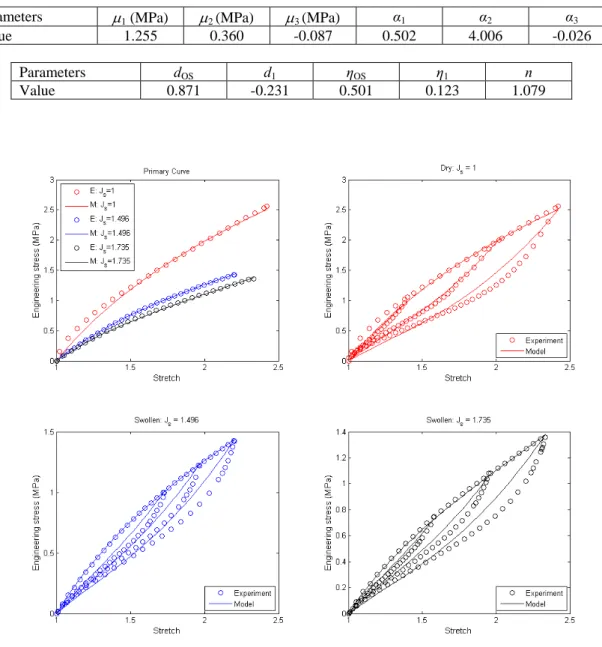
Fig. 2. Comparison between the model and experimental data.
Comparison with Experimental Data. Fig. 2 illustrates the comparison between the model and experimental data. In general, the model gives qualitatively good agreements with experimental data. The stress-softening is well described by the model for dry rubber and for swollen rubbers, in particularly at relatively low strain. More discrepancies are observed in swollen rubber for a larger strain level. Indeed, the model appears to overestimate the stress response. The effect of swelling is well described as shown by the primary curves where the model is capable to predict the general stress response of swollen rubbers.
The discrepancies observed between the model and experimental data in large strain range (where strong reinforcement due to strain hardening occurs) can be explained by the limitation of the model itself. Indeed, as highlighted in [3], this limitation is inherent in the choice of the damage mechanism: since the damage variable is written in terms of a maximum deformation state, theoretical secondary curves are proportional. This proportionality is not satisfied at large strain when the reinforcement becomes apparent.
Conclusions
In the present work, the modeling of Mullins effect (stress-softening) in swollen rubber under cyclic loading was addressed. In order to describe the damage in material resulting to stress-softening, an extension version of CDM model developed by Chagnon et al. [3] was considered. More precisely, the damage parameter is enriched by including the effect of swelling on the stress-softening. Results show that the model gives qualitatively good agreements with experimental data.
Acknowledgements
The authors greatly appreciate the financial support of this research from the Ministry of Higher Education Malaysia through High Impact Research Grant HIR-MOHE D000008-16001.
References
[1] A.S.M.A. Haseeb, H.H. Masjuki, C.T. Siang, M.A. Fazal. Compatibility of elastomers in palm biodiesel, Renew. Energ. 35, 2356-2361 (2010).
[2] A. Andriyana, A.B. Chai, E. Verron, M.R. Johan. Interaction between diffusion of palm biodiesel and large strain in rubber: Effect on stress-softening during cyclic loading, Mech. Res. Comm. 43, 80-86 (2012).
[3] G. Chagnon, E. Verron, L. Gornet, G. Marckmann, P. Charrier. On the relevance of Continuum Damage Mechanics as applied to the Mullins effect in elastomers, J. Mech. Phys. Solids. 52, 1627-1650 (2004).
[4] J. Lemaitre, J.L. Chaboche. Mécanique des Matériaux Solides, Dunod, Paris (1985).
[5] L. Mullins. Softening of rubber by deformation, Rubber Chem. Technol. 42, 339-362 (1969). [6] J.C. Simo. On a fully three-dimensional finite-strain viscoelastic damage model: formulation and
computational aspects, Comput. Methods Appl. Mech. Eng. 60, 153-173 (1969).
[7] C. Miehe. Discontinuous and continuous damage evolution in Ogden-type large-strain elastic materials, Eur. J. Mech. A/Solids 14, 697-720 (1995).
[8] G. A. Holzapfel. Nonlinear Solid Mechanics. A Continuum Approach for Engineering, Wiley (2000).
[9] L. Treloar. The Physics of Rubber Elasticity, Oxford University Press, London (1975).
[10] A.B. Chai, A. Andriyana, E. Verron, M.R. Johan, A.S.M.A. Haseeb. Development of a compression test device for investigating interaction between diffusion of biodiesel and large deformation in rubber, Polym. Test. 30, 867-875 (2011).
[11] R.W. Ogden. Large deformation isotropic elasticity: on correlation of theory and experiment for compressible rubberlike solids, Proceeding of the Royal Society of London. A328, 567-583 (1972).