OATAO is an open access repository that collects the work of Toulouse
researchers and makes it freely available over the web where possible
Any correspondence concerning this service should be sent
to the repository administrator:
[email protected]
This is an author’s version published in:
http://oatao.univ-toulouse.fr/24535
To cite this version:
Masi, Giulia and Josse, Claudie
and Esvan, Jérôme
and Chiavari, Cristina
and Bernardi, Elena and Martini, Carla and Bignozzi, Maria Chiara and
Monticelli, Cecilia and Zanotto, Federica and Balbo, Andrea and Svara Fabjan,
Erika and Kosec, Tadeja and Robbiola, Luc Evaluation of the protectiveness of
an organosilane coating on patinated Cu-Si-Mn bronze for contemporary art.
(2019) Progress in Organic Coatings, 127. 286-299. ISSN 0300-9440
Official URL:
https://doi.org/10.1016/j.porgcoat.2018.11.027
Evaluation of the protectiveness of an organosilane coating on patinated Cu
Si-Mn bronze for contemporary art
G. Masi
a•
*
, C. Josse
\
J. Esvan
C,
C. Chiavari
d, E. Bernardi
\
C. Martini
f, M.C. Bignozzi
a,
C. Monticelli
8.
h, F. Zanotto
8•
h, A. Balb
o
&•
h, E. Svara Fabjan
i, T. Kosec
i, L. Robbiol
aj
• Dtpartlmento di Ingegner/Jl Ctvile, Chimka, Ambientale e dei MotulaU, Unlvemtd di Bolo&n0, via Tem1dni 28, 40131, Bolognq, 1ta1yb CentTe de Mkrocoractérisatlon Raimond CastJling (CNRS UMS 3623), lJn1vershi Fédérale de Toulouse, 31400, Toulouse, Fronœ • CentTe lntenmlvemtaire de Recherche et d7ng� des MaJirlœa, lJn1venlti de Toulouse, 4 allée Emile Manso, 31030, rouleuse, France
d Dlpa1t1menb) di Beni CulJurali, Unlven/td di Bolo&nO, 1ta1y
• Dtpartlmento di Chimka lrutistriale "l'oso Montanarlw, Universltd di Bologna, viale del Rlso,glmenlo 4, 40136, BolognQ, ltaly 'Dtpartlmento di lngtgntria lndustriale, Universltd di Bologna, viale del Rlso,glmenlo 4, 40136, Bolognq, 1ta1y
•centro
di Studi sullo Corrosione e Metallurgta "A. Daccclw, lJnlvemJd di Fetraro, Perroro., ltaly• Tecnopolo di Penoro, Rete dell'Alta Tecnologia dtllo Re//Jone Emilla RCl7!0gno., ltoly
1 Slovenian Nalionol Buil� and Cbril Engineering lnstltutt, DlmJleva 12, S1-1000, Ljub/jano., Slovenia
J TRACES Lab (CNRS UMRS6Q8), Un1"'1"Slii Toulouse Jeon-Ja,rès, S, allées Antonio-Machado, 31058, Toulouse, Fronœ
ARTICLE INFO AB STRACT
Keywords: Organlc coatlng Bronze Atmospheric corrosion UV degradatlon Electrochemlcal techniques XPS
A 3-mercapto-propyl-trimethoxysilane coating (PropS..SH) applied on Cu-Si-Mn bronze, patinated by "liver of sulphur", was investigated as a non-toxic alternative to Incralac", usually applied on outdoor artistic bron7.eS. Electrochemical testing was performed in synthetic acid rain. Exposure to temperature/UV cycles and ac celerated corrosion test simulating unsheltered exposure to rainwater was also carried out. The exposed samples were characterised by FEG..SEM coupled with EDS on F1B cross-sections and XPS on free surfaces. The black patina without protective coating was scarœly protective against bronze corr06ion and easily transformed into cuprous oxide. PropS..SH coating fully preserved the black patina microstructure and phase constituents ( cuprous oxide and cuprous sulphide). The PropS-SH coating also resulted more protective than Incralac• when aged under run-off conditions. Selective dissolution of copper from the silicon bronze alloy was observed on both uncoated and Incralac "-coated bronze, leading to the formation of an internai Si-rich corrosion layer.
1. Introduction
Protection of outdoor bronze monuments has been attracting a significant research interest sinœ the restoration programme of the Quadriga of the Basilica di San Marco in Veniœ in 1977, which is a comerstone event in the field of cultural heritage conservation (1). Protective treatments, including both cleaning procedures and appli cation of surface coatings, such as acrylic polymers admixed with cor rosion inhibitors (Incralac •), were found to be the best solution against atmospheric corrosion (1).
Incralac• was developed in 1964 by the International Copper Research Association (INCRA) (2). lt is an unpatented formulation based on Acryloid B 44, a thermoplastic methyl methacrylate
• Corresponding author.
copolymer manufactured by Rohm and Haas, dissolved in rather toxic solvents, like toluene and xylene (3). Incralac• also contains benzo triazole (BTA) as a copper corrosion inhibitor and chelating agent (suspecte<! of carcinogenicity [ 41), together with a levelling agent (ei ther Paraplex G 60, which is epoxidized soybean oil, or a silicone om. BTA also acts as a coating UV stabilizer (5).
Following titis approach, micro crystalline wax and other organic polymers, such as poly siloxanes, were later developed (5 9). Among the others, 3 mercapto propyl trimethoxysilane (PropS SH) proved to be effective for the protection of bare Cu and Cu based alloys in NaCl solution (10 13), as well as in synthetic acid rain (14). The protec tiveness of PropS SH is enhanced by the addition of nanoparticles (15). In previous works, PropS SH was applied on quatemary bronze, pre
E-mail addresses: [email protected] ( G. Masi), claudie.josse@ums<astaing.fr (C. J06Se), [email protected] (J. Esvan),
[email protected] (C. Chiavari), [email protected] (E. Bernardi), [email protected] (C. Martini), [email protected] ( M.C. Bignozzi),
œcilia.montiœl[email protected] (C. Monticelli), feder[email protected] (F . Zanotto), andrea.balbo@unife. it (A. Balbo), [email protected] (E. Svara Fabjan), [email protected] (T . Kosec), [email protected] (L Robbiola).
examination (not shown in this paper) revealed a typical dendritic microstructure with Si coring and a few shrinkage cavities within in terdendritic spaces. CuSi3Mn plates were cut to obtain 25 × 25 (for
dropping and spectroscopic tests) or 50 × 50 mm2(for electrochemical
tests) coupons. 2.1.2. Patina application
Traditional black patina was applied on the bronze coupons by the
torch technique [25 27,31]. The patination process was performed by
Livartis Foundry, according to the good practice of artistic foundries. Before patination, coupons were sandblasted over the as cast surfaces. Sand blasting procedure was executed by Kärcher HD 1080 machine at pressure 230 bar and Termit quartz sand with granulation 0.063
0.71 mm, using waterflow rate at 800 L/h. The bronze surface was then
preheated with a torch up to 50 60 °C and an aqueous solution of po
tassium sulphide (K2S, Merck, p.a. quality at 3 wt.%) was applied by
brushing until a black colour appeared. Heating and application cycles were repeated until the typical black colour was fully developed and, finally, the metal was allowed to dry and rinsed with tap water. The free
surface of K2S patinated bronze was analysed by Glow Discharge Op
tical Emission Spectroscopy (GD OES). The concentration profiles were measured after gentle rinsing with ethanol, so as to remove surface contamination. GD OES analysis was carried out with a Grimm style
glow discharge lamp in DC mode, as detailed in [32].
2.1.3. Preparation and application of tested coatings
3 Mercapto propyl trimethoxy silane (PropS SH, purity 95%,
Aldrich) was dissolved in a hydroalcoholic solution (90/5/5 v/v
ethanol/water/PropS SH), acidified to pH 4 by addition of some drops
of diluted sulphuric acid solution, according to a coating preparation
methodology tuned during previous tests [12,14,19,21]. After 24 h
hydrolysis at room temperature, the solution was used for coating
preparation. Incralac® was purchased from Bresciani s.r.l. (www.
brescianisrl.it) and was used both undiluted (dip coating application method) and as a 3 wt% solution in ethyl acetate solvent (solution often adopted by restorers, here used in the case of the spraying application method).
For both PropS SH and Incralac®, dip coating consisted of 1 h im
mersion in the coating formulation, followed by fast withdrawal. Subsequently, the coatings were cured at 50 °C for 24 h, before exposure to the aggressive environments. This application method produced si
lane and Incralac®films with different final specific weights (about 1.6 g
m−2and 5.6 g m−2on average, respectively) and thus with different
thicknesses. Therefore, in order to compare the protective efficiency of coatings under similar conditions, a spraying application method (fol lowed by 24 h curing at 50 °C) was also applied, producing coatings
with a constant specific weight of 6 ± 1 g m−2. The latter application
method has the further advantage to be more consistent with the cur rent practices adopted by conservators.
Contact angle measurements were determined by static method, using FTA 1000 DropShape Instrument B FrameSystem, First Ten
Angstroms. The droplet of distilled water (4μL) was placed on the solid
surface and the image was recorded. Contact angle was defined by fitting Young Laplace equation.
2.2. Protective assessment of coatings
Black patinated samples in the as supplied condition (henceforward
“uncoated”) and black patinated bronze coated by Incralac®or PropS
SH were investigated using several experimental techniques, described in the following paragraphs.
2.2.1. Electrochemical evaluation
In order to achieve accelerated corrosion conditions, the electro chemical tests (EIS and ohmic drop compensated polarization curves) were performed in a tenfold concentrated synthetic acid rain solution patinated by dropping test simulating the exposure to acid rain run off
[16,17]. PropS SH can form, after hydrolysis in hydroalcoholic solu
tion, metalsiloxane (MeeOeSi) [18] and/or metal thiolate (MeeSeC)
bonds [19], ensuring strong adherence to the substrate. It also exhibits
good performance against bronze corrosion during subsequent drop
ping exposures [17].
Several investigations about the protectiveness of innovative coat ings have been performed, mainly related to traditional casting bronze,
involving ternary or quaternary alloys (Cu Sn Zn Pb) [14,20 23].
However, the development of industrial copper based alloys led to less toxic, lead free materials for artistic bronze foundry. Traditional casting, either by lost wax process or by sand casting, is currently carried out also using modern Cu Si Mn alloys. Due to its excellent corrosion resistance, good weldability, remarkable castability and golden colour, this silicon bronze is now widely used by artistic foun
dries for bronze monuments [24].
Usually bronzes exposed in outdoor conditions are patinated to
improve both aesthetical features and corrosion resistance [25]. Black
patination, historically based on the use of Barèges salt during the 19th
century, has been further developed with the use of K2S aqueous so
lution applied by cold or hot techniques [25 27]. Recent investigations
showed that the traditional black patina on pure copper and bronze varies not only with the metallic substrate but also with temperature, as
a function of the adopted application techniques [26,27]. The torch
(hot) technique was the most common method used by 19th century
bronze patineurs and still remains a basic process in cultural heritage for architectural and ornamental applications of Cu based alloys. It is still
used today for large bronze sculptures [25,26]. To our knowledge, no
published reports investigated the protective efficiency of coatings on modern artistic bronze (Cu Si Mn), artificially patinated with tradi tional recipes and exposed to atmospheric conditions.
Therefore, with the final aim of improving the corrosion resistance of patinated modern bronze exposed to outdoor conditions and of preserving the nature and microstructure of the patina, this research focuses on assessing the protective efficiency of a silane coating PropS
SH onto K2S patinated modern cast bronze (CuSi3Mn). In particular,
PropS SH has been assessed as a possible alternative to Incralac® (which
has a higher impact on health and environment).
Preliminary screening of the coatings performance was firstly car ried out by electrochemical tests. However, the electrochemical ap proach does not provide information on the surface evolution as a
function of outdoor exposure conditions [14,28,29]. Therefore, a
complementary assessment was subsequently carried out, based on a
specific accelerated corrosion test (dropping test), closely simulating
unsheltered exposure to rainwater [16]. The release of metallic cations
in the ageing solution was quantified, in order to identify the possible influence of alloying elements on the corrosion behaviour. Moreover, complementary analytical methods were applied, involving colori metric measurements as well as X ray photoelectron spectroscopy (XPS), grazing angle X ray diffraction (GXRD) and FEG SEM (Field Emission Gun Scanning Electron Microscope) observation of in situ cross sections, prepared by Focused Ion Beam (FIB) milling. This characterisation allowed to correlate coating behaviour with surface evolution.
2. Materials and methods 2.1. Materials
2.1.1. Bronze alloy
The bronze, supplied by Livartis Foundry d.o.o, Slovenia (www.
livartis.si/en), is an as cast silicon manganese alloy (Cu Si Mn), with
3.1 ± 0.4 Si and 0.9 ± 0.1 Mn (wt%) as main alloying elements, also containing Sn and Zn (< 0.1 wt%) and P (0.02 wt%) as trace elements.
It corresponds to the copper casting alloy UNS C87300 [30]. As cast
(ARx10, pH 3.30). The non concentrated rain solution (AR) reproduced the composition of winter acid rains collected over 2001 2003 in Bologna (Italy) and was used as a reference for similar studies
[16,22,28,33]. AR was synthetized following the recipe reported in
[23] and the ion concentrations were: SO42−1.90 mg L1, Cl 1.27 mg L
1, NO
3 4.62 mg L1, CH3COO 0.23 mg L1, HCOO 0.05 mg L1, NH4+
1.05 mg L1, Ca2+0.34 mg L1, Na+0.53 mg L1, pH 4.35. Sigma Aldrich
ACS reagents and HNO365% Merck suprapur were used.
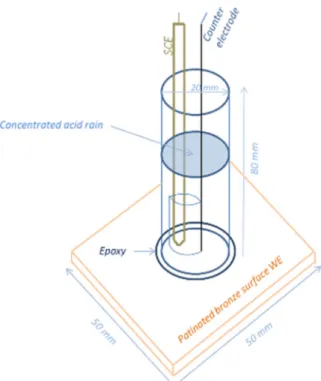
The electrochemical cell consisted of a poly methyl methacrylate tube with internal diameter of 20 mm and height of 80 mm, which was
glued onto 50 × 50 × 5 mm3uncoated or coated bronze coupons by an
epoxy adhesive (Fig. 1).
In this tube, filled by ARX10, a Pt wire and a saturated calomel
electrode (SCE) were introduced to act as counter and reference elec trodes respectively, while the bronze specimen underneath was the working electrode for electrochemical measurements.
With the aim to limit the effects of water evaporation (leading to
solution concentration) and pH variation due to the corrosion process (pH increase connected to oxygen reduction), the ARX10 solution was renewed after 1, 2 and 3 weeks (168, 336 and 504 h), just after the scheduled electrochemical measurements. The tests were performed by a PAR/ AMETEK PARSTAT2273 potentiostat/galvanostat.
The evolution of the bronze corrosion process was monitored over 30 days of exposure by electrochemical impedance spectroscopy (EIS), under the following experimental conditions: ± 10 mV rms alternating
potential signal with respect to the corrosion potential (Ecor), 100
kHz 1 mHz frequency range and 10 frequencies/decade. Polarization
resistance (Rp) values were estimated from the spectra in the Nyquist
form, as the difference between the limit of the real part of the im
pedance at frequency tending to 0 (Rp’), and the solution resistance (Rs)
value, that is Rp= Rp’ Rs. The time evolution over time of the Rpand
Ecoraverage were obtained by triplicate experiments.
Ohmic drop compensated polarization curves were collected after 1 h, 24 h and 30 days of immersion. Separate anodic and cathodic po
tential scans, always starting from Ecor, were carried out at a rate of
0.1667 mV s−1. These tests were performed in triplicate and re
presentative curves are reported. The corrosion protection efficiency,
PE, was calculated according to Eq.(1):
= − × PE J J J 100 cor cor cor 0 0 (1)
where Jcor0is the value for the uncoated sample and Jcoris the corrosion
current density for protected surfaces. The corrosion current densities were obtained by the Tafel extrapolation from the polarization curves. All the potentials quoted in the text are related to the SCE reference electrode.
2.2.2. Climatic chamber exposure with temperature/UV cycles and colour measurements
The sprayed PropS SH coating was tested in climatic chamber. As plain PropS SH coatings are known to undergo degradation due to ex
posure to temperature/UV cycles in climatic chamber [14], these
samples were prepared with a silane formulation also containing a
commercial anti UV product (8 wt% vs PropS SH of TINUVIN®400 by
BASF). This option was taken into account for assessing the possibility to pre industrialize the PropS SH coating formulation for outdoor ap plications.
The test procedure for evaluating UV protection efficiency was performed using two climatic chambers: Q sun Xe 3 test chamber, Q lab
and climatic chamber KK 340 CHLT, Kambič, for obtaining the defined
UV freezing conditions, respectively.
The exposure consisted of 17 cycles, corresponding to 3 average months of UV exposure in the natural conditions. Each cycle consisted of four steps:
Step 1: 2 h temperature ramp (from 0 °C to 35 °C,first cycle from
room temperature to 35 °C, UV light switched off),
Step 2: 16 h of UV exposure part (UV light switched on, UV irra
diance 55 W m−2, T 35 °C and relative humidity 70%),
Step 3: 2 h temperature ramp (from 35 °C to 0 °C, UV light switched off) and
Step 4: 4 h of freezing (4 h at 0 °C, UV light switched off). All the samples were characterized by visual observation before and after exposure to UV and temperature cycles, as well as by the mea surement of the colour coordinates in the CIELab colour space on the
uncovered surface of the samples in three different areas. The mea
surement of colour coordinates in the same areas on the surface samples (before and after the exposure) was achieved by using an adjustable frame. These measurements were carried out by using a Datacolor D400 spectrophotometer with a D65 illuminant, a 10° observer, a measured
area of∅ 6.6 mm and specular component excluded (SCE), operating
with a d/0 SCE measuring geometry. In the CIELab space, each colour is
defined by three coordinates: L*, corresponding to lightness and ran
ging from 0 (black) to 100 (white), a* and b*, corresponding to the chromatic coordinates and without specific numerical limits (+a* is
red, a* green, +b* yellow, b* blue). Total colour change (ΔE*) was
calculated through Equation(2):
= + +
ΔE* (ΔL*)2 (Δa*)2 (Δb*)2 (2)
For each sample,ΔE* was calculated by averaging the ΔE* of the
three measured areas.
In general,ΔE* values lower than 3 can be assumed as not appre
ciable and, in thefield of Cultural Heritage, ΔE* in the range between 3
and 5 are considered acceptable, whileΔE* > 5 are considered clearly
perceivable [34].
2.2.3. Ageing method: dropping test
In order to evaluate the specific impact of outdoor conditions, ac celerated ageing was carried out by the dropping test, closely simu
lating unsheltered geometries directly exposed to rainwater [16]. Cy
cles of exposure to weathering solution were carried out on both uncoated and coated samples by spraying. Only one side (25 × 25 mm) of each coupon was directly exposed to the weathering solution, while the other surfaces were protected by epoxy resin. For this ageing test, the weathering solution was the non concentrated acid rain solution
Fig. 1. Electrochemical cell for the preliminary assessment of coating protec-tiveness.
(AR, Section2.2.1).
The dropping test [16] consisted of periods of AR dropping onto the
samples and periods of sample drying. In particular, cycles of 3 days of dropping / 1 day drying and 2 days of dropping / 1 day drying were alternated for two weeks, reaching a total Time of Wetness (ToW) of 10 days per sample. Duplicate experiments were performed simultaneously for each surface condition. All the samples were placed at a 45° angle on polytetrafluoroethylene supports. A peristaltic pump dropped the AR solution by means of four capillary tubes per sample, with an almost
constant dropped volume of 60 mL h−1on each exposed sample. The
runoff solution was separately collected from each sample. At the end of each dropping period, volume and pH of the collected solutions were recorded. Then, samples of the solutions were placed in HDPE bottles,
acidified with HNO365% suprapur (to prevent adsorption of cations on
the bottle surfaces and favour dissolution of any metal complex) and stored at 4 °C for the subsequent analysis of the released metal cations (Cu, Mn and Si). The concentration of Cu and Mn in the weathering solutions was determined through Atomic Absorption Spectrometry (AAS), by using a Perkin Elmer AAnalyst 400 provided with Flame Atomization and a Perkin Elmer PinAAcle 900Z and with Transversely Heated and longitudinal Zeeman background correction. The latter
instrument reaches a Limit of Detection of 0.3μg L−1 for Cu and
0.2μg L−1 for Mn. Si concentration was measured by Microwave
Plasma Atomic Emission Spectrometer (MP AES) Agilent 4210 with a
Limit of Detection of 18μg L−1. Due to the leaching effect of dropping,
that hinders the growth of corrosion products, the protective efficiency of the tested coatings was quantified through metal release in the
ageing solutions. In particular, the Inhibiting Efficiency in terms of
metal release (ηM) was calculated using Eq.(3):
⎜ ⎟ = ⎛ ⎝ − ⎞ ⎠ × η M M M 100 M sol NC sol C sol NC , , , (3)
where Msolis the amount of metal released in the ageing solution per
aged surface unit (μg cm−2); NC is the uncoated sample and C is the
coated sample, as reported in [35].
In addition, at the end of each dry period, gravimetric measure ments were carried out by a digital balance KERN AGB210 4 with re peatability of ± 0.1 mg. The mass variation during exposure tests was calculated as the difference between the initial weight of the sample and the weight of the samples at different ageing times.
2.2.4. Surface analysis and structural characterization
After the colorimetric measurements, all the samples were char acterised by Scanning Electron Microscopy (SEM) coupled with Energy
Dispersive Spectroscopy (EDS), X ray diffraction under grazing angle
(GXRD) and by X ray photoelectron spectroscopy (XPS).
The colorimetric measurements were carried out on samples before
and after coating application, as previously described in Section2.2.2.
At least three samples were used for calculating average values of colour variations (ΔL*, Δa*, Δb*, ΔE*).
Fig. 2. Morphology of“as-supplied” black patina (K2S) on CuSi3Mn bronze: (a) optical image of the black patina; (b) general view of the patina surface; (c) in situ FIB
cross-section of a representative portion of the sample; (d) GD-OES concentration profiles of S and alloying elements (Cu, Si and Mn) measured as a function of the distance from the free surface. In order to improve the readability of the image, the GD-OES concentration profiles for Si and Mn were amplified 10 times (x10). (e) X-ray maps (C, O, Si, S, Cu) of the black patina; (f) superimposition of O (yellow) and S (cyan) EDS signal to highlight the layered structure of the patina (For interpretation of the references to colour in thisfigure legend, the reader is referred to the web version of this article).
SEM observations of the uncoated and coated bronze were carried out using a FEG SEM FEI Helios NanoLab 600i coupled to EDS system (Aztec Oxford apparatus, SDD detector, WD 4 mm). After surface ex
amination, in situ cross sections of specific representative locations were
obtained by Focused Ion Beam (FIB) milling (Ga+ions) as detailed in
[36]. For the surface and cross section imaging, an accelerating voltage
of 5 kV and a current intensity of 86 pA was applied, while for the chemical analysis by EDS, 10 kV and 1.4 nA were used. All the samples were carbon coated by sputtering using a Leica ACE 600 for improving
conductivity.
X ray Diffraction (XRD) was performed using a SEIFERT XRD
3000 TT diffractometer (Cu Kα, λ = 0.15418 nm). The samples were
analysed in grazing incidence mode (GXRD), incident grazing angle of 2°, pattern acquisition from 10° to 80°, 2θ mode, step of 0.03° and step
time of 24 s. The analysed surface area corresponds to∼0.5 cm².
XPS analyses were carried out using a monochromated Al Kα source
(hν = 1486.6 eV) on a ThermoScientific K Alpha system. The X ray
spot size was about 400μm in diameter. The photoelectron emission
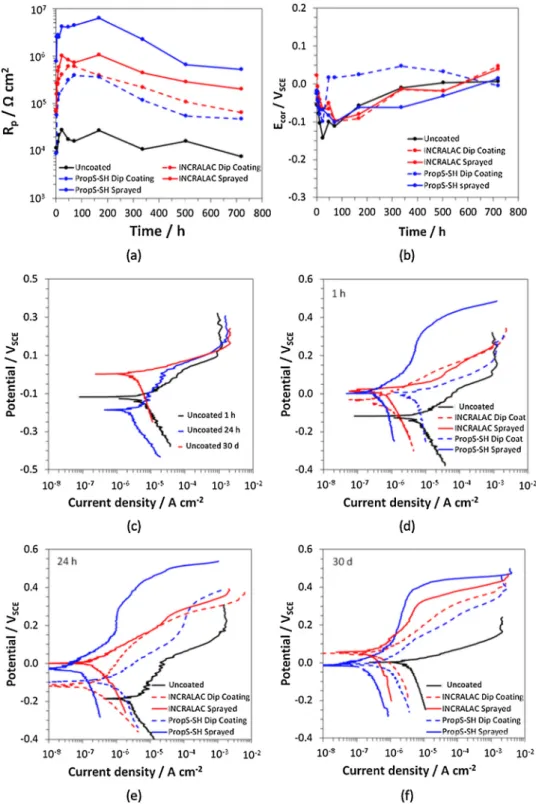
Fig. 3. Electrochemical characterization of uncoated and coated bronzes. Polarization resistance (a) and corrosion potential (b) values recorded during 30 days of exposure to acid rain (ARX10). Polarization curves recorded on uncoated specimens at different immersion times (c) and on uncoated and coated specimens after 1 h (d), 24 h (e) and 30 days (f) of exposure to ARX10. (For interpretation of the references to colour in thisfigure legend, the reader is referred to the web version of this article).
spectra were recorded in direct N(Ec). The pass energy wasfixed at 130 eV with a step of 1 eV for surveys, and 40 eV with a step of 0.1 eV
for core levels. Ionic sputtering of the surfaces was made with Ar+ion
beam accelerated under 200 eV at low current for 30 s, in order to re
move carbon surface contamination. XPS data were fitted by using
Thermo Scientific™Avantage Software and the Shirley method was used
for background subtraction of all the peaks. 3. Results and discussion
3.1. K2S patina
Macroscale observation of the black patina on CuSi3Mn bronze displays a rather homogeneous surface, black and dark grey in colour (Fig. 2a). The colour coordinates resulting from the average of six samples are: L* = 24 ± 1, a* = 1.3 ± 0.5, b* = 2.1 ± 0.9. SEM ob
servation, however, indicates a noticeable surface roughness (Fig. 2b),
due to the sandblasting applied before patination. At micrometric scale, the patina surface consists of micrometric grains also enclosing some abrasive particles.
Grazing angle XRD reveals the presence of orthorhombic chalcocite
(Cu2S JCPDS PDF 00 033 0490) and cuprous oxide (Cu2O JCPDS
PDF 01 071 3645), and also confirms the presence of some quartz (SiO2
JCPDS PDF 01 089 1961) from the sandblasting procedure. A re
presentative FIB cross section of the black patina is shown inFig. 2b.
The influence of sand blasting is clearly visible, producing scratches
about 10μm wide and thin cracks in the surface layer of strain har
dened bronze. The black patina displays a variable thickness, ranging
from 500 nm to about 3μm. It is characterised by a two layer structure
(EDS maps of the FIB cross section inFig. 2e and f): an internal cuprous
oxide layer, covered by an external layer of cuprous sulphide. The in ternal oxide, thin and homogeneous, is due to heating during the pa
tination process, before the application of the K2S solution [37]. The
external cuprous sulphide formed mainly small dendritic crystals. GD
OES measurements reported in Fig. 2d confirm the FIB observation,
showing a thin patina layer (< 1μm) with an external S rich sub layer
and an inner O rich sub layer.
3.2. Preliminary electrochemical evaluation of coating protectiveness
Atfirst, the corrosion behaviour of patinated modern bronze, both
uncoated and coated by PropS SH or Incralac®, was monitored by
electrochemical tests during exposure to concentrated synthetic acid rain (ARx10). The protection efficiency of the different surface treat ments, applied either by dip coating or by spraying on patinated bronze, as well as of the black patina on the uncoated samples, was firstly investigated by monitoring the time evolution of the polarisation
resistance Rpand corrosion potential Ecorvalues. The results obtained
during 30 days of continuous exposure to ARX10 are shown inFigs. 3a
and 3b.
For the uncoated black patina, the Rpvalues showed a slight in
crease from 11 kΩ cm2to 28 kΩ cm2, during the initial 24 h. Then,
despite somefluctuations, they decreased down to 7.9 kΩ cm2at the
end of the exposure (Fig. 3a), suggesting relatively high degradation
rates. The corresponding Ecor values evolved from 0.07 V after 1 h
immersion to more active values ( 0.14 VSCE) after 24 h and then con
tinuously increased up to 0.007 VSCE, at the end of test (Fig. 3b).
During the first week of exposure, PropS SH dip coated bronze
specimens exhibited Rpvalues about one order of magnitude higher
than those recorded on the uncoated sample (Fig. 3a). Then, the Rp
values tended to decrease slowly, although they always remained much
higher than those of the uncoated one(about 47 kΩ cm2
, after 30 days).
Even though dip coating produced Incralac®layers with specific weights
much higher (5.6 g m−2on average) than those of silane coatings (1.6 g
m−2on average), Incralac®led to only slightly higher Rpvalues, with
similar time evolution and final average Rp values of 65 kΩ cm2
(Fig. 3a). The high initial Rp values suggest that both PropS SH and
Incralac®applied by dip coating offer a good protection, involving a
good adherence onto the substrate and an effective barrier effect to
wards the aggressive environment. However, Rpdecreases with time,
indicating a slow penetration of the aggressive solution as well as of dissolved oxygen through the coatings, partially impairing their per formances. In order to assess and compare the performance of silane
and Incralac®, sprayed coatings of the same specific weight of about 6 g
m−2(and hence comparable thickness) were then tested.
Fig. 3a shows that the spraying method led to some improvement in comparison to dip coating. This improvement is much more noticeable
in the case of PropS SH, which affords Rpvalues one order of magnitude
higher than those obtained by dip coating, due to its increased thick ness.
The polarization curves recorded at different exposure times on
uncoated specimens are collected in Fig. 3c. These curves highlight
relatively high initial anodic slopes of about 0.12 V/decade, after 1 h, and 0.24 V/decade, after 24 h of exposure. In this period, the cathodic polarization curve of oxygen reduction tends to shift towards lower current densities. Conversely, at the end of the exposure period (30 days), the anodic slope significantly decreases to about 0.06 V/decade, while the cathodic currents again accelerate. These variations suggest that initially the patina becomes more compact and protective, likely due to the precipitation of insoluble corrosion products, probably cu prous oxide, inside the patina pores. Then, at the end of exposure, prevalent formation of soluble corrosion products appears to occur, because patinated bronze exhibits an active corrosion behaviour, meaning that the patina is not protective anymore.
The polarization curves recorded on PropS SH and Incralac®(de
posited by dip coating and by spraying after 1 h, 24 h and 30 days of
immersion) are shown inFigs. 3d, 3e and 3f, respectively.
After 1 h exposure (Fig. 3d), all coated bronze specimens showed
Ecorvalues nobler than that of uncoated bronze. However, in the case of
silane applied by dip coating (1.6 g m−2), a negligible inhibition of the
corrosion current density (Jcor) was achieved, while the other thicker
coatings offered a significant protectiveness. In particular, regardless
the application method, Incralac®appreciably inhibited the cathodic
process, while PropS SH applied by spraying showed a more significant
barrier effect, against both the cathodic and the anodic process. After
24 h of exposure (Fig. 3e), a marked Jcorreduction was observed on all
coated samples in comparison to their performances at shorter im mersion times, again more evident in the case of sprayed silane. This
coating was the most efficient in hindering both the cathodic and the
anodic reactions of the corrosion process and afforded Jcorvalues as low
Sample Ecor (VSCE) Jcor (μA cm 2) PE (%) 30 days Uncoated bronze 0.003 4.0 –
Incralac®Dip Coating 0.058 0.69 83
Incralac®Sprayed 0.056 0.45 89
PropS-SH Dip Coating 0.015 0.72 82
PropS-SH Sprayed 0.009 0.10 97
Table 2
Colour variation measurements in CIELab 1976 colour space induced by coating application on black patina on CuSi3Mn.
Δa* Δb* ΔL* ΔE*
Incralac® 0.5 ± 0.2 1.2 ± 1.4 2.0 ± 1.7 2.9 ± 1.2 PropS-SH 0.2 ± 0.4 1.0 ± 0.4 3.8 ± 0.4 3.8 ± 0.3
Table 1
Corrosion potential (Ecor) and current density (Jcor) parameters and Protection
as 3·108A cm−2. At the end of exposure (Fig. 3f), the corrosion process was slightly accelerated on all specimens, but the sprayed silane still showed a marked reduction of both cathodic and anodic currents in dicating an effective blockage of oxygen reduction process and anodic alloy dissolution. This mixed protective effect was already observed for PropS SH when applied on non patinated copper and bronze as well as
on bare magnesium alloys [12,17,19,21,38]. In the case of copper and
bronze, FTIR and XPS analyses evidenced that this protective effect was
connected to the formation of strong thiolate (CueSeC) bonds (from
the condensation of SH groups in the silane molecule and CueOH
groups on copper and bronze surface) [19] and to the development of a
rather dense three dimensional SieOeSi bond network [19,21]. Pore
plugging in silane network by insoluble bronze corrosion products contributes to improve the coating barrier effect, as suggested by EIS analysis [12,19].
After 30 days of exposure, highfinal protective efficiencies (PE)
were still calculated by applying Eq.(1), particularly in the case of
sprayed PropS SH. Table 1, collecting the Ecor and Jcor parameters
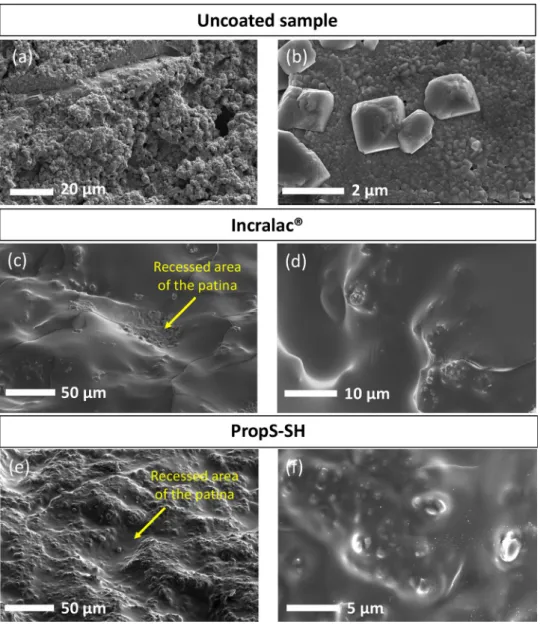
Fig. 4. (a–d) Incralac®and (e–h) PropS-SH surfaces on K
2S-patinated bronze (spraying application of both the coatings), at different magnifications. Optical and SEM
derived from the 30 days polarization curves, shows that thefinal PE of
sprayed silane is 97%, while those of Incralac®are 83 and 89%, in the
case of dip coating or spraying application methods, respectively. The excellent performance of spray coated surfaces is thus confirmed by the electrochemical curve evolution with time.
3.3. Incralac®and PropS SH spray coated surfaces: characterisation before
ageing
The influence of silane spraying application on patina colour and
contact angle wasfirstly assessed.
The preliminary optical investigation confirmed the relative
homogeneity of all coatings produced by spraying at a macroscale level.
As shown inTable 2, both coatings do not induce remarkable colour
variations, as theΔE* values were 2.9 and 3.8 for Incralac®and PropS
SH, respectively.
Analogous results were obtained by contact angle measurements on
both coatings, showing a contact angle of 81.3° for Incralac®and 80.6°
for PropS SH, while for the uncoated bronze the contact angle was 20°.
The morphology of the coated surfaces is displayed inFig. 4.
Spray application of Incralac®and PropS SH induced the formation
of a continuous layer, masking the rough morphology of the black pa
tina previously shown in Fig. 2. However, the surface coated by In
cralac®(Fig. 4a d) reveals a very thin coating layer for the areas hardly
reachable by the spray jet (bottom of sand blasting grooves). Cu sul phide crystals are still visible, even though partly embedded within the
polymeric layer, which also shows some micro porosities (Fig. 4d).
Conversely, the PropS SH layer is more homogeneously distributed, as
shown inFig. 4e h. In particular, at higher magnification (Fig. 4h), the
silane coating forms a continuous network, efficiently covering the Cu sulphide crystallites of the black patina. This distinction has to be re
lated to the different surface wettability afforded by the two different
coating formulations applied. This was confirmed by simple capillary rise measurements performed after partial immersion of the bronze sheets in the coating formulations, followed by sheet drying. The ca pillary rise after 15 min of partial immersion (2 mm deep) was about
5 mm for Incralac®and 8.5 mm for PropS SH. These results suggested
that, for the latter formulation, the attractive forces between solution and black patina overcome the cohesive ones between the solution
molecules by a greater extent than in the case of Incralac®. The higher
wettability of PropS SH is likely due to the high chemical affinity be
tween the thiol groups and superficial Cu cations [39] in Cu2S and Cu2O
patina compounds and determines an easier access of the silane solution into surface cavities, due to capillary forces.
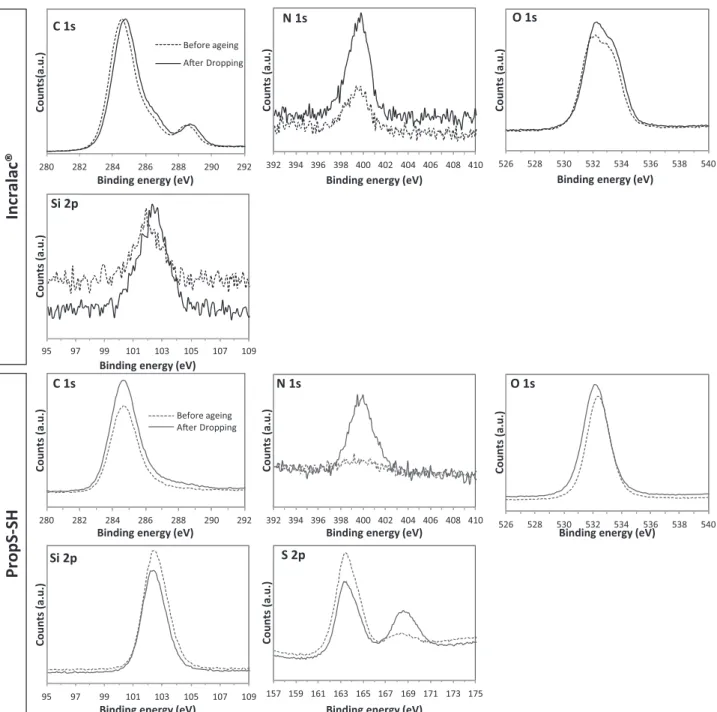
The results of XPS analysis of the two coatings applied on black
patina are reported inTable 3and inFig. 5. They were obtained after a
slight Ar+etching for limiting C contamination on the top surface. For
Incralac®, the top surface mainly consists of C and O with minor con
tributions from N and Si elements. In particular, C 1 s showed an intense peak centred at BE = 284.6 ± 0.1 eV, characteristic of C C and C H chains of methyl methacrylate and ethyl methacrylate, present in the coating formulation, and two minor peaks at BE = 286.3 ± 0.1 eV and BE = 288.5 ± 0.1 eV, linked to C O and O C = O species, respectively. In addition, O 1 s is mainly linked to C 1 s. This is also confirmed by the
atomic quantification reported inTable 3, in which the O element in the
coating is completely linked to C, with a C/O atomic ratio of about 1. N was detected in low concentration (N 1 s, BE = 399.5 ± 0.1 eV), highlighting the presence of BTA corrosion inhibitor within the organic
layer, as reported in [40 42].
Regarding the top surface of PropS SH, the main elements detected are C, O, Si and S, as expected. In particular, C 1 s showed an intense peak at BE = 284.6 ± 0.1 eV, characteristic of the aliphatic chain of
the coating and also two other small contributions
(BE = 286.3 ± 0.1 eV and BE = 288.2 eV) linked to CeS/CeO and
OeC]O species, respectively. An intense Si 2p peak was observed at
BE = 102.3 ± 0.1 eV, ascribed to the silane (CeSieO and SieOeSi), as
detailed in [13,43]. A small concentration of SiO2(BE = 103.4 ± 0.1
eV) was also found. The analysis of S 2p signal takes into account the presence of a doublet structure of the core level with a spacing of 1.2 eV
(S 2p1/2 S 2p3/2= 1.2 eV) and a theoretical intensity ratio of 2 (I(S
2p3/2) / I(S 2p1/2) = 2). In particular, S 2p peak is centred at BE =
163.3 ± 0.1 eV, characteristic of SeC bonds and thiol groups. It also
shows a minor contribution centred at BE = 168.1 ± 0.1 eV, to be
ascribed to the presence of sulphate groups [13,43 46], as highlighted
inFig. 5(dashed line). OeC]O and sulphate bonds are connected to a limited oxidation of the coating, as already observed for organic thiol
compounds, such as PropS SH, exposed to the atmosphere [14,47 49].
It is unclear if also the small concentration of SiO2 (peak at BE =
103.4 ± 0.1 eV) could be related to silane oxidation or to con tamination of the original silane monomer commercial product. From
the atomic quantification reported inTable 3, the atomic ratios were
calculated by considering only the concentration of Si 2p corresponding to the BE value related to silane (BE = 102.4 eV). The obtained values (Si/C = 0.35, Si/O = 0.47 and Si/S = 1.60) are in rather good agree ment with the theoretical ones (Si/C = 0.33, Si/O = 0.67 and Si/
S = 1.00), indicating that the Ar+ ion sputtering is efficient in re
moving contamination without damaging the polymer. However, the Si/O and Si/S ratios are respectively slightly lower and higher than the theoretical ones. The former difference is linked to the additional
contribution of SiO2species found on this coated substrate, while the
latter one is likely due to a loss of sulphur from the silane top layer after
thiol group oxidation to volatile sulphur oxide [49].
Table 3
XPS atomic quantification (at%) of Incralac®and PropS-SH coatings before and after dropping test. The XPS measurements were carried out after Ar+ sputtering
(200 eV for 30 s). C 1 s N 1 s O 1 s Si 2p S 2p Cu 2p CC, CH, CN, C Si C-O, C S C]O O-C]O N C N O O Si C Si O Si
SiO2 C S Sulphates Cu(I)
Before ageing Incralac® Peak BE (eV) 284.7 286.2 288.5 399.6 532.4 101.9 – – – – at% 61.0 10.4 8.9 0.5 18.6 0.6 – – – – PropS-SH Peak BE (eV) 284.7 286.3 288.2 399.2 532.4 102.4 103.4 163.2 168.1 – at% 37.4 3.8 0.7 0.3 31.1 14.6 3.2 8.1 0.9 – After dropping Incralac® Peak BE (eV) 284.7 286.4 288.5 399.6 532.4 102.3 – – – 932.9* at% 59.0 8.2 11.2 1.1 19.3 1.0 – – – 0.3 PropS-SH Peak BE (eV) 284.7 286.3 288.2 400.2 532.2 102.1 103.4 163.2 168.1 932.9* at% 39.4 4.6 3.4 1.4 30.7 8.3 4.6 4.6 2.8 0.2
3.4. Evaluation of the coatings protectiveness by accelerated ageing 3.4.1. Colour variation after UV/temperature exposure
Afirst assessment of the protectiveness of PropS SH coating, pre
pared by spray application, was performed after the exposure to UV and temperature cycles. PropS SH coating underwent a negligible colour variation. In particular, the following variations were calculated: Δa*= 0.1 ± 0.1, Δb* = 0.1 ± 0.3 and ΔL*=−0.9 ± 0.2. Therefore, the total colour variations of PropS SH coating after UV cycles could be considered as non noticeable, indicating that, in the presence of the commercial UV stabilizer, PropS SH performs well under the synergistic exposure to temperature changes (ranging from 0 °C to 35 °C) and UV radiation.
3.4.2. Surface evolution during dropping test and inhibiting efficiency The evolution of uncoated and coated samples exposed to ac celerated ageing by dropping test was monitored within a total Time of Wetness (ToW) of 10 days. Mass variations recorded during the test as a
function of ToW are reported inFig. 6. These results confirm the pro
tective barrier effect of both coatings obtained by spray application.
Thus, while uncoated bronze exhibits a marked linear trend
(R2= 0.997) of mass decrease with ToW, the coated samples only re
veal a very limited mass decrease. However, at the end of ageing, a
slight weight increase was measured for Incralac®. This can be due to
localised corrosion at the coating/substrate interface, as detailed later, locally inducing corrosion deposits. Possible water absorption by the coating is considered less likely as the weight increase is recorded only at the end of the ageing.
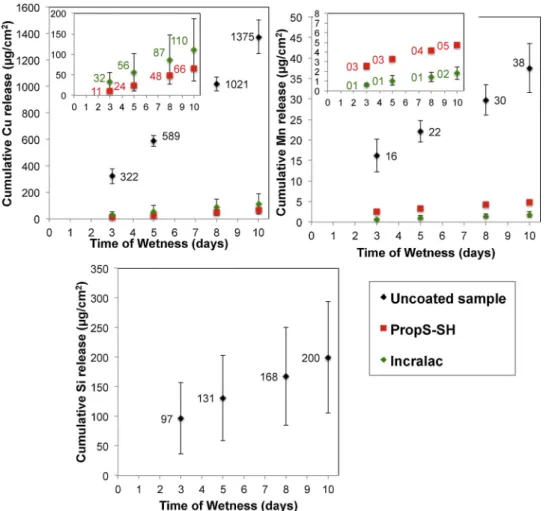
The evolution with ToW of Cu, Mn and Si release in the weathering
solutions is shown inFig. 7. Regarding Si, for both PropS SH and In
cralac®coated samples, its concentration in solution was always under
the Limit of Detection (LoD = 18μg L−1), therefore Si release was re
ported inFig. 7only for uncoated samples andηSiwas not calculated.
Linear release trends were detected for Cu, Mn and Si. In the case of uncoated samples, Cu/Mn and Cu/Si weight concentration ratios (about 36 and 6, respectively) are much lower than in the alloy (about 96 and
31), likely due to a preferential dissolution of Mn and Si alloying ele ments in the weathering solutions, while Cu species precipitate on the surface forming a porous Cu oxide deposit, as detailed hereafter. This
result highlights that the dropping test always leads to a significant
surface leaching for uncoated bronze, thus preventing the formation of a protective barrier layer of Cu based corrosion products.
By comparison to the uncoated ones, the coated samples displayed a much lower dissolution rate for all the analysed metallic elements without marked surface modification (as detailed later), clearly con firming the high protectiveness of both coatings. Inhibiting efficiency
values (η), calculated by Eq.(3), quantify these differences. In parti
cular, Incralac®afforded average ηCuvalues of 92 andηMnof 95, while
PropS SH showedηCuof 95 andηMnof 87, confirming an excellent and
comparable protective performance of these coatings.
3.4.3. Surface characterisation after accelerated ageing by dropping After dropping, the uncoated patinated Cu Si Mn bronze underwent extensive degradation due to corrosion, compared to the coated ones
that did not exhibit corrosion (Fig. 8). These results from surface
morphology observation were in agreement with gravimetric and metal release data, discussed in Section 3.4.2.
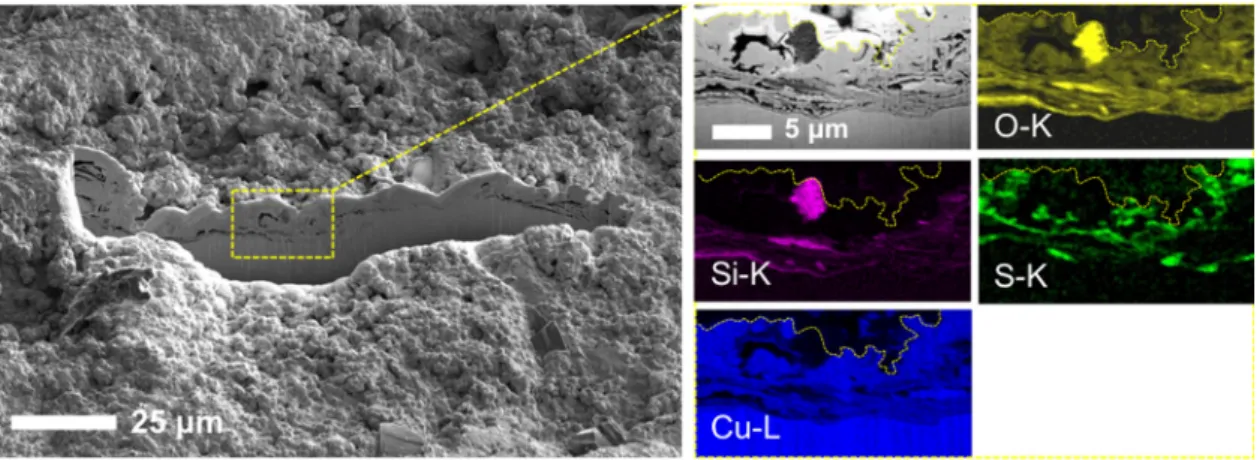
On the uncoated samples (Fig. 8a), the formation of Cu based cor
rosion products, linked to a significant evolution of the black patina, was observed. Due to runoff and high Cu ions release in the ageing solution, the initial rough surface was still observable, but it was par tially masked by the formation of a new layer of cubic crystallites (Fig. 8b). XRD measurements revealed that these Cu species consist of
cuprous oxide (Cu2O JCPDS PDF 01 071 3645), but they also indicate
the presence of orthorhombic Cu2S (JCPDS PDF 00 033 0490) and re
sidual quartz particles due to sandblasting (JCPDS PDF 01 089 1961).
No hydroxysulphate salts were identified. The samples coated by PropS
SH
(Figs. 8e and f) did not show remarkable differences by comparison
to the surfaces before ageing (Fig. 4). However, the Incralac®coating
exhibits a smoother surface, characterised by cracks after dropping
Fig. 6. Mass variation for the uncoated (black dataset) and coated bronze samples (PropS-SH and Incralac®by spraying in red and in green, respectively) during accelerated ageing by dropping test (For interpretation of the references to colour in thisfigure legend, the reader is referred to the web version of this article).
Fig. 7. Cumulative Cu, Mn and Si ions release (μg/cm2) from bronze samples (uncoated and
coated by spraying) in acid rain solution, as a function of exposure time, for a total Time of Wetness (ToW) of 10 days of dropping test. Concentration of Si specie is not reported for coated samples, as it is under the Limit of Detection (LoD < 18 ppb). (For interpretation of the references to colour in thisfigure legend, the reader is referred to the web version of this article).
(Fig. 8c and d), which were not observed for PropS SH (Fig. 8e and f). Furthermore, surface alterations appeared in areas exhibiting lower
thickness of the protective coatings. For Incralac®, this occurs in cor
respondence with recessed areas (e.g. bottom of sand blasting grooves
Fig. 8c) while for PropS SH (i.e. for the surface treatment with higher penetration capability), this occurs on raised areas (i.e. upper part of
grooves Fig. 8e).
In addition, colour measurements reported inTable 4revealed that
the uncoated bronze undergoes marked colour change during dropping (ΔE*∼9). This change was mainly due to an increase in lightness
(ΔL*∼7.5) and to chromatic variations towards blue. On the contrary,
the colour of coated samples did not significantly change due to drop
ping test (ΔE* < 3). No evident alteration of the aesthetical appearance
was detected, especially for PropS SH coated surfaces, indicating a good protectiveness without patina evolution and formation of corrosion products.
The influence of dropping on the two coatings was analysed also by
XPS measurements. Results are reported inFig. 5, comparing the re
ported core levels before (dashed line) and after (solid line) the drop
ping test. Atomic quantification measured on their top surfaces after
ageing is reported inTable 3. For Incralac®, the results show that no
significant variation occurred, except a slight increase in N 1 s and Si
2p. In parallel, on the top surface of PropS SH, no strong differences in
the environment of the main elements (C 1 s, O 1 s, Si 2p, S 2p and Cu
2p) was observed, as shown inFig. 5. This confirms that no marked
modification of the coating surface chemistry occurred after ageing. In
addition, as detailed inTable 3, dropping induced an increase in N 1 s
contribution. This could be ascribed to the presence of nitrate species from the acid rain solution on the outermost coating layers. An increase
of SOxspecies at BE = 168.1 ± 0.1 eV for S 2p was also detected. This
increase is related to oxidation of silane coatings and to the presence of sulphates among the corrosion products, as observed in a previous
study [49]. However, even if Cu 2p signal slightly increased after
dropping, Cu remained present in very low concentration with a not well resolved Cu 2p signal.
Fig. 8. Surface morphology after dropping: (a, b) Uncoated bronze; (c, d) bronze coated by Incralac®(e, f); bronze coated by PropS-SH (both the coatings were applied by spraying).
Table 4
Colour variation measurements in CIELab 1976 colour space induced by ac-celerated ageing (dropping test).
Δa* Δb* ΔL* ΔE*
Uncoated sample 0.9 ± 0.7 4.1 ± 2.2 7.5 ± 1.6 8.8 ± 1.6 Incralac® 0.3 ± 0.5 0.8 ± 1.0 0.4 ± 1.1 1.2 ± 1.2 PropS-SH 0.4 ± 0.2 0.20 ± 0.03 0.5 ± 0.3 0.7 ± 0.2
3.4.4. Cross section examination after accelerated ageing by dropping Investigation of the microstructure of the coating/patina/bronze system after ageing was performed by FEG SEM observation of in situ
FIB cross sections. The results for uncoated samples are shown inFig. 9.
By comparison with the examination before ageing reported inFig. 2,
the corrosion process induced a marked modification of the patina structure. Internal preferential dissolution of Cu is observed, producing
numerous voids and exfoliations within the corrosion modified patina.
This is accompanied by a relative enrichment in Si and O, forming an internal corrosion layer in which S element is also observed.
Therefore, a decuprification process may take place, characterized
by the internal oxidation of the alloy with preferential dissolution of Cu ions and a relative enrichment in oxidised Si. This phenomenon appears
similar to the corrosion behaviour highlighted for tin bronze [16]. In
that case, selective dissolution of Cu, due to internal oxidation, induces selective enrichment in the stable oxidised Sn alloying element. How ever, in the case of the Cu Si Mn bronze, further work is needed to
study the corrosion behaviour in more detail.
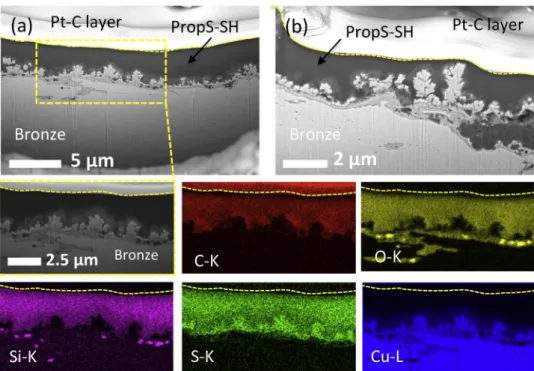
As regards the coated samples, FIB cross section observations are
reported inFigs. 10 and 11for Incralac®and PropS SH, respectively. In
general, the coatings fully cover the black patina,filling up the poros
ities among black Cu sulphide crystallites. This microstructural char acterisation confirms the surface observations performed before ageing. For both coatings, the polymer layer is not homogenous in thickness. Its
thickness ranges from about 150 nm (Figs. 10 and 11b) to several mi
crometres: about 10μm for Incralac®and 7μm for PropS SH (Figs. 10b
and 11a respectively). However, as previously pointed out (Fig. 4), the
thickness variations of Incralac®are opposed to those of PropS SH, due
to the fact that PropS SH exhibited higher wettability compared to In
cralac®on the black patina, as previously discussed. In fact, Incralac®is
thicker on the raised areas of the patinated bronze (i.e. on the top areas of sand blasting grooves) and very thin in the lower recessed parts. The
opposite occurs for PropS SHfilm.
Fig. 10also shows that large pores are visible inside the Incralac®
Fig. 9. FIB cross-section of the uncoated bronze after dropping. X-ray maps of both the cross-sections show the distribution of O, Si, S and Cu (Mn is not reported as the EDS map is not well-resolved). Pt-C layer was applied before FIB milling in order to protect the top surface of the cross-section. (For interpretation of the references to colour in thisfigure legend, the reader is referred to the web version of this article).
Fig. 10. FIB cross-section of the bronze coated by Incralac®(applied by spraying) after ageing by dropping, in correspondence of (a) a thinner part (recessed parts) and (b) coating thicker part, corresponding to raised areas of the bronze, i.e. on the top of grooves induced by sand-blasting). X-ray maps on cross-section revealing the dis-tribution of the main elements in the coated system (area outlined by the dashed yellow line in (a)). Pt-C layer was applied before FIB milling in order to protect the top surface of the cross-section (For interpretation of the re-ferences to colour in thisfigure legend, the reader is re-ferred to the web version of this article).
layer, with diameters ranging from 1 to several μm, sometimes in
contact with the black patina. Conversely, PropS SH (Fig. 11) is dense
and well adherent to the underlying black patina.
Such differences are connected to a different wettability of the black
patina by the coating formulations. In fact, the high affinity of the thiol groups with the Cu cations of the patina is expected to particularly favour the penetration of hydrolized PropS SH solution inside the pa tina pores and cavities, by the contribution of capillary forces. This property of the PropS SH solution can improve the adherence of the obtained coating onto the patina and increase its protectiveness against bronze corrosion, even if the contributions of other factors, such as density of the polymeric network, pore dimensions, pore plugging capability by corrosion products cannot be excluded and are worthy of further investigations.
Because of the observed thickness variations in the studied coatings, corrosion started within the thinnest part of the coatings, inducing possible localised corrosion attacks which could be on the recessed
areas for Incralac®and on raised areas for PropS SH.
For Incralac®, this is shown inFig. 10a (SEM image), and by the
corresponding X ray maps of C and O elements (polymeric coating) as well as of Si, Cu and Mn (patina). Corrosion, developed at the bronze/ black patina interface, produces Cu based corrosion products (Cu and O elements on the coating surface) and an internal corrosion layer under the initial patina. This is highlighted by the presence of large amounts
of oxygen under the sulphide layer (Fig. 10). The X ray map of O ele
ment, together with those of S and Cu, clearly shows that, as for the
uncoated sample (Fig. 9), a decuprification process occurred, char
acterised by a marked Cu dissolution (low Cu signal) and a relative enrichment in Si (high Si signal) as well as in Mn, even though to a
lower extent (the x ray map of Mn was not reported inFig. 9because of
its low resolution, however the comparison of localised EDS micro analysis data pointed out this phenomenon).
For PropS SH coating after dropping, the FIB cross section did not reveal a clear corrosion attack at the coating substrate interface (Fig. 11), as demonstrated also by x ray maps inFig. 11. The original
structure of the initial black patina (previously reported in Fig. 2) is
apparently conserved, indicating that also a thin layer of PropS SH is able to protect the substrate from corrosion.
Thesefindings suggest that, even if the two coatings exhibit very
low and comparable metal releases from the substrate, in terms ofηCu
andηMnvalues (section3.4.2), only PropS SH efficiently prevents alloy
corrosion. Instead, Incralac®cannot avoid the formation of Si and Mn
enriched layers under the patina (EDS x ray maps inFig. 10), related to
localised corrosion in thinner areas of the coating according to its lower wettability.
4. Conclusions
The assessment of the protectiveness of 3 mercapto propyl tri
methoxysilane (PropS SH) coating applied on K2S patinated CuSi3Mn
bronze was carried out. The following main conclusions can be drawn from this work:
•
The K2S patina applied by torch technique on silicon bronze forms adouble layer structure: an internal cuprous oxide layer, directly re lated to surface heating during the patination process, covered by an external one mainly consisting of cuprous sulphide (small coalesced crystals), identified by XRD and in situ FIB cross section.
•
Based on results from electrochemical tests, thicker PropS SH andIncralac®coatings applied by spraying offer a good protection to
patinated bronze, better than by dip coating, particularly in the case of PropS SH. Protective efficiency (PE) values of sprayed coatings
are 97 and 89% for silane and Incralac®, respectively.
•
Incralac®and PropS SH coatings applied by spraying produce continuous layers. However, Incralac®does not completely penetrate
within patina cavities, whereas PropS SH is found to cover more homogenously the patinated surface due to its higher wettability.
•
Black patina on Cu Si Mn bronze, if not protected, undergoes colourand morphological change. PropS SH (with a commercial UV sta bilizer) coatings show excellent performance under UV/temperature cycles in terms of colour variation, being the total colour change non noticeable (ΔE* = 1.0 ± 0.1).
•
Accelerated ageing by dropping does not induce strong variation inthe chemistry of both coating layers, indicating a good stability of the polymer/patina system. A slightly higher inhibiting efficiency in
terms of metal release (ηM) was measured for PropS SH. In fact,
based on cross section examination, PropS SH seems to better pre vent the accumulation of insoluble corrosion products, compared to
Incralac®, which cannot avoid the formation of a Si enriched cor
rosion layer in the thinner coating zones, suggesting the onset of
Fig. 11. FIB cross-section of the bronze coated by PropS-SH (applied by spraying) after ageing by dropping, in correspondence of (a) thick part located in the recessed parts and (b) thin part (raised area of the bronze surface) of the bronze surface. X-ray maps on cross-section of the main elements located within the coated system after ageing. Pt-C layer was applied before FIB milling in order to protect the top surface of the cross-section.
decuprification when exposed to acid rain. Acknowledgements
This work has been performed in the scope of the B IMPACT project within the M ERA.NET network, supported by national funding orga
nisations (MIZŠ Slovenia, MIUR Italy, RMP France).
The authors wish to thank: Livartis d.o.o. (Slovenia) for producing
quaternary alloy bronzes (www.livartis.si/en) and Dr. Cédric Charvillat
(CIRIMAT, University of Toulouse) for XRD measurements. Dr. Iuri Boromei (Dept. of Industrial Engineering at the University of Bologna)
is gratefully acknowledged for GD OES analyses of the K2S patinated
bronze. References
[1] V. Alunno Rossetti, M. Marabelli, Analyses of the patinas of a gilded horse of St Mark’s Basilica in Venice: corrosion mechanisms and conservation problems, Estud. Conserv. E Restauro 21 (1976) 161–170.
[2] J. Wolfe, R. Grayburn, A review of the development and testing of Incralac lacquer A review of the development and testing of Incralac lacquer, J. Am. Inst. Conserv. (2017) 1–20,https://doi.org/10.1080/01971360.2017.1362863.
[3] http://www.conservationsupportsystems.com/product/show/incralac-solvent-based/metal-coatings, (n.d.).
[4] J. Kim, K. Chang, T. Isobe, S. Tanabe, Acute toxicity of benzotriazole ultraviolet stabilizers on freshwater crustacean (Daphnia pulex), J. Toxicol. Sci. 36 (2011) 247–251.
[5] G. Bierwagen, T.J. Shedlosky, K. Stanek, Developing and testing a new generation of protective coatings for outdoor bronze sculpture, Prog. Org. Coat. 48 (2003) 289–296,https://doi.org/10.1016/j.porgcoat.2003.07.004.
[6] M. Pilz, H. Romich, gel derived coatings for outdoor bronze conservation, J. Sol-gel Sci. Technol. 8 (1997) 1071–1075.
[7] E. Bescher, J.D. Mackenzie, Sol-gel coatings for the protection of brass and bronze, J. Solgel Sci. Technol. 26 (2003) 1223–1226,https://doi.org/10.1023/ A:1020724605851.
[8] A. Colledan, A. Frignani, V. Grassi, F. Zucchi, Inhibiting treatments for outdoor bronzes, Proc. 10th Eur. Symp. Corros. Scale Inhib. (10 SEIC), (2005) pp. 843–858. [9] L.B. Brostoff, E. De La Rie, Research into protective coating systems for outdoor
bronze sculpture and ornamentation, Conférence Int. Sur La Conserv. Des Métaux, (1997), pp. 242–244.
[10] H. Fan, S. Li, Z. Zhao, H. Wang, Z. Shi, L. Zhang, Inhibition of brass corrosion in sodium chloride solutions by self-assembled silanefilms, Corros. Sci. 53 (2011) 4273–4281,https://doi.org/10.1016/j.corsci.2011.08.039.
[11] M. Kozelj, A.S. Vuk, I. Jerman, B. Orel, Corrosion protection of Sunselect, a spec-trally selective solar absorber coating, by (3-mercaptopropyl)trimethoxysilane, Sol. Energy Mater. Sol. Cells 93 (2009) 1733–1742,https://doi.org/10.1016/j.solmat. 2009.05.023.
[12] F. Zucchi, V. Grassi, A. Frignani, G. Trabanelli, Inhibition of copper corrosion by silane coatings, Corros. Sci. 46 (2004) 2853–2865,https://doi.org/10.1016/j. corsci.2004.03.019.
[13] Y.S. Li, W. Lu, Y. Wang, T. Tran, Studies of (3-mercaptopropyl)trimethoxylsilane and bis(trimethoxysilyl)ethane sol-gel coating on copper and aluminum, Spectrochim. Acta - Part A Mol. Biomol. Spectrosc. 73 (2009) 922–928,https://doi. org/10.1016/j.saa.2009.04.016.
[14] C. Chiavari, A. Balbo, E. Bernardi, C. Martini, F. Zanotto, I. Vassura, et al., Organosilane coatings applied on bronze: influence of UV radiation and thermal cycles on the protectiveness, Prog. Org. Coat. 82 (2015) 91–100,https://doi.org/ 10.1016/j.porgcoat.2015.01.017.
[15] A. Balbo, A. Frignani, C. Monticelli, Influence of nanoparticles on the inhibiting efficiency of organosilane coatings on bronze. Part 1: electrochemical character-ization, Eurocorr 2012 (EFC Event n.330), EFC, London, UK (CD-ROM) (2012) 1–8 Paper 1524.
[16] E. Bernardi, C. Chiavari, B. Lenza, C. Martini, L. Morselli, F. Ospitali, et al., The atmospheric corrosion of quaternary bronzes: the leaching action of acid rain, Corros. Sci. 51 (2009) 159–170,https://doi.org/10.1016/j.corsci.2008.10.008. [17] C. Chiavari, A. Balbo, E. Bernardi, C. Martini, M.C. Bignozzi, M. Abbottoni, et al.,
Protective silane treatment for patinated bronze exposed to simulated natural en-vironments, Mater. Chem. Phys. 141 (2013) 502–511,https://doi.org/10.1016/j. matchemphys.2013.05.050.
[18] W.J. van Ooij, D. Zhu, M. Stacy, A. Seth, T. Mugada, J. Gandhi, et al., Corrosion protection properties of organofunctional silanes—an overview, tsinghua sci, Technol. 10 (2005) 639–664,https://doi.org/10.1016/S1007-0214(05)70134-6. [19] F. Zucchi, A. Frignani, V. Grassi, G. Trabanelli, M. Dal Colle, The formation of a protective layer of 3-mercapto-propyl-trimethoxy-silane on copper, Corros. Sci. 49 (2007) 1570–1583,https://doi.org/10.1016/j.corsci.2006.08.019.
[20] E. Joseph, P. Letardi, R. Mazzeo, S. Prati, M. Vandini, Innovative treatments for the protection of outdoor bronze monuments, Met. 2007 (2007) 71–77.
[21] A. Balbo, C. Chiavari, C. Martini, C. Monticelli, Effectiveness of corrosion inhibitor films for the conservation of bronzes and gilded bronzes, Corros. Sci. 59 (2012) 204–212,https://doi.org/10.1016/j.corsci.2012.03.003.
[22] C. Chiavari, E. Bernardi, C. Martini, F. Passarini, F. Ospitali, L. Robbiola, The at-mospheric corrosion of quaternary bronzes: the action of stagnant rain water,
Corros. Sci. 52 (2010) 3002–3010,https://doi.org/10.1016/j.corsci.2010.05.013. [23] C. Chiavari, E. Bernardi, A. Balbo, C. Monticelli, S. Raffo, M.C. Bignozzi, et al.,
Atmospheric corrosion offire-gilded bronze: corrosion and corrosion protection during accelerated ageing tests, Corros. Sci. 100 (2015) 435–447,https://doi.org/ 10.1016/j.corsci.2015.080.013.
[24] Casting of copper and copper alloys casting, ASM Handbook vol 15, ASM Int., 2008, pp. 1026–1048.
[25] P.D. Weil, A review of the history and practice of patination, Corros. Met. Artifacts a dialogue between conserv, Archaeol. Corros. Sci. 479 (1977) 77.
[26] I.Z. Balta, L. Robbiola, Study of black patinas on copper and bronze obtained by using 19th century western traditional techniques of artificial patination, Proc.8th Int. Conf. Non-Destructive Investig. Microanal. Diagnostics Conserv. Cult. Environ. Herit. (2005).
[27] I.Z. Balta, L. Robbiola, Characterization of artificial black patinas on artistic cast bronze and pure copper by using SEM–EDS and light microscopy, Proc. 13th Eur. Microsc. Congr. 22–27 August 2004, Antwerp, Belgium, EMC 2004 CD-Rom Conf. Prepr. (2004).
[28] E. Bernardi, C. Chiavari, C. Martini, L. Morselli, The atmospheric corrosion of quaternary bronzes: an evaluation of the dissolution rate of the alloying elements, Appl. Phys. A Mater. Sci. Process. 92 (2008) 83–89,https://doi.org/10.1007/ s00339-008-4451-0.
[29] L. Robbiola, C. Fiaud, S. Pennec, New model of outdoor bronze corrosion and its implications for conservation, ICOM Comm. Conserv. Tenth Trienn. Meet. (1993) 796–802. August 199.
[30] A. Cohen, Properties of cast copper alloys, properties and selection: nonferrous alloys and special-purpose materials, ASM Handbook vol 2, ASM Int., 1990, pp. 356–391.
[31] R. Hughes, Artificial Patination, Butterworth-Heinemann Oxford, 1993. [32] G. Masi, C. Chiavari, J. Avila, J. Esvan, S. Raffo, M.C. Bignozzi, et al., Corrosion
investigation offire-gilded bronze involving high surface resolution spectroscopic imaging, Appl. Surf. Sci. 366 (2016) 317–327,https://doi.org/10.1016/j.apsusc. 2016.01.101.
[33] C. Chiavari, E. Bernardi, C. Martini, L. Morselli, F. Ospitali, L. Robbiola, et al., Predicting the corrosion behaviour of outdoor bronzes: assessment of artificially exposed and real outdoor samples, Met. 2010, Proc. Interim Meet. ICOM-CC Met. Work. Group, Oct. 11-15, 2010 (2011) 218–226.
[34] W.S. Mokrzycki, M. Tatol, Colour differenceΔ E-A survey, Mach. Graph. Vis. 8 (2012).
[35] C. Chiavari, E. Bernardi, D. Cauzzi, S. Volta, M.C. Bignozzi, B. Lenza, et al., Influence of natural patinas of outdoor quaternary bronzes on conservation treat-ments, Met. 2013, Proc. Interim Meet. ICOM-CC Met. Work. Gr. (2013), pp. 159–168.
[36] G. Masi, J. Esvan, C. Josse, C. Chiavari, E. Bernardi, C. Martini, et al., Characterization of typical patinas simulating bronze corrosion in outdoor condi-tions, Mater. Chem. Phys. 200 (2017) 308–321,https://doi.org/10.1016/j. matchemphys.2017.07.091.
[37] D.A. Scott, Copper and Bronze in art: corrosion, colorants, conservation, The Getty, Los Angeles (2002).
[38] F. Zanotto, V. Grassi, A. Frignani, F. Zucchi, Protection of the AZ31 magnesium alloy with cerium modified silane coatings, Mater. Chem. Phys. 129 (2011) 1–8. [39] J. Bao, Q. Wang, X. Liu, L. Ding, Site-selective deposition of copper by controlling
surface reactivity of SAMs with UV-irradiation, Surf. Sci. 602 (2008) 2250–2255, https://doi.org/10.1016/j.susc.2008.05.005.
[40] T. Kosec, D.K. Merl, I. Milošev, Impedance and XPS study of benzotriazole films formed on copper, copper-zinc alloys and zinc in chloride solution, Corros. Sci. 50 (2008) 1987–1997,https://doi.org/10.1016/j.corsci.2008.04.016.
[41] A. Galtayries, A. Mongiatti, P. Marcus, C. Chiavari, Surface characterisation of corrosion inhibitors on bronzes for artistic casting, Corros. Met. Herit. Artefacts Investig. Conserv. Predict. Long Term Behav. 48 (2007) 335–351,https://doi.org/ 10.1533/9781845693015.335.
[42] L. Tommesani, G. Brunoro, A. Frignani, C. Monticelli, M. Dal Colle, On the pro-tective action of 1,2,3-benzotriazole derivativefilms ageinst copper corrosion, Corros Sci. 39 (1997) 1221–1237.
[43] F. Sinapi, S. Julien, D. Auguste, L. Hevesi, J. Delhalle, Z. Mekhalif, Monolayers and mixed-layers on copper towards corrosion protection, Electrochim. Acta 53 (2008) 4228–4238,https://doi.org/10.1016/j.electacta.2007.12.061.
[44] M. Finšgar, 2-Mercaptobenzimidazole as a copper corrosion inhibitor: part II. Surface analysis using X-ray photoelectron spectroscopy, Corros. Sci. 72 (2013) 90–98,https://doi.org/10.1016/j.corsci.2013.03.010.
[45] Z. Mekhalif, L. Massi, F. Guittard, S. Geribaldi, J. Delhalle, X-Ray Photoelectron Spectroscopy Study of Polycrystalline Zinc Modified By N -Dodecanethiol And 3-Perfluorooctyl-Propanethiol vol 405, (2002), pp. 186–193.
[46] F. Sinapi, I. Lejeune, J. Delhalle, Z. Mekhalif, Comparative protective abilities of organothiols SAM coatings applied to copper dissolution in aqueous environments, Electrochim. Acta 52 (2007) 5182–5190,https://doi.org/10.1016/j.electacta.2006. 12.087.
[47] G.A. Bagiyan, I.K. Koroleva, N.V. Soroka, A.V. Ufimtsev, Oxidation of thiol com-pounds by molecular oxygen in aqueous solutions, Russ. Chem. Bull. 52 (2003) 1135–1141,https://doi.org/10.1023/A:1024761324710.
[48] W. Sui, W. Zhao, X. Zhang, S. Peng, Z. Zeng, Q. Xue, Comparative anti-corrosion properties of alkylthiols SAMs and mercapto functional silica sol-gel coatings on copper surface in sodium chloride solution, J. Solgel Sci. Technol. 80 (2016) 567–578,https://doi.org/10.1007/s10971-016-4108-y.
[49] G. Masi, A. Balbo, J. Esvan, C. Monticelli, J. Avila, L. Robbiola, et al., X-ray Photoelectron spectroscopy as a tool to investigate silane-based coatings for the protection of outdoor bronze: the role of alloying elements, Appl. Surf. Sci. 433 (2018),https://doi.org/10.1016/j.apsusc.2017.10.089.