O
pen
A
rchive
T
OULOUSE
A
rchive
O
uverte (
OATAO
)
OATAO is an open access repository that collects the work of Toulouse researchers and
makes it freely available over the web where possible.
This is an author-deposited version published in :
http://oatao.univ-toulouse.fr/
Eprints ID : 16845
The contribution was presented at WiSATS 2015 :
http://www.psats.eu/2015/show/home
To cite this version :
Dhaou, Riadh and Franck, Laurent and Halchin, Alexandra
and Dubois, Emmanuel Philippe and Gélard, Patrick Gateway selection
optimization in Hybrid MANET-Satellite network. (2015) In: 7th EAI
International Conference on Wireless and Satellite Systems (WiSATS 2015), 6
July 2015 - 7 July 2015 (Bradford, United Kingdom).
Any correspondence concerning this service should be sent to the repository
administrator: [email protected]
Gateway selection optimization in Hybrid
MANET-Satellite network
Riadh Dhaou 1, Laurent Franck 2, Alexandra Halchin 1, Emmanuel Dubois 3, Patrick Gelard 3
(1) Université de Toulouse – IRIT, TéSA (2) Télécom Bretagne - Institut Mines-Telecom, TéSA (3) CNES, Toulouse, France
{riadh.dhaou, alexandra.halchin}@enseeiht.fr, [email protected], {emmanuel.dubois,
patrick.gelard}cnes.fr
Abstract. In this paper, we study the problem of gateway placement in an
hybrid mobile ad hoc – satellite network. We propose a genetic algorithm based approach to solve this multi-criteria optimization problem. The analysis of the proposed algorithm is made by means of simulations. Topology dynamics are also taken into account since the node mobility will impact the gateway placement decisions. Our solution shows promising results and displays unmatched flexibility with respect to the optimization criteria.
Keywords: Genetic algorithm, gateway selection, mobility.
1 Introduction
In the event of forest fires, network services should be provided even though communication infrastructures have been damaged. Mobile ad hoc networks (MANETs) and wireless mesh networks (WMNs) have attracted the attention of researchers. These technologies display multiple advantages such as self-organization and self-healing capabilities, which make them suitable for disaster recovery [1] or search and rescue operations [2]. Services, like video transfer, push-to-talk voice communication, short messaging, and map distribution are topical in that context. One of the most challenging characteristics of MANETS is their mobile nature; nodes are free to move and organize themselves arbitrarily, thus yielding network topologies that may change rapidly and unpredictably. If connectivity to the remote backbones is required, it has to be provided by long haul technologies such as satellite communications. However the integration of MANETs and satellite access raises significant challenges in terms of optimizing network resources, link availability, providing Quality of Service (QoS), minimizing costs and energy consumption [14],[15].
Let’s consider a MANET where a subset of nodes called gateways also embed satellite communication capabilities, the problem is to determine a selection of these gateway nodes where satellite access will be actually enabled, thus serving as gateway to remote backbones for the MANET. We refer to this problem as “gateway
placement”. On the other hand, the selection of gateways will be subject to constraints that reflect operational and communication optimizations: the number of active gateways will be kept minimal and the path from a regular node to its closest gateway must also be short.
In this work we propose and evaluate a Genetic Algorithm (GA) for near optimally solving the gateway placement problem. The GA approach supports optimization with multiple criteria, namely, minimization of the number of hops forming the path between regular node and gateways (the nearest gateway is selected in terms of hops), load minimization of each selected gateway, minimization of the number of paths that share the same link and minimization of the number of gateways. The GA proposed in this paper also takes into account node mobility and regarding this matter the duration of convergence of the algorithm is optimized. Finally, the impact of gateway shadowing by obstacles is also studied.
2 Related work
In the literature, there is significant work related to the gateway selection optimization problem in wireless mesh networks, mainly focused on improving the performance of WMNs, like gateway allocation, routing, interference management and scheduling. There are some works regarding throughput optimization [1, 3] and also a two-fold optimization, namely, the maximization of the size of the giant component in the network and that of user coverage [4]. However, these solutions assume networks with fixed topologies, and a fixed number of gateways to be placed. Sharing a similar motivation as ours, exiting research works on wireless mesh networks have seen some focus on gateway selection problem based on the use of genetic algorithms. In [5] an evolutionary algorithm approach is presented for gateway placement, optimizing the throughput. Le et al. consider a uniform topology and don’t take into consideration the optimization of gateway load. [7] describes a GA approach to network connectivity and user coverage. However, the authors’ focus is on finding a feasible solution using different mutation operators. Xhafa et al. in [8] consider another approach based on simulated annealing algorithm for optimizing the placement of mesh routers in WMNs. A drawback of this approach is the high convergence delay of the algorithm.
A key aspect of our work, which distinguishes it from existing research, is the fact that we study gateway placement in a context of a dynamic topology. The goal in [13] is to find a dynamic placement of mesh routers in a rectangular geographical area to adapt to the network topology changes at different times while maximizing both network connectivity and client coverage. This paper is different from ours because their goal is to maximize the size of the greatest sub-graph component and the client coverage using a partial swarm optimization approach. The main drawback of [13] is the use of a purely mathematical mobility model. The work presented in [6] may be extended for mobility. Hoffman et al. use genetic algorithms to solve the joint problem of Internet gateway allocation, routing and scheduling while minimizing the average packet delay in the network. Although their topology network model is suitable for one with mobility, the simulations are made on one instance of this
model, resulting in a static topology being used. While our goal is to minimize the number of gateways, the authors in [6] allocate a fixed number of gateways in order to obtain better network performance. Moreover, load balancing between gateways is not ensured.
To the best of our knowledge, there are no prior applications of GAs to select a various number of MANET nodes called gateways that will provide access to the satellite capacity, taking into account mobility.
3 Evaluation framework
Simulations of wireless networks employ several components critical to the accuracy of the simulations, one of the most important being the mobility model that mimics the user motion by means of factors such as speed, direction, type of field [10] [11]. The simulation scenario that we use relies on a mobility model called FireMobility describing group motion behavior during forest firefighting operations [12]. The model was designed from interviews with French Civil Protection personnel and field guides. The model describes the deployment of several firefighters’ columns, each of them being composed of 3 intervention groups plus a command car. Each group is composed of 1 command car, 4 water tank trucks and 4 firemen pairs. A 7-column model accounts for 196 nodes. These nodes are dispatched on a rectangular playground of 1000 m x 1000 m facing and flanking the fire. As the fire moves, they are re-dispatched according to tactics of firefighting and to ensure safety rules [2].
In this paper, we study the gateway placement problem in a wireless network based on the topology model described above. The term of gateway placement corresponds to the identification of which nodes should be activated from a subset of eligible nodes. In a context of firefighting, only the nodes corresponding to vehicles are eligible (about 60 % of all the nodes). In case of network partitioning, the gateway placement has also to take this situation into account so that no node is left isolated.
4 Genetic Algorithm
It was shown that node placement problems are computationally hard to solve optimally, and therefore heuristic and meta-heuristic approaches are used in practice. Heuristic methods are known for achieving near-optimal solution in reasonable time.
The use of genetic algorithms for optimization problems was inspired from natural evolution. The idea behind GA is to consider a population of individuals. Each individual is a candidate solution to the optimization problem. Selection, mutation and crossover operators are used to foster the improvement of individuals’ characteristics as generations pass. It is expected that after a sufficient number of generations, individuals representing a (close to) optimal solution will emerge. A corner stone of the GA is the fitness function that expresses how good an individual (i.e., solution) is with respect to the original problem. The purpose of the GA is therefore to maximize (or minimize) the fitness function and indirectly reaching for solution optimality.
4.1 GA for Gateway Placement Problem
In this section, we present an instantiation of a GA for the problem of gateway placement in a MANET-Satellite network. Each individual contains a chromosome made of n genes where n is the total number of nodes in the network. A gene is encoded using a bit. Setting the ith gene to 1 means that the ith node acts as a gateway. The fitness function, to be minimized, will be detailed in the next section and is based on different strategies for the overall optimization of gateway placement. The initialization of the original population serving as seed for the forthcoming generations had to be chosen with care. A first approach is to randomly generate each individual, potentially yielding a lot of sub-optimal or invalid solutions (e.g., having a partitioned network without any gateway serving a partition). Our approach mixes three improvements. First, only individuals resulting in a valid solution are generated (this approach is proposed in [6]). Second, only individuals displaying less than g gateways are generated. The parameter g is defined as a conservative upper bound on the maximum number of gateways that may be required for the network. Finally, because the GA will be used repeatedly on subsequent topology snapshots, the solution (i.e., the best individual) found from the previous snapshot will be used in the current snapshot to initialize 10 % of the population. These three optimizations speed up convergence to an optimal solution. On a 2008 dual Xeon quad core computer, processing a 10-column topology (i.e., 280 nodes) takes about 30 seconds.
During the evolutionary phase of the GA, successive rounds of selection, crossover and mutation operators take place. The fitness function is computed for each individual and a selection of the best ones is made. The selection is probabilistic, the better the fitness, the higher the chances to be selected. Doing so does not deterministically rule out weaker individuals. Together with crossovers and mutations, it prevents the GA to get trapped in a local optimum. Evolution stops when the fitness function is stable (i.e., within a 10-3 interval) for 20 generations.
4.2 Fiteness evaluation
The fitness function f has a particular importance in GAs because it determines how good a given solution is. Minimizing the fitness function indirectly contributes in the finding of an optimal gateway placement. Several approaches – called metrics – are used for defining the fitness function.
Metric 1: Our goal is to minimize the number of active gateways (g), maximum
link load (MLL) which represents the traffic intensity of the most charged link (serving 1 node represents 1 unit of traffic) and the cumulated distance (CD) between regular nodes and their assigned gateway measured in hops:
f1 = 2*g + MLL + CD
Metric 2: By using shortest path routing, the GA may induce congestion in
gateways that are centrally located in the network topology. In order to avoid this hotspot effect, metric 2 introduces another parameter to the fitness function called the maximum gateway load (MGL). MGL represents the number of regular nodes that the most loaded gateway serves.
Metric 3: Each gateway should be evenly loaded in order to prevent any
bottleneck phenomenon. We introduce in the fitness function formula a parameter, the maximum difference (MD) among gateways load. The weight of the gateway factor (g) is equal to 4 here because there are many parameters related to load.
f3= 4*g + MLL + CD + MGL + MD
Metric 4: Reducing interferences among network nodes is a primary concern in
the development of wireless networks. Only high quality, least interfering routes to the gateways should be selected. In the previous metrics, shortest path computation is used to assign gateways to the regular nodes. In the current metric, we assign gateways to regular nodes using the shortest path metric and also a gateway dependent metric. For each gateway we will assign a threshold that represents the maximum number of nodes that can be served by the same gateway. The use of the threshold is described in the next section.
f4 = 2*g + MLL + CD + MD
4.3 Relation between GA optimization and routing optimization
Traditionally, most of the solutions developed for gateway discovery and selection in MANETs are based on a hop count metric to minimize the distance to gateways. With that respect, choosing the shortest path is not always a wise choice as traffic may be routed over poor and highly congested paths. Similarly, the GA should not favor the solutions where gateways are close to each other as they can be exposed to collective shadowing and interferences.
[9] describes dedicated metrics for gateway and route selection in multi-hop backbone networks. The best route to any of the available gateways is computed taking also into account the load at the gateways. In [6], the authors use a genetic algorithm to solve the gateway allocation problem and also the routing with the goal of minimizing the average packet delay in the network. They demonstrate that deviating from the shortest hop routing does not significantly improve performance. If a gateway is overloaded, queuing delays may propagate in the network and it is more effective to uniformly distribute the load over multiple gateways. As a consequence, with metric 4, we use a combined metric mixing gateway-dependent and hop-count metric. When calculating the shortest path between a node and every possible serving gateway, if the candidate closest gateway already serves a specific number of regular nodes, the node is assigned to the nearest gateway. When compared with metric 3,
metric 4 consists in shifting the task of gateway load optimization from the GA to the
routing algorithm.
4.4 Functional validation
We validated the GA on simple, regular topologies such as rings and grids. The objective of these tests was to check if the solution given by GA is the optimal one and to highlight the factors that can change the GA convergence. The results obtained helped us to refine the fitness function and to figure out how to take into account the satellite communication aspects. From these tests, we defined a population size as 3
times the network size and a mutation probability of 1 over 100 where only one gene in the chromosome is changed per mutation.
5 Results
The GA was tested over topologies implementing a 5-column FireMobility model (i.e., 140 nodes). A topology is composed of 2 000 snapshots at 1 s intervals. In order to ensure the validity of the results, experiments are repeated 20 times with different random seeds and averaged.
The simulation results consider 4 scenarios which relate to metrics defined before: (a) basic optimization, (b) optimization taking into account the node mobility, (c) minimization and distribution of the gateway load and (d) optimization taking into consideration the optimization of the gateway load at routing level. The impact mobility and gateway shadowing (as a result of tree masking) is also covered.
5.1 Scenarios without shadowing
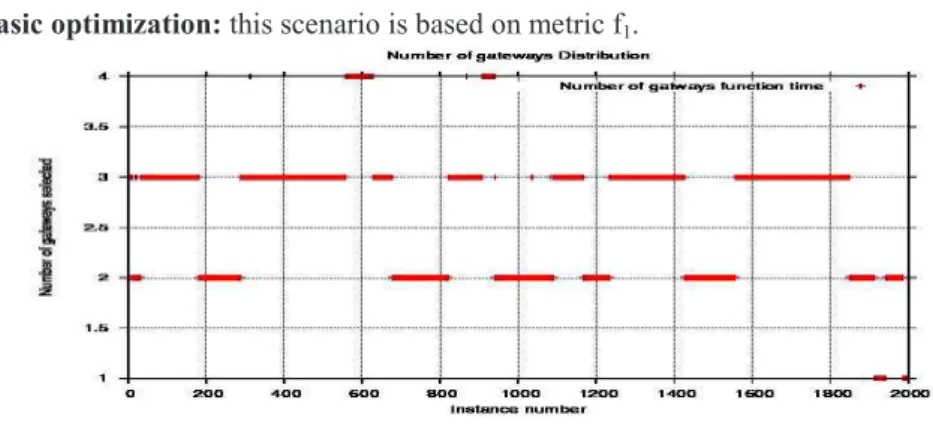
Basic optimization: this scenario is based on metric f1.
Fig. 1. # of selected gateways at each snapshot of the topology
Figure 1 shows that the genetic algorithm does a good work in placing a low - 4 at most - number of gateways. The price to pay is a potential high load per gateway with uneven distribution (Figure 2). On the field, it will translate in congestion and interferences among nodes. Other results, not shown here, show that regular nodes are at a maximum distance of 2 hops from their gateway with a favorable side effect of minimizing also the maximum link load (MLL).
Optimization with node mobility: the second scenario calls for the inclusion of
factors related to node mobility and the link between gateway/satellite. Metric f2 is
used.
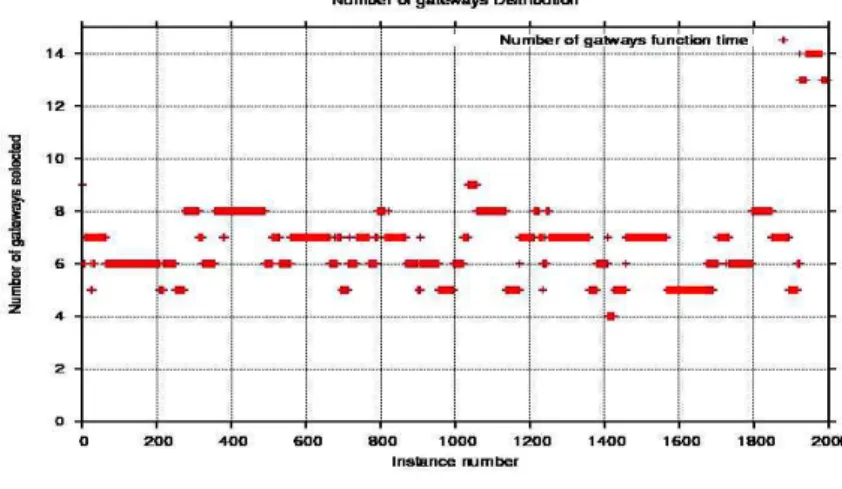
Fig. 3. # of selected gateways at each snapshot of topology
Fig. 4. Load distribution for each selected gateway
Figure 4 shows a decrease in terms of gateway load as expected. Even though the number of selected gateways increases (Figure 3), the other parameters such as maximum link load are unchanged. A close inspection at Figure 4 reveals that the gateway load is not homogenously distributed. For a 140-node network, the load of one of the 7 gateways of the network is 60, thrice the load of an equivalent homogenous distribution (20 per gateway). This phenomenon can be explained by the fact that the nodes in the topology are not uniformly distributed.
Optimization of the gateway load distribution: The gateway load should be
homogeneously distributed and minimized in order to prevent any bottleneck phenomena. In order to achieve an even gateway load, the third metric is used: f =
4*g + MLL + CD + MGL + MD
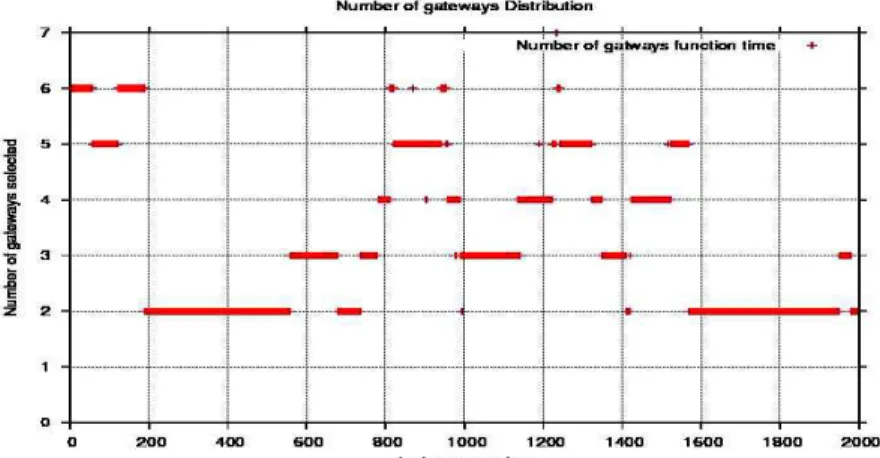
Fig. 5. # of selected gateways at each snapshot of topology
Fig. 6. Load distribution for each selected gateway
Figure 5 and 6 show that less gateway nodes are necessary, the load slightly increases but is homogeneously distributed among gateways. Concerning the optimization of the others metrics like link load, we have to admit that results show as a significant increase (MLL is tripled, while it was optimal for f1 and f2). It is a direct result of the fitness function where the gateway load factor is more represented than the two other link related factors (MLL and CDD). The choice of gateway nodes is also different from the prior scenarios. These three first scenarios also demonstrate one key advantage of GA over heuristics based approaches: adapting the optimization
criteria (i.e., the fitness function) is made easily and does not require a redesign of the core optimization algorithm.
Load balancing with optimization of gateway load at routing level: The
simulations are realized with the fourth metric: f = 2*g + MLL + CD + MD. For each regular node the affiliation to a gateway is based on the shortest path metric and also taking into account the gateway load.
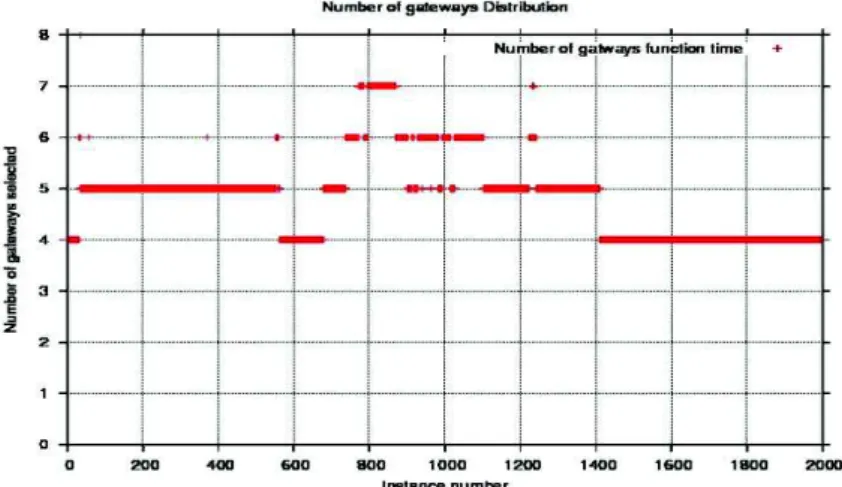
The number of selected gateways at each topology snapshot and the load of each gateway are shown in Fig. 7 and 8. The main gain obtained using this method is that the load is well distributed over the number of gateways. The results concerning the number of selected gateways are satisfying regarding the network size. The optimization of the maximum link load is also taken into account (MLL decreases to 2).
Fig. 7. # of selected gateways at each snapshot of topology
Fig. 8. Load distribution for each selected gateway
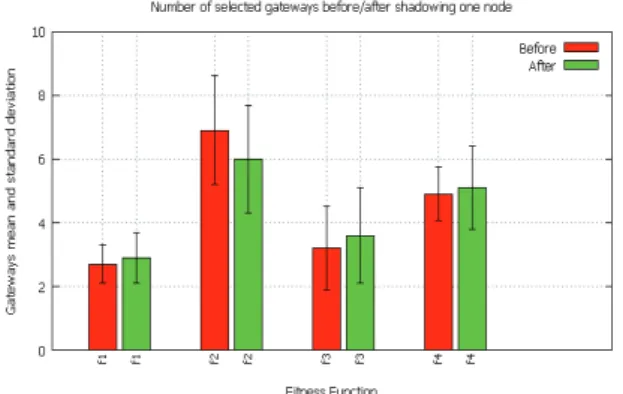
Figure 11 (left) shows simulation results concerning the mean and standard deviation of the number of selected gateways obtained using the four metrics. If the
most important issue is to optimize the satellite interface usage, then the first metric should be favored since it performs well in terms of number of selected gateways and also of link load. However, this can only be achieved at the cost of high gateway load. If the main concern is to reduce the gateway load and also to optimize the other parameters, the second metric is preferable. In order to have a reasonable number of gateways and an evenly distributed load among gateways the fourth metric should be used. A disadvantage of this last metric is the fact that the link load increased. In our opinion it is more important to have stable solutions and number of gateways reduced despite of a link load increased by 1 (number of paths per link).
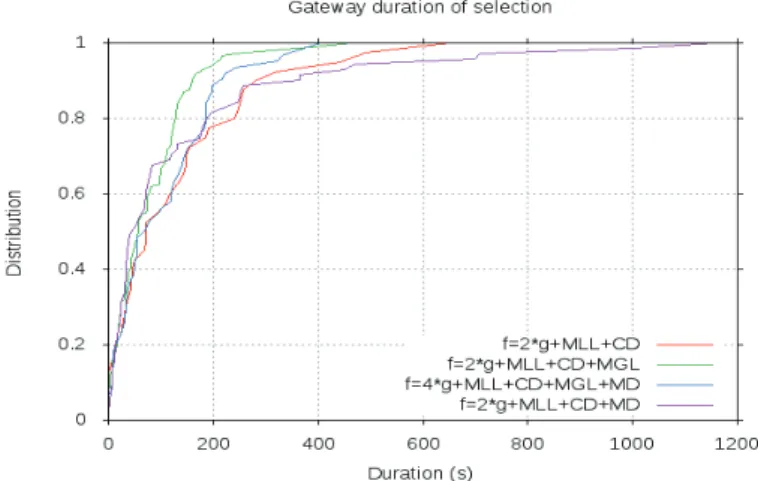
Fig. 9. CDF of duration for one gateway placement
5.2 Impact of mobility
Gateway placement is evaluated at each snapshot, it is therefore important to assess how long a gateway keeps its role. Fig. 9 and Fig. 10 show the CDF, mean and standard deviation of gateway lifetime. Metric 4 offers the best stability.
Figure 11: # selected gateways before/after shadowing
!
Fig. 12. Link load distribution before/after shadowing
"
#
$
%
!
5.2 Gateway shadowing
Obstacles like trees can cause satellite signal impairments for certain gateways. This phenomenon is called shadowing. To assess the impact of shadowing on gateway placement, we performed a systematic shadowing of the nodes selected as gateways. In this context, it translates into marking as “non eligible” a node that was selected as gateway and resuming gateway placement.
Figure 11, 12 and 13 present the results obtained in terms of number of selected nodes, link load and path cumulated distance after systematically shadowing each node selected as gateway. The results are presented averaged for each simulation computed with the four metrics presented earlier.
Making a synthesis on the results obtained with shadowing, we can say that there is no significant increase of the number of selected gateways. After shadowing, the number of gateways is reduced by 1 at maximum. The link load is optimized and Fig. 12 highlights that the fourth metric improves link load.
Fig. 14. Percentage of the solution kept after shadowing
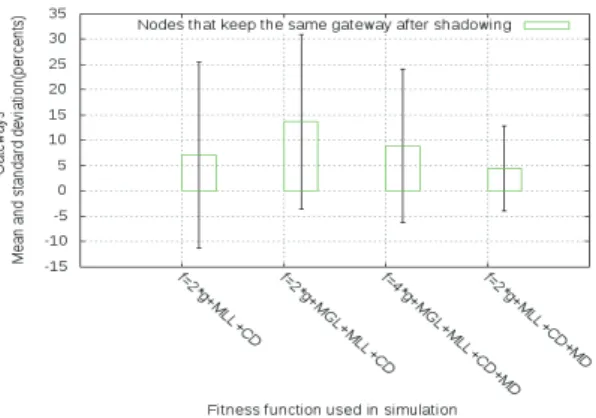
Fig. 15. Percentage of the nodes that are served by the same gateway after shadowing
Fig. 14 shows the percentage of the gateways that are kept established after shadowing. The second metric is the best performer in terms of gateway stability. We noticed that the algorithm has the tendency to choose complementary pairs of nodes with a strong impact on gateway change when shadowing occurs. Fig. 15 shows the
percentage of regular nodes that are served by the same gateway after shadowing. As expected, the second metric yields the larger stability ratio before/after shadowing. Placements with less gateways are also likely to suffer from the most drastic changes.
6 Conclusion
In this work we have presented a Genetic Algorithm approach for the problem of gateway placement in hybrid MANET- Satellite network with the goal to minimize the number of gateways and to optimize various parameters such as: gateway load, link load, path cumulated distance and also the convergence time of the algorithm. The problem was studied on a topology model called FireMobility modeling firefighters action during forest fires. The suitability of GA to this problem was demonstrated. We showed by means of simulations the suitability of different metrics that may be used. Specifics of satellite communications such as gateway shadowing were also discussed. Other criteria, such as the network density [16] may also be considered in the future.
7 Acknowledgements
This work is partly funded by the French Space Agency under contract CNES R&T R-S12/TC-0008-018 “SatManet”.
References
[1] 1. W. Liu, H. Nishiyama, N. Kato, Y. Shimizu, and T. Kumagai. A Novel Gateway Selection Method to Maximize the System Throughput Of Wireless mesh Network Deployed in Disaster Areas. IEEE International Symposium on Personal, Indoor and Mobile Radio Communications 2012: 771 – 776, 2012
[2] M. Hamdi, L. Franck and X. Lagrange. Gateway Placement in Hybrid MANET-Satellite Networks, IEEE Vehicular Technology Conference, pages 1-5, September 2012
[3] F. Li, Yu Wang, X. Li, A. Nusairat and Y. Wu Gateway Placement for throughput Optimization in Wireless Mesh Networks. Mobile Networks and Applications 13(1-2): 198-211, 2008
[4] F. Xhafa, C.Sanchez, L.Barolli. Ad Hoc and Neighborhood Search methods for Placement of Mesh Routers in Wireless Mesh Networks. IEEE International Conference on Distributed Computing Systems Workshops 2009: 400-405, 2009
[5] D. Le and N. Nguyen. A New Evolutionary Approach for Gateway Placement in Wireless Mesh Networks. International Journal of Computer Networks and Wireless Communications vol.2: 550-555, October 2012
[6] F. Hoffman, D. Medina and Adam Wolisz. Optimization of Routing and Gateway Allocation in Aeronautical Ad Hoc Networks using Genetic Algorithms. International Wireless Communications and Mobile Computing Conference: 1391-1396, 2011
[7] F. Xhafa, C.Sanchez and L.Barolli. Genetic Algorithms for Efficient Placement of Router Nodes in Wireless Mesh Networks. IEEE International Conference on Advanced Information Networking and Applications 2010: 465-472, 2010
[8] F. Xhafa, A. Barolli, C. Sanchez, L. Barolli. A Simulated Annealing Algorithm for Router Nodes Placement Problem in Wireless Mesh Networks. Simulation Modelling Practice and Theory 19(10): 2276-2284, 2011
[9] U. Ashraf, S. Abdellatif and G. Juanole. Gateway Selection in Backbone Wireless Mesh Networks. IEEE Wireless Communications and Networking Conference 2009: 2548-2553, 2009
[10] Pazand, McDonald. A Critique of Mobility Models for Wireless Networks Simulation. Computer and Information Science, 2007
[11] P. Sankar, Prabhakaran. Impact of realistic Mobility Models on Wireless Networks Performance. (WiMoB’2006), IEEE International Conference, June 2006
[12] L. Franck, M. Hamdi, and C. G. Rodriguez. Topology modeling of emergency communication networks: Caveats and pitfalls. TIEMS ( The International Emergency Management Society) Workshop, 2011
[13] C. Lin. Dynamic Router Node Placement in Wireless Mesh Networks: A PSO Approach with Constriction Coefficient and Its Convergence Analysis. Inf. Sci. 232:294-304, 2013
[14] R. Dhaou, V. Gauthier, M. I. Tiado, M. Becker, and A.-L. Beylot. Cross layer simulation: Application to performance modelling of networks composed of manets and satellites. Network Performance Engineering, ser. Lecture Notes in Computer Science, D. D. Kouvatsos, Ed. Springer, 2011, vol. 5233, pp. 477–508.
[15] M. Salhani, R. Dhaou, A. Beylot. Terrestrial Wireless Networks and Satellite Systems Convergence, The 25th AIAA International Communications Satellite Systems Conference, The American Institute of Aeronautics and Astronautics, 2007.
[16] B. Paillassa, C. Yawut, and R. Dhaou. Network awareness and dynamic routing: The ad hoc network case. Computer Networks, vol. 55, no. 9, pp. 2315-2328, 2011.