En vue de l'obtention du
DOCTORAT DE L'UNIVERSITÉ DE TOULOUSE
Délivré par :Institut National Polytechnique de Toulouse (INP Toulouse) Discipline ou spécialité :
Micro-ondes, Électromagnétisme et Optoélectronique
Présentée et soutenue par :
Mme LI WUle jeudi 17 décembre 2015
Titre :
Unité de recherche : Ecole doctorale :
CONTRIBUTION A L'ETUDE MULTI-PHYSIQUE DU CHAUFFAGE DE
MILIEUX POREUX PAR ENERGIE RADIOFREQUENCE
INTERMITTENTE DANS UNE CELLULE COAXIALE
Génie Electrique, Electronique, Télécommunications (GEET)
Laboratoire Plasma et Conversion d'Energie (LAPLACE) Directeur(s) de Thèse :
M. JUNWU TAO M. JEAN LOUIS LACOUT
Rapporteurs :
M. KAMA HUANG, SICHUAN UNIVERSITY M. LIONEL ESTEL, INSA ROUEN
Membre(s) du jury :
1 Mme PATRICIA ARLABOSSE, ECOLE NLE SUP DES MINES ALBI CARMAUX, Président
2 M. JEAN-FRANCOIS ROCHAS, WAVES CONCEPT, Membre
2 M. JEAN LOUIS LACOUT, INP TOULOUSE, Membre
Contribution to the multi-physics
study of porous media heated
intermittently by RF energy in a
coaxial cell
I
Acknowledgements
This PhD study is accomplished in laboratory of Laplace, ENSEEIHT, Toulouse University. It is a result of support and assistance by many people. I wish to express my gratitude to them for their contributions.
Firstly, I would like to thank Laplace for receiving me to do PhD here.
I would like to address my hearty gratitude particularly to my supervisors, Professor Junwu TAO in Laplace-ENSEEIHT of Toulouse University and Professor Jean-Louis LACOUT in CIRIMAT-ENSIACET of Toulouse University, for guiding me through my PhD research. They are very knowledgeable and patient, which set good examples for me in the future. Their support, advices, help, encouraging and friendship during my study will be always appreciated and remembered.
I should admit that it is my great honor to have Prof. Kama HUANG from Sichuan University, China and Prof. Lionel ESTEL from LSPC-INSA Rouen in my committee. I appreciate their precious time for examining my dissertation even though their schedules are quite full.
I would also like to express my sincere gratitude to Madame Patricia ARLABOSSE from MINES Albi-Carmaux and M. Jean François ROCHAS from Société WAVES CONCEPTE to accept to be the examiner and attend my defense.
My deep appreciation also goes to Dr. Tan-Hoa VUONG and Prof. Jacque DAVID in our group for their help during these three years, especially for their help in doing experiments and realizing the direct power coupler and impedance adaptation circuit. My gratitude goes equally to Prof. Serge LEFEUVRE, Aron RAMIS and Christina from Midival for their help during the preparation of my experiment.
The infrared camera is provided by another group--CS in our laboratory of LAPLACE. I should thank particularly Mr. Didier FLUMIAN for his generously lending the infrared camera to me and guiding us how to use the infrared camera.
I wish to thank the family of Prof. TAO, the wife of Prof. Jean-Louis LACOUT and Madame Zhongxia HU. They all treat me like a family member, which makes me feel like that I stay with family and help me get through the suffering of home sick.
II
I also want to take this opportunity to thank all my friends in China and in France. They are always willing to listen to my grumbles and give me a hand whenever I need help. Their concerns and supports always give me the energy to overcome difficulties. My gratitude equally goes to my friends and labmates: Yalei HOU, Xiaolan TANG, Dan LI, Huacheng ZHU, Junqing LAN, Yang YANG, Priscilia DAQUIN, Caroline GIRARD, Jammal RAMMAL, Jingyi WANG, Wencong ZHANG and so on for their kindly help and friendship. Last but not least, I would like to express my deepest appreciation and thanks to my family. They are always available and ready to help me when I need their support. They comfort me when I am sad or home sick. They are all inclusive of me even though when I am capricious and stubborn. It is their unconditional patience, love and support that get me through this long endeavors.
III
Résumé
Avec l'explosion économique et démographique, le besoin en matériaux poreux tels que la nourriture, le bois ou la brique connait une croissance telle que leur commerce est très actif dans le monde entier. La déshydratation des milieux poreux étant l'une des plus importantes et stables méthodes pour leur préservation, il est parfois nécessaire d'utiliser cette méthode pour stocker, transporter et mieux utiliser ces matériaux. Depuis la Seconde Guerre Mondiale, il existe des méthodes de chauffage RF dans bien des domaines. Bien que beaucoup de nouvelles technologies de chauffage sont devenues extrêmement importantes du point de vue commercial et très largement utilisées, le chauffage RF est préféré aux autres moyens de chauffage pour plusieurs raisons: 1) le résultat est plus rapide, nécessitant un moindre temps pour atteindre la température désirée; 2) le chauffage radiofréquence peut être spatialement plus uniforme que les méthodes conventionnelles de chauffage; 3) le chauffage par radiofréquences peut être allumé ou éteint instantanément; 4) il est plus efficace pour un grand volume de nourriture; 5) l'investissement nécessaire est moindre, etc. Cependant on trouve très peu d'information sur le chauffage radiofréquence pour la déshydratation des matériaux poreux dans la littérature. Par conséquent, il est intéressant d'étudier les interactions entre les radiofréquences et les milieux poreux.
Afin d'améliorer le taux d'énergie radiofréquence utilisé, cette thèse propose une cavité coaxiale pour étudier le cycle de chauffage radiofréquence d'une pomme de terre dans différents états : solide, liquide et gazeux. Dans un premier temps nous avons étudié les mécanismes de transport de masse et de chaleur dans le milieu poreux sans radiofréquence sur le modèle d'une brique 1D à l'aide d'un code Matlab. Les résultats de simulation ont été comparés qualitativement avec ceux du papier de référence. A partir de ce modèle, nous avons construit et simulé un modèle 2D axisymétrique avec le chauffage radiofréquence périodique d'une pomme de terre. L’équation de Landau et Lifshitz, Looyenga a été utilisées pour prédire le changement de permittivité effective dans la simulation car il est difficile d'obtenir une donnée précise pour un milieu poreux. La salinité de l'échantillon chauffé (qui est une caractéristique très importante) a été estimée. Les effets de différentes périodes, hauteurs de l'échantillon et puissances de la distribution en température ont été étudiés et analysés. Nous avons également mené des expériences similaires pour mesurer les changements de température durant le processus de chauffage. Tous les résultats de simulations sont comparés qualitativement avec les résultats mesurés.
IV
De même nous avons effectué des analyses de sensibilité et en avons conclu quelques suggestions concernant l'amélioration des effets du chauffage. A partir de ces suggestions, nous avons proposé un nouveau modèle de chauffage radiofréquence afin de s'affranchir des défauts du modèle précédent.
Mots clés: Chauffage radiofréquence par intermittence, milieux poreux, permittivité effective,
V
Abstract
With the rapid growth of economic and population explosion, the demands for porous media such as foods, woods and bricks enlarge so wildly that their trades are busy around the world. To be stored, transported and utilized better, dehydration of porous media is necessary since drying is one of the most important and stable methods for preserving materials.
After World War two, possible RF heating in many domains was suggested. Even though a lot of novel heating technologies have become extremely commercially important and been widely used, RF heating is preferred to the other heating means for several significant reasons: 1) it is rapid and requires less time to come up to the desired process temperature; 2) radio frequency heating may be relatively spatially more uniform than conventional heating; 3) radio frequency heating systems can be turned on or off instantly; 4) it is better for large, thick food; 5) it requires lower investment costs, and so on. However, little information on radio frequency heating for commercial drying of porous media is available in the published literature. Therefore, it will be interesting to research the interaction between RF and porous media.
This thesis, to improve the use ratio of RF energy further, proposed a coaxial cell to research RF cycling heating potato with different phases: solid, liquid and gas. The mechanism of mass and heat transport in the porous media without RF energy was studied first by solving the governing equations of 1D brick model with Matlab codes. The calculated results compared qualitatively with those in the reference paper. Based on that model, an axisymmetric 2D model with periodically RF heating potato was built and simulated. Landau and Lifshitz, Looyenga equation was employed to predict the effective permittivity change in the simulation since it is difficult to get the accurate measurement data of porous media. The salinity of heated sample- a very important parameter of the mixing rule-was estimated. The effects of different process period, variation of height of sample and power on the temperature distributions were studied and analyzed. Corresponding experiments were also conducted to measure the temperature change during the heating process. All the simulated results compared qualitatively with the measured ones.
Sensitivity analysis was also done and some suggestions on the improvement of heating effect were concluded. Based on the suggestions, a new RF heating model was proposed to overcome the drawbacks of our previous model.
VI
Key words: RF intermittently heating, porous media, effective permittivity, Landau and
VII
Table of contents
Acknowledgements... I Résumé ... III Abstract ... V List of figures ...XI List of tables ...XVII Nomenclature ... XIX
Chapter 1 Introduction and objectives ... 1
Reference of chapter 1 ... 5
Chapter 2 Theoretical basis and applications ... 7
2.1 Disciplines employed for researching the mass and heat flow in porous media ... 7
2.1.1 Simple models of moisture transport in porous media ... 7
2.1.2 More generalized models for multiphases transport in porous media ... 7
2.1.3 Applications of the multiphase flow models to conventional heating ... 10
2.2 Mechanism of microwave and RF in the heating ... 11
2.2.1 Brief introduction of polarizations ... 11
2.2.2 Brief introduction of effective permittivity ... 13
2.3 Mathematical modeling and applications of RF heating porous media ... 16
2.3.1 Mathematical equations ... 16
2.3.2 Applications of RF heating ... 17
2.4 Intermittent heating ... 19
Reference of chapter 2 ... 23
Chapter 3 Numerical research on multiphase transfer under convective heating ... 29
3.1 Theoretical preparation... 29
3.1.1 Assumptions ... 29
3.1.2 Equilibrium state variables and vapor pressure ... 30
3.1.3 Mass and heat conservation equations ... 33
3.1.4 Initial and boundary conditions ... 39
3.2 Numerical solutions ... 41
3.2.1 Introduction of the used finite difference method ... 41
3.2.2 Discretization for the governing equations ... 43
3.2.3 Discretization of the boundary ... 46
3.2.4 Assembly of matrix ... 49
3.2.5 The calculated results and discussion ... 51
VIII
3.4 Conclusion ... 60
Reference of chapter 3 ... 61
Chapter 4 Measurement of effective permittivity of potato Agata ... 63
4.1 Effective permittivity of agricultural products... 64
4.1.1 Impact factors of permittivity ... 64
4.1.2 Dielectric mixture equations ... 67
4.2 Measurement techniques of effective permittivity ... 71
4.2.1 Common measurement techniques ... 72
4.2.2 Measurement developed in LAPLACE ... 76
4.3 Estimate the salinities of researched material ... 80
4.3.1 Measurement preparation... 80
4.3.2 Measuring the input impedance of partially loaded cell ... 84
4.3.3 Estimated results... 85
4.4 Discussion and conclusion... 89
Reference of chapter 4 ... 91
Chapter 5 A 2D axisymmetric model of RF intermittently heating potato ... 95
5.1 Schematic of 2D axisymmetric model ... 95
5.2 The governing equations ... 96
5.2.1 Maxwell’s equation ... 97
5.2.2 Momentum conservation equation ... 97
5.2.3 Mass conservation equation ... 98
5.2.4 Heat conservation equation ... 98
5.2.5 Phase change ... 99
5.2.6 Initial and boundary conditions ... 100
5.3 Input parameters... 100
5.3.1 Specific heat capacity ... 101
5.3.2 Capillary diffusivity of liquid water ... 101
5.3.3 Permeability of water and gas ... 102
5.3.4 The permittivity of potato during the processing ... 103
5.4 The experiment ... 108
5.4.1 Material and preparation ... 108
5.4.2 The implement of experiment ... 109
5.5 Comparison of results and discussion ... 110
5.5.2 Comparison of temperature profiles of intermittent heating ... 112
5.5.3 Simulated pressure tendency ... 120
IX
5.6 Conclusion ... 128
Reference of chapter ... 131
Chapter 6 Sensitivity analysis and optimizations ... 133
6.1 Sensitivity analysis ... 133
6.1.1 Effect of different RF power ... 133
6.1.2 Effect of mass transfer coefficient ... 136
6.1.3 Effect of heat transfer coefficient ... 139
6.1.4 Effect of water intrinsic permeability ... 142
6.1.5 Effect of water saturation ... 145
6.1.6 Effect of porosity ... 148
6.1.7 Effect of height of sample ... 151
6.1.7 Effect of different location of the potato sample ... 154
6.2 The optimization of the RF heating model ... 156
6.3 Conclusion ... 158
Reference of chapter 6 ... 159
Chapter 7 Conclusions and future work ... 161
XI
List of figures
Figures in chapter 2:
Figure 2.1 Schematic of mechanism of RF heating
Figure 2.2 Intermittent heating modes: (a) step-wise, (b) step-up, (c) step-down
Figures in chapter 3:
Figure 3.1 Schematic of porous media
Figure 3.2 Representative element volume of porous media Figure 3.3 Schematic of 1D brick
Figure 3.4 Schematic of discretization method Figure 3.5 Sketch for the Crank-Nicolson scheme Figure 3.6 Discretization of the calculation domain Figure 3.7 Flow chart of calculation
Figure 3.8 Pressures of 61 nodes vs 21 nodes Figure 3.9 Pressures of 61 nodes vs 41 nodes Figure 3.10 Pressures of 61 nodes vs 81 nodes Figure 3.11 Pressures of 61 nodes vs 101 nodes Figure 3.12 Saturations of 61 nodes vs 21 nodes Figure 3.13 Saturations of 61 nodes vs 41 nodes Figure 3.14 Saturations of 61 nodes vs 81 nodes Figure 3.15 Saturations of 61 nodes vs 101 nodes Figure 3.16 Temperatures of 61 nodes vs 21 nodes Figure 3.17 Temperatures of 61nodes vs 41 nodes Figure 3.18 Temperatures of 61 nodes vs 81 nodes Figure 3.19 Temperatures of 61 nodes vs 101 nodes Figure 3.20 Calculated temperatures by Matlab Figure 3.21 Temperatures in reference paper Figure 3.22 Calculated saturations by Matlab Figure 3.23 Saturations in reference paper Figure 3.24 Calculated pressures by Matlab Figure 3.25 Pressures in reference paper
XII
Figures in chapter 4:
Figure 4.1 Schematic of transmission line measurement system Figure 4.2 Schematic of open-end probe measurement system Figure 4.3 Schematic of free space measurement system Figure 4.4 Schematic of resonant cell measurement system Figure 4.5 Schematic of coaxial cell
Figure 4.6 Schematic of coaxial cell connected with conical transition Figure 4.8 Picture of two transitions mounted head tail
Figure 4.9 Photos of the cutting equipment Figure 4.10 Photos of the cut sample
Figure 4.11 Comparisons of measured data of potato samples placed at different locations Figure 4.12 Comparisons of fitted measured data of potato samples placed at different locations
Figure 4.13 Comparisons of simulated data of potato samples placed at different locations Figure 4.14 Comparison of measured data of potato samples with different height
Figure 4.15 Simulated input impedances with different inner diameter of annular samples Figure 4.16 Measured input impedances with different inner diameter of annular samples Figure 4.17 Equivalent circuit of the whole measured system
Figure 4.18 Picture of equipment for measurement
Figure 4.19 Comparison of measured and simulated input impedance: (a) real part, (b) imaginary part
Figure 4.20 Comparison of measured and simulated effective permittivity: (a) real part, (b) imaginary part
Figure 4.21 Measured data of Russett Burbank potato by Nelson
Figures in chapter 5:
Figure 5.1 Schematic of 2D axisymmetric model Figure 5.2 Simple flow chart of simulation
Figure 5.3 Schematic of effective permittivity updation
Figure 5.4 Temperature of cross-section after 12th heating: sample doesn’t touch inner conductor (left); sample doesn’t touch outer conductor (middle); sample touches both conductors (right)
XIII
Figure 5.6 Schematic of the experiment setup
Figure 5.7 Positions of two points for measuring temperature: height of sample is 57mm (left); height of sample is 45mm (right)
Figure 5.8 Temperature changes of point 1 Figure 5.9 Temperature changes of point 2
Figure 5.10 Comparison of temperatures of sample after processing 15 cycles (inside)
Figure 5.11 Comparison of temperatures of sample after processing 15 cycles (outside surface) Figure 5.12 Temperature changes of point 1
Figure 5.13 Temperature changes of point 2
Figure 5.14 Comparison of temperatures of sample after processing 25 cycles (inside) Figure 5.15 Comparison of temperatures of sample after processing 25 cycles (side surface) Figure 5.16 Temperature changes of point 1
Figure 5.17 Temperature changes of point 2
Figure 5.18 Comparison of temperatures of sample after processing 16 cycles (inside) Figure 5.19 Comparison of temperatures of sample after processing 16 cycles (side surface) Figure 5.20 Samples without (left) and with (right) transformation
Figure 5.21 Temperature changes of point 1 Figure 5.22 Temperature changes of point 2
Figure 5.23 Comparison of temperatures of sample after processing 20 cycles (inside) Figure 5.24 Comparison of temperatures of sample after processing 20 cycles (side surface) Figure 5.25 Pressure change of point 1(left) and distribution (right) after processing 15 cycles Figure 5.26 Pressure change of point 1(left) and distribution (right) after processing 25 cycles Figure 5.27 Pressure change of point 1(left) and distribution (right) after processing 16 cycles Figure 5.28 Pressure change of point 1(left) and distribution (right) after processing 20 cycles Figure 5.29 Cross-sectional distribution of temperature (left) and pressure (right) after processing 15 cycles
Figure 5.30 Cross-sectional distribution of temperature (left) and pressure (right) after processing 25 cycles
Figure 5.31 Cross-sectional distribution of temperature (left) and pressure (right) after processing 16 cycles
Figure 5.32 Cross-sectional distribution of temperature (left) and pressure (right) after processing 20 cycles
Figure 5.33 Average moisture content (left) and distribution (right) after processing 15 cycles Figure 5.34 Average moisture content (left) and distribution (right) after processing 25 cycles
XIV
Figure 5.35 Average moisture content (left) and distribution (right) after processing 16 cycles Figure 5.36 Average moisture content (left) and distribution (right) after processing 20 cycles
Figures in chapter 6:
Figure 6.1 Comparison of pressures of point 1 Figure 6.2 Comparison of moisture contents
Figure 6.3 Comparison of average temperatures Figure 6.4 Comparison of temperatures of point 1
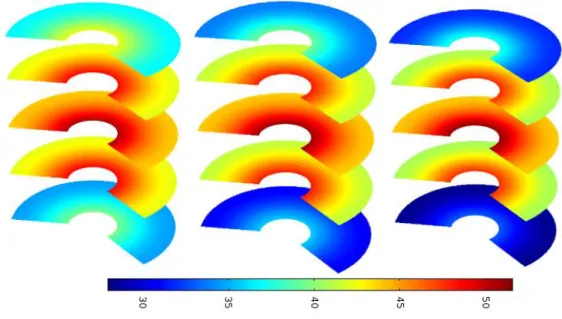
Figure 6.5 Comparison of water concentration distributions of different slices of samples heated by different powers: 50W (left), 100W (middle), 150W (right)
Figure 6.6 Comparison of temperature distributions of different slices of samples heated by different powers: 50W (left), 100W (middle), 150W (right)
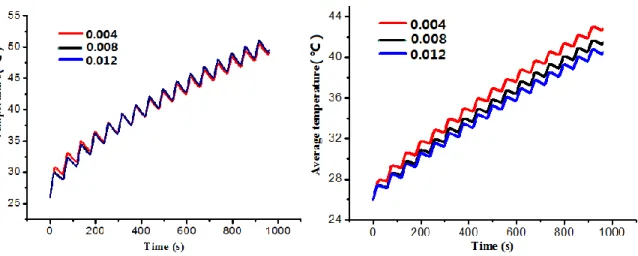
Figure 6.7 Comparison of temperatures of point 1 Figure 6.8 Comparison of average temperatures Figure 6.9 Comparison of moisture contents Figure 6.10 Comparison of pressures of point 1
Figure 6.11 Comparison of water concentration distributions of different slices of samples heated by different values of ℎ𝑚: 0.004m/s (left), 0.008m/s (middle), 0.012 m/s (right)
Figure 6.12 Comparison of temperature distributions of different slices of samples heated by different values of ℎ𝑚: 0.004 (left), 0.008 (middle), 0.012 (right)
Figure 6.13 Comparison of temperatures of point 1 Figure 6.14 Comparison of average temperatures Figure 6.15 Comparison of moisture contents Figure 6.16 Comparison of pressures of point 1
Figure 6.17 Comparison of water concentration distributions of different slices of samples heated by different values of ℎ𝑡: 10 (left), 20 (middle), 100 (right).
Figure 6.18 Comparison of temperature distributions of different slices of samples heated by different values of ℎ𝑡: 10 (left), 20 (middle), 100 (right)
Figure 6.19 Comparison of temperatures of point 1 Figure 6.20 Comparison of average temperatures
Figure 6.21 Comparison of moisture contents Figure 6.22 Comparison of pressures of point 1
XV
Figure 6.23 Comparison of water concentration distributions of different slices of samples heated by different values of 𝑘𝑖𝑛,𝑤: 1e-15 (left), 1e-16 (middle), 1e-17 (right)
Figure 6.24 Comparison of temperature distributions of different slices of samples heated by different values of 𝑘𝑖𝑛,𝑤: 1e-15 (left), 1e-16 (middle), 1e-17 (right)
Figure 6.25 Comparison of temperatures of point 1 Figure 6.26 Comparison of average temperatures Figure 6.27 Comparison of pressures of point 1
Figure 6.28 Comparison of water concentration distributions of different slices of samples heated by different values of 𝑆𝑤: 0.6 (left), 0.9 (middle), 0.96 (right)
Figure 6.29 Comparison of temperature distributions of different slices of samples heated by different values of 𝑆𝑤: 0.6 (left), 0.9 (middle), 0.96 (right)
Figure 6.30 Comparison of temperatures of point 1 Figure 6.31 Comparison of average temperatures Figure 6.32 Comparison of pressures of point 1
Figure 6.33 Comparison of temperature distributions of different slices of samples heated by different values of 𝜙: 0.85 (left), 0.88 (middle), 0.9 (right)
Figure 6.34 Comparison of water concentration distributions of different slices of samples heated by different values of 𝜙: 0.85 (left), 0.88 (middle), 0.9 (right)
Figure 6.35 Comparison of temperatures of point 1 Figure 6.36 Comparison of average temperatures Figure 6.37 Comparison of moisture contents Figure 6.38 Comparison of pressures of point 1
Figure 6.39 Comparison of temperature distributions of different slices of samples heated by different values of heights: 57mm (left), 45mm (middle), 28.5mm (right)
Figure 6.40 Comparison of water concentration distributions of different slices of samples heated by different values of heights: 57mm (left), 45mm (middle), 28.5mm (right)
Figure 6.41 Comparison of temperatures of point 1 Figure 6.42 Comparison of average temperatures Figure 6.43 Comparison of moisture contents Figure 6.44 Comparison of pressures of point 1
Figure 6.45 Comparison of temperatures of point 1 Figure 6.46 Comparison of average temperatures Figure 6.47 Comparison of moisture contents
XVI
Figure 6.48 Comparison of pressures of point 1
Figure 6.49 Comparison of water concentration distributions of different slices of samples heated by different values of positions: 20mm (left), 40mm (middle), 60mm (right)
Figure 6.50 Comparison of temperature distributions of different slices of samples heated by different values of positions: 20mm (left), 40mm (middle), 60mm (right)
XVII
List of tables
Table 2.1 Frequencies assigned by FCC for industrial, scientific and medical use Table 2.2 Some successful applications of RF heating foods
Table 2.3 Research findings of stepwise intermittent heating food products Table 3.1 Input parameters of 1D brick model
Table 4.1 Effect of the dielectric properties of salt, fat and free water with frequency and temperature
Table 4.2 General comparison of dielectric property measurement systems Table 4.3 Effective permittivities of measured samples
Table 4.4 Comparison of measured average and simulated effective permittivity Table 5.1 Input parameters of potato in the simulation
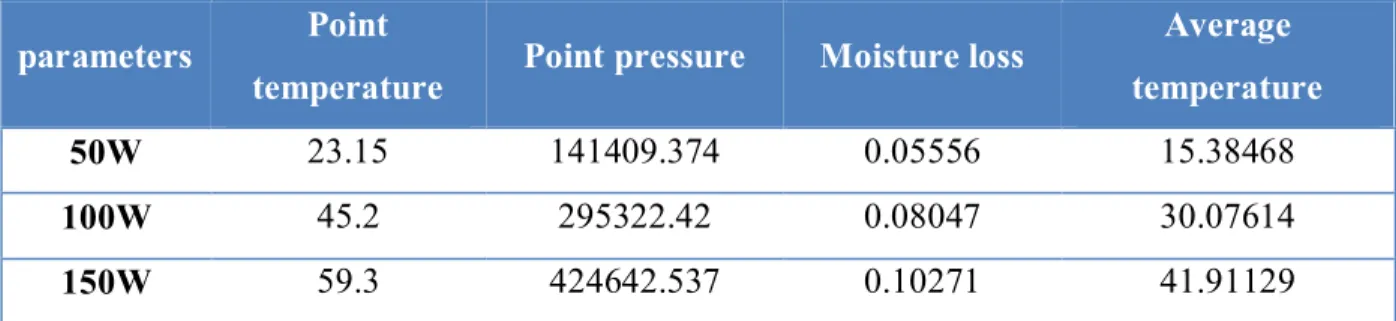
Table 6.1 Increasing of temperature, pressure e and moisture loss under different power levels Table 6.2 Comparison of moisture content losses of different Sw
XIX
Nomenclature
Latin Symbol :
Symbol Description 𝑎 Radius, (𝑚)
𝑏𝑖 Coefficients in finite differential equations
𝐶 Molar density of gas mixture, (𝑘𝑔/𝑚𝑜𝑙) 𝐶𝑝 Specific heat, (𝐽/(𝑘𝑔 ∙ 𝐾))
𝑐 Mass concentration, (𝑘𝑔 / 𝑚3)
𝑐𝑖 Coefficients in finite differential equations
𝐷𝑐 Binary diffusivity of air and vapor, (𝑚2/𝑠)
𝐷𝑒𝑓𝑓,𝑔 Effective gas diffusivity in moist materials, (𝑚2/𝑠)
𝐷𝑒𝑓𝑓 Effective diffusivity in moist materials, (𝑚2/𝑠)
𝐷𝑤 Capillary diffusivity, (𝑚2/𝑠)
𝐸⃑ Electric field intensity, (𝑉/𝑚) 𝑓 Frequency, (1 𝑠⁄ )
𝐻⃑⃑ Magnetic field intensity, (𝑁/(𝑚 ∙ 𝐴)) ∆ℎ𝑣𝑎𝑝 Enthalpy of vaporization, (𝐽/𝑘𝑔)
ℎ𝑡 Heat transfer coefficient on open boundary,(𝑊/(𝑚2∙ 𝐾))
ℎ𝑚 Mass transfer coefficient on open boundary, (𝑚/𝑠) 𝐼 Volumetric evaporation term, (𝑘𝑔/(𝑚3∙ 𝑠))
XX
𝐾 Evaporation rate constant, (1/s) 𝐾𝑖 Coefficients in differential equations 𝑘 Boltzmann constant, (𝐽/𝐾)
𝑘𝑡 Thermal conductivity, (𝑊/(𝑚 ∙ 𝐾))
𝑘𝑖𝑛 Intrinsic permeability, (𝑚2)
𝑘𝑖𝑛,𝑤 Liquid intrinsic permeability at very wet stage, (𝑚2)
𝑘𝑖𝑛,𝑔 Gas intrinsic permeability at very dry stage, (𝑚2)
𝑘𝑟,𝑔 Gas relative permeability, dimensionless 𝑘𝑟,𝑤 Water relative permeability, dimensionless
𝑘𝑒𝑓𝑓 Effective thermal conductivity, (𝑊/(𝑚 ∙ 𝐾))
𝑗 Mass diffusive flux, (𝑘𝑔/(𝑚3∙ 𝑠)))
𝑗 Symbol of imaginary part 𝑀 Molecular weight, (𝑘𝑔/𝑘𝑚𝑜𝑙) 𝑀 Moisture content (d.b.) N Normality of the solution 𝑃 Total pressure, (𝑃𝑎) 𝑃0 Initial pressure, (𝑃𝑎)
𝑝𝑣 Partial pressure of vapor, (𝑃𝑎)
𝑝𝑎 Partial pressure of air, (𝑃𝑎)
𝑝𝑐 Capillary pressure, (𝑃𝑎) 𝑝 Polarization
XXI
𝑄 Volumetric heat source term, (𝑊/𝑚3)
𝑅 Universal gas constant, (𝐽/ (𝑘𝑚𝑜𝑙 ∙ 𝐾)) 𝑅𝑣 Vapor gas constant, (𝐽/(𝑘𝑔 ∙ 𝐾)) 𝑅𝑎 Air gas constant, (𝐽/(𝑘𝑔 ∙ 𝐾))
𝑡 Heating time, (s) 𝑉 Volume, (𝑚3)
∆𝑉 Representative element volume 𝑚⃑⃑ Convective flux, (𝑘𝑔/(𝑚2∙ 𝑠))) 𝑛⃑ Total flux, (𝑘𝑔/(𝑚2∙ 𝑠))) 𝑛 Time point S Salinity 𝑆𝑤 Liquid saturation 𝑆𝑔 Gas saturation 𝑆0 Initial saturation 𝑆11 Reflection coefficient 𝑇 Temperature, (𝐾) 𝑇0 Initial temperature, (𝐾) 𝑢⃑ Velocity, (m/s) 𝜒𝑖 Molar fraction 𝑥 X-axis ∆𝑥 Mesh size of space ∆𝑡 Time increment
XXII
𝑍 Input impedance, (Ω)
𝑍0 Characteristic impedance, (Ω)
𝑍𝑚𝑒𝑎𝑠 Measured input impedance of total system, (Ω) 𝑍𝑒𝑐ℎ Input impedance of loaded cell, (Ω)
Greek symbols:
Symbol Description
𝛼 Empirical spread of relaxation times 𝜌 Density, (𝑘𝑔 𝑚⁄ 3)
𝜙 Porosity
𝜇 Viscosity, (𝑃𝑎 ∙ 𝑠) 𝜔𝑣 Mass fraction of vapor
𝜔𝑎 Mass fraction of air
𝜇0 Permeability of free space
𝜀 Permittivity
𝜀0 Permittivity of free space
𝜀𝑟 Relative permittivity
𝜀𝑟′ Dielectric constant
𝜀𝑟′′ Dielectric loss
𝜀∞ Permittivity under extremely high frequency
XXIII
𝜆 Latent of vapor, (𝐽/𝑘𝑔) 𝜔 Angular frequency, (1/𝑠)
(𝜌𝐶𝑝)𝑒𝑓𝑓 Effective heat capacity of the moist materials, (J/𝑚3)
𝜌𝑒𝑓𝑓 Apparent density, (kg/𝑚3)
𝜌𝑣,0 Ambient vapor density, (kg/𝑚3)
𝜎 Surface tension, (𝑁/𝑚); ionic conductivity 𝜏 Relaxation time, (𝑠)
𝜇 Dynamic viscosity, (𝑃𝑎 ∙ 𝑠); static conductivity 𝜐 Volume fraction
Subscripts and superscripts:
Symbol Description 𝑎 Air 𝑣 Vapor 𝑔 Gas 𝑤 water 𝑎𝑚𝑏 Ambient 𝑠 Solid matrix 𝑒𝑓𝑓 Effective 1,2, 3 ⋯ Different substances 0 Atmosphere 𝑙 Load
XXIV ′ Real part ′′ Imaginary part ∗ Conjugate
Abbreviation:
Symbol Description 𝑆𝐶 Short circuit 𝑂𝐶 Open circuit 𝑅𝑒 Real part 𝐼𝑚 Imagianry part1
Chapter 1 Introduction and objectives
A porous medium is characterized by a partitioning of the total volume into solid matrix and pore space, with the latter being filled by one or more fluids. Many natural substances such as rocks and soil (e.g. petroleum reservoirs), biological tissues (e.g. wood, bones), a lot of foods and man-made materials such as cements and ceramics can be considered as porous media. They are important and can be seen everywhere in our everyday life, research field and industrial applications.With the development of economic and population explosion, more and more porous media such as foods, woods and bricks are needed and their trades are more frequently around the world. To be stored, transported and utilized better, dehydration of porous media is necessary since drying is one of the most important and stable methods for preserving materials because most of the water inside them has been removed.
Before, most of the drying based on the conventional heating such as steam, hot water, hot air or a combination of any of them which have been used almost since human being learnt how to use fire. These kinds of heating methods are mature and applied everywhere if dehydration is needed. However, the energy source of conventional heating only can heat the surfaces of the treated materials directly. It causes food molecules to react largely from the surface inward, so that successive layers heat in turn, leading to a temperature gradient that can burn the outside of the material while the interior is rare. Since the interior temperatures and moistures of samples can be changed only by the heat conduction from surfaces, these drying processes require enormous time, energy and cost due to high latent heat of water. Moreover, the traditional methods may be easier to cause the problems to environment. Nowadays, human development faces a profound crisis of energy sources and environment. Therefore, it is a must to find the high efficient methods to treat the vast porous media. Advanced drying techniques and equipment are therefore necessary to reduce energy consumption and drying time. To improve this situation, a lot of new methods have been investigated for drying porous media: freeze drying, air oven drying, vacuum drying, RF and microwave drying, to name a few [1][2][3][4][5].
Radio and microwave heating are preferred to the other heating means for the primary reason that they are rapid and require less time to come up to the desired process temperature, which
2
can approach the benefits of high temperature-short time processing. This is particularly true for solid and semi-solid foods that depend on the slow thermal diffusion process in conventional heating [6]. It has been proven that radio frequency and microwave heating may be relatively spatially more uniform than conventional heating [ 7 ], however, heating uniformity is hard to predict.
Many researchers focus on microwave drying a large range of porous media in different domains, and there have been numerous articles until today with relative parameters widely available. However, very little information on radio frequency heating for commercial drying of porous media is available in the published literature and much fewer commercial facility for this purpose could be located than microwave, despite RF heating applications in the food industry have been recognized since the 1940s [8][9], and despite the many strengths it owns. Our quantitative understanding is still limited even though the existence of periodical summaries in comprehensive reviews [5].
What’s more, even though that there exist some drawbacks for RF heating comparing to microwave heating such as less RF sources in the market, relatively lower heating efficiency, RF heating still could be an attractive alternative over microwave heating for processing porous media. It has been reported that RF heating could be an attractive alternative over MW heating for processes of porous media due to its several advantages such as better for large, thick food, lower investment costs, easier to understand and control and so on [5][10]. Laycock, Piyasena and Mittal also reported that RF heating at 27.12 MHz could serve to reduce cooking times by up to 90% in whole, minced and comminuted beef [11]. Therefore, it is very interesting and necessary to research RF processing porous materials. However, researchers indicated that RF heating may also lead to uneven temperature distribution with the existence of hot spot or thermal runaway [12]. Fortunately, these problems might be improved by another advantage of RF heating.
The other advantage of radio frequency heating systems is that they can be turned on or off instantly. The merits of intermittent drying have been well established for a variety of materials with or without electromagnetic energy [13][14]. Periodically heating reportedly results in greater depth of heating than continuous heating for the same total input energy. Furthermore, RF intermittently heating, comparing to continuous application of power, leads to more uniform temperature distribution within the sample [15]. This can improve product
3
quality and process efficiency [16] and be a potential alternative solution for hot spot and thermal runaway.
Therefore, RF heating presents a promising prospective. In this thesis, I try to propose a model of RF intermittently heating porous media. To achieve more uniform temperature distribution and lower the computation requirement, a coaxial cell is employed as the heating equipment. As mentioned above, many researchers focus on microwave drying, therefore, the information about key parameter that determines the interaction between RF and materials-effective permittivity- is rare. Therefore, a method for estimating the materials-effective permittivity of porous media is also proposed. Potato is chosen as the researched object because its structure parameters are available in literatures.
The objects of my thesis are to:
1) Investigate the interaction between RF and porous media, studying how the mass and heat transfer inside the sample during RF heating.
2) Propose a multi-physics model for radio frequency heating porous media by coaxial cell.
3) Develop an experimental system to measure the distribution on temperature and moisture change to check the simulation results and optimize the simulation model. 4) Study and analyze which parameters having strong impacts on the heating effects. 5) Try to improve the RF heating system.
Organization of this dissertation:
Chapter 2: Briefly introduce the mathematical background about conventional and RF heating porous media. The mechanism of how RF heats materials and its applications are also addressed.
Chapter 3: Study the definitions and relations of the parameters describing porous media. The heat and mass transfer in the porous media of a 1D model of brick under conventional heating is investigated to further understand the mechanism of multiphase flow of porous media. The calculated results are analyzed and compared.
Chapter 4: Study the knowledge of effective permittivity of porous media and choose Landau and Lifshitz, Looyenga equation to predict the effective permittivity of potato. To estimate the salinity of potato-a very important parameter for the mixing rule, the coaxial cell is employed
4
to measure the input impedance of loaded cell. A COMSOL combining Matlab code is developed to estimate the salinity of potato samples by comparing the measure and corresponding simulated input impedances under different frequencies. Another COMSOL combined Matlab code is used to double check the estimated salinity.
Chapter 5: Based on the mathematical model in chapter 3, the Maxwell’s equations are coupled with them to simulate the model of RF intermittently heating potato sample in the coaxial cell. The effective permittivity is predicted by Landau and Lifshitz, Looyenga equation with our estimated salinity. Four different cases of simulations are conducted. Corresponding experiments are also carried out. The simulated and measured results are compared and analyzed.
Chapter 6: Sensitivities of several important parameters in the RF heating porous media model are studied. These analyses are focus on the impacts of variations of parameters on the changes of temperature, pressure distributions and moisture losses of the processed materials. Some improvements of heating effect are provided. Aimed at overcoming the problems existed in our model, another idea of RF heating porous media is briefly presented.
Chapter 7: Conclude what I have done and the points that may be helpful for the research of RF heating other kinds of porous media. Prospective works are also listed.
5
Reference of chapter 1
[1] C. D., Clary, S. J., Wang, & V. E., Petrucci, “Fixed and incremental levels of microwave power application on drying grapes under vacuum,” Journal of Food Science, vol.70, no.5, pp. 344-349, 2005.
[2] Cui, Z.W., Li, C.Y., Song, C.F., Song, Y.,. “Combined microwave-vacuum and freeze-drying of carrot and apple chips,” Dry. Technol., vol.26, no.12, pp. 1517–1523, 2008.
[3] Bai-Ngew, S., Therdthai, N., Dhamvithee, P., “Characterization of microwave vacuum-dried durian chips,” J. Food Eng., vol.104, pp.114–122, 2011.
[4] M. Zhang, J. Tang, A.S. Mujumdar and S. Wang, “Trends in microwave-related drying of fruits and vegetables,” Trends in Food Science & Technology, vol. 17, pp. 524-534, 2006. [5] Punidadas Piyasena, Chantal Dussault, Tatiana Koutchma, H. S. Ramaswamy, and G. B. Awuah, “Radio frequency heating of foods: principles, applications and related properties—A review,” Critical Reviews in Food Science and Nutrition, vol.43, no.6, pp.587–606, 2003. [6] U.S. Department of Health and Human Services “Kinetics of Microbial Inactivation for Alternative Food Processing Technologies,” A report of the Institute of Food Technologists
for the Food and Drug Administration of the U.S. Department of Health and Human Services,
http://www.fda.gov/Food/FoodScienceResearch/SafePracticesforFoodProcesses/ucm100250.h tm.
[7] Datta, A. K. and Hu, W., “Quality optimization of dielectric heating processes,” Food
Technol. vol. 46, no.12, pp.53-56, 1992.
[ 8 ] Anonymous, “Radio frequency ovens increase productivity and energy efficiency,”
Prepared Foods, September, pp. 125, 1993.
[9 ] McCormick, R, “Dielectric heat seeks low moisture applications,” Prepared Foods, September, pp.139–140, 1988.
[10] Joseph P. Kerry and John F. Kerry, “Processed meats: improving safety, nutrition and quality,” Wood head publishing limited, pp. 645, 2011.
[11] L. Laycock, P. Piyasena, G.S.Mittal, “Radio frequency cooking of ground, comminuted and muscle meat products,” meat science, vol. 65, no.3, pp. 959-965, 2003.
6
[12] Zhang, L., Lyng, J. G., & Brunton, N. P. , “Effect of radio frequency cooking on the texture, colour and sensory properties of a large diameter communited meat product,” Meat
Science, vol.68 , no.2, pp.257–268, 2004.
[13] N. N. Grinchik, P. V. Akulich, A. L. Adamovich, P. S. Kuts, and S. P. Kundas, “Modeling of nonisothermal heat and moisture transfer in capillary-porous media in periodic microwave heating,” J. Engineering Physics and Thermophysics, vol.80, no. 1, pp. 1-10, 2007 .
[14] I. Farkas, Z. Rendik, “Intermittent thin layer corn drying,” Drying Technology, vol.15, no.6–8, pp. 1951–1960, 1997.
[15] H. W. Yang, S. Gunasekaran, “Comparison of temperature distribution in model food cylinders based on Maxwell’s equations and Lambert’s law during pulsed microwave heating,”
J. Food Engineering, vol.64, no.4, pp. 445–453, 2004.
[ 16 ] S. Gunasekaran, “Pulsed microwave-vacuum drying of food materials,” Drying
7
Chapter 2 Theoretical basis and
applications
2.1 Disciplines employed for researching the mass and heat
flow in porous media
2.1.1 Simple models of moisture transport in porous media
The effective diffusivity is introduced in the description of moisture loss in conventional drying. This coefficient considers all the effects of possible mechanisms of transport of moisture in both the liquid and vapor gas phases.
𝜕𝑀
𝜕𝑡 = ∇(𝐷𝑒𝑓𝑓∇𝑀) (2-1)
Where M is the total moisture content. 𝐷𝑒𝑓𝑓 indicates the effective diffusivity whose value in
most researches is obtained from fitting experimental data to the solution of the same equation. The heat transfer equation is employed to govern the heat transport inside the material:
(𝜌𝐶𝑝)𝑒𝑓𝑓𝜕𝑇𝜕𝑡 = ∇(𝑘𝑒𝑓𝑓∇𝑇) + 𝐼 (2-2) (𝜌𝐶𝑝)𝑒𝑓𝑓 presents an effective parameter whose meaning is provided in the next section. 𝐼 is
the rate of internal evaporation which is approximated by Tong et al. [1] as:
𝐼 = 𝜆𝜌𝑑𝜕𝑀𝜕𝑡 (2-3)
However, this equation assumes that all of the moisture change at any location contributes to latent heat at that location, which is physically unrealistic. Ni et al. [2] also propose a different but simple assumption regarding evaporation term and the corresponding equations. However, it still has its limitations.
2.1.2 More generalized models for multiphases transport in porous media
Luikov developed a theory for porous media in 1975 which became famous and was applied in the study of other researchers [ 3 ]. Based on the phenomenological theory of
non-8
equilibrium thermo dynamic, he derived the heat transfer equation and mass conservation equation of liquid water. The temperature, moisture content and gas pressure were chosen as primary variables. The final equations were:
𝜕𝑇 𝜕𝑡 = 𝐾11∇ 2𝑇 + 𝐾 12∇2𝑀 + 𝐾13∇2𝑃 (2-4) 𝜕𝑀 𝜕𝑡 = 𝐾21∇2𝑇 + 𝐾22∇2𝑀 + 𝐾23∇2𝑃 (2-5) 𝜕𝑃 𝜕𝑡 = 𝐾31∇ 2𝑇 + 𝐾 32∇2𝑀 + 𝐾33∇2𝑃 (2-6)
The advantages of this model are: 1) the convective flows of gas and capillary flow are taken into consideration; 2) these equations are parallel, which is favorable to find the analytical solution for some simple cases. Unfortunately, this model also has several serious drawbacks. Because all the flux formulas are based on phenomenology, the physical interpretation is not very clear. The phase conversion factor—ratio of water transport in the vapor phase to water transport in the liquid phase, is treated as a constant and employed in this theory. Even though its utilization can simplify the model solution, the assumed value of phase conversion factor really makes the solution semi-empirical. What’s more, the gas diffusion is not described in diffusion transport and liquid bulk flow is not described in convective transport. Although the theory is used in some works to calculate the relative effects of various parameters on the solution, it is not applied widely today due to these disadvantages.
To overcome those shortcomings existed in Luikov’s model and provide a better theory, Whitaker developed a set of heat and mass transfer equations for porous media based on mechanism [ 4 ]. Firstly, he derived the heat transfer equation and each phase’s mass conservation equation. Then he volume averaged different phases. Rigorous study for the transition from the individual phase at the “microscopic” level to representative average volume at the “macroscopic” level provided the fundamental and convincing basis for this theory. To achieve these equations, some assumptions were taken, like: 1) Darcy’s law was valid for this model; 2) temperatures of these three phases were equivalent; 3) Fickian diffusion and filtrational flow motived gas transport; 4) only capillary flow existed in the liquid transport while the effect of gas pressure was assumed negligible; 5) the structure of porous media was rigid and there was no bound water inside. The final equations are shown below:
9 (𝜌𝐶𝑝)𝑒𝑓𝑓𝜕𝑇𝜕𝑡+ (𝜌𝑤𝐶𝑝𝑤⃑⃑⃑⃑⃑ + 𝜌𝑢𝑤 𝑔𝐶𝑝𝑔𝑢⃑⃑⃑⃑ )𝛻𝑇 = 𝛻(𝑘𝑔 𝑒𝑓𝑓𝛻𝑇) − 𝜆𝐼 (2-7) 𝜕 𝜕𝑡(𝜀𝑔𝜌𝑣) + ∇(𝜌𝑣𝑢⃑⃑⃑⃑ ) = ∇ (𝜌𝑔 𝑔𝐷𝑒𝑓𝑓,𝑔∇ ( 𝜌𝑣 𝜌𝑔)) + 𝐼 (2-8) 𝜕 𝜕𝑡(𝜀𝑔𝜌𝑎) + ∇(𝜌𝑎𝑢⃑⃑⃑⃑ ) = ∇ (𝜌𝑔 𝑔𝐷𝑒𝑓𝑓,𝑔∇ ( 𝜌𝑎 𝜌𝑔)) (2-9) 𝜕 𝜕𝑡(𝜀𝑤𝜌𝑤) + ∇(𝜌𝑤𝑢⃑⃑⃑⃑⃑ ) = −𝐼 (2-10) 𝑤
Compared to the theory of Luikov, the physics of this model is better understood. The hypotheses are clear and reasonable, and the parameters are well-defined. Whitaker has also applied his theory to the case study [5][6].
Besides the two theories presented above, Bories et al. [7], Moyne and Degiovanni [8], Plumb et al. [9], Nasrallah et al. [10], H. Ni et al. [11] also developed their own governing equations in research. Their equations were similar to those of Whitaker’s. Although they did not always discuss the phase averaging explicitly, much of the steps and assumption in Whitaker’s model were implied in these formulations. Among them, S. Ben Nasrallah cited a lot of works conducted previously and theoretically studied the heat and mass transfer during the drying of porous media. His model was drawn from the work of Whitaker [4] and leaded to a very comprehensive set of equations with three variables—temperature, moisture content and pressure. The conservation equations for vapor, liquid water, gaseous mixture and heat in the porous medium were written, respectively, as:
𝜕𝜌𝑣 𝜕𝑡 + 𝜕 𝜕𝑥(𝜌𝑣𝑢⃑⃑⃑⃑ − 𝜌𝑣 𝑔𝐷𝑒𝑓𝑓,𝑔 𝜕 𝜕𝑥( 𝜌𝑣 𝜌𝑔)) = 𝐼 (2-11) 𝜕𝜌𝑤 𝜕𝑡 + 𝜕 𝜕𝑥(𝜌𝑤𝑢⃑⃑⃑⃑⃑ ) = −𝐼 (2-12) 𝑤 𝜕𝜌𝑔 𝜕𝑡 + 𝜕 𝜕𝑥(𝜌𝑔𝑢⃑⃑⃑⃑ ) = 𝐼 (2-13) 𝑔 𝜕 𝜕𝑡(𝜌𝐶̅̅̅̅̅𝑇) +𝑝 𝜕 𝜕𝑥(𝜌𝑤𝐶𝑝,𝑤𝑢⃑⃑⃑⃑⃑ 𝑇 + ∑𝑤 𝑗=𝑣,𝑎𝜌𝑗𝐶𝑝,𝑗𝑢⃑⃑⃑ 𝑇𝑗 ) = 𝜕 𝜕𝑥(𝑘𝑒𝑓𝑓 𝜕𝑇 𝜕𝑥) − ∆ℎ𝑣𝑎𝑝 ° 𝐼 (2-14) Where ∆ℎ𝑣𝑎𝑝° = ∆ℎ𝑣𝑎𝑝+ (𝐶𝑝,𝑤 − 𝐶𝑝,𝑣)𝑇 (2-15)
10
𝜌𝐶𝑝
̅̅̅̅̅ = 𝜌𝑠𝐶𝑝,𝑠+ 𝜌𝑤𝐶𝑝,𝑤+ 𝜌𝑣𝐶𝑝,𝑣+ 𝜌𝑎𝐶𝑝,𝑎 (2-16) This model is employed successfully to research the heat and mass transport in the porous materials. In my research, the model of S. Ben Nasrallah is utilized to study how mass and heat transport in 1D brick for better understanding the mechanism of flows in porous media with convection heating.
2.1.3 Applications of the multiphase flow models to conventional heating
Almost all the models for multiphase flow in porous media can be classified into two groups according to whether the researchers developed their equations based on phenomenological observation (Luikov) or mechanistic consideration (Whitaker). For the Luikov system, Robbins and Ozisik [12] decoupled Luikov’s equations to get analytic solution and further studied the effect of various dimensionless parameters on drying in constant gas pressure. Irudayara and Wu [13][14] solved 1D and 2D Luikov’s equations by finite element method. R.N. Pandey et al. developed a novel technique that provided complete and satisfactory solutions to Luikov system to specified initial and surface conditions [15]. His new method was applied to obtain the temperature and moisture distributions during contact drying of a moist porous sheet. A number of pairs of complex conjugate roots were evaluated and a set of bench mark results was obtained. L.B. Dantas et al. estimated dimensionless parameters of Luikov’s system for heat and mass transfer in capillary porous media [ 16 ]. They also examined the effects of the heating process, more specifically the heat flux magnitude and the heating time period, on the accuracy of the estimated parameters. F. Nadi et al. developed a two-dimensional model to simulate coupled heat and mass transfer in apple under vacuum drying based on Luikov’s equations. A parametric study was also carried out to determine the effects of heat and mass transfer coefficients on temperature and moisture content distributions inside apple during vacuum drying. A comparison between the theoretical predictions and a set of experimental results reported in the literature showed very good agreement [17].
Even though the Luikov system is accepted by many researchers, the mechanistic formulation of Whitaker’s model is more widely used. Wei et al. studied conventional heating 1D cylindrical model with Whitaker’s theory [18]. The finite difference method as well as central difference method was adopted to discretize time and space component of the equations. A similar set of equations was solved with a method of finite differences based on the notion of
11
control domain by Nasrallah and Perré in 1988 [10]. They used a non-uniform mesh with centered space difference and fully implicit time differencing with upwinding for the convective term. Models of brick and softwood treated in 1D slab coordinates were studied during conventional heating with their deduced formulas. Later, Perré and Moyne [ 19 ] extended this work to solve the governing equations of 2D rectangular softwood model. They took the bound water into account for conventional heating of softwood that was treated as hygroscopic and anisotropic material. Boukadida and Nasrallah [ 20 ] followed similar formulation and analyzed the heat and mass transfer in 2D model of clay brick. For more general application, Phillip Gibson deduced a set of nonlinear partial differential equations to describe the coupled energy and mass transport inside hygroscopic porous media, particularly with reference to textile materials in woven, nonwoven, and laminated forms [21]. The basis for the set of governing equations was Whitaker's comprehensive theory for mass and energy transport through porous media. Ilic and Turner [22] assumed that the porous media was consisted of wet and dry zones with moving boundary and applied separate equations in each zone. Turner and Perré compared the model developed by Perré and his coworkers with that developed by Turner and his coworkers [23]. The final forms of equations were slightly different in the two models although the underlying physics were exactly the same. They compared their 2D codes for conventional drying of wood and concluded reasonable qualitative agreement between them. P. Perré and J. Passard proposed a physical and mechanical model to predict the stress field in wood [24]. Two examples were proposed, which allowed the importance of the mechanical characterization to be exhibited. Following this work, R. Rémond et al. proposed a model able to simulate heat and mass transfer and mechanical behaviour of a wooden board during processing [25].
2.2 Mechanism of microwave and RF in the heating
2.2.1 Brief introduction of polarizations
The radio frequency spectrum covers a broad band of frequencies from 3kHz to 300MHz. The microwave that is similar to RF in heating behaviors embraces the higher range between 300MHz and 3000GHz. RF heating or MW heating is an innovative technique that bases on electro-technologies. Both of them are known as dielectric heating that is a process in which a high frequency alternating electric field (radio wave or electromagnetic radiation) heats a dielectric material. Unlike the conventional heating method that energy is transferred from the
12
heat source to the processed material due to the great temperature gradient, RF and microwave can generate heat within the product directly because of the frictional interaction between molecules (i.e., volumetric heating).
Owing to congested bands of microwave and RF already being used for communication purposes, only a limited number of bands are allocated for industrial, scientific and medical applications. The bands in the USA assigned by the Federal Communications Commission (FCC) are listed below. It is worth-noticing that frequencies of 433.896MHz and 2375MHz are also available for use outside USA.
Table 2.1 Frequencies assigned by FCC for industrial, scientific and medical use Frequency Radio frequency 13.56MHz ± 6.68kHz 27.12MHz ± 160kHz 40.68MHz ± 20kHz Microwave 915MHz ± 13MHz 2450MHz ± 50MHz 5800MHz ± 75MHz 24125MHz ± 125MHz
In all the materials, there exist either free or bound charges. The interaction between tested materials and EM field causes motion of the bound charges. This effect is named polarization which can be classified as ionic, orientation, atomic and electronic polarization. Movement of ions in the media under the impact of EM field is called ionic polarization. It is strongly temperature dependent typically predominant effect when frequency is lower than 1GHz [26]. In RF heating system, the RF generator creates an alternating electric field between two electrodes. The heated material locates between the electrodes where the alternating energy causes polarization, the molecules in the material continuously reorienting themselves to face opposite pole.
13
Figure 2.1 Schematic of mechanism of RF heating
Microwave doesn’t have sufficient energy to cause ionization [26]. Electric polarization occurs in atoms, in which electrons can be displaced with respect to the nucleus. This polarization exists in all the materials with varying degrees. The materials are almost lossless if only the electric polarization and atomic polarization are present.
Orientation polarization is the most significant one among all the possible forms of energy loss mechanisms when the frequency is above 1 GHz. It is present widely in many dielectric materials. The presence of moisture or water causes dielectric heating due to the dipolar nature of water. During electromagnetic heating, when the high frequency alternating electric field is incident on the water molecules, the permanently polarized dipolar molecules try to realign themselves with the electric field. Since the polarity changes rapidly, this realignment occurs million times per second and causes internal friction of colliding neighboring molecules resulting in the volumetric heating of the material. This effect is also temperature dependent while the electric and atomic polarizations are irrelevant to the temperature. At microwave frequencies, dipole polarization is the most important mechanism for energy transfer at the molecular level. Water is chiefly responsible for the MW heating due to dominant dipolar interaction with microwave comparing to other components of the materials. Microwave heating might also occur due to the oscillatory migration of ions in the food which generates heat in the presence of a high frequency oscillating electric field [27].
2.2.2 Brief introduction of effective permittivity
The relationship between the permittivity and polarization is then described as:
14
The relative permittivity is a measure of the polarizing effect of external electric field. Polarization of the electric charge in which the rotational motion is restricted leads to a time lag between the electric field and the polarization. This time lag is known as relaxation time and proportional to the dissipation energy within the material.
For heat to be generated inside the materials, MW or RF must penetrate into the samples. The permittivity quantifies the capacitive and conductive components of the materials. The term “permittivity” implies the relative complex permittivity here, i.e., the permittivity of a material relative to free space, often termed the complex dielectric constant. It is often expressed as:
𝜀𝑟 = 𝜀𝑟′ − 𝑖𝜀𝑟′′ (2-18)
Where 𝜀𝑟′ is the dielectric constant and 𝜀𝑟′′ is the dielectric loss factor. The dielectric constant
is associated with the capability for energy storage in the electric field in the material, and the loss factor presents energy dissipation in the material or the conversion from electric energy to heat energy. Here, all loss mechanisms, due to dipole relaxation and ionic conduction, are included in the dielectric loss factor 𝜀𝑟′′.
2.2.2.1 Factors influencing dielectric property
Several factors like EM frequency, temperature, density, compositions and their volume fractions, have the impacts on dielectric properties of biomass.
As discussed above, the substances can be heated due to the polarization mechanisms. Variations of frequencies may cause different times of rotation or collide among molecules, generating diverse heat levels. Nelson indicated that the dielectric properties vary significantly with the change of frequencies for most of the materials [28]. Debye equation can calculate the permittivity of water that exists commonly in the biomass for a wide range of frequencies [29].
The effect of temperature on the dielectric properties mainly lies on its ability to change the dielectric loss factor. There is no analytical expression to be used in Debye’s equation to estimate the variations of dielectric properties when changing temperatures [26][30]. The dielectric loss factor may increase or decrease with increasing of temperature [26].
15
The bulk density is vital for the granular materials as they entrap air in the voids. Comparing to the liquid water, air has a much lower dielectric loss factor. In highly granular and low bulk density materials, since their amounts of air with low loss factor are very high, the dielectric loss factors overall decrease. This will ultimately stunting the heating rate in EM field.
Water is the dominant component for many porous media. Its dielectric property is very high comparing to the other constitutes. Wang et al. summarized that water content in the materials largely determined the dielectric properties of the whole substances [31].
2.2.2.2 Measurement and mixing rules for dielectric properties
The methods to determine the dielectric properties of materials can be grouped into resonant and resonant methods. The resonant methods are relatively more accurate than the non-resonant methods. However, both of these two kinds of methods have their advantages and disadvantages and find their applications in the real world. The most commonly used techniques for permittivity measurement at the microwave frequencies include open-ended probe methods, transmission line methods, resonant cell methods and free space methods using horn waveguides, time domain reflectometry methods and so on [32][33][34].
However, for some materials, machining of samples to exact dimensions required for dielectric properties measurement is difficult. What’s more, its measurements might be easy to do, but to provide the exact dielectric properties for porous materials is a difficult undertaking. It is hard to obtain the uniform temperature and moisture distribution in the porous sample due to its inhomogeneous structure, which may lead to inaccurate measurement. Besides, since the permittivity depends on several factors that are correlated with each other, it is impossible to measure the relation between dielectric property with one factor while maintain the other parameters unchangeable. Therefore, mixing rules seems to be an interesting alternative approach since it is reported that mixing rules approximate the properties to an extent of being used in real world work [35].
The dielectric properties play a key role for the interaction of EM field and materials. The information about dielectric properties and how we estimate the permittivity of sample used in our research are detailed in chapter 4.
16
2.3 Mathematical modeling and applications of RF heating
porous media
The interaction mechanisms of radio frequency heating are quite similar to those of microwave heating. Therefore, the principles of microwave heating are generally applicable to radio frequency, which makes it easier to research and understand the interaction between RF and porous media.
2.3.1 Mathematical equations
Modeling of EM heating porous media has been achieved generally in two ways. One is to divide the entire heating into periods and to simplify the governing equations in each period of time [36]. The other is to simultaneously solve these fully coupled equations for the entire heating process [37][38]. The former may not need much computer capability but require many assumption and simplification which restrict its more general use. The latter takes advantages of the powerful capability of computer to provide more accurate and more general predictions [39]. For the recent researches, most of the models adapt the latter method to study the interaction between EM and treated materials. The governing equations consist of mass and heat transfer equations developed based on Whitaker’s system and the Maxwell’s equations [38]. 𝛻 × 𝐸⃑ = −𝑗𝜔𝜇0𝐻⃑⃑ (2-19) 𝛻 × 𝐻⃑⃑ = 𝑗𝜔𝜀0𝜀𝑟𝐸⃑ (2-20) 𝜕 𝜕𝑡(𝜙𝜌𝑤𝑆𝑤) + 𝛻 ∙ (𝑢⃑⃑⃑⃑⃑ 𝜌𝑤 𝑤) − 𝛻 ∙ (𝐷𝑐𝛻(𝜙𝜌𝑤𝑆𝑤)) = −𝐼 (2-21) 𝜕 𝜕𝑡(𝜙𝜌𝑔𝑆𝑔) + 𝛻 ∙ (𝜌𝑔𝑢⃑⃑⃑⃑ ) = 𝐼𝑔 (2-22) 𝜕 𝜕𝑡(𝜙𝜌𝑔𝑆𝑔𝜔𝑣) + 𝛻 ∙ (𝑢⃑⃑⃑⃑ 𝜌𝑔 𝑔𝜔𝑣) = 𝛻 ∙ (𝜙𝑆𝑔 𝐶𝑔2 𝜌𝑔𝑀𝑎𝑀𝑣𝐷𝑒𝑓𝑓,𝑔𝛻𝑥𝑣) + 𝐼 (2-23) 𝜌𝑒𝑓𝑓𝐶𝑝,𝑒𝑓𝑓𝜕𝑇𝜕𝑡+ 𝛻 ∙ ((𝜌𝐶𝑝𝑢⃑ )𝑓𝑙𝑢𝑖𝑑𝑇) = 𝛻 ∙ (𝑘𝑒𝑓𝑓𝛻𝑇) − 𝜆𝐼 + 𝑄 (2-24)
This set of equations will be utilized in our model for studying RF drying potato sample in chapter 5.
17
2.3.2 Applications of RF heating
The birth of electromagnetic induction technology dates back to 1831[ 40 ]. Many RF applications have been demonstrated throughout the history of electromagnetism. After World War two, possible RF heating in many domains were suggested. Food is one of the dominant treated objects. Here in this section, a brief introduction of RF heating application in research and industry will be presented. Since potato is chosen as the example in our research, this introduction will place particular emphasis on the applications of RF heating foods.
The application of RF heating has a long history, for the early work with RF heating of foods (porous media) can be dated back to the 1940s [41][42]. These early efforts attempted to apply RF energy to cook various processed meat products, to heat bread, to dehydrate and blanch vegetables, etc. [ 43 ][ 44 ]. However, the work resulted in very few commercial installations in the 1940s, primarily due to the high overall operating costs associated with using RF energy. By the 1960s, studies on the application of RF energy in foods focused mainly on thawing frozen products. Several commercial lines emerged [45]. Demeczky [46] successfully showed that juices (peach, quince and orange) in bottles moving on a conveyer belt through an RF applicator had better bacteriological and organoleptic qualities comparing to those treated by conventional thermal methods. In the late 1980s, RF energy found its commercial applications in the food industry for post-bake drying of cookies and crackers [47] [48]. Such RF systems have been recognized to be 70% efficient in removing moisture while only 10% efficiency with conventional ovens [49]. The use of RF heating resulted in reduced energy consumption and improved product quality, both considered great advantages over the traditional baking oven. During the 1990s, due to increased food safety requirements, great attention has been given to the use of RF energy for pasteurization and sterilization of meat products [50]. It has been reported that RF heating could be particularly suitable for heat processing cured whole meat products like hams because the principle mode of heating occurs via ionic depolarization [51]. Solvated ions are particularly plentiful in hams since curing salts have been added in the preparation, making a much stronger RF absorption ability and quicker increasing of temperature. In the past, RF heating had been applied to the pasteurization of sausage meat emulsions [52]and cured hams [53]. Tulip International AS Denmark and APV has even found commercial application with the development of a method for the continuous production of cooked meats.


![Table 4.1 Effects of the dielectric properties of salt, fat and free water with frequency and temperature [7][11]](https://thumb-eu.123doks.com/thumbv2/123doknet/3191536.91186/94.893.98.803.347.843/table-effects-dielectric-properties-salt-water-frequency-temperature.webp)