RECURSION, SALTATION, BUT NOT COMMUNICATION? A CRITIQUE OF CHOMSKY'S LANGUAGE EVOLUTION THEORY
THE SIS PRESENTED
AS PARTIAL REQUIREMENT TO THE MASTERS IN PHILOSOPHY
BY
ERIC MUSZYNSKI
Avertissement
La diffusion de ce mémoire se fait dans le respect des droits de son auteur, qui a signé le formulaire Autorisation de reproduire et de diffuser un travail de recherche de cycles supérieurs (SDU-522 - Rév.01-2006). Cette autorisation stipule que «conformément à l'article 11 du Règlement no 8 des études de cycles supérieurs, [l'auteur] concède à l'Université du Québec à Montréal une licence non exclusive d'utilisation et de publication de la totalité ou d'une partie importante de [son] travail de recherche pour des fins pédagogiques et non commerciales. Plus précisément, [l'auteur] autorise l'Université du Québec à Montréal à reproduire, diffuser, prêter, distribuer ou vendre des copies de [son] travail de recherche à des fins non commerciales sur quelque support que ce soit, y compris l'Internet. Cette licence et cette autorisation n'entraînent pas une renonciation de [la] part [de l'auteur] à [ses] droits moraux ni à [ses] droits de propriété intellectuelle. Sauf entente contraire, [l'auteur] conserve la liberté de diffuser et de commercialiser ou non ce travail dont [il] possède un exemplaire.»
RÉCURSION, SALTATION, MAIS SANS COMMUNICATION? CRITIQUE DE LA THÉORIE CHOMSKYENNE DE
L'ÉVOLUTION DU LANGAGE
MÉMOIRE PRÉSENTÉ
COMME EXIGENCE PARTIELLE DE LA MAÎTRISE EN PHILOSOPHIE
PAR
ERIC MUSZYNSKI
du jury, Pierre Poirier et Jean-Guy Meunier, pour des commentaires pertinents et suggestions appréciées tout au long de l'élaboration de ce travail.
Merci également au Conseil de recherches en sciences humaines (CRSH) et au Fonds de recherche société et culture Québec (FRQSC) pour le soutien financier durant cette recherche.
Finalement, merci à Charles Reiss, linguiste à l'université Concordia, pour m'avoir introduit au monde fascinant de la linguistique de Chomsky, Clare Fawcett, anthropologue à l'université St-Francis Xavier, pour son aide à plusieurs niveaux, et
Katherine McClintock pour la révision de l'anglais; toutes les erreurs demeurent, bien
TABLE OF CONTENTS ... ii LIST OF FIGURES ... . RÉSUMÉ ... . ABSTRACT ... . INTRODUCTION ... 1 CHAPTERI ... 9
THE "RECURSION-ONL Y" HYPOTHESIS 1.1. Concepts of evolution ... 9
1.1.1. Adaptation ... 10
1.1.2. Exaptation ... 10
1.1.3. Gradualism versus saltationism ... 11
1.2. FLN/FLB distinction ... 14
1.2.1. The distinction defined ... 14
1.2.2. FLB and its contents ... 16
1.3. FLN and the saltationist argument ... 19
1.3.1. The so-called "recursion-only" hypothesis ... 19
1.3.2. Critiques by Pinker and Jackendoff ... 19
1.3.3. Language's appearance through saltation ... 21
1.4. Recursion defined ... 22
1.4.1. Recursion - definition 1: embedding ... 23
1.4.2. Recursion - definition 2: cyclical ... 24
1.5. Critiques to recursion-only ... 26
1.5.1. Karlsson: "True" recursion is rare ... 27
1.5.2. Critique of Karlsson ... 28
1.5.3. Everett: Piraha ... 30
1.5.4. The "official" answer and its pitfalls ... 31
1.6. Recursion as a property ... 33
1.6.1. Recursion instantiated ... 34
1.6.2. The recursive property and the interfaces ... 36
1.7. Conclusion ... 37
CHAPTER II ... 3 9 THE MINIMALIST PROGRAM 2.1. Beyond the "recursion-only" hypothesis ... 39
2.2. The Minimalist Pro gram as field of research ... .40
2.2.1. Brief history ... 40
2.2.2. Aims ... 42
2.3. Building blocks of the MP ... 44
2.3.1. Merge ... 44
2.3 .2. Lexical items ... 46
2.4. Application of Merge and lexical features ... .48
2.4.1. Asymmetry of interfaces ... 49
2.4.2. Additional complexities in syntax ... 51
2.5. The place of Merge in the faculty of language ... 53
2.5 .1. Computational load ... 53
2.6. The broader scope of Merge ... 54
2.6.1. In human cognition ... 55
2.6.2. In non-human cognition ... 56
2.7. Conclusion ... 59
CHAPTER III ... 60
MEROE AND SALTATIONISM 3.1. Chomsky's Minimalism and language evolution ... 60
3.2. Premises ... 62
3 .2.1. Setting the stage ... 62
3.2.2. Human revolution and "Out of Africa" ... 63
3 .2.3. Species-wide language faculty ... 64
3.2.4. Language not for communication ... 64
3.2.5. The atoms of computation ... 66
3.3. Chomsky's conclusions ... 67
3 .3 .1. Merge as keystone ... 67
3.3.2. Communication's non-adaptationist origins ... 69
3.3.3. No proto-language ... 70
3.3.4. Chronology oflanguage evolution ... 70
3.4. Strengths of the theory ... 71
3.5. Critiques of premises ... 73
3.5.1. The Minimalist Program at center stage ... 74
3.5.2. Human revolution ... 74
3.5.3. Species-wide language faculty ... 76
3.5.5. The atoms of computation ... ,. ... 80
3.5.6. Premises: summary ... 80
3.6. Chomsky's conclusions revisited ... 81
3.6.1. Merge as keystone ... 83
3.6.2. Communication's non-adaptationist origins ... 84
3.6.3. No proto-language ... 88
3.7. Chronology revisited ... 89
3. 7 .1. The case of the missing lexical items ... 90
3.7.2. Boeckx: saltationism through lexical items ... 91 3.7.3. Jackendoff: the MP precludes gradualism ... 92
3.7.4. Clark: a moderate approach ... 94
3.7.5. The MP does not warrant saltationism ... 94
3.7.6. An alternative scenario ... 95
3.8. Conclusion ... 99
CONCLUSION ... 101 BIBLIOGRAPHY ... 104
voulant que celle-ci ait des assises biologiques. Néanmoins, son implication dans les débats entourant l'évolution de la faculté du langage est chose récente. Il défend la position que le langage aurait évolué par une saltation : en d'autres mots, il serait apparu grâce à un seul changement génétique, et n'aurait pas été le fruit d'une adaptation pour la communication. Le travail qui suit examine et critique les arguments mis de l'avant par Chomsky pour supporter cette idée depuis son entrée dans le débat. Sa première contribution explicite à ce sujet (Hauser, Chomsky et Fitch, 2002) propose que la seule caractéristique du langage qui lui est propre est la récursion. L'article propose que, puisqu'on retrouve toutes les autres propriétés du langage soit dans d'autres aspects de la cognition humaine soit dans d'autres espèces, il s'ensuit que la récursion est le seul élément qui a dû évoluer spécifiquement pour le langage. Un examen approfondi de cette proposition soulève deux problèmes majeurs: la récursion n'est jamais définie, et l'algorithme qui doit instancier cette récursion n'est jamais spécifié. Chomsky a subséquemment publié des articles (Chomsky, 2010; Berwick & Chomsky, 2011) où ces problèmes sont résolus en faisant appel aux découvertes faites dans le cadre du Programme Minimaliste, sa théorie linguistique la plus récente. Après un bref aperçu de ce Programme, les prémisses et les conclusions de son travail récent à propos de l'évolution du langage sont examinées pour montrer comment elles appuient son approche saltationiste. Une telle étude révèle où se situent les failles potentielles de la proposition, ce qui permet de démontrer que le scénario saltationiste n'est pas justifié adéquatement, même sans sortir du paradigme du Programme Minimaliste. Finalement, je présente un scénario gradualiste de l'évolution du langage utilisant les mêmes mécanismes que ceux proposés par Chomsky, montrant ainsi qu'une telle approche est plus plausible que l'alternative saltationiste.
Mots-clés : évolution du langage, Programme Minimaliste, biolinguistique, saltationisme
faculty, but has only recently involved himself in debates surrounding language evolution. His position is that language evolved through a saltation: in other words, language appeared in a single evolutionary step, and was not the result of adaptation for communication. This paper follows and criticizes the arguments advanced by Chomsky to defend this claim since his entry into the debate. His views were first made explicit in Hauser, Chomsky & Fitch (2002), wherein it is proposed that the sole characteristic of language differentiating it from other cognitive capacities in humans and animals is recursion. This implies that it is the only property that needed to have evolved specifically for language. A thorough review and critique of the article shows that it suffers from two major setbacks: a lack of definition of recursion, and the fact that the algorithm instantiating the recursion in question remains unspecified. Chomsky later published additional articles which resolved these issues (Chomsky, 2010; Berwick & Chomsky, 2011), drawing on findings in the Minimalist Pro gram, his latest linguistic theory. After a brief overview of the Pro gram, the premises and conclusions of his most recent work on language evolution are scrutinized, which defend a saltationist account of the evolution of the language faculty. This also reveals certain flaws in the argument, allowing me to argue that the saltationist scenario· is unwarranted, even when one takes at face value the findings within the Minimalist Program. I conclude by proposing a gradualist scenario to demonstrate that it is more plausible than the saltationist account.
Study into the evolution of the human language faculty logically ought to draw on findings in contemporary linguistics. Starting in the mid-twentieth century, thanks in no small measure to the work of Noam Chomsky, the field of linguistics changed its focus from the structural regularities found in languages to the underlying cognitive mechanisms which allow language comprehension and production. Chomsky argued in a famous debate with Piaget (Piattelli-Palmarini, 1980) that this capacity should be understood as a "language organ" assumed to be common to all human beings. The fact that the human species is endowed with a biological mechanisms for human language should not be controversial: it is evident that only humans communicate using human words, syntax, phonology and the whole gamut of mechanisms that humans use to produce language. This is not to say that other species do not communicate, nor even that they do not have their own "language"; it implies merely that humans have their own species-specific language, which, taken as a whole, is inaccessible to other species. No matter how much you may talk to your dog or your plants, they will never answer using a sentence in English (or Hindi or Inuktitut. .. ).
·The present investigation generally uncritically takes for granted much of Chomsky's framework regarding the study of language, but, as will be clear, does so in an effort to reveal certain flaws when it is applied to language evolution. When speaking of "language evolution" in this context, it is important to understand that this research is specifically about the biological evolution of the capacity for language as found in the human species. From a "Chomskyan" perspective, the interest of the research is not to study a general capacity for communication, including as it would "body language'', social norms, prescriptive grammar, and perhaps even any information-conveying mechanism in any biological entity. Such a delineation would be far too broad, not to
mention that to systematically address all the relevant mechanisms in a uniform manner may be (near) impossible (Chomsky, 2011). The cultural evolution of specific languages is also set aside; different cultures have produced a wide variety of languages, and disciplines such as historical linguistics have much to say about the spread, interactions, and development of particular languages. Culture may moreover play an important role in providing feedback to biological mechanisms, in a process called gene-culture co-evolution (Lai and & Brown, 2011, chap. 7), or niche-construction theory (Bickerton, 2009a, pp. 98-105). Chomsky however has maintained a strict seperation between the biological aspects of language-those which concem him-, and those stemming from culture, or the environment more generally (Chomsky, 2005). His research therefore investigates the faculty of language, and not the plurality of languages, or a language in particular. Of course this very restrictive delineation of the object of study is by no means adopted by ail researchers of language evolution, as will be shown shortly. But for the present research, 1 propose to provisionally adopt Chomsky's approach to better show its internai inconsistencies. With this in mind, 1 will be using the expressions "language evolution" and "evolution of language" to refer to the evolution of the biological capacity of language in the human species.
Interestingly, despite Chomsky's emphasis on ties between language and biology, for the greater part of his career he seemed reluctant to delve into the issue of language evolution. Until 2002, most of his comments on the matter were noncommittal statements to the effect that it is "hard to imagine a course of selection that could have resulted in language" ( quoted in Kenneally, 2007, p. 39) 1, with the implied
1
This quotation is curiously not attributed to a specific publication in Kenneally's book, though it may corne from an interview conducted by Kenneally. See Botha ( 1998) for an in-depth review of quo tes by Chomsky pre-2002 about his view of language evolution. Aliquotes are qualified and no specific argument or conclusion is clearly present, although the general sentiment seems to be that expressed in Kenneally's passage.
conclusion that there is little of interest to say about language evolution. As has often been pointed out, the study of the evolution of the faculty of language is notoriously difficult because of a general lack of evidence. Language does not leave fossils, and evidence must therefore be inferred from our knowledge of the contemporary language faculty, reverse engineering of linguistic capacities, comparative studies of proto-linguistic capacities found in other species, as well as extrapolations from archaeological findings of cultural artefacts. But it is very difficult to make accurate inferences from this type of research and such an endeavour can easily lead to "Just-So stories" about language evolution: stories that sound nice, maybe even plausible, but are not truly supported by any hard evidence. It has become almost hackneyed for works such as this one to mention the 1866 ban on publications about the evolution of language by the Société Linguistique de Paris and the Philological Society of London, typically thought to be in reaction to the proliferation of unfounded and indeed unfalsifiable speculations about the origins of language2. That sentiment is still present to this day, notably echoed in Lewontin' s (1998) pessimistic argument that there is much, if not all, of the evolution of cognition which we will never be able to exp Iain.
Nevertheless, many researchers from diverse fields have disregarded such pessimistic arguments and have developed various approaches to the evolution of language. Earlier in the twentieth century, Leroi-Gourhan (1964) argued from neuro-physiological and archaeological evidence that bipedalism had the significant effect of freeing the hands and face for fine motor use. The development oftool-making and speaking would have developed in parallel, reinforcing one another. More recently,
2
But cf Cohen 's (2013) "Historical, Darwinian, and current perspectives on the origin(s) of language'', Lefebvre, Claire, Bernard Comrie and Henri Cohen (eds.), New Perspectives on the Origins of
Language. xvi, 582 pp. (pp. 3-30) wherein he argues that at least in the case of the Société
Linguistique de Paris, the ban may have been the result of political and sectorial pressures rather than considerations regarding the value of such work.
Philip Lieberman, a cognitive scientist with a background in phonetics, has studied the motor control and cognitive fonctions involved in speech production, including data regarding the human species' vocal tract length. According to his research, the length is unique in allowing the production of our human phonemic repertoire (Lieberman, Klatt, & Wilson, 1969). He also looked into the interaction of various parts of the cerebral cortex, arguing that the idea of a "language organ", or module, is erroneous. Our capacity for language is instead the result of interactions of various parts of the brain also implicated in other capacities, which were mostly already present in our primate ancestors (cf. Lieberman 2002). Along similar lines, Sue Savage-Rumbaugh and her collaborators (Savage-Rumbaugh & Lewin: 1994; Savage-Rumbaugh, Shanker & Taylor: 1996, 1998) work on primate research, teaching human language to bonobos in an attempt to demonstrate the similarities between humans and one of the most closely related species to humans. If apes could be shown to learn language in the same way we do, it would suggest continuity in cognitive capacities between humans and apes, implying that human linguistic capacities are not unique to humans, merely more developed versions of primate cognition. She claims that some of her bonobos have successfully acquired human language. Her research is however contradicted by Terrace's (1979) work with the (then) famous Nim Chimpsky, a chimpanzee raised in a human family and taught sign language; despite learning some vocabulary, Nim never spontaneously created complete grammatical sentences.
One of the most influential articles in the field of linguistics was Steven Pinker and Paul Bloom's (1990) "Natural Language and Natural Selection", in which they explicitly argued against what they perceived to be Chomsky's position on language evolution. In the article they argue that "language is no different from other complex abilities such as echolocation or stereopsis, and that the only way to explain the origin of such abilities is through the theory of natural selection" (1990, p. 3). Pinker &
communication, with gradua! changes being the fruit of natural selection for this capacity (ibid, p. 14). Others have. proposed specific capacities or selection pressures
which would have accounted for the origin of language. For instance Bickerton
(2009a) proposes that displacement-the capacity to refer to things outside our
immediate perception-would have been the first ingredient for the development of
language. Dunbar (1996) hypothesises that language replaced grooming as a form of
social bonding in our ancestors when our communities became too large to allow for
sufficient grooming time between each individual. Despite these and many other proposals regarding the evolution of language, none of these arguments seemed to hold sway over Chomsky, who stayed surprisingly mute on such matters.
All this changed when in 2002, Chomsky coauthored an article with two evolutionary
biologists, Marc D. Hauser and Tecumseh Fitch, for Science: "The Faculty of
Language: What Is It, Who Has
It
,
and How Did It Evolve?" In this paper Chomsky'sviews on language evolution were finally made explicit. Meant to facilitate
interdisciplinary communication, the article proposed a distinction between the
Faculty of Language - Broad (FLB) and the Faculty of Language - Narrow (FLN).
Whereas FLN contains all the biological components that are unique to human language and to the human species, FLB contains FLN as well as the components which contribute to the language capacity, but are also found in other parts of
cognition or in other species. The authors further hypothesized that the only thing that
satisfies the uniqueness condition is "recursion"- a term which was unfortunately
never explicitly defined in the article. This, it is implied, justifies a saltationist
approach to the evolution of language. As will be explained in more detail in chapter I, in biology a saltation (from the latin "saltus", leap) is a sudden, atypical change in a
species over a single generation, as opposed to the more common graduai change
generally expected through slight variation and natural selection. The argument
advanced by Hauser et al. (2002) to justify this approach is that the parts of language
present in other species) allowing recursion-ostensibly a very simple mechanism-to appear and act as a keysmechanism-tone mechanism-to all other components, effectively uniting all the parts necessary for a fully functioning language capacity in one step. Furthermore, according to the authors, if whatever satisfies the uniqueness condition is indeed that restricted, it "has the interesting effect of nullifying the argument from design" (2002, p. 1573). In other words, since such a simple mechanism simply cannot appear in more than a single step, it could not be the result of successive steps of natural selection, shaping it to its use in language. The hypothesis that it is not the fruit of adaptation also suggests that it may be the result of non-evolution-related constraints that may be present in neurological architecture.
This article is critically assessed in chapter I, where I rev1ew and clarify the arguments sketched above, as well as detail some of the criticisms it has drawn. After a brief overview of central concepts to evolutionary biology, the FLB/FLN distinction is examined. I argue that rather than facilitating cross-disciplinary communication, it may have caused more confusion than anything else. I then turn to the sole component hypothesized to be in FLN: recursion. Various definitions ofrecursion are explored, showing that since no definition is given in the article, what the authors meant is far from obvious. After a review of two previous critiques of the recursion-as-FLN hypothesis, I propose a critique of my own which, unlike the two previous ones, has the advantage of not relying on a change of theoretical framework or on empirical data, but simply the conceptual -clarification of the term "recursion" and its place within FLN. This approach reveals that if no specific recursive algorithm is specified for FLN, Hauser, Chomsky and Fitch's hypothesis is doomed to remain inconclusive and thus contributes very little to the debate.
After 2002, Chomsky penned additional articles, developing his view of language evolution, emphasizing his saltationist and non-adaptationist account. In these articles, he bases much of his argument on findings in the Minimalist Program, the
most recent generative linguistics paradigm for the study of language. The Minimalist Pro gram attempts to reconcile linguistics and biology, "forc[ing] linguists to reformulate previous findings in terms of elementary units, operations and interface conditions" (Di Scullio & Boeckx, 2011, p. 4) in the hopes that such simplified
mechanisms would more easily be found through biology. As will be explained in
greater detail in chapter II, the Minimalist Program postulates a single syntactic
process "Merge", which joins two lexical units (words or previous outputs of Merge ),
ensuring grammaticality thanks to lexical features on the units, in a process called
"feature-checking". Simplifying to the utmost, lexical units have features, for instance
the feature [+f], which need to be rnatched by another unit in the Merge operation, in this case a lexical unit with the feature [-f]; successive applications ofMerge continue
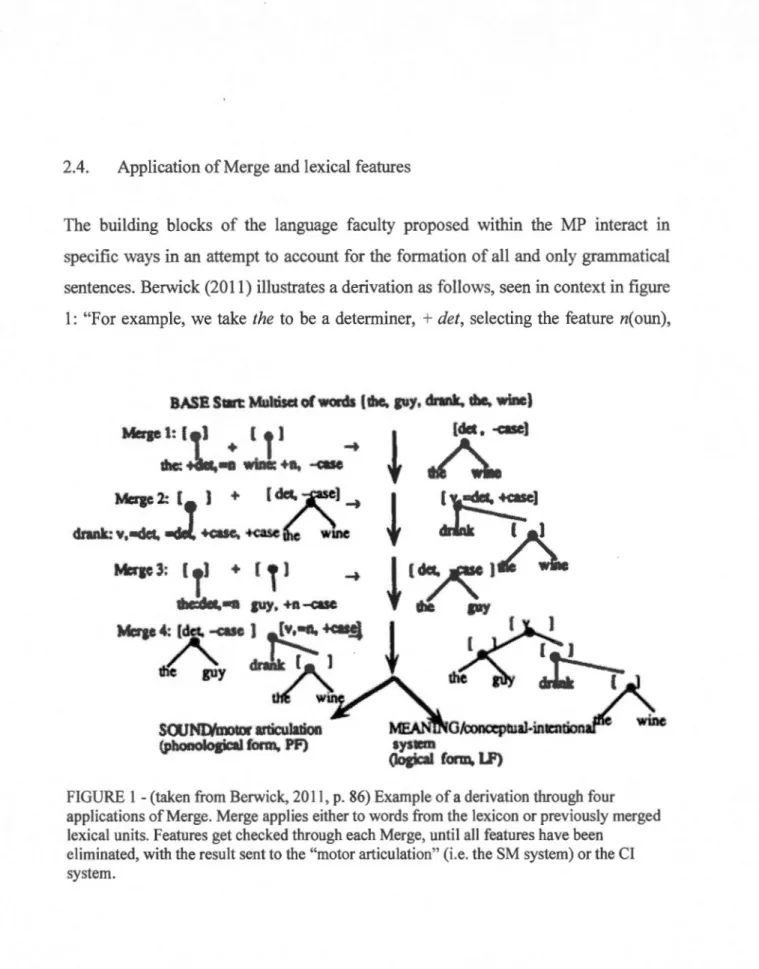
until all features are checked, resulting in a well-formed sentence (Berwick, 2011, p. 87). In Chomsky's writings, Merge has corne to replace recursion as the uniquely human linguistic capacity, rebutting some of the critiques levelled at the Hauser et al. (2002) article. It will however become clear that his approach offloads the
computational complexity onto the lexical features, seemingly allowing Merge to be the simple algorithm needed for the saltationist argument. As will be shown, Chomsky's reliance on the Minirnalist prograrn effectively resolves the critiques
levelled at him in chapter 1, but opens him up to other critiques formulated in chapter
III.
Researchers have rejected Chomsky's ideas regarding the evolution of language on
many fronts. Needless to say, his saltationist and non-adaptationist conclusions are
often viewed unfavourably, but few have been able to point out inherent problems
within Chomsky's account. Sorne will invoke previously formulated alternative
hypotheses, often developed by researchers outside the field of linguistics, approaching the question from another angle (see for instance the research mentioned
earlier by Lieberrnan et al., 1969, Lieberman 2002; Dunbar, 1996; Savage-Rumbaugh & Lewin, 1994; Savage-Rumbaugh et al., 1996, 1998). Others will accept Chomsky's
approach to linguistics in general, but argue that the empirical evidence does not---or
likely will not in the future- support his theories (cf. Pinker & Jackendoff, 2005;
Jackendoff & Pinker, 2005; Bickerton 2009b, 2009c). In chapter III, I propose instead
to argue from within Chomsky's framework and reveal through careful examination
that his theory contains certain inconsistencies. I argue that Chomsky's new approach
fails because it must disregard the use of lexical features in order to maintain its
saltationism. I explore in greater detail the explicit saltationist arguments as found in Chomsky (2010) and Berwick & Chomsky (2011) to show that the appearance of
lexical units is assumed to have happened before Merge. As has been remarked ·
explicitly or implicitly in a handful of articles (cf. Bickerton, 2009b; Jackendoff,
2010; Boeckx 2011; Clark, 2013), but not fully fleshed out into a strong argument, the evolution of lexical items and features is a major stumbling block for Chomsky's saltationist argument. I argue that it is more plausible for Merge to have developed
much earlier, with lexical features arriving later and developing gradually, eventually
allowing for the linguistic competence we now have.
Through careful examination of the premises and arguments advanced by Chomsky
and his co-authors, I will demonstrate that Chomsky's arguments for language's
development through saltation fail to capture the implications of the various
interacting mechanisms of language that he himself proposes. In so doing, I show that his theory is at best incomplete, and at worst incoherent. It furthermore suggests
that if the Minimalist Program is to have a strong impact on language evolution
debates, more research is required into the relation between words, concepts, and
lexical features, a path which has the potential to lead to a more plausible, intuitive,
1.1. Concepts of evolution
Before delving into language evolution proper, a few of the central concepts of
evolutionary theory must be defined in order to properly situate the discussion in
Hauser, Chomsky and Fitch (2002; henceforth HCF) and Chomsky's writings.
Interestingly however, many of the discussions on language evolution that will be
surveyed in this paper do not engage in significant ways with much of the work in
biology or the conceptual distinctions proposed in the philosophy of biology3. This is
undoubtedly a lacuna, as many arguments rely on sometimes poorly understood
principles of evolutionary biology, especially in the articles Chomsky has published
after his work with Hauser and Fitch (see chapter III). In any case, no matter the
accuracy with which it is deployed by Chomsky or others, background knowledge of
central and relevant themes in evolution is necessary to properly understand the issues and arguments pertaining to language evolution.
Because this thesis focuses specifically on Chomsky's theoretical framework, 1 will
mostly be relying on concepts he himself has used, namely exaptation and
saltationism, which are, for the most part, sufficient for the purposes of my critiques.
3
Other sources of course do approach the issue from the biological perspective, but they generally do
1.1.1. Adaptation
Evolution is "the theory of the change of organic species over time" (Sloan, 2010).
Lewontin has characterized our contemporary understanding of evolution through
three necessary building blocks of evolution: (1) variations in morphologies,
physiologies and behaviour ("phenotypic variation"), which leads to (2) varying rates of survival and reproduction ("differential fitness"), which must also be (3) heritable
("fitness is heritable") (Lewontin, 1970, p. 1 ). Acting upon these mechanisms is
natural selection, famously proposed by Darwin (1859), which will tend to eliminate
those organisms with the least fitness, leading to change in the population over time.
The typical assumption within the theory of evolution is that traits which are present
in a species are adaptations. (However this assumption is sometimes faulty, as will be
shown in the next section.) Adaptations are traits that have been favoured by natural
selection (Laland & Brown, 2011, p. 92), meaning that they are adapted to a specific
environment, or niche.
1.1.2. Exaptation
Y et not all traits are selected for. Williams (1966), an influential evolutionary
biologist, stated that "adaptation is an onerous concept that should be used only
where it is really necessary" (p. 4 ). In the same vein, Gould and Lewontin (1979) in
their well-known article "The Spandrels of San Marco" argue that evolutionary
biologists too often assume that the only explanation for any given trait is that it is an
adaptation. Many factors other than adaptation can explain the presence of a given
trait, such as architectural constraints (p.15), by-products of other adaptations,
and Vrba (1982) coined the term "exaptation" to refer to a trait which contributes to the fitness of an organism without having been selected for that specific fonction.
An exaptation is a trait that is currently useful for a given fonction, but whose
historical development is not (at least not exclusively) the result of selection for that fonction. In the words of Gould and Vrba: "such characters, evolved for other usages (or no fonction at all), and later "coopted" for their current role, [are] called
exaptations" (1982, p. 6). For example, the development of feathers in birds
apparently happened before flight, implying that feathers could not have developed as
an adaptation for flight, despite their obvious contemporary importance with respect
to that fonction. Gould and Vrba mention a few hypotheses regarding their origin,
such as the possibility that they developed for insulation, only later being exapted for
flight (ibid., p. 7). Note that this does not exclude the fact that feathers or any other
exaptation could have subsequently evolved for that new fonction, only that at some
point previously in the trait's development, it was not selected for the current
fonction. Exaptations and adaptations are thus not mutually exclusive.
1.1.3. Gradualism versus saltationism
Another typical assumption within the theory of evolution is that changes within a
population happen gradually. Darwin believed that "Natura non facit saltum'', which is to say that evolutionary change must happen in small successive steps rather than great leaps. He even stated that "if it could be demonstrated that any complex organ
existed, which could not possibly have been formed by numerous, successive, slight
modifications, my theory wçmld absolutely break down." (Darwin 1859, p. 189) For Darwin, and indeed in the mind of many, evolution must be the result of slight variations in successive generations.
But Darwin's gradualism came under fire by saltationists as soon as it was proposed. Even his supporter Thomas Huxley, "Darwin's bulldog", warned him in a letter that he had loaded his work "with an unnecessary difficulty in adopting 'Natura non facit
saltum' so unreservedly" (Huxley, 1859). The debate continues into the twentieth
century, with Richard Goldschmidt (1940, paraphrased in Gould 1980) proposing that every so often, a great mutation will produce a "hopeful monster", which may lead to a rapid, discontinuous change from one generation to the next. This idea is later defended by Stephen Jay Gould, who ex plains Goldschmidt' s idea in the following way:
new species arise abruptly by discontinuous variation ... every once in a while a macromutation might, by sheer good fortune, adapt an organism to a new mode of life, a "hopeful monster" in his terminology. Macroevolution proceeds by the rare success of these hopeful monsters, not by an accumulation of small changes within populations. (Gould, 1980, p. 24)
Gould then goes on to illustrate the success of such an approach through examples of species which have features that purportedly allow for no intermediate graduai steps. For instance, a certain genera of boid snakes have a movable joint in the center of the upper jaw, which seems to have no possibility for graduai adaptation: "How can a jawbone be half broken?" (Gould, 1980, p. 26) This is precisely the type of argument invoked by HCF and later Chomsky for their saltationist claims.
Saltationism is often associated with speciation and punctuated equilibrium, but that association is not fully warranted in either case. As testified by the quotation in the previous paragraph, saltations can accow1t for speciation, but speciation can also happen through graduai evolution, for instance in the case where a given population is segregated from another for long enough that the graduai changes amount to a new species. Punctuated equilibrium is a theory that proposes that those graduai changes . that lead to speciation typically happen in bursts (on a geological timescale) rather than slow accumulation of slight changes (Gould & Elderedge, 1977). Although the
changes leading from one species to the next are thought to be rapid, they are nevertheless gradual and not saltational (Gould, 2002). Saltations thus do not equate with speciation, although they are one way in which it may happen.
The discontinuous changes proposed by saltationists are generally not the result of a great overhaul in the genes. Instead, it is thought that small changes in genotype can result in qualitatively large changes in the phenotype. Thiessen (2009) defines saltational evolution as "a genetic modification that is expressed as a profound phenotypic change across a single generation and results in a potentially independent lineage" (Theissen, 2009, p. 46). Saltations are thus not thought to arise through large genotypic changes, which would be highly improbable, but rather through small changes that in volve large effects. Y et as Shapiro (2011) demonstrates, even genotypic variation is not as simple as was once believed: "our view of genome change has become one that describes active cell processes rather than a series of random accidents." (p. 129) Shapiro calls these processes 'natural genetic engineering', which "range from horizontal gene transfers and the movement of transposable elements through chromosome rearrangements to whole genome duplications and cell fusions." (p. 128) These new discoveries in genetics, coupled with the possibility that small genotypic changes can lead to great phenotypic transformations, show that "clear evidence exists for abrupt events of specific kinds at all levels of genome organisation." (Shapiro, 2011, p. 128).
The defenders of the saltationist approach all concede that the traditionally upheld small incremental changes exist, but nevertheless attribute a non-negligible role to saltational events. As Theissen (2009) explains: "Advocates of these views often do not completely deny gradual changes (typically during adaptation or microevolution), but consider them unable to explain the origin of phenotypic novelties, or species and higher order taxa." (p. 44) For some, such as Gould, the role of saltation should not be overstated: "my own betting money goes on a minor and infrequent role" (Gould
2002, p. 1146, quoted in Clark, 2013, p. 182). However as Chouard (2010) has
written in a news feature in Nature, other saltationists believe that "single-gene
changes that confer a large adaptive value do happen: they are not rare, they are not
doomed and, when competing with small-effect mutations, they tend to win." (p. 864)
One way or the other, saltations seem to be more and more accepted as a plausible evolutionary scenario, at least in certain cases.
As shall be shown in the next section, Chomsky and his collaborators argue that
language was made possible by the appearance of recursion, which allowed the
exaptation of the various cognitive mechanisms which comprise the faculty of
language (FLB). Insofar as such a minor novelty (recursion) is expected to have
yielded such a drastic change in cognitive capacities (language), the approach can be labelled saltationist. The approach is then justified through an argument similar to that advanced by Gould (1980): recursion (defined in section 1.4) cannot be half there; it is either present or it is not, implying that it can only appear in a single step.
1.2. FLN/FLB distinction
1.2.1. The distinction defined
As mentioned earlier, the study of the evolution of the faculty of language is
interdisciplinary as language itself calls upon so many aspects of the human organism for its implementation. With so many different disciplines involved, clashes between theoretical frameworks and misunderstandings about the definitions of terms are bound to happen. At the very center of many misunderstandings has been the most
fundamental term itself: "language". No consensus exists regarding its definition: for
instance, for some linguists language is defined as the computational mechanisms
divorced from the context in which it is used; for anthropologists or psychologists it is often synonymous with human communication in general. Reacting to this perceived problem, Hauser, Chomsky and Fitch (HCF 2002, Fitch, Hauser and Chomsky 2005; henceforth FHC), propose and refine a distinction ostensibly meant to facilitate cross-disciplinary study of the evolution of language. The faculty of language is thus divided into the two following conceptions:
(i) FLB, Faculty of Language -Broad, is the group of organism-internal systems used for the production and comprehension of language. FLB also includes within it FLN.
(ii) FLN, Faculty of Language - Narrow, is the subset of mechanisms in FLB which are uniquely human, and unique to language.
This conceptual distinction is intended to clarify which aspects of language different researchers are focusing on, and defuse any arguments about whether language ought to be defined as communication or as mental computations. As HCF point out:
"many acrimonious debates in this field have been launched by a failure to
distinguish between these problems" (p.1569). Thus, not only is this distinction made to facilitate communication across disciplines, it allows researchers to continue their respective research programs without treading on each other's toes. But though this distinction may be 'politically' savvy, Churchland (1986) has argued that such an approach may not always be in the best scientific interest. She maintains that in the case of neuroscience and psychology, the disciplines ought not be conceived as tunnelling through a mountain from opposite ends with the objective of meeting one another "because the co-evolution [of the disciplines] typically is far more interactive than that, and involves one theory's being susceptible to correction and reconceptualization at the behest of the cohort theory." (Churchland, 1986, p. 373) The same argument applies to any disciplines which work on the same broad issues, as is the case with language evolution. However the distinction is meant to do more than simply resolve differences between disciplines: it is also intended as a guide to empirical research across disciplines.
Indeed, the interest in the delineation of FLN is also to isolate what it is that humans possess which allows us to have language as we do. Since no other animal is able to
communicate with human language, it is clear that humans possess certain capacities
which are not found in any other species. Although HCF propose contents for FLN
(discussed Jater), the authors do remark in the subsequent article that FLN "could
possibly be empty, if empirical findings showed that none of the mechanisms
involved are uniquely human or unique to language, and that only the way they are .
integrated is specific to human language." (FHC, 2005, p. 181) The conceptual
distinction between FLB and FLN thus raises the question as whether there are uniquely human and linguistic capacities and what those capacities are. This in turns leads to theoretical and empirical investigations regarding how and when they might have appeared in our lineage. The interest in FLN is therefore not a hubris-inspired hunch about human exceptionality, but rather an evolutionary-minded question about human-specific adaptations.
1.2.2. FLB and its contents
HCF not only propose the FLN/FLB distinction, but also put forward hypotheses
about the contents of each, starting with FLB. As defined above, they propose that
FLB includes FLN, but also "at least two other organism-internal systems, which we
call "sensory-motor" and "conceptual-intentional"" (p.1570-71). Since both these
systems are assumed to not be unique to language and humans, HCF point out some
promising research in comparative biology in these areas. Regarding the role of the sensory-motor system, HCF applaud research done into vocal imitation and invention
in songbirds or dolphins, constraints imposed on vocal tract anatomy in primates, or
the capacity for discrimination of sound patterns in language (p. 1573). The conceptual-intentional system for its part involves such aspects as theory of mind and
concept acquisition, with research clone on the seeing/knowing distinction in
chimpanzees, referential vocal signs in primates, and intentional communication (for
a complete list of the research commended by HCF, see Table 1, p.1573). HCF also
leave open the possibility that there may be other systems to be included. Although these two systems are not accepted by all as discrete modules within the mind (see e.g. the work in cognitive linguistics: Croft & Cruse, 2004), HCF maintain that these
systems which they include in FLB internet in various ways, accounting for human
language production and comprehension.
The FLN/FLB distinction may seem fairly straightforward at first glance, but begins
to seem a little more confusing when the authors propose that there are parts of the
organism which play a supporting role in language production and comprehension,
but still don't make it into FLB. According to their conceptualization, FLB "excludes
other organism-internal systems that are necessary but not sufficient for language
(e.g., memory, respiration, digestion, circulation, etc.)." (HCF 2002, p. 1571) The exclusion of these systems is somewhat intuitive insofar as it is easy to recognize that, for instance, respiration does not play a pivotal role in language production or
comprehension (especially when sign language is taken into account). Furthermore,
one does want to find a way to exclude parts of the organism that are clearly
irrelevant, such as the immune system or a sense of balance. But the characterization
of these parts as "necessary but not sufficient for language" is inadequate, since any
of the other parts of FLB taken in isolation, including FLN, is necessary but not
sufficient for language (since it is taken for granted that it is only through their
interaction that we produce language ). It furthermore cannot be that all the contents
of FLB as understood by HCF are sufficient for language, since clearly memory at the
very least is necessary.
If it is confusing to decide what should be excluded from FLB, it is aise difficult to settle on the conceptual basis for inclusion in FLB. Necessity and sufficiency do not
seem to be the appropriate boundaries for the conceptual distinction if the boundaries are to be drawn where HCF intended them to be. Not only does it give rise to the problems above, it also proves difficult to use when one tries to distinguish which parts of the sensory-motor systems are recruited. For instance, sign language does not involve auditory channels or articulatory muscles, and vocalized language can do
without visual eues. What does it mean then to say that the sensory-motor system is
part of FLB? What must be intended is some abstraction of the particulars of the
sensory-motor system, or perhaps some sort of high-level conversion of the outputs
of the other language-faculty modules to whatever motor output is recruited (and presumably the same thing the other way around for the input). Nevertheless, it is perhaps legitimate to speak of the sensory-motor system generally without having to specify the particulars if we assume that there are processes that will be recruited no matter the medium used to communicate. But the question remains: which specific parts of the sensory-motor system should be included within FLB? One can hope that the distinction will serve precisely to clarify such questions, leading to empirical
research regarding specific aspects of the systems in FLB which are recruited, in
which case a certain amount of vagueness in its delineation is warranted, and
assumed to be temporary.
In any case, since the focus of the present work is specifically about the saltationist
argument regarding language evolution, which itself relies on FLN and its contents,
the problems concerning FLB's unclear delineation need not be resolved here.
Fortunately, the FLN distinction is fairly clearly defined, though the same cannot be
said of its content, leading to problems which corne into sharp focus when seen in the
1.3. FLN and the saltationist argument
1.3 .1. The so-called "recursion-only" hypothesis
The contents of FLN were defined in HCF, but unfortunately in such a way that it has led to much confusion and debate which could have been avoided. In the abstract of the article, HCF "hypothesize that FLN only includes recursion'', understandably leading Pinker and Jackendoff (2005) to characterize HCF's position as the
"recursion-only hypothesis" (p.204). This was an unfortunate coining of the term as it tums out that there never was a "recursion-only hypothesis". Sorne years later, Fitch and Hauser both explicitly wrote that they "regret certain editorial decisions that perhaps made our argument more opaque than desirable" (Fitch, 2010, p.75), and put forth a "mea culpa for unfortunate cutting of corners in the abstract of Hauser,
Chomsky and Fitch (2002)" (Hauser, 2010, p.94). HCF apparently never meant anything like the "recursion-only hypothesis", and point out (Chomsky, persona! communication, Oct. 25th 2013) that they explicitly state in the article that "FLN comprises only the core computational mechanisms of recursion as they appear in narrow syntax and the mappings to the interfaces" (HCF 2002, p. 1573, emphasis mine). Recursion thus is meant to interface with the conceptual-intentional and sensory-motor systems in specific ways (and presumably any other system that may be contained in FLB). Those interfaces are thus included in FLN, and are meant to account for certain unique aspects of language.
1.3.2. Critiques by Pinker and Jackendoff
But, of course, what precisely "the mapping to the interfaces" means has also tumed out to be problematic. First, Jackendoff and Pinker, in their response to FHC 2005, raise the question as to whether the sentence is to be understood as the "mechanisms
of recursion as they appear in [ syntax and the mappmgs to the interfaces]" or
"[mechanisms of recursion as they appear in syntax] and [the mappings to the
interfaces]" (Jackendoff & Pinker, 2005, p. 217). In other words, it is not clear whether the sentence is meant to convey that it is recursion which is in both the
narrow syntax and the interfaces which is to be considered FLN, or whether the
recursion is only in the narrow syntax, and the mappings themselves are not
(necessarily) recursive. Second, as Jackendoff and Pinker (2005, p. 217) point out, it is unclear what the mappings to the interfaces are supposed to mean as it is never
truly spelled out in either HCF or FHC. As we shall see later, Chomsky does provide
more explicit explanations on this front in later articles (but as will also be shown, those explanations raise their own problems).
Jackendoff and Pinker also made it clear that it was possible, as they did, to interpret
the characteristics of FLN ( viz. being unique to language and unique to humans ), in a
more gradua! way than HCF (and FHC). They propose that a given trait may be
included in FLN if it has "been modified in the course of human evolution to such a
degree that it is different in significant aspects from its evolutionary precursors[ ... ], though not necessarily different in every respect" (Jackendoff & Pinker, 2005, p.
214). Thus, although they adopt the FLB/FLN distinction, they place within FLN
many other components of the language faculty, such as phonology, certain parts of
concept formation, words, speech perception, etc. With respect to phonology for
instance, Pinker and Jackendoff state: "It appears that some of the combinatorial
properties of phonology have analogues in some species of birdsong, and perhaps in
some cetacean song, but not in any primates; if so, they would have to have evolved
separately in humans" (Pinker & Jackendoff, 2005, p. 212). FHC for their part reject
this approach in favour of a more strict delineation, all the while conceding that other
researchers have defined FLN differently, "leaving the possibility of a more inclusive
1.3.3. Language's appearance through saltation
Such restrictions on admittance to FLN allow HCF to advance claims that it is not the
result of adaptation but rather of a single random mutation. Whereas the contents of
FLB may have "an ancient evolutionary history long predating the emergence of
language", the hypothesis that FLN contains only recursion allows them to argue that
"if FLN is indeed this restricted, this hypothesis has the interesting effect of
nullifying the argument from design, and thus rendering the status of FLN as an
adaptation open to question" (HCF 2002, p.1573). In other words, all prerequisites for
language were already in place when recursion appeared, thus allowing the
components of FLB to be exapted for language, implying that the faculty of language
was not shaped as an adaptation for language. HCF leave the door open as to the
origin of the sudden use of recursion in language, stating both that it "appears to lack
any analog in animal communication and possibly other domains as well" (p.
1571)-suggesting that it was a novelty in the biological world at the time of its
appearance-and that it may be used "to solve other computational problems such as
navigation, number quantification, or social relationships" (p. 1578) in humans or
other species-suggesting that it may be an exaptation itself. The latter seems more
plausible insofar as the capacities of navigation and social relationships certainly are
present in other species, but it needs to be shown that they too rely on recursion.
The saltationist argument also implies that language could not have evolved
gradually, becoming more and more complex as adaptation ran its course, but rather
appeared at a single moment in our species' history. This also precludes the
possibility of a proto-language, on the premise that language is defined as the whole
of FLB, including FLN. Thus, even if pre-linguistic communication could be shown
FLN, any talk of mechanisms related to communication cannot be referring to language.
HCF therefore implicitly hold a saltationist approach to language evolution, as
opposed to a gradualist one (as we shall see in chapter III, in subsequent publications
Chomsky has made his saltationist approach more explicit). As explained earlier, if
no intermediate steps can be imagined between a trait's absence and its apparition,
then there is a good chance that it is the result of saltation. HCF claim that this is the
case when stating that "we see little reason to believe either that FLN can be
anatomized into many independent but interacting traits, each with its own
independent evolutionary history, or that each of these traits could have been strongly
shaped by natural selection" (p.1574) In contrast, if FLN contains only a single
component, it is plausible to maintain that it appeared through one random mutation,
especially if that component is thought to be very simple, yet able to account for the
sudden appearance of a fully-formed language capacity.
HCF unfortunately never define recursion, despite the fact that it plays such a central
role in their theory, and according to them, in language itself. The closest they corne
to defining it is by explaining that recursion "takes a finite set of elements and yields
a potentially infini te array of discrete expressions" (HCF, p. 1571 ), without
explaining how this is done. In the next section I will explore various definitions and
show that the choice of definition has a strong impact on the claims in HCF.
1.4. Recursion defined
The ·notion of recursion is used in many disciplines, and its precise definition often
differs depending on the context. Generally speaking, recursion is a process whereby
illustration of this is to be found in an image which contains within itself the very
same image, which itself contains the very same image, and so on. In computer
science, a function or algorithm is recursive when the process calls upon itself in its
own generation (Fitch, 2010). In linguistics, recursion has often been assumed to be
central to language production, yet until recently, rarely rigorously and formally
defined. As has been pointed out many times (cf. Parker 2006, Tallerman et al. 2009,
Karlsson 2010, Fitch 2010), even linguistic recursion can be defined in many ways.
The following are two distinct definitions which are both employed in linguistics.
1.4.1. Recursion - definition 1: embedding
A definition that was long used (often implicitly) in generative grammar is the
following, sometimes referred to as "self-same embedding" and hereafter named
"recursion-embedding":
(iii) Recursion-embedding: the capacity for an algorithm to insert a structural
unit of a particular type ( e.g. no un phrase, sentence) within another unit of the
same type (Tallerman, et al., 2009, p. 140).
This is the type ofrecursion which was found in Chomsky's earlier writings, at least
as early as Syntactic Structures (1957), where the explicit goal was "the construction
of a grammar that can be viewed as a device of some sort for producing the
sentences" (p. 11) of a given language. That "device" takes the form of a set of
rewrite mies which constructs sentences from the top down. The following
illustration is proposed by Bickerton (2009a, pp. 241-242): a given sentence S can be
subdivided into a noun phrase (NP) and a verb phrase (VP). Thus we have the rule:
(iv) S -+NP VP
These phrases as well contain var1ous elements, such as determiners (Det),
prepositional phrases (PP), as well as verbs (V) and nouns (N), yielding the following
(v) NP - (Det) N (PP) (S) (vi) VP - V (NP (NP) (PP) (S) (vii) PP - P NP
These are recursive rules since S contains within it NP and VP, which each in turn contain S, implying that sentences can be inserted in sentences. A NP can also be contained within a NP through the PP rule. This type of recursion is found in sentences su ch as (the notation is simplified for ease of reading):
(viii) [John thinks that [Mary loves Jake.]s]s (ix) [The <log on [the dock]NP]NP is noisy.
This set of rules therefore allows the production of an infinite set of sentences
through finite means, since the recursion ensures that rules can be repeated infinitely.
1.4.2. Recursion - definition 2: cyclical
A second way to define recursion bas become popular in the Minimalist Program in linguistics (cf. Nevins, Pesetsky,
& Rodri
gues 2009, Rizzi 2009). Researchers in the program posit that one of the central, if not the only, mechanism in language is 'Merge', which joins two units into a single unit, and can potentially do so an infinite number of times, using its own output as input (Bickerton, 2009c ). According to thisapproach, recursion has the following broader definition, hereafter referred to as
"recursion-cyclical":
(x) Recursion-cyclical: "the property whereby certain formal rules or rule
systems reapply to their own output" (Tallerman et al., 2009, p. 140)
Merge can join previously Merged units with other units, meaning that it can be applied to its own output indefinitely, and as such, is a recursive process. Note that Merge is not the only process that abides by recusion-cyclical: by definition, any
process which can take its previous output as input is considered recursive. Unlike recursion-embedding, this type of recursion creates a bottom-up approach to sentence
construction since it begins with the basic lexical units and constructs sentences by adding additional units. Merge and this type of recursion will be discussed in detail in
section 2, as it has corne to be central to Chomsky's views on language evolution.
1.4.3. Effects of recursion
Whether relying on definition 1 or 2, an important effect of recursion is that it is able
to produce a boundless number of sentences using finite means. This point has been
raised countless times by Chomsky ( eg. 1957, 1966, 2000a, 2005), as well as in HCF
(p. 1571) and is seen as an essential feature of the faculty of language. Of course
within anyone's finite lifetime it is impossible to produce or observe an infinity of
sentences, and it must be inferred from available data and starting assumptions. By
definition, both definitions of recursion are combinatorial processes which join
discrete units (words or parts of sentences) into sentences which are boundless.
However it needs to be noted that other types of algorithms, in particular iteration,
can also create a boundless number of strings from finite means. An iterative
algorithm is one which has the capacity to repeat its own process potentially
. infinitely, just as a recursive one does. Indeed the distinction between these two types
of algorithms can be difficult to grasp, since one might be tempted to think of one as
a subclass of the other. However that is not the case, as each proceeds in different
ways, yielding significant differences.
The most significant difference is recursion's capacity for building a hierarchical
structure within its constituents. Indeed it has long been recognized that sentences
adhere to a hierarchical structure, thus accounting for the long-range dependencies
between parts of sentences (e.g. subject-verb agreement, reflexives, etc.). A recursive
hierarchy. As Karlsson (2010) explains, an iterative algorithm, for its part, will not
produce a hierarchical structure, yielding instead "flat output structures, repetitive
sequences on the same depth level as the first instance." (p. 2) It follows, as Rizzi
(2009) points out, that mere iteration of a process is not sufficient to claim it is
recursive despite the fact that it too could produce a boundless nurnber of sentences
using finite means. According to him, it is also "its capacity to create a hierarchical
structure" (p.65) which is tell-tale of the recursive nature of a given algorithm. One
important thing to remember however is that any structure created in language is only
ever inferred, since extemalized language is always serialized and therefore
transformed into a flat structure for output. This compounds the difficulty in
differentiating between a recursive and an iterative algorithm since, as shall be
explained in the next section, in most cases the serialized output of an iterative
algorithm can be made to match that of a recursive one.
1.5. Critiques to recursion-only
In this section I will explain two critiques that have been levelled at the
recursion-only hypothesis, and show how they are not as potent as the authors expected them to
be. The first is some corpus analysis done by Karlsson (2010), wherein he shows that
the outputs of recursion-embedding are for the most part able to be reproduced
through mere iteration. Furthermore, those examples which are unambiguously
recursive-embedding are exceedingly rare, implying that recursion cannot be a central
part of language. The second critique is Dan Everett's well-known and controversial
claim that there exists a language, Pirahâ, which does not contain recursion. As we
shall see, both these attempts to rebut the recursion-only hypothesis fail to do so,
among other reasons because they attack a straw man in assuming that recursion can
only be defined through embedding, as described in definition 1 above. As will be
publications (Chomsky, 2010; Berwick & Chomsky 2011), rendering critiques to
recursion-embedding obsolete (whether the choice of recursion-cyclical is superior is
another matter: see Everett, 2009, p. 437-438 for a brief discussion regarding this
issue). Nevertheless, at the time these critiques of HCF seemed important, still raise important points, and so are addressed here.
1.5 .1. Karlsson: "True" recursion is rare
Karlsson (2010) claims that the recursion-only hypothesis does not stand up to
scrutiny because it simply is not manifest enough in spoken and written language.
The first thing Karlsson notes is that much of recursion can be mimicked by iteration.
lndeed, algorithms that specify sequential arrangement can corne in at least two
forms: recursive and iterative. As mentioned earlier, whereas a recursive process will
call upon its own output to yield a hierarchically structured output, "iteration yields
flat output structures, repetitive sequences on the same depth level as the first
instance." (Karlsson, 2010, p. 2) Yet the difference between the two is not obviously apparent in the output, since externalized language is always linear, and the depth of structure (should there be any) can only be inferred through analysis. In light of this,
Karlsson claims that only very specific kinds of recursion-embedding are not
convertible to iteration. Recursion-embedding cornes in two subtypes: nested
recursion and tail-recursion. Tail-recursion adds components to the left or the right of
a given structure; nested recursion 'splits open' the existing structure to add
components in the middle. Sentence (viii) above is an example of tail recursion,
repeated here for convenience:
(xi) [John thinks that [Mary loves Jake.]s]s
(xii) [A lot of the housing [that the people [that worked in New Haven] lived in]
was back that way.] (Reich and Dell 1976, quoted in Karlsson 2010, p.8)
According to Karlsson, only nested recursion is not algorithmically convertible to iteration, and therefore "nested recursion ( center-embedding) is recursion par excellence" (Karlsson, 2010, p. 6).
Karlsson then goes on to show through analyses of large corpus data of European
languages that nested recursion is in fact quite rare, whether in written or spoken
language. The maximum level of center-embedding for written language is 3, and for
spoken 2, and appears so rarely in spoken language (twice in the hundreds of corpuses analysed) that Karlsson considers it "practically absent from ordinary spoken language" (p. 8). He then concludes that recursion "cannot therefore
reasonably be considered a central design feature of language, as claimed by Hauser,
Chomsky, and Fitch (2002)" (Karlsson, 2010, p. 8) since in the great majority of cases it is replaceable by iteration.
1.5.2. Critique of Karlsson
Two possible rebuttals from Chomsky corne to mind, which Karlsson effectively
dodges. The first of those criticisms regards the relevance of corpus analysis to
linguistics. Chomsky's criticism in this respect relies on the well-known
competence/performance distinction he introduced early in his career. The distinction casts serious doubt on the relevance of research done on corpuses, since analyses of performance cannot be directly transferable to competence. However in the context of evolution this distinction does not apply directly: natural selection cares not a whit about competence, and selects only on the basis of performance. Research into performance is thus very relevant to language evolution. The second critique relates to Chomsky's emphasis on parsimony in explanations in linguistics (a desideratum