OATAO is an open access repository that collects the work of Toulouse researchers and makes it freely available over the web where possible
Any correspondence concerning this service should be sent
to the repository administrator: [email protected]
This is an author’s version published in: https://oatao.univ-toulouse.fr/25684
To cite this version:
David, Laurent and Lemkecher, Fatma and Chatellier, Ludovic and Dewitte, Manon and Courret, Dominique and
Doessegger, Andreas Downstream fish passage technologies for small-to-medium hydropower plants: part I. (2019) In: Congrès HydroEs 2019 (Hydro Energy & Sustainability 2019), 29-30 January 2019 (Grenoble, France)
DOWNSTREAM FISH PASSAGE TECHNOLOGIES FOR
SMALL-TO-MEDIUM HYDROPOWER PLANTS: PART I
Technologie de dévalaison des poissons pour les petites et moyennes
installations hydroélectriques : partie 1
Laurent David1, Fatma Lemkecher1, Ludovic Chatellier1, Manon Dewitte1,2, Dominique Courret2, Andreas
Doessegger3
1 Institut Pprime, CNRS, Université de Poitiers, ENSMA, Poitiers, France
[email protected], [email protected], [email protected],
2 Agence Française de la biodiversité– Pôle Ecohydraulique, AFB-IMFT-Université de Toulouse-CNRS,
Toulouse, France
3 Limmatkraftwerke AG, Baden, Switzerland
KEY WORDS
Downstream fish migration, fish guidance structures, inclined and angled bar racks, modified bar racks, low bar spacing
Dévalaison des poissons, structure de guidage, grille orientée et inclinée, grille à barreaux modifiés, faible espacement entre barreaux.
ABSTRACT
Hydropower plants (HPPs) can block or delay fish migration and cause fish injuries or mortalities during the turbine passage. In the scope of the EU Horizon 2020 research project “Fishfriendly Innovative Technologies for hydropower” (FIThydro), different solutions for downstream migration are studied, applied and compared in different test cases. In particular, Fish Guidance Structures (FGS) with a behavioral or physical effect on fish can be effective solutions to protect and guide downstream migrating fish towards bypasses at water intakes of HPPs. However, these structures should not impair the hydroelectric operation.
In this first part, inclined and angled bar racks with low bar spacing are proposed as a solution for small to medium hydropower plants. In the second part of Albayrack et al, 2019, solutions for medium to large HPPs are discussed.
Head loss and upstream and downstream velocities fields are important criteria to choose the most efficient solution for both fish protection and hydroelectric operation. In this paper, different solutions with low bar spacing are proposed and discussed for two small and medium HPPs in relation to these different criteria.
Introduction
Since 2000, several European and national Directives have raised the global concern about fish mortality during migrations, especially for diadromous species such as European eels, sea trout or salmon smolts. During downstream migration, fish may face hydropower plants and may have to cross turbines. Several studies have shown that fish may be lethally injured during their passage through turbines (Monten, 1985, Larinier, 2008, Gomes & Larinier, 2008). In order to address this issue, several solutions have been developed to prevent fish from being injured, such as fish-friendly turbines, but most of them have a restricted operating range and are difficult to install to replace existing turbines. Alternatively Fish Guidance Structures (FGS) with a behavioral or physical effect on fish can be effective solutions to protect and guide downstream migrating fish at water intakes of HPPs (Bates & Vinsonhaler, 1957; Electric Power Research Institute [EPRI] & Dominion Millstone Laboratories [DML], 2001; Boes & Albayrak, 2017, Courret & Larinier, 2008, Raynal et al, 2015, Tomanova et al. 2018). Their role is to prevent fish from entering into turbines and to guide them toward bypasses.
SHF Conference : «HydroES 2019», Grenoble January2019 David et al.– Downstream fish passage technologies However these structures should not impair the hydroelectric operation, with acceptable head-losses and no significant perturbation of inlet flow conditions of turbines.
In 2008, leaning on literature and many in-situ assessments of bypass efficiency, Courret and Larinier defined the conception and dimension bases of fish-friendly trashracks with a narrower bar spacing and an angle to the flow. Trashracks may therefore be either inclined from the floor or angled from the bank. Criteria concerning the dimensions (width, water depth), entrance velocity and positioning of bypasses are also defined (Courret et al. 2015). In the context of the EU Horizon 2020 research project “Fishfriendly Innovative Technologies for hydropower” (FIThydro), different solutions for downstream migration are studied, applied and compared in different test cases.
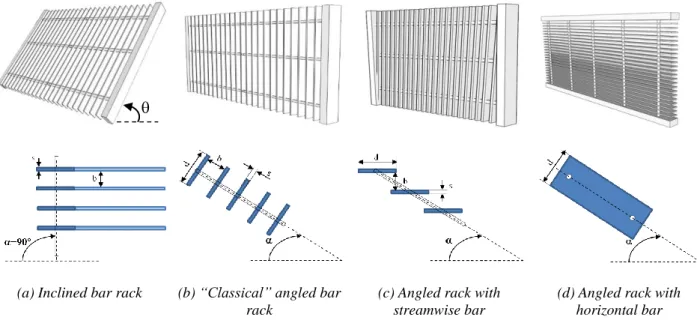
In this paper, inclined and angled bar racks (Figure 1) which are classified as material fish protection barriers and which may function as a physical or as a behavioral barrier, depending on fish size and bar spacing, are studied. Head loss, assessed by formula given by the literature and by new measurements, and upstream and downstream velocities fields are important criteria to choose the most efficient solution for both fish protection and hydroelectric operation. Different solutions with low bar spacing are proposed and discussed for two small and medium HPPs in France and Switzeland in relation to these different criteria.
(a) Inclined bar rack (b) “Classical” angled bar rack
(c) Angled rack with streamwise bar
(d) Angled rack with horizontal bar
Fig. 1: Detailed general view at the top and top view at the bottom of (a) inclined bar rack, (b) angled bar rack, (c) Angled
rack with streamwise barand (d) Angled rack with horizontal bar.
Head loss formulas
Different formulas have been developed during the last 50 years for several rack configurations, bar shapes and bar spacings.
Raynal et al. (2013a) developed a formula to predict the head loss coefficient ξ for inclined trashracks based on extensive laboratory experiments in the case of low bar spacing and low angle :
: 𝜉 = 𝐾𝑖( 𝑃𝑏 1−𝑃𝑏) 1.65 𝑠𝑖𝑛2(𝜃) + 𝐶 ( 𝑃𝑠𝑝 1−𝑃𝑠𝑝) 0.77 , (1)
where Ki is the bar shape coefficient equal to 3.85 for rectangular bars (PR) and 2.10 for
hydrodynamically-shaped bars (PH), C is the support bar shape coefficient given by Kirschmer (1926) equal to 1.79 for cylinders, i.e. circular, and 2.42 for rectangular support bars, rack inclination angle from the horizontal plane, Pb is
the blockage ratio of bars, Psp is the blockage ratio of support bars calculated with 𝑃𝑏=
𝑁𝑏 𝑠
𝐵 and 𝑃𝑠𝑝 = 𝑁𝑠𝑝 𝐷𝑠𝑝
H1 .
For angled racks with vertical bars, Raynal et al (2013.b, 2014) also developped a single equation which may be used for classical and streamwise bar orientations. The Ki coefficient value depends on the bar shape (KPR
= 2.89 and KPH = 1.7) and the effect of the angle α is modeled by the term Kα which varies according to the bar
orientation
𝜉 = 𝐾𝑖( 𝑃𝑔 1−𝑃𝑔) 1.6 𝐾𝛼 (2) where 𝐾𝛼= 1 + 𝑘𝑖( 90−α 90 ) 2.35 (1−𝑃𝑔 𝑃𝑔 ) 3
for perpendicular bars and 𝐾𝛼 = 1 for streamwise bars.
The trashrack-blockage ratio Pg can be split into two contributions, one representing the lateral blockage
ratio Pb due to the bars and the other the blockage ratio Psp due to the support.
𝑃𝑔= 𝑃𝑏+ 𝑃𝑠𝑝 (3)
where : 𝑃𝑏= 𝑁𝑏 𝑠
𝐵 sin 𝛼 for “classical” angled rack, 𝑃𝑏= 𝑁𝑏 𝑠
𝐵 for angled rack with streamwise bars, and 𝑃𝑠𝑝= (1 − 𝑃𝑏)
𝑁𝑠𝑝 𝐷𝑠𝑝
H1 for the 2 configurations.
Recently, measurement conducted by Lemkecher et al (2019) have demonstrated that the head losses for angled trashracks with horizontal bars could also be accurately estimated using the inclined trashrack formula (1) as Ebel (2013) suggested. In this case, this formula is implemented considering that is replaced by α, the rack orientation angle from the flow direction, 𝑃𝑏 =
𝑁𝑏 𝑠
H1 and 𝑃𝑠𝑝 = 𝑁𝑠𝑝 𝐷𝑠𝑝
B with Nb, s, B, Nsp, Dsp and H1 are respectively, the number of bars, the bar thickness, the channel width, the number of vertical support, the support thickness and the upstream water depth. The bar shape coefficient Ki are the same.
Though building a single headloss formula including all possible trashrack parameters remains challenging, it should be considered as an objective for future developments.
Case study hydropower plants
HPP Las Rives is on the Ariège River downstream Foix (France). It is a case study in the FIThydro project. The mean interannual discharge is estimated at 41.8 m3/s and the maximum turbine discharge is 45 m3/s. The
head is about 6 m depending on the Ariège discharge. The HPP is equipped with 3 Francis turbines at the power plant and 2 dive turbines, one on the headrace channel and one other next to the fishpass, with a total installed capacity of 2.7 MW and a mean annual production of 12 GWh.
In 2014, the former rack was changed to have a better efficiency (protection of turbines and downstream migration of female silver eels [> 50-60 cm] and smolts of Atlantic salmon). The rack was moved from the power plant to the head of the headrace channel in order to integrate the downstream migration flow to the minimum flow flowing in the bypassed reach of the river (figure 2). The width of the bar screen is 14 m, the clearance between the bars is 20 mm, the inclination of the trashrack was fixed to 26° and surface of the bar screen is 111 m2 (mean normal velocity to the rack Vn equal to 0.41 m/s at maximum discharge). 3 downstream
migration outlets are located at the top of the bar screen and the flow for the downstream migration is 1.35 m3/s
(3% of maximum turbine discharge).
Watercourse Ariège
Situation : Commune de Varilhes
Inter-annual discharge 41.8 m3/s
Low-water flow : 12 m3/s
Instream flow : 4.6 m3/s
Function of the dam : Hydropower Length of headrace canal : ~ 195 m Length of bypassed reach : ~ 550 m Maximum turbine discharge: 45 m3/s
Species concerned : Salmon, see trout, eel, brown trout
Capacity of HPP 2.7 MW
SHF Conference : «HydroES 2019», Grenoble January2019 David et al.– Downstream fish passage technologies HPP Turgi is located on the Limmat River near the small town of Turgi (Switzerland ; Fig. 4a of Albayrak et al, 2019). The mean annual discharge in the Limmat River is 101 m3/ s for the series 1935-2015
(Fig. 4b of Albayrak et al, 2019). The current design discharge of the HPP is Qd = 35 m3/s with a bulb turbine
of 1 MW. The HPP will be upgraded with a new turbine of 1.9 MW and the design discharge will be increased to 80 m3/s by modifying the head race channel with a width of 30 m. It is also planned to install a FGS with
horizontal bars placed at a rack angle of α = 38°. This type of FGS is widely used at small HPPs up to Qd =
100 m3/s due to its velocity limitation and narrow bar spacing ranging between b = 10 and 20 mm (Ebel 2013).
Head losses prediction for case study HPPs
The headlosses for both HPPs Las Rives and Turgi were calculated using Eqs. 1-3 for trasracks with low bar spacing and four different configurations, for the design discharges Qd = 45 m3/s and 80 m3/s, respectively
with a rectangular bar shape.
As in Raynal et al (2015), the rack angle is determined to comply with the 2 following criteria:
a criterion for fish guidance : Vt/Vn ≥ 1 for angled racks (α ≤ 45°) and Vt/Vn ≥ 2 for inclined racks ( ≤ 26°), with Vt and Vn the components of the velocity tangential and normal to the rack face respectively.
a criterion to avoid impingement of fish on the rack : Vn ≤ 0.5 m/s over the whole rack. For this purpose, results and recommendations of Raynal et al (2013a , 2013b, 2014) and Lemkecher et al (2019) were considered for inclined rack, “classical” angled bar rack, angled bar rack with streamwise bars and angled rack with horizontal bars respectively.
The type of trashrack, the bar size and space, the hydraulic parameters are written in the Table 1. Bars spacers are used for the calculation. They are circular, their diameter is 20 mm and they are separated by one meter. From the different conditions to applied on Vn and Vt, the incidence and the orientation angles are calculated and summarized in the Table 1. Finally, the head loss coefficients and the resulting head losses are evaluated for both parameters in Table 1.
For inclined rack (S1), the angle is determined by the criterion for fish guidance, while for angled racks (S2, S3 and S4) this is by the criterion to avoid impingement of fish. Though headlosses are very high for the classical angled bar rack, they are acceptable (only few centimeters) for the other configurations. The inclined vertical bar rack and the horizontal angled bar rack give approximately the same results (the same formula is used to evaluate them, only the angle changes) and seem to be the best solutions for the two HPPs. The upstream velocity for the Turgi hydropower plant is low and allows to have a larger angle for angled trashrack. Downstream the bar rack, the flow is globally symmetrical and homogeneous for angled trashrack with streamwise bars and horizontal bars and for inclined trashrack. The head losses are smaller for the hydrodynamic bars: between -22% and -42% depending on the rack configuration. The hydrodynamic shape of bars is also interesting to prevent a permanent clogging of the rack due to the blockage of elements between two bars. The head losses are evaluated for clean racks; a suitable cleaning machine (sufficiently efficient and rapid) is then essential to keep it clean. Finally as the economical aspect is also a criteria for the choice of an operational solution, the total length of the bar system and the trashrack cleaner also have to be considered. Here, due to the small angle needed to obtain a ratio Vt/Vn≥ 2, the total bar length for the inclined trashracks is higher than for the angled solutions.
Conclusions
This study presents the potential technical solutions for small and medium hydropower plants for downstream migration. From literature surveys and measurements coming from an European project about fishfriendly solutions and mitigation measures associated to the energy production, different solutions of material barriers for downstream migration of fishes have been proposed with a low bar spacing. Angled and inclined bar racks with vertical or horizontal bars and different orientations of the bars (oriented streamwise or perpendicularly to the bar rack direction) are compared. Head losses, normal and tangential velocity profiles are calculated and analyzed to offer different kind of solutions to the operators. Note that all the equations used to predict the head losses have been determined for clean trashracks. Measurements with clogging have shown that the head losses increase with clogging but differently with respect to the bar shape. The results show that the classical
angled configuration with vertical bars is the most detrimental solution by introducing both the highest headlosses and asymmetric velocity profiles downstream of the trashrack. The other solutions are good alternative which have to be chosen with taking into account the length of the trashrack, the cleaning machine and the position of the bypasses on the HPP. Finally, the economical aspect has to be considered to evaluate the cost of each solution.
Table 1: Rack, bar and hydraulic parameters, head loss coefficients and resulting head losses for the French and Swiss HPPs
Bar, rack and hydraulic parameters, head losses
HPP Las Rives HPP Turgi
S1 S2 S3 S4 S1 S2 S3 S4 Rack angle, α (°) 90 25 31 31 90 30 40 40 Vertical rack angle, (°) 26 90 90 90 26 90 90 90 Bar coefficient for trashrack, KPR (-) 3.85 2.89 2.89 3.85 3.85 2.89 2.89 3.85 Bar coefficient for trashrack, KPH (-) 2.10 1.70 1.70 2.10 2.10 1.70 1.70 2.10 Bar thickness s (mm) 8 8 Bar depth d (mm) 50 50 Clear bar spacing b (mm) 20 15 Discharge (m3/s) 45 80 Canal width B (m) 14 30 Canal height H1 (m) 4 4.1 Mean approach flow velocity (m/s) 0.8 0.65 ξ PR with spacers 0.33 7.76 1.41 0.38 0.43 5.22 2.78 0.69 ∆h PR (m) 0.011 0.253 0.046 0.012 0.009 0.110 0.060 0.015 ξ PH with spacers 0.25 4.57 0.83 0.27 0.31 3.07 1.64 0.43 ∆h PH (m) 0.008 0.149 0.027 0.009 0.007 0.066 0.035 0.009 Total length of the bars (m) 4220 4377 1850 3592 12199 10696 5348 8320
S1 = Inclined bar rack, S2 = Angled bar rack, S3 = Streamwise angled bar rack, S4 = Horizontal angled bar rack
ACKNOWLEDGEMENTS
This project has received funding from the European Union's Horizon 2020 research and innovation programme under grant agreement No. 727830, FITHydro (Fishfriendly Innovative Technologies for Hydropower). The authors would further like to thank ONDULIA, the hydroelectricity company, for their collaboration in this project (www.ondulia.com).
REFERENCES
Albayrak, I., Hager, W. H., Boes, R. M. (2017). An experimental investigation on louvres and angled bar racks. Journal
of Hydraulic Research, 56(1): 59-75, DOI: 10.1080/00221686.2017.1289265.
Albayrak,I., Beck, C., Kriewitz, C. R., Doessegger, A., Boes R. M.(2019). Downstream fish passage technologies for medium-to-large hydropower plants: Part II. SHF Conference : «HydroES 2019», Grenoble January2019
SHF Conference : «HydroES 2019», Grenoble January2019 David et al.– Downstream fish passage technologies
Bates, D. W., & Vinsonhaler, R. (1957). Use of louvers for guiding fish. Trans. American Fisheries Society, 86(1), 38-57.
Boes R., & Albayrak, I. (2017). Fish guidance structures: New head loss formula and fish guidance efficiencies.
Proceedings of the 37th IAHR World Congress. Kuala Lumpur, Malaysia, 2495-2501.
Courret, D., & Larinier, M. (2008). Guide pour la conception de prises d'eau "ichtyocompatibles" pour les petites centrales hydroélectriques. Rapport GHAAPPE RA.08.04 pour l’ADEME.
Courret, D., Larinier, M., David, L., Chatellier. L.. 2015. Development of criteria for the design and dimensioning of fish-friendly intakes for small hydropower plant. Fish Passage 2015, Groningen, June 22-24, 2015
Ebel, G. (2013): Fischschutz und Fischabstieg an Wasserkraftanlagen – Handbuch Rechen- und Bypasssysteme [Fish protection and downstream fish migration at hydropower plants – Hand book for fish guidance and bypass system]. BGF, Mitteilungen aus dem Büro für Gewässerökologie und Fischereibiologie Dr. Ebel (Band 4); Halle (Saale), Germany (in German).
Gomes, P., Larinier,M. (2008). Dommages subis par les anguilles lors de leur passage au travers des turbines Kaplan – Etablissement de formules prédictives. Report, Rapport GHAAPPE RA08.05. Programme national de recherche-développement Anguilles-Ouvrages.
EPRI (Electric Power Research Institute) & DML (Dominion Millstone Laboratories) (2001). Evaluation of angled bar racks and louvers for guiding fish at water intakes. Report 1005193: 106. Palo Alto, CA and Waterford, CT. Larinier, M. (2008). Fish passage experience at small-scale hydro-electric power plants in France. Hydrobiologia (2008)
609:97–108.
Lemkecher, F., David L., Chatellier, L., Courret, D., (2019) experimental study on angled fish-friendly trashracks with horizontal bars. Submitted to Journal of Hydraulic Research.
Monten, E. (1985). Fish and turbines. Fish injuries during passage through power station turbines. Vattenfall, Stockholm. Raynal, S., Courret, D., Chatellier, L., Larinier, M., Laurent, D. (2013a). An experimental study on fish-friendly trashracks
- Part 1. Inclined trashracks. Journal of Hydraulic Research, 51(1), 56-66.
Raynal, S., Chatellier, L., Courret, D., Larinier, M., Laurent, D. (2013b). An experimental study on fish-friendly trashracks - Part 2. Angled trashracks. Journal of Hydraulic Research, 51(1), 67-75.
Raynal S., Chatellier L., Courret D., Larinier M., David L., (2014). Streamwise bars in fish-friendly angled trashracks,
Journal of Hydraulic Research, Volume 52 (3), 426-431.
Raynal S., Chatellier L., Courret D., Larinier M., David L., (2015). Study on fish friendly inclined and angled trashracks.
La houille Blanche n° 3, 2015, p. 31-36.
Tomanova S., Courret D., Alric A., De Oliveira E.,Lagarrigue T.,Tétard T., (2018). Protecting efficiently sea-migrating salmon smolts from entering hydropower plant turbines with inclined or oriented low bar spacing racks Ecological