« He is no fool who gives what he cannot keep to gain that which he cannot lose » Jim Elliott
Avant propos
Cette thèse de l’école doctorale SEVAB de l’Université Toulouse III a été réalisée au laboratoire Evolution et Diversité Biologique (EDB, UMR5174 CNRS-UPS). Elle a été financée par une bourse du Ministère de l’Enseignement et de la Recherche. Les recherches ont été financées par l’Institut Polaire Français Paul-Emile Victor (IPEV – projet 1162 ‘SexCoMonArc’), ainsi que par le « Laboratoire d’Excellence » TULIP (ANR-10-LABX-41). Elle est constituée d’une introduction générale, de cinq chapitres sous forme d’articles scientifiques et d’une discussion générale, tous en anglais.
Remerciements
Voilà les pages de ma thèse qui seront les plus lues … 3 ans d’acharnement pour que finalement les gens ne retiennent que s’ils ont été remerciés ou pas. Je vais essayer de n’oublier personne, mais si jamais cela arrivait j’espère que la ou les personnes en question sauront se montrer compréhensives.
Arrivé à Toulouse en septembre 2007, je ne savais pas trop ce que l’avenir me réservait. En tout cas, mon rêve n’a jamais été de devenir chercheur (au contraire, j’en avais plutôt une image négative !), mais plusieurs personnes ont grandement contribué à ce changement de perspective. J’aimerais remercier en particulier Christophe Andalo, Pierrick Blanchard,
Gaël Grenouillet, Sergine Ponsard et Christophe Thébaud, qui par leurs différents
enseignements en L3 et M1 m’ont vraiment donné envie de persévérer dans le milieu de la recherche en Ecologie et Evolution. J’aimerais surtout remercier Sergine Ponsard qui a accepté de me prendre en stage à la fin de ma Licence pour me permettre de découvrir le milieu de la recherche (ma démarche « éthnographique » comme elle disait). Cela a vraiment été un élément déclencheur de mon envie de continuer sur cette voie.
Un autre élément qui a fortement influencé mon désir de continuer dans la recherche, c’est la découverte que la recherche peut se faire sur le terrain. L’opportunité qui m’a été offerte après mon stage de master 1 (merci à Sarah Leclaire pour son encadrement !) de partir en Alaska a été révélatrice de ce point de vue là. Merci à Sarah Leclaire, Etienne Danchin et
Joël White d’avoir accepté que je vienne sur le terrain. Merci à Sarah et Joël de m’avoir
(presque) tout appris sur les mouettes tridactyles, sur la vie à Middleton et tout ce qui va avec. Merci aussi à François Bailly et Pierrick Blanchard pour leur aide et leur compagnie dans la 2e partie de la saison.
De fil en aiguille, je suis donc arrivé en Master 2 Recherche où j’ai eu l’immense privilège, honneur et joie de travailler avec Pierrick Blanchard et Etienne Danchin. Un immense merci à Pierrick qui m’a (presque) tout appris à propos de sexe-ratio et de la vie de chercheur et à Etienne d’avoir parfaitement joué le jeu malgré ton emploi du temps hyper-chargé. Et comme ça c’est super bien passé, j’ai donc voulu continuer avec eux en thèse …
Une thèse c’est long: 3 ans. Ca laisse le temps de faire beaucoup de choses, mais 3 ans c’est aussi très court et je n’aurais jamais pu réaliser tout ce qui se trouve dans cette thèse sans l’aide précieuse d’un grand nombre de personnes.
Tout d’abord j’aimerais remercier Pierrick. Je ne sais pas si j’aurais pu imaginer avoir un meilleur directeur de thèse que toi : ton investissement, ton exigence, ta bonne humeur et tes connaissances m’ont grandement aidé et m’ont sûrement permis de faire une bien meilleure thèse que ce que j’aurais pu faire tout seul. Notre entente va bien au-delà du purement professionnel et je suis très heureux de tout ce qu’on a pu partager au cours de ces 3 ans. Je sais que l’on restera en contact et j’en suis heureux.
Merci aussi à Etienne pour ta franchise concernant ta faible disponibilité. Mais malgré cela tu as quand même été là aux moments où il y en avait besoin et ta connaissance de l’espèce ont aussi été précieuse dans l’avancée de mes travaux de thèse.
Ces 3 ans de thèse n’auraient pas été aussi plaisants sans la présence au laboratoire de tous mes collègues en thèses ou post-docs. Merci à Aurélie, Josselin, Joris, Yann, Boris, Léa,
Lise, Lorenza, Olivia, Mathieu, Aurèle, Staffan, Pierre-Jean, Ivan et à tous ceux que j’aurais oublié. Merci pour toutes les discussions sérieuses ou pas, merci de m’avoir accepté
malgré ma (mes?) différences ! Une spéciale dédicace à mes collègues du bureau 33 : Aurèle,
(combien de tablettes a-t-on mangé à ton avis ?) a rendu le travail au labo bien plus agréable. Merci aussi aux 2 FENIX (Mathieu et Josselin) avec qui j’ai partagé les joies de ce
merveilleux sport qu’est le handball.
Un grand merci à Emeline Lhuillier qui m’a tout appris en biologie moléculaire pour le sexage des poussins. C’était super agréable de travailler avec toi et aussi de partager de bonne tranches de rigolade à la pause de midi. Bon vent pour la suite et au plaisir !!
Comment ne pas remercier aussi tous les stagiaires qui m’ont aidé au sexage moléculaire des poussins. Merci à Alix Albert, Ingrid Auria, Quentin Fernandez, Vincent Gilbin,
Sophie Gonzalez, Anika Immer, Emmanuelle Joube, Clervie Le Corre, Didier Saura, Marjorie Thominot et Fanny Veinante pour toutes ces heures passées au labo. Sans vous je
n’aurais pas eu la moitié des résultats présentés dans cette thèse. Bonne chance pour la suite !!
J’ai passé quasiment un tiers de mon temps de thèse sur le terrain et là aussi j’ai été grandement aidé. Sans ces 3 équipes d’assistants de terrain je n’aurais pas pu faire ma thèse. Un immense merci à Lena Agdere, Elise Albert et Romain Durieux pour l’équipe de 2011, à Laurent Gaillard, Emilie Lefol et Emmanuelle Voisin pour l’équipe de 2012 et à Julie
Grousseau et Anika Immer pour l’équipe de 2013. Non seulement vous avez été d’une
grande aide d’un point de vue professionnel, mais c’était aussi agréable de vous avoir pour la vie quotidienne ! J’espère que vous trouverez chacun une situation professionnelle qui vous conviendra !
Merci à Frédéric Barazzutti, Nicole Hommet et Linda Jalabert pour leur aide avec les différentes démarches administratives que j’ai eu à faire au cours de ma thèse. Merci aussi
l’Institut Polaire Français Paul-Emile Victor (IPEV) et le LABEX TULIP pour leur
Merci à Scott Hatch de nous avoir donné cette liberté de réaliser les expériences que l’on voulait dans cette tour expérimentale.
Merci aux membres du comité de thèse : Jean-Baptiste Ferdy, Fabrice Helfenstein et
Mark Hewison. Merci pour votre aide et vos conseils tout au long de ces 3 ans de thèse.
Merci aussi à Charlotte, Joël, Manu, Mélanie et Olivia pour leur relecture d’une partie de ma thèse et merci à Aurélie, Boris, Joël, Josselin, Julien et Robin pour leur aide dans l’élaboration de la présentation Power Point. Merci à chacun d’avoir pris du temps pour m’aider.
Et puis j’aimerais spécialement remercier tous mes amis hors labo, c’est précieux de vous avoir afin de ne pas oublié qu’il n’y a pas que la recherche dans la vie. Merci à Valérie,
Claire, Landy, Elaïs, Sabine, Anjara, Bérangère, Simon et Gaëlle, Thomas et Mélanie, Manu, Max et Maud, Audrey, Tim, Marie, Pierre, Annelyse, Alexandra et Pierre, Micaël, Joël et Dorine, Jonathan et Salomé et bien d’autres …
Enfin, je ne serais pas en train d’écrire ces remerciements sans le soutien inconditionnel de mes parents, de ma sœur et de tout le reste de ma famille. Merci pour votre amour en toutes circonstances !
Une petite histoire de mouettes …
Le mâle REO/BS (R = rouge; E = vert clair; O = orange; B = bleu; S = metal) est né en 2003 sur le nid I10 de la tour expérimental de Middleton Island. Comme tous les poussins qui se sont envolés cette année là, il a été bagué avec une bague rouge et une bague métal avec un numéro unique. Il a été recapturé en 2011 sur le nid T12 (non loin du nid I10 où il est né !) et bagué avec la combinaison qu’il possède sur la photo. En 2013, il s’est reproduit avec la femelle YS/GRR (qui elle par contre n’est pas né sur un nid qui a été suivi au cours des années, on ne sait donc pas d’où elle vient) et ils ont élevés deux poussins qui se sont envolés en fin de saison. Peut-être le début d’une longue histoire entre ces deux oiseaux … En effet, après une première reproduction réussie, il est commun de revoir les deux mêmes parents l’année suivante (et les suivantes) ensemble à nouveau. Des belles histoires comme celle-ci, il y en a plein à Middleton …
Table des matières/ Contents
AVANT-PROPOS ... 3
REMERCIEMENTS ... 5
UNE PETITE HISTOIRE DE MOUETTES ... 9
TABLE DES MATIÈRES/ CONTENTS ... 11
INTRODUCTION ... 13
Part 1: Sex allocation theory: which sex to invest in? ... 18
Box 1 ... 24
Sex allocation hypotheses in birds and mammals Part 2: Hatching asynchrony: when to begin incubation? ... 28
Part 3: Egg yolk composition: how much hormones to put in each egg? ... 34
CHAPTER 1A ... 41
Food availability and offspring sex in a monogamous seabird: insights from an experimental approach. Behavioral Ecology 23 (4): 751-758 CHAPTER 1B ... 65
Reproductive costs and offspring sex-ratio bias in a seabird. In preparation BOX 2 ... 93
Is it reasonable to apply the Trivers-Willard hypothesis to the kittiwake? CHAPTER 2A ... 97
Is natural hatching asynchrony optimal? An experimental investigation of sibling competition patterns in a facultatively siblicidal seabird. In press for Behavioral Ecology and Sociobiology CHAPTER 2B ... 123
Physiological and fitness correlates of experimentally altered hatching asynchrony magnitude in wild seabird chicks. In revision for General and Comparative Endocrinology BOX 3 ... 143
CHAPTER 3 ... 145
Differential influence of maternal effects on chick aggression depending on pre-laying food availability. In preparation
GENERAL DISCUSSION AND PERSPECTIVES ... 169 REFERENCES ... 179 ABSTRACT ... 197
Introduction
What is a ‘decision’ in behavioural ecology?
Throughout their life animals face decisions that can influence their fitness. In behavioural ecology, the term decision does not necessarily refer to a complex cognitive process but rather describes the fact that an animal is regularly exposed to several alternatives differing in their consequences in terms of fitness (Danchin et al. 2008). For instance, in spatially heterogeneous environments habitat choice likely impacts access to resources such as a safe reproduction site, food or mates for example. Individuals able to choose the habitat that maximises their fitness (survival and reproductive success) should then be favoured by natural selection. It is important to notice that the characteristics (biotic and abiotic) of the chosen habitat may not maximise fitness in every environment. Hence, individuals able to take the decision maximising fitness according to current conditions (i.e. ‘plastic’ individuals) should be advantaged over individuals unable to adapt their decision to changes in conditions.
Focus on some reproductive decisions
In my thesis, I chose to focus on a few reproductive decisions and I tried to test whether individuals are able to choose1 according to the current conditions. First, I investigated whether individuals adjust the sex of their offspring in order to maximise their own fitness or that of their offspring (Chapter 1A, p. 41 and 1B, p. 65). Second, I studied two decisions potentially influencing sibling competition patterns: the onset of incubation, which affects
1 Again, the term ‘choice’ is meant here, and throughout this thesis, in the evolutionary sense, i.e. changes in
hatching asynchrony (Chapter 2A, p. 97 and 2B, p. 123) and egg yolk composition, which I studied indirectly by manipulating food availability (Chapter 3, p. 145).
In this three-part introduction, I give an overview of what is already known about these reproductive decisions. At the end of each part I give details concerning the study species by focusing on the characteristics making it interesting in regard to the concerned decision.
Throughout the introduction and in the general discussion I will use the personal form, as these present my personal perspective, although this work is obviously not only mine and all the ideas presented in this thesis emerged from discussions with many people and especially with my two PhD supervisors.
Study species: the black-legged kittiwake (Rissa tridactyla)
Black-legged kittiwakes (Rissa tridactyla) are small pelagic gulls (Laridae) (Photo 1A-B-C), with a circumpolar distribution in the northern hemisphere. They have been widely studied in different part of their range (from Alaska to Norway and France), which is explained by their ubiquity, the fact that they breed in colonies and their ease of observation (in their natural sea cliff habitat or on buildings) (more details in Hatch et al. 2009). Kittiwakes may breed from the age of three years but first breeding usually occurs later (Wooller & Coulson 1977). They are long lived and can live over twenty years in the Pacific part of their range. Parents almost equally share tasks such as nest construction (Cullen 1957), incubation (Coulson & Wooller 1984) and chick rearing (Roberts & Hatch 1993). The modal clutch size is two (Photo 1C) and chicks hatch after twenty-seven days of incubation on average (Hatch et al. 2009). Chicks are semi-precocial: mobile with open eyes and body covered with down (Starck & Ricklefs 1998) (Photo 1D-H). They usually fledge after forty days (Hatch et al. 2009) (Photo 1I) and spend almost all their time at sea until they first come back to breed.
Photo 1. A: An adult kittiwake
newly hatched chick. F: Two c being fed. H: A chick begging
e flying. B: Close-up view of an adult. C: Adults an chicks a few days old. E: A parent and its two chicks.
for food. I: A fledgling in flight.
d their eggs. D: A
Field site: Middleton Island, Alaska, USA
All the work presented in this thesis has been conducted on Middleton Island, Alaska, USA (59° 26’N, 146° 20’W) (Photo 2A-B). This island is an abandoned US Air Force base dating from the cold war, where black-legged kittiwakes (Rissa tridactyla) come to breed in spring and summer. As their natural habitat (i.e. cliffs) deteriorated, kittiwakes began to breed on the abandoned buildings and especially on an abandoned radar tower (Photo 2C). This tower is a twelve-wall polygon where the walls have been converted into artificial cliffs by Scott A. Hatch in the 1990s (Photo 2D). There are more than three hundred breeding sites occupied by kittiwakes. One-way window glasses allow us to observe parental and chick behaviour from inside the building (~20 cm) (Photo 2E; for more details see Gill & Hatch 2002) and also to capture eggs and chicks repeatedly throughout the season. A small gap below the window allows us to capture the adults with a hook and then we bring them inside through the window. For some nest sites, there is also a small tray near the window that slides through the wall and allow us to experimentally feed the birds (Photo 2F; for more details see Gill & Hatch 2002). All breeders are individually marked by a five-ring combination (four colour rings and one US metal ring) and fledglings are also ringed with one metal ring and one colour ring (the colour changes for each cohort).
Photo 2: A: Location of Middleton Isl
abandoned radar tower renovated as artif sites. D: Kittiwakes can be observed fro given on a tray that slides through the win
land in the Gulf of Alaska. B: An aerial view of M ficial cliffs for breeding kittiwakes. C: Closer view fr om within the tower through one-way mirror glasses
ndow.
Middleton Island. B: The from the artificial breeding . E: Supplemental food is
Part 1: Sex allocation theory: which sex to invest in?
“… I now see that the whole problem is so intricate that it is safer to leave its solution for the future” (Darwin 1874). The problem Darwin referred to was sex allocation. Almost 150 years later, sex allocation theory (Charnov 1982; Frank 1990), and in particular sex ratio variation, is one of the most influential, yet controversial, theory in evolutionary biology. It refers to the way parents invest in male and females functions, with an expected bias toward offspring of the sex providing the higher fitness return under current conditions (Charnov 1982; Frank 1990). Although selection is theoretically expected to act on sex allocation (i.e. parental investment according to sex), most of the studies have assumed that sex-ratio (i.e. the proportion of males) should reflect sex allocation (Sheldon 1998), because sex allocation is usually harder to measure (but see Hewison et al. 2005). Here, I will mostly refer to sex-ratio rather than to sex allocation. Trivers and Willard (1973) were among the first to propose that a sex-ratio bias might be adaptive in certain conditions. They predicted that, in polygynous species such as most ungulates, if maternal condition is correlated to offspring condition and if differences in offspring condition endure until adulthood, mothers in good condition should be selected to bias their sex-ratio towards sons, as they would benefit more from being in good condition when adults as compared to daughters (but see Leimar 1996). Despite strong evidence of adaptive sex-ratio adjustment in almost all taxa (reviewed in West 2009), findings are more consistent among insects, and hymenoptera especially (reviewed in Godfray 1994), than among birds and mammals for instance (reviewed in Cockburn et al. 2002). This was first explained by the difference of control on sex determination between these taxa: haplodiploidy for hymenoptera and chromosomal sex determination for birds and mammals (Maynard-Smith 1978; Williams 1979). However, West and Sheldon (2002) showed that
when the fitness benefits of sex-ratio adjustment are high and easily predictable, adaptive shift in sex-ratios are observed regardless of the mechanism of sex determination.
Striking results among parasitic hymenoptera
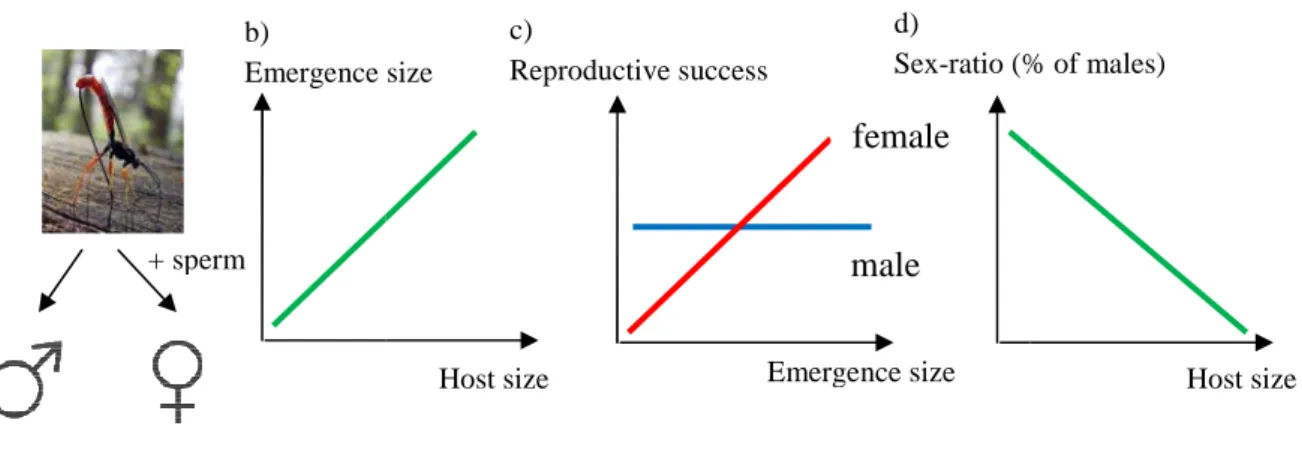
All hymenoptera species are haplodiploid and females have full control over sex determination. They store sperm in a spermatheca and during laying, they can either release stored sperm to fertilise the egg or not. Sex is determined by the number of chromosomes: a fertilised egg will give a diploid female, whereas an unfertilised egg will give a haploid male. Among hymenoptera, solitary parasitic wasp species have been widely studied in relation to sex ratio variation. Females lay a single egg in an insect larva in which it will hatch and the wasp larvae will feed from inside the host. Size at emergence is strongly correlated to host size and females should benefit more from a larger size in term of fitness as larger females are able to lay more eggs, whereas male size does not influence fitness (Charnov et al. 1981; Godfray 1994; Figure 1). Hence, females are expected to bias offspring sex in relation to host size by laying female eggs in large larvae and male eggs in small larvae. This prediction has been supported in many parasitic wasp species (reviewed in Godfray 1994; Figure 1). Interestingly, the precision of sex-ratio adjustment to host size is higher in species killing the host in which they lay an egg (idiobionts) than in species which do not kill the host (koinobionts) (West & Sheldon 2002). This result suggests that sex-ratio adjustment depends on the predictability of the fitness benefits: in koinobiont species, the host can still grow after the wasp has laid, hence it is more difficult for the mother to predict the quantity of resources which will be available to her offspring.
Less consistent results
A potentially costly m While parasitic wasps show pr random and should thus lead people to think that the observ bias (Williams 1979; Clutton-rather than adaptive basis (Kra to overcome sex determinati different selection pressures 1998; Badyaev et al. 2002; Pr underlying mechanism remain 2006). As in mammals the m (ZW), it is likely that the mech no reason that the mechanism species and life-histories in w & Petrie 2003). Knowing the
Figure 1. Parasitic wasp can a
fertilised eggs, and males from u Relationship between emergenc (proportion of males) according t
Emergence
a) b)
+ sperm
in birds and mammals
mechanism?
recise control over sex determination, meiosi to a mean sex-ratio of 0.5 in birds and mam ved sex-ratio bias were just due to sampling -Brock 1986; FestaBianchet 1996) or had a p ackow 1995). It is obvious now that birds and ion constraint to adaptively adjust sex ratio (e.g., Gomendio et al. 1990; Komdeur et a ryke & Griffith 2009a; Thogerson et al. 2013
ns unknown (reviewed in Pike & Petrie 200 male is the heterogametic sex (XY) and in bi
hanism will differ between these two groups. m should be unique within a group given which adaptive sex-ratio adjustment has been
mechanism is of importance because, depen
adaptively adjust offspring sex ratio to host size. a) unfertilised eggs; b) Relationship between host size a ce size and reproductive success in relation to offspr
to host size. size
Host size Emergence size Reproductive success Sex-ratio (%
c) d)
male female
is is supposed to be mmals. This first led error or publication purely physiological d mammals are able o according to the al. 1997; Komdeur ). Nevertheless, the 03; Alonso-Alvarez irds it is the female . Moreover, there is the wide range of demonstrated (Pike nding on the timing
) Females come from and emergence size; c) ring sex.; d) Sex-ratio Host size % of males)
of the adjustment, it might be costly in time and/or resources and this cost might balance the benefit of adjusting sex-ratio or not (Alonso-Alvarez 2006). For example, if female birds could reabsorb an ovum containing an unwanted sex-chromosome and reovulate until the wanted sex-chromosome is produced, it would delay laying and potentially increase predation risk and/or hatching asynchrony (Emlen 1997). Moreover, as classical sex allocation theory predicts that sex-ratio adjustment should be cost-free (Maynard-Smith 1980), the confirmation of a cost could change the predictions (but see Komdeur et al. 2002 for an example with no apparent cost of sex-ratio adjustment). Investigations on the mechanisms of sex-ratio adjustment have mostly been done on bird species and the proposed hypotheses range over every stage of the egg production (reviewed in Pike & Petrie 2003; Alonso-Alvarez 2006). There is also increasing evidence for a role of maternal hormones at the time of laying on chick sex (e.g., Veiga et al. 2004; Correa et al. 2005; Bonier et al. 2007), but their exact role remains unclear. In relation to these findings, the most recent hypothesis to date in birds states that during the first meiotic division the segregation of the polar body could be blocked due to hormonal effects, which in turn would lead to a chimeric embryo with cells of both sexes (Tagirov & Rutkowska 2013). Then the hormonal environment would cause one cellular type to decline and determine the sex of the egg (Tagirov & Rutkowska 2013). Interestingly, this could also potentially allow spermatozoids to specifically fertilise a cell with a given sex chromosome: contrary to common thought, males (who have ZZ sex chromosomes) may also influence sex determination. However, despite more effort put into seeking the proximate mechanism(s) in the last decade, we are still lacking a mechanism and we can therefore not exclude potential fitness costs in sex-ratio adjustment among birds and mammals. Hence, as long as this question remains unsolved, we might expect sex-ratio adjustment to occur only when the fitness benefits are high and thus probably higher than the fitness costs.
Many factors can influence the fitness return of sons and daughters
There are now many examples of adaptive sex-ratio adjustments in mammals and birds (reviewed in Cockburn et al. 2002; Komdeur 2012), thereby strongly suggesting that, at least in some species, the benefits can outweigh the potential costs. Logically, striking adaptive sex-ratio adjustments are found when there is one strong selection pressure with a differential fitness effect on male and female offspring. For example, in gouldian finches (Erythrura gouldiae), there are two colour morphs and chicks hatched from pairs made up of two birds of the same morph (i.e. compatible) have a higher chance to reach sexual maturity than chicks hatched from pairs with two birds of a different morph (i.e. incompatible) (Pryke & Griffith 2009b). Moreover, the fitness costs of incompatible mating are higher among female chicks (80% mortality rate before sexual maturity) than among male chicks (40% mortality rate before sexual maturity) (Pryke & Griffith 2009b). Hence, females mated with a genetically incompatible male adaptively produced a male-biased primary sex-ratio, whereas the same females adjusted their sex-ratio towards daughters when mated with a genetically compatible male (Pryke & Griffith 2009a).
However, as birds and mammals have more complex life-histories than parasitic wasps for instance, there are many hypotheses and corresponding selection pressure that have been proposed to influence sex-ratio adjustment in birds and mammals (reviewed in Cockburn et al. 2002; see Box 1, p. 24). Moreover, it is often unlikely that only one selection pressure will influence the fitness benefits of producing sons and daughters. It is therefore important to identify the different selection pressures acting on a species and to try to disentangle between them in order to better make predictions and interpret the data. The ideal case is when the different selection pressures act in the same direction. The sex-ratio adjustment may then be striking, as showed in red deer and macaques by Gomendio et al. (1990). There were more fitness benefits to produce sons for dominant females than for subordinate females in red deer
(Clutton-Brock et al. 1984) (the narrow sense Trivers-Willard hypothesis, see Box 1, p. 24), whereas the reverse was true for macaques (Silk 1983) (the local resource competition hypothesis, see Box 1, p. 24). Additionally, the rearing of a son (a daughter) led to a reduced probability of reproduction the next season for subordinate females than the rearing of a daughter (a son) in red deer (in macaques), whereas offspring sex did not influence the mother’s probability of reproduction in dominant females (the cost of reproduction hypothesis, see Box 1, p. 24). Hence, the relative fitness benefits and the relative fitness costs of producing sons or daughters for dominant and subordinate females were complementary and led to a high selection on females to bias offspring sex accordingly, which has been found (Gomendio et al. 1990).
In the case of the red deer, Gomendio et al. (1990) considered the narrow-sense Trivers-Willard hypothesis and the cost of reproduction hypothesis and clearly checked whether the different underlying assumptions concerning these hypotheses held, thereby allowing them to test sex-ratio predictions. However, this is often not the rule. To test the cost of reproduction hypothesis, for example, one need to confirm that the larger sex is more costly, but people often make the assumption that, in sexually dimorphic species, the larger sex is more costly to rear without testing it.
Although, it is sometimes true (e.g., Northern elephant seal: Reiter et al. 1978; red deer: Clutton-Brock et al. 1981; American kestrel: Anderson et al. 1993; fallow deer: Birgersson 1998; wandering albatross: Weimerskirch et al. 2000; European sparrowhawk: Vedder et al. 2005; common murre: Cameron-MacMillan et al. 2007; brown songlark: Magrath et al. 2007), other studies did not find any evidence of a higher rearing cost of the larger sex (e.g., blue-footed booby: Torres & Drummond 1999; brown falcon: McDonald et al. 2005; Nazca booby: Townsend et al. 2007) or at least to a lesser extent than suggested by sexual dimorphism (Anderson et al. 1993; Krijgsveld et al. 1998).
Individual characteristics:
Narrow sense Trivers-Willard hypothesis (Trivers & Willard 1973): In polygynous mammals, males commonly have a higher variance of reproductive success than females. (1) If maternal condition is correlated to offspring condition at the end of the period of parental investment; (2) if differences in offspring condition continue into adulthood and (3) if a small advantage in condition increase males’ more than females’ reproductive success, mothers in good condition should preferentially produce sons and mothers in poor condition should preferentially produce daughters.
Wide sense Trivers-Willard hypothesis (Burley 1981; Leimar 1996; Hewison & Gaillard 1999): Parents should invest more in the sex that gains most benefits either from an extra investment or from any heritable characteristic. For example, if daughters inherit their mother’s social rank, high ranking mothers should bias their sex-ratio towards daughters. Cost of reproduction hypothesis (Myers 1978): If one sex is energetically more costly to
produce or to rear, mothers in poor condition should avoid fitness costs by producing the cheaper sex in order to increase their survival and/or future reproductive success.
Maturation time hypothesis (Dijkstra et al. 1990; Pen et al. 1999): If the outcome of the first breeding event of one sex is more dependent on its birth date than for the other sex, parents should adjust the sex of their offspring to the laying date. Hence, this hypothesis leads to a seasonal trend in sex ratio.
Social environment:
Local resource competition (Clark 1978; Silk 1983): Parents more susceptible to resource competition should bias their sex ratio towards the dispersing sex in order to avoid competition between relatives, whereas parents in better environment should be able to pay the cost of producing the philopatric sex.
Local resource enhancement (or repayment model) (Emlen et al. 1986; Lessells & Avery 1987; Pen & Weissing 2000): If benefits from helpers-at-the-nest vary with a certain environmental variable, parents who gain the most of producing helpers will bias their sex ratio towards the helping sex and conversely for parents who have either no (or less) benefits or more costs.
Box 1. Several hypotheses proposed in the context of adaptive sex-ratio adjustment in birds and mammals
Hence, before testing predictions of the cost of reproduction hypothesis, people should probably first test whether the larger sex is indeed more costly to rear, especially in species with a slight sexual dimorphism. The absence of differential cost does not mean that sex-ratio adjustment should not be expected, as other selection pressures could still occur. For example, even without any differential cost, one sex could still benefit more from a higher parental investment or from any characteristic inherited from its parents in term of future reproductive success (wide sense Trivers-Willard hypothesis).
Why is the kittiwake interesting in this regard?
Different behavioural and life-history characteristics indicate that we might expect adaptive sex-ratio adjustment according to the cost of reproduction hypothesis and/or to the wide sense Trivers-Willard hypothesis. During my thesis, I examined whether their assumptions were met and studied whether sex-ratio varied according to these hypotheses.
Males are larger than females as adults (body mass: 10.2%, tarsus length: 3.5%; wing length: 2.8%: Helfenstein et al. 2004a), but nothing is known about sex-specific growth during chick rearing in kittiwakes, although chick growth has already been studied (e.g., Suryan et al. 2002; Jodice et al. 2008). Hence, I first investigated whether sexual dimorphism takes place during chick rearing (Chapter 1A, p. 41), as found in other species (Richner 1991). Nevertheless, as sexual dimorphism is slight in this species as compared to others, it is not obvious that males are more costly to rear than females. I thus also studied a sex-specific cost and I found some evidence for it. I further tested whether it influenced sex-ratio adjustment (Chapter 1B, p. 65).
Not only are adult males larger than adult females, but they also arrive earlier than females on the breeding sites and compete intensely for them (Cullen 1957; Coulson 1968; Wooller & Coulson 1977). The outcome of such competition may impact the onset of reproduction and
the length of the rearing period, a key determinant for chick post-fledging survival and future reproductive performance (Cam et al. 2003). Accordingly, within a breeding season, males starting their reproduction earlier appear to be heavier and better competitors (Coulson 1968; Wooller & Coulson 1977; Coulson & Thomas 1985). Moreover, nest characteristics affect reproductive success (Coulson 1968; Regehr et al. 1998; Massaro et al. 2001) and male-male competition has been reported to be all the more intense at the most attractive nesting sites (Wooller & Coulson 1977). The male’s physical ability to defend the nest may also be important during chick rearing (see Moe et al. 2002; Leclaire et al. 2010), when prospecting behaviour (Cadiou & Monnat 1996; Cadiou 1999) and/or predation are common (Massaro et al. 2001), as suggested by the higher nest attendance of males observed during this period (Leclaire et al. 2010). Altogether, given that (1) rearing conditions determine body mass and structural size at fledging (Gill et al. 2002) and given that (2) these characteristics are further expected to have long-term fitness consequences in this species (Cam et al. 2003), these observations suggest that rearing conditions may be more important determinants of male than female subsequent reproductive success (see also Albrecht & Johnson 2002 for a similar fitness return pathway), which accords with the observed sexual dimorphism (Helfenstein et al. 2004a). Hence, selection pressures for optimal rearing conditions, such as larger size and body mass at fledging, might be higher among males. This led me to the prediction that sons may benefit more in terms of future reproductive success than females from a higher parental ability to care (wide sense Trivers-Willard hypothesis, Box 1, p. 24). I used data from a long-term feeding experiment to compare hatching sex-ratios between fed and unfed pairs over three breeding seasons and found that overall unfed pairs produced relatively more daughters than fed pairs (Chapter 1A, p. 41). However, our results could also be coherent with the cost of reproduction hypothesis (see above and Chapter 1B, p. 65). In our case, the underlying assumption of the wide sense Trivers-Willard hypothesis is that male chicks born on fed nests
should have a higher reproductive success as adults than male chicks born in unfed nests, whereas there should be no difference between females. In order to test that, I used the long-term data from the feeding experiment (Box 2, p. 93).
Also, as kittiwakes are genetically monogamous with no extra-pair offspring (Helfenstein et al. 2004b), paternity analysis were not necessary in my studies.
Part 2: Hatching asynchrony: when to begin incubation?
Female birds cannot lay all their eggs at the same time. In species laying more than one egg, there is usually a time lag of at least one day between each egg. Females (or parents, in species sharing the incubation task) thus have to choose whether they begin to incubate assiduously their eggs just after laying or whether they wait until more eggs are laid. A general observation is that hatching asynchrony is common in many bird species (Magrath 1990), which suggests that incubation usually starts before clutch completion. This phenomenon has attracted a lot of attention among ornithologists and many hypotheses have been proposed (reviewed in Amundsen & Slagsvold 1991; Stoleson & Beissinger 1995; Stenning 1996). For example, hatching asynchrony has been proposed to minimise predation risk (Clark & Wilson 1981), to preserve egg viability in harsh (cold or warm) environments (Arnold et al. 1987), to create ‘insurance offspring’ in case the older chick fails to hatch (Cash & Evans 1986) or to allow chicks’ peak food demand to occur at different time (Bryant 1978). However, David Lack was the first to propose an explanation for hatching asynchrony (Lack 1947, 1954). His first observation was that, in unpredictable environments, females usually lay more eggs than the number of chicks the pair would be able to fledge under average environmental conditions (Lack 1954; Ricklefs 1965). He thus hypothesised that, if food appeared to be insufficient to fledge all chicks, hatching asynchrony would create a within-brood hierarchy allowing parents to preferentially feed the older chick(s) and would thus facilitate a quick elimination of the younger chick(s) when needed, whereas hatching synchrony would not allow this preferential feeding, thereby making all chicks starving and leading to an overall reduced fledging success (the facultative brood reduction hypothesis: Lack 1947, 1954). Moreover, if food appears to be plentiful, hatching asynchrony should not be a disadvantage, as despite the within-brood hierarchy parent would be able to feed and
fledge all their chicks. This hypothesis has been widely tested in many species but with inconsistent results: while some studies found support for it (e.g., Magrath 1989), others did not (e.g., Amundsen & Stokland 1988). Amundsen and Slagsvold (1991) reviewed thirty experimental studies on hatching asynchrony and concluded that there was no global support for Lack’s hypothesis because synchronous hatching led to a higher fledging success than asynchronous hatching. Interestingly, however, synchronous chicks were found to be generally lighter at fledging and therefore maybe less likely to survive.
Hahn (1981; following Hamilton 1964) completed Lack’s hypothesis by proposing that hatching asynchrony would be a way to minimise sibling competition and therefore to reduce energy wastage, leading to a more efficient food allocation (the sibling rivalry hypothesis). Species showing overt aggression should be good candidates to test this hypothesis, as chicks can waste energy through begging (as other species) but also through aggression. In support to this, Mock and Ploger (1987) found that, in cattle egrets (Bubulcus ibis), synchronous hatching led to lower fledging success with higher sibling competition and higher parental feeding rates than asynchronous hatching. Hence, not only did hatching synchrony reduce fledging success (coherently with the facultative brood reduction hypothesis) but it also increased parental energy expenditure, thereby potentially reducing their subsequent survival and/ or reproductive success (Mock & Ploger 1987). Chick growth was not measured in this study and one can argue that maybe surviving synchronous chicks were in better condition at fledging due to their parents’ higher feeding rates. However, Mock and Ploger’s results have been confirmed in species exhibiting aggression or not and none of these studies found a growth advantage for synchronous chicks (Fujioka 1985; Wiebe & Bortolotti 1994a; Osorno & Drummond 1995; Gilby et al. 2011). Creating a dominance hierarchy through hatching asynchrony reduces sibling competition and leads to a more efficient food allocation, but a too large hatching asynchrony seems to be deleterious as it increases brood reduction (e.g.,
Amundsen & Stokland 1988; Osorno & Drummond 1995; Viñuela 1999). Hence, parents should find the best trade-off in order to reduce sibling competition and energy wastage as found in synchronous broods and high chick losses as found in very asynchronous broods. A few studies have investigated whether the natural magnitude of hatching asynchrony led to this pattern and indeed found it in both species showing overt aggressions (e.g., Mock & Ploger 1987; Osorno & Drummond 1995) and begging scramble (Gilby et al. 2011). According to the facultative brood reduction hypothesis (Lack 1947, 1954) and the sibling rivalry hypothesis (Hahn 1981), hatching asynchrony magnitude should influence sibling competition both at the brood (e.g., higher aggression rates in synchronous broods) and individual level (e.g., higher older chick aggression rate with increasing hatching asynchrony) and in terms of growth and survival. However, authors rarely investigated all these aspects together within a study.
How should hatching asynchrony magnitude influence chick stress?
Within this framework it is also easy to predict that the magnitude of hatching asynchrony should influence both parents’ and chicks’ physiology and stress hormones are probably good candidates. There are many studies in adults showing that a social or nutritional stress like having an unattractive mate (Griffith et al. 2011) or enduring reduced food availability (Kitaysky et al. 1999a) can increase baseline stress hormone levels. To my knowledge, no study has investigated whether the magnitude of hatching asynchrony would influence parental stress hormone levels or any other physiological traits, although it can be predicted that the higher feeding rates, and therefore foraging activity, found in synchronous broods should lead to higher stress hormone levels (Angelier et al. 2007a). Among chicks, as hatching asynchrony usually leads to an unequal allocation of food between chicks, younger chicks may be under nutritional stress and are thus expected to have higher baseline
nutritional stress than their older siblings. However, results are inconsistent: some studies confirmed these expectations (e.g., Tarlow et al. 2001; Eraud et al. 2008), others found no effect of rank (e.g., Blas et al. 2005; Poisbleau et al. 2010) or even the reverse pattern (e.g., Schwabl 1999; Love et al. 2003). Moreover, aside from one study on a captive population of American kestrels (Love et al. 2003), no study has investigated whether the magnitude of hatching asynchrony influences baseline stress hormone levels.
Can parents manipulate hatching asynchrony according to environmental
conditions?
If hatching asynchrony is adaptive in a way that it can help parents to have control over brood reduction, we would expect that the optimal magnitude of hatching asynchrony would change with environmental conditions. Many studies found that a large hatching asynchrony magnitude led to a higher frequency of brood reduction (e.g., Mock & Ploger 1987; Amundsen & Stokland 1988; Osorno & Drummond 1995), thus if the environmental conditions are expected to be poor during chick rearing, parents may want to increase hatching asynchrony by an earlier onset of incubation. Wiebe and Bortolotti (1994b) measured hatching asynchrony over four years in American kestrels and showed that hatching asynchrony was lower in good food years than in poor food years. They also showed that food supplemented parents had more synchronous broods than non supplemented pairs (Wiebe & Bortolotti 1994b). Moreover, Wiebe (1995) showed mathematically that the previous result is all the more expected when food supply during chick rearing is predictable from food supply at the time of laying (see also Wellicome 2005). However, there are also studies finding that food supplementation led to a higher hatching asynchrony (Nilsson 1993; Eikenaar et al. 2003), but, interestingly, in these two species (marsh tits Parus palustris and Australian reed Phragmites australis) only the females incubate the eggs, whereas in kestrels both sexes
incubate. Indeed, Nilsson (1993) argued that, in the former case, experimental feeding reduced the need of females to feed intensively after they laid their first egg and before they begin to incubate, thereby leading to a larger hatching asynchrony. Facultative manipulation of hatching asynchrony may thus depend on food predictability and whether females are constrained to feed before beginning to incubate. Hence, species where both parents share the incubation task should be useful in this regard as the energetic constraint is less likely.
Why is the kittiwake interesting in this regard?
The black-legged kittiwake is a facultatively siblicidal seabird (Braun & Hunt 1983) with a modal brood size of two chicks. Both parents share the incubation and chick-rearing tasks (Coulson & Wooller 1984). The first-egg hatches on average 1.35 days before the second one (Gill et al. 2002). The older chick systematically attacks its younger sibling, who respond by a submissive posture (Braun & Hunt 1983). Sibling aggression intensity is dependent on food availability (Irons 1992; White et al. 2010) and potentially on female feeding effort (Leclaire et al. 2010). The adaptive benefits of hatching asynchrony have been less studied in siblicidal species than in species where chicks compete via begging. Moreover, as there are two potential sources of energy wastage in sibling competition, begging and aggression, this species is interesting to study in regard to the sibling rivalry hypothesis (Hahn 1981). I experimentally manipulated hatching asynchrony magnitude to create experimental broods whose hatching asynchrony ranged from zero to three days. I subsequently observed chicks’ and parents’ behaviours (i.e. aggression, begging and feeding) both at the brood and individual levels and measured chick growth and survival in order to get a more complete picture of the influence of hatching asynchrony magnitude on these variables (Chapter 2A, p. 97). My results corroborated previous findings concerning the sibling rivalry hypothesis and confirmed that the natural hatching asynchrony magnitude might be optimal. Then, as no
study has yet studied how hatching asynchrony magnitude influences chick baseline corticosterone (i.e. the major stress hormone in birds) levels in a wild bird, I used the same experiment to investigate it (Chapter 2B, p. 123). Finally, I also used the long-term feeding experiment to test whether parents can manipulate hatching asynchrony according to environmental conditions (Box 3, p. 143).
Part 3: Egg yolk composition: how much hormones to put in each
egg?
The initial finding that bird mothers can transfer substances such as hormones and antioxidants to their egg yolk and that it could influence chick behaviour (Schwabl 1993) led to extensive research in the last twenty years. This phenomenon falls into the area of maternal effects, which are non-genetic modifications of offspring phenotype caused by the environment provided by the mother during development (Mousseau & Fox 1998). While they were initially thought to be maladaptive, evidence that they provide a mechanism for adaptive transgenerational phenotypic plasticity are accumulating (Mousseau & Fox 1998; Marshall & Uller 2007) and cover a wide range of taxa (plants: Roach & Wulff 1987; insect: Mousseau & Dingle 1991; birds: Groothuis et al. 2005a; mammals: Maestripieri & Mateo 2009). Most of the research concerning maternal effects in birds focused on androgen hormones and especially on testosterone, but some studies also looked at antioxidants (e.g., Royle et al. 2001; Saino et al. 2003) and antibodies (e.g., Gasparini et al. 2007). Besides egg yolk substances, hatching asynchrony can also be regarded as a (indirect) maternal effect (or parental effect, in species sharing the incubation task) (Royle et al. 2001), as parents can influence the within-brood size hierarchy and thereby offspring phenotype (see Introduction Part 2, p. 28 and Chapter 2A, p. 97).
Positive effects of yolk androgens on chick fitness
Many studies have found positive effects of maternal yolk androgens, making no doubt that they can indeed influence offspring behaviour and subsequent survival (reviewed in Groothuis et al. 2005a). Maternal androgens have been found to increase chick competitiveness by triggering earlier hatching (e.g., Eising et al. 2001; Eising & Groothuis 2003) and begging (e.g., Schwabl 1996; Eising & Groothuis 2003; Noguera et al. 2013;
Ruuskanen & Laaksonen 2013). Coherently with these findings, authors found that maternal androgens led to an increased growth (e.g., Groothuis et al. 2005b; Navara et al. 2005; Müller et al. 2010a) and survival rates (e.g., Eising & Groothuis 2003; Pilz et al. 2004; but see Sockman & Schwabl 2000). There are even some lines of evidence that yolk androgens can have long-term effects on offspring fitness (Ruuskanen et al. 2012). To my knowledge, there is only one study showing that yolk testosterone can increase siblicidal aggression (Müller et al. 2012), which is surprising given that testosterone is supposed to mediate aggressive behaviours. Results were sometimes inconsistent which has been proposed to reflect species specific differences (Groothuis et al. 2005a), but positive effects of yolk hormones on pre- and post natal development rates are overall more common than negative effects (reviewed in von Engelhardt & Groothuis 2011).
Negative effects of yolk androgens on chick fitness
Maternal yolk androgens have also been found to entail costs to offspring fitness, leading to the idea that mothers would face a trade-off between the benefits and the costs of bestowing eggs with yolk androgens (Groothuis et al. 2005b). Among these negative effects the most commonly found is immunosuppression (e.g., Andersson et al. 2004; Müller et al. 2005; Navara et al. 2005; Sandell et al. 2009; but see Tschirren et al. 2005). Further studies also found that increased yolk hormones concentrations can lead to increased energy expenditure (Tobler et al. 2007; but see Eising et al. 2003) and reduced antioxidant capacity (Tobler & Sandell 2009).
Yolk hormones within-clutch variation: an adaptive explanation across
species?
Maternal effects impact offspring fitness, but they should have been selected to increase the mother fitness (Müller et al. 2007; Marshall & Uller 2007). Interestingly, yolk hormones levels are often found to vary within clutch, which suggests that mothers may manipulate offspring competitive abilities differently according to their position in the hatching sequence in order to increase their own fitness. Authors have found that yolk hormone levels can either increase (e.g., Schwabl 1993; Müller et al. 2012) or decrease (e.g., Schwabl 1997) over laying sequence. This has been suggested to illustrate two alternative maternal reproductive strategies: brood reduction or brood survival (reviewed in Müller & Groothuis 2013). In the former case, mothers would be willing to enhance sibling size asymmetries caused by hatching asynchrony by giving more yolk androgens to the older sibling(s) in order to facilitate brood reduction (Schwabl 1997). In this context, last eggs would be produced as an insurance against hatching failure of the earlier laid eggs (Forbes 1990). In the latter case, mothers would be willing to decrease sibling size asymmetries caused by hatching asynchrony and to boost their younger chicks’ competitive abilities by giving them more yolk androgens in order to facilitate the survival of the whole brood (Schwabl 1993; Lipar et al. 1999). However, experimental work showed that increased yolk androgens in younger chicks did not allow them to fully compensate the large handicap due to hatching asynchrony (Schwabl 1996; Eising et al. 2001). It has been predicted that mothers should manipulate different maternal effects in concert in order to increase their own fitness (Marshall & Uller 2007). For instance, they should manipulate hatching asynchrony and yolk androgens together. In a brood survival strategy, they should favour small hatching asynchrony magnitude with increasing yolk androgens in the laying sequence. Müller and Groothuis
(2013) recently confirmed this prediction using a comparative analysis: they showed that yolk testosterone compensation in late eggs was negatively correlated with hatching asynchrony, size difference at hatching and growth rate, thereby confirming that mothers can adaptively manipulate different maternal effects together in order to increase their own fitness by favouring brood survival or not.
Should environmental conditions influence yolk hormones deposition?
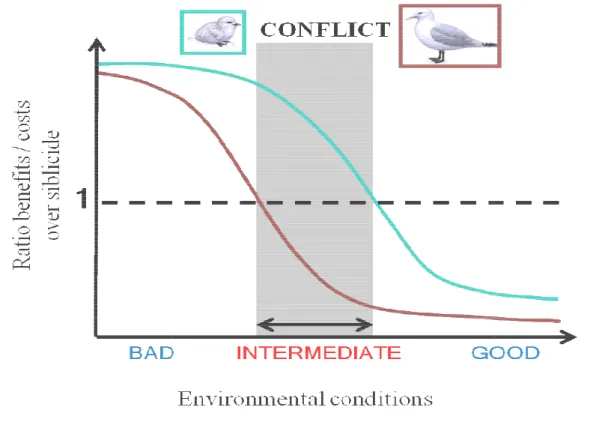
Although within-clutch variation in yolk androgens seems systematic within a species, it extent may still vary according to environmental conditions. Hence, mothers in species with a brood survival strategy should favour their younger chick’s survival especially when food availability is high and the younger chick survival more likely. Food quality has been manipulated in three studies on captive passerine species and two of them found a steeper increase of yolk testosterone across laying sequence in high quality diet broods (Sandell et al. 2007; Vergauwen et al. 2012), but mothers on high quality diets also laid larger clutches which may have had some confounding effects. In the lesser black-backed gull (Larus fuscus), supplementary fed mothers put less androgens into their eggs regardless of laying rank (Verboven et al. 2003). In the blue-footed booby (Sula nebouxii), mothers put proportionally more androgens in their second eggs during a poor food year than during a good food year (Dentressangle et al. 2008). Hence, in study where food availability did not modify clutch size, mothers seem to respond to high food availability by decreasing yolk androgens deposition in the last egg as compared to the low food availability situation. If food availability is so high that all chicks should easily survive, mothers may reduced the potential fitness costs of increased yolk androgens deposition in their last egg(s). Interestingly, Benowitz-Fredericks et al. (2013) compared yolk androgen contents in supplementary fed and control black-legged kittiwakes (Rissa tridactyla) between two years with contrasting food
availability. They found that egg than in their first one wh Their results thus suggested t when the younger chick was survival prospects are very lo mother and the older chick respectively (Fig. 2). Howev increase her fitness by fledgin the death of its younger sib reduction (Fig. 2). Yolk and chance of winning this conflic
Figure 2. Ratio benefits on costs
(blue curve) and for the mother beneficial for the senior chick to authorisation of Charlotte Perrot)
mothers deposited relatively more testostero hen survival prospects of the younger chick hat mothers avoided the potential costs of in s very likely to survive and also favoured w. Indeed, when food availability is very hi
may agree over the younger chick fate: ver, when food availability is intermediate ng two chicks, whereas the older chick may ling, thus resulting in a parent-offspring c drogens deposition is one way the mother ct.
s over siblicide according to environmental condition r (red curve). There is a conflict (grey area) when it o keep its sibling, whereas it is the reverse for the mo
).
one in their second were intermediate. ncreased androgens siblicide when its gh or very low, the
survival or death, e, the mother may y benefit more from
conflict over brood could increase her
s for the senior chick t is more costly than other. (Used with the
Why is the kittiwake interesting in this regard?
There are three findings, from three different kittiwake populations including mine, that second-laid eggs contain more testosterone than first laid eggs (Müller et al. 2012; Vallarino et al. 2012; Benowitz-Fredericks et al. 2013) and also three studies finding the same pattern for androstenedione (i.e. another androgen) (Gasparini et al. 2007; Müller et al. 2012; Benowitz-Fredericks et al. 2013). These patterns are thus in line with a brood survival strategy (Müller & Groothuis 2013), which fits with the fact that kittiwakes are facultatively siblicidal (Braun & Hunt 1983): the younger chick survival prospects are higher when food availability is high (White et al. 2010). Carotenoids, however, seem to be higher in first-laid eggs (Vallarino et al. 2012), as already found in another gull species (Royle et al. 2001). Moreover, there seem to be no differences in antibodies (Gasparini et al. 2007), lipids, proteins or corticosterone concentrations (Vallarino et al. 2012) according to laying order. Chick aggression is enhanced by higher androgen concentrations (Müller et al. 2012), but clearly this advantage given to the younger chick is never enough to compensate the initial competitive disadvantage due to hatching asynchrony (Braun & Hunt 1983; White et al. 2010). Moreover, mothers seem to manipulate the amount of yolk testosterone according to chick survival prospects and food availability (Benowitz-Fredericks et al. 2013): they may put more testosterone into their second egg when its survival would benefit them, but not the older chick. I thus wanted to test whether food availability differentially affected the younger chick’s competitiveness, as suggested by these previous results. To do so, I did an experiment where younger chicks, coming from parents either fed or not before laying, were put in a dominant position in order to let them fully express the effects of maternal androgens (Chapter 3, p. 145). I expected younger chicks from unfed parents to exhibit more aggressiveness in a dominant position than those from fed parents and than older chicks from
unfed parents as well. It has to be noticed that I did not directly manipulate yolk androgen levels, but the aim of the experimental design was that our results could only be explained by a difference in yolk constitution.
Chapter 1A: food availability and offspring
sex
Food availability and offspring sex in a monogamous seabird:
insights from an experimental approach
Behavioral Ecology 23 (4): 751-758
Thomas Merkling1,2, Sarah Leclaire1,2, Etienne Danchin1,2, Emeline Lhuillier1,2, Richard H. Wagner3, Joël White 1,2,3, Scott A. Hatch4 and Pierrick Blanchard1,2
1Université de Toulouse, UPS, ENFA; UMR5174 EDB (Laboratoire Évolution et Diversité Biologique); 118
route de Narbonne, F-31062 Toulouse, France.
2CNRS; UMR5174 EDB, F-31062 Toulouse, France 3
Konrad Lorenz Institute for Ethology, Savoyenstrasse 1a, 1160 Vienna, Austria
Disponibilité en nourriture et sexe du descendant chez un oiseau
marin monogame: aperçu à partir d’une approche expérimentale
Behavioral Ecology 23 (4): 751-758
RÉSUMÉ
La théorie de l’allocation au sexe prédit que les parents devraient favoriser les descendants du sexe qui leur procurera le plus grand retour en valeur sélective (i.e. le sexe qui apportera le plus de petits-enfants). Malgré un nombre croissant de preuves suggérant que les vertébrés sont capables de surmonter la contrainte de la détermination chromosomique du sexe, le patron général reste équivoque, indiquant ainsi un besoin d’études expérimentales. Sur trois saisons de reproduction, nous avons utilisé des données d’une expérience de nourrissage pour étudier l’allocation au sexe chez des mouettes tridactyles (Rissa tridactyla). La compétition entre mâles pour l’accès aux sites de reproduction est commune chez cette espèce où les mâles sont plus gros et grands que les femelles. Ainsi, nous avons fait l’hypothèse que les parents produisant des poussins en meilleur condition que la moyenne à l’envol, comme cela devrait être le cas pour des parents recevant de la nourriture supplémentaire, devraient augmenter leur retour en valeur sélective en produisant des fils. Inversement, produire des filles devrait être une meilleure tactique pour les parents non nourris expérimentalement. Nous avons donc prédit que les parents nourris expérimentalement devraient produire plus de fils que les parents non nourris. Cette prédiction devrait être particulièrement attendue si le dimorphisme sexuel apparaît dès la période d’élevage des jeunes, ce qui suggérerait de fortes pressions de sélection pour un développement optimal des mâles. Nos résultats montrent que (1) les mâles étaient plus lourds et grands que les femelles avant l’envol et que (2) les parents nourris expérimentalement produisaient relativement plus de poussins mâles que les parents
non nourris. Nous interprétons ces résultats dans le contexte d’un processus de type Trivers-Willard. De plus, nos données ont aussi montré que les parents non nourris produisaient significativement plus de poussins femelles, alors que la sex-ratio était équilibrée chez les parents nourris expérimentalement. Puisque les trois saisons de reproduction considérées correspondaient à des années avec peu de nourriture naturellement disponible, les parents non nourris expérimentalement ont pu produire plus de filles pour éviter le coût à la reproduction potentiellement supérieur d’élever un fils.
Mots clés: allocation au sexe; croissance de poussins; dimorphisme sexuel; génétiquement monogame; hypothèse du coût à la reproduction; hypothèse de Trivers-Willard; mouette tridactyle; nourrissage expérimental; sex-ratio.
ABSTRACT
Sex allocation theory predicts that parents should favor offspring of the sex that provides the greatest fitness return. Despite growing evidence suggesting that vertebrates are able to overcome the constraint of chromosomal sex determination, the general pattern remains equivocal, indicating a need for experimental investigations. We used an experimental feeding design to study sex allocation during three years in black-legged kittiwakes (Rissa tridactyla). Intense male-male competition for securing a breeding site is common in this species in which males are heavier and larger than females. Hence, we hypothesized that parents producing fledglings in better than average condition, as supplementarily fed pairs do, would increase their fitness return by producing sons. Conversely, producing daughters would be a better tactic for unfed parents. Hence, we predicted that fed parents produce more sons than unfed parents. This prediction is particularly expected if sexual dimorphism arises as early as during chick rearing, suggesting strong selective pressures for optimal male development. Our results showed that (1) males were heavier and larger than females prior to fledging and that (2) fed parents produced relatively more male hatchlings than unfed parents. We interpret this result in terms of a Trivers-Willard-type process. Further, our data revealed that unfed parents significantly overproduced female hatchlings whereas offspring sex ratio was balanced among fed parents. Because the three reproductive seasons we considered were particularly poor food years, unfed parents may have overproduced daughters to avoid the apparent higher reproductive costs of raising sons.
Keywords: black-legged kittiwake; chick growth; experimental feeding; genetically monogamous; reproductive cost hypothesis; sex allocation; sex ratio; sexual dimorphism; Trivers-Willard hypothesis.
INTRODUCTION
Sex allocation is one of the most compelling, yet controversial, theories in evolutionary biology. It refers to the way parents should invest in male and female functions, with an expected bias towards offspring of the sex providing the higher fitness return under current conditions (Frank 1990). As an example, in species where body condition impacts the reproductive success of males more than females, and assuming that some females are better able to produce offspring in good condition than others (condition enduring into adulthood), such females are expected to bias their offspring sex-ratio towards males (Trivers & Willard 1973). Whereas sex allocation predictions have been confirmed by empirical studies in some taxa such as parasitic Hymenoptera (reviewed in Ode & Hunter 2002), the factors shaping those patterns remain confused for others, such as birds and mammals (Cockburn et al. 2002).
In birds, the availability of molecular sex identification techniques (Griffiths et al. 1998; Fridolfsson & Ellegren 1999) has led to a growing number of studies reporting adaptive sex ratio biases (reviewed in Alonso-Alvarez 2006; Blanchard et al. 2007), suggesting an ability of some birds to overcome the constraint imposed by chromosomal sex determination (West et al. 2002). However, inconsistent results are also commonly reported, including contradictory results within the same species (e.g., Rosivall et al. 2004; Maddox & Weatherhead 2009), lack of sex-ratio bias when theoretically expected (e.g., Leech et al. 2001; Cockburn & Double 2008) and counterintuitive biases (e.g., Doutrelant et al. 2004; Dietrich-Bischoff et al. 2006). Hence, as highlighted by West et al. (West et al. 2002), further investigations are required to improve our understanding of sex ratio patterns. In particular, because most published studies are based on correlational studies and focus on species with polygynous mating systems or with helpers at the nest, in line with classical theoretical expectations (Cockburn et al. 2002), there is a clear need for new studies using experimental approaches (Komdeur & Pen 2002) and targeting species with contrasting mating systems.
In this paper, we describe an experiment aimed at investigating sex ratio patterns in a genetically monogamous seabird (Helfenstein et al. 2004a), the black-legged kittiwake (Rissa tridactyla). Several life-history and behavioral characteristics of this species comprise potential selective pressures that may have led to the evolution of adaptive sex allocation tactics. Males typically arrive at the breeding colonies earlier than females and compete intensely for the best nesting sites (Cullen 1957; Coulson 1968; Wooller & Coulson 1977). The outcome of such competition may impact the onset of reproduction and the length of the rearing period, a key determinant for chick post-fledging survival and future reproductive performance (Cam et al. 2003). Accordingly, within a breeding season, males starting their reproduction earlier appear to be heavier and better competitors (Coulson 1968; Wooller & Coulson 1977; Coulson & Thomas 1985). Moreover, nest characteristics affect reproductive success (Coulson 1968; Regehr et al. 1998; Massaro et al. 2001) and male-male competition has been reported to be all the more intense at the most attractive nesting sites (Wooller & Coulson 1977). The male’s physical ability to defend the nest may also be important during chick rearing (see Moe et al. 2002; Leclaire et al. 2010), when prospecting behaviour (Cadiou & Monnat 1996; Cadiou 1999) and/or predation are common (Massaro et al. 2001), as suggested by the higher nest attendance of males observed during this period (Leclaire et al. 2010). Altogether, given that (1) rearing conditions determine body mass and structural size at fledging (thereafter referred to as “condition” and considered as proxies of a male ability to obtain / defend a breeding site) (Gill et al. 2002) and given that (2) these characteristics are further expected to have long term fitness consequences in this species (Cam et al. 2003), these observations suggest that rearing conditions may be more important determinants of male than female subsequent reproductive success (see also Albrecht & Johnson 2002 for a similar fitness return pathway). Indeed, adult male kittiwakes are heavier and larger than females (body mass: 10.2%, tarsus length: 3.5%; wing length: 2.8%, Helfenstein et al. 2004b),
with large heavy males likely favored by sexual selection (as expected in other seabird species with terrestrial displays and between-males competition; Serrano-Meneses & Székely 2006).
Pacific populations of kittiwakes have been experiencing chronic breeding failure at many colonies since the late 1970’s (Gill & Hatch 2002). In our population, a supplemental feeding experiment has been carried out since 1996 on a sample of birds to determine whether food availability limits productivity (Gill & Hatch 2002). This hypothesis was strongly supported by the difference in breeding parameters between supplemented (provided with ad libitum food through the entire breeding season) and non-supplemented pairs (Gill & Hatch 2002; Gill et al. 2002), as expected given that the chick-rearing stage is highly food limited (Gill & Hatch 2002). In 1996-1997, annual productivity averaged only 0.48 chicks per nest while it reached 1.15 when birds were given extra food (Gill & Hatch 2002). More specifically, chicks from fed parents had greater mass gain and wing chord, attained heavier peak mass, and survived better until fledging than chicks from unfed parents (Gill et al. 2002). Hence, fed parents are better able to provide offspring with good rearing conditions, and ultimately to produce fledglings in good condition, than unfed parents in this food-restricted population.
In this theoretical context, we tested two predictions. Because natural and sexual selection are expected to favor large and heavy adult males, we first predicted that (1) sexual dimorphism arises during chick rearing, with males being larger and heavier than females close to fledging, as commonly reported in dimorphic seabirds (blue-footed booby: Torres & Drummond 1999; wandering albatross: Weimerskirch et al. 2000; common tern: Becker & Wink 2003). Although several previous studies have analyzed chick growth in kittiwakes (Coulson & Porter 1985; Suryan et al. 2002; Jodice et al. 2008), none have compared the growth of male and female chicks. Further, in the context of the supplemental feeding experiment that allowed us to increase inter-pair variability in the ability to provide care (a key determinant of sex allocation in a Trivers-Willard context, e.g. Hewison et al. 2002;


![Figure 1. Free T3 levels [log(pg/ml)] and DEE (kJ/day) according to parental sex, ChickDays and](https://thumb-eu.123doks.com/thumbv2/123doknet/2244724.17641/79.892.101.750.428.969/figure-free-levels-log-dee-according-parental-chickdays.webp)