Measuring Internet performance within the organization
Yann RIVAL
Michel KALIKA
PARIS DAUPHINE UNIVERSITY
PARIS DAUPHINE UNIVERSITY
PHD Candidate & Assistant Professor
Professor of Management
Tel/Fax: 0033 1 53 59 96 95
[email protected]
[email protected]
Abstract
What is the link between the use of the Internet and the performance within the organization?
This research is made relevant by the lack of studies dealing with the evaluation of the effects of the Internet on the performance within the firm. It first proposes to draw a model derived from the alignment perspective that would enable to understand and measure the Internet performance of the firm.
Using the Information Systems (IS) literature about alignment and data collected from 11 interviews of general and Internet managers from the main companies of the French tourism sector, 10 variables were identified to build an original model.
This model is then applied to a sector where firms frequently use the Internet: tourism.
The first results, based on 107 returned questionnaires, show a positive relation between Internet strategy alignment and Internet performance. The positive relation between the organizational dimension of Internet strategy alignment and the financial dimension of Internet performance is particularly significant.
Keywords
Internet, strategy, Information Technologies (IT), Information Systems (IS), alignment, model, tourism.
INTRODUCTION
The economic influence of the Internet was strongly criticized after the e-crack experienced in the spring of 2000. A few years later, the Internet is more present than ever in the activity of the firm. One can clearly realize that when looking at the data made available by the principal institutes collecting economic information. If we take a look at the B to C revenue of 2003, Europe raised 29.81 billion euros and the U.S. raised around 552 billion dollars.
This paper first describes the main trends in Internet research. Then, from the strategic alignment perspective, this research proposes a model measuring Internet performance within the organization. Finally, the application of this model to the tourism sector gives us the first results explaining Internet performance.
THREE MAIN TRENDS
The Internet succeeded in becoming a strategic reality in the heart of the firms’ business and it has been the subjectof various research. We can distinguish three main trends in Internet research.
The first trend presents a methodology for the integration of the Internet within the organization: how
to do Internet? (Venkatraman, 2000; Kulatilaka et al., 2001; Limayem et al., 1999; Van Der Heijden,
2001).
The second trend studies Internet technologies and the developmental impact on the firm: what is
changing with Internet? (Earl et al., 2001; Bakos, 1998; Rayport et al., 1995).
Finally, a third trend, relatively recent and with very few studies derived from it, focuses on the evaluation of the firm’s Internet activity in order to answer a question which has not been very much dealt with: are the positioning and the results of the firm satisfying as far as the Internet is concerned?
(Nickerson, 2002; Wheeler, 2002; Monod, 2002).
AIM OF THE RESEARCH
This research focuses on the firm’s Internet strategy and, more precisely, on the adoption of Internet technologies within the firm for the presentation and the exchange of products and services.
Moreover, the study aims at proposing and applying an original model -derived from the third research trend which tries to evaluate the Internet- for measuring the performance of the firm’s Internet strategy.
METHODOLOGY
We decided to apply this investigation to a sector where firms frequently use the Internet: tourism. In an exploratory approach, 11 semi-structured interviews were made between June 2002 and July 2004 with general and Internet managers of the main companies of the French tourism sector focusing on different topics: impact of the Internet on the tourist industry, description of the Internet project of the firm, relations between Internet managers and general managers, current results of the Internet activity in the firm and objectives for the next years. All the interviews were recorded, transcribed and
analyzed using a thematic classification. These interviews have enabled us to identify a certain number of key variables which will be used in our final model.
Then 610 questionnaires were sent to the main companies of the French tourism sector for the application of the model and the study of the relation between the degree of Internet strategy alignment and the Internet performance level.
THE STRATEGIC ALIGNMENT MODEL AS A FRAMEWORK
The Strategic alignment model for IS/IT (Henderson and Venkatraman, 1993) suggesting that strategy and IT developments must be coherent, can be applied to Internet technologies. If we consider Internet strategy as emerging from Internet technologies, the Henderson and Venkatraman model would enable us to assess the congruence of the Internet strategy with the rest of the firm. It is then possible to study the relation between the coherence of Internet strategy and the results obtained as far as the Internet is concerned.
Today, however, there are very few, if any, studies that apply the strategic alignment model to assess Internet strategies.
AN INTERNET STRATEGIES ASSESSMENT MODEL
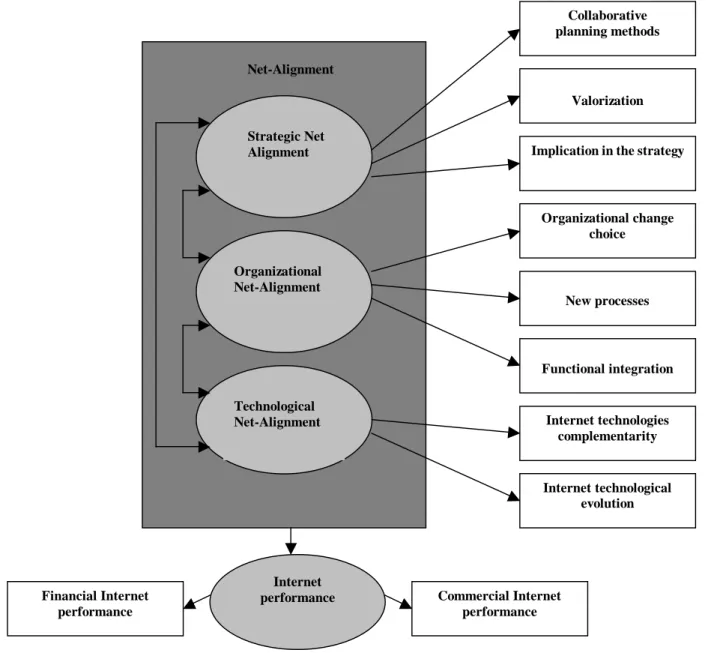
We define Net-Alignment as the fit between the Internet Strategy of the firm (elaboration and application processes of the Internet strategy) on the one hand, and the Business Strategy (elaboration and application processes of the business strategy), the organization of the firm (structures and organizational processes), and the Internet structure (technological infrastructure and processes linked to the Internet) on the other hand. Strategic Net-Alignment, Organizational Net-Alignment and Technological Net-Alignment constitute the Net-Alignment of the firm.
Besides, the firm’s Internet performance is directly influenced by the implementation of the Internet strategy.
From the IS/IT literature describing factors that inhibit/facilitate Alignment or characterize the IS/IT performance and the data collected in the 11 interviews, 10 variables were identified and adapted to the Internet strategies assessment model (Figure 1):
- Regarding the construct Strategic Net-Alignment:
• Collaborative planning methods: planning process including the Internet activity (Broadbent and Weill, 1993; Reich and Benbasat, 2000),
• Valorization: consideration of the Internet activity by other functions of the firms (Ciborra, 1997; Papp, 1995; Interviews),
• Implication in the strategy: implication of the Internet activity in the strategy (Broadbent and Weill 1993; Papp, Luftman and Brier, 1995; Interviews),
- Regarding the construct Organizational Net-Alignment:
• Organizational change choice: choice of adapting the organizational structure of the firm to the Internet activity (Amami and Rowe, 2000; Henderson and Venkatraman, 1993; Interviews),
• New processes: creation of new processes for the Internet activity in the firm (Broadbent et Weill, 1993; Interviews),
• Functional integration: level of integration of Internet-based technologies within the different departments of the firm (Amabile and Gadille, 2002; Henderson and Venkatraman, 1993; Interviews),
- Regarding the construct Technological Net-Alignment:
• Internet technologies complementarity: complementarity in Internet technological investments (Amabile and Gadille, 2002; Henderson and Venkatraman, 1993),
• Internet technological evolution: development of a new Internet technologies (Rockart et al., 1996; Weill et Vitale, 2002; Interviews),
- Finally, regarding the explained construct of the model, Internet performance:
• Commercial Internet performance: growth rate of sales directly or indirectly related to the Internet, growth rate of market shares related to online direct/indirect sales, conquest of new markets thanks to the Internet (Venkatraman, 1989; Interviews).
• Financial Internet performance: yield of the capital invested on the Internet, net result obtained by the Internet activity compared with that of the main rivals, an increased control of costs thanks to the Internet (Venkatraman, 1989; Interviews).
MEASUREMENT PERSPECTIVE
As far as the measuring of alignment is concerned, we have chosen an original approach.
Instead of observing alignment through variables only valid for one given moment (like most empirical studies on alignment which are based on bi-varied approaches), we used a scale for measuring the alignment that integrates the formative variables of the “Fit”. More precisely it consists in measuring the level of alignment, beginning with the study of the constitutive mechanisms of alignment.
Offering a measure whose validity is long-lasting, this approach is particularly suited to the Internet. The environment related to the Internet evolves very quickly indeed and it is practically impossible to aim at a pre-determined objective. When involved in the dot-com activity management, you have to be permanently able to combine better decisions in the present and the creation of new decisions (Venkatraman, 2000).
From this perspective, we adapted alignment scales described in the IS literature to the Internet in order to establish a Net-Alignment scale. In the same way, we applied performance scales commonly used in the IS/IT literature to the Internet, in order to establish an Internet performance scale.
Strategic Net Alignment Organizational Net-Alignment Technological Net-Alignment Net-Alignment Collaborative planning methods Valorization
Implication in the strategy
Organizational change choice New processes Functional integration Internet technologies complementarity Internet technological evolution Internet
performance Commercial Internet
performance Financial Internet
performance
Figure 1. The Internet Strategies Assessment Model
APPLICATION AND RESULTS
610 questionnaires were sent to the main companies of the French tourism sector for the application of the Internet strategies assessment model and the study of the relation between the degree of Net-Alignment and Internet performance measure. Then, statistical analyses have been carried out with SPSS, the software used to process the 107 returned questionnaires (18% of the firms answered). The validity and reliability of our five concepts (Net-Alignment, Strategic Net-Alignment, Organizational Net-Alignment, Technological Net-Alignment and Internet performance) were successfully tested. The average score of Cronbach’s alpha for each construct is 0.8, which proves the reliability of this exploratory research. Besides, the use of Confirmatory Factor Analysis (CFA) enabled us to verify the unidimensionality of every concept.
The study of the link between the alignment of Internet strategy and Internet performance is made thanks to the observation of correlations at the 5 % level and at the 10% level (Table 1)
The first results show a positive relation between Internet strategy alignment and Internet performance. Among the two dimensions of Internet performance, the financial dimension is the one which is the most influenced by the alignment of Internet strategy. Among the three dimensions constitutive of the Internet strategy alignment, the organizational dimension is the one that has the highest influence on Internet performance. Therefore, the correlation between Organizational Net-Alignment and Financial Internet performance equals 0,680.
To be more precise, the creation of new processes for the Internet activity in the firm (a new way of processing e-mails from the website, a new way of processing incoming calls, a call-centre devoted to the web site) and the level of integration of Internet-based technologies within the different departments of the firm (on-line customer services, on-line supervision of stock and availability, order of products and services through the Internet...) seem to play an essential part in the success of Internet strategy.
To conclude, we should underline the weakness of the link between the technological alignment of Internet strategy and the Internet commercial performance (0,93).
This was a brief presentation of the first collected results which will have to be followed-up by an in-depth analysis of the numerous results obtained by the application of this model for the evaluation of Internet strategies to the tourism sector.
Table1- First results Internet performance Commercial Internet performance Financial Internet performance Net-Alignment 0, 508** 0,455** 0,565** Strategic Net-Alignment 0,454** 0,407** 0,487
Collaborative planning methods 0,350** 0,273 0,350
Valorization 0,442** 0,497** 0,489**
Implication in the strategy: 0,429** 0,342** 0,472**
Organizational Net-Alignment 0,616** 0,508** 0,680**
Organizational change choice 0,442** 0,363** 0,486**
New processes 0,527** 0,412** 0,557**
Functional integration 0,516** 0,468** 0,609**
Technological Net-Alignment 0,311* 0,293* 0,369**
Internet technologies complementarity 0,304* 0,265* 0,373**
Internet technological evolution 0,280* 0,276* 0,316**
* sig<0,10, **sig<0,05.
References
Amabile S., Gadille M., (2002), « La valorisation des usages d’Internet et de sites Web par l’alignement stratégique : une caractéristique de l’entreprise étendue? », AIM Conference, 9 p. Amami M., Rowe F., (2000), « Les Opportunités de recherche en commerce électronique sur
Broadbent M., Weill P., (1993), “Improving business and information strategy alignment: learning from the banking industry”, IBM Systems Journal, Vol. 32, N°1, pp. 162-179.
Ciborra C.U., (1997), “De profundis? Deconstructing the Concept of Strategic Alignment”, Scandinavian Journal of Information Systems, Vol. 9 No. 1, pp. 67-82.
Earl M., Khan B., (2001), “E-commerce is Changing the Face of IT”, MIT Sloan Management Review, Vol. 43 No. 1, pp. 64-72.
Henderson J.C., Venkatraman N., (1993), “Strategic Alignment: Leveraging Information Technology for Transforming Organizations”, IBM Systems Journal, Vol. 32 No. 1, pp. 4-16.
Kulatilaka N., Venkatraman N., (2001), “Strategic Options in the Digital Era”, Business Strategy Review, Vol. 12 No. 4, pp. 7-15.
Limayem M., Chabchoub N., (1999), “Les Facteurs influençant l’utilisation d’Internet dans les organisations”, Systèmes d’Information et Management, Vol. 4 No. 1, pp. 29-56.
Monod E., (2002), “Internet et performance de l’entreprise : Etude de l’organisation industrielle de 104 PME en Loire-Atlantique”, AIM Conference, 13 p.
Nickerson R., (2002), “An E-commerce System Model”, Proceedings of the Eight Americas Conference on Information Systems, pp. 310-316.
Papp R., (1995), Determinants of Strategically Aligned Organization: A industry, Multi-perspective Analysis & Validation, Unpublished doctoral dissertation, Stevens Institute of Technology, Hoboken, New Jersey.
Papp R., Luftman J., (1995), «Business and IT Strategic Alignment: New Perspectives and Assessments », America Conference in Information Systems, 5 p.
Rayport J.F., Sviokla J.J., (1995), “Exploiting the Virtual Value Chain”, Harvard Business Review, November-December, pp. 75-85.
Reich B.H., Benbasat I., (2000), « Factors that Influence the Social Dimension Of Alignment between Business and Information Technology Objectives », Management Information Systems Quarterly, March, pp. 81-113.
Rockart J. F., Earl M., Roos J., (1996), « Eight Imperatives for the New IT Organization », Sloan Management Review, fall, pp. 43-56.
Van Der Heijden H., (2001), “Measuring IT core capabilities for electronic commerce”, Journal of Information Technology, Vol. 16 No. 1, pp. 13-22.
Venkatraman N., (1989), « The Concept of Fit in Strategy Research: Toward Verbal and Statistical Correspondence », Academy of Management Review, Vol.14, N°3, pp. 423-444.
Venkatraman N., (2000), “Five Steps to a Dot-Com Strategy: How To Find Your Footing on the Web”, MIT Sloan Management Review, Vol. 41 No. 3, pp. 15-28.
Vitale M., Weill P., (2002), « What IT Infrastructure Capabilities are needed to Implement E-business Models? », MIS Quarterly Executive, March, Vol. 1, N°1, pp. 17-34.
Wheeler B.C., (2002), “NEBIC: A Dynamic Capabilities Theory for Assessing Net-Enablement”, Information Systems Research, Vol. 13 No. 2, pp. 125-146.