Association for Information Systems
AIS Electronic Library (AISeL)
MCIS 2008 Proceedings
Mediterranean Conference on Information Systems
(MCIS)
10-1-2008
THE ROLE OF CULTURAL VALUES IN THE
INDIVIDUAL INTENTION TO ACCEPT
ADMINISTRATION E-SERVICES (ITA E-AD):
A TWO COUNTRY STUDY
Antoine Harfouche
Université Paris-Dauphine, France, [email protected]
Georges Aoun
Université Saint Joseph de Beyrouth, Campus des sciences sociales, Lebanon, [email protected]
Follow this and additional works at:
http://aisel.aisnet.org/mcis2008
This material is brought to you by the Mediterranean Conference on Information Systems (MCIS) at AIS Electronic Library (AISeL). It has been accepted for inclusion in MCIS 2008 Proceedings by an authorized administrator of AIS Electronic Library (AISeL). For more information, please [email protected].
Recommended Citation
Harfouche, Antoine and Aoun, Georges, "THE ROLE OF CULTURAL VALUES IN THE INDIVIDUAL INTENTION TO ACCEPT ADMINISTRATION E-SERVICES (ITA E-AD): A TWO COUNTRY STUDY" (2008). MCIS 2008 Proceedings. Paper 22.
"THE ROLE OF CULTURAL VALUES IN THE INDIVIDUAL
INTENTION TO ACCEPT ADMINISTRATION E-SERVICES (ITA
E-AD): A TWO COUNTRY STUDY"
Harfouche, Antoine, Université Paris-Dauphine, Place du Maréchal de Lattre de Tassigny, 75775 Paris Cedex 16, France, [email protected]
Aoun, Georges, Université Saint Joseph de Beyrouth, Campus des sciences sociales, B.P. 17-5208 Mar Mikhael, Beirut 1104-2020, Lebanon, [email protected]
Abstract
E-services, if accepted by users, have the potential to improve the relation of the Administration with the citizen (Heeks 2002). In France, Accenture Institute Study1 found that, by the end of 2006, 74 percent of French Citizens were seduced by the Administration e-services. But it is not the case of all countries. In Maghreb countries, for example, despite incentives and media campaigns that encourage them to go online for government and private transactions, most Tunisians, Moroccans and Algerians still hesitate to use the Internet services2. So it seems that in some countries, citizens are unwilling to use e-administration services. In Lebanon, despite the country growing debt, Administration continues investing in Information Technology (IT), and e-administration has become the government priority. However, Lebanese do not often use Internet. Studies found that only 28 percent of Lebanese use the Internet services. Will the Lebanese citizens use the Administration’s e-services? What are the external and internal variables that influence the acceptance and use of these e-services at the first stages of the acceptance process? Is there any individual’s cultural value that influences the evaluation of the IT and the e-services acceptance?
This work-in-progress develops an integral model of users’ intention to accept e-administration services (ITA ad Model). It captures the influence of different external and internal variables on e-services acceptance and use at the first stages of the acceptance process. The ITA e-ad Model focuses on the association between (1) Administration e-services perceived outcomes (2) individual’s cultural variables, specifically Hofstede (1980) cultural values (masculinity/femininity, individualism/collectivism, power distance, and uncertainty avoidance), (3) environmental variables, and (4) their evaluations in the first stages of the acceptance process. The innovation of this model is that it focuses on the association between cultural values and the evaluations of the Administration e-services acceptance.
This model can help Administrations better deploy and manage their IT investments by better understanding their citizens. Administration’s communication can incorporate these cultural values that influence the evaluation of e-services acceptance.
Keywords: e-administration, e-services acceptance, intention to accept e-services, cultural values.
1
http://www.internet.gouv.fr/informations/information/statistiques/?debut_page=80
2
INTRODUCTION
E-services, if accepted by users, have the potential to improve the relation of the Administration with the citizen (Heeks 2002). But in some countries, citizens are unwilling to use these administration services. In Lebanon, Administration is heavily investing in Information Technology (IT), and e-administration has become the government first priority. However, Lebanese do not often use Internet. Studies found that only 28 percent of Lebanese use Internet services. Will the Lebanese citizens use the Administration’s e-services? What are the external and internal variables that influence the acceptance and use of these e-services at the first stages of the acceptance process? Is there any individual’s cultural value that influences the e-services evaluation and acceptance?
While technology adoption in the workplace has been studied extensively, little systematic research has been conducted to understand the determinants of acceptance and use of Administration’s e-services. This work-in-progress develops an integral model for individuals’ intention to accept Administration e-services (ITA e-ad Model). It captures the influence of different external and internal variables on Administration e-services acceptance and use at the first stages of the acceptance process. The model focuses on the association between individuals’ cultural values and their evaluations of the e-services acceptance and use. In this work-in-progress, we use the cultural values conceptualized and measured by Hofstede (1980) (masculinity/femininity, individualism/collectivism, power distance, and uncertainty avoidance). Hofstede's cultural dimensions have become popular and have been included in studies concerning the e-mail use (Straub, Keil & Brenner 1997) and workplace information systems use. These researches proved that national cultural values are important moderators in IT acceptance (Hofstede 2000, Straub 1994, Van Birgelen et al. 2002, Straub et al. 2000, and Strite & Karahanna 2006). But little research has been devoted to the relationship between cultural values and the intention to accept Administration’s e-services.
Explaining human behaviour is a very complex and difficult task. In order to highlight the complexity and multidisciplinary nature of the e-services acceptance process, we developed our model by drawing from established bases of research in (1) social psychology, (2) marketing (consumer behaviour)3, and (3) Information Systems (IS) and Human-Computer Interaction4 (HCI).
Different studies in Psychology [the theory of reasoned action (TRA; e.g., Fishbein & Ajzen 1975, Ajzen & Fishbein 1980), the theory of planned behaviour (TPB; e.g., Ajzen 1991), and the theory of interpersonal behavior (TIB; Triandis 1980)]; in marketing [Engel, Blackwell & Miniard (1986)], in IS and HCI [the technology acceptance model (TAM1; Davis et al. 1989, and TAM2, Venkatesh & Davis 2000), the decomposed theory of planned behavior (DTPB; Taylor & Todd 1995), the decomposed theory of reasoned action (DTRA; Karahana et al 1999), the model of PC utilization (MPCU; Thompson et al. 1991), the social cognitive theory (SCT; Compeau & Higgins 1995, Compeau, Higgins, & Huff 1999), the C-TAM-TPB model (Taylor & Todd 1995), the motivational Theory (MM; Davis et al. 1992), and the UTAUT (Venkatesh et al.2003)] have demonstrated the strong relationship between intention to accept an IT innovation and the acceptance of this IT. This relation between intention and acceptance is out of the scope of this research. Our purpose is to outline constructs that shape the intention to accept Administration’s services in the first stage of the e-services acceptance process, and to develop a general model of e-e-services individual acceptance intention.
3
Marketing researchers and consumer behaviour analysts proposed many models concerning behaviour explanation: Howard & Sheth (1969), Engel, Blackwell, & Miniard (l986), Rogers & Shoemaker (1971), Bagozzi (1999), Shiffman et al. (2003).
4
IS and HCI research offers models of workplace technology adoption research at two levels: the individual level (e.g., Davis et al. 1989) and the organizational level (e.g., Cooper & Zmud, 1990). A large number of theoretical models employed to study individual adoption and usage behavior in IS have a social psychology foundation. This includes the technology acceptance model TAM1 and TAM2 (e.g., Davis et al. 1989; e.g. Venkatesh & Davis 2000), the decomposed theory of planned behavior DTPB (e.g., Taylor & Todd 1995), the decomposed theory of reasoned action DTRA (Karahana et al 1999), the model of PC utilization (MPCU) which is adapted from TIB (Thompson et al. 1991).
1
CONSTRUCTS THAT SHAPES THE IT ACCEPTANCE PROCESS
Key constructs that shape e-services acceptance decision process are numerous. Based on Rogers’s (1983) innovation diffusion theory (IDT), we divided these key constructs into three categories: (1) e-services perceived outcomes; (2) individual differences, and finally (3) environmental influences like contextual factors and communications concerning the e-services received by the individual from his social environment.
1.1 Administration e-services outcomes
Perceived characteristics of using e-services are divided into four different criteria: (1) the utilitarian outcomes which refers to Perceived Usefulness (PU, Davis 1989, 1993; Davis et al. 1989; Rogers, 1983; p.232; 1995, p.15-16; Moore & Benbasat, 1991, p.195; Compeau & Higgins, 1995b; Davis et al.’s, 1992; Thompson et al., 1991; Venkatesh et al., 2003) of e-services acceptance, (2) the hedonic outcomes refer to Perceived Affective Quality of e-services acceptance (PAQ, Zhang & Li, 2004; Van der Heijden, 2004; Sun & Zhang 2006), (3) the social outcomes refers to image or status gains (ISG, Moore & Benbasat, 1991, 1996), to result demonstrability (RD, Moore & Benbasat, 1991,1996), and to visibility, (V, Moore & Benbasat, 1991, 1996), and (4) control criteria like trialability (TRI, Moore & Benbasat, 1991, 1996), relative cost (RC, Tornatzky & Klein 1982), declining cost (DC), voluntariness of use (VU, Moore & Benbasat, 1991), and complexity or Perceived Ease of Use (PEU, Davis 1989, 1993; Davis et al. 1989; Rogers, 1983, p.232; 1995, p.15-16; Moore & Benbasat, 1991).
1.2 Individual and cultural differences
Individual characteristics that influence e-services acceptance are: attitudes, beliefs, motivation, knowledge, resources (money, time, and processing capabilities), personality, values and lifestyle, demographic variables, education, computer experience, personality characteristics and cultural variables… In this study, we will not consider the effect of all these variables. We will focus on attitude and cultural differences. We will take also in consideration the IT trait variables that refer to comparatively stable characteristics of individuals and are invariant to situational stimuli: computer playfulness (CP, Webster & Martocchio 1992, Moon & Kim 2001), personal innovativeness in IT (PIIT, Agarwal & Prasad 1998, Agrawal & Karahanna 2000) and computer self efficacy (CSE, Compeau, & Higgins 1995a).
A large number of researches proved also that social and national cultural values are an important set of individual difference moderators in IT acceptance (Hofstede 2000, Straub 1994, Van Birgelen et al. 2002, Straub et al. 2000, and Strite & Karahanna 2006). Most of these scholars used Hofstede (1980, 1983) national cultural values which are values that depict a culture or society in terms of values (masculinity/femininity, individualism/collectivism, power distance, and uncertainty avoidance). But little research has been devoted to the relationship between these national cultural values and the Administration’s e-services acceptance intention. This is why we will integrate Hofstede’s (1980) national cultural values (masculinity/femininity, individualism/collectivism, power distance, and uncertainty avoidance) which will be measured at the individual or micro level.
1.3 Environmental influences
Environmental influences are the physical or social external stimuli that influence the user behavior. It includes the communications about the e-services, received by the individual from his social environment and the stimuli created by the Administration. It also includes the influences of contextual factors.
A lot of prior research presented evidence that social influence plays a key role in IT acceptance especially in the pre-adoption period (Triandis 1971, Thompson et al. 1991, Karahana et al. 1999) and when users' knowledge concerning IT is vague (Hartwick & Barki 1994). The perceived social influences combine Subjective Norms (SN), which includes friends and family influences (FFI),
secondary sources’ influences (SSI), and workplace referents’ influences (WRI), with personal network exposure (PNE, e.g. Valente 1995, p. 70, Hsieh et al. 2008.
External control factors vary from context to context (Ajzen 2001) and depend on the situation. It consists of constructs like: MPCU’s Thompson et al.’s (1991) facilitating conditions (FC), Igbaria et al.’s (1996) end user support (EUS) and Coyle’ (2001) security (SE).and privacy environment (PE).
2
THE ADMINISTRATION E-SERVICES ACCEPTANCE INTENTION
MODEL
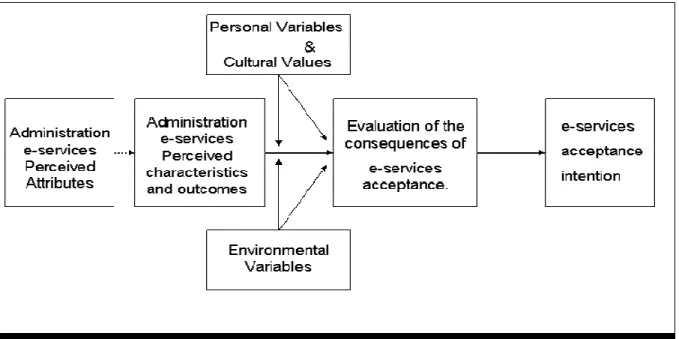
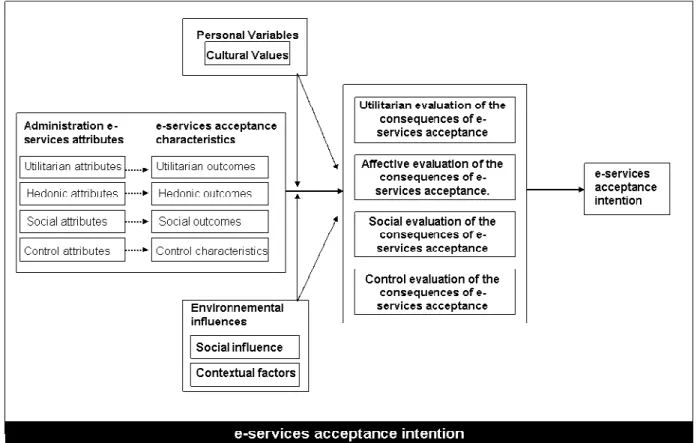
Based on a large literature review, we present a general model of various elements involved in the mental processes of the individual’s acceptance Administration’s e-services in his environment: ITA e-ad Model. This model reflects the theoretical findings about (I) personal variables specifically cultural values, e-services outcomes, external variables like the social influence and contextual control; (II) the interaction between these key constructs and utilitarian, affective, social and control evaluation of the e-services acceptance; and (III) the impact of the utilitarian, affective, social and control evaluation on e-services acceptance intention.
Figure 1. A general model of various elements involved in the mental processes of the individual’s acceptance Administration’s e-services
2.1 The user evaluations of the consequences of e-services acceptance
Administration’s e-services acceptance process involves careful weighting and evaluation of utilitarian5 (or functional), hedonic6 (emotion driven benefits like sensory pleasures, daydreams…), social7, and control e-services acceptance outcomes.
5 Prior research has emphasized the importance of the utilitarian outcomes which are defined as the extent to which using an
IT enhances the effectiveness of an individual activities. These attributes are very strong predictors of IT acceptance (Venkatesh & Brown 2001).
6
Research describes hedonic outcomes as the pleasure derived from the IT usage.
7
Figure 2. The ITA e-ad Model of the individual’s evaluation of Administration’s e-services acceptance
Evaluation of the utilitarian consequences is based primarily on cognition.
The evaluation of hedonic consequences is determined primarily by feelings and affect.
The evaluation of social outcomes is determined by the perceived social influence and secondary sources (Venkatesh & Brown 2001), and by personal network exposure (PNE).
The control evaluation is determined by the comparison of resources available (such as: money, time, and information) versus barriers inhibiting acceptance (such as: high cost, lack of support, lack of security, privacy respect and difficulty of use) (Hartwick & Barki 1994).
2.2 Discussions of the research model
The ITA e-ad Model asserts that e-services acceptance intention (AI) is a direct function of perceived utilitarian consequences (PUC), perceived affective consequences (PAC), perceived social consequences (PSC), and perceived control consequences (PCC). More formally, e-services acceptance intention (AI) is a weighted function of the utilitarian, affective, social and control evaluation.
AI = W1 PUC + W2 PAC + W3 PSC + W4 PCC
Each of the determinants of e-services acceptance intention, i.e., PUC, PAC, PSC, and PCC, is, in turn, determined by underlying e-services’ outcomes formulated using an expectancy-value model (Fishbein 1968) which attaches a weight to each outcome. This weight varies from one person to another depending on the individual cultural differences.
2.3 Discussions on the methodology, the instrument development and Conclusion
This research model is general enough to be applied to a large number of situations and contexts. It determines the final intention of Administration’s e-services acceptance. It can help Administrations optimizing the deployment and management of their IT investments by better understanding their citizens. Administration’s communication departments can incorporate these cultural values which influence the evaluation of the IT acceptance.
The proposed model will be empirically tested using data collected from two different countries. Data will be collected from a large sample of French and Lebanese potential users of the Administration’s e-services. Questions will be asked about the Administration e-services acceptance intention.
The instrument used in this research will featured two broad categories of questions regarding: (1) factors related to e-services acceptance and usage, and (2) individual cultural values.
The seven point Likert scale were written to elicit factors driving e-services acceptance decision. The questions will be evaluated by experts and peers, and modifications will be made based on their feedback. A pilot study will be conducted next month in two large universities (Saint Joseph University Lebanon and Paris-Dauphine France). The pilot study will be used to conduct a preliminary test of the instrument, to collect comments and suggestions about the instrument from respondents. The ITA e-ad Model try to satisfy Little’s conditions: the model is robust, easy to control, adaptive, complete, easy to communicate and simple.
References
Agarwal, R. & Karahanna, E. (2000). Time Flies When You're Having Fun: Cognitive Absorption and Beliefs about Information Technology Usage. MIS Quarterly, 24 (4), 665-694.
Agarwal, R. & Prasad, J. (1998). A Conceptual and Operational Definition of Personal innovativeness in the Domain of Information Technology. Information Systems Research, 9 (2), 204-215.
Ajzen, I. & Fishbein, M. (1980). Understanding Attitudes and Predicting Social Behavior. Prentice-Hall, Englewood Cliffs, NJ.
Ajzen, I. (1991). The Theory of Planned Behavior. Organizational Behavior and Human Decision Processes, 50, 179-211.
Ajzen, I. (2001). Nature and Operation of Attitudes. Annual Review of Psychology, 52, (1), 27- 32. Compeau, D.R. & Higgins, C.A. (1995a). Computer Self-efficacy: Development of a Measure and
Initial Test. MIS Quarterly, 19 (2), 189-212.
Compeau, D.R. & Higgins, C.A. (1995b). Application of Social Cognitive Theory to Training for Computer Skills. Information Systems Research, 6 (2), 118-143.
Cooper, R.B. & Zmud, R.W. (1990). Information Technology Implementation Research: A Technological Diffusion Approach. Management Science, 36 (2), 123-139.
Coyle, F.P. (2001). Wireless Web: A Manager’s Guide. Addison Wesley, NJ.
Davis, F.D. (1993). User acceptance of information technology: system characteristics, user perception and behavioural impacts. International Journal of Man-Machine Studies, 38 (3), 475-487.
Davis, F.D., Bagozzi, R.P. & Warshaw, P.R. (1992). Extrinsic and Intrinsic Motivation to Use Computers in the Workplace. Journal of Applied Social Psychology, 22, 1111-1132.
Davis, F.D., Bagozzi, R.P. & Warshaw, P.R. (1989). User Acceptance of Computer technology: A Comparison of two Theoretical Models. Management Science, 35 (8), 982-1003.
Davis, F.D. (1989). Perceived Usefulness, perceived ease of use and user acceptance of information technology. MIS Quarterly, 13 (3), 319-340.
Engel, J.F., Blackwell, R.D. & Miniard, P.W. (1986). Consumer behavior. Chicago: the Dryden Press. Fishbein, M (1968). An investigation of relationships between beliefs about an object and the attitude
towards that object. Human Relationships, 16, 233-240.
Fishbein, M. & Ajzen, I. (1975). Belief, attitude, intention, and behavior: An introduction to theory and research. Reading Mass, Don Mills, Ontario: Addison-Wesley Pub. Co.
Hartwick, J. & Barki, H. (1994). Explaining the Role of User Participation in Information System Use. Management Science, 40 (4), 440-465.
Heeks, R. (2002). Information Systems and Developing Countries: Failure, Success, and Local Improvisations. The Information Society, 18, 101–112.
Hofstede, G. (1980). Culture's Consequences: International Differences in Work-Related Values. Sage, Beverly Hills, CA.
Hofstede, G. (1983). Dimensions of national cultures in fifty countries and three regions. In J.B. Deregowski, S. Dziurawiec, R. C. Annis (Eds.), Expiscations in cross-cultural psychology. Lisse, Netherlands: Swets & Zeitlanger.
Hofstede, G. (2000). The information age across cultures. Proceedings of 5th AIM conference – Information Systems and Organizational Change. CD-Rom, 10 pp.
Howard, J.& Sheth, J.N. (1969). Theory of Buyer Behavior. In J. Wiley & Sons, New York.
Hsieh, J.J., Po-An, Rai A., & Keil, M. (2008). Understanding Digital Inequality: Comparing Continued Use Behavior Models of The Socio-Economically Advantaged and Disadvantaged. MIS Quarterly, March, 32 (1), 97-126.
Igbaria, M., Guimaraes, T. & Gordon, G.B. (1995). Testing the Determinants of Microcomputer Usage Via a Structural Equation Model. Journal of Management Information Systems, 11 (4), 87-114. Karahanna, E., Straub, D.W. & Chervany, N.L. (1999). Information Technology Adoption Across
Time: A Cross-Sectional Comparison of Pre-Adoption and Post-Adoption Beliefs. MIS Quarterly, 23(2), 183-214.
Little, J.D.C. (1970). Models and managers: The concept of a decision calculus. Management Science 16, PP. B466-B485.
Moon, J. & Kim, Y. (2001). Extending the TAM for a World-Wide-Web Context. Information and Management, 38 (4), 217-230.
Moore, G.C & Benbasat, I. (1996). Integrating Diffusion of Innovations and Theory of Reasoned Action Models to Predict Utilization of Information Technology by End-Users. In K. Kautz and J. Pries-Heje, Diffusion and Adoption of Information Technology, Chapman and Hall, London, pp. 132-146.
Moore, G.C. & Benbasat, I. (1991). Development of an instrument to measure the perceptions of adopting an information technology innovation. Information Systems Research, 2(3), 192-222. Rogers, E.M. (1995). Diffusion of Innovations. 4th Ed., Free Press, New York.
Rogers, E.M. (1983). Diffusion of Innovations. 3d Ed., Free Press, New York.
Rogers, E.M. & Shoemaker, F. (1971). Communication of Innovations: A Cross-Cultural Approach. 2nd Ed., New York: The Free Press.
Straub, D.W. (1994). The effect of culture on IT diffusion: e-mail and fax in Japan and the US. Information Systems Research, 5(1), 23-47.
Straub, D.W., Keil, P. & Brenner, A. (1997). Testing the technology acceptance model across cultures: A three country study. Information & Management, 31(1), 1-11.
Straub, D.W., Loch, K., Evaristo, R., Karahanna, E. & Strite, M. (2002). Toward a theory-based measurement of culture. Journal of Global Information Management, 10(1), 13-23.
Srite, M. & Karahanna, E. (2006). The influence of national culture on the acceptance of information technologies: An empirical study. MIS Quarterly, 30, 679-704.
Sun, H. & Zhang, P. (2006). The role of affect in IS research: A critical Survey and a research Model. In: P. Zhang and Galletta, Humain-Computer Interaction and Management Information Systems-Foundations, ME Sharpe, Inc., Armonk, NY.
Taylor, S. & Todd, P.A. (1995). Understanding Information Technology Usage: A Test of Competing Models. Information Systems Research, 6(2), 144-176.
Thompson, R.L., Higgins, C.A. & Howell, J.M. (1991). Personal Computing: Toward a Conceptual Model of Utilization. MIS Quarterly, 15(1), 124-143.
Tornatzky, L.G. & Klein, K.J. (1982). Innovation characteristics and innovation adoption-implementation: A meta-analysis of findings. IEEE Transactions on Engineering Management, 29(1), 28-45.
Triandis, H.C. (1980). Values, Attitudes, and Interpersonal Behavior. In H.E. Howe (ed.), Nebraska Symposium on Motivation: Beliefs, Attitudes, and Values, University of Nebraska Press, Lincoln, NE, pp. 195-259.
Triandis, H.C. (1971). Attitude and Attitude Change. John Wiley Sons Inc., New York.
Valente, T. (1995). Network Models of the Diffusion of Innovations. New York: Hampton Press. Van der Heijden, H. (2004). User Acceptance of Hedonic Information Systems. MISQ, 28(4),
695-704.
Van Birgelen, M, Ruyter, K.D, Jong, A.D., Wtzels, M. (2002). Customer evaluations of after-sale service contact modes: An empirical analysis of national culture's consequences,” International Journal of Research in Marketing, 19, 43-64.
Venkatesh, V. & Brown, S. (2001). A Longitudinal Investigation of Personal Computers in Homes: Adoption Determinants and Emerging Challenges. MIS Quarterly, 25(1), 71-102.
Venkatesh, V. & Davis, F.D. (2000). A Theoretical Extension of the Technology Acceptance Model: Four Longitudinal Field Studies. Management Science, 46(2), 186-204.
Venkatesh, V., Morri, M.G., Davis, G.B., Davis, F.D. (2003). User Acceptance of Information Technology: Toward a Unified View. MIS Quarterly, 27(3), 425-478.
Webster, J. & Martochhio, J. (1992). Microcomputer playfulness: Development of measure with workplace implications. MIS Quarterly. 16(2), 201-226.