Do Legal Origins Matter ?
The Case of Bankruptcy Laws in Europe (1808-1914)
Jérôme SGARD
CEPII and Université de Paris-Dauphine
January 2006
CEPII, 9 rue Georges-Pitard, 75015 Paris,
Email : [email protected]
Do Legal Origins Matter ?
The Case of Bankruptcy Laws in Europe (1808-1914)
Abstract
Since LLSV early 1998 paper, a growing body of research has argued that “legal origins” have a country-specific, time-invariant effect on property rights and economic development. Following upon LLSV’s own methodology, an original data-set of 51 bankruptcy laws has been built: it ranges over 15 European countries and more than hundred years (1808-1914), and summarises how the rights and incentives of the parties were defined, as the procedure unfold. The first conclusion is that all legal traditions protected strongly creditors’ rights, over the whole period; only English law comes out prima facie as less protective. Evidences then suggest that the evolution of these laws was influenced less by their past than by continent-wide trends, arguably linked to capitalist development. An early century model thus saw heavy repression of failed debtors and highly regulated procedures. After a transition period from the late 1860’s to the late 1880s’, prison for debt was abandoned, rehabilitation became easier, and the parties got much more room to bargain.
Do Legal Origins Matter ?
The Case of Bankruptcy Laws in Europe (1808-1914)
1. Introduction: ‘legal origins’ and the evolution of bankruptcy law
Over the last ten years, a growing body of research has emphasised the impact of legal origins, or legal traditions, on economic development*. The basic intuition stems from standard neo-institutionalist economics: property rights, the integrity of contracts and the security of transactions matter for financial contracting, hence for investment and growth. The main innovation brought about i.a. by Rafael La Porta, Florencio Lopes-de-Silanes, Andrei Shleifer and Robert Vishny (hereafter LLSV) was to rely upon large cross-country data-bases in order to test empirically these propositions.
In this attempt, however, they were confronted to a standard problem of endogeneity: institutions, including legal ones, could be shaped by the process of economic development, rather than being a shaping factor, so that they would not help accounting for variations across countries. The solution was to use each country’s “legal origin” as an exogenous variable: i.e. their belonging to either the Common law tradition, or to various currents of continental law – French, German, Scandinavian or Socialist. As they measured the quality of legal institutions, LLSV indeed observed strong covariance within these sub-groups of countries. And when included in regression equations, this variable came out as a significant factor in explaining different economic outcomes - bank intermediation, stock market capitalisation, the availability of equity finance, etc1. Already in their first joint paper, LLSV (1997) concluded that, other things equal, Common law countries better protect property rights and draw economic benefits from this; they are followed by Scandinavian, German and finally French law countries. Comparable conclusions were reached in latter papers, and by other authors, which focussed on an ever increasing array of variables, generally with the same hierarchy among “legal origins”2. There is no question that bringing legal history into the economic debate was an important and welcome innovation. Neither will anybody contest that legal history belongs to the very long term: as stated by Gleaser and Shleifer (2001), the canonical opposition between English and French law had already emerged in the Middle-Ages.3 Yet, the main difficulty with the argument derives from the
*
The author thanks for their remarks and suggestions, though with the usual caveat, Marc Flandreau, Jean Cartelier, Aldo Musacchio, Jaime Reis, Jean-Laurent Rosenthal, Jean-Louis Vallens and Yishay Yafeh. 1
See LLSV 1997, 1998, 1999a, 2000. 2
See for example Beck and al. (2003), Beck and al. (2005), Demirgüc-Kunt and Maksimovic (1998), Djankov et alii (2006), Levine (1998). For a survey see Beck and Levine (2005)
3
Comparing legal traditions is an old field of research; see Lyon-Caen (1876), and its US edition the same year; Zweigert and Kötz (1998) for a recent survey and discussion.
econometric and analytical interpretation of this very notion: “legal origin” is used as a country-specific, time-invariant parameter, which is expected to have permanent effects on institutions and on economic performances. This assumption is actually required, if the endogeneity problem is to be solved neatly4.
Hence, the underlying paradox: whereas the overall approach comes with a strong smell of Northian historiography, the actual use of history, or duration, is profoundly a-historical. It does not and cannot account for phases or cycles in economic or political development. Nor are these propositions
consistent with the standard assumptions of the Law and Economic school, which states that the law is shaped by market forces. On the contrary, “legal origins” are supposed to have emerged in a given historical context and to have then crystallised: they are interpreted as some essential hard-core identity, which would lie beyond the reach of either economic or political competition5.
This obviously raises concerns. To start with, no empirical evidence has been presented which would support this proposition. Historians have certainly identified different legal and institutional patterns, over sub-periods, which may have had diverging economic consequences. But this is different from the identification of permanent biases which would have tangible economic effects over all countries and centuries. Besides, the actual indices used as a proxy for those rights, in the econometric
regressions, are very narrow. In their early seminal papers, for instance, LLSV chose bankruptcy laws as a representative creditors’ rights institution6. And within these laws, they identify four critical items which were supposed to reflect the guarantees offered in general to creditors under the respective procedures. This highly discriminating approach certainly goes against the grain of mainstream legal theory, which defines property rights as a complex bundle of rights, rather than a neatly defined, positive endowment. It also makes them more vulnerable to country- or period- specific patterns. Can for instance the criteria chosen by LLSV be applied to other historical periods ? Or should they merely
4
A softer version of the argument could have stated that “legal origins” have had a significant economic impact during some periods and a more muted one during others; but such environment-contingent clause could then be extended to present-day countries, e.g. more or less developed ones. The whole argument would then loose much of its strength; in other words, by construction, it has to be epistemically universal.
5
A number of authors have presented this thesis in a less straight-forward manner. Berkowitz and alii (2003) for instance argue that the impact of ‘legal origins’ is contingent on whether their adoption is voluntary or not (ie colonial) ; Djankov et alii (2003b), though arguing from the standard LLSV viewpoint, underline that there is room for a country-specific trade-off depending upon e.g. its degree of development. From a mostly theoretical view point, Ayotte and Hayong (2004) defend a comparable idea, though with a different conclusion –
developing countries should adopt more regulated or formalised law than developed ones; see also Berkovitch and Israël (1999). Standard opponents to the students of “legal origins” often argue that political (rather then legal) institutions are the key when defending property rights; see for instance Rajan and Zingales (2003), Acemoglu (2003), and of course Marx and Engels (1848).
6
Note that, historically, bankruptcy law in England and the US stems from statutory law, whereas case-law has never produce a coherent body of rules on this issue; the only major exception in this respect is the US equity receivership, which emerged in the late nineteenth century (see Skeel 2001 and Martin 1974). By the same token, French commercial courts, which have jurisdiction over bankruptcy, have almost always been staffed by
be considered as a present-day expression for a more fundamental, underlying reality? But how should that reality then be identified?
This paper presents an original attempt at testing the proposition that legal traditions are a time-invariant, country-specific variable, that can actually work in a purely exogenous way in economic development. Following on the above-mentioned paper, it focuses on bankruptcy law in Europe during the nineteenth century, a rather large scope that offers at least three advantages: all Western legal traditions are represented in the sample; the period under review witnessed large-scale economic and institutional changes; and lots of reforms have been adopted in all countries7. In other terms, there is a lot of a priori variation across time and countries.
Two questions are then addressed: did “legal origins”, as defined by LLSV, have the same differentiated impact on 19th century creditors’ rights than the one they identify in the late 20th century? Did these “origins” also bear on other important features of these laws, when they were discussed and designed? Bankruptcy is indeed a very complex, multi-facetted institution: it thoroughly redefines the rights of the parties at the onset; it imposes on them binding, non-market rules of
interaction, which are also dependent upon an array of pre-existing bodies; and the environment in which they operate utterly expose them to moral hazards and to threats of opportunistic behaviour : which situation could be actually more dangerous than one where all debt contracts are broken and market discipline is destroyed? Sensitivity to an evolving environment might indeed be a key factor beyond the common statement that bankruptcy laws are historically unstable8.
The notion of time-invariant patterns may thus be thoroughly tested against an alternate hypothesis: maybe lawmakers attempted primarily to address pragmatically emerging problems, or the demands formulated by social actors? In so doing, they would of course have had to deal with the existing legal institutions and professions, as with a specific legal grammar. But maybe these variables did not have such a tangible impact on how the eventual solutions did work? Maybe the evolutions observed across countries reflect much more the economic challenges arising from capitalist development than the respective legal histories?
Although providing complete answers to these questions is beyond the scope of this article, it presents a series of evidences which infirm at least some hypothesis. With this aim, 51 legal acts, statutes and codes, adopted in Europe between 1808 and 1914, have been collected and coded. In the majority of cases, the primary text has been consulted and in the other cases, nineteenth century legal treaties and
7
There has been on average 3,4 reforms per country during the period under review, with a maximum of eight in England.
textbooks were used. The contemporary legal literature also helped identifying the main themes in the policy debates of the time. A series of simple, LLSV-type indices was thus designed, which reflect actual trends in the evolution of bankruptcy laws, over time and across countries.
This original approach, which has no equivalent in terms of either method or scope, brings about two main conclusions. First, under LLSV’s own limited criteria, creditors’ rights during bankruptcies were very strongly protected by law, during the whole century and in all countries – whatever their legal tradition; only England comes out with a somewhat weaker performance. As a rule, the literature of the time indeed suggests that a bankruptcy code which would not aim primarily at protecting creditors’ rights would have just been pointless. Second, when one goes beyond the features selected by LLSV, available evidences infirm the notion that legal traditions would have had an exogenous, permanent, i.e. predictable effect on how the law is shaped: how it attempts to define the incentives and
constraints of agents. It is hard indeed to identify beyond the successive reforms the impact of a single, a-historical factor hypothetically anchored in an “origin”.
Two specific topics come out strongly: how controlling the debtor’s moral hazard, including via imprisonment; and the capacity for the parties to re-contract on their residual property rights after a default, i.e. to agree on an arrangement or reorganisation plan9. Under both respects, two continent-wide models emerged successively, during the first half of the period and then over the latter decades. Legal traditions only show up against the backdrop of these continent-wide trends. Of course, one could then try to re-link the successive reforms and adjustments made in each country, so as to a write history of national bankruptcy laws; but the identification of a time-invariant inner thread would be a wholly different proposition.
Section two presents the data set its main analytical dimensions. Section three discuss how, on this basis, the sample of countries performed under the LLSV criteria of creditors’ right ; it also presents an enhanced LLSV index, which reflects more closely of 19th century reality though it remains close to the initial intuition. The next section discuss the continent-wide transition towards a non-punitive bankruptcy law to a more liberal, non-threatening one. Section five shifts to the liberalisation of rules regarding arrangements and re-contracting. Section 6 concludes.
2. A Data-base on European Bankruptcy laws, 1808-1914.
8
The point comes up especially in the case of Common law countries; see e.g. Warren (1935), Berglöf and alii (2001), Skeel (2001). See also Percerou (1935, vol. 1, p. 36-37).
In order to analyse the evolution of national bankruptcy laws over the nineteenth century, 51 legal texts adopted in 15 European countries have been collected10. They extend from the 1808 French Code de commerce, which was the main source of influence on the continent until mid-century, till World War I11. Some countries of course did not exist at the beginning of the period, such as Belgium, the German Reich and Italy; but Prussia and the Kingdom of Piedmont are included in the data set. Others did not have a unified bankruptcy law before mid-century, as Norway, Finland, and a large part of the Northern German Confederation (outside Prussia); in some case only partial information was available. Europe-wide cycles of reforms can then be identified, with a minor upswing during the 1840s’, and again a lot of activity during the 1870’s and 1880s’.
Sources are the primary legal texts, when accessible (often as a translation); and, as a second-best, a substantial number of nineteenth century legal treaties, commentaries and textbooks were used. Features of each laws have been coded in a series of 0/1 digits, so as to reflect how the law defined both the rights of the players and the rules of the game - the procedure and the cards which the actors could play. This data set however reflects exclusively a formalistic, comparative history of the legal texts. It does not include any materials relating to the social or political economic history of bankruptcy, or on how agents actually relied upon these institutions, or how successful the law was.
The starting point is the four items chosen by LLSV (1998) in order to measure the protection of creditor’s rights during bankruptcy. Namely, they consider that creditors’ rights are considered better protected if :
- the management does not stay during reorganisation procedure; - the management cannot seek protection from creditors unilaterally;
9
The terms ‘arrangements’, ‘compositions’, ‘continuation’ or ‘reorganisation’ plans are used here as synonymous.
10
The history of bankruptcy laws has attracted increasing attention since the 1980’s, though this literature deals mostly with the US experience. At one end of the spectrum are various trends in cultural history, which often centre on the “moral economy” of debt and default (Finn 2003, Anderson 2004, Mann 2003, Weiss 1986), and various approaches in the social history of failure (Duffy 1985, Hoppit 1987, Lester 1995). Others authors have focussed on the actual working of the institution, during specific episodes: for instance, the short life of the second American federal law in 1841-42 (Balleisen 2001), the role of the third federal law (1867-1878) in the economic reconstruction of the South (Thompson 2004), or the political economic history of the last-to-date, 1978 US law (Posner 1978, Carruthers and Halliday 1998). Before that, some early, mostly descriptive works contributed to opening the field and identifying the main issues at stake (Warren 1935, Coleman 1974). A classic example is the conflict on bankruptcy reform and land exemption which opposed the rural West to the financial centres of the North-East. In this perspective, Howard Rosenthal and his colleagues have provided new insights into the political economic determinants of bankruptcy reforms in the United States (Berglöf and Rosenthal 2000 and 2004, Nunez and Rosenthal 2002, Berglöf, Rosenthal and von Thadden 2001 which also extend to some European experiences; also Domowitz and Tamer 1997). This approach has been extended by David Skeel (2001) to twentieth century trends, with an often close analytical language.
11
Austria, Belgium, Denmark, England, France, Finland, Prussia/ Germany, Hungary, Italy, The Netherlands, Norway, Portugal, Russia, Spain and Sweden. Greece, Malta and Switzerland are mentioned occasionally but are not included in the data set.
- reorganisation procedures are not associated with an automatic stay; - the rights of secured creditors are protected during reorganisation.
A first aim was thus to replicate or approximate the simple additive index proposed by LLSV, which ranks the protection of creditors’ rights from 0 (minimum) to 4 (maximum). When working on 19th century texts however, problems rapidly arise from the differences in economic and institutional contexts: many policy issues of the time just fall outside LLSV’s quality criteria. Most obviously, bankruptcies concerned mostly personal entrepreneurs, or traders, rather than incorporated businesses : this of course affects a lot of a agency problems.
Take the case of going concern issues – for instance whether and how the firm can operate during the procedure. This point emerged only in the late nineteenth century, typically in the case of railways companies12. Before that, the principal/ agent problem during the procedure was secondary: the priority for creditors, when a default was known, was to immediately take the control the remaining assets, so that the bankrupt would not hide them or secretly transfer them. Indeed, seizing the assets or the body of the debtor were long considered as two major, alternate avenues to protect creditors against opportunism. On the other hand, how reorganisation plan were decided was already a major issue. But the main question during the nineteenth century was not whose voice would be decisive – there was no uncertainty on this; it was the guarantees and relative autonomy left by the procedure to the parties, when negotiating.
Hence the two main analytical issues documented by the data-set: How were the risks of moral hazards contained, at a time when the main perceived threat came from the debtor’s personal behaviour? How did the law structure the interaction between the private parties and which degree of autonomy did it allow them? The first question remains close to a definition of creditors’ rights as a rather straightforward issue of protecting wealth against market indiscipline. The second considers the trade-off between the risks of moral hazard and the guarantees of a judicial procedure.
3. LLSV and the quality of nineteenth century bankruptcy laws
If LLSV’s four criteria are taken literally, measuring the quality of European bankruptcy laws during the nineteenth century is neither difficult, nor very informative: creditors’ rights were very strongly protected, in all countries, during the whole period. on that basis, almost all countries would have probably received either a 3 or 4 mark, depending upon how the criteria are interpreted. Let’s look in some details at how LLSV’s concerns come up in the 19th century context.
First, as a universal rule, a trader would lose the control over, and often the legal property of his assets (personal and commercial) on the day bankruptcy was declared. But he would also lose the legal capacity to trade – i.e. to sell and buy, pay and borrow, etc.; even a fresh start would not be possible, unless he would be rehabilitated (often a hard act)13. In this sense, there is no way entering bankruptcy would have protected managing rights. There are however two exceptions: first are rare cases of judicially controlled individual moratoria, during the first decades; then are out-of-bankruptcy frameworks adopted at the end of the century in many countries: the parties could negotiate under some judicial oversight though the trader kept most of his rights. If LLSV criteria are taken literally, these clauses actually weakened creditors’ rights; but at the time, as shall be discussed latter, they were envisaged as efficiency-enhancing reforms, which support co-operation and early entry into negotiations.
Orthodox conclusions are reached again on the matter of secured creditors: nineteenth century laws emphatically protected their rights during bankruptcy. Expectedly, the sole contentious issue is that of the privileged (i.e. statutory, non-contractual) claims of third-parties on the bankrupt’s estate: i.e. claims owned by the Treasury and churches, workers and servants, doctors and pharmacists, etc. But this was mostly a threat for junior creditors, which are not the focus of LLSV. Beyond, although measuring the extent of privileged claims is hard14, the legal and policy literature of the time does not suggest that they were instruments to funnel large extra-contractual interests into the distributive machine that is bankruptcy. As regard more generally the principle of absolute priority between investors, an interesting albeit marginal practice was to offer some percentage in the proceed of liquidation to the benevolent, co-operative debtor: England, Würtemberg and Malta had such clause15. Literally taken, this prescription represented an explicit infringement in the creditors’ rights, though it was conceived as a pro-creditor incentive device.
The fourth LLSV argument, on stays, is more problematic, from an analytical viewpoint. By definition, bankruptcy is a collective instrument of debt collection, which is substituted to individual remedies when they threaten a loss of value for creditors, as a whole; i.e. when there is a going 12
The point has been well documented in the case of the US law; see Martin (1974) and Skeel (2001). 13
In other words, the opposition between “manager-driven” and “manager-displacing” bankruptcy law does not work during the nineteenth century ; see Skeel (1998), Armour, Cheffins and Skeel (2002).
14
The main difficulty encountered in this survey is that these clauses are most often scattered in many different bodies of law, rather than in the bankruptcy text – the fiscal and civil code, the laws on tenants and land lease, the emerging labour law, etc. However, provisions for wages and rents would typically be limited to a year or an eighteen months, plus a ceiling on the amount being reimbursed. On the other hand, no indication has been found of widespread land exemptions, as was (is) often the case in the United States; see Warren (1935), Posner E. (1978). Universal moratoria, another common US practice at the time (Alston 1984, Bolton and Rosenthal 2002) is also unknown in Europe.
15
This incentive varied within a (5-10%), (5-8,3%) and (5-10% ) bracket respectively. The reference in the case of Malta is a 1815 ordnance on civil procedure; for Würtemberg see Saint Joseph (1844).
concern issue, or if a prisoners’ dilemma, or common pool problem, may result in a grab race16. In other terms, bankruptcy is an extra-contractual institution which necessarily suspends or rewrites some individual rights17. Typically this takes two canonical forms: a stay on payments and/or on private execution18; and qualified majority voting when deciding e.g. on liquidation, reorganisation or debt discharge. This is the point from which the LLSV argument should be approached: how did European countries deal with these options and the underlying threat of spoliation ?
- Stays were general practice on the Continent, during the whole period, with some qualification with early century Austrian law, and some undocumented periods in eg Denmark. As a rule, foreclosures were stayed when bankruptcy was declared, generally until liquidation was decided. In the case when senior interest payments were dealt with, the law excluded them from the stay. England adopted the principle of a stay on private remedies from 1869 onwards.
- Qualified majority voting by all non-senior creditors was a standard feature of all reorganisation agreements; typically, the vote would be counted both in terms of number of creditors and sums of claims, with majority thresholds of three quarters and two thirds respectively; judicial confirmation was conditional upon a positive vote and was a prerequisite for the agreement to become binding.19 - A somewhat different issue is that of debt discharge, specifically when it can be imposed upon (some) creditors. Since 1702, English creditors had been able to agree, on a qualified majority basis, to relieve the honest and co-operative debtor of her debt, after the assets had been auctioned off. This clause has generally been presented as a reflection of a remarkable pro-business bias in the English law20. This statement often ignores that continental creditors could generally take the same decision: the difference is that it would be part of an arrangement, of a rather private nature, instead of being addressed at the end of the procedure, as a single-issue vote21. It may well be that eventual discharge was easier to obtain in England, in the 18th and early 19th centuries; and more importantly the rights to trade again were probably easier to recover. But as far as creditors’ right are concerned, the major divergence with continental practices only emerged in 1843: discretion on discharge was then
16
Jackson (1985), Hart (2000), White (1977). 17
This is stated as one important reason why English bankruptcy law did not emerge from Common law but from statutory law (Jones, 1979) ; its instability over time apparently derived, at least partly, from the contradictory principles embedded in the respective bodies of legal texts.
18
As a simplification, both options are considered here together. 19
No statute provided the judge with the right to impose an agreement on creditors, if they failed to agree (as with the ‘cram down’ provision of the present US Chapter 11).
20
« Thus the bankrupt becomes a clear man again ; and (…) may become a useful member of the
commonwealth” (Blackstone, 1811, p.488). On the English debt discharge, see Holdsworth (1925), Tabb (1991), McCoid (1996). Note that courts also had discretion when confirming discharge.
21
A corollary issue is the Common Law-specific debate on whether bankruptcy should be only involuntary (i.e. initiated exclusively by creditors) or also voluntary - initiated by the debtor; see McCoid (1987 and 1988). This
transferred to English courts, with no veto power to the assembly of creditors. This step towards weaker property rights has never been taken by any other country, during the whole period under review.
In order to summarise these various elements, a simple LLSV type, additive index has been calculated for all countries, over the whole period. It does not reflect literally LLSV’ own variables, but rather tries to adjust to 19th century rules, while remaining as close as possible to their own judgement on what should, and should not do a bankruptcy procedure. Selected items are the following22 :
- regulations on stays explicitly preserves interest payments on secured debt; - opening negotiations on reorganisation plan is not associated with a stay; - no money incentive to the debtor (rule of absolute priority);
- no capacity by the court to declare a debt discharge.
Graph 1 then reflects the piecemeal elements just being discussed: creditors’ rights were strongly protected during the whole period, in all countries, whatever their legal tradition. Only English law comes out as an exception, as its performance declined over time and ended the period clearly below average. In order to account for these paradoxical evidences, other features of these laws should now be brought into the picture.
4. Fighting moral hazard: prison for debt and “la mort civile”.
As stated, the basic aim of a bankruptcy procedure is to enforce a rule-based distribution of residual assets, at a time when the incentives on all actors is to run and grab them. This non-market rule of collective action should be a bulwark against full de-coordination, but also against the less spectacular, though manifold threats of opportunism and moral hazards. Arguably, in past centuries, the challenge was magnified by acute problems of information and communication : contracts, accounting books, property titles, instruments of payment, judgements – all these were much less formalised than today and circulated much more slowly.
One can hypothesise that these high transaction costs were a factor beyond the strong repressive features of all early statutes, which indeed defined bankrupts as outright criminals – « publicos
dispute has no equivalent on the Continent, where both parties have traditionally had the capacity to initiate the procedure.
22
Items which would have been close to LLSV intuition, though they are poorly differentiated across 19th century statutes, have not been included – for instance on issues of senior creditors.
ladrones y verdaderos robadores »23. Apparently the protection of commerce and debt markets could not do without heavy-handed instruments of social discipline, whatever the costs for the proverbial “honest but unlucky trader”24. The 1808 Napoleonic Code de commerce was probably the high point in the reliance upon repressive instruments as a substitute to apparently insufficient market discipline: all failed debtors were jailed, at least for a short exemplary period, and rehabilitation was highly conditional. At the time, shame and infamy were part and parcel of market discipline. Remarkably, however, this bias was not specific to France or to Civil law countries: in all Europe (as in America), lots of debtors ended up in jail in the early nineteenth century.25
This remarkable case of convergence across countries was however followed by yet another one, after a short transition period: whereas in 1865 no country had yet suppressed prison for debt, ten years latter 13 of them, of all legal traditions, had taken the step. At the time, many argued (in today’s language) that moral hazard would be incontrollable and that credit markets would decline. But they lost the argument, i.a. to those who believed that prison unduly increased the risk of entrepreneurship, at a net loss for the economy. In other terms, the majority of countries agreed that the straightforward, hard-headed defence of creditor’s rights might not be always consistent with economic development. More endogenous instruments of market discipline could do a better job.
The decline of repression is illustrated by a broader LLSV-type index, which focuses on prison for debt and rehabilitation (see Box 2). The average, cross-country index indeed confirms the account of a twice-in-a-century convergence pattern across Europe (Graph 2): after having shared a repressive approach, all countries eventually agreed that commercial failure should not cause “la mort civile” -provided the law had been respected. This evolution was however not unanimous: differences come up beyond this broad trend, e.g. between legal families or religions (Graph 3 and 4):
- Common law countries already had a tradition and reputation for allowing bankruptcies to have limited social costs (at least for entrepreneurs). As a rule however commercial rights were easier to recover than civic or political ones, which in England were still affected by bankruptcy, at the end of the century; and prison for small debtors – now called consumer debtors - was still widespread before World War I, in stark contrast to the situation in most Western countries26.
- The landmark German 1877 Code then provided a model for a bankruptcy law without any repressive feature, modelled as an almost pure procedural, problem-solving instrument. Its
23
Spanish act of 1502, in Novissima recopilacion de la leyes de Espana (1831). 24
This ever-present figure is the hero of Balzac’ novel César Birotteau (1837). 25
belonging to a civil law tradition, as well as its large influence in neighbouring countries, made it, in the eyes of many commentators, the actual successor of the 1808 French code27.
- France had more difficulty distancing itself from its Napoleonic repressive legislation: it adopted only in 1888 a new status for lawful debtors, which limited professional costs, although some political stigma was still present until the early twentieth century28. More generally, though they became steadily more liberal, it took more time in French and Scandinavian law countries.
5. Arrangements and the contractual autonomy of parties
Entering new contractual commitments with a once-failed entrepreneur clearly requires a leap of faith. But re-contracting may also be highly beneficial to all parties: for instance if the expected return of liquidation is brought down by the poor liquidity of the markets for property and capital goods – a common feature of early-capitalist economies.
Although, at first sight, the trade-off between re-contracting and liquidation seems to be for the parties to settle29, the law has always had its word here – probably because informational and commitment problems are especially acute when re-contracting. Until the end of the eighteenth century, on the Continent, arrangements between debtors and creditors had been mainly private affairs, subjected to qualified majority voting and light supervision (though often an increasing one, e.g. in France)30. Then, the 1808 Code came again as a counter-model, as arrangements, now called Concordats, were transferred within a minute judicial process. The parties could certainly negotiate on reorganisation plans and then obtain confirmation, though the law stated most exactly when, where and under which conditions they could speak up; and no private accords were allowed unless unanimity was reached. But this was not perceived as an undue official intervention: the Code de commerce, just as the more famous Code civil, are the constitution of bourgeois, liberal society. The rationale for a highly regulated bankruptcy law was that it should offer the best possible guarantees against fraud, dissimulation and corruption – which were seen as the hallmarks of work-out techniques during the Ancien Régime and the revolutionary years. There was a strong demand for procedural formalism31.
27
« une manifestation très sérieuse et probablement durable du génie juridique allemand » (Thaller 1887, p. 87) 28
Percerou (1935). 29
Jackson (1982). 30
See Savary (1749), Denisart (1771), Renouard (1857) and Hilaire (1985) for France; Josephus II (1781) on Austria, Ricard (1722) for Amsterdam, the Ordenanzas (1794) for Spain, and the indications on eighteenth century Hamburg law, in Saint-Joseph (1844).
31
« if, by a fatal negligence, the bankrupt and the debtors are allowed to cast off any [legal or procedural] provision, the aim of the lawmakers will be missed : fraud will come together with the impudence of impunity, it will seize the sanctuary of justice and flout its authority » (Laurens, 1806, p. 152). On this period, see also Renouard (1857), Picard (1910), Percerou (1935).
The striking point however is that, again, most other European countries did not offer more flexibility to private actors. As a rule, in the following decades, traders could indeed bargain though under the close control of judges and officials, within the long, costly, single-entry process of bankruptcy. As already stated, a limited number of countries, such as Belgium and Portugal, only kept the lighter, non-bankruptcy option of a judicial stay, or individual moratorium, as a response to short-term liquidity problems32. Path-braking reforms only emerged during the last quarter of the century, in a context marked i.a. by the emergence of corporations, large financial markets and growing problems of going concern.
In order to account for this evolution, an index of creditors’ autonomy has been designed, which adds six variables (Box 2). Its main aim is to reflect how the rules of interaction between judicial
institutions and private interests evolved, hypothetically towards a less intrusive and constraining model. One issue is whether judicial confirmation of arrangements was contingent upon substantive pre-conditions or the discretionary judgement of the court. Then is the possible shift towards a more differentiated institutional set-up, where agents were offered a menu of options, with more or less judicial oversight, as opposed to the single-entry bankruptcy process. Finally, the possibility to actively manage the assets during the procedure is also added.
The average, cross-European index offers again a bi-polar view, though it is less marked that in the previous case: the average European country offered a low degree of contractual autonomy until mid-century, before shifting to a more liberal approach after 1870, as more discretion was transferred to the parties (Graph 5). The brake-down along the religious line then shows Catholic countries being more liberal than Protestant (Graph 6), though this counter-intuitive proposition is then put into perspective by the “legal tradition” variable: two leading Protestant innovators took opposite roads - England and Germany; and a Catholic one (Belgium) sided with the former, eventually carrying with her most of the French law family, plus the slow-moving Scandinavians. This story-line is reflected in the “non-converging” pattern of evolution, on the right side of Graph 7.
England being here an innovator is surprising. Although Common law countries are generally considered more supportive of market forces and institutional innovation, no statutory guarantee to arrangements was possible in England before mid-nineteenth century33. Until that time, the law offered
32
As a rule, the rejection of this option was grounded again on risks of opportunism by either the debtor of some creditors ; see for instance Renouard (1857) or Füger and Wessely (1841). Legislation allowing such moratoria was introduced in France in 1848 and 1871 and rapidly withdrawn, though in the latter case some jurisdictions, in trading cities, apparently kept sanctioning the practice for some years. See Silvian (1915).
33
A 1697 English allowing for qualified majority votes on arrangement was abandoned one year later, on the account of extensive fraud and dissimulation (see for quotations Holland, 1864, pp14-17). This does not imply
much less support to re-contracting than both the pre-Napoleonic and the Concordat approaches, favoured on the Continent 34. English creditors would only choose between unanimity accords under private seal and bankruptcy, which would exclusively lead to liquidation; as already stated, the only open question was whether the bankrupt would be offered a discharge on her residual debt. Still in 1825 and 1849, two partial reforms had been failures: the majority threshold was too high (9/10 in sums in the former case), and the debtor had to relinquish most of his goods, whereas the aim of an arrangement is to avoid undue liquidation.
The breakthrough came in 1861, when these restrictions were abandoned so that bankruptcy could be also an instrument for restructuring balance sheets35. The key policy question, at that point, was whether such accord should be negotiated within or outside the bankruptcy process; i.e. whether softer forms of judicial oversight could be envisaged. After some trial and errors, agents were left in 1883 with three options:
- a full bankruptcy procedure leading to liquidation, with the possibility for the judge to grant a discharge;
- a reorganisation or self-liquidation plan, decided outside formal bankruptcy, with limited personal costs to the debtor, but still under tight judicial oversight (the debtor lost the control over assets, he was publicly interrogated, the judge had substantial power to reject the voted plan, etc);
- finally, a high-majority, low oversight formula was close to the past, unanimity deeds of arrangements, and appeared to be the most favourite option, as became clear once registration and some publicity rules were introduced in 1887.
On the continent, Belgium invented in 1883 a two-track approach, comparable to that designed the same year in England: the Concordat préventif allowed distressed debtors to negotiate wide-ranging plans under some judicial oversight, though without supporting the many costs of entering formal bankruptcy. He would not loose control over his assets, and his obligations in terms of provision of information were more limited; but he was put under some control by the court and the creditors, and if he failed to obtain qualified support, he would be shifted to bankruptcy per se. On the other hand was the German model, shaped by the 1877 code, which explicitly aimed at incurring minimal economic and civic costs to the debtor: after due consideration, lawmakers decided that all forms of arrangements should actually be decided within this modern, economical procedure, together with considerable difficulties in Common law countries. Information however is rare, since these agreements
explicitly aimed as eliciting publicity. See indications on eighteenth century practices in Hoppit (1987) and in Lester (1995), as regard the nineteenth century. This anti-arrangement bias is also present in the United States, where the option was introduced only in the third federal bankruptcy law, in 1867. Tellingly Coleman (1974) does not mention the terms ‘arrangement’ or ‘composition’ in his index. See also Mann (2003).
34
On 18th century and early 19th century English law, see Davies (1744), Cullen (1800) and Cooper (1801). 35
outright liquidation. In this respect, they remained closer to LLSV’s preference for rigid procedural guarantees against their optional relaxation.
Convergence at the end of the century thus took place around two models: by 1914, ten countries had adopted a multiple-track, Anglo-Belgian approach while the remaining five had opted for the integral, German one36. Legal traditions had thus bifurcated, though only case by case monographs would tell which variables were beyond each choice – the structure of the law, institutional inheritance, legal professions, interest groups, financial structure, foreign influence, etc. Yet, all these widely-discussed reforms had the same basic end : they tried to enlarge the scope for restructuring arrangements and, more specifically, to reach a better trade-off between judicial guarantees and the cost of re-contracting. And remarkably, strong innovators emerged in all three major legal traditions, an empirical evidence which prima facie contradicts the notion that, for some inherent reason, they would be unequally adaptable37. Moreover, nothing at this point supports the conclusion that, say, German creditors were worst off than Belgian or English ones.
6. Conclusion.
A data-set of 51 European laws and statutes has documented the evolution of bankruptcy procedures between 1808 and 1914. A first conclusion is that the protection of creditors’ rights was a core feature of all statutes, during the whole century, whatever the legal tradition they belonged to; only England may be considered a partial exception. The claim that “legal origins” have a permanent, country-specific impact on creditors’ rights, as defended i.a. in LLSV (1998), is thus not warranted38. This certainly does not imply that all countries were equally efficient in actually protecting stated rights; but as far as the structure of the law is concerned there is not much room for doubt.
Beyond, the main lesson is that broad, continent-wide evolutions, arguably linked to the process of capitalist development, are much more important that country-specific features. Two bankruptcy models were thus identified, across the Continent. A first one, best represented by the 1808 Napoleonic Code, was characterised by heavy threats and repression vis-à-vis the debtors and by limited contractual autonomy. At the time, the rationale put forwards was the need to control moral hazard and opportunism. After a transition period between the late 1860’s and the late 1880s’, an alternate, more liberal model emerged: prison for debt was abandoned, rehabilitation became easier, and the parties got much more room to re-contract on property rights. If the explanation for the first,
36
See table 4, the different variants of Concordat Préventif adopted in European countries. 37
early century model is correct, then, apparently, transactions risks should have declined sharply in the latter part of the century.
These empirical evidences do not contradict the observation of covariance within legal traditions. They rather underline the extent of joint changes across countries as well as the pattern along which traditions may evolve: they can endure for centuries, but they can also adjust rapidly to a changing environment. The shift of English statutory law towards court-based debt discharge and multiple-entry procedures is a remarkable example. Yet, it is not possible to point any occasion when “legal origins” might have been at work, against or in support of creditors’ rights. No essential or a-historical hard core of legal institutions could be observed, that would predict how real-world institutions are designed and how they bear on economic outcomes. “Legal origins” are a proxy for a social entity, which shape, structure and quality remain elusive.
REFERENCES
Primary legal texts
Chronologically, the main primary sources has been, first, Saint-Joseph (1844) for early 19th century laws. Then is the Annuaire de Législation étrangère, published every year by the Société de Législation Comparée from 1871 onwards ; it referenced most laws, on all subjects, adopted in European countries, with the main ones being translated. Then is the series of bilingual books published between 1911 and 1914 in the collection ‘Lois commerciales de l’univers’ ; this was the French side of a remarkable international project, aborted in 1914, which included parallel publications in the US and Germany.
Aström A., Hambro E., Kallenberg E., 1911. Droit commercial et droit de la faillite de la Suède. Paris: Librairie Générale de Droit et de Jurisprudence, coll. ‘Lois commerciales de l’univers’, volume 23, 171 p., translation by L. Beauchet (bilingual edition).
Aström A., Hambro E., Kallenberg E., 1911. Le droit commercial et le droit de la faillite de la Norvège. Paris: Librairie Générale de Droit et de Jurisprudence, coll. ‘Lois commerciales de l’univers’, volume 23, 206 p., translated by L. Beauchet (bilingual edition).
Balwin, E. T., 1891. The bankruptcy act and rules. London: Steven and Haynes, 425 p..
Benito L., 1914. Espagne, droit commercial, code de commerce, lois complémentaires. Paris: Librairie Générale de Droit et de Jurisprudence, coll. ‘Lois commerciales de l’univers’, volume 37, 351 p., translated by H. Prudhomme (bilingual edition).
Brown J. H. and Ogbourne W. W., 1849. The bankruptcy law consolidation act of 1849. London: Joseph Rickersy printer, 123 p..
Code de commerce, 1807. Bulletin des lois, n°164, pp. 161-284, Paris: Imprimerie impériale,
Code de commerce du royaume d’Italie, 1883. Nice: Cauvin-Empereur libraire-éditeur, 422 p., translated and annoted by H. Marcy.
Code de commerce et loi de procédure du Royaume d’Espagne, 1838. Paris and Rennes : Blin et Joubert. 580 p., translated by M. V. Foucher.
Code de commerce hongrois promulgué le 19 mai 1875, suivi des lois hongroises sur le change et les faillites, 1894. Paris: Durand et Pedone-Lauriel, coll. ‘Lois commerciales de l’univers’, xii-376 p. translated, annotated and introduced by R. de la Grasserie.
Code de commerce portugais de 1888, 1889. Paris: Imprimerie Nationale, xlv-264 p., coll. ‘Codes étranger’, translated and annoted by Ernest Lehr.
Code de commerce pour les Etats de S.M. le roi de Sardaigne, 1842. Torine : Imprimerie Royale, 236p..
Code du commerce du Royaume de Hollande, 1839. Paris: Imprimerie Royale, 285p., translated by M. W. Wintgens.
Codigo Commercial Portuguez approvado por decreto de 1833, com um appendice contendo a legislação que modificou, alterou ou completou o mesmo codigo, 1890. Coimbra : Imprensa da universidade, l-280 p.
Hahn, C., 1869. Die Preussische Konkurs-Ordnung und das Anfechtungesetz vom 9.Mai 1855. Breslau: Kern Verlag, 292 p.
Janisch, F., 1903. Die österreichisches Konkursordnung, gesetz von Dezember 1868. Leipa: Künfter, 170 p..
Josephus II, Romanorum Emperator , 1781. Allgemeine Gerichts und Konkursordnung fûr Böheim, Mähren, Schlessien, Östermarkt, Kärnten, Krain, … . Klagenfurt: Ignaz Kleinmayer, 199 p..
Klibanski H.O., 1913. Les lois commerciales de la Finlande, y compris les lois sur la lettre de change, sur la faillite et les lois maritimes. Paris: Librairie Générale de Droit et de Jurisprudence, coll. ‘Lois commerciales de l’univers’, volume 35, 388 p., translated from Russian by F. Mallieux and J. Rapoport (bilingual edition).
Klibanski H.O., Pergamante O. IA., Zavadskiy, 1912. Droit commercial russe, lettre de change – faillite – droit maritime. Paris: Librairie Générale de Droit et de Jurisprudence, coll. ‘Lois commerciales de l’univers’, volume 35, 388 p., translated by F. Mallieux (bilingual edition). Carpentier P.(1901. Législation commerciale de l’Allemagne. Code de commerce, entré en vigueur en
1900, loi sur le change, loi sur la faillite (refondue). Paris: Chavalier-Maresq, xxiii-576 p..
Les codes suédois de 1734 (civil, pénal, commercial), 1895 Paris: Pedone-Lauriel, coll. ‘Codes étrangers’, translated, annoted and introduced by R. de la Grasserie, .
Namur, P., 1876. Le code de commerce belge révisé. Bruxelles: Bruylants et Cie, second volume. Novissima recopilacion de la leyes de Espana, 1831. Madrid: Rosa et Libero, third volume. Ordenanzas de la ilustre Universidad y casa de contratacion de la villa de Bilbao (1737), 1794.
Madrid: de Sancha, 405 p..
Ricard, J.-P., 1722. Le négoce d’Amsterdam. Rouen : Machuel et all., 773 p..
Saint-Joseph, A. de, 1844. Concordance entre les codes de commerce étrangers et le code de commerce français. Paris: Videcoq et Delamotte, xlvi-417 p..
Société de Législation Comparée. Annuaire de Législation étrangère. Paris: Cotillon et Fils. Annual editions between 1871 and 1914.
Tybjerg E., 1911. Le droit commercial et le droit de la faillite du Danemark. Paris: Librairie Générale de Droit et de Jurisprudence, coll. ‘Lois commerciales de l’univers’, volume 24, 186 p., translated by L. Beauchet (bilingual edition).
Van Regteren-Altena M. (1911. Législation commerciale des Pays-Bas. Paris: Librairie Générale de Droit et de Jurisprudence, coll. ‘Lois commerciales de l’univers’, volume 28., 167 p., translated by F. De Hoon H., De Pelsemaeker F. et P.Carpentier (bilingual edition).
Secondary historical sources
Blackstone, Sir W., 1811. Commentaries on the Laws of England. London: William Reed, new edition with the analyses of J.F. Archbold.
Cooper Th., 1801. The Bankrupt Law of America compared with the Bankrupt Law of England. Philadelphia: John Thompson, 399 + annexes.
Cullen, A., 1800. Principles of the Bankrupt Law. London: Cadell and Davies, 488 p.. Davies, Th., 1744. The laws relating to Bankrupts. London: Henry Lintot, 550 pages.
Denisart, J.B., 1771. Collection de décisions nouvelles et de notions relatives à la jurisprudence actuelle, seventh edition. Paris: Chez Veuve Desaint, 4 volumes.
Dupin, A., 1900. De la faillite civile, nécessité de son organisation, étude de droit comparé et de législation. Grenoble : imprimerie Villard, 238 p..
Füger, J., Wessely, 1841. Füger’s Gerichtliches Verfahren in Streitsachen nach der österreichisches allgemeine Gerichts- un Konkursordnung vom 1. Mai 1781. Wien: Braumüller und Seidel, fourth edition, three tomes, 250 p., 252 and 335p.
Goldschmidt, Levin, 1875. Handbuch des Handelsrecht. Stuttgart: Ferdinand Entze, 690 p.. Holland, T. E., 1864. An essay upon compsition deeds and other modes of arrangements with
creditors. London: Sweet, 198p.
Lambrechts, H. et alii, 1896-1897. Dictionnaire pratique de droit comparé, Paris: Chevalier-Marescq et Cie, 550 p..
Laurens, J.-L., 1806. Traité des faillites et banqueroutes dans l’ordre judiciaire. Paris: Chomel, 402 p..
Lecomte, M., 1879. Etude comparée des principales législations européennes en matière de faillite. Paris: Durand et Pedone-Lauriel, 118 p..
Levinthal, Louis, 1918. The Early History of Bankruptcy Law, University of Pennsylvania Law Review, 66.
Lyon-Caen, Ch., 1876. Tableau des lois commerciales en vigueur dans les principaux états de l’Europe et de l’Amérique. Paris: Cotillon et Cie, 43 p..
Lyon-Caen, Ch., 1888. Loi anglaise sur la faillite du 25 Août 1883. Paris: Imprimerie Nationale, lxvii-212p.
Noel R., 1919. A History of the Bankruptcy Law; William s Hein & Co, (2002 reprint).
Percerou J., 1935. Faillites, banqueroutes et liquidations judiciaires. Paris: Rousseau et Cie, 3 vol., 1070 p., 1048 p. and 524p..
Renouard, A.-Ch., 1857. Traité des faillites et banqueroutes. Paris: Guillaumin et Cie, 3rd edition, two volumes, 574 and 560 p..
Robson, G. Y., 1888. A treatise on the law of private arrangements with creditors. London: William Cloves and Sons, 207p.
Sacré A., Oudin L., 1874. Manuel de droit commercial français et étranger, suivant les lois, les coutumes et la jurisprudence. Paris: A. Marescq, 816 p..
Savary, J., 1749. Le parfait négociant. 7th edition, Paris: Veuve Estienne, 2 vol., 1060 and 759p.. Silvian, M., 1915. Le concordat préventif en droit comparé, Paris: Giard et Brière, xx-250 p..
Paschoud, F., 1905. Le concordat préventif de la faillite. Lausanne: Imprimerie Charles Pache, 256 p.. Thaller, E., 1887. Des faillites en droit comparé, avec une étude sur le règlement des faillites en droit
international. Paris: A. Rousseau, two volumes.
Zimmerl, J., 1822. Handbuch für Richter, Addvokaten und Justizbeamte, Wien, Gehlen, deux tomes, 567 et 445 p..
Recent publications
Acemoglu D., 2003, Why Not a Political Coase Theorem? Social Conflict, Commitment and Politics, Journal of Comparative Economics. v.31, 620 - 652
Alston, L.J., 1984. Farm Foreclosure Moratorium Legislation: A Lesson from the Past. American Economic Review 74, 445-457.
Anderson, E., 2004. Ethical Assumptions in Economic Theory: Some Lessons from the History of Credit and Bankruptcy. Ethical Theory and Moral Practice, 7-4, 347-360.
Armour J., Cheffins B., Skeel D., 2002. Corporate Ownership Structure and the Evolution of Bankruptcy Law: Lessons from the United Kingdom. Vanderbilt Law Review 55, 1669-1785. Ayotte, K and Hayong Y., 2004. Matching Bankruptcy Laws to Legal Environment. Columbia
Business School.
Balleisen E. J., 2001. Navigating Failure: Bankruptcy and Commercial Society in Antebellum America. Chapel Hill: University of North Carolina Pr., 344 p.
Bebchuk A., Fried J., 1996. The Uneasy Case for the Priority of Secured Claims in Bankruptcy. Yale Law Journal, 105-857.
Beck T., Demirgüc-Kunt A., Levine R., 2003. Law and Finance : Why Does Legal Origin Matter ? Journal of Comparative Economics, 31(4), 653-676.
Beck T., Demirgüc-Kunt A., Levine R., 2005. Law and Firms’ Access to Finance. American Law and Economics Review 7(1), 211-52.
Beck, T., Levine R., 2005. “Legal Institutions and Financial Development.” in Handbook for New Institutional Economics, Claude Menard and Mary M. Shirley eds., Norwell MA: Kluwer Academic, 251-278.
Berglöf E., Rosenthal H., 2000. The Political Economy of American Bankruptcy: The Evidence from Roll Call Voting, 1800-1978. Princeton University, miméo, 69p..
Berglöf E., Rosenthal H., 2004. Power Rejected: Congress and Bankrutpcy in the Early Reform. Princeton University, mimeo.
Berglöf E., Rosenthal H., von Thadder E.-L., 2001. The Formation of Legal Institutions for Bankrutpcy: A Comparative Study of the Legislative History. Princeton University, miméo.
Berkowitz D., Pistor K., Richard J.-F., 2003, Economic Development, Legality and the Transplant Effect. European Economic Review, 47(1): 165-195.
Berkovitch E., Israël R., 1999. Optimal Bankrutpcy Law Across Different Economic Systems. The Review of Financial Studies 12-2, 347-377.
Bolton P., Rosenthal H., 2001. The Political Economy of Debt Moratoria, Bailouts and Bankruptcy. in: Pagano M. ed., Defusing Default: Incentives and Institutions, Washington DC: Inter-American Development Bank, 77-115.
Carruther B.G., Halliday T.C., 1998. Rescuing Business : The Making of Corporate Bankruptcy Law in England and the United States. Oxford: Clarendon Press, 582p.
Coleman P. J., 1974. Debtors and Creditors in America – Insolvency, Imprisonment for Debt, and Bankruptcy, 1607-1900.Washington D.C.: BeardBooks, 1999 reprint, 302 p..
Dalhuisen, J. H., 1968. Compositions in bankruptcy. Leiden: Sijthoff, 158p.
Demirgüc-Kunt A., and Maksimovic V., 1998. Law, Finance and Firms Growth. Journal of Finance, 53, 2107-2127.
Djankov S., La Porta R., Lopez-de-Silanes F., 2003. The Practice of Justice. The Quarterly Journal of Economics, 118, pp. 739-517.
Djankov S., R. La Porta, F. Lopez-de-Silanes and Shleifer A ., 2003. Courts: the Lex Mundi Project. Quarterly Journal of Economics, 118, 453-517.
Djankov S., McLiesh C., Sleifer A., 2006. Private Credit in 129 Countries. Miméo, 42 p.
Domowitz I., Tamer E., 1997. Two Hundred Years of Bankrutpcy: A Tale of Legislation and Economic Fluctuation. Institute for Policy Research at Northwestern University, IPR Working Paper, 97-25.
Duffy I. P.H., 1985. Bankruptcy and Insolvency in London During the Industrial Revolution (British Economic History). New York: Garland Pub., 438p.
“Fallimento”, in : Mortati C., Pugliatti S. eds., 1967. Enciclopedia del diritto. Varese: Guffrè.
Finn, M., 2003. The Character of Credit : Personal Debt in English Culture, 1740-1914. Cambridge University Press, (Cambridge Social and Cultural Histories), 374 p.
Glaeser E., Shleifer A., 2002. Legal Origins. Quarterly Journal of Economics, 117, 1193-1229. Hart, O., 2000. Different Approaches to Bankruptcy, NBER Working Paper 7921, Cambridge. Hilaire J., 1986. Introduction historique au droit commercial. Paris: PUF, 355p.
Holdsworth, W., 1925. A History of English Law. 2d ed., London: Sweet and Maxwell, 1992 reprint. 15 volumes.
Hoppit J., 1987. Risk and Failure in English Business 1700-1800. Cambridge University Press, 228p. Jackson Th H., 1982. Bankruptcy, Non-Bankruptcy Entitlements, and the Creditors’ Bargain. Yale
Law Journal 91, 91-857.
Jackson Th. H., 1986. The Logic and Limits of Bankruptcy Law. Cambridge: Harvard University Press, 287 p.
Jones, W.J., 1979. The Foundation of English Bankrutpcy: Statutes and Commissions in the Early Modern Period. Transactions of the American Philosophical Society, 69/3.
Lamoreaux N., Rosenthal J.-L., 2005. Legal Regime and Contractual Flexibility: A Comparison of Business’s Organizational Choices in France and the United States during the Era of Industrialization. American Law and Economics Review, 7(1).
La Porta R., Lopes-de-Silanes F., Shleifer A., Vishny R., 1997. Legal Determinants of External Finance. The Journal of Finance, 52-3, 1131-1150
La Porta R., Lopes-de-Silanes F., Shleifer A., Vishny R., 1998. Law and Finance. Journal of Political Economy, 106-6, 1113-1155.
La Porta R., Lopes-de-Silanes F., Shleifer A., Vishny R., 1999a. Corporate Ownership around the World. The Journal of Finance, 54, 471-517
La Porta R., Lopes-de-Silanes F., Shleifer A., Vishny R., 1999b. The Quality of Government. Journal of Law, Economics and Organizations, 15, 222-279.
La Porta R., Lopes-de-Silanes F., Shleifer A., Vishny R., 2000. Investor Protection and Corporate Governance. Journal of Financial Economics, 58-1, 1-25.
Lester V.M., 1995. Victorian Insolvency, Bankruptcy, Imprisonment for Debt, and Company Winding-Up in Nineteenth-Century England. Oxford: Clarendon Press, 354p..
Levine R., 1998. The Legal Environment, Banks, and Long-run Economic Growth. Journal of Money, Credit and Banking, 30, 596-620.
Mann B. H., 2003. Republic of Debtors: Bankruptcy in the Age of American Independence. Harvard: Harvard University Press, 320 p.
Martin, A., 1974. Railraods and the Equity Receivership: An Essay on Institutional Change. The Journal of Economic History, 34-3, 685-709.
Marx, Karl and Friedrich Engels, 1848. Manifest der Kommunistischen Partei. Frankfurt am Main : Fischer-Taschenbuch. 2005 reprint, 137 p.
McCoid, J., 1987. The Occasion for Involuntary Bankruptcy. American Bankruptcy Law Journal, 61-195.
McCoid, J., 1988. The Origins of Voluntary Bankruptcy. Bankruptcy Development Journal, 361. McCoid, J., 1996. Discharge: The Most Important Development in Bankruptcy History. American
Bankruptcy Law Journal, 70-163.
Musacchio, A., 2005. Can Civil Law Countries Get It Right? Bankruptcy Law and Corporate Governance in historical perspective, Brazil, 1850-2001. miméo, Harvard Business School.
Nunez S. and Rosenthal, 2002. Bankruptcy ‘Reform’ in Congress: Creditors, Committees, Ideology, and Floor Voting in the Legislative Process. University of Princeton, mimeo.
Pagano M., and Volpin P., 2001. The Political Economy of Finance. Oxford Review of Economic Policy, 17, 502-519.
Picard, R., 1910, Les cahiers de 1789 au point de vue industriel et commercial. Paris, Rivière, 276 p. Picker R. C., 1992. Voluntary Petitions and the Creditors’ Bargain. University of Cincinnati Law
Review, 61-519.
Posner E., 1978. The Political Economy of the Bankrutpcy Reform Act of 1978. Michigan Law Review, 96.
Rajan, R. and Zingales L., 2003. The Great Reversals: The Politics of Financial Development in the 20th century”. Journal of Financial Economics, 69, pp. 5-50.
Schwartz A., 1984. The Continuing Puzzle of Secured Debt. Vanderbilt Law Review, 37-1051.
Skeel, D.A., 1998. An Evolutionnary Theory of Corporate Law and Corporate Bankruptcy. Vanderbilt Law Review, 51, pp. 1325-1350.
Skeel, D. A., 2001. Debt's Dominion: A History of Bankruptcy Law in America. Princeton: Princeton University Press, 272 p..
Tabb Ch., 1991. The Historical Evolution of the Bankruptcy Discharge. American Bankruptcy Law Journal, 65-325
Tabb Ch. J., 1995. The History of Bankruptcy Law in the United States. Am Bankruptcy Institute Law Rev., spring 1995, 3-1.
Thompson E. L., 2004. The Reconstruction of Southern Debtors: Bankruptcy After the Civil War (Studies in the Legal History of the South). Athen: University of Georgia Press.
Warren C., 1935. Bankruptcy in United States History. Washington: BeardBooks, 190 p. (1999 reprint).
Weiss, B., 1986. The hell of the English: Bankruptcy and the Victorian Novel. Lewisburg: Bucknell University Press, 208p.
White L., 1977. Bankrutpcy as an economic intervention. Journal of Libertarian Studies, 1-4, 281-288.
Box 1 – The bankrupt’s status, an index
- Is prison for debt a standard feature, or is it limited to open misconduct, bad faith behaviour, etc?
- Can the debtor be freed, once he has transferred all his wealth to his creditors? - Is rehabilitation a normal outcome of bankruptcy closure?
Box 2 – Contractual autonomy, an index
Are there pre-conditions to the confirmation of an arrangement, in terms of i.a. minimal return?
Does the law include an out-of-bankruptcy, judicial moratorium (or stay) for solvent but illiquid debtors?
Does the law allow broader, out-of-bankruptcy arrangements, with judicial oversight and confirmation ?
Does such arrangement require pre-conditions, in terms i.a. of minimal return? Are there legal guarantees to extra-judicial arrangements?
Does the law allow the receivers to engage into active trading on behalf of the creditors?
Annex 1
Major bankruptcy laws adopted between 1814 and 1914 in Europe
Austria
1859, law on bankruptcy 1865, end of prison for debt
1869, reform of the law on bankruptcy 1885, new bankruptcy law
Belgium
1830, inherits the French 1808 Code 1851, reform of the bankruptcy law 1871, end of prison for debt
1883, introduction of the non-bankruptcy composition
Denmark
1842, law on bankruptcy 1872, law on bankruptcy,
end of prison for debt 1887, reform of the law
1905, non-bankruptcy composition England,
1814, reform of the bankrutcy law 1826, reform of the bankrutcy law 1831, reform of the bankrutcy law 1843, reform of the bankrutcy law 1849, reform of the bankrutcy law 1861, reform of the bankrutcy law 1869, reform of the bankrutcy law,
end of prison for debt 1883, reform of the bankrutcy law France
1808, Code de commerce 1838, new bankruptcy law 1866, end of prison for debt 1889, non-bankruptcy composition 1905, reform of the bankruptcy law Finland
1868, law on bankruptcy Germany/ Prussia
1855, Prussian bankruptcy law
1877, law on bankruptcy, end of prison for debt
1898, partial reform of the bankruptcy law
Hungary
1842, law on bankrutpcy 1881, law on bankruptcy Italy
1842, commercial code (Kingdom of Piedmont & Sardinia)
1882, new commercial code, end of prison for debt 1903, non-bankruptcy composition The Netherlands
1814, inherits the 1808 Code de commerce 1838, reform of the commercial code 1893, reform of the commercial code,
end of prison for debt Norway
1863, law on bankruptcy 1874, end of prison for debt 1899, non-bankruptcy composition Portugal
1833, new commercial code 1888, new code oommerce, 1899, non-bankruptcy composition Russia
1826, Digest of commercial law 1903, non-bankruptcy composition Spain
1829, new commercial code 1885, new commercial code 1897, reform of the non-bankruptcy
composition Sweden
1830, ordnance on bankruptcy 1862, new bankruptcy law Switzerland
1874, end of prison for debt
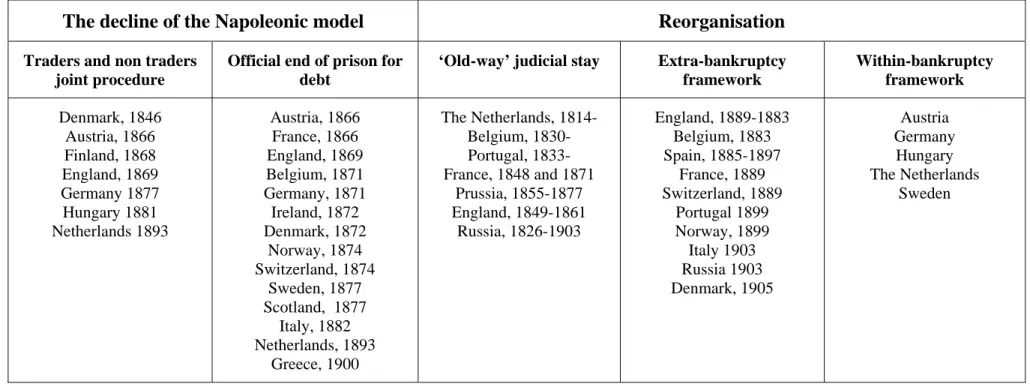
Table 1 - 1865-1885 : towards a new bankruptcy model
The decline of the Napoleonic model
Reorganisation
Traders and non traders joint procedure
Official end of prison for debt
‘Old-way’ judicial stay Extra-bankruptcy framework Within-bankruptcy framework Denmark, 1846 Austria, 1866 Finland, 1868 England, 1869 Germany 1877 Hungary 1881 Netherlands 1893 Austria, 1866 France, 1866 England, 1869 Belgium, 1871 Germany, 1871 Ireland, 1872 Denmark, 1872 Norway, 1874 Switzerland, 1874 Sweden, 1877 Scotland, 1877 Italy, 1882 Netherlands, 1893 Greece, 1900 The Netherlands, 1814-Belgium, 1830-Portugal, 1833-France, 1848 and 1871 Prussia, 1855-1877 England, 1849-1861 Russia, 1826-1903 England, 1889-1883 Belgium, 1883 Spain, 1885-1897 France, 1889 Switzerland, 1889 Portugal 1899 Norway, 1899 Italy 1903 Russia 1903 Denmark, 1905 Austria Germany Hungary The Netherlands Sweden
Graf1
Graph 1: Creditors' rights during bankruptcy: an enhanced LLSV index
0 1 2 3 4 5 6 180 5 182 0 183 5 185 0 186 5 188 0 189 5 191 0
Graf2
Graph 2 : The liberalisation of the debtor's status,
average index
0
1
2
3
1805
1830
1855
1880
1905
Graf3
Graph 3 : The debtor's status, by legal traditions
0
1
2
3
4
1805
1830
1855
1880
1905
Graf4
Graph 4 - The debtor's status by religion
0 1 2 3 1808 1840 1872 1904 Catholic Protestant
Graf5
Graph 5 : Statute of bankrupt and contractual autonomy
0
0,5
1
1,5
2
2,5
3
3,5
1805
1830
185
5
1880
1905
Graf6
Graph 6: Contractual autonomy, by religion
0 0,5 1 1,5 2 2,5 3 3,5 1805 183 0 1855 1880 190 5 Catholic Protestant
Graf7