HAL Id: tel-01784503
https://pastel.archives-ouvertes.fr/tel-01784503
Submitted on 3 May 2018
HAL is a multi-disciplinary open access archive for the deposit and dissemination of sci-entific research documents, whether they are pub-lished or not. The documents may come from teaching and research institutions in France or abroad, or from public or private research centers.
L’archive ouverte pluridisciplinaire HAL, est destinée au dépôt et à la diffusion de documents scientifiques de niveau recherche, publiés ou non, émanant des établissements d’enseignement et de recherche français ou étrangers, des laboratoires publics ou privés.
Human Habits Investigation : from Mobility
Reconstruction to Mobile Traffic Prediction
Guangshuo Chen
To cite this version:
Guangshuo Chen. Human Habits Investigation : from Mobility Reconstruction to Mobile Traffic Prediction. Networking and Internet Architecture [cs.NI]. Université Paris-Saclay, 2018. English. �NNT : 2018SACLX026�. �tel-01784503�
Human Habits Investigation: from
Mobility Reconstruction to
Mobile Traffic Prediction
Thèse de doctorat de l'Université Paris-Saclay
préparée à École Polytechnique
École doctorale n°580 : sciences et technologies
de l'information et de la communication
Thèse présentée et soutenue à Paris, le 10 avril 2018, par
Guangshuo Chen
Composition du Jury :
M. Marcelo DIAS DE AMORIM
Directeur de Recherche,CNRS et UPMC Sorbonne Universités Président, Rapporteur
M. M. André-Luc BEYLOT
Professeur, CNRS Rapporteur
M. Jérôme HÄRRI
Professeur, EURECOM Examinateur
Mme Lila BOUKHATEM
Maître de Conférences, Université Paris-Sud Examinateur
Mme Ana AGUIAR
Maître de Conférences, Université de Porto Examinateur
Mme Aline Carneiro VIANA
Chargé de Recherche, Inria Directeur de thèse
M. Marco Fiore
Chargé de Recherche, CNR-IEIIT Invité
N
NT
: 2
0
1
8
S
A
C
L
X
0
2
6
ABSTRACT
Characterizing and predicting human mobility and mobile data traffic serves as an im-portant component in cellular networks for network optimization, network management, and application design. Although a large and growing body of the literature on human mobility has characterized the mobility of individuals and proposed human mobility predictive models, only a few studies have focused on the mobile data traffic consumption of individuals, especially from the spatiotemporal viewpoint. Also, such analyses requires the human behavior data mining on the datasets of Charging Data Records (CDR) collected from cellular operators. To this end, this thesis studies the per-user mobile data traffic prediction and the conjoint problems on the utilization of operator-collected datasets.
First, the literature review of the two topic — mobile data traffic prediction and human mobility data utilization — is presented in the thesis, in terms of the existing achievements, techniques, and open research issues.
Second, we mine the operator-collected datasets. We address the challenges brought by the heterogeneity and sparsity of CDR, with respect to mobility measurement, data incompleteness, and data processing. Particularly, we evaluate the mobility data incompleteness in voice call CDR, reveal the geographical bias caused by the mapping of user locations to cell towers, and confirmm the state-of-the-art findings regarding the capability of CDR to model individual movement patterns.
Third, we propose novel approaches to recover incomplete mobility information by formal-izing the CDR completion tasks and defining the instant and slotted CDR-based trajectories. For the completion of instant CDR-based trajectories, our proposed techniques achieve an in-creased temporal completion of CDR data and retain significant spatial accuracy and have 50% of better completion and 5% of higher accuracy compared with the most common proposal in the literature. For the completion of slotted CDR-based trajectories, our technique can precisely recover 55% of the missing one-hour time slots from only 10% of known locations. These techniques serve as a technical foundation for our prediction analysis.
Finally, we study the prediction of mobile data traffic generated by individual mobile net-work subscribers. To begin with, we propose a novel practice to observe the spatiotemporal correlation of per-user mobile data traffic. We reveal that both the temporal and spatial issues are critical in achieving an accurate prediction. After that, we construct the time series of data traffic volumes and visited locations for large-scale user sets and evaluate the theoretical and practical predictabilities. Our data-driven results show that it is theoretically possible to anticipate the individual demand with a typical accuracy of 81% despite user heterogeneity. Real-world prediction can achieve an average accuracy of 70% and can be further enhanced up to 10% by knowing visited locations. Besides, our results also show that using the contextual information can enhance the performance of human mobility predictive models.
Consequently, this thesis contributes to addressing key problems of operator-collected dataset utilization and providing efficient solutions for forecasting per-user mobile data traffic. Future work lies on using more contextual information to achieve better mobility completion and data traffic prediction.
RÉSUMÉ
Caractériser et prédire la mobilité humaine et le trafic de données mobiles est important dans les réseaux cellulaires pour l’optimisation du réseau, la gestion du réseau et la conception des applications. Bien que de nombreuses études sur la mobilité humaine aient caractérisé la mobil-ité des individus et proposé des modèles prédictifs de mobilmobil-ité humaine, seules quelques études se sont intéressées à la consommation de trafic de données mobiles des individus, notamment du point de vue spatio-temporel. En outre, ces analyses requièrent l’exploration de données sur le comportement humain sur les ensembles de données des enregistrements de données de charge (CDR) collectés auprès des opérateurs cellulaires. Cette thèse étudie la prédiction du trafic de données mobiles par utilisateur et les problèmes liés à l’utilisation des ensembles de données collectés par l’opérateur.
Premièrement, la revue de la littérature sur les deux sujets - la prédiction du trafic de données mobiles et l’utilisation des données de mobilité humaine - est présentée dans la thèse, en termes de réalisations, de techniques et de questions de recherche ouvertes. Nous présentons la collection de CDR et les problèmes existants et des solutions sur le traitement de CDR. Nous passons également en revue les études de pointe sur le trafic de données mobiles à partir de points de vue agrégés et individuels.
Deuxièmement, nous exploitons les ensembles de données collectés par l’opérateur. Nous abordons les défis apportés par l’hétérogénéité et la rareté de la CDR en termes de mesure de la mobilité, d’incomplétude des données et de traitement des données. En particulier, nous évaluons l’incomplétude des données de mobilité dans l’appel vocal CDR, révélons le biais géographique causé par la cartographie des emplacements des utilisateurs aux tours cellulaires, et confirmons les découvertes de pointe concernant la capacité de la CDR à modéliser les mouvements individuels.
Troisièmement, nous proposons de nouvelles approches pour récupérer les données de mo-bilité incomplètes de la CDR. Nous formalisons le problème d’achèvement de CDR et définis-sons les trajectoires CDR instantanées et ficelées. Pour l’achèvement des trajectoires CDR instantanées, nos techniques proposées réalisent une complétion temporelle accrue des données CDR et conservent une précision spatiale significative et ont un meilleur achèvement de 50% et une précision plus élevée de 5% et plus par rapport à l’approche la plus courante. Pour l’achèvement de trajectoires CDR fendues, notre technique peut précisément récupérer 55% des créneaux horaires d’une heure manquants à partir de seulement 10% des emplacements connus. Ces techniques servent de fondement technique à notre analyse de prédiction.
Quatrièmement, nous étudions la prédiction du trafic de données mobile généré par les abonnés individuels du réseau mobile. Pour commencer, nous proposons une nouvelle pratique pour observer la corrélation spatio-temporelle du trafic de données mobile par utilisateur. Nous révélons que les problèmes temporels et spatiaux sont essentiels pour obtenir une prédiction précise. Après cela, nous construisons les séries temporelles de volumes de trafic de données et les emplacements visités pour les ensembles d’utilisateurs à grande échelle et évaluons les prédictions théoriques et pratiques. Nos résultats basés sur les données montrent qu’il est théoriquement possible d’anticiper la demande individuelle avec une précision typique de 81% malgré l’hétérogénéité de l’utilisateur. La prédiction dans le monde réel peut atteindre une précision moyenne de 70% et peut être améliorée jusqu’à 10% en connaissant les lieux visités.
v
En outre, nos résultats montrent également que l’utilisation de l’information contextuelle peut améliorer la performance des modèles prédictifs de la mobilité humaine.
Par conséquent, cette thèse contribue à résoudre les principaux problèmes de l’utilisation des ensembles de données collectés par l’opérateur et à fournir des solutions efficaces pour la prévision du trafic de données mobiles par utilisateur. Les travaux futurs reposent sur l’utilisation de plus d’informations contextuelles pour améliorer la mobilité et la prédiction du trafic de données.
Acknowledgement
First of all, I would like to thank my supervisor, Aline Carneiro Viana, for giving me the opportunity to conduct the research presented in this thesis. I also would like to express my gratitude to Marco Fiore, who can be regarded as my co-supervisor without question. Without patient guidance and insightful suggestions of Aline and Marco along these years, this thesis would not have been possible.
I would like to thank those who I have collaborated with, including Sahar Hoteit, Carlos Sarraute, Yota Katsikouli, and researchers who participate the MACACO project. I also would extend my appreciation to Rafael Costa, who reviewed a part of my thesis. I would like to thank all my colleagues. I quite enjoy the time sharing with you.
At last, I own my deepest gratitude to my parents for their encouragement and under-standing in the past four years.
PUBLICATIONS
This thesis resulted in the following list of publications:
Published
• G. Chen and A.C. Viana, "On the Quest for Representative Mobile Datasets", ACM S3 Workshop with MobiCom 2015, September 2015, Paris, France.
• S. Hoteit, G. Chen, A.C. Viana, and M. Fiore, "Filling the gaps: On the completion of sparse call detail records for mobility analysis", ACM CHANTS Workshop with Mobi-Com 2016, October 2016, New York City, USA.
• G. Chen, A.C. Viana, and C. Sarraute, "Towards an Adaptive Completion of Sparse Call Detail Records for Mobility Analysis", IEEE DAMN! Workshop with PerCom 2017, March 2017, Hawaii, USA.
• S. Hoteit, G. Chen, A.C. Viana, and M. Fiore, "Spatio-Temporal Completion of Call Detail Records for Human Mobility Analysis", CoRes, June 2017, Quiberon, Frace.
• G. Chen, S. Hoteit, A.C. Viana, M. Fiore, and C. Sarraute, "The Spatiotemporal In-terplay of Regularity and Randomness in Cellular Data Traffic", IEEE LCN, October, 2017, Singapore.
• G. Chen, S. Hoteit, A.C. Viana, M. Fiore, and C. Sarraute, "Enriching Sparse Mobility Information in Call Detail Records", Elsevier Computer Communications, 2018.
• G. Chen, A.C. Viana, and M. Fiore, "Human Movement Pattern Recovery via Mobile Network Data", CoRes.
• G. Chen, A.C. Viana, and M. Fiore, "Forecasting Individual Mobile Data Traffic Usage", CoRes.
Under Submission
• G. Chen, A.C. Viana, M. Fiore, and C. Sarraute, "Individual Trajectory Reconstruction from Mobile Network Data", EPJ Data Science.
• G. Chen, A.C. Viana, M. Fiore, and C. Sarraute, "The Theoretical and Practical Pre-dictability of Individual Mobile Data Traffic".
Contents
1 Introduction 1
1.1 Predicting Per-user Mobile Data Traffic . . . 2
1.2 Utilizing Operator-collected Datasets . . . 3
1.3 Contributions and Thesis Outline . . . 4
2 Background 7 2.1 Mobile Data Traffic Prediction . . . 7
2.2 Operator-collected Mobility Data Utilization . . . 13
2.3 Summary . . . 19
3 Datasets: Characteristics and Challenges 21 3.1 Human Behavior Collection . . . 21
3.2 Operator-collected Large-scale Datasets . . . 22
3.3 Application-based Mobility Datasets . . . 26
3.4 Challenge of Completeness . . . 29
3.5 Challenge of Mobility Measurement . . . 33
3.6 Challenge of Data Processing . . . 39
3.7 Summary . . . 40
4 CDR-based Trajectory Completion 41 4.1 Terminology . . . 42
4.2 Completing Instant CDR-based Trajectories . . . 43
4.3 Completing Slotted CDR-based Trajectories . . . 57
4.4 Summary . . . 68
5 Per-User Mobile Data Traffic Prediction 69 5.1 Terminology and Definitions . . . 70
5.2 Characterizing Individual Mobile Data Traffic . . . 73
5.3 Constructing Per-user Spatiotemporal Behavioral Data . . . 76
5.4 Investigation through Temporal Dynamics . . . 79
5.5 Investigation through Spatiotemporal Dynamics . . . 86
5.6 Additional Investigation of Human Mobility . . . 91
5.7 Summary . . . 95
6 Conclusion and Outlook 97 6.1 Summary of the Thesis. . . 97
6.2 Limitation and Outlook . . . 98
6.3 Concluding Remarks . . . 100
Chapter 1
Introduction
Since the first mobile phone was invented in 1973 [1], the past half-century has seen increasingly rapid advances in the innovation of mobile devices and mobile communication technologies. Nowadays mobile devices are almost necessary for business and personal lives. For instance, mobile devices and connections have reached 8 billion in 2016; they will be 11.6 billion in 2021 [2]. Meanwhile, the tremendous spreading of mobile devices leads to the rapid increment of mobile data traffic: 18-fold from 2011 to 2016 and 7-fold from 2016 to 2021 [2].
The growth of mobile devices, along with the explosion of mobile applications, keeps press-ing on the radio access capacity of existpress-ing cellular network infrastructures. Besides, the growing diversity of mobile applications brings various needs on the means of mobile connec-tivity and bandwidth management. To cope with these problems, it is necessary to have a continuous development of techniques for managing cellular networks.
Central to the design of network management techniques is the thorough understanding of human behaviors, which leads to a proliferation of studies, including [3,4,5,6,7,8,9,10,11, 12,13, 14,15], in the field of wireless and cellular communications. Besides, the quantitative understanding of human behaviors (e.g., individual whereabouts) has recently emerged as a central question in multi-disciplinary research, such as human nature characterization [16,17], city planning [18], traffic engineering [19], marketing [20,21] and etc. Individual actions are the root cause of the dynamics that impact technological and economical interests for many research communities.
The ability to foresee future human activities has important implications in network design, management, control, and optimization in cellular networks. For instance, recent developments in data offloading [22] have highlighted the need of the prediction of human mobility [6,7], data traffic [8, 9], and user communications [10]. The accurate prediction of human behaviors also contributes to the improvement of QoS (quality of service) [5,11], routing [12], energy saving of mobile devices [13], and application design [14, 15]. At the heart of anticipating a human behavior are the theoretical predictability (that evaluates to what degree the behavior can be foreseen maximumly) and the practical predictability (that measures the performance of actual prediction approaches). The primary goal of this thesis is to provide technical foundations for the investigation the theoretical and practical predictability of mobile data traffic. For this, we provide a detailed introduction in Section1.1.
The investigation of mobile data traffic relies on the availability of corresponding behavioral data. In particular, it requires real-world datasets, which describe the cellular communication activities of mobile network subscribers, to study the variation in individual’s mobile data traffic over time and space. In the literature, the primary choice is to use datasets collected by cellular operators [23], which consists of charging data records (CDR) tracking a variety of telecommunication events. Such datasets often cover the entire consumption and generation of mobile data traffic but capture thew limited mobility of mobile subscribers whose locations are logged from the occurrence of telecommunication events. The challenge caused by the latter
2 Chapter 1. Introduction
often appears in mobility-related analyses [16,17,24], including ours in this thesis. Hence, the secondary goal of this thesis is to provide solid solutions for addressing the problem of limited mobility information in operator-collected datasets. For this, we provide a detailed introduction in Section1.2.
Later, we give a brief overview of the contributions in this thesis in Section1.3.
1.1
Predicting Per-user Mobile Data Traffic
Motivation One of the most critical assumptions for system management is that future conditions of the system are obtainable or predictable. For instance, the high availability of mobility prediction can enable various application scenarios such as location-based recommen-dation [25], home automation [26], and location-related data dissemination [27], while also help to improve QoS [5,7]. The better prediction of future mobile data traffic demand can help to improve the design of solutions for network load balancing [8, 12]. A large and growing body of literature has investigated the topic of predicting human mobility [23], while several critical aspects on the prediction of mobile data traffic are still missing.
Existing Studies and Limitations The theoretical predictability is determined by the interplay between regularity and randomness. For instance, the temporal order of a user’s visited locations limits the predictability of his mobility [17]; the statistical characteristics such as long-range dependence [28] and self-similarity [29] restricts the predictability of Internet traffic in wired networks [30] or cellular base stations [31,32]. In particular, for mobile phone subscribers, the regularity of their Internet traffic is not only reflected by the statistics of data but also related to the user’s whereabouts [27,33,34,35].
The practical predictability is bounded with actual prediction approaches. In terms of the aggregation level of data traffic, we mass the studies of understanding and predicting mobile data traffic into two classes, i.e., the (1) aggregated and (2) per-user studies. The exist-ing literature mainly focuses on the first class. Several studies have been carried out on the prediction of mobile data traffic of clusters (hotspot) [36], base stations [37, 38], and appli-cations [33, 39]. Particularly, the characterization of aggregated data traffic of base stations has been widely investigated, such as temporal repetitive patterns [27,37] and spatiotemporal correlation [27, 40]. The characterization of per-user mobile data traffic is investigated in terms of data volumes [27,34,41] and applications [42], which provide valuable findings such as (1) a small user group usually takes accounts for most of the traffic and (2) per-user mobile data traffic is also spatiotemporally correlated. Nevertheless, there is still no work using the characterization into the practical prediction. Besides, several approaches are proposed on the prediction of radio channel throughput [43,44] and latency [11,45].
To the best of our knowledge, there is no analysis of (i) the theoretical and practical predictabilities of per-user mobile data traffic or (ii) the associated impacts to the former’s prediction brought by users’ visited locations.
Objective In this thesis, we fill the taps above and provide a first investigation of the pre-dictability of mobile data traffic generated by individual users. We focus on data traffic vol-umes, i.e., the amount of kilobytes generated by the mobile services consumed by a mobile
1.2. Utilizing Operator-collected Datasets 3
network subscriber. Overall, as our primary goal, we address two central research questions, i.e.,
• How predictable is the individual consumption of mobile data traffic?
• Whether how does the information of individual mobility contribute to the prediction of mobile data traffic?
1.2
Utilizing Operator-collected Datasets
Motivation Real human footprints are essential to the human mobility investigation by providing the information of movements. In this context, using specialized spatiotemporal datasets such as GPS surveys seems to be a direct solution, but there is a huge overhead of collecting such a detailed dataset at scale. Hence, charging data records (CDR) have been lately considered as a primary data source for large-scale mobility studies [23]. CDR contain information about when, where and how mobile network subscribers have issued and received voice calls, sent and received text messages, or established data traffic sessions. The operator-collected mobile phone datasets, consisting of CDR, usually cover large populations [23], which makes them a practical choice for performing large-scale mobility analyses.
Nevertheless, a cellular network is far from being a perfect mobility sensory platform. CDR-based trajectories are coarse in space and sparse in time. The accuracy of positioning a mobile device is limited by the antenna coverage, which can be as large as several km2 in urban areas; the temporal distribution of CDR is highly heterogeneous and sparse, i.e., having typical inter-event times of hours. We refer to this spatiotemporal flaw of CDR data as the CDR sparsity. The CDR sparsity along with the indiscriminate use of CDR data may question the validity of research conclusions, such as inferring visited locations [46], learning recurrent movement patterns [46], and measuring mobility-related features [16, 17]. This sparsity also makes the vast majority of the trajectory data unusable: for instance, 100K, 50K and 700 individuals are retained for analysis from populations of 6M, 10M, and 1M in [16, 17, 24], respectively. This maps to percentages between 0.07% and 1.67% of the total user base, whereas the bulk of CDR information is dropped due to the insufficient sampling frequency of a user’s movements. Understanding whether and to what extent such sparsity affects mobility studies is a critical issue.
On the purpose of mitigating the CDR sparsity, we propose a task named CDR completion for reconstructing functional trajectories of individual users from the original incomplete CDR data. A successful CDR completion would fill the gaps in the individual positioning infor-mation conveyed by CDR with the spatiotemporal points that closely match the real-world movement patterns of each subscriber. CDR completion has the potential to increase the size of user populations considered in CDR-based mobility analyses by orders of magnitude, with straightforward benefits to the confidence and generality of results.
Existing Studies and Limitations A few previous works have investigated the validity of mobility studies based on CDR. An influential analysis [46] observed that using CDR allows to correctly identify popular locations that account for 90% of each subscriber’s activity; however, biases may arise when measuring individual human mobility features. Works such as [46] or the later [47] discussed biases introduced by the incompleteness of positioning information, i.e., the
4 Chapter 1. Introduction
fact that CDR do not capture every location that a user has traveled through. Nevertheless, another important bias of CDR is caused by the use of cell tower locations of mobile network subscribers in their footprints instead of their actual positions, while it is still overlooked in the literature.
The literature on CDR completion is fairly thin. The most intuitive solution is to consider that the location in an entry of CDR stays representative for a time interval period (e.g., one hour) centered on the actual event timestamp [17,35]. Approaches based on interpolation only work in the presence of trajectories composed of thousands of locations per day [24], which is hardly the case with CDR. It is also worth noting that the GPS trace reconstruction (as in [48]) is a very different problem from CDR completion. GPS data are collected with a fixed periodicity and at high frequency (e.g., at every minute), hence do not need to be completed in time.
Objective We address three central research questions as our secondary goal:
• Whether and to what extent does the use of CDR data affect human mobility studies? • What degree of (in)completeness can one expect in CDR-based trajectories inferred from
real-world large-scale mobile phone datasets?
• How efficiently can the CDR completion fill spatiotemporal gaps in CDR-based trajec-tories?
It is worth noting that the solutions of the CDR completion contribute reversely to the data processing for analyzing mobile data traffic.
1.3
Contributions and Thesis Outline
Building on the importance of mobile data traffic prediction and the presence of CDR sparsity, this thesis focuses on (i) per-user mobile data traffic prediction (as our primary goal) and (ii) mobility information completion of operator-collected datasets (as our secondary goal). The major results of our work has been developed in the framework of EU CHIST-ERA MACACO project [49].
In this thesis, we first deal with and discuss the problems regarding our secondary goal, because achieving our primary goal needs individual locations and mobile data traffic volumes, and thus, how to obtain such data from our operator-collected datasets has to be addressed in advance. In particular, the dissertation consists of two parts. After introducing the background (cf. Chapter 2), in the first part (cf. Chapter 3 and 4), we study our datasets’ characteristics and biases and develop the CDR completion solutions, so as to achieve the secondary goal. Then, in the second part (cf. Chapter 5), we construct the behavioral data based on the CDR completion solutions that we have developed, and investigate the prediction of mobile data traffic generated by individual users, so as to achieve the primary goal. We provide the thesis outline in the following, which also summarizes briefly the contributions of each chapter.
Chapter 2 We begin the thesis by introducing the background in Chapter 2. We analyze the literature and come out with a review of the two topic (i.e., mobile data traffic prediction and human mobility data utilization) consisting of existing achievements, techniques, and open
1.3. Contributions and Thesis Outline 5
research issues with respect to our goals. This chapter serves as the foundation of the following ones.
Chapter 3 This chapter focuses on the datasets that we leverage in the thesis. We explore our datasets’ basic characteristics and access the common challenges in dealing with operator-collected datasets in terms of data completeness, mobility information, and data processing. Regarding the impact on results brought by these challenges, we provide a confirmation of previous known issues and validate new issues in the spatial and temporal perspectives. Our results shed light on the use of similar datasets. The work related to this chapter is:
• G. Chen and A.C. Viana, "On the Quest for Representative Mobile Datasets", ACM S3 Workshop with MobiCom 2015, September 2015, Paris, France.
• G. Chen, S. Hoteit, A.C. Viana, M. Fiore, and C. Sarraute, "Enriching Sparse Mobility Information in Call Detail Records", Elsevier Computer Communications, June 2018.
• G. Chen, S. Hoteit, A.C. Viana, M. Fiore, and C. Sarraute, "Individual Trajectory Reconstruction from Mobile Network Data", EPJ Data Science, under submission.
Chapter 4 This chapter deals with a specific challenge brought by CDR temporal sparsity. It aims at reconstructing reliable CDR-based trajectories. For that, we define the CDR-based trajectories and CDR completion tasks, and propose novel effective techniques. We reveal the advantage of our techniques via data-driven simulations: they could achieve a far increased completion and retain essential spatial accuracy compared with the typical proposals in the literature. Our study, on one hand, provides necessary techniques for the next chapter, and on the other hand, fills the literature gaps of the mobility reconstruction. The work related to this chapter is:
• S. Hoteit, G. Chen, A.C. Viana, and M. Fiore, "Filling the gaps: On the completion of sparse call detail records for mobility analysis", ACM CHANTS Workshop with Mobi-Com 2016, October 2016, New York City, USA.
• G. Chen, A.C. Viana, and C. Sarraute, "Towards an Adaptive Completion of Sparse Call Detail Records for Mobility Analysis", IEEE DAMN! Workshop with PerCom 2017, March 2017, Hawaii, USA.
• G. Chen, S. Hoteit, A.C. Viana, M. Fiore, and C. Sarraute, "Enriching Sparse Mobility Information in Call Detail Records", Elsevier Computer Communications, June 2018.
• G. Chen, S. Hoteit, A.C. Viana, M. Fiore, and C. Sarraute, "Individual Trajectory Reconstruction from Mobile Network Data", EPJ Data Science, under submission.
Chapter 5 In this chapter, we address the problems in terms of our primary goal, and add solid contributions to the topic of mobile traffic prediction. We perform a detailed spatio-temporal analysis on the theoretical and actual performance of the prediction of per-user mobile data traffic demand. Our analysis suggests the feasibility of anticipating (i) how much mobile data traffic will be consumed by a given subscriber and (ii) where this will occur in a very effective manner. The work related to this chapter is:
6 Chapter 1. Introduction
• G. Chen, S. Hoteit, A.C. Viana, M. Fiore, and C. Sarraute, "The Spatiotemporal In-terplay of Regularity and Randomness in Cellular Data Traffic", IEEE LCN, October, 2017, Singapore.
• G. Chen, A.C. Viana, M. Fiore, and C. Sarraute, "The Theoretical and Practical Pre-dictability of Individual Mobile Data Traffic", under preparation.
Chapter 2
Background
This chapter introduces the background of our studies. It conducts literature reviews of the two major topics in our studies, i.e., the prediction of mobile data traffic and the utilization of operator-collected datasets.
2.1
Mobile Data Traffic Prediction
To what degree is the Internet traffic predictable? It is a question that has led to a number of attractive issues and has been continuously investigated since the invention of the Internet [50]. In this section, we review the state-of-the-art on the prediction of mobile data traffic. Our discussion is organized from two perspectives:
• Aggregated mobile data traffic. In this perspective, we consider the mobile data traffic from the viewpoint of a mobile network operator. Such data traffic is aggregated over many mobile devices within the same cell, the same close geographical area, or the same service/application.
• Individual mobile data traffic. Here we discuss in an individual viewpoint, i.e., the mobile data traffic that is generated by a single mobile device.
For each perspective, we briefly introduce the data traffic characterization and particularly present the practical prediction techniques. It is worth noting that, in this section, we focus on the studies on the Internet traffic and exclude those on other traffic (e.g., voice calls).
2.1.1 Literature on Aggregated Mobile Data Traffic
The investigation on aggregated mobile data traffic is mainly driven by the analyses on world-wide large-scale operator-collected datasets. For instance, such datasets that have nationworld-wide populations are deeply mined in the relevant studies by Paul et al. [27] (USA), Hoteit et al. [51] (France), and Xu et al. [37,38] (China).
2.1.1.1 Characterization
There are two major aspects with respect to the characterization, i.e., temporal dynamics and spatiotemporal correlation.
There is a general agreement on the regularity of the temporal variation of aggregated mobile data traffic [23]. Almost at the same time, Paul et al. [27] and Shafiq et al. [33] separately investigate the temporal evolution of aggregated mobile data traffic of cell towers and popular applications. They both find that such traffic follows a daily repetitive pattern over weekdays: in general, the traffic has low demand during nighttime and high demand during daytime. The same repetitive pattern is also observed by Xu et al. [37, 38]. Is is also
8 Chapter 2. Background
remarked in [27,33,52] that the traffic over weekdays and weekends have different repetitive patterns and demands; a larger data traffic demand exists on weekdays than weekends. An interesting fact is that the temporal variations observed by Paul et al. [27] and Shafiq et al. [33] have different peak hours, which is also observed from other network traffic [23]. For this, a possible explanation is that such temporal variation under a higher temporal resolution partially depends on the area of study.
The spatiotemporal correlation exists among the data traffic generated by cell towers over many users in the same area. In the pure spatial perspective, the distribution of the data traffic is spatially heterogeneous: it varies over different regions as revealed by Paul et al. [27] and Xu et al. [37,38]. Further, the latter authors find that the cell towers have similar data traffic profiles regarding their regions (i.e., resident, transport, office, and entertainment) and such profiles of adjacent cell towers are correlated. In the spatiotemporal perspective, the two papers show that the spatial heterogeneity above also varies over time: pick hours depend on regions. The former authors leverage a quantitive measure (i.e., the Moran’s I statistic) to evaluate spatiotemporal diversity of the data traffic. They find that in general, the imminent loads of adjacent cell towers are more correlated when these loads are high, but the correlation is relatively weak and almost disappears around midnights. Recently, [53] further investigates the spatiotemporal correlation and propose an approach to infer the hidden spatial and temporal structures of aggregated mobile data traffic.
Also, several studies reveal the spatial heterogeneity aggregated over applications. The earlier work by Trestian et al. [40] already shows that the Internet traffic over services and applications is consumed differently at home and work locations. Hoteit et al. [51] find that the data traffic loads of cell towers have different inner diversities among TCP- and UDP-based services. Later, the extended analysis by Shafiq et al. [39] finds that the data traffic aggregated by popular applications is strongly heterogenous over regions. This provides the capability of categorizing cell towers into four classes (web browsing, email, audio, and mixed traffic) with respect to the major applications in their data traffic loads.
2.1.1.2 Prediction
Some efforts have been put on the prediction of aggregated mobile data traffic. They aim at converting the observed dynamics and correlations above to practical prediction techniques. In the following, we review the proposed prediction techniques according to the level of the aggregation.
• Cell-level data traffic. There is a common observation on the fact that the data traffic of cell towers has a high degree of both theoretical and practical predictabilities. Regarding the theoretical viewpoint, Zhang et al. [31, 32] investigate the limits of the theoretical predictability by observing the traffic of 7, 000 cell towers in China. They find that under the temporal resolution of 30 minutes, aggregated traffic (voice, text, and data) can be well predicted from the historical demand of the preceding 15 hours; the theoretical predictability of the data traffic is lower than that of the data flow of voice calls or text messages. They also find that the knowledge of the traffic demands of adjacent cells towers can enhance the theoretical predictability, but in a less degree on the data traffic than the others, which supports the quantitative evaluation on the spatiotemporal correlation by Paul et al. [27]. Their results ensure the capability of time series prediction techniques on the prediction of such traffic.
2.1. Mobile Data Traffic Prediction 9
Regarding the practical prediction techniques, Xu et al. [37, 38] show that the cell-level data traffic is predictable via a linear combination of four primary components corresponding to human activities. Zang et al. [54] propose a mixed machine learning approach composed of K-means clustering, Elman Neural Network, and wavelet decom-position. An alternative prediction approach is proposed by Yi et al. [55]; it builds a complex network among cell towers, measures the traffic on the very important ones, and predicts the others’ traffic using Support Vector Regression – another machine learn-ing method. It can recover the whole picture of the traffic demand from only 8% of the total cell towers. In the opposite viewpoint, Nika et al. [36] perform an empirical study on data hotspots using a large-scale operator-collected dataset of 5, 327 cell towers, and show the availability of standard machine learning methods on the prediction of future hotspots (cells towers) of the traffic demand from the past history.
• Application-level data traffic. The early paper by Keralapura et al.[56] proposes a technique to cluster users and their browsing profiles. The authors find that user behav-ior in terms of Internet surfing can be captured using a small number of clusters. Such heterogeneity of aggregated mobile data traffic is also investigated by Ying et al. [57]. Later, Shafiq et al. [33] uses a Zipf-like model to capture the distribution of application-level mobile data traffic and finds that the regularity makes the temporal variation of the traffic highly predictable from the history of the past demand using a simple Markovian method. Recently, Zhang et al. [58] design a mixed application-level traffic prediction framework that leverages the α-stable modeled property and dictionary learning to sep-arately deal with the temporal variation and the spatial sparsity of the traffic. Marquez et al. [59] extend the analysis in [33] and reveal a strong heterogeneity in difference mobile service demands using correlation and clustering. They show that the temporal usage patterns are quite different from service to service. Besides, several works focus on the traffic generated by special services, such as chatting (e.g., WhatsApp [60] and WeChat [61]), video streaming [62], and mobile cloud [63].
In summary, the proposed techniques extend the technical bound on the prediction of mobile data traffic: they not only leverage the legacy tools that used for analyzing wired network traffic (e.g., the entropy, Markov property, α-stable modeled property) to capture the temporal variation but also import several state-of-the-art machine learning tools to utilize the spatiotemporal correlation.
2.1.2 Literature on Individual Mobile Data Traffic
A relatively small body of literature is on the investigation of individual mobile data traffic, which is also driven by data mining. Differently, the relevant studies utilize both large-scale operator-collected datasets, e.g., by Paul et al. [27] and Oliveira et al. [34,52], and small-scale mobile crowdsensing datasets, e.g., by Jo et al. [35].
2.1.2.1 Characterization
The characterization from the individual viewpoint is performed by Paul et al. [27], Jo et al. [35], Li et al. [42], Oliveira et al. [34,52], among others.
10 Chapter 2. Background
There is a general agreement on the heterogeneity of the data traffic, with respect to the user population and the time. It is shared by Paul et al. [27] and Oliveira et al. [34,52]. They show that most of the total data traffic is generated from a small group of "heavy" users.
Regarding the temporal variation, both the authors above find that, in general, each user is highly active only in a few hours per day, and similarly, the temporal variation is different on weekdays and weekends, as in aggregate mobile data traffic. The latter authors [34,52] find that individual mobile data traffic also follows daily repetitive patterns and the users also have peak and non-peak hours in terms of data traffic. In particular, they find that the variation of different hours within the same day is stronger than that of the same hours overs different days.
As to the spatiotemporal correlation, Paul et al. [27] point out that a user is usually active at only a few of his common locations. Jo et al. [35] mine a small dataset of locations and services of 124 users over 16 months and they identify the spatiotemporal correlations of service usage patterns.
Other dynamics with respect to social features are also revealed. For instance, Oliveira et al. [34,52] find that the distribution of individual mobile data traffic is slightly heterogeneous over the age and gender; Li et al. [42] focus on the major smartphone operating systems and discuss the traffic dynamics and major application in each system.
2.1.2.2 Prediction
Yet, fewer studies have addressed the prediction of individual mobile data traffic. Regarding the bandwidth of mobile devices around a cell tower, a theoretical analysis is performed by Bui et al. [43,44]. Based on a theoretical LTE radio model, the authors propose a model to predict the bandwidth of mobile devices over a wide range of time scales [43]. Their model considers both the user location and the statistic of bandwidth availability. They also design a refined model aiming at the prediction of short-term bandwidth using Gaussian Random Walks [44]. Regarding the latency of each data session, Zhao et al. [11,45] address the static and dynamic latency estimation problems and propose a distance-feature decomposition algorithm based on the Matrix Factorization technique to predict the latency.
In summary, the current literature has already shown the temporal dynamics and spatio-temporal correlations of both aggregated and individual mobile data traffic, while only a few practical prediction techniques are proposed aiming at the latter’s prediction. Still, a large amount of the investigation on individual mobile traffic is needed. For instance, to perform data-driven prediction analysis on the theoretical and practical predictabilities of individual mobile data traffic.
2.1.3 Taxonomy of Prediction Techniques
In this thesis, we study the prediction of individual mobile data traffic by mining individual time series of locations and data sessions. For that, here we review the state-of-the-art techniques for the time series prediction. Some of them have been already used in the prediction of the Internet traffic.
2.1. Mobile Data Traffic Prediction 11
2.1.3.1 Theoretical Predictability Measurements
The theoretical predictability of a time series describes its inherent forecasting capacity and is independent of any actual prediction technique. It evaluates to what degree the time se-ries can be foreseen and bounds to the maximum forecasting performance. The theoretical predictability is correlated with the uncertainty that is usually measured by the entropy in information theory [64]. Feder et al. [65] build the quantitive correlation between the pre-dictability and entropy, which is later applied on the study of an actual behavior (i.e., human mobility) by Song et al. [17]. They are then followed by similar predictability studies on human mobility [66,67], vehicular traffic [68], radio spectrum state [69], and aggregated mobile data traffic [31]. Nevertheless, the theoretical predictability of per-user mobile data traffic remains untouched.
Analyzing the theoretical predictability helps the design and implementation of practical prediction techniques e.g., human mobility prediction [66]. In this thesis, we study the theoreti-cal predictability of mobile data traffic on the foundation of Feder et al. [65]. Yet, the practical predictability of time series still depends on the prediction techniques, e.g., probabilistic or regression models. We summarize these practical techniques in the following.
2.1.3.2 ARIMA Prediction Models
This class contains the typical ARIMA, AR, MA, and ARMA models. They are designed for the prediction of time series of continuous scalar values and leverage moving average and autoregressive filtering. They often appear in the time series analyses of statistics and economic studies [70]. The application of the models assumes that the target time series or its difference is stationary [70]. Besides the typical models, the others in this class, such as MEAN, LAST, BM, FARIMA, and GARCH, are used to predict network resources in wired networks [71,72, 73,74] with smoothing solutions (e.g., wavelet approximation) [43]. Nevertheless, the designs of the typical models cannot combine discrete values (e.g., visited cell tower locations) in their prediction, and none of these works has considered the spatial dynamics of their targets.
2.1.3.3 Markovian Prediction Methods
The methods in this class, i.e., MC, PPM, SPM, and ALZ, leverage the Markov property. They are mainly designed for the prediction of time series of discrete observations. Their application assumes that the target time series has the Markov property, i.e., its current value is always de-termined by a limited number of its previous values. In this class, a prediction method predicts the current value Xtof a time series by building a probabilistic model from its full history and
solving the following maximization problem: ˆxt= arg maxxP (Xt = x|xt−1,· · · , xt−k) where
xt−1,· · · , xt−k are the newest k previous values observed in the time series.
MC (Markov Chain) This is almost the simplest Markovian method [75]. A k-th order Markov chain, represented as MC(k), makes a prediction of the state Xt solely based on the
fixed previous k states. It builds a transition matrix consisting of the probabilities of transitions from the past k states to the current one. There are several common practices to compute the probabilities, such as MLE (maximum likelihood estimation) [76] and MCMC (Markov Chain Monte Charlo) [77]. However, it needs a large number of samples to compute probabilities, which grows quickly with respect to the order k and the alphabet of discrete values.
12 Chapter 2. Background
PPM (Prediction by Partial Matching) This is an improved method of the Markov chain, used massively in the lossless text compression [78]. A k-th order PPM model, repre-sented as PPM(k), is a combination of MC(m), ∀m ≤ k. It computes the so-called escape probabilities of the state Xtas the weighted sums of the probabilities of all the Markov models in the combination. We use the implementation of Moffat et al. [78, Method C] in this thesis.
SPM (Sampled Pattern Matching) This is another improved method of the Markov chain designed by Jacquet et al. [79]; for predicting the current state Xt, it considers much
larger immediately preceding states than the MC or PPM does. In a SPM predictor, instead of using a fixed order k, the considered length of immediately preceding context is determined as a fixed fraction (represented as the parameter α) of the longest context which has previously appeared. An SPM model with the parameter α is represented as SPM(α).
ALZ (Active LeZi) This is an improved online prediction algorithm based on the classical LZ78 data compression scheme proposed by Gopalratnam et al. [80]. It also employs the power of the Markov property and is able to incrementally learn the sequence and to deliver real time predictions. The ALZ algorithm also makes a prediction of the state Xt in the time series given the preceding context, while a variable window of immediately preceding symbols is maintained, of which the length is the longest phrase previously observed in a classical LZ78 parsing. With this window, the algorithm can compute statistics on all possible preceding contexts. For the pseudo code of this algorithm, we refer the reader to [80, Figure 3].
2.1.3.4 Supervised Machine Learning Methods
This class contains a group of state-of-the-art techniques that are categorized to the field of supervised machine learning in practice [81]. These techniques can solve problems in the shape of y = f (x) where x and y are the input and output vectors. Each of them builds a model (which is composed of kernel functions, decision/regression tress, or neuron networks) upon a training set that consists of known instances of x and its corresponding y as the output classes (in a classification problem) or values (a regression problem). Then, the trained model can predict y from x in a new instance. They are capable of forecasting time series of continuous and discrete values.
SVM (Support Vector Machine) This is actually a classification algorithm [75]. It assigns a new input vector x to one of the already known output classes y, just as other classification algorithms do. SVM is adaptive to both linear and non-linear discriminant functions during the training process. It applies a kernel function to map the training data to a high-dimensional feature space, which ensures the ability to produce a more accurate classification. Further, SVM is insensitive to the number of input features.
GBRT (Gradient Boosted Regression Trees) This algorithm is on the basis of the en-semble learning technique [82]. It build a prediction model as an ensemble of weak prediction models, i.e., regression trees, in a state-wise fashion and allows optimization of an arbitrary differentiable loss function. The GBRT algorithm has advantages in terms of flexibility for heterogeneous features, good predictive power, and training speed, and has well-tested imple-mentations.
2.2. Operator-collected Mobility Data Utilization 13
MLP (Multilayer Perceptron) This algorithm is a typical supervised learning algorithm using artificial neural networks. It is designed for both regression and classification problems. A MLP network is a feedforward artificial neural network that is fully connected. The MLP algorithm accepts different activation functions, layers and neurons [83].
To the best of our knowledge, there is still no study about these prediction techniques’ per-formance on per-user mobile data traffic prediction. We are not able to judge which is superior so far, and thus, will perform a comparative study in this thesis. First, ARIMA models are not considered because they do not support discrete values, which is necessary for our analy-sis. Second, all Markovian methods will be utilized, since they show impressive performance on similar time series prediction scenarios, such as human mobility prediction [76] and aggre-gated mobile data traffic prediction [33]. Besides, supervised machine learning techniques are shown to be effective in multiple application scenarios [75,83], including aggregated Internet traffic [84]. We will also consider them in our analysis.
2.2
Operator-collected Mobility Data Utilization
A large amount of operator-collected datasets has been utilized in the literature [23], due to the spreading of mobile devices and the enlarging openness of mobile network operators. In the wide scope of research disciplines driven by mining the operator-collected datasets, the analytic data investigation of human mobility is one of the most significant topics [23]. In this context, the mobile network works like a gigantic and multi-modal sensing platform that produces time-stamped human footprints. In this section, we introduce the background on the utilization of the operator-collected datasets. Our focus is on the state-of-the-art means of processing human footprints with the limited spatiotemporal granularity [23] in order to provide an introductory guide.
2.2.1 The Events that Produce Human Footprints
Human footprints in most of the operator-collected datasets come from CDR – once referred to Call Detail Records and later to Charging Data Records in the 3GPP specification [85, TS 32.298]. The collection of CDR is triggered by the so-called charging events [85, TS 32.250/32.251]. In the following, we list the types of charging events that lead to human footprints.
• Voice call. This is the most common trigger to the collection of operator-collected datasets in the literature [23]. Each voice call CDR marks (i) when the call originates and terminates and (ii) only the cell tower where the call originates. Significant effort has been put on the characterization of voice calls [46, 86, 87, 88,89,90, 91]; it is well known that the temporal heterogeneity and sparsity of voice calls limit the quality of mobility information and cause a heavy data loss of locations.
• Text message. This is also a common trigger and produces text message CDR that are similar to voice call CDR. Yet, each text message triggers two CDR separately, which correspond to the origination and delivery of the message and mark the cell towers from/to which the message is created/delivered. Usually, text message CDR appear together with voice call CDR in the operator-collected datasets [23]. According to the
14 Chapter 2. Background
characterization [46], text messages also only provide limited mobility information due to their temporal heterogeneity and sparsity.
• Internet visit. This event triggers multiple CDR types such as S-CDR, SGW-CDR, and PGW-CDR [85, TS 32.251]. Only the S-CDR has a mandatory parameter describing the location of devices; it points to the cell tower where a mobile device originated a session for Internet visits. This event appears as a new source of human footprints in recent years, and is used in several studies [27, 40, 46, 92, 93, 94, 95]. Internet visits provide far more human footprints than voice calls or text messages; they still suffer the temporal heterogeneity but are far less sparse than the other two events [52]. Therefore, a operator-collected dataset of Internet visits usually appears as the ground-truth data as in [46,96].
• Mobility update. Every time a mobile device enters a roaming process or has an inter-system handover, a CDR is triggered and contains the identifier of the new cell tower. Several operator-collected datasets contain human footprints collected by this events along with Internet visits, including [96,97,98].
• Location request. The 3GPP specification [85, TS 23.271] describes the capability for both the network and mobile devices to initiate location requests. Once a location request is created, the network use its built-in LCS (location services) method [99] to measure the position of the target mobile device, and two CDR are recorded: one for the origination of the location request and the other for the termination [85, TS 32.251]. However, to the best of our knowledge, none of the datasets collects the location request CDR.
• Others. Events such as power on/off and network switch (LTE to 2G/3G) may also trigger the generation of CDR of their own types and help the collection of human footprints, while they rarely appear in the literature: we only find one dataset [96] uses these events together with Internet visits.
Consequently, voice calls and text messages are still the major contributors to human foot-prints in the literature heretofore [23], while the mobility information among them has limited temporal granularity due to their high temporal heterogeneity and sparsity. Nevertheless, due to the fact that there are more geo-referenced CDR types while having more sensitive user behavior data, we may have mobile network operators with better openness and operator-collected datasets with a higher temporal resolution in future.
2.2.2 Extracting Geographical Coordinates from CDR
The aforementioned charging events help the collection of human footprints in the literature. Particularly, in the CDR of these charging events, there are specific parameters which provide those human footprints, named and defined in the 3GPP specification [85, TS 29.002]. With respect to the provided information, we categorize these parameters into three classes, i.e., who (Subscriber Equipment Number, Served IMEI, or Served IMSI), when (Event time stamps), and where (Cell Identifier or Location Estimate) [85, TS 29.002].
The where parameters need some explanation. The cell identifier parameter is the digit identifier of the serving sector, antenna, or cell tower that a mobile device communicates with.
2.2. Operator-collected Mobility Data Utilization 15
It is included as a mandatory parameter in the CDR of all the charging events mentioned above, while it is not a geographical coordinate. The location estimate parameter represents the geographical coordinate of a mobile device, but is only included in the CDR of a location request which is not a common trigger of the collection of human footprints. Therefore, in most of the operator-collected datasets, the dataset users or the data providers have to convert those cell identifiers to actual geographical coordinates. In the following, we summarize the major means of the conversion.
• The most common means is to use the LCS methods [99], which can only be done by the data providers or the mobile network operators. In most cases, the Pure CID (Cell Identity) method is used in the operator-collected datasets to obtain cell tower locations from identifiers. It returns the coordinates having the location resolution of cell towers [99]. In a very few cases, other LCS methods (e.g., Enhanced CID method [99]) are used in mobile networks and lead to more accurate human footprints, e.g., in the datasets used by Sahar et al. [24] and Jiang et al. [97].
• When CDR are directly exposed without geographical coordinates but only cell identifiers (e.g., in the dataset used by Schlaich et al. [100]), the dataset users are able to obtain geographical coordinates via a series of third-party databases and services, which are listed in the following.
– OpenCelliD [101] is a community database that documents the locations of cell towers and WiFi access points all over the world. The positioning leverages multiple Android smartphone applications (OpenCelliD apps [101, Data Source]) that are capable of reading identifiers of the cell towers and GPS coordinates of the mobile devices. Due to this methodology, the precision is limited, i.e., usually in a degree of kilometers.
– France OpenData [102] is a government database that accompanies the opening data of the States and the administrations. It provides a dataset of the cell tower locations, categorized by the generation (2G, 3G, and LTE) and the mobile network operator (Orange, SFR, Free, and Bouygues) in France. The dataset is considered precise because it is the mobile network operators who publish the geographical coordinates of their cell tower locations.
– Google Geolocation [103], Unwired Labs [104], OpenSignal [105] and Mozilla Loca-tion Service [106] provide the services letting mobile devices determine their loca-tions by sending the identifier of a cell tower or WiFi access point. Their precision is determined by the community of data contributors and thus varies widely.
• Rarely, when cell identifiers are partially exposed in CDR, i.e., only their location area codes [85, TS 32.298], the users can still obtain "locations" in a very low spatial resolution, such as Zip Codes used in the dataset of Issacman et al. [107].
Consequently, in the operator-collected datasets, human footprints are converted from cell identifiers of the CDR and have the location resolution of cell towers. Their spatial granularity depends on the density of the cell tower deployment. This issue needs to be carefully considered in the utilization, while the evaluation of the positioning error in these human footprints is still neglected in the literature. On the positive side, there are many other more accurate LCS
16 Chapter 2. Background
methods, such as A-GPS that improves the accuracy to under 5 meters [99]. It is reasonable to expect a operator-collected dataset with a higher location resolution in future.
2.2.3 Reliability of Human Footprints
As introduced above, the operator-collected datasets have the limited spatiotemporal granular-ity. This may question the reliability of the results and cause some biased conclusions. A large amount of effort has been put in assessing the reliability [23]. For such studies, the ground-truth datasets with higher granularities are necessary, in order to capture a more complete picture of the mobility. In the following, we summarize the ground-truth used in the literature to validate the operator-collected datasets.
In the validation, human footprints as ground-truth are either those of the same users captured from their events that appear more frequently, or those captured from another user population. Ranjan et al. [46] employ a dataset (500K users; 1 month) captured from San Francisco as the ground-truth. In the one-month observing period, each of their users has voice calls or text messages in a median magnitude of 101.5; the ground-truth data has human footprints in a median magnitude of 102.5[46, Fig 2(a)]. Yet, this amount of human footprints as ground-truth is not always sufficient to capture a user’s entire mobility in a month. The same situation occurs in the study of Zhao et al. [96], their ground-truth (1loc/6hrs; 686K users; 1 day) has almost the same temporal granularity as the dataset of voice calls. Gonzalez et al. [16] employ a small dataset (0.5loc/hr; 206 users; 1 week) to show the reliability of a far larger voice call dataset (100K users; 6 months). Similarly, Song et al. [17] use a small number of trajectories (1loc/hr; 100 users; 8 days) to validate their methodology to estiamte the entropy of locations that is later applied on a large-scale CDR dataset (0.5loc/hr; 50K users; 14 weeks). Hoteit et al. [24] make a ground-truth dataset of highly active subscribers (103loc/day; 707 users; 1 day) to validate their trajectory completion approach. Even the locations manually reported in a web survey appear as ground-truth in [107]. In all, none of these ground-truth datasets that have been ever used, has full advantage in terms of the population, the length of the observing period, the accuracy of positioning, and the granularity, compared with the operator-collected datasets captured by voice calls or text messages.
Besides, the voice calls or text messages made by the very users in the ground-truth are sometimes needed. In an ideal case, they are included in the ground-truth, as in [46, 96]. Otherwise, equivalent CDR-like data needs to be artificially generated. Heretofore, there is not any best practice to such generation. Song et al. [108] perform such CDR-like data by uniformly removing locations from the ground-truth, while the generated data does not fit the appearance pattern of voice calls. Hoteit et al. [24] proceed more reasonably; they remove locations according to the distribution of voice calls.
The existing analyses on the reliability only aim at the human footprints captured by voice calls or text messages. Those captured by Internet visits are in default regarded as the ground-truth. However, since the mobile data traffic is also temporally heterogeneous and sometimes sparse [40, 46], the reliability of this type of human footprints remains an open question and needs for attention. Based on the discussions above, we conclude that (i) CDR are hitherto an appropriate choice to obtain human footprints; (ii) more accurate ground-truth data is needed to have more convincible reliability analyses.
2.2. Operator-collected Mobility Data Utilization 17
2.2.4 Biased Mobility Feature Measurement
A major use of human footprints is to measure mobility features, such as uncertainty of loca-tions [17], location displacement [16], and significant locations [26,109,110]. These features describe per-user mobility in certain levels and are of importance in mobility-related stud-ies [23]. Due to the limited spatiotemporal granularity in human footprints, the biased results may be obtained. We separate the validation of the results by each feature in the following.
• Uncertainty of locations. This feature is usually measured by the entropy or entropy rate of locations [17], as a common prepositive step of the prediction analyses [31,66], and is also used in network management (e.g., cellular paging [111]). Due to the nature of the entropy, the loss of locations impacts the accuracy of the entropy management. The early paper by Song et al. [17] shows that the entropy rate of time series of locations, measured by a operator-collected dataset, is smaller than the actual entropy rate; they develop a technique to estimate the unbiased entropy rate in [108]. Later, Ranjan et al. [46] confirmed this bias.
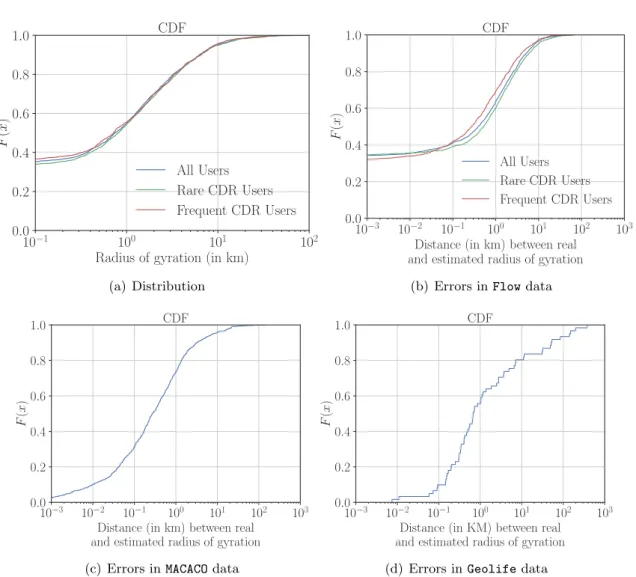
• Location displacement. This is a significant feature measuring the individual span of movement. A common metric of the location displacement is the radius of gyration. It was firstly measured in a large-scale operator-collected dataset by Gonzalez et al. [16], but they did not consider the impact of the data loss. The later paper by Ranjan et al. [46] shows that the distribution of the radius of gyration of highly-frequent voice call users is close to the actual distribution. Another common metric is the appearance frequency of each location. Ranjan et al. [46] show that, when the frequencies are computed from voice calls, the less frequent locations may disappear and the frequent locations may have their frequencies less than the actual ones [46]. This incompleteness of less frequent locations is later discussed by Zhang et al. [47].
• Significant locations. Locations such as individual’s home and work places are impor-tant in various applications, and are measured by several studies [16,26,110]. Ranjan et al. [46] find that their measurement is merely suffered from the loss of locations: using operator-collected datasets allows to correctly identify popular locations that account for 90% of each subscriber’s activity. Besides, Zhang et al. [47] find that CDR-based individual trajectories can match the reference information from public transport data, i.e., GPS logs of taxis and buses, as well as subway transit records.
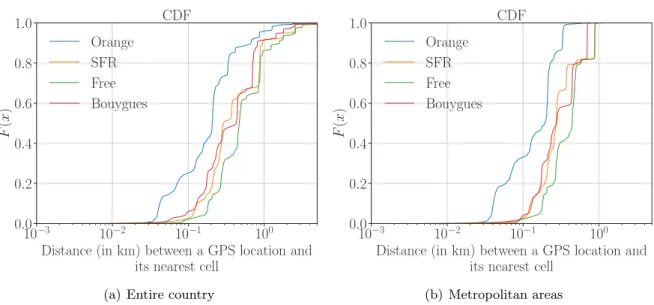
Recall that another critical bias caused by the use of cell tower locations instead of users individual actual positions has been overlooked in the literature. The early paper by Isaac-man [107] unveils that using CDR as positioning information may lead to a distance error within 1 km compared to ground-truth collected from 5 users. Still, we do not have a global view of how the use of cell tower locations impacts the user positioning. We address this issue with the presentation of our datasets (cf. Section3.5).
2.2.5 Practices to Overcome the Limited Granularity
We have introduced the collection of human footprints and the biased results of mobility fea-tures. In mobility studies, the data preliminary of the operator-collected datasets is mandatory and in most cases, aims at addressing the challenges brought by the limited spatiotemporal
18 Chapter 2. Background
granularity. In the following, we summarize the representative data preliminary practices on human footprints.
• Filter out "bad" users. This is a common procedure in the literature. It is to set a threshold based on the demand and then eliminate from the analysis the users who are below the threshold. There is hardly a standard on this procedure. One representative threshold is to keep the users that have at least one call every two hours on average and have at least two unique locations during the period of study, which is used by Gonzalez et al. [16], Song et al. [17][112], and Ranjan et al. [46]. This threshold guarantees the collection of a highly active group of users and keeps the significant locations [46]. Note that such filtering, whether or not effective, may drop a large number of users and thus should be applied on a large population to ensure the scale of the remaining users, e.g., keeping thousands of the users as in [16,17,24].
• Reduce the resolution. This relates to the reduction of the resolution of time and space and the merging of human footprints. It can reduce the requirement on the number of human footprints. Usually, the temporal resolution depends on the type of events and varies according to the quality of the data, e.g., 15 minutes [46], 1 hour [16,17, 112], 2 hours [113], and 6 hours [96]. Although it is not very common, a few studies use reduced spatial resolutions. For instance, De Montjoye et al. [113] replace the cell tower identifiers with the clusters that are merged by one or more cells.
• Segment the observing period. This concerns the separation of the observing period into segments and make different user groups for the segments. For instance, divide into daytime and nighttime hours [90, 96], weekdays and weekends [110, 114], weeks or months [17]. This practice may loose some of the long-term behaviors but can keep more users than using the whole observing period.
• Correlate with the mobility loss. This is to build a function between results and inherent features of human footprints (e.g., the loss rate of locations) by leveraging a ground-truth dataset. The function is then used to fix the biased result obtained by the incomplete mobility information. For instance, Song et al. [17] find a linear correlation between the loss rate of voice calls and the logarithm of the entropy rate of time-ordered locations [108, Fig. S3]. Iovan et al. [86] find a quadratic fit between the number of charging events and the median daily travelled distance of a user.
• Perform controlled experiments. This is to repeat the methodology or the mobility measurement on an alternative controlled dataset, used in [16,17,112,115]. The con-trolled dataset usually has a higher resolution than the counterpart used in the study. The conclusion is more convincible provided that the same results can be obtained from both datasets.
• Infer missing locations. This is to infer a user’s position during a close time when a time-stamped location is recorded, so as to enlarge the availability of human footprints. Regarding voice calls, Ficek et al. [87] propose a probabilistic inter-call mobility model, using a finite Gaussian mixture model to determine users’ positions between their con-secutive voice calls. Their work contributes to the location inference and particularly, supports the common intuitive solution that is to assume that a human footprint stays
2.3. Summary 19
representative for a time interval period (e.g., one hour) centered on the actual event timestamp, as used in [17,35]. Approaches based on interpolation only work in the pres-ence of trajectories composed of thousands of locations per day [24], which are not very adaptive to common operator-collected datasets of voice calls or text messages.
• Reconstruct trajectories. This is to use a user’s existing human footprints to recon-struct a stable trajectory. For instance, Zhang et al. [116] leverage the tensor factorization technique to generate a spatiotemporal graph from a operator-collected dataset for their analysis; they do not validate the accuracy of their spatiotemporal graph. The mobility reconstruction techniques designed for GPS location samples (e.g., [48]) may be adaptive on the datasets of Internet visits but not on those of voice calls or text messages because they are originally designed for highly frequent location samples.
Consequently, the literature on the reliable practices dealing with the limited granularity is fairly thin. In this thesis, we contribute to the location inference and the trajectory recon-struction on the human footprints of voice calls or text messages, or in other words, on the mobility data having a low sampling frequency. To the best of our knowledge, there is no validated investigation on the trajectory reconstruction.
2.3
Summary
In this chapter, we review the literature on the prediction of mobile data traffic, the theo-retical and practical prediction techniques, and the utilization of operator-collected datasets. In the following, we present our datasets (cf. Chapter 3) and propose our techniques of the location inference and trajectory reconstruction (cf. Chapter4), so as to fill the gap in the lit-erature. Then, we leverage the prediction techniques introduced in this chapter to investigate the prediction of individual mobile data traffic (cf. Chapter5).