Novel approaches in Text Information Retrieval
Experiments in the Web Track of TREC 2004
Mohamed Farah and Daniel Vanderpooten
Lamsade, University of Paris Dauphine, France
{farah,vdp}@lamsade.dauphine.fr
Abstract : In this paper, we report our experiments in the mixed query task of the Web track for TREC 2004. We deal with the problem of ranking Web documents within a mul-ticriteria framework and propose a novel approach for infor-mation retrieval. We focus on the design of a set of crite-ria aiming at capturing complementary aspects of relevance. Moreover, we provide aggregation procedures that are based on decision rules, to get the ranking of relevant documents.
1
Introduction
The TREC 2004 mixed query task of the Web track consists in searching a collection of about 1.25 million .Gov docu-ments to find responses to 225 queries : 75 homepage find-ing (HP) queries, 75 named page (NP) findfind-ing queries and 75 topic distillation (TD) queries.
For the HP and NP finding sub-tasks, there is mainly one single document, either a homepage or not, that meets the information need behind the query. Therefore, precision-like measures such as rank reversal, are of the utmost interest. For the TD sub-task, many ‘good entry points’ to relevant sites can meet the information need. Consequently, a good precision-recall compromise is searched and measures such as average precision are relevant.
To deal with this task, two main approaches are conceiv-able. The first option is to devise a method that works what-ever is the query. The second option is to conceive specific methods for each query type. This last option needs a filter-ing step to find to which type each unlabeled query belongs to.
Many factors or sources of evidence can be used to de-rive a ranking. Such factors are the document content and/or structure, the anchor text, the hyperlink structure of the col-lection, the URL features, etc. Existing approaches generate a ranking of documents based on a score that possibly com-bines many of these factors. This aggregation is done using either quite simple weighted sum or lexicographic order ag-gregation operator, or difficult to interpret measures.
In this first participation to the TREC conference series, we submitted one official run. We used a multicriteria ap-proach where we focus on the design of a set of criteria aim-ing at capturaim-ing complementary aspects of relevance. We use ‘natural procedures’ to aggregate these criteria and rank doc-uments accordingly. We conducted the experiments using a
retrieval system designed and developed from scratch to sup-port any search function that might be useful. In the exper-iments reported here, we process all the queries without a filtering process (option 2).
This paper is organized as follows. We first introduce the multicriteria framework where we describe the overall ap-proach (section 2). In section 3, we describe our system specificities. Experimental results are presented in section 4. Conclusions are provided in the final section.
2
The multicriteria framework
In this work, we acknowledge that the Web search environ-ment is rich with multiple sources of evidence, all of which have strengths that presumably complement one another and weaknesses that can significantly deteriorate retrieval effec-tiveness when used by themselves. We therefore claim that being able to make effective use of the available information can significantly improve retrieval effectiveness.
We hereafter propose a formal approach for Web informa-tion retrieval where relevance is explicitly defined as multi-dimensional. The overall approach could be split into three phases.
2.1 The modelling phase
It consists firstly of the identification of the factors affecting relevance.
In the text information retrieval context, some factors have solidly been established as important, through extensive test-ing in the information retrieval literature, and could therefore be considered as the basis for criteria design [4, 6, 10, 11]. Such factors are :
– Term frequency (tf ) which is the number of occurrences of terms in documents. It is in fact widely accepted that the more often a term occurs within a document, the more likely it is important for that document.
– Term locality (tl) which captures the presence of terms in specific structured portions of the documents such as the title or the keywords.
– Document length (dl) which evaluates the information contained in documents.
– Term proximity (tp) which captures the nearness of query terms within documents since it is assumed that when query terms are close to each other, the document should best correspond to the information need behind the query.
Moreover, with the advent of the Web, factors pertaining to the popularity or visibility of documents have proven to improve performance. Such factors could be the scores in-duced by algorithms such as PageRank [1] or HITS [5] as well as simple measures such as documents in-degrees or out-degrees [2].
These factors are then used to develop a set of appropriate decision criteria. These criteria stand for the basis of pair-wise comparisons among the potentially relevant candidate
documents. Each criterion will give rise to a partial prefer-ence relation modelling the way two documents are
com-pared.
Formally, a criterion is a real-valued function g defined on the set of candidate documents which aims at comparing any pair of documents d and d′
, on a specific point of view, as follows :
g(d) ≥ g(d′
) ⇒ d ‘is at least as relevant as’ d′
Evaluating document according to each criterion can be affected by imprecision, uncertainty, or inaccurate determi-nation. Moreover, There is no one best way to build criteria and different formulations can be acceptable. Therefore, a slight difference in the scores of two documents, with re-spect to one criterion, should not lead to discriminate them. In order to model imprecision underlying criteria design, we set the following discrimination thresholds [7] :
– An indifference threshold allows for two close-valued documents to be judged as equivalent although they do not have exactly the same performance on the criterion. The indifference threshold basically draws the bound-aries between an indifference and a preference situa-tions.
– A preference threshold is introduced when we want or need to be more precise when describing a preference situation. Therefore, it establishes the boundaries be-tween a situation of a strict preference and an hesita-tion between an indifference and a preference situahesita-tions, namely a weak preference.
Thresholds can either be set as fixed or variable along the criterion scale.
Comparing two documents d and d′ according to a
crite-rion gj with an indifference threshold qj and a preference
threshold pj, leads to the following preferential situations :
– dIjd′⇔ −qj ≤ gj(d) − gj(d′) ≤ qj
– dQjd′⇔ −qj < gj(d) − gj(d′) ≤ pj
– dPjd′⇔ gj(d) − gj(d′) > pj
where Ij, Qj and Pj represent respectively indifference,
weak preference and strict preference relations restricted to
criterion gj. These3 relations could be grouped into an
out-ranking relation Sjsuch that dSjd′ ⇔ gj(d) + qj≥ gj(d′).
Each criterion can be endowed with specific indicators of importance, namely its relative importance which gives an idea on what criteria are more important than others.
2.2 The aggregation phase
This phase takes the partial preference structures induced by the criteria family and aggregates them into one or more
overall preference relation(s) that model relevance. To do so,
we use partial compensatory aggregation mechanisms that are based on the following basic principles to compare two documents d and d′[8] :
– A concordance principle : d ‘is as least as relevant as’ d′
if the majority of criteria agree with this assertion, and – A discordance principle : d ‘is as least as relevant as’
d′
if none of the discordant criteria strongly refutes this assertion.
Formally, we build an overall outranking relation S, whose meaning is ‘is at least as relevant as’. Therefore,
dSd′if and only if the two above-mentioned conditions hold.
These conditions may be more or less demanding, resulting in different outranking relations.
Let
– F= {g1, . . . , gp} be a family of p criteria,
– H be an overall preference relation, where H is P , Q, I or S,
– Hjbe a partial preference relation, i.e. restricted to
cri-terion gj,
– C(dHd′) = {j ∈ F : dH
jd′} be the concordance
coali-tion of criteria in favor of establishing dHd′
. We distinct two basic families of outranking relations. If we do not have information on the relative importance of the criteria, we use conditions referring to the number of criteria supporting or refuting the outranking such as the fol-lowing outranking relations :
dS1d
′
⇔ C(dSd′
) = F (1)
which is a well established relations.
dS2d′ ⇔ card(C(dP d′)) ≥ card(C(d′Qd))
and C(d′
P d) = ∅ (2)
where there should be more criteria concordant with dP d′
than criteria concordant with d′
Qd. At the same time, there
should be no criterion concordant with d′
dS3d ′
⇔ card(C(dP d′
)) ≥ card(C(d′
P∪ Q d)) (3)
where there should be more criteria concordant with dP d′
than criteria supporting a strict or weak preference in favor of d′.
dS4d′ ⇔ card(C(dP d′)) ≥ card(C(d′P d)) (4)
where there should be more criteria concordant with dP d′
than criteria concordant with d′
P d.
where
S1⊂ S2⊂ S3⊂ S4
since when we move from Sj to Sj+1, the credibility of the
comparisons gets weaker.
If the relative importance of criteria can be assessed, we can use more elaborated outranking relations that allow com-pensation in some directions but not others. More precisely, we can accept that a ‘relatively’ bad performance on one cri-terion gj can be compensated by a good performance on a
more important criterion gi.
2.3 The exploitation phase
In order to derive the final ranking, we need exploitation pro-cedures that enrich the outranking relations elaborated in the aggregation phase. In fact, these relations are not necessarily transitive. To do so, we use information on how each docu-ment is compared to the other docudocu-ments according to each outranking relation.
The exploitation procedure we use has its roots in the [8, 9]. It consists in partitioning the set of potential candidates
D into r ranked classes leading to the definition of a
com-plete preorder. Each class Ch encloses documents that are
considered as ex aequo where C1is the best class.
Each class Ch results from a distillation process which
is an iterative process starting from the base set E0 =
D\ {C1∪ . . . ∪ Ch−1}. This process iterates over the
out-ranking relations defined in the aggregation phase, starting from the well established relation till the less demanding one. Each iteration i tries to reduce the set of ex-aequo doc-uments, starting from the distillate Ei−1, to get the distillate
Ei, as follows :
1. Compute for each d ∈ Ei−1 its qualification
si(d, Ei−1), which is the difference of the number of
documents that could be considered as ‘better’ in the one side, and ‘worse’ in the other side, than d according to Si,
2. smax= maxd∈Ei−1{si(d, Ei−1)}
3. Ei= {d ∈ Ei−1: si(d, Ei−1) = smax}
The distillation process stops when card(Ei) = 1,
other-wise, the last class will consist of the last distillate produced by the use of the less demanding outranking relation.
3
System description
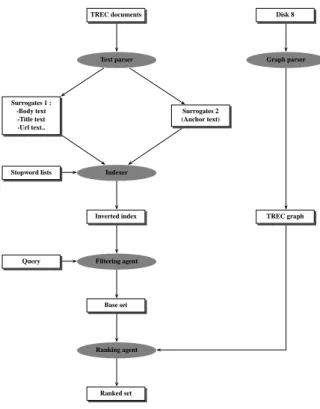
To facilitate empirical investigation of the proposed method-ology, we developed a prototype search engine implement-ing a basic multicriteria approach. The software is entirely implemented in java SDK1.4.1. It mainly consists of five agents (see figure 1) :
– A text parser which processes the TREC collection to get the document surrogates. In fact, document repre-sentation is based on its internal content delimited by the body tags, as well as texts in the URL, the title, key-words and description tags. Moreover, we use link an-chor texts present in Web documents pointing to the cur-rent document since it is shown in [3] that such texts of-ten provide accurate descriptions of pointed documents content. We consider only stems as index terms using the Porter algorithm to reduce the size of the inverted index. We also discard cuurent english stopwords, – A graph parser which builds the TREC graph where
nodes are documents and edges are hyperlinks between documents,
– An indexer which produces an inverted index of the whole collection,
– A filtering agent which matches query terms with TREC documents to get the unordered base set of potentially relevant items, and
– A ranking agent which implements the muticriteria al-gorithm.
Five criteria are considered in this study. We distinguish one-term queries having single terms from complex queries. – g1 captures frequencies of query terms. For one-term
queries, we use
tf
tfmax
where tf is the term frequency and tfmaxcorresponds
to the most frequent term in the document. For complex queries, we retain either the product or the sum aggre-gation operator.
– g2 captures the occurrences of query terms within the
anchor text (location L1), the URL (L2), the title (L3),
the keywords tag (L4) and the description tag (L5). For
the one-term queries, we first compute a partial perfor-mance with respect to each location Li:
g2(d, t, Li) = number of occurrences of t in Li
The overall score of each document with respect to this criterion is computed using the weighted sum operator as follows : g2(d, t) = P5 i=1kig2(d, t, Li) P5 i=1ki
TREC documents Disk 8
Text parser Graph parser
Surrogates 1 : -Body text -Title text -Url text.. Surrogates 2 (Anchor text)
Stopword lists Indexer
Inverted index TREC graph
Query Filtering agent
Base set
Ranking agent
Ranked set
Fig. 1. System description
where kiis an importance score for location Li. In fact,
we suppose that some locations are more important that others.
For complex queries, the overall score is computed as
g2(d, q) =
X
t∈q
g2(d, t)
– g3 is a popularity measure. It is either the number of
document in-links, or the authority score computed us-ing the HITS algorithm.
– g4aims at favoring entry points to relevant sites by
de-termining for each document the number of its relevant children.
– g5 is a proximity criterion that is only considered for
complex queries. It is inversely proportional to the min-imal matching span of query terms in the document, i.e. the smallest text excerpt from the document that con-tains all the query terms.
It is obvious that these criteria play different roles for each specific task. Therefore, knowing to which type each topic belongs can lead to a definition of specific procedures for each query type. Since this is not the case, we consider that each criterion is neither predominant nor negligible and de-velop an aggregation procedure that is based on the outrank-ing relations of equations (1)-(4).
4
Results
We report here performances of the official run we submitted to the mixed query task of the Web track, as well as other runs we carried out after an expansion of our system so that it can process queries with high number of potentially relevant documents.
We begin with a detailed performance analysis on a per query type basis, then discuss overall performance of each run.
Beforehand, we begin with a brief description of the runs.
4.1 The Runs
The various runs we discuss in this paper are the followings : – LamMcm1 : This is the official run we submitted to TREC 2004. It implements the aggregating and ex-ploitation procedures of sections (2.2) and (2.3). Crite-ria g1 to g4 are considered where the product
aggrega-tion operator is used for the criterion g1. We suppose
that no information on the relative importance of crite-ria is available. We therefore use the outranking rela-tions of equarela-tions (1)- (4). The indifference and pref-erence thresholds are considered as variable. They are set to 20% and 50%, respectively. For each query, we only considered the first 500 processed documents from those that match query terms. This is basically due to the limitations of the prototype version of the system. – mcm1 : This is the same as LamMcm1 but uses another
filtering mechanism which is based on criterion g2. In
fact, we considered the first 1000 documents according to his criterion. This is the basic run for the followings. – mcm2 : Same as mcm1 but uses a different formulation
of criterion g1. We used the sum operator to aggregate
frequencies of the terms of the query.
– mcm3 : Same as mcm1 but uses fixed thresholds. We used the following values : q = (0.05; 0; 5; 3) and p = (0.1; 0.25; 10; 6).
– mcm4 : Same as mcm1 but uses criterion g5.
4.2 The HP/NP finding sub-tasks
HP/NP queries correspond to situations where users do not need large lists of relevant documents to search in but would rather prefer to get the URL of a specific home page (HP queries) or a non-home page document (NP queries).
Tables 1 and 2 depict various statistics based on rele-vance assessments of the HP and NP query tasks, respec-tively. They clearly show that there is one correct answer per HP/NP topic.
Tables 3 and 4 provide a summary description of the runs with respect to the HP/NP queries.
For the HP queries, using fix thresholds leads to the best run (mcm3) with MRR=56.77%, whereas using the sum ag-gregation operator for criterion g1 retrieves more relevant
num_queries 75
num_rel_docs 83
Mean_rel_docs / query1.106
Table 1. Relevance judgment statistics for HP queries
num_queries 75
num_rel_docs 78
Mean_rel_docs / query1.040
Table 2. Relevance judgment statistics for NP queries
Run MRR S@1 S@5 S@10 mcm1 46.06 36.00 57.33 68.00 mcm2 55.67 46.67 65.33 74.67 mcm3 56.77 41.33 74.67 80.00 mcm4 35.33 29.33 41.33 49.33 LamMcm1 32.61 26.67 41.33 45.33
Table 3. Summary description of the Runs for the HP query finding
task Run MRR S@1 S@5 S@10 mcm1 57.34 45.20 73.97 75.34 mcm2 56.99 41.10 79.45 82.19 mcm3 52.74 41.09 67.12 75.34 mcm4 50.79 38.35 65.75 69.86 LamMcm1 32.26 21.33 44.00 54.67
Table 4. Summary description of the Runs for the NP query finding
task
items in the first position (S@1 = 46.67% for mcm2). Run mcm3 is also the best run to retrieve rapidly most of the cor-rect answers (S@5=74.67% and S@10=80.00%).
For the NP queries, run mcm2 retrieves more relevant items in the top 5 and 10 retrieved list whereas run mcm1 is more efficient to get the relevant item in the first position (MRR=57.34% and S@1 = 45.20%).
Surprisingly, using criterion g5 deteriorates performance
for both the HP and TD queries.
4.3 The Topic Distillation sub-task
This task aims at retrieving ‘key resources’ on a given topic. There is no explicit definition of what constitutes a key re-source. Nevertheless, it seems to be appropriate to return at first, father pages which have many relevant children. This is achieved by the criterion g4.
Table 5 provides a summary description of the runs with respect to the TD queries.
Firstly, this table shows low performance of the official run. This is principally due to the following factors:
– The run was not considered for judgment in the pool-ing procedure, which means that the best ranked docu-ments of the run may not have been assessed for rele-vance judgements, Run AvP S@1 S@5 S@10 mcm1 13.25 36.00 69.33 80.00 mcm2 13.14 40.00 74.67 81.33 mcm3 11.53 22.67 65.33 74.67 mcm4 9.68 33.63 53.36 61.43 LamMcm1 4.87 17.33 40.00 46.67
Table 5. Summary description of the Runs for the TD task
– In the prototype version of our system, among all the documents matching the query (the base set), only a subset of at most 500 documents could be processed. Therefore a wide number of relevant items are skipped for evaluation. In HP/NP tasks, this limitation does not have significant impact on the system performance, but in the TD task, there is an important impact on perfor-mance,
– We did not use any training queries from last years to tune some parameters and especially thresholds. Runs mcm1 and mcm2 have the best performances whereas performance falls down when the proximity crite-rion is used.
4.4 The mixed-query task Table 6 shows that :
– Run mcm2 is significantly better than the other runs, – Considering the proximity criterion deteriorates
perfor-mance, and
– The use of variant thresholds performs better.
Run AvP S@1 S@5 S@10 mcm1 38.35 39.01 66.81 74.43 mcm2 41.05 42.60 73.09 79.37 mcm3 39.68 34.98 69.05 76.68 mcm4 31.19 33.63 53.36 61.43 LamMcm1 22.68 21.78 41.78 48.89
Table 6. Summary description of the Runs for the mixed-query task
5
Conclusions
In this paper, we proposed a novel vision of the informa-tion retrieval problem and described a system that imple-ments a multicriteria methodology. The ideas developed for the TREC collection of textual documents can be adapted to any family of criteria deemed to be relevant and respecting some properties. It also provides a general framework within which different document types could be searched and re-trieved.
Further experiments are currently undertaken to help judge which criteria are more important than others or which ones are more task specific.
References
1. S. Brin and L. Page. Anatomy of a large-scale hypertextual web search engine. In Proceedings of the 7th International
World Wide Web Conference, pages 14–18, Brisbane,
Aus-tralia, Apr. 1998.
2. J. Carriere and R. Kazman. Webquery: Searching and visualiz-ing the web through connectivity. In Proceedvisualiz-ings of the 6th
In-ternational World Wide Web Conference, pages 7–11, Santa
Clara, California, Apr. 1997.
3. N. Crasswell, D. Hawking, and S. Robertson. Effective site finding using link anchor information. In Proceedings ACM
SIGIR 2001, pages 250–257, 2001.
4. A. Kilgarriff. Which words are particularly characteristic of a text ? a survey of statistical approaches. In Proceedings of
the AISB Workshop on Language Engineering for Document Analysis and Recognition, pages 33–40, Brighton, UK, Apr.
1996.
5. J. M. Kleinberg. Authoritative sources in a hyperlinked envi-ronnement. Journal of the ACM, 46(5):604–632, Sept. 1999. 6. S. E. Robertson and K. Spark Jones. Simple proven approaches
to text retrieval. Technical report 356, Cambridge University Computer Laboratory, May 1997.
7. B. Roy. Main sources of inaccurate determination, uncer-tainty and imprecision. Mathematical and Computer
Mod-elling, 12(10/11):1245–1254, 1989.
8. B. Roy and D. Bouyssou. Aide multicrit`ere `a la d´ecision :
M´ethodes et cas. Economica, 1993.
9. B. Roy and J. Hugonnard. Ranking of suburban line extension projects on the Paris metro system by a multicriteria method.
Transportation Research, 16A(4):301–312, 1982.
10. G. Salton. Automatic Text Processing. Addison-Wesley, 1989. 11. G. Salton and C. Buckley. Term-weighting approaches in auto-matic text retrieval. Information Processing and Management, 24(5):513–523, 1988.