HAL Id: pastel-00004228
https://pastel.archives-ouvertes.fr/pastel-00004228
Submitted on 21 Jul 2010HAL is a multi-disciplinary open access
archive for the deposit and dissemination of sci-entific research documents, whether they are pub-lished or not. The documents may come from teaching and research institutions in France or abroad, or from public or private research centers.
L’archive ouverte pluridisciplinaire HAL, est destinée au dépôt et à la diffusion de documents scientifiques de niveau recherche, publiés ou non, émanant des établissements d’enseignement et de recherche français ou étrangers, des laboratoires publics ou privés.
Efficient Information Dissemination in Wireless
Multi-hop.
Song Yean Cho
To cite this version:
Song Yean Cho. Efficient Information Dissemination in Wireless Multi-hop.. Computer Science [cs]. Ecole Polytechnique X, 2008. English. �pastel-00004228�
EFFICIENT INFORMATION DISSEMINATION IN WIRELESS MULTI-HOP NETWORKS
A DISSERTATION
SUBMITTED TO THE DEPARTMENT OF INFORMATIQUE AND THE COMMITTEE ON GRADUATE STUDIES
OF ECOLE POLYTECHNIQUE
IN PARTIAL FULFILLMENT OF THE REQUIREMENTS FOR THE DEGREE OF
DOCTOR OF PHILOSOPHY
Song Yean Cho September 22, 2008
c
Copyright by Song Yean Cho 2009 All Rights Reserved
Preface
Many protocols and applications in wireless multi-hop networks indispensably use broad-casting to delivery messages to all nodes in a network. Wireless routing protocols such as DSR, AODV and ODRMP broadcast route discovery messages, and many application protocols exchange query and response messages by broadcasting. Hence, the efficiency of broadcasting is critical to efficiency of these wireless protocols. Efficient wireless broadcast-ing is a topic that this thesis studies where efficiency is measured by the total transmission number to broadcast one unit data to the whole network. The study is done in two ways: extending classical methods and utilizing a novel method, network coding.
Classical broadcasting protocols are based on store-and-forward routing that views pack-ets as atomic objects and lpack-ets a node store incoming packpack-ets in its local queue for some delay, before forwarding one or several copies of the packets to its neighbors. Among the classical broadcast protocols, the simplest and most widely used broadcast protocol is pure flood-ing. Pure flooding reliably provides total coverage of a network, but causes redundancy of packets, resulting in unnecessary collisions, and enormous inefficiency. To combat this inef-ficiency, many efficient broadcast protocols have been studied using probabilistic algorithms such as a gossip protocol, or algorithms based on topology control such as a Multi-Point Relay (MPR) based protocol. These broadcast protocols have been successfully used in many wireless protocols standardized in IEEE 802.11 and IETF.
One possible application of the broadcast protocols is wireless mesh networks standard-ized in 802.11 Working Group S. The 802.11 mesh networks face challenges such as inefficient broadcasting of so-called associated station information that is partially updated; there ex-ists redundancy between newly updated data and already broadcasted data. This thesis addresses these challenges by introducing an Association Discovery Protocol (ADP) that is combined with MPR-based broadcasting and integrated with an extension of an Optimized Link State Routing (OLSR) protocol for the 802.11 mesh networks. The results of analysis
which could theoretically outperform the broadcast protocols with classical store-and-forward routing and would not require precise topology information. This solution is network coding. Theoretically, network coding enables an optimized solution for wireless broadcasting in a polynomial time, while it is NP-complete with classical store-and-forward routing and only approximation algorithms exist. Hence, broadcasting with network coding is, theoretically, at least as efficient as any other broadcasting.
This thesis focuses on utilizing network coding specifically as a practical solution for efficient wireless broadcasting. For the practical solution, this thesis proposes simple al-gorithms based on intuitive rationale about optimal efficiency of wireless network coding. The efficiency of the proposed simple algorithms is theoretically analyzed, and proven to be asymptotically optimal. The efficiency also is experimentally analyzed and shown, in some examples, to outperform other broadcasting with classical store-and-forward routing. Finally, from these simple algorithms we derive a practical broadcasting protocol executing with a simple and efficient coding method (that is, random linear coding). In addition, we propose a simple novel method for real-time decoding that could be combined with the practical network coding broadcasting protocol.
Acknowledgments
The thesis has been an inspiring, very challenging, but always interesting and exciting experience. I am deeply indebted to my advisor, Professor Philippe Jacquet and Dr. Cedric Adjih, for their support, encouragement, and invaluable advice during my Ph.D. study. Their wide knowledge and logical way of thinking have been of great value for me whenever I challenged issues of my study. Their understanding and personal guidance have provided a good basis for the present thesis.
I would like to thank Prof. Mario Gerla and Dr. Thierry Turletti for serving as my thesis readers and their invaluable suggestions. I would also like to Prof. Pierre Duhamel and Prof. Walid Dabbous for serving on my thesis committee and thank Prof. Francois Baccelli for serving as a chairman of my thesis committee.
I wish to thank ex-collaborators, Bang-Hoon Chun, a vice president, Kyoung-Hoon Yi, a principle manager in Samsung advanced institute of technology, and also thank Prof. Jin-Young Choi and Prof. Arthur H. Lee. Their advice has inspired and encouraged me.
I would like to thank my collaborators, Dr. Emmanuel Baccelli, Prof. Thomas H. Clausen and Prof. Pascale Minet whose suggestions have been very valuable.
I take this opportunity to express my profound gratitude to my friends, Yang-Jae, Hee-Young and Su-Jin for their moral support during my study.
Finally, this thesis is dedicated to my parents, who have given me continuous and unconditional support of all my undertakings, scholastic and otherwise. They always believe in me and never fail to provide all the support.
Preface v Acknowledgments vii 1 Introduction 1 1.1 Overview . . . 1 1.2 Contribution . . . 3 1.3 Thesis outline . . . 8
2 Broadcast Protocols in Wireless Networks 10 2.1 Efficient Wireless Broadcasting with Store-and-Forward Routing . . . 11
2.2 Efficient Broadcasting Extension to Wireless Mesh Networks . . . 18
2.3 Summary . . . 33
3 Network Coding Background 35 3.1 Introduction of Network Coding . . . 35
3.2 Practical Framework of Network Coding . . . 37
3.2.1 Linear Coding . . . 37
3.2.2 Random Linear Coding . . . 40
3.3 Theoretical Performance of Network Coding . . . 44
3.3.1 Min-cut Max flow Theorem . . . 44
3.3.2 Maximum Multicasting Rate of Network Coding . . . 47
3.3.3 Maximum Broadcast Rate of Wireless Network Coding . . . 49
3.3.4 Maximum Broadcast Rate of Random Linear Coding . . . 50
3.4 Summary and a Problem Statement . . . 51 viii
4 Efficient Wireless Broadcasting with Network Coding 54
4.1 Overview . . . 54
4.2 Related Work of Efficient Wireless Network Coding . . . 55
4.3 Network Model and Evaluation Metrics . . . 59
4.3.1 Network Model . . . 59
4.3.2 Evaluation Metrics and Efficiency Bound of Store-Forward Broadcasting 60 4.3.3 Efficiency Measuring Tools and Methods . . . 64
4.4 Principal Rationale . . . 67
4.4.1 Operations of each node for Broadcasting with Random Linear Cod-ing . . . 67
4.4.2 Basic Principle for Rate Selection . . . 68
4.4.3 Heuristic for Rate Selection: IRMS . . . 73
4.5 Theoretical Analysis of Efficiency . . . 76
4.5.1 Theoretical Analysis of Efficiency in 1D lattice torus networks . . . 76
4.5.2 Proof of Asymptotical Optimality in 2 dimensional Euclidean Space 82 4.5.3 Proofs of the Achievable Broadcast Capacity . . . 89
4.6 Experimental Efficiency Evaluation . . . 104
4.6.1 Efficiency in Different Types of Networks . . . 104
4.6.2 Distribution of the Min-cut . . . 106
4.6.3 Random Unit Disk Graphs N , M . . . 107
4.6.4 Difficulties for Distributed Rate Selection . . . 109
4.7 Rate Selection Improvement : Dynamic Adaptation . . . 110
4.7.1 Dynamic Heuristic for Rate Selection . . . 111
4.7.2 Experimental Results . . . 116
4.8 Summary . . . 125
5 Network Coding Protocol 128 5.1 Algorithm and Packet Format . . . 128
5.1.1 Framework for Broadcasting with Random Linear Coding . . . 129
5.1.2 Termination Protocol . . . 129
5.1.3 Packet Format . . . 131
5.1.4 Performance Evaluation using NS-2 . . . 133
5.2 Real-time Decoding . . . 134 ix
5.2.3 Real-Time Decoding: Effects of SEW . . . 139
5.3 Summary . . . 141
6 Summary and Future work 142
Bibliography 147
List of Tables
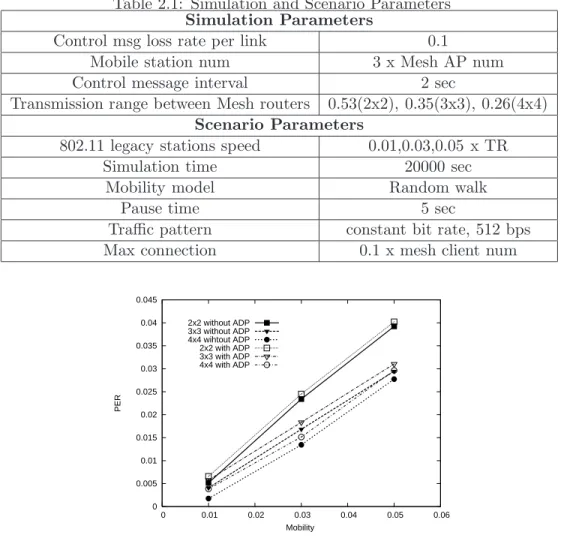
2.1 Simulation and Scenario Parameters . . . 31
4.1 Default simulation parameters. . . 116
4.2 Default simulation parameters of NS-2 . . . 119
4.3 Impact of field size . . . 119
4.4 Impact of α . . . 121
5.1 Data Packet Format . . . 131
5.2 Control Packet Format . . . 132
5.3 Local Neighbor Table . . . 133
5.4 Simulation Parameters of NS-2 for Efficiency Evaluation . . . 134
5.5 Simulation Parameters of NS-2 for RDT Evaluation . . . 139
2.1 Pure flooding vs. MPR flooding . . . 17
2.2 Architecture of hybrid wireless mesh networks . . . 19
2.3 The change of association with mesh clients’ mobility . . . 26
2.4 Mesh routers in grid topology . . . 30
2.5 Comparison of PERs with and without ADP optimization . . . 31
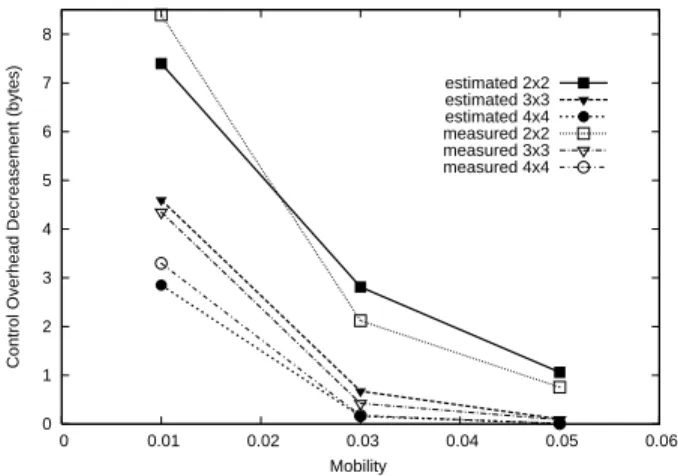
2.6 Control overhead decrease . . . 32
3.1 An example of a wired network with network coding . . . 36
3.2 An example of a wireless network with network coding . . . 37
3.3 An encoding process . . . 38
3.4 Received encoding data at destination t . . . 39
3.5 Buffering received packets (global vectors and information vectors) . . . 41
3.6 A decoding process at a node v . . . 42
3.7 An example of S/T partition and a cut . . . 45
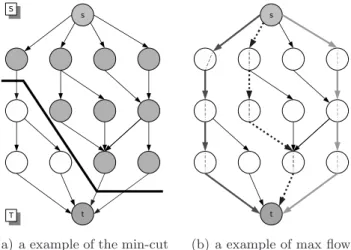
3.8 An example of the min-cut and the max flow . . . 46
3.9 an example of a cut capacity . . . 49
4.1 Network Models . . . 59
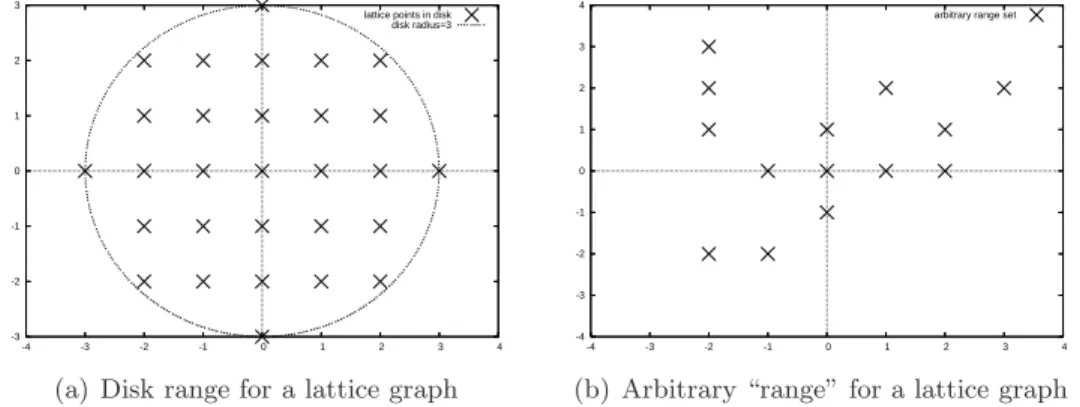
4.2 Examples of range for lattices . . . 60
4.3 Ecost numerically and theoretically computed . . . 62
4.4 An example of optimal solution of a lattice graph and a random unit disk graph . . . 62
4.5 An efficiency bound without network coding . . . 63
4.6 Connected Dominating Set . . . 64
4.7 Conversion of a directed hypergraph for max flow computation . . . 65
4.8 Retransmitting from source’s neighbors with rate 1 with the source rate M = 5 69
4.9 Retransmitting from the source’s two hop neighbors with rate 1 . . . 70
4.10 Innovative packet receptions at the nodes inside each area . . . 70
4.11 A gap of rank of nodes . . . 71
4.12 Min-cut with IRON heuristic . . . 72
4.13 Min-cut with IRMS . . . 74
4.14 an example of 1D torus network topology . . . 77
4.15 S/T partition in a one dimensional torus network . . . 80
4.16 a sample network inside a square . . . 83
4.17 Neighborhood obtained using the Minkowski sum . . . 91
4.18 S/T partition of a lattice network with ∆L . . . 93
4.19 Mapping points in G to a point in embedded lattice L . . . 96
4.20 Relative cost (efficiency compared to optimal) . . . 105
4.21 Mincut distribution . . . 106
4.22 Ecost on random unit disk graphs with torus effect . . . 107
4.23 Ecost on random unit disk graphs without torus effect . . . 108
4.24 Example of cut . . . 109
4.25 Cut S/T at destination: ∆S = {v1, v2, v3, v4}; T = {t} . . . 111
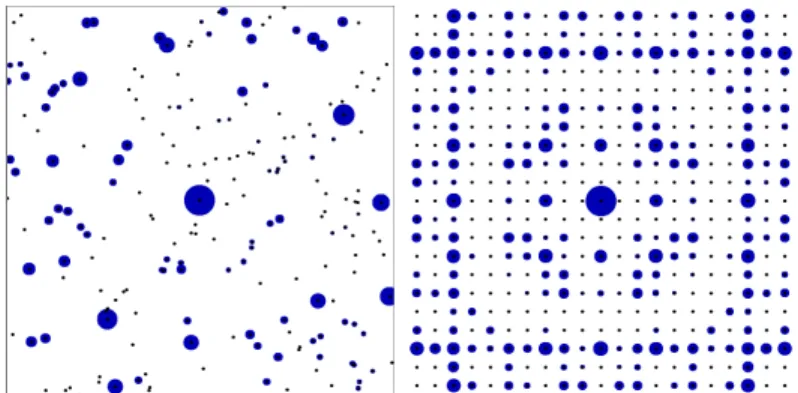
4.26 Example topology (source is the larger node) . . . 112
4.27 Line network . . . 115
4.28 Average innovative packet rate vs time . . . 117
4.29 Performance of different heuristics . . . 118
4.30 Increasing density . . . 120
4.31 Impact of generation size . . . 121
4.32 Maximum rank gap with the source . . . 122
4.33 Propagation with distance α = 1 . . . 122
4.34 Propagation with distance α = 5, α = 10 . . . 122
5.1 Relative efficiency of our heuristics . . . 135
5.2 Decoding at a Node . . . 136
5.3 Low Triangle in Global Encoding Vectors in Local Buffer . . . 136
5.4 Evolution of avg. D, avg.(Ihigh),min.(Ihigh) and source rank, with high mo-bility, N=200 M=8.867 . . . 140
Chapter 1
Introduction
1.1
Overview
Because a channel of wireless networks is unreliable and its devices have mobility, wireless networks are naturally dynamic; the dynamic features cause difficulty where all wireless protocols exchange messages. Hence, many wireless protocols use broadcasting as a way to delivery their messages. For example, routing protocols use broadcasting to distribute control messages and application protocols use it in a discovery phase.
The simplest way to execute broadcasting is pure flooding where every node forwards all initially-received packets. Pure flooding requires no global topology information and no control traffic, and reliably covers the whole network. However, pure flooding causes many redundant data receptions and unnecessary transmissions. These unnecessary retransmis-sion wastes bandwidth which is deficient in wireless networks; it also wastes devices’ energy which is limited in mobile devices. This inefficiency should be avoided, and hence this the-sis studies efficient broadcasting. The efficiency that we study is energy-efficiency that is measured by the number of transmission to deliver one unit data. Hence, we can define an efficient broadcast protocol for this study as;
Efficient Broadcast Protocol : distributes a unit data (a packet) from a source to all nodes inside a network with the minimal transmission number.
For efficient broadcasting, a substantial number of protocols have been proposed; these broadcast protocols have aimed to decrease redundant data reception, while keeping the
total coverage of a network. The protocols are usually based on either probabilistic algo-rithms [1–3], where packets are only forwarded with a certain probability, or Connected Dominating Set (CDS) algorithms [4–6], where packets are forwarded only by the limited number of forwarder nodes in CDS sets. We investigated the efficient broadcast protocols and extended one of them, an MPR(Multi-Point Relaying)-based protocol for wireless mesh networks.
The mesh networks face challenges such as inefficient broadcasting of a so-called asso-ciated station information, whose newly updated data has redundancy with already broad-casted data. To address these challenges, this thesis introduces an association discovery protocol (ADP) that is combined with MPR-based broadcasting and integrated with an extension of an OLSR protocol for mesh networks. The results of analysis with modeling and simulation shows that ADP effectively decreases control overhead and improves perfor-mance. The performance improvement is observed specifically for delay constrained control traffic; however, for continuous data traffic, a basic limitation may exist for broadcast pro-tocols with classical store-and-forward routing.
The limitation comes from a classical communication model assuming one source and one destination such as a telephone system [7]. Unlike telephone networks from which the classical communication model originated, recent networks are shared networks where multiple nodes access the same channel such as Ethernet and wireless LAN. In the shared networks, there may exist several destinations from a source and multiple paths to several destinations, and the multiple paths would be organized by connecting several communica-tion entities. Moreover, the multiple paths could be partially overlapped by having common links. With the classical communication model, all communication entities organizing the paths use classical store-and-forward routing, which treats packets as atomic objects and stores packets in a local buffer for some delay before forwarding them to other nodes. When store-and-forward routing is used, the capacity of the common links should be shared by multiple paths. This sharing would result in capacity shrinkage that is assigned to some destinations. As far as we keep the classical point-to-point communication model, it is hard to avoid the capacity shrinkage, regardless of a high compression rate at the source and reliable transmission without any error.
In order to overcome the basic limitation of the classical communication model, we may benefit from the existence of intermediate nodes in recent networks. In the shared networks, we can permit a new operation to intermediate nodes in addition to storing and forwarding
1.2. CONTRIBUTION 3
of the classical communication model. The new operation is coding, and permitting coding at intermediate nodes is called as network coding.
Network coding enables each connection to use the whole capacity of the overlapped paths as if there exists only one connection in the network. In the seminal work of [8], Ahlswede et al. theoretically proved and qualified the benefit of network coding with mul-ticast scenarios. The quantified benefit is a theoretical upper bound of network resource utilization (that is, the max-flow min-cut bound for multicasting) that classical store-and-forward routing may not achieve in some cases. This benefit is one motivation for this thesis to focus on network coding.
Another motivation is the existence of a simple and efficient coding method, random linear coding [9,10]. Random linear coding not only is simple but also guarantees to asymp-totically achieve the theoretical upper bound of network resource utilization for multicas-ting [11]. When the simple random linear coding method is used, a remaining problem is how to minimize the transmission number to achieve the upper bound, or cost optimization. The cost optimization of wireless broadcasting is NP-complete with classical store-and-forward routing [1]. But with network coding, we can obtain an optimal solution for wireless broadcasting in a polynomial time by solving a linear optimization problem [12, 13], and we can have a converging approximation in a decentralized way [13]. However, this thesis proposes a different and even simpler approach to obtain the optimal solution, rather than solving a linear optimization problem.
1.2
Contribution
The main contribution of this thesis follows: first, we extend an efficient broadcast protocol with store-and-forward routing for wireless mesh networks, propose ADP in order to im-prove broadcast performance, and analyze the protocol’s performance with modeling and simulation. Second, we design simple and efficient broadcasting with network coding. We theoretically prove it to be asymptotically optimal in one dimensional torus networks and in two dimensional networks on Euclidean spaces, and in practice show that our broadcasting outperforms other broadcasting with store-and-forward routing.
We extend MPR-based broadcasting to wireless mesh networks with OLSR routing protocol by proposing an association discovery protocol (ADP) in order
to efficiently broadcast data whose content does not totally change and is par-tially updated. Moreover, we analyze the efficiency of the protocol with model-ing and simulation. An MPR-based broadcast protocol is one efficient broadcast protocol that decreases the transmission number by reducing the number of forwarding nodes. We extend the MPR-based broadcast protocol in order to complement OLSR routing protocol for IEEE 802.11 wireless mesh networks. While taking advantage of MPR-based broadcast-ing, our extension introduces ADP in order to limit the overhead of repeating information in periodically broadcasted data [14]. This extension could support efficient broadcasting in mesh networks specifically when the data should be periodically broadcasted within a con-strained delay, and the periodically broadcasted data would be partially updated each time. An example of such data is a database of mobile hosts in mesh networks, a so-called associ-ated station information. The improved efficiency with our extension is controlled with our analytical model which models the database changes and control overhead to broadcast the changes. Our simulations on some representative graphs show efficiency improvement and accurate efficiency control with our modeling. This extension presents a successful solution based on efficient broadcasting with store-and-forward routing specifically for burst and delay constrained control traffic.
We introduce a simple and novel approach for efficient broadcasting with network coding that achieves the maximal-efficiency-benefit of wireless network coding. For continuous data traffic, there exists different approach that does not require precise topology information and theoretically outperforms other broadcast protocols with store-and-forward routing. This solution is network coding. Network coding creates multiple
benefits: a coded packet transmission can simultaneously bring innovative, that is new and
useful, data to several different receivers. When all receivers of a transmission can receive innovative data from the transmission, multiple benefits are maximized. In other words, in order to maximize benefits of wireless network coding, every transmitted packet must be innovative to all receivers. Formally,
maximal-efficiency-benefit of wireless network coding is achieved when every transmitted
coded packet provides innovative data to all receivers.
Our basic approach to achieve the maximal-efficiency-benefit of wireless network coding comes from the following intuitive rationale and hypothesis. Each node needs to receive innovative data from every transmitted coded packet of each neighbor in order to achieve the maximal-efficiency-benefit of wireless network coding. If the necessity is satisfied, the
1.2. CONTRIBUTION 5
received innovative data number per unit time at a node must be proportional to the expected number of neighbors (M ). For the rationale and hypothesis, we follow simple reasoning (see details in section 4.4.2), which infers that every node could have the same transmission rate (one) if every node had the same expected number of neighbors (M ) and the same receiving rate (a max flow, M ) of innovative data. With this reasoning, we obtain the basic rate selection algorithm to assign the Identical Rate to Other Nodes (IRON) besides the source.
We theoretically prove asymptotical optimality of our simple broadcasting with network coding in large dense networks. We prove the optimal efficiency of our approach (IRON) in one dimensional torus networks in section 4.5.1 and also in two dimensional networks on Euclidean spaces in section 4.5.2. For the proof in two dimensional networks, we extend our basic approach IRON to IREN/IRON that assigns Increased Rates
for Exceptional Nodes and Identical rates for Other Nodes (IREN/IRON). The reason to
introduce IREN/IRON is that two dimensional networks on Euclidean spaces have some border effects where nodes around the border definitely have fewer neighbors than the average. Hence, while most nodes nearly have the same number of neighbors (M ), as networks become larger and denser, nodes around the border have exceptionally lower numbers of neighbors than others. Because of the border effects, IRON has to be extended for the two dimensional networks. With the extended approach (IREN/IRON), we prove that its maximum broadcast rate with network coding is the expected neighbor number (M ), and from the proven maximum broadcast rate we deduce that our simple broadcasting with network coding is asymptotically optimal. The optimal efficiency means that every transmission is asymptotically beneficial and innovative to all receivers. This near-optimal efficiency could not be achieved by broadcasting with store-and-forward routing, and hence our simple broadcasting is, theoretically, at least as efficient as other broadcast protocols with store-and-forward routing. For one dimensional torus networks, the asymptotical optimality is proven with similar logic, except that IRON is used instead of IREN/IRON because of the non-existence of the border effects.
We develop static and dynamic heuristics for random networks and exper-imentally show through simulation results that our simple broadcasting based on our heuristics with network coding could outperform other broadcasting with store-and-forward routing. Our theoretically analyzed rate selection algorithms (IRON and IREN/IRON) assume that most nodes have the same number of neighbors
(M ). However, in practical networks, the expected neighbor number is diverse, and there exist the starving nodes that have small numbers of expected neighbors (≤ M ). This small neighborhood of a node causes that the node’s receivng rate of innovative data is lower than the receiving rate of innovative data for maximal-efficiency-benefit of wireless network coding. Hence, we need a general rule to provide sufficient information to the starving nodes. To achieve this purpose, based on the neighborhood size our general rule statically determines which neighbors will starve, and lets a node Increase its Rate for Most
Starv-ing Nodes(IRMS). Although the static heuristic (IRMS) uses only the local topology, some
experimental results show that more than 90 percent of nodes have the receiving rate of innotative data for maximal-efficiency-benefit of wireless network coding, M (a max flow and a capacity of min-cut). Hence the maximum broadcast rate could be closer to the trans-mission rate (M ) for the maximal-efficiency-benefit of wireless network coding. Moreover, the cost to achieve the maximal-efficiency-benefit is low. As a result, some representa-tive simulations showed that the static heuristic, in practice, could outperform MPR-based
broadcasting which uses precise two hop neighbor information, and could be as efficient as Connected Dominating Set (CDS) based broadcasting which uses a centralized algorithm with precise global topology. Also we propose a dynamic adaptation of our simple broadcasting
with network coding for spare networks. The static heuristic (IRMS) generally shows good efficiency in dense networks. However, we find that its efficiency decreases in some cases of small and sparse networks. We identify the cause: local static information is not sufficient to account for the irregularity of small sparse networks. Hence, we introduce the novel approach of using dynamic information beyond topology; the approach is not necessarily optimal, but it is efficient. This dynamic information is how much innovative data each node has at time t. Using the information, the dynamic heuristic technically increases a trans-mission rate of a node up to the largest gap of innovative data with its neighbors : Dynamic Rate Adaptation for Gap with Other nodes (DRAGON). The largest gap should be positive so that the node must have more innovative data than at least one neighbor, and other-wise the node must stop transmission until it has a positive gap with its neighbors. This dynamic adaptation of DRAGON behaves as a feedback control to equalize the innovative data gap in the same neighborhood. Some experimental results showed that in some sparse networks DRAGON could achieve efficiency levels of up to 70% of the theoretical optimal obtained by solving a linear optimization problem and 85% of the experimental optimal obtained by executing simulations with selected rates of the optimal solution. Moreover,
1.2. CONTRIBUTION 7
some experimental results also showed that DRAGON could experimentally outperform the geometric approximate upperbound of a connected dominating set, which was obtained to
consider the essentially overlapped space of two unit-disks for connection (see Erel−cost(no−coding)
in section 4.3.2.2).
We present a practical protocol for efficient wireless broadcasting with
net-work coding from the proposed heuristics in wireless mobile netnet-works. In
addition, we also propose a simple novel method for real-time decoding. As Codecast [15], CodeTorrent [16], MORE [17] and file sharing protocols for Wireless Mesh Networks [18] present practical protocols using a random linear coding method, we also present a practical protocol. While other protocols emphasize loss recovery and delay con-straint, our protocol focuses on energy-efficiency which is achieved by our heuristics (IRON, IRMS and DRAGON). We detail operations of our protocol based on our algorithms with additional features : terminating protocol and real-time decoding. These operations include operations to transmit encoded data with random linear coding, and operations to exchange control data in order to organize the local information base. The local information base is required to decide when a node can stop transmitting encoded data while assuring eventual decoding at all nodes. In other words, our practical protocol guarantees eventual decoding with the restricted terminating condition; the condition demands an individual node to confirm that itself as well as its neighbors have sufficient data to recover all source packets. However, in practical wireless networks, neighborhoods may dynamically change and the changes could cause difficulty in maintaining the terminating condition for complete decod-ing at all nodes. Hence, for all nodes’ eventual encoddecod-ing, our practical protocol details the precise scheduling rules to transmit and stop encoded data with algorithms to manage the local information base used for the scheduling rules. Moreover, we also proposes a simple and novel method for real-time decoding for a practical solution. Generally, network coding does not guarantee decoding until a node receives all required data to recover all source packets. Such phenomena have been, in practice, frequently observed. In fact, it is theoret-ically known that the probability of decoding before the end of the whole network coding transmission, decreases as the efficiency of network coding increases [19]. Hence, efficient broadcasting with network coding could bring intolerable delay. Real-time decoding can decrease the intolerable delay by enabling a node to recover some source packets before the end of the network coding transmission. Some experimental results showed that our simple real-time decoding method improved the decoding rate of received data up to 80 percent.
1.3
Thesis outline
The contributions of this thesis are summarized as:
• Propose, analyze and evaluate an efficient broadcasting (ADP) which extends MPR-based broadcasting in order to efficiently broadcast data in wireless mesh networks with a hybrid structure.
• Introduce a simple and novel approach for efficient broadcasting based on network coding that achieves the maximal-efficiency-benefit of wireless network coding.
• Theoretically prove asymptotical optimality of our simple broadcasting based on network coding in large dense networks.
• Develop static and dynamic heuristics for random networks and experimentally show through simulation that our simple broadcasting based on our heuristics with network cod-ing could outperform other broadcastcod-ing with store-and-forward routcod-ing.
• Present a practical protocol specification with a simple real-time decoding method for efficient wireless broadcasting with network coding from the proposed heuristics in wireless mobile networks.
This thesis is organized as follows: in chapter 2, we present an efficient broadcast proto-col for wireless mesh networks. The broadcast protoproto-col extends an MPR-based broadcast protocol and is combined with a newly proposed ADP. In chapter 3, we present a literature review in the context of a practical framework to use network coding, and then a literature review related with theoretical performance of multicasting with network coding. In addi-tion, we also explain that rate selection is a key to designing an efficient broadcast protocol with random linear coding. In chapter 4, we propose, qualify and analyze the possibility of utilizing network coding as an alternative broadcasting solution for continuous data traffic. We first introduce our basic rate selection to achieve the maximal-efficiency-benefit of wire-less network coding. Next, we theoretically study the efficiency of our basic rate selection and prove its efficiency to be asymptotically optimal in one dimensional torus networks and in two dimensional networks with extension. Then, we experimentally study its efficiency in practical networks and also proposed a dynamic heuristic DRAGON for irregular and sparse networks. In chapter 4, we present practical protocol specifications derived from our approach and algorithms. The specification details brief algorithms of data transmis-sion with our algorithms using a random linear coding method, packet formats and a local
1.3. THESIS OUTLINE 9
information base. In addition, we also propose a simple and novel method for real-time decoding. Finally, in chapter 6, we summarize the thesis and present future work.
Broadcast Protocols in Wireless
Networks
In this chapter, we present efficient broadcast solutions with store-and-forward routing and one specific application of efficient broadcasting to mesh networks. As described in chapter 1, the efficiency that this thesis intends to achieve is energy-efficiency that is measured by the transmission number to deliver one unit data.
When efficiency is not considered, the simplest and most widely used approach to broad-cast is pure flooding, where every node that receives a packet for the first time forwards it to its neighborhood. Pure flooding is simple and reliably provides a total coverage of a net-work. However, in terms of efficiency, pure flooding causes a lot of redundancy of packets, which results in unnecessary collisions and a huge waste of efficiency [1]. The inefficiency of pure flooding has caused many other efficient broadcast protocols to be studied. In this chapter, we review the efficient broadcast protocols with store-and-forwarding routing and investigate one efficient broadcast protocol, an MPR-based broadcast protocol for wireless mesh networks [14]. Moreover, we propose an additional protocol combined with an MPR based broadcast protocol in order to decrease control overhead to periodically broadcast data whose content is partially updated, and whose updated content has redundancy with already broadcasted data. That is an association discovery protocol (ADP). With modeling and simulation, we analyze the performance of executing ADP with MPR-based broadcast-ing.
2.1. EFFICIENT WIRELESS BROADCASTING WITH STORE-AND-FORWARD ROUTING11
2.1
Efficient Wireless Broadcasting with Store-and-Forward
Routing
In this section, we categorize existing broadcast protocols with store-and-forward routing into four families: pure flooding, probability based approaches, area based approaches and neighbor-knowledge based approaches as is done in [20]. We explain briefly each category and details eight broadcast protocols belonging to four categories. Because simulation of [20] showed that an MPR-based broadcast protocol was generally efficient in various wireless network environments, we study the use of an MPR-based broadcast protocol in wireless mesh networks. In this section, we classify seven wireless broadcast protocols with store-and-forward routing into four categories as seen in [20]: Pure flooding, probability based approaches, area based approaches and neighbor-knowledge based approaches.
Pure flooding lets every node forward all initially-received packets. Probability based approaches use some basic understanding of the network topology to assign a probability for a node to forward. Area based approaches assume that nodes have a common trans-mission distance and let a node forward the received packet only if its forwarding reaches a sufficiently large additional coverage area. Neighbor knowledge approaches maintain neigh-borhood information by exchanging control messages such as a ’hello’ message packet, and use the maintained neighborhood information to decide if a node forwards the packet or not.
♦ Common Operations: Packet Processing and Forwarding
In this section, we explain common operations for all protocols belong to four categories to process and to forward packets as seen in [6]. Each packet encapsulates one more broad-casted messages and the packets are embedded in UDP datagram for transmission over the network.
Messages can be flooded onto the entire network, or flooding can be limited to nodes within a diameter (in terms of number of hops) from the originator of the message. Thus transmitting a message to the neighborhood of a node is just a special case of flooding. When flooding any control message, duplicate retransmissions will be eliminated locally (i.e., each node maintains a duplicate set to prevent transmitting the same message twice). Each message in a packet has its own message header, which includes an originator address field, a Time To Live field and a message sequence number field. An originator address field contains the address of the node that originally generated this message. When
a node has several network interfaces and addresses, a node chooses one address as a main address and uses it as an originator address. But in this thesis, we assume that a node has a network interface and an address. A message sequence number field uniquely identifies each message generated from the originator node. Message sequence numbers are used to ensure that a given message is not retransmitted more than once by any node. A Time To Live field contains the maximum number of hops a message will be transmitted. Before a message is retransmitted, the Time To Live must be decremented by 1. When a node receives a message with a Time To Live equal to 0 or 1, the message must not be retransmitted under any circumstances. Normally, a node would not receive a message with a TTL of zero. Thus, by setting this field, the originator of a message can limit the flooding radius.
Upon receiving a packet, a node examines each of the message headers in a packet. A node may receive the same message several times. Thus, to avoid re-processing of some messages that were already received and processed, each node maintains a Duplicate Set. In this set, the node records information about the most recently received messages where duplicate processing of a message is to be avoided. For such a message, a node records a ”Duplicate Tuple” (D-addr, D-seq-num, D-retransmitted, D-time), where D-addr is the orig-inator address of the message, D-seq-num is the message sequence number of the message, D-retransmitted is a boolean indicating whether the message has been already retransmit-ted, D-time specifies the time at which a tuple expires and must be removed.
In a node, the set of Duplicate Tuples are denoted the ”Duplicate set”.
Thus, upon receiving a basic packet, a node must perform the following tasks for each encapsulated message:
1. If the packet contains no messages (i.e., the Packet Length is less than or equal to the size of the packet header), the packet must silently be discarded.
2. If the Time To Live of the message is less than or equal to zero), or if the message was sent by the receiving node, the message must silently be dropped.
3. Processing condition: if there exists a tuple in the duplicate set, where: (D-addr == Originator Address, AND D-seq-num == Message Sequence Number) then the message has already been completely processed and must not be processed again. Otherwise, the node processes the data in the message.
2.1. EFFICIENT WIRELESS BROADCASTING WITH STORE-AND-FORWARD ROUTING13
Originator Address, AND D-seq-num == Message Sequence Number), then the mes-sage has already been considered for forwarding and should be retransmitted again. Otherwise: the message must be considered for forwarding
”Default Forwarding Algorithm”: the default forwarding algorithm is the following: 1. If the sender of the packet is not detected to be in the one hop neighborhood of the node, the forwarding algorithm must silently stop here (and the message must not be forwarded).
2. If there exists a tuple in the duplicate set where: ( D-addr == Originator Address AND D-seq-num == Message Sequence Number ). then the message will be further considered for forwarding if and only if: D-retransmitted is false.
3. Otherwise, if such an entry doesn’t exist, the message is further considered for for-warding.
4. If the time to live of the message is greater than ’1’, the message MUST be retrans-mitted (as described later in steps 6 to 8).
5. If an entry in the duplicate set exists, with same originator Address, and same Message Sequence Number, the entry is updated as follows: D-time= current time + DUP-HOLD-TIME (duplication tuple hold time). D-retransmitted is set to true if and only if the message will be retransmitted according to step 4. Otherwise an entry in the duplicate set is recorded with: D-addr = Originator Address, D-seq-num = Message Sequence Number, D-time = current time + DUP-HOLD-TIME. D-retransmitted is set to true if and only if the message will be retransmitted according to step 4. If, and only if, according to step 4, the message must be retransmitted then:
6. The TTL of the message is reduced by one. 7. The hop-count of the message is increased by one
8. The message is broadcast on all interfaces (Notice: The remaining fields of the message header should be left unmodified.)
If after steps 3, the message is not considered for forwarding, then the processing of this section stops (i.e., steps 4 to 8 are ignored); otherwise, if it is still considered for forwarding then steps 4 to 8 are used.
♦ Pure Flooding
Pure flooding is initiated by a source node that broadcasts a packet to all its neighbors [21, 22]. Each neighbor of the source in turn forwards the packet exactly one time and this continues until all nodes inside the network receive the source packet. Pure flooding was proposed as a way to operate reliable broadcasting or multicasting in highly dynamic networks, for instance, as presented in [21]. In addition, Jetcheva et al proposed to use pure flooding in ad hoc networks with low node density and high mobility in [22]. Pure flooding is simple and reliably covers the whole network. However, pure flooding causes many redundant data receptions and unnecessary transmissions. Because of this inefficiency, a substantial number of more efficient protocols for wireless broadcasting have been proposed.
♦ Probability based approaches
The probability based approach in [1] is similar to pure flooding except that the nodes only forward received packets with a predetermined probability (rebroadcast-probability) that is less than one. In dense networks, multiple nodes share similar transmission cov-erage. Thus, although some randomly chosen nodes do not forward the received packets, all nodes can receive the broadcasted packets and the skipped forwarding can save net-work resources. In sparse netnet-works, there exists much less shared coverage, and hence low rebroadcasting-probability prevents the broadcasted packets from reaching some nodes. When the rebroadcast-probability is one, the probability based approaches become identical to pure flooding.
Hass et al [3] also proposed a probability based approach, which is broadly called gossip. Gossiping also requires that each node forwards packets with a pre-specified rebroadcast-probability. The key idea of a gossip protocol is that correctly chosen rebroadcast-probability enables highly reliable broadcasting, even in sparse networks. However, choosing the correct value of probability is a difficult problem. The correct value of rebroadcast-probability is closely associated with the topology of the network. Thus, without the total topology information, the value of rebroadcast-probability may not be correctly estimated. Moreover, the topology of wireless networks evolves over time due to transmission failures and link errors, and therefore, a suitably chosen gossip-probability may become sub-optimal over the network lifetime.
♦ Area based approaches
The purpose of area based approaches is to maximize the area size that a forwarded packet covers. Let us assume a node exists inside the source’s transmission range r. If the receiving
2.1. EFFICIENT WIRELESS BROADCASTING WITH STORE-AND-FORWARD ROUTING15
node is closely located to the source, forwarding of the receiving node can cover only a small additional area. On the other hand, if the receiving node is located at the boundary of the source’s transmission range r, then the forwarded packet from the node can reach a significant additional area, precisely 60 percent [1]. Hence, the area based approaches allow a node to evaluate the size of additional coverage and then forward the received packet depending on the evaluation result. Note that the area based approaches do not consider whether nodes exist within the area or not, and only consider how large an area is covered by the forwarding.
To estimate precise additional coverage, a node needs to know its precise location and a transmitter’s precise location. Global Positioning System (GPS) can be used [1] to get the precise location information. A node that finds its precise location using GPS, inserts its precise location in the forwarded packet. Then, any node that receives the packet can calculate the precise additional coverage. Only when the calculated additional coverage is larger than the threshold, the node forwards the packet.
♦ Neighbor knowledge based approaches
”Self pruning”: is the simplest protocol of neighbor knowledge based approaches [23]. Self pruning uses precise one hop neighbor information that is obtained via a hello message. When a node forwards a packet, the node inserts its neighbor list in the forwarded packet. Then, any receiver of the packet compares its own neighbor list and the neighbor list in the received packet. If the comparison result indicates that retransmission from the node can reach any additional node, the receiver forwards the packet, and otherwise, does not forward it.
”Scalable broadcast algorithm (SBA)”: uses two hop neighbor information orga-nized inside each node instead of inserting its neighbor list in a forwarded packet [24]. To organize the two hop neighbor information, each node exchanges a periodic hello message including its identification (ID) and its neighbor list. Periodically exchanging the hello message enables a node to maintain the current two hop neighbor information. With the up-to-date two hop neighbor information, a node decides if it forwards or not. For example, node A broadcasts a packet and node B receives it. On receiving the packet, node B refers to its two hop neighbor information in order to find that node B has non-overlapped neighbors with neighbors of node A. If node B finds any non-overlapped neighbors, node B forwards the packet after adding the sender node to B’s neighbor list. Although node B receives the
duplicated packet from another neighbor, node B executes the same comparison process as it does for the packet from A. However, for forwarding decisions of the same packet within a predetermined transmission delay, node B forwards only once. The predetermined trans-mission delay is locally maintained inside a node and is randomly chosen from a uniform distribution between 0 and the highest possible delay interval.
”Dominant Pruning with Greedy Set Cover Algorithm”: also uses two hop neighbor knowledge like SBA [23]. But, unlike SBA, dominant pruning requires each node to proactively choose some or all of its one hop neighbors as forwarders. Only these chosen nodes forward the broadcasted packet. In order to inform one hop neighbors of the selected forwarders, each broadcasted packet includes the selected forwarder list inside its forwarded packet header. On receiving the packet, a node checks if the packet includes itself in its forwarder list. If the node is included in the packet’s forwarder list, the node forwards it. Before forwarding, the node decides which neighbors should forward the packet again using the Greedy Set Cover algorithm in [25]. The Greedy Set Cover algorithm excludes neighbors that already received the packet by recursively choosing one hop neighbors that cover the most two hop neighbors until all two hop neighbors are covered. The node’s computed forwarder list is included in the forwarded packet from the node.
”Dominant Pruning with Extended Localized Algorithm”: is another com-pletely localized algorithm to construct CDS for dominant pruning and is proposed by Wu et al [26, 27]. Their algorithm also lets all nodes organize all of their two hop neighbors by exchanging their open neighborhood information with their one hop neighbors. With the two hop neighbor information, all nodes are initially unmarked as forwarding nodes. The process to choose forwarders uses the following simple rule: any node having two uncon-nected neighbors is marked as a forwarder. The set of marked nodes form a forwarding node set, with a lot of redundant nodes. Two pruning principles are provided to post-process the forwarder set S, based on the neighborhood subset coverage. A node u can be taken out from S, if there exists a node v with higher ID such that the closed neighbor set of u is a subset of the closed neighbor set of v. For the same reason, a node u will be deleted from S when two of its connected neighbors in S with higher IDs can cover all of u’s neighbors. This pruning idea generates the following general rule [26]: a node u can be removed from S if there exist k connected neighbors with higher IDs in S that can cover all u’s neighbors. ”Multi-Point Relaying (MPR)”: also uses two hop neighbor information [5,6]. Each node selects a subset of neighbors called Multi-Point Relays as a forwarder set. This allows
2.1. EFFICIENT WIRELESS BROADCASTING WITH STORE-AND-FORWARD ROUTING17
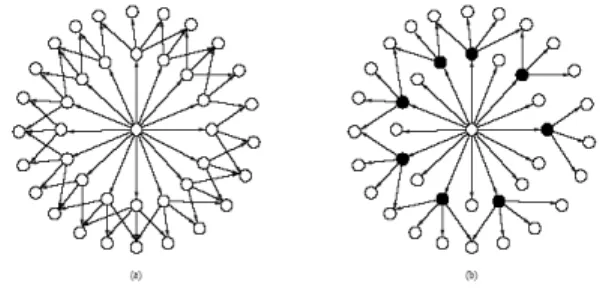
neighbors that are not in the MPR set to receive the message without forwarding it. To form the MPR set, each node continuously gathers precise two hop neighbor information using a hello message. Based on the precise two hop neighbor information, a node selects an MPR set that guarantees that all two hop away nodes get the forwarded packets, i.e., each two hop away node must be a neighbor of a node in the MPR set. The MPR set locally minimizes the duplicate retransmissions. (as seen in Figure 2.1, where MPR nodes are black dots).
Figure 2.1: Pure flooding vs. MPR flooding
Because MPR sets are a kind of local dominating set, selecting minimal size MPR sets is also an NP-problem, but there exists an efficient heuristic which follows a ”degree greedy” strategy that selects neighbors with the largest coverage of uncovered two hop neighborhoods [6]. The heuristic has good guaranteed approximation performance. The detailed algorithm to select an MPR set is described in algorithm 1.
Algorithm 1: MPR Selection Heuristic
1: Select as an MPR node all the neighbors of node v that are the only neighbors of 1.1
a two hop node from node v.
2: While there exist any uncovered two hop nodes from node v, node v selects as 1.2
MPR a neighbor of node v that is a neighbor to the largest number of uncovered two hop nodes. If ties exist, select a node with the smallest node ID.
3: Discard any MPR node u such that the MPR set excluding u can still cover all 1.3
two hop nodes
With the selected MPR sets using the heuristic in algorithm 1, the MPR-based broad-cast protocol follows a simple rule to broadbroad-cast data: a node retransmits a broadbroad-cast packet if and only if the received packet is not received before, and the transmitter of the packet is an MPR. The main benefit of MPRs is that they allow for fewer forwarding nodes than
in pure flooding, where all nodes are forwarding nodes as seen in Figure 2.1. We use the efficient MPR-based broadcast protocol for mesh networks, which is used in an early draft of the Institute of Electrical and Electronics Engineers (IEEE) 802.11 Working Group S.
2.2
Efficient Broadcasting Extension to Wireless Mesh
Net-works
MPR-based broadcasting is an efficient broadcasting method with classical store-and-forward broadcasting in wireless networks. MPR-based broadcasting reduces the transmission num-ber by decreasing the size of a forwarder set. One practical application is to use the efficient MPR-based broadcast protocol with an OLSR protocol for mesh networks, which is specif-ically standardized in IEEE 802.11 Working Group S. When we use the two protocols, an additional protocol should be added. The additional protocol is ADP, which decreases the control overhead distributed using an MPR-based broadcast protocol. We explain the ex-tension of an MPR-based broadcast protocol in wireless mesh networks as follows: we first explain wireless mesh networks in terms of their structure and contrast with other wireless networks such as Mobile Ad hoc Networks (MANET); we then describe other protocols ap-plied to wireless mesh networks; we explain an OLSR protocol using MPR-based broadcast protocol to distribute control messages;we introduce an association discovery protocol to decrease control overhead; we analyze the performance by using the association discovery protocol with a model; we detail experimental results and summarize the results to apply MPR-based broadcasting with an OLSR protocol and an association discovery protocol.
♦ Introduction of Wireless Mesh Networks
Wireless Mesh Networks (WMNs) have been proposed as a prominent network solution for ubiquitous networks [28], and industry standard groups such as IEEE 802.11 [29–31], 802.15 [32] and 802.16 [33] are developing new specifications for WMNs. The recent broad interest in WMNs is due to two major features of WMNs. First, WMNs are capitalizing on the self-organizing aspects of ad-hoc networks, and the ease of deployment with minimal preparation, requiring less administration and maintenance. Second, WMNs (particularly, for 802.11 networks) can capitalize on a broad installed base, and on a technology that has been already developed: they enable mesh clients to access networks, without requiring
2.2. EFFICIENT BROADCASTING EXTENSION TO WIRELESS MESH NETWORKS19
them to execute an additional routing protocol (for instance, 802.11 stations). Instead of running a complex routing protocol, clients simply associate themselves with mesh routers and rely on mesh routers to access the whole WMN; the routing on the wireless mesh routers is transparent for the client. This feature may also be used by design, in order to isolate the routing functionality from the clients; then different deployment of WMNs with different features, could still accommodate the same wireless mesh client. This also allows lighter clients and simpler participation in heterogeneous networks.
Figure 2.2: Architecture of hybrid wireless mesh networks
Figure 2.2 illustrates two main components of WMNs: mesh routers and mesh clients. Mesh routers create multi-hop networks that are self-configuring and self-healing, by exe-cuting routing protocols. The routing protocols for WMNs need not be much different from those of wireless ad hoc networks in general and Mobile Ad hoc NETworks (MANET) [34] in particular. For MANETs, several routing protocols such as OLSR (Optimized Link State Routing Protocol) [6], AODV (Ad hoc On demand Distance Vector) [35], TBRPF (Topology Broadcast based on Reverse-Path Forwarding) [36] and DSR (Dynamic Source Routing) [37] have been proposed, and some variants of such protocols are being used for WMNs.
Unlike mesh routers, mesh clients should associate with mesh routers to access networks. To associate with mesh routers, mesh clients use specific attachment protocols such as page/inquiry for Bluetooth or association request/reply for IEEE 802.11.
routers should perform new operations in addition to the operations that the classical ad-hoc network routers perform. The basic MANET routing protocols [6, 35–37] are indeed operating on flat topology; hence it is insufficient to find paths between mesh clients of the hybrid network. In order to collect complementary information, mesh routers can execute an additional auxiliary protocol.
In this chapter, we propose such a solution: an association discovery protocol (ADP) for mesh networks. Using ADP, mesh routers can compute routes to the mesh clients associated with other mesh routers (by means of an association table). Our protocol is simple and gen-eral; it can be used to complement any ad-hoc network routing protocol with any efficient broadcast protocol. However, it targets more specifically 802.11s, for which it was initially developed. Additionally, because it is proactive in nature, it is more naturally suited to run with MPR-based broadcast protocol and the optional 802.11s OLSR protocol’s variant, Radio-Aware OLSR (RA-OLSR), integrated in an early draft of 802.11s [38].
♦ Routing with Store-and-Forward Broadcasting in Wireless Mesh Networks A hybrid network structure is not a unique feature of WMNs. Hybrid routing protocols such as FSR [39], ZRP [40], CBRP [41], or Landmark (Landmark+OLSR [42]) have been explored for MANETs with some hybrid structures. But their hybrid structure is in general different from that of WMNs in two aspects: WMNs admit the presence of non-router nodes and they can use a flat address space.
Assuming the existence of a routing protocol between mesh routers, the problem that we are trying to solve is straightforward: how can we exchange information indicating which
station (mesh client) is attached to which mesh router ?
Routing protocols themselves integrate some functionalities to inject some external routes in the network. For instance, OSPF has its own mechanisms to import non-OSPF routes with specific types of OSPF LSA messages [43, 44]. These messages are used to exchange routes that are external to the OSPF network, and are then used to complement the routes computed by OSPF.
Similarly, in order to integrate nodes without routing functions, OLSR also provides a mechanism called Host and Network Association (HNA) to exchange information about routes to non-OLSR nodes. However, in the current specification [6], HNA in [6] is not well adapted to non-OLSR nodes for which the last hop (an OLSR node) may be changing quickly; an OLSR node periodically distributes HNA messages listing all its non-OLSR
2.2. EFFICIENT BROADCASTING EXTENSION TO WIRELESS MESH NETWORKS21
nodes with MPR-based broadcast protocol. There are two problems. The first one is the necessity of performing a full diffusion of the HNA-database when a node disappears, and the second one is the large overhead of such messages, when the number of associated stations is large. An approach based on both layer two and layer three could improve the efficiency on HNA messages [45].
Looking at a broader picture, more general protocols also exist to diffuse distributed sets of information, such as OSPF-style database exchange protocols for OLSR [46], Gossip-based protocols [47] and reactive protocols using on-demand request/response. Unlike these protocols, our protocol is specifically designed to address the following information exchange problems:
• Information items (which mesh client is associated with which mesh router) with sequence numbers
• Medium-sized information set (potentially too large to be diffused periodically, but for which a single level of hierarchy is sufficient)
The main feature of the ADP proposed is to limit the overhead of repeating information that is already broadcasted and partially updated. The ADP is combined with MPR-based broadcasting to take advantage of the optimized flooding mechanism. In the next section, we explain OLSR briefly.
♦ OLSR Routing Protocol with MPR Broadcasting
An OLSR protocol, which can be used to select paths in WMNs, is a proactive link-state routing protocol, employing periodic message exchanges to update topological information in each mesh router. Because an OLSR protocol is specifically designed to operate in the context of wireless multi-hop networks such as MANET, it provides an optimized flooding mechanism, called Multi Point Relay (MPR)-based broadcasting, which is used to diffuse topology information. MPR based broadcasting optimizes flooding by minimizing the re-dundant retransmissions of Topology Control (TC) messages. Minimization is achieved by limiting the forwarders of messages to some MPRs. A set of MPRs relays is a small set of neighbors through which a sender can reach all two hop neighbors.
As Figure 2.1 shows, messages can be broadcast from the source to the entire WMN through MPRs’ relaying. The first figure in Figure 2.1 shows the retransmission of pure
flooding, where every node retransmits the packet and the second figure shows the retrans-mission of MPR based broadcasting, where only MPR nodes retransmit the packet. Only with MPRs’ retransmission, can the source successfully broadcast the packet to every node in the network. In addition, a node can reach any node in the network only utilizing links between MPRs. Thus setting up the paths may not require all links between mesh routers. Information about links with MPRs is sufficient, by property of the MPR (and because all nodes have selected an MPR set). Thus mesh routers can simply transmit the addresses of all their MPR selectors with their addresses in TC messages. Even if the topology infor-mation obtained from received TC messages is a partial topology of the whole WMN, the shortest path obtained from this partial topology has the same length as the shortest path from the full topology [48].
For the specific application of 802.11s Mesh Networks, a variant of OLSR is used as an option: Radio-Aware OLSR. It integrates essential features for selecting links with good quality.
Now, considering the hybrid structure of WMNs, the association between mesh clients and mesh routers must be discovered in order to complement the topology information of the mesh routers.
When delivering messages, One or more messages are encapsulated in each packet and the messages share a common header. In addition, none of these messages requires that a node forwards the same messages more than one time. In other words, the duplicity of received messages is checked and a node only forwards the messages that are received for the first time.
♦ Association Discovery Protocol with OLSR Routing and MPR Broadcast-ing
ADP, which is combined with MPR-based broadcast protocol, can be used to complement any routing protocol, as previously indicated. However, we designed it specifically with 802.11s Mesh Networks in mind: “802.11s” is the task group ’S’ of the 802.11 working group, in charge of proposing mesh networks extensions to 802.11. Indeed, our protocol had been integrated in the early drafts of 802.11s in [38] (“Associated Station Discovery”).
Such mesh networks distinguish two types of nodes1:
1Mesh Points, which are clients able to run the routing protocol are also possible in 802.11s, but for our
2.2. EFFICIENT BROADCASTING EXTENSION TO WIRELESS MESH NETWORKS23
• Mesh routers, which run the routing protocol, and are able to associate mesh clients. • Mesh clients (legacy 802.11 STA), which associate themselves with mesh routers. The base mechanism of ADP is the following: mesh routers diffuse the whole set of mesh clients associated with themselves using MPR-based broadcast protocol. It is hence a proactive protocol, similar in spirit to the functioning of an OLSR protocol; in both cases the topology (associated station) information messages must be refreshed within a guaranteed interval (i.e. before the expiration). However, in addition to periodic message exchange, in case of topology/association change, faster updates are possible, and are desirable, in optimized implementations. As explained in section 2.2, mesh clients rely on mesh routers to compute paths to their destinations, and these computations require both routing tables and association tables. To obtain the two types of database (tables), mesh routers exchange the list of mesh clients associated with themselves in addition to the traditional information from the routing protocol. They store and maintain the received information using two information bases:
• Local Association Base (LAB): Each mesh router keeps track of mesh clients associ-ated with itself. This information base is updassoci-ated whenever associassoci-ated mesh clients leave or new mesh clients join.
• Global Association Base (GAB): Each mesh router maintains a GAB to record which station is associated with which mesh router in the entire WMN. Upon receiving LAB from all other mesh routers, the GAP is updated. Hence the GAB contains the union of all the LAB, of each mesh router in the WMN.
To fill the GAB of other routers, each mesh router broadcasts its full LAB periodically. These additional periodical messages generate overhead. This feature brings an interesting trade-off between bandwidth use and reactivity to changes. Considering that a LAB is not modified when there is no new association or disassociation, an optimization is possible: diffusing only updates (newly associated, or disassociated stations).
There is, however, a fundamental issue with the exchange of differential updates: sage loss. When a differential update is lost, it is not sufficient to detect the loss of the mes-sage and have it repeated because additional changes could occur (including re-association of disassociated stations for instance) before the message repeats. It is complex to pro-vide recovery after message loss, using uniquely differential updates, without maintaining
a time-ordered log of all changes. Hence, an additional mechanism to check information base consistency, and a mechanism to exchange full (non-differential) updates has to be integrated.
A main feature of our protocol, is that it restricts itself to the two last mechanisms, while offering performance comparable to differential updates. To do so, every mesh router with a large number of mesh clients, can divide its LAB into several smaller blocks. Then updates of association/disassociation of one or a few stations, are made by diffusion of the one or the few small blocks containing those addresses. Since in 802.11 type of networks, the MAC overhead is important for small packets, the cost of either sending one address or sending a few addresses in the same message is expected to be on the same order of magnitude.
”General Protocol Operation of association discovery protocol” : Precisely, the protocol operates with three kinds of messages.
• LABA messages: used for diffusion of the full of content of one block, some blocks, or all blocks of the LAB of the originator node.
• LABCA messages: used for diffusion of checksum of one block, some blocks or all blocks of the LAB of the originator node. The purpose of such messages is to avoid repetition of already widely disseminated information: a checksum of the block is diffused instead of the block itself.
• ABBR messages: used to require a set of blocks, typically upon receiving a mismatching
LABCAchecksum for some block(s) owing to lost LABA messages.
Notice the inherent tradeoff on block size: larger blocks imply larger LABA messages, and small blocks imply larger LABCA messages.
With this set of three messages, a large number of protocol variants could be imple-mented, depending on client mobility, packet loss, and communication patterns. Generally, blocks, or messages intervals, may all be adjusted dynamically, and need not be identical for all blocks. However, for interpretability the size and the interval would need to be predeter-mined. In addition, all messages need not be sent by/to the mesh router originally holding LAB information. And LAB updates may be sent preferentially to some more critical mesh routers.
2.2. EFFICIENT BROADCASTING EXTENSION TO WIRELESS MESH NETWORKS25
Note also that instead of a checksum, a simple sequence number per block could al-ternatively be used, matching the methods of OSPF for instance. The advantage of the checksum is that it allows to arbitrarily change the repartition of the addresses into blocks, a feature that is not currently used.
In the following, we will focus on a simple variant of the protocol described in the fol-lowing section.
”Simple Protocol Operations of Association Discovery Protocol”: In this sec-tion, we are describing simple protocol operations, which still uses the ability to decrease the ADP overhead using checksums.
In these protocol operations, there are two operating modes: a full mode and a checksum mode. Initially mesh routers operate in a full mode. After a given duration, mesh routers that did not sense any change in their LAB, will start to operate in a checksum mode. Any change in their LAB resets mesh routers back to operate in a full mode.
- Full Mode: In full mode, mesh routers periodically broadcast the whole content of their LAB (all blocks).
- Checksum Mode: If the network becomes stable and few mesh clients are moving, the LAB of mesh routers will not change much. In this case, mesh routers avoid generating heavy overhead by simply diffusing checksums representing the status of their LAB rather than sending all their content, in LABCA messages.
Upon receiving these checksums, a receiving mesh router cannot populate entries in its GAB, but it can verify them. If a checksum mismatch is found, this implies that the mesh router has missed some updates of the LAB of the mesh router that originated the message. In this case, the mesh router will send a request (ABBR) for the mismatching parts to the original mesh router in order to restore the consistency of its GAB by recovering the lost information. Upon receiving these requests, the mesh router switches to a full mode, thus emitting the contents of its whole LAB.
♦ Analytical Model of Association Discovery Protocol with MPR Broadcast-ing
As described in the previous section, the mesh routers executing the ADP are switching between two operation modes, depending on the stability of the associated mesh clients.
without message loss (i.e. without ABBR requests) and without changes in station associ-ation (i.e. change in the LAB), the mesh routers switch to a checksum mode. The fixed number of LABA emission intervals is a parameter of each mesh router in the system. In order to evaluate the performance of the system, the following two metrics are used: Packet
Error Rate (PER) (i.e. number of packets lost due to obsolete routing information) and
the control overhead. In this section, we provide an analytical model of the performance for this protocol.
”Packet Error Rate (PER)”: In our model, mesh clients move independently and their movements are not synchronized. To focus on PERs’ change according to the ADP’s operations, data packets are assumed to be lost only when mesh clients move from the sojourned mesh router, and notifications of this movement are lost. The loss time when the position of mesh clients is not known is shorter than the sojourn time when mesh clients associate with the mesh router.
Figure 2.3: The change of association with mesh clients’ mobility
Under this assumption, mesh router i changes its operation mode from full mode to
checksum mode when its LAB does not change for hi x ti, where hi is mesh router i’s
control message distribution interval and ti is the number of message intervals for mesh
router i to switch from full to checksum mode. As mesh clients move, they associate with
each mesh router several times for some duration. We call lifetime (Lα
i) the duration when
a mesh client α associates with a mesh router i, and we call frequency (τα
i ) the number of
times that one mesh client α sojourns with mesh router i. Packets are lost as long as the control message is not received (the control information loss duration). PER between mesh clients can be derived from the average control information loss duration (ACILD) between