HAL Id: pastel-00003889
https://pastel.archives-ouvertes.fr/pastel-00003889
Submitted on 22 Jul 2010
HAL is a multi-disciplinary open access archive for the deposit and dissemination of sci-entific research documents, whether they are pub-lished or not. The documents may come from teaching and research institutions in France or abroad, or from public or private research centers.
L’archive ouverte pluridisciplinaire HAL, est destinée au dépôt et à la diffusion de documents scientifiques de niveau recherche, publiés ou non, émanant des établissements d’enseignement et de recherche français ou étrangers, des laboratoires publics ou privés.
Analyse of economic and financial performance in the
activities of industrial service.
Cam Tu Doan
To cite this version:
Cam Tu Doan. Analyse of economic and financial performance in the activities of industrial service.. Humanities and Social Sciences. Ecole Polytechnique X, 2008. English. �pastel-00003889�
Thèse présentée pour obtenir le grade de DOCTEUR DE L’ECOLE POLYTECHNIQUE
Domaine: Sciences Economiques et Sociales Spécialité : Sciences de Gestion
par
ÑOAØN CAÅM TUÙ
Sujet de la thèse:
THE ROLES OF MANAGEMENT CONTROL SYSTEMS
TO IMPLEMENT STRATEGIC CHANGE: THE CASE OF
INDUSTRIAL SERVICE OPERATIONS
Soutenue le 31/01/2008 devant le jury composé de :
Nicolas BERLAND Professeur à l'Université Dauphine,
rapporteur,
Philippe HASSON Vice Président de la société INEO Suez,
Groupe SUEZ.
Sihem Ben MAHMOUD-JOUINI Professeur Associé à HEC Paris, Nicolas MOTTIS Professeur à l'ESSEC, rapporteur,
Jean-Pierre PONSSARD Directeur de Recherche CNRS et
Professeur à l'Ecole Polytechnique, co-directeur de thèse,
Olivier SAULPIC Professeur Associé à ESCP-EAP Paris,
L’École Polytechnique n’entend donner aucune approbation, ni improbation aux opinions émises dans les thèses. Ces opinions doivent être considérées comme propres à leur auteur.
Acknowledgements
Doing a PhD thesis is one of the most extraordinary adventures in my life. Never have I forgotten the joyfulness and happiness of Professor Jean-Pierre Ponssard, my thesis supervisor, as he exclaimed in delight “La recherche, c’est génial! Non?” (in English, “Doing the research is really wonderful, isn’t it?). The joy of finding people who trust me and are willing to help me is invaluable. I know that this work is a collaborative fruit rather than mine. It is impossible to mention all, given so many people who have helped to design, implement, apply, criticize, and sponsor the work. I am going to try anyway, and if your name is not listed, rest assured that my gratitude is not less than for those listed below.
My thesis was financed through a CIFRE convention, sponsored by three organisms: French Ministry of Research, INEO Suez company, and Econometric laboratory of Ecole Polytechnique. I would like to express my gratitude to these institutions and also the Chair of Business Economics who gave me the financial support and material resource to complete this thesis and present it in international conferences.
All my acknowledgements are to Professor Philippe Lorino of ESSEC for his trust in me. A PhD study could only start thanks to his trust offered to a student whom he only had known through an email. I, coming from Strategic Management field, had been an outsider in Management control one. Professor Philippe Lorino not only allowed me to follow the interesting seminars of ESSEC’s doctoral programs but also recommended me to contact an outstanding thesis supervisor on his behalf.
He is Professor Jean-Pierre Ponssard, who deserves an extra special thankfulness, not only for his unfailing encouragements, supports and guidance but also for his belief in me. Until now, his sharp ideas, simple but rich, always surprise me. Patiently and attentively, he has taught me how to carry out a scientific research in a company, how to transform my elementary ideas to interesting ones, how to make a nearly bankrupt CIFRE contract (and then thesis) become successful, and so on. Experienced and kind-hearted, he has always helped me and encouraged me to overcome various hardships. As I often said to his new PhD students, I’m enormously lucky for and proud of being accepted as his PhD student.
Equally, my profound acknowledgements are dedicated to Associate Professor Olivier Saulpic, my co-supervisor, for the outstanding supervision of my work. Likely to Jean-Pierre, Olivier is always available and volunteer, despite his working burden, to read my writings, discuss with me, and actively participate in the frequent meetings relating to the thesis. His remarks on my writing documents or my interview manners are always direct, interesting, and useful. Olivier also demonstrates an example of an excellent thesis supervisor.
All my acknowledgements are also dedicated to Professor Nicolas Berland of Dauphine University, Associate Professor Sihem Mahmoud-Jouini of HEC, and Professor Nicolas Mottis of ESSEC, for their helpful remarks and inspiring discussions during the pre-defence, in conferences, or in various occasions, which actively contribute to the results of this thesis. And I also highly appreciate Philippe Hasson, Executive Vice-President, for his beliefs in me. He gave me a “carte blanche” to consult their twenty-year archival records and to interview the operational managers, and especially sacrificed their precious time to make the thesis advance.
I am also grateful to Philippe Mallet, ex-director of INEO Suez’s management control department for welcoming me into his entity and initiating the CIFRE convention. He always truly wished to see the success of my PhD study and tried his best to help me. Similarly,
Jacques Ceron, Executive Vice-President, spent his invaluable time to challenge and debate my research question. Equally, I am strongly indebted to Pierre d’Alteroche, Xavier Baudry, Olivier Berna, Bernard Jacqueminet, Nguyen Thu-Hien, Efisia Cadeddu, and all interviewees (whose names cannot be revealed due to the anonym principle) for their continuous encouragements, their attentive comprehension, and their willingness to share their professional experiences with me.
I would like to express my warm gratitude to Professor Michel Berry and Professor Florence Charue-Duboc of Ecole Polytechnique, Professor Aldonio Ferreira of Portuguese Catholic University, Professor Marc Nikitin of Orléans University, Professor David Otley of Lanscaster University, Professor Yves de Ronge of Louvain Catholic University, Professor Robert Simons of Harvard Business School, Professor Raymond-Alain Thiétart of Dauphine University, and all CECO’s and CRG’s researchers of Ecole Polytechnique for their precious suggestions and comments on a part of this thesis. Special thankfulness is also dedicated to Professor Robert Paturel of Toulon University, Professor Laurent Schwab, and Professor Nguyeãn Myõ Dung of CFVG-HCMC in Vietnam for their invaluable assistances.
And I am equally thankful to my lovely friends - Ignace Adant, Mai Anh and Traø, Tatiana and Stéphan Bourcieu, Corentin Curchod, Lise Gastaldi, Thuriane Mahé, Nguyeãn Phöông Hoaøng, Ngoâ Huyønh Ñieåu and Nguyeãn Vaên Leâ, Jean-Philippe Nicolaï, Blandine Prevost, Marie-Anne Valfort, Marie-Hélène Vergot, Vuõ Vieät Haø, Vuõ Thanh Vaân, and Grégory Wegman – for sharing with me the difficult moments of a student life in France and inspiring me the love of France, especially its fantastic and marvellous capital - Paris.
My gratefulness is also sent to Lyza Audel, Eliane Nitiga-Madelaine, Christine Mouyeket, Chantal Poujouly (of CECO), Martine Drouiller, Frédérique Mary, and Michèle Ricordel (of INEO Suez), Michèle Breton (of CRG), Nadiège Coranson (of CREA) for their priceless administrative supports. I also would like to thank Michel Multan of Ecole Polytechnique’s library for his exceptional availability to help me to access the various and valuable sources of bibliography.
Last but not least, all my profound gratitude is also addressed to my family. Without their encouragements, their patience, and their love, this long and abroad study would not be possible. Thank Phuùc Tieân, my little daughter, for very well accompanying me to carry out interviews in different sites of INEO Suez. Thank you, Mom and Dad, for giving me the love of research. Thank Quoác Tuaán, my husband, for somehow sacrificing his professional career for my study. Thank you, my grandfathers, my parents-in-law, my adopted parents, my uncles, my aunts, and my cousins for their precious and continuous encouragements.
Once again, my profound gratitude is to people who have assisted in various forms to bring this works to its conclusion. All errors remain my own.
Paris, December 3rd, 2007. ÑOAØN Caåm Tuù
Abstract
This thesis investigates how managers use the management control systems as levers of strategic change. This question is interesting both from a theoretical and a practical viewpoint. The investigation is focused on the case of industrial service operations. The specificities of this sector - immaterial flows, heterogeneous competences, customer involvement - make its environment particularly unstable. Meanwhile, the information technology era forces the service companies to continually carry out strategic change to create a sustainable competitive advantage.
Simons (1995, 2000)’s lever-of-control framework is used as starting point. This framework proposes two extreme benchmarks to classify management control systems: interactive versus diagnostic systems depending on the degree of involvement of the top management.
This thesis develops two new ideas: firstly, that the framework of analysis could be extended to cover four dimensions: the management tool, the organizational structure, the use of control system, and the compensation system; secondly, it explores how all four dimensions interact in practice.
The tool dimension originates from the managerial literature on control systems. It emphasizes the importance of the horizontal coordination of the material flows from suppliers to customers. The organisational dimension comes from the literature on project management, which enlarges this coordination issue to new products and new services. The compensation dimension has already been introduced by Simons, though this dimension has rarely been explored in practice.
Two case studies are used to explore the relevance of this grid. The analysis covers several years in which strategic changes occurred, making explicit how these changes were translated into the four dimensions of our grid. It appears that some configurations along these four dimensions are more efficient than others. A more efficient configuration simultaneously exhibits some interactive and diagnostic features. This balanced approach, which we characterize for industrial service companies, is offered as an interesting idea to be explored in future research. Consequences in terms of the role of the controller are also discussed. Keywords: management control systems, interactive control, diagnostic control, service industries
Table of contents
Table of contents ... 1
GENERAL INTRODUCTION ... 3
The research question ... 4
Main findings ... 5
Thesis structure ... 11
Bibliography ... 13
Chapter 1: REVIEW OF THE MANAGEMENT CONTROL LITERATURE... 17
Introduction of the chapter 1 ... 18
1. Evolution of Management control before and after Kaplan and Johnson (1987).... 24
2. Strategic change... 29
3. Simons’s typology... 41
4. Outcomes of management control systems ... 58
5. Open questions... 86
Concluding remarks... 90
Bibliography ... 91
Chapter 2: REVISIT OF PROJECT MANAGEMENT LITERATURE ... 98
Introduction of the chapter 2 ... 99
1. Challenges faced by the new management control approach as applied to a project oriented organization: a case study as a starting point... 100
2. What can be learned from the management project literature ... 106
Concluding remarks... 122
Bibliography ... 124
Framework... 129
Methodology ... 129
INEO Suez... 141
Bibliography ... 147
Chapter 4: CASE STUDIES... 148
Section 1. Hi-Tech case ... 149
Section 2: Electra case... 176
GENERAL CONCLUSION ... 202
General Bibliography ... 205
List of Figures and Tables ... 217
Figures ... 217
Tables... 217
Detailed table of contents ... 218
GENERAL
The research question
This thesis investigates how managers use the management control systems as levers of strategic change. This question is interesting both in theoretical and practical viewpoints. Firms operate in an increasingly turbulent environment caused by technological, social, political, and ethical change. Otley (1994) called for studying management of change which relates to methods of planning and developing flexibility to cope with change. Research that investigates the dynamics of change should contribute to management control research (Covaleski et al., 1996; Luft, 1997).
Earlier research on the role of management control systems in implementing strategic change pays little attention on how management control systems are used in organization undergoing strategic changes (Abernethy, 1999; Shields, 1997; Langfield-Smith, 1997). It is interesting to study how change occurs, who initiates it, what constrains it, and which mechanisms should be used to facilitate it (Kelly & Amburgey, 1991).
The investigation is focused on the case of industrial service operations. More precisely, the investigation has taken place at INEO Suez, a subsidiary of the Suez group, that specializes in providing electricity and telecom services for transport networks and buildings. The specificities of this sector - immaterial flows, heterogeneous competences, customer involvement - make their environment particularly unstable. Meanwhile, the information technology era forces the service companies to continually carry out strategic change to create a sustainable competitive advantage. Consequently, a radical shift occurs in the ways they manage and measure success (Schlesinger & Heskett, 1991; Karmarkar, 2004; Heskett et al. 1994).
Industrial service companies face operational questions such as:
- How to effectively monitor projects of different size and different scope?
- How to efficiently coordinate heterogeneous competences related to technical and commercial knowledge all through a value chain that remains largely unobservable to the top management?
A study on the process of strategic change in such companies appears as an interesting area to develop new insights on the role management control systems to implement strategic change.
Main findings
Simons (1995, 2000)’s lever-of-control framework is a fruit of ten-year research after a stream of many case studies (186 semi-directive interviews) and quantitative surveys (162 companies) in different US and Canadian industries. His lever-of-control framework has strong concentration on strategic issues (Ferreira & Otley, 2003). And it opens “a useful wider framework” and gives “a complete picture of a wide range of possible controls” (Otley, 2003:317). The control systems do not only serve to reduce the divergence of interests but also communicate senior management’s orientations to subordinates and thus facilitate learning. Their roles are also extended to coordinate efforts, rather than only measure performance (Berland & Sponem, 2005).
Simons provides two extreme benchmarks to classify the use of management control systems: interactive versus diagnostic. One of the main dimensions1 for this distinction is the degree of involvement of the top management. In the interactive benchmark, top managers deeply involve themselves into the process (e.g. interpreting data by themselves, regularly challenging their subordinates) while in the diagnostic benchmark they remain at a distance (e.g. book presentation, or accountability of subordinates).
The compensation dimension has already been introduced by Simons (i.e. formula-based for diagnostic process and contribution-based for interactive process), though this dimension has rarely been explored in practice.
This thesis develops two main new ideas: firstly, that the framework of analysis of management control system should not be limited to the use of control system and the compensation system, but could be extended to cover two other dimensions: the organizational structure and the management tool; secondly, it explores how all four dimensions interact in practice. Such an interaction introduces a balanced approach combining both interactive and diagnostic features as another important benchmark.
These ideas will be discussed in reverse order.
1
Other remaining dimensions are content of discussion, type of discussion, and involvement of operational managers.
A balanced use of control systems
A number of authors have investigated the actual use and the related benefit of interactive control system in strategy emergence, strategy implementation, innovation, organizational learning, and company performance (e.g. Obsorn, 1998; Abernethy, 1999; Bisbe and Otley, 2004; Davila, 2000). However, some drawbacks have also been identified.
Simons (1995, 2000) points out that without due care, participants in the interactive control process may feel threatened by the active interest and participation of senior managers; hence the threat of embarrassment can ruin learning. And such involvement requires the important investment (both in cost and time). Simons (1987) proposed the top management “not to usurp the decision rights of subordinates. Similar to Simons, Bibse et al (2007) put forth the need of “non-invasive, facilitating and inspirational involvement” to reduce the threat of embarrassment.
In fact, although a number of debates on the impacts of top managers’ involvement on organization performance have been initiated a long time ago, the results are often contradictory (Besson et al. 2004).
Let’s take the budget2 as an example. Otley (1978) “found positive relations between emphasis [on pressure of managers] and managers’ budgetary performance” (Hartmann, 2000:454).While Hopwood (1972:161) argued that “too much budget emphasis would not only cause disagreement and conflict, but would also be ineffective”.
Effectively, “organizational and environmental variables make the measurement of performance relationship extremely difficult” (Simons, 1994:184).
It is worthwhile to observe that most empirical studies follow Simons (1995, 2000) on the separate use of control systems: either interactive control or diagnostic control. Such a dichotomy may prevent a necessary enrichment. A joint use of control system3, if used in a balanced manner, may provide a potential solution in reducing the drawbacks of interactive control.
2
The budget, though often used as a diagnostic system, can be used as an interactive control system (cf. Appendix 1 – “Diagnostic and Interactive budgetary control”, Simons, 1991).
3
e.g. interactive control at top management and diagnostic control at middle one or vice versa (Haas & Kleingeld, 1999; Tuomela, 2005).
A joint and balanced use of interactive and diagnostic control systems tends to have a positive impact on company’s performance in the high level of strategic change (Adebayo, 2007; Henri, 2006a). A diagnostic use of control system facilitates the application of interactive use (e.g. facilitation of strategic dialogue throughout organization) (Haas & Kleingeld, 1999). A joint use provides a possibility for trade-off between contradictory tensions (Marginson, 2002).
Henri (2006a) proposed some following hypotheses. The positive effects of interactive use may vanish due to insufficient use of diagnostic control to set boundaries and to highlight effectiveness issues, or due to excessive diagnostic use which constrains innovation and risk taking. A balanced use can create a dynamic tension which ensure and intensify positive effects of interactive control on capabilities such as innovativeness, organizational learning, entrepreneurship, market orientation. Such a use also fosters organizational dialogue, enhances creativity, and focuses organizational attention, thus becomes an important lever of strategic change. The result of Henri (2006a)’s quantitative study confirms his hypothesis only for firms in high environmental uncertainty. But once again he did not provide a pattern of a balanced use of control system in strategic change.
Other authors have indeed argued in that direction, but their arguments are often elusive in terms of what is actually meant by “balanced” use (Adebayo, 2007; Haas & Kleingeld, 1999; Henri, 2006 a, b; Marginson, 2002).
To foster a more articulate definition of balanced use we shall explore the literature on project management. Project management, and in particular the management of project portfolio, has gone throw an internal revolution that shares the same starting point of the management control literature: the inadequacy of traditional accounting systems (Johnson and Kaplan, 1987). The specificities of the industrial service sector make this detour particularly attractive. It will provide substance for the roles of organisational design and how the managers (from top to middle) and interface actor involve themselves into the process. Our case studies will then demonstrate the validity of this enriched framework.
A three-dimension grid for the analysis of management control systems
Ponssard & Saulpic (2006) extended Simons’ framework by making explicit the Tool dimension. Simons (1995, 2000) often emphasized that the only difference between the diagnostic control and the interactive control situates in the use of control system, not in the tool that they rely on. Ponssard & Saulpic suggest that an interactive process would more
naturally rely on a customized tool and a diagnostic process on a generic tool. Their arguments are based on a review of the actual management tools that have appeared in the recent past (such as Balanced score cards, EVA, ABC costing).
The compensation dimension has already been introduced by Simons (i.e. formula-based for diagnostic process and contribution-based for interactive process), though this dimension has rarely been explored in practice.
As already mentioned, the literature on project portfolio management reveals the key role of organizational structure to understand the interaction between the top manager and the project teams.
As a result, we suggest analyzing the roles of a management control system in the implementation of strategic change through a four-grid dimension: use of control system, management tool, compensation system, and organizational structure. Our case studies will then demonstrate the validity of this enriched framework.
Role of the actors in the use of management control system
Our results also lead to a proposal to clarify the role of the different actors in the use of Management Control Systems according to the type of use and to the type of issue at stake when the system is used interactively.
According to Simons (1995, 2000), for a diagnostic use of control system, the main actors are the gatekeepers (like accountants, sales planners, engineers, and quality control expert management controllers), who are in charge to focus the attention of the line managers on the negative variances; and for an interactive use, the main actors are operational managers (down to three or four levels in the organization). Although he also stressed the important roles the middle managers, he did not much indicate the patterns of motivation and behaviour necessary for middle managers to fulfill these expectations.
The recent research project management literature exhibits a new function – PMO (project management office) – when there is a need of coordination between different projects. In one of our case studies, a new position was created in a context where the main stakes were to coordinate different entities and to implement strategic changes. We thus suggest differentiating between three situations:
- A diagnostic use, where the main actor has a role of identifying the important variances in order to save managerial time while guaranteeing the implementation of planned strategy. According to Simons, this role is usually fulfilled by a gatekeeper, - An interactive use, when the main issue is a vertical dialogue on strategic
uncertainties. In this case, the main actor has a role of communicating and interpreting the results on one main strategic uncertainty. According to Simons, this role is fulfilled by line manager.
- A balanced use, when the main issues are coordination and strategic governance. In this case, the main actor has a role to coordinate some key decisions between operational entities and interpret strategy and search for strategy implementation. According to the project management literature, this role must be fulfilled by a specific function of PMO actors. In our case study, it was fulfilled by an actor which was hierarchically dependent from the CEO of the different entities, but had no hierarchical power on these entities. Let’s name this actor as an interface actor, who manages the interfaces between top management and operational management, and among functional services, or among different entities.
It is interesting to draw from the recent research on PMO actors in the project management literature to explicit the new roles of these interface actors. It suggests giving the interface actors a function of strategic governance (through a legitimate power) to make them become a facilitator. Actually, most researches consider an interface actor at best as only a coordinator who does not have a function of strategic governance.
This dual set of functions, according to Thiry & Deguire (2007), consists of 1) strategic governance and coordination (i.e. interpreting strategy and offering the means to reformulate, update, and implement strategy), and 2) administrative governance (i.e. collecting data, optimizing efforts, setting standards and procedures, consulting, training). The actual researches on interface actors emphasize on their administrative functions and mostly ignore their functions relating to the strategic governance and coordination.
The positions of interface actors, that is actors that play a role similar to the one we defined, are often so delicate that their implementation often fails or has only a short life (Kendall & Rollins, 2003; Mottis, 1993; Moisdon & Weil, 1992). Some frequent causes of failures are: 1) they fail to demonstrate their tangible value; 2) other employees perceive interface actors as information hunters for top management; 3) the formula-based compensation systems
aggravate the negative regards on interface actors because the latter are seen as a threat – most often too authoritative; 4) interface actors locate too low in the organization structure; or 5) interface actors neglect the interests of top management.
PMO’s often locate at the position of middle managers, thus they can use their advantages to have positive impacts on the joint use and then significantly contribute to strategic change. Huy (2001) pointed out some strengths of middle managers such as having value-adding entrepreneurial ideas, leveraging the informal networks, and managing the tension between continuity and change, which helps to avoid chaos or inertia. In our own formulation:
- Interface actors can have value-adding entrepreneurial ideas about how to grow and change a business. Because they are close to day-to-day operations, customers and frontline employees, but far enough away from frontline work that they can see the big picture, which allows them to see new possibilities, both for solving problems and for encouraging growth.
- Interface actors can be better than most senior executives at leveraging the informal networks at a company that make substantive, lasting change possible. In addition to their powerful webs of relationships, interface actors can explain the radical changes in language of his people would understand, thus “sell” the idea of change in a friendly way. Sometimes, barriers to change are senior managers. Interface actors, closer to ground, understanding outside market pressures as well as internal capabilities and sensitivities, can evaluate feasibility and relevance of proposed change.
Interface actors can influence on the implementation of the balanced approach of management control system. In addition to the administrative tasks, they also search for interpreting strategy, implementing it, facilitating dialogue and learning in the organization functions. Neither too close nor so far to top management and front-line management, the interface actor can analyze the daily issues in both viewpoints, thus give a boost on collective interests. The question of whether these roles (strategic governance, coordination, and administrative tasks) must be fulfilled by different actors or whether a single actor can have three different roles remains to be better studied.
Thesis structure
The thesis consists of a general introduction, four chapters and a general conclusion. The general introduction and the general conclusion recapitulates the main findings and provides avenues for future research. Chapter 1 gives a general presentation of the current state of research on the use of management control systems for implementing strategic change. Chapter 2 revisits the management project literature from our research perspective. Chapter 3 describes our investigation process. Chapter 4 provides an extensive discussion of our two case studies.
Chapter 1 studies the relationship between the strategic change and the management control system. In this chapter we give our definition of strategic change, review the literature on interactive control systems and the diagnostic control systems, and as well as what have been said on their joint use.
We define the concept of strategy through three different aspects: strategy content (Porter, 1980, 1985; Miles & Snows, 1978, 1986), strategy-making process (Mintzberg, 1978, 1985, 1987), and strategy implementation. Despite their interdependence, our study emphasizes the strategy implementation, in particular the roles of top managers and middle managers (Huy, 2001a, 2002b; Porter & Lorsch, 2004) and the management control systems (Burns & Vaivio, 2001).
To study how the managers use the management control systems as levers of strategic change, we select the Simons (1995, 2000)’s concepts of interactive and diagnostic control system. An analysis on the different works of Simons through the framework of Bibse et al. (2007) and of Ponssard & Saulpic (2006) is done. The result of this clarification enables to have a new look on a joint use of control systems, and then advance towards a balanced joint use. The comparison of three case studies (Simons, 1994; Tanguy, 1989; and Tuomela, 2005) illustrates the theoretical concepts and opens a new perspective to formulate the concept of “a balanced use”. This perspective will be confirmed and further elaborated through the following chapters.
Chapter 2 focuses on a limited part of the project portfolio management literature. We analyze the frequent challenges faced by the new management control approach as applied to a project oriented organization. They involve the organization of horizontal interaction among experts, the monitoring of heterogeneous activities by top management, and the roles of controller to capitalize the knowledge (Mottis, 1995; Demeestère et al., 2002). The findings indicate that
the project-based organization often deals with such challenges through customized and generic tools (Sanchez, 1995; Wheelright & Sasser, 1989; Wheelright & Clark, 1992; House & Price, 1991), a special mode of use of control systems (Bowen et al., 1994; Takeuchi & Nonaka, 1986), a specific type of organizational structure (Nonaka, 1988, 1994; Ackoff, 1989), and a compensation system oriented toward intrinsic motivation (Mahaney & Lederer, 2006; Raghu et al., 2003). A new actor, namely as PMO actor (Thiry & Deguire, 2007; Dai & Wells, 2004), is created to facilitate the horizontal and vertical interactions.
Chapter 3 presents our framework resulting from the two preceding chapters. A four-dimension framework used to analyze the management control system in strategic change comprises use of control system, management tool, compensation systems, and organizational structure. The investigation process will be detailed through 6 steps (Yin, 1984, 1994, 2003; Einsenhardt, 1989): getting started, selecting cases, crafting instruments and protocols, entering the field, analyzing data and reporting data, and reaching closure. We discuss how the problems of cooperation were overcome.
Chapter 4 presents our two case studies – Hi-Tech and Electra. Both of them are subsidiaries of INEO Suez and experienced strategic changes (in 2002 and 2006 for Hi-Tech, and in 2003 for Electra) after the arrival of the new top managers. Both managers were under the important pressure of performance improvement, searched for facilitating the interactivity and the communication, but had implemented the strategic change by different manners. While the Hi-Tech’s top manager intensively involved in the project management, the Electra’s peer preferred to take a moderate involvement in the commercial process. Although both searched for exploiting the advantages of vertical and horizontal coordination, one employed a matrix structure (i.e. Hi-Tech), another created a new position – an interface actor (i.e. Electra). Both created some new customized tools to facilitate the interactivity. And the compensation systems are also varied: mainly objective, formula-based for Hi-Tech (2002-2006), but mainly subjective, compensation-based for Electra. Consequently, the results of strategic change of two case studies are also different.
In conclusion, these analyses confirm the relevance of our four-dimension analysis grid. And they also demonstrate the interaction of four dimensions, which in turn makes explicit a pattern of a balanced approach.
Bibliography
Abernethy MA, Brownelle P. 1999. The role of budgets in organization facing strategic change: an exploratory study. Accounting, Organizations and Society 27: 189-204
Ackoff RL. 1989. The Circular Organization: An Update. Academy of Management Executive 3(1): 11-16
Adebayo A. 2007. "How the Diagnostic and Interactive use of MAS Determine the Relationship between Task Uncertainty and Organizational Performance". In AAA (Ed.),
AAA 2007 Management Accounting Section (MAS) Meeting: Fort Worth, Texas
Berland N, Sponem S. 2005. Interactive Budgetary Control and Management by Objectives: Evidence from a Case Study. In EAA (Ed.), European Accounting Association (EAA)
Congress 2005: 25p: Göteborg
Besson M, Löning H, Mendoza C. 2004. Les directeurs commerciaux face au processus budgétaire. In Comptabilité (Ed.), Normes et Mondialisation: 24p: Orléans, 12-14 mai 2004 Bisbe J, Batista-Foguet J-M, Chenhall R. 2007. Defining management accounting constructs: A methodological note on the risks of conceptual misspecification. Accounting, Organizations
and Society 32(7-8): 789-820
Bisbe J, Otley D. 2004. The effects of the interactive use of management control systems on product innovation. Accounting, Organizations and Society 29: 709-737
Bowen HK, Clark KB, Holloway CA, Leonard-Barton D, Wheelwright SC. 1994d. Regaining The Lead In Manufacturing. Harvard Business Review 72(5): 108-109
Bowen HK, Clark KB, Holloway CA, Wheelwright SC. 1994a. Development Projects: The Engine of Renewal. Harvard Business Review 72(5): 110-120
Bowen HK, Clark KB, Holloway CA, Wheelwright SC. 1994b. Make Projects the School for Leaders. Harvard Business Review 72(5): 131-140
Bowen HK, Clark KB, Holloway CA, Wheelwright SC. 1994c. Projects Studied by the Manufacturing Vision Group. Harvard Business Review 72(5): 114-115
Burns J, Vaivio J. 2001. Management accounting change. Management Accounting Research 12(4): 389-402
Covaleski MA, Dirsmith MW. 1996. Managerial accounting research: The contributions of organizational and sociological theories. Journal of Management Accounting Research 8: 1-35
Dai CX, Wells WG. 2004. An exploration of project management office features and their relationship to project performance. International Journal of Project Management 22(7): 523-532
Davila T. 2000. An empirical study on the drivers of management control systems' design in new product development. Accounting, Organizations and Society 25: p.383-409
Demeestere R, Lorino P, Mottis N. 2002. Contrôle de gestion et pilotage de l'entreprise (2ème ed.). DUNOD: Paris
Eisenhardt KM. 1989. Building Theories from Case Study Research. Academy of
Haas M, Kleingeld A. 1999. Multilevel design of performance measurement systems: enhancing strategic dialogue throughout the organization. Management Accounting Research 10(3): 233-261
Hartmann FGH. 2000. The appropriateness of RAPM: toward the further development of theory, Accounting, Organizations and Society, Vol. 25: p.451-482
Henri J-F. 2006a. Management control systems and strategy: A resource-based perspective.
Accounting, Organizations and Society 31: 529-558
Henri J-F. 2006b. Organizational culture and performance measurement systems. Accounting,
Organizations and Society 31(1): 77-103
Hopwood AG. 1972. An Empirical study of the role of accounting data in performance evaluation. Journal of Accounting research: P.156-182
House CH, Price RL. 1991. The Return Map: Tracking Product Teams. Harvard Business
Review 69(1): 92-100
Huy QN. 2001a. In praise of middle managers. Harvard Business Review 79(8): 72-79
Huy QN. 2001b. Time, temporal capability, and planned change, Academy of Management
Review, Vol. 26: 601-623. Academy of Managemen
Huy QN. 2002b. Emotional Balancing of Organizational Continuity and Radical Change: The Contribution of Middle Managers. Administrative Science Quarterly 47: 31-69
Karmarkar U. 2004. Will You Survive the Services Revolution? Harvard Business Review 82(6): 100
Kelly D, Amburgey TL. 1991. Organizational Inertia And Momentum: A Dynamic Model Of Strategic Change, Academy of Management Journal, Vol. 34: 591. Academy of Management Kendall GI, Rollins SC. 2003. Advanced Project Portfolio Management and the PMO. International Institue for Learning, Inc. and J.Ross Publishing, Inc.
Langfield-Smith K. 1997. Management control systems and strategy: a critical view.
Accounting, Organizations and Society 22(2): 207-232
Luft JL. 1997. Long-term change in management accounting: Perspectives from historical research. Journal of Management Accounting Research 9: 163-197
Mahaney RC, Lederer AL. 2006. The Effect Of Intrinsic And Extrinsic Rewards For Developers On Information Systems Project Success. Project Management Journal 37(4): 42-54
Marginson D. 2002. Management control systems and their effects on strategy formation at middle-management levels: Evidence from a U.K. organization. Strategic Management
Journal 23(11): 1019-1033
Miles RE, Snow CC. 1986. Organizations: New Concepts for New Forms. California
Management Review 28(3): 62-73
Miles RW, Snow CC. 1978. Organizational Strategy, Structure, and Process. McGraw-Hill: New York
Mintzberg H, Ahlstrand, B. and Lampel, J. 1998. The Strategy Safari. Prentice-Hall: Hemel Hempstead, UK
Mintzberg H, Waters JA. 1985. Of strategies, Deliberate and Emergent. Strategic
Mintzberg H. 1978. Patterns in strategy formation. Management Science 24(9): 934-948 Mintzberg H. 1987a. The Strategy concept I: Five Ps for Strategy. California Management
Review Fall 1987: 11-24
Mintzberg H. 1987b. The Strategy concept II: Another look at why organizations need strategies. California Management Review Fall 1987: 25-32
Moisdon J-C, Weil B. 1992. L'invention d'une voiture: un exercice de relations sociales?
Gérer et Comprendre n°28, n°29(Septembre et Décembre 1992): 30-41; 50-58
Mottis N. 1993. Coordination, incitations et modèles-types organisationnels: le pilotage de l'informatique bancaire, Dir. de thèse: JP PONSSARD: 284p. Ecole Polytechnique: Paris Mottis N. 1995. Mieux coordonner sans contractualiser: une alternative valable pour piloter des activités informatiques. Gérer et Comprendre(N°41): 56-67
Nonaka I. 1988. Toward Middle-Up-Down Management: Accelerating Information Creation.
Sloan Management Review 29(3): 9-18, 10p
Nonaka I. 1994. A Dynamic Theory of Organizational Knowledge Creation. Organization
Science 5(1): 14-38, 24p
Osborn CS. 1998. Systems for sustainable organizations: emergent strategies, interactive controls and semi-formal information. Journal of Management Studies 35(4): 481-509
Otley D. 1978. Budget Use and Managerial Performance. Journal of Accounting Research 16(1): 122-149
Otley D. 1994. Management control in contemporary organizations: towards a wider framework. Management Accounting Research 5(3-4): 289-299
OTLEY D, FAKIOLAS A. 2000a. Reliance on accounting performance measures: dead end or new beginning? Accounting, Organizations and Society 25: 497-510
OTLEY D, M.Pollanen R. 2000b. Budgetary criteria in performance evaluation: a critical apparaisal using new evidence, Accounting, Organizations and Society, Vol. 25: p.483-496 Otley D. 2003. Management control and performance management: whence and whither? The
British Accounting Review 35(4): 309-326
Ponssard J-P, Saulpic O. 2006. Les systèmes de pilotage: une relecture théorique inspirée des travaux de Simons. CNRS & Ecole Polytechnique & ESCP-EAP
Porter M. 1985. Competitive Advantage: creating and sustaining superior performance. Free Press: New York
Porter ME. 1980 (1998). Competitive Strategy: Techniques for Analyzing Industries and Competitors. Free Press: New York
Porter ME, Lorsch JW, Nohria N. 2004. Seven Surprises for New CEOs. (Cover story).
Harvard Business Review 82(10): 62-72
Raghu TS, Sen, P. K., & Rao, H. R. 2003. Relative performance of incentive mechanisms: Computational modeling and simulation of delegated investment decisions. Management
Science 49(2): 160–178
Sanchez R. 1995. Strategic Flexibility In Product Competition. Strategic Management
Journal 16(5): 135-159
Schlesinger LA, Heskett JL. 1991. The Service-Driven Service Company. (Cover story).
Shields MD. 1997. Research in management accounting by North Americans in the 1990s,
Journal of Management Accounting Research, Vol. 9: 3-61. American Accounting
Association
Simons R. 1994. How new top managers use control systems as levers of strategic renewal.
Strategic Management Journal 15: 169-189
Simons R. 1995. Levers of control: how managers use innovative control systems to drive strategic renewal. Havard Business School Press
Simons R. 2000. Performance Measurement and Control systems for implementing strategy. Prentice-Hall: New Jersey, USA
Takeuchi H, Nonaka I. 1986. The new new product development game. Harvard Business
Review 64(1): 137-146
Thiry M, Deguire M. 2007. Recent developments in project-based organisations.
International Journal of Project Management 25(7): 649-658
Tuomela T-S. 2005. The interplay of different levers of control: A case study of introducing a new performance measurement system. Management Accounting Research 16(3): 293-320 Wheelwright SC, Clark KB. 1992. Creating project plans to focus product development.
Harvard Business Review 70(2): 67-83
Wheelwright SC, Sasser Jr WE. 1989. The New Product Development Map. Harvard
Business Review 67(3): 112-125
Chapter 1:
REVIEW OF THE
MANAGEMENT
Introduction of the chapter 1
The chapter One reviews the relationship between management control systems and strategy following the suggestion of Johnson & Kaplan (1987). These authors indeed recommended that the strategy process be (re-)positioned at the heart of management control, for the relevance of this discipline.
The objective of this chapter is twofold. First, it defines the essential dimensions to form a diagnostic control system or an interactive control system (i.e. properties of control systems) A system can be only considered as interactive or diagnostic if it owns all dimensions. Such a definition aims to avoid the confusion of system identification and enable to have a better distinction between the interactive control system and diagnostic control system.
Second, it also demonstrates the important roles of the joint use of diagnostic control system and interactive control system, especially in strategic change. In fact, most actual researches following Simons (1995, 2000) focus on the separate use of control systems, thus ignore their potential interdependence and articulation. The positive effects of the joint use are only revealed recently by Henri (2006a). Our objective is to study how the interactive control systems and diagnostic control systems are articulated and interdependent.
The structure of the chapter One is as follows. The section 1 provides a synthesis of the management control evolution since the early attempts to “renovate” management control theory and practices that took place in the 1990s (Kaplan, 1994; Otley, 1995, 2003). This literature can be classified into two broad categories. The first one, which is the dominant one, studies the new accounting techniques (such as Balanced Scorecard, Economic Value Added, Activity-Based Cost), while the second one studies the use of management control (like levers-of-control of Simons, 1995, 2000). According to Otley (2001), the first approach emphasizes too much on “accounting”, “control” and “strategy formulation”. Again, management control faces the risk of irrelevance. The second approach thus concentrates more on “management” and strategy implementation”. This chapter will focus on one dimension of the relationship between management control and strategy: the one that occurs when organizations face a strategic change. It builds on the approach developed by Simons on the use of management control systems.
The section 2 briefly reviews the notion of strategic change. The strategy concept will be studied through three viewpoints: strategy content, strategy-making process, and strategy implementation.
The section 3 analyzes in details Simons’s concepts of interactive control and diagnostic control. It will be argued that the differentiation between interactive and diagnostic control systems, as originally defined by Simons, remain somewhat ambiguous, in particular relative to the characteristics of the tools and/or the compensation schemes that support each system. This triggers the need of further research. Another issue relates to the separate use or the joint use of interactive and diagnostic control systems. Simons suggests a separate use whereas some authors suggest a joint use. They argue that the system may be used interactively by the middle managers and diagnostically by the top management (or vice versa). The open questions in the section 4 will end up this chapter.
The remaining of this introduction provides an overview of the chapter.
Strategic change
Strategic change is usually defined as change in strategy (Ginsberg, 1988). It consists of the change in strategy content or strategy-making process at the corporate or business level. Huy (2005) extended the Ginsberg’s (1988) initial definition on strategic change. He included the changes in structure, systems, and personnel, which are nominated as “the implementation of strategy”.
The content of strategy means the company’s generic strategy as cost leadership, differentiation, or focus (Porter, 1980, 1985), or its strategic positions as Prospector-Defender-Analyzer (Miles & Snow, 1978). Mintzberg (1978, 1985, 1987) pointed out different strategy-making processes through the concepts of deliberate strategy and emergent strategy, and of strategy as 5P. The top management and middle management actively contribute to implement a strategy. Management control systems also play a key role to drive organizational transformations (Chenhall & Euske, 2007). The role of management accountants is also changed from a simple “controller”, “scorecard keeper” to a “business support” or “internal business consultant” or “hybrid accountant” (IMA, 1999 ; Coad, 1999 ; Grandlund and Lukka, 1997, 1998a).
Concepts of Interactive versus diagnostic control systems
While many researchers look for tool modernization, Simons focuses his research on how senior managers can use control systems to implement and develop business strategy.
His lever-of-control framework has strong concentration on strategic issues (Ferreira & Otley, 2003). And it opens “a useful wider framework” and gives “a complete picture of a wide range of possible controls” (Otley, 2003:317). The control systems do not only serve to reduce the divergence of interests but also communicate senior management’s orientations to subordinates and thus facilitate learning. Their roles are also extended to coordinate efforts, rather than only measure performance (Berland & Sponem, 2005).
On the basis of Bisbe et al. (2007)’s4 and Simons (1995, 2000)’s, the interactive control systems may be characterized through three following dimensions:
- intensive, frequent and personal attention and involvement of top managers. Despite its intensive implication, subordinates/middle managers in interactive control systems have much more reduced autonomy than those in diagnostic ones. Their main roles are to collect information (up, down or sideway). It provides a balance between active attention of top managers and decision rights of subordinates,
- face-to-face debate, dialogue and challenge, - concentration on strategic uncertainties.
On the other side, the diagnostic control systems consist of:
- attention-conserving for top managers, except for goal negotiation, management-by-exception. Subordinates are accountable for results and have the freedom to choose how to achieve them,
- no direct frequent discussion, or only document presentation, - concentration on critical performance variables.
Ponssard & Saulpic (2006) propose to focus on involvement of management, tool design, and compensation systems. Given the essential roles of tool design (Otley, 2001; Ponssard, 1994; Tanguy, 1989; Tuomela, 2005) and compensation systems (Simons, 1995, 2000; Ponssard &
4
We would like to express our profound gratitude to Professor Robert Simons and Professor David Otley for their precious helps. Professor R.Simons recommended us to take into account the result of the paper of Bibse et al. in our analysis, and Professor D. Otley sent us the preliminary version of this paper in 2005.
Saulpic, 2006), we employed these two dimensions, in addition to the use of control systems, to characterize a control system in strategic change.
Outcomes of separate use or joint use of MCS
A management control system, in Simons’s viewpoint, is used either diagnostically or interactively, not both. The research literature is more open on this point.
Most of researchers focus on a separate use of diagnostic control and interactive control (Simons, 1990, 1994; Abernethy & Brownell, 1999; Davila, 2000; Bisbe & Otley, 2004), only some researchers stress a joint use of diagnostic control and interactive control (Haas & Kleingeld, 1999; Otley & Ferreira, 2005; Toumela, 2005; Henri, 2006; Adebayo, 2007). In the viewpoint of the separate use, the interactive control systems, according to Simons (1995, 2000), allow facilitating strategy emergence and organizational learning, while the diagnostic control systems help to communicate and then implement intended strategy. Others extended the roles of interactive control systems. Interactive use of control systems may:
- Favour innovation in low-innovating firms but reduce innovation in high-innovating firms. But the style of use of management control systems influences the impact of innovation on performance both in low- and high-innovating firms. The interactive control helps to translate creativity into effective innovations and enhanced performance (Bisbe and Otley, 2004),
- Convert emergent strategies into useful action thanks to the combination with semi-formal information (Osborn, 1998),
- Influence on organizational performance. It is highest when a diagnostic (/interactive) use of budgets is matched with low (/high) levels of strategic change (Abernethy & Brownell, 1999).
In the viewpoint of the joint use, the latter means the same control system can be simultaneously used diagnostically at a higher level, but interactively at a lower level or vice versus (Haas & Kleingeld, 1999; Tuomela, 2005). A joint use may help:
- to implement contradictory tensions within the organization (Marginson, 2002)
- on one side, through an interactive implementation at the lower level, to intensify positive effects on innovativeness, organizational learning, entrepreneurship, market orientation (Henri, 2006a),
- on the other side, through a diagnostic implementation at the higher level, to enhance the interactive implementation at the lower lever (Haas & Kleingeld, 1999),
Simons (1994)’s case study will be compared with Tanguy (1989)’s and Tuomela (2005)’s to illustrate the different styles of use and their outcomes.
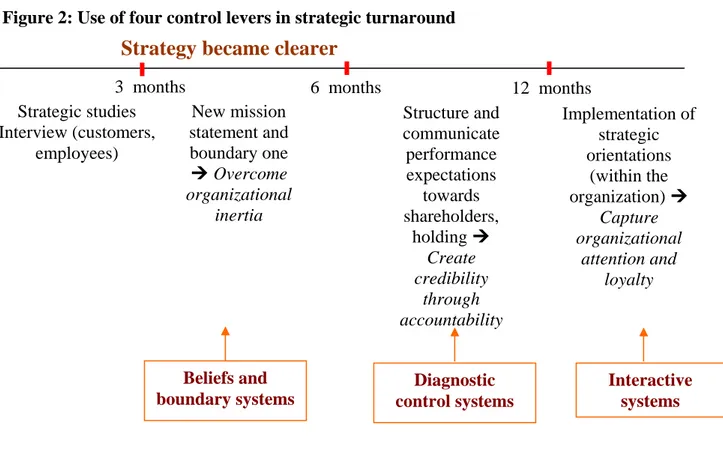
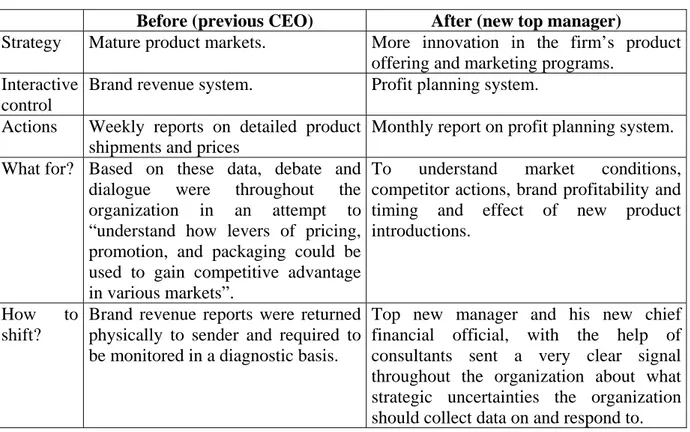
Simons illustrate how diagnostic and interactive control systems complement each other to implement a strategic change over time. Strategic change, always associated with the appointment of a new CEO, may differ in the mandate for change perceived by the manager: a “strategic turnaround” if the CEO is under significant pressure of performance improvement, a “strategic evolution” if the CEO has to continue pursuing the precedent success of the company.
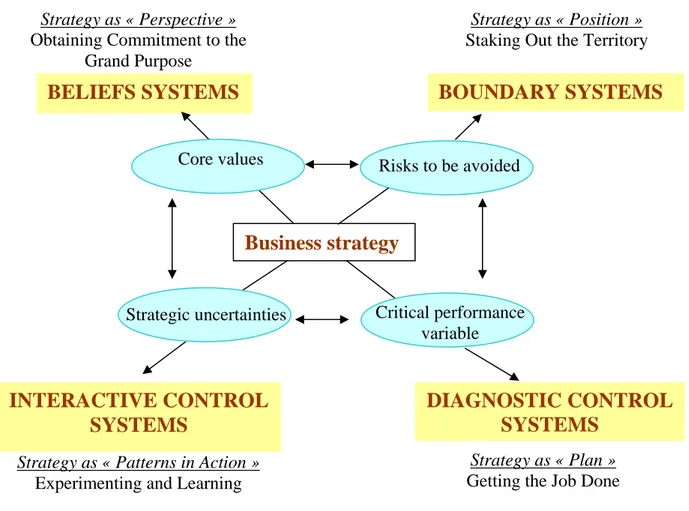
In a strategic turnaround, the CEO may openly declare the failure of past strategies; they sequentially implement new beliefs, boundary, diagnostic control and interactive control systems. The two first systems enable to overcome the organizational inertia, while the diagnostic systems allow creating credibility through accountability. The interactive control systems help the CEO to capture the organizational attention and loyalty.
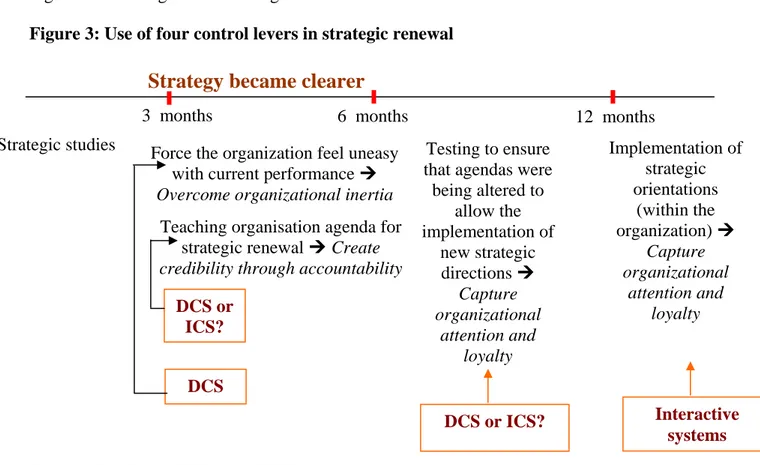
However, in a strategic evolution, as the CEOs are not supposed to openly criticize past strategies, diagnostic control is used as an initial step to promote change, then interactive control is introduced to implement the change all through the organization, beliefs systems and boundary systems are barely used. The manner to change over time from diagnostic to interactive control is demonstrated. The issue of vertical coordination between the top manager and the subordinates is dominant, while neither the horizontal coordination issue nor the need to elaborate a customized tool is mentioned.
Tanguy (1989) provides another way of management control use in strategic change. It concerns a strategic turnaround in a company operating in the Champagne sector. The company faced difficult coordination problems due to major uncertainties concerning both its outputs and its inputs. The new CEO triggered the creation of a customized tool. This tool facilitates the elaboration of strategies that would be both feasible (i.e. it would allow to bypass the climatic variability and be consistent with the regulatory constraints of the Champagne sector) and profitable. However he did not directly participate in the discussion with his subordinates, in particular as long as feasibility was concerned. His implication focused on the profitability of the proposed feasible strategies. The face-to-face meetings – to elaborate the feasible strategies - were only organized among cross-functional teams.
The involvement of the top management is neither as distant as typical of diagnostic control nor as intensive as typical of interactive control. It will be qualified as “moderate”. The involvement of the middle managers is typical of interactive control. Altogether, this case study illustrates the benefit of a use of management control system that simultaneously draws from diagnostic and interactive involvement of managers. Such a use can be qualified as “joint use”. The joint use of the new customized tool by all managers gave the same reference scenario for all actors; it facilitated dialogues, both vertically and horizontally. In this case study it will be seen that the management controller was legitimate to support this management control system.
The Tuomela (2005)’s case FinABB presents the interplay between interactive and diagnostic control. The 3K Scorecard, a customized tool, was used interactively at top management’s level, but diagnostically at lower levels. The diagnostic control enables to clarify the goals, strategies and relevant key success factors, while the interactive control allows learning about all of them and searching for the ways to implement them. The roles that the business controllers played, either as a reporting accountant or coordination, are dependent on the willingness of operational managers.
Although such use of the 3K Scorecard encouraged strategy emergence, learning and discussion, some resistances remained. The threat of embarrassment and time-consuming were the main challenges. The incentive systems were oriented toward intrinsic motivation – to encourage the desire of learning and discussion.
While Simons’ case study focused on studying top management level, Tanguy and Tuomela extended their research to lower levels. Simons argued that in the context of strategic change, one interactive control system is only used after diagnostic control systems. And the vertical coordination between the top manager and the subordinates is dominant, while neither the issue of horizontal coordination nor the need for a customized tool is mentioned.
Tuomela’ case study illustrated the possibility to use the same customized tool interactively at top management level, and diagnostically at lower level. Whereas Tanguy’s case study gave an inverse example: interactively at lower level and moderately at top management. Both researchers emphasized the essential roles of horizontal coordination and customized tools. The roles of management controllers, in both cases, are reinforced as the main coordinators, not as scorekeepers. They translated the intentions of top management to middle one, selected
the subject of discussion, animated the debate, and then transferred the results to the top management.
A new element of incentive systems implicitly appeared in Tuomela: intrinsic motivation – desire of learning and discussion. However, the interactive control provides a better visibility of actions, reduces the maneuvers of operational managers, and thus threatens them. And it requires an important investment in time and costs which is not easily supported by the organization. It seems that the joint use of a control system at different hierarchical level has not yet provided a satisfied lever of strategic change.
Henri (2006) argued that a balanced use of both diagnostic and interactive control systems allows amplifying the positive effects of both systems while reducing their negative effects. The key issue is to create a balanced use. What is the nature of such a use? The actual researches, in particular three above-mentioned case studies, have not yet provided the response. This will be one of our research objectives.
1. Evolution of Management control before and after Kaplan and
Johnson (1987)
Management Control is often considered as “young” in comparison with other disciplines of management sciences (Zimnovitch, 1999; Malo & Teller, 1999; Hoper, 2001) even though “historians have demonstrated that accounting reports have been prepared for thousands of years”5 (Johnson & Kaplan, 1987:6).
5
Johnson & Kaplan (1987), in their book "Relevance Lost" regarded as an influential book concerning management accounting and control systems published to date (Ezzamel et al., 1990; Noreen, 1987), presented historical monographs on the evolution of management accounting systems.
- In the early 19th century: industrial accounting systems, as a consequence of the Industrial Revolution, had been born to support the profit-seeking activity of entrepreneurs by focalizing on conversion cost.
- 1880-1900: the scientific management movement created standard costs. Great advances in transportation and communication required an efficient coordination between logistical, conversion, and distribution activities of enterprises, so new measures like gross margin were created to motivate and evaluate the efficiency of internal processes.
- In 1920s, due to coordination problems between the diverse activities of vertically integrated and multidivisional organizations, DuPont Powder and General Motors "devised budgets to coordinate and balance the internal resource flux from raw material to final customer", and "developed a new measure, Return on Investment, to compare performance in the firm's diverse parts with performance of the whole" (Johnson & Kaplan, 1987:64). "By 1925 virtually all management accounting practices used today had been developed: cost accounts for labour, material, and overhead; budgets for cash, income, and capital; flexible budgets, sales forecasts, standard costs, variance analysis, transfer prices, and divisional performance measures”(Johnson & Kaplan, 1987:12). The 1980s saw the obsolescence of management accounting systems.
After a brief definition of management control, the reasons of emergence of “new” control systems will be discussed as a reaction towards the decline of pure accounting systems. This synthesis of the evolution of management control provides an overview of our research motivation.
Definition of “management control”
R.N.Anthony conceptualized Management Control Systems in 1965. His intention is to “broaden the scope of information being considered beyond just accounting information” and to bring “issues of managerial motivation and behaviour into view” (Otley, 1999:364-365).
“The management control process is the process by which managers of all levels ensure that the people they supervise implement their intended strategies” (Anthony & Govindarajan, 2004:4).
This definition, according to Berry et al. (2005), reflects Anthony’s current views on management control systems, which have some continuity with his original approach, but abandon some elements like:
“Management control is primarily a process for motivating and inspiring people to perform organization activities that will further the organization’s goal. It is also a process for detecting and correcting unintentional performance errors and intentional irregularities, such as theft or misuse of resources” (Anthony et al., 1989).
Strategy formulation, management control and task control have a distinct and hierarchical relationship.
“Management control fits between strategy formulation and task control in several respects… Strategy formulation focuses on the long run, task control focuses on short-run operating activities, and management control is in between” (Anthony, 1998:6).
Management control, hence, “rests very firmly in the domain of accounting” (Berry et al., 2005). The dynamic interplay between planning and control processes is ignored (Lowe & Puxty, 1989). Until 1985, the research on management control systems had been widely developed in financial accounting, particularly conventional cost accounting and in behavioural and organizational accounting (Otley, 2001).
Decline of pure accounting systems
Johnson and Kaplan (1987:1-15) pointed out a paradox: management control practices no longer provided information relevant for managers' planning and control decisions, while ironically "many senior managers began to believe they could run their firms 'by the numbers'”. The last 60 years have been characterized by the decline of pure management accounting and the rise of financial accounting. Some main reasons are:
- There is divergence between the firm’s performance and its performance indicators, - The environment of the firm has become more and more turbulent. “Continuous
change requires continuous adaptation” (Otley, 1994:292). But the traditional approach of management control systems fails to reply to the new requirement of organizational change. Since this approach “emphasized stability, control and efficiency and productivity of isolated machines, workers and departments. Budgets, standards and variance reporting were the primary tools to promote cost control” (Kaplan, 1994). Consequently, management accounting systems are thus “irrelevant to contemporary organizations, or even counter-productive to good management decision-making” (Otley, 2001),
- In spite of the increased attention to the relationship between management control and strategy, its theoretical models have evolved little since the Anthony’s definition of management control in 1965 (Simons, 1987).
To make management accounting systems more relevant, Johnson and Kaplan (1987) proposed “management accounting systems can and should be designed to support the operations and the strategy of the organization” (p.17). It means that the strategy should be repositioned at the heart of the firm’s management.
Emergence of new management control
The 1990s marked the continual attempts to “modernize” or “renew” management accounting theory and practices (Kaplan, 1994; Otley, 1995, 2003). A common thread of this research is a growing interest in the relationship between Management Control systems and strategy. This “innovative” research can be roughly grouped in two inter-related strands. The first focuses on new techniques, while the second concentrates on the use of accounting techniques.
Concerning the first approach, the researchers focus on finding “new” accounting techniques or practices. Activity-based cost (ABC) management, Economic Value Added, and Balanced Scorecard have been developed and ‘advertised’ as the symbol of “new” management control systems.
Balanced Scorecard is "a set of measures that gives top managers a fast but comprehensive view of the business. The Balanced Scorecard includes financial measures that tell the results of actions already taken. And it complements the financial measures with operational measures on customer satisfaction, internal processes, and the organization's innovation and improvement activities - operational measure that are the drivers of future financial performance" (Kaplan & Norton, 1992).
The Balanced Scorecard, putting strategy and vision, not control, at the center, illustrates a new tendency of management control research. It helps to pull people toward an overall goal and improve decision-making process (Kaplan & Norton, 1992; Kaplan, 1994).
However, “much management accounting research has lost its way” by paying too much attention on “accounting” and “strategy formulation”, but not enough on “management” and “strategy implementation” (Otley, 2001: 243). Otley proposed to move from “measurement” of performance to “management” of performance (Otley, 1999, 2001, 2003).
“Performance management concerns the formal processes [more than the traditional management accounting practices] that organizations use in attempting to implement their strategic intent, and to adapt to the circumstances in which they have to operate” (Otley, 2001:250).
This point of view reflects the second strand of research that is, the way managers use a control system. This is the cornerstone of Simons’s (1995) levers of control.
In fact, the research on the use of management and accounting information systems was initiated by Simon H. et al. (1954)6, but was not much developed by other researchers until Simons (1987). Simon et al. (1954) interviewed more than 400 executives in seven
6
H. Simons was rewarded a Nobel Memorial prize in Economics "for his pioneering research into the decision-making process within economic organizations" (1978). He is the founding father of bounded rationality.