O
pen
A
rchive
T
OULOUSE
A
rchive
O
uverte (
OATAO
)
OATAO is an open access repository that collects the work of Toulouse researchers and
makes it freely available over the web where possible.
This is an author-deposited version published in :
http://oatao.univ-toulouse.fr/
Eprints ID : 9629
To link to this article : DOI:10.1111/j.1365-2427.2009.02315.x
URL :
http://dx.doi.org/10.1111/j.1365-2427.2009.02315.x
To cite this version : Navel, Simon and Mermillod-Blondin, Florian
and Montuelle, Bernard and Chauvet, Eric and Simon, Laurent and
Piscart, Christophe and Marmonier, Pierre Interactions between fauna
and sediment control the breakdown of plant matter in river
sediments. (2010) Freshwater Biology, vol. 55 (n° 4). pp. 753-766.
ISSN 0046-5070
Any correspondance concerning this service should be sent to the repository
administrator:
[email protected]
Interactions between fauna and sediment control the
breakdown of plant matter in river sediments
S I M O N N A V E L * , F L O R I A N M E R M I L L O D - B L O N D I N * , B E R N A R D M O N T U E L L E†, E R I C C H A U V E T‡, §, L A U R E N T S I M O N * , C H R I S T O P H E P I S C A R T * A N D P I E R R E M A R M O N I E R * *Universite´ de Lyon, Lyon; CNRS, UMR 5023, Laboratoire d’Ecologie des Hydrosyste`mes Fluviaux, Universite´ Lyon 1, Villeurbanne, France
†
Cemagref, CEMAGREF Lyon, Lyon Cedex, France
‡
Universite´ de Toulouse, UPS, INP, EcoLab (Laboratoire d’ecologie fonctionnelle), Toulouse, France
§CNRS, EcoLab, Toulouse, France
S U M M A R Y
1. A substantial portion of particulate organic matter (POM) is stored in the sediment of rivers and streams. Leaf litter breakdown as an ecosystem process mediated by
microorganisms and invertebrates is well documented in surface waters. In contrast, this process and especially the implication for invertebrates in subsurface environments remain poorly studied.
2. In the hyporheic zone, sediment grain size distribution exerts a strong influence on hydrodynamics and habitability for invertebrates. We expected that the influence of shredders on organic matter breakdown in river sediments would be influenced strongly by the physical structure of the interstitial habitat.
3. To test this hypothesis, the influence of gammarids (shredders commonly encountered in the hyporheos) on degradation of buried leaf litter was measured in experimental systems (slow filtration columns). We manipulated the structure of the sedimentary habitat by addition of sand to a gravel-based sediment column to reproduce three conditions of accessible pore volume. Ten gammarids were introduced in columns together with litter bags containing alder leaves at a depth of 8 cm in sediment. Leaves were collected after 28 days to determine leaf mass loss and associated microbial activity (fungal biomass, bacterial abundance and glucosidase, xylosidase and aminopeptidase activities).
4. As predicted, the consumption of buried leaf litter by shredders was strongly influenced by the sediment structure. Effective porosity of 35% and 25% allowed the access to buried leaf litter for gammarids, whereas a lower porosity (12%) did not. As a consequence, leaf litter breakdown rates in columns with 35% and 25% effective porosity were twice as high as in the 12% condition. Microbial activity was poorly stimulated by gammarids, suggesting a low microbial contribution to leaf mass loss and a direct effect of gammarids through feeding activity.
5. Our results show that breakdown of POM in subsurface waters depends on the accessibility of food patches to shredders.
Keywords: decomposition, hyporheic zone, leaf litter, sediment characteristics
Correspondence: Simon Navel, UMR – CNRS 5023, Laboratoire d’Ecologie des Hydrosyste`mes Fluviaux, Universite´ Claude Bernard Lyon1, 6 rue Dubois, Campus de la Doua, 69622 Villeurbanne Cedex, France. E-mail: [email protected]
Introduction
Particulate organic matter (POM), essentially terres-trial derived leaves (Elosegi & Pozo, 2005), is the main source of organic carbon and nutrients in most forested headwater streams (Cummins, 1974; Webster & Meyer, 1997). The maintenance of stream commu-nity structure and function is dependent on this allochtonous input (Wallaceet al., 1997; Woodcock & Huryn, 2005). In streams, leaf litter breakdown is controlled by abiotic factors (abrasion, fragmentation and leaching) and by the concerted action of a wide variety of organisms. Fungi are the first organisms involved in leaf breakdown (Webster & Benfield, 1986; Gessner, Chauvet & Dobson, 1999) but major part of leaf mass loss is due to macroinvertebrates, especially the shredder functional feeding group (Smith & Lake, 1993; review in Grac¸a, 2001).
During spates, large amounts of allochtonous POM canbe trappedin thesediment (Rounick&Winterbourn, 1983; Marchant, 1988; Naegeliet al., 1995). For exam-ple, annual storage of the coarse fraction of POM (>1 mm) measured by Smock (1990) in the subsurface sediment of a first-order stream in southeastern U.S.A. was around sixfold higher than in surface sediment. Moreover, 50% and 21% of autumnal allochtonous leaf input were reported to be buried in sediment by Herbst (1980) and Metzler & Smock (1990) respec-tively. The hyporheic zone may act as a storage zone and a decomposition zone for organic matter, but assessments of POM decomposition rate in river sediments are scarce. The few studies that have described this process showed that POM decomposi-tion was slower in sediments than in superficial water (Herbst, 1980; Rounick & Winterbourn, 1983; Metzler & Smock, 1990) and concluded that factors like oxygen concentration, faunal composition and degree of burial could account for this pattern (Boulton & Foster, 1998; Naamane, Chergui & Pattee, 1999; Tillman et al., 2003). Because of the large number of factors potentially affecting POM processing in river sediments, we developed an experimental approach that allowed manipulation of sediment structure and investigation of the influence of shredder activity on organic matter processing.
A factorial experimental design was used, in which occurrence of a leaf consumer and sediment proper-ties were manipulated in microcosms. Sediment structure (percentage of pore volume available for
shredder displacements in the sedimentary matrix) was manipulated by varying the proportion of sand in a gravel-based sediment. For each of three effective porosity treatments, we assessed the influence of gammarids on decomposition. Gammarids are a key shredder group in surface waters (Lecerfet al., 2005; Piscart et al., 2009) and also inhabit the hyporheic zone (Dole-Olivier & Marmonier, 1992a,b). In micro-cosms, the interactions between sediment properties and gammarid occurrence in organic matter process-ing were studied by determinprocess-ing (i) leaf litter break-down; (ii) leaf litter respiration; (iii) nutrient and dissolved organic carbon (DOC) release rates from leaf litter; (iv) microbial (fungi and bacteria) abun-dance, biomass and activity on leaves and (v) organic carbon and nitrogen content of leaves. Because sed-imentary condition appears to be a critical ecological driver in the hyporheic zone (Valett, Fisher & Stanley, 1990; Strayer et al., 1997; Olsen & Townsend, 2003), it is expected to have a major influence on POM processing. We hypothesised that a decreased pore size would reduce accessibility of trapped organic matter to macroorganisms and the availability of nutrient and oxygen for POM decomposers (bacteria and fungi), resulting in reduced POM processing in sediments.
Methods
Collection of sediments, leaves and fauna
Gravel and sand were collected from the Rhoˆne River. Gravel was sieved manually to select particle sizes ranging from 2 to 4 mm and 7–10 mm. Before use in experiments, gravel was cleaned with deionised water and dried at 60"C. Sand of 100–1000 lm grain size was elutriated to eliminate POM.
We collected senescent leaves from alder (Alnus glutinosa (L.) Gaertn.) from the riparian zone of the Rhoˆne River during abscission (November 2007). Leaves were air-dried and stored in the laboratory. Two weeks before introduction into the experimental columns, leaves were conditioned in small-mesh bags immersed in a nearby river (located on the campus of the University Claude Bernard, Lyon, France) for 10 days, a time sufficient to allow microbial colonisa-tion (Suberkropp & Chauvet, 1995). In the laboratory, conditioned leaves were cut into 21.8 mm diameter discs, avoiding central veins. Discs were then
air-dried for 4 days at ambient temperature and 21 sets of 30 randomly selected dry discs were weighed before introduction to experimental columns.
We selected the common shredder group of gam-marids (Willoughy & Sutcliffe, 1976; Herbst, 1982; Griffith, Perry & Perry, 1994) to study faunal influ-ences on leaf litter breakdown. Gammarids were collected from a station on the Rhoˆne River and were kept for 2 weeks in the laboratory for acclimation to experimental conditions (temperature and water quality). Collected gammarids belonged to the species Gammarus fossarum K. and Gammarus pulex L. with relative abundances of about 70% and 30% respec-tively. Previous experiments showed that these two species produced similar leaf litter breakdown rates (S. Navel, unpubl. data). We verified this result in the present study (see below, Rates of leaf breakdown and respiration of gammarids in surface water conditions). Moreover, all gammarids used in sediment columns were determined at the end of the experiment to verify the comparable proportions of the two species in experimental units.
Rates of leaf breakdown and respiration of gammarids in surface water conditions
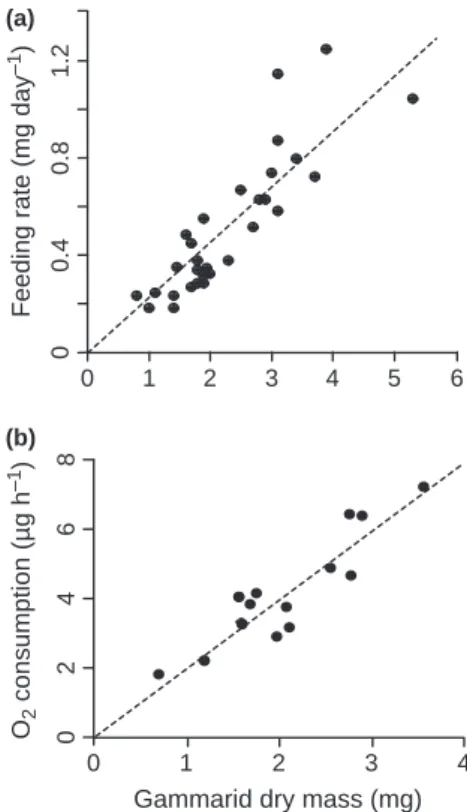
We measured individual leaf litter breakdown and respiration rates of gammarids in surface water conditions at 15"C to compare with data obtained in experimental columns. Feeding rates of gammarids were assessed by measuring dry mass loss of three discs of conditioned leaf litter (dry mass: 55.74 ± 3.50 mg) with one gammarid after 9 days, in cylindrical microcosms (6.5 cm diameter, 100 mL volume, n = 30) filled with 60 mL of river reconsti-tuted water (see below). Gammarids and leaf litter were then dried separately at 60"C for 48 h and weighed to determine feeding rate, corrected by the dry mass loss obtained from control microcosms without gammarids (n = 5), expressed in mg leaf litter day)1mg)1dry gammarid.
Individual respiration rates of gammarids were determined using a Micro-Respiration System (Uni-sense, Aarhus, Denmark), according to Brodersen et al. (2008). Gammarids were individually introduced into micro-respiration chambers (4.5 mL) filled with reconstituted river water which was continuously stirred to prevent any vertical oxygen gradient in the chambers. Oxygen uptake rates were determined
hourly from changes over time in concentration of O2
measured with micro-sensor inserted into respiration chambers (records every 15 min during 3 h). After measurement, each gammarid individual was dried at 60"C (for 48 h) and weighed. Oxygen uptake rate was expressed aslg of O2h)1mg)1dry gammarid.
After measurements, all gammarid specimens were determined to verify the expected negligible effect of species (G. fossarum versus G. pulex) on both feeding and respiration rates.
Influence of shredders and sediment characteristics on buried leaf litter
Experimental design. Experiments were carried out in slow filtration columns (Mermillod-Blondin, Mauc-laire & Montuelle, 2005) at constant temperature (15 ± 0.5"C) under a 12 h light ⁄12 h dark cycle. Each column was 35 cm high and 10 cm in diameter. Openings along each column at 1-cm intervals allowed sampling of water at different depths and times during the experiments.
To test the influence of physical habitat on organic matter processing, the fraction of sand (100–1000lm) inserted in gravel-filled columns was manipulated to control the volume of pores available for gammarid occupation. As gammarids are not recognised as active bioturbators, the porosity was considered to be unchanged during the experiment. We tested three effective porosities, namely 35% (P1), 25% (P2) and 12% (P3), calculated as the ratio of the volume of free interstitial water (volume not filled by sediment nor by water adsorbed on sand) to the total volume of the sediment column. These effective porosities were in the range of data obtained from gravel-bed rivers (Gayraud & Philippe, 2003; Lautz & Siegel, 2006) and the variable proportions of gravel and sand used in our experiments mimicked the physical habitat het-erogeneity occurring in gravel-dominated rivers (Richards, Brasington & Hughes, 2002). For treatment P1, each experimental column was filled exclusively with 7–10 mm gravel (1750 g), allowing the occur-rence of pores of area up to 15 mm2 (data obtained from photographs of the sediment surface using Osiris Software, Ligier et al., 1994). For the other treatments we filled columns with five successive additions of 7–10 mm gravel (300 g), 2–4 mm gravel (40 g) and wet sand (50 and 100 g for P2 and P3, respectively). During installation, a layer of 30 leaf
discs was introduced in all columns. These leaf discs were inserted between two circular sieves (pore size: 3 mm) of the column diameter at a depth of 8 cm below the sediment surface. About 10 cm of water was left above the sediment surface. The sediment part of each column was kept in the dark to suppress photoautotrophic processes. For each effective poros-ity treatment, we used six columns to assess litter breakdown with (three columns) and without fauna (three columns).
After installation of sediment and leaf discs, col-umns were supplied from above with river reconsti-tuted water (96 mg L)1 NaHCO3, 39.4 mg L)1
CaSO4Æ2H2O, 60 mg L)1MgSO4Æ7H2O, 4 mg L)1 KCl,
19 mg L)1Ca(NO3)2Æ4H2O and 1.6 mg L)1(CH3CO2)2
CaÆH2O; pH = 7.5 (US EPA, 1991) using peristaltic
pumps. For each set of columns with a similar porosity, infiltration flow rate was determined to obtain a similar retention time of water across all effective porosity treatments. Interstitial water veloc-ity was fixed to 5.4 cm per hour in all columns, in accordance with values reported in the hyporheic zone of streams (Triska, Duff & Avanzino, 1993; Morrice, Dahm & Valett, 2000) Supplied water was aerated to maintain concentrations of dissolved oxy-gen (O2) between 8.5 and 9.5 mg L)1at the inlet of the
columns throughout the experiment.
After 1 week of water supply, 10 gammarids of medium mass and size (mean ± SD: dry mass, 2.18 ± 0.14 mg; total body length, 7.92 ± 1.17 mm; cephalic height, 1.66 ± 0.21 mm and cephalic width, 0.94 ± 0.12 mm) were selected and randomly as-signed to three columns of each effective porosity treatment. During the experiment, water was sampled each week (days 0, 7, 14, 21 and 28 days after fauna addition) at three depths (overlying water, 1 cm above and 1 cm below the layer of leaf discs) to determine the oxygen uptake (respiration) and nutrient release rates from leaf litter under the different experimental condi-tions. At the end of the experiment, fungal biomass, total bacterial abundance, abundance of active eubac-teria and enzymatic activities involved in carbon and nitrogen cycles were measured on leaf discs. Leaf discs were then dried and weighed to quantify mass loss during the experiment and the final concentrations in total nitrogen (TN) and organic carbon.
Water analyses. At days 0, 7, 14, 21 and 28, water circulation in the sediment columns was shunted at
each depth to collect 50 mL of water. During sam-pling, an oxygen micro-sensor probe fitted in a glass tube (Unisense) was connected to the water derivation to measure dissolved O2 without contact with
atmo-spheric oxygen. Determinations of N–NH4+, N–NO3)
(including NO2)) and P-PO43)concentrations in water
were conducted using an automatic analyser (Easy-chem Plus, Systea, Italia) based on standard colori-metric methods (Grasshoff, Ehrhardt & Kremling, 1983), after filtration through 0.7lm pore size What-man GF⁄F filters (Millipore, Billerica, MA, U.S.A.). Water samples for DOC were filtered through 0.22lm pore size Whatman GSWP filters (Millipore), acidified with three drops of HCl (35%) and stored at 4"C. DOC concentration was measured with a total carbon analyser (multi N⁄C 3100; Analytik Jena, Jena, Germany) based on combustion at 850"C after removing dissolved inorganic C with HCl and CO2
stripping under O2flow.
Fungal biomass. Fungal biomass was estimated using ergosterol quantification (Gessner, Ba¨rlocher & Chauvet, 2003). For each column, five sampled discs previously maintained at )20 "C were lyophilised for 12 h, weighed, and placed in closed glassware. Reflux was realised by incubating discs in 5 mL KOH ⁄meth-anol (8 g L)1) extraction solvent for 12 h at 4"C. After extraction, sterol hydrolysis by saponification reaction was started by submerging glassware in a water bath held at 80"C for 30 min. Reaction was then stopped by cooling (15 min at ambient temperature then 15 min at 4 "C, in the dark) and acidification (pH < 3) with 1 mL HCl (0.65MM). A sample of each
saponified extract (3 mL = half volume) was then introduced in a Oasis HLB 3cc extracting column (Waters corporation, Milford, MA, U.S.A.) which had been previously conditioned. Conditioning of extract-ing columns was based on an initial elution with methanol (1 mL), an elution with methanol⁄KOH– methanol⁄HCl 0.65MM (1 mL), a washing with 5%
methanol (1 mL) and a final drying under low vacuum (1 h, 0 to )5 bar). Sterols were released from filters of extracting columns by eluting with succes-sive addition of constant volume of isopropanol (350lL, 4·). Products were collected in a weighed flask to determine mass and volume of isopropanol. The ergosterol fraction was finally isolated and quan-tified using HPLC system (HPLC 360⁄442, Kontron, Eching, Germany) with an injection volume of 10lL,
an eluant (100% methanol) flow rate of 1.4 mL min)1, a detector wavelength set at 282 nm and column temperature of 33 ± 1"C. Peak area and concentration of ergosterol in eluted isopropanol was calculated with D I A M I R ED I A M I R E software (JMBS Inc., Newark, DE,
U.S.A.) using known standards of ergosterol. Mass of ergosterol in the initial sample was then calculated according to the volume of isopropanol eluted from the initial sample. Mycelial biomass was estimated from ergosterol amounts using a 182 conversion factor determined for aquatic hyphomycetes which are known to dominate fungal assemblages on decom-posing litter (Gessner & Chauvet, 1993). Results were expressed in mg fungi g)1dry mass of leaf litter. Bacterial abundances. The DNA intercalating dye DAPI (4¢,6-diamidino-2-phenylindole, 200 ng lL)1;
Sigma, Buchs, Switzerland) and a Cy3-probe (EUB 338, eubacteria, Amann, Glo¨ckner & Neef, 1997) were used on leaf discs to determine the total numbers of bacteria stained with DAPI and the numbers of active eubacteria (hybridised with EUB 338, Karner & Fuhrman, 1997). During column dismantling (day 29), two leaf discs were immediately collected and fixed in 4% paraformaldehyde in phosphate-buffered saline (PBS) for 10 h. Fixed samples were subse-quently washed twice in PBS and stored in ethanol and PBS (50 : 50) at )20"C. After storage (1 month), 0.5 g of fixed samples was homogenised in 4 mL of 0.1% pyrophosphate in PBS using a Sonicator XL 2020 (Misonix Inc., Farmingdale, NY, U.S.A.) with a 2-mm diameter probe set at 100 W during two 1-min periods. All homogenised samples were finally sup-plemented with the detergent NP-40 (Sigma) to a final concentration of 0.01%. Aliquots (10lL) of homog-enised samples were spotted onto gelatine-coated slides and were hybridised with Cy3-labelled oligo-nucleotide probe (EUB 338) and concomitantly stained with DAPI. Hybridisations were performed in 15lL of hybridisation buffer (0.9MM NaCl, 20 mMM
Tris⁄HCl, 5 mMM EDTA, 0.01% sodium dodecyl
sul-phate; pH 7.2) in the presence of 30% formamide, 1lL of DAPI and 1 lL of the probe (25 ng lL)1) at 37"C for 2 h. After hybridisation, the slides were washed in buffer at 48"C for 20 min, rinsed with distilled water and air-dried. Slides were mounted with Citifluor solution (Citifluor Ltd, Leicester, U.K.) and the preparations were examined at 1000· magni-fication with a BH2-RFCA Olympus microscope fitted
for epifluorescence with a high-pressure mercury bulb (50 W) and filter sets BP 405 (for DAPI) and BP 545 (for Cy3). Bacteria from the samples were analysed in 20 fields per sample with up to 30 cells per field. Numbers of DAPI- and Cy3-bacteria were expressed per g dry leaf litter.
Microbial enzymatic activities. We assessed activity of cellulases and peptidases as key enzymes involved in leaf conversion of polymeric compounds into smaller molecules that can be assimilated by microorganisms (Sinsabaugh, Carreiro & Alvarez, 2002).B-glucosidase and xylosidase, and leucine aminopeptidase involved in cellulose and amino-acids degradation, respectively, were determined according to Romani et al. (2006). Activities were analysed by fluorimetry using sub-strate analogues [4-methyl-Umbelly-Feryl-b-DD
-gluco-sidase (750lMM), 4-methyl-Umbelly-Feryl-xylosidase
(1000lMM) andLL-leucine-4-methyl
Coumarinyl-7-amid-eHCl (1000lMM), respectively] for both
predetermina-tion of saturation curves and experimental measurements. Analyses were performed within 24 h of dismantling the columns. Litter discs were stored at 4"C before analysis.
For each experimental column, three measurements were performed for each exoenzyme. In parallel, exoenzymatic activities of one formaldehyde-killed control (three discs previously treated with a 39% formaldehyde solution for 30 min) was analysed for each enzymatic activity and pore volume treatment. For each measurement, three sampled discs were put in closed glassware with a constant volume of substrate (2 mL). Incubation was performed at 20"C during 40 min. After incubation, sample flasks were transferred into boiling water to stop reaction and then centrifuged for 3 min at 5000 g. Constant vol-umes of the supernatant (300lL) and buffer (30 lL, pH 10.4) were deposited on a storage-plate. Fluorim-etry measurements were made using a microplate reader (Safire microplate reader; Tecan, Ma¨nnedorf, Switzerland) with an excitation wavelength of 363 nm and emission wavelength of 441 nm for MUF-glu and MUF-xyl. Wavelengths were set at 343 nm (excitation) and 436 nm (emission) for MCA-leu. Litter dry mass was determined at the end of analyses to express results as nmol of hydrolysed compound h)1g)1dry leaf litter. For each sample, values were corrected by the fluorimetric signal obtained with the formalde-hyde-killed control.
C : N ratio. Leaf litter discs collected at the beginning and the end of the experiment were dried (24 h at 60"C) and powdered by a ball mill grinder (Mixer Mill MM 200; Retsch, Haan, Germany). Total organic carbon (TOC) was determined by high-temperature combustion at 900"C under O2 flow and subsequent
measurement of CO2by infrared detectors (multi N⁄C
3100; Analytik Jena, Jena, Germany). TN was analysed using an elemental analyser (FlashEA; Thermo Fisher Scientific, Waltham, MA, U.S.A.) set up for N analysis. Data of TOC and TN were used to calculate C : N molecular ratio for litter from each column.
Data treatment
Differences in dry mass loss, microbial characteristics (fungal biomass, DAPI and EUB densities, enzymatic activities) and C : N ratio were tested using two-way
A N O V A
A N O V A with effective porosity treatments (i.e. P1, P2
and P3) and fauna treatments (i.e. controls and gammarids) as main effects. When significant differ-ences were detected among treatments, we used the contrasts method to determine which treatments differed (Crawley, 2002).
Three-way repeated measures A N O V AA N O V A (RM-A N O V (RM-A
A N O V A) were used to test the influences of available
pore volume, fauna and depth on repeated measures of water concentrations in O2, DOC, N–NO3)
(includ-ing NO2)), N–NH4+and P–PO43).
When variables (O2and DOC) showed differences
between the top and bottom of leaf litter (significant influence of depth), we calculated the process rates occurring in the leaf litter for each column and each day of measurement as follows:
PR¼ ðDC# VÞ=Time
where PR is the process rate (O2 uptake and DOC
release rates) in the leaf litter (mg h)1), DC is the
difference in oxygen or DOC concentration (mg L)1) between the top and the bottom of the leaf litter,V is volume of water (L) contained in the column between the top and the bottom of the leaf litter, Time is the transit time of water (h) between the top and the bottom of the leaf litter = 0.16 h for all treatments.
Two-way RM-A N O V AA N O V As were performed to test the influence of available pore volume and fauna on these process rates. Data expressed as ratio (leaf dry mass loss) were firstly arcsine-transformed before statistical analysis in order to fit the assumption of
homosce-dasticity. Statistical analyses were performed usingRR
software (R Development Core Team, 2007), version 2.6.0. Significance for all statistical tests was accepted ata < 0.05.
Results
Rates of leaf breakdown and respiration of gammarids in surface water conditions
As G. pulex and G. fossarum did not show significant differences for either leaf consumption (A N O V AA N O V A1;
‘Species effect’: F(1,27)= 1.1229, P = 0.299) or oxygen
consumption (F(1,13)= 0.5809, P = 0.461) reported to
body mass, data obtained with the two species were pooled in the following analyses. Both feeding rates and oxygen consumption rates by gammarids showed a significant and positive correlation with individual dry mass (Pearson’s r = 0.867 and P < 10)9 for daily leaf dry mass loss, Fig. 1a; Pearson’s r = 0.906 and P < 10)5for oxygen consumption rate, Fig. 1b). Based on these relationships, a medium gammarid (i.e. dry mass of c. 2.2 mg) was expected to consume 4.18lg
0 1 2 3 4 5 0 1.2 (a) (b) 0.8 0.4
Feeding rate (mg day
–1 ) 6 O2 consumption (µg h –1 ) 0246 8
Gammarid dry mass (mg)
0 1 2 3 4
Fig. 1 (a) Daily feeding rate and (b) individual oxygen consumption rate measured in free water at 15"C in relation to gammarid dry mass. The fitted lines were based on a linear regression forced to 0.
oxygen h)1and contribute to a leaf litter breakdown rate of 0.51 mg day)1.
Influences of shredders and sediment characteristics on buried leaf litter
Litter dry mass loss. Leaf litter degradation rates measured at the end of the experiments (Fig. 2) were clearly influenced by effective porosity and fauna treatments (A N O V AA N O V A; F(2,12)= 10.359, P = 0.002 and
F(1,12)= 28.089,P < 0.001, respectively). No significant
differences in leaf litter breakdown were measured among effective porosity treatments in columns with-out gammarids (controls) (analysis of contrasts; P > 0.4 for all pairwise comparisons). The influence of gammarids on leaf litter breakdown rate depended on sediment characteristics (A N O V AA N O V A; ‘effective
poros-ity’· ‘fauna’ interaction effect: F(2,12)= 7.898,
P = 0.006). Leaf mass loss was approximately doubled in presence of gammarids in columns with available pore volume of 35% and 25% (analysis of contrasts; |t12| = 4.890, P < 0.001 for P1; |t12| = 4.465,
P < 0.001 for P2) whereas no effect was observed in the lowest pore volume (analysis of contrasts; |t12| = 0.176,P = 0.863).
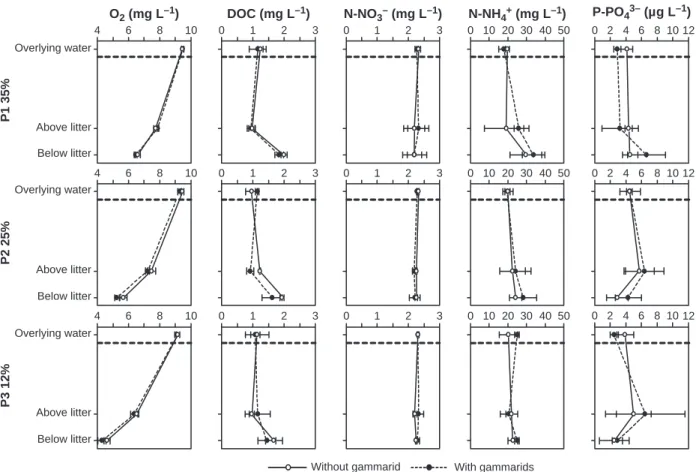
Water chemistry and biogeochemical processes. N–NH4+
and P–PO43)concentrations remained low (<40lg L)1
for both) at all depths throughout the experiment. N–NO3) (including NO2)) concentrations were not
influenced by effective porosity (RM-A N O V AA N O V A;F(2,36)=
0.829, P = 0.444), fauna (RM-A N O V AA N O V A; F(1,36)= 1.079,
P = 0.306), nor depth (RM-A N O V AA N O V A; F(2,36)= 2.093,
P = 0.138). In contrast, O2 and DOC concentrations
showed significant changes with depth (RM-A N O V AA N O V A;
F(2,36)= 4952, P < 10)6 for O2 and F(2,36)= 27.417,
P < 10)6for DOC). O2 concentrations decreased with
depth in columns whereas DOC concentrations showed the opposite pattern (Fig. 3).
Effective porosity and fauna treatments had a significant effect on oxygen consumption (Table 1, RM-A N O V AA N O V A; F(2,12)= 957.01, P < 0.001 and F(1,12) =
45.15, P < 0.001 respectively). Oxygen uptake in leaf litter increased with increasing effective porosity and the stimulating action by gammarids was increased in columns with highest porosity (RM-A N O V AA N O V A;F(2,12)=
14.90,P < 0.001 for ‘effective porosity’ · ‘fauna’ inter-action effect). In contrast, there was no effect of gammarids on DOC release rates (RM-A N O V AA N O V A;
F(1,12)= 0.016,P = 0.903) while effective porosity had
a significant and positive influence on this process (Table 1; RM-A N O V AA N O V A;F(2,12)= 11.809,P < 0.002).
Characteristics of microbial assemblages. Mean esti-mated fungal biomass (Fig. 4a) was 38.2 ± 7.7 mg g)1 dry leaf litter and was not significantly influenced by effective porosity and fauna treatments (A N O V AA N O V A; F(2,12)= 1.427, P = 0.278 and F(1,12)= 1.056,
P = 0.324, respectively).
Bacterial abundances (Fig. 4b,c) significantly chan-ged with effective porosity (A N O V AA N O V A; F(2,12)= 7.077,
P = 0.009 for total bacteria and F(2,12)= 9.667,
P = 0.003 for active eubacteria). Total numbers of bacteria were significantly higher on leaves incubated in the lowest effective porosity P3 than in P2 (analysis of contrasts; |t15| = 3.266, P = 0.005). On the
oppo-site, the numbers of active eubacteria increased with the effective porosity (analyses of contrasts; P1 versus P2: |t15| = 3.881, P < 0.002; P1 versus P3: |t15| =
2.238, P = 0.041). Whatever the effective porosity in columns, the total number of bacteria and the number of active eubacteria (hybridised with EUB 338) developed on leaves increased in presence of gammarids (A N O V AA N O V A;F(1,12)= 6.440,P = 0.026 for total
bacteria and F(1,12)= 5.618, P = 0.035 for active
eubacteria).
Glucosidase activity significantly increased with effective porosity (A N O V AA N O V A; F(2,12)= 4.884, P = 0.028;
Fig. 5a). This influence of porosity was not observed for xylosidase (A N O V AA N O V A; F(2,12)= 3.573, P = 0.061;
Fig. 5b) and leucine aminopeptidase activities (A N O V AA N O V A;F(2,12)= 1.050, P = 0.380; Fig. 5c). When we
only considered data obtained from control columns, no significant differences in enzymatic activities were
0 P1 35% P2 25% P3 12%
Leaf dry mass loss
(percent of initial dry mass)
10 20 30 40 50 Without gammarids With gammarids
Fig. 2 Loss of leaf dry mass buried at a depth of 8 cm in sediment columns for three pore volume and two gammarid treatments after 4 weeks of experiment (mean ± SD,n = 3).
measured among porosity treatments (Fig. 5, analyses of contrasts,P > 0.1 for all pair-wise comparisons). No significant influence of gammarids was detected on enzymatic activities (A N O V AA N O V A;F(1,12)= 2.739,P = 0.124
for glucosidase; F(1,12)= 0.260, P = 0.619 for
xylosi-dase;F(1,12)= 2.383,P = 0.149 for leucine
aminopepti-dase), apparently due to the high variability of the measurements for xylosidase and leucine aminopep-tidase. However, mean values tend to increase in presence of gammarids in the higher effective porosity
treatments P1 and P2 (up to 39.2% for leucine aminopeptidase in P1), whereas activities did not change in the lowest porosity treatment P3 (3.3% for leucine aminopeptidase).
C : N ratio. Total organic carbon and TN concentra-tions in leaves collected at the end of the experiments ranged from 45.9% to 50.1% and 3.19% to 3.68%, respectively. C : N ratio of leaves varied between 15 and 17 and were not significantly influenced by
O2 (mg L–1) DOC (mg L–1) N-NO3– (mg L–1) N-NH4+ (mg L–1) P-PO43– (µg L–1)
Overlying water Overlying water Overlying water Above litter Above litter Above litter Below litter Below litter Below litter
Without gammarid With gammarids
P1 35% P2 25% P3 12% 4 6 8 10 4 6 8 10 4 6 8 10 0 1 2 3 0 1 2 3 0 1 2 3 0 1 2 3 0 1 2 3 0 1 2 3 0 10 20 30 40 50 0 10 20 30 40 50 0 10 20 30 40 50 0 2 4 6 8 10 12 0 2 4 6 8 10 12 12 0 2 4 6 8 10
Fig. 3 Depth profiles of dissolved O2, DOC, N–NO3), N–NH4+and P–PO43)concentrations for three effective porosity and two
gammarid treatments after 3 weeks of experiment (mean ± SD,n = 3).
Table 1. Uptake of dissolved O2and release rates of DOC calculated from concentrations measured above and below the leaf
litter buried at a depth of 8 cm in sediment columns for three effective porosity and two gammarid treatments during the course of the experiment (mean ± SD,n = 3)
P1 (35%) P2 (28%) P3 (21%) With gammarids Without gammarids With gammarids Without gammarids With gammarids Without gammarids O2uptake (mg h)1) 1.48 ± 0.02 1.25 ± 0.03 1.26 ± 0.04 1.22 ± 0.03 0.58 ± 0.05 0.53 ± 0.01 DOC release (lg h)1) 596 ± 377 462 ± 157 330 ± 57.6 425 ± 20.2 46.4 ± 89.4 54.2 ± 60.8
effective porosity nor gammarid treatments (A N O V AA N O V A; F(2,12)= 2.812, P = 0.100 and F(1,12)= 1.665, P = 0.221
respectively).
Discussion
Sediment grain size and microbial breakdown
Our study showed no direct influence of porosityper se on buried leaf litter breakdown. Without gammar-ids, around 13–17% of initial dry mass of litter was lost after 4 weeks due to fungal and bacterial activity and mechanical processes (leaching, fragmentation and abrasion by sand). The similar enzymatic (gluco-sidase, xylosidase and leucine aminopeptidase) activ-ities measured in control columns for the three
porosity treatments indicated that the tested sediment grain size did not affect microbial activities on leaf litter. Moreover, we observed low variation in phys-ical and chemphys-ical conditions in the different experi-mental treatments. By using experiexperi-mental systems with similar interstitial velocities, we reproduced comparable chemical conditions for microbes in all porosity treatments: comparable nutrient (N–NH4+,
N–NO3)and P–PO43)) concentrations were measured
in interstitial water around leaf litter and dissolved oxygen concentrations were always higher than 6 mg L)1 just above leaf litter. Although associated with a slight decrease in dissolved oxygen, the reduction of effective porosity did not induce a shift from aerobic to anaerobic conditions in the interstitial habitat because no decrease in nitrate concentrations (indicating a denitrification process) occurred with depth in any porosity treatment. In such physical and chemical conditions, the three sedimentary matrix treatments did not differentially constrain microbial activity on leaf litter. Field experiments have demon-strated that leaf litter breakdown by microorganisms was linked with the concentrations of oxygen (Chauvet, 1988; Medeiros, Pascoal & Grac¸a, 2009) and nutrients (Young, Huryn & Townsend, 1994; Suberkropp & Chauvet, 1995; Baldy et al., 2007) in streams. In the hyporheic zone, influence of sediment structure on organic matter processing would also be expected to result from variations in available dis-solved oxygen induced by surface water–groundwa-ter exchanges (Franken, Storey & Williams, 2001; Lefebvre, Marmonier & Pinay, 2004). Our experimen-tal work supports these expectations because it demonstrates that modification of the sediment struc-ture when not associated with changes in availability of electron acceptors (oxygen) and nutrients (nitrogen, phosphorus) has little influence on microbial break-down of leaf litter.
Influence of gammarids on buried leaf litter
Gammarids are key agents of leaf litter breakdown in superficial waters (Willoughy & Sutcliffe, 1976; Herbst, 1982; Hieber & Gessner, 2002). Marchant & Hynes (1981) estimated annual feeding rates of leaf litter by a Gammarus pseudolimnaeus Bousfield popu-lation of 1547 kg ha)1 in the Credit River (Ontario, Canada). Mathews (1967) estimated that G. pulex could be responsible for consumption of up to 13%
01 3 P1 35% P2 25% P3 12% 2
Number of active bacteria
(10
9 g
–1
leaf dry mass)
0
4
8
12
Total number of bacteria (10
9 g
–1
leaf dry mass)
Without gammarids (a) (b) (c) With gammarids 0 20 40 60 Fungal biomass (mg g –1
leaf dry mass)
Fig. 4 Estimated fungal biomass (a), total number of bacteria (b) and number of EUB hybridised bacteria (c) measured on leaf litter buried at a depth of 8 cm in sediment columns for three effective porosity and two gammarid treatments after 4 weeks of experiment (mean ± SD,n = 3).
of total leaf litter in a British river. Leaf litter breakdown has also been reported to be positively correlated with gammarid density in streams of several French regions (Dangles et al., 2004; Lecerf et al., 2005; Piscart et al., 2009). Our experiment dem-onstrated that gammarids also have a predominant action on breakdown of leaf litter buried in stream sediments. Their impact was, however, strongly linked with the pore size of the sedimentary matrix. Leaf litter breakdown increased by 100% with gam-marids in columns with the highest effective poros-ities (i.e. 25% and 35%) but remained unchanged (in comparison to treatments without gammarids) in columns with 12% effective porosity. These results suggest that effective porosity determined the acces-sibility of buried leaf litter to gammarids. In the more porous treatment (35%), many pores (n > 20) were
>5 mm2 and could easily allow gammarids (frontal surface of gammarids = 1.58 ± 0.39 mm2, calculated as ‘cephalic width· cephalic height’) to access and consume buried leaf litter. In contrast, the reduction of effective porosity by sand addition in the less porous treatment (12%) probably suppressed the occurrence of pores and prevented access to leaf litter by gammarids.
In columns with the highest porosities, the signif-icant impact of gammarids on leaf litter breakdown may be linked to direct feeding on leaves and⁄or a positive interaction between gammarids and the microorganisms involved in organic matter process-ing. Measurements in columns with the highest pore volume (P1) indicated a stimulation by 19% of oxygen uptake in leaf litter due to gammarids (corresponding to an increase of c. 230lg O2h)1). Such stimulation
could be only partially (18%) explained by the respiration of the 10 individuals introduced in col-umns (41.9lg O2h)1). Thus, activities of gammarids
on leaf litter may have stimulated microbial respira-tion associated with leaves. Similarly, we detected a positive influence of gammarids on bacterial abun-dances (total number of bacteria and number of active bacteria) on leaves. Gammarids may enhance the microbial compartment through several mechanisms (Kinsey, Cooney & Simon, 2007) including: (i) increase in availability of nutrients and DOC from excretion and fragmentation of leaf litter (Joyce, Warren & Wotton, 2007; Joyce & Wotton, 2008); (ii) increase in nutrient availability in leaf litter due to locally enhanced water flow and (iii) increase in the number of active bacteria through gammarid feeding activity. Gammarids may keep biofilms in a growing phase, like earthworms in soils (Scheu et al., 2002) and nematodes in sediment (Traunspurger, Bergtold & Goedkoop, 1997). However, the measurements of fungal biomass and microbial enzymatic activities directly involved in organic matter degradation (glu-cosidase, xylosidase and leucine aminopeptidase) showed no or little impact of gammarids on the microbial compartment. In our study, the gammarid-microbe interaction seems too limited to induce a twofold stimulation of leaf breakdown as mediated by microorganisms. Therefore, the enhanced breakdown was most probably linked to direct feeding of gam-marids on the POM rather than to a complex inter-action between microbial and invertebrate activities. At the end of the experiment, observations of eaten
0
40
80
120 (a) Without gammarids
(b) (c) With gammarids Glucosidase (µmol h –1 g –1
leaf dry mass)
0 246 1357 Xylosidase (µmol h –1 g –1
leaf dry mass)
P1 P2 P3 35% 25% 12% 40 0 20 60
Leucine aminopeptidase (µmol h
–1
g
–1
leaf dry mass)
Fig. 5 Glucosidase (a), xylosidase (b) and leucine aminopepti-dase (c) activities measured on leaf litter buried at a depth of 8 cm in sediment columns for three effective porosity and two gammarid treatments after 4 weeks of experiment (mean ± SD, n = 3).
leaf discs and substantial amounts of faecal pellets in more porous treatments indicated breakdown due to gammarid feeding activity. Leaf litter consumption by gammarids in the most porous treatment was 0.227 mg leaf litter day)1mg)1 dry gammarid. This rate is similar to the mean leaf litter consumption obtained for non-buried leaves (0.222 mg day)1mg)1 dry gammarid, Fig. 1a). Such a similarity indicates that leaf consumption by gammarids is not affected by burial as long as pore size and water chemistry allow access of gammarids to the leaves. Since the high oxygen concentrations (>6 mg L)1) measured at the top of leaf litter were not constraining for gammarids (Metzler & Smock, 1990), pore size was the main factor controlling the accessibility to leaf litter.
Our results are in accordance with field experi-ments (Maridet, Wasson & Philippe, 1992; Maridet et al., 1996; Strayer et al., 1997) indicating that pore volume determines habitat suitability of the sediment for invertebrates. Using a freeze-core sampling tech-nique, Maridet et al. (1996) showed that the vertical distribution of interstitial communities of inverte-brates was affected by sediment porosity under 3%. In our experiment, despite large pore volumes (>10% of the interstitial habitat was not filled with gravel and sand), a reduction of pore volumes (voids) from 25% to 12% was enough to constrain the vertical distribu-tion of medium-sized gammarids and the breakdown of leaf litter buried in sediments. The discrepancy between the results of Maridet et al. (1996) and the present study suggests that the effect of sediment structure of the interstitial habitat is directly related to invertebrate size. It is therefore likely that the smallest gammarid individuals (<1 mg dry mass) would have access to buried leaf litter for an available pore volume of 12% in our experiment (P3). Future studies should consider different sizes of shredders (within and among taxa) to better explain pore size effects on leaf litter breakdown in river sediments.
Finally, this study demonstrates the main influence of grain size features on shredder distribution and associated leaf litter breakdown in the hyporheic zone. Several studies (e.g. Stief & de Beer, 2002; Nogaro et al., 2007, 2008; Bulling et al., 2008) have demonstrated the key influence of interactions be-tween sediment characteristics and invertebrate activ-ities on ecological processes (organic matter breakdown, nutrient fluxes). Similarly, it appears from the present experiment that we cannot consider
the role of invertebrates in the hyporheic zone without reference to the relationships between their functional traits (feeding and bioturbation modes) and habitat properties.
At the ecosystem level, the present study also suggests that the maintenance of POM stocks in river sediments over time would depend on sediment characteristics that control the distribution of benthic invertebrates in hyporheic zone. More precisely, we expect a highly porous sedimentary matrix (with more than 20% of effective porosity) associated with high abundances of benthic invertebrates to favour intense breakdown (potentially as high as in surface environment) and fast reduction of buried OM stocks. In contrast, sediment with low porosities would prevent migration of benthic invertebrates, leading to low breakdown rates and long-term storage of buried OM stocks. Since the maintenance of stream community structure and function is dependent on the presence of leaf litter (Wallace et al., 1997; Woodcock & Huryn, 2005), we hypothesise that fauna–sediment interactions, through their potential major implication on buried POM dynamics, play a key role in whole-stream ecosystem functioning.
Acknowledgments
We thank Bernadette Volat (Cemagref, Lyon), Fe´lix Vallier (LEHF, Villeurbanne) and Didier Lambrigot (EcoLab, Toulouse) for their helpful assistance. This study was funded by the ANR Biodiversity pro-gramme (ANR-06-BDIV-007) InBioProcess 2007–2010. We also thank C. Townsend and two anonymous reviewers for advice and constructive comments of the manuscript.
References
Amann R., Glo¨ckner F.O. & Neef A. (1997) Modern methods in subsurface microbiology:in situ identifica-tion of microorganisms with nucleic acid probes. FEMS Microbiology Reviews, 20, 191–200.
Baldy V., Gobert V., Guerold F., Chauvet E., Lambrigot D. & Charcosset J.Y. (2007) Leaf litter breakdown budgets in streams of various trophic status: effects of dissolved inorganic nutrients on microorganisms and invertebrates.Freshwater Biology, 52, 1322–1335. Boulton A.J. & Foster J.G. (1998) Effects of buried leaf
water chemistry and fauna in a gravel-bed river in northern New South Wales, Australia. Freshwater Biology, 40, 229–243.
Brodersen K.P., Pedersen O., Walker I.R. & Jensen M.T. (2008) Respiration of midges (Diptera; Chironomidae) in British Columbian lakes: oxy-regulation, tempera-ture and their role as palaeo-indicators. Freshwater Biology, 53, 593–602.
Bulling M., Solan M., Dyson K., Hernandez-Milian G., Luque P., Pierce G., Raffaelli D., Paterson D. & White P. (2008) Species effects on ecosystem processes are modified by faunal responses to habitat composition. Oecologia, 158, 511–520.
Chauvet E. (1988) Influence of the environment on willow leaf litter decomposition in the alluvial corridor of the Garonne River.Archiv fur Hydrobiologie, 112, 371– 386.
Crawley M.J. (2002)Statistical Computing: An Introduction to Data Analysis Using S-Plus. Wiley, New York. Cummins K.W. (1974) Structure and function of stream
ecosystems.BioScience, 24, 631–641.
Dangles O., Gessner M.O., Guerold F. & Chauvet E. (2004) Impacts of stream acidification on litter break-down: implications for assessing ecosystem function-ing.Journal of Applied Ecology, 41, 365–378.
Dole-Olivier M.J. & Marmonier P. (1992a) Effects of spates on the vertical distribution of the interstitial community.Hydrobiologia, 230, 49–61.
Dole-Olivier M.J. & Marmonier P. (1992b) Patch distri-bution of interstitial communities: prevailing factors. Freshwater Biology, 27, 177–191.
Elosegi A. & Pozo J. (2005) Litter input. In: Methods to Study Litter Decomposition: A Pratical Guide (Eds M.A.S. Grac¸a, F. Ba¨rlocher & M.O. Gessner), pp. 3–11. Springer, Dordrecht.
Franken R.J.M., Storey R.G. & Williams D.D. (2001) Biological, chemical and physical characteristics of downwelling and upwelling zones in the hyporheic zone of a north-temperate stream. Hydrobiologia, 444, 183–195.
Gayraud S. & Philippe M. (2003) Influence of bed-sediment features on the interstitial habitat available for macroinvertebrates in 15 french streams. Interna-tional Review of Hydrobiology, 88, 77–93.
Gessner M.O. & Chauvet E. (1993) Ergosterol-to-biomass conversion factors for aquatic hyphomycetes. Applied and Environmental Microbiology, 59, 502–507.
Gessner M.O., Chauvet E. & Dobson M. (1999) A perspective on leaf litter breakdown in streams.Oikos, 85, 377–384.
Gessner M.O., Ba¨rlocher F. & Chauvet E. (2003) Quali-tative and quantiQuali-tative analyses of aquatic hyphomy-cetes in streams. In: Freshwater Mycology (Eds C.K.M.
Tsui & K.D. Hyde), pp. 127–157. Fungal Diversity Research Series 10, Hong-Kong.
Grac¸a M.A.S. (2001) The role of invertebrates on leaf litter decomposition in streams – a review. International Review of Hydrobiology, 86, 383–393.
Grasshoff K., Ehrhardt M. & Kremling K. (1983)Methods of Seawater Analysis. Verlag Chemie, Berlin.
Griffith M.B., Perry S.A. & Perry W.B. (1994) Secondary production of macorinvertebrate shredders in head-water streams with different baseflow alkalinity. Jour-nal of the North American Benthological Society, 13, 345– 356.
Herbst G.N. (1980) Effects of burial on food value and consumption of leaf detritus by aquatic invertebrates in a lowland forest stream.Oikos, 35, 411–424. Herbst G.N. (1982) Effects of leaf type on the
consump-tion rate of aquatic detritivores.Hydrobiologia, 89, 77– 87.
Hieber M. & Gessner M.O. (2002) Contribution of stream detrivores, fungi, and bacteria to leaf breakdown based on biomass estimates.Ecology, 83, 1026–1038.
Joyce P. & Wotton R.S. (2008) Shredder fecal pellets as stores of allochtonous organic matter in streams. Journal of the North American Benthological Society, 27, 521–528.
Joyce P., Warren L.L. & Wotton R.S. (2007) Faecal pellets in streams: their binding, breakdown and utilization. Freshwater Biology, 52, 1868–1880.
Karner M. & Fuhrman J.A. (1997) Determination of active marine bacterioplankton: a comparison of universal 16S rRNA probes, autoradiography, and nucleoid staining. Applied and Environmental Microbiology, 63, 1208–1213.
Kinsey J., Cooney T.J. & Simon K.S. (2007) A comparison of the leaf shredding ability and influence on microbial films of surface and cave forms of Gammarus minus Say.Hydrobiologia, 589, 199–205.
Lautz L.K. & Siegel D.I. (2006) Modeling surface and ground water mixing in the hyporheic zone using MODFLOW and MT3D. Advances in Water Resources, 29, 1618–1633.
Lecerf A., Dobson M., Dang C.K. & Chauvet E. (2005) Riparian plant species loss alters trophic dynamics in detritus-based stream ecosystems.Oecologia, 146, 432– 442.
Lefebvre S., Marmonier P. & Pinay G. (2004) Stream regulation and nitrogen dynamics in sediment inter-stices: comparison of natural and straightened sectors of a third-order stream.River Research and Applications, 20, 499–512.
Ligier Y., Ratib O., Logean M. & Girard C. (1994) Osiris: a medical image manipulation system.M. D. Computing: Computers in Medical Practice, 11, 212–218.
Marchant R. (1988) Vertical-distribution of benthic inver-tebrates in the bed of the Thomson River, Victoria. Australian Journal of Marine and Freshwater Research, 39, 775–784.
Marchant R. & Hynes H.B.N. (1981) The distribution and production of Gammarus pseudolimnaeus (Crustacea: Amphipoda) along a reach of the Credit river, Ontario. Freshwater Biology, 11, 169–182.
Maridet L., Wasson J.G. & Philippe M. (1992) Vertical distribution of fauna in the bed sediment of three running water sites: influence of physical and trophic factors. Regulated Rivers: Research and Management, 7, 45–55.
Maridet L., Philippe M., Wasson J.G. & Mathieu J. (1996) Spatial and temporal distribution of macroinverte-brates and trophic variables within the bed sediment of three streams differing by their morphology and riparian vegetation.Archiv fur Hydrobiologie, 136, 41–64. Mathews C.P. (1967) The energy budget and nitrogen turnover of a population ofGammarus pulex in a small woodland stream.Journal of Animal Ecology, 36, 62–69. Medeiros A.O., Pascoal C. & Grac¸a M.A.S. (2009) Diver-sity and activity of aquatic fungi under low oxygen conditions.Freshwater Biology, 54, 142–149.
Mermillod-Blondin F., Mauclaire L. & Montuelle B. (2005) Use of slow filtration columns to assess oxygen respiration, consumption of dissolved organic carbon, nitrogen transformations, and microbial parameters in hyporheic sediments.Water Research, 39, 1687–1698. Metzler G.M. & Smock L.A. (1990) Storage and dynamics
of subsurface detritus in a sand-bottomed stream. Canadian Journal of Fisheries and Aquatic Sciences, 47, 588–594.
Morrice J.A., Dahm C.N. & Valett H.M. (2000) Terminal electron accepting processes in the alluvial sediments of a headwater stream. Journal of the North American Benthological Society, 19, 593–608.
Naamane B., Chergui H. & Pattee E. (1999) The break-down of leaves of poplar and holm oak in three Moroccan streams: effect of burial in the sediment. Annales de Limnologie-International Journal of Limnology, 35, 263–275.
Naegeli M.W., Hartmann U., Meyer E.I. & Uehlinger U. (1995) POM-dynamics and community respiration in the sediments of a floodprone prealpine river (Necker, Switzerland). Archiv fur Hydrobiologie, 133, 339–347.
Nogaro G., Mermillod-Blondin F., Montuelle B., Boisson J.C., Lafont M., Volat B. & Gibert J. (2007) Do tubificid worms influence organic matter processing and fate of pollutants in stormwater sediments deposited at the surface of infiltration systems? Chemosphere, 70, 315–328.
Nogaro G., Mermillod-Blondin F., Montuelle B., Boisson J.C. & Gibert J. (2008) Chironomid larvae stimulate biogeochemical and microbial processes in riverbed covered with fine sediment.Aquatic Sciences, 70, 156–168. Olsen D.A. & Townsend C.R. (2003) Hyporheic commu-nity composition in a gravel-bed stream: influence of vertical hydrological exchange, sediment structure and physicochemistry.Freshwater Biology, 48, 1363–1378. Piscart C., Genoel R., Doledec S., Chauvet E. &
Marmo-nier P. (2009) Effects of intense agricultural practices on heterotrophic processes in streams. Environmental Pollution, 157, 1011–1018.
R Development Core Team (2007) R: A Language and Environment for Statistical Computing. R Foundation for Statistical Computing, Vienna. Available at: http:// www.r-project.org (last accessed on 27 August 2009). Richards K., Brasington J. & Hughes F. (2002)
Geomor-phic dynamics of floodplains: ecological implications and a potential modelling strategy.Freshwater Biology, 47, 559–579.
Romani A.M., Fischer H., Mille-Lindblom C. & Tranvik L. (2006) Interactions of bacteria and fungi on decom-posing litter: differential extracellular enzyme activi-ties.Ecology, 87, 2559–2569.
Rounick J.S. & Winterbourn M.J. (1983) Leaf processing in 2 contrasting beech forest streams – effects of physical and biotic factors on litter breakdown.Archiv fur Hydrobiologie, 96, 448–474.
Scheu S., Schlitt N., Tiunov A.V., Newington J.E. & Jones T.H. (2002) Effects of the presence and community composition of earthworms on microbial community functioning.Oecologia, 133, 254–260.
Sinsabaugh R.L., Carreiro M.M. & Alvarez S. (2002) Enzyme and microbial dynamics during litter decom-position. In:Enzymes in the Environment (Eds R. Burns & R.P. Dick), pp. 249–266. Marcel Dekker, New York. Smith J.J. & Lake P.S. (1993) The breakdown of buried and surface-placed leaf-litter in an upland stream. Hydrobiologia, 271, 141–148.
Smock L.A. (1990) Spatial and temporal variation in organic matter storage in low-gradient, headwater streams.Archiv fur Hydrobiologie, 118, 169–184. Stief P. & de Beer D. (2002) Bioturbation effects of
Chironomius riparius on the benthic N-cycle as mea-sured using microsensors and microbiological assays. Aquatic Microbial Ecology, 27, 175–185.
Strayer D.L., May S.E., Nielsen P., Wollheim W. & Hausam S. (1997) Oxygen, organic matter, and sedi-ment granulometry as controls on hyporheic animal communities.Archiv fur Hydrobiologie, 140, 131–144. Suberkropp K. & Chauvet E. (1995) Regulation of leaf
breakdown by fungi in streams: influences of water chemistry.Ecology, 76, 1433–1445.
Tillman D.C., Moerke A.H., Ziehl C.L. & Lamberti G.A. (2003) Subsurface hydrology and degree of burial affect mass loss and invertebrate colonisation of leaves in a woodland stream.Freshwater Biology, 48, 98–107. Traunspurger W., Bergtold M. & Goedkoop W. (1997) The
effects of nematodes on bacterial activity and abun-dance in a freshwater sediment.Oecologia, 112, 118–122. Triska F.J., Duff J.H. & Avanzino R.J. (1993) The role of water exchange between a stream channel and its hyporheic zone in nitrogen cycling at the terrestrial-aquatic interface.Hydrobiologia, 251, 167–184.
US EPA (1991)Methods for Measuring the Acute Toxicity of Effluents and Receiving Waters to Freshwater and Marine Organisms, 4th edn. US Environmental Protection Agency, Washington. EPA/600/4-90/027, pp. 34–35. Valett H.M., Fisher S.G. & Stanley E.H. (1990) Physical
and chemical characteristics of the hyporheic zone of a Sonoran desert stream. Journal of the North American Benthological Society, 9, 201–215.
Wallace J.B., Cuffney T.F., Eggert S.L. & Whiles M.R. (1997) Stream organic matter inputs, storage, and export for Satellite Branch at Coweeta Hydrologic
Laboratory, North Carolina, USA.Journal of the North American Benthological Society, 16, 67–74.
Webster J.R. & Benfield E.F. (1986) Vascular plant breakdown in fresh-water ecosystems.Annual Review of Ecology and Systematics, 17, 567–594.
Webster J.R. & Meyer J.L. (1997) Stream organic matter budgets. Journal of the North American Benthological Society, 16, 3–161.
Willoughy L.G. & Sutcliffe D.W. (1976) Experiments on feeding and growth of the amphipodGammarus pulex (L.) related to its distribution in the river Duddon. Freshwater Biology, 6, 577–586.
Woodcock T.S. & Huryn A.D. (2005) Leaf litter process-ing and invertebrate assemblages along a pollution gradient in a Maine (USA) headwater stream. Envi-ronmental Pollution, 134, 363–375.
Young R.G., Huryn A.D. & Townsend C.R. (1994) Effects of agricultural development on processing of tussock leaf litter in high country New Zealand streams. Freshwater Biology, 32, 413–427.