
Pépite | Oxydation sélective et préférentielle du sulfure d'hydrogène par bouclage chimique
181
0
0
Texte intégral
(2) Thèse de Tanushree Kane, Université de Lille, 2018. Acknowledgement My doctoral studies where financially supported by the Region Hauts-de-France (Grant n. 16000310), the University of Lille and the « Ministère de lʼEnseignement supérieur de la Recherche et de lʼInnova on ». I would like to thank these institutions for offering me this opportunity which helped me to experience the scientific and cultural exposure in France. I thank Pr. F. Dumeignil for providing me all the necessary resources for my research at the Laboratory of Catalysis and Solid state Chemistry (UCCS) in Lille. It is genuine pleasure to express my deep sense of gratitude towards my guide Axel Löfberg. His enormous information and background in the subject and technical aspect helped me to understand the subject. All the passionate scientific discussions with him during the last three years helped me to acquire the skills and knowledge of this field. His guidance helped me in all the time in research and in writing of this thesis. Besides my advisor, It was a great honor for me to have Pr Cuong PHAM-HUU and Pr. Jose LOPEZ-NIETO as the reporters for my thesis, thank you so much for your valuable reviews. I sincerely thank Pr. Carole LAMONIER and Pr. Franck Dumeignil for their participation in my defense jury My sincere thank to the colleagues who, during the last three years, taught me different scientific and personal values towards life. Apart from this, their presence made the work life easier, working atmosphere in the laboratory was precious. At last, my personal gratitude towards my friends and my beloved family for the encouragement which helped me in the completion of the thesis. Their unconditional support and care always helped me in my life to move and work towards my goal.. 2. © 2018 Tous droits réservés.. lilliad.univ-lille.fr.
(3) Thèse de Tanushree Kane, Université de Lille, 2018. RESUMÉ Le gaz naturel et le biogaz contiennent du H2S qui doit être éliminé avant toute utilisation. Cela se fait généralement par adsorption, par la récupération de H 2S et par conversion en soufre élémentaire dans des procédés de type Claus. L'oxydation sélective catalytique de H 2S par O2 est une alternative, mais les catalyseurs subissent une désactivation en raison de l'accumulation d'espèces soufrées et le mélange H2S/O2 nuit à la sélectivité. De plus, cela ne peut pas être fait en présence de l'hydrocarbure pour des raisons de sécurité. Un procédé innovant d'oxydation sélective de H2S en bouclage chimique est proposé dans lequel la réaction se déroule en deux étapes : la réduction d’un solide porteur d’oxygène par H2S avec formation de S élémentaire et la régénération du porteur par O2. Il est démontré que V2O5 est une phase active prometteuse pour ce procédé. Parmi plusieurs supports testés, le TiO2 et le SiO2 s’avèrent les plus adéquats et il est montré que les matériaux de faible surface doivent être privilégiés. L'effet de la teneur en V2O5 sur le support de TiO2 est étudié et il est montré que la distribution optimale de phase active est atteinte lorsque l'équivalent de 2 monocouches de V2O5 est présent. L’étude de la réactivité de ce porteur montre qu’un équilibre optimal entre V3+, V4+ et V5+ est nécessaire. La présence d'espèces V4+ favorise la réactivité, mais seule la réduction d'espèces V5+ à V4+ est sélective, la réduction en V3+ entraînant la formation de SO2. Ce procédé est insensible à la présence de méthane, ouvrant la voie à la purification du biogaz ou du gaz naturel sans nécessiter de séparation préalable du H 2S.. 3. © 2018 Tous droits réservés.. lilliad.univ-lille.fr.
(4) Thèse de Tanushree Kane, Université de Lille, 2018. RESUME Natural gas and biogas resources contain H 2S, which needs to be removed prior to any use. This is usually done by adsorption followed by H2S recovery and conversion through Claus type processes to produce elemental sulfur. Direct catalytic selective oxidation of the H 2S to elemental sulfur is an alternative but catalysts suffer from deactivation due to accumulation of sulfur species and H2S/O2 mixing usually affects selectivity. Furthermore, it cannot be done in the presence of the hydrocarbon due to safety issues. To overcome these limitations, a Chemical Looping Selective Oxidation of H 2S (CLSOSH) process is proposed in which the reaction proceeds in two steps: a “reductant step” in which H2S reduces the carrier and produces elemental S and an “oxidant step” in which the carrier is regenerated by O2. V2O5 was demonstrated that to be a promising active phase for CLSOSH. Several support materials were tested. TiO2 and SiO2 proved to be the most adequate and it was shown that low surface area materials should be privileged. The effect of V2O5 loading on TiO2 support was investigated and it was shown that optimal distribution of V2O5 is reached when the equivalent of 2 monolayers of active phase are present. Detailed analysis of the reactivity of this carrier showed that an optimal balance between V3+, V4+, and V5+ need to be found. The presence of V4+ species promote reactivity but only V5+ to V4+ species reduction should be involved to reach optimal selectivity as reduction to V3+ lead to SO2 formation. CLSOSH proved to be insensitive to the presence of methane is the feed, opening the path for biogas or natural gas purification without the need of H 2S separation.. 4. © 2018 Tous droits réservés.. lilliad.univ-lille.fr.
(5) Thèse de Tanushree Kane, Université de Lille, 2018. Table of Contents Chapter 1 – Introduction and bibliography ........................................................................... 13 1.1 - H2S and H2S removal ................................................................................................ 13 1.2 - H2S Oxidation ........................................................................................................... 15 1.2.1- Claus process ...................................................................................................... 15 1.3- Selective oxidation of H2S.......................................................................................... 18 1.3.1 - Catalysts for direct (co-feed) selective oxidation of H 2S ..................................... 18 1.3.2 - Effect of temperature ........................................................................................ 21 1.3.3 - Effect of presence of other reactants like water and ammonia .......................... 22 1.3.4 - Effect of support ................................................................................................ 23 1.3.5 – Insight on vanadium based carrier .................................................................... 24 1.3.6 - Redox property of vanadia based catalysts ........................................................ 25 1.4 - Chemical Looping processes ..................................................................................... 29 1.5 - Scope of the thesis ................................................................................................... 32 1.5.1 - Proposal ............................................................................................................ 33 Chapter 2 – Experimental methodology ............................................................................... 37 2.1 - Chemical looping reactor setup ................................................................................ 37 2.2 - Reactor .................................................................................................................... 38 2.3 - Sulfur condensation ................................................................................................. 38 2.4 - Exhaust gas purification ........................................................................................... 39 2.4.1 - Safety ................................................................................................................ 39 2.5 - Gas flow control ....................................................................................................... 39 2.5.1 - Periodic feed operation ..................................................................................... 39 2.6 - Reaction conditions .................................................................................................. 41 5. © 2018 Tous droits réservés.. lilliad.univ-lille.fr.
(6) Thèse de Tanushree Kane, Université de Lille, 2018. 2.6.1 - Partial pressure analysis (online mass spectrometer) ......................................... 42 2.6.2 - Calculations ....................................................................................................... 44 2.7 - Characterization methods. ....................................................................................... 46 2.7.1 - X-ray powder diffraction (XRD) .......................................................................... 46 2.7.2 - Temperature-programmed reduction (TPR) ....................................................... 47 2.7.3 - Textural properties analysis via Brunauer–Emmett–Teller (BET) and Barrett-JoynerHalenda (BJH) ............................................................................................................... 47 2.7.4 - The X-ray photoelectron spectroscopy (XPS)...................................................... 48 2.7.5 - Raman spectroscopy .......................................................................................... 48 Chapter 3 – Bulk V2O5 reactivity in Chemical Looping Selective Oxidation of H2S .................. 51 3.1 - Preparation and characterization of bulk V2O5. ........................................................ 52 3.2- Characterization of Bulk and Surface properties........................................................ 53 3.2.1 - BET .................................................................................................................... 53 3.2.2 -XRD .................................................................................................................... 53 3.2.3 - TPR .................................................................................................................... 54 3.2.4 - XPS .................................................................................................................... 55 3.2.5 - Raman ............................................................................................................... 56 3.3 - Chemical looping reactivity of V2O5 for H2S selective oxidation. ............................... 56 3.3.1 - Effect of reactant Concentration ........................................................................ 58 3.3.2 - Effect of Temperature........................................................................................ 62 3.3.3 - Effect of different reactant ratio ........................................................................ 63 3.4 - After reaction characterization................................................................................. 65 3.4.1 - XRD.................................................................................................................... 66 3.4.2 - XPS .................................................................................................................... 67 6. © 2018 Tous droits réservés.. lilliad.univ-lille.fr.
(7) Thèse de Tanushree Kane, Université de Lille, 2018. 3.4.3 - Raman ............................................................................................................... 70 3.5 - General discussion and conclusions.......................................................................... 70 Chapter 4 - Different supports for Chemical Looping Selective Oxidation of H2S. .................. 75 4.1 - Synthesis of the Oxygen Carrier solids ...................................................................... 75 4.2 - Characterization ....................................................................................................... 76 4.2.1 - BET .................................................................................................................... 76 4.2.2 - XRD.................................................................................................................... 78 4.2.3 - TPR .................................................................................................................... 79 4.2.4 - XPS .................................................................................................................... 81 4.2.5 - Raman ............................................................................................................... 82 4.3 - Reactivity of supported carriers in CLSOH ................................................................ 83 4.3.1 - Reactivity of supports ........................................................................................ 83 4.3.2 - Reactivity of supported V2O5 ............................................................................. 84 4.4 - General discussion and conclusions.......................................................................... 89 Chapter 5 - Effect of loading of the V2O5 active phase on TiO2 support ................................. 93 5.1 - Solid preparation...................................................................................................... 93 5.2 - Characterization of V2O5 over TiO2 10 support ......................................................... 94 5.2.1 - BET .................................................................................................................... 94 5.2.2 - XRD.................................................................................................................... 95 5.2.3 - XPS .................................................................................................................... 96 5.2.4 - TPR .................................................................................................................... 98 5.2.5 - Raman ............................................................................................................... 99 5.3 - Reactivity at low V2O5 loadings (0.5ML10, 1ML10, 1.5ML10) .................................. 101 5.4 - Effect of different amounts of 0.5ML10 and comparison to 2ML10 ........................ 105 7. © 2018 Tous droits réservés.. lilliad.univ-lille.fr.
(8) Thèse de Tanushree Kane, Université de Lille, 2018. 5.4.1 - Comparison between 0.5ML10 and 2ML10 ...................................................... 107 5.5 - Reactivity at high V2O5 loadings (2ML10, 5ML10, 10ML10, 15ML10) ...................... 108 5.5.1 - Reactivity at 2000 ppm of H2S, 10000 ppm of O2 ............................................. 109 5.5.2 - Effect of reactant concentration ...................................................................... 112 5.6 - Effect of TiO2 specific surface area ......................................................................... 117 5.6.1 - Reactivity of bare TiO2 (10) and TiO2 (45) supports .......................................... 117 5.6.2 - Characterization of V2O5 supported on TiO2 (10) and TiO2 (45) ........................ 118 5.6.3 - Reactivity comparison between 2ML10 and 1.65ML45 .................................... 120 5.7 - General discussion and Conclusions ....................................................................... 124 Chapter 6 - Detailed study of “2ML10” V2O5/TiO2 carrier .................................................... 133 6.1 - “2ML10” Preparation and characterization ............................................................ 133 6.1.1 - BET .................................................................................................................. 133 6.1.2 - XRD.................................................................................................................. 134 6.1.3 - TPR .................................................................................................................. 134 6.1.4 - XPS .................................................................................................................. 135 6.2 - Chemical looping activity for 2ML10 ...................................................................... 136 6.2.1 - Effect of reactant concentration. ..................................................................... 136 6.2.2 - Effect of cycling timing ..................................................................................... 141 6.2.3 – Effect of different ratio between reactants (H2S:O2) ........................................ 145 6.2.4 - Effect of CH4 presence ..................................................................................... 151 6.3 - After Reaction Characterization ............................................................................. 154 6.3.1 - XRD.................................................................................................................. 155 6.3.2 - TPR .................................................................................................................. 156 6.3.3 - XPS .................................................................................................................. 157 8. © 2018 Tous droits réservés.. lilliad.univ-lille.fr.
(9) Thèse de Tanushree Kane, Université de Lille, 2018. 6.3.4 - Raman ............................................................................................................. 160 6.4 - General discussion and conclusions........................................................................ 161 Chapter 7 – Conclusions and perspectives .......................................................................... 167 7.1 - Conclusions ........................................................................................................ 167 7.2 - Perspectives ....................................................................................................... 169 References - ....................................................................................................................... 172. 9. © 2018 Tous droits réservés.. lilliad.univ-lille.fr.
(10) Thèse de Tanushree Kane, Université de Lille, 2018. 10. © 2018 Tous droits réservés.. lilliad.univ-lille.fr.
(11) Thèse de Tanushree Kane, Université de Lille, 2018. Chapter I Introduction and bibliography.. 11. © 2018 Tous droits réservés.. lilliad.univ-lille.fr.
(12) Thèse de Tanushree Kane, Université de Lille, 2018. 12. © 2018 Tous droits réservés.. lilliad.univ-lille.fr.
(13) Thèse de Tanushree Kane, Université de Lille, 2018. Chapter 1 – Introduction and bibliography 1.1 - H2S and H2S removal About 10% of total global emissions of H2S are due to human activity in particular from petroleum refineries, coke ovens, paper mills (using the sulfate method), and tanneries [1]– [4]. H2S is one of the most dangerous and toxic gases emitted through the chemical process in different industries. It is harmful to human beings as well as to animals causing death at concentrations above 350 ppm. The presence of sulfur is one of the main problems associated with fossil fuels, and it must be removed before the fuels can be used as energy sources or chemical feedstock. Sulfur is present in fuels in the form of hydrogen sulfide (H2S) or it is chemically combined with hydrocarbons. Even after treatment, gasoline or diesel fuels still contain sulfur from a few parts per million (ppm) to several hundred ppm, generally, while natural gas contains up to 20 ppm sulfur. Depending on the type of the coal and the process, the sulfur content in coalderived gaseous fuels may vary from several hundred ppm to more than 1 %. Even though H2S has a high heating value its use as a fuel is difficult as one of its combustion products is SO2 which is harmful to the environment. H2S also constitutes the major problem for industrial processing. When fuels containing H 2S are used in subsequent industrial transformations, severe poisoning of any catalysts by depositing on the surface and killing the active site of the catalysts will occur. Another disadvantage of H2S is its reactivity with equipment and can lead into corrosion and/or sulfur deposition. For all these reasons, it is crucial to remove H2S from the original feedstock at the earliest stage of any process. Chemical oxidants are often used in wastewater treatment plant to manage the toxicity and odor from hydrogen sulfide produced industrially. However, most commonly, H 2S has to be removed from the polluted stream before it can be transformed or valorized. Many commercial technologies based on wet and dry adsorption and oxidation have been used for H2S removal from gases. These methods are used separately and some are used in combinations. Use of these methods depends on the requirement of the end gas products and the amount of gas that needs to be treated during the process. A usual process used in H2S removal is based on absorption [5], [6]. The decrease in concentration of hydrogen sulfide from percentage to ppm levels is easily attainable in these process streams. The different processes used under these categories include absorption in liquids such as alkanolamine, ammonia solution and alkaline salt solutions. Mostly in the 13. © 2018 Tous droits réservés.. lilliad.univ-lille.fr.
(14) Thèse de Tanushree Kane, Université de Lille, 2018. industries, adsorption techniques are used with different alkanolamines. Well known example is HOCH2CH2NH2. The presence of hydroxyl group helps in the decrease in vapor pressure and increases the water solubility of alkylamine in solution. Amine present in the solution neutralizes the H2S. This solution then passes through the absorber bed for further process. There are certain disadvantages of this process as it cannot be used for the purification of coal gas, which contains COS, CS2, HCN, pyridine bases, thiophene, mercaptans, ammonia and traces of nitric oxide in addition to CO2 and H2S impurities. There is the possibility of side reactions of alkanolamine with these impurities. To overcome these problems, ammonia solution is used. H2S can be eliminated from coal gas feedstock by absorption in aqueous ammonia at room temperature in absorption columns. Another solution for H2S removal is the use of weak acid anion such as carbonate or phosphate and alkaline salts solutions formed from sodium or potassium. The weak acid used as a buffer which helps in the maintaining the pH from changing too rapidly on the absorption of the gases. At room temperature, H2S is absorbed into a solution of dilute sodium carbonate in an absorber column. H2S is then regenerated by using the column in counter solution flow. Regenerated H2S is then oxidized by using SO2 and nearly 95 % of H2S can be removed through this process. This simple economically operating process has disadvantages like oxidation of H2S with SO2 sometimes leads into the thiosulphate formation which gets stuck into the column and contaminates the basic salts used during the process and the disposal of the extracted sulfide as SO2 is environmentally damaging. Combination of sodium hydroxide (NaOH) and sodium hypochlorite (NaOCl) gives a practical approach for the H2S removal problem. The principal reason for the use of this chemical is their oxidation capability, low cost, and availability. The reactions that occur during this process are as follows: 𝐻 𝑆 + 2𝑁𝑎𝑂𝐻 ↔ 𝑁𝑎 𝑆 + 2𝐻 𝑂. 𝐸𝑞 1.1. 𝑁𝑎 𝑆 + 4𝑁𝑎𝑂𝐶𝑙 ↔ 𝑁𝑎 𝑆𝑂 + 4𝑁𝑎𝐶𝑙. 𝐸𝑞 1.2. This is a continuous process and generates operating cost directly related to the amount of H2S in the stream. This is the only economically reasonable process for gas streams with relatively low concentrations of H2S. The disadvantage of this process is that as the reactions occur in the aqueous phase this gas phase must be transported to the liquid phase. The products of the above reactions stay dissolved in the solution until the solution is saturated. To avoid salt precipitation, the solution is periodically or continuously removed and refilled. Different processes are also developed along with these main absorption processes. Koppers Company developed a vacuum distillation method which allowed the H 2S to be recovered rather than combusted by operating at low pressure and using steam as the stripping vapor. The further process, developed as Benfield process, in which hot potassium carbonate is used 14. © 2018 Tous droits réservés.. lilliad.univ-lille.fr.
(15) Thèse de Tanushree Kane, Université de Lille, 2018. and can remove 90 % of the H2S from a feedstock with less evolution of the carbonyl sulfide, carbon disulfide, and mercaptans. This process is used now a day to remove CO2, SO2, and HCN. Various reactions are involved in the process including hydrolysis which amplifies the overall H2S removal. This process has been modified further in recent years and it has been reported that it can reduce H2S levels in the exit gas to < 1 ppm. Other H2S removal processes are based on adsorption. These have been extensively reviewed recently[7]. In these cases, solid substrates are used which have the capacity to physisorb (usually in high porosity materials) or chemisorb H 2S. Carbon bases supports, zeolites, metalorganic-framework or oxide materials are usually used for these purposes. The key factor for the selection of the most adequate material is the selectivity towards H2S adsorption and its capacity in line with the volume of gas that needs to be purified. The regenerability of the solids is also a key factor which often limits the use of these technologies.. 1.2 - H2S Oxidation When H2S has been removed from the desired effluent, it needs to be recovered from the adsorbent or absorption solution, further transformed and, possibly, valorized. The Claus process is certainly the most ancient and proven method for transforming H2S to elemental Sulfur nowadays. 1.2.1- Claus process Claus process was invented in the second half of 19 th century to recover elemental sulfur from gaseous hydrogen sulfide produced during fuel desulfurization. Indeed, many petroleum refining and chemical industries use this desulfurization process to convert the sulfur content of petroleum product to hydrogen sulfide. Claus process proceeds through two steps: first is thermal and second is catalytic [1]. In the first step, one third of the of the initial H2S is burned in combustion chamber at 1000°C1200°C. 𝐻 𝑆 + 𝑂 → 𝑆𝑂 + 𝐻 𝑂. ∆° = −519𝐾𝐽𝑚𝑜𝑙. 𝐸𝑞 1.3. It is then followed by the catalytic reaction between SO2 formed and the remaining H2S.. 𝑆𝑂 + 2𝐻 𝑆 → 𝐻 𝑂 + 𝑆. ∆° = −146.5𝐾𝐽𝑚𝑜𝑙. 𝐸𝑞 1.4. In the first step of Claus process a large number of reactions occur during the thermal combustion, yielding a large variety of products. This adds to wide variations in H2S conversion. To acquire a suitable H2S/SO2 ratio, one of the most important points is the 15. © 2018 Tous droits réservés.. lilliad.univ-lille.fr.
(16) Thèse de Tanushree Kane, Université de Lille, 2018. temperature of the system. If it is low (< 925 °C), kinetic problems possibly can occur, but if it is too high (> 1600 °C), production of SOx and NOx increases and which ultimately results in corrosive or acid attack to the furnace. Formation of byproducts like COS and CS2 in the furnace cannot be avoided because of the presence of CO2 and hydrocarbons in the system. In the second step, the optimal ratio for the H2S and SO2 react is around 2: 1 to form elemental Sulfur. Maximum yield can be achieved by using less exothermic catalytic process in the second step. After passing through the series of the reactors, the gas flows through a sulfur condenser, where liquid sulfur is condensed and collected. The residual unreacted H 2S and SO2 is then transported to the next stage, where it is recycled in the presence of Claus catalyst. In practice, it signifies that the reactor temperature has to be maintained just above the sulfur dew point to prevent its condensation on the catalyst. However, conversion of COS and CS, by hydrolysis also occurs during this catalytic step, therefore to obtain the better conversion a temperature higher than 230 °C is essential which induces thermodynamic equilibrium limitations to the process. Several Claus units are thus necessary to achieve the highest conversion. The first converter inlet temperature is 230-250 °C to get a maximum conversion of COS and CS2, the second one is 200-220 °C, and the third one is 190-210 °C for a maximum H2S-SO2 reaction. The outlet temperatures are higher, reaching 340 °C in the case of the first reactor. Lower temperature in this process leads to the deactivation of the catalysts by decomposition of sulfur. Over time, without changing the main principle of the process, Claus process technology has evolved. The main aim of the Claus process is not only converting H2S but also eliminating other sulfur compounds present in the refineries[8].. Figure 1.1: Claus process illustration [9]. As discussed before, other sulfur compounds are also formed like carbon disulfide (CS 2) and carbon oxysulfide (COS), 20 to 50 % of the pollutants in the tail-gas contribute to these compounds. Their presence in the system affects the catalysts. By hydrolyzing these gasses, H2S gas can be regenerated which can then be selectively oxidized. 16. © 2018 Tous droits réservés.. lilliad.univ-lille.fr.
(17) Thèse de Tanushree Kane, Université de Lille, 2018. Effective catalysts are required in this process. They should be highly selective, with high surface areas and particles generating low and stable pressure drop as well as high resistance and stability in the presence of water. They should also not be too expensive as during the industrial process a large amount of catalyst is used. Catalysts that are used in this process are alumina, TiO2, MgO, and CaO [2][8]. The recovery of sulfur in the Claus process is not complete due to the overall limitation of thermodynamic equilibrium (95-97 % of sulfur is recovered). The remaining hydrogen sulfide in the effluent must be removed by additional costly tail gas-treating (TGT) systems. The Claus process is therefore uneconomical for small plants and not suitable for the gas streams with low concentrations of H2S. As sulfur recovery is necessary for many small-scale plants, other processes are looked as alternatives for Claus process such as liquid redox and scavenging systems to recover the sulfur for their small-scale sour gas treating applications. But these effective systems have relatively high operating costs. Combination of Selective oxidation with tail gas treatment provides savings both for capital and operating costs over conventional treatments. Hence, in order to meet the call of strict environmental regulations, large numbers of new methods have been developed to improve the sulfur recovery efficiency of Claus plants. Recently two dry catalytic processes were developed. Both Mobil direct oxidation process (MODOP) and Super Claus process apply one-step recovery of elemental sulfur from Claus tail gas. These processes were industrialized with the challenge to remove this remaining H 2S from the system. So the most efficient among all these processes was the dry catalytic oxidation of H2S to elemental sulfur after hydrogenation of the sulfur-containing gas by H 2. The advantage of this selective oxidation is that it is not equilibrium limited. The two processes use, respectively, TiO2-based or alumina-supported iron oxide/chromium oxide catalysts. Although, complete recovery of sulfur is possible, there is a certain adverse effect of these processes, such as the toxic properties of chromium oxide and the formation of SO 2 as byproducts by means of the following reactions steps. Removal process depends on a number of reactors used during the process. 2𝐻 𝑆+ 𝑂 → 𝑆 + 𝐻 𝑂. 𝐸𝑞 1.5. 𝐻 𝑆+ 𝑂 → 𝑆𝑂 + 𝐻 𝑂. 𝐸𝑞 1.6. 𝑆 + 𝑂 → 𝑆𝑂. 𝐸𝑞 1.7. 𝑆 + 2𝐻 𝑂 → 𝐻 𝑆 + 𝑆𝑂. 𝐸𝑞 1.8. To summarize, it was evident that elemental sulfur yield depends on the catalyst performance, so selective catalysts are necessary to avoid the total oxidation of H2S to SO2/SO3 and the side 17. © 2018 Tous droits réservés.. lilliad.univ-lille.fr.
(18) Thèse de Tanushree Kane, Université de Lille, 2018. reaction of the sulfur oxidation. Not only catalytic performances are responsible for the selectivity towards sulfur but also temperature and H2S/O2 ratio. In the literature, the preferable reaction temperature found is between 180°C and 250°C. Indeed, while working on the co-feed H2S oxidation, temperature preferred is always above 180°C as sulfur is present in the gaseous state at this temperature.. 1.3- Selective oxidation of H2S Selective oxidation reactions are amongst the most performed chemical reactions after polymerization in chemical industries. Oxidation reactions plays the vital role in the current chemical industrial process in the production of economically important intermediates such as alcohols, epoxides, aldehydes, ketones and organic acids, but also will contribute to the formation of new green and sustainable chemical processes. Gas-phase selective oxidation of alcohols using air or oxygen as the oxidant shows the industrially practical and environmentally benign protocol, which produces aldehydes and ketones in a solvent-free and in a continuous manner. In the field of hydrocarbon selective oxidation, the main challenge is to limit over-oxidation to undesired product as these will always be favored by thermodynamics. These reactions also face technical difficulties as mixing of hydrocarbons and oxygen can generate explosive mixtures. Selective oxidation of H2S into elemental sulfur is one of the options to overcome the drawbacks of the Claus process and to achieve desired product in minimum economic losses. Overall selective oxidation performances depend on the many factors such as a reaction temperature, side reactions and byproducts, presence of other reactant and catalyst selection 2𝐻 𝑆+ 𝑂 → 𝑆 + 𝐻 𝑂. 𝐸𝑞 1.9. Direct oxidation of H2S to elemental sulfur is irreversible and does not have any equilibrium limitations. This is an exothermic reaction and can be carried out at low temperature (150250 ºC). Side reactions that occur during the process such as oxidation of the produced sulfur and complete oxidation of H2S to SO2 are responsible for the alteration of sulfur yield in a single step oxidation process. An increase of sulfur yield in such a selective oxidation process strongly depends upon the development of new active and selective catalysts. In the recent studies on the reaction on the laboratory scale many studies have been carried out in different reaction conditions [10]. Some of the main conclusions in this field are reminded hereafter. 1.3.1 - Catalysts for direct (co-feed) selective oxidation of H2S Catalysts plays an essential role in the selective oxidation of H2S process. These catalysts should have high stability in presence of sulfur with high selectivity towards desired productswith sufficiently high surface area and the resistance towards water. By considering 18. © 2018 Tous droits réservés.. lilliad.univ-lille.fr.
(19) Thèse de Tanushree Kane, Université de Lille, 2018. these important properties many researchers studied the different catalysts for the process. It was observed that different rare earth metals like vanadium, magnesium, iron, cobalt, molybdenum, bismuth, and antimony on one side, and different supports like CeO2, TiO2, SiO2, SiC, alumina, different clays, and HUSY were studied extensively to get the selectivity towards desired product [8], [11]–[15]. Metal oxides, oxide or carbon supports and different clays have been the most extensively studied. In terms of activities for H2S-selective oxidation by oxygen (H2S/O2 = 0.5) metal oxides active phases can be classified in the following order: V2O5 > Mn2O3 > CoO > TiO2> Fe2O3 > Bi2O3 > Sb6O13 > CuO > Al2O3= MgO = Cr2O3. Among these, V2O5, MgO and Mn2O3 are considered the most selective catalysts. Iron and Vanadium based catalyst are widely used for this reaction and large volume of literature is available. Iron oxide is one of the oldest catalysts tested in selective oxidation of H2S. It is also a cheap catalyst, it has relatively high activity for H2S oxidation, but its sulfur selectivity is quite low because of requiring an excess amount of oxygen. But number of methods have been already established to modify iron oxide catalysts to obtain more selective and stable catalysts specifically by addition of other additives like antimony, tin, nickel-iron phosphates or supports such as β-SiC [16]. Terorde et al. [9] studied the selectivity of iron based systems on different supports like Al2O3, MgO, TiO2, CeO2, ZrO2, and SiO2. This study shows that inertness of the support towards the sulphate formation decides the best activity of the system. SiO 2 proved as a better support with iron as compared to other support. Acidic properties of the support and its effect on the interaction with metal were studied [9], [17], [18]. Iron oxide impregnated on the alumina-intercalated Laponite clay proved as an active catalyst for selective oxidation with iron oxide mostly present in the form of isolated Fe3+ in an oxidic environment. Strong Lewis acid sites present on the catalyst helps in the adsorption of the H2S on the catalyst surface which proved as a favorable step for the oxidation. Vanadium catalysts also attracted the attention of the researcher due to its redox properties and ability to react at low temperature. Number of literature is available on the Vanadium based catalysts for this process. Studies on the different doped metal on the vanadium catalysts proved the effect of these metals on the vanadium species and hence on the activity and selectivity of the catalysts. Various Metals like Mo, La, Cu, Ce were studied in detail [10][19]–[22]. Presence of other metals like Ag, Na, Cu and Ca also have effect on the activity of the H2S conversion to elemental sulfur. The catalytic behavior in the partial oxidation of H 2S of these catalysts strongly depends on the nature of crystalline phases. Incorporation of the V2O5 with the other metal enhances the activity [23].. 19. © 2018 Tous droits réservés.. lilliad.univ-lille.fr.
(20) Thèse de Tanushree Kane, Université de Lille, 2018. In many other studies, selective binary oxide catalysts have been used for the reaction. Cu-V catalysts has been used to study the reaction which leads to the 98 % selectivity. This catalyst is then compared to Cu-V-Mo catalysts which proved to be better in terms of conversion but not in selectivity. Sulfate species form with this catalysts during the initial stage of the reaction. V5+ species present in the catalysts resulted in the formation of mostly SO2. Partially reduced catalyst which contained V2+ and V+4 in the forms of Cu3VS4 and VO2, showed high activity in selective oxidation. As stated above fully oxidized Vanadium species leads to over oxidation to SO2 whereas partially reduced V2+ and V4+ species leads to selective oxidation to elemental sulfur[24]. In the literature, a study shows the effect of lanthanum in the vanadium catalysts. LaVO4 catalysts were studied and then further promoted with Antimony. La-V-Sb catalysts worked better in a wide “temperature window” for obtaining 100 % sulfur yield. Basicity and the larger size of the La3+ ion in the system is responsible for the better activity. Apart from this, presence of Sb in the catalysts helps in the reduction of the vanadium oxidation state and which leads to the improved site isolation effect. This finally resulted in generating reduced species of the vanadium responsible for the better selectivity of the system [25]. Rare earth metals were used previously because of their abundance and because of their high ionic radii. A study [26] shows that bimetallic magnesium vanadium catalysts were more active and selective as compared to only vanadium oxide catalyst. Reduction of the vanadium species in V2O5 is much more difficult than the bimetallic rare earth vanadium species. Jong Shik Chung et al. [27] studied the CrOx and CrOx supported on SiO2 catalysts for the reaction. These Cr based catalysts proved to be active at low temperature. Amorphous Cr 2O3 provides higher yield with stronger resistance against water than supported Cr/SiO 2. But at high temperature, above 300 °C, supported catalysts have same activity as amorphous Cr 2O3 because the side reactions occurring on the silica support removes SO2 which helps to increase the sulfur yield. Lattice oxygen in the chromia plays a vital role in the oxidation of H2S, but Chromium based catalyst is better to avoid due to its toxic nature. One of the important supports that is used widely for this reaction is alumina. Different supported and binary alumina catalysts are commonly used for the selective oxidation processes [28][29]. CuO /Al2O3 has been studied in detailed. Catalysts were tested at low temperature (110 °C) and during the reaction several sulfurated species, such as sulfate, sulfur, and especially sulfide species formed over the surface of the catalysts. Formation of polysulfide species over the reaction time is main product among others. Even during the regeneration of the catalysts in presence of 25 % of water at 330 °C, formation of SO 2 has never been detected. This confirmed that the formation of sulfide and even polysulfide species on the surface of the catalyst is a result of simple sulfur adsorption and the oxidation of S−II to S0. Different metal oxides still have the increasing scientific interest in the recent studies and more and more studies is happening on it for the process [30]. 20. © 2018 Tous droits réservés.. lilliad.univ-lille.fr.
(21) Thèse de Tanushree Kane, Université de Lille, 2018. Recently carbon based catalysts proved to be efficient solutions for the selective oxidation [3] [14][31]–[33]. Cuong Pham-Huu et al. [14] studied the reaction over NiS2 nanoparticles with multi-walled carbon nanotubes at ambient temperature. Carbon catalysts have some advantages over the other catalysts such as their inertness which help to avoid the sulfation problems. The high surface area of the support significantly reduces the problems of mass transfers and allows high catalytic performances compared to other conventional solid carriers. In addition to this, the complete absence of microporosity in the carbon nanotubes also makes them very attractive compared to the traditional activated charcoal support in which a large number of micropores greatly increases the diffusion phenomena. Along with these advantages, these catalysts show some disadvantages such as the formation of side product like COS and CS2 which can poison the catalysts during the process. Dae-Won Park et al. [17], considered structural support like aluminum pillared clay doped with vanadium. This study shows that the increase in the vanadium content on the support leads to the formation of crystalline vanadium. The activity shown by the vanadia-supported catalysts depended on the nature of the surface vanadia species as well as on the acid sites of the catalyst. The bridging V-O-support bond appears to be the most critical bond. When Vanadium species are highly dispersed on the support, more V-O-support species in strong interaction are formed. The higher the loading of vanadium is, the weaker is the interaction between vanadium species and support. In this case, aluminum pillared clay gives better surface area and helps in the better dispersion of vanadium. This helps in the improvement of the interaction of the vanadium with the aluminum pillar clays surface. Horia Metiu et al. [34] explain the stability of the V2O5 supported over rutile TiO2 in the presence of water. Density functional theory has been used to examine how the presence of bulk oxygen vacancies and of adsorbed oxygen on the surface affects the V2O5. The oxidation reaction carried out on the surface and the reaction mechanism is that proposed by Mars-van Krevelen. The reductant takes oxygen from the oxide surface and creates oxygen vacancies, and the gaseous oxygen in the gaseous feed heals them affects a V2O5 cluster [10][35]. To summarize this literature study, catalysts that are necessary for this process all show redox properties. V2O5 based catalysts have proved to be the best and most studied catalyst for the selective oxidation in co-feed processes. Supports have their effect on the metal dispersion and control over the particle size of the loaded metal but can also directly interact with H 2S. Choice of the support will therefore play an important role for the selectivity and activity of the process. 1.3.2 - Effect of temperature The Temperature of the process has a strong impact on the selectivity. Mostly used temperature range for this reaction is in the 150 °C-350 °C range although some have been carried out at lower temperature. 21. © 2018 Tous droits réservés.. lilliad.univ-lille.fr.
(22) Thèse de Tanushree Kane, Université de Lille, 2018. Studies have been carried out to show the effect of temperature on the reaction and on the formation of byproducts [10] [22][36]. Various catalysts have been used for the processes. The multi-metallic oxides of TiO2-supported vanadium oxide incorporating with Fe, Cr, and Mo have been reported to maintain the lower ignition temperatures of both reduction and oxidation compared to the catalysts containing only containing only VOx and TiO2. This improved reoxidation property of mixed oxides helps in the selective oxidation of H 2S. With increase in the temperature of the system, selectivity towards SO2 increases. Low temperature study for the process has been studied on the ceria based catalysts at 150°C. Crystalline V2O5 is the most active phase thorough out the different reaction conditions, and vanadium and ceria have a synergistic effect [21]. Specifically, Marc J. Ledoux et al. [36], [37] studied the low temperature reaction on NiS2/SiC catalysts with discontinuous mode i.e. separation of the reaction with reaction and regeneration cycles at 40 °C, but even though selectivity towards the sulfur is high, at low temperature accumulation of the solid sulfur on the catalysts is observed which results into its deactivation. Alessandro Trovarelli et al. [31] investigated the use of low-temperature catalytic oxidation for the removal of H 2S from tail gases from geothermal plants, in presence of water and its effect on the overall performance of the activated carbon catalyst at 60 °C. They suggested that the reaction takes place in the thin water layer formed inside the catalysts pore from the dissolved H2S and chemisorbed O2. With the temperature, selectivity towards the sulfur decreases whereas at such low temperature (60 °C) sulfur accumulation is observed on the catalysts with low conversion of the H2S. Generally, at high temperature, low selectivity towards the elemental sulfur with high conversion of H2S is observed while the selectivity towards the SO2 is favored.. 1.3.3 - Effect of presence of other reactants like water and ammonia Number of studies have been reported for the effect of presence of other reactants such as water or ammonia. In biogas and natural gases, inbuilt water is present which eventually affect the desulfurization process. Usually steel smelting is the process where a mixture of H 2S, NH3, and water vapor is released. This water and ammonia can affect the process of removal of the H2S from the overall system [2] both in terms of H2S conversion than of formation of side products. Dae-Won Park et al. [38] proposed a study of vapor phase catalytic selective conversion of H2S in a stream containing both ammonia and water on V2O5/ TiO2 and Mo–V– O/TiO2 catalysts. With H2S:Water:Ammonia ratio fixed at 1:12:2 in volume percent, reaction was carried out at different temperatures but higher temperature gives more of SO 2 and less production of elemental sulfur observed in the H 2S oxidation without NH3. In the presence of NH3, the produced SO2 can react to form (NH4)2SO3. 22. © 2018 Tous droits réservés.. lilliad.univ-lille.fr.
(23) Thèse de Tanushree Kane, Université de Lille, 2018. SO + 2NH + H O (NH )2SO. Eq 1.10. (NH )2SO + S (NH )2S O. Eq 1.11. Insertion of Mo in the V-O/ TiO2 proved to be better in terms of activity as compared to original system due to its increased redox property. While performing the study in presence of excess water (more than 35 vol. %) Jong Shik Chung et al. [22] explain commercial application of different vanadium catalysts in the selective oxidation of H 2S to elemental sulfur at low temperatures (less than 250 °C). During the reaction, they found that TiVOx was the only catalyst that could sustain its activity without deactivation at 230 °C with 85-90% selectivity towards the sulfur. Alessandro Trovarelli et al. [31] focus on the special effect of water on the overall performance of activated carbon catalyst for the direct selective oxidation of H 2S. It is shown that water strongly influences the reaction rate and the total amount of sulfur that can be adsorbed on the catalyst before the regeneration. As mentioned earlier, it is suggested that the reaction takes place in a thin water layer, inside the carbon pores, from the reaction of dissolved H2S. Water present in the feed could then promote the deposition of sulfur on the edge of the active sites partly on the support, or mechanically remove the sulfur from the sites to the support. 1.3.4 - Effect of support Different supports have been studied to understand their effect on the activity and selectivity of the system. Support plays an important role in the dispersion of active phase as well as on the adsorption and interaction of the reactant. Surface area, pore size and distribution along the catalysts influences the activity [2]. Many literature deals with the use of carbons as a catalyst or as an absorbent [1]. Although the reported results are partly contradictory as to the mechanism and the kinetics of H 2S oxidation, it appears that the porous structure and the pore size are predominant factors. Indeed, nearly all the porous solids used showed catalytic activity for H 2S oxidation, but their activity and selectivity depended not only on their porous structure but also on their chemical composition. Interaction of the metals with the supports can influence the activity of the process. Piyasan Praserthdam et al. [10] explain that while performing the selective oxidation reaction of H2S dispersion of the vanadium on different supports plays the important role. It has been reported that TiO2-supported vanadium catalyst exhibited much better redox characteristics compared to those supported on SiO2, resulting in more stable catalytic activity. Sena Yasyerli et al. [16] explain that CeO2 is a good candidate for high temperature H2S removal. It was also shown that a Ce-V mixed oxide catalyst containing equimolar amounts of cerium and vanadium (CeVO4) gave very high sulfur yields in the selective oxidation of H2S. Recent studies with cerium incorporated manganese adsorbents prepared for high temperature H2S removal 23. © 2018 Tous droits réservés.. lilliad.univ-lille.fr.
(24) Thèse de Tanushree Kane, Université de Lille, 2018. indicated that the major role of cerium oxide in these adsorbents was to improve the regenerability of the adsorbent and to form elemental sulfur during the regeneration step. The H2S oxidation reaction with molecular oxygen on sodium faujasites was investigated in a flow system within the temperature range 0-300 °C and at higher temperatures (70-300 °C). NaY is distinctly more active than NaX. Catalysts shows generation on the surface of radicals’ species such as Sx, HSx.., O2.-, SO2.-, SO3.-, and H2S2.-. These species take part in the reaction as intermediate compounds, and their concentrations strongly influence the reaction rate [39]. Furthermore, in a review study, G C Bond et al. [40] explains the effect of the support on the formation vanadium active species. This concept of the oxide monolayer was suggested by Russell and Stokes, when measuring the dehydrogenation activity of MoO3/Al2O3 catalysts. This further explains that, in analogy to the use of metals in the form of small particles dispersed on a support, an oxide is most efficiently used when present as a layer applied as thinly as possible over the surface of a similar support. The oxide then exists as a monolayer or monomolecular dispersion and is maximally influenced by the support. This type of study further explains that the novelty of the concept of oxide monolayers stability on the surface of the support due to the formation of oxo species [41]. Detailed DFT study has been also done on samples with V2O5 over TiO2 and reduced form of V2O5. This study concluded that the geometry of supporting surface is responsible for the dissociation energy of the vanadyl group and so the mobility of vanadyl oxygen in case of lowdensity (less than monolayer) vanadate particles on this surface [42]. Interaction of the active species with the support also determines the selectivity towards desired products. In terms of the mechanism, most of the reactions have been discussed on the basis of an oxidation-reduction mechanism. Mainly these reaction based on three different mechanisms such as the Mars–van Krevelen (M–V K) mechanism or the lattice oxygen-based redox mechanism, phase cooperation and site isolation[43]. While discussing the oxygen based reactions, one needs to consider the main types of oxygen electrophilic and nucleophilic which are responsible for total and partial oxidation, respectively. Electrophilic oxygen consists of electron deficient adsorbed species such as superoxide O 2-, oxides O- and nucleophilic oxygen includes saturated species such as terminal oxygen groups M=O. This nucleophilic “O” oxygen species is capable of carrying out selective oxidation, for example, it was observed that catalytic activity and selectivity continued at the same level even after gas phase oxygen is cut off. But the existence of the equilibrium leads to over oxidation of the species [44]. 1.3.5 – Insight on vanadium based carrier As explained in the previous paragraphs vanadium-based catalysts have proved to be better for selective oxidation of H2S. 24. © 2018 Tous droits réservés.. lilliad.univ-lille.fr.
(25) Thèse de Tanushree Kane, Université de Lille, 2018. These catalysts have been studied extensively in last three decades for several reactions due to the great redox capacity of vanadium. Supported vanadium oxide catalysts are very important in industrial processes. In many cases they are doped with promoters to improve their activity and/or selectivity, and supports are used to improve mechanical strength, thermal stability and lifetime [40]. One of the main issues regarding supported vanadium is the way the species are dispersed on the surface in particular when the content reaches monolayer formation [45], [46]. Different studies show that titania surface may be covered by one or more layers having precisely the lamellar structure of V2O5. However, many researchers proved that there are at least two forms of vanadium oxide, one of which covered the support surface as a layer of isolated or polymeric vanadate or vanadyl groups, quite unlike the surface of V2O5 [45]–[51]. Thus, Vanadium can be present in various forms on the support including monolayers to crystalline phase. Presence of these different phases depend on the interaction of vanadium with support as well as on the concentration of vanadium. Textural properties of the support also play an important role in the existence of different species. Oxide monolayers also appear to be quite thermally stable[40]. These allow to distinguish between surface vanadia overlayer species and crystalline V2O5 phases with respect to different monolayers formation on the supports.[10], [11] [52]–[56].. Figure 1.2 - Different approach for the dispersion, of V2O5 on the support [57]. Properties of surface vanadia species can be experimentally determined with several different characterization techniques both physico-chemically (Raman, IR, XPS, solid state 51V NMR and UV-VIS DRS) and chemically (TPR, chemisorption and oxidation reactions). 1.3.6 - Redox property of vanadia based catalysts While studying the redox properties of the vanadium based catalysts, Wachs et al. [48][58] studied different supported vanadium oxide catalysts which are active for many hydrocarbon oxidation reactions. Characterization studies have revealed that the deposited vanadium phase contains two-dimensional surface vanadium along with V2O5 crystallites above monolayer coverage. This monolayer coverage on vanadium was studied on the different support like Al2O3, TiO2, ZrO2, Nb2O5, SiO2, and CeO2. After calcination, V (5+) species are 25. © 2018 Tous droits réservés.. lilliad.univ-lille.fr.
(26) Thèse de Tanushree Kane, Université de Lille, 2018. observed showing the full oxidation state of Vanadium. While considering the reactivity of the Vanadium species according to the Mars-Van Krevelen redox mechanism, the oxidation of hydrocarbons proceeds by two steps: (1) The reactant molecule initially reduces an oxidized surface site and (2) The reduced surface site is subsequently reoxidized with gas phase molecular oxygen. The reactivity properties of the supported vanadium catalysts were compared with the structural properties of the dehydrated surface V (5+) species rather than the dehydrated reduced surface vanadia V (4+) and V (3+) species. Apart from this, the importance of the role of terminal V=O bond as well as that of bridging V-O-V bond in case of the hydrocarbon selective oxidation was shown. The surface concentration of bridging V-O-V bonds increases with surface vanadia coverage due to the increase in the ratio of polymerized to isolated surface vanadia species as illustrated in Figure 1.3. The reduction of V2O5 proceeds through several stages V2O5 → V6O13 → VO2 → V2O3 Colpaert et al. [59]also have reported the temperature dependence for the reduction of V2O5. It is believed that during the reaction over a V2O5 catalysts, lower oxides are formed which have an active part in the reaction mechanism. The enhanced mobility of the oxygen at these boundaries is thought to influences the oxidation-regeneration rate of the V5O5-catalyst. For partial oxidation of H2S, it has been suggested that high amount of vanadium present in the system generating V2O5 species proved as a better catalyst at the lower temperature [18]. V2O5 crystallites are partially reduced forming V4O9 which seems to be active and selective in this type of reactions [23] [60][56] [61].. Figure 1.3: Redox property of the V2O5 [12] 26. © 2018 Tous droits réservés.. lilliad.univ-lille.fr.
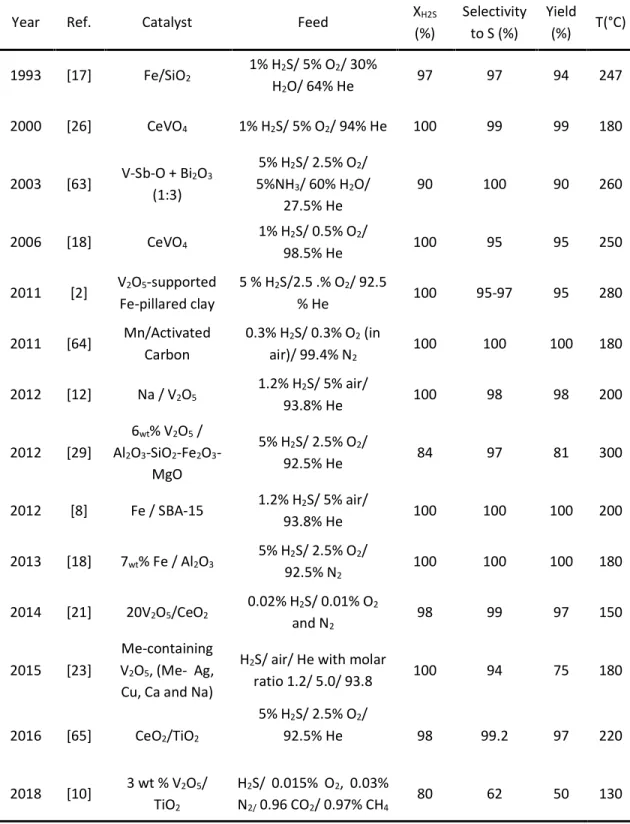
(27) Thèse de Tanushree Kane, Université de Lille, 2018. Effect of the presence of different alkali metals (Li, Na, K ) along with vanadium species on activity was also studied [12] [20] [26]. Doping vanadium oxide catalysts with alkali-metals can modify both structural and acid characteristics of catalysts, changing thus their catalytic properties. SO2 production is observed during the first stage of the reaction but it decreases with time as after the reaction it shows more of reduced species of V2O5. V4O9 is the main crystalline phase observed in catalysts after reaction and is responsible for the selective oxidation. The presence of V5+-O-V4+ pairs as a substitute of V5+-O-V5+pairs (as in V2O5) encourages higher selectivity to the partial oxidation product [62]. To conclude this review of catalytic systems for selective oxidation of H2S, it can be seen that the temperature range where the researchers got the best results varies from 180 to 300 °C. It is also interesting to underline that 100% conversion and 100% selectivity can be achieved but with really low % of H2S in the inlet (0.3%, 1% …). Focusing on the catalyst, it seems that iron, manganese, vanadium and sodium compounds are the most active. It is also reported in the literature some disadvantages using one or another catalyst [66]. The incorporation of alkali metal to pure V2O5, with an alkali metal/vanadium ratio of 0.04, especially the sodiumdoped one, favors an increase in the catalytic activity for partial oxidation of H 2S, with high selectivity to sulfur (>98%)[12]. Titanium based catalyst shows deactivation in the presence of water vapor. Vanadium based catalyst has high activity and selectivity but the drawback is that it depends on the chemical state of vanadium. Iron based catalyst should be optimize because they required an excess amount of oxygen [67], so it is easier to reach a mix between partial and total oxidation and it gets deactivated due to the sulfidation and sulfur deposition. In presence of CH4 and CO2 catalysts does not shows better activity at low temperature [10]. Generally, if the catalyst show high conversion its selectivity decreases. Use of high concentration of H 2S and O2 is not suitable due to safety aspects considering the explosive limit of H2S. As mentioned earlier presence of other reactants may influence the overall selective oxidation process. So, preferential oxidation of H2S is not possible in presence of reactant like different alkanes in particular when excess oxygen is needed as this can induce severe safety issues.. 27. © 2018 Tous droits réservés.. lilliad.univ-lille.fr.
(28) Thèse de Tanushree Kane, Université de Lille, 2018. Year. Ref.. Catalyst. Feed. XH2S (%). Selectivity to S (%). Yield (%). T(°C). 1993. [17]. Fe/SiO2. 1% H2S/ 5% O2/ 30% H2O/ 64% He. 97. 97. 94. 247. 2000. [26]. CeVO4. 1% H2S/ 5% O2/ 94% He. 100. 99. 99. 180. 2003. [63]. V-Sb-O + Bi2O3 (1:3). 5% H2S/ 2.5% O2/ 5%NH3/ 60% H2O/ 27.5% He. 90. 100. 90. 260. 2006. [18]. CeVO4. 1% H2S/ 0.5% O2/ 98.5% He. 100. 95. 95. 250. 2011. [2]. V2O5-supported Fe-pillared clay. 5 % H2S/2.5 .% O2/ 92.5 % He. 100. 95-97. 95. 280. 2011. [64]. Mn/Activated Carbon. 0.3% H2S/ 0.3% O2 (in air)/ 99.4% N2. 100. 100. 100. 180. 2012. [12]. Na / V2O5. 1.2% H2S/ 5% air/ 93.8% He. 100. 98. 98. 200. 2012. [29]. 6wt% V2O5 / Al2O3-SiO2-Fe2O3MgO. 5% H2S/ 2.5% O2/ 92.5% He. 84. 97. 81. 300. 2012. [8]. Fe / SBA-15. 1.2% H2S/ 5% air/ 93.8% He. 100. 100. 100. 200. 2013. [18]. 7wt% Fe / Al2O3. 5% H2S/ 2.5% O2/ 92.5% N2. 100. 100. 100. 180. 2014. [21]. 20V2O5/CeO2. 0.02% H2S/ 0.01% O2 and N2. 98. 99. 97. 150. [23]. Me-containing V2O5, (Me- Ag, Cu, Ca and Na). H2S/ air/ He with molar ratio 1.2/ 5.0/ 93.8. 100. 94. 75. 180. 98. 99.2. 97. 220. 80. 62. 50. 130. 2015. 2016. [65]. CeO2/TiO2. 5% H2S/ 2.5% O2/ 92.5% He. 2018. [10]. 3 wt % V2O5/ TiO2. H2S/ 0.015% O2, 0.03% N2/ 0.96 CO2/ 0.97% CH4. Table 1.1 Relevant work published in recent years for oxide based systems for selective oxidation of H2S.. 28. © 2018 Tous droits réservés.. lilliad.univ-lille.fr.
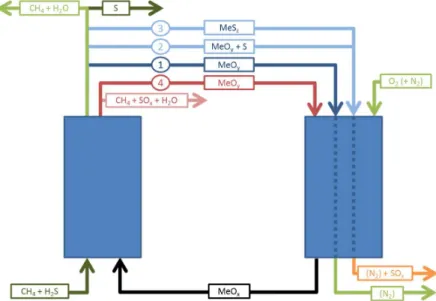
(29) Thèse de Tanushree Kane, Université de Lille, 2018. 1.4 - Chemical Looping processes In recent years, lot of studies have been done on chemical looping processes and their industrial applications. Main principle of chemical looping oxidation is that an oxygen carrier material is used as a reactant and not as a catalyst [68]. It consists of a two-step reaction where the reduction of the oxygen carrier takes place in the first step and in second step this reduced carrier get re-oxidized and simultaneously regenerated. Thus, the main difference in the principle between the co-feed and this process is the decoupling the main reaction in two steps so that the operation conditions can be optimized independently. In principle, chemical looping can be considered for all phases (gas, liquid or solid) or in heterogeneous systems. Main advantage of the chemical looping over co-feed system is the continuous regeneration of the solid during reaction and therefore there is no accumulation of by-products on the solid. This potentially allows to limit deactivation phenomena. In the following review of literature, we will consider only solid oxygen carriers and gas phase reactants. In these cases, chemical looping generally involves the use of fluidized bed systems [69] or fixed bed switching reactors. Definitely, original reactor systems are necessary with respect to classical co-feed fixed (or fluidized) bed reactor. For the experimental studies in the laboratory scale the fixed bed reactor which is fed alternatively with the gas reactants is usually the most appropriate. Another possibility, which is better adapted for industrial applications, would be the use of a circulating bed reactor. The main principle would be transportation of the catalysts from one reactor to the other where each part of the two steps can performed separately. It is important to note that such circulating bed reactors are commonly used in industry. One of the most recognized processes is the Fluid Catalytic Cracking (FCC) [70][71]. This process is used mainly in petroleum refineries. The primary aim of the process is to vaporize and crack low value heavy oil into different more valuable products (gasoline, diesel, olefins…) in the first reactor and regenerate the catalyst in the second one. The vaporized petrol gets in contact with a powdered catalyst in order to carry the reaction. The main issue in such conditions is the deactivation of the catalyst due to the amount of carbon deposition on the active sites from the cracking reactions. Therefore, the catalyst is circulated rapidly into a second vessel to be regenerated by air, in other words, burning the carbon by oxygen. In addition to this, working with fluidized beds helps to avoid hot spots in comparison with fixed beds, which have worse heat transfer. Generally, chemical looping has been considered for hydrocarbon conversion. First, oxygen carrying material get reduced in presence of hydrocarbon. This reduced carrier then transfer to the air reactor which then oxidizes the metal and regenerates it. This regenerated catalyst is then reused for the combustion process in fuel reactor. Side reactions may occur during the reactions and deposits on the catalysts can occur but during the oxidation step these deposits 29. © 2018 Tous droits réservés.. lilliad.univ-lille.fr.
(30) Thèse de Tanushree Kane, Université de Lille, 2018. get oxidized so they do not accumulate contrary to co-feed catalytic processes. This is one of the important advantages of the system over conventional reaction system. The chemical looping combustion (CLC) is one of the processes which uses such circulating oxygen carrier concept. A fuel is in contact with a solid oxide through which the required oxygen is provided to have the total combustion, ideally a mixture of CO2 and H2O. Steam is then condensed which allows getting pure CO2. This pure CO2 can then be trapped for further valorization or sequestration. After the combustion, the catalyst is transferred to a second vessel to be re-oxidized by air in order to recover the oxygen capacity. A general reaction is given as follows: C H m + (2n + m)M O → (2n + m)MyO M O. + ½ O (air) → MyOx. + mH O + nCO. ∆°𝐻 > 0. ∆° < 0. 𝐸𝑞 1.12 Eq1.13. MyOx = oxidized oxygen carrier MyOx-1 = reduced oxygen carrier CLC is essentially developed with the aim of reducing CO2 emissions in fuel combustion processes. Other breakthrough in the field of chemical looping is dry reforming of methane (DRM) to produce syngas. Chemical looping DRM has been investigated successfully at laboratory scale by using periodic feed reactor and Ni/CeO2 based materials as oxygen carriers [72]. DRM is a highly endothermic reaction that needs to be carried out at high temperature i.e. above 600 °C. 𝐶𝐻 + 𝐶𝑂 → 2𝐶𝑂 + 2𝐻. 𝐸𝑞 1.14. Again, the reaction is divided into two steps. The first step consists of the reacting methane with an oxygen vector material that would get reduced and produce selectively syngas. In a second step, this reduced solid would be re-oxidized by CO2 to regenerate oxygen vector. 𝑆𝑡𝑒𝑝 1 − 𝐶𝐻 + 𝑆𝑜𝑙 − 𝑂 → 𝑆𝑜𝑙 − 𝑅 + 𝐶𝑂 + 2𝐻 𝑆𝑡𝑒𝑝 2 − 𝑆𝑜𝑙 − 𝑅 + 𝐶𝑂 → 𝑆𝑜𝑙 − 𝑂 + 𝐶𝑂. 𝐸𝑞 1.15 𝐸𝑞 1.16. The main advantage of this process is that -if the stream from the first step is isolated -a syngas with H2/CO ratio of 2 can be achieved which is ideal for the industrial purpose. Another advantage is that it avoids the Reverse Water Gas Shift (RWGS) reaction as there is no direct 30. © 2018 Tous droits réservés.. lilliad.univ-lille.fr.
(31) Thèse de Tanushree Kane, Université de Lille, 2018. contact between CO2 and H2. Finally, as the solid is periodically regenerated, deposited carbon can be removed and does not accumulate, catalysts deactivation is thus prevented. Chemical looping has been considered for other reforming processes for syngas formation. For example, in auto thermal reforming (ATR) methane is co-feed with the steam to get the supplemental oxygen to overall perform the steam reforming of methane. Along with this, partial oxidation of methane can be done by using chemical looping process as a degree of fuel oxidation is controlled by carrier residence times or by using appropriate solid oxygen vectors which results in the formation of CO and H 2. Another application of the chemical looping method is for selective oxidation. A famous industrial process is oxidative dehydrogenation of n-butane. R. M. Contractor et al. studied this reaction on the (VO)2P2O7 catalysts. The vanadium phosphate was circulated between two reactors. n-butane was oxidized in one bed whereas in the other, the vanadate was reoxidized [73]. E. Bordes et al. [74] explains the butane dehydrogenation reaction by using, a fluidized bed or a recirculating solids riser reactor (RSR) which allows to have a continuous regeneration of the catalysts. Advantage of the RSR is it can separate reduced catalysts from the product stream and treated back to in the regeneration zone for reoxidation. The catalyst is thus recirculated between the two zones and remains in a transient cyclic state. Absence of oxygen during one step helps in the selectivity [71], [75]–[77]. In this procedure, the main redox process occurs in between the V5+ and V4+ oxidation states of vanadium. Stoichiometry of the chemical system is as follows, 𝐶𝐻. +𝑉. 𝑂 +𝑉. → 𝑀𝐴 + 𝑉. + 2𝐻 𝑂. →𝑉. 𝐸𝑞 1.17 𝐸𝑞 1.18. Minimizing as much as possible the oxidation of maleic anhydride into COx and H2O 𝑀𝐴 + 𝑉. → 4𝐶𝑂 +𝑉. +𝐻 𝑂. 𝐸𝑞 1.19. This system is applicable for higher concentration of the reactant as compared to the co-feed conventional reaction system. J. Santamaria et al. [78] worked on n-butane oxidative dehydrogenation with fluidized bed reactor with MoO3/MgO catalysts and used two-zone fluid bed reactor (TZFBR) for the reaction which also use the concept of sequential operation at catalyst level. Such two-zone fluid bed reactor is different from the circulating fluid bed reactor (CFBR) as only one vessel is employed, and oxygen is introduced as a part of the fluidizing gas, whereas the hydrocarbon flow is introduced at an intermediate point of the catalyst bed. This allows the hydrocarbon oxidation to take place with lattice oxygen in the reducing zone of the bed. The oxygendepleted (reduced) catalyst is then regenerated (reoxidized), after being transported by. 31. © 2018 Tous droits réservés.. lilliad.univ-lille.fr.
(32) Thèse de Tanushree Kane, Université de Lille, 2018. internal circulation to the oxidizing zone at the bottom part of the reactor, where oxygen is fed. Chemical looping concept can therefore open the field for several industrial processes optimization. The key to such development is in the oxygen carrier. Such oxygen carriers need to fulfill specific requirements. They should have: . high reactivity in both the oxidation and the reduction reaction; show good selectivity for the desired (total or partial) oxidation; good stability over many of redox cycles; good resistance towards coking or contaminants deposition and removal; good mechanical resistance in circulating bed systems.. So, efforts are mostly committed to select proper oxygen vector solids for the targeted process.. 1.5 - Scope of the thesis Biogas, and in particular biomethane, is an important source of renewable carbon which is the object of increasing interest in the frame of climate issues and future limitation of the availability of fossil carbon sources. This biogas generally contains significant amounts of H2S (a few hundred ppm to a few %, depending on the source of the biogas). The presence of H2S constitutes a major handicap for the recovery of biogas. In the case of thermal combustion of methane, the biogas must be purified to maximum H2S levels of ppm in order to avoid SOx emissions during combustion. When methane is recovered for the production of synthetic fuel or high value-added chemicals (e.g. through reforming to synthesis gas), these transformations necessarily involve catalysts whose performances may be affected by the presence of H 2S. While the development of new generations of catalysts resistant to sulfur poisoning is underway, this does not solve the problem of the presence of sulfur compounds in the end use products. It seems sensible to develop a method of purification of the biogas prior to any intervention of valorization. Indeed, considering the low reactivity of methane, it is preferable to react preferentially H2S in an H2S/CH4 mixture because any product of methane upgrading would have a greater reactivity and thus make it more difficult to treat preferably H2S. Currently, the applied methods involve the adsorption of H2S or the separation and transformation of H2S into S by the Claus process as already explained. This is a well-established process but it suffers several drawbacks essentially due to thermodynamic limitation which imply multiple operations to reach full conversion of H2S to S. Direct selective oxidation of H2S to S is an interesting solution to remove H2S from gaseous effluents. This reaction can be carried out at a relatively low temperature (100-250 °C) in the presence of a catalyst and O2. The gas phase S may be condensed at the reactor outlet and 32. © 2018 Tous droits réservés.. lilliad.univ-lille.fr.
Figure
![Figure 1.1: Claus process illustration [9]](https://thumb-eu.123doks.com/thumbv2/123doknet/3605904.105793/16.918.237.732.669.905/figure-claus-process-illustration.webp)
![Figure 1.2 - Different approach for the dispersion, of V 2 O 5 on the support [57]](https://thumb-eu.123doks.com/thumbv2/123doknet/3605904.105793/25.918.159.761.591.743/figure-different-approach-dispersion-v-o-support.webp)
+7

Documents relatifs