HAL Id: hal-02953739
https://hal-mines-albi.archives-ouvertes.fr/hal-02953739
Submitted on 6 Oct 2020
HAL is a multi-disciplinary open access
archive for the deposit and dissemination of
sci-entific research documents, whether they are
pub-lished or not. The documents may come from
teaching and research institutions in France or
abroad, or from public or private research centers.
L’archive ouverte pluridisciplinaire HAL, est
destinée au dépôt et à la diffusion de documents
scientifiques de niveau recherche, publiés ou non,
émanant des établissements d’enseignement et de
recherche français ou étrangers, des laboratoires
publics ou privés.
An AI framework and a metamodel for collaborative
situations: Application to crisis management contexts
Frederick Benaben, Audrey Fertier, Aurélie Montarnal, Wenxin Mu, Zheng
Jiang, Sebastien Truptil, Anne-Marie Barthe-Delanoë, Matthieu Lauras,
Guillaume Mace-ramete, Tiexin Wang, et al.
To cite this version:
Frederick Benaben, Audrey Fertier, Aurélie Montarnal, Wenxin Mu, Zheng Jiang, et al.. An AI
framework and a metamodel for collaborative situations: Application to crisis management contexts.
Journal of Contingencies and Crisis Management, Wiley, 2020, 28 (3), pp.291-306.
�10.1111/1468-5973.12310�. �hal-02953739�
1 | INTRODUCTION
Being able to take part into collaborative networks is one of the key features of today's organizations (Li, 2012). In this article, collabo-rative networks are considered from the definition of (Camarinha-Matos & Afsarmanesh, 2005) that can be summarized as follows: A collaborative network is constituted by a variety of organizations (largely autonomous, geographically distributed and heterogeneous in terms of
their: operating environment, culture, social capital and goals) which collaborate to better achieve common or compatible goals, and whose interactions are supported by computer network. Unlike other networks, in collaborative network, collaboration is an intentional property that derives from the shared belief that together the network members can achieve goals that would not be possible or would have a higher cost if attempted by them individually. The set of organizations involved to respond in a crisis management context is one of the various
An AI framework and a metamodel for collaborative situations:
Application to crisis management contexts
Frederick Benaben
1| Audrey Fertier
1| Aurélie Montarnal
1| Wenxin Mu
2|
Zheng Jiang
1| Sebastien Truptil
1| Anne-Marie Barthe-Delanoë
3| Matthieu Lauras
1|
Guillaume Mace-Ramete
4| Tiexin Wang
5| Loïc Bidoux
6| Jacques Lamothe
11Centre Génie Industriel, IMT Mines Albi,
Université de Toulouse, Albi, France
2Department of Information Management,
School of Economics and Management, Beijing Jiaotong University, Beijing, China
3Laboratoire de Génie Chimique, Université
de Toulouse, CNRS, INPT, UPS, Toulouse, France
4Iterop, Colomiers, France 5College of Computer Science and
Technology, Nanjing University of Aeronautics and Astronautics, Nanjing City, China
6Worldline, Seclin, France
Correspondence
Wenxin Mu, Department of Information Management, School of Economics and Management, Beijing Jiaotong University, 3 Shangyuancun, Xizhimenwai, Beijing 100044, China.
Email: [email protected]
Tiexin Wang, College of Computer Science and Technology, Nanjing University of Aeronautics and Astronautics, Jiangjun Road, Nanjing City, China.
Email: [email protected]
Frederick Benaben, Centre Génie Industriel, IMT Mines Albi, Université de Toulouse, Campus Jarlard, Route de Teillet, Albi, France.
Email: [email protected]
Abstract
Identifying, designing, deploying and maintaining accurate collaborative networks of organizations (e.g. responders in a crisis situation) are key activities in nowadays ecosystems. However, there is a lack regarding formal approaches dedicated to char-acterize collaborative networks of organizations. Formal descriptions of collabora-tive situations, that could be used, transformed, computed and exploited would be of great benefit for the quality of such collaborative networks. This article presents a model-based AI framework for describing collaborative situations and the asso-ciated formal metamodel dedicated to be instantiated to characterize collaborative situations in a very wide range of application domains. This metamodel (describing collaborative situation between organizations) is structured according to four com-plementary dimensions: the context (social, physical and geographical environment), the partners (the involved organizations, their capabilities resources and relations), the objectives (the aims of the network, the goals to be the achieved and the risks to avoid, etc.) and the behaviour (the collaborative processes to be implemented by the
partners to achieve the objectives in the considered context). Besides, this metamodel
can be extended for some precise application domains. This article focuses on this mechanism in the specific context of crisis management.
K E Y W O R D S
artificial intelligence, collaboration, crisis management, data science, knowledge management, metamodel, model-driven engineering, network
kinds of collaborative network that has to deal with a given situa-tion, potentially highly unstable. The collaborative network must be defined, designed, deployed and maintained (including dismantling). Although Collaborative Networks exist in a large variety of forms, their life cycle is composed of five main stages (Camarinha-Matos, Afsarmanesh, Galeano, & Molina, 2009):
• Creation: structured according to the two following steps (a) initi-ation and recruiting, (description) and (b) foundiniti-ation (startup). • Operation: the nominal living period of the collaborative situation. • Evolution: management of small changes (in partners, roles or
actions).
• Metamorphosis: management of major changes (in objectives, principles and membership), generally requiring a new form of organization.
• Dissolution: when the collaboration must be dismantled.
In the context of collaborative network engineering and manage-ment, the first question following this description of the life cycle of a collaborative network is: how can we manage the collabora-tion life cycle efficiently? The first statement to take into account with regards to that question is the following: the management of a collaborative networks requires being able to deal with these five steps, that is, to have access to the appropriate knowledge in order to take decisions and conduct the collaboration on the right track. This statement provides the first requirement to manage efficiently a collaborative situation: have at one's disposal the appropriate knowl-edge about the collaborative network to manage the life cycle of the collaboration.
The next question is then: how to get that knowledge? The sec-ond statement to consider with regards to that secsec-ond question is the following: the constantly increasing volume of data makes to-day's world numeric. There are a lot of data sources (sensors, social medias, opendata, etc.) dedicated or non-dedicated to the context of the collaboration. The second requirement (actually refining the first one) to manage efficiently a collaborative situation is then the following: use efficiently available data from all accessible data sources to create on-the-fly the appropriate knowledge about the collaborative network to manage the life cycle of the collaboration.
This refined requirement is clearly aiming at crossing the domain of collaborative networks (Camarinha-Matos et al., 2009) and the domain of Big Data (Power, 2014). To reach that expectation, this article aims at presenting an Artificial Intelligence framework for (a) data gathering, then (b) information modelling and (c) finally deci-sion support, using (d) knowledge bases. The principle is to use a collaborative situation metamodel that could be instantiated using the collected data in order to obtain representative collaborative situation models. In the case of crisis management contexts, the re-sult is the automatic definition of a situation common operational picture (COP). The obtained models can then be used to specify and maintain the appropriate collaborative response model (i.e., the behavioural schema able to deal with the specificities of the situ-ation), or for any other purpose that could benefit of the obtained
and maintained situation model (e.g., simulation, visualization, etc.). In this article, the focus is centred on the collaborative situations meta-model itself, and moreover on the extension of this metameta-model for crisis management collaborative situations. The data gathering level (for-ward) and the information exploitation level (back(for-ward) are men-tioned but they have not been described nor discussed. The data gathering level has been described for instance in and Bénaben et al. (2017) and Fertier, Montarnal, Barthe-Delanoë, Truptil, and Benaben (2016) with the automated interpretation of data coming from sensors and opendata like weather or traffic data. This is still a topic of interest, especially regarding the question of social media data (Coche, Montarnal, Tapia, & Benaben, 2019). The information exploitation level throughout a mediation information system has been deeply described in (Bénaben et al., 2015).
As a consequence, this article is structured as follows: The first section of this article provides an overview of existing related re-search works through a literature review. The second section fo-cuses specifically on the collaborative situation metamodel and its extension to crisis management contexts (including an illustration). The final section concerns the conclusions and the perspectives.
2 | LITER ATURE REVIEW
Considering the global objective of this article (i.e., describing the collaboration metamodel used in an innovative AI framework to for-malize gathered raw data, in order to support the management of collaborative situation, especially coordinated crisis response), this section is structured according to the following main subsections: (a) big data as a preliminary point, and (b) information modelling about collaborative networks (including the study of existing metamodels) as the heart of the literature review.
2.1 | Preliminary point: an overview about big data
Big data is performed through a fast analysis of large amounts of data, of different types, from var-ious sources, to provide a flow of emerging usable knowledge
(Power D. J., 2014) This knowledge is useful if the distance between the context and the result of the big data analysis is small (Demchenko, Grosso, De Laat, & Membrey, 2013): obviously, data may be considered as crucial by someone and perfectly useless by someone else (depending on the context). The classical vision of big data usually introduces the follow-ing four main characteristics:
• The volume: it refers directly to the amount of data (continu-ously generated (Demchenko et al., 2013; Hashem et al., 2015; Krishnan, 2013; Power, 2014);
• The variety: it refers to the variety of data types (images, texts, videos, numbers, etc.) and data format (structure, unstructured, etc.). Besides, this characteristic is accentuated by the fact that there are known and unknown sources (Demchenko et al., 2013; Hashem et al., 2015; Krishnan, 2013; Ohlhorst, 2012; Power, 2014; Raghupathi & Raghupathi, 2014);
• The velocity: it refers to both the frequency of data production and the frequency of data processing (Demchenko et al., 2013; Hashem et al., 2015; Krishnan, 2013; Power, 2014);
• The veracity: it refers to the trustfulness, the objectivity, the au-thenticity, and the security of gathered data (Demchenko et al., 2013; Hashem et al., 2015; Lukoianova & Rubin, 2013).
The worldwide research activities on the domain of big data sys-tematically focus on at least one of these characteristics (Lukoianova & Rubin, 2013). For instance, Map Reduce is dedicated to deal with volume of data (Grolinger et al., 2014). Similarly, the use of metadata (dedicated to describing the content of data) can manage the vari-ety of data (Krishnan, 2013). However, the main conclusion from the study of existing research results in the domain of Big Data is that most (almost all) current research or innovation works in this domain are focusing on trying to process (in real time) the huge amount of incoming data to directly provide hints, clues or advice about the ob-served situation. This is definitely interesting and required. However, as discussed in (Benaben, Montarnal, Fertier, & Truptil, 2016), this may be considered as “reflex” mode and the maturity curve of Big Data should start requiring bringing more “consciousness” in the ex-ploitation process of data.
The distinction between data, information and knowledge has been hardly discussed in the last decades. One of the first defini-tions relevant for this article can be found in (Ackoff, 1989): “Data are symbols that represent properties of objects, events and their environments. They are products of observation”, “information is referred from data, it is contained in descriptions, answers to ques-tions that begin with such words as who, what, where, when and how many” and, “Knowledge is conveyed by instructions, answers to how-to questions”.
More recently, Rus and Lindvall (2002) provides the following definitions: “Data consists of discrete, objective facts about events but nothing about its own importance or relevance; it is raw material for creating information” while “Information is data that is organized to make it useful for end users who perform tasks and make deci-sions” and “Knowledge is broader than data and information and re-quires understanding of information (information about information, such as who has created the information).”
In addition, the notion of common operational picture, defined in Dickinson (2013) and inherited from the domain of command and control requires the contextualization of data to obtain information. The obtained information, stored as models, is analysed, updated and monitored to support decision.
For (Bellinger, Castro, & Mills, 2004) “data is raw, it simply exists and has no significance beyond its existence. […] It does not have meaning of itself”, while “information is data that has been given
meaning by way of relational connection” and “knowledge is the appropriate collection of information, such that it's intent is to be useful.”
For (Rowley, 2007), “data has no meaning or value because it is without context and interpretation. Data are discrete, objective facts or observations, which are unorganized and unprocessed, and do not convey any specific meaning.”, while “information is format-ted data and can be defined as a representation of reality” (it is in line with a lot of vision where “information is data that have been shaped, organized, given meaning, etc.”), and “knowledge is the combination of data and information, to which is added expert opinion, skills and experience, to result in a valuable asset, which can be used to aid decision-making.”
From the previous elements and definition, the following discus-sion can be introduced: The concept of data seems quite stable (ob-jective facts or observations). The notion of information is generally seen as an extension of data with meaning, contextualization, etc. From the perspective of this article, this vision implies two conse-quences: obtaining information on the one hand requires connecting data with the context (or elements of the context) and on the other hand instantiating concepts based on the available data (or sets of data) to create formal information as instances of these concepts. Finally, the definitions of knowledge are quite fuzzy and unprecise. Most of the time, they refer to part of the information and to its usefulness. This aspect of knowledge seen as useful (and sometimes processed) information is interesting, but missed the generalized and formalized dimension of knowledge, that is, the learning of abstract concepts. Consequently, in the context of this article, the proposal is the following: knowledge can be seen as twofold. On the one hand, knowledge includes capitalized information, inherited for instance from previous experience or from case studies. That knowledge de-scribes the experience of the subject, the remaining elements after its past life. On the other hand, knowledge embeds abstract con-cepts that can be used to instantiate new information (and that have been used to instantiate capitalized information). That knowledge describes the formalized notions extracted from the past life of the subject. So, roughly speaking, this article claims that knowledge is twofold: concrete knowledge (capitalized past instances) and ab-stract knowledge (structured descriptive concepts). Based on this discussion, this article uses the following simple visions of data, in-formation and knowledge:
• Data: formalized observation of the world.
• Information: result of the interpretation of data through the in-stantiation of conceptual references.
• Knowledge: capitalized static information about previous experi-ence and extracted abstract concepts.
One strong hypothesis concerns data and the fact that all the questions of data source discovery, understanding, trust and clean-ing are out of the scope of the current article. The hypothesis is the following “let's assume that there is available data that is meaningful, trustable and usable”.
The concept of decision is generally defined as the choice, con-clusion or judgement made after consideration of available possi-bilities and the best to do (extracted from Oxford and Cambridge dictionaries). In the context of this article, it is important to connect what should be considered in the decision process to information and knowledge. Consequently, this article uses the following definition: • Decision: choice, conclusion or judgement made after processing
actionable information and knowledge about the situation. The following figure (Figure 1) presents the K-DID (Knowledge/ Data/Information/Decision) Framework, which is somehow based on the DIKW (Data/Information/Knowledge/Wisdom) pyramid pre-sented in Rowley (2007):
The challenge of decision-making and AI, according to the frame-work introduced in Figure 1 is somehow to climb the levels of the framework by performing gathering (or perception) to reach the data level, then interpretation to reach the information level, and finally exploitation to reach the decision level. This climb uses all along the reference knowledge to perform the aforementioned tasks (espe-cially interpretation and exploitation).
Regarding the objective of this article (i.e., describing the collab-oration metamodel used in an innovative AI framework to formalize gathered raw data, in order to support the management of collabo-rative situation, especially coordinated crisis response), this frame-work is instantiated according to the following proposal: the focus is on the interpretation stage to climb from raw data to situation informa-tion (model), using the abstract knowledge embedded in a collaborative situation metamodel.
So, in the following, two different approaches to deal with mas-sive amount of data to climb the K-DID abstraction layers will be presented and studied with regards to the objective of this article: data science and model-driven engineering.
2.1.1 | Data science
According to Jagadish et al. (2014), Data Science, is composed of two main parts: Data Management and Data Analytics. Data
Management includes Acquisition, Content Extraction and Data Integration and Representation. Data Analytics includes Analysis and Human-Interpretation. It is easy to draw the line between this vision of Data Science and the K-DID framework on Figure 1. As shown on Figure 2, Data Management fills in the data layer while Data Analytics is dedicated to performing detection of frequent patterns and correlations to obtain general statistics (including providing the user with visualization that may be interpreted by him), which is basically what is expected at the decision layer of Figure 1.
Basically, the most important finding from that analysis is that Data Science and more broadly general approaches of AI actually do short-cut the Information level. These approaches focus on provid-ing the decision level with material that would actually support the making of a decision by establishing statistical reports on the data. This definitely allows such systems to deal with Volume and Velocity of data.
2.1.2 | Model-driven engineering
Model-Driven Engineering (MDE), as described in Rodrigez Da Silva (2015) mainly relays on two basic activities: Modelling and Model transformation. It is important to notice at this point that MDE is ab-solutely not dedicated to software engineering (though it is used a lot in that domain), and as stated in Dietz, Proper, and Tribolet (2014) can be used in Industrial Engineering contexts.
Modelling is classically based on the following steps (Benaben, Fertier, Lauras, & Salatge, 2019):
1. Definition of the boundaries of the subject: definition of the exact perimeter of the system to be modelled.
2. Choice of the modelling point of view: definition of the why, for whom and for what purpose of the modelling activity.
3. Choice of the projection plan: selection of the modelling language that fits the point of view (basically that is relevant to the goal of the model and understandable by the future users).
4. Projection of the subject on the projection plan: this is the model design step.
F I G U R E 1 The K-DID framework and
the abstraction levels data, information, decision and knowledge [Colour figure can be viewed at wileyonlinelibrary.com]
5. Choice of the granularity level: definition of the appropriate preci-sion level of the model.
It is important to notice that step 4 requires a metamodel. There are lot of definition of what is a metamodel. First of all, from (MDA, 2020), “a model represents some concrete or abstract thing of in-terest, with a specific purpose in mind. The model is related to the thing by an explicit or implicit isomorphism. Models in the context of the MDA Foundation Model are instances of MOF metamodels and therefore consist of model elements and links between them”. For the purpose of this article, and to draw the link with the concept of meta-model, a model is seen as a partial description of a subject, according to a certain point of view and expressed in a formalized language. This first definition is necessary to understand the role of a metamodel. (OMG, 2017) describe it as “a model that defines the language used to define a model”. A metamodel is so the model of a modelling language or domain. More pragmatically, a metamodel can be seen as “the de-scription of all concepts of a language, their semantics and the syn-tactic related to the use of these concepts” (Chapron, 2009). Based on this and on (Bezivin, 2005), we will keep the following definition:
A metamodel is the description of concepts and relationships between these concepts that allows to define models where: the models conform to the metamodel and the metamodel is represented by the models. With regards to the domain of knowledge management, a metamodel is also usually used as the high-level structure of an ontology. This is the way to describe abstract concepts (and their relationships), that can be instantiated while populating the ontology.
The concept of metamodel is particularly used and significant in the domain of model transformation. Transformation rules are actually defined between metamodels. On a very schematic point of view model transformation is the tool used to travel the mod-el-driven engineering cycle.
Finally, regarding MDE, the question about the location of MDE on the intelligence framework presented in Figure 1 should be con-sidered to echo the proposal of Figure 2. With regards to that intelli-gence framework, it can be stated that the Modelling step (based on metamodel) is dedicated to perform the interpretation feature. The Model Transformation step is dedicated to use the obtained model to generate new content that would be more useful for the user to take decision. This is the exploitation feature.
F I G U R E 2 Location of Data Science in
the K-DID framework [Colour figure can be viewed at wileyonlinelibrary.com]
F I G U R E 3 Location of Model-Driven
Engineering in the K-DID framework [Colour figure can be viewed at wileyonlinelibrary.com]
The following picture illustrates the location of MDE on the in-troduced Intelligence framework:
Basically, the most important finding from that analysis is that Model-Driven Engineering is dedicated to exploit formalized model but unable to build that model (Figure 3). These approaches focus on providing the decision level with material that can be exploited in decision-making process through model-driven engineering tools (e.g. model transformation, formal analysis, optimization, etc.). This formal processing of models allows such systems to deal with the Variety and Value of information because the model-driven activ-ities can be triggered by various type of information and content.
2.1.3 | Limits and complementarities of both visions
In the context of this article, the question of Veracity of data is out of scope due to the fact that we only consider data that is already clean and trustable (the topic is not about data source discovery or data filtering and cleaning). Besides, on the one hand, the conclu-sion of Subsection 1.1.1 shows that data science seems to be able to deal with Volume and Velocity. On the other hand, the conclu-sion of Subsection 1.1.2 claims that model-driven engineering seems more appropriate to deal with Variety and Value. But both these ap-proaches struggle with specific conditions as soon as we extend the range and the amount of data to manage:
• Data science can not deal with unknown type or content: just like a shark, able to detect a drop of blood in millions of litters of sea water, but which would be lost with a Rubik's Cube®. This is due to
the fact that the data associated to the Rubik's Cube® is out of the
scope of its perception and it can only apply a default behaviour (like attack, ignore or escape).
• Model-Driven Engineering can not manage a large amount of
data: just like a baby, able to start to play with a Rubik's Cube®
because of its shape, colour, touch, etc. but would be unable to detect a full glass of lemonade in his bath among all other tastes and odours of the water.
These considerations have been largely discussed in (Benaben et al., 2016) and are generally represented on the framework of Figure 1 in the following figure:
The line of attack is, first, to use Data Science to perform the modelling step by interpreting the flow of incoming data thanks to Data Analysis tools (Figure 4). Then it is expected to instantiate con-cepts of a metamodel to create situation model(s). Second, the goal is to use Model-Driven Engineering to exploit the generated situation model(s) by taking advantage of the content of the models through Model Transformation tools. Then it is expected to obtain more rele-vant and more actionable models to support decision-making.
The following picture illustrates how, considering the previous element, Data Science and Model-Driven Engineering can be located altogether on the Intelligence framework of Figure 1. The upper left part of Figure 5 concerns Data Science (Data Analytics and Data Management), the upper right part concerns Model-Driven Engineering (Modeling and Model Transformation) and the bottom part represents the way both could be combined to provide an Artificial Intelligence framework:
Basically, the question of the use of data science for data in-terpretation and the design of situation model has been described (Fertier, Montarnal, & Benaben, 2019), as well as the question of in-formation exploitation and model transin-formation to get a response model (Bidoux, Pignon, & Benaben, 2019; Montarnal et al., 2018; Mu, Benaben, & Pingaud, 2018). As a consequence, the following of this article will strongly focus on the “missing piece” of that puzzle: the metamodel. The next subsection describes and compares some existing collaboration and crisis management metamodels.
F I G U R E 4 Limits of both Data Science
and Model Driven Engineering in the K-DID Framework [Colour figure can be viewed at wileyonlinelibrary.com]
2.2 | Existing knowledge management structures
related to crisis management
Two types of Knowledge management structures predominate with regards to the domain of crisis management:
metamodels presenting concepts and vocabulary necessary for coherent modelling of a set of situations for a given point of view. ontologies built for the purpose of facilitating the reuse and shar-ing of information, as described in Uschold and Grunshar-inger (1996) and Gómez-Pérez (2001), thanks to a set of concepts, for a part of the world and a given point of view. In this category, we often find the taxonomies built to name similar concepts and the rela-tions between them.
These definitions both come from recommendations written by Gruber (1995) under the term ontology, to frame a process of con-ceptualization. They are similar in design, but pursue different goals: (a) instantiation or (b) the reconciliation of pre-defined concepts.
To identify existing metamodels dedicated to describe natural disasters, we used a systematic literature review on the Web of Science documentaries with the following request: “(ontology OR ontologies OR metamodel OR metamodel) AND (“natural disaster” OR “natural disasters”))”.
Only the articles categorized under the name “Computer Science” have been retained. In all, 20 publications were obtained and studied. Besides, some knowledge management contributions that were not in this subset but are in our scope have been added like Polarisco (Mhadhbi, Karray, & Archimede, 2019). The most relevant results are summarized in the following Table:
In Table 1, there are 12 articles, 7 of them are using ontology as modelling tool, 5 of them are using metamodel as modelling tool. Both modelling methods are used in the research field. Han and Xu (2015), Iribarne et al. (2010) and Jung and Chung (2015) cover ge-neric or hybrid situation, they are focusing on three different model-ling subjects: context, partner or objective.
For the crisis situation, from the timeline, the first publications are Benaben, Hanachi, Lauras, Couget, and Chapurlat (2008) and Kruchten, Woo, Monu, and Sotoodeh (2008). They all cover the three modelling keys: context, partner and objective. However, Benaben et al. (2008) is trying to address the link from partner to risk, then to sequence. They provide the clear logic between those concepts Kruchten et al. (2008)'s modelling vision is more about the “disaster event” (Othman, Beydoun, & Sugumaran, 2014) adds response and rescue concepts to the model. In 2015, the technology of big data and cloud computing are well developed. Researchers link data to the knowledge modelling, for example (Calcaterra, Cavallo, Modica,
F I G U R E 5 A proposal of A.I. Framework based on Data Science and Model-Driven Engineering [Colour figure can be viewed at
& Tomarchio, 2015), adds sensor, spatial and region data. In 2019, AI and data combined tools are presented. In that situation, multi-ma-jor involved research appeared. Madhbi et al. (2019) considers crisis situation and also ethical issues. They use “victim” and “stakeholder” concepts to define their crisis model. Zschocke et al. (2010) also adds “Vulnerability” to their key modelling concepts. To summarize, the modelling of crisis situation is affected by the development of big data and AI technology, the researchers in crisis field agree that data is one key part to solve classical issues and current issues in crisis research.
To meet the information needs of crisis management decision makers, the reference structure should enable decision makers to:
reason. To do this, the concepts, and by extension the instances of the model, must be linked together through pre-defined relationships;
improve their awareness of the situation effectively. To do this, concepts must cover all the information that can be used to sup-port decision-making. This information may relate to the partners of the crisis collaboration, their objectives or the characteristics of the crisis theatre;
monitor and react to the cascading effects of the ongoing crisis. To do this, the proposed concepts must be able to be specified according to the changing and unpredictable nature of the crisis. All the results presented in Table 1, derived from the state of the art, have been evaluated according to these three criteria. In view of
these results, we propose two distinct categories to evaluate exist-ing structures accordexist-ing to their complexity:
the metamodels that make it possible to define complex relation-ships between concepts, for example, “a risk, generated by a haz-ard, impacts one or more issues”. This category includes the work of Benaben et al. (2008), Iribarne, Padilla, Criado, and Vicente-Chicote (2010), Kruchten et al. (2008), Othman et al. (2014), and Zschocke, de León, and Beniest (2010).
the ontologies, which are dedicated to define and set terms in a given business domain.
Then three different categories according to their coverage of information on a crisis situation:
generalists who are concerned with the objectives of the collabo-ration, the crisis context and the partners involved in the response to the crisis. Here, we find the work of Benaben et al. (2008), Kruchten et al. (2008), Othman et al. (2014), and Yu, Li, and Wang (2015).
intermediaries, which concern at least two of these categories; the specialists who conceptualize the information of only one of these categories, such as the work of Iribarne et al. (2010). Finally, three different categories depending on the level of ab-straction worked:
general, when all types of crises can be represented by the pro-posed structure;
TA B L E 1 Reference research works on knowledge management framework (metamodels and Ontology) in crisis management
Reference Type Coverage Abstraction Main concepts
Benani et al. (2017) Ontology Objectives, Partners Sub-domain specific (terrorist attack)
Context, Cause, Solution, Attack
Benaben et al. (2008) Metamodel Context, Objectives, Partners
Domain specific (crisis situation) Partner, Capacity, Resource, Task, Danger, Risk, Consequence,
Han and Xu (2015) Ontology Objectives, Partners Generic Planning, Event, Tasks
Othman et al. (2014) Metamodel Context, Objectives, Partners
Domain specific (crisis situation) Response organization, Rescue, Exposure Kruchten et al. (2008) Metamodel Context, Objectives,
Partners, Domain specific (crisis situation) Disaster Event, Cell, Infrastructure Mhadhbi et al. (2019) Ontology Partners, Objectives Domain specific (crisis situation) Victim, Action, Means,
Stakeholder
Jung and Chung (2015) Ontology Context, Partners Hybrid Environment, Location,
Equipment
Calcaterra et al. (2015) Ontology Context, Objectives Domain specific (crisis situation) Hazard, sensor, Spatial object, Region
Yu et al. (2015) Ontology Context, Objectives, Partners
Sub-domain specific (electric network)
Environment, Responders, Physical system, Hazard, Risk
De Nicola, Tofani, Vicoli, and Villani (2011)
Ontology Context, Objectives Sub-domain (critical infrastructures)
Structure, risk, impact, measures.
Iribarne et al. (2010) Metamodel Partners Generic Actor, Choreography, Task
Zschocke et al. (2010) Metamodel Partners, Objective Domain specific (crisis situation) Hazard, Risk, Vulnerability, Actor
by domain, when the proposed concepts are specific to a type crisis, as in Benani, Maalel, Ghézala, and Abed (2017) or Yu et al. (2015).
mixed, when the structure allows to describe a crisis according to several levels of abstraction as in Benaben et al. (2008) and Jung and Chung (2015).
The following picture illustrates the relationships between these metamodels and models (where arrows with white trian-gle express inheritance relationship and classical arrows express instantiation):
In the context of the current article, the ambition for the meta-model is to be used in an AI framework that should deal with variety and value of data to create models of situations through instances of concepts (Figure 6). This seems quite in line with Benaben et al. (2008), Kruchten et al. (2008) and Othman et al. (2014).
3 | COLL ABOR ATIVE SITUATION
METAMODEL
This section is dedicated to describing the overall theoretical meta-model of collaborative situations. This description aims at justifying the role, the objective and finally the structure of the components of the collaborative situation metamodel. It is also dedicated to in-troduce the refinement mechanisms to get the crisis management metamodel. Consequently, this second section is structured ac-cording to three subparts: (a) pre-requisite about the specificities of the observed collaborative situations (and the associated require-ments in terms of data management), (b) the presentation of the metamodel of collaborative situations and (c) the presentation of the extension of the metamodel dedicated to the crisis manage-ment domain.
3.1 | Framework for a metamodel of
collaborative situations
The characterization of a collaborative situation requires describing several points of view. To describe clearly these points of view, this article directly refers to two modelling domains: (a) system model-ling, where a system is an arrangement of parts or elements that to-gether exhibit behaviour or meaning that the individual constituents do not (INCOSE, 2020), because a network of organizations can be considered as a system, (or a system of systems) and (b) enterprise modelling, because organizations may be considered as enterprises from a modelling perspective. On the one hand, system modelling is traditionally based on three main dimensions (Hause, Thom, & Moore, 2005):
• Requirement/Functional view1: This dimension describes mainly
the expectations of the system. It is dedicated to clarify its purposes.
• Structural view: This dimension presents on the one hand the components of the system and the relations they have with each other, and on the other hand the environment of the system and the relationships between the system (its components) and that environment.
• Behavioural view: This dimension describes the dynamic aspect of the system and the way it performs. It is dedicated to model the processes and the performances of the system.
Enterprise modelling, on the other hand, is often considered ac-cording to four points of view (Vernadat, 1996):
• Informational view: This point of view describes the embedded data and associated knowledge of the organization.
• Functional view: This point of view presents the whole capability of the organization through its behaviour and its processes. • Organizational view: This point of view describes the
responsibil-ities, allocations and hierarchical schemes of the structure of the organization.
• Resources view: This point of view presents the means and the individual capabilities of people, software, machines composing the organization.
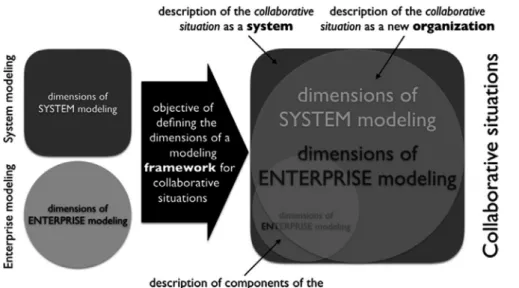
Considering that the main objective of setting up a collaborative network can be seen as “the design of an organization, which is a system of organizations” the previously described points of views (about system modelling and enterprise/organization modelling) should be considered to define the modelling framework of collab-orative situations.
Based on the overall idea presented in Figure 7, the main challenge is to exploit the modelling dimensions inherited from Enterprise/System modelling framework to create the appropriate modelling framework (and its relevant points of view) for collabo-rative situations managed by a collabocollabo-rative network. Actually, the principle is to consider the collaborative situation (to be modelled) as a system including a collaborative network of organizations.
The basic principles to reach that objective are the following: 1. The collaborative situation modelling framework should be based
on the system modelling dimensions (because the collaborative network, involved in the collaborative situation is a system). 2. Considering the way the collaborative situation should be
inte-grated in its environment, the structural view of the framework could be split in two parts: components (i.e., partners of the col-laborative network) and environment.
3. A collaborative situation model (and especially the part de-scribing the collaborative network) should embed knowledge about information, functions, resources and organization of the
collaborative network as a whole (because the collaborative net-work is an organization).
4. The dimension (of the collaborative situation modelling frame-work) specifically describing components (i.e., partners of the col-laborative network) should be based on the enterprise modelling dimensions (because partners are enterprises).
Figure 8 presents the consequences of these principles on the basis of the big picture presented on Figure 7. That Figure 8 presents the mapping of enterprise modelling dimensions onto system model-ling dimensions, considering that in the collaborative network, each component is an organization (enterprise) itself. So the mapping not only tries to connect the dimensions of system modelling and enter-prise modelling altogether, but it also with the modelling dimension of subcomponents seen as enterprises.
3.2 | Description of the metamodel (COSIMMA for
collaborative situations metamodel)
From Figure 8 and the previously listed principles, it is possible to le-gitimate that the collaborative situation metamodel presented in this article is structure according to four main dimensions: (a) context (i.e., “structure environment” from Figure 8), (b) partners (i.e., “structure components” from Figure 8), (c) objectives (i.e., “requirements” from Figure 8) and (d) behaviour (i.e., “behaviour” from Figure 8). Besides, the partner dimension should include concepts describing informa-tion, functions, resources and organization of the involved or avail-able partners. Furthermore, the four mentioned dimensions for the whole framework (context, objectives, partners and behaviour) should as well include concepts describing information, functions, resources and organization of the collaborative network.
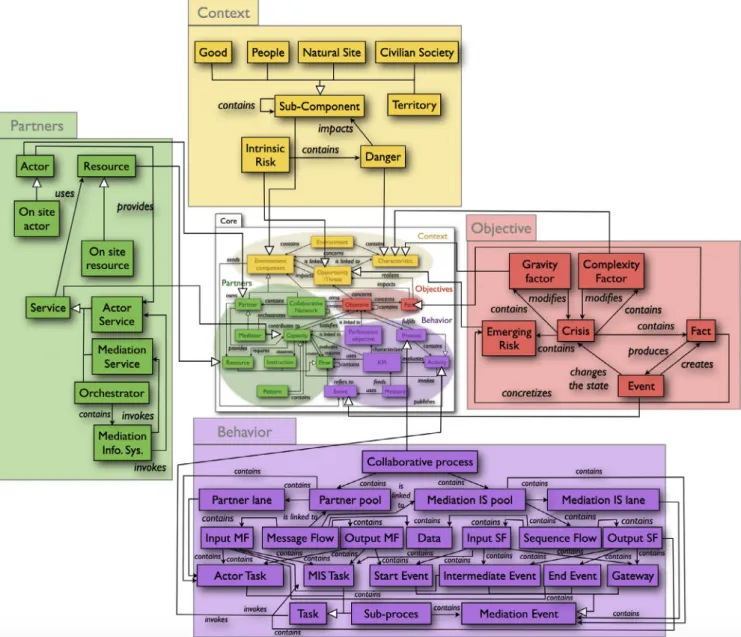
Consequently, the metamodel (Figure 9) proposed in this article is structured as follows:
F I G U R E 7 The use of enterprise and
system modelling dimensions with regards to the objective of defining the modelling dimensions of a collaborative situation framework
• Context dimension (light grey) including components and charac-teristics of the considered environment, and also opportunities or threats specific to these environment characteristics.
• Partner dimension (strong grey) expresses the different resources and know-how of the partners. This includes notably capabilities, patterns, instructions, resources (information, material, people,
F I G U R E 8 The mapping principle
of enterprise and system modelling dimensions on the modelling dimensions of a collaborative situation framework [Colour figure can be viewed at wileyonlinelibrary.com]
F I G U R E 9 Concepts and relations between concepts embedded in the four-dimension framework of collaborative situation modelling
etc.), flows (linking capabilities) and connector/mediator able to orchestrate the different business processes.
• Objective dimension (medium grey) containing characteristics of collaborative network (common objective and facts that the col-laboration has to manage).
• Behaviour dimension (dark grey) that characterized the concrete op-erations, which are deployed to concretize the collaboration. This includes business processes/activities and their associated events and messages. Besides, this dimension includes as well a Performance point of view (white) that assesses the overall performance of the collaboration by comparing, through dedicated Key Performance Indicators (KPIs), the performance objective to the measures on the field.
Figure 9 presents the modelling framework for collaborative sit-uations with the four aforementioned dimensions embedding con-cepts (boxes) and relations (arrows) between concon-cepts to describe
a collaborative situation (whatever the concerned business domain). The used formalism is UML-based.
Based on the previous considerations, this article claims that a collaborative situation may be modelled by instantiating concepts and relations of the previous diagram presented in Figure 9, which is actually a collaborative situation metamodel. The next question at this point is “how can such a collaborative situation model be used to infer the way a collaborative situation could be established, could evolve and even catch opportunities or re-organize to remain suc-cessful?” and more precisely: “is it possible to model part of the col-laborative situation (e.g. partners and context) and infer the other part?”. This is a direct echo to the question asked in the introduction of this article: considering the characteristics of a set of organiza-tions (partners) and the characteristics of the environment they are involved in (context), is it possible to define what could be done by such a group of organizations in that environment (objectives) and how should this network of partners perform (behaviour).
F I G U R E 10 COSIMMA structured according to the core metamodel dedicated to collaborative situations and the layer composed with
3.3 | Description of the crisis management
extension of COSIMMA
As described in Lauras, Truptil, and Bénaben (2015), the Collaborative Situation Metamodel defined for crisis management is structured ac-cording to two layers: (a) the core layer which actually describes con-cepts and relations of any collaborative situation, and (b) the specific layer containing concepts that inherit from the core concepts and that describe more precisely concepts of the domain. The core is agnostic while the layer is dedicated to crisis management domain (in some other research works, other layers have been defined about supply chain and health care).
The core layer of the metamodel has been defined in the previ-ous subsection. The crisis management metamodel is structured as presented in Figure 10.
The core metamodel at the centre and four packages (Context, Partners, Objectives and Behaviour) contain concepts dedicated to crisis situation inheriting from the core concepts. Each of the con-cepts of the crisis management layer presented in Figure 10 is de-scribed in the following.
3.3.1 | Context package
• Good: inherited from environment component of the core layer, this concept represents any human-made elements that could be threatened by the crisis situation (e.g., building, road, etc.). • People: inherited from environment component of the core layer,
this concept represents any group of persons that could be threat-ened by the crisis situation (e.g., students of a school, employees of a plant, etc.).
• Natural site: inherited from environment component of the core layer, this concept represents any natural element of the environment that could be threatened by the crisis situation (e.g., lake, forest, etc.). • Civilian society: inherited from environment component of the core
layer, this concept represents any social actors (e.g., media, intel-lectual society, etc.).
• Territory: inherited from environment component of the core layer, this concept represents any administrative area (e.g., county, island, etc.). • Danger: inherited from characteristics (implicitly embedding
dan-gerous and favourable characteristic of the environment), this concept represents any specific dangerous characteristic of the environment.
• Intrinsic risk: inherited from opportunity/threat (implicitly embed-ding positive and negative potentialities) of the core layer, this concept represents any permanent risk due to some identified danger (e.g., earthquake, riot, etc.).
3.3.2 | Partners package
• Actor: inherited from partner of the core layer, this concept rep-resents any stakeholder involved in crisis management (e.g.,
firemen, EMS, policemen, etc.).
• Resource on site: inherited from resource of the core layer, this con-cept represents any physical component used by actors on the crisis field to perform any of its service (e.g., truck, decontamina-tion tent).
• Service: inherited from capacity of the core layer, this concept rep-resents any ability of actors to perform some actions that could be useful for the crisis management (e.g., evacuate victims, treat injured people, etc.).
• Actor service: inherited from service of the crisis layer, this concept represents any service specifically provided by actors.
• Mediation service: inherited from service of the crisis layer, this concept represents any service provided by Mediation IS. This mediation services can be communication services (for instance transmission of a message from one stakeholder to another) or added-value services (for instance a calculation of resource allocation).
3.3.3 | Objectives package
• Emerging risk: inherited from opportunity/threat (implicitly embed-ding positive and negative potentialities) of the core layer, this concept represents any risk specifically emerging due to the crisis itself.
• Effect: inherited from fact of the core layer, this concept rep-resents any direct consequence of the crisis itself (e.g., 10 injured people, fire, etc.). With the various types of risks, this is the con-cept whose instance should be considered primarily for opera-tional interventions.
• Mission: inherited from objective of the core layer, this concept represents any assigned duty directly responding to identified risk or effect of the crisis.
• Triggering Event: inherited from event of the core layer, this con-cept represents any event occurring during crisis management that must be considered as (potentially) triggering complementary consequences.
• Gravity factor: inherited from characteristic of the core layer, this concept represents any factor of the current situation that may change the gravity of the crisis.
• Complexity factor: inherited from characteristic of the core layer, this concept represents any factor of the situation that may change the type of the crisis.
3.3.4 | Behaviour package
This package is a specific case as the extension is not dedicated to crisis management as a business domain but to a specific way of managing the behaviour. Actually, the added classes are covering the domain of collaborative business process with a vision very close to the BPMN formalism. This part of the metamodel has been pre-sented in Touzi, Bénaben, Pingaud, and Lorré (2009).
3.4 | Implementation of the COSIMMA metamodel
in R-IOSuite
The COSIMMA metamodel is implemented in the R-IOSuite suite of tools (which can be accessed and tested on line: https://r-iosui te.com/). The technical options for the implementation of that metamodel were numerous: OWL, RDF, XML or Turtle, for instance. However, one key requirement is the fast and easy access of any model, whatever the number of instances and the complexity of its structure (including the constraints of inheritance through domain and sub-domain layers). The choice has been made to use Neo4J and de Cypher language, ap-propriate for efficient request to the models. A specific XSD has been defined to describe the concepts and their relations.
As presented on Figure 11, the modelling editor based on COSIMMA allows to describe the objectives (upper part: risks to prevent and effects to treat), the context (middle part: buildings, sensors, people to consider) and the partners (lower part: actors and resources) of the face crisis situation.
This model is very simple and only presents a few instances. Actually, the real model contains hundreds of instances (for exam-ple the ones from the context point of view, automatically generated from the amenities identified on the considered area thanks to Open Street Map content). The main purpose of Figure 11 is to show an example of such model and to illustrate the use of the implementa-tion of COSIMMA. Besides, it is important to notice that the model of Figure 11 has been obtained fully automatically for the objective and context parts, as detailed in Fertier et al. (2019).
3.5 | Discussion about COSIMMA
Using such metamodel in between the data gathering and the in-formation exploitation layers brings several advantages. It offers a generic framework which clearly sets apart the understanding of a situation (priority is given back to the business side of the problem) and the way it can be solved which ensures that none of them influ-ences the way the other is handled. Hence, the informational models based upon COSIMMA have all chances to be the most exhaustive possible but also completely impartial of the collaborative situation, while the exploitation of the instances of the models to support the decision-making is as well unspecific and built to comprehend any instances of the metamodel.
With such claims, the evaluation of the proposed metamodel re-lies mainly on its genericity and adaptability to adapt to any problem linked to how networks collaborate. In practice, this is showed by the variety of applications is has already went through: automated virtual breeding environment (Montarnal et al., 2018), crisis manage-ment situational awareness (Fertier et al., 2019), crisis managemanage-ment resource planning (Bidoux et al., 2019), risk management (Clement, Kamissoko, Marmier, & Gourc, 2018). In most of the latter research, the metamodel was assessed by potential end users in the context of tabletop exercises or research projects.
The further steps, which take advantage of the current matu-rity level of the works, will include establishing a proper evaluation framework to assess the efficiency of such a metamodel, and its evaluation by broader groups of end users from several fields.
F I G U R E 11 An example of a crisis situation model (flooding of the river Loire) obtained using R-IOSuite and the COSIMMA metamodel
4 | CONCLUSION
The current orientation of AI is mainly based on learning principles that exploit massive data to infer various types of outputs: classifi-cation of data, visualization of data, detection of patterns and sig-nals, etc. This way is definitely promising and of great potential. On the other hand, this way is also dedicated to provides results that, even though powerful, can not be explained for the most. These ap-proaches can be considered closer to learned reflex than to explain-able intelligence. The current article claims that there is another way, complementary to the current one, which should be based on using data to build models, then using these models to provide outputs that can be explainable. This alternative way though requires a for-mal abstract knowledge that has been described in this article as a metamodel (and only in the specific domain of collaborative situation in crisis management). Providing computer systems with that kind of metamodel is one way to bring them in the direction of understand-ing given situations in a conscious and sentient way, so maybe able to deal with unknown situations and able to justify their output. After this article, the next step is to deal with the life cycle of the meta-model and the way to exploit data to correct, adjust and enrich the knowledge embedded in the metamodel.
ENDNOTE
1 The name can be different (e.g. in SysML formalism or in System
Engineering domain).
REFERENCES
Ackoff, R. (1989). From data to wisdom. Journal of Applied System Analysis,
16, 3–9.
Bellinger, G., Castro, D., & Mills, A. (2004). Data, information, knowledge
and wisdom, 2004. Retrieved from http://www.syste ms-think ing.
org/dikw/dikw.htm
Benaben, F., Fertier, A., Lauras, M., & Salatge, N. (2019). Integrating Model-Driven Engineering as the next challenge for Artificial Intelligence – Application to risk and crisis management. In N. Mustafee, K.-H.-G. Bae, S. Lazarova-Molnar, M. Rabe, C. Szabo, P. Haas, & Y.-J. Son (Eds.), Proceedings of the 2019 Winter Simulation
Conference.
Benaben, F., Hanachi, C., Lauras, M., Couget, P., & Chapurlat, V. (2008). A metamodel and its ontology to guide crisis characterization and its collaborative management. Proceedings of ISCRAM'08. Washington, DC.
Benaben, F., Montarnal, A., Fertier, A., & Truptil, S. (2016). Big Data and the question of horizontal and vertical intelligence: A discussion on disaster management. Proceedings of the IFIP Working Conference on
virtual enterprise (pp. 156–162). Porto, Portugal: Springer.
Bénaben, F., Montarnal, A., Truptil, S., Lauras, M., Fertier, A., Salatgé, N., & Rebière, S. (2017). A conceptual framework and a suite of tools to support crisis management. Proceedings of 50th Hawaiian
International Conference on System Sciences (pp. 237–246). Hawaii.
Bénaben, F., Mu, W., Boissel-Dallier, N., Barthe, A.-M., Zribi, S., & Pingaud, H. (2015). Supporting interoperability of collaborative net-works through engineering of a service-based Mediation Information System (MISE 2.0). Enterprise Information System, 9(5–6), 556–582. Benani, S., Maalel, A., Ghézala, H. B., & Abed, M. (2017). Towards a
deci-sion support model for the resolution of episodic problems based on ontology and case bases reasoning: Application to terrorism attacks.
(pp. 1502–1509). Proceedings of the 14th IEEE/ACS International
Conference on Computer Systems and Applications.
Bezivin, J. (2005). On the unification of power of models. Software &
System Modeling, 4(2), 171–188.
Bidoux, L., Pignon, J.-P., & Benaben, F. (2019). Planning with preferences using multi-attribute utility theory along with a choquet integral.
Engineering Applications of Artificial Intelligence, Elsevier, 85, 808–817.
https://doi.org/10.1016/j.engap pai.2019.08.002
Calcaterra, D., Cavallo, M., Modica, G. D., & Tomarchio, O. (2015). A se-mantic framework to characterise and monitor territories affected by environmental risks. Proceedings of the 2nd International Conference on
Information and Communication Technologies for Disaster Management
(pp. 272–279).
Camarinha-Matos, L. M., & Afsarmanesh, H. (2005). Collaborative net-works: A new scientific discipline. Journal of Intelligent Manufacturing,
Springer, 16, 439–452. https://doi.org/10.1007/s1084 5-005-1656-3
Camarinha-Matos, L. M., Afsarmanesh, H., Galeano, N., & Molina, A. (2009). Collaborative networked organizations – Concepts and prac-tice. Computers & Industrial Engineering, Elsevier, 57(1), 46–60. Chapron, J. (2009). L'urbanisme organisationnel: Méthodes et aides à la
décision pour piloter l'évolution du système d'information de l'entre-prise. PhD Manuscript. Ecole Nationale Supérieure des Mines de
Saint-Etienne.
Clement, A., Kamissoko, D., Marmier, F., & Gourc, D. (2018). The robust-ness of the round planning face to risks of road freight transport. In
2018 4th International Conference on Logistics Operations Management
(pp. 1–7). IEEE.
Coche, J., Montarnal, A., Tapia, A., & Benaben, F. (2019). Actionable col-laborative common operational picture in crisis situation: A compre-hensive architecture powered with social media data. Proceedings of
PRO-VE'19. Milano, Italy: Springer, IFIP.
De Nicola, A., Tofani, A., Vicoli, G., & Villani, M. L. (2011). Modeling col-laboration for crisis and emergency management. Proceedings of The
First International Conference on advanced collaborative networks, sys-tems and applications (pp. 22–27).
Demchenko, Y., Grosso, P., De Laat, C., & Membrey, P. (2013). Addressing big data issues in scientific data infrastructure. Proceedings of 13th
IEEE International Conference on collaboration technologies and systems IEEE (pp. 48–55).
Dickinson, I. (2013). National resilience extranet common operational
pic-ture. Niteworks report. Ref No: NW/Pj/ResComms/4902a.
Dietz, J., Proper, E., & Tribolet, J. (2014). The enterprise engineering series. Berlin, Germany: Springer.
Fertier, A., Montarnal, A., Barthe-Delanoë, A.-M., Truptil, S., & Benaben, F. (2016). Adoption of big data in crisis management toward a bet-ter support in decision-making. Proceedings of the Inbet-ternational
Conference on information systems for crisis response and management.
Rio De Janeiro, Brazil.
Fertier, A., Montarnal, A., & Benaben, F. (2019). Real-time data exploita-tion supported by model and event-driven architecture to enhance situation awareness, application to crisis management. Enterprise
Information Systems, 14(6), 769–796.
Gómez-Pérez, A. (2001). Evaluation of ontologies. International Journal
of Intelligent Systems, 16(3), 391–409.
https://doi.org/10.1002/1098-111X(20010 3)16:3<391:AID-INT10 14>3.0.CO;2-2
Grolinger, K., Hayes, M., Higashino, W. A., L'Heureux, A., Allison, D. S., & Capretz, M. A. M. (2014). Challenges for MapReduce in big data. Electrical and Computer Engineering Publications. Paper 44. Gruber, T. R. (1995). Toward principles for the design of ontologies used
for knowledge sharing? International Journal of human-computer
Studies, 43(5–6), 907–928. https://doi.org/10.1006/ijhc.1995.1081
Han, Y., & Xu, W. (2015). An ontology-oriented decision support system for emergency management based on information fusion. Proceedings
of the 1st ACM SIGSPATIAL International Workshop on the Use of GIS in Emergency Management, 15.
Hashem, I. A. T., Yaqoob, I., Anuar, N. B., Mokhtar, S., Gani, A., & Khan, S. U. (2015). The rise of “big data” on cloud computing: Review and open research issues. Information Systems, 47, 98–115. https://doi. org/10.1016/j.is.2014.07.006
Hause, M., Thom, F., & Moore, A. (2005). Inside SysML. Computing and Control
Engineering, 16(4), 10–15. https://doi.org/10.1049/cce:20050402
INCOSE (2020). Retrieved from https://www.incose.org/about -syste ms-engin eerin g/syste m-and-se-defin ition
Iribarne, L., Padilla, N., Criado, J., & Vicente-Chicote, C. (2010). An in-teraction meta-model for cooperative component-based user inter-faces. In OTM Confederated International Conferences “On the Move
to Meaningful Internet Systems” (pp. 259–268). Berlin, Germany:
Springer.
Jagadish, H., Gehrke, J., Labrinidis, A., Papakonstantinou, Y., Patel, J., Ramakrishnan, R., & Shahabi, C. (2014). Big data and its technical challenges. Communication of the ACM, 57(7), 86–94. https://doi. org/10.1145/2611567
Jung, H., & Chung, K. (2015). Ontology-driven slope modeling for disas-ter management service. Clusdisas-ter Computing, 18(2), 677–692. https:// doi.org/10.1007/s1058 6-015-0424-1
Krishnan, K. (2013). Data Warehousing in the age of big data. Amsterdam, Netherlands: Elsevier Science & Technology Books.
Kruchten, P., Woo, C., Monu, K., & Sotoodeh, M. (2008). A conceptual model of disasters encompassing multiple stakeholder domains.
International Journal of Emergency Management, 5(1–2), 25–56.
https://doi.org/10.1504/IJEM.2008.019906
Lauras, M., Truptil, S., & Bénaben, F. (2015). Towards a better manage-ment of complex emergencies through crisis managemanage-ment metamod-eling. Disasters, Wiley, 39(4), 687–714.
Li, L. (2012). Effects of enterprise technology on supply chain collabo-ration: Analysis of China-linked supply chain. Enterprise Information
System, 6(1), 55–77. https://doi.org/10.1080/17517 575.2011.639904
Lukoianova, T., & Rubin, V. L. (2013). Veracity roadmap: Is big data ob-jective, truthful and credible? Proceedings of 24th 24th ASIS SIG/CR Classification Research Workshop. Advances in Classification Research
Online, 24(1), 4–15. https://doi.org/10.7152/acro.v24i1.14671
MDA (2020). MDA Guide. Retrieved from http://doc.omg.org/ omg/03-06-01
Mhadhbi, L., Karray, M. H., & Archimede, B. (2019). A modular ontology for semantically enhanced interoperability in operational disaster re-sponse. Proceedings of ISCRAM 2019. Valencia, Spain.
Montarnal, A., Mu, W., Benaben, F., Lamothe, J., Lauras, M., & Salatge, N. (2018). Automated deduction of cross-organizational collabora-tive business processes. Information Sciences, Elsevier, 453, 30–49. https://doi.org/10.1016/j.ins.2018.03.041
Mu, W., Benaben, F., & Pingaud, H. (2018). An ontology-based collabo-rative business service selection: Contributing to automatic building of collaborative business process. Service Oriented Computing and
Applications, Springer, 12(1), 59–72. https://doi.org/10.1007/s1176
1-018-0229-1
Ohlhorst, F. J. (2012). Big data analytics: turning big data into big money. Hoboken, NJ: John Wiley & Sons.
OMG (2017). Meta-modeling and the OMG Meta Object Facility (MOF). White paper by the OCUP 2 Examination Team.
Othman, S. H., Beydoun, G., & Sugumaran, V. (2014). Development and validation of a Disaster Management Metamodel (DMM). Information
Processing & Management, 50(2), 235–271. https://doi.org/10.1016/j.
ipm.2013.11.001
Power, D. J. (2014). Using ‘Big Data’ for analytics and decision sup-port. Journal of Decision Systems, 23(2), 222–228. https://doi. org/10.1080/12460 125.2014.888848
Raghupathi, W., & Raghupathi, V. (2014). Big data analytics in healthcare: Promise and potential. Health Information Science and Systems, 2(1), 3–11. https://doi.org/10.1186/2047-2501-2-3
Rodrigez Da Silva, R. (2015). Model Driven Engineering, a survey sup-ported by the unified conceptual model. Computer Languages,
Systems and Structures, 43, 139–155. https://doi.org/10.1016/j.
cl.2015.06.001
Rowley, J. (2007). The wisdom hierarchy: representations of the DIKW hierarchy. Journal of Information and Communication Science, 33(2), 163–180. https://doi.org/10.1177/01655 51506 070706.
Rus, I., & Lindvall, M. (2002). Knowledge management in software en-gineering. IEEE Software, 19(3), 26–38. https://doi.org/10.1109/ MS.2002.1003450
Touzi, J., Bénaben, F., Pingaud, H., & Lorré, J.-P. (2009). A Model-Driven approach for collaborative service-oriented architecture design.
International Journal of Production Economics, 121(1), 5–20. https://
doi.org/10.1016/j.ijpe.2008.09.019
Uschold, M., & Gruninger, M. (1996). Ontologies: Principles, methods and applications. Knowledge Engineering Review, 11(2), 93–136. https:// doi.org/10.1017/S0269 88890 0007797
Vernadat, F. (1996). Enterprise Modelling and Integration, principles and
ap-plications. London, UK: Chapman & Hall.
Yu, F., Li, X., & Wang, S. (2015). CBR method for risk assessment on power grid protection under natural disasters: Case representation and retrieval. International Conference on computational science and
its applications (pp. 113–125).
Zschocke, T., de León, J. C. V., & Beniest, J. (2010). Enriching the de-scription of learning resources on disaster risk reduction in the ag-ricultural domain: An ontological approach. Research Conference on
Metadata and Semantic Research (pp. 320–330). Berlin, Germany: