HAL Id: hal-01548200
https://hal.inria.fr/hal-01548200
Submitted on 27 Jun 2017
HAL is a multi-disciplinary open access
archive for the deposit and dissemination of
sci-entific research documents, whether they are
pub-lished or not. The documents may come from
teaching and research institutions in France or
abroad, or from public or private research centers.
L’archive ouverte pluridisciplinaire HAL, est
destinée au dépôt et à la diffusion de documents
scientifiques de niveau recherche, publiés ou non,
émanant des établissements d’enseignement et de
recherche français ou étrangers, des laboratoires
publics ou privés.
IntuiScript a new digital notebook for learning writing
in elementary schools: 1st observations
Nathalie Girard, Damien Simonnet, Eric Anquetil
To cite this version:
Nathalie Girard, Damien Simonnet, Eric Anquetil. IntuiScript a new digital notebook for learning
writing in elementary schools: 1st observations. 18th International Graphonomics Society Conference
(IGS2017), Jun 2017, Gaeta, Italy. pp.201-204. �hal-01548200�
elementary schools: 1st observations
Nathalie Girarda
, Damien Simonnetb
and Eric Anquetilb
Micka¨el Renaultb
a
University Rennes 1, UMR IRISA
b
INSA Rennes, UMR IRISA Campus de Beaulieu F-35042 Rennes, FRANCE {firstname.lastname}@irisa.fr
Abstract. IntuiScriptis an innovative project that aims for designing a digital notebook dedicated to handwriting learning at primary schools. One of the main goals is to provide children real-time feedback to make them more autonomous. These feedbacks are produced by automatically analysing their drawing, and this online analysis makes possible an adaptation of the pedagogical scenario to each child according to his own difficulties. The IntruiScript project complies with a user-centered design approach, based on iterative campaigns of development and test with more than 1000 children from three to seven years old, in 40 pilot-classes, and implying also teachers and pedagogical experts. First short-term test campaigns have been done allowing to evaluate the pedagogical relevance of educational scenarios proposed and have generated an anonymous database of 27.000 handwritten characters, with their descriptions (gesture, drawing time, completion rate . . .). This paper presents the approach to analyse the children writings and to give them feedbacks. The first observations extracted from the in-class experiments and the database collected are also presented.
1. Introduction
In 1987, seven principles to improve teaching, especially for undergraduate students, have been proposed (Chickering and Gamson, 1987). With the advent of new technologies, teaching methods must adapt, and Chickering and Ehrmann (1996) enriched the original principles to help the use of new tech-nologies. Especially they highlight three main recommendations that have been followed in the
IntuiS-cript1
project: good practice uses active learning techniques, gives prompt feedback, and respects diverse
talents and ways of learning. In 2013, a comparative study about the acquisition of the training hand-writing between digital devices and paper was presented (Jolly et al., 2013). Results show a significant improvement of children trained on the digital device compared to children trained on paper, notably in terms of fluency (decreasing of the ’in-air’ time, and stopping time). One of the main differences between the two approaches was the use of static model, as a letter write on a paper, for the paper-based approach and a dynamic models, as a video showing the drawing of letters, for the digital-based approach. This use of dynamic model is also an important point that have been integrated in the design of the IntuiScript digital notebook. Therefore, digital devices that become more and more affordable for schools and teach-ers, bring new tools that could help in the handwriting learning process. Based on that, the IntuiScript projectaims for the introduction of these kind of innovative services to support pedagogical innovation in primary schools. Indeed, the main objective is to offer an advanced digital writing experience at school by using pen-based tablet(see Fig. 1(a) and Fig. 1(b)). This project will:
• allow children to work in autonomy with online and real time feedback;
• propose pedagogical exercises that are adapted to the level of each child based on the automatic analysis of their handwriting;
• provide precise off-line analysis of children’s writing (i.e. order, direction, shape) to help teachers to understand children’s writing skills and difficulties;
• allow teachers to have a dual view on children skills with a dashboard giving an overview of children performances but also to view in details the handwriting steps of an exercise.
During the project, several modules will be designed, each one is linked to different learning steps in pri-mary schools and aims to improve different children’s skills. Therefore the designing is made in connection with pedagogical experts. The IntuiScript notebook is currently composed of six modules: Block Letter
Writing, Digit Writing, Word Identification, Graphical Identification, Preparation to the Cursive Writing and Cursive Writing. In this paper, we focus on modules for Block Letter Writing and Cursive Writing illustrated by Fig. 1(c) and Fig. 1(d). This paper presents results of the first experimentation conducted in 20 preschools with 465 children who have handwritten 27.000 letters. The proposed feedback and the way they are defined are presented in section 2.. Then, Section 3. presents the firsts experiments and results of the test campaigns currently conducted. Finally, Section 4. concludes this paper.
1
(a) (b) (c) (d)
Fig. 1. IntuiScript project overview: First in-class experiment (a), with example of tablet tactile device used (b), and different modules: for Block Letter Writing (c), and for Cursive Writing (d)
(a) (b) (c) (d) (e) (f) (g) (h) (i) (j) (k)
Fig. 2. The on-line feedback given with a colour-scale indicator drawn under each gesture: very good (green with yellow star) (a), good (green) (b), average (orange) (c) and incorrect (red) (d). An original gesture from a digital device (e), and its decomposition in strokes (delimited by pen up) (f) and elementary strokes (Sn) (g) with the
drawing direction and order. Median strokes are represented by thicker lines in (h). And the scores and sub-scores computed from different Block letters in (i), (j), (k).
2. Writing analysis
As explained before different works have shown the importance of feedback in real time (Kluger and DeNisi, 1996; Shute, 2008), therefore in IntuiScript a special attention is paid to this aspect. In the notebook, each module gives an on-line and real time feedback with a colour-scale indicator (see Fig. 2(a) to Fig. 2(d)) that is easy to understand for children. Other visual feedback are accessible to children, as an example the letter model is automatically played when they start an exercise, they can replay this dynamic model as well as their letter when they want. Despite the user-friendliness of the colour-scale feedback, its computation is based on fundamental writing analysis characteristics. In the literature, handwriting quality is related to legibility and kinematic (Dinehart, 2015). The former corresponds to letter shape and its associated readiness. The latter concentrates on the writing process (e.g. order, direction, fluidity) that must be efficient, as writing is a fundamental skill that is necessary for learning and using knowledge. More precisely, the writing process requires three central skills: a complete visual representation of each letter (Fig. 2(e)), a recognition of elementary strokes in letters (Fig. 2(f)), and the ability to reproduce a letter as a sequence of elementary strokes respecting the direction (Fig. 2(g)) (Schickedanz, 1999). There are two typical applications resulting from the handwriting analysis: the medical systems that use mainly the kinematic aspect (Jolly and Gentaz, 2013; Accardo et al., 2013), and the educational systems that pay more attention to legibility features, and use simple kinematic features (Falk et al., 2011). During the early learning stage of the writing, i.e. for 5 years old children (target of IntuiScript), the focus is mainly made on the legibility of the writings (shape). Then, several kinematic aspects are integrated especially the order, and the direction aspects. The French Ministry of Education defines documents that describe a writing convention which is a recommendation for teacher. Based on these recommendation, in the IntuiScript notebook, the handwriting analysis is based on three criteria: shape, order and direction. Shape combined HBF49-shape features and fuzzy histogram of orientation (Delaye and Anquetil, 2013; Simonnet et al., 2017). Order and direction criteria are correct if the order and direction of elementary strokes are correct. Order is determined by identifying the order of median strokes (i.e. the middle of elementary stroke, see thicker lines in Fig. 2(h)) in a gesture based on a median stroke classifier. Direction uses the fuzzy histogram of direction features to characterise local changes of directions (Simonnet et al., 2017). Finally, the multi-criteria classifier combines the scores cs, co and cd of the shape, order and direction classifiers, as follows:
min(αscs,1.0) · P(co, cd) where P(co, cd) = 1 if co+ cd= 2 α1 if co+ cd= 1 α0 if co+ cd= 0 (1)
where α1 = 0.49, α0 = 0.35 and αs = 1.1. This output score belongs to [0, 1] and is then linked to the
Description of the data extracted.
Module
Complete Database Analysed Database
#Symbol #Children
#Symbol #Children
#Children Starting at least 1 time
Total 27.073 465 in average difficulty in high difficulty
Block Letter 16.692 409 5675 189 111 149
Cursive Letter 10.381 237 6117 145 117 105
3. Experiments and first observations
The project is based on a user-centred design approach that involves several cycles of design followed by in-class test campaigns2
. For the project, three levels of in-class experiments are scheduled. The first level aims for validating and consolidating in a progressive manner each of the designed modules (one by one). The in-class experiments last 1 to 2 hours in the presence of children and teachers. This level of experiments is followed by a consolidation step allowing the improvement of the notebook in order to conduct the second level of tests in good conditions. The second level of tests, in short-term immersion (1 to 2 weeks), aims for experiments with the Authoring Mode and the Personalised Pedagogical Progression,
i.e.teachers configure their exercises by their own and, conducted their classes as they currently process during handwriting learning session. After the consolidation step of the second level, the last level of tests is dedicated to long-term immersion (3 months), that will allow an analysis of the notebook usefulness for the handwriting learning (quality, fluency, etc.). In this paper, we focus on the data extracted from the short-term tests.In this context, the use of digital devices is organised around digital workshops of twenty minutes with six tablets. These digital workshops come in addition to the traditional workshop on papers to understand the impact of digital technologies on the handwriting learning. From the past tests, we have extracted anonymous information about all writings of around 465 children. Currently our database contains more than 27.000 entries describing different features of children writings. Each entry corresponds to a digit, a capital or a cursive letter written by a children. Among the different features, the digital tablet allows the observation of the time required to write a specific symbol, the number of strokes used to write it, and also the pressure applied by the children on the stylus all along each drawing. Moreover, the score progression during the writing sequence of a child is recorded and each score can be easily linked to specific criteria in the gesture done. A file with all entries -the letters, anonymous ID, repeat number, age, gender, laterality, duration, number of strokes, average pressure, variance of pressure, scores- is available online3
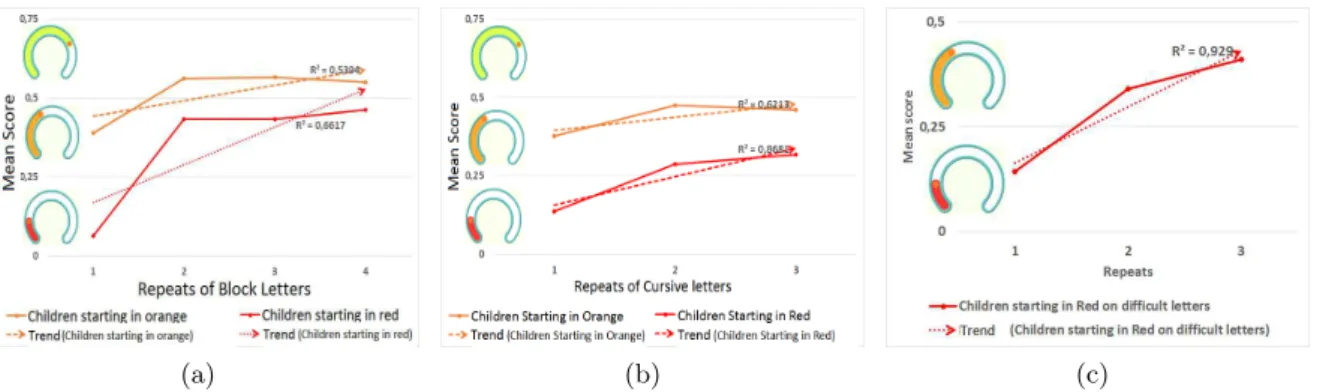
. Among all these records, we extracted a subpart according to the score tuning used (see Table 1). The 111 children in average difficulty for the first repeat of a Block letter produced 299 input, corresponding to mistakes on 21 letters, 481 input were produced by the 117 children in average difficulty on cursive letter. 471 block letters with incorrect feedback were produced by the 149 children in high difficulty, representing 19 different letters. And, 502 cursive letters were produced by the 105 children in high difficulty on 21 different letters. Fig. 3 presents the observed progression of children during the writing repetition of several block letters Fig. 3(a) and cursive letters Fig. 3(b) (initial phase of the cursive writing module). Only Children with difficulties on the first repeat are considered (see Table 1). For block letters, the first repeat corresponds to the letter they initially write in the whole word, then the repeats 2 to 4, are the new trainings they have, to improve their writing. On both figures, we can observe that children improve their scores no matter when the repeats are done (see the linear trend -dashed lines- for each curve). We can also observed that children starting with the lower score reach the average score: increase mean of 0.18 of the score - increase rate 9% for cursive letters, and for block letter: increase mean of 0.39 of the score - increase rate 13%. This progression is also observed when we focus only on the difficult letters (Dumont (2013) see Fig. 3; only the children starting in red are depicted since for the others we do not have enough data - reliability index R2
close to 0). But, when they start in Orange, they reach the good score only for Block letter: increase mean of 0.16 of the score -increase rate 5%. For cursive letter, they -increase their score from 0.08 - -increase rate 4%. These results come from short session (only four/three repeats). In future works we will explore the long-term impact of the approach. Moreover, we will explore several solutions to show children the localisation of their mistakes on their drawings. The following test campaign will be dedicated to this task: test several types of feedback and analyse the impact on children handwriting improvement.
2
https://vimeo.com/142233890; https://vimeo.com/140660028
3
(a) (b) (c)
Fig. 3. Letter writing progression during an exercise: Block letters (a), Cursive letters (b), difficult cursive letters (c)
4. Conclusion
This paper presents part of the IntuiScript notebook. Especially, we have focus on the design and the analysis of two modules: the block letter writing module and the cursive writings module. We presented the analysis engine that allows the child productions to be evaluated according to different skills: shape, direction, and order. With this evaluation, a personalised progression is proposed to each children. As shown in the analysis, the current feedback encourages children in their progression, but it’s maybe not yet sufficient to help them correct all their mistakes. In future works, we will reinforce these feature key. Moreover, several characteristics are not currently considered in the evaluation computation like the pressure and speed. These features are mainly linked to fluency skill, and deserve to be consider in future improvement. The project is ongoing and other modules are currently implement, long-term experiments are also conducted, that will provide more data to be analyzed.
5. Acknowledgments
This work takes place in the context of the 3 years research project IntuiScript, founded by the French government as part of innovative projects (BPI). The authors are grateful to their industrial partners (Script&Go, Microsoft), educational experts, Brittany region and LOUSTIC laboratory.
References
Accardo, A. P., Genna, M., and Borean, M. (2013). Development, maturation and learning influence on handwriting kinematics. Human movement science, 32:136–146.
Chickering, A. W. and Ehrmann, S. C. (1996). Implementing the seven principles: Technology as Lever.
AAHE Bulletin, 49(2):3–6.
Chickering, A. W. and Gamson, Z. F. (1987). Seven principles for good practice in undergraduate education. AAHE Bulletin, 39(7):3–7.
Delaye, A. and Anquetil, E. (2013). Hbf49 feature set: A first unified baseline for online symbol recognition.
Pattern Recognition, 46:117–130.
Dinehart, L. H. (2015). Handwriting in early childhood education: Current research and future implica-tions. Journal of Early Childhood Literacy, 15:97–118.
Dumont, D. (2013). Le syst`eme d’´ecriture des minuscules latines manuscrites en usage dans les ´ecoles
fran¸caises : int´erˆet de la prise en compte de ce syst´eme pour l’enseignement de l’´ecriture manuscrite. PhD thesis, Universit´e Paris-Descartes.
Falk, T. H., Tam, C., Schellnus, H., and Chau, T. (2011). On the development of a computer-based handwriting assessment tool to objectively quantify handwriting proficiency in children. Computer
Methods and Programs in Biomedicine, 103:102–111.
Jolly, C. and Gentaz, E. (2013). Analysis of cursive letters, syllables, and words handwriting in a french second-grade child with developmental coordination disorder and comparison with typically developing children. Frontiers in psychology, 4:1–10.
Jolly, C., Palluel-Germain, R., and Gentaz, E. (2013). Evaluation of a tactile training for handwriting ac-quisition in french kindergarten children: A pilot study. Kindergartens: Teaching methods, expectations
and current challenges, pages 161–176.
Kluger, A. N. and DeNisi, A. (1996). The effects of feedback interventions on performance: A historical review, a meta-analysis, and a preliminary feedback intervention theory. Psycho. Bulletin, 119:254–284. Schickedanz, J. A. (1999). Much More than the ABCs: The Early Stages of Reading and Writing. National
Association for the Education of Young Children.
Shute, V. J. (2008). Focus on formative feedback. Review of Educational Research, 78:153–189.
Simonnet, D., Anquetil, E., and Bouillon, M. (2017). Multi-criteria handwriting quality analysis with online fuzzy models. Pattern Recognition.