MULTIPLE-INPUT MULTIPLE-OUTPUT COMMUNICATIONS SYSTEMS USING RECONFIGURABLE ANTENNAS
XINGLIANG LI
DÉPARTEMENT DE GÉNIE ÉLECTRIQUE ÉCOLE POLYTECHNIQUE DE MONTRÉAL
THÈSE PRÉSENTÉE EN VUE DE L’OBTENTION DU DIPLÔME DE PHILOSOPHIÆ DOCTOR
(GÉNIE ÉLECTRIQUE) AVRIL 2015
c
ÉCOLE POLYTECHNIQUE DE MONTRÉAL
Cette thèse intitulée :
MULTIPLE-INPUT MULTIPLE-OUTPUT COMMUNICATIONS SYSTEMS USING RECONFIGURABLE ANTENNAS
présentée par : LI Xingliang
en vue de l’obtention du diplôme de : Philosophiæ Doctor a été dûment acceptée par le jury d’examen constitué de :
M. CARDINAL Christian, Ph. D., président
M. FRIGON Jean-François, Ph. D., membre et directeur de recherche M. HACCOUN David, Ph. D., membre
DEDICATION
ACKNOWLEDGMENTS
It would not have been possible to complete this thesis without the help of all the kind people around me. I would like to thank the most important person in my life, my beloved wife Ran Cao, for her unconditional support, great patience and immense self-sacrifice. I will forever owe her a debt of gratitude for always having confidence in me, even in the times when I didn’t. I would like to thank my parents, who have given me everything and have supported me all these years. And, I also owe a lot to Hanhan, my daughter, my life joy.
I would like to express my sincere gratitude to my supervisor, Prof. Jean-François Frigon, for his generous support and insightful guidance. His encouragement was invaluable to me during my doctoral study. This thesis would not have seen the light without his help. I would also like to thank the members of my thesis committee, Prof. Christian Cardinal, Prof. David Haccoun and Prof. Paul Fortier, for their valuable comments.
I would like to acknowledge all of my colleagues and friends in Poly-Grames, Diego Perea-Vega, Mohamed Jihed Gafsi, Vida Vakilian, Eddy Dailleux, Liang Han, Xuhua Shen, Ya Deng and Pengyan Zhang, for their suggestions, help and friendship.
RÉSUMÉ
Depuis les années 1990, l’utilisation des systèmes de communications sans-fil à entrées multiples-sorties multiples (MIMO) a été introduit pour fournir des transmissions fiables à grande vitesse. Cette thèse porte sur l’application et l’étude des systèmes MIMO avec des antennes reconfigurables, qui sont ajustable électroniquement pour produire différents diagrammes de rayonnement d’un seul élément d’antenne et ainsi offrir une diversité de diagrammes de rayon-nement. En particulier, nous étudions le comportement de la capacité de canal des systèmes MIMO à sélection de diagrammes de rayonnement (PS-MIMO), et nous proposons aussi des algorithmes de sélection du diagramme de rayonnement atteignant la capacité maximale.
Tout d’abord, nous étudions l’application des antennes reconfigurables dans l’estimation des statistiques spatiales à long terme de canaux spatiaux avec grappes de multi-trajets (clus-ter). Nous proposons un estimateur de spectre de type Capon et une technique d’adaptation de la covariance (COMET) pour estimer conjointement l’angle moyen et l’étalement angu-laire de la grappe spatiale avec des antennes reconfigurables. En second lieu, sur la base des statistiques à long terme du canal MIMO, nous proposons des algorithmes de sélection de di-agramme de rayonnement MIMO (SPS-MIMO) pour atteindre la capacité maximale de canal ergodique. L’analyse de la maximisation de la capacité ergodique du système SPS-MIMO indique que le modèle statistique de sélection fournit des gains supplémentaires en améliorant la puissance du signal reçu et en décorrélant les signaux reçus avec différents diagrammes de rayonnement directionnels. Troisièmement, nous nous concentrons sur le modèle de sélection instantanée des diagrammes de rayonnement MIMO (IPS-MIMO) basé sur des informations instantanées d’état de canal (CSI) afin de maximiser la capacité instantanée pour chaque réalisation de canal. Nous démontrons que l’ordre de diversité des systèmes MIMO peut être multipliée par le nombre de diagrammes de rayonnement avec sélection de diagramme instantanée. Afin d’évaluer la capacité moyenne de l’IPS-MIMO, nous proposons un nouvel algorithme qui permet d’approximer étroitement la moyenne de la valeur maximale de la capacité du canal MIMO avec des trajets arbitrairement corrélés. Nous proposons également un algorithme pour sélectionner instantanément les diagrammes de rayonnement pour at-teindre la capacité moyenne. En outre, sur la base d’une simple expression en forme fermée de la capacité coefficient de corrélation, nous sommes en mesure de proposer un algorithme de sélection de sous-ensemble de diagrammes qui offre un compromis entre performances et la complexité de l’algorithme de sélection.
combinaison de l’utilisation d’antennes reconfigurables et de systèmes MIMO avec soit des algorithmes de sélection de diagramme de rayonnement statistique ou instantanée. La capac-ité des systèmes PS-MIMO à améliorer les performances du système, y compris la capaccapac-ité et de l’ordre de la diversité, est démontrée par l’analyse théorique et des simulations numériques.
ABSTRACT
Since the 1990s, the use of multiple-input multiple-output (MIMO) systems has been intro-duced to modern wireless communications to provide reliable transmission at high data rates. This thesis focuses on the application of MIMO systems with reconfigurable antennas, which are electronically tunable to produce a number of radiation patterns at a single antenna el-ement and provide pattern diversity. In particular, we investigate the capacity performance of the pattern selection MIMO (PS-MIMO) systems, and we also present maximum capacity achieving algorithms for radiation pattern selection.
First, we investigate the application of reconfigurable antennas in estimating long term spatial statistics of spatial clustered channels. We propose a Capon-like spectrum estimator and a covariance matching technique (COMET) to jointly estimate the mean angle and the angular spread of the spatial cluster with reconfigurable antennas. Second, based on the long term statistics of the MIMO channel, we propose statistical pattern selection MIMO (SPS-MIMO) algorithms to achieve maximum ergodic channel capacity. Analysis of the ergodic capacity maximization of the SPS-MIMO indicates that the statistical pattern selection pro-vides additional gains by enhancing received signal power and decorrelating received signals with different directional radiation patterns. Third, we focus on the instantaneous pattern selection MIMO (IPS-MIMO) based on instantaneous channel state information (CSI) in or-der to maximize the instantaneous capacity for every channel realization. We prove that the diversity order of MIMO systems can be multiplied by the number of radiation patterns with instantaneous pattern selection. In order to evaluate the mean capacity of the IPS-MIMO, we propose a novel algorithm which closely approximates the mean of the maximum of the channel capacity of arbitrarily correlated MIMO channels. We also propose an algorithm for instantaneously selecting radiation patterns to achieve the mean capacity. In addition, based on a simple closed-form approximation to the capacity correlation coefficient, we are able to propose a subset pattern selection algorithm which enables the trade-off between performances and complexity.
In conclusion, important extra gains can be obtained as a result of combining the use of reconfigurable antennas and MIMO systems with either statistical or instantaneous radiation pattern selection. The capability of the PS-MIMO to improve system performances, including capacity and diversity order, is demonstrated through theoretical analysis and numerical simulations.
TABLE OF CONTENTS
DEDICATION . . . iii
ACKNOWLEDGMENTS . . . iv
RÉSUMÉ . . . v
ABSTRACT . . . vii
TABLE OF CONTENTS . . . viii
LIST OF FIGURES . . . xi
LIST OF ALGORITHMS . . . xv
LIST OF APPENDICES . . . xvi
LIST OF ACRONYMS AND ABBREVIATIONS . . . xvii
LIST OF SYMBOLS . . . xix
CHAPTER 1 INTRODUCTION . . . 1
1.1 Background and Motivation . . . 1
1.2 Objectives and Methodology . . . 3
1.3 Contributions . . . 4
1.4 Organization of the Thesis . . . 5
CHAPTER 2 LITERATURE REVIEW . . . 7
2.1 Reconfigurable Antennas . . . 7
2.2 Radiation Pattern Diversity in MIMO Systems . . . 8
CHAPTER 3 SYSTEM MODEL AND CHANNEL MODELS . . . 14
3.1 Reconfigurable Antennas for MIMO Systems . . . 14
3.2 System Model of Pattern-Selection MIMO . . . 17
3.3 Modeling Pattern-Selection MIMO Channels . . . 19
3.3.1 Deterministic Modeling . . . 20
3.3.2 Stochastic Modeling . . . 25
3.3.3 Clustered Channel Models . . . 26
3.4 Chapter Summary . . . 34
CHAPTER 4 ESTIMATING PARAMETERS OF CLUSTER CHANNELS FOR RE-CONFIGURABLE ANTENNA ARRAYS . . . 35
4.1 Data Model . . . 36
4.2 Spectrum Methods for Reconfigurable Antenna Arrays . . . 38
4.2.1 Conventional Capon Estimation of DoA . . . 38
4.2.2 Generalized Capon Estimation of DoA and Angular Spread . . . 39
4.2.3 Simulation . . . 40
4.3 Covariance Matching Estimation Techniques for Reconfigurable Antenna Array 42 4.4 Chapter Summary . . . 45
CHAPTER 5 PS-MIMO WITH STATISTICAL SELECTION . . . 46
5.1 Dynamic Radiation Pattern and CRLH-Leaky-Wave Antenna . . . 46
5.2 Capacity of Clustered MIMO Channels with Dynamic Radiation Patterns . . 47
5.2.1 Ergodic Capacity of Kronecker Model . . . 48
5.2.2 Ergodic Capacity Gain of SPS-MIMO . . . 49
5.3 Finding the Optimal Configuration . . . 52
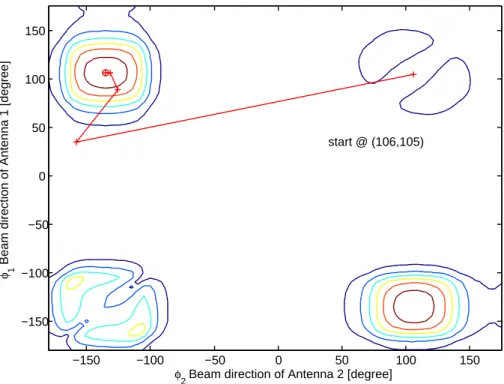
5.4 Numerical Results . . . 54
5.5 Chapter Summary . . . 59
CHAPTER 6 PS-MIMO WITH INSTANTANEOUS SELECTION . . . 60
6.1.1 Diversity Order of Conventional MIMO . . . 61
6.1.2 Diversity Order of IPS-MIMO . . . 65
6.2 Capacity of IPS-MIMO with OSTBC . . . 69
6.2.1 Ergodic Capacity of Conventional OSTBC Systems . . . 69
6.2.2 Gaussian Approximation to the Channel Capacity . . . 72
6.2.3 Expected Value of the Maximum of Correlated Gaussians . . . 73
6.2.4 Capacity Covariance of Two Correlated OSTBC . . . 74
6.2.5 Approximating the Capacity Correlation Coefficients . . . 79
6.3 Capacity of IPS-MIMO with Spatial Multiplexing . . . 84
6.3.1 Incremental Radiation Pattern Selection . . . 84
6.3.2 Subset Radiation Pattern Selection . . . 86
6.3.3 Numerical Results . . . 87
6.4 Chapter Summary . . . 90
CHAPTER 7 SUMMARY AND CONCLUSIONS . . . 91
7.1 Summary . . . 91
7.2 Future Works . . . 93
REFERENCES . . . 94
LIST OF FIGURES
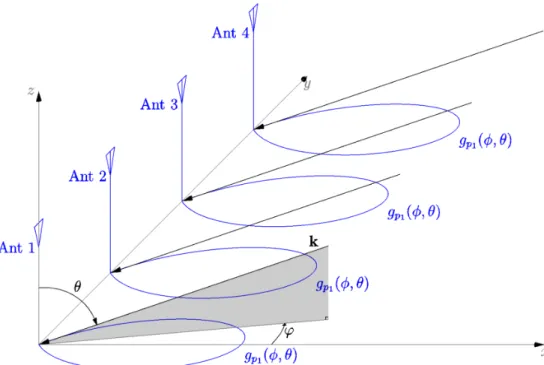
Figure 3.1 A 4-element reconfigurable antenna array is placed along the y-axis. When a plane wave with wavevector k(φ, θ) arrives at the array, the complex response of the n-th element at pattern state np is gnp(φ, θ). 15
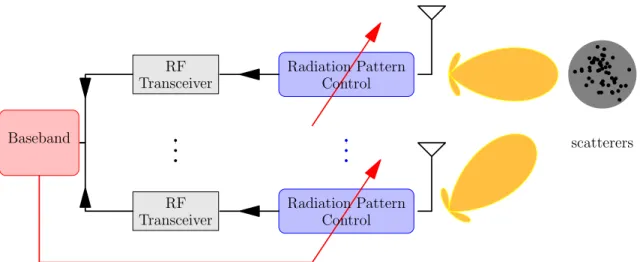
Figure 3.2 System model of PS-MIMO with reconfigurable antennas at the re-ceiver side. . . 17 Figure 3.3 The top view of a MIMO channel in an indoor environment where
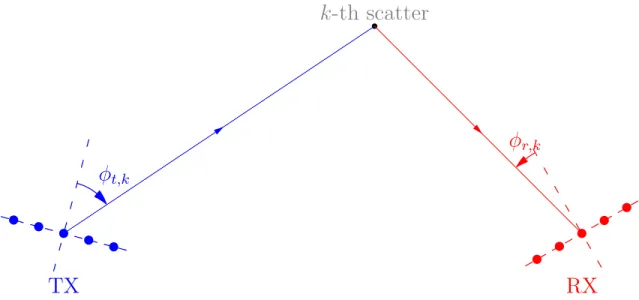
multipath propagation in the elevation angle is assumed negligible. The multipath reflected by the k-th scatterer is shown in the figure, with φt,k, the azimuth DoD, and φr,k, the azimuth DoA, indicated,
respectively. . . 20 Figure 3.4 A cluster-based channel. Clusters are decomposed into a number of
resolvable multipath components and can be viewed differently at either link-end. . . 26 Figure 3.5 A two-cluster channel with the first cluster at (30◦, 135◦) and the second
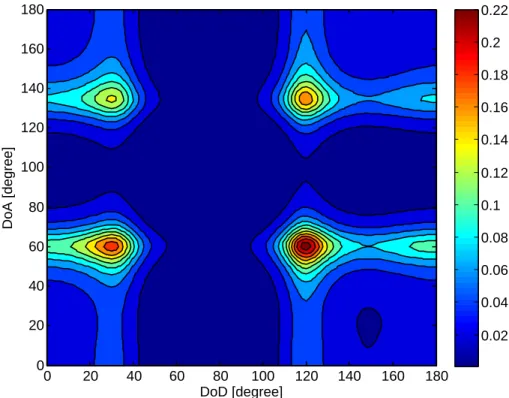
cluster at (120◦, 60◦). Both clusters have the same power. The angular spread of each cluster at either the TX or the RX side is 10◦. These two subfigures illustrate the joint Capon spectrum simulated by a 4 × 4 MIMO system with half-wavelength spaced ULA at both sides. . . . 32 Figure 4.1 Radiation patterns of a reconfigurable CRLH-LWA with 5 pattern
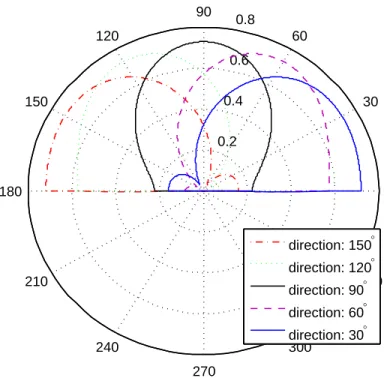
states at the antenna. . . 41 Figure 4.2 The theoretical pseudo spectrum of the generalized Capon estimator
for the mean angle and angular spread of a 1-cluster channel. The mean angle φc = 80◦. The angular spread σc= 12◦. SNR γ = 10 dB. 41
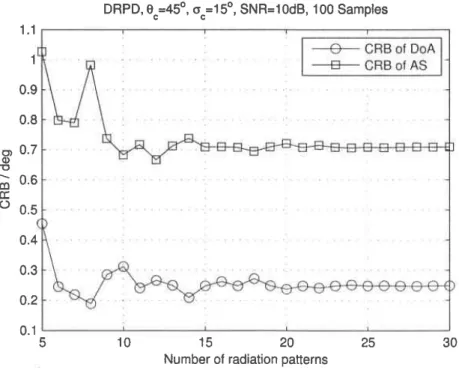
Figure 4.3 Cramer-Rao bound of the mean angle and angular spread of a cluster with a single reconfigurable antenna which has the beamwidth of 60◦. 44
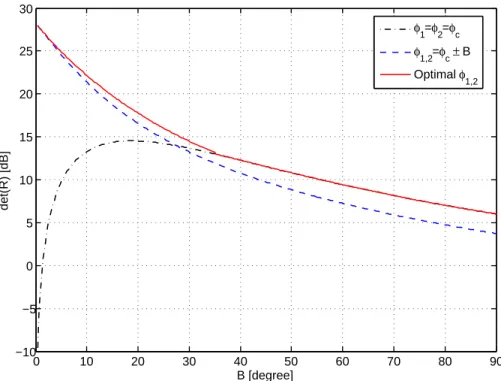
Figure 5.1 The determinant of a (2, 2) MIMO channel correlation matrix R, given different radiation pattern directions when the beamwidth of the ab-stract radiation pattern varies from 0 to 180 degrees. The solid line is the case when the directions are optimized. The dotted line is the case when both directions aim to the mean angle of the cluster. The dashed line is the case with full radiation pattern decorrelation. The cluster parameters are φc= 0◦ and σc = 15◦. Half-wavelength ULA is deployed. 51
Figure 5.2 Impact of the power gain of a SPS-SISO system in 4 different spatial clustered channels. . . 52 Figure 5.3 Search the radiation pattern state maximizing the capacity merit
func-tion with Newton’s method. . . 53 Figure 5.4 Search the radiation pattern state maximizing the capacity merit
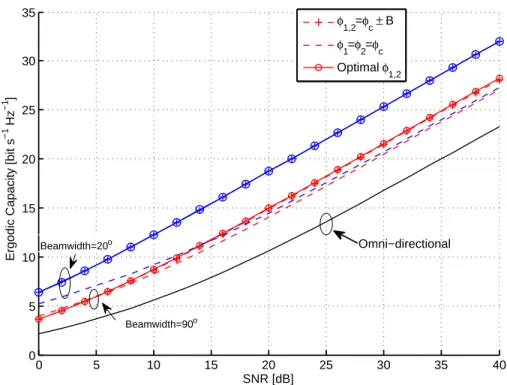
func-tion with grid search. . . 53 Figure 5.5 Ergodic channel capacity of a (2, 2) MIMO system using abstract
dy-namic radiation patterns. The circled lines give the maximum ergodic capacity with optimal radiation patterns. The lines with ‘+’ markers give the ergodic capacity with radiation patterns which fully decor-relate the channel. The dotted lines give the ergodic capacity with radiation patterns aiming to the cluster mean angle to maximize the power gain. . . 55 Figure 5.6 Ergodic channel capacity of a (2, 2) MIMO system deploying dynamic
radiation patterns using CRLH-LWA. The circled line gives the maxi-mum ergodic capacity with optimal radiation pattern directions. The dotted line gives the ergodic capacity with radiation pattern directions aiming to the cluster mean angle to maximize the power gain. . . 56 Figure 5.7 Searching radiation pattern directions that maximize the ergodic
chan-nel capacity of a (2, 2) SPS-MIMO using two 8-cell CRLH-LWA’s. SNR=10 dB. . . 57 Figure 5.8 Searching radiation pattern directions that maximize the ergodic
chan-nel capacity of a (2, 2) SPS-MIMO using two 20-cell CRLH-LWA’s. SNR=10 dB. . . 58
Figure 5.9 Ergodic channel capacity of a two-cluster MIMO channel using 20-cell CRLH-LWA’s at the receiver and omni-directional antennas at the transmitter. The mean angles are φc= [0◦, 60◦] and the angle spreads
are σc = [15◦, 15◦]. . . 59
Figure 6.1 Simulated and bounds of the outage probability of (2, 2) conventional MIMO systems over Rayleigh fading channels versus rate. γ = 0 dB. 64 Figure 6.2 Simulated and bounds of the outage probability of (2, 2) conventional
MIMO systems over Rayleigh fading channels versus SNR. r = 1 bit/s/Hz. 64 Figure 6.3 Simulated outage probability of a (1, 1|4) IPS-SISO system with
orthog-onal radiation patterns versus rate. Ideal scattering at the transmitter and receiver. γ = 0 dB. . . . 67 Figure 6.4 Impact of the number of orthogonal radiation states, P , per receive
antenna, on the outage probability of (1, 1|P ) IPS-SISO versus SNR curves. Ideal scattering at the transmitter and receiver. r = 8 bit/s/Hz.
. . . 68 Figure 6.5 Simulated outage probability of a (2, 2|2) IPS-MIMO versus SNR. ULA
with half-wavelength spacing at the transmitter and receiver. Ideal scattering. γ = 10dB. . . . 68 Figure 6.6 Approximated ergodic capacity of correlated IPS-OSTBC. The cluster
configuration is TGn Model A. Each receive antenna can provide 4 radiation patterns with beamwidth=120◦, equally spaced from 0◦ to 180◦. . . 76 Figure 6.7 Approximated ergodic capacity of correlated IPS-OSTBC. The cluster
configuration is TGn Model B. The deployed reconfigurable antennas are the same as Fig. 6.6. . . 77 Figure 6.8 Approximated ergodic capacity of correlated IPS-OSTBC. The cluster
configuration is TGn Model C. The deployed reconfigurable antennas are the same as Fig. 6.6. . . 77 Figure 6.9 Approximated ergodic capacity of correlated IPS-OSTBC. The cluster
configuration is TGn Model D. The deployed reconfigurable antennas are the same as Fig. 6.6. . . 78 Figure 6.10 Impact of various approximations to the capacity correlation coefficient
Figure 6.11 Approximated ergodic capacity of correlated IPS-MIMO . . . 85 Figure 6.12 Example of the subset selection of radiation patterns. Radiation
pat-terns corresponding to weak or highly-correlated branches are removed. 86 Figure 6.13 Channel capacity CDF of a (2, 2|4) IPS-MIMO system. The antennas
are surrounded by ideal scattering environments and separated by half wavelength. . . 88 Figure 6.14 Mean capacity of a (2, 2|4) IPS-MIMO system in a one-cluster spatial
channel. The antennas are separated by half wavelength. . . 89 Figure 6.15 Channel outage probability of a (2, 2|4) IPS-MIMO system ina
LIST OF ALGORITHMS
6.1 Incremental radiation pattern selection . . . 84 6.2 Subset radiation pattern selection . . . 87
LIST OF APPENDICES
Appendix A DISTRIBUTION OF kHk2F OVER NAKAGAMI FADING CHANNELS100 Appendix B COVARIANCE OF THE CAPACITY OF TWO CORRELATED MIMO
OSTBC SYSTEMS OVER RAYLEIGH FADING CHANNELS . . . . 103 Appendix C V-BLAST SYSTEMS WITH RECONFIGURABLE ANTENNAS . . 106
LIST OF ACRONYMS AND ABBREVIATIONS
3GPP third generation partnership project AS angle spread = azimuth spread AWGN additive white Gaussian noise BER bit error rate
BPSK binary phase-shift key
BS base station
CDF cumulative distribution function CDMA code division multiple access CIR channel impulse response
CRLH-LWA composite right/left-handed leaky-wave antenna CSI channel state information
D-BLAST diagonal Bell Labs layered space-time DFT discrete Fourier transform
DoA direction-of-arrival DoD direction-of-departure DoF degree of freedom EGC equal gain combining
ESPAR electronically steerable parasitic radiator EVD eigenvalue decomposition
FER frame error rate FET field-effect transistor iff if and only if
i.i.d. independent and identically distributed ISI inter symbol interference
LOS line of sight
LWA leaky-wave antenna
MEMS micro-electromechanical systems MGF moment generating function MIMO multiple-input multiple-output
ML maximum likelihood
MLSE maximum-likelihood sequence estimation MMSE minimum mean square error
MSE mean square error
OFDM orthogonal frequency division multiplexing OSIC ordered successive interference cancellation OSTBC orthogonal space-time block code
PAS power azimuth spectrum PDF probability density function PDP power delay profile
PEP pairwise error probability
RF radio frequency
RMS root mean square
Rx receiver
SCM spacial channel model SER symbol error rate
SINR signal-to-interference-and-noise ratio SISO single-input single-output
SM spatial multiplexing SNR signal-to-noise ratio STBC space-time block code
SVD singular value decomposition
Tx transmitter
ULA uniform linear arrays
V-BLAST vertical Bell Labs layered space-time WLAN wireless local area networks
LIST OF SYMBOLS
, variable definition E[·] expectation operator ⊗ Kronecker product
Hadamard (element-wise) product
R real field C complex field a, α scalar a column vector A matrix AT matrix transpose
AH matrix conjugate transpose (Hermitian) A− generalized matrix inverse
det A determinant of A trA trace of A
kAkF Frobenius norm of A
vec (A) stacks A columnwisely into a column vector unvec (a) restore the vector a to the original matrix r(A) rank of A
0m×n zero matrix
d·e ceiling operator b·c floor operator
CHAPTER 1
INTRODUCTION
1.1 Background and Motivation
Since the 1990s, the use of multiple transmit and receive antennas has been introduced to modern wireless communications. Computer simulations and theoretical analysis presented in the pioneering works by Winters [1] and Telatar [2] have shown that, by deploying these multiple-input multiple-output (MIMO) systems, the spectral efficiency in a point-to-point communication scenario can be increased linearly with the number of antennas. Therefore, MIMO is regarded as an essential technical breakthrough which serves as a promising solution to the ever increasing demand for high data rates in future wireless communications.
In general, a multidimensional MIMO system can provide two types of performance gains: the space diversity gain and the spatial multiplexing gain. A MIMO system with Nt transmit and Nr receive antennas can create NtNr space diversity branches between the
transmit and receive antenna ports. When the propagation channel is in deep fading, these branches can be exploited to improve system robustness. By transmitting and/or receiv-ing replicated data symbols over different antennas, which is known as space diversity, the possibility of a transmission failure is significantly reduced because some symbol replica may undergo deep fades while others may not. The error probability of this space diversity system decreases exponentially by the number of combined diversity branches, i.e. , the diversity or-der. A classical example of an efficient space diversity is space-time coding, which has been applied in wireless communication systems [3, 4]. Under circumstances where the channel is not in a deep fade, MIMO systems can also be used to increase the data rate by means of spatial multiplexing techniques. MIMO systems over spatially uncorrelated channels can support min(Nt, Nr) independent spatial channels [5]. By dividing the transmission symbol
stream into multiple parallel substreams and transmitting each substream via a separate spa-tial channel, the transmission data rate is increased by the number of spaspa-tial subchannels. Indeed, it has been theoretically proven that the ergodic channel capacity of a spatial mul-tiplexing MIMO system increases linearly with the number of independent parallel spatial channels supported by the MIMO system, which is known as the degree of freedom [2]. The vertical Bell Laboratories layered space-time architecture (V-BLAST) is a famous example of spatial multiplexing [6]. Provided that the number of receive antennas is no less than the
number of transmit antennas, V-BLAST transmits parallel symbol streams over the transmit antennas, and the receive antennas are used for demultiplexing the different symbol streams at the receiver. The data rate of V-BLAST is therefore multiplied by the number of transmit antennas.
However, the space diversity gain and the spatial multiplexing gain of a MIMO system can not be maximized simultaneously. For example, a typical spatial multiplexing system provides no spatial diversity gain whereas a space-time code which achieves full space diver-sity reduces the achievable spatial multiplexing gain. Though spatial multiplexing is more attractive to obtain higher data rate than space diversity, the performance of a full spatial multiplexing system suffers from fading, particularly, in the low signal-to-noise (SNR) regime. Therefore, it is necessary in this case to reserve some of the available spatial resources for diversity to guarantee reliable transmission, which is known as diversity-multiplexing trade-off. In [7], the optimal diversity-multiplexing tradeoff curves for some certain transmission schemes are derived, verifying that higher space diversity gain comes at the price of sacrificing spatial multiplexing. Spatial correlation is another negative factor which prevents from fully exploiting the theoretically promising advantages of MIMO systems, especially in the high SNR regime. Propagation channels are usually spatially correlated to various degrees because homogeneous scattering is an ideal and unrealistic assumption in most real-world channels. Furthermore, the physical dimension of handheld devices is often limited and results in high correlation between closely spaced antenna elements. Hence the number of available spatial resources is restricted by spatial correlation which is introduced both over the air and at the antenna side. In an extreme case, a “keyhole” correlated MIMO channel provides one degree of freedom [8], causing severe capacity losses in the high SNR regime comparing to spatially uncorrelated channels [9].
Having acknowledged that increasing the transmission reliability of MIMO systems by adding space diversity sacrifices the spatial multiplexing gain, a growing community of re-searchers have extended their scopes from only using the variation of fading channels to directly manipulating the antenna itself to provide diversity, which had been the most ig-nored part in MIMO technologies, until recently, for overcoming the challenges aforemen-tioned. Space diversity mentioned above is an antenna diversity technique. Other antenna diversity techniques include polarization diversity and pattern diversity. Unlike space diver-sity which takes advantages of multipath fading in the space domain with separately spaced multi-element arrays, polarization diversity systems transmit signals with orthogonal po-larizations of antennas, and pattern diversity provides orthogonality by producing spatially disjoint radiation patterns. For example, multi-mode antennas can generate pattern diversity by transmitting signals via orthogonal modes [10]. The multi-mode antenna MIMO produces
diversity without being separated by a physical distance and the system performance is com-parable with conventional MIMO systems, which proves that space diversity can be replaced by pattern diversity. Therefore, it is possible to utilize pattern reconfigurable antennas in a spatial multiplexing MIMO system to achieve full spatial multiplexing gain while obtaining pattern diversity for reliable transmission.
This thesis is a contribution to the application of radiation pattern reconfigurable an-tennas in MIMO wireless communication systems. Reconfigurable anan-tennas are switchable or tunable to produce a number of radiation patterns and provide pattern diversity. In the low SNR regime, the pattern diversity can provide additional diversity to guarantee reliable transmission. In the high SNR regime, the additional pattern diversity can be utilized to replace space diversity so that full spatial multiplexing gain is maintained without adding more antennas.
1.2 Objectives and Methodology
The general objective of this research is to analyze performances of MIMO systems with pattern reconfigurable antennas deployed at the receive side in wireless communications over flat or block fading channels. The methodology of this research is based on the analysis of system performance of MIMO with pattern reconfigurable antennas, assuming perfect channel state information (CSI) at the receiver side.
In the first part of this research, the system model of pattern selection MIMO (PS-MIMO) and the channel modeling with reconfigurable antennas are provided as the prerequi-sites for analyzing the system performance and designing selection algorithms for PS-MIMO. The second part of this thesis investigates channel estimation techniques with recon-figurable antennas. Either full or partial channel state information (CSI) is necessary for analyzing system performances of PS-MIMO systems and designing pattern selection algo-rithms.
After obtaining channel parameters by estimation with reconfigurable antennas, the major part of this research then focuses on the design of selection algorithms and the analysis of system performances of PS-MIMO. The radiation pattern of a reconfigurable antenna can be electronically manipulated in real time. The PS-MIMO system selects a proper set of radiation patterns for the reconfigurable antennas to achieve certain kinds of performance gains. According to the selection method, there are two categories of PS-MIMO systems: the statistical selection and the instantaneous selection. The statistical pattern selection MIMO (SPS-MIMO) system configures the reconfigurable antennas based on a long-term channel
statistics. And statistical pattern selection algorithms should be designed according to long-term statistical performance criteria.
The instantaneous pattern selection MIMO (IPS-MIMO) system configures the recon-figurable antennas based on instantaneous full channel state information (CSI). And instan-taneous pattern selection algorithms should be designed according to instaninstan-taneous perfor-mance criteria.
In summary, the specific objectives of this research include:
• A mathematical model of PS-MIMO systems and models of MIMO channels with re-configurable antennas.
• Finding techniques to estimate channel parameters of MIMO channels modeled by the spatial channel model with reconfigurable antennas.
• Developing pattern selection algorithms and providing performance analysis for SPS-MIMO systems.
• Developing pattern selection algorithms and providing performance analysis for IPS-MIMO systems.
1.3 Contributions
This thesis is a contribution to the application of radiation pattern reconfigurable antennas in MIMO wireless communication systems. Our contributions in this thesis are listed as follows:
• We propose to use a pattern reconfigurable antenna array for estimating statistical parameters of spatial clustered channels. A novel channel model is proposed to remove the non-existent phantom clusters in the widely used Kronecker channel model. A MUSIC based direction of departure (DoD) estimation is proposed for mean angles of the clustered channel with pattern reconfigurable arrays. For the estimation of both the mean direction and the angular spread of the clustered channel, the covariance matching technique (COMET) is applied.
• We propose to use the statistical pattern selection (SPS) in MIMO systems over spa-tially correlated flat fading channels. An upperbound on the ergodic channel capacity of this SPS-MIMO system is calculated. Based on the upperbound, an exhaustive search-ing algorithm is proposed to find the radiation patterns of the reconfigurable antenna for
maximizing the ergodic channel capacity. A fast radiation pattern searching algorithm based on Newton’s method is also proposed. The searching algorithms are validated with an actual pattern reconfigurable antenna, the composite right/left-handed leaky wave antenna (CRLH-LWA), as a demonstration.
• We propose to use the instantaneous pattern selection (IPS) in MIMO systems over spa-tially correlated flat fading channels. An accurate approximation to the ergodic channel capacity of IPS-OSTBC with arbitrarily correlated radiation patterns is proposed. A complexity reduced pattern selection algorithm for IPS-OSTBC and IPS-MIMO is pro-posed.
1.4 Organization of the Thesis
This thesis is divided into seven chapters. Chapter 1 is the introduction to this research and thesis, which provides an overview of the research background, objectives and contributions. The following part of this thesis is organized as follows.
In Chapter 2, a literature review is given concerning research results on reconfigurable antennas, pattern diversity MIMO systems and system performance analysis of instantaneous antenna selection for MIMO systems.
In Chapter 3, the reconfigurable antenna is briefly introduced and the system model of the PS-MIMO systems equipped with reconfigurable antennas is presented. General PS-MIMO channel models are presented in terms of both deterministic and stochastic ap-proaches. The spatial cluster channel models for PS-MIMO are discussed for future eval-uation. A spatially correlated MIMO channel model, the sum-Kronecker mode is proposed to generate channel matrices. This channel model is as easy to use as the Kronecker model but it is able to avoid artificial clusters. So it is particularly useful in verifying estimation algorithms for cluster parameters in multi-clustered MIMO channels.
In Chapter 4, a study of estimating the channel parameters of spatially clustered channels with a reconfigurable antenna array are presented. A subspace based method is examined for estimating the direction of arrivals (DoA) with reconfigurable antennas. A Capon-like spectrum estimator is proposed to jointly estimate the mean angle and angular spread of a clustered channel. The covariance matching technique for estimating the mean angle and angular spread is also discussed.
In Chapter 5, algorithms for maximizing the ergodic channel capacity of PS-MIMO systems with statistical pattern selection over spatially correlated Rayleigh fading channels are proposed. The ergodic channel capacity of the proposed selection algorithm is evaluated
by numerical simulations. Analysis of the ergodic channel capacity maximization problem for statistical selection is also included.
In Chapter 6, we focus on the instantaneous channel capacity performance of PS-MIMO systems with instantaneous pattern selection over spatially correlated Rayleigh fading chan-nels. For every channel realization, the radiation patterns of the receiving antennas are selected to maximize the instantaneous channel capacity. The ergodic channel capacity of the instantaneous selection system is then studied based on an approximation of the capac-ity distribution. Algorithms aiming to select radiation patterns which maximizes the ergodic capacity of the instantaneous selection system are presented.
CHAPTER 2
LITERATURE REVIEW
In this chapter, recent research results related to pattern diversity in MIMO systems are reviewed. The first section will give a brief introduction to the current progress in reconfig-urable antennas. In the second section, we will present a literature survey on the application of radiation pattern reconfigurable antennas in MIMO communication systems. In the last section, we go over research results on antenna selection diversity in MIMO systems, a prob-lem which exhibits some similarities with pattern diversity.
2.1 Reconfigurable Antennas
Radiation characteristics of antennas are traditionally assumed fixed at certain operating fre-quencies. Recently, microwave researchers have developed reconfigurable antennas to provide more possibilities. A reconfigurable antenna can intentionally alter its operating frequen-cies, impedance bandwidths, polarizations, and/or radiation patterns. Our research interests mainly focus on the application of radiation pattern reconfigurability in MIMO systems. Throughout this thesis, unless otherwise stated, we use the term “reconfigurable antenna” to refer to “radiation pattern reconfigurable antenna” for convenience.
Changing radiation patterns while keeping the operating frequency and bandwidth could greatly enhance system performances. Manipulating the radiation pattern of an antenna can be used to avoid interfering sources or improve transmission efficiency. The antenna radiation pattern is determined by the distribution of electric or magnetic currents on the radiating structure. Changes to the current distribution can be achieved by altering the physical or effective structure of the radiating structure or by changing the electrical characteristics of the radiating structure. The most common radiation pattern reconfiguration techniques are implemented by electric switches or variable reactive loading [11]. Depending on whether the tunable component of the reconfigurable antenna provides discrete or continuous changes, antenna reconfiguration techniques are classified into two categories: discrete tuning and continuous tuning. The discrete tuning provides a small number of radiation patterns while the continuous tuning can ideally excite infinite number of radiation patterns at the antenna port.
field-effect transistors (FET) which switch between the “ON” state and “OFF” state. Piazza proposed to adjust the effective electric length of a dipole antenna with a PIN diode to switch between two distinct radiation patterns while keeping the operating frequency [12]. The radio-frequency microelectromechanical system (RF-MEMS) is another widely used switching component for radiation pattern reconfigurability. Petit designed a three-element parasitic-antenna array with two RF-MEMS switches which alter the length of the loading stubs to obtain reconfigurable radiation patterns [13]. In [14], Grau designed a pixel antenna which uses a multifunctional MEMS-reconfigurable radiator capable of producing up to five distinct radiation patterns.
The continuous tuning allows smooth changes in the antenna’s radiation pattern. For instance, in 1978, Harrington proposed a parasitic dipole array in which the driven dipole element are surrounded by parasitic dipoles loaded with tunable reactances [15]. Varying the loading reactance of each parasitic element leads to changes to the apparent magnitude and phase of the signal on each array element and results in a directive beam in a desired direction. This electronically steerable parasitic radiator (ESPAR) antenna can provide continuous steerable radiation pattern [16]. However, limited by the element spacing and size, the ESPAR can not provide high-directive pattern and can not be easily used in MIMO systems. Another example of continuously tuned reconfigurable antennas is the composite right/left-handed leaky-wave antenna (CRLH-LWA). Caloz [17] proposed a CRLH-LWA design which consists of a periodic structure composed of cascaded CRLH microstrip unit cells with tunable varactors. The antenna can be continuously tuned to control the phase of the signal at each cell so that a directional radiation pattern is continuously steerable from backfire to endfire. Piazza in [18] proposed another CRLH-LWA structure of a compact size so that the antenna is more applicable in MIMO systems.
2.2 Radiation Pattern Diversity in MIMO Systems
Radiation pattern diversity in MIMO systems can improve the wireless communication per-formance in rich scattering environments. But system capacity and reliability suffers when the transmission channel is in deep fading or highly correlated. Since the propagation channel in the wireless medium is fixed by the given environment and out of control of the communi-cation system, reconfiguring the radiation patterns of the antennas is an effective mechanism to change the propagation characteristics of the channel between the antenna ports at the transmitter and receiver side so that better performance can be achieved over the altered wireless channel. This is the fundamental idea of radiation pattern diversity.
(DRPD).
Recently, polarization diversity, pattern diversity and multi-mode diversity have been studied to combat fading and improve system performances. [20] and [21] proposed to utilize different antenna radiation patterns in clustered MIMO channels to improve channel capacity by increasing the channel gain and/or reducing spatial correlation. But these schemes are unable to provide selection diversity. [22] proposed a real-time radiation pattern selection scenario for orthogonal space-time coding (OSTBC) systems. The authors proved that if P disjointed radiation patterns are used, the diversity order in terms of average error probability is multiplied by P fold. But this result is only valid for spatially uncorrelated MIMO channels. Antennas are the key elements in wireless communication systems. Over the years, the operating characteristics of antennas such as their polarizations and radiation patterns have been assumed to be fixed at their operating frequencies. Though a phased array can produce a steerable radiation pattern, the operating characteristics of a single element in the array do not change. As discussed in Section 2.1, electronic engineers have recently developed reconfigurable antenna elements with one or some of their operating characteristics adjustable by mechanical or electrical method.
The major challenge of a wireless communication link is the uncertainty of the propaga-tion environment which varies from time to time and from locapropaga-tion to locapropaga-tion. The varying nature of the wireless propagation environment is the key problem of wireless communica-tions. MIMO systems can linearly increase the data rate by transmitting data streams over multiple antennas, i.e, spatial multiplexing. MIMO systems can also improve the link relia-bility by properly combining radio signals transmitted or received over different antennas, i.e, space diversity. However, it is not possible for a MIMO system to achieve maximum mult-plexing gain and full diversity at the same time with conventional static antennas. When the wireless channel undergoes strong fading, we have to sacrifice the multiplexing gain to provide more diversity. Furthermore, in indoor or urban wireless communication environments, the degree of freedom and diversity gain deteriorates due to the spatial correlation of the channel. And, because of the limited size of mobile terminals, closely spaced antennas make the MIMO channels even more correlated and therefore deteriorate system performances. Recently, sev-eral novel antennas providing DRPD have been designed, such as the CRLH-LWA with fully steerable directional radiation patterns and switchable micro-electromechanical systems (MEMS) antennas. For each antenna element, we can adjust its radiation pattern to fit the current instantaneous or long-term radio propagation channel characteristics and provide pattern diversity gain. As a consequence, we can replace space diversity by pattern diversity such that more spatial subchannels can be used to reliably transmit parallel data streams
and therefore increase the date rate. On the other hand, carefully adjusting the radiation patterns of different antennas may reduce channel correlation and improve multiplexing gain and diversity order. Therefore, it is proposed to deploy DRPD antennas in MIMO systems (DRPD-MIMO) over correlated channels such as indoor and urban environments.
The reconfigurability of antennas enables the capability of altering the propagation char-acteristics of the wireless channel between the transmitter and the receiver. Decades ago, wireless engineers began to use beamforming techniques to achieve similar features with an-tenna arrays consisting of monopoles or dipoles. However, a beamforming anan-tenna array is not reconfigurable because its multiple antenna elements cannot change their operating characteristics.
The reconfigurability is most useful for devices with restricted space to install several antenna elements. A typical application is a single-element portable device, such as cell phones or laptops, which are limited both in size and battery power. A monopole or strip antenna is usually used with a fixed radiation pattern to provide omnidirectional coverage. In this case, if a reconfigurable antenna with its radiation pattern redirected to the direction of radio signals was used, the wireless device will then be able to use its battery power more efficiently.
In the uplink, it can either achieve higher data rate or improve the transmission relia-bility in poor propagation environments (deep fades) at no extra transmitting power. Or, the battery power assumption of the portable device can be significantly reduced without sacrificing transmission performances. In the downlink, it can also mitigate deep fades and interference from other users and therefore improve the signal-to-interference-plus-noise ratio (SINR).
In a multiple antenna scenario, radiation pattern reconfigurability introduces another degree of freedom which can be used to improve the diversity-multiplexing compromise. That is, the system can maintain its maximum spatial multiplexing gain given by the number of receive/transmit antennas, while increasing the diversity gain limited by the degree of reconfiguration provided by each antenna element.
In [23], it is suggested that by using reconfigurable directional antennas the MIMO channel capacity in indoor multipath environments can be improved by channel decorrelation as well as a directional gain. But these works are just showcases of exploiting the great potential of pattern diversity, and no quantitative performance analysis is given. In [20], the benefit of pattern diversity in a two-element circular patched antenna (CPA) array is analyzed. An upper bound of ergodic channel capacity is derived and the error performance of a practical system using Alamouti scheme is given.
It is shown in [24] that the capacity of MIMO systems can be increased over correlated fading channels by decorrelating with reconfigurable radiation patterns. It is in [25] that for the first time a theoretical analysis on the error performance gain offered by a reconfigurable MIMO system using Orthogonal Space-Time Block Codes (OSTBC) is derived. It is proved that with orthogonal radiation patterns the diversity order of the system is the product of the number of the transmit antennas, the number of the receive antennas and the number of available radiation pattern states. Furthermore, it was also observed that correlated radia-tion patterns degrades system performances comparing to systems with orthogonal radiaradia-tion patterns. Channel estimation of the reconfigurable MIMO system is also discussed in [25].
However, recent researches of theoretical analysis on the performance gain of pattern diversity in MIMO systems is quite limited and how to select radiation patterns to maximize system performances is still an open problem.
2.3 Antenna Selection in MIMO Systems
In this section, we summarize existing literature on the application of antenna selection in MIMO systems. The radiation pattern selection is more complicated than antenna selection and these two selection schemes differ greatly for the antenna selection switches between the geometry locations of antenna elements while the radiation pattern selection switches between the radiation characteristics. However, it is still worthy of discussing the methodologies and system configurations of antenna selection.
Antenna selection in MIMO systems is proposed to reduce system cost by using fewer radio frequency (RF) chains than full MIMO systems. Antenna selection schemes for opti-mizing the capacity performance are proposed in [26–28]. In [26], the MIMO channel capacity of selecting a single receive antenna in MIMO systems under fading channels with correlation at the receiver side is considered. A closed-form expression for the outage probability and an upper bound for the ergodic capacity of such system is derived by analyzing the joint cumulative distribution function and the joint probability density function of the squared row norms of the channel matrix with moment methods. It is demonstrated that antenna selection based on maximizing the squared row norms of the channel matrix achieves a full diversity order that is similar to a full MIMO system without antenna selection. Antenna subset selection algorithms maximizing capacity of uncorrelated channels are discussed in [27] and [28].
[27] establishes the equivalence in diversity order between the full MIMO system and the antenna selection system by analyzing the outage characteristics. It is also proved in [27]
that the channel capacity is statistically lower bounded by the capacity of a set of parallel independent SIMO channels each with selection diversity. The proposed subset selection scheme achieves near optimal performance with low complexity. [28] derived an upper bound on the capacity based on the analysis of the joint statistics of the ordered SNR’s, as the sum of the logarithms of ordered chi-square distributed variables based on the analysis of the joint statistics of the ordered SNR’s. In [28], it is suggested that maximizing the rank and the singular values of the correlation matrix of the channel maximizes the capacity. The subset selection scheme proposed in [28] chooses two rows for the possible deletion whose correlation is the highest and delete the one with the lower power.
Low complexity antenna selection schemes aiming to capacity maximization in correlated MIMO channels are discussed in [29] and [30]. The proposed selection scheme in [29] is given based on the lower and upper bounds of the ergodic capacity with long-term channel statis-tics. The proposed selection algorithm applies a suboptimal sequential-selection approach instead of the exhaustive search. In [30] the low complexity selection scheme is proposed based on the theory of convex optimization and selection schemes for minimum mean square error (MMSE) and ordered successive interference cancellation (OSIC) V-BLAST receivers of spatial multiplexing MIMO systems are given.
Antenna selection schemes for improving system reliability are proposed in [24, 31–33]. In [31], the upper and lower bounds of the diversity order achieved by transmit antenna se-lection for spatial multiplexing systems in uncorrelated Rayleigh fading channels with linear receivers are given. [24] proposes an antenna selection scheme by maximizing instantaneous SNR. With this selection scheme the OSTBC-MIMO system achieves near optimal error rate performance in correlated Rayleigh channels with less complexity. [32] proposes a subset se-lection scheme to improve the array gain and adapting OSTBCs to any number of transmit antennas and to maximize the conditional SNR and minimize the instantaneous probability of error. [33] proposes transmit antenna selection and constellation selection for spatial multi-plexing MIMO system for a given target data rate by maximizing the minimal post-processing SNR and maximizing the lower bound for a given outage data rate. In [34], antenna selection for spatial multiplexing multi-user MIMO systems in correlated spatial channels with linear and OSIC receivers are investigated. The selection algorithms are designed to maximize the sum rate or minimize the total power. Channel estimation issues for antenna selection are also considered and a training sequence signals in the preamble is proposed. [31] proposed a geometrical framework theoretically analyze the diversity order achieved by transmit antenna selection for separately encoded spatial multiplexing systems with linear and decision- feed-back receivers. When two antennas are selected from the transmitter, the exact achievable diversity order is rigorously derived, which previously only appeared as conjectures based
on numerical results in the literature. If more than two antennas are selected, lower and upper bounds on the achievable diversity order are available. Furthermore, the same geo-metrical approach is used to evaluate the diversity-multiplexing trade-off curves for spatial multiplexing systems with transmit antenna selection.
CHAPTER 3
SYSTEM MODEL AND CHANNEL MODELS
In MIMO communications systems, the radio channel is one of the dominating factors which determine the characteristics of the entire system. Therefore, a proper channel model is a crucial precondition and guarantee to the system design. It helps to understand the system behavior and serves as a channel simulator so that system performances, including the channel capacity and the transmission error rate, can be reliably tested and fairly evaluated.
Wireless channels consists of the free space propagation environment and the anten-nas. Though the former has been addressed by a lot of published researches, the impact of the antenna part, apart from the antenna gain, is often ignored and the potential of the reconfigurability of antenna radiation characteristics usually neglected. Recent researches have discovered that deploying reconfigurable antennas in MIMO communication systems is a promising solution to the demand of high performance wireless communications over correlated channels on handhold devices where the antenna spacing is limited.
In this chapter, we first introduce the concept of antenna reconfigurability and the mathematical description of reconfigurable antennas and reconfigurable antenna arrays in Section 3.1. In Section 3.2, we propose the system model for a pattern-selection MIMO (PS-MIMO) wireless communication system and discuss its working mechanism. In the last section, we expand conventional MIMO channel modeling techniques to PS-MIMO channel modeling. In this section, a generic deterministic channel model with geometric parameters and a generic stochastic channel model for PS-MIMO systems are discussed. By assuming PS-MIMO over spatially clustered channels, we propose the Kronecker model and the sum-Kronecker model for PS-MIMO channels, both of which can be described by cluster statistics. The Kronecker model will be used for simulation and system performance analysis in future chapters. The sum-Kronecker model, which avoids spatial aliasing, will be used for simulation and analysis of channel estimation with PS-MIMO.
3.1 Reconfigurable Antennas for MIMO Systems
Each possible configuration with which a reconfigurable antenna can radiate distinct radiation patterns is called a pattern state. We denote the reconfiguration parameter by p, which can be either discrete or continuous, depending on whether it is switching-based or tuning-based.
Figure 3.1 A 4-element reconfigurable antenna array is placed along the y-axis. When a plane wave with wavevector k(φ, θ) arrives at the array, the complex response of the n-th element at pattern state np is gnp(φ, θ).
For the discrete case , without loss of generality, we assume that p ∈ {1, . . . , P } where P is the number of distinct pattern states to which the antenna can be configured. For the continuous case , the range of p is the direct product of the range of the reconfiguration parameter of each tunable element. However, we can convert the continuous case to the discrete case by making P samples from the reconfiguration parameter range so that the continuous case is reduced to the discrete case with P pattern states for selection. For conciseness, we abuse the use of the notation p and do not distinguish between the pattern state, the reconfiguration parameter and the numbered index of the reconfiguration parameter. With these notations, we denote the radiation pattern function of the reconfigurable antenna at the pattern state p by gp(φ, θ), where φ and θ are the azimuthal and elevation angle, respectively.
Consider an antenna array equipped with N reconfigurable antennas. Without loss of generality, we assume that radiation characteristics of the reconfigurable antennas in the array are identical and each antenna has P pattern states. We define the pattern vector of the array by
g(φ, θ; ψ) = [gp1(φ, θ) gp2(φ, θ) · · · gpN(φ, θ)]
T (3.1)
3-dimensional complex radiation pattern. We use a N -digit and P -ary number
ψ = (p1p2. . . pN)P (3.2)
to represent the radiation states configured at all the antennas in the array.
The array response of the reconfigurable array at the array state ψ to a plane radio wave at the solid angle (φ, θ) is referred to as the array response vector, denoted by a(φ, θ; ψ). The array response vector is given by the Hadamard product (element-wise product) of the steering vector v(φ, θ) and the pattern vector g(φ, θ; ψ):
a(φ, θ; ψ) = v(φ, θ) g(φ, θ; ψ). (3.3) The steering vector, which is given by
v(φ, θ) =he−jkTr1 e−jkTr2 · · · e−jkTrNiT , (3.4)
contains phases of signals excited by a plane radio wave from the direction (φ, θ) at the antenna ports. It is determined by the array geometry and the direction of the plane radio wave propagation. In Eq. (3.4), rn = [xnynzn]T is the location vector of antenna n (n =
1, · · · , N ) in Cartesian coordinates, and the wavevector k describes phase variation of the radio wave propagating along the direction (φ, θ)
k(φ, θ) = 2π
λ [sin θ cos φ sin θ sin φ cos θ]
T, (3.5)
where λ is the wavelength of the propagating radio wave. The magnitude of the wavevector k = |k(φ, θ)| = 2π/λ is also known as the wavenumber. The inner product of the wavevector and the location vector of antenna n, kTr
n, is the phase shift of the plane wave at the antenna
relative to the origin of the coordinate system.
Fig. 3.1 illustrates an example of a 4-element reconfigurable antenna array with a plane wave impinging from the direction (φ, θ). The phase shift of the received signal at antenna n (n = 1, 2, 3, 4) is proportional to the projection of the corresponding antenna’s location vector rn upon the wave propagating direction i.e. k(φ, θ)Trn. The received amplitude at antenna
n is weighted by gpn(φ, θ) , which is the corresponding 3-dimensional radiation pattern of the
Baseband RF Transceiver Radiation Pattern Control RF Transceiver Radiation Pattern Control scatterers
...
...
Figure 3.2 System model of PS-MIMO with reconfigurable antennas at the receiver side.
3.2 System Model of Pattern-Selection MIMO
Conventional MIMO systems are equipped with antennas which only provide fixed radiation patterns. A conventional MIMO system consisting of Nttransmit and Nr receive antennas is
denoted by [Nt, Nr]. The input-output relation of the conventional MIMO system over block
fading channels is given by
r = Hs + n (3.6)
where r ∈ CNr×1
is the received symbol vector and s ∈ CNt×1 is the transmitted symbol
vector. H ∈ CNr×Nt is the MIMO channel transfer matrix, and n ∈ CNr×1 is the complex additive white Gaussian noise (AWGN) at the receiver.
Unlike conventional MIMO systems, a MIMO system equipped with pattern reconfig-urable antennas at either or both the transmit and receive sides is defined by a Pattern-Selection MIMO (PS-MIMO) system. According to the deployed side(s) of the reconfigurable antennas, we classify PS-MIMO systems into three categories:
• Transmit pattern selection MIMO (TPS-MIMO), in which reconfigurable antennas are deployed at the transmit side only;
• Receive pattern selection MIMO (RPS-MIMO), in which reconfigurable antennas are deployed at the receive side only;
• Joint transmit and receive pattern selection MIMO (TRPS-MIMO), in which reconfig-urable antennas are deployed at both the transmit and receive sides.
We use the following notation
[Nt|(Pt,1, Pt,2, · · · , Pt,Nt); Nr|(Pr,1, Pr,2, · · · , Pr,Nr)]. (3.7)
to represent a PS-MIMO system with Nt reconfigurable antennas at the transmitter and Nr
reconfigurable antennas at the receiver.
The notation Eq. (3.7) means that the nt-th (nt = 1, . . . , Nt) antenna in the transmit
array has the capability to create Pt,nt pattern states and the nr-th (nr = 1, . . . , Nr) antenna
in the receive array can create Pr,nr pattern states. If the transmitter or the receiver uses
identical reconfigurable antennas which has Pt or Pr pattern states, respectively, Eq. (3.7) is
reduced to a simpler form given by
[Nt|Pt; Nr|Pr]. (3.8)
With this notation, the [Nt|1; Nr|1] PS-MIMO system is equivalent to the [Nt; Nr]
conven-tional MIMO system.
For a RPS-MIMO system, without loss of generality, it is convenient to assume that the reconfigurable antennas have identical radiation properties and each has P pattern states. We denote this RPS-MIMO system by (Nt, Nr|P ). Each combination of the pattern states
of all reconfigurable receive antennas is called a channel state, denoted by ψ. For the sake of simplicity, we do not distinguish between the actual configuration of a channel state and the index of the channel state. In this case, we use a P -ary number with Nr digits to represent
ψ by
ψ = (p1p2· · · pNr)P (3.9)
where pnr (nr ∈ {1, 2, . . . , Nr}) is the pattern state of the nr-th receive antenna, i.e. , the
index of the selected radiation pattern of receive antenna n. The universe set of the channel states of a PS-MIMO system is given by
Ψ = {(p1p2. . . pNr)P|p1, p2, . . . , pNr ∈ {1, 2, . . . , P }} , (3.10)
with its size |Ψ| = PNr.
With notations and assumptions introduced above, we can now present a general system model of RPS-MIMO systems:
where s is the transmit symbol vector, ψ is a channel state selected from Ψ, and H(ψ), r(ψ) and n(ψ) are the channel transfer matrix, received vector and noise vector at the receiver corresponding to the configured channel state, respectively. It is straightforward to obtain similar models using a similar methodology for TPS-MIMO systems and TRPS-MIMO systems.
In Fig. 3.2, we illustrate a block diagram of TPS-MIMO system. Symbols for trans-mission are passed to the radio frequency circuits and transmitted to the free space by the reconfigurable antennas. The pattern states of the reconfigurable antennas are controlled by the baseband so that the radiation patterns are adapted to the instantaneous or long-term distribution of scatterers in the physical channel. The selection algorithm can be designed to maximize the instantaneous or ergodic channel capacity, to minimize the error rate or other criteria depending on system objectives.
Based on the channel state information (CSI) used by the selection algorithm, PS-MIMO systems can be classified into two categories:
• Instantaneous selection (IS): The selection algorithm switches the radiation patterns according to the instantaneous channel state information so that it achieves optimal performances at each channel snapshot.
• Statistical selection (SS): The selection algorithm determines the radiation patterns according to the long-term (statistical) channel state information so that it achieves better performance statistics (eg., average) over a large number of channel snapshots.
3.3 Modeling Pattern-Selection MIMO Channels
There are generally two major techniques to model multipath MIMO channels. One is the deterministic approach, which is also known as “ray-tracing”. The deterministic approach models delays and complex gains of the propagating paths by parameters which describe the geometric positions of all antennas and scatterers in the propagation environment. By combining these path gains, we are able to generate channel matrices for further evaluation and simulations. The deterministic model is most useful for precisely evaluating system performances for a particular antenna system in a specific environment setup, without the need of performing measurement campaigns. The other is the stochastic approach, which generates channel matrix entries using predetermined statistics (eg., statistical distribution, mean and covariance) of sub-channel gains between antenna ports. The stochastic approach is faster and simpler in simulating channel matrices comparing to the deterministic approach but does not describe a specific environment. Some stochastic models are well structured and
k-th scatter
TX
φ
t,kRX
φ
r,kFigure 3.3 The top view of a MIMO channel in an indoor environment where multipath propagation in the elevation angle is assumed negligible. The multipath reflected by the k-th scatterer is shown in the figure, with φt,k, the azimuth DoD, and φr,k, the azimuth DoA,
indicated, respectively.
tractable to obtain analytical results of system performances, which also enables insightful understanding of system designs.
Our thesis focuses on the analysis of pattern reconfigurable antennas in MIMO systems. Thus we need a channel model which is both geometrical and stochastic so that it can describe the spatial dispersion of the multipaths and is tractable to perform analytical analysis. In this section, firstly the generic deterministic channel model is introduced to model the channel directivity with directional channel response; secondly, the generic stochastic channel model is introduced to model the statistics of the channel matrices with the mean and auto/cross-correlation; thirdly, we introduce the clustered channel model to give a stochastic description of the MIMO channel with geometrical parameters, and discuss the relationship between the geometrical model and the stochastic model.
3.3.1 Deterministic Modeling
The most general deterministic model of MIMO channels is the generic channel model (GCM) proposed in [35]. The GCM distinguishes between the radio channel and the propagation channel. The latter is described by the double-directional channel response, excluding both the transmit and receive antennas, and the former is described by a non-directional channel response [35]. The GCM assumes K resolvable multipaths and describes how the multipaths, which are modeled by directions of departure (DoD) and directions of arrival (DoA), are
impacted by antenna configurations and the propagation channel separately. The effect of the propagation channel (the multipaths part) is described by the double-directional channel response, excluding the impact of both the transmit and receive antennas. The double-directional channel response is the superposition of the contributions of all multipath gains, which is given as following
h(τ, φr, θr, φt, θt) = K
X
k=1
βkδ(τ − τk)δ(φt− φt,k)δ(φr− φr,k)δ(θt− θt,k)δ(θr− θr,k), (3.12)
where τ, φt/r, θt/r are the delay, azimuth DoD/DoA, and elevation DoD/DoA, respectively,
of the channel, βk, τk, φt/r,k and θt/r,k are the complex gain, delay, azimuth DoD/DoA and
elevation DoD/DoA, respectively, of the k-th multipath.
The impact of reconfigurable antenna arrays on impinging radio waves have been dis-cussed in Section 3.1 and Section 3.2. Taking the antenna part into account, the channel matrix of a (Nt|Pt, Nr|Pr) TRPS-MIMO system configured at the channel state (ψt, ψr) is
modeled by concatenating the double channel response and the antennas: H(τ ; ψt, ψr) = Z 2π Z 2π Z 2π Z 2π h(τ, φr, θr, φt, θr)ar(φr, θr; ψr)at(φt, θt; ψt)Tdφtdφrdθtdθr = K X k=1 βkδ(τ − τk)ar(θr,k, φr,k; ψr)at(θt,k, φt,k; ψt)T, (3.13)
where ψtand ψrrepresent the reconfiguration parameters of the transmit and receive antenna
array, at(θt, φt; ψt) and ar(θr, φr; ψr) are the array response vectors of the reconfigurable
transmit and receive array, with antenna geometry and radiation patterns included implicitly in the array response vectors as Eq. (3.3).
Throughout this thesis, our analysis focuses on the application of reconfigurable antennas in indoor propagation environments, where it is reasonable to assume that all radio waves propagate within the azimuthal plane and the elevation propagation is negligible, that is we will use the following assumption:
Assumption 3.1 (Azimuthal assumption). For indoor environments, all radio waves prop-agates in the azimuthal plane.
The azimuthal assumption is verified by reported measurements that indoor multipath energy dispersion is very small in the vertical dimension and most of the energy is localized within the azimuthal plane. The reason is intuitive because the floor height is considerably smaller than the azimuthal size in most buildings [36]. In this case, the radiation pattern of a reconfigurable antenna at the pattern state p is written as gp(φ). Fig. 3.3 illustrates the
generic spatial MIMO channel model in an indoor propagation environment. The multipath component corresponding to the k-th scatterer departs from the transmitter at azimuth angle φt,k and arrives at the receiver at azimuth angle φr,k. In addition, we will also make
the following assumption in the thesis regarding the independence of multipaths.
Assumption 3.2 (Uncorrelated scattering assumption). Radio waves that are coming at different directions are uncorrelated. [37]
According to the azimuthal assumption and the uncorrelated scattering assumption, the channel matrix of a TRPS-MIMO configured at the channel state (ψt, ψr) in Eq. (3.13)
reduces to H(ψt; ψr) = K X k=1 βkar(φr,k; ψr)aTt(φt,k; ψt), (where ψt∈ Ψt and ψr ∈ Ψr) (3.14)
For a (Nt; Nr|Pr) RPS-MIMO system, the transmit array response is at(φt) since the
transmit antennas are non-reconfigurable. Therefore, the channel matrix of the RPS-MIMO in which the receive antenna array is configured to ψr is written as
H(; ψr) = K
X
k=1
βkar(φr,k; ψr)aTt(φt,k; ). (3.15)
Similarly, the channel matrix of a (Nt|Pt; Nr) TPS-MIMO system configured to ψt is
H(ψt; ) = K
X
k=1
βkar(φr,k; )atT(φt,k; ψt). (3.16)
Selecting from the Channel Generating Matrix
From Eq. (3.14) to Eq. (3.16), the channel matrix of the PS-MIMO system is generated with the selected array response vector(s). We will now consider a virtual MIMO system, in which each pattern state of the reconfigurable antenna assumes a distinct virtual antenna. That is we consider a virtual MIMO system with virtual antennas consisting of all possible pattern states of the reconfigurable antennas. The channel matrix of this virtual MIMO is denoted by HG. Similar to Eq. (3.14), the virtual channel matrix HGof a TRPS-MIMO system modeled
by the GCM is HG= K X k=1 βka˜r(φr,k)˜aTt(φt,k). (3.17)