an author's https://oatao.univ-toulouse.fr/21754
https://doi.org/10.1007/978-3-319-91470-1_9
Stephens, Chad and Dehais, Frédéric and Roy, Raphaëlle N. and Harrivel, Angela and Last, Mary Carolyn and Kennedy, Kellie and Pope, Alan Biocybernetic Adaptation Strategies: Machine awareness of human state for improved operational performance. (2018) In: International Conference on Augmented Cognition, 15 July 2018 - 20 July 2018 (Las Vegas, United States).
Biocybernetic Adaptation Strategies: Machine awareness
of human engagement for improved operational
performance
Chad Stephens1 Frédéric Dehais2 Raphaëlle N. Roy2 Angela Harrivel1
Mary Carolyn Last3 Kellie Kennedy1 and Alan Pope1
1 NASA Langley Research Center, Hampton VA 23681, USA
{chad.l.stephens, angela.r.harrivel, alan.t.pope}@nasa.gov
2Institut Supérieur de l'Aéronautique et de l'Espace (ISAE),Université de Toulouse, Toulouse,
France
{frederic.dehais, raphaelle.roy}@isae-supaero.fr
3Analytical Mechanics Associates, Hampton VA 23666, USA
Abstract. Human operators interacting with machines or computers continually adapt to the needs of the system ideally resulting in optimal performance. In some cases, however, deteriorated performance is an outcome. Adaptation to the situ-ation is a strength expected of the human operator which is often accomplished by the human through self-regulation of mental state. Adaptation is at the core of the human operator's activity, and research has demonstrated that the implemen-tation of a feedback loop can enhance this natural skill to improve training and human/machine interaction. Biocybernetic adaptation involves a “loop upon a loop,” which may be visualized as a superimposed loop which senses a physio-logical signal and influences the operator’s task at some point. Biocybernetic ad-aptation in, for example, physiologically adaptive automation employs the “steer-ing” sense of “cybernetic,” and serves a transitory adaptive purpose – to better serve the human operator by more fully representing their responses to the sys-tem. The adaptation process usually makes use of an assessment of transient cog-nitive state to steer a functional aspect of a system that is external to the operator’s physiology from which the state assessment is derived. Therefore, the objective of this paper is to detail the structure of biocybernetic systems regarding the level of engagement of interest for adaptive systems, their processing pipeline, and the adaptation strategies employed for training purposes, in an effort to pave the way towards machine awareness of human state for self-regulation and improved op-erational performance.
1
Introduction
Human operators generally face a complex, dynamics and uncertain environment under time pressure. The occurrence of unexpected events (e.g., critical failure) requires flex-ibility and cognitive regulation policies to meet task demand (Sperandio, 1978). Vari-ous strategies may be employed by humans to achieve adaptation. In a study of the physiological effects of a kinetically adaptive environment, Jager et al. (2017) describe the reciprocal relationship between adaptive humans and such environments. Schwarz and Fuchs (2017) point out that “humans are adaptive systems themselves”, that is, they are able to mitigate critical user states by applying self-regulation strategies. They cite as examples “investing more effort if task demands increase or drinking coffee to com-bat fatigue”. Additionally, the system itself can be made to adapt to the human. Schmorrow proposes a system that adapts to a trainee’s level in the context of flight training: “Imagine an aviation recruit experiencing a simulator that is tailored to the trainee at the most fundamental neurophysiological level. Imagine that this simulator’s integrated helmet and sensor suite are hooked up to a ‘black box’ that modifies the simulated flight exercise based on a real-time assessment of the student pilot’s cogni-tive state, using information collected by the sensor suite.” (Schmorrow, 2005). Simi-larly, the task modulation concept embodied in the self-regulation training technology based on biocybernetic adaptation may be adapted for use in task simulators. The sim-ulator embodiment of the closed-loop modulation concept, Stress Counter-response Training (Palsson & Pope, 1999), integrates physiological self-regulation training into the practice of mission-relevant tasks. Stress Counter-response Training is based upon the concept of instrument functionality feedback which ties the functionality of a sim-ulator to the requirement to maintain the physiological equanimity suited for optimal cognitive and motor performance under emergency events in an airplane cockpit.
Further examples of the integration of simultaneous human and system adaptation are aimed at psychophysiological goal achievement, not necessarily at the achievement of optimal performance. Biocybernetic adaptation has been employed as a self-regula-tion training method for applicaself-regula-tion in clinical and sports settings. In these technologies, the adaptation approach involves physiological signals modulating some aspects of the training tasks in such a way as to reward trainees for approaching a target signal (Pope, et al. 2014). These physiological self-regulation training technologies are designed to improve adherence to a training regimen by delivering the training through engaging, motivating, and entertaining experiences. The processing employed in these technolo-gies is minimal to enable real-time feedback. Likewise, the decision rules are usually simple, e.g., modulating a single task element based upon signal level. For instance, some consequences in a digital game or simulation reward the user for achieving a psychophysiological goal by diminishing an undesirable effect in a game (analogous to negative reinforcement). Other consequences reward the user for achieving a psycho-physiological goal by producing a desirable effect (analogous to positive reinforce-ment) such as additional scoring opportunities. That is, some modulation effects enable superimposed disadvantages in a digital game or simulation to be reduced by progres-sion toward a psychophysiological goal, whereas others enable advantages to be ef-fected by progression toward a psychophysiological goal. In these technologies, the
physiological modulation method is tailored to the overall game or simulation task, but without regard for changes in the task context or other situational factors. Fuchs and Schwarz (2017) identify this as a “hard-coded” adaptation strategy, where the system triggers a predetermined adaptation strategy.
Self-regulation training can be deliberate as just described or could occur inadvert-ently as a result of an operator’s exposure to an adaptive system. Technology in the field of self-regulation training has commonly taken into account the fact that the phys-iological self-regulation behavior and skill of the trainee changes as training progresses. These systems have incorporated algorithms that respond to momentary, transient changes in physiological signals in real time, as well as longer time course changes that reflect a trainee’s emerging ability to voluntarily control physiological parameters. The momentary changes are displayed as information and reward feedback for learning of self-regulation skill, while the longer time course measurements are assessed to guide the setting of higher and higher regulation performance goals. An outcome of self-regulation training accomplished with an adaptive system is improved cognitive state management skill which is effectively meta-awareness on the part of the trainee. This effect demonstrates an observing system as defined in second order cybernetics (von Foerester, 1995).
2
Biocybernetic loop implementation for adaptive systems
A first and important step for biocybernetic adaptation is to determine what temporal and magnitude changes in physiological signals reflect operator or trainee state changes that warrant mitigation. Indeed, one important concern with the implementation of such assisting systems is to succeed in providing assistance in a timely and appropriate man-ner (Parasuraman et al., 1999). Spurious triggering of the assistance system may have negative consequences on human operators (Parasuraman et al., 1997). Therefore, an approach is to target mental states that are 1) relevant predictors of human performance and 2) that can be robustly identified via behavioral and neurophysiological measures. Mental states of interest are discussed, followed by a description of the biocybernetic adaptation pipeline.Traditionally, most of the research has focused on mental workload-based biocyber-netical adaptation. However, the usability of the mental workload construct remains limited. Although theoretically and practically interesting, it remains ill-defined (Man-drick et al., 2017), providing a non-specific and generic index rather like a thermometer. Moreover, mental workload should not be viewed as the result of an external demand applied on an individual passively adapting to it, but rather as an active process that depends on the human operator’s level of engagement. For instance, a highly demand-ing situation will not necessarily induce high workload if an individual does not engage to achieve. Several reasons may account for this lack of engagement such as excessive task difficulty (Durantin, Gagnon, Tremblay, & Dehais, 2014), repetitive and boring tasks (Durantin, Dehais, & Delorme, 2015) and cognitive fatigue (Hopstaken et al., 2015). Conversely, an over-engagement in a non-priority and non-demanding task could induce high workload (e.g., interacting with the entertainment system or texting
while driving) and jeopardize safety (Lee, 2014; Dehais, Causse, Vachon, & Tremblay, 2012). Thus, human cognitive performance has to be considered the byproduct of the level of task demand by the level of task engagement. Interestingly, the concept of en-gagement is related to a triad of attentional states: attentional disenen-gagement, atten-tional over-engagement, and attenatten-tional in-engagement. Also, the study of engagement is richer than the concept of workload: this concept accounts for neurophysiological and behavioral phenomena and it can be characterized with portable measurement tools (Verdiere, Roy, & Dehais, 2018). For example, a biocybernetic system was designed to mitigate task disengagement due to automation by triggering changes in task mode based on the fluctuations of an engagement index constructed as a ratio of EEG band powers (Scerbo, et al., 2000). Derivation of the engagement index was based on the proposition that the closed-loop paradigm that represents the adaptive configuration in which physiological indices are to have a steering role can also serve as a prior valida-tion test bed for the indices themselves (Pope, et al., 1995).
Firstly, attentional disengagement occurs when task demand is too low leading to episodes of mind wandering (Durantin et al., 2015) or when task demand exceeds men-tal capacity. In these two extreme situations, human operators generally drop the pri-mary task to focus on automatic secondary tasks. These two states are characterized by the disengagement of the executive network, underpinned by the deactivation of the dorsolateral prefrontal cortex (Durantin et al., 2014; Harrivel, Weissman, Noll & Pel-tier, 2013). Secondly, attentional over-engagement, also referred to attentional tunnel-ing (Wickens, 2005) and “channelized attention” (Harrivel, et al., 2016), is defined as “the allocation of attention to a particular channel of information, diagnostic hypothesis or task goal, for a duration that is longer than optimal, given the expected cost of ne-glecting events on other channels, failing to consider other hypotheses, or failing to perform other tasks”. Some authors postulate that this impaired attentional state results from a disengagement deficit of the orientation network underpinned by the thalamus (LaBerge et al., 1992). Whereas the assessment of such brain structure remains difficult to be perform in operational context - it requires the use of fMRI – some studies have disclosed that attentional over-engagement is associated with an attentional shrinking and long fixation time (Dehais et al., 2011). Recently, the EEG engagement index pro-posed by Pope, Bogart, & Bartolome (1995) was shown to be sensitive to episodes of over-engagement leading to inattentional deafness to auditory alarm under real-flight settings (Dehais et al., 2014).
Lastly, recent work has shown the existence of an attentional in-engagement state whereby human operators are unable to engage their attention to process relevant in-formation when facing critical situations. One could describe this state as “panic mode” in a vernacular fashion. This state, that is the exact opposite of attentional tunneling, is explained in terms of impaired thalamus tonic mode to maintain focused attention. This state of “attentional confusion” or “attentional entropy” is associated with high saccadic activity and absence of long fixations (Dehais et al., 2015).
Another interesting approach could be to identify the dynamic model of such fea-tures. Tools derived from the linear algebra and control communities to perform an approximation of the neurophysiological features model that could be explored to mon-itor the engagement of an operator. The method provides a smooth interpolation of all
the data points enabling the extraction of frequency features that reveal fluctuations in engagement with growing time-on-task (Poussot-Vassal et al., 2017). Alternatively, the use of large-scale EEG connectivity is a relevant approach not only to detect but also to predict future performance and fluctuation of engagement (Senoussi et al., 2017).
The implementation of the biocybernetic adaptation pipeline mostly consists of the classical steps of a Brain-Computer Interface, that is to say a signal acquisition step (e.g., EEG), a preprocessing step that generally deals with artifacts (e.g., eye blinks) and better conditions the signal, a feature extraction step (e.g., extraction of the average power in specific frequency bands), a machine learning step (e.g., a classification step), and lastly an adaptation step (Roy & Frey, 2016). This last step can consist of providing the estimated mental state to the system’s decisional unit. The decisional unit system allows the loop to be closed. This is done by implementing a decisional unit driven by a policy resulting from the resolution of a (Partially Observable) Markov Decision Pro-cess ((PO)MDP) that takes into consideration uncertainties on actions, partial observa-ble states (i.e., mental states) or potentially non-deterministic behavior of the human operator (Gateau et al., 2016; Drougard et al., 2017). Eventually, a last step is to design a catalogue of adaptive solutions to mitigate decline in performance and improve hu-man perforhu-mance. These solutions are presented in the next section.
3
Successful implementation of adaptive solutions
An early example is an electromyographic biofeedback training system that imple-mented a shaping procedure by adjusting the gain of the feedback loop after each inter-val of training based on a trainee’s success at lowering EMG levels (Pope and Gersten, 1977). This system employed a fixed strategy by which task characteristics are adapted to the individual. A training strategy implies a set of assertions relating strategy char-acteristics and their effects on training progress. In a more advanced implementation, a data base of these assertions could be updated on-line and the training system would be self-improving. In effect, the system would evaluate the results of mini-experiments with various strategy versions within a session and modify the strategy accordingly. O'Shea and Sleeman (1973) developed this hierarchical framework in the context of adaptive teaching systems.
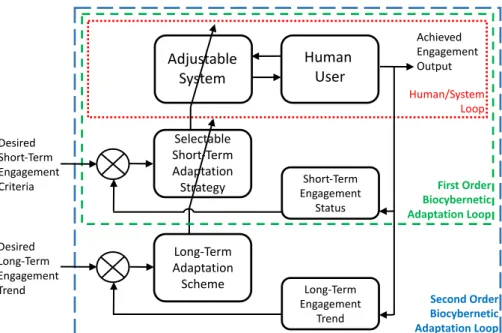
Similarly, physiologically adaptive systems will need to be designed to respond ap-propriately not only to transient changes and spontaneous drifts in operator state due to developing conditions such as fatigue, but also to conditioning of physiological changes as a result of an operator’s extended exposure to information feedback about their phys-iological state. Accordingly, an adaptive implementation that took into consideration the operator “training” effect of its information feedback employed a continually up-dated model of the operator analogous to the “template of average performance” in the “symbionic cockpit” (Reising & Moss, 1985). Techniques developed for adapting a brain-computer interface classifier to adjust for possible features drift could be applied to address this type of consequence (Vidaurre et al., 2011). Configuration of an adaptive system that takes into consideration these long-term and short-term processes is de-picted in Figure 1.
Fig. 1. Configuration of an adaptive system for managing human user engagement. The De-sired Short-Term Engagement Criteria and Long Term Engagement Trends vary according to context (e.g., phase of flight). The Adjustable System has adjustable parameters, such as auto-mation level. The Adjustable System is adjusted by the currently invoked Short-Term tion Strategy and is driven by input from the human user. The Selectable Short-Term Adapta-tion Strategy has a catalog of selectable strategies, each one of which is in effect for a selectable duration. The currently invoked Strategy is selected by the Long-Term Adaptation Scheme and is driven by the discrepancy between the desired criteria and actual engagement status. The Long-Term Adaptation Scheme is driven by the discrepancy between the desired and actual en-gagement trend. The Achieved Enen-gagement Output is the level of an enen-gagement index derived from physiological and behavioral measures and is driven by the Adjustable System.
An additional strategy is the exercise of self-regulation skill acquired as a result of self-regulation training. Prinzel, Pope, and Freeman (2002) demonstrated that partici-pants given feedback of the accuracy of their estimates of engagement levels, across a partitioning of the range of an EEG-based engagement index into six subranges, were able to achieve “a 70% level of correct identifications.” Further, while interacting with an adaptive automation system, “Participants in the self-regulation condition were bet-ter able to maintain their task engagement level within a narrower range of task modes, thereby reducing the need for task mode changes. The effect of this was an increase in task performance as well as a decrease in reported workload.” Prinzel et al. (2002) fur-ther comment, “The neurofeedback provided during training may have allowed these participants to better manage their cognitive resources and thereby regulate their en-gagement state, allowing them to better respond to a change in automation mode. The
Human
User
Adjustable
System
Selectable Short-Term Adaptation Strategy Long-Term Engagement Trend Achieved Engagement Output Desired Short-Term Engagement Criteria Desired Long-Term Engagement Trend Long-Term Adaptation Scheme Short-Term Engagement Status Human/System Loop First Order Biocybernetic Adaptation Loop Second Order Biocybernetic Adaptation Loopresults of this study support other research that has shown that physiological self-regu-lation could enhance the cognitive resource management skills of pilots and comple-ment the benefits of adaptive automation.”
In addition to clinical and sports applications, biocybernetic adaptation as self-regu-lation training is applied in a third area, the aircrew training context (Stephens, et al., 2017). The instructor-trainee interaction is influenced, closing the loop on a broader time scale. Here the adaptation involves an attention management training approach to complement the usual observations of airline training instructor pilots by informing them, in the training context, of the occurrence of attention-related human performance limiting states (AHPLS) experienced by their trainees. Classifier models are trained to recognize trainee state during simulated flight scenarios based on patterns of the phys-iological signals measured during benchmark tasks (Harrivel, et al., 2016). Machine learning models’ real time determinations of the cognitive states induced by the sce-nario tasks are displayed as gauges embedded in a mosaic of windows that also displays real time images of the scenario tasks that the trainee is performing (e.g., scene camera, simulator displays, animation of simulator controls), and this mosaic1 is video recorded (Harrivel et al., 2017). The loop is closed when their state information is conveyed to the trainee as part of each session debrief. This approach involving trainee-trainer in-teraction leverages the effective bio-social influences on learning specified by Kamiya (Strehl, 2014). Like the adaptive automation application, the adaptation strategy here takes into consideration contextual parameters such as the instructor’s discretion re-garding the appropriateness of conveying particular state information to the trainee.
This psychophysiologically-based AHPLS detection and mitigation system is mod-eled after the Hypoxia Familiarization Training (HFT) employed in aviation. The focus of HFT is on recognizing symptoms of hypoxia and taking steps to recover from the hypoxia being experienced. Similarly, recognition and recovery from AHPLS is in-tended to improve self-monitoring of and response to one’s own attentional perfor-mance, maintaining more effective states and managing attention. Such meta-aware-ness results from this form of self-regulation training intended to develop attention management skill. If deployed in ground-based commercial aviation training contexts, the intent is to mitigate potential in-flight loss of airplane state awareness (ASA) and thus reduce aviation accidents and incidents.
In general, biocybernetic adaptation can be applied within autonomous systems to imbue further intelligence into the systems about humans involved in operations. In a potential adaptive automation application, the cognitive state of the operator of a semi-autonomous vehicle would be tracked by the vehicle system. The system uses the cog-nitive state information to judge the operator’s ability to take back control of the system in critical or noncritical hand-off instances2.
1 This concept is captured in a non-provisional patent application: Stephens, C., Harrivel, A.,
Pope, A., & Prinzel, L. (2017, patent pending) “System and Method for Training of State-Classifiers.” [NASA Case No.: LAR-18996-1]
2 This concept is captured in a non-provisional patent application: Harrivel, A., Stephens, C.,
Kennedy, K., & Pope, A. (2017, patent pending) "Multivariate Monitoring for Human Oper-ator and Machine Teaming" [NASA Case No.: LAR-19051-1].
4
Conclusion
The implementations of specific adaptations described in this paper represent actual systems designed for improving human/machine interaction and furthermore enabling human operators to improve self-regulation skills. The adaptation strategies described herein include combinations of technological advances in the areas of neuroscience and psychophysiology designed for specific contexts including clinical, aviation, and sports. The example implementation systems instantiate concepts and enable practical and empirical testing to evaluate adaptation strategies. Adaptation management issues were discussed including dynamic selection and configuration of adaptations. Devel-opment of adaptation strategies can create further questions for consideration such as how to handle possible side effects on the human operator caused by setting up a bio-cybernetic loop. This and other questions require empirical results to be sufficiently addressed. Ongoing research efforts at NASA and the Institut Supérieur de l'Aéro-nautique et de l'Espace (ISAE) seek to apply adaptation strategies to answer these ques-tions and reveal further quesques-tions with the ultimate goals or improved safety and effi-ciency in aerospace operations.
References
Dehais F, Causse M, Vachon F, Régis N, Menant E, Tremblay S. (2014) Failure to detect critical auditory alerts in the cockpit: evidence for inattentional deafness. Human Factors 56(4), 631-644.
Dehais, F., Causse, M., Vachon, F., & Tremblay, S. (2012). Cognitive conflict in human au-tomation interactions: a psychophysiological study. Applied ergonomics, 43(3), 588-595. Dehais, F., Roy, R. N., Durantin, G., Gateau, T., & Callan, D. (2017, July). EEG-engagement
index and auditory alarm misperception: an inattentional deafness study in actual flight con-dition. In International Conference on Applied Human Factors and Ergonomics (pp. 227-234). Springer, Cham.
Drougard, N., C. P. Chanel, C. Roy, R. N. & Dehais, F. (2017) Mixed-initiative mission planning considering human operator state estimation based on physiological sensors. IROS17, 9th Workshop on Planning, Perception and Navigation for Intelligent Vehicles, Durantin, G., Gagnon, J. F., Tremblay, S., & Dehais, F. (2014). Using near infrared
spectros-copy and heart rate variability to detect mental overload. Behavioural Brain Research, 259, 16-23.
Durantin, G., Dehais, F. & Delorme, A. (2015). Characterization of Mind Wandering using fNIRS. Frontiers in Systems Neuroscience. 9. 45. 10.3389/fnsys.2015.00045.
Fairclough, S., and Gilleade, K. (2013) Capturing user engagement via psychophysiology: measures and mechanisms for biocybernetic adaptation. International Journal of Autono-mous and Adaptive Communications Systems. 6:1, 63–79.
Freeman, F. G., Mikulka, P. J., Prinzel, L.J., & Scerbo, M. W. (1999) Evaluation of an adap-tive automation system using three EEG indices with a visual tracking task. Biological Psy-chology, 50, 61-76.
Fuchs, S. & Schwarz, J. (2017). Towards a Dynamic Selection and Configuration of Adapta-tion Strategies in Augmented CogniAdapta-tion. In Proceedings, Part II (pp.101-115), Augmented Cognition. Enhancing Cognition and Behavior in Complex Human Environments: 11th In-ternational Conference, AC 2017, Held as Part of HCI InIn-ternational 2017, Vancouver, BC, Canada, July 9-14, 2017.
Gateau, T., Chanel, C. P. C., Le, M.-H. & Dehais, F. (2016) Considering human’s non-deter-ministic behavior and his availability state when designing a collaborative human-robots system, in Intelligent Robots and Systems (IROS), 2016 IEEE/RSJ International Conference on. IEEE, 4391–4397.
Harrivel, A. R., Weissman, D. H., Noll, D. C., & Peltier, S. J. (2013) “Monitoring attentional state with fNIRS,” Frontiers in Human Neuroscience, 7(861).
Harrivel, A., Liles, C., Stephens, C., Ellis, K., Prinzel, L., & Pope, A. (2016) Psychophysio-logical Sensing and State Classification for Attention Management in Commercial Aviation. in American Institute of Aeronautics and Astronautics, SciTech. 2016: San Diego, Califor-nia.
Harrivel A., Stephens C., Milletich R., Heinich C., Last M. C., Napoli N., Abraham N., Prinzel L., Motter M., & Pope A. (2017) Prediction of Cognitive States during Flight Simulation using Multimodal Psychophysiological Sensing. in American Institute of Aeronautics and Astronautics SciTech. 2017: Grapevine, Texas.
Hopstaken, J. F., Linden, D., Bakker, A. B., & Kompier, M. A. (2015). A multifaceted inves-tigation of the link between mental fatigue and task disengagement. Psychophysiology, 52(3), 305-315.
Jager, N., Schnädelbach, H., Hale, J., Kirk, D., & Glover, K. (2017) Reciprocal Control in Adaptive Environments. Interacting with Computers, 29 (4), 512-529.
Lee, J. D. (2014). Dynamics of driver distraction: The process of engaging and disengaging. Annals of Advances in Automotive Medicine, 58, 24.
Mandrick, K. Chua, Z., Causse, M., Perrey, S. & Dehais, F. (2016). Why a Comprehensive Understanding of Mental Workload through the Measurement of Neurovascular Coupling is a Key Issue for Neuroergonomics? Frontiers in Human Neuroscience. 10. 10.3389/fnhum.2016.00250.
O’Shea T. & Sleeman D. (1973) A design for an Adaptive Self Improving Teaching system. In: Rose J (Ed) Advances in Cybernetics and Systems, vol 3. Gordon & Breach, London. Palsson, O. S., & Pope, A. T. (1999). Stress Counterresponse Training of Pilots via Instrument
Functionality Feedback. On Symposium: New Methods in Biofeedback Delivery: NASA Innovations from Aerospace to Inner Space. Proceedings of the 1999 Applied Psychophys-iology (AAPB) Meeting. April 10, 1999, Vancouver, Canada.
Pope, A. T. & Gersten, C. D. (1977). Computer Automation of Biofeedback Training. Behav-ior Research Methods and Instrumentation, 164-168.
Pope, A. T., Bogart, E. H., & Bartolome, D. S. (1995). Biocybernetic System Validates Index of Operator Engagement in Automated Task. Biological Psychology, 40, 187-195. Pope, A.T., Stephens, C.L., & Gilleade, K. (2014). Biocybernetic Adaptation as Biofeedback
Training Method, Chapter 5 In Fairclough, S. H. & Gilleade, K. (Eds.), Advances in Physi-ological Computing, Springer London.
Poussot-Vassal, C., Roy, R. N., Bovo, A., Gateau, T., Dehais, F., & Carvalho Chanel, C. P. (2017) A Loewner-based Approach for the Approximation of Engagement-related Neuro-physiological Features. Presented at the 20th The International Federation of Automatic Control (IFAC) World Congress, Toulouse, France, July, 2017.
Prinzel, L. J., Pope, A. T., & Freeman, F.G. (2002). Physiological Self-regulation and Adap-tive Automation. International Journal of Aviation Psychology, 12(2), 179-196.
Reising, J. M. & Moss, R. W. (1985). 2010: The Symbionic Cockpit. Proceedings of the Na-tional Aerospace and Electronics Conference, Dayton, OH, 2, 20-24, May, 1985. pp. 1050-1054.
Ros, T., Baars, B. J., Lanius, R. A. & Vuilleumier, P. (2014) Tuning pathological brain oscil-lations with neurofeedback: a systems neuroscience framework. Frontiers in Human Neuro-science. 8:1008.
Roy, R. N. & Frey, J. (2016) Neurophysiological Markers for Passive Brain–Computer Inter-faces, in Brain–Computer Interfaces 1: Foundations and Methods (eds M. Clerc, L. Bougrain and F. Lotte), John Wiley & Sons, Inc., Hoboken, NJ, USA.
Roy, R. N., Bovo, A., Gateau, T., Dehais, F., & Chanel, C. P. C. (2016). Operator Engagement During Prolonged Simulated UAV Operation. IFAC-PapersOnLine, 49(32), 171-176. Scerbo, M. W., Freeman, F. G., & Mikulka, P. J. (2000). A Biocybernetic System for Adaptive
Automation, In Backs, R.W. and Boucsein, W. Engineering Psychophysiology: Issues and Applications, Lawrence Erlbaum: Mahwah, NJ. pp. 241-253.
Scerbo, M. W. (2005). Biocybernetic Systems: Information Processing Challenges that Lie Ahead. In Proceedings of the 11th International Conference on Human-Computer Interac-tion, Volume 11: Foundations of Augmented Cognition. July 22-27, 2005, Las Vegas, NV: MIRA Digital Publishing. CD-ROM.
Schmorrow, D. D. (2005). Aviation Training: A Future Avenue. Avionics Magazine, October 2005.
Schwarz, J. & Fuchs, S. (2017) Multidimensional Real-Time Assessment of User State and Performance to Trigger Dynamic System Adaptation. In Proceedings, Part I (pp.383-398), Augmented Cognition. Enhancing Cognition and Behavior in Complex Human Environ-ments: 11th International Conference, AC 2017, Held as Part of HCI International 2017, Vancouver, BC, Canada, July 9-14, 2017.
Senoussi, M., Verdiere, K. J., Bovo, A., Chanel, C. P. C., Dehais, F., & Roy, R. N. (2017, October). Pre-stimulus antero-posterior EEG connectivity predicts performance in a UAV monitoring task. In Systems, Man, and Cybernetics (SMC), 2017 IEEE International Con-ference on (pp. 1167-1172). IEEE.
Sperandio, J. C. (1978). The regulation of working methods as a function of work-load among air traffic controllers. Ergonomics, 21(3), 195-202.
Stephens, C., Prinzel, L., Harrivel, A., Comstock, R., Abraham, N., Pope, A., Wilkerson, J., & Kiggins, D. (2017). Crew State Monitoring and Line-Oriented Flight Training for Atten-tion Management. Proceedings of the 19th InternaAtten-tional Symposium on AviaAtten-tion Psychol-ogy (ISAP), May 8-11, 2017. Dayton, OH.
Stephens, C.L., Scerbo, M.W., & Pope, A.T. (2012) Adaptive Automation for Mitigation of Hazardous States of Awareness. In P. Desmond, G. Matthews, & P. Hancock (Eds.) Hand-book of Operator Fatigue. Hants, UK: Ashgate Publishing.
Strehl, U. (2014). What learning theories can teach us in designing neurofeedback treatments. Frontiers in Human Neuroscience, 8. DOI: 10.3389/fnhum.2014.00894
Verdière, K. J., Roy, R. N., & Dehais, F. (2018). Detecting pilot's engagement using fNIRS connectivity features in an automated vs manual landing scenario. Frontiers in Human Neu-roscience, 12, 6.
Vidaurre, C., Sannelli, C., Müller, K-R. & Blankertz, B. (2011). Machine-Learning-Based Coadaptive Calibration for Brain-Computer Interfaces. Neural Computation, Volume 23, Issue 3, 791-816.
von Foerster, H. (Ed.). (1995). Cybernetics of cybernetics: Or, the control of control and the communication of communication (2nd ed.). Minneapolis, MN: Future Systems.
Wickens, C. D. (2005) Attentional Tunneling and Task Management. Technical Report, AHFD-05-01/NASA-05-10, NASA Ames Research Center, Moffett Field CA.