Any correspondence concerning this service should be sent
to the repository administrator: [email protected] This is an author’s version published in:
http://oatao.univ-toulouse.fr/19155
Official URL
DOI : http://doi.org/10.1017/S1431927617001532 Open Archive Toulouse Archive Ouverte
OATAO is an open access repository that collects the work of Toulouse researchers and makes it freely available over the web where possible
To cite this version: Monier, Etienne and Oberlin, Thomas and Brun, Nathalie and Tencé, Marcel and Dobigeon, Nicolas Reconstruction of randomly and partially sampled STEM spectrum-images. (2017) In: Microscopy and Microanalysis Meeting (M&M 2017), 6 August 2017 - 10 August 2017 (Saint-Louis, Missouri, United States).
Reconstruction of Randomly and Partially Sampled STEM Spectrum-Images
Etienne Monier1, Thomas Oberlin1, Nathalie Brun2, Marcel Tencé2, Nicolas Dobigeon11.
University of Toulouse, IRIT/INP ENSEEIHT, F-31071 Toulouse Cedex, France 2.
Laboratoire de Physique des Solides, CNRS UMR 8502, Univ. Paris-Sud, Univ. Paris-Saclay, Bât. 510, 91405 Orsay Cedex, France
Scanning transmission electron microscopy (STEM) offers the ability to acquire several single- and multi-channels signals generated simultaneously for each probe position: cathodoluminescence (CL), electron energy loss spectroscopy (EELS) and high-angle annular dark-field imaging (HAADF). However, in some cases, sensitive samples (e.g., biological samples or molecular structures) may suffer from irradiation damages during acquisition. As a consequence, it is often necessary to reduce probe current or dwell time, which could significantly lower the signal-to-noise ratio. Another approach consists in acquiring only a subset of pixels randomly chosen in a given region of interest. This particular experimental set-up has been implemented on the STEM VG HB501 (LPS, Orsay, France), with the beam following a predetermined random path. The reconstruction of HAADF images is then straightforward with well known algorithms. However, when reconstructing the associated spectrum image, the high number of energy bands makes the problem computationally expensive.
Meanwhile, recent works in signal and image processing have introduced new algorithms using arguments borrowed from the theory of compressed sensing (CS), which enables a full reconstruction from few measurements, provided the image is sparse in a particular well-chosen domain. More generally, a wide range of regularizations have been proposed in the last decade to approximately solve inverse problems through convex optimization. Applications include fast acquisition schemes in MRI [1], hyperspectral image fusion [2], as well as many standard image processing problems (denoising, inpainting, etc). Inspired by these works, we propose here a new reconstruction technique of the whole spectrum image from partial random measurements. To this end, we exploit the low-rank structure of the data, which assumes that the spectrum image can be represented as a linear combination of ! elementary spectra. The reconstruction task is then formulated as a linear inverse problem which combines a low-rank representation and a spatial regularization that promotes the spatial coherence.
If we denote by " the full spectral image to be reconstructed, the proposed algorithm relies on the low-rank factorial decomposition " # $% where $ is a matrix spanning the signal subspace and % is the image represented in this subspace. The signal subspace $ and the noise level are assumed to be previously estimated from the observations using a principal component analysis (PCA). Only the image in the subspace % should be estimated afterwards. For that purpose, assuming a Gaussian reconstruction error, we control the squared Euclidean distance between % and the observations while minimizing two penalties corresponding to the following assumptions. First, the image % is assumed to be spatially smooth, leading to the minimization of the spatial gradient energy. Second, the energy distribution of % along the different principal components of the spectrum image is assumed to match that of the observations. These three ingredients lead to a convex cost function which is minimized with an accelerated projected gradient algorithm [3].
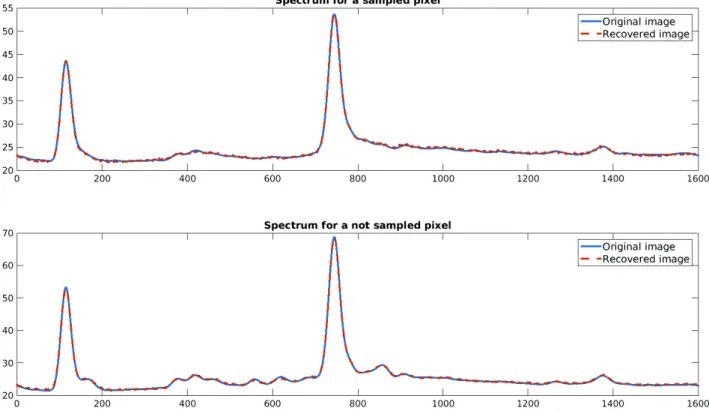
To conduct a quantitative study of the proposed strategy, reference data has been generated by blurring a CL spectrum image, mainly to reduce the noise level and produce a spatially smooth image. Gaussian noise has been added to the resulting synthetic image with a SNR of 20dB, before random sampling of 20% of the pixels. Figures 1 and 2 illustrate the performance of the method on doi:10.1017/S1431927617001532
this experiment. The reconstruction of one band of interest is displayed in Figure 1, while Figure 2 shows the ground-truth and reconstruction of two pixel spectra, one being initially sampled (top) and not the other one (bottom). By further implementing other appropriate estimation schemes and adaptively choosing the pixels to be acquired, we expect to improve the spectrum image recovery [4].
References:
[1] Boyer, C., Weiss, P., & Bigot, J. SIAM Journal on Imaging Sciences 7(2) (2014), p. 1080. [2] Wei, Q. et al, IEEE Transactions on Geoscience and Remote Sensing, 53(7) (2015), p. 3658. [3] Beck, A., & Teboulle, M. SIAM journal on imaging sciences, 2(1) (2009), p. 183.
[4] NB thanks M. de Frutos, A. Tararan and A. Zobelli for providing samples and data.
Figure 1. Reference, observed and reconstructed images at band #618 with 20% observed pixels.