OATAO is an open access repository that collects the work of Toulouse
researchers and makes it freely available over the web where possible
Any correspondence concerning this service should be sent
to the repository administrator:
[email protected]
This is an author’s version published in:
http://oatao.univ-toulouse.fr/24232
To cite this version:
Voegel, Célestine
and Giroudon, Marie and Bertron, Alexandra and Patapy,
Cédric and Matthieu, Peyre Lavigne and Verdier, Thomas and Erable,
Benjamin
Cementitious materials in biogas systems: Biodeterioration
mechanisms and kinetics in CEM I and CAC based materials. (2019) Cement and
Concrete Research, 124. 105815. ISSN 0008-8846
Cementitious materials in biogas systems: Biodeterioration mechanisms and
kinetics in CEM I and CAC based materials
Célestine Voegel
a,b, Marie Giroudon
a,c, Alexandra Bertron
a,⁎, Cédric Patapy
a,
Peyre Lavigne Matthieu
c, Thomas Verdier
a, Benjamin Erable
baLMDC, Université de Toulouse, INSA, UPS, 135 Avenue de Rangueil, 31077 Toulouse Cedex 04, France bLaboratoire de Génie Chimique, Université de Toulouse, CNRS, INPT, UPS, Toulouse, France
cLISBP, Université de Toulouse, CNRS, INRA, INSA, 135 Avenue de Rangueil, 31077 Toulouse Cedex 04, France
A R T I C L E I N F O Keywords: Degradation Cement paste Durability SEM
Calcium aluminate cement
A B S T R A C T
In anaerobic digestion plants, biological activities transform biowaste into a renewable energy: the biogas. This process produces aggressive and complex media in direct contact with the structure. Few studies have focused on the deterioration of concrete in such environments. In order to support the sustainable development of biogas production growing sector, this study intends to provide thorough information on the biowaste chemical composition and on materials biodeterioration mechanisms occurring in biogas plants. Cementitious materials with various surface compositions (pastes of CEM I, CAC and CEM I treated with oxalic acid) were immersed in the liquid phase of laboratory bioreactors reproducing anaerobic digestion conditions. Altered depths mea-surements in time highlighted the better resistance of the CAC material. The microbial biofilm coverage on the material's surface was delayed by the surface pretreatment with oxalic acid and was less dense for the CAC paste. Chemical and mineralogical analyses mainly showed leaching and carbonation phenomena.
1. Introduction
The microbial fermentation of organic matter in the absence of oxygen, called anaerobic digestion, leads to the production of biogas, a sustainable fuel gas energy mostly composed of methane (65% CH4) but
also containing a significant amount of carbon dioxide (35% CO2), and
leaves a solid residue, the digestate.
Anaerobic digestion ensures the treatment of biowaste directly at the production source (thus reducing the final quantity of waste). Biogas can be used to produce heat with a good energy efficiency and can also be used as a fuel to produce electricity, with a lower yield. The most common energy recovery method for biogas is cogeneration, which consists of combining the production of heat and of electricity by recovering the heat of combustion to transform it into electricity [1]. The digestate, made up of non-biodegradable organic matter (mostly lignin is the case of vegetal waste), mineral matter and water, is used as a soil fertilizer and can be a source of additional revenue [2]. In ad-dition, anaerobic digestion permits greenhouse gas emissions to be re-duced and helps to increase the incomes of the biogas plants operators. This technology of sustainable energy production has been evaluated as one of the most energy-efficient and environmentally friendly [3].
In view of these multiple advantages, biogas production by
anaerobic digestion is strongly encouraged by European policies and its development has become global, using many sources of organic waste. Since 2009, the number of biogas plants in Europe has steadily in-creased from 6227 to 17,662 anaerobic digestion structures in 2016 [4].
As for agricultural and agro-industrial buildings, concrete is the material the most commonly used for the construction of biogas plants. This is related not only to its low cost and ease of implementation but also to its air- and water-tightness and its good thermal inertia [5,6]. However, in digesters, structural concrete is directly in contact with both the liquid and gas phases of the digesting biowaste, which are aggressive to concrete [7,8].
Biogas is the final product of four consecutive degradation reactions that make up the anaerobic process: hydrolysis, acidogenesis, acet-ogenesis and methanacet-ogenesis [9,10]. In most plants, the digestion process is performed under mesophilic conditions, with an optimal operating temperature of around 37 °C which requires low self-con-sumption of energy for the heating [11]. In the first step of the process, hydrolysis decomposes complex organic polymers (proteins, lipids and carbohydrates) into simple soluble molecules: amino acids, long-chain fatty acids and sugars. These compounds are then reduced into short chain volatile fatty acids (VFA) during the acidogenesis step.
⁎
Corresponding author at: INSA Toulouse Dép. Génie Civil, 135 avenue de Rangueil, 31077 Toulouse Cedex 4, France. E-mail address:[email protected](A. Bertron).
Acetogenic bacteria degrade the organic acids into acetate, hydrogen and carbon dioxide. These three compounds are finally consumed by the methanogenic archaea to produce methane, and also CO2[12–14].
The degradation of nitrogenous compounds such as proteins and urea leads to the production of ammonia, mainly present in the form of ammonium ions under the pH conditions of the anaerobic digestion [15,16].
Consequently, by being in contact with the biowaste at every step of the anaerobic digestion, concrete may undergo deterioration due to both the chemical and biological agents. Several compounds in the medium [6,7] are aggressive to concrete: volatile fatty acids, excreted by the acidogenic bacteria, ammonium and dissolved CO2:
•
Volatile fatty acids metabolized during anaerobic digestion are or-ganic acids whose calcium salts are soluble in water. Even if the acidity of organic acids is lower than mineral acids, the buffer effects and the solubility of the organic salts make them not less aggressive to concrete. Their attack results in a progressive dissolution of all the initial hydrated phases of the cement paste [17–19].•
The ammonium cation NH4+is the conjugated acid of ammoniaNH3, produced during the anaerobic digestion. The ammonium ion
react with the cementitious matrix supposedly according to an ex-change mechanism 2 NH4+⟶ Ca2+ [20,21]. This leads to the dissolution of portlandite and C-S-H and the decalcification of the cementitious matrix [22,23].
•
The presence of carbon dioxide in the medium leads to thecarbo-nation of the cement paste: portlandite and C-S-H are dissolved and calcium carbonates are formed [24–26]. Even if most of the time, carbonation can be beneficial for the concrete durability by clogging the porosity [24,25], in submerged systems such as anaerobic di-gestion medium, dissolved CO2can lead to the dissolution of
cal-cium bearing phases, including the calcal-cium carbonates [21]. The microorganisms involved may organize themselves as a biofilm on the surface of the material [27] and induce very high local con-centrations of aggressive agents, accentuating the deterioration [7,28]. In this context, the concrete undergoes deterioration resulting in in-creased porosity and reduced impermeability, leading to a greater risk of reinforcement corrosion [6,29]. Damage to the structures could lead to both important economic and environmental impacts such recovery of a smaller amount of biogas, pollutant flows nearby the plant, and the need for repairs.
The European standard EN 206 [30] and the French information document FD P 18-011 [31] classify environments that are chemically aggressive for concrete by defining three classes of increasing aggres-siveness, XA1 to XA3. Among the aggressive species present in the li-quid phase of fermenting biowaste, the texts consider the presence and the concentration of carbon dioxide (aggressive CO2), sulphate
(SO42−), magnesium (Mg2+), and ammonium (NH4+), together with
the pH and the water hardness. However, neither document considers the action of organic acids or of microorganisms [17,29], nor the temperature effect, which could accelerate the degradation reactions [32]. Moreover, the pH is not suitable to characterize the aggressive-ness of some liquid media, including those containing organic acids [5,33]. It therefore appears that the normative texts are incomplete as far classifying the aggressiveness of agricultural environments, and especially the anaerobic digestion environment, is concerned. In order to facilitate their classification in the standards, better knowledge of
these complex environments, in terms of composition and aggressive-ness toward concrete, is needed.
This study aims to (i) widely characterize the medium in terms of chemical composition; (ii) identify and understand the biodeterioration mechanisms and (iii) compare the performances of different cementi-tious materials (CEM I, CAC and CEM I surface-treated with oxalic acid). The influence of the oxalic acid treatment, the type of binder and the biofilm coverage on the material durability are discussed. 2. Materials and methods
2.1. Materials
2.1.1. Cement paste manufacturing
Three types of materials were used for this study: (i) cement pastes of ordinary Portland cement, CEM I 52.5 R (denominated CEM I); (ii) cement pastes made of calcium aluminate cement, Secar 51 RG (CAC) (chemical oxide composition and Blaine specific surface of both the previous cements are given inTable 1) and (iii) CEM I pastes the surface of which had been treated with a 0.28 M oxalic acid solution (de-nominated CEM I-Ox) [34]. CEM I paste was considered as the reference material and CAC and CEM I-Ox cements were chosen because of their already proven higher durability in an acid environment [33–36].
According to several authors [33,35,36], calcium aluminate ce-ments show high durability in acidic media, with a good chemical stability. This could be explained by the alkalinity and the stability of the initial (e.g. katoite C3AH6, aluminium hydroxide AH3) phases and
that newly formed through acidic attack, aluminium hydroxide AH3,
which has a high thermodynamic stability [37,38]. Moreover, the al-kalinity of CAC binders vs. OPC ones is detailed in the study of Bu-vignier et al. [39] by comparing the neutralization capacity of an OPC with the one of CAC-based materials on the basis of the calculation by Letourneux and Scrivener [40]. The higher neutralization capacity of the CAC was highlighted and it was assumed that it could contribute to the higher resistance of CAC materials to microorganisms-bearing en-vironments by hindering or inhibiting microbial activity on their sur-face [39].
Chemical action of the oxalate anion has already been studied and used to provide a surface protection for marble [41,42]; electron mi-croscope observations showed a structural correspondence between the calcium oxalate and the calcite crystals of the marble [43]. The che-mical reaction is thought to be based on the transformation of calcium carbonate from the marble into calcium oxalate [44]. This surface layer protects the marble without clogging the pores of the stone [42]. This type of treatment has also been explored on cementitious materials in laboratory studies, which have shown that, despite the very low pH of the oxalic solution used (pH = 1), ordinary Portland paste does not lose mass and is not degraded in depth [33,34]. Calcium oxalate forms a layer on the surface of the material, filling the peripheral porosity. The salt formation is believed to be due to the reaction of the oxalate so-lution with the Portland cement matrix [17], where the sacrificial dis-solution of the portlandite allows the formation of calcium oxalate in the outer layer of the paste specimen. According to Larreur-Cayol et al. [33], the protective effect of the calcium oxalate salt could come from its molar volume which allows the salt to fill the volume released by the dissolution of portlandite and also some of the capillary porosity. Voegel et al. [34] also showed that the oxalic acid treatment on a CEM I paste could delay the paste alteration by an acetic acid solution.
CaO SiO2 Al2O3 Fe2O3 MgO SO3 Na2O K2O Blaine's specific surface (cm2/g)
CEM I 64.5 20.1 4.83 2.47 1 3.49 0.14 0.17 4970
CAC 44 5.6 52.9 1.47 0.2 < 0.2 0.23 0.37 3870
Table 1
experiments run in duplicate) were kept in an oven at 37 °C throughout the experiment. The reaction medium, with an initial volume of 525 mL, was continuously stirred by a magnetic stirring system. Bio-waste was renewed at the end of each 5-week digestion cycle. This period corresponds to the average time required for the complete di-gestion of a substrate [49] and is commonly used as a typical duration for laboratory tests [50,51]. Two cycles were carried out.
2.3. Analysis of the liquid phase of the digesting biowaste
The liquid phase composition of the digesting biowaste was mon-itored over time in order to analyse the concentration of organic acids, ammonium and CO2, and the pH [7]. Regular sampling of 1.5 mL of the
liquid phase was carried out and concentrations of the organic acids were measured using High Performance Liquid Chromatography ana-lyses (Thermo Fisher U3000; column: Aminex HPX-87H BIORAD; eluant: H2SO4; flow rate: 0.5 mL·min−1) [7,48]. Ammonium
con-centrations were measured using Ionic Chromatography (Thermo Electron ICS 3000, column: CS16; pre-column; cartridge holder; eluant: 30 mM methanesulfonic acid; flow rate: 1.0 mL·min−1). The soluble
CO2produced from the microbial activity was occasionally determined
by analysis of total inorganic carbon (TOC-SCHIMADZU) [7]. 2.4. Observation of biofilm on cement pastes
Cement paste slices were sawn carefully in order to preserve the biofilm on their surfaces. Before the observations, the biofilms were first chemically fixed and then dehydrated according to the method of Voegel et al. [7,48]. The biofilm was observed by SEM-FEG (JEOL 7100F TTLS combined with EDX XMax, 5 kW) after 5 weeks (CEM I, CEM I-Ox, CAC) and 10 weeks (CEM I-Ox).
2.5. Microscopic observations and analysis of chemical and mineralogical changes in cementitious materials
The cylindrical cement paste specimens were removed from the biowaste after each digestion cycle (i.e. after 5 and 10 weeks of im-mersion) and 5 mm cement paste slices were collected by sawing the cylindrical specimens perpendicularly to their longitudinal axis with a diamond saw. A part of a slice was then embedded in an epoxy resin (Mecaprex MA2+ by Presi) and dry-polished using silicon carbide polishing disks (Presi) according to the procedure described by Bertron et al. [52]. The polished sections were coated with carbon before being analysed. Microstructural observations of cement pastes were made by Scanning Electron Microscopy (SEM, JEOL JSM 6380LV) using back scattered electron (BSE) mode. Chemical analyses were performed on the same specimens using energy dispersive X-ray spectrometry (EDS, Brucker Xflash 6/30 - SDD) and electron-probe micro-analysis (EPMA, Cameca SXFive, 15 kV, 20 nA, scanning area of the beam 2 × 2 μm2).
Punctual analyses were carried out by positioning a hundred points manually, carefully avoiding anhydrous grains, from the degraded surface to the sound core [7]. A microstructural and chemical zonation of the deteriorated specimens according to the distance to the surface was identified from the correlated results of SEM + EDS and EPMA: the zonation is primarily set through chemical composition profiles ob-tained from EPMA and then X-ray diffraction (XRD) analyses are per-formed to evaluate the mineralogical composition in each zone. Mi-neralogical analyses in the different zones identified were carried out by XRD (Siemens D5000, Co cathode, 40 kV, 30 nA) using the proce-dure presented in Bertron et al. [53].
3. Results
3.1. Composition of the liquid fraction of the digesting biowaste
Table 2 summarizes the composition of the liquid fraction of the The CEM I and CAC paste specimens were made with a water/
binder ratio of 0.4. This ratio optimizes the effects of the acid oxalic treatment and a study by Voegel et al. [34] showed that the water/
binder ratio of 0.4 led to a positive mass variation, whereas no mass change was detected for a ratio of 0.27. Thus, the higher porosity of the matrix with a water/binder ratio of 0.4 could have led to the pre-cipitation of a larger amount of calcium oxalate [34]. The pastes were
mixed according to the French standard NF EN 196-3 [45] and cast in
cylindrical moulds 75 mm high and 25 mm in diameter. The pastes were cast in three consecutive layers, each vibrated for 120 s. They were removed from their moulds 24 h after pouring. Then, each spe-cimen underwent an exogenous cure in a small amount of water at 20 °C for 27 days, which allowed the hydration to continue while limiting leaching. After the curing period, 5 mm thick slices were sawn from paste cylinder specimen, to be used for the biofilm growth testing. Also, some CEM I paste cylinders and slices were immersed in a 0.28 M oxalic acid solution (C2H2O4) (pH = 0.76) for 7 days, the other specimens
being kept in sealed bags. The initial porosities of the paste specimens were measured by water intrusion porosimetry adapting the French standard NF P18-459 [46] for cement pastes specimens. The results
were 40 ± 1% for CEM I and 27 ± 1% for CAC. 2.1.2. Characterization of cement paste surfaces
Just before immersion in the biowaste, the surface pH of the spe-cimens was measured with pH paper: it was between 12 and 13 for the CEM I and CAC pastes (sound cementitious materials) whereas it was about 1 for the CEM I-Ox paste (because of the pH 0.76 oxalic acid treatment) [27].
The main mineralogical phases of the cement pastes surfaces before the immersion were determined by X-ray Diffraction (XRD) analyses. The diffractograms showed the phases habitually encountered in sound CEM I and CAC cement pastes. The CEM I paste surface was composed of C-S-H, portlandite (Ca(OH)2), ettringite, CxAHy, C3S and C2S. The
CAC paste surface showed C3AH6, gibbsite (AH3), gehlenite (C2AS),
mayenite (C12A7), C2AH8, brownmillerite (C4AF) and calcium
alumi-nate oxide (CA). Microscopic observations (performed with a Scanning Electron Microscope (SEM) in back scattered electron mode (BSE)) and mineralogical analysis (by XRD) were made on the surface of the CEM I specimens treated with oxalic acid. They showed an adherent, con-tinuous layer of precipitate of whewellite (calcium oxalate mono-hydrate) covering the whole specimen (Fig. 1). This layer was formed over a thickness of 100 to 200 μm and clogged the porosity locally [33,34]. More details about the method are given in §2.5.
2.2. Immersion of cement pastes in the synthetic biowaste
The substrate for biogas production by anaerobic digestion used in this study was a laboratory synthetic biowaste representative of the organic domestic waste currently produced in France according to the CIRSEE (International Research Center On Water and Environment). Its composition was provided by IRSTEA of Antony (France): a mix of different food products. All the details on composition and production are given in Voegel et al. [7]. Bacterial inoculation was made from a
sludge sampled in a municipal wastewater treatment in Toulouse (France) in order to induce the anaerobic digestion process [47]. The
inoculation was operated with a Vinoculum/Vsubstrate ratio of 2.5, which
corresponded to an optimal ratio of 1 g CODinoculum/g CODsubstrate,(with
COD the chemical oxygen demand) as already established in previous works [7,48]. Cement pastes were totally immersed in the liquid phase
of the biowaste in anaerobic bioreactors for 5 weeks. The surface area/ volume ratio (cement paste surface area/inoculated biowaste volume) was 224 cm2 L−1 for the cylindrical samples and 34 cm2 L−1 for the
slices used for biofilm development monitoring. These two ratios are quite high in comparison with real situations of industrial digester (4 cm2 L−1 [48]) but allow to amplify the phenomena occurring close to
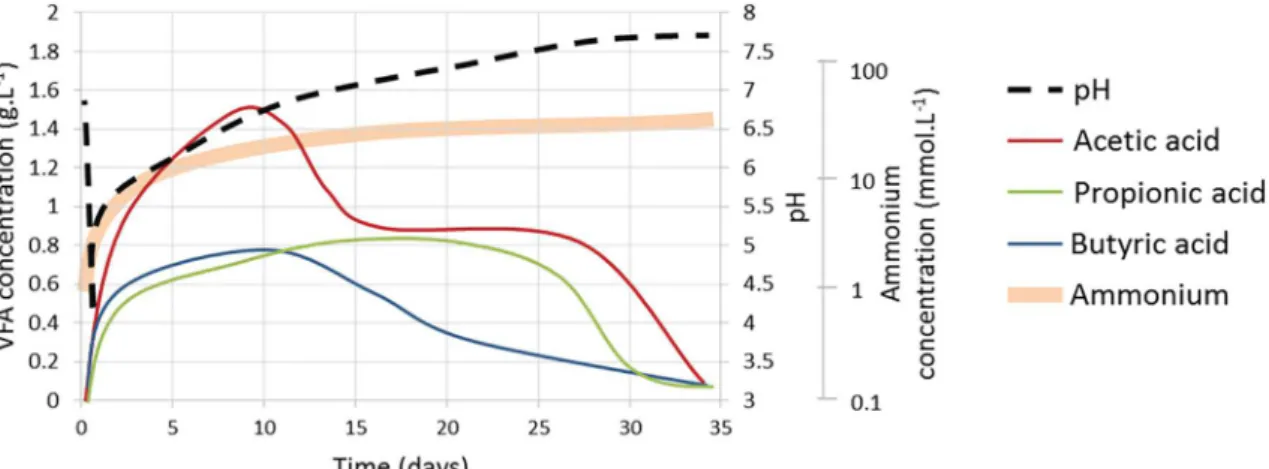
bioreactors through several cycles. The values in the table are averages over the six bioreactors run at the same time (two bioreactors per material type).Fig. 2shows the typical evolutions of the pH and the acid concentrations during a cycle of anaerobic digestion [7].
FromTable 2, no major difference in the composition of the liquid fraction is observed between the two cycles (5 and 10 weeks). The acetic acid concentration reaches 23 mmol·L−1on average, whereas the
propionic and butyric acids concentrations reach 9 mmol·L−1.Table 2
andFig. 2show that the pH decreases in the first few days, to values around 4.5. Within this period, hydrolysis and acidogenesis steps cor-related with the production of organic acids. After that, the pH reaches 7.0 on the 10th day and stabilizes around 7.8 thereafter due to a pro-gressive and then total consumption of the VFA during the acetogenesis and methanogenesis steps. Koenig and Dehn [8] found similar pH
values (pH of approximately 7) in the liquid phase of their laboratory fermenter. The average ammonium concentrations reach 55 mmol·L−1.
This value is consistent with the studies by Voegel et al. [7] and Gir-oudon et al. [54], where the evolutions of the ammonium concentration were similar and reached about 800 mg·L−1(40 mmol·L−1) and with
McCarty [49] who states that ammonium concentrations can reach 1000 mg·L−1for a digester in good function.
Punctual analyses of dissolved CO2 concentrations showed that,
after 3 weeks of biowaste anaerobic digestion, the CO2concentration
was 2.3 mmol L−1± 0.2 mg·L−1. The digesting biowaste contained
little or no sulfur bearing compounds.
Fig. 1. (a) SEM observation and (b) mineralogical analysis of the CEM I-Ox paste surface after the 7 days oxalic acid treatment (Wh: whewellite (calcium oxalate monohydrate)).
Table 2
Composition of the liquid fraction of the digesting biowaste in terms of VFA concentration, ammonium concentration and pH: minimum value–maximum value (standard deviations).
VFA concentration (mmol·L−1) Ammonium concentration (mmol·L−1) pH Acetic acid Propionic acid Butyric acid
1st cycle (week 1 to 5) 0.14–22.99 (0.22–2.14) 0.26–10.79 (0.12–2.54) 0.00–8.31 (0–1.17) 0.85–54.90 (0.11–1.00) 4.33–7.81 (0.31–0.18) 2nd cycle (week 6 to 10) 1.14–24.42 (0.10–2.87) 0.14–9.84 (0.09–2.55) 0.00–9.83 (0–2.32) 0.83–52.24 (0.09–2.11) 4.47–7.52 (0.23–0.15)
3.2. Altered depths of the cement pastes
Fig. 3shows the altered depths of the cement pastes after 5 weeks (one digestion cycle) and 10 weeks (two digestion cycles) of immersion in the digesting biowaste. Altered depths were obtained by analyses of flat polished sections using BSE-mode SEM coupled to EDS and EPMA. Altered depths correspond to limits between the sound zone (zone 1) and the beginning of the altered zone (zone 2) onFigs. 5, 7 and 9.
After 5 weeks of exposure to the digesting biowaste, the CAC sam-ples had the smallest altered depth (200 μm) whereas CEM I-Ox and CEM I pastes had altered depths of 400 and 650 μm respectively. After 10 weeks, the degraded depth of the CAC pastes had increased slightly, reaching a value of 250 μm, whereas CEM I-Ox and CEM I reached degraded depths of 550 and 750 μm.
During the first cycle (< 5 weeks), the protective properties of the calcium oxalate seemed to be efficient as the CEM I-Ox degraded depth was 1.6 times less than that of CEM I pastes. During the second cycle (between 5 and 10 weeks), the increase of the degraded depth of the CEM I-Ox paste was 150 μm which was greater than the increase of the degraded depth of the non-treated CEM I paste (of 100 μm). Thus, it seems that the calcium oxalate treatment was no longer effective at this point.
The CAC pastes showed positive achievement throughout the ex-periment as their degraded depths after 10 weeks were only 250 μm which was 2 or 3 times less than the CEM I-Ox and CEM I degraded depths after 5 weeks.
3.3. Microscopic observation of biofilms
Fig. 4presents the SEM observation of the surface of CEM I, CAC and CEM I-Ox pastes after 5 weeks of immersion and 10 weeks of im-mersion for the CEM I-Ox sample. At both sampling dates (i.e. 5 and 10 weeks), the CEM I pastes surfaces showed a uniform, dense biofilm whereas the biofilm observed on the surface of the CAC was less dense, with few microorganisms. In contrast, microbial colonization was not observed on the surface of the CEM I-Ox slice after 5 weeks of anaerobic digestion and calcium oxalate precipitates, similar to those observed on the cement paste immediately after the oxalic acid treatment (Fig. 1), covered the surface. After 10 weeks of immersion, the entire surface of the CEM I-Ox paste was covered by a dense biofilm and calcium oxalate precipitates were no longer observed. It can be assumed that between 5 and 10 weeks of exposure the surface conditions enabled a biofilm to form on the surface. The biofilm may have produced local conditions that finally dissolved the oxalate salt.
3.4. Chemical and mineralogical analysis of the cementitious specimens 3.4.1. CEM I paste
The chemical composition profiles of the CEM I paste sample at 10 weeks of immersion, as a function of the distance to the surface, and the image of the same specimen by SEM in back-scattered electron (BSE) mode are presented on the right side ofFig. 5. The outer layer of the specimen was partly dissolved when it was removed from the bio-waste. The thickness of the material lost is reported on the figure (about 150 μm) and was measured by measuring the difference between the initial diameter of the sample and its final dimensions. The left side of
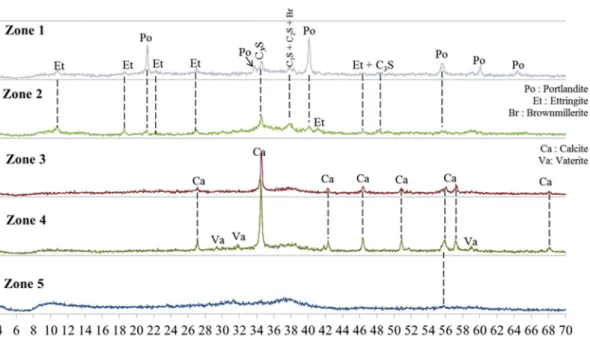
Fig. 5gives the chemical composition profile of the outer layers of the CEM I paste immersed for 5 weeks in the fermenting biowaste (adapted from Voegel et al. [7]). A chemical zonation of the specimens was identified and is represented on the figure, from zone 1, corresponding the intact core, to zone 5, corresponding to the outer layer in contact with the biofilm and the biowaste. The mineralogical characterization by XRD in each zone defined inFig. 5is presented inFig. 6. From the core to the outer layer, the chemical and mineralogical evolution of the cementitious matrix is as follows:
•
Zone 1 corresponds to the sound zone. The mineralogical analysesshowed a composition similar to that of an unaltered specimen, mainly made of hydrated phases (portlandite, ettringite, and C-S-H) and anhydrous grains (C3S, C2S, brownmillerite C4AF). The SEM
observations show the high density of the anhydrous residual ce-ment grains (in lighter grey on the SEM image).
•
Zone 2 is 350 μm thick and shows the same two main phenomena ineach cycle: (i) a slight decalcification corresponding to the
Fig. 2. Typical evolution of pH, VFA concentrations and ammonium concentration for a single anaerobic digestion cycle, adapted from Voegel et al. [7].
dissolution of portlandite, and (ii) an enrichment in sulfur, which can be correlated with a slight intensification of the ettringite peaks in the mineralogical pattern (Fig. 6). This secondary ettringite comes from the diffusion of sulfates from the altered zone, and is classically observed in transition zone of specimens exposed to leaching [53,55]. It is probably not expansive as no microcracks are observed by SEM in this zone. The density of the anhydrous grains remains high in this zone, as can be observed in the SEM picture.
•
After each cycle, zone 3 is mainly characterized by the dissolution ofthe anhydrous grains shown in the SEM picture and a lower density of the hydrated matrix (darker colour of the cement paste). The mineralogical pattern (Fig. 6) shows that calcite is the main crys-tallized phase in this zone and that ettringite, C3S, C2S and
brown-millerite phases are dissolved. The chemical composition (Fig. 5) shows the decrease in the sulfur content, correlated with the dis-appearance of the ettringite peaks and the decrease of the total amount of oxides. This zone is 180 μm thick.
•
Zone 4 is mainly composed of the two polymorphs of calciumcar-bonate (CaCO3), calcite and vaterite, which form for C/S
ratio ≥ 0.67 in the C-S-H [56]. The chemical composition (Fig. 5) shows the partial decalcification of the sample and a peak of phos-phorous, probably brought by the biowaste. No peak of a crystal-lized phase containing phosphorus is visible on the diffraction pat-tern, at either 5 or 10 weeks, suggesting that an amorphous P-phase has precipitated. This zone is 30 μm and 80 μm thick respectively after the 5th and the 10th weeks, respectively, and shows a low density in the SEM image.
•
Zone 5 is the outer layer, mainly visible after 5 weeks (70 μm thick). This zone is mainly amorphous (Fig. 6) and is likely to be composed of a Si-Al gel, containing phosphorus in its outer part. At 10 weeks, it can be assumed that this external zone was partially dissolved or detached from the matrix. The missing zone was determined to be around 150 μm thick according to image analysis measurements performed on the cross section of the specimen.3.4.2. CEM I-Ox paste
The chemical composition profiles, according to the distance to the surface, of the CEM I-Ox paste sample at 10 weeks of immersion, and the image of the same specimen by SEM in BSE mode are presented in
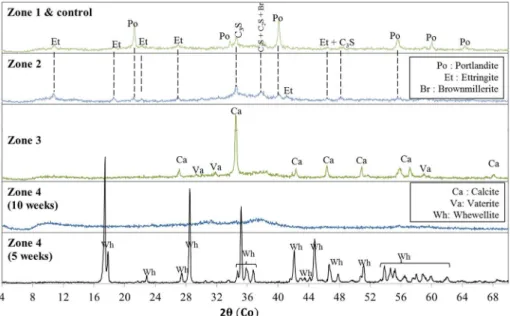
Fig. 7, right side. The left side of the figure gives the chemical com-position profile of the outer layers of the CEM I-Ox paste immersed for 5 weeks in the fermenting biowaste. The mineralogical characterization by XRD of each zone is presented inFig. 8. In light of the chemical and mineralogical analyses, four zones can be distinguished after 5 and 10 weeks, with differences in the composition of the outer layer be-tween the two exposure times. The zonation is as follows:
•
Zone 1 corresponds to the unaltered zone. Its mineralogical and chemical composition is similar to that of zone 1 of the CEM I paste.•
As for the CEM I paste specimen, Zone 2 shows a slight dec-alcification with an increase of the sulfur oxide content. From a mineralogical point of view, portlandite peaks are reduced whereas ettringite peaks are intensified, which could be correlated with the increase of sulfur oxides content. This zone is 400 μm thick and theFig. 4. SEM observations of biofilms on cement pastes after 5 weeks (CEM I, CAC, CEM I-Ox) and 10 weeks (CEM I-Ox) of immersion in the digesting biowaste. Calcium oxalate crystals are identified by white arrows.
SEM image shows a less dense structure here than in zone 1.
•
Zone 3, 180 μm thick, contains mainly calcium in the form of calciteand vaterite. Anhydrous grains are no longer observed in the SEM image and the paste density has decreased.
•
For zone 4, two different patterns are observed at 5 and 10 weeks ofexposure to the biowaste. At 5 weeks, this zone is mainly composed of calcium and phosphorus. The CaO content is related to the pre-cipitation of the calcium oxalate salt (whewellite), preserved on the surface, the XRD pattern being very similar to that of the surface before the immersion (Fig. 1). The phosphorus enrichment is probably due to diffusion and fixation of this element from the biowaste. At 10 weeks, the calcium content tends to zero in the outer
part of this zone. Whewellite has been dissolved and the XRD dif-fractogram shows an amorphous pattern of the remaining cement matrix.
3.4.3. CAC paste
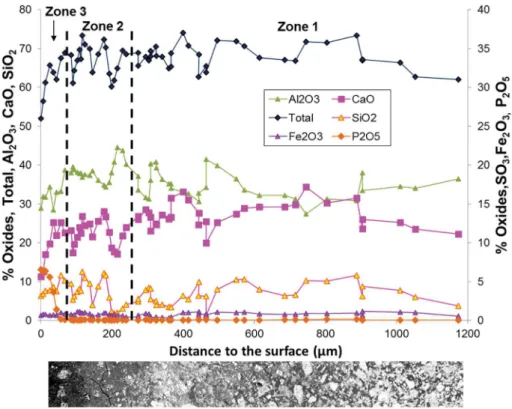
The chemical composition of the CAC paste after 10 weeks of im-mersion is presented inFig. 9, together with a BSE-mode SEM image of the sample. Chemical compositions are similar after 5 and 10 weeks. The mineralogical analyses from the core to the surface are presented in
Fig. 10. Three zones are distinguished:
•
Zone 1 has similar composition to that of a sound specimen, i.e. it is Fig. 5. Chemical composition after 10 weeks of immersion and chemical composition of the outer layers of the CEM I paste after 5 weeks [7] according to the distance to the surface (EPMA) (top) and SEM observations of the polished section in BSE mode (bottom).mainly made of aluminium and calcium, and contains crystalline anhydrous (calcium aluminium oxides (CA), mayenite (C12A7),
brownmillerite (C4AF), gehlenite (C2AS)) and hydrated phases
(C3AH6, gibbsite (AH3), C2AH8), usually found in aluminate cement
matrices. It shows a high density (lighter grey zone on the SEM images).
•
Zone 2, 180 μm thick, shows a slight decalcification, and therefore a slight relative enrichment of Al. Mineralogical analyses show the same phases as in zone 1 overall. However, some slight differences can be noted: the peaks of the anhydrous phases, CA and gehlenite are less intense closer to the surface; in contrast, gibbsite peaks (AH3) increased. Aragonite is detected, probably due to thecarbo-nation of katoite C3AH6[57]. Moreover, the density of the paste
decreases (darker background on the SEM image).
•
Zone 3 shows an enrichment in phosphorus with an intensedecalcification and a decrease of the aluminium content. However, no peak of a crystallized P-bearing phase is observed on the dif-fraction pattern. The total oxides content decreases from 65 to 50%. The mineralogical analysis shows intense peaks of AH3, the broad
bases of which characterize the poorly crystallized character of this phase. The density of the peripheral zone remains relatively high. 4. Discussion
4.1. Chemical and microbial composition of the liquid fraction of the digesting biowaste
The liquid fraction contained in lab-scale anaerobic bioreactor has properly undergone the consecutive reactions of the anaerobic diges-tion process. First, the hydrolysis and acetogenesis steps led to a
Fig. 7. Chemical composition of the CEM I-Ox paste after 10 weeks of immersion and chemical composition of the outer layers of this paste after 5 weeks of immersion according to the distance to the surface (EPMA) (top), and SEM observations of the polished section in BSE mode (bottom).
decrease of the pH and an increase of the VFAs concentration: the total VFAs concentration reached about 75 mmol·L−1and the pH dropped to
4.3. The VFAs metabolized in the digesting biowaste were acetic, pro-pionic and butyric acids, which are acids with soluble calcium salts. Then, the acetogenesis and methanogenesis steps gave rise to con-sumption of the VFAs and an increase to the neutrality area of the pH, which reached 7.8 at the end of the digestion cycle. The ammonium concentration increased quickly during the first few days of digestion
and then stabilized at values around 55 mmol·L−1. Both cycles showed
similar aggressive conditions in terms of concentrations of aggressive metabolites (VFA, ammonium and dissolved CO2) and pH values. This
means that concrete structures in which anaerobic digestion takes place will undergo repeated aggression when they are replenished in fed-batch, or a continuous aggression in the case of continuously-fed di-gesting installation.
These concentrations of aggressive metabolites in the liquid phase
Fig. 9. Chemical composition of the CAC paste after 10 weeks of immersion according to the distance to the surface (EPMA) (top), and SEM observations of the polished section in BSE mode (bottom).
of the bioreactors give information on the aggressiveness of the en-vironment for concrete.Table 3summarizes the limit values for solu-tions according to the exposure classes as given in FD P 18-011 [31] for the concentrations of aggressive CO2and the ammonium, together with
the pH. Considering that, for each cycle, the pH increased to values up to 6.5 after 7 days, the pH of the anaerobic digestion in normal op-eration should not lead to aggressive conditions for concrete according to the French information document FD P 18-011 [31] where the upper limit of pH of the XA1 exposure class is 6.5. The standard documents [30,31] also take the presence and the concentration of ammonium and dissolved CO2into account. The maximum concentration values
mea-sured during the anaerobic digestion (55 mmol·L−1for ammonium and
2.3 mmol·L−1for dissolved CO
2) made the liquid phase of the anaerobic
digestion a highly aggressive medium for cement based materials (class XA3 according toTable 3): the maximum concentration of ammonium measured was > 7 times the upper limit considered in the XA3 range (3.33–5.55 mmol·L−1) and the dissolved CO
2concentration was above
the lower limit of the XA3 class (1.67 mmol·L−1). It also can be noticed
that ammonium and bicarbonate concentrations of several grams per liter have been found in fully functioning industrial digesters [58–60]. Moreover, it can be highlighted that neither document considers the presence and concentration of VFA, even though several authors [17,33] have shown that the acid concentration is a much more sig-nificant parameter than the pH in the evaluation of the aggressiveness of certain types of acids, including organic acids.
The presence and impact of microorganisms, in the form of a biofilm or not, are not considered either by the FD P18-011 [31] regulation. However, the establishment of a microbial biofilm between the 5th and the 10th week was clearly a factor increasing the deterioration kinetics of the CEM I-Ox paste. In contrast, the CAC paste was particularly re-silient to the biofilm proliferation and was the material that showed the strongest resistance against the biodeterioration. Several studies agree that microorganisms are acting as accelerating agents on the dete-rioration of concrete, aggravating its biodetedete-rioration [7,8,28,29,61]. More particularly, a study by Magniont et al. [28] has highlighted the clear influence of a biofilm formation of E. coli intensifying the CEM I degradation. In addition, it was also demonstrated that the ability of bacteria to create a biofilm could be very harmful for concrete struc-tures [5,28]. According to the non-aggressive pH-conditions, the dis-solution of the external zone (Si-Al gel) of the CEM I paste presently observed after 10 weeks of exposure can be explained by particularly severe local conditions brought by the establishment of a biofilm at the surface.
Lastly, the standard considers temperatures between 5 and 25 °C while the anaerobic digestion process occurs mostly at mesophilic conditions (around 37 °C) in the industrial sector [11]. Even if a rise in temperature increases reaction rates andfinally the concrete degrada-tion kinetics, this factor is not taken in account for the exposure classes.
4.2. Performances of tested materials in relation with biofilm-materials interaction phenomena
The CEM I paste showed the highest deterioration kinetics, with the greatest degraded depths after 5 and 10 weeks and complete biofilm coverage observed at 5 weeks of exposure. The early microbial coloni-zation of the CEM I paste could be explained by the topology of the surface of CEM I, especially the abundance of micrometric holes, which Voegel et al. [27] found to be favourable to adhesion and microbial proliferation.
The oxalic acid treatment has resulted after 5 weeks in a less intense degraded depth than in the CEM I specimen, a chemical composition close to that of a sound sample, and no biofilm coverage. This resistance against the microbial biofilm growth could come from the surface texture created on the CEM I treated by oxalic acid: according to Voegel et al. [27], considering the characteristics of its surface height dis-tribution, the CEM I-Ox paste covered by calcium oxalate was less fa-vourable to microbial growth. However, after 10 weeks of immersion, the salt was no longer observed and the sample was covered by biofilm. The CEM I-Ox paste then showed the same degradation mechanisms as the CEM I paste, with a large degraded depth. Thus, the treatment seemed to have a protective effect for a limited duration only: it al-lowed degradation to be delayed by delaying the biofilm formation on the surface, which underlines the worsening effect of this formation. The oxalic acid surface treatment probably provided two types of pro-tection: the delay of biofilm formation and the presence of a layer of calcium oxalate, which was initially stable against acid attacks, thus protecting the matrix, but dissolved in the short term, revealing a sur-face composition close to that of the non-treated CEM I favourable to microbial proliferation.
Although the CAC pastes presented surfaces favourable to pro-liferation [27], this material showed the highest durability, with the smallest degraded depths after 10 weeks and only a non-uniform weak surface coverage by a microbial biofilm. The anhydrous phases of the CAC paste were the most preserved and the aluminate cement showed some peaks of crystallized AH3. However, a halo baseline
character-istics of amorphous compounds is also observed on the surface layer. 4.3. Biodeterioration mechanisms
Fig. 11summarizes the main chemical and mineralogical changes in the CEM I and CAC pastes exposed to the anaerobic digesting biowaste for two cycles, together with exposure conditions and degraded depths. 4.3.1. CEM I paste
In accordance with Voegel et al. [7], the analyses for the ordinary Portland cement showed alteration mechanisms corresponding to a combination of (i) leaching resulting from the exposure of cementitious materials to VFA [62] and ammonium [20], and (ii) carbonation due to the presence of aqueous CO2[21]. As the biowaste contained little or no
sulfur, it is likely that the relative enrichment in sulfur at depth, ex-pressed by the formation of secondary non-expansive ettringite, was due to the movement of sulfur from the outer layer, where S-bearing phases were dissolved, into zone 2. The peak of phosphorus in zone 4 was associated with the presence of phosphorus in the substrate [7]. Unlike the CAC paste, the CEM I paste was significantly affected by biofilm formation, leading to an external zone that was totally dec-alcified: anhydrous grains were completely dissolved after only 5 weeks of immersion, from zone 5 to zone 3.
4.3.2. CAC paste
In contact with biowaste, the CAC paste underwent chemical and mineralogical changes. Several phenomena were identified, such as surface decalcification, (incomplete) dissolution of the anhydrous grains and the hydrates on the surface, precipitation of calcium car-bonates at depth and a phosphorous peak in the intermediate zone. It
Aggressive agents Aggressiveness class according to NF EN 206 [30]
In the biowaste studied XA1 XA2 XA3
Aggressive CO2 (mg·L−1) ≥15 and ≤20 > 40 and ≤100 > 100 101 NH4+(mg·L−1) ≥15 and ≤30 > 30 and ≤60 > 60 and ≤100 990 pH ≤6,5 and ≥5,5 < 5,5 and ≥4,5 < 4,5 and ≥4,0 7.5 Table 3
Limit values for exposure classes for liquid environments according to FD P 18-011 [31].
could also be noted that the peripheral zone maintained a relatively high density. The fact that the CAC paste performs best could be linked to lower colonization of the CAC pastes compared to other binders [63,64]. Herisson et al. [65] explained this by the bacteriostatic effect of aluminium, present in large amounts in the CAC cements. It should be noted that, when considering very aggressive sulfur oxidizing con-ditions comparable to those in sewer networks, Buvignier et al. [61] showed no direct effect of the aluminium on the bacteria responsible for the acid attack, which the authors attributed to the adaptation of the microbial biofilm to high Al concentrations. The particular effect of CAC on microbial biofilm development was also observed in different conditions by Peyre Lavigne et al. [66] (sulfur-oxidizing biofilms) and Dalod et al. [63] (photosynthetic biofilms). Results of both studies suggested that the biofilm development and/or activity was slown down on the CAC substrates compared to the one grown on ordinary binder based materials. Moreover, Peyre Lavigne et al. [66] showed that the biofilm on CAC was less dense, and drier, and with lower mi-crobial diversity compared to biofilm grown on other binders. More-over, according to the literature, the formation of an aluminium gel (AH3) on the surface leads to better durability of calcium aluminate
cement matrices, since this gel is known to be stable at moderately acidic pH [37].
5. Conclusion
In this study, cement paste specimens were exposed to the anaerobic digestion liquid phase of laboratory reactors for 10 weeks. At the end of the experiment, all the cementitious materials tested: made of CEM I (ordinary Portland cement), CAC (calcium aluminate cement) or CEM I-Ox (CEM I treated with oxalic acid) were covered by biofilm and pre-sented biodeterioration. The pastes were affected by alteration me-chanisms including leaching, carbonation and phosphorus enrichment. However, it should be noted that differences of behaviour were high-lighted according to the material. The treatment with oxalic acid seemed to protect the specimen from biodeterioration by preventing the formation of biofilm during the first 5 weeks. Calcium oxalate therefore seems to have a proliferation inhibiting effect, at least in the short term. After this period, CEM I and CEM I-Ox followed the same degradation kinetics and mechanisms, with the formation of secondary non-ex-pansive ettringite at depth. CAC paste showed the best durability
performances and smallest degraded depth in the long term. Moreover, the anhydrous phases of the CAC paste were the best preserved and some of them were still present in the surface layer. This good dur-ability could be linked to a less dense coverage by the biofilm but probably also to the CAC mineralogy and to the formation of a per-ipheral gel of AH3, stable at moderately acidic pH.
Acknowledgements
The authors gratefully thank the PRES Université de Toulouse and the Région Midi-Pyrénées for their financial support, and IRSTEA, Antony, for the biowaste production protocol. They also wish to thank the French National Research Agency (AeNR) for funding the project BIBENdOM – ANR – 16 – CE22 – 001 DS0602.
References
[1] ADEME, Fiche technique: Méthanisation, (2015).
[2] Observ'ER, Le baromètre 2017 des énergies renouvelables électriques en France, (2017).
[3] H. Fehrenbach, J. Giegrich, G. Reinhardt, U. Sayer, M. Gretz, K. Lanje, J. Schmitz, Kriterien einer nachhaltigen Bioenergienutzung im globalen Ma\s sstab, UBA-Forschungsbericht, vol. 206, (2008), pp. 41–112.
[4] European Biogas Association (EBA), Statistical Report 2017 - Abridged Version, European Biogas Association (EBA), Brussels, 2017.
[5] A. Bertron, Understanding interactions between cementitious materials and mi-croorganisms: a key to sustainable and safe concrete structures in various contexts, Mater. Struct. 47 (2014) 1787–1806,https://doi.org/10.1617/s11527-014-0433-1. [6] A. Bertron, M. Peyre-Lavigne, C. Patapy, B. Erable, Biodeterioration of concrete in agricultural, agro-food and biogas plants: state of the art and challenges, RILEM Tech. Lett. 2 (2017) 83–89,https://doi.org/10.21809/rilemtechlett.2017.42. [7] C. Voegel, A. Bertron, B. Erable, Mechanisms of cementitious material deterioration
in biogas digester, Sci. Total Environ. 571 (2016) 892–901,https://doi.org/10. 1016/j.scitotenv.2016.07.072.
[8] A. Koenig, F. Dehn, Biogenic acid attack on concretes in biogas plants, Biosyst. Eng. 147 (2016) 226–237,https://doi.org/10.1016/j.biosystemseng.2016.03.007. [9] S. Cole, J.R. Frank, Methane from Biomass: A Systems Approach, Springer,
Netherlands, 1988.
[10]G.M. Evans, J.C. Furlong, Environmental Biotechnology - Theory and Application, John Wiley & Sons, 2003.
[11] R. Kothari, A.K. Pandey, S. Kumar, V.V. Tyagi, S.K. Tyagi, Different aspects of dry anaerobic digestion for bio-energy: an overview, Renew. Sust. Energ. Rev. 39 (2014) 174–195,https://doi.org/10.1016/j.rser.2014.07.011.
[12] Y. Li, S.Y. Park, J. Zhu, Solid-state anaerobic digestion for methane production from organic waste, Renew. Sust. Energ. Rev. 15 (2011) 821–826,https://doi.org/10. 1016/j.rser.2010.07.042.
[13]M.H. Gerardi, The Microbiology of Anaerobic Digesters, John Wiley & Sons, 2003. Fig. 11. Chemical and mineralogical changes and degraded depths of CEM I and CAC pastes exposed to the liquid-solid phase of an anaerobic digestion bioreactor after 10 weeks of immersion and their conditions of exposure.
[14] L. Appels, J. Baeyens, J. Degrève, R. Dewil, Principles and potential of the anaerobic digestion of waste-activated sludge, Prog. Energy Combust. Sci. 34 (2008) 755–781, https://doi.org/10.1016/j.pecs.2008.06.002.
[15] M. Kayhanian, Ammonia inhibition in high-solids biogasification: an overview and practical solutions, Environ. Technol. 20 (1999) 355–365,https://doi.org/10. 1080/09593332008616828.
[16] Y. Chen, J.J. Cheng, K.S. Creamer, Inhibition of anaerobic digestion process: a re-view, Bioresour. Technol. 99 (2008) 4044–4064,https://doi.org/10.1016/j. biortech.2007.01.057.
[17] A. Bertron, J. Duchesne, Attack of Cementitious Materials by Organic Acids in Agricultural and Agrofood Effluents, Perform. Cem.-Based Mater. Aggress. Aqueous Environ, Springer, Dordrecht, 2013, pp. 131–173, https://doi.org/10.1007/978-94-007-5413-3_6.
[18] A. Koenig, F. Dehn, Main considerations for the determination and evaluation of the acid resistance of cementitious materials, Mater. Struct. 49 (2016) 1693–1703, https://doi.org/10.1617/s11527-015-0605-7.
[19] A. Koenig, A. Herrmann, S. Overmann, F. Dehn, Resistance of alkali-activated binders to organic acid attack: assessment of evaluation criteria and damage me-chanisms, Constr. Build. Mater. 151 (2017) 405–413,https://doi.org/10.1016/j. conbuildmat.2017.06.117.
[20] G. Escadeillas, Ammonium Nitrate Attack on Cementitious Materials, Perform. Cem.-Based Mater. Aggress. Aqueous Environ, Springer, Dordrecht, 2013, pp. 113–130,https://doi.org/10.1007/978-94-007-5413-3_5.
[21] G. Escadeillas, H. Hornain, La durabilité des bétons vis-à-vis des environnements chimiquement agressifs, Durabilité Bétons, Presse de l'ENCP, 2008, pp. 613–705. [22] C. Carde, G. Escadeillas, R. François, Use of ammonium nitrate solution to simulate
and accelerate the leaching of cement pastes due to deionized water, Mag. Concr. Res. 49 (1997) 295–301.
[23] F.M. Lea, The action of ammonium salts on concrete, Mag. Concr. Res. (52) (1965) 115–116https://doi.org/10.1680/macr.1965.17.52.115.
[24] V. Baroghel-Bouny, B. Capra, D. Laurens, La durabilité des armatures et du béton d'enrobage, Durabilité Bétons, Presse de l'ENCP, 2008, pp. 303–385.
[25] A. Morandeau, M. Thiéry, P. Dangla, Investigation of the carbonation mechanism of CH and C-S-H in terms of kinetics, microstructure changes and moisture properties, Cem. Concr. Res. 56 (2014) 153–170,https://doi.org/10.1016/j.cemconres.2013. 11.015.
[26] M. Thiery, Modélisation de la carbonatation atmosphérique des matériaux ci-mentaires: Prise en compte des effets cinétiques et des modifications micro-structurales et hydriques, Ecole Nationale des Ponts et Chaussées, 2005. [27] C. Voegel, N. Durban, A. Bertron, Y. Landon, B. Erable, Evaluation of microbial
proliferation on cementitious materials exposed to biogas systems, Environ. Technol. (2019) 1–11,https://doi.org/10.1080/09593330.2019.1567610. [28] C. Magniont, M. Coutand, A. Bertron, X. Cameleyre, C. Lafforgue, S. Beaufort,
G. Escadeillas, A new test method to assess the bacterial deterioration of cementi-tious materials, Cem. Concr. Res. 41 (2011) 429–438,https://doi.org/10.1016/j. cemconres.2011.01.014.
[29] A. Bertron, M. Coutand, X. Cameleyre, G. Escadeillas, J. Duchesne, Attaques chi-mique et biologique des effluents agricoles et agroalimentaires sur les matériaux cimentaires, Matér. Tech. 93 (2005) s.111–s.121,https://doi.org/10.1051/ mattech:2006010.
[30] AFNOR, NF EN 206, Béton - Spécification, performances, production et conformité, Paris, France, (2014).
[31] AFNOR, FD P18-011, Béton - Définition et classification des environnements chi-miquement agressifs - Recommandations pour la formulation des bétons, Paris, France, (2016).
[32] S. Kamali, M. Moranville, S. Leclercq, Material and environmental parameter effects on the leaching of cement pastes: experiments and modelling, Cem. Concr. Res. 38 (2008) 575–585,https://doi.org/10.1016/j.cemconres.2007.10.009.
[33] S. Larreur-Cayol, A. Bertron, G. Escadeillas, Degradation of cement-based materials by various organic acids in agro-industrial waste-waters, Cem. Concr. Res. 41 (2011) 882–892,https://doi.org/10.1016/j.cemconres.2011.04.007.
[34] C. Voegel, A. Bertron, B. Erable, G. Escadeillas, Chemical Treatment with Oxalic Acid to Improve the Durability of Cement-based Materials in Acid Environments, (2015), pp. 670–678.
[35] A. Bertron, Durabilité des matériaux cimentaires soumis aux acides organiques: cas particulier des effluents d'élevage, INSA Toulouse, 2004.
[36] A. Bertron, J. Duchesne, G. Escadeillas, Durability of Various Binders Exposed to Organic Acids in Manure, Montreal (2007).
[37] H. Fryda, F. Saucier, S. Lamberet, K. Scrivener, D. Guinot, La durabilité des bétons d'aluminates de calcium, Durabilité Bétons, Presse de l'ENCP, 2008, pp. 767–823. [38] K.L. Scrivener, J.-L. Cabiron, R. Letourneux, High-performance concretes from
calcium aluminate cements, Cem. Concr. Res. 29 (1999) 1215–1223,https://doi. org/10.1016/S0008-8846(99)00103-9.
[39] A. Buvignier, C. Patapy, M. Peyre Lavigne, E. Paul, A. Bertron, Resistance to bio-deterioration of aluminium-rich binders in sewer network environment: study of the possible bacteriostatic effect and role of phase reactivity, Cem. Concr. Res. ((Submitted)).
[40] R. Letourneux, K. Scrivener, The resistance of calcium aluminate cements to acid corrosion in wastewater applications, Mod. Concr. Mater. Bind. Addit. Admix, Thomas Telford Publishing, 1999, pp. 275–283, ,https://doi.org/10.1680/ mcmbaaa.28227.0028.
[41] M. Matteini, Inorganic treatments for the consolidation and protection of stone artefacts, Conserv. Sci. Cult. Herit. 8 (2008) 13–27,https://doi.org/10.6092/issn.
1973-9494/1393.
[42] D. Pinna, B. Salvadori, S. Porcinai, Evaluation of the application conditions of ar-tificial protection treatments on salt-laden limestones and marble, Constr. Build. Mater. 25 (2011) 2723–2732,https://doi.org/10.1016/j.conbuildmat.2010.12. 023.
[43] A. Burgos-Cara, E. Ruiz-Agudo, C. Rodriguez-Navarro, Effectiveness of oxalic acid treatments for the protection of marble surfaces, Mater. Des. 115 (2017) 82–92, https://doi.org/10.1016/j.matdes.2016.11.037.
[44] E. Hansen, E. Doehne, J. Fidler, J. Larson, B. Martin, M. Matteini, C. Rodriguez-Navarro, E.S. Pardo, C. Price, A. de Tagle, J.M. Teutonico, N. Weiss, A review of selected inorganic consolidants and protective treatments for porous calcareous materials, Stud. Conserv. 48 (2003) 13–25,https://doi.org/10.1179/sic.2003.48. Supplement-1.13.
[45]AFNOR, NF EN 196-3. Méthodes d'essai des ciments — Partie 3: Détermination du temps de prise et de la stabilité, (2017).
[46]AFNOR, NF P18–459. Essai pour béton durci - Essai de porosité et de masse volu-mique, Paris, France, (2010).
[47] L. Neves, R. Oliveira, M.M. Alves, Influence of inoculum activity on the bio-me-thanization of a kitchen waste under different waste/inoculum ratios, Process Biochem. 39 (2004) 2019–2024,https://doi.org/10.1016/j.procbio.2003.10.002. [48] C. Voegel, A. Bertron, B. Erable, Biodeterioration of cementitious materials in
biogas digester, Matér. Tech. 103 (2015) 202,https://doi.org/10.1051/mattech/ 2015023.
[49]P.L. McCarty, Anaerobic waste treatment fundamentals, Public Works. 95 (1964) 66.
[50]P. Vindis, M. Mursec, M. Janzekovic, F. Cus, The impact of mesophilic and ther-mophilic anaerobic digestion on biogas production, J. Achiev. Mater. Manuf. Eng. 36 (2009) 192–198.
[51] D.P. Chynoweth, Renewable biomethane from land and ocean energy crops and organic wastes, HortScience 40 (2005) 283–286,https://doi.org/10.21273/ HORTSCI.40.2.283.
[52] A. Bertron, G. Escadeillas, P. de Parseval, J. Duchesne, Processing of electron mi-croprobe data from the analysis of altered cementitious materials, Cem. Concr. Res. 39 (2009) 929–935,https://doi.org/10.1016/j.cemconres.2009.06.011. [53] A. Bertron, J. Duchesne, G. Escadeillas, Accelerated tests of hardened cement pastes
alteration by organic acids: analysis of the pH effect, Cem. Concr. Res. 35 (2005) 155–166,https://doi.org/10.1016/j.cemconres.2004.09.009.
[54] M. Giroudon, M. Peyre-Lavigne, C. Patapy, A. Bertron, Biodeterioration mechan-isms and kinetics of SCM and aluminate based cements and AAM in the liquid phase of anaerobic digestion, MATEC Web Conf 199 (2018) 02003, ,https://doi.org/10. 1051/matecconf/201819902003.
[55] P. Faucon, F. Adenot, J.F. Jacquinot, J.C. Petit, R. Cabrillac, M. Jorda, Long-term behaviour of cement pastes used for nuclear waste disposal: review of physico-chemical mechanisms of water degradation, Cem. Concr. Res. 28 (1998) 847–857, https://doi.org/10.1016/S0008-8846(98)00053-2.
[56]L. Black, C. Breen, J. Yarwood, Structural features of C–S–H(I) and its carbonation in air—a Raman spectroscopic study. Part II: carbonated phases, J. Am. Ceram. Soc. (3) (2007) 908–917.
[57] S. Goñi, A. Guerrero, Accelerated carbonation of Friedel's salt in calcium aluminate cement paste, Cem. Concr. Res. 33 (2003) 21–26, https://doi.org/10.1016/S0008-8846(02)00910-9.
[58] D. Karakashev, D.J. Batstone, I. Angelidaki, Influence of environmental conditions on methanogenic compositions in anaerobic biogas reactors, Appl. Environ. Microbiol. 71 (2005) 331–338,https://doi.org/10.1128/AEM.71.1.331-338.2005. [59] O. Yenigün, B. Demirel, Ammonia inhibition in anaerobic digestion: a review,
Process Biochem. 48 (2013) 901–911,https://doi.org/10.1016/j.procbio.2013.04. 012.
[60]S.R. Jenkins, J.M. Morgan, C.L. Sawyer, Measuring anaerobic sludge digestion and growth by a simple alkalimetric titration, J. Water Pollut. Control Fed. 55 (1983) 448–453.
[61]A. Buvignier, M. Peyre-Lavigne, C. Patapy, E. Paul, A. Bertron, Understanding the Resistance of Calcium Aluminate Cements in Sewer Environments: Role of Soluble Aluminium on the SOB Activity, Ghent University, Belgium, 2017, pp. 215–216. [62] A. Bertron, J. Duchesne, G. Escadeillas, Degradation of cement pastes by organic acids, Mater. Struct. 40 (2007) 341–354, https://doi.org/10.1617/s11527-006-9110-3.
[63]E. Dalod, A. Govin, R. Guyonnet, P. Grosseau, C. Lors, D. Damidot, Influence of the chemical composition of mortars on algal biofouling, in: K.L. Fentiman, C.H. Mangabhai, R.J. Scrivener (Eds.), Int. Conf. Calcium Aluminates, IHS BRE Press, Palais des Papes, Avignon, France, 2014, pp. 523–534.
[64]A. Govin, I. Albuquerque, P. Grosseau, Development of an accelerated test of fungal biodeterioration. Application to calcium aluminate cements, in: K.L. Fentiman, C.H. Mangabhai, R.J. Scrivener (Eds.), Int. Conf. Calcium Aluminates, IHS BRE Press, Palais des Papes, Avignon, France, 2014, pp. 511–522.
[65] J. Herisson, M. Guéguen-Minerbe, E.D. van Hullebusch, T. Chaussadent, Behaviour of different cementitious material formulations in sewer networks, Water Sci. Technol. 69 (2014) 1502–1508,https://doi.org/10.2166/wst.2014.009. [66] M. Peyre Lavigne, A. Bertron, L. Auer, G. Hernandez-Raquet, J.-N. Foussard,
G. Escadeillas, A. Cockx, E. Paul, An innovative approach to reproduce the biode-terioration of industrial cementitious products in a sewer environment. Part I: test design, Cem. Concr. Res. 73 (2015) 246–256,https://doi.org/10.1016/j.cemconres. 2014.10.025.