HAL Id: pastel-00001827
https://pastel.archives-ouvertes.fr/pastel-00001827
Submitted on 7 Jul 2006
HAL is a multi-disciplinary open access
archive for the deposit and dissemination of sci-entific research documents, whether they are pub-lished or not. The documents may come from teaching and research institutions in France or abroad, or from public or private research centers.
L’archive ouverte pluridisciplinaire HAL, est destinée au dépôt et à la diffusion de documents scientifiques de niveau recherche, publiés ou non, émanant des établissements d’enseignement et de recherche français ou étrangers, des laboratoires publics ou privés.
innovations are cumulative and complementary
Yann Ménière
To cite this version:
Yann Ménière. Patent-based strategies and R&D efficiency when innovations are cumulative and complementary. Humanities and Social Sciences. École Nationale Supérieure des Mines de Paris, 2005. English. �pastel-00001827�
Ecole des Mines de Paris
DE PARIS
Collège doctoral
N° attribué par la bibliothèque
|__|__|__|__|__|__|__|__|__|__|
T H E S E
pour obtenir le grade de
Docteur de l’École des Mines de Paris
Spécialité «Économie industrielle»
présentée et soutenue publiquement
par
Yann MENIERE
INSIDE THE PATENT THICKET:
PATENT BASED STRATEGIES AND R&D EFFICIENCY WHEN
INNOVATIONS ARE CUMULATIVE AND COMPLEMENTARY
Directeur de thèse : François LEVEQUE
Jury
Professor Suzanne Scotchmer
Président
Professeur Claudes Crampes
Rapporteur
Doctor Katharine Rockett
Rapporteur
Contents
List of Figures v
List of Tables vi
Introduction 1
I The Economics of Patent Law 19
1 A legal system to allocate rights on innovations 21
1.1 Introduction . . . 21
1.2 Stand alone innovations . . . 24
1.2.1 Patent duration is not su¢ cient to tailor patent protection to inno-vations . . . 24
1.2.2 Knowledge disclosure and selective patenting . . . 27
1.2.3 Patents protect technologies, not markets . . . 29
1.2.4 Marketing the patented technology . . . 31
1.3 Cumulative innovations . . . 34
1.3.1 Why granting forward patent protection? . . . 34
1.3.2 Forward protection requires ex ante licensing . . . 37
1.3.3 Patentability requirements . . . 39
1.4 Patent enforcement . . . 42
1.4.1 Patent protection is not perfect . . . 42
1.4.2 Patent protection through litigation . . . 44
1.4.3 Do settlements relax patent protection? . . . 46
1.4.4 Patent protection without litigation . . . 49
1.5 Conclusion . . . 51
2 Non-obviousness and complementary innovations 54 2.1 The model . . . 59
2.3 Strong non-obviousness requirement . . . 65
2.4 Optimal non-obviousness requirement . . . 68
2.5 Conclusion . . . 71
II Patents and the Persistence of the Incumbent 73 3 Patent strategies and the persistence of dominant …rms 75 3.1 Patent and exclusivity . . . 78
3.1.1 The incentives to innovate . . . 79
3.1.2 The incentives to preempt . . . 81
3.1.3 The incumbent’s dilemma . . . 83
3.1.4 Conclusion and comments . . . 85
3.2 Using patent as a tool for trade . . . 87
3.2.1 Buying the entrant’s patent . . . 88
3.2.2 Choosing the next competitor . . . 91
3.2.3 Licensing to followers . . . 93
3.2.4 Conclusion . . . 96
3.3 Leveraging cumulative patents . . . 97
3.3.1 Cumulative patents as barriers to entry: theoretical elements . . . . 98
3.3.2 Patent portfolios as barriers to entry: empirical elements . . . 99
3.3.3 Contracting on cumulative innovations . . . 100
3.3.4 Buying upstream patents . . . 103
3.3.5 Conclusion on blocking patents . . . 104
3.4 Conclusion . . . 105
4 Cumulative Patents, drastic Innovation and the Persistence of Monopoly107 4.1 The model . . . 108
4.2 Solving the model . . . 111
4.2.1 M has bought the patent ex ante . . . 111
4.2.2 E has bought the patent ex ante . . . 113
4.2.3 R sells the patent ex post . . . 115
4.3 First node . . . 116
4.4 Incentives to develop the upstream patent . . . 122
4.4.1 Incentives for R to develop the upstream innovation . . . 123
4.4.2 Ex ante contracts between the three …rms . . . 124
4.5 Conclusion and discussion . . . 132
III Patent Agreements between Competitors 139 5 Blocking patents and R&D investments 141 5.1 Introduction . . . 141
5.2 A review of the literature . . . 143
5.2.2 Complementary patents, cross licensing and R&D investments . . . 145
5.2.3 Surveys and empirical studies . . . 148
5.3 Exogeneous blocking patents and ex ante licensing agreements . . . 150
5.3.1 The model . . . 150
5.3.2 Downstream investments . . . 153
5.3.3 Comparing the scenarios . . . 160
5.3.4 Upstream investment and welfare . . . 164
5.4 Endogeneous blocking patents . . . 169
5.4.1 The model . . . 170
5.4.2 Endogeneous patent breadth . . . 171
5.4.3 Costly patenting . . . 173
5.5 Conclusion . . . 174
5.5.1 Appendix 5.1: proof of Proposition 5.2 . . . 177
Conclusion 185
List of Figures
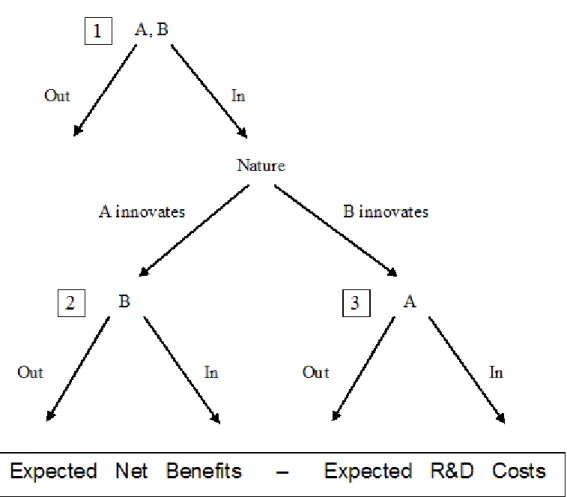
2.1 The patent race under the weak requirement . . . 61
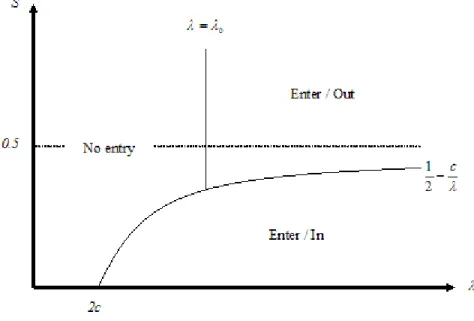
2.2 Outcomes under the weak requirement . . . 64
2.3 The patent race under the strong requirement . . . 66
3.1 Patent propensities of software "Incumbents" and "Entrants" (source: Gra-ham and Mowery, 2003) . . . 101
4.1 Timing of the game . . . 110
4.2 Outcomes of the auction . . . 117
4.3 Allocation of the basic patent and persistence of the incumbent . . . 120
4.4 Over and under incentives for the research …rm to develop the basic innovation125 5.1 Timing of the model. . . 151
5.2 Decision to sign ex ante agreements. . . 163
5.3 E¤ect of compulsory licensing on ex ante agreements. . . 165
5.4 Total welfare in function of the patent breadth. . . 167
5.5 Social e¢ ciency of the ex ante agreement. . . 169
List of Tables
0.1 The motives for patenting innovations . . . 11
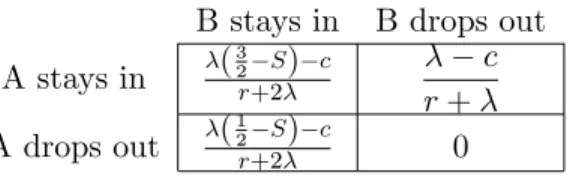
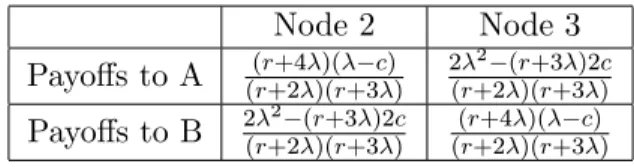
2.1 Continuation payo¤s if A has patented the …rst innovation (Node 2) . . . . 62
2.2 Entry payo¤s (Node 1) . . . 63
2.3 Continuation payo¤s of A and B at Nodes 2 and 3 . . . 67
3.1 Exclusive patents and persistence of the incumbent: summary of the results 84 4.1 Expected pro…ts of M and E when M has bought the upstream patent ex ante.112 4.2 Expected pro…ts of M and E when E has bought the upstream patent ex ante.114 4.3 Expected pro…ts of M, E and R when the upstream patent is sold ex post. . 115
4.4 Equilibria of the game. . . 119
4.5 Joint venture contract: case 1 . . . 127
4.6 Joint venture contract: case 2 . . . 129
4.7 Joint venture contract: case 3 . . . 131
5.1 Downstream investment under the three scenarii. . . 161
Acknowledgments
I am gratefull to François Lévêque for having supervised my thesis. He has encouraged me to follow closely the current controversies on patents in Europe and the United States, which has shaped my work and permitted me to have a real dialog with lawyers, IP managers and policy makers. He has trusted me enough to propose me to write a book with him during my thesis. He has also permitted me to stay two months at the University of California at Berkeley at the beginning of my PhD. I had discussions there with Suzanne Scotchmer, John Barton, Richard Gilbert and Mark Lemley, which has been a determinant input for my thesis. Of them, I am especially gratefull to Suzanne Scotchmer. She has helped and encouraged me at several occasions since then, giving me the opportunity to participate in several conferences and seminars. In Paris, David Encaoua has also followed my work, welcoming me regularly at his innovation seminar and giving usefull advises. The third part of the thesis is derived from a joint paper with Sarah Parlane. Sarah has also kindly advised me at di¤erent stages of my thesis work.
I had a great time doing my thesis at Cerna. It was a pleasure to meet and share activities with the other PhD students of Cerna, nonetheless my o¢ ce mates Frédérik and Gildas. I want to thank Matthieu Glachant and all the participants of the Cerna workshop for their careful readings and comments at many occasions. Thanks also to Césaria Ferreira, without whom my practical life at Cerna would have been much more complicated!
Last but not least, my wife Elise has (nearly) never complained about my talking repeatedly about things of such narrow interest as "patent breadth". She has been the strongest support for me.
For the last two decades, a more systematic use of patents, along with a strength-ening of patent law and the development of new technologies, has modi…ed competition based on innovation, thereby challenging the traditional economic view of patents as a legal tool to promote innovation. In the agro-biotechnology sector, the semi-conductor and the software industry, …rms tend to hedge their intellectual assets by accumulating large patent portfolios which they eventually license or cross-license to each other. Other …rms specialize in R&D activities, and sell or license their patents to downstream operators. Some even specialize in …ling patents which they use to sue other …rms and reap part of their pro…ts (Lemley & Shapiro, 2004). Patent grants in the United States and other industrialized countries such as France more than tripled between 1980 and 2001, whereas they had been stable over the previous 20 years (Ja¤e, 2000; Gallini, 2002). It is di¢ cult to say to what extent this "patent ‡ood" is a cause or a consequence of the new strategies of the …rms. Yet what is certain is that it has created a "patent thicket" which …rms have now to navigate (Shapiro, 2001).
This thesis is made of three independent parts; each aims to shed light on how …rms compete and innovate within the "patent thicket". More precisely, each part gives a di¤erent insight into the strategic uses of patents and their e¤ects on R&D when the tech-nology is such that …rms build upon each other’s innovations. Such cumulative innovations (Scotchmer, 1991) feature especially, although not exclusively, in high tech industries such as software, electronics, telecommunications and biotechnologies. In all of them, …nal prod-ucts are likely to embody several patented elements, which results in increased strategic interaction between patent holders.
The strategic use of patents has arisen as a major concern during the last few years. In 2003, the National Science Agency in the US issued a report called Patents in the Knowledge-Based Economy, while the Federal Trade Commission organized hearings in 2002 that resulted in the publication, in 2003, of a Report entitled To Promote Innovation: A Proper Balance of Competition and Patent Law and Policy. Both initiatives were taken as a reaction to a perceived shift in the way …rms innovate and compete in industries where patents have come to play a central role. Both conclude that patents may be harmful for competition and innovation, and identify a lack of enforcement of patent law by the US Patent O¢ ce as a major cause of the situation. In the European Union, the re‡ection on patent strategies is more prospective as high tech industries are in the main less devel-oped than in the US and the opportunity of conferring patent protection to software and biotechnology inventions is still under debate. The European directive on software patent has not yet been adopted, while the European Directive 44/98 on biotechnology patents still has to be interpreted before being transposed into several national laws. It is all the more important if we are to understand how a shift in patent protection may in‡uence the evolution of the industries mentioned above.
My thesis provides a theoretical approach to this question. It is thus a useful complement to surveys and empirical studies such as the NSA and FTC reports, and sets out to show what can be derived from the US experience and applied to the European one. In particular, an analytic approach helps to separate out which issues stem from a patent o¢ ce enforcement failure on the one hand, and those that are the result of the mere application of patent law to some particular technologies on the other hand.
The theoretical approach which I adopt in each Part of the thesis can be summed up in three main points. Insead of carrying out the economic analysis of patents in a context of stand alone innovations, I focus on technologies that are fragmented into di¤erent patentable elements. Secondly, and as a consequence, I study the strategic interactions of …rms in a context of fragmented patents. I therefore capture and propose a welfare analysis of strategic behaviours that have been observed empirically. Finally, I carry out this analysis by taking into account the e¤ects of patent strategies on R&D investments and innovation. This adds on the one hand to papers that focus on how patents on stand alone innovations a¤ect R&D investments and, on the other hand, to papers that study how fragmented patents a¤ect pricing behaviours in a static framework. This analysis therefore contributes to the literature on cumulative innovation, which studies how patents may a¤ect investments in subsequent innovations.
Focusing on cumulative and complementary innovations
Patents do not necessarily protect stand alone innovations. The intellectual prop-erty of one given technology may be fragmented into several patents that may belong to di¤erent owners. The classical way of analysing patents as temporary monopolies awarded on stand alone innovations is not su¢ cient to capture this fragmentation, nor its e¤ects on the …rms’ behaviour. Therefore, throughout the thesis I thus use two theoretic con-cepts, namely cumulative and complementarity innovation. This allows me to capture how patented innovations can be aggregated to each other, as well as the speci…c issues that this may raise.
Patents on stand alone innovations
Economists generally justify patents as a means to foster innovation by granting innovators a temporary monopoly that allows them to recover their initial R&D investments. This argument can be outlined in a very simple setting derived from Scotchmer (2006). Consider an innovation of value v that can be developed by investing an amount c. Assume also that (v; c) is private information of one single agent until the innovation has been developed. Patent law creates an incentive to transform ideas into innovations only when their value exceeds their cost. As the innovator has been granted the exclusivity on the innovation, she can set a monopoly price and make a monopoly pro…t . Yet the monopoly price dissuades some consumers from purchasing the innovation. This deadweigh loss implies that the pro…t is lower than the social value v of the innovation had it been distributed as a public good. In this context the innovator will invest only if > c, so that innovations verifying < c < v will not be developed. As social e¢ ciency requires that all ideas that verify v > c are developed, this is only a second best.
As in this simple setting, the economic analysis of patents generally deals with a fundamental trade-o¤ between innovation as a factor of dynamic e¢ ciency, and the paten-tee’s monopoly power as a factor of static ine¢ ciency (Lévêque & Ménière, 2004). That said the main thrust of this thesis is to study speci…c questions raised by the cumulative and complementary nature of innovation and not the trade-o¤ between static and dynamic e¢ ciency.
Cumulative innovations and the hold up issue
The concept of cumulative innovation captures the fact that innovators build upon each other’s works (Scotchmer, 1991). Two innovations are cumulative if the achievement of the …rst one is necessary to enable the achievement of the second one. The sequential link between cumulative innovations can take di¤erent forms. Innovations that improve the quality of an existing product, or that reduce the cost of a production process are cumulative. The discovery of a new application of an invention is also a form of cumulative innovation. Finally, cumulativity is characteristic of research tools, which are innovations that are used to produce other innovations.
Cumulativity raises the di¢ cult problem of sharing the property of innovation between di¤erent subsequent innovators (Scotchmer, 1991). If an upstream innovation is not pro…table per se, it may be necessary to grant its inventor a patent that confers him a right on the subsequent, downstream innovation. This can however jeopardize the development of the downstream innovation. Indeed the upstream patentee may be tempted to hold up the downstream innovator once it has been developed. If she expects this, the downstream innovator will thus be dissuaded from investing in R&D.
Complementary innovations and the multiple marginalization issue
The concept of complementarity captures the fact that a complete technology may embody several patented elements which, unlike cumulative innovations, do not result from each other (Shapiro, 2001). By the end of 2002, the MPEG standard for digital video compression contained for example 525 patents, belonging to 22 companies. In
agro-biotechnology, Golden Rice - a genetically engineered rice variety bred to help combat vitamin A de…ciency - encompasses more than 70 patents from 5 di¤erent technological …elds (Joly & Hervieu, 2003). Generally, most products in electronics, telecommunications and biotechnology encompass several patents.
Patented innovations can be analysed as perfect complements if each of them is necessary to work out a given technology. In this case each patent confers a monopoly on one input of the technology and behaves unilaterally as a monopolist. According to the Cournot theorem (1938), this triggers an underuse of each innovation. Indeed each patentee …xes a price mark up that reduces the overall demand for the technology and, thereby, the demand for each other complementary patent. This multiple marginalization is detrimental for both social welfare and the patent holders’pro…ts.
Patent strategies when innovations are cumulative and complementary Having de…ned cumulative and complementary innovations as a structural element of my analysis, one of the objectives of this thesis is to identify which patent strategies may take place within this framework. In particular, this work aims to understand the motives and e¤ects of strategic behaviors that have been underscored by empirical references.
The tragedy of anticommons
Heller and Eisenberg (1998) summarize the conditions of innovation and compe-tition within the "patent thicket" (Shapiro, 2001) as a "tragedy of anticommons". By contrast with the "tragedy of commons" which quali…es the overuse and depletion of scarce resources when they are in free access, the "tragedy of anticommons" describes a situation
in which several individuals own rights of exclusion on a non-rival resource such as a tech-nology, which in turn leads to underuse of this resource. Although their paper focuses on biotechnologies, it can be applied to all industries where cumulative and complementary innovations are protected by patents.
The underlying idea is that the multiplication of patent owners results in higher transaction costs. This increases the cost of innovation and has thus a detrimental e¤ect on the …rms’incentives to innovate. The hold up of subsequent innovations and the multiple marginalization issue form part of these transaction costs, although they are not quoted by Eisenberg and Heller (1998). Other costs of transaction include costs related to identifying the patent owners, the cost of bargaining, designing and enforcing licensing contracts. In agricultural biotechnology, these costs have for example left unexplored several …elds in which research would necessitate access to numerous patents (Gra¤ & alii, 2003). Trans-action costs also increase with legal uncertainty on the actual scope of the patent, and economic uncertainty on value of future products. This explains why, for instance, new U.S. biotechnology …rms with high costs of litigation generally shy away from investing in technological …elds where other …rms already secured patents (Lerner, 1995).
The "tragedy of anticommons" gives an initial, pessimistic insight into how …rms innovate within a "patent thicket". The more fragmented the patents, the less the inno-vation. This analysis is however limited in several respects. Indeed Heller and Eisenberg consider patents only as an external threat for innovators. They do not envisage that …rms can rely on their own patents to elaborate new speci…c strategies that are adapted to their environment. Moreover they consider patents as a given. They do not explain the patenting
behaviour of …rms, nor their subsequent patent trading strategies.
Patent strategies in practice
According to empirical studies, patents play their incentive role fully only in a small number of industries, such as the pharmaceutical industry (Arora et alii., 2001). A survey of R&D laboratories in the U.S. manufacturing sector (Cohen, Nelson & Walsh, 2000) highlights their managers’ lack of faith in patents as an e¤ective way of protecting their innovations. Firms cite trade secrecy and the …rst mover advantage as the most e¤ective forms of protection, ahead of patents. Other studies, conducted in Europe, (Lanjouw, 1998; Schankerman, 1998) estimate the value of patent protection at 15% to 25% of R&D expen-diture. In other words, patents seem to be generally ine¢ cient at guaranteeing innovators return on their investment.
The apparent paradox between high patent …gures and weak patent protection can be explained by an increase in the …rms’propensity to patent for a given amount of R&D spending, especially in sectors with cumulative and complementary innovations. Hall and Ziedonis (2001) show that the number of patents per million of R&D dollars has doubled in the U.S. semi-conductor industry between 1982 and 1992. Graham and Mowery …nd similar results in the U.S. software industry. They show that the aggregate patent propensity of the top 15 U.S. packaged software …rms has increased between 1987 and 1997, from less than 2 to more than 5 patents per $100 millions of R&D spending1. A monography by Bekkers and alii (2002) highlights a similar evolution in telecommunications equipment.
The increase in the patenting propensity has taken place against a background
1
The increase is limited from less than 2 to more than 3 patents per $100 millions of R&D spending if Microsoft is dropped out of the panel
of lenient patent o¢ ces that allow …rms to obtain additional low value patents for a given R&D e¤ort (Hall, 2004; Lemley & Shapiro, 2004; ). In this context there are various motives for inventors to …le additional patents. Patents are used as a signal towards share holders, creditors or consumers (Lemley, 2000; Long, 2002) or to reduce strategic uncertainty by hedging their innovations (Lerner, 2002). Patents have also been increasingly used as strategic weapons in competition.
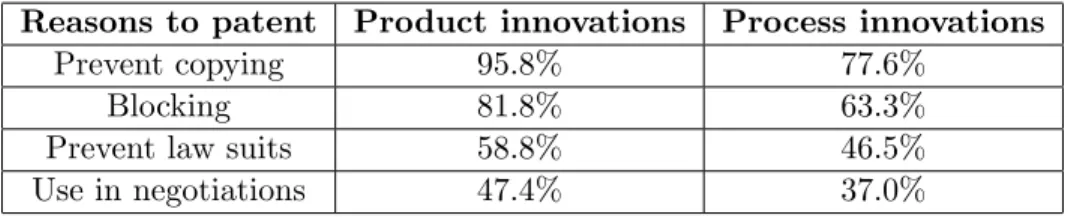
Table 0.1 reports other results from the survey of U.S. R&D laboratories (Cohen, Nelson & Walsh, 2000). It shows the four main motives for R&D managers to patent. Unsurprisingly their main reason for patenting an innovation is to protect it from imitation by rivals. Yet the other reasons correspond to a more strategic use of patents as a way of interacting with other …rms. Patents are …led to prevent a competitor from patenting its own innovation (the "block" motive) or, conversely, to prevent being sued for infringement by a competitor. In this context of mutual threat of infringement, patents confer bargaining power to negociate licenses.
A large study of the determining factors of patent suits and settlements in the US between 1978 and 1999 con…rms the importance of …ling patents for strategic purposes (Lanjouw and Shankerman, 2004). It shows that having a large patent portfolio reduces the probability of litigation. This applies more to large …rms than to their smaller counterparts. Indeed large companies are more likely to have repeated interactions, both in intellectual property and product markets. According to game theory predictions, such repeated inter-actions are factors that facilitate cooperation.
Reasons to patent Product innovations Process innovations
Prevent copying 95.8% 77.6%
Blocking 81.8% 63.3%
Prevent law suits 58.8% 46.5%
Use in negotiations 47.4% 37.0%
Table 0.1: The motives for patenting innovations
Cohen, Nelson and Walsh (2000) …nd that the ranking of motives for patenting innovations vary from sector to sector. They distinguish between "discrete" and "complex" technologies. When a technology is "discrete", as in the pharmaceutical or the chemical industry, a marketable product or process comprizes relatively few patentable elements. In this instance the main motive for patenting is to prevent copying. The "complex" technolo-gies correspond to sectors where innovations are in the main cumulative and complementary, such as telecommunications equipment, semiconductors, software or biotechnology. Here …rms often need to secure an access to other …rms’ patents. Thus they accumulate large patent portfolios principally to block other …rms, prevent law suits, and negociate licences (Cohen, Nelson & Walsh, 2000; Hall & Ziedonis, 2001).
A theoretical approach of patent strategies when innovations are cumulative and complementary
The aim of this thesis is to use the tools of economic theory to capture and explain patent strategies that may take place in a framework of complementary and cumulative innovations. The three Parts of the thesis do not constitute a general theory. Rather, they shed light on di¤erent issues in a context either of cumulative or of complementary innovation. In each of them I go beyond the framework of the "tragedy of anticommons"
by asking why …rms seek to acquire patents and how they use them. My goal is therefore to shed the light of economic theory on some of the patent strategies that have been revealed by empirical studies.
A welfare analysis focused on R&D investments
The theoretic approach of patent strategies allows the evaluation of their wel-fare e¤ects. These e¤ects include static elements such as market power and the resulting deadweigh loss, and dynamic elements such as R&D costs and the frequency and size of innovations. As I study patent strategies in the context of cumulative and complementary innovations, I focus on the interactions between patents holders rather than on how patents a¤ect the welfare of consumers. I depart therefore from the usual trade-o¤ between static and dynamic e¢ ciency and concentrate on the dynamic e¤ects of patent strategies on R&D investments.
R&D investments and social e¢ ciency
The general problem of R&D e¢ ciency is one of information aggregation (Scotch-mer, 2005). Consider for instance n ideas (vi; ci)i=1;nfeaturing innovations of value vi that can be developed at cost ci, and assume that these innovations are substitutable. Social e¢ ciency then requires that only the idea that maximizes vi ci is carried out. This opti-mum may however be di¢ cult to achieve if the ideas (vi; ci), or even the costs ci and values vi taken separately, are private information of di¤erent agents. There is therefore a need for a speci…c mechanism capable of gathering and aggregating these information so as to make the best investment decision. Patents, grants and prizes are such mechanisms. Yet
none of them can always ensure a …rst best optimum. The e¢ ciency of R&D investments in the case of patents shall therefore be considered in a second best world.
The merit of patents is that only those agents whose ideas verify vi ci > 0 have an incentive to invest ci. Yet patents raise an important coordination issue when two or more …rms have ideas (vi; ci) of substituable innovations. Indeed several …rms may then have an incentive to innovate in order to bene…t from the exclusivity conferred by the patent. In this framework, the patent may not be awarded to the …rm with the best idea. Moreover, a large body of literature (for a complete survey, see Reinganum, 1989) shows that such "patent races" trigger either excessive or insu¢ cient R&D investments. Both the number of …rms that invest in R&D and their individual level of investments may be ine¢ cient. Whether they are excessive or insu¢ cient principally depends on which "production function for knowledge" is considered (Scotchmer, 2005). More precisely, the e¢ ciency of R&D duplications depends on how the aggregation of R&D costs a¤ects the overall probability that the innovation will …nally be developed. On the one hand, …rms invest in R&D until the individual expected pro…t from an additional investment in zero. Thereby they dissipate the whole expected social value of the innovation. On the other hand, costs duplication may for instance compensate individual under-incentives to innovate when a patent owner cannot appropriate the whole social value of its innovation.
Patent races when innovations are cumulative and complementary
The three models that I develop in the thesis transpose di¤erent patterns of patent race between two …rms in a framework of cumulative and complementary innovations. I thereby add to several papers on cumulative innovation (Green & Scotchmer, 1990;
Scotch-mer, 1996, Denicolò, 2000). These papers aim to …ne tune patent policy. They evaluate the e¢ ciency of R&D in patent races for that purpose. The …rst Part of this thesis extends these patent policy models to a framework of complementary innovations. By contrast the models that I develop in Parts 2 and 3 do not directly focus on policy levers. They nevertheless allow you to evaluate the welfare impact of patent strategies on the e¢ ciency of R&D investments. In this way they shed light on the welfare properties of the patent regime in the context of cumulative and complementary innovation.
Outline of the thesis
The thesis consists of three Parts and …ve chapters. Chapters 1 and 3 contain surveys of the economic literature. In the remaining chapters I develop original theoreti-cal models that study how …rms compete and innovate in the context of cumulative and complementary innovations.
The economics of patent law
The …rst Part of the thesis focuses on the set of legal rules that constitute the patent system. The …rst chapter is a general survey of these rules and their economic functions. The second chapter develops a theoretical model that focuses more precisely on how one speci…c rule, namely the non-obviousness patentability requirement, can in‡uence the degree of fragmentation of patents on complementary innovations, and thereby the e¢ ciency of R&D investments.
The …rst chapter has a wider focus than the rest of the thesis, as it reviews the whole literature on patent law. It also adopts a di¤erent approach as its focus is patent as
a legal means to protect innovations, not patent strategies. I discuss to what extent the legal rules that make up the patent system allow me to adapt the protection conferred by patents to various patterns of innovation. To the end, I draw the distinction between stand alone and cumulative innovations, and consider as a third step the problem of enforcement of patent protection in the courts. In all instances, I argue that the patent system does not directly de…ne protection in terms of the market, which gives the patent system more ‡exibility to adapt di¤erent patterns of innovation.
The second chapter focuses on one speci…c rule of the patent system, namely the obviousness patentability test. I develop a theoretical model showing that a strict non-obviousness requirement can prevent the negative e¤ects of an excessive fragmentation of industrial property. I consider a marketable product or process that embodies two comple-mentary innovations. In this setting I can de…ne a strong non-obviousness test as the case in which only the marketable product or process is patentable, while each complementary innovation can be patented under a weak non-obviousness requirement. My argument for a strict test relies on a trade-o¤ between the costs of patent fragmentation, namely trans-action costs, hold-up and multiple marginalization, and the bene…t of patent disclosure, which is to avoid the duplication of R&D costs. The model shows that although a severe non-obviousness requirement may result in R&D cost duplications because small innova-tions are neither patented nor disclosed, setting a minimum threshold of non-obviousness is an e¢ cient way to limit the cost incurred if complementary patents are scattered between di¤erent owners.
Patents and the persistance of incumbent …rms
In the second Part of the thesis, I analyse how patents and patent strategies a¤ect the persistence of dominant …rms. As in the previous Part, the …rst chapter is a general survey of the economic literature which is not limited to a cumulative and complementary innovations. The following chapter develops a theoretical model of cumulative innovation showing how an incumbent monopoly can persist by preempting an upstream patent on a drastic innovation.
The third chapter is a survey of the literature. I start from the framework ini-tially developed by Arrow (1962) to study how innovation a¤ects the market structure. I then introduce patents and patent strategies into this framework so as to review how they in‡uence the persistence, or replacement, of dominant …rms. The survey shows that in-troducing patents and licensing strategies into the traditional theory of innovation tends to reverse the general result that innovation favours the entry of new competitors rather than the persistence of incumbent …rms. Admittedly, focusing on the exclusivity conferred by patents on a product market leads to the general conclusion that an entrant has more incentives to innovate than an incumbent monopoly, because of a business stealing e¤ect. However, an e¤ective way for the dominant …rm to persist is to use patents as tools for trading technology. Indeed patent transactions between an entrant and an incumbent can often increase the industry surplus, by preventing price competition or costly R&D races. Finally, cumulative innovations create another set of e¤ective persistence strategies for the incumbent.
third one. The model shows that when innovation is cumulative, an incumbent will be able to pre-empt an upstream patent that enables the development of a sweeping, drastic innovation. I assume that this innovation is developed using an upstream patent, and that it is patentable too. In this case the value that the incumbent or an entrant can o¤er for the upstream patent depends on their respective bargaining power in case the upstream patent belongs to one …rm, and the downstream patent to another …rm. As the incumbent makes a pro…t even if the innovation is not marketed, it has a higher bargaining power than the entrant, and can thus systematically pre-empt basic patents that could later result in subsequent drastic innovations.
Blocking patents and R&D investments
The third Part is made of one chapter, derived from a joint paper with Sarah Parlane (Ménière & Parlane, 2004). It develops a theoretical model to study the incentives of symmetric competitors to use their patent to block each other, and to sign cross-licensing agreements.
I consider two symmetric …rms that invest in R&D to develop new products. The …rms operate indepedently from each other, so that their products, although perfect substitutes, are di¤erent and protected by di¤erent patents. However, I assume that the patents can be broader than the underlying innovations. As a result, patents may be used opportunistically by the …rms as o¤ensive tools to hold-up the product developed by their competitor.
This model sheds light on the free riding behavior of patent holders who tend to reduve their R&D investments if they expect to hold their competitor’s product. As
a result investments decrease with the blocking power of patents, so that licensing agree-ments signed before developing new products are pro-competitive when patents are likely to be blocking. When patents have a weak blocking power, such licensing agreements are however anticompetitive because they give the …rms an opportunity to tame investments in development and, thereby, to reduce the probability of having to compete neck and neck on the product market. The model also shows that it may not be welfare improving that the courts erode the market power conferred by patents. Indeed this raises the incentives for the …rms to settle ex ante agreements, be they pro- or anti-competitive.
The model also allows us to capture the …rms’incentives for increasing their block-ing power by addblock-ing new patents to their portfolio. It predicts especially that …rms will use this strategy in sectors where the development of new products is relative easy, in order to reduce the intensity of R&D competition. In that case the equilibrium patenting strategies are detrimental to welfare and they may even be detrimental to pro…t if the cost of …ling new patents is low. By contrast the …rms have no incentives to undertake such strategies if R&D is already expensive and uncertain, which explains for example why …rms are less keen to accumulate large patent portfolios in industries such as pharmaceuticals or chemicals.
Part I
This Part focuses on the legal rules that support the patent system. I rewiew in Chapter 1 how patent protection adapts to di¤erent innovation patterns through a set of legal rules. I then then develop in Chpater 2 a model showing that the non-obviousness patentability requirement permits to prevent a socially ine¢ cient fragmentation of patents on technologies made of complementary innovations.
Chapter 1
A legal system to allocate rights on
innovations
1.1
Introduction
The question of patent design is at the crossroad of technology, law and economics. A patent delimits a correspondence between the realm of technology and the realm of law, while economic analysis is a way to evaluate and …ne tune this correspondence. Economic analysis shall however be carried on, not only on a stand alone innovation basis, but also by taking into account the broad picture of a legal system that transforms non rival information into exclusive assets.
The purpose of this chapter is to review how patent protection can adapt to di¤er-ent innovations within such a general system. Recall that the economic function of patdi¤er-ents is to create incentives to innovate by enabling the innovators to appropriate the reward of
their inventions. Consider for instance an innovation that is featured by its cost c and value v. Granting the inventor the exclusivity on her invention allows her to make a pro…t < v. As a result she will develop the innovation if and only if > c. Besides the problem of deadweight loss, this simple way of presenting the function of patents highlights other short-comings. First, several innovations with di¤erent costs and values may perform the same function. Therefore patent protection may result in cost duplications (if several innovators invest in di¤erent ideas at the same time) and in patenting the wrong innovation (if the …rst developed innovation is not the most valuable one). However I rule out the problems of selection and cost duplications in this part, to consider only cases in which any innovation verifying v > c is worth developing for the society. As stated by Maurer and Scotchmer (2004), this corresponds to the case of isolated idea where patent is supposed to work best. I can thereby focus on another issue raised by the patent rationale, namely the fact that one single form of intellectual property right, featured by general rules, is supposed to …t all innovations.
While the economic rationale of patents - to concede market power to innovators as a reward and an incentive for innovation - is relatively simple, the underlying legal construction is indeed far more complex. From a legal viewpoint, a patent is a temporary property right that can last up to twenty years. It consists of two parts: a description of the innovation and a list of claims delimiting the exclusive rights conferred by the patent. For an innovation to be patentable, its description has to meet three criteria. The precise de…nition of these criteria varies from country to country, but is substantially the same. For example, the European Patent O¢ ce’s patentability criteria for an innovation are novelty, inventive
step, and industrial applicability, while they become respectively novelty, non-obviousness, and utility in US law. The scope of the claims delimits the market power granted to the patentee. To ensure that the claims are not excessive, they must be consistent with the description of the innovation. The extent of the protection conferred on an innovation is initially determined by a patent o¢ ce examiner, who applies the three criteria and evaluates the consistency between the claims and the description of the innovation. A …rm armed with a patent can then impose its legal monopoly by suing a competitor for infringement on the basis of the claims.
To what extent can this legal system …t heterogeneous innovations? I survey the literature to tackle this question, and argue that the patent system has enough ‡exibility to adapt di¤erent patterns of innovation, under some conditions however. I review as a …rst step what mechanisms allow to tailor patent protection to innovations di¤ering in costs and values. I identify and discuss three di¤erent elements of patent law, namely the self selection of patent duration by the patentee, the requirement that the patentee discloses some knowledge if she patents her innovation, and the restriction of protection to technology rather than market. Then, as a second step, I turn as a second step to the particular case of cumulative innovation. By contrast with the stand alone innovations studied in the …st part, cumulative innovations build upon each other. Hence the problem of allocating incentives has to be formulated for the whole sequence of innovation. I show that implementing patentability requirements and conferring a protection against future innovations are two di¤erent ways to distribute patent protection among successive innovators. I compare their respective e¢ ciency, and discuss the conditions of this e¢ ciency. I …nally consider the
problem of enforcing patent protection once a patent has been granted. Such enforcement is indeed costly and distorts the e¤ective patent protection conferred to some categories of innovations.
1.2
Stand alone innovations
I review as a …rst step how patent law can …t to stand alone innovations features by di¤erent costs and values. I discuss successively the role of patent duration, the formulation of patent claims in terms of technology, and the role of patent disclosure.
1.2.1 Patent duration is not su¢ cient to tailor patent protection to in-novations
Patent duration is the most direct way of controlling the rights granted to inno-vators. The longer the patent duration, the higher the cumulated pro…t derived from this patent and thereby the R&D investment that can be …nanced1. As the monopoly power awarded to patent holders also generates a deadweight loss for consumers, the duration of each patent should ideally be set so that the innovator’s pro…t just compensates her R&D cost. This scenario would however require that the duration of each patent be set on a case by case basis by the patent o¢ ce. This is actually not the case. The value and cost of innovations are private information of the innovators. In this context, the law sets ex ante general rules about duration, namely a system of renewal fees and a maximum duration. The innovators can then choose their patent’s duration in conformity with the legal rules.
1Of course the discount rate erodes the incentive power of the pro…t ‡ows that are remote in time. But
This system improves upon the application of a uniform duration to innovations which values and costs di¤er. Nordhaus (1969) shows that besides providing incentives to develop costly innovations, lengthening uniformly the patent life also results in overprotect-ing those innovations which R&D costs are low. He develops a model to trade-o¤ these two e¤ects, and concludes that a uniform, …nite patent scope duration exists that balances them e¢ ciently. Nevertheless, this uniform solution cannot match the scenario in which each patent’s duration is adapted to the cost and value of the underlying innovation.
As a matter of fact, the actual duration of patents rarely reaches the 20 years maximum set in the U.S. and European systems. From a market standpoint, a patent becomes worthless once it is not pro…table anymore. Therefore, the e¤ective patent life ends up when the patented innovation is replaced on the market by a better one, which may happen before the legal term (O’Donoghue, Scotchmer & Thisse, 1998). This market term is re‡ected in patent law through the patent renewal system. Indeed the 20 years legal duration is a maximum. Patent holders have to pay fees regularly if they want to renew their patents until this duration cap. In both the European and American patent systems, the fees increase over time so that only the most pro…table patents will last. In this context, empirical studies on the French and German cases (respectively: Schankerman, 1998; and Lanjouw 1998) conclude that the proportion of patents that are extended beyond ten years does not exceed 50%. In Germany, patents that reach the maximum legal term never represent more than 30% of any investigated patent class (Schankerman, 1998). More generally, Pakes (1986) reports that the proportion of full terms patents in France and Germany is below 7% and 11% respectively.
How does this form of variable duration a¤ect the patent system? The patent renewal system works as a delegation mechanism to produce innovations which cost and value are private information of the innovator (Gallini and Scotchmer, 2002). Cornelli and Schankerman (1999) and Scotchmer (1999) show that it leads to over-rewarding the most valuable innovations, because the high pro…t ‡ows they generate are even ampli…ed by more renewals. Consider for instance two innovations that have been patented at the same time. Assume that the pro…t ‡ow expected from innovation A is higher than the renewal fee, while the pro…t ‡ow from B is below the fee. As a result only the patent A is renewed. And the initial asymmetry between the pro…ts generated by A and B is accentuated by the additional pro…t ‡ow due to the longer duration of patent A.
This over-reward is justi…ed only if these innovations are also the most costly to develop. Cornelli and Schankerman (1999) argue in that way by considering that an innovation’s value depends on the innovator’s e¤ort. However, Scotchmer (1999) concludes against the e¢ ciency of the renewal system by considering a more general setting where the value and cost of innovations are unobservable and can be independently distributed. If the cost of the innovation is a function of its value, she con…rms that an optimal patent renewal system can be designed, but warns that the …rst renewal fees may have to be negative (Scotchmer, 1999; Cornelli & Schankerman, 1999). It would be di¢ cult to implement such a system, because opportunistic …rms could harvest these subsidies without really innovating (Gallini and Scotchmer, 2002). If the values and costs of innovations are independently distributed, Scotchmer shows that a uniform patent life should be preferred to a patent renewal system. One can therefore conclude that patent duration cannot be used to tailor
the incentive power of patents to each innovation. The patent renewal system is a weak screening mechanism, so that uniformity prevails.
1.2.2 Knowledge disclosure and selective patenting
While patent duration cannot e¢ ciently dissociate the innovator’s reward and the innovation’s value, the patent disclosure rule tends to do so by moving the innovator’s rewards closer to each other. Patenting requires the disclosure of enough knowledge to enable, in principle, the reproduction of the innovation. When deciding whether to patent or not an invention, an innovator faces a trade-o¤ between the legal protection conferred by the patent and the requirement to disclose information to potential imitators. As reported in industry surveys, many …rms prefer to rely on secret rather than on patents to protect their innovations (Levin & al., 1987; Cohen & al., 2000). Anton and Yao (2004) develop a model that captures this trade-o¤. They show that e¤ective patent protection will not be proportionate to the value of innovations. Rather, patenting and disclosure strategies tend to level the protection conferred to innovators.
Anton and Yao (2004) consider a Cournot duopoly in which the two …rms initially have the same marginal cost c. One of the …rms develops a process innovation that reduces its marginal cost to c < c. It can decide to patent this innovation or not. In either case, it can also disclose some enabling knowledge s about the innovation, which its competitor can appropriate to produce at cost s c. However, if the innovation is patented, the imitator may be held infringing with some probability , and have to pay royalties , that are independent from the innovation’s value.
Yao show that in some cases, it may be pro…table to patent and partially disclose the inno-vation, so as to manipulate its competitor’s beliefs about the actual value of the innovation. An innovator will patent its invention and fully disclose it if the innovation is relatively small (e.g. if c is above a certain threshold denoted c ). Indeed a small cost decrease is not worth risking an infringement penalty, so that the other …rm will not use the disclosed knowledge. In that case it is pro…table for the inventor to disclose as much knowledge as possible. The other …rm will believe it is facing a competitor with a low marginal cost and, as usual in Cournot competition, it will reduce its output accordingly.
Anton and Yao show that innovations of medium value will be patented but not fully disclosed. If the disclosed knowledge is such that s < c (meaning that the disclosed knowledge enables a marginal cost below c ), then the second …rm will always choose to imitate the innovation. By disclosing only part of it, the patentee can therefore trigger imitation and expect a bene…t from infringement which, as the probability of infringement and the infringement royalty are exogenous, exceeds the pro…t loss due to imitation.
However, the result may not hold with the most valuable innovations. Indeed the lower the marginal cost of the innovator, the higher its direct market pro…ts compared to the exogenously …xed infringement payments. So that the loss from imitation may overweigh the infringement payment if patent protection is not strong enough. In this case, the innovator will choose not to patent its invention. This decision, along with a small knowledge disclosure, will be su¢ cient to signal the other …rm that the innovation is important. In that way, uniform probabilities of infringement and infringement …nes induce a disconnection between the innovation’s intrinsic value and the reward ensured by patent
protection.
1.2.3 Patents protect technologies, not markets
Besides patent length, the scope of the exclusive rights conferred by the patent may also be used to …ne tune patent protection on a case by case basis. As I will argue, patent claims are formulated in terms of technology, which allows to link the innovator’s pro…t to the innovation’s R&D cost rather than the innovation’s market value.
Note …rst that the patent scope is set by the patent o¢ ce, while it is the patentee who selects the patent duration in a menu set by the law. As a result the problem of infor-mation asymmetries is often neglected in the economic analysis of patent scope. Examiners are generally supposed to know the cost and value of innovation. So their main problem is to delimit the patent scope so as to maximize social welfare. Note also that a patent may give rights on imitations and substitute products, but also on subsequent innovations that may be patentable too. As I focus here on the tailoring of patent protection to stand alone innovations, I keep this latter case aside and will consider it separately in the second part of the chapter. My purpose in this subpart is to review how the patent scope a¤ects social welfare. This requires taking into account not only the market power held by the patentee, but also the overall R&D costs of innovation and imitation, and the patentee’s licensing strategy. Articulating alltogether these elements …nally leads to the conclusion that patent scope should not include substitute innovations that have been developed independently.
A …rst direct way to think about patent scope is to focus on the market power it confers. Gilbert and Shapiro (1990) measure it by the price a patentee is able to charge for the innovation. Klemperer (1990) de…nes it more precisely as the power to exclude
substitute products. In his view a narrow scope would include close substitutes only, while a larger scope would permit to exclude even very imperfect substitutes. For example, Howard Head, the inventor of the oversized tennis racket, holds a patent that gives him a monopoly on rackets with a strung surface of between 85 and 130 square inches. A broader scope would grant him rights on strung surfaces of between, say, 50 and 150 square inches. In a welfare perspective, these …rst approaches of patent scope emphasize a trade-o¤ between the additional reward of the innovator on the one hand, and the induced deadweight loss for consumers on the other hand. However, they overlook the e¤ects of patent scope on research investments by rivals and imitators, and the licensing strategies available for the patentee in this context.
Competitors can circumvent a patent and o¤er products that represent a substitute to the innovation. Therefore Gallini (1992) makes a step forward by measuring the scope of a patent by the R&D cost required to imitate the patented innovation without infringing the patent. Because the innovation can be freely accessed once the patent expires, it is possible for imitators to make a pro…t in the market only during the validity of the patent. Hence, a long patent attracts imitators by giving them the time to recover the cost of their imitation, whereas a broad patent scope dissuades imitators by increasing the cost of imitation. Gallini (1992)’s de…nition sheds light on another social e¤ect of patent scope. Besides creating competition, which is bene…cial to consumers, imitation has a cost for society. Indeed the R&D expenditure undertaken by the imitators is useless, because an equivalent technology - the patented technology - has already been developed.
1.2.4 Marketing the patented technology
Introducing imitators into the picture also reveals new strategic opportunities for the patentee. Maurer and Scotchmer (1998) develop a model showing that licensing a patent can deter imitation. In their model, the patentee competes à la Cournot with licensees and/or imitators. Licensing contracts include a …xed fee and a per unit royalty. Absent any imitator, the licensor can …x the market price by setting the royalty rate and the number of licensees. Furthermore, it can recover all the licensees’ pro…ts through the …xed fee. Lowering the market price by licensing is then pro…table for the licensor if it can thereby (i) deter imitation and (ii) get a pro…t which is higher than without licensing but with imitation2.
Maurer and Scotchmer show that all these conditions are satis…ed if the cost of imitation is su¢ ciently higher than the cost of the patented innovation. If circumventing a patent is relatively costly, a small price decrease is su¢ cient for the patentee to deter imitation while keeping most of the monopoly pro…t. By contrast, if a patent can be circumvented at a low cost, the patentee cannot recover her R&D investment even if she licenses the patent. In the model, this implies that patents should protect innovators against simple imitations whose cost is below one half of the R&D cost incurred by the patentee. Otherwise the innovations would not be produced. However, patent scope should not include imitations whose cost is closer to the R&D cost of the patented invention. It is socially more e¢ cient that the patentee grants licenses to deter imitators. This prevents cost duplications and erodes the patentee’s market power without jeopardizing its incentives to innovate.
2Furthermore, this strategy is possible only if (iii) the pro…t from licensing is higher than the R&D cost
A strict interpretation of this would be that patent scope should be determined on a case by case basis, by taking into account the respective costs of innovation and imitation and the shape of the demand curve. Patent examiners do not use such economic information, all the more because it is too costly to obtain them. Nevertheless, these …ndings show that patent protection should not be de…ned according to market substituability. One should rather consider the technolgy underlying the innovation. As Maurer and Scotchmer (1998) argue, a way to implement their result could be to transpose the principle of independent innovation defense, that already exists for trade secret and copyright, into patent law. It states that an innovation should not be held infringing an intellectual property right if it has been developed independently from the protected innovation. As similar innovations that have been developed independently are likely to have close R&D costs, this principle easily matches the conditions for non infringement formulated by Maurer and Scotchmer3. Their model may more generally justify patent law requiring that claims are consistent with the description of the technology. It is for instance consistent with the infringement doctrines. Indeed, even the US doctrine of "equivalents", which allows interpreting patent claims beyond their literal meaning, requires that the infringing product be an economic substitute but also that it be based on the same technology. A 1950 statement by the US Supreme Court summarizes the point:
3
Interestingly, the idea of independent innovation defense furthermore permits to extend their result to the case where several …rms are engaged in a patent race. Indeed most papers on patent scope focus only on the ex post relation between the patentee and her competitors, without taking into account the e¢ ciency issue raised by an eventual patent race if several …rms have the same idea of innovation. Applying the independent innovation defense would then result in an oligopoly rather than a monopoly, because each successful innovator would have the right to market her innovation. Using a deterministic R&D function, Maurer and Scotchmer (1998) show that this would at the same time erode the patentee’s monopoly and limit the R&D cost duplication, while preserving the …rms’ incentives to innovate. Beyond the principle of independent innovation defense, this result reinforces the insight that patent protection should allow substitute innovations developed upon di¤erent technologies. This can indeed limit cost duplications and enhance lower prices, while preserving enough incentives for the innovation to be achieved.
If two devices do the same work in substantially the same way, and accom-plish substantially the same result, they are the same, even though they di¤er in name, form, or shape.
Separating the function performed by the innovation from the underlying technol-ogy may however be di¢ cult in some cases. Regarding software,this problem is especially acute. Indeed software patents, when they are awarded, protect algorithms performing a functionality. However, the algorithm may be described in the patent in such an abstract way that it simply reformulates the performed functionality. It is then impossible to cre-ate another program performing the same functionality without infringing the pcre-atent. By contrast, there are many di¤erent ways to program an algorithm in source code. Under copyright protection they are considered as independent creations, but under patent pro-tection they all infringe the patent on the algorithm. In that way copyright corresponds to a very narrow scope of the program protection, but patent tend to provide a monopoly on the functionality rather than on an exclusive use of the underlying technology.
A survey of how the patent system awards protection on stand alone innovations reveals that its uniform rules allow some tailoring of the rights granted on di¤erent in-novations, although it does so quite imperfectly. The self selection of patent duration by innovators does not allow to link the protection of innovations to their development cost. The possibility for innovators to choose between patent and trade secret protection intro-duces a leveling mechanism, by which small innovations are fully protected by patents, medium ones are partly protected, and the largest ones are protected by trade secret if infringement compensations are not proportionate to their value. Linking the innovator’s reward to the innovation’s cost is however more e¤ectively ensured by the requirement that
patent protection be de…ned in terms of technologies rather than of market, because the market power granted to the inventor is then lower the easier its innovation is to develop.
1.3
Cumulative innovations
So far I have focused on the protection conferred by patents on stand alone inno-vations. A di¤erent problem arises when innovations are cumulative, e.g. when upstream inventions enable downstream inventions. Patent law has to allocate incentives to innovate along the whole chain of cumulative innovations (Scotchmer, 1991). Insu¢ cient incentives at one stage may otherwise jeopardize the development of one innovation, and thereby of all the following ones. For instance, it may be necessary that the inventor of a basic innovation that is worthless for consumers, a research tool for instance, can bene…t from the pro…ts generated by inventions developed upon it.
As I show below, two elements in patent law may allow to allocate protection between cumulative innovations. Patent claims may …rst confer forward protection against subsequent innovations, thereby allowing upstream innovators to derive a pro…t from sub-sequent improvements. In turn, implementing patentability requirements allows to grant patent protection more selectively, thereby ensuring a better protection to the eligible in-novations by excluding some improvements from patentability.
1.3.1 Why granting forward patent protection?
There are three main arguments for granting forward patent protection on innova-tions, that are related to the sharing of incentives between innovators and the organization
of subsequent research. First, forward protection can be justi…ed in terms of R&D e¢ -ciency. Kitch (1977) argues that concentrating the rights on the whole innovation prospect in the hands of the …rst innovator is an e¢ cient way to organize the subsequent research. When it is pro…table, the patentee has an incentive to delegate the research e¤orts to other …rms through licensing contracts. Thereby, it can ensure an e¢ cient allocation of resources, by avoiding the cost duplications triggered by patent races, and by delegating investments to the most e¢ cient …rms. The solution advocated by Kitch is therefore equivalent to delegating all the rights on a innovation lead to a private planner.
A second argument for granting forward patent protection against subsequent innovations is that some basic, upstream innovations are not pro…table per se, although they open a prospect of pro…table innovations (Scotchmer, 1991). Their inventors should then be rewarded by getting a part of the pro…ts realized on subsequent innovations. Consider for instance two successive innovations, de…ned by their respective values and costs (v1; c1) and (v2; c2). Assuming that v1+ v2 c1 c2 > 0, it is socially desirable for both innovations to be produced. Assuming also that v1 c1 < 0, innovation 1 is not pro…table as a stand alone innovation. Therefore it will not be developed, nor the second innovation. Here the condition for innovation 1 to be pro…table is that the …rst innovator can derive a pro…t from innovation 2. This is possible if innovation 1 is protected by a patent whose scope includes innovation 2. Then the …rst innovator will be able to claim a right on the second innovation even if it has been developed - and eventually patented - by somebody else.
Sharing the rewards of innovation between subsequent inventors is all the more important as the innovations may compete with each other. In this case, forward protection
can prevent such competition, thereby increasing the e¤ective duration of patents and the innovators’ pro…ts. This analysis is carried out by O’Donoghue, Scotchmer and Thisse (hereafter OST, 1998), who generalize the two-innovations pattern and show that forward protection is necessary to distribute incentives along a chain of heterogeneous innovations. The OST model captures the technology by considering an in…nite sequence of patentable quality improvements ( 1; 2; 3:::), with quality qn= qn 1+ n. The idea of a new improvement always comes to a new …rm, so that there is no patent race and that the upstream patent holders cannot go on innovating alone. Each idea is a pair ( ; c) with the value of the improvement, and c its development cost. The ideas come randomly following a Poisson process. All ideas have the same R&D cost c, but the improvement value is random, so that and c are independent from each other. Besides the in…nity of the improvement sequence, the originality of the model is that the successive innovations are vertically di¤erentiated substitutes. As a consequence, a patented product can be dropped out of the market by a better quality version before the legal term of the patent. Introducing this negative ’business stealing’ externality between successive innovators allows OST to conclude that protecting innovations against imitation only - which would correspond here to banning lower quality products - yields sub-optimal incentives to innovate. Forward patent protection is thus required to internalize business stealing externalities and restore optimal incentives to innovate.
OST characterize forward protection as a parameter K such that an innovation with quality qi infringes the patent on quality q if qi q < K. Under such protection new innovators have to buy licenses on the upstream patents they have infringed. As a result, the
pro…ts from cumulative innovations are pooled and shared more evenly between successive subsequent patent holders, which compensates the heterogeneity of the innovations’values. This chain of licensing is broken once an innovation comes up that does not infringe the previous patents. A new chain of licensing can in turn start.
1.3.2 Forward protection requires ex ante licensing
Forward patent protection is therefore both necessary to provide and secure incen-tives to early innovators, and useful to organize R&D e¢ ciently. However these arguments may fall short if the upstream patentees fail to co-ordinate with the downstream innovators. Indeed, granting forward protection to upstream innovators creates a risk that they hold-up the downstream innovations and deprive their inventors from their incentives to innovate (Scotchmer, 1991). Green and Scotchmer (1995) show that such a hold-up by the upstream patentee is possible even when the downstream innovation has been patented too. Consider indeed the two stage model described above, in which v1+ v2 c1 c2 > 0 and v1 c1 < 0 so that innovation 1 is not pro…table per se and forward protection is required. Now, if the two inventors bargain once the second innovation has been achieved and patented, the cost c2 is already sunk and the bargaining surplus is only v2. Assuming an equal sharing of this surplus, the second innovators can expect a net pro…t of v2
2 c2, which may be negative. If it is negative, neither the second, nor the …rst inventor have the incentives to innovate and the innovation lead is not explored. Even if the second innovator’s pro…t is positive, the unbalance in the incentives to innovate may in turn induce too much R&D investments in the …rst innovation and not enough in the second one (Denicolò, 2000), which contradicts Kitch (1977)’s argument about the R&D e¢ ciency of forward protection. In any case, the
patent system fails to allocate e¤ective incentives to innovate. Lerner (1995) …nds for exam-ple that new U.S. biotechnology …rms with high costs of litigation generally avoid investing in technological areas where other …rms already have patents.
Given the risk of hold-up, the key condition for forward protection to be e¢ cient is that licensing agreement can be signed before the downstream inventor invests in R&D. In the above case, such a deal would indeed allow to include c2 in the bargaining surplus, therefore ensuring positive net pro…ts of v1 c1+v22c2 and v22c2 for the …rst and second
innovators respectively. If ex ante agreements are possible, Scotchmer (1996) even shows that it would be welfare improving not to patent subsequent innovations. In that case the upstream patentee would bene…t from a better bargaining power, and end up with higher incentives to innovate.
Such contracting on future innovations may however be di¢ cult to achieve because they generate high transaction costs. Identifying the subsequent innovators su¢ ciently early may prove di¢ cult for the patentee. In turn, the subsequent innovators often have to incur sunk costs of R&D before really contracting with the patentee, which they may be reluctant to do (Barton, 1997). Furthermore, as the contract is on future improvements, the parties may have di¤erent expectations on their value, which complicates the negotiations. Finally, the transaction costs are particularly important when a subsequent innovator has to bargain separately with several di¤erent upstream patent owners (Merges & Nelson, 1991; Mazzoleni & Nelson, 1998). In the case of biotechnology, Heller and Eisenberg (1998) warn that the stacking of royalties on gene fragment patents may block the development of new diagnostic kits. As a matter of fact, Merges and Nelson (1991) report cases from the early aircraft,