© Ali Rahimi, 2020
Selection of Wood Supply Contracts to Reduce Cost in
the Presence of Risks in Procurement Planning
Thèse
Ali Rahimi
Doctorat en génie mécanique
Philosophiæ doctor (Ph. D.)
Selection of Wood Supply Contracts to Reduce Cost in
the Presence of Risks in Procurement Planning
Thèse
Ali Rahimi
Sous la direction de :
Mikael Rönnqvist, directeur de recherche
Luc LeBel, codirecteur de recherche
Jean-François Audy, codirecteur de recherche
ii
Résumé
Les activités d'achat dans l'industrie des pâtes et papiers représentent une part importante du coût global de la chaîne d'approvisionnement. Les décideurs prévoient l'approvisionnement en bois requis jusqu'à un an à l'avance afin de garantir le volume d'approvisionnement pour le processus de production en continu dans leur usine. Des contrats réguliers, flexibles et d'options avec des fournisseurs de différents groupes sont disponibles. Les fournisseurs sont regroupés en fonction de caractéristiques communes, telles que la propriété des terres forestières. Cependant, lors de l'exécution du plan, des risques affectent les opérations d'approvisionnement. Si les risques ne sont pas intégrés dans le processus de planification des achats, l'atténuation de leur impact sera generalement coûteuse et compliquée. Des contrats ad hoc coûteux supplémentaires pourraient être nécessaires pour compenser le manque de livraisons. Pour aborder ce problème dans cette thèse, dans un premier projet, un modèle mathématique déterministe des opérations d'approvisionnement est développé. L'objectif du modèle est de proposer un plan d'approvisionnement annuel pour minimiser le coût total des opérations relatives. Les opérations sont soumises à des contraintes telles qu’une proportion minimale de l'offre par chaque groupe de fournisseurs, des niveaux cibles des stocks, de la satisfaction de la demande, la capacité par la cour à bois et la capacité du procédé de mise en copeaux. Les décisions sont liées à la sélection des contrats d'approvisionnement, à l'ouverture de cour à bois et aux flux du bois. Dans un deuxième projet, une évaluation du plan d'approvisionnement à partir du modèle déterministe du premier projet est effectuée en utilisant une approche de simulation Monte Carlo. Trois stratégies contractuelles différentes sont comparées : fixes, flexibles et une combinaison des deux types des contrats. L'approche de simulation de ce projet évalue la performance du plan par la valeur attendue et la variabilité du coût total, lorsque le plan est exécuté pendant l'horizon de planification. Dans un troisième projet, une approche de programmation stochastique en deux étapes est utilisée pour fournir un plan d'approvisionnement fiable. L'objectif du modèle est de minimiser le coût prévu du plan d'approvisionnement en présence de différents scénarios générés en fonction des risques. Les décisions lors de la première étape sont la sélection des contrats dans la première période et l'ouverture des cours à bois. Les décisions de la deuxième étape concernent la sélection des contrats commençant après la première période, les flux, l'inventaire et la production du procédé de la mise en copeaux.
iii
L'étude de cas utilisée dans cette thèse est inspirée par Domtar, une entreprise des pâtes et papiers située au Québec, Canada. Les résultats des trois projets de cette thèse aident les décideurs à réduire les contraintes humaines liées à la planification complexe des achats. Les modèles mathématiques développés fournissent une base pour l'évaluation de la stratégie d'approvisionnement sélectionnée. Cette tâche est presque impossible avec les approches actuelles de l'entreprise, car les évaluations nécessitent la formulation de risques d'approvisionnement. L'approche de programmation stochastique montre de meilleurs résultats financiers par rapport à la planification déterministe, avec une faible variabilité dans l'atténuation de l'impact des risques.
iv
Abstract
Procurement activities in the pulp and paper industry account for an important part of the overall supply chain cost. Procurement decision-makers plan for the required wood supply up to one year in advance to guarantee the supply volume for the continuous production process at their mill. Regular, flexible and option contracts with suppliers in different groups are available. Suppliers are grouped based on common characteristics such as forestland ownership. However, during the execution of the plan, sourcing risks affect procurement operations. If risks are not integrated into the procurement planning process, mitigating their impact is likely to be expensive and complicated. Additional expensive ad hoc contracts might be required to compensate for the lack of deliveries. To tackle this problem, the first project of this thesis demonstrates the development of a deterministic mathematical model of procurement operations. The objective of the model is to propose an annual procurement plan to minimize the total cost of procurement operations. The operations are subject to constraints such as the minimum share of supply for each group of suppliers, inventory target levels, demand, woodyard capacity, and chipping process capacity. The decisions are related to the selection of sourcing contracts, woodyards opening, and wood supply flow. In the second project, an evaluation of the procurement plan from the deterministic model from project one is performed by using a Monte Carlo simulation approach. Three different strategies are compared as fixed, flexible, and a mix of both contracts. The simulation approach in this project evaluates the performance of the plan by the expected value and variability of the total cost when the plan is executed during the planning horizon. In the third project, a two-stage stochastic programming approach is used to provide a reliable procurement plan. The objective of the model is to minimize the expected cost of the procurement plan in the presence of different scenarios generated based on sourcing risks. First-stage decisions are the selection of contracts in the first period and the opening of woodyards. Second-stage decisions concern the selection of contracts starting after the first period, flow, inventory, and chipping process production.
The case study used in this thesis was inspired by Domtar, which is a pulp and paper company located in Quebec, Canada. The results of three projects in this doctoral dissertation support decision-makers to reduce the human limitation in performing complicated procurement planning. The developed mathematical models provide a basis to evaluate the selected procurement strategy. This task is nearly impossible with current approaches in the company, as the evaluations require the formulation of
v
sourcing risks. The stochastic programming approach shows better financial results comparing to deterministic planning, with low variability in mitigating the impact of risks.
vi
Table of contents
Résumé ... ii Abstract ... iv Table of contents ... vi List of tables ... ix List of figures ... x Acknowledgments ... xii Foreword ... xiii Introduction ... 1 Problem description ... 4 Case study ... 6 Literature review ... 10Pulp and paper value chain... 10
Procurement operations ... 12
Groups of suppliers ... 13
Supply contracts ... 14
Risk and uncertainty ... 15
Common solution methods ... 16
Contributions ... 18
Chapter 1: An Optimization Model for Selecting Wood Supply Contracts ... 18
Chapter 2: Evaluation of Wood Supply Procurement Planning in the Presence of Sourcing Risks ... 19
Chapter 3: Selecting Wood Supply Contracts under Uncertainty using Stochastic Programming ... 19
References ... 21
Chapter 1 An Optimization Model for Selecting Wood Supply Contracts ... 24
Résumé ... 24
Abstract ... 25
1.1 Introduction ... 26
1.2 Materials and methods ... 29
1.2.1. Background to procurement activities ... 29
1.2.2. The planning process and optimization model ... 32
vii 1.3 Results ... 46 1.3.1. Flexibility ... 46 1.3.2. Portfolio ... 52 1.4 Discussion ... 54 1.5 Conclusion ... 55 1.6 Acknowledgements ... 55 1.7 References ... 56
Chapter 2 Evaluation of Sourcing Contracts in Wood Supply Procurement using Simulation ... 60
Résumé ... 60 Abstract ... 61 2.1 Introduction ... 62 2.2 Literature review ... 63 2.3 Problem description ... 65 2.4.1 Short-term risks ... 69 2.4.2 Long-term risks ... 70 2.4 Methodology ... 71 2.4.1 Mathematical model ... 72
2.4.2 Monte Carlo simulation ... 75
2.5 Case study ... 82
2.6 Results ... 84
2.7 Conclusion ... 90
2.8 Acknowledgement ... 91
2.9 References ... 91
Chapter 3 Selecting Wood Supply Contracts under Uncertainty using Stochastic Programming ... 93
Résumé ... 93
Abstract ... 94
3.1. Introduction ... 95
3.2. Literature review ... 97
3.3. Stochastic programming model ... 100
SP development ... 100
3.3.1 Scenario generation ... 107
3.4. Case study ... 108
viii
3.6. Conclusion ... 116
3.7. Acknowledgments ... 117
3.8. References ... 118
Conclusion ... 120
Recommendations for future work ... 121
ix
List of tables
Table 1.1. Contract characteristics. ... 34
Table 1.2. Case dimension and key characteristics. ... 41
Table 1.3. Different types of contracts. ... 42
Table 1.4. Supplier groups portfolio parameters. ... 44
Table 1.5. Capacity limits per period (DMT)... 44
Table 1.6. Values of cost parameters in each period. ... 45
Table 1.7. Results for three cases based on flexibility in contracts (inflexible a1, flexible a2 and mixed case a3) (*1000 CAD$). ... 47
Table 1.8. The number of selected contracts for each case per assortment. ... 51
Table 1.9. Supply portfolio for each case, comparing the relative percentage of total volume and relative percentage of selected contracts (%). ... 52
Table 1.10. Supply portfolio based on changing portfolio parameters for each group separately (%). ... 53
Table 2.1. Four scenarios of the thawing characterized by month and three transportation zones. ... 76
Table 2.2. Formulation of risks and uncertain parameters. ... 79
Table 2.3.Case size and key characteristics. ... 82
Table 2.4. The probability distribution for uncertain parameters. ... 83
Table 2.5. Probability of different scenarios for the thaw and breach risks. ... 83
Table 2.6. Cost comparison of the forecast plan (inflexible F-a1, flexible F-a2 and a mix of the two previous cases F-a3) and actual operations (inflexible A-a1, flexible A-a2 and a mix of the two previous cases A-a3) (in $1000 CAD) ... 85
Table 2.7. The standard deviation of costs for actual operations ($1000 CAD) ... 85
Table 2.8. Cost comparison of actual operations with the flexible set (A-a2) for different combinations of sourcing risks ($1000 CAD). ... 87
Table 2.9. The standard deviation of costs for actual operations for different combinations of sourcing risks (1000 CAD$) ... 87
Table 3.1. Four scenarios of the thawing characterized by month and three transportation zones. ... 108
Table 3.2. Supplier groups portfolio parameters. ... 110
Table 3.3. Values of cost parameters in each period. ... 110
Table 3.4. The values of woodyard parameters in each period. ... 111
Table 3.5. Size and solution time for three cases (a1: fixed contracts, a2: flexible contracts, a3: mixed). ... 113
Table 3.6. The expected value of costs for Oracle, SP, and DM (1000CAD$). ... 113
x
List of figures
Figure 1.1. The general flow of wood supply for PPC. ... 33
Figure 1.2. The flow of wood supply from different supplier groups to the pulp and paper mill for the case study. ... 41
Figure 1.3. Monthly demand profile of wood chips at the mill. ... 43
Figure 1.4. Target stock level at yards for wood chips and pulp log. ... 45
Figure 1.5. Inventory level at yards for hardwood assortments. ... 49
Figure 1.6. Inventory level at yards for softwood assortments. ... 50
Figure 1.7. Portfolio values for case a3 as the base case. ... 53
Figure 2.1. Flowchart of procurement planning in the presence of short-term risks. ... 67
Figure 2.2. Flowchart of procurement planning in the presence of long-term risks. ... 68
Figure 2.3. Three climate zones in Quebec. ... 76
Figure 2.4. Example of the simulation approach with the impact of respective risks and mitigation actions for one scenario ... 81
Figure 2.5. The flow of wood fiber for the case study ... 82
Figure 2.6. Box and whisker plot for different cost segments comparing case a1, a2 and a3. ... 86
Figure 2.7. Inventory level of yards for hardwood pulp log (forecast plan VS. real plan). ... 89
Figure 3.1. Illustration of the decision variables in the procurement network... 104
Figure 3.2. The flow of wood fiber from five groups of suppliers. ... 109
Figure 3.3. Monthly demand profile of wood chips at the mill. ... 111
Figure 3.4. Inventory target levels in yards for wood chips and pulp logs. ... 112
Figure 3.5. The comparison of the total cost of procurement planning by Oracle, SP, and DM for 10 scenarios in the presence of fixed contracts (a1), flexible contracts (a2), and mixed contracts (a3). ... 115
xi
To my loved ones…my wife and son…my parents and brothers
xii
Acknowledgments
I would like to thank my dear supervisor, Professor Mikael Rönnqvist, for his kind and valuable support during the Ph.D. I am honored working as his student and learning from him. I will keep in mind the lessons for my lifetime.
I would also like to thank my dear co-supervisors Professor Luc LeBel and Professor Jean-François Audy. I appreciate their efforts to improve the quality of this thesis. I am grateful for the valuable comments of the jury on my thesis, as well as comments from anonymous reviewers of journals where I submitted my articles. I am grateful for being a member of the FORAC Research Consortium for the financial support and helpful insights from the team. I appreciate a collaboration with Etienne Thivierge-Robitaille, the intern of FORAC for providing his experience and data for this project. Also thanks to the administrative and technical support of FORAC including Catherine Lévesque, Sophie Bélanger-LeBel, Alexandre Morneau, Edith Brotherton, Réjean Sicotte, and Philippe Marier.
Special thanks to Mr. André Gravel, Mr. Benoit Beausoleil, and Mr. Daniel Morin at Domtar for providing me with the information used in the case studies. Their support and willingness to share information was a big contribution in conducting this study.
I would like to express my deep gratitude to those who have helped me by any means to finalize my thesis. My dear friends Hojat, Sandro, Jocelene, Taisa, Salah, José, and beloved Pipoca Pires for their presence and their mental supports. I thank my previous Professors, Reza Tavakoli Moghadam, Ali Siadat, Armand Baboli, Reza Ghodsi and Fariborz Jolai for being supportive and paving my way to reaching this point.
My dear parents and my brothers are the reason for any accomplishment in my life. I would not be at this stage if it were not for them to show me the way and help me through each stage. I am always thankful for their open minds and bright visions to prepare me for what awaits in the future and create the best version of myself. Lastly and most importantly, all is done because of my unconditional love for my wife, my life, my moon and stars, my best friend, Shadab. My courage, my hope, my strength, and my commitment is fueled by your love. Everything I have done and I will do is for you and for our son, LeonardoDicatrio-Capuchin Rahimi.
xiii
Foreword
This thesis is prepared as an article insertion thesis comprising five chapters starting with the introduction and ending with a conclusion. Chapters 1, 2 and 3 regroup accepted and submitted articles. Here is the information on the mentioned articles:
1. A. Rahimi, M. Rönnqvist, L. Lebel, J.F. Audy, "An optimization model for selecting wood supply contracts." Canadian Journal of Forest Research 50.4 (2020): 399-412.
2. A. Rahimi, M. Rönnqvist, L. Lebel, J.F. Audy, “Evaluation of Wood Supply Procurement Planning in the Presence of Sourcing Risks”, revised on 16 March 2020, International Transactions in Operational Research.
3. A. Rahimi, M. Rönnqvist, L. Lebel, J.F. Audy, “Selecting Wood Supply Contracts under Uncertainty using Stochastic Programming”, revised on 08 April 2020, Informational Systems and Operations Research.
Furthermore, in addition to the above-mentioned papers, the results of this work were presented by me at the following conferences:
Rahimi, M. Rönnqvist, L. Lebel, J.F. Audy, “Planification des processus d’approvisionnements en présence de risque”, Comité de suivi et d'orientation (CSO)-Université Laval, March 28, 2017, Quebec, Canada.
Rahimi, M. Rönnqvist, L. Lebel, J.F. Audy, “Prise en compte du risque pour le développement d'une stratégie d‘approvisionnement en bois”, Expo conference, 2017, Quebec, Canada.
Rahimi, M. Rönnqvist, L. Lebel, J.F. Audy, “Wood procurement planning under sourcing uncertainties”, 21st Conference of the International Federation of Operational Research Society, July 17-21, 2017, Quebec, Canada.
Rahimi, M. Rönnqvist, L. Lebel, J.F. Audy, “Evaluation of wood procurement plan under sourcing uncertainties”, Optimization Days, May 7-9, 2018, Quebec, Canada.
Rahimi, M. Rönnqvist, L. Lebel, J.F. Audy, “Wood procurement planning under sourcing uncertainties”, CIRRELT conference, May 10, 2018, Quebec, Canada.
Rahimi, M. Rönnqvist, L. Lebel, J.F. Audy, “sélection du portefeuille des sources d’approvisionnement pour une entreprise de pâtes et papiers”, Expo Conference, Jan 29, 2019, Quebec, Canada.
1
Introduction
Procurement operations for a pulp and paper company (PPC) involve activities to provide wood supply for the production units. The wood procurement in Quebec accounts for an important portion of total cost in the PPC supply chain, between 30% (Domtar 2017) and 50% (Sfeir et al. 2019). Planning for procurement operations is usually performed through contracts. The selected set of supply contracts provides the monthly wood supply deliveries for the planning horizon, called the “forecast plan”. Procurement decision-makers seek a forecast plan to minimize procurement costs. Production at PPCs requires continuous wood supply to avoid shutdowns related to the lack of material. To ensure the availability of wood supply, procurement managers engage in contracts with suppliers for usually one year. As a result, an annual forecast plan is determined to secure sufficient wood supply. In the presence of sourcing risks inherent to the operations of procurement, it is unlikely that the execution of real deliveries conforms to the schedule of the forecast plan. The variations between the characteristics of real and forecasted deliveries lead to re-adjustments in the operations. Additional, often more expensive, contracts might be required to compensate for the lack of wood supply, while extra deliveries may result in higher inventory than the target level. Managing the re-adjustments, as well as finding the proper mitigation strategy is challenging, time consuming, and requires the review of a large set of available options. Therefore, it is important for procurement decision-makers to specify a procurement plan that mitigates the impact of sourcing risks with the least cost.
Traditionally, holding a minimum level of inventory (safety stock) has been a common strategy practiced by PPC managers to mitigate the risk of shortage (Carlsson et al. 2014). In our case, however, a target level of inventory is determined intuitionally based on the historical data of sourcing risks and the duration of their impact. The decision-makers opt for the target level to monitor the maximum upward and downward variations from the target level. The maximum downward variation from the target level corresponds to the safety stock level. In the presence of cyclical deliveries, the target level and allowable variations in each period differ accordingly. In our case, it is determined to fulfill the fiber demand by the production unit between one or two months.
In addition, acquiring a large number of contracts with distinct suppliers is a common strategy for a PPC to share the supplier-related risks (Merzifonluoglu 2017) such as supplier bankruptcy, delayed deliveries or equipment breakdown (Sawik 2011). To ensure lowering risks, decision-makers typically dedicate a portion of the wood fiber demand to each supplier, creating a portfolio of
2
suppliers. The advantage of having a portfolio is to avoid the allocation of large portions of the supply to a few suppliers. An exclusive partnership with a supplier necessitates a significantly higher reserved capacity from that supplier compared to multiple sourcing (Serel et al. 2001). The problem is the optimal determination of the wood supply allocation to suppliers.
In selecting the best contracts, several characteristics have to be considered such as the schedule of deliveries, volume in each delivery, the price per unit of delivery, and volume flexibility. Based on the characteristics, different types of contracts have emerged to satisfy the transaction requirements between buyers and sellers. Some of the most common types were described by
Lienhoop and Brouwer (2015) as regular,flexible and option.
In Hellion (2013) regular contracts are modeled by fixed price, discount, and fixed duration contracts. For portfolios with regular fixed characteristics, a lack of flexibility was the main issue addressed by Martel and Klibi (2016). As a result, in mitigating the risk of expensive purchases, the risk of extra inventory may increase. Thus, adding flexibility to contracts can be an efficient way to address this problem (Martínez-de-Albéniz and Simchi-Levi 2005). Flexible contracts allow the buyer to change the order level with a usually higher unit cost than fixed contracts (Blanco et al. 2018). Options contracts give the opportunity to the buyer to pay a small fraction of a contract up-front and
in return reserves the capacity from the supplier up to a certain level (Bansal et al. 2007).In this way,
when necessary, the buyer can pay to receive extra volume up to the option level. This will prevent unnecessary inventory costs for the buyer. It was demonstrated by Peleg et al. (2009) that under various conditions a trade-off between contracts of different duration should be favorable and no specific types of contracts dominate others.
In addition to different types of contracts, suppliers can be organized also in different groups where the characteristics of each group have a direct impact on the characteristics of their contracts. A supplier group is characterized by the common business status of its suppliers, which is determined based on their working environments, such as forestland ownership or the assortment they supply for PPC. Assortments are different tree segments sorted based on the requirements of forest industries and the difference in species, dimension, and quality (Fuente et al. 2017) (e.g., softwood wood chips or hardwood pulp logs). Suppliers’ business status determines their relationship with other companies (Drolet and LeBel 2010). For example, contracts with some supplier groups tend to be less flexible, while the business status of other groups may allow for contracts that are more flexible.
3
Considering the aforementioned aspects of the wood supply procurement, a typical PPC uses a manual planning approach. Manual planning has limitations to consider all details related to large procurement operations. The necessity of developing tailor-made decision support tools for the PPC is addressed by Carlsson et al. (2009). Considering the characteristics of each contract, in addition to supplier groups, procurement planning demands extreme efforts and attention when using the manual approach. Nevertheless, no evaluation can be made to ensure the efficiency of the selected plan, since the comparison of different sourcing options is too complicated for human perceptions. In addition, dealing with such real-world applications with inherent risks and uncertainties could result in erroneous decisions. The size of the problem becomes too large to analyze the performance of the plan considering future realizations of random events.
In order to address the aforementioned planning complexities and provide an advanced analytical approach to decrease the errors during manual planning, three main research questions are raised: 1. What is the optimal procurement plan for the PPC by selecting a portfolio of sourcing
contracts?
2. What is the impact of sourcing risks on procurement operations when executing the forecast plan?
3. What is the procurement plan that is expected to have minimum costs when executed in presence of sourcing risks?
Considering these questions, we develop tools in three projects that support the decision-making process. These tools lead to facilitate analyzing the sourcing options and provide insights into the selection of optimal portfolio and its performance in a relatively short time. In this regard, mathematical modeling as a powerful tool enables the optimal solution for such a complex problem in deterministic assumptions and in the presence of uncertainty (Shishegar, et al. 2019).
The case study used in these projects is inspired by a real PPC located in Quebec, Canada. The PPC has one production mill supplied by hundreds of suppliers. Procurement operations in this company are planned based on data and charts in Excel spreadsheets. Decisions are taken based on the experience of decision-makers without using any advanced analytical tool. In addition, risks are integrated intuitively into the planning, which is a complicated task to be done in the presence of thousands of sourcing options. Currently, the target inventory level is the main mitigation tool at the company. In this Ph.D. thesis, the main objective is to provide decision support tools to suggest a reliable procurement plan in the presence of a constraint for maximum variations from the target
4
stock level. In order to fulfill this objective, three projects are defined. The first project is the development of a mathematical model based on the current operations in the procurement department of the PPC. This provides a standard and flexible tool for performing the second project, in which a Monte Carlo simulation approach is adapted to evaluate the performance of the proposed plan by the deterministic model. In the third project, the proposition of a reliable plan based on stochastic programming is the objective.
Problem description
Procurement operations include wood supply purchases, harvesting, transportation, and reception at the mill (Uusitalo and Pearson 2010). By outsourcing some of these operations, overhead costs are transferred from direct labor supervision to management of the outsourcing contracts (Meixell et al. 2014). Management of these costs is important since they account for a large portion of the total cost to produce pulp and paper. For a PPC in India, it can reach 57% of the total cost (Jain 2016) while for our case in Canada, it is nearly 30% (Domtar 2017). Considering the size of the operations, their management is a difficult task and any variations from the procurement plan could become expensive due to costs related to either the lack of wood supply or extra inventory volume.
Outsourcing has also resulted in a new business interface for the wood supply chain and has created a customer-supplier relation between PPC and its suppliers. It created new challenges, as the suppliers were no longer under PPC’s direct control. For example, it has been addressed that a majority of small or medium-sized suppliers pay little attention to strategic planning (Wang et al. 2011). This is in contrast with the PPCs’ procurement planning for continuous raw material, months in advance. Besides, the perception of suppliers from their business status variates and this might complicate the customer-supplier integration (Drolet and LeBel 2010).
To fulfill the demand of the production process, hundreds of suppliers are involved, each with one or more contracts in different types, comprising thousands of available sourcing options. This creates a complex procurement network for the PPC, with thousands of deliveries performed on a monthly basis. Deliveries are also planned according to the inventory target level of the mill’s woodyard and remote woodyards (satellite stockpiles). Inventory target levels are used to mitigate the risk of shortage and they are determined by the procurement manager based on historical data, to mitigate procurement risks.
5
Suppliers-related risks such as delayed deliveries and risks originated from external sources such as the start of the thawing are inherent to wood procurement operations. Because of these risks, characteristics of suppliers’ deliveries may be different from forecasted deliveries in the contract or their deliveries may not continue from a time period completely.
Although contracts create a commitment between suppliers and the PPC, market variations may affect the operations. Suppliers may delay in delivering the required volume or revise their production of wood. In such situations, suppliers deliver the wood supply to other better-paying clients to maximize their profit. Suppliers may not be able to fulfill their contracts due to reasons such as fire or infestation in their harvesting zones. Although with low probability, the impact of such events can be large. The conditions in the market have forced many suppliers to shut down their operations, consequently breaching the contract with the PPC. For example, several closures occurred around 2008 when international market changes forced companies to lay off shifts or close their operations (Pinkerton and Benner 2013).
The spring thaw for regions subject to winter season like our case, is when the frozen ground starts to melt. This refers to the impact of warmer temperatures on road structure after the winter season. During thawing, ice melts, water permeate the road infrastructure, lowering the bearing capacity. The forest industries during this period face limitations on the harvesting and transportation and therefore, a reduction in its capacity to produce and deliver wood fiber. A similar effect is observed in countries with long rain seasons, where heavy rain causes instability in the forest road structure. The challenge is to plan for these periods, given that their beginning is uncertain. The intensity of procurement operations is usually increased before the forecasted start of these periods to harvest and stock sufficient wood supply and hedge against the risk of shortage during these periods. This strategy may cause high inventory costs, if the start date is delayed, or force expensive mitigation actions to avoid shortages, in case of an early thawing. High costs are due to the mitigation initiatives that the company must take to adapt the plan. Therefore, when thawing is delayed, the inventory level should remain higher for a longer period compared to the forecast. In the occurrence of an early thawing, the inventory level has not still reached the target level and the early decrease in deliveries requires additional purchases of wood supply or re-negotiating the actual contracts to avoid shortage.
In the eventuality of unwanted events, a large portfolio of suppliers can provide opportunities for necessary modifications in the order volume. This is referred to as a portfolio strategy practiced by
6
the procurement of the PPC. The risk is perceived to be lower with such a portfolio, although this may come at a relatively higher cost than the sole sourcing strategy. It is necessary to evaluate the trade-off between the cost and the reliability that is provided by the selected portfolio.
In addition to purchasing wood assortments, the procurement of a PPC may sell some assortments. The assortment is sold to its suppliers or other clients in the market. The assortments are harvested from the forestland of the PPC and is more profitable to be sold rather than being consumed by the mill. Therefore, the procurement of the PPC makes profits by selling them.
Some suppliers also have the possibility to provide their wood supply in the spot market. The availability of wood supply in the spot market supports the mitigation of the supply shortage, however, imposing a risk of expensive purchases. Typically, decision-makers are looking after a reliable procurement plan to avoid such purchases.
Figure 0-1 provides a schematic description of the context of this study. In this figure, numerous production mills are shown, served by suppliers and woodyards. Each supplier or woodyard can serve more than one mill. The network of suppliers delivers wood supply either directly to the mills or to the woodyards. As shown in the figure, supplier-related risks, as well as the risk related to the
start of the spring thaware considered to have an impact on the volume of deliveries from suppliers
to mills and woodyards, without impact on deliveries from woodyard to mills.
Figure 0- 1. The illustration of the network of the procurement considered in our study
Case study
The current case study is based on a PPC in Quebec, Canada. The procurement plan is determined for one year ahead with monthly reviews and updates on the status of the inventory and wood flows. In our case, the PPC includes one production mill (a fully integrated pulp and paper mill)
Mills Woodyards
Risks Risks
7
with two internal wood yards, one for logs and the other for chips. Logs are processed into chips by chippers at the mill and transferred to the internal wood chips yard. It also benefits from several available external woodyards (terminals) for pulp logs. Although the number of available external woodyards may vary, two of them are included in our case, to highlight their availability. External woodyards are operated jointly with suppliers. They are situated between suppliers (harvesting areas) and the production mill. The main advantage is to decrease transportation costs by using higher capacity trucks from forest to woodyards and also holding inventory for delivering during the periods with low deliveries from suppliers. However, the financial impact of using external woodyards should be analyzed in integrity with other procurement activities.
Having hundreds of suppliers, the PPC has categorized them into five main groups; pulp log from PPC’s forest land, pulp log from the public forest, pulp log from forest association of domestic wood
producers,pulp log from private suppliers, and wood chips from private suppliers. Our developed
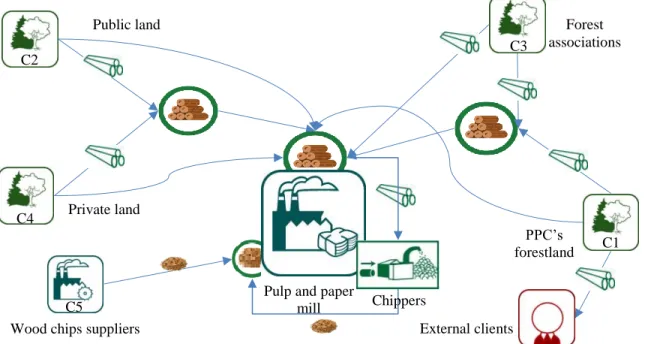
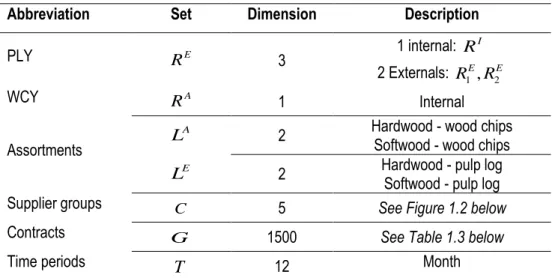
model can integrate individual suppliers or groups of suppliers, each with specific types of contracts. For clarity and better representing the decision-making process observed in our case study, procurement planning is formulated considering groups of suppliers. Each group has in average 300 contracts available (total number of contracts is 1500), half being fixed and half being flexible contracts. In Figure 0-2, groups and their deliveries are illustrated.
Figure 0- 2.The wood supply flow from groups of suppliers in the case study
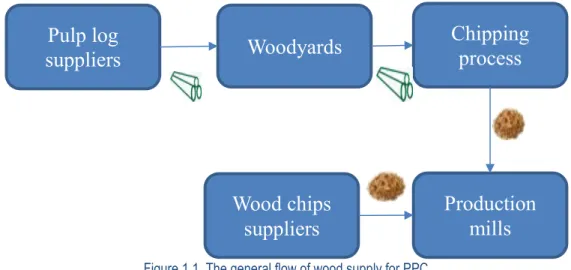
As shown in the figure, pulp logs from suppliers are either directly delivered to the internal woodyard or indirectly through external woodyards. Wood chips are delivered to the wood chips yard
PPC’s forestland Private land
Pulp and paper mill Public land
Forest associations
Wood chips suppliers External clients
C1 C2
C3
C4
8
at the mill, added to the chips produced by chippers. Each group is described depending on its landownership or type of assortment delivered to the mill. Below the description of each group of suppliers is followed.
1. Pulp log from PPC’s forest land (𝐶1):
This category includes the forest contractors working on the PPC’s private forestland. These are strategic and long-term contractors with fixed and flexible contracts. These suppliers provide relatively high flexibility in deliveries as the land they operate on is owned by the PPC. They continuously exchange information with the PPC and can adapt their production.
2. Pulp log from the public forest(𝐶2):
This category includes suppliers working on public forests. In addition, the PPC has its own share of the public forest through timber licenses (TL). Contracts are established with contractors working on PPC's TL or with other suppliers holding their own TLs. More information on this organizational approach can be found in (Direction de la gestion des stocks ligneux 2016).
3. Pulp log from forest association of domestic wood producers(𝐶3):
This category includes purchases from forest associations of private wood producers in Quebec (Foretprivee.ca 2019). A forest association is an aggregation of private forest landowners. The forest association organizes the process of selling and buying wood supply and is the sole negotiating agent for its members.
4. Pulp log from private suppliers (𝐶4):
This category is associated with purchases from private suppliers, mainly located outside of Quebec in the USA and neighboring Canadian provinces such as Ontario. Some suppliers that are located in Quebec (without being represented by forest associations) include individuals, families, organizations, First Nations groups or corporations.
5. Wood chips from private suppliers (𝐶5):
This category includes wood chip purchases from sawmills and chip producers. Wood chips are moved to the PPC with different transportation modes than pulp logs. In general, approximately 70% of the wood chips used for a PPC production process in Quebec are produced by sawmills (Grubıi et al. 2019).
Different contracts are defined for each group of suppliers, as shown in Table 0-1. In addition to traditional contracts with fixed characteristics, flexible and option contracts are included. The three mentioned types can be categorized as being short-term or long-term, and exclusive. Therefore,
9
types of contracts are defined collectively, meaning that a specific contract can be categorized for example as an exclusive long-term fixed contract.
Table 0- 1. Types of contracts
Contract types Definition
Exclusive Contracts with contractors working on PPC’s forestland or with suppliers located near the PPC
Regular long-term Contracts that are scheduled to deliver during one year
Regular Short-Term Contracts with a delivery schedule of a maximum of six months
Fixed Traditional contracts with fixed order volume at each given period
Option Contracts with the possibility to reserve supply capacity of supplier for later periods
Flexible Contracts which have a certain level of flexibility, enabling upward or downward modifications in the order volume
Exclusive contracts are solely between the PPC and the associated supplier group. They are more reliable in providing the order volume since they do not impose risks related to market price variations. The PPC also has direct control over the operations of exclusive suppliers. Short-term contracts are usually more expensive, but with more volume flexibility. They usually cover purchases outside of Quebec, e.g. Ontario or the US. To hedge against price and exchange rate variations.
The characteristics of contracts are determined based on the group of suppliers and the type of contract, as defined in Table 0-2. Contract characteristics are negotiated beforehand and they are available as potential sourcing options. The procurement department of PPC has the discretion to select among them to minimize costs with respect to improving the reliability. Reliability in different applications has similar definition which is the probability of maintaning the forecasted state for system (Tavakkoli-Moghaddam, et al. 2016).
Table 0- 2. Contract characteristics
Characteristic Definition
Nominal volume Agreed volume written in the contract stated in dry metric tonne (DMT)
Volume flexibility The negotiated ratio of the nominal volume to determine the maximum allowable upward and downward variations for order volume (0 for fixed contracts)
Assortment Wood chips or pulp logs, from either softwood or hardwood species Wood supply unit price Cost per volume unit of the wood assortment for each time period One-time fixed cost The cost associated with initiating the contract
Start, end The first and the last period of deliveries
Schedule The detailed plan for volume of assortment to be delivered in each period
Origin, destination Respectively: where the wood supply has been produced and the location it is being delivered
The unit price of wood supply includes material, labor, overhead, logistics charges and profits of the supplier (Meixell et al. 2014). Depending on the contract, it may be the same or not in each period. The fixed cost of a contract is usually higher for flexible contracts and includes the costs of
10
necessary equipment, permits, or facilities that have to be established for the execution of its deliveries. The destinations include three pulp log yards and one wood chip yard. Wood chip yard, as well as one pulp log yard, are located at the production mill. The origin is important, especially for identifying the associated risks, such as the beginning of thawing for different geographical zones. Data related to the determination of these characteristics are provided separately in the following chapters of the thesis, depending on the required details.
Since this study focuses on the procurement department of the PPC, the starting point is at the beginning of the financial year, when the procurement department receives the demand for wood supply from the production department. Each group of suppliers is expected to have a total volume of deliveries between a minimum and a maximum limit, to emphasize on maintaining a diverse supply portfolio.
Literature review
At first, some related reviews and articles on pulp and paper related studies and the procurement process of PPC are provided. Then, sourcing strategies with contract and supplier selection are reviewed. Next, risk management and the existing frameworks in different applications, as well as in forestry will be reviewed. In all cases, developing optimization models is shown to be benefitial to achieve an optimal system performance with respect to the constraints (Shishegar, et al. 2018).
Pulp and paper value chain
One of the first pulp and paper supply chain problems was addressed by Benders et al. (1981) which contributed to the design of production/distribution networks by utilizing a mathematical programming model to suggest network design decisions. Decisions in the deterministic approach concerned continuous production processes in this industry. Since then, many studies have worked in detail to manage PPC’s operations.
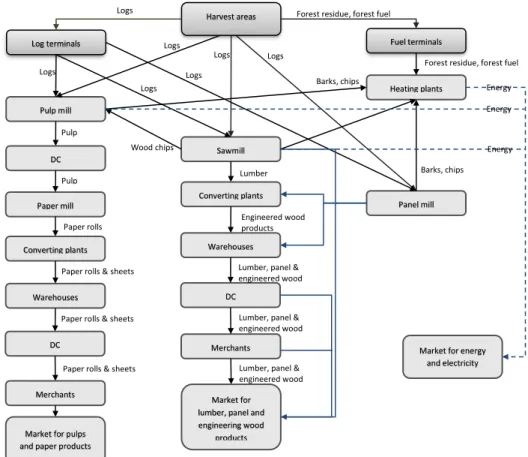
Regarding the position of PPC in the forest value chain, Figure 0-3 shows the relationship between PPC and other industries. The wood flow starts from harvest areas and goes to terminals, sawmills, pulp mills, and panel mills. The lower part of the tree has a higher value and it is used typically for sawmill operations. The upper part, with characteristic unfit for the sawmill process, is sent to pulp and paper mills.
In addition to final products, sawmills produce co-products and by-products. Co-products are demand-driven, while by-products are usually produced from primary processing and usually have a
11
lower market value. In Quebec, a PPC procures a large volume of wood chips from the co-products of sawmill production. Sawmills co-products include approximately 60% of wood chips, 22.5% barks, and 17.5% wood shavings and sawdust (Gouvernement du Québec 2016).
The wood supply in the form of logs or chips is transformed into pulp to produce paper at the pulp mill. The mixture depends on the produced pulp grade or the used manufacturing process. Examples of final products are newsprint, fine paper, and packaging materials. A PPC might own many production mills, each having a specific demand for wood supply (D’Amours et al. 2008).
Pulp and paper production was studied more recently by Alayet et al. (2016) in a supply chain in conjunction with several independent business units. They considered a network including sawmilling operations, pulp and paper production, and energy production. The decision included the harvesting volume of wood and their allocation to business units, as well as stock volume. They illustrated the importance of price, demand, and wood freshness variations in order to increase supply chain benefit. In Ben Daya and Nourelfath (2019), the authors developed a multi-objective optimization model motivated by the integrated biorefinery and the pulp and paper business model. The case study was in Canada. They simultaneously minimized greenhouse gas emissions and maximized the financial value of the integrated model. Economic and environmental such as the cash return on capital invested, the internal return rate, the emission rate, the internal integration rate, and the waste recycling rate were used to compare Pareto optimal investment road-maps.
12
Figure 0- 3. Different supply chains for forest products (D’Amours et al. 2008) Procurement operations
At the beginning of the procurement planning, before determining the sourcing strategy, details of the available sourcing options are drafted (Tittler et al. 2001). By determining the sourcing strategy among available sources, a wood procurement plan is prepared. In a procurement plan, operational decisions are identified regarding harvesting, inventory handling, and transporting material to mills (Beaudoin et al. 2007). Such decisions determine the harvesting areas for procuring wood fiber, as well as the allocation of wood to each production mill, either a sawmill or a pulp and paper mill or other industries (D’Amours et al. 2008).
In the presence of uncertainty related to the PPCs’ procurement operations, Bergman and Löfgren (1991) provided three common strategies practiced by PPC managers. First is to have many supply sources to neutralize the impact of stochastic sources. Second is by holding a minimum level of inventory (safety stock), and use it in case of shortage. The third is to deal with the consequences and to apply mitigation solutions (e.g. spot market purchase, production stoppage…).
The first two use a proactive strategy, while the third one uses a reactive one. In a study by Yin et al. (2002), it is shown that the proper inventory policy has benefits for the company in case of
Fuel terminals Heating plants Pulp mill DC Paper mill Sawmill Converting plants Warehouses DC Panel mill Market for lumber, panel and engineering wood
products
Merchants Market for energy
and electricity Logs
Pulp
Pulp
Paper rolls
Paper rolls & sheets
Paper rolls & sheets Log terminals Harvest areas Logs Logs Logs Logs Logs Logs
Forest residue, forest fuel
Barks, chips
Energy Forest residue, forest fuel
Energy
Energy Barks, chips
Paper rolls & sheets Wood chips
Engineered wood products Lumber
Lumber, panel & engineered wood products Lumber, panel & engineered wood products
Lumber, panel & engineered wood products Converting plants Warehouses DC Merchants
Market for pulps and paper products
13
uncertainty. Controlling the level of inventory prevents stock out. In the study by Chopra and Sodhi (2004) benefits of multiple sourcing strategies and controlling supply risks were mentioned. Risks in procurement were introduced by causing fluctuations in the price of deliveries from suppliers or transportation costs. Drivers of these risks were the exchange rate and duration of contracts. In Dulmin and Mininno (2003) and Sarkis et al. (2007), it is addressed that selecting suppliers is the most important task, as it has a high impact on quantity, quality, time and price of purchased material.
Everett et al. (2000) formulated the optimal allocation of suppliers to mill by a mixed-integer programming model. Their proposed model has determined decisions in tactical and strategic levels. The sourcing options consist of pine and eucalyptus logs from several suppliers, chips from sawmills, and recycled papers. Philpott and Everett (2001) presented a stochastic programming model for a PPC for a planning period of ten years. Their stochastic model presented three scenarios for the market forecast, as expected, optimistic, and pessimistic forecasts. However, the size of the problem was too large to achieve optimal results. Nevertheless, the results of the model for the three scenarios showed considerable variability.
Sawik (2013) has developed a decision-support tool for selecting suppliers to respond to customer orders. In that study, the objective function consists of the cost of back-ordered, purchasing and lost orders, to decide the optimal schedule for customer orders. It is concluded that suppliers with high disruption risks hold the lowest share of supply or they are not selected at all.
In a study by Bansal et al. (2007) the problem is defined as selecting both contracts and suppliers for a multinational company. In order to do that, contracts are classified based on characteristics such as their types, prices, durations, and suppliers. Their deterministic model suggested the optimal sourcing strategy by minimizing the costs. In the study by Talluri and Lee (2010), the authors investigated the optimal selection of contracts in manufacturing firms by mixed-integer programming approach. They presented insights to manufacturing managers on choosing the right contracts (short, long or mid-term), in the presence of market price uncertainty, supplier discounts, investment costs, and supplier capacity restrictions. An important conclusion of their study was that the long-term contract strategy might not be superior to short-long-term strategy. This was also concluded that no strategy systematically dominated others.
Groups of suppliers
Kaufman et al. (2000) proposed a typology based on the collaboration capacity and technology of the suppliers and classified them. Four distinct groups for suppliers were identified in their
14
typology. In the first group, the company and its suppliers have low dependency because switching costs are low. Suppliers in the second group are attractive for the company, as they reduce internal monitoring (administrative) costs. The third group represents suppliers that are mutually dependent on the company, where trust reduces the uncertainty. Finally, in the last group, suppliers are technology-oriented and have weak relations with the company.
Similar to the previously mentioned groups, in Canada, suppliers can be classified into different groups. A large proportion of forestlands is in public ownership. The allocation of timber licenses to private companies is an important decision since it is associated with the uncertainty of supply in those forests (Niquidet and O’Kelly 2010). In British Columbia, a study by Pinkerton and Benner (2013) was conducted to examine the resilience of sawmills in the presence of economic shocks. The authors concluded that more access to publicly owned timber supply is required to increase the benefit. In Quebec, it was decided to allocate 25% of government-owned lands to be sold through an auction system, while the rest is allocated through long-term contracts (Gouvernement du Québec 2013). More information about different groups of suppliers can be found in Lehoux et al. (2012). The authors have mentioned forest business units to address different stakeholders in providing wood products, such as private landowners, forest contractors, forest companies, and forest management groups.
Supply contracts
Traditionally, long-term contracts have been used to eliminate the risk of price variations for the procurement operations (Martínez-de-Albéniz and Simchi-Levi 2005). Long-term contracts are also called forward buy contracts or fixed commitment contracts in the literature. In these contracts, characteristics are fixed, i.e. fixed volume and fixed price for the supply. Therefore, the buyer is not exposed to the risk of price variations. However, the risk of high inventory levels is more likely in this case, as well as the risk of shortage, due to the inability to modify the contract.
Option contracts were introduced to reduce the above-mentioned risks. In these contracts, the buyer pre-pays a fraction of the total value of the contract up-front while reserving the capacity of a supplier up to a certain level (Bansal et al. 2007). The capacity is usable in case the buyer pays an additional price. The average unit price of such contracts is typically higher than a traditional long-term contract.
Option contracts shift inventory risks from the buyer to the supplier, since the supplier should develop the flexibility in its operations to provide the buyer with the options. Thus, a different contract
15
has been emerged to share risk between suppliers and buyers, called flexible contracts. In these contracts, the amount of supply is fixed but have a possibility of modification at the time of order, by a given percentage. As described, flexible contracts are referred to as a combination of long-term and options contracts (Martínez-de-Albéniz and Simchi-Levi 2005).
In some PPCs, a clause is added to contracts as “right of first refusal”. In these contracts, the supplier holds the ability to seek bids to maximize its return. In this case, the PPC can decide whether to match or exceed the bid. Otherwise, this contract gives the right to suppliers to sell the wood in the spot market (Behavior et al. 2009). Roise (2016) has reviewed the usage of long-term contracts in the forest industry. Interviews with professionals and an extensive literature review were done. It was concluded that the landowners could benefit by adding the right of first refusal clause to certain silvicultural and harvesting activities, to reduce concerns about losing control over their land. However, the usage of this phrase is in tight connection to market variations and spot market price volatility, which is not considered in our study.
Another contract, which is widely used, is the quantity discount contract. It provides price incentives for quantities above a certain level to maximize the profit of suppliers and provide economies of scale to the buyer. Discount contracts are most effective in coordinating different stakeholders in supply chains (Hezarkhani and Kubiak 2010).
Risk and uncertainty
Mason and Mitroff (1973) have categorized problems as being either structured or unstructured. In structured problems, considering the relationships between an event and its environment, all the outcomes are known based on three forms: certainty (known deterministic relationship), risk (probabilistic and known relationships) or uncertainty (probabilities are not known but the possible states of the relationship are known), while in unstructured problems absolutely no information is available. Structured problems are repetitive in nature and do not require subjective inputs, while all or some terms in unstructured problems must be extracted by extensive analysis based on opinions and judgments of experts.
Miller (1977) stated, “Risk occurs where the future is not known, but the probability distribution of possible futures is known”. In Kersten et al. (2006) it was denoted that “risk is the damage - assessed by its probability of occurrence - that is caused by an event within a company, its supply chain or its environment”. These definitions suggest that the term “risk” can be adapted for an event in the future that is not known in advance, but where its occurrence can be estimated with a probability. The more
16
risks are involved in one domain, the more volatile it would be the profitability. Three tasks have been proposed for risk mitigation by Li (2004). First, to quantify the risk into numerical data, then design certain tools and measures to control it, and at last, since as ideal can never be reached, an acceptable risk level be justified.
However, as stated by Gadow (2000), “uncertainty” represents known expected damage from a risk. For example, for a buyer, there is a probability that its supplier delivers less supply than the order amount. In the case where the probability and variation from the order volume is known, the delivery volume becomes an uncertain parameter and there is a risk of a supply shortage.
A few studies have incorporated uncertainty into supply chain optimization of forest industries such as biomass power plants (Shabani and Sowlati 2016a), pulp mill (Shahi et al. 2017), wood remanufacturing mill (Rafiei et al. 2015), chemical industries (Gupta and Maranas 2003), and sawmill (Kazemi Zanjani et al. 2013).
In the domain of forestry, Brumelle et al. (1990) provide a framework to recognize risks, based on definitions by Mason and Mitroff (1973). They were the first to categorize sourcing risks as production, timber prices, fire, insects and salvage prices in forest management and silvicultural investment. Risks affecting energy efficiency in the Swedish pulp and paper industry were recognized by Thollander and Ottosson (2008) as technical risks such as the risk of production disruptions. They used questionnaires to determine the ranking of the risk elements. The results showed that not all risks are market-related and thus firm-specific risks can be more important such as lack of staff awareness or long decision processes.
In Cunico and Vecchietti (2015), the authors have considered uncertainty in the characteristics of deliveries from suppliers. The selection of suppliers and contract types was performed by including decisions related to the purchase quantities involved and the stock of materials. In addition, the uncertainty in the supply was represented as an interval for the upper and the lower limit of the delivery volume. In their study, there was no distinction made between different sourcing risks causing short-term or long-term variations in the supply.
Common solution methods
Traditionally, deterministic models including safety stock at distribution centers are considered to take into account uncertainty. The problem is to decide the level of the stock in each distribution center, while its advantage is the small size of the planning problem. By identification of the sources of data, a suitable method or hybrid of methods can be decided. In addition to safety stock, other
17
solution methods have been proposed such as stochastic optimization (Birge and Louveaux 2011) and robust optimization approach (Mulvey et al. 1995).
Robust optimization
Using Robust Optimization (RO) is common when the focus is on obtaining a solution that will be feasible for any realization taken by the unknown coefficients within a small, “realistic” set, called the uncertainty set (Gabrel et al. 2012). Uncertainty set is centered around the nominal values of the uncertain parameters. The approach in RO is to make the worst-case solution as good as possible. Hence, any realization of the uncertain parameters is feasible in a robust solution (Bertsimas, 2010 and Ben-tal et al. 2009). The deficiency of RO lies in over-conservative (Thiele 2010) and costly solutions (Bredström et al. 2013). These drawbacks can be addressed by adding practical considerations in the uncertainty description (Carlsson et al. 2014). For achieving this purpose, historical information and characteristics of uncertain parameters in practice are entered into the model, such as setting the total uncertainty over a certain period to zero.
Stochastic programming
Stochastic Programming (SP) approach is based on the knowledge about distributions of the uncertain data or probable scenarios. Solutions from the SP approach are expected to be optimal on average.
Sawik (2014) formulated a mixed-integer SP to integrate supplier selection decisions with customer order scheduling. Disruption risk was considered with either a single or a dual sourcing strategy. Risks were considered as affecting individual suppliers or a set of suppliers in the same region at once. Local suppliers were more reliable but more expensive than foreign suppliers, who were more exposed to risks. It was concluded that the supplier reliability is the key factor for their selection, whether in maximizing service level or minimizing costs.
A more general model for wood procurement decisions is presented by Beaudoin et al. (2007) in the form of mixed-integer SP. Two types of decision variables were presented, first-stage and second-stage. The planner is responsible for instantiating first-stage variables, such as the binary decision on whether harvesting a block and if so, the proportion of the harvested block. Second-stage variables coordinate tactical decisions with operational decisions, such as flow variables. Their method fulfills the shortcomings of the manual planning process, mainly in proposing alternative plans and evaluating their performances under uncertainty. The authors used Monte Carlo simulation
18
to generate scenarios randomly for the problem based on the key factors of uncertainty, such as standing inventory and production capacity.
Simulation approach
Besides solution approaches, evaluations of the solution in the presence of uncertainty is also very well addressed in the literature. Usually, simulation is used to evaluate the performance of the plan. In a study by LeBel and Carruth (1997), they analyzed the cost of inventory in the presence of variability in procuring wood supply for a mill. Uncertainty was related to the failure in loggers operations and the recovery time, mainly due to weather conditions. After the simulation, metrics were presented on the production and capacity utilization of loggers, inventory levels, and production of by-products. It was concluded that setting two days buffer of production between trucking and harvesting decreases the risk of shortage at the mill significantly. Through this evaluation, the company was able to save time and money on avoiding expensive trials in practice.
Production planning has been coupled with an inventory management problem in the work by Shahi et al. (2017). They considered a PPC in Northern Ontario by including demand and supply uncertainty using a simulation-optimization approach. The optimization model aimed at maximizing the net annual profit of the pulp mill. It was concluded that merchandizing yards could absorb supply and demand shocks. Therefore, yards could improve customer satisfaction by ensuring the continuous production of the pulp mill.
Contributions
Three projects are defined in this Ph.D. thesis. Each project is presented briefly below as there is a full paper on each of them.
Chapter 1: An Optimization Model for Selecting Wood Supply Contracts
The procurement planning of a PPC in the presence of different sourcing contracts is a large and complex problem. Characteristics of contracts and suppliers, in addition to practical constraints such as portfolio strategy limits, inventory target levels, and capacities of woodyards are difficult to be consider for manual planning approaches. According to the literature review, no work has been found to develop an analytical model for addressing such complexities of the PPC procurement process. Thus, as the first project of this Ph.D. thesis, a novel mixed-integer linear programming model is developed. The model takes into account the procurement network including suppliers, woodyards and a production mill. This project contributes to the literature by including different types and
19
characteristics for contracts among multiple groups of suppliers. Decisions concern the selection of contracts with groups of suppliers, external woodyards openings, the flow of material and inventory level of woodyards, and lastly the chipping volume in each period. The deterministic model minimizes the total cost of procurement and select the best set of contracts. Evaluations were made for this project by using sensitivity analysis on different sets of contracts (regarding flexibility) and portfolio limits for groups of suppliers.
Chapter 2: Evaluation of Wood Supply Procurement Planning in the Presence of Sourcing Risks
Although a deterministic model provides an optimal plan with minimization of costs, it is complicated to evaluate the performance of the proposed plan from the deterministic model in the presence of risks. Sourcing risks are inherent to the procurement operations of the PPC. To propose a better evaluation of the portfolio strategy and measuring the potential impact of sourcing risks the second project is performed. This project is based on a simulation of the procurement operations. Several random events are generated using a Monte Carlo approach. The performance of the plan in the presence of different problem setting is evaluated by monitoring the statistical distribution of results. In practice, the PPC can benefit from the findings to test the selected procurement plan beforehand, avoiding high costs of the wait-and-see approach or time-consuming evaluations of individual contracts and suppliers. Instead, the PPC can update any changes or new information into the selected portfolio and generate the output of the simulation approach in terms of expected values and variations. This project contributes to the academic literature by providing a Monte Carlo simulation approach of the procurement operations embedded in an optimization model in the presence of contract unreliability, contract breach, and the stochastic start of the thawing.
Chapter 3: Selecting Wood Supply Contracts under Uncertainty using Stochastic Programming
There is a lack of an analytical approach to propose a procurement plan taking into account sourcing risks. Previous projects do not optimize the performance of the proposed plan in consideration of sourcing risks. Developing a decision support tool for proposing such a plan is the objective of this study. Sourcing risks and related uncertainties are integrated into the planning before the execution phase. This way fewer modifications and less total cost are expected after the execution of the proposed plan. The resulted plan from the SP approach will have an average optimal performance in the presence of different realizations of risks. To test the efficiency of the plan it is
20
compared with the proposed plan by the deterministic model. Based on the developed scenarios, the solution from each approach is generated for individual scenarios. Then, the average value of objective function and variation of results for all scenarios are compared. The SP model is the first to integrate the sourcing risks in the context of contract selection for procurement operations of a PPC. A two-stage approach is used to divide decision variables. First stage variables are selected contracts in the first period and woodyards opening decisions, while the decision for selecting future contracts as well as flow, inventory and chipping volume is second stage and dependent on the realization of different scenarios. This project contributes to the gap of an SP model for PPC procurement operations. In practice, the consideration of uncertainty and sourcing risks during the planning was nearly impossible and no advanced analytical tool was available. By the use of the SP model, the decision-maker can save on average $1 million dollars comparing to deterministic planning.