Title: The Latent Profiles Emerging from the Individualized Classroom Assessment Scoring System: A Cultural Perspective
Introduction. 1987 words.
As preschool turns into a typical setting in early childhood, it seems essential to better understand the nature of children’s preschool experiences. Indeed, this period of life offers learning opportunities essential to children's development (Hamre & Pianta, 2005; Raver et al., 2008). More specifically, the social interactions and learning tasks to which children are exposed on a daily basis in their educational context are essential to their socio-emotional development and their academic success (Darling-Churchill and Lippman, 2016; Slot, 2018)
Theoretical framework.
The Individualized Classroom Assessment Scoring System (inCLASS) is an American observational tool that assesses the social and behavioral interactions (with the adults, peers and suggested tasks) typical of a three to five-year-old child in the natural environment of a childcare center (Downer, Booren et al., 2010). According to Downer and colleagues (2010), the authors of this observation tool, the way in which children make use of the learning opportunities and social interactions offered in an early childhood educational context is one of the best predictors of their social and academic development. In this regard, this observational tool uses an approach that captures a child's overall level of adaptation by responding to situations and challenges appropriate to their development (Bohlmann et al., 2019; Pianta et al., 2016).
However, certain characteristics of the child, such as the child's gender and first language, and the culture in which the child lives in might affect the level of engagement and social
interactions reported by the inCLASS. Indeed, according to Urie Bronfenbrenner's ecological systems theory (1979), the importance of considering the influence of the environment in which the child lives in when examining psychological processes such as engagement is clearly
illustrated. More specifically, according to Bronfenbrenner (1979), a child's development is progressive and involves a bidirectional relationship between the child and his environment. Thus, a child's level of engagement in their interactions with adults, peers, and tasks would greatly depend on the context (or environment) in which these interactions take place.
Cultural variations
In the United States, Williford and colleagues (2013) performed a latent-profile analysis on a sample of 395 American children (306 girls and 299 boys) of approximately 4 years (M = 50.18 months) based on the four-factor model of inCLASS (teachers, peers, tasks, negative engagement) in order to analyze the level of engagement of children in their social interactions and academic tasks. The researchers obtain a solution with three profiles adapted to the data of their sample (see Figure 1). Once again, it is relevant to consider that the sample used for this study includes only American children.
In this regard, it is very likely that a study of a cultural environment different from that of the United States, such as France and/or Quebec (Canada), might highlight distinct profiles of children since the educational approaches vary and are imbedded in the culture of the country. For example, children in French educational settings could find themselves in greater numbers in profiles characterized by a high level of commitment to learning tasks since the French
educational program is centered on language and cognitive tasks as well as preparing the children with the necessary academic knowledge for reading, writing and mathematics (OECD, 2004; Garnier, 2013). On the other hand, children in Quebec (Canada) educational settings might find themselves clustered in profiles with high levels of peer interactions since their educational program Accueillir la petite enfance promotes the overall development of children and natural learning strategies through play, interactions, activities and exploration (Samuelson & Carlsson, 2008). Finally, some characteristics inherent to the child (e.g., gender and first language) could thus influence their fitting to a specific engagement profile. For instance, according to the literature, boys tend to have lower task engagement scores (Vitello et al., 2012) as well as higher rates of aggressive behavior in their social relationships than girls (Vitello et al., 2012; Walker, 2005) which may impact the profile they belong to. At last, children with a first language other than French might also cluster more in profiles with a lower level of commitment to tasks, interactions with their peers and teachers since their lower knowledge of the language used in the educational context could make it really difficult for them to understand and express their
emotions and needs. This language barrier might also make it more complicated for them to interact with their peers and their teachers and to understand behavioral demands consistent with the classroom rules (Commodari, 2013; Menting et al., 2011).
Ultimately, a latent profile analysis would contribute to the cultural validation of the inCLASS. Indeed, this analysis would make it possible to establish specific engagement profiles for children who live in the same country, and who may adhere to the same cultural values and practices. By adding other factors, such as the child's gender and first language, which may also influence inCLASS scores, we will be able to get a more accurate picture of the conceptual validity of the inCLASS.
Method.
Sample.
The present study aims to determine the latent profiles of the four domains of the
inCLASS. The sample included 404 children observed with the inCLASS divided in two groups, 201 children (103 girls) from the Quebec (Canadian) sample (M= 38.06 months, SD = 2.32) and 203 children (100 girls) from the French sample (M = 40.52 months, SD = 2.43).
Materials.
The Child and Family Sociodemographic Questionnaire was administered to parents who have accepted their child to be part of this study by signing the consent form. This questionnaire collects information about the child, the educational context the child is attending, as well as sociodemographic information on the families of the concerned child.
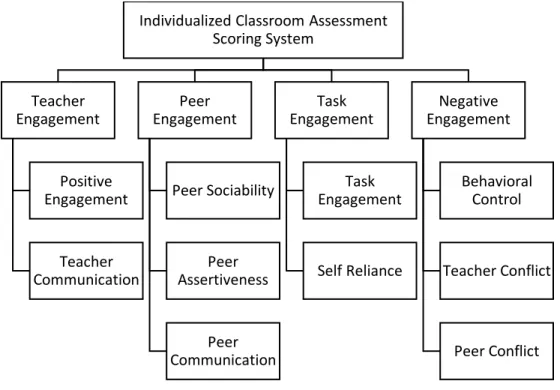
Child engagement was observed using the four-way Individualized Classroom Assessment Scoring System (InCLASS) observation tool proposed by Bohlmann, Downer, Williford and colleagues (2019). This model has four domains and ten dimensions: 1) interactions with teachers (positive engagement, communication); 2) interactions with peers (sociability, communication, assertiveness); 3) orientation towards the task (commitment to the task, autonomy); and 4) negative engagement (conflict with teachers, conflict with peers,
behavioral control) (see Figure 2). This tool requires a certified observer to observe one child at a time for four 20-minute observation cycles, including 5 minutes of scoring, for a total of one hour, spread out over a morning period. In order to assess the child's level of engagement, a 7-point Likert-type scale, from 1 to 7, was used. Levels 1 and 2 indicate a low level of engagement, levels 3, 4 and 5 a moderate level of engagement, and levels 6 and 7 indicate a high level of
engagement. Conversely, when analyzing conflict between the child and the teacher, or between the child and his peers, higher scores indicate a higher frequency of negative interactions.
Procedure.
The recruitment of educational contexts in Montreal (Canada) was carried out by telephone between February and March 2017 and that of Grenoble (France) from October 2017 to January 2018. Drawn randomly from a list of childcare centers provided by the official bodies of the Quebec Ministry of the Family and the Rectorate of Grenoble, a total of 38 childcare centers (41 groups) agreed to participate in Montreal, while a total of 31 childcare centers (41 classes) agreed to participate in Grenoble.
Results.
A Latent Profile Analysis (LPA) was used to create profiles of children’s engagement with teachers, peers, tasks and negative engagement. One, two-, three-, four- and five-profile solutions were examined. Results indicated a four-profile solution for both France (BIC = 2238,2, ABIC = 2133,7, VLMR and Adjusted LRT p value = .319; entropy = .755) and Quebec (Canada) (BIC = 2563, ABIC = 2458,6, VLMR and Adjusted LRT p value = .186; entropy = .805).
France.
The results indicate that 40.4% (n = 82) was classified into the Typically-Engaged profile with the majority of the sample, characterized by relatively low positive engagement with
teachers, moderately-low engagement with peers, moderately-high engagement with tasks and low negative engagement. The second profile, labeled Low-Typically-engaged includes 36.9% (n = 75) of the sample and is characterized by children demonstrating the lowest level of engagement with teachers, peers, tasks but also a low negative engagement. The third profile, labeled Middle-Positively-Engaged, included 16.4% of the sample (n =33.3), consisting of children demonstrating the highest level of positive engagement with teachers, a lower level of positive engagement with peers, a similar moderately high engagement with tasks and just as low negative engagement compared to the other three profiles. The final Middle-Negatively-Engaged profile, included 6.3% of the sample (n = 12.7) and displayed the lowest level of teacher
engagement, the highest level of peer engagement, an equal level of task engagement and the highest level of negative engagement compared to the other three profiles (see Figure 3).
Quebec (Canada).
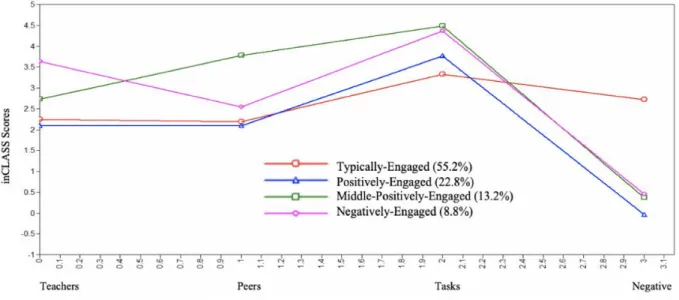
The results indicate that 55.2% (n =111) was classified into the Typically-Engaged profile with the majority of the sample, characterized by relatively low positive engagement with teachers and peers, a moderate engagement with tasks and a low negative engagement. The second profile, labeled Positively-Engaged, included 22.8% of the sample (n = 45.8), consisting of children demonstrating a higher positive engagement with teachers, peers and tasks and a slightly higher negative engagement compared to the Typically-Engaged profile. The third profile, labeled Middle-Positively-Engaged includes 13.2% (n = 26.5) of the sample and is characterized by children demonstrating a moderate level of engagement with teachers, a low level of engagement with peers, a moderately-high level of engagement with and a low negative engagement. The final Negatively-Engaged profile, including only 8.8% of the sample (n = 17.7), highlights a low level of engagement with teachers and peers, the lowest level of
engagement with tasks and the highest level of negative engagement compared to the other three profiles (see Figure 4).
Gender and First Language.
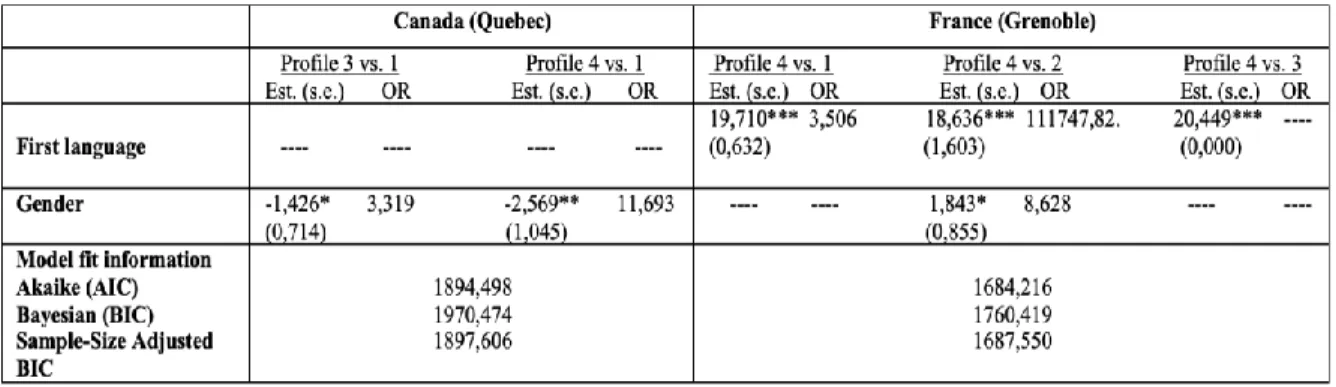
The predictors of gender and first language were then added to the four-profile solution using the three-step method for both France and Québec (Canada) determine whether these characteristics have an influence on belonging to a specific profile (Asparouhov and Muthén, 2014). The results indicate that children whose first language is French were more likely to be regrouped in the Negatively-Engaged profile than in the Typically-Engaged, Middle-Positively-Engaged and Low-Typically-Engaged profiles in the French sample. No significant differences were found regarding language in the Quebec (Canada) sample. This analysis also revealed that boys were more likely than girls to be regrouped in the Middle-Negatively-Engaged profile than in the Middle-Positively-Engaged profile in the French sample. At last, boys were more likely than girls to be regrouped in the Negatively-Engaged profile than in the Positively-Engaged and the Middle-Positively-Positively-Engaged profiles in the Canadian sample (see Table 1).
Discussion.
The results of this analysis reveal that cultural educational practices have a significant impact on the profiles of children that emerge. Indeed, unlike the American three-solution profile of children documented by Williford and colleagues (2013), France and Quebec highlight a four-solution profile that are very different in nature. This could be explained by the fact that the main objectives of the American, French and Quebec education system are dependent on the cultural practices and norms of the country in question. For instance, in France, the emphasis is put on the linguistic and cognitive development of children (OECD,2004; Garnier, 2013). Conversely, in Quebec, socio-emotional development and play are promoted instead (Gouvernement du Québec, 2019). This could also explain the reason behind the fact that having a language barrier had a more pronounced effect on children from France compared to children from Quebec
(Canada). Moreover, as the literature suggests, boys were more likely to be clustered in low-level profiles compared to girls since they tend to exhibit higher rates of aggressive behaviors in their social relationships and lower executive function capabilities compared to girls (Vitello et al., 2012; Walker, 2005).
Conclusion.
To conclude, the inCLASS seem to still needs to be assessed for its’ cultural sensitivity on an international level in order to be able to validate this observational tool which is based on American cultural values and norms.
Table 1. Latent class regression model estimating the effect of gender and first language on class membership
Figure 1. Williford and colleagues’ (2013) graphical representation of the three-profile solution of the inCLASS based on an American sample.
Figure 2. Domains and dimensions of the Individualized Classroom Assessment Scoring System (inCLASS).
Figure 3. Graphical representation of the 4-profile-solution of the inCLASS based on a French (Grenoble) sample.
Individualized Classroom Assessment Scoring System Teacher Engagement Positive Engagement Teacher Communication Peer Engagement Peer Sociability Peer Assertiveness Peer Communication Task Engagement Task Engagement Self Reliance Negative Engagement Behavioral Control Teacher Conflict Peer Conflict
Figure 4. Graphical representation of the 4-profile-solution of the inCLASS based on a Canadian (Québec) sample.
References
Asparouhov, T., & Muthén, B. (2014). Auxiliary variables in mixture modeling: Three-step approaches using M plus. Structural Equation Modeling: A Multidisciplinary Journal, 21(3), 329-341.
Bohlmann, N. L., Downer, J. T., Williford, A. P., Maier, M. F., Booren, L. M., & Howes, C. (2019). Observing children's engagement: Examining factorial validity of the inCLASS across demographic groups. Journal of Applied Developmental Psychology, 60, 166-176. Bronfenbrenner, U. (1979). The ecology of human development. Harvard university press. Commodari, E. (2013). Preschool teacher attachment, school readiness and risk of learning
difficulties. Early Childhood Research Quarterly, 28(1), 123-133.
Darling-Churchill, K. E., & Lippman, L. (2016). Early childhood social and emotional
development: Advancing the field of measurement. Journal of Applied Developmental Psychology, 45, 1-7.
Downer, J. T., Booren, L. M., Lima, O. K., Luckner, A. E., & Pianta, R. C. (2010). The
Individualized Classroom Assessment Scoring System (inCLASS): Preliminary reliability and validity of a system for observing preschoolers’ competence in classroom interactions. Early childhood research quarterly, 25 (1), 1-16.
Garnier, P. (2013). Produits éducatifs et pratiques familiales à l'âge de la maternelle: l'exemple des cahiers d'activités parascolaires. La revue internationale de l'education familiale, (2), 133- 149.
Gouvernement du Québec. (2019). Accueillir la petite enfance : Programme éducatif pour les services de garde du Québec.
https://www.mfa.gouv.qc.ca/fr/publication/documents/programmeeducatif.pdf
Hamre, B. K., & Pianta, R. C. (2005). Can instructional and emotional support in the first-grade classroom make a difference for children at risk of school failure?. Child development, 76(5), 949-967.
Menting, B., Van Lier, P. A., & Koot, H. M. (2011). Language skills, peer rejection, and the development of externalizing behavior from kindergarten to fourth grade. Journal of Child Psychology and Psychiatry, 52(1), 72-79.
OECD (2004). Towards High-Performing Health Systems. OECD Health Project. Organisation for Economic Co-operation and Development OECD Publications 2, Paris, France
(Publication Services).
Pianta, R., Downer, J., & Hamre, B. (2016). Quality in early education classrooms: Definitions, gaps, and systems. The Future of Children, 26(2), 119-137.
Raver, C. C., Jones, S. M., Li-Grining, C. P., Metzger, M., Champion, K. M., & Sardin, L. (2008). Improving preschool classroom processes: Preliminary findings from a randomized trial implemented in Head Start settings. Early childhood research quarterly, 23(1), 10-26. Samuelsson, I. P., & Carlsson, M. A. (2008). The playing learning child: Towards a pedagogy of
early childhood. Scandinavian journal of educational research, 52(6), 623-641.
Vitiello, V. E., Booren, L. M., Downer, J. T., & Williford, A. P. (2012). Variation in children's classroom engagement throughout a day in preschool: Relations to classroom and child factors. Early Childhood Research Quarterly, 27 (2), 210-220.
Walker, S. (2005). Gender differences in the relationship between young children's peer-related social competence and individual differences in theory of mind. The Journal of Genetic Psychology, 163(2), 197-209.