Épuration d’un effluent piscicole par l’irrigation intensive d’une plantation d’arbres à croissance rapide
Par Maud Fillion
Institut de recherche en biologie végétale Département de sciences biologiques
Faculté des arts et sciences
Mémoire présenté à la Faculté des études supérieures en vue de l’obtention du grade de
Maître es sciences (M Sc)
Crad2coflrO
Janvier 2007 a’ ?1r7 ‘w
(II’I
de Montréal
Direction des bibliothèques
AVIS
L’auteur a autorisé l’Université de Montréal à reproduire et diffuser, en totalité ou en partie, par quelque moyen que ce soit et sur quelque support que ce soit, et exclusivement à des fins non lucratives d’enseignement et de recherche, des copies de ce mémoire ou de cette thèse.
L’auteur et les coauteurs le cas échéant conservent la propriété du droit d’auteur et des droits moraux qui protègent ce document. Ni la thèse ou le mémoire, ni des extraits substantiels de ce document, ne doivent être imprimés ou autrement reproduits sans l’autorisation de l’auteur.
Afin de se conformer à la Loi canadienne sur la protection des renseignements personnels, quelques formulaires secondaires, coordonnées ou signatures intégrées au texte ont pu être enlevés de ce document. Bien que cela ait pu affecter la pagination, il n’y a aucun contenu manquant.
NOTICE
The author of this thesis or dissertation has granted a nonexclusive license allowing Université de Montréal to reproduce and publish the document, in part or in whole, and in any format, solely for noncommercial educational and research purposes.
The author and co-authors ifapplicable retain copyright ownership and moral rights in this document. Neither the whole thesis or dissertation, nor substantial extracts from it, may be printed or otherwise reproduced without the author’s permission.
In compliance with the Canadian Privacy Act some supporting forms, contact information or signatures may have been removed from the document. While this may affect the document page count, it does not represent any Ioss cf content from the document.
Université de Montréal Faculté des études supérieures
Ce mémoire intitulé
Épuration d’un effluent piscicole par l’irrigation intensive d’une plantation d’arbres à croissance rapide
Présenté par: Maud Fillion
A été évalué par un jury composé des personnes suivantes
Marc Arnyot, Ph.D., président-rapporteur Michel Labrecque, M.Sc., directeur de recherche Jacques Brisson, Ph.D., codirecteur de recherche
RÉSUMÉ
Plusieurs études récentes ont validé les performances d’arbres, notamment de saules et de peupliers en culture intensive sur courtes rotations (CICR) pour le traitement d’effluents chargés en éléments organiques ou le recyclage de boues usées. L’objectif de ce projet était de démontrer l’efficacité d’espèces de saule et de peuplier pour le traitement d’effluents peu concentrés en mode d’irrigation intensive, en vérifiant leur réponse aux conditions physico-chimiques engendrées par ce traitement et en mesurant leur capacité à retenir le phosphore. L’expérience comportait également un second volet, où un inoculum commercial (MYCORISE®, Premier Tech) de mycorhize arbusculaire, Glonius intraradices, était appliqué afin de vérifier si de cette manière, l’absorpïion du P pouvait être accrue. Les performances de deux espèces de saules et un hybride de peuplier en présence et absence de mycorhizes ont ainsi été testés devant deux concentrations de phosphore. Selon les résultats de cette étude en deux volets, les saules répondent mieux que les peupliers aux conditions d’inondation et semblent bénéficier davantage de la présence des mycorhizes, bien que la colonisation par l’inoculurn utilisé ait réussi chez les deux espèces. En effet, il a été observé que sous une irrigation intensive d’environ 140 mm d’eau par jour, Satix viminatis maintenait un niveau adéquat d’azote foliaire (concentration foliaire de 20 mg NIg) et atteignait, après deux ans de croissance, des rendements comparables à ceux obtenus avec une irrigation régulière dans des conditions de sol similaire (1 TMA/ha).
À
l’opposé, PopuÏus NM5 a démontré en conditions d’inondation une faible productivité et des signes de déficience nutritionnelle (concentration foliaire de 10 mg N/g) très tôt en saison. Par ailleurs, nous avons observé qu’une colonisation mycorhizienne des racines permettait à SaÏix vimiizalis et Salix miyabeana d’augmenter de 33% le phosphore total contenu dans leur bois, grâce à une augmentation significative de leur biomasse ligneuse.Mots clés : phytoremédiation, mycorhizes, phosphore, CICR, saule, peuplier, ligniculture, décontamination.
ABSTRACT
Several recent studies validated the performances of trees, in particular willows and poplars in short rotations intensive culture (SRTC), for wastewater treatrnent and recycling siudge. The purpose of this project was to show the effectiveness of willow and poplar species for the filtration of an effluent of low concentrations, under intensive irrigation. During this study, we evaluated trees response to the physicochemical conditions generated by the intensive irrigation and their capacity to retain phosphorus. The experiment also included a second part, where a commercial inoculum (MYCOIUSE®, first Tech) of arbuscular mycorrhiza, Glornus intraradices, was applied in order to verify the impact on P absorption. The performance of two species of willow and one poplar hybrid with or without mycorhizes were then tested with two phosphorus concentrations. According to our resuits, willows present a better response than poplars under flooded conditions and higher benefits associated to the presence of mycorrhizas, although colonization by the inoculums succeeded with both species. Indeed, we observed that under an intensive irrigation of approximately 140 mm of water per day, $aÏix viminalis maintained an adequate foliar nitrogen level (foliar concentration of 20
mg N/g) and reached, after two years of growth, yields obtained under regular irrigation in sirnilar ground conditions (1 tDM!ha). In contrast, Fopulus NM5 showed a low productivity and signs of nutritional deficiency (foliar concentration of 10 mg N/g) very early in season. In addition, we observed that a mycorrhizal colonization allowed SaÏix viminaÏis and $aÏix miyabeana to increase by 33% their stem’s total phosphorus content, because ofa significant increase oftheir wood biomass.
Mots clés: phytoremediation, mycorrhizes, phosphorus, SRIC, wilÏow, poplar, ligniculture, decontamination.
TABLE DES
MATIÈRES
RÉSUMÉ III
ABSTRACT IV
TABLE DES MATIÈRES y
LISTE DES TABLEAUX VII
LISTE DES FIGURES VIII
LISTE DES ANNEXES IX
LISTE DES ABRÉVIATIONS X
REMERCIEMENTS XI
DÉCLARATION CONCERNANT LES ARTICLES SCIENTIFIQUES XIII
CHAPITRE 1: INTRODUCTION 1
VALORISATION DES EAUX USÉES 2
1.1 CULTUREINTENSIVESURCOURTES ROTATIONS 3 1.2 POUVOIR FILTRANT 3 1.3 IRRIGATION INTENSIVE 4 1.4 MYCORHIZES 5 1.5 OBJECTIFS 6 1.6 APPROCHES GÉNÉRALES $ 1.7 ORGANISATION DU MÉMOIRE 8
CHAPITRE 2 : PERFORMANCE 0f A W’ILLOWAND A POPLAR SPECIES IN SHORT ROTATION INTENSIVE CULTURE FOR PIIOSPHORUS UPTAKE
UNDER INTENSE IRRIGATION 10
2.1 ABSTRACT 10
2.2 INTRODUCTION 10
2.3 MATERIALS AND METHODS 12
2.3.1 SITE DESCRIPTION 12
2.3.2 SPECIES AND EXPERIMENTAL 13
2.3.3 WATER AND NUTRIENT APPLICAlION 15
2.3.4 MEASUREMENTS AND ANAL 16
2.4 RESULTS AND DISCUSSION 17
2.4.1 TREE GROWTH AND FLOOD TOLERANCE 17
2.4.2 TREATMENT EFFICIENCY 21
2.5 CONCLUSION 23
2.6 ACKNOWLEDGEMENTS 23
CHAPITRE 3: PHOSPHORUS RETENTION EFFICIENCY 0F ONE HYBRID POPLAR AND TWO WILLOWS SPECIES USING ARBUSCULAR MYCORRHIZAL FUNGI 29
2.1 ABSTRACT 29
2.2INTRODUCTION 29
2.3 MATERIALS AND METHODS 31
2.3.1 EXPERIMENTAL DESIGN 31
2.3.2 MEASUREMENTS AND ANALYSES 32
2.4RESULTS 33
2.4.1 MYCORRHIZAL COLONIZATION 33
2.4.2 GROWTH 34
2.4.3 PRODUCTIVITY 34
2.4.4 PHOSPHORUS CONCENTRATIONAND CONTENT 36
2.5 DISCUSSION 39 2.5.1 MYCORRHIZAL COLONIZATION 39 2.5.2 PRODUCTIVITY 40 2.5.3 NUTRIENT CONTENT 41 2.6 CONCLUSION 41 2.7 ACKNOWLEDGEMENTS 42 2.8REFERENCES 42
CHAPITRE 4 : CONCLUSION GÉNÉ[ \I.E 46
RÉFÉRENCES BIBLIOGRAPHIQUES 49
ANNEXES ANNEXE 1:
LISTE DES TABLEAUX
Tableau 1.1 Water characteristics rneasured from the effluent cvery two weeks in the basin of sedimentation at the fish farrn in Chartierville.
Tableau 1.2 Mean values of soi! characteristics rneasured from samples taken at the plantation of Chartierville in May 2005, before irrigation, at three different depths.
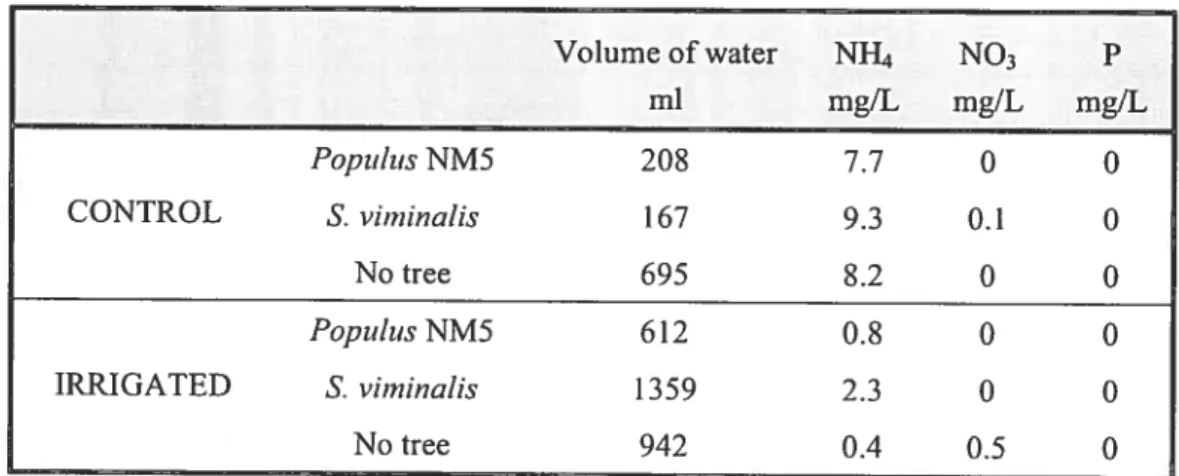
Tableau 1.3 Mean values of water analysis sarnpled in lysimeters every two weeks throughout the irrigation period of summer 2005 at Chartierville.
Tableau 1.4 Leaves and stems average dry mass (g) per plant for non-irrigated (control) and irrigatedF. NM5 and S. virninalis.
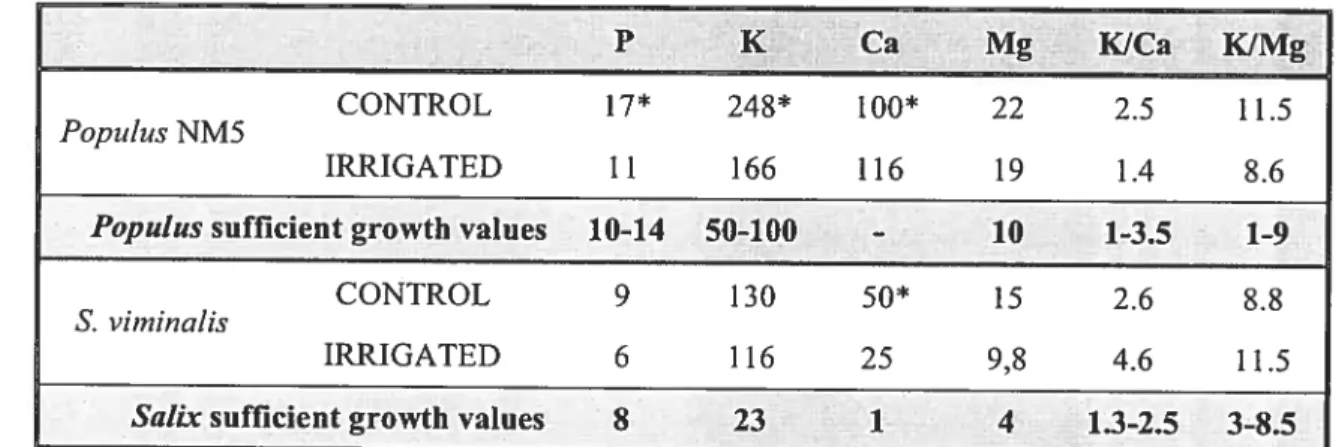
Tableau 1.5 Ratios of the nutrients contents in foliar tissues of i;Tigated and non-irrigated (control) plants for P. NM5 and S. viminaÏis (N considered to be 100 part).
Tableau 2.1 Percentages of AMF root length colonization of the three clones at two levels of P irrigation.
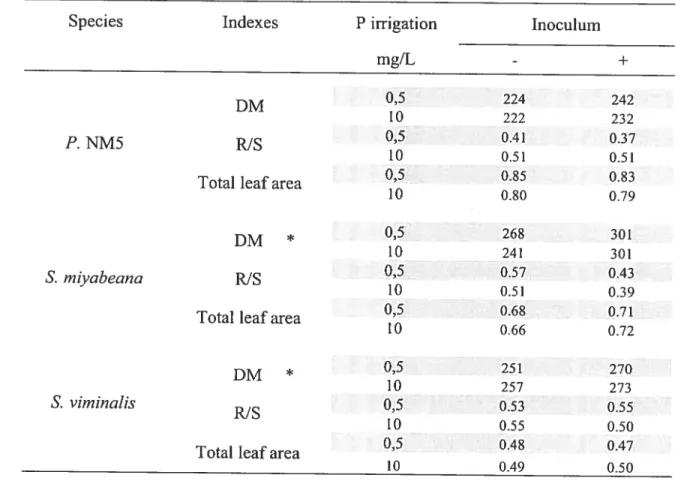
Tableau 2.2 Indexes of productivity (d;y mass) and resource use efficiency (root/shoot ratio and specific leafarea) for each species.
Tableau 2.3 Percentage of increased of plant P content in leaves and stems with increasing P irrigation and mycorrhizal colonization.
LISTE DES FIGURES
Figure 1.1 The experimental design of the400m2 plantation down stream the fish farm at Chartierville.
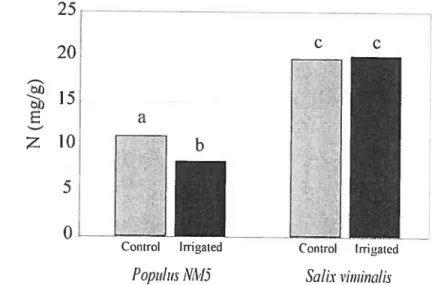
Figure 1.2 Average N foliar concentrations of irrigated and non-irrigated (control) plants of P. NM5 and S. viminaÏis.
figure 2.1 Average growth curves for PopuÏus NM5, S. miyabeana and S. virninalis under two P irrigation levels and with or without myconhizal inoculum, from June 5th (day 1) to September l3th 2005 (day 100).
Figure 2.2 Leaves phosphorus concentration (mg/g of dry mass) and phosphorus content (mg) of Populos NM5, S. miyabeana and S. virninaÏis.
figure 2.3 Stems phosphonis concentration (rng/g of dry mass) and content (mg) in Pop ïtÏïts NM5, S. miyabeana and S. virninalis.
LISTE DES ANNEXES
Annexe 1 Résultats des analyses de variance (ANOVA) effectuées sur les données récoltées à la pisciculture de Chartierville.
Annexe 2 Résultats des analyses de variance (ANOVA) effectuées sur les données récoltées en milieu serni contrôlé au Jardin botanique de Montréal.
LISTE DES ABRÉVIATIONS
OC : Degrés Celsius
AMF : Arbuscular mycorrhizal fungi (mycorhize à arbuscules) Ca: Calcium
CICR: Culture intensive sur courte rotation cm : Centimètre
EcMF : Ectomycorrhizal fimgi (ectomycorhize) g: Gramme
ha : Hectare K: Potassium
K20 : Oxyde de potassium Kg : Kilogramme
KOH : Hydroxyde de potassium L $ Litre m : Mètre Mg : Magnésium mm : Millimètre N : Azote NH4: Ammonium NO3 : Nitrate P : Phosphore
F. NM5 $ PopuÏus nigra x F. maxirnowiczii
P205 : Phosphore anhydride SLA : Specific leafarea
SRJC: Short rotation intensive culture
tDM : ton of dry mass (tonne de matière sèche) TMA : tonne de matière anhydre
REMERCIEMENTS
Cette recherche a été réalisée grâce au soutien financier de la Société de recherche et de développement en aquaculture continentale (SORDAC) et les Fonds de recherche sur la nature et les technologies (FQRNT). L’inoculurn mycorhizien utilisé dans cette expérience a été gracieusement fourni par l’entreprise Premier Tech de Rivière-du-Loup.
Merci tout d’abord à Michel Labrecque, mon directeur, qui m’a accepté dans son équipe avec beaucoup de générosité. J’ai pu enrichir mes connaissances d’une façon incroyable grâce à tes conseils et ta façon de communiquer ta curiosité. Tu m’as penTus de développer un regard plus intégral sur notre discipline et ta générosité m’a permis d’acquérir des expériences sans pareil qui ont dépassé largement tout ce en quoi je m’attendais en m’engageant dans la maîtrise.
Merci à Jacques Brisson, mon co-directeur. Je te considère comme un scientifique passionné et un conteur captivant. J’admire ta rigueur qui a souvent remis en question ce que je proposais, dans le but de toujours améliorer la portée de mes recherches. Plus que tout, ta propension à transmettre ton émerveillement devant la nature et les lois qui la structurent m’ont aidé à comprendre comment moi aussij’y suis attachée et à quel point
je suis prête à m’y dévouer.
Je tiens à remercier Trian Ion Teodorescu, pour son savoir immense et son expérience incomparable. Tu as été celui qui m’a montré l’essentiel tu m’a appris à instituer des relations entre les idées hautes et leurs incarnations concrètes, sur le terrain.
Merci à Marc Saint-Arnaud et Laetitia Lioussanne pour m’avoir aiguillée dans cette aventure mycorrhizienne. Votre aide fut plus qu’appréciée. Gabriel Teodorescu et tous les étudiants du laboratoire Brisson : Vincent, Florent, Marie-Ève, Jolle, Étienne, Bastien, Marie et Carole. Je vous suis très reconnaissante! Merci pour votre présence. Merci à Jérémy Locklear et à Roger pour le dur labeur que vous m’avez offert, à la sueur
de vos fronts. Un énorme merci à Stéphane Daigle, Marie-Claude Tunnel et Hélène Lalande pour leur support technique très apprécié.
Merci à toute l’équipe de l’Institut de recherche de Geraardsbergen en Belgique, notamment Bart Vandecasteele, Pierre Van Peteghem, Linda Meiresonne, Boudewijn Michiels et Bnino De Vos. Mon aventure dans votre contrée flamande fut hautement enrichissante d’un point de vue scientifique autant qu’humain.
Enfin, j’aimerais remercier ma famille et mes amis pour leur grande compréhension et leur infatigables encouragements depuis le début de cette expérience. Nicolas, à qui je réserve une admiration sans bornes, merci mille fois. Ta présence me donne la force et la confiance dont j’ai besoin. Encore merci.
DÉCLARATION CONCERNANT LES ARTICLES SCIENTIFIQUES
Liste des articles scientifiques
I) Maud Fillion, Jacques Brisson, Trian Ion Teodorescu, Sébastien Sauvé et Michel Labrecque
Performance of a wiÏlow and a poplar species in short rotation intensive culture for phosphonts uptake under intense irrigation
Article en préparation, destiné à larevueBiomass and Bio energy
II) Maud F illion, Miche! Labrecque, Jacques Brisson
Phosphorus retention efficiency of one hybrid popÏar and two wiÏlow species using arbuscuÏar mycorrhizaÏfztngi
Article en préparation, destiné à la revue Journal ofEnvironinental QuaÏity
Maud f illion a été la principale auteure des deux articles scientifiques présentés ci-après. Ses directeurs Miche! Labrecque et Jacques Brisson ont établi la problématique, supervisé les actions sur le terrain qu’elle a elle-même opérées avec l’aide de Trian Ion Teodorescu et révisé les textes. Sébastien Sauvé a lui aussi collaboré en tant que réviseur du premier article.
Chapitre 1. INTRODUCTION
En vertu d’une entente conclue entre le ministère du Développement durable, de l’Environnement et des Parcs et les pisciculteurs québécois, les effluents en phosphore d’une pisciculture ne doivent pas excéder 4,2 Kg par tonne de poisson produit (Ouellet, 1999). Pour respecter cette limite, plusieurs solutions ont été envisagées, par l’entremise du choix des moulées et de l’entretien des étangs par exemple, et plus récemment, par l’utilisation de marais filtrants (Summerfeit et al., 1999; Naylor et al., 2003). Bien qu’elles s’inscrivent inévitablement dans le processus de réduction des émissions de phosphore, ces avenues ne touchent que partiellement le problème. Le traitement de ces effluents étant plus problématique de par le fait qu’ils se caractérisent par un fort débit et une concentration en
phosphore inférieure à 0,5 mg/L (Morin, 1998). Devant de telles conditions, l’exploitation du potentiel des végétaux pour absorber les contarninants organiques constitue une technologie adaptée. En raison de leur haut taux de transpiration, les végétaux cultivés peuvent réduire les quantités d’eau rejetées dans l’environnement tout en bénéficiant des nutriments transportés par l’eau usée pour leur croissance et leur développement (Hall et al., 1998). L’utilisation d’une culture ligneuse pour ce type de filtration pourrait également entraîner un revenu supplémentaire pour le pisciculteur par la vente du bois produit. Le potentiel de réduction des émissions en phosphore d’un effluent piscicole, par l’irrigation intensive d’une plantation d’arbres à croissance rapide, soulève ainsi un intérêt écologique et économique.
Ce premier chapitre est consacré à la mise à jour des connaissances sur les processus de traitement des eaux par les arbres ainsi que la technique de culture intensive sur courtes rotations (CICR) sur laquelle est basée la présente étude. Les facteurs influant sur le potentiel filtrant des arbres, tout comme les conséquences d’une irrigation intensive et les perspectives qu’offre la rnycorhization, seront aussi des champs abordés ci-après afin de mieux cerner toutes les implications du traitement d’un très large volume d’eau combiné avec de faibles concentrations de polluants.
Valorisation des eaux usées
Les contarninants organiques contenus dans les effluents comportent généralement des éléments nutritifs tels que l’azote et le phosphore, susceptibles de stimuler la croissance de végétaux dans les écosystèmes aquatiques. Leur déversement dans les cours d’eau naturels engendre souvent un enrichissement excessif qui peut affecter les communautés végétales et animales et modifier sérieusement l’intégrité écologique du milieu aquatique récepteur; un phénomène que l’on nomme eutrophisation. Cette forme de pollution due à l’activité humaine peut aussi, dans certains cas, entraîner le développement de cyanobactéries, ou algues bleues. Ces efflorescences algales ne sont pas sans conséquence, puisque certaines espèces libèrent des toxines dangereuses pour l’homme et les animaux. Au Québec, la prolifération d’algues bleues dans les plans d’eau est un phénomène observé sur une portion grandissante du territoire. Pour éviter les déversements polluants en milieux naturels, les eaux usées industrielles ou urbaines, les boues d’épurations ou encore les déchets agricoles, sont parfois utilisés comme fertilisants agricoles et sylvicoles, ce qui pennet des rendements accrus pour les végétaux en culture à de faibles coûts (Perttu et Kowalik, 1997). On décrit ce procédé par lequel des végétaux sont utilisés pour valoriser des résidus organiques polluants pour nos écosystèmes par le tenue phytoremédiation (Licht et Isebrands, 2005). En plus de l’absorption directe et de la métabolisation des éléments organiques par les plantes, la couverture végétale peut également bénéficier d’une activité microbienne et fongique au niveau de la rhizosphère, ce qui optimise le recyclage des nutrirnents (Aronsson et Perttu, 2001).
Depuis des années, les peupliers (Populus spp.) et les saules (Salix spp.) sont plantés en bandes riveraines dans les milieux agricoles afin de retenir les fertilisants dans l’eau de ruissellement et de limiter ainsi le déversement des polluants dissous vers les cours d’eau naturels (Lowrance et al., 1984). Encore aujourd’hui, ces végétaux sont panni les plantes ligneuses les plus couramment utilisées en phytoremédiation (Licht et lsebrands, 2005). L’efficacité de ces arbres vient principalement du fait qu’ils possèdent un réseau racinaire très fourni, un taux de croissance élevé et une flexibilité à croître dans divers milieux (Labrecque et al., 1997; Weih, 2004). Leur importante production de biomasse est en
général associée à un recyclage rapide des éléments et une consommation élevée en eau (Mirck, 2002), ce qui augmente de façon considérable le rendement de filtration par unité de surface de plantation par rapport à d’autres espèces.
Culture intensive sur courtes rotations
On appelle culture intensive sur courtes rotations (CICR) la technique selon laquelle une plantation à haute densité de plantes ligneuses à croissance rapide est exploitée afin de maximiser les rendements à l’hectare. Cette technique fait également appel à des plantes qui ont la capacité de rejeter vigoureusement après la taille ou le recepage des portions aériennes. Ainsi, la biomasse produite par ce type de culture peut être récoltée à intervalles courts de 2 à 4 ans selon les conditions et les espèces utilisées. On estime que de tels systèmes de culture ont une durée de vie économique de 25 à 30 ans (Makeschin, 1999). Aujourd’hui, la production de biomasse Ligneuse à visées commerciales se fait dans plusieurs pays pour répondre à divers marchés (Licht et Isebrands, 2005). Plusieurs auteurs ont déjà démontré les factiltés épuratrices de ce type de plantation pour la décontamination des effluents chargés en éléments organiques (Lowrance et al., 1984; Perttu et Kowalik, 1997; Elowson, 1999; Aronsson et Bergstrom, 2001; Jonsson et ai, 2004, 2006). En revanche, bien que plusieurs chercheurs aient travaillé sur le potentiel épurateur des salicacées, peu de littérature concerne les effluents à faible charge.
Pouvo irfiÏtrant
L’efficacité épuratrice d’une plantation d’arbres à croissance rapide peut dépendre de plusieurs facteurs: le type dc sol, la concentration des polluants dans l’effluent ou encore l’intensité de l’irrigation, les espèces utilisées, etc. (Jonsson et al., 2004). En effet, la rétention des éléments sur les particules de sol (l’adsorption) est plus importante dans les sols argileux, alors que la captation par les arbres des nutriments transportés par l’effluent (l’absorption) est supérieure dans les conditions où le sol est pauvre. Par exemple, dans un
système à gravier, basé sur la culture hydroponique, il a été observé que le saule retenait 91% du phosphore contenu dans l’eau d’irrigation (Mant et al., 2003). Dans un système avec sol, l’efficacité de l’arbre pour le phosphore se situe entre 40% et 80%, selon tes conditions de l’expérience avec des concentrations en phosphore variant de 0,2 mg/L à 15 mg/L (Perttu et Kowalik, 1997; Mirck et al., 2005). Dépendamment des caractéristiques physico-chimiques du milieu et de l’effluent en présence, l’atteinte de l’objectif de filtration visé repose sur l’ajustement judicieux de chacun des facteurs en fonction des autres. Par exemple, la concentration des polluants dans l’eau d’irrigation fera varier le taux d’irrigation applicable pour optimiser l’efficacité épuratrice de la plantation. En effet, des études ont démontré qu’une plantation irriguée avec 10 ou 15 mm d’eau par jour avec des concentrations de phosphore variant de 4 à 15 mg/L offrait un rendement comparable à une plantation irriguée avec plus de 50 mm par jour avec des concentrations inférieures à 0,5 mg PIC (Perttu et Kowalik, 1997; Elowson, 1999; Jonsson, 2006). Le pouvoir filtrant d’une plantation est aussi fortement lié au potentiel d’évapotranspiration de la surface irriguée (Elowson, 1999). Par le phénomène de transpiration, la végétation participe à la réduction de l’écoulement et à l’allongement du temps de résidence du flux, ce qui augmente la concentration en nutriments dans le sol et facilite l’absorption par les racines (Hall et al., 1998; Pauliukonis et Schneider, 2001). Les orthophosphates représentent la forme du phosphore la plus disponible pour une utilisation par les végétaux, mais aussi celle qui est la plus réactive chimiquement. Les orthophosphates regroupent les formes oxydées du phosphore (H3P04, HP042, P043D et leur répartiion dépend du pH du milieu. En somme, un des principes fondamentaux de la phytoremédiation est d’associer l’espèce appropriée au site de contamination. De même, les paramètres liés à l’irrigation doivent être réglés pour répondre aux conditions de sol, de climat ainsi qu’à la nature et la concentration du contaminant à extraire.
irrigation intensive
Dans les systèmes de culture de plantes quel qu’il soit, les quantités de fertilisants à appliquer, sont habituellement détenninées selon l’apport en azote. Cet élément limitant
nappes d’eau adjacentes. Certaines études démontrent que 100 Kg/ha d’azote disponible semble être une dose adéquate pour l’établissement des saules et des peupliers en culture intensive sur courte rotation tout en minimisant les risques de lessivage des nitrates (Labrecque et al., 1998; Elowson, 1999; Berthelot et al., 2000). Toutefois, dans le cas où l’effluent serait très dilué, la limitation n’est plus imposée par la quantité de nutriments apportés, mais plutôt par la capacité du sol à retenir l’eau et surtout, la tolérance des arbres aux conditions édaphiques qu’engendre l’irrigation intensive. La plus importante contrainte pour la croissance des arbres en conditions d’inondation est le manque d’oxygène. En effet, l’irrigation intense d’un sol peut limiter les échanges gazeux avec l’atmosphère au point de causer un déficit important en oxygène au niveau des racines (Good et al., 1992; Kozlowski, 1997). Ce phénomène est d’autant plus important dans un sol lourd (argileux) où l’espace entre les particules de sol est réduit par rapport à ce qu’on retrouve dans les sols sablonneux. La plupart des espèces de saule et de peuplier sont naturellement adaptés aux conditions anaérobiques des zones riveraines et montrent une bonne tolérance à l’excès d’eau (Hallgren, 1989; Licht et Isebrand, 2005). En général, cette tolérance est directement liée à l’aptitude des arbres à développer des adaptations physiologiques associées au transport de l’oxygène vers les racines. L’hypertrophie de la tige et l’accroissement du nombre de lenticelles, l’oxydation de la rhizosphère et l’augmentation de la porosité racinaire sont entre autres des exemples d’adaptation aux conditions physico-chimiques engendrées par l’inondation d’un sol (Hallgren, 1989). Encore ici, le choix de l’espèce est très important puisqu’une variation intraspécifique de la tolérance à la surirrigation est observable chez les SaÏicaceae (Hallgren, 1989; Liu and Dickmann, 1992).
Mycorhizes
Dans un système de filtre végétal, le processus de rétention des polluants n’est pas uniquement généré par la plante elle-même, mais aussi par les microorganismes de la rhizosphère (Mirck et al., 2005). Par exempte, en échange de carbone, les champignons
mycorhiziens associés aux racines assurent une plus grande transiocation de certains éléments limitant vers la plante hôte (Backhaus et al., 1986). Leur présence peut ainsi augmenter de façon significative la capacité de rétention de certains éléments par la plante. Les deux types d’associations mycorhiziennes les plus répandus sont les mycorbizes à arbuscules (AMF), le champignon ayant son siège à l’intérieur des cellules de la racine, et les ectornycorhizes (EcMf), le champignon étant situé à l’extérieur des cellules de la racine (Jones et al., 1998; van der Heijden, 2001). Si leurs effets sur les plantes sont relativement les mêmes, certains auteurs s’entendent pour dire que les AMF prédominent dans les endroits principalement limités en phosphore alors que les EcMF prévalent dans les milieux déficients en azote (Read, 1989; van der Heijden, 2001). D’ailleurs, de nombreuses expériences dénotent que les AMF sont majoritaires chez les jeunes plants en croissance offrant ainsi des bénéfices à court terme contrairement aux avantages à long tenne que semblent procurer les EcMf (Dhillion, 1994; Van der Heijden, 2001; Khasa et al., 2002). Quoiqu’il en soit, les peupliers et les saules font partie des rares espèces qui forment des associations avec les deux types de mycorhizes (Lodge, 1989; Khan, 1993; Dhillion, 1994). Leur présence peut avoir un impact majeur sur la croissance et la nutrition des plantes, en plus d’augmenter la protection des racines contre divers pathogènes (Khasa et al., 2002; Helgason et al., 2006). Bref, pour tous les avantages que les mycorhizes procurent aux plantes, la perspective de les utiliser pour la filtration du phosphore dans les effluents dilués des piscicultures semble intéressante. Pourtant, relativement peu d’expériences ont été menées au sujet de l’impact des mycorhizes dans des stratégies de phytoremediation de polluants organiques et peu d’investigations ont été faites sur la colonisation des espèces de Fopulus et de Salix par des inoculums commerciaux développés pour le marché agricole.
Object
L’étude présentée ici visait à analyser le potentiel d’une plantation d’arbres à croissance rapide pour la rétention du phosphore provenant d’un effluent dilué. L’expérience a été menée selon deux volets : un premier en milieu naturel, dans une
pisciculture située au sud-est de Montréal, et un second, en conditions serni-contrôlées, conduite au Jardin botanique de Montréal.
En milieu naturel, les objectifs étaient:
1) Vérifier l’hypothèse selon laquelle la croissance des arbres vient réduire le déversement de phosphore provenant de l’effluent piscicole dans les plans d’eau environnants.
2) Analyser la croissance ainsi que le statut nutritionnel d’une espèce de saule et de peuplier hybride dans les conditions physico-chimiques engendrées par l’irrigation continue d’un sol lourd.
Suivant la mise en place d’un dispositif de plantation à forte densité, une analyse a pu être menée sur la capacité de deux espèces (saule et peuplier) à extraire le phosphore d’un effluent avant qu’il ne soit déversé dans les cours d’eaux naturels. L’étude a permis de voir l’impact d’une charge de contaminants et d’une irrigation importante sur de jeunes arbres en plus d’évaluer la performance de ce type d’intervention en conditions réelles.
En milieu contrôlé, l’objectif était:
1) Déterminer l’impact d’un inoculum commercial de AMF (Glornus intraradices) sur la rétention du phosphore par trois espèces (deux saules et un peuplier) soumises à deux concentrations de phosphore différentes.
2) Comparer la performance de rétention du phosphore des trois espèces choisies.
En utilisant un dispositif de plantation en pot, une étude a pu être menée sur les impacts d’une inoculation d’un champignon mycorhizien à arbuscule sur la performance de rétention du phosphore de trois espèces utilisées commercialement en CICR au Québec. Cette approche visait à explorer le potentiel d’une association mycorrhizienne pour l’amélioration des capacités épuratrices des arbres utilisés en CICR.
Approches générales
En premier lieu, une plantation de 800 m2 a été établie au printemps 2004 à la pisciculture de Pierre Vézina à Chartierville dans les Cantons-de-l’est. Le dispositif expérimental a été défini en respect des exigences statistiques mais également en tenant compte de contraintes imposées par l’espace disponible sur le terrain et les divers traitements à appliquer. Deux espèces végétales ont été plantées, soit le saule osier (Salix viminalis 5027) et un peuplier hybride soit le peuplier NM5 (FopuÏtts nigra x P. maximowicziz). Après une première année de croissance, un système d’arrosage par gicleurs alimentés par une pompe a été installé pour irriguer et ainsi permettre l’épuration des eaux contaminées sur une moitié de la plantation pendant la période de croissance de l’été 2005, l’autre moitié servant de témoin. Des mesures de croissance et de concentration en phosphore dans les différentes parties de la plante ont été réalisées, de même que des mesures sur la concentration en phosphore dans le sol et dans l’eau de percolation. Des lysimètres ont été disposés dans chacun des blocs expérimentaux afin de recueillir ces eaux de percolation. En second lieu, une expérience en milieu semi contrôlé a été conduite sur le site du Jardin botanique. Le dispositif comportait deux espèces de saule (Salix viminalis 5027, S. miyabeana 8X64) et le peuplier hybride NM5 (PopuÏus nigra x F. rnaximowiczii). La moitié des plants du dispositif a été inoculée avec le même inoculum mycorhizien décrit plus haut (G. intraradices). Afin de mettre en relief les effets de la mycorbization dans des conditions limitées en phosphore, deux concentrations différentes ont été utilisées, l’une se rapprochant de la teneur d’un effluent piscicole, soit 0,5 mg/L et l’autre suffisamment importante pour modifier le statut nutritionnel des plantes (10 mg/L), sans toutefois fournir un apport trop élevé qui aurait pu affecter la colonisation mycorhizienne (> 15 mg/L P205).
Organisation du mémo ire
Les résultats concluants de ces deux expériences menées en parallèle sont présentés sous forme de deux articles scientifiques distincts constituant les deux prochains chapitres de ce document. Le dernier chapitre de ce travail présente une conclusion générale
permettant de revenir sur les objectifs définis ci-dessus. Enfin, deux annexes présentent à la toute fin de ce document les résultats des ANOVA qui ont été effectués sur les données récoltées en milieu naturel et contrôlé.
Chapitre 2.
PERFORMANCE 0F A WILLOW AND A POPLAR SPECIES IN SHORT ROTATION INTENSIVE CULTURE FOR PHOSPHORUS UPTAKE
UNDER INTENSE IRRIGATION
Maud Fillion1, J. Brisson2, T.I. Teodorescu2, Sébastien Sauvé1 and M. Labrecque2
1. Université de Montréal, C.P. 6128, succursale Centre-ville, Montreal Quebec, Canada, H3C 3J7
2. Institut de Recherche en Biologie Végétale, 4101 Sherbrooke East, Montreal Quebec, Canada, HIX 2B2
Abstract In this smdy, we evaluated a simple and cost-effective way of treating the effluent of a fisli farm in southern Quebec, with its large volume (2300 Llmin) and low pollutant concentration (0.3 mgP/L), by the intense irrigation of fast-growing deciduous trees. On a plantation established in 2004 from stem cuttings at a density of 20,000 trees per hectare, we investigated growth and nutritional plant response to a high hydraulic regime in two species (Salix virninalis and Fopttlus nigra x F. maximowiczii), using a comparative approach with measurernents from irrigated and control plots. The plantation was irrigated from June to September 2005 with about 140 mm per day. The equivalent of 120 Kg NO3-N, 40 Kg P205-P and $5 Kg K20-K per hectare per year was applied by means of irrigation with wastewater. No mortality occurred and stem biornass production of both poplar and willow species were flot statistically different on irrigated and control areas. However, Satix viminalis seemed more tolerant to flooded conditions since these corresponded more closely to its nutritional requirements (foliar concentration of 20 mgN/g). The capacity of Salix virninalis to withstand waterlogged conditions could play an important role in the sustainability of a plantation for the filtration of effluent at low pollutant concentration.
INTRODUCTION
f ast-growing trees for biornass production is proposed as an economical and ecological
materials for wood-based industries (Licht and Isebrands, 2005). In Quebec for example, pulp and paper and wood panelling manufacturers have recently shown an interest in fiber from willow plantations under short rotation intensive culture (SRIC) (Labrecque and Teodorescu, 2005: Sean and Labrecque, 2006). Production of woody biomass through SRTC leads to several environrnentaï benefits due to the renewable nature of this ver’’ productive system and its capacity to recycle organic residue such as siudge, manure or wastewater (Spitzer and Ahamer, 1992).
The efficiency of vegetation as filters has been demonstrated in several field studies conducted in many different countries (Perttu and Kowalik, 1997; Nixon et al., 2001; Mirck et al., 2005). Willows and poplars in SRIC can be highly efficient for recycling organic residue from wastewater because of their rernarkable growth rate (Labrecque and Teodorescu, 2001; Labrecque et al., 1998). Indeed, rapid biornass production is associated with a high nutrient turnover and an abundant tise of water (Mirck, 2005).
Pollution and wastewater discharge are problems frequently encountered by fish farrners (EnelI, 1995; Dumas et al., 1998; Naylor et al., 2003; Porrello et al., 2005). In raceway freshwater fish faniis, the water flow rate is kept high to reduce free ammonia concentrations, which dilutes pollutants originating rnostly from excreta and undigested fish food (Corneau et al., 2001). Handling a large volume ofthis type ofwater having a low concentration of pollutants requires special solutions (Jonsson et al., 2004). In the province of Quebec (Canada), the average flow rate of fresliwater fish fan-ris is 1 600L/rnin with a mean phosphorus concentration of 0.3 rng/L (Ouellet, 1999). Therefore, extended water purification is appropriate for solving a water quality issue of such dimensions and the use of SRIC could represent a simple and cost-effective solution (Lowrance et al., 1984; Perttu and Kowalik, 1997; Licht and Isebrands, 2005).
Previous studies have shown that willow and poplar in SRIC use significantly more water than agricultural crops and other tree species (Grip et al., 1989; Hinckley et al., 1994; Lindroth et al., 1994) and are both characterized by an excellent capacity for acquiring nutrients under a variety of conditions and for tolerating waterlogging (Nixon et al., 2001).
In fact, high evapotranspiration rates decrease discharge flows toward natural waterways and increase water residence tirne, which facilitates nutrient absorption by roots (Hall et al., 1998; Pauliukonis and Schneider, 2001). Considering the large volume ofwater undergoing treatment, the high rate of water consumption of the selected trees can increase the purifying efficiency per surface unit of the plantation and ensure an optimal productivity for wood harvest. However, few studies conducted to date concem phosphorus retention capacity from diluted effluent. Also, the tolerance of wiÏlows and poplars to flooded conditions is specie-dependent (Haligren, 1989; Good et al., 1992) and therefore the adaptation capacity ofthe selected species will influence the viability ofthe system.
The present study tested the hypothesis that intense irrigation ofwillow and poplar in SRTC
could accommodate the high rate of flow characteristic of fish farrn effluent and limit phosphorus discharge into natural ecosystems. The aims of the experirnent were to analyze phosphoms purification efficiency and intense irrigation tolerance of a willow and a poplar species. Therefore, on a 400 rn2 experirnental site, vie (I) investigated growth and nutritional plant response to a high hydraulic regirne of two different species (Salix virninalis and FopuÏtts nigra x P. rnaxirnowiczii) and (ii) evaÏuated the impact of a planted area on the levels ofphosphoms in mn-off.
MATERIAL AND METHOD
Site description
The experirnent was conducted at a fish farrn located in Chartierville (45°16’ N, 71°12’ W) in southem Quebec. This freshwater fish fanu produces 50 tons of fish annually (SalveÏinus fontinaÏis and Oncorhynchrts mykiss), with an average water flow rate of 2213 L/rnin (Table 1.1). The climate ofthe region is continental hurnid, at an altitude of 550m with an annual average temperature of 4.6°C and 1100 mm of precipitation. The length of the growing season varies between 120 and 140 days and total precipitation during this experiment (from June to September 2005) vas approxirnately 320 mm (Environrnent Canada, 2005).
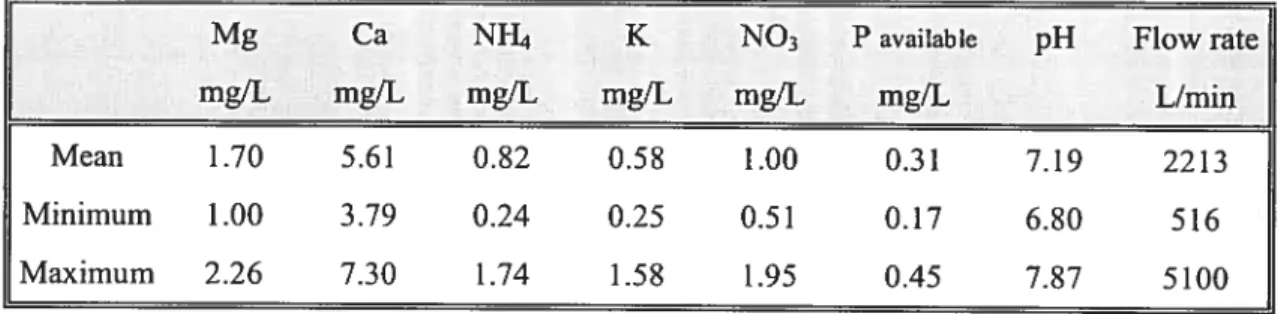
Table 1.1 Water charactenstics measured from the effluent every two weeks in the sedimentation basin at the fish farm in Chartierville.
Mg Ca NR4 K NO3 P available pH Flow rate
mg/L mg/L mg/L mg/L mg/L mg/L L/rnin
Mean 1.70 5.61 0.82 0.58 1.00 0.31 7.19 2213
Minimum 1.00 3.79 0.24 0.25 0.51 0.17 6.80 516
Maximum 2.26 7.30 1.74 1.58 1.95 0.45 7.87 5100
Species and experimental design
In the spring of 2004, sou was tilled on the $00 m2 experirnental site before adding a 30 cm layer of topsoil to homogenise the natural site and help provide good conditions for tree growth. One species of willow, SaÏix virninalis MUh1., and one hybrid poplar, Populus
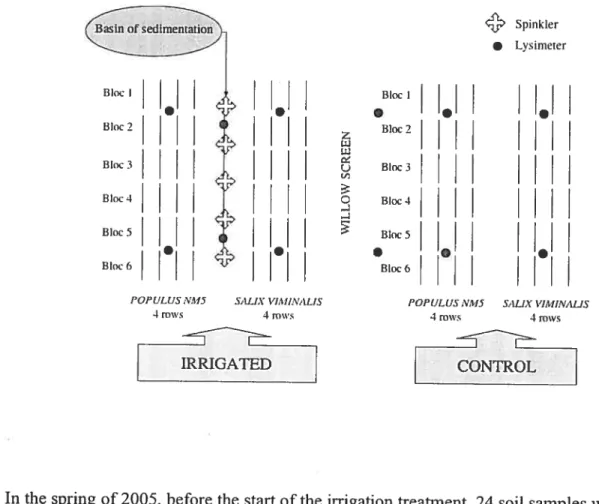
nigra x P. rnaximowiczii, were then planted, respectively codified by the ministère des Ressources naturelles et de la faune du Québec as clone 5027 and clone 3729 (but also as clone NM5). S. virninalis bas been successfully used in several SRIC plantations in southem Quebec over the last ten years (Labrecque and Teodorescu, 2003) and Popîtius NM5 bas been identified as the rnost productive among ten willow and poplar species recently tested in an experimental trial (Labrecque and Teodorescu, 2005). A total of 1 200 cuttings were planted by hand every 20 cm, in 19 rows at a distance of 1.5 m apart and at a depth of 16-18 cm to create a plant density of 20,000 cuttings/ha. After one year ofgrowth, the field was spiit into two plots (control vs irrigated) each cornposed with two subplots (S. virninalis and Poptthts NM5). Each subplot was separated into six blocks. Three meters separated the two species in each plot and six meters separated the control from the inigated part. Within these six meters, three rows of S. virninaliswere planted as a buffer to prevent irrigation water from reaching the control plot. Fish farrn water vas purnped from the sedirnentation basin and sprinkled over the first plot (Figure 1.1). Irrigation occurred from June 22nd to September 13th 2005, 12 hours a day fora total of 14$ mm of water per day, including the 4 mm!day that both plots received from precipitation during the experimental period. Regular weeding was perfonned by hand during the two growing seasons.
Spinkler
• Lysirneter
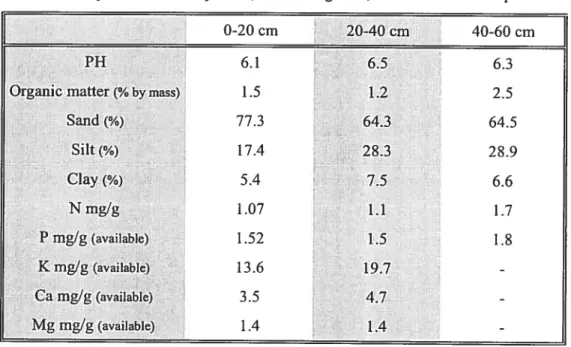
In the spring of 2005, before the start of the irrigation treatment, 24 sou samples were taken at three different depths: 0-20, 20-40 and 40-60 cm (Table 1.2). The plantation site was a
loamy-sandy texture with poor organic matter content (average around 1.7 % by mass). The pH of the sou was slightly acidic with an average of 6.3 over the three layers sampled. In the first 40 cm, the layer where roots expansion mainly occurs, the average content of N
(1.1 mg/g) and P (1.5 mg/g) was low whereas content of K was considered high (17.0 mg/g) (Doucet, 1994). Soils samples were analysed colorirnetrically on the flow injection instrument for P and N (Parkinson and Ail en, 1975) whuie K, Mg and Ca were determined by using an atomic absorption spectrophotometer (Varian AA6TM).
Figure 1.1 The experimental design of the 400m2 plantation downstream from the fishfarm at Chartierville.
z LU LU u C —J Bloc I Bhw2 Bloc 3 B4 Bloc 5 • • Bloc 6
POPULC!S VIlS £UJX VlMlNlLJS
4rows 4 rows IRRIGATED BlocI • • • Bloc 2 Bloc 3 Bloc 4 BlocS • • • Bloc 6
POPULUS.l1l5 SALIX VJMIN1LIS
4 rows 4 rows
Table 1.2 Mean values of sou characteristics rneasured in samples taken at the Chartierville plantation in May2005, before irrigation, at three different depths.
O-20 cm 20-40 cm 40-60 cm PH 6.1 6.5 6.3 Organic matter(%bymass) 1.5 1.2 2.5 Sand (%) 77.3 64.3 64.5 Sut (%) 17.4 28.3 28.9 Clay(%) 5.4 7.5 6.6 Nmg/g 1.07 1.1 1.7 Pmg/g(available) 1.52 1.5 1.8 Kmg/g(available) 13.6 19.7 -Ca mg/g (avai]able) 3.5 4.7 -Mg mg/g (available) 1.4 1.4
-Water and nutrient application
The irrigation water pumped from the sedimentation basin of the fish farm was analysed every two weeks (Table 1.1). The proportion of ail P forrns was accomplished colorirnetrically with the phosphornolybdenic complex in the presence of ascorbic acid (Murphy and Riley, 1962; Maher et al., 2002) and analysed by spectrophotornetry. Ah water analyses were done under the supervision of Dr. Sébastien Sauvé at the chernical laboratory of University of Montreal. Nitrogen and phosphorus concentrations were rather constant throughout the season, even thou values from 3 to 4 tirnes higher were observed in may with the meit of snow. Over the growth season, an average of 1.00 mg/L of NO3, 0.82 mg/L of N114 and 0.31 rng/L of available P was rneasured. Based on these values and the amount of irrigation, the irrigated plot received a dose approxirnately equivalent to 220 Kg/ha of available N and 40 Kg/ha of available P over the experimental year. Ditches 1 to 2 meters deep surrounded the fleld experirnent ofthe irrigated part.
Twelve lysirneters were installed at 1.5 to 2.5 meters in depth in each plot to collect infiltration water (f igure 1.1). The lysirneters were installed in the spring of 2004, one year prior to starting the irrigation treatment, to allow surrounding soil to stabitize. The
differences in depth were due to the stony subsoil, which made manual drilling of holes extrernely difficuit. During the irrigation period, the water retained by these lysimeters was sampled with a manual pump every two weeks (Table 1.3). Since the mean quantity of water sarnpled in each plot differed markedly, it is likely that water from the irrigated part did flot flow in the non-irrigated part. Lysirneters situated in a treeless zone in each plot were used as a control value.
Measurements and analyses
Ail measurernents were carried out arnong trees on the two middle rows of every block to limit the boundary effect. At the end of the growing season, in October 2005, growth and biornass partitioning were measured from eight plants randomly chosen in every block for each species and treatment, for a total of 192 plants. Height and diameter ofthe main stem were recorded whule biomass, partitioned into leaves and stem, was collected and oven dried for 48 hours at 70°C.
In September 2005, samples from well-developed leaves 20 cm from the top of the shoots were randomly chosen in each block for tissue analyses. In October, samples of wood were also taken from different parts of 10 stems in each block. To analyse the nutrient content, samples of leaves and stems were dried, ground and then digested in suÏphuric acid and peroxide with the addition of catalysts (lithium and selenium) at 340°C for about three hours. The digested solutions were analysed colorimetricaliy on the flow injection instrument for P and N (Parkinson and Ailen, 1975) whule K, Mg and Ca were determined from the suiphuric acid and peroxide digestion by using an atomic absorption spectrophotometer (Varian AA6TM).
Analysis of variance (ANOVA) was used for comparing the above ground biomass of inigated and control plots, as weÏl as their nutrient content. Calculations were perforrned using Statistical Analyses Software (SAS Institute mc, 2000) with a significance levei of 0.05.
Most experiments with flooding conditions reported in the literature use volumes of irrigation between 20 to 30 mrn/day or simply the water level close to the soi! surface (Haligren, 1989; Good et ai, 1992; Jonsson et al., 2004). In fact, the dosing of wastewater or siudge application is normally based on N-amounts since this strongly influences N03-N leaching loads (Elowson, 1999; Aronsson and Bergstrô;n, 2001). In this experiment, the very iow concentrations of NO3-N (1 mg/L) and availabie P (0,3 mg/L) did not requfre limiting the volume of wastewater provided to the plantation. By supplying 140 mm every day, the moderate doses of fertilizers applied (120 Kg of N03-N, 40 Kg of P2O5-P and 85 Kg of K2O-K) were considered adequate for improving growth and reducing risk of leaching into loamy sou in regular hydraulic conditions (Labrecque et al., 199$; Aronsson and Bergstrôm, 2001). The main stress factor encountered for the plantation was then the flooding conditions. During the irrigation period, accumulation of water on the soil surface rarely occurrcd for some blocks situated in srnall depressions. Water in blocs 1 and 2 for willows and blocks 3 and 4 for poplars (Figure 1.1) took more time to infiltrate the soil than elsewhere. Nevertlieless, no block effect lias been revealed by the statistical analysis for any of the variables.
Tree growth and flood tolerance
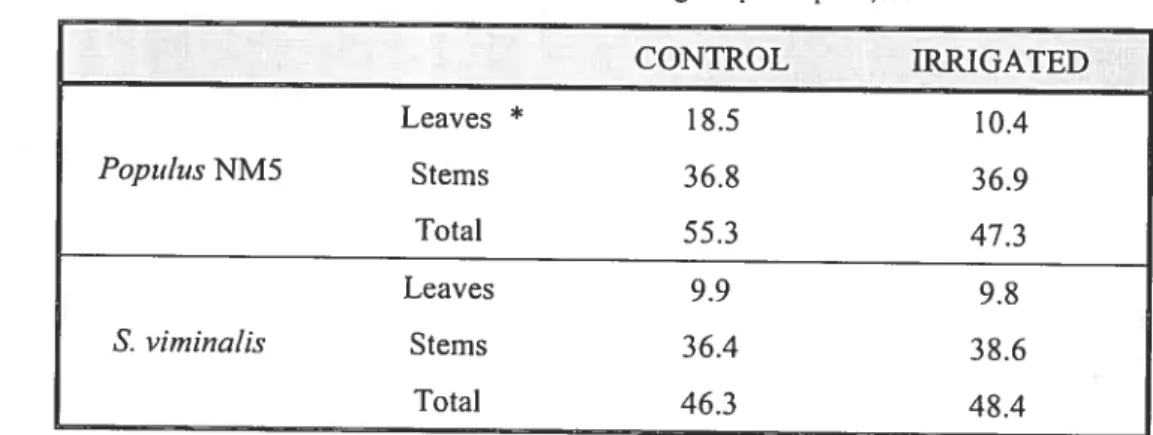
In spite ofthe fact tliat willows and poplars are well known for their tolerance to high water leveis, intense irrigation can reduce air exchange in sou and negatively affect their biomass production (Elowson, 1999; Nixon, 2001). However, some authors have found that the response to these flooding conditions is species-dependent in SaÏicaceae (Haligren, 1989; Liu and Dickmann, 1992). In this experiment, no mortality was observed, so the species did support the intense irrigation. For willows and poplars, there were no statistical differences for total biomass nor for stem biomass production between irrigated and control (Table 1.4). Also, no significant differences were found in the height and diameter of the main stem for both species. Therefore, even thougli the intense irrigation treatment was started early in the establishment of the plantation, at the beginning of the second growing season, both species seemed to have responded well to the extrernely high level of irrigation.
A significantly lower foliar biornass for irrigated trees was rneasured for?. NM5
(p=O.003)
(Table 1.4). In a sirnilar study, Liu and Dickrnann (1992) reported analogous observations conceming reduced leaf expansion of certain Foptdtis species under flooded conditions. Good et al. (1992) neither found any significant effect of waterlogging in relation to leaf dry weight parameter for S. viminalis. This indicates that the transpiration potential ofF. NM5 could be reduced under intense irrigation contrary to S. viminalis, even though poplars usually have a transpiration rate slightly superior to that of willows (Persson and Lindroth, 1994; Hall et al., 1998). With the objective ofpurifying a large volume ofwater, the potential of evapotranspiration is an important factor.Table 1 .4 Leaves and stems average dry mass (g) per plant for non-irrigated (control) and irrigatedP. NM5 and S. viminalis.
NOTE: Values with *
are different for Control and lrrigated plot at p<0,05.
CONTROL IRRIGATED Leaves * 18.5 10.4 Populus NM5 Stems 36.8 36.9 Total 55.3 47.3 Leaves 9.9 9.8 S. Wminalis Stems 36.4 38.6 Total 46.3 48.4
In order to evaluate the ability of these species to withstand the effects of waterlogging, the nutritional status of the trees in both plots was analysed. The nutritional status of plants can be characterized by the concentration of N and the ratios of macro-elements contained in the leaves. ForP. NM5, N leaf concentrations were under the level for sufficient growth of 17 rngN/g as suggested by van den Burg (1990). The leaf samples from the irrigated plots showed a mean concentration of 8.3 mgN/g compared to 11.0 mgN/g in the control (p=O.Ol6) (Figure 1.2). Sou water status significantly alters the utilization of sou N (Liu and Dickrnann, 1992; Pezeshki et al., 1999). Nitrogen deficiency symptoms such as a loss of green colour progressing to yellow coloration were moreover visible starting from the rniddle of the summer for inigated poplars. Salix showed concentrations of N in leaves of 20 rngN/g in both plots, as reported by Labrecque et al. (199$) for willows cultivated in
unfertitised plantations. These resuits are very close to the critical value for sufficient growth of 21 mgN/g for Salix species according to Kopinga and van den Burg (1995). The macronutrient ratios in the leaves were calculated with respect to N. for deciduous trees, these ratios are considered optimal at these levels: N = 100, P = 10-14, K 50-100,
Mg 10 (Kopinga and van den Burg, 1995). In this experirnent, ail ratios for P. NM5 exceeded these optimal values, especiaïly for the irrigated plot since these values were significantly higher for P, K and Ca compared to control values (Table 1.5). With a deficiency in N concentration and high ratios of other elements, P. NM5 showed a significant nutritional imbalance, which suggests a limited longevity potential for trees. As a matter of fact, P. NM5 also presented a Iow biornass yield (1 tDM/ha) (Table 1.4), compared to the 2OtDMIha harvested after two years of growth for the exact same specie by Labrecque et aI (2005). Since this unsatisfactory growth xvas also observed in the non irrigated plot, field conditions and the limited length of the vegetation growth period could be factors responsible for this weak biornass production. However, before one can hope to draw benefits from xvater filtration in terrns of biomass productivity, the sustainability of the filtration system must be assured through the physiological aptitude of species to respond to flood conditions.
figure 1 .2 Average N foliar concentrations of irrigated and non-irrigated (control) plants of P. NM5 and S. viminatis. NOTEt Colurnns with different letters are significantly different (p< 0,05).
20
-Z 10 b
0H__Li
Control lrrigatedPopulus NMJ
C C
Control 1rriated
Studies carried out on a site where nutrient levels did flot lirnit birch tree growth (Betula pendïtÏa Roth), which have a comparable nutritional behaviour to willows (Ericsson et al., 1992), demonstrated that foliar macronutrient ratios with respect to N=100 were >8 for P (Ericsson and Ingested 1988), >23 for K (Ericsson and Kahr, 1993), and >1 and >4 for Ca and Mg, respectively (Rytter and Ericsson 1993). In this experiment, ratios calculated for S. viminalis were in the upper limit of these ranges, except for P (ratio of 6) in the irrigated trees (Table 1.5). As mentioned before, high water level in soi! can decrease absorption of macronutrients because of reduced root activity (Kozlowski, 1997; Licht and Isebrands, 2005). We therefore observed a low concentration of P in the irrigated leaves of S. virninaÏis although the P rernoval capacity is not altered by the irrigation since there were no significant differences for stem’s P concentration (results flot shown). Considering that in a short rotation woody crop system, harvest usually takes place in winter and leaf content remms to the soi! through litter, the crop’s nutrient absorption capacity depends largely on stem content. S. viminaÏis is normally knOWn for its impressive growth, but the field
conditions of this experiment do not justify a comparison of productivity with the average obtained in other studies on agricultural sites. The dry biornass yields reached in this experiment after two years of growth (1 tDM/ha) are slightly under the values reported for
this specie in southem Quebec in non-fertilized conditions (2 tDMJha) (Labrecque and Teodorescu, 2001; Labrecque and Teodorescu, 2005). AIso, yield ofwillow plantations in SRTC can increase considerably during a second rotation, by about 44 to 300% in comparison to the first rotation cycle (Jug et al., 1999). Therefore, retention capacity could probably reach higher values after the first rotation cycle, since this specie seems to satisfy its nutritional needs even under intense irrigation and poor sou conditions.
Table 1.5 Ratios of the nutrient contents in foliar tissues of irrigated and non-irrigated (control) plants forP. NM5 andS. viininatis(N considered to 5e 100 part).
P K Ca Mg K/Ca KJMg
CONTROL 17* 248* 100* 22 2.5 11.5
Popuhis NM5
IRRIGATED 11 166 116 19 1.4 8.6
Popidus sufficïent growth values 10-14 50-100 - 10 1-3.5 1-9
CONTROL 9 130 50* 15 2.6 8.8
S. viininatis
IRRIGATED 6 116 25 9,8 4.6 11.5
Salix sufficient growth values 8 23 1 4 1.3-2.5 3-8.5
NOTE: Values with *
are different for Control and Irrigated plot at p e 0,05. Populos sufficient growth values are from Kopinga and van den Burg, 1995. Sait-c sufficient growth values of N and P are from Ericsson and Ingested 1988, ofK from Ericsson and Kahr, 1993 and ofCa and Mg from Rytter and Ericsson,] 993.
Treatment efflciency
The plant-sou system used in this experiment could absorb the total volume of water applied on the plantation since no surface run-off was observed. According to our observations, tree growth seems to have reduced NO3 leaching even though high irrigation increases the risk of N leaching (Jonsson et al., 2006). Only samples from lysirneters of the irrigated area, where no trees had been planted, showed presence of NO3 in the drainage water (Table 1.3). However, lateral drainage may have occuned in sub-surface layers, since the concentrations of NH4 coliected in lysimeters from the irrigated plot were 10 to 15 tirnes lower than in the control area (Table 1.3). On the other hand, this significant decrease in NH4 concentration may also be explained by a dilution caused by irrigation water. P was below detection levels of 0,01 mg/L in ail lysimeters. In a sirnilar study with intense irrigation (50 rnrn/day) and higher concentration of P (1 mg/L), Jonsson et al. (2006) also reportcd P retention levels as high as 96%.
Table 1.3 Mean values of water analysis sa;npled in lysimeters every two weeks throughout the irrigation period ofsummer 2005 at Chartierville.
Volume ofwater NI-L4 NO3 P
ml mg/L mgIL mg/L PopuÏtts NM5 20$ 7.7 0 0 CONTROL S. viminalis 167 9.3 0.1 0 No tree 695 8.2 0 0 Populus NM5 612 0.8 0 0 IRRIGATED S. viminalis 1359 2.3 0 0 No tree 942 0.4 0.5 0
By providing 140 mm per day to this 400m2 plantation surface, approximately 4% of the fish farm effluent was treated. Total P removals over this experirnental surface via shoot biornass for S. viminalis and P. NM5 was estimated at 0.5-1 Kg P whule approximately 1 to 1.5 Kg P was brought up with the irrigation. This P removal capacity could be considered quite low (approxirnately 66%), but it is important to mention that in the current experirnent, plants had flot reached rnaturity before intense irrigation started. In other environrnental conditions, the purification efficiency of these species at maturity and without fertilisation over a four-year growth period can be up to 12 Kg P /ha per year (Labrecque and Teodorescu, 2005). In Quebec, the aim of the Environrnent Ministry is to reduce the P ernissions from fish farrns by 40%. According to our results, we evaluate that a surface of 1 hectare could be sufficient to filter 100% of the effluent with a partial P retention (66%) with possibility of P accumulation in soils. Reducing the irrigation by haïf could help to reach a complete retention using 2 hectares. The use of arbuscular mycorrhizal ftingi to increase P removal could also be considered in this context (Jones et al., 1991; Baum and Makeschin, 2000). According to these previous studies, the benefits related to mycorrhizal infection on plant growth and P uptake is superior under low P concentrations. More efficient P rernoval from plant biomass would allow for a smaller plantation sïze.
CONCLUSION
In general, P. NM5 and S. viminalis showed tolerance to flooding as evidenced by the lack of rnortality. However, to ensure the performance of the filtration system, prior consideration should be given to the specie that offers the best yields, for a higher evapotranspiration potential and a more significant total nutrient removal. Given the conditions of this study, S. viininaÏis seems to promise better longterm purification efficiency since this specie has met its nutritional needs more effectively and reached the average year growth while preserving an equivalent foliar biornass even under intense irrigation. However, these resuits cannot be extrapolated to several irrigation seasons without further studies. When the hydraulic rate of an effluent is not baÏanced with the rate of uptake of water and nutrients by the crop concemed, problems can develop with build-up of salinity and pollutants or contamination of groundwater. For this reason, selecting the rnost suitable specie for the site location and clirnate or experiencing the benefits of mycorrhizal colonisation to facilitate nutrient absorption could be interesting avenues for other studies.
Acknowledgements
We extend special thanks to Jérérny Locklear, Marie-Josée Tardif and Hélène Lalande for fieldwork and technical support. The authors would also like to express their sincere appreciation to Pierre Vézina, the owner of the fish farrn, for the space provided for this experiment and bis precious colaboration. This experiment was funded by the fonds québécois de la recherche sur lanature et les technologies (FQRNT).
REFERENCE S
1.Aronsson, P. G., L. F. Bergstrom. 2001. Nitrate leaching from lysimetcr-grown short-rotation willow coppice in relation to N-application, irrigation and sou type. Biomass & Bioenergy 21: (3) 155-164.
2.Corneau, Y., J. Brisson, J.-P. Réville, C. f orget, A. Drizo. 2001. Phosphorus removal from trout farrn effluents by constructed wetlands. Water Science and Technology 44: (11/12) 55-60.
3.Doucet, R., La science agricole: climat, sols et productions végétales du Québec (ed. 2e éd. rev., 1994).
4.Dumas, A., G. Laliberte, P. Lessard, J. de la Noue. 1998. Biotreatment of fisli farm effluents using the cyanobacterium Phormidium bohneri. Aquacultural Engineering 17: (1) 57-68.
5.Elowson, S. 1999. WilJow as a vegetation filter for cleaning of polluted drainage water from agricultural land. Biomass & Bioenergy 16: (4) 28 1-290.
6.Enell, M. 1995. Environmental-Impact of Nutrients from Nordic fish farming. Water Science and Technology 31: (10) 61-7 1.
7.Ericsson, T., T. Ingestad. 1988. Nutrition and Growth of Bircli Seedlings at Varied Relative Phosphorus Addition Rates. Physiologia Plantarum 72: (2) 227-235.
8.Ericsson, T., M. Kahr. 1993. Growth and Nutrition of Birch Seedlings in Relation to Potassium Supply Rate. Trees-Structure and function 7: (2) 78-85.
9.Ericsson, T., L. Rytter, S. Linder, Nutntional dynamics and requirements of short rotation forests. In Ecophysiology of short rotation forest crops. J. B. F.-R. Edited by C.P. Mitcheil, T. Hinckley and L. Sennerby-Forsse, Ed. (Elsevier Applied Science, London, 1992).
10.Good, J. E. G., J. D. Winder, E. Sellers, T. G. Wiliiams. 1992. Species and Clonai Variation in Growth-Responses to Waterlogging and Submersion in the Genus Salix. Proceedings of the Royal Society ofEdinburgh Section B-Biological Sciences 98:21-4$.
11 .Grip, H., S. Halidin, A. Lindroth. 1989. Water-Use by Intensively Cultivated WilIow Using Estimated Stomatal Parameter Values. Hydrologicai Processes 3: (1) 51-63.
12.Hail, R. L., S. J. Allen, P. T. W. Rosier, R. Hopkins. 1998. Transpiration from coppiced poplar and wiilow rneasured using sap-flow methods. Agricultural and Forest Meteorology 90: (4) 275-290.
13.Hallgren, S. W. 1989. Growth-Response ofPopulus Hybrids to flooding. Annales Des Sciences Forestieres 46: (4) 361-372.
14.Hinckley, T. M. et al. 1994. Water Flux in a Hybrid Poplar Stand. Tree PhysioÏogy 14: (7-9) 1005-1018.
15.Jonsson, M., I. Dimitriou, P. Aronsson, T. Elowson. 2004. Effects of sou type, irrigation volume and plant species on treatrnent of log yard mn-off in lysimeters. Water Research 3$: (16) 3634-3642.
16.Jonsson, M., I. Dirnitriou, P. Aronsson, T. Elowson. 2006. Treatment of Iog yard mn-off by irrigation ofgrass and willows. Environrnental Pollution 139: (1) 157-166.
17.Jug, A., C. Hofinann-Schielle, F. Makeschin, K. E. Rehfuess. 1999. Short-rotation plantations of balsam poplars, aspen and willows on former arable land in the Federal Republic of Gennany. II. Nutritional status and bioelement export by harvested shoot axes. Forest Ecology and Management 121: (1-2) 67-83.
l$.Kopinga, J., J. van den Burg. 1995. Using sou and foliar analysis to diagnose the nutritional status ofurban trees. Journal of Arboriculture 21:17-24.
19.Kozlowski, T. T., Responses of woody plants to flooding and salinity, Tree Physiology (Heron Publishing, Victoria, Canada, 1997), vol. Monograph No. Ï.
20.Labrecque, M., T. I. Teodorescu. 2005. Field performance and biornass production of 12 willow and poplars in short-rotation coppice in southem Quebec (Canada). Biornass and Bioenergy 29: (1) 1-9.
21.Labrecque, M., T. I. Teodorescu, S. Daigle. 1998. Early performance and nutrition of two willow species in short-rotation intensive culture fertilized with wastewater siudge and impact on the sou characteristics. Canadian Journal of Forest Research-Revue Canadienne De Recherche forestiere 2$: (11) 1621-1635.
22.Licht, L. A., J. G. Isebrands. 2005. Linking phytorernediated pollutant removal to biomass economic opportunities. Biomass & Bioenergy 2$: (2) 203-2 18.
23.Lindroth, A., T. Verwijst, S. Halldin. 1994. Water-Use Efficiency ofWillow - Variation
with Season, Humidity and Biomass Allocation. Journal ofHydrology 156: (1-4) 1-19. 24.Liu, Z. J., D. I. Dickrnann. 1992. Responses of 2 Hybrid Populus Clones to Flooding, Drought, and Nitrogen Availability .1. Morphology and Growth. Canadian Journal of Botany-Revue Canadienne De Botanique 70: (11) 2265-2270.
25.Lowrance, R. et aï. 1984. Riparian forests as Nutrient f ilters in Agricultural Watersheds. Bioscience 34: (6) 374-377.
26.Maher, W., F. Kricowa, H. Louie, T. Nguyen and W. Y. Huang. 2002. Determination of total phosphonis and nitrogen in turbid waters by oxidation with aikaline potassium peroxodisulfate and low pressure microwave digestion autoclave heating and use of closed vessels in a bot water bath: comparison with Kjeldahl digestion. Analytica Chirnica. Acta 463: 283-293.
27.Mirck, J., J. G. Isebrands, T. Verwijst, S. Ledin. 2005. Developrnent of short-rotation willow coppice systems for environmental purposes in Sweden. Biomass & Bioenergy 28: (2) 219-228.
28.Murphy, J.,J.P. Riley.1962. A modified single solution method for phosphate in natural waters. Analytica Chimica. Acta. 12:162-176.
29.Naylor, S., J. Brisson, M. A. Labelle, A. Drizo, Y. Comeau. 2003. Treatrnent of freshwater fish farrn effluent using constructed wetlands: the role of plants and substrate. Water Science and Technology 48: (5) 2 15-222.
30.Nixon, D. J., W. Stephens, S. F. Tyrrel, E. D. R. Brierley. 2001. The potential for short rotation energy forestry on restored iandfihl caps. Bioresource Technology 77: (3) 237-245. 31.Ouellet, G., “Les rejets des stations piscicoles et leurs impacts environnementaux” (Ministère de UAgriculture, Pêcheries et Alimentation, 1999).
32.Parkinson, A., N. Allen. 1975. A wet oxidation procedure suitable for the determination of nitrogen and minerai nutrients in biological material. Comm. Sou Sci. and plant Anal 6: (1) 1—11.
33.Pauiiukonis, N., R. Schneider. 2001. Temporal pattems in evapotranspiration from lysimeters with three common wetland plant species in the eastem United States. Aquatic Botany 71: (1) 35-46.
34.Persson, G., A. Lindroth. 1994. Simulating Evaporation from Short-Rotation Forest
-Variations within and between Seasons. Journal ofHydrology 156: (1-4) 2 1-45.
35.Perttu, K. L., P. J. Kowalik. 1997. Salix vegetation filters for purification of waters and soils. Biomass & Bioenergy 12: (1) 9-19.
36.Pezeshki, S. R., R. D. DeLaune, P. H. Anderson. 1999. Effect of flooding on elernental uptake and biomass allocation in seedlings of three bottorniand tree species. Journal of Plant Nutrition 22: (9) 14$ 1-1494.
37.Porrello, S. et al. 2005. Loading of nutrient from a land-based fish fanTi (Orbetello,
Italy) at different tirnes. Aquaculture International 13: (1-2) 97-10$.
38.Rytter, L, T. Ericsson. 1993. Leaf Nutrient Analysis in Salix-Virninalis (L) Energy Forest Stands Growing on Agricultural Land. Zeitschrift Fur Pflanzenernahrung Und Bodenkunde 156: (4) 349-356.
Chapitre 3.
PHOSPIIORUS RETENTION EFFICIENCY 0F ONE HYBRID POPLAR AND TWO WILLOW SPECIES USING ARBUSCULAR MYCORRHIZAL FUNGI
Maud f illion, J. Brisson, M. Labrecque
Institut de Recherche en Biologie Végétale, 4101 Sherbrooke Street East, Montreal Quebec, Canada, H1X 2B2
Abstract — Using mycorrhizal fungus for phytorernediation strategies offers viable
opportunities to increase biomass productivity and hence improve potiutant uptake. In this study, PopuÏtts NM5 (P. nigra vs. P. rnaximowiczii), Salix miyabeana (SX64) and Salix
virninalis (5027) were planted in pots to evaluate the influence of colonisation by fungi GÏoinits intraradices on phosphorus uptake after one year of growth using two different phosphonis concentrations in irrigation water. Based on analysis of the foliar and woody components, our resuits show that the two treatments (myconhizas and P-irrigation) interact differently with total P content. The foliar P content is principally enhanced by the P-irrigation concentration, whereas the mycon-hizal colonisation increases stem P content. The latter increase is rnainly due to an increment of biomass production, without modification of the P concentration, indicating that mycorrhizal associations affect the phosphorus use efficiency. G. intraradices increased total biomass of S. miyabeana and S. viininalis which consequently increased their P content in stems by 33%. Colonisation on P. NM5 resulted in an increase of the main stem height throughout the year of study, but had no effect on total biomass or on total P content.
INTRODUCTION
In Canada, most lakes adjacent to agricultural lands present eutrophication. Phosphorus leaching into surface waters from fish farming sources has been identified as a contributor to surface water quality degradation (Ouellet, 1999). For this industry to remain sustainable, phosphorus discharge must be reduced, but handiing large volumes of water with a low concentration of pollutants requires special solutions (Jonsson and al., 2004).
Large-scale water purification techniques may improve water quality, and the use of a vegetation filter couid represent a simple alternative as well as a cost-effective solution (Lowrance et aI., 1984; Perttu and Kowalik, 1997; Licht and Isebrands, 2005).
For rnany years now, vegetation filter efficiency bas been demonstrated in several countries by field lysimeter and fuli-scale experiments (Perttu and Kowalik, 1997; Nixon et al., 2001; Mirck et al., 2005). As a matter of fact, poplars (FopuÏïts spp.) and willows (Satix spp.) have been used for riparian plantings for centuries (Lowrance et al., 1984; Licht and Isebrands, 2005), and they are stili the most common tree species used for wastewater filtration because of their rapid biornass production, which causes a higli nutrient turnover and makes abundant use of water (Mirck et al., 2005). The filtration process takes advantage of this potential of plants to use water and nutrients. Plant filtration also offers interesting economic opportunities for short rotation forestry, since the irrigation of a plantation with landfihl leachate reduces water stress for trees and supplies constant fertilization, thus promoting tree growth (Nixon et ai, 2001).
Mycorrhizal associations are also known to have positive effects on plant growth (Jones et al., 1990; Baum and Makeschin, 2000). In addition to stimulating performance and development, mycorrhizal fungi can increase winter survival and pathogen resistance (Van der Heijden, 2001; Khasa et al., 2002). In fact, the benefits of rnycorrhizas to host plants are multiple, but their major impact on productivity is associated with an increased supply of phosphorus to the plant via the mycorrhizal hyphea (Khasa et al., 2002). In a phosphorus limiting environment, arbuscular mycorrhizal fiingi (AMF) predorninate over ectomycorrhiza (Van der Heijden and Kuyper, 2001). The prospect of using AMF inoculums for P filtration at low concentrations is consequently interesting. Yet relativeÏy littie is known about mycorrhizal impact in phytoremediation strategies with organic pollutants and few studies have examined the colonisation of Fopulus and Salix species using commercial inoculums.
The aim of this experiment was to determine the impact of AMF colonisation on the performance of three species in tenus of P uptake. In a pot trial, we compared the